

Submitted:
28 October 2026
Posted:
02 November 2026
You are already at the latest version
Abstract
The informal economy remains an important source of employment across ASEAN-5 economies despite economic growth and formalization initiatives. This study examines informal economic activity in Indonesia, Malaysia, the Philippines, Thailand, and Vietnam through bibliometric mapping and comparative qualitative analysis, drawing on PLS-SEM findings reported by Ramdani Salim et al. (2026) for panel data covering 2015–2022. The reported results indicate a negative association between institutional quality and informality (β = −0.378; p = 0.015), alongside positive associations for social protection, labor market policies, and economic growth. These patterns are consistent with possible coverage gaps and regulatory constraints, but do not establish their causal mechanisms. The reported technological mediation result was not statistically significant (β = 0.011; p = 0.335), providing no sufficient evidence of mediation in that model. The comparative analysis identifies differences in institutional development, labor market structures, social protection systems, and digital governance across the five countries. Its contribution is to interpret these findings within national policy contexts and develop an integrated framework combining institutional strengthening, inclusive social protection, adaptive labor regulation, and digital governance. The framework offers policy directions for inclusive and sustainable development, rather than evidence of the effectiveness of individual interventions.
Keywords:
informal economy
; ASEAN-5
; institutional quality
; social protection
; labor market regulation
; digital governance
; formalization
I. Introduction
The informal economy continues to be the backbone of the ASEAN economy, accounting for more than 60 percent of the workforce (International Labour Organization [ILO], 2018). Informal operations in this sector include unregistered micro-enterprises, work without contracts or legal protection, and digital platform-based activities that are not documented in the taxation or social security systems. Although ASEAN has grown into a global economic powerhouse, with the fifth-largest economy and a combined GDP of USD 3 trillion in 2020 (ASEAN Secretariat, 2022), the majority of the workforce remains reliant on the informal sector, particularly in agriculture, services, and labor-intensive small industries.
According to the parameters listed above, there are substantial disparities and variations in the features of informality among the five ASEAN countries. Indonesia is experiencing structural informality due to rural-urban mobility and fiscal decentralization (Medina & Schneider, 2019). Despite relatively rigorous labor market rules, Malaysia's MSMEs face substantial compliance expenses today. In contrast, the Philippines is dominated by informal employment in the service sector, which includes the digital gig economy. Thailand has a split labor market, with tourist and informal service industries dominating. Despite considerable economic progress, Vietnam's traditional agricultural and domestic manufacturing industries remain largely informal.
This study addresses the need for a comparative account of how institutional quality, social protection, labor market policies, economic growth, and digital governance interact with national contexts across ASEAN-5. It examines the relationship between policy discourse and informal practices and develops contextual policy strategies. Building on Ramdani Salim et al. (2026), which reports a negative association between institutional quality and informality and positive associations for social protection, labor market policies, and economic growth, the analysis investigates how these patterns relate to coverage bias, regulatory rigidity, and uneven implementation. Such associations do not establish that formalization policies themselves increase informality. The contribution is a comparative synthesis linking existing quantitative evidence to country-specific policy contexts and an integrated framework for institutional reform, inclusive social protection, adaptive labor regulation, and digital economic governance. This framework addresses the implications of persistent informality for inclusive development, fiscal capacity, labor protection, and sustainable and equitable economic development.
The analysis addresses three research questions: How do institutional, social protection, labor market, economic growth, and digital governance conditions differ across ASEAN-5? How do country-specific contexts inform the interpretation of the quantitative associations reported by Ramdani Salim et al. (2026)? What integrated policy priorities follow from this comparative evidence?
II. Literature Review and Theoretical Framework
The analysis distinguishes informal employment, which concerns the formal status of jobs, from informal-sector activity, which concerns the status of economic units, and from estimates of the shadow economy. Employment shares, enterprise counts, and output-based measures describe different dimensions of informality and are not treated as interchangeable indicators. Cross-country comparisons therefore require attention to each source's definition, unit of measurement, reference period, and sector coverage.
Comparative accounts of informality provide a basis for examining differences in theory, policy, and national context (Chen, 2023). Tokman (2007) cautions against equating informality with illegality or precarious work and treats formalization as a means of inclusion. Maloney (2004), drawing on Latin American evidence, offers a microentrepreneurial interpretation rather than treating all informal activity as a residual of segmented labor markets. Meagher and Lindell (2013) examine inclusion and adverse incorporation in African informal economies. These perspectives inform the comparative interpretation here, but do not independently establish country-specific conditions in ASEAN-5.
Dell’Anno (2022) distinguishes definitional and theoretical approaches to the informal economy and emphasizes policy responses tailored to the characteristics, contexts, and needs of different informal units. This perspective reinforces the need to interpret employment, enterprise, and output measures separately rather than use them as interchangeable indicators.
With an emphasis on the relationship between institutional quality, social protection, labor market regulations, and digital technology in influencing the dynamics of the informal economy in the ASEAN-5 region, this study employs several fundamental theories as the primary perspective in developing the analysis and research findings. This study highlights, through Institutional Theory in the Context of the Informal Economy, that incentives for business actors to enter the formal sector are determined by the quality of governance, legal certainty, and regulatory effectiveness (Acemoglu & Robinson, 2012; North, 1990). In contrast, economic behavior is influenced not only by market mechanisms but also by formal institutions (legal rules, tax regulations, government policies) and informal institutions (social norms, cultural values, and public trust). The conditions and facts of this study also revealed that participation in the informal economy tends to rise when there is a gap or asymmetry between the two. According to Williams and Horodnic (2016), the percentage of employees and business actors who take the informal route increases with the degree of discrepancy between government morality (official state regulations) and societal morality (community values). This theory implies that while poor institutional quality raises transaction costs, increases uncertainty, and enhances incentives to be informal, high-quality institutions can reduce compliance costs, boost public trust, and promote formalization. On the other hand, corruption and bureaucratic red tape exacerbate these inclinations (Devine, 2020).
The various implementations of this idea are illustrated by the striking variation among the ASEAN-5 nations: The Philippines suffers from weak law enforcement capabilities and the dominance of the digital gig economy; Indonesia faces fiscal decentralization and regional bureaucracy, which results in differences in the quality of institutions across regions; Malaysia has strict regulations but few incentives, so SMEs remain informal; Vietnam's agricultural and domestic manufacturing sectors are still informal because the country is still going through an institutional transformation, whereas Thailand has a dual labor market with an interplay between formal legislation and community norms.
Related evidence on financial intermediation helps distinguish institutional context from informal-employment outcomes. Prestianawati et al. (2025) examine domestic credit distribution in Indonesia, Singapore, Malaysia, the Philippines, and Thailand during 2013–2022. They report positive associations with interest rates and new business registrations and a negative association with tax levels. Their outcome is domestic credit, not informality, and their sample includes Singapore rather than Vietnam; the study therefore supplies contextual evidence on credit markets, not confirmation of this manuscript’s formalization mechanisms.
On the other hand, the theory of social protection in the context of the informal economy is based on the idea that every individual has the right to a minimum guarantee to face socio-economic risks such as illness, unemployment, old age, or loss of income (ILO, 2018, 2021). Inclusive social protection can encourage informal workers to transition to the formal sector, but if coverage is limited to formal workers, the gap widens. This means that social protection functions not only as a safety net but also as a springboard that allows informal workers to transition with clear incentives. Social protection mechanisms can take the form of contributory (contribution-based), non-contributory (tax- or subsidy-based), or hybrid/portable schemes that allow workers to move sectors without losing their protection rights. The implication is that limited coverage reinforces vulnerability and the cycle of poverty, while inclusive social protection can incentivize formalization. While digital integration through digital IDs, mobile payments, and e-governance can expand coverage to informal workers.
Canelas and Niño-Zarazúa (2022) review contributory and non-contributory programmes across Asia and the Pacific, Latin America, and Africa. They find that the evidence is too limited for definitive conclusions about the effects of expanding social protection on informality; reported incentives to formalize or remain informal are generally small and confined to particular populations. Guven et al. (2021) provide operational guidance on social protection instruments for different groups in the informal economy, including innovative social insurance and integration within broader protection systems. Their report focuses on Africa and beyond and provides design considerations, not direct evidence for the country-specific ASEAN-5 recommendations developed here.
The application of this theory across ASEAN-5 countries shows vast variation: Indonesia is still biased towards formal workers through BPJS, thus requiring a portable digital ID-based scheme; Malaysia faces high contribution costs that hinder MSMEs; the Philippines needs cross-border protection for migrant workers and the gig economy; Thailand can strengthen local community-based protection for the tourism sector; and Vietnam needs to extend protection to the agricultural sector. Labor market theory, specifically in the context of the informal sector, describes how the interaction of labor supply and demand determines job structure, salaries, and levels of formality (Fields, 2005; Williams, 2019). Excessive rules, high minimum wages, and expensive compliance costs all encourage small businesses to leave the formal sector. The labor market dualism hypothesis (formal vs. informal) and the incentive-regulation theory are the two most frequently employed methodologies. Rigid labor markets expand the informal sector, but adaptable labor markets with fiscal incentives and portable social security can encourage a move to the formal sector.
Loayza (2016) models links among informality, regulation, migration, and growth, distinguishing higher labor costs faced by formal firms from higher capital costs and lower productivity faced by informal firms. Fahn and Murooka (2025) examine labor-market outcomes when firms use informal, self-enforcing agreements and show that greater labor supply need not lower wages. In that study, “informal” describes incentive agreements rather than the registration or protection status of employment, so its results inform labor-market theory without establishing the size or determinants of the informal economy.
The conditions across the ASEAN-5 clearly reflect varied patterns: Indonesia has a mismatch between regional minimum wages and the capacity and capabilities of most MSMEs; Malaysia has strict regulations without fiscal incentives; the Philippines is dominated by labor migration and the digital gig economy; Thailand has a clear dualism between informal tourism and formal industry; and Vietnam is experiencing rapid growth without adequate formal job creation. The idea of Technology and Digital Governance serves as a platform for underlining that technology adoption is only effective in pushing formalization when combined with e-government, e-registration, and e-tax systems (Rani et al., 2024). Digitalization, on the other hand, can accelerate formalization through digital IDs, mobile payment systems, and online business registration, but it can also create new forms of digital informality when gig economy platforms emerge without social protection, with key mechanisms including access to technology, e-government integration, economic platform development, and digital ID interoperability. Digitalization reduces transaction costs and enhances market access, but without integrated digital governance, technology will reinforce platform-based informality.
Technology and digital governance may affect informality by reducing transaction costs and improving access to registration, taxation, and social protection systems. The country comparison identifies different implementation contexts: fintech and e-commerce adoption with limited tax integration in Indonesia; relatively advanced e-government alongside MSME compliance costs in Malaysia; demand for portable, app-based protection in the Philippine gig economy; tourism digitalization with incomplete formal-system integration in Thailand; and limited digitalization in Vietnamese agriculture and household manufacturing. These contextual interpretations connect the technology dimension to institutional quality, social protection, and labor market regulation. They motivate an integrated policy framework in which digitalization supports formalization rather than creating additional activities outside formal arrangements.
Banik and Padalkar (2021) examine the spread of platform-mediated short-term employment and find that technological infrastructure alone does not fully explain its uneven development and effects. Chacaltana et al. (2024) similarly identify a multidirectional relationship between technology and informality: e-government can reduce informality, while technology adoption can also facilitate forms of own-account work. These studies provide broader context for the technology dimension, rather than evidence that the national mechanisms proposed here have been causally established.
Nguyen et al. (2024) examine the relationship between internet usage and the shadow economy in a global sample covering 2002–2015. This provides a related empirical setting for the digitalization dimension, but internet usage is not equivalent to integrated digital governance, and shadow-economy measures are not interchangeable with informal-employment shares.
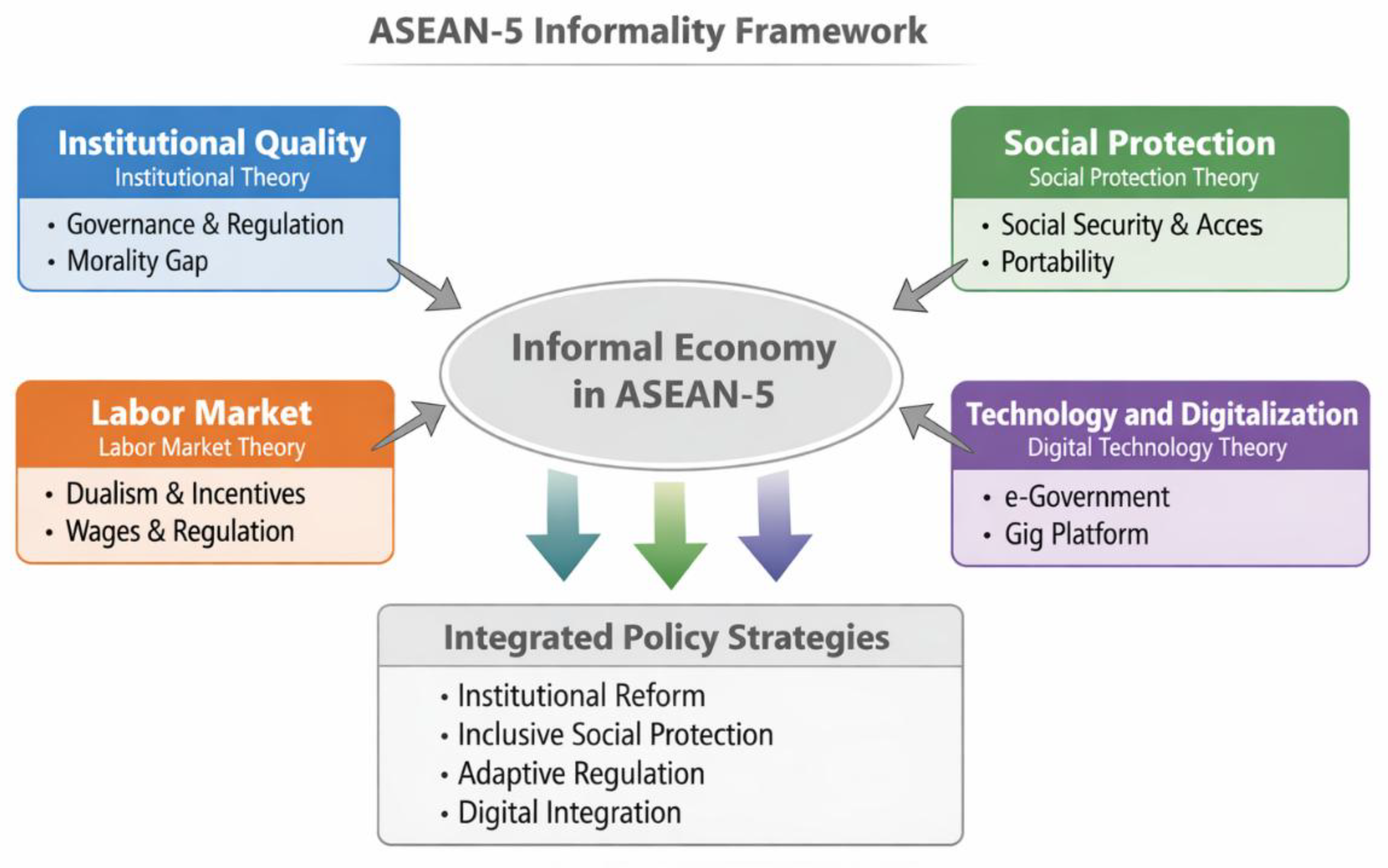
The conceptual framework explains how institutional quality, social protection, labor market policies, and digital technology relate to informal economic activity in ASEAN-5. Economic growth is also included among the study's explanatory variables, while technological progress is specified as a potential mediator. These dimensions provide a basis for examining how governance, policy coverage, labor market conditions, and technological change relate to formalization and the persistence of informality. Their relationships are interpreted alongside the structural and sociocultural contexts identified in the comparative analysis.
Figure 1.
ASEAN-5 Informality Framework.
III. Methodology
This study uses comparative qualitative and quantitative content analysis to develop policy strategies for the informal economy in ASEAN-5. The quantitative component draws on the PLS-SEM findings of Ramdani Salim et al. (2026), based on panel data for Indonesia, Malaysia, the Philippines, Thailand, and Vietnam during 2015–2022; these findings are treated as previously reported evidence rather than new estimates produced in this study. The exploratory qualitative component examines policy narratives, socioeconomic dynamics, and institutional practices across the five countries. Integrating these sources allows the analysis to examine contextual differences and contradictions that aggregate quantitative findings alone cannot explain.
-
Data Collection Stage. In this research, the data collection and analysis stages were carried out using the following methods and approaches:
- Content analysis (thematic analysis): classifying themes and patterns from policy documents, institutional reports, and academic publications related to informality. This included reviewing official government documents, reports from international institutions (ILO, ASEAN Secretariat, World Bank, UNESCAP), and national policies related to the informal economy. This analysis aimed to identify how countries formulate formalization and social protection strategies. Key themes such as institutional quality, social protection, labor market regulation, economic growth, and digital technology also identified. These themes then compared (cross-analyzed) across ASEAN-5 countries.
- Participatory: involving academics, policymakers, and MSME practitioners. These interviews explored in-depth perspectives on the challenges of formalization, informal practices, and opportunities for digital-based policies. An analysis of published reports from regional think tank leading institutions also conducted to identify public narratives, community perceptions, and emerging informal practices in each country.
- Bibliometrics with VOSviewer: Mapping keyword co-occurrence from Scopus publications over the past 10 years to identify trends, dominant themes, and research gaps (Vinayavekhin et al., 2023). Using software like VOSviewer, the research mapped trends on the informal economy in ASEAN over the past 10 years. The results of this analysis helped identify dominant themes, author networks, and research gaps.
- Qualitative content analysis with MAXQDA: Coding themes based on inductive reading and deductive theoretical frameworks (Fife & Gossner, 2024).
- Literature review: Reviewing international and regional journal publications to understand theories, trends, and best practices. This literature served as a basis for comparing institutional theories, social protection, labor markets, and digital governance.
- Data sources: Academic journals, national policies, multilateral reports (ILO, ADB, UNESCAP), and regional think tank publications.
- Main variables: Institutional Quality, Social Protection, Labor Market Policy, Economic Growth, Technological Progress (as a mediator), and the size of the Informal Economy.
2. Analysis Stage
The analysis stage conducted systematically and in layers to gain a deeper understanding of the dynamics of the informal economy in the ASEAN-5. The process began with coding policy documents, institutional reports, and academic publications to identify key themes, argumentation patterns, policy gaps, and contradictions between normative discourse and empirical practice. This step allowed researchers to assess the extent to which social protection policies, labor market regulations, and digital governance are inclusive or merely rhetorical.
The next stage is a cross-country comparative analysis, which examines the similarities and differences in informal economic dynamics in Indonesia, Malaysia, the Philippines, Thailand, and Vietnam. The analysis focuses not only on statistics or formal policies but also considers the social, cultural, and institutional contexts that influence informal economic behavior. This approach allows for the identification of regional patterns as well as national characteristics, allowing the results to inform the formulation of contextualized policy strategies.
The analysis combines policy document reviews, expert and stakeholder interviews, and bibliometric analysis to compare evidence across sources. Coding, pattern matching, content mapping, and cross-case synthesis are used iteratively to connect themes and assess their relevance across ASEAN-5 countries. Triangulation is used to examine convergence and divergence among sources rather than to guarantee validity or reliability. The resulting synthesis provides a basis for policy-relevant interpretation, while the strength of its conclusions depends on the coverage, quality, and transparency of the underlying evidence.
IV. Results and Discussion
Data processing and analysis from previous research (Ramdani Salim et al., 2026) show that the dynamics of the informal economy in the ASEAN-5 can be mapped into four main dimensions that interact with each other and form a complex structure of informality. This provides the basis for developing strategies that will provide important input for each ASEAN-5 country: Structural, Institutional, Socio-Cultural, and Policy Response.
Reviewing structural aspects and dimensions, poverty, migration, and urbanization are the main driving factors. Extreme poverty rates encourage and open opportunities for the search for alternative employment outside the formal sector. Rural-urban migration increases the number of workers not absorbed by the formal market, while rapid urbanization suppresses cities' capacity to provide formal employment, making the informal sector the dominant choice for vulnerable groups.
Institutional factors such as governance quality, regulatory effectiveness, and law enforcement capacity influence business incentives. Weak institutions, bureaucratic red tape, and corruption raise compliance costs, forcing small businesses to operate informally. In contrast, strong institutions with adaptive regulations reduce the incentives for informality. Meanwhile, gender roles, family work, and community norms all play an important role in the sociocultural dimension. Women and family workers dominate the informal sector due to a lack of formal employment opportunities. Social norms that accept informal work practices as part of community culture help to ensure the sector's long-term viability. Particularly, policy responses are influenced by formalization strategies, social protection coverage, and labor market regulations. Rigid or biased policies against formal workers frequently fail to encourage a move to the formal sector. On the contrary, inclusive, adaptive, and digital-based strategies can incentivize informal workers to join the formal system.
Comparative Results Among ASEAN-5 Countries
The quantitative findings refer to the 2015–2022 panel reported by Ramdani Salim et al. (2026), whereas the country summaries include information attributed to later sources. The later material provides contextual updates and is not treated as an extension of the original panel or as evidence that the estimated relationships remained unchanged through 2026.
Based on the results of data analysis obtained from previous research (Ramdani Salim et al., 2026), the following is a comparative profile of mapping between countries regarding the economic conditions and structures of ASEAN-5:
- Indonesia: exhibits prominent levels of structural informality due to rural-urban migration and fiscal decentralization. Policy strategies need to focus on institutional reform, digitalization of mobile ID-based social protection, and formalization programs for MSMEs using a graduated compliance approach.
- Malaysia: faces strict labor market regulations, but MSME clusters are burdened by high compliance costs. Relevant strategies include the implementation of tiered regulations, the provision of fiscal incentives, and the integration of e-registration systems with tax incentives.
- The Philippines: demonstrates the dominance of the digital gig economy and international labor migration. Government policy strategies need to be directed at integrating digital platforms with e-governance systems, portable social protection for migrant workers, and mobile app-based contribution schemes.
- Thailand: experiences a dual labor market dominated by the tourism and informal service sectors. Appropriate policy strategies include flexible regulations for the tourism sector, local community-based social protection, and formal incentives for small businesses in the service sector.
- Vietnam: has a strong informality base in the agriculture and household manufacturing sectors. Policy strategies need to include industrial upgrading, rural community-based formalization programs, and the integration of cooperatives with the national social protection system.
Table 1 presents country-level information attributed to sources from 2025–2026, including quantitative estimates and qualitative descriptions of trends. The entries differ in reference period, unit of analysis, and type of evidence. They are therefore presented as contextual information rather than a harmonized comparison of informal employment proportions across ASEAN-5.
The country summaries describe distinct patterns of informality: informalization pressures in Indonesia and the Philippines, census-related measurement developments in Malaysia, a reported decline in Thailand, and persistent informal employment in Vietnam. Because the underlying indicators and reference periods differ, these summaries do not establish a comparable ranking of informality or a common regional trend. They instead provide context for regional policy priorities concerning institutional reform, inclusive social protection, adaptive labor regulation, and improved data integration.
- Institutional reform to strengthen formal job creation.
- Inclusive social protection for informal workers.
- Adaptive labor regulations for the gig/digital sector.
- Cross-country data integration for more comprehensive regional strategies.
Country-context interpretation of the regional findings
Ramdani Salim et al. (2026) report PLS-SEM estimates for the determinants of informal economic activity in ASEAN-5. Institutional quality is negatively associated with the size of the informal economy (β = −0.378; p = 0.015). This result is consistent with the interpretation that governance quality, legal certainty, and regulatory effectiveness may support formalization through lower compliance costs, greater public trust, and stronger incentives to register businesses. Social protection, labor market policies, and economic growth are reported to have statistically significant positive associations with informality. Coverage bias, regulatory rigidity, and implementation gaps are possible explanations for these patterns, particularly for vulnerable workers and SMEs facing high compliance costs. However, the estimates do not by themselves establish that these policies cause informality or identify the mechanisms responsible for the associations.
The reported mediation result for technological advancement was not statistically significant (β = 0.011; p = 0.335). This finding provides insufficient evidence of technological mediation in the estimated model; it does not demonstrate that digitalization is ineffective or explain why mediation was not detected. Fragmented implementation of e-government, e-registration, and e-tax systems remains a possible contextual interpretation rather than a mechanism established by this statistical result.
The reported model has an R² of 0.902 and an adjusted R² of 0.888, indicating substantial in-sample explanatory power for the measured informality outcome. These values describe the variation accounted for within the estimated model; they do not independently establish causal validity, out-of-sample predictive performance, or robustness. The results support examining informality through institutional, social policy, labor market, and technological dimensions, while the strength of that interpretation depends on measurement quality, model specification, and the treatment of the panel data structure.
Interpretation Per Country:
- Indonesia: Growth in the service and MSME-based economy is expanding the informal sector; social protection remains biased toward formal workers.
- Malaysia: Labor market regulations are strict, but MSMEs face high compliance costs and therefore remain informal.
- Philippines: International labor migration and the dominance of the digital gig economy are expanding informal employment; social protection is not yet inclusive.
- Thailand: Tourism-driven growth is reinforcing a dual labor market, with formal and informal sectors coexisting.
- Vietnam: High-quality institutions are squeezing the informal sector, but new challenges are emerging in the form of platform-based digital jobs not recorded in the formal system.
Overall, these findings support the notion that informality in ASEAN-5 is a multifaceted phenomenon influenced by structural, institutional, sociocultural, and policy factors. Institutional quality has been shown to be the most consistent factor in reducing informality, whereas non-inclusive social protection and labor market policies exacerbate the informal sector. Although digitalization has enormous potential as a catalyst for formalization, it has yet to be effectively integrated with formal governance. As a result, relevant policy strategies for ASEAN-5 must be integrated and multidimensional, encompassing institutional reform, inclusive social protection, adaptive regulation, and the integration of digital technologies that support formalization.
The interpretation has several limitations. The quantitative results are drawn from a previously reported 2015–2022 panel and cannot be assumed to describe conditions in 2026. The country summaries combine indicators with different definitions, reference periods, and units of analysis, limiting direct comparison. Regional associations also cannot be interpreted as country-specific causal effects. Consequently, the proposed policy framework represents an evidence-informed set of priorities rather than an evaluation of intervention effectiveness; further research using harmonized indicators and designs capable of testing mechanisms is needed.
V. Conclusions
Informality remains an important employment and policy concern in Indonesia, Malaysia, the Philippines, Thailand, and Vietnam. The comparative synthesis and the quantitative findings reported by Ramdani Salim et al. (2026) identify institutional quality as negatively associated with informality, while social protection, labor market policies, and economic growth exhibit positive associations. Coverage bias, regulatory rigidity, and non-inclusive growth offer possible contextual explanations, but the evidence does not establish that these factors cause the observed relationships or provide a harmonized estimate of the informal employment share across ASEAN-5.
The comparative analysis presents informality as a phenomenon shaped by structural, institutional, sociocultural, and policy contexts. The country interpretations emphasize regional variation associated with fiscal decentralization and bureaucracy in Indonesia; regulatory and compliance constraints for MSMEs in Malaysia; labor migration and digital platform work in the Philippines; labor market dualism in Thailand; and ongoing institutional transformation in Vietnam. These interpretations motivate country-specific policy priorities within shared regional principles: institutional strengthening, inclusive social protection, adaptive regulation, quality-based growth, and integrated digital governance. They do not independently establish the causal contribution of each national characteristic.
Strategy Recommendations
- Institutional Deepening: Strengthening the rule of law, regulatory certainty, and e-government services to reduce compliance costs and increase public trust in institutions.
- Inclusive Social Protection: Developing a non-contributory, portable, digital ID-based scheme to enable informal workers to access sustainable social security.
- Adaptive Labor Market Policy: Implementing graduated compliance regulations and fiscal incentives for MSMEs to encourage the transition to the formal sector.
- Quality-Based Growth: Encouraging industrial upgrading and formal job creation that is oriented towards productivity and sustainability.
- Digital Governance Integration: Harmonizing e-registration, e-taxation, and digital ID so that technology functions as an accelerator of formalization, rather than simply expanding new forms of digital informality.
- ASEAN Informality Observatory: Establishing a regional data center to monitor developments in informality, share best practices, and strengthen policy coordination between countries.
This study confirms that informality in ASEAN-5 is a multifaceted phenomenon that cannot be explained by a single variable. Institutional quality has been shown to be a key factor in reducing informality, whereas non-inclusive social protection and labor market policies have expanded the informal sector. Digitalization has tremendous potential as a catalyst for formalization, but its effectiveness is dependent on its integration with formal governance.
The comparative synthesis motivates an integrated, adaptive, and context-specific policy approach combining institutional reform, inclusive social protection, flexible labor market regulation, and digital governance. Its intended objective is to reduce informality while supporting equitable, inclusive, and sustainable economic development. Table 2 translates these principles into proposed national priorities and supporting instruments. The matrix is a policy synthesis, not an evaluation of effectiveness, and implementation would require assessment of feasibility, institutional capacity, and national conditions.
References
- Acemoglu, D.; Robinson, J. Why nations fail: The origins of power, prosperity, and poverty. In Crown Business; 2012. [Google Scholar]
- ASEAN Secretariat. Informal workers: Why their inclusion and protection are crucial to the future of work. 2022. [Google Scholar]
- Badan Riset dan Inovasi Nasional. Proyeksi kelas menengah dan dinamika sektor informal di Indonesia. 2026. [Google Scholar] [PubMed]
- Banik, N.; Padalkar, M. The spread of gig economy: Trends and effects. Foresight STI Gov. 2021, 15(1). [Google Scholar] [CrossRef]
- Canelas, C.; Niño-Zarazúa, M. Social protection and the informal economy: What do we know? (Working paper); UNESCAP, 2022. [Google Scholar]
- Chacaltana, J.; de Mattos, F.; García, J. New technologies, e-government and informality; (ILO Working Paper No. 112); International Labour Organization, 2024. [Google Scholar]
- Chen, M. A. The informal economy in comparative perspective: Theory, policy and reality. Indian J. Labour Econ. 2023. [Google Scholar] [CrossRef]
- Dell’Anno, R. Theories and definitions of the informal economy: A survey. J. Econ. Surv. 2022, 36(5), 1610–1643. [Google Scholar] [CrossRef]
- Department of Statistics Malaysia. Economic census 2026: Informal sector report. 2026. [Google Scholar] [PubMed]
- Devine, H. How institutions shape the informal economy; World Bank Publications, 2020. [Google Scholar]
- Fahn, M.; Murooka, T. Informal incentives and labour markets. Econ. J. 2025, 135(665), 144–179. [Google Scholar] [CrossRef]
- Fife, S. T.; Gossner, J. D. Deductive qualitative analysis. Int. J. Qual. Methods 2024. [Google Scholar] [CrossRef]
- Fields, G. S. A guide to the dual labour market theory (Social protection discussion paper); World Bank, 2005. [Google Scholar]
- General Statistics Office of Vietnam. Labour market update: Informal employment in Vietnam. 2026. [Google Scholar] [PubMed]
- Guven, M.; Jain, H.; Joubert, C. Social protection for the informal economy: Operational lessons for developing countries in Africa and beyond; World Bank, 2021. [Google Scholar]
- International Labour Organization. More than 60 per cent of the world’s employed population are in the informal economy. 2018. [Google Scholar] [PubMed]
- International Labour Organization. World employment and social outlook: Trends 2021; 2021. [Google Scholar]
- International Labour Organization. Thailand country report on informal economy; ILO Regional Office, 2025–2026. [Google Scholar]
- Loayza, N. V. Informality in the process of development and growth; (Policy Research Working Paper No. 7858); World Bank, 2016. [Google Scholar]
- Maloney, W. F. Informality revisited. World Dev. 2004, 32(7), 1159–1178. [Google Scholar] [CrossRef]
- Meagher, K.; Lindell, I. Engaging with African informal economies: Social inclusion or adverse incorporation? Afr. Stud. Rev. 2013, 56(3). [Google Scholar] [CrossRef]
- Medina, L.; Schneider, F. Shedding light on the shadow economy: A global database (Working paper); CESifo, 2019. [Google Scholar]
- Nguyen, C. P.; Schinckus, C.; Nguyen, Q. B.; Le Tran, D. T. Digitalization and informal economy: A global evidence of internet usage. J. Ind. Bus. Econ. 2024, 51(1), 1–37. [Google Scholar] [CrossRef]
- North, D. C. Institutions, institutional change and economic performance; Cambridge University Press, 1990. [Google Scholar]
- Philippine Statistics Authority. Labour force survey: Informal employment trends. 2026. [Google Scholar] [CrossRef]
- Prestianawati, S. A.; Aprilia, Y. F.; Rasli, A.; Chanu, I.; Fawwaz, M. Institusi ekonomi dan penyaluran kredit: Pengaruh suku bunga, pajak, dan investasi di ASEAN-5. J. Inform. Ekon. Bisnis 2025, 7(2), 148–154. [Google Scholar] [CrossRef]
- Ramdani Salim, A.; Sihite, M.; Gustari, I. The informal economy in motion: ASEAN-5 drivers and challenges [Preprint]; Preprints.org., 2026. [Google Scholar] [CrossRef]
- Rani, A. A. A.; Muda, R.; Hanif, A.; Rashid, A. A. Enhancing consumer and family economic well-being in ASEAN: The role of technological advancement and institutional quality in navigating the informal economy. Malays. J. Consum. Fam. Econ. 2024, 32. [Google Scholar] [CrossRef]
- Tokman, V. Modernizing the informal sector (DESA working paper); DESA, 2007. [Google Scholar]
- Vinayavekhin, S.; Phaal, R.; Thanamaitreejit, T.; Asatani, K. Emerging trends in roadmapping research: A bibliometric literature review. Technol. Anal. Strateg. Manag. 2023, 35(5), 558–572. [Google Scholar] [CrossRef]
- Williams, C. C. Tackling undeclared work in the European Union: An evaluation of government policy approaches. UTMS J. Econ. 2019, 10(2). [Google Scholar]
- Williams, C. C.; Horodnic, I. A. An institutional theory of the informal economy: Some lessons from the United Kingdom. Int. J. Soc. Econ. 2016. [Google Scholar] [CrossRef]

Table 1.
Country-Level Informality Indicators and Reported Trends, With Differing Reference Periods.
Table 1.
Country-Level Informality Indicators and Reported Trends, With Differing Reference Periods.
| Country | Key conditions and context | Reported indicators and trends | Source |
|---|---|---|---|
| Indonesia | BRIN projects a decline in the middle class due to the increase in informal employment. | Informalization is increasing in the lower-middle service and manufacturing sectors. | Badan Riset dan Inovasi Nasional (2026) |
| Malaysia | The 2026 Economic Census begins recording the informal sector (hawkers, gig workers, homestay, online sellers). | 416,942 informal micro-enterprises were recorded in early 2026. | Department of Statistics Malaysia (2026) |
| Philippines | Economic growth slows; the informal sector becomes a "hidden safety net" | Around 42% of the workforce (20.6 million people) is still informal. | Philippine Statistics Authority (2026) |
| Thailand | The informal proportion fell from 72% (2019) to 65% (2024) but remains large. | 1.1 million informal jobs lost 2019–2021; partial recovery until 2024. | International Labour Organization (2025–2026) |
| Vietnam | The informal sector still absorbs most of the workforce, especially in rural areas and the small trade sector. | It is estimated that more than 55% of the workforce is still informal. | General Statistics Office of Vietnam (2026) |
Table 2.
ASEAN-5 Government Policy Recommendation Matrix.
| Country | Informality characteristics | Key challenges | Strategy recommendations for priority policies | Supporting instruments |
|---|---|---|---|---|
| Indonesia | High levels of informality due to rural–urban migration and fiscal decentralization | SMEs are difficult to formalize due to compliance costs; Social protection biased towards formal workers | Institutional reform; digitization of social protection based on mobile ID; graduated compliance for MSMEs | E-government, mobile ID, fiscal incentives |
| Malaysia | Strict labor market regulations; SMEs face high compliance costs | High registration fees and regulatory rigidity | Graduated compliance; Fiscal incentives and registration fee subsidies | Integrated e-registration with tax incentives |
| Philippines | The dominance of the digital gig economy and international labor migration | Gig workers and migrants are not protected; social contributions are not portable | Integration of digital platforms with e-governance; portable social protection; App-based contribution scheme | E-tax, mobile application, migrant insurance scheme |
| Thailand | Dualism of the labor market; dominance of the tourism and informal service sectors | Informal tourism workers are unprotected; regulations are rigid. | Flexible regulations for the tourism sector; community-based social protection; formal incentives for small businesses | Local community programs, formal tourism incentives |
| Vietnam | Strong informality base in agriculture and household manufacturing | Rapid growth but limited formal employment; Dominant Agricultural Sector | Industrial upgrading; rural community-based formalization programs; Integration of cooperatives with social protection | Village cooperatives, industrial upgrading programs, agricultural e-registration |
Disclaimer/Publisher’s Note: The statements, opinions and data contained in all publications are solely those of the individual author(s) and contributor(s) and not of MDPI and/or the editor(s). MDPI and/or the editor(s) disclaim responsibility for any injury to people or property resulting from any ideas, methods, instructions or products referred to in the content. |
© 2026 by the authors. Licensee MDPI, Basel, Switzerland. This article is an open access article distributed under the terms and conditions of the Creative Commons Attribution (CC BY) license (http://creativecommons.org/licenses/by/4.0/).
Copyright: This open access article is published under a Creative Commons CC BY 4.0 license, which permit the free download, distribution, and reuse, provided that the author and preprint are cited in any reuse.