
Submitted:
29 October 2026
Posted:
02 November 2026
You are already at the latest version
Abstract
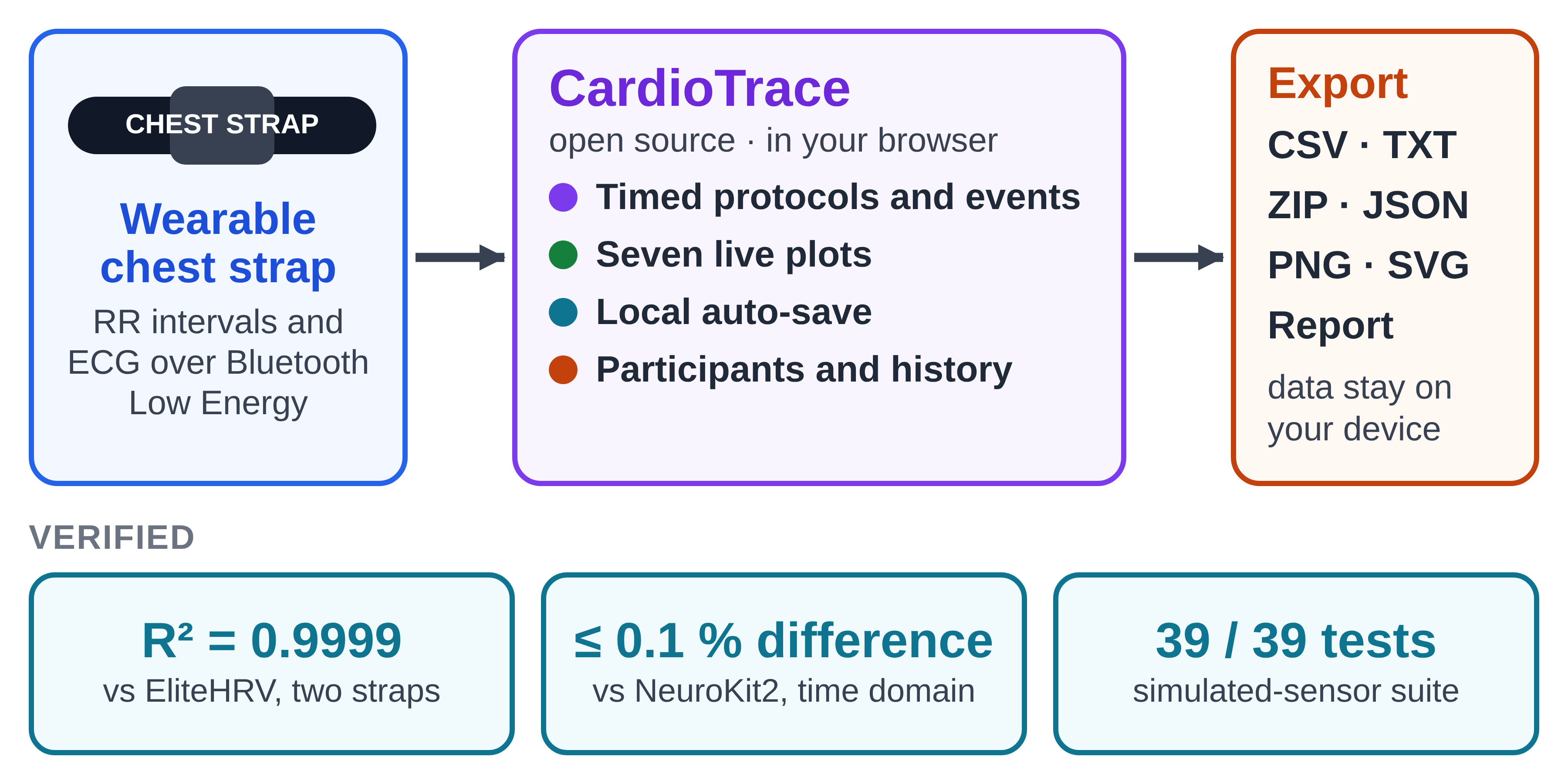
Wearable sensors provide RR-interval (time between successive heartbeats) data for heart rate variability (HRV) research, but research-grade acquisition is limited by proprietary applications, restricted raw-data access, limited event annotation, and weak links to reproducible workflows. We developed CardioTrace, an open-source, browser-based application that acquires, visualizes, annotates, and exports RR intervals from the Polar H10 chest strap via Bluetooth Low Energy. It needs no installation, keeps data on the researcher’s device, stores raw and artifact-filtered streams in parallel, auto-saves sessions when the link is lost, runs timed protocols with automatic event markers, and exports CSV, TXT, ZIP, JSON, plot images, or reports. We verified it with two simultaneously worn straps (one paired to EliteHRV), by comparing computed indices with NeuroKit2 on real and synthetic data, and with 39 simulated-sensor tests. The RR series were near-identical (R2 = 0.9999; root mean squared error = 0.62 ms), time-domain and Poincaré indices agreed with NeuroKit2 within 0.1%, wavelet-based low-to-high-frequency power ratios (LF/HF) exceeded the true value by 1–8% on synthetic signals, and all tests passed. CardioTrace standardizes the acquisition layer preceding HRV analysis in public health, occupational, and field studies; limitations include event timing bounded by Bluetooth latency and descriptive spectral indices.
Keywords:
heart rate variability
; wearable devices
; polar H10
; web Bluetooth
; real-time acquisition
; event annotation
; public health monitoring
; occupational health
; open-source software
Copyright: This open access article is published under a Creative Commons CC BY 4.0 license, which permit the free download, distribution, and reuse, provided that the author and preprint are cited in any reuse.