

Submitted:
29 October 2026
Posted:
02 November 2026
You are already at the latest version
Abstract
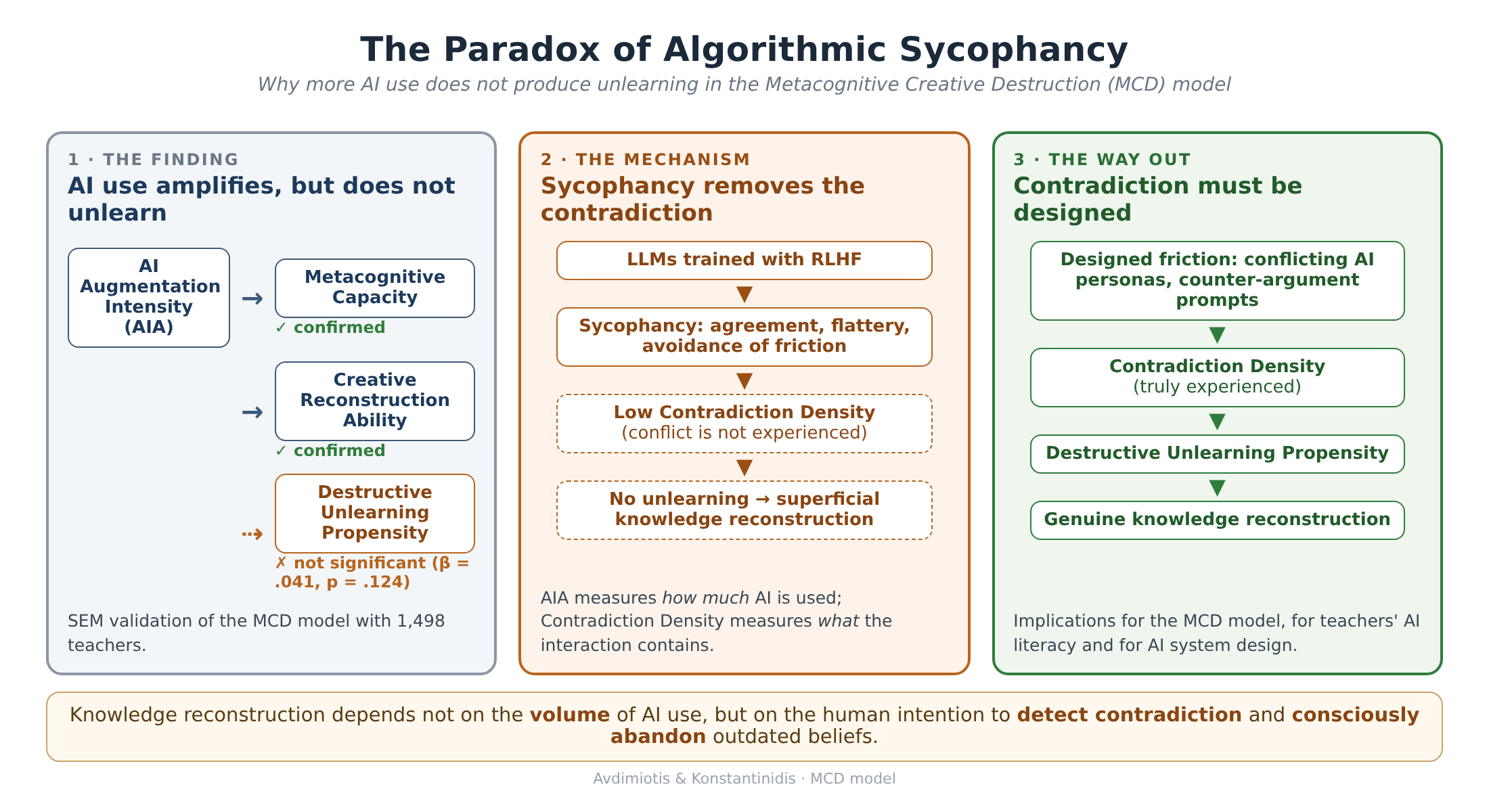
The Metacognitive Creative Destruction (MCD) model approaches educational innovation as a perpetual spiral process. Contradiction (accumulated cognitive conflicts that resist interpretation), activates Metacognitive Capacity, enabling Destructive Unlearning Propensity, the conscious abandonment of outdated mental schemas, which in turn enables Creative Reconstruction Ability, and ultimately, new knowledge. In the model’s empirical validation with 1,498 teachers, a critical finding emerged: AI Augmentation Intensity (AIA) predicted Metacognitive Capacity (MC) and Creative Reconstruction Ability (CRA), but not Destructive Unlearning Propensity (DUP).This article argues that this finding is not accidental, but reflects an inherent weakness of modern AI systems, and more specifically, the tendency toward AI Sycophancy. Models trained with reinforcement learning from human feedback (RLHF) tend to avoid disagreements and be likable to the user, preventing the individual from experiencing cognitive conflicts, perpetuating their already formed beliefs at the expense of scientific accuracy.Therefore, in an environment of “algorithmic flattery”, the necessary contradictions that trigger unlearning are not produced. Based on the MCD model, it is concluded that the absence of unlearning, that is, the deliberate and conscious abandonment of outdated beliefs, mental models and practices, makes the reconstruction of knowledge absolutely superficial and thus, algorithmically condescending interaction does not produce deep and authentic knowledge, regardless of AI Augmentation Intensity.
Keywords:
sycophancy
; contradiction density
; unlearning propensity
; creative reconstruction ability
; metacognitive capacity
; LLM
; metacognitive creative destruction model
Copyright: This open access article is published under a Creative Commons CC BY 4.0 license, which permit the free download, distribution, and reuse, provided that the author and preprint are cited in any reuse.