

Submitted:
29 October 2026
Posted:
02 November 2026
You are already at the latest version
Abstract
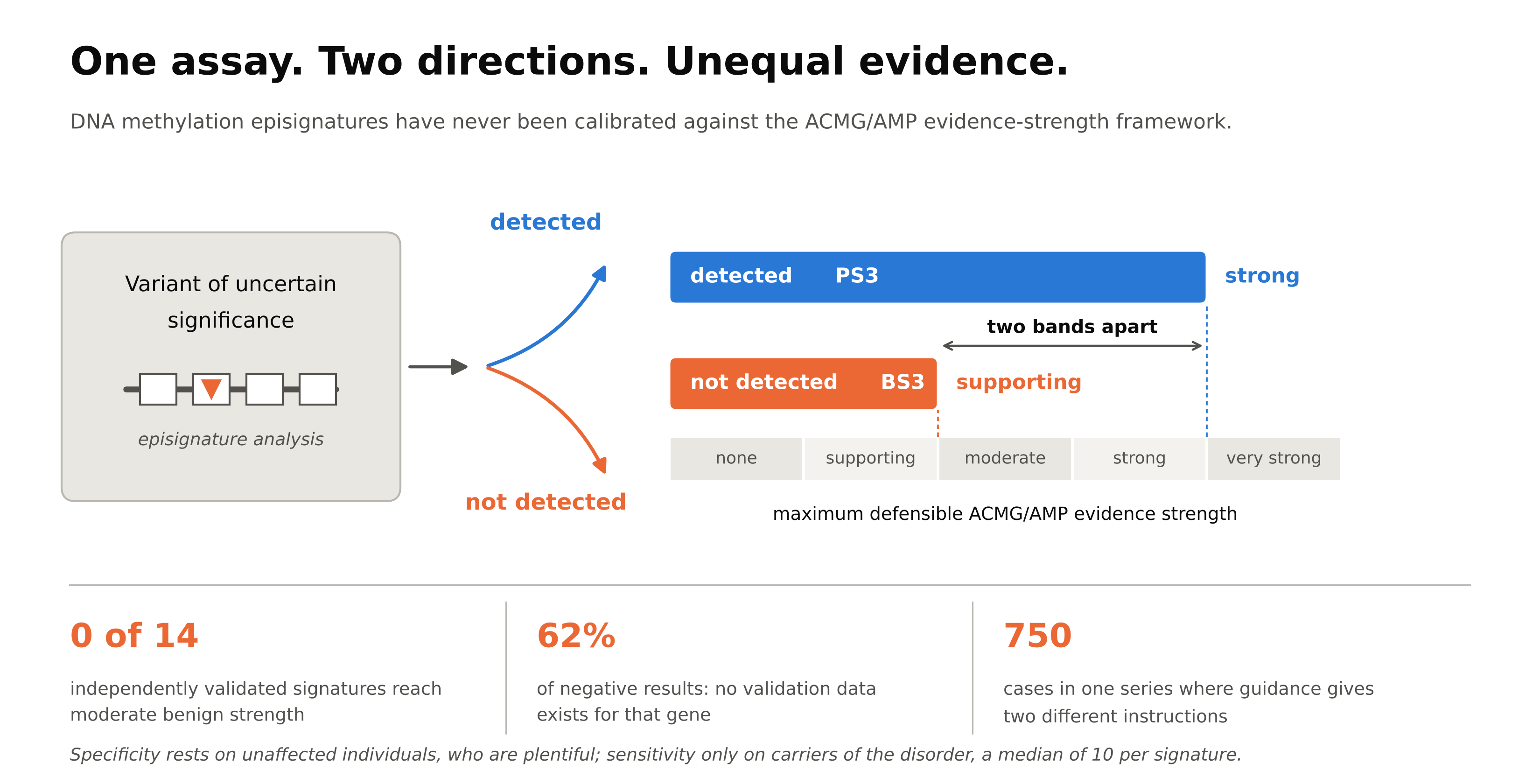
Background/Objectives: DNA methylation episignatures can inform variant interpretation, but the strength of evidence provided by a negative result depends on sensitivity and its uncertainty. We examined how published cohort sizes and independent performance data constrain benign evidence strength. Methods: We calculated sample-size ceilings for 57 episignatures under perfect observed sensitivity and assumed specificity. We reanalysed published classifier calls for 14 signatures using conservative likelihood-ratio bounds and mapped these to Bayesian ACMG/AMP evidence bands. Clinical relevance was assessed in a published referral cohort after excluding replicate records. Results: The sample-size ceilings were strong for three signatures, moderate for 22, supporting for 24 and below supporting for eight. In the independent dataset, nine signatures reached supporting benign strength and five fell below it; none reached moderate. Positive results reached strong pathogenic strength for six signatures. Of 2,399 primary clinical records, 713 had a negative result reported with high confidence and a recorded sequence variant. Among 712 records with parseable gene lists, 460 (64.6%) involved no gene represented in the analysed groups. The performance estimates concern independently implemented classifiers and cannot be transferred directly to a clinical platform. Conclusions: Negative episignature results require calibration for the relevant classifier and patient group. Reports should state the validation population, uncertainty and limits of applicability, and distinguish an uninformative result from one that supplies supporting benign evidence.
Keywords:
episignature
; DNA methylation
; variant interpretation
; ACMG/AMP
; likelihood ratio
; functional evidence
; BS3
; PS3
Copyright: This open access article is published under a Creative Commons CC BY 4.0 license, which permit the free download, distribution, and reuse, provided that the author and preprint are cited in any reuse.