
Submitted:
30 October 2026
Posted:
02 November 2026
You are already at the latest version
Abstract
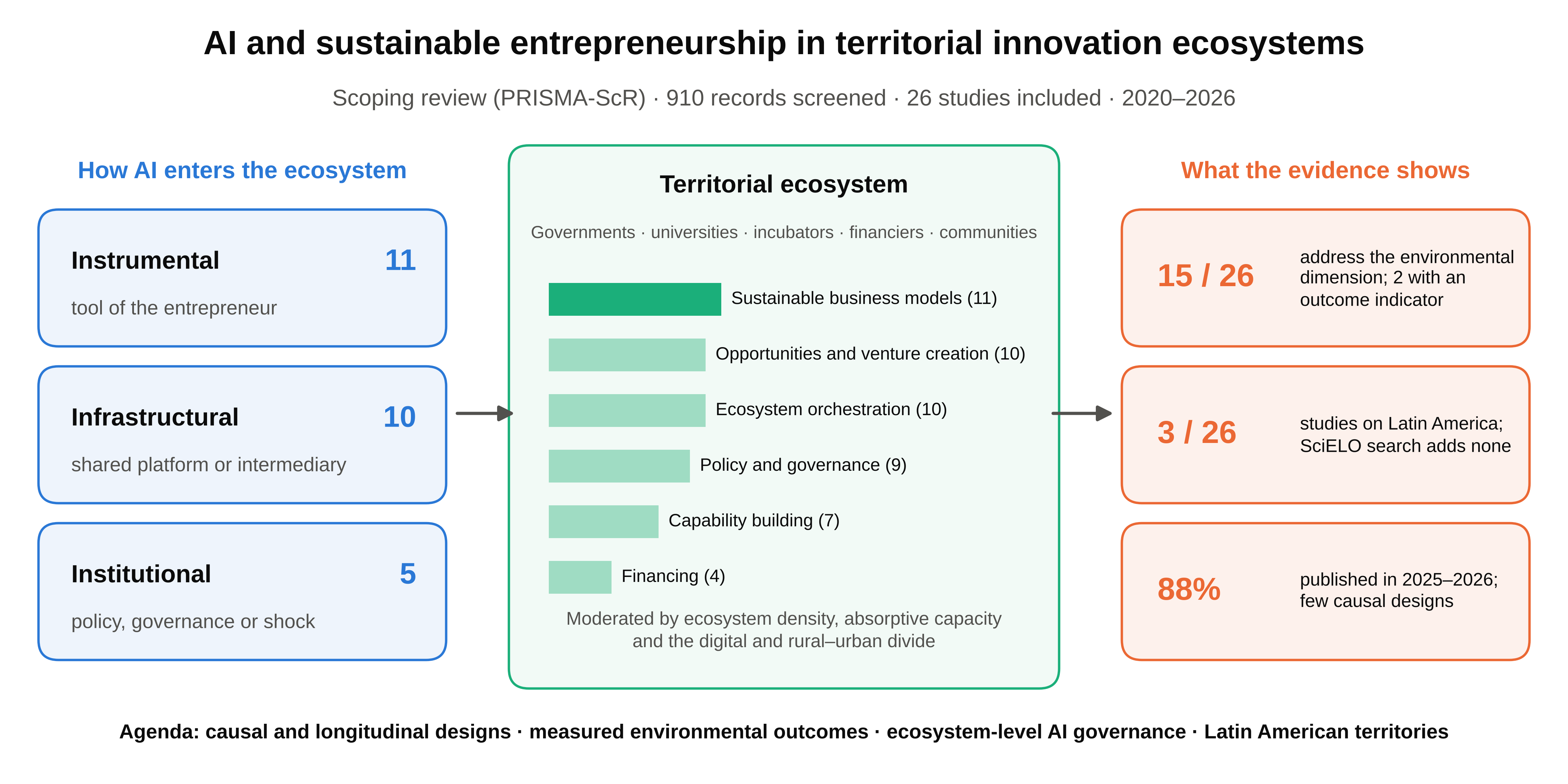
Artificial intelligence (AI) is increasingly presented as a lever for sustainable entrepreneurship and the Sustainable Development Goals (SDGs), yet little is known about how its contribution unfolds within the territorial ecosystems where ventures emerge. This scoping review mapped how AI is conceptualised, its pathways, ecosystem actors, outcomes, risks and gaps. Following JBI guidance and PRISMA-ScR, we searched EBSCO Discovery Service, Lens.org and SciELO (2020–2026); AI-assisted screening and charting were fully verified, and two reviewers coded independently. Of 910 records, 26 studies were included. The evidence is recent (88% from 2025–2026) and concentrated in Europe and Asia; only three studies address Latin America. Of the 26 studies, 11 view AI through an instrumental lens, 10 through an infrastructural or orchestrating lens and 5 through an institutional lens. Sustainable business models (11), venture creation and ecosystem orchestration (10 each) were the most frequent pathways; governments and universities, the most frequent actors. Environmental effects were addressed in 15 studies but measured with an outcome indicator in only 2, and the SDGs cited were mainly economic and social (especially SDGs 8 and 9). We propose an integrative framework, research propositions and an agenda on causal designs, environmental measurement, AI governance and Latin America.
Keywords:
artificial intelligence
; generative AI
; sustainable entrepreneurship
; entrepreneurial ecosystems
; innovation ecosystems
; territorial development
; digital entrepreneurship
; sustainable development goals
; scoping review
Copyright: This open access article is published under a Creative Commons CC BY 4.0 license, which permit the free download, distribution, and reuse, provided that the author and preprint are cited in any reuse.