

Submitted:
30 October 2026
Posted:
30 October 2026
You are already at the latest version
Abstract
Cannabis genetics has produced a decade of SNP panels that cannot speak to one another, and we show that the reason runs deeper than competing coordinate systems. Building a first liftOver chain between the field's two principal assemblies — Purple Kush ASM23057v4 and CBDRx/cs10 — over ten multi-allelic loci, validated with CrossMap at 93.6–99.8% flank identity, we find that the two assemblies share no chromosome numbering: Purple Kush chromosomes 1, 2, 6 and 9 correspond to cs10 chromosomes 5, 6, 7 and 8 respectively, and not one maps to the cs10 chromosome of its own number. Because both assemblies use the same vocabulary, any comparison made between them on chromosome labels alone has been comparing different chromosomes. The chain reconciles their apparently conflicting placements of the terminal cannabinoid synthase cluster, and establishes that none of the ten loci falls within the capture space of CannSelect, the field's largest genotyping platform — a deployment question unanswerable before the chain existed. We inventoried 22 published marker sets, preprints and databases spanning 4,099 accession records (a conservative unique union of ~3,300–3,800 accessions), retrieved or recomputed marker lists for every set that could be obtained — including probe-by-probe parsing of the 18,040-probe CannSelect v1.0 target-enrichment design — and tested them against each other at the exact-position level. Overlap was zero in six of eight panel-to-panel tests. Critically, this holds within a single reference assembly: Cull & Joly (20 SNPs), HASCH (1,504 targets) and CannSelect (18,040 probes, ~1.03 Mb of capture space) are all specified on CBDRx/cs10, yet CannSelect captures only 10 of 1,504 HASCH SNPs (0.7%) and none of the 20 Cull & Joly SNPs. Positional disjointness is therefore not merely an artefact of competing assemblies but a consequence of independent discovery populations and thinning rules operating within the same coordinate frame. We correct two coordinate assignments in the prior literature. The 344 structural SNPs of Jin et al. (2021) are on the Purple Kush assembly ASM23057v4, not cs10, verified against GenBank, which is what made the chain necessary. And the Henry et al. (2020) KASP panel, which we re-place marker by marker from its original assay flanking sequences, is not in a separate coordinate family as previously described but in cs10 — reported under chromosome numbers that are the ordinal index of the cs10 RefSeq accession, so that seven of its ten chromosome labels are wrong. Of its 21 testable nuclear markers, eleven reproduce at their published position at 96.2–100% identity and confirm that key without exception; nine do not reproduce there at all and resolve elsewhere in cs10 at 93.0–99.4%, and we supply their verified positions; one lies in a repeat family and is left provisional. The marker names themselves prove to encode draft-assembly scaffold and offset, which supplies an independent check: two markers 554 bp apart in the draft are 554 bp apart in our cs10 placement. Three markers carry near-identical paralogues elsewhere in the genome, a specificity caveat for anyone running the assays. Relabelled and re-placed, the panel becomes a fourth cs10 panel and behaves like the others: one of 1,504 HASCH markers falls inside its verified amplicon intervals, none of Cull & Joly's 20 do. That single HASCH marker, four CannSelect capture regions and the Henry marker SVIP9 converge within 200 bp on chromosome 5 — the only such convergence in the inventory. Beneath the positional divergence the panels converge functionally on the THCAS/CBDAS synthase region, where Henry's VSSL_A250D KASP marker and Kannapedia's THCAS c.749C>A tag the identical inactive-synthase Ala250Asp allele, and where even CannSelect's curated gene set centres on the cannabinoid synthases. A universal panel therefore cannot be assembled by concatenating published lists and must be built as modules in each laboratory's native coordinate system, anchored by functional loci that translate across assemblies. We propose a 60-marker Tier-1 universal core in four modules, every marker published and genotype-validated, with Tier-2 high-density backbones for NGS-capable laboratories. The Henry 2020 KASP core alone achieves P(collision) = 4.5 × 10⁻⁷ across 420 accessions; adding ten multi-allelic anchors takes it to 2.1 × 10⁻¹⁴. We report a caveat not visible in the source data: five of those ten anchors lie within a single 2.45 Mb block of chromosome 1, violating the independence assumed by the chain rule, with a sensitivity estimate of approximately 1.8 × 10⁻¹¹ under the conservative assumption that the block behaves as one locus. We then validate Module A in silico on its full public genotype matrix (420 accessions, 22 markers): principal components recover the published population structure, leave-one-out cluster assignment reaches 84.0% against a 37.1% baseline, and identity markers and synthase anchors prove complementary rather than redundant. But the same data show that the theoretical P(ID), which we reproduce exactly, understates reality by about 280-fold: 11 pairs of distinctly named cultivars share a complete 22-marker genotype where 0.04 collisions were expected, because clonal propagation, linkage and bottlenecked germplasm violate the independence the chain rule assumes. Probability of identity should therefore be measured on real germplasm rather than calculated. A community liftOver chain between cs10, Purple Kush, Pink Pepper and the MGC contigs remains the single highest-value next step for the field.
Keywords:
Cannabis sativa
; reference assembly
; liftOver
; coordinate harmonization
; chromosome nomenclature
; SNP panel
; cultivar identification
; tri-allelic markers
; target enrichment
; THCAS
; probability of identity
1. Introduction
Cannabis sativa is now a regulated agricultural commodity across much of North America and Europe, and regulation requires that a cultivar can be verified. A producer claiming to sell a named variety, a regulator checking a chemotype declaration, a breeder protecting a cross, and a forensic laboratory distinguishing fibre-type hemp from drug-type material all need the same thing: a genotyping assay that returns a defensible identity call at reasonable cost.
The field has not been short of candidate assays. Since 2015 at least a dozen groups have published SNP marker sets for this crop, ranging from minimal PCR panels of twenty markers to mid-density amplicon platforms of fifteen hundred targets to, most recently, an eighteen-thousand-probe target-enrichment platform, alongside whole-genome resequencing catalogues of twelve million variants. Several are validated in vitro. Several come with primers or public probe designs. Collectively they represent more than four thousand genotyped accession records.
What the field does not have is a panel that works everywhere. The practical experience of anyone attempting to combine these resources is that they do not combine. The central question of this meta-analysis is why, and what follows from the answer.
We approached this by inventorying every published cannabis SNP marker set we could identify, retrieving or recomputing the actual marker lists wherever the underlying data were public, and then testing the panels directly against one another at the exact-position level. The result was stark enough to reframe the problem. The obvious explanation for non-overlapping panels is that they sit in different reference assemblies, and that explanation is partly correct. But the arrival of CannSelect — the first cannabis platform to publish its complete probe design, and by a wide margin the largest — allowed a test that was not previously possible: three panels specified on the same assembly, compared directly. They barely intersect. An 18,040-probe design spanning roughly 1.03 Mb of capture space recovers 0.7% of a 1,504-target amplicon panel and none of a 20-SNP PCR panel, despite all three being built on CBDRx/cs10.
That finding has a specific diagnosis and a specific remedy, and much of this paper is devoted to each. We then supply a first instalment of the remedy, and it returns a second finding sharper than the first. Building a ten-anchor liftOver chain between Purple Kush and cs10 — from public sequence, with no whole-genome alignment — shows that these two assemblies do not share chromosome numbering: what Purple Kush calls chromosome 6 is what cs10 calls chromosome 7, and no Purple Kush chromosome we tested maps to the cs10 chromosome of its own number. Since both are written simply as “chr6” in the literature, comparisons drawn between them on chromosome labels have been comparing different chromosomes without anything to signal it. We also take up a secondary question posed in an earlier brief-idea submission by the present author: whether multi-allelic SNPs — tri- and tetra-allelic loci, which carry more information per assay than biallelic markers can — could serve as high-value anchors in such a panel. The 344 structural SNPs of Jin et al. (2021) [2] are the only substantial multi-allelic set published for this crop, and we examine them in detail.
Our contributions are sevenfold. First, a complete inventory of published cannabis marker resources with recomputed statistics, including the first independent parse of the CannSelect v1.0 probe design. Second, the demonstration and diagnosis of near-zero cross-panel positional overlap, shown for the first time within a single assembly. Third, a coordinate correction to the prior literature affecting the field's only multi-allelic marker set. Fourth, a concrete two-tier universal panel built to survive that diagnosis. Fifth, a correction to our own recommendation: a linkage caveat affecting the multi-allelic module that is not apparent from the published data and that revises the panel's headline identification power by three orders of magnitude. Sixth, an in-silico validation of the one module with a complete public genotype matrix, which confirms that the module performs as designed and simultaneously demonstrates that the probability-of-identity statistic the whole field relies on understates real collision rates by more than two orders of magnitude. Seventh, and the result we regard as the most consequential for how the existing literature should be read: a first liftOver chain between Purple Kush and cs10, which establishes that the two assemblies share no chromosome numbering at all.
2. Materials and Methods
2.1. Scope and Inclusion
We sought to inventory every publicly described SNP marker set for Cannabis sativa, together with the databases and whole-genome resequencing catalogues from which future marker sets will be drawn. Peer-reviewed papers, preprints and one curated industry database were all eligible; preprints are flagged as such throughout and their accession counts are not treated as peer-reviewed finals. Non-SNP marker classes (InDel panels, microsatellites) were inventoried for context but excluded from the overlap testing and the panel design. Twenty-two studies, datasets and resources met these criteria and are listed in full in Table 1.
2.2. Data Acquisition
Wherever raw marker lists, genotype matrices or probe designs were public, they were retrieved and parsed rather than transcribed from publication tables. Henry et al. 2018 was obtained as VCF and CSV from figshare article 7297565; Henry et al. 2020 as the 420 × 22 genotype matrix with cluster assignments from figshare article 11778936; Jin et al. 2021 as the S1/S2 supplementary tables carrying all 344 structural SNPs with REF and ALT1–ALT3 alleles and 23-strain genotypes; HASCH as the complete 1,504-marker supplementary workbook; and Cull & Joly 2025 as the published 20-SNP table with chromosome, position, alleles, annotation and primers. Kannapedia was sampled by retrieving 185 strain pages, stratified, from a population of 1,342, yielding 222 unique high-impact variants together with synthase presence/absence calls.
CannSelect v1.0 was obtained as the published probe FASTA and target files from the CornellHemp/CannSelect repository and parsed probe by probe, together with the preprint full text. All 18,040 unique probes were classified and tabulated: 15,134 genomic probes (9,860 range-target probes plus 2,637 SNP-centred point targets at two probes each, of which 498 are X-linked), 2,801 probes on 122 annotated genes identified by cs10 transcript accessions, and 105 probes on special targets including cannabinoid synthase sequences. Per-chromosome probe counts, merged capture-target counts and capture spans were computed directly from the design rather than taken from the preprint.
For the remaining studies — Ren 2021, Lynch 2016, Laverty 2019, Grassa 2018, Vergara 2021, Toth 2020, Torres 2022, Prentout 2021, Eržen 2026, Mostafaei Dehnavi 2025, the Chinese hemp KASP fingerprinting set, Devèze 2024 and Zhang 2021 — full marker lists were not public, and a study-level inventory was recorded instead: marker class, accession count, platform and coordinate system, with accession counts verified against the publications.
2.3. Coordinate Systems and Two Corrections
Because every overlap test depends on knowing which assembly each panel is specified against, the coordinate system of each marker set was verified directly rather than assumed from the publication text. Two of the assignments in the prior literature turned out to be wrong, and both are corrected here.
Four distinct reference assemblies are in simultaneous use across the inventory. Cull & Joly 2025, HASCH 2024, CannSelect 2026 and — as established below — Henry et al. 2020 are all on CBDRx, also known as cs10, with HASCH and CannSelect using the NC_044370–NC_044379 accessions. Kannapedia reports on MGC contigs with HGVS gene-level nomenclature. CannSelect additionally draws Y-specific candidate sequences from the JL-Father assembly GCA_013030025.1. The Pink Pepper assembly (ASM2916894v1, Kangwon National University, 2023) is distinct from cs10 and is used by CannSelect only for in-silico specificity testing.
The first correction concerns Jin et al. 2021. Their 344 structural SNPs are frequently described, as being in cs10 coordinates. They are not. Their CM010790–CM010799 contigs belong to the Purple Kush assembly ASM23057v4, which we confirmed directly against GenBank. A Purple Kush position cannot be compared with a cs10 position without a liftOver chain, which Section 3.8 supplies for the Module C loci.
The second correction concerns Henry et al. 2020, and is established in Section 3.4. It was made in two passes: a constrained pass, aligning each assay flank to the window predicted by the accession-index key, and an unconstrained pass over all ten chromosomes for every marker the first pass did not resolve. A locus was accepted at ≥92% identity over ≥85% of the flank, and preferred over an alternative only when it exceeded it by at least five identity points. That panel has been described, including by us, as reporting gene loci in a separate AR100-style assembly — a fifth coordinate family, incomparable with the cs10 panels. It is not. Its coordinates are cs10 coordinates. What is wrong is the chromosome labelling: the published chromosome numbers are the ordinal index of the cs10 RefSeq accession rather than the chromosome name, so that NC_044370 was called chromosome 1, NC_044371 chromosome 2, and so on through NC_044379 as chromosome 10. Because those accessions are, in order, X, 1, 3, 4, 5, 2, 9, 6, 7 and 8, seven of the ten labels are wrong. Module A is therefore directly comparable with the other cs10 panels once relabelled, and all overlap tests involving it were repeated on the corrected coordinates.
2.4. Recomputation of Marker Statistics
Statistics were recomputed from raw matrices rather than copied from the source publications, so that markers from different studies are described on a common footing. For every set with a public genotype matrix we computed observed heterozygosity, unbiased expected heterozygosity, minor allele frequency and polymorphic information content. For Henry 2020 we additionally computed a chi-square test of association between each marker's genotype and the published DAPC cluster assignment. For Jin 2021 we computed, for each of the 344 structural SNPs, a cluster-discrimination score measuring how strongly its genotype classes across the 23 sequenced strains separate the CBD cluster, the balanced cluster and the three THC clusters.
One discrepancy emerged from this recomputation and is reported rather than smoothed over: marker SVIP19 appears in Table 2 of Henry et al. 2020 but carries no calls in the published genotype matrix, so the panel described as 23 markers is genotyped at 22. All identification-power figures in this paper use 22.
2.5. Cross-Study Overlap Testing
Panels were compared pairwise at the exact chromosome-and-position level wherever both members of a pair use the same reference assembly, and by range-overlap testing where one panel publishes amplicon bounds or capture regions rather than point positions. Eight tests were possible and are reported in Table 5.
The three cs10 panels — Cull & Joly, HASCH and CannSelect — permit the strongest form of the test, since no coordinate translation is involved and any non-overlap cannot be attributed to assembly differences. HASCH and Cull & Joly markers were tested for containment within CannSelect's merged capture regions, and separately against CannSelect's SNP-centred point targets to distinguish incidental capture from deliberate shared targeting.
Where exact comparison was impossible because the panels sit in different assemblies, convergence was assessed at the gene and locus level instead — that is, by asking whether two markers tag the same functional variant even though their stated positions cannot be compared.
2.6. Identification Power
Probability of identity was computed from observed genotype frequencies by the standard chain rule across loci, reported as the complementary probability of collision, the chance that two randomly drawn distinct accessions share a complete multilocus genotype. For Henry 2020 the calculation uses the 420-accession matrix directly, in which 296 unique multilocus genotypes are observed at 22 markers. Multi-allelic contributions from Module C were estimated from genotype-class counts across the 23 Jin strains.
Two properties of this calculation should be stated at the outset, because they bound every figure derived from it. It assumes independence across loci, which linkage violates, and independence between individuals, which clonal propagation violates; Section 4.3 quantifies the first and Section 3.11 measures the combined effect directly. And it is conservative with respect to Module D, whose structural presence/absence calls carry discriminating information that the biallelic formula does not capture.
2.7. Panel Construction
The Tier-1 panel was assembled under four constraints, applied in order. Every marker must be already published. Every marker must have been genotyped in a real population, not merely proposed from sequence. The panel must cover cultivar identity, chemotype and sex. And the panel must be modular, so that a laboratory can deploy the modules its platform supports without needing to translate coordinates between assemblies.
The last constraint follows directly from the overlap result and is the design's organising principle. Modules are specified in their native coordinate systems and are not forced into a common one.
2.8. Construction of a Purple Kush to cs10 liftOver chain
Section 4.1 of an earlier draft of this paper named a liftOver chain between the field’s assemblies as its single highest-value next step. We attempted it, for the ten Module C loci, and report the method here because it is reusable and because it required no whole-genome alignment.
For each Module C marker, a 501 bp window centred on the reported Purple Kush position was retrieved from the appropriate chromosome record by NCBI efetch. The centre base of all ten windows matched the REF allele reported by Jin et al. (2021), which independently confirms both the assembly assignment of Section 2.3 and the coordinates themselves.
Each window was then placed in cs10 by exact seed search: twelve 24-mer seeds per strand, scanned against all ten cs10 chromosomes in 20 Mb blocks, requiring at least three seeds to agree on the implied centre. A positive control — searching a window back against its own Purple Kush chromosome — recovered the exact input coordinate with full seed support, establishing that the method works before any negative result was interpreted. Eight of ten markers were placed genome-wide; the remaining two were recovered at a relaxed seed length of 18 within the syntenic block identified by the other anchors on the same Purple Kush chromosome.
Every placement was then refined by Smith-Waterman local alignment (match +2, mismatch −3, gap −5) of the 501 bp query against an 801 bp cs10 window, and the cs10 coordinate aligned to the query centre was taken as the lifted position. Alignment blocks were emitted in UCSC chain format and the resulting chain validated with CrossMap.
The lifted positions were finally tested against the CannSelect v1.0 capture space, parsed from the published probe file. Because CannSelect reports RefSeq (NC_) accessions while the chain uses INSDC (LR_) accessions, coordinate equivalence between the two was verified by confirming that a published probe sequence occurs in the INSDC record at the stated coordinates.
2.9. In-Silico Validation of Module A
The panel proposed here is assembled from published components, and a reviewer is entitled to ask whether it works on real material rather than on paper. We therefore retrieved the one Tier-1 module for which a complete public genotype matrix exists — Module A — and tested it directly.
The Henry et al. 2020 matrix was downloaded from figshare article 11778936 (CC BY 4.0) and parsed from the source workbook: 420 accessions × 22 markers, with no missing calls, together with each accession’s cultivar name and its published DAPC cluster assignment at K = 5. Genotypes were recoded as minor-allele dosage. Before any analysis we recomputed minor allele frequency, observed heterozygosity and expected heterozygosity for all 22 markers directly from the raw genotypes and checked them against Table 3; all 22 reproduced to three decimal places, confirming that the matrix was parsed and the alleles oriented correctly.
Four analyses were then run. First, principal component analysis on the standardised dosage matrix, with accessions coloured by their published cluster assignment — an independent check that the module recovers the population structure it was built to describe. Second, leave-one-out nearest-centroid classification on the leading four principal components, repeated for the full 22 markers, for the 19 identity markers alone, and for the three synthase-interval anchors alone, to measure how much each component of the module contributes. Third, a marker rarefaction: markers were added in descending expected heterozygosity and both the theoretical probability of identity and the number of distinct multilocus genotypes recorded at each step. Fourth, and most importantly, the theoretical probability of identity was compared against the collisions actually observed in the 420 accessions, with each colliding pair classified by whether the two accessions carry the same cultivar name, different cultivar names, or at least one unnamed entry.
That fourth analysis is the one that tests the assumption underlying every identification-power figure in this paper, and Section 3.11 reports that it fails.
2.10. Use of AI Tools
Large language model assistance (Anthropic Claude) was used for literature retrieval and triage, for parsing and recomputation of the public marker matrices and the CannSelect probe design, for the overlap, identification-power and liftOver calculations, and for manuscript drafting and figure generation. It was not used to generate genotypes or marker records. Every marker in Tier 1 traces to a named published source listed in Table 1, and all cited sources were retrieved and checked by the author, who takes full responsibility for the content.
3. Results
3.1. Twenty-Two Marker Resources, 4,099 Accession Records
Table 1 inventories the 22 studies, datasets and resources. They divide into four classes: minimal validated panels deployable by any laboratory with PCR (Cull & Joly, 20 markers; Henry 2020, 22); fixed-target platforms of increasing density (HASCH, 1,504 amplicons; CannSelect, 18,040 probes); discovery-scale resequencing catalogues (Ren 2021, approximately 12 million SNPs; the Chinese hemp KASP set, 11.55 million; Mostafaei Dehnavi 2025, 23,266 significant trait SNPs); and curated database resources (Kannapedia, 1,342 strain pages with StrainSEEK and CannSNP90 genotyping).
Accession counts sum to 4,099 across the fourteen datasets with countable accessions (Table 2). The true unique union is smaller, because the 70 accessions of Henry 2018 are Kannapedia RSP strains, CannSelect's count includes a 321-individual segregating population rather than distinct accessions, and several public whole-genome sets overlap; we estimate it conservatively at 3,300 to 3,800 unique accessions. This is the widest base against which any fixed cannabis panel can currently be validated.
Approximately 2,240 curated marker records were tabulated in the companion workbook across all retrievable sets, together with the full 18,040-probe CannSelect design.
3.2. Recomputed Marker Statistics
The Henry 2020 KASP panel (Table 3) has a mean minor allele frequency of approximately 0.26 across a range of 0.013 to 0.489, and resolves 296 unique multilocus genotypes among 420 accessions at 22 markers. Nineteen of the 22 markers are significantly associated with DAPC cluster assignment; the three that are not (VSSLdigi12, VSSLdigi19 and, marginally, VSSLdigi6) are the three rarest, with minor allele frequencies of 0.025, 0.013 and 0.039 respectively.
The chemotype anchors behave as the panel's design intends. VSSL_BtBd is fixed C/C in the terpinolene-dominant cluster K4 and T/T in the hemp cluster K5; SW6 is G/G in K4 against A/A in K5; VSSL_A250D tags the inactive-synthase Ala250Asp allele. These three markers all sit in the same synthase interval on chromosome 9 of the assembly used — a point we return to in Section 4.3, since it bears on independence.
The Henry 2018 transcriptome set is unusually information-dense: the 38 informative SNPs have a mean minor allele frequency of 0.348, and across the full 1,409-SNP set the mean is 0.342, with 855 SNPs above 0.3. The Kannapedia sample returns a high-impact variant catalogue headed by PKSG-2b p.Thr11Ser, ELF3 p.Gly271Ala, the HIGH-impact frameshift PKSG-4b p.Phe163fs, and aPT1 p.Ile136Val (Table 4).
3.3. Near-Zero Positional Overlap, Including Within a Single Assembly
The central empirical finding of this meta-analysis is reported in Table 5 and Figure 1. Across nine panel-to-panel tests, six returned no shared positions at all, one returned a single marker, one returned four capture regions at a single locus, and one returned ten of 1,504.
The strongest form of the result is the within-assembly comparison, which the publication of the CannSelect design made possible for the first time, and which the coordinate correction of Section 3.4 extends to a fourth panel. Cull & Joly, HASCH, CannSelect and Module A are all specified on CBDRx/cs10, so no coordinate translation is involved and non-overlap cannot be blamed on competing references. CannSelect's 18,040 probes resolve into 6,786 merged capture regions spanning approximately 1.03 Mb. Within that capture space fall 10 of HASCH's 1,504 markers, or 0.7%, and none of Cull & Joly's 20.

Table 5.
Exact-position overlap between published panels. Comparisons were made directly where both panels use the same reference assembly, and by range-overlap testing against published amplicon bounds or capture regions otherwise.
Table 5.
Exact-position overlap between published panels. Comparisons were made directly where both panels use the same reference assembly, and by range-overlap testing against published amplicon bounds or capture regions otherwise.
| Comparison | Result | Assemblies compared |
|---|---|---|
| Cull & Joly 20 × HASCH 1,504 | 0 | cs10 × cs10 — same assembly |
| HASCH 1,504 × CannSelect capture regions | 10 captured (0.7%) | cs10 × cs10 — same assembly |
| Cull & Joly 20 × CannSelect capture regions | 0 captured | cs10 × cs10 — same assembly |
| Jin 344 × HASCH 1,504 | 0 | Purple Kush × cs10 |
| Jin 344 × Cull & Joly 20 | 0 | Purple Kush × cs10 |
| Jin 344 within Module A amplicon ranges | 0 | Purple Kush × cs10 |
| HASCH 1,504 within Module A amplicon ranges | 1 | cs10 × cs10 — same assembly (SVIP9) |
| Cull & Joly 20 within Module A amplicon ranges | 0 | cs10 × cs10 — same assembly |
| CannSelect capture regions × Module A ranges | 4 regions, 1 locus | cs10 × cs10 — same assembly (SVIP9) |
| Jin 344 × CannSelect | not testable | Purple Kush × cs10 — liftOver required |
| Kannapedia THCAS c.749C>A ≡ Henry VSSL_A250D | same allele | Functional-level match; positions not comparable |
Four reference assemblies are in simultaneous use across the inventory: CBDRx/cs10 (Cull & Joly, HASCH, CannSelect and — once relabelled, Section 3.4 — Henry 2020), Purple Kush ASM23057v4 (Jin 2021), MGC contigs with HGVS nomenclature (Kannapedia), and JL-Father for CannSelect’s Y-specific candidates. Pink Pepper (ASM2916894v1) is a further distinct assembly used only in CannSelect’s in-silico specificity tests. The four Module A comparisons use the corrected cs10 coordinates of Table 7.
The structure of those ten intersections is itself informative. Six are identical SNP target identifiers rather than incidental capture — that is, CannSelect selected the same point target that HASCH selected — and three of those six are on the X chromosome, with one on chromosome 5 and two on chromosome 8 in HASCH nomenclature (Table 6). Deliberate convergence on the same markers is therefore concentrated in the sex-linked region, which is consistent with both designs drawing on the same public whole-genome variant sources where sex-linked markers are concerned, and with genuinely independent selection everywhere else.
Module A behaves the same way. Against its eleven verified amplicon intervals — the markers whose published coordinates reproduce by alignment (Section 3.4) — exactly one of HASCH’s 1,504 markers falls inside, none of Cull & Joly’s 20 do, and four CannSelect capture regions overlap. All four, and the single HASCH marker, sit at the same locus.
Two stacked causes account for the overall pattern. Most panels were built against different assemblies, as Section 2.3 sets out. But even panels sharing cs10 barely intersect, because they were selected from different discovery populations under different thinning rules: HASCH targets were chosen from public variant sets at minor allele frequency above 0.3, Cull & Joly's from a small cultivar panel, and CannSelect's by merging four diversity datasets totalling 23.1 million markers and thinning to 579,728 polymorphic sites before probe design. Under those conditions, near-zero overlap is what one should expect.
It is nonetheless worth stating plainly, because it is the reason the obvious approach to building a universal panel — pooling the published lists — cannot work, and because it disposes of a reasonable assumption: that the problem would resolve itself once the field converged on a single reference genome. It has not. Four panels on cs10 share almost nothing.
3.4. Module A is in cs10, with Mislabelled Chromosomes and Nine Coordinates that Do Not Reproduce
The KASP submission form for the Henry 2020 panel supplies the 501 bp flanking sequence actually used to design each assay, which allows the panel to be placed by sequence rather than trusted on its published coordinates. Twenty-two of the 23 markers carry a bracketed SNP; the twenty-third, SVIP19, carries neither a marked SNP nor more than 200 bp of sequence, which is a sufficient explanation for its absence from the published genotype matrix and for the panel being genotyped at 22 markers rather than 23 (Section 2.4). One of the 22, VSSL_mito, is organellar, leaving 21 testable nuclear markers.
The submitted marker names turn out to carry their own provenance, which has not been noted before. Each is of the form locus.S<scaffold>_<offset> or locus.C<contig>_<offset> — SVIP5.S10259_41758, SVIP15.C32022897_153 — with scaffold identifiers running as high as S127390. These are not cs10 coordinates and cannot be: cs10 has ten chromosomes. They are positions in the fragmented draft assembly on which the assays were originally designed, carried forward into the assay names and never reconciled with the chromosome-level coordinates later entered into the submission form. The names therefore provide an independent check on any placement we derive. Two markers share a scaffold: SW6.S19603_8374 and VSSL_BtBd_19603_8928, 554 bp apart in the draft. Our verified cs10 positions for them are 25,822,634 and 25,823,188 — 554 bp apart, exactly. A third marker, VSSL_A250D, carries the same scaffold 19603 with its offset truncated in the form, and places 71 bp from SW6.
Placing the 21 nuclear flanks against all ten cs10 chromosomes produced a pattern that was at first confusing: markers kept landing at positions falling inside their published coordinate ranges, but on a different chromosome from the one published. That pattern has a single explanation, which we then tested directly. If the published chromosome numbers are the ordinal index of the cs10 RefSeq accession rather than the chromosome name, every such case is predicted exactly.
The test is simple: take each marker’s published range, translate its chromosome number through the accession index (1 → NC_044370, 10 → NC_044379), fetch that window and align the flank to it by Smith-Waterman. Eleven of the 21 markers align at 96.2% to 100% identity over at least 99.5% of the flank, with VSSL_digi6 at 100% (Table 7). For all eleven the ordinal key holds, without a single exception.
The resulting correction is substantial, because the accessions NC_044370 through NC_044379 are, in chromosome order, X, 1, 3, 4, 5, 2, 9, 6, 7 and 8. Seven of the ten published chromosome labels are therefore wrong, and eight of the eleven verified markers carry a wrong label. The three synthase markers published on “chromosome 9” are on cs10 chromosome 7 — which is where Section 3.8 independently locates the cannabinoid synthase array, at 25.82–30.98 Mb, and the published range 25,821,934–25,823,723 falls at its very start. The four markers published on “chromosome 10” are on chromosome 8; those on “chromosome 7” are on chromosome 9; “chromosome 6” is chromosome 2; “chromosome 2” is chromosome 1; “chromosome 1” is the X. Only chromosomes 3, 4 and 5 are labelled correctly, and only because those three indices happen to coincide.
The remaining ten markers required a second pass, unconstrained by the published coordinates: each flank was aligned against all ten chromosomes in full, and the best-scoring locus taken wherever it fell. Nine of the ten resolve cleanly, at 93.0% to 99.4% identity over 87–100% of the flank, and in every case the locus is somewhere other than the published position — usually on a different chromosome altogether, and never within the decoded window. At the published locus these nine align at 75.3–82.0% where they align across the flank at all; for four of them — VSSL_digi7, VSSL_digi14, VSSL_digi19 and SVIP22 — the published window returns no alignment longer than 50 bp. Their verified positions are given in Table 7. The tenth, SVIP10, sits in a repeat family in which no locus in the genome exceeds 92.4%, and we report it as provisional rather than force a placement.
These nine are a different kind of error from the chromosome labels, and a more consequential one. The label problem leaves every position intact and is repaired by a lookup table. Here the coordinate itself is wrong: neither the printed chromosome nor the ordinal-decoded chromosome contains the marker, and the position does not correspond to anything. The most economical explanation is that the chromosome-level coordinates in the submission form were assigned to some markers by a lookup that silently failed, while the assays themselves — designed and validated on draft-assembly scaffolds, and genotyped on real plants — were never affected. The genotype matrix of 420 accessions stands; only its coordinate annotation does not.
The unconstrained pass also exposed a third issue, invisible to any coordinate-based check and material to anyone deploying these assays. Three markers have a near-identical second locus elsewhere in cs10: VSSL_BtBd at 96.8% identity 264 kb from its true position on chromosome 7, VSSL_digi12 at 99.8% identity 74.6 kb from its true position on chromosome 5, and VSSL_digi4 at 96.9% identity on chromosome 9, a different chromosome from its verified placement on chromosome 8. In the first two cases the published coordinate is the correct one and the paralogue is a decoy; in all three, a KASP assay designed on these flanks may amplify both copies, which would present as a persistent heterozygote or as allele-dropout depending on primer placement. This is a testable prediction and one we flag rather than resolve here.
The consequence for this paper is that Module A is not, as we previously wrote, in a separate coordinate family. It is in cs10, and it can be compared positionally with HASCH, Cull & Joly and CannSelect directly. We repeated every overlap test involving it on the eleven verified amplicon intervals, excluding the nine markers whose published intervals are now known not to correspond to their true loci. Excluding them removes no overlap: every hit reported in Section 3.3 falls on a verified marker.
One further observation follows from the correction and is reported here because it is the only one of its kind in the whole inventory. Of the 1,504 HASCH markers, exactly one falls inside a Module A amplicon range: NC_044374.1_82097851, inside the range of SVIP9 on cs10 chromosome 5. SVIP9 is among the eleven verified markers, and our independent placement puts it at chromosome 5 position 82,097,931 — 80 bp from the HASCH target. And four CannSelect capture regions, spanning 82,097,751–82,098,063, cover the same locus. Three panels built independently, by three groups, from three discovery populations, converge within 200 bp at a single site on chromosome 5. Nothing else in the inventory does this.
3.5. CannSelect v1.0 Tested Against the Inventory
CannSelect (Wilkerson et al. 2026, preprint) is an Agilent SureSelect XT HS2 target-enrichment probe set developed at Cornell University, by a wide margin the largest published cannabis genotyping platform and the first to release its complete probe design. Because that design is public, it could be parsed independently rather than taken on the preprint's description, and its relationship to the rest of the field could be measured directly.
Its targets were drawn from four diversity datasets aligned to cs10 — Carlson GBS at approximately 543,000 SNPs, McKay-laboratory IPK whole genomes at 1.81 million, Ren 2021 at 12.01 million, and Woods et al. at 8.74 million — totalling 23.1 million markers, merged and thinned to 579,728 polymorphic sites. The v1.0 design comprises 18,040 unique probes, 49,560 after Agilent GC-boosting, laid out as paired 120 bp probes with 100 bp overlap centred on each SNP, plus region targets and 130 curated gene targets selected from 148 candidates covering cannabinoid synthases, cannflavin biosynthesis, abiotic stress, disease resistance, flowering time, plant architecture and trichome density, with Y-specific candidate sequences from the JL-Father assembly. Our per-chromosome parse is given in Table 8. Reported performance includes 88.5% mean capture efficiency across 15 replicated USDA-ARS hemp accessions, in-silico unique alignment of 94.2% in cs10 and 90.5% in Pink Pepper, and a proof-of-concept association study mapping day-neutrality to the Autoflower1 locus on chromosome 1 between 19.2 and 23.6 Mb in 321 segregating individuals.
Three conclusions follow for the present analysis. First, and most consequentially, CannSelect does not absorb the other panels. Capturing 0.7% of HASCH and none of Cull & Joly means that adopting it does not harmonise a laboratory with its existing genotyping data; the platform's value lies elsewhere, in the roughly 194,000 on-target SNPs per run that give orders of magnitude more per-sample information than any fixed panel can.
Second, it corroborates the modular design argued for here. The field's largest investment in marker discovery still converges on the same functional gene set — cannabinoid synthases and sex loci — rather than on shared SNP positions. Functional anchoring works where positional pooling does not, and that is now true at every scale the field has attempted.
Third, its discovery population is hemp-biased: only one of the four source datasets includes substantial drug-type diversity, and its performance in high-cannabinoid germplasm rests on in-silico alignment at 91.1% rather than on-tissue validation. For hemp-oriented programmes CannSelect is the leading Tier-2 backbone; for drug-type and medicinal germplasm it argues for running alongside, rather than instead of, the HASCH backbone, whose validation set comprised 116 medicinal and 87 hemp accessions.
Jin's multi-allelic markers cannot be tested against CannSelect at all, because they are on Purple Kush (Section 2.3). Building that liftOver chain would immediately answer a question of practical importance: whether the ten-locus multi-allelic core falls inside CannSelect capture space, and therefore whether Module C could ride free on a platform a laboratory is already running.
3.6. Functional Convergence Beneath the Positional Divergence
The panels agree about the biology while disagreeing about the coordinates, and the clearest demonstration is a single allele described twice. Henry 2020's VSSL_A250D KASP marker, validated across 420 accessions, and Kannapedia's THCAS c.749C>A p.Ala250Asp, reported in 40.5% of strains, are the same inactive-synthase variant reached from two directions in two nomenclatures.
The convergence is general rather than anecdotal. The terminal cannabinoid synthase cluster is the pivot of every panel in the inventory: Henry's synthase markers on cs10 chromosome 7, Jin's 37% enrichment of structural SNPs on chromosome 6 of Purple Kush, Kannapedia's synthase presence/absence calls, CannSelect's curated gene targets, and the physical-map rearrangements described by Laverty et al. all describe the same locus in five coordinate systems.
This is what makes a modular panel possible. Functional anchors — synthase status, the Ala250Asp allele, sex-linked markers — translate across assemblies even when positions do not, and they are what allow a laboratory running Module D against the Kannapedia contigs and a laboratory running Module C against Purple Kush to produce comparable chemotype calls without a shared coordinate system at all.
3.7. The Multi-Allelic Set of Jin et al. (2021)
Among all inventoried resources, only Jin et al. 2021 reports substantial multi-allelic content: 344 structural SNPs of which 339 are tri-allelic and 5 tetra-allelic, called from whole-genome sequencing of 23 Canadian market strains at a minor allele frequency threshold of 10% (BioProject PRJNA683613).
The information-theoretic case for such markers is straightforward. A biallelic SNP has a maximum polymorphic information content of 0.5; a tri-allelic locus reaches 0.625 and a tetra-allelic locus 0.6875. More alleles means more discrimination per assay, which matters when the assay count is the binding constraint on cost.
Their genomic distribution is not uniform (Figure 2). Chromosome 6 of the Purple Kush assembly — which carries the synthase cluster in that reference — holds 127 of 344, or 37%, against 45 on chromosome 2 and 41 on chromosome 1; 40 fall on unplaced contigs. Both tetra-allelic loci examined here, chr6:10,618,924 and chr6:27,088,669, sit on the synthase chromosome.
Recomputed discrimination scores identify a top-ten core (Table 9), led by chr9:15,712,511 with the highest score in the set, and concentrating on chromosomes 6, 9 and a block of chromosome 1 between approximately 72.7 and 75.2 Mb. These ten form Module C of the proposed panel. Their allele frequencies are provisional: 23 strains cannot support frequency estimation, and the selection was made on discriminant behaviour rather than on frequency. All coordinates in this section are Purple Kush, not cs10.
3.8. A First Purple Kush to cs10 liftOver Chain
All ten Module C markers were placed in cs10 (Table 10). Flank identity after local alignment ranges from 93.6% to 99.8%, mean 97.4%, and the chain validates: CrossMap returns, for all ten markers, the coordinate derived independently by alignment.
A second, independent check supports the placements. At every one of the ten lifted positions, the cs10 base is among the alleles Jin et al. reported as segregating at that marker — nine of them an ALT allele and one the REF. A misplacement would not be expected to satisfy this.
The chromosome correspondence is the first substantive result (Figure 3a), and it is not what a reader would assume. Purple Kush chromosome 1 maps to cs10 chromosome 5; chromosome 2 to cs10 chromosome 6; chromosome 6 to cs10 chromosome 7; and chromosome 9 to cs10 chromosome 8. No Purple Kush chromosome in this set maps to the cs10 chromosome bearing the same number. Any analysis that has silently assumed chromosome-number correspondence between these two assemblies — and the convention of describing both simply as “chr6” invites exactly that — has been comparing different chromosomes.
This also resolves, rather than undermines, the synthase observation of Section 3.7. The 37% enrichment of Jin’s structural SNPs on Purple Kush chromosome 6 is an enrichment on what cs10 calls chromosome 7, which is where cs10 places the terminal cannabinoid synthase cluster. The two descriptions agree once the chain is applied; they appear to disagree only without it.
Within Purple Kush chromosome 1, the five anchors span 72.76–75.21 Mb and land between 79.64 and 82.62 Mb on cs10 chromosome 5, preserving a recognisable syntenic block of comparable extent. The block is not cleanly collinear: three anchors align on the minus strand and two on the plus, and one anchor (JIN-TRI-1-74669276) falls out of order relative to its neighbours. These two anchors also carry the lowest flank identities in the set, 94.8% and 93.6%, so we report the apparent local rearrangement as unconfirmed rather than claiming an inversion; whole-genome alignment would settle it.
The chain answers the question Section 3.5 could only pose. Projected into cs10, none of the ten Module C markers falls inside CannSelect capture space (Figure 3b, Table 11). The nearest capture target lies 4.3 kb away for the closest marker and 87.5 kb away for the furthest, with a median separation of roughly 44 kb. Module C therefore cannot ride on a CannSelect run: a laboratory wanting the multi-allelic anchors must assay them separately, by KASP or amplicon, exactly as Section 3.10 specifies. That is a concrete deployment finding, and it was unobtainable before the chain existed.
We are explicit about what this chain is. It is a seed chain covering roughly 4.6 kb in ten windows, sufficient to lift positions inside those windows and nothing else. It is not a whole-genome chain, which requires both assemblies aligned in full by minimap2 or LASTZ and axtChain. What it demonstrates is that the harmonisation this field needs is tractable at the locus level with public data and no specialised infrastructure, and that even ten anchors overturn an assumption about chromosome identity that the literature has been carrying unexamined.
4. Discussion
3.9. Identification Power
The Henry 2020 KASP core alone, at 22 markers across 420 accessions, yields a collision probability of 4.49 × 10⁻⁷, or P(ID) = 0.99999955 (Table 12). Adding the ten multi-allelic anchors of Module C takes the collision probability to 2.13 × 10⁻¹⁴ under the chain rule — an improvement of roughly seven orders of magnitude, and the quantitative core of the argument for multi-allelic markers.
Section 4.3 revises this figure downward for linkage, and Section 3.11 then measures what it is actually worth on real germplasm. Neither revision changes the operational conclusion, but the second changes how the figure should be reported.
3.10. The Proposed Universal Panel
Table 13 specifies the Tier-1 panel: 60 markers in four modules, every one published and genotyped in a real population. Module A is the 23-marker KASP identity core of Henry 2020 (22 with calls), validated across 420 accessions and three genotyping platforms, carrying identity, population structure and the three chemotype anchors. Module B is the 20-marker PCR panel of Cull & Joly 2025, validated in triplicate on 34 samples across 17 cultivars in both fresh and dried material, published with primers, and including three X-linked markers that supply sex determination. Module C is the ten multi-allelic anchors described above. Module D is a Kannapedia chemotype module: the Bt/Bd synthase presence/absence call plus the six highest-frequency high-impact functional variants, which translates the panel's output directly into the nomenclature the industry already uses.
Modules A and B together form a 43-marker minimal routine core sufficient for cultivar verification, deployable by any laboratory with PCR, since Module B's primers are published. Module C requires targeted assay design against the Purple Kush loci, which is straightforward from public flanking sequence. The liftOver chain of Section 3.8 now places these loci in cs10 coordinates, and shows that none of them falls inside CannSelect capture space — so the module cannot be obtained free from a capture run and must be assayed separately. Module D is report-based.
Tier 2, for NGS-capable laboratories, is given in Table 14. CannSelect v1.0 is now the largest fixed-target backbone and the leading option for hemp-oriented programmes; HASCH remains the best-validated across both hemp and medicinal germplasm and the better choice for drug-type work. Jin's 344 structural SNPs serve as a multi-allelic extension of any capture design, and Henry's 1,409 transcriptome SNPs and Sawler's 14,031 GBS markers remain useful backbones. Discovery sets for new marker development include Ren 2021, Eržen 2026, the Iranian GBS catalogue and the Chinese hemp KASP resource.
Tier 2 cannot be merged into a single matrix today. That requires a liftOver chain between cs10, Purple Kush, Pink Pepper and the MGC contigs, which does not exist.
Figure 4.
Architecture of the Tier-1 universal panel and the identification power of successive configurations. Modules A and B together form a 43-marker routine core deployable by any laboratory with PCR, since Module B's primers are published. Bars are drawn on a log scale of the collision probability.
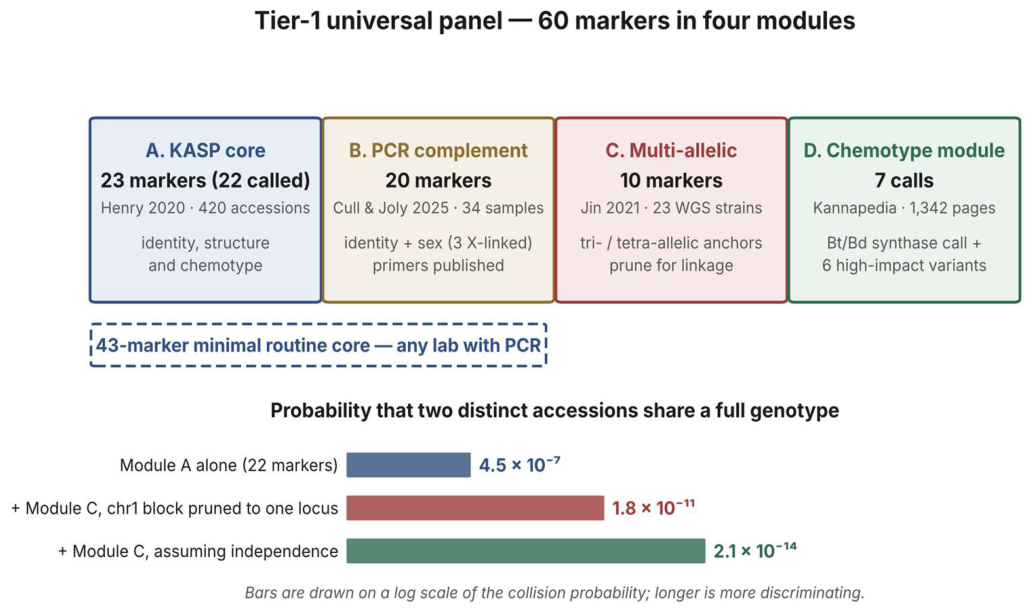
3.11. In-Silico Validation: the Panel Works, and Its Collision Probability Does Not
All 22 recomputed marker statistics reproduced the published values exactly, and the theoretical probability of identity computed from the raw genotypes came to 4.494 × 10⁻⁷ — matching the 4.49 × 10⁻⁷ reported in Table 9 to three significant figures. The calculation is therefore reproducible from public data, which is worth establishing before reporting what it fails to predict.
Principal component analysis on the 22-marker dosage matrix recovers the published population structure (Figure 5a). The first two components capture 15.7% and 13.3% of variance, and the five DAPC clusters occupy distinguishable regions, with the hemp cluster K5 (n = 17) separating cleanly from everything else and the terpinolene-dominant cluster K4 (n = 84) occupying its own lower quadrant. Leave-one-out nearest-centroid classification on the leading four components assigns 84.0% of accessions to their correct cluster against a majority-class baseline of 37.1% (Figure 5c).
The modular architecture is justified quantitatively by the same analysis. The 19 identity markers alone reach 63.6% and the three synthase-interval anchors alone reach 66.2%. Three markers thus carry about as much cluster information as the other nineteen combined, and neither component approaches the 84.0% the two reach together. This is the clearest available evidence that identity markers and functional chemotype anchors are complementary rather than redundant, which is the premise of the module design.
Rarefaction (Figure 5b) shows where the marker count stops paying. Eight markers resolve 262 of 420 accessions and give a theoretical P(ID) of 4.6 × 10⁻⁴; fourteen reach 345 and 4.1 × 10⁻⁶; the last four markers added move the count from 359 to 361 while the theoretical figure continues to fall by a further order of magnitude. The divergence between a curve that keeps improving and a count that has stopped is the first visible sign of the problem.
The problem itself is this. At P(ID) = 4.49 × 10⁻⁷, the expected number of accession pairs sharing a complete 22-marker genotype among 420 accessions is 0.04 — that is, one would expect none. The observed number is 111, distributed across 37 groups, the largest containing seven accessions with identical genotypes (Table 15).
Classifying those 111 pairs by cultivar name separates the benign from the consequential. Fifty-nine are pairs of accessions carrying the same cultivar name, where an identical genotype is the correct answer and the panel is working exactly as intended on clonally propagated material. Forty-one involve at least one unnamed accession, of which the dataset contains 164, and cannot be interpreted. Eleven are pairs of accessions carrying different cultivar names — genuine identification failures — including AtomicalHaze against PinkKush five times, OriginalAmnesia against SourTangie twice, and AgentOrange against GirlScoutCookies, TangerineDream against ViolatorKush, and GorillaGlue against HollyGrail once each.
Eleven failures among 87,990 possible pairs is an observed collision rate of 1.25 × 10⁻⁴, roughly 280 times the theoretical P(ID). The discrepancy is not an error in the calculation, which reproduces exactly; it is a failure of the independence assumption the calculation rests on. Section 4.4 takes up what follows from it.
4.1. Coordinate Fragmentation, and What the Within-Assembly Result Adds
The overlap results reframe what is wrong with cannabis marker genetics, and they do so in two stages.
The first stage is the familiar one. Five reference assemblies are in simultaneous use across the inventory. A laboratory reading three papers receives three incompatible descriptions of what may well be overlapping biology, with no automated way to discover the overlap. Every meta-analytic operation that the rest of plant genetics takes for granted — pooling, replication, cross-validation, imputation — is unavailable. The Jin coordinate correction in Section 2.3 is a direct illustration: the field's only multi-allelic marker set has been described as cs10 in secondary sources, including in an earlier version of this analysis, and is in fact on Purple Kush.
The second stage is new, and it is the more important of the two. One might reasonably expect this problem to dissolve as the field standardises on cs10. The within-assembly comparison shows that it would not. Cull & Joly, HASCH and CannSelect are all on cs10, and they share almost nothing: 0.7% of HASCH markers fall in CannSelect's capture space and none of Cull & Joly's. A shared assembly is necessary for combinability but nowhere near sufficient, because discovery population and thinning rule dominate. Two groups selecting 1,504 and 18,040 markers from overlapping variant catalogues, on the same genome, will still produce near-disjoint sets unless they coordinate on which markers to select.
Two distinct remedies therefore follow, and they are often conflated. A community liftOver chain between cs10, Purple Kush, Pink Pepper and the MGC contigs is the first: a tractable piece of work requiring no new sequencing, which would immediately convert roughly 2,240 curated marker records and several million discovery variants from isolated lists into a combinable resource, and which would answer directly whether the multi-allelic core falls inside CannSelect capture space. But liftOver alone will not produce a shared panel. The second remedy is a published set of agreed anchor positions on cs10 that new platforms commit to including — a few hundred markers, chosen once, carried by everyone. The ten shared HASCH/CannSelect targets, six of them deliberate and concentrated in the sex-linked region, show that this happens spontaneously only where the source data leave no real choice.
Until both exist, modular design in native coordinates is not a stylistic preference but the only safe architecture.
4.2. The Two Principal Assemblies Share no Chromosome Numbering
Chromosome identity in cannabis genomics is not reliable, and this paper found it failing in two independent ways — once between assemblies, once inside a single one.
The liftOver chain of Section 3.8 is ten anchors wide, and it was enough to overturn an assumption that the cannabis literature has carried without examination.
Purple Kush chromosome 1 is cs10 chromosome 5. Purple Kush chromosome 2 is cs10 chromosome 6. Purple Kush chromosome 6 is cs10 chromosome 7, and Purple Kush chromosome 9 is cs10 chromosome 8. Not one of the four Purple Kush chromosomes carrying Module C markers corresponds to the cs10 chromosome of the same number. We have not tested the remaining six, and nothing in this result suggests a simple offset that would predict them; each correspondence has to be established empirically.
The hazard this creates is specific and easy to miss, because the two assemblies use the same vocabulary. A paper reporting a locus on “chromosome 6” in Purple Kush coordinates and a paper reporting a locus on “chromosome 6” in cs10 coordinates are describing different chromosomes, and nothing in either paper signals it. Any comparison, synteny statement, candidate-gene argument or marker-overlap test made between these assemblies on the basis of chromosome labels alone is, at best, unverified.
That the field has not tripped over this more visibly is partly because the two assemblies have rarely been compared directly — which is itself the problem this paper is about — and partly because the affected comparisons tend to be stated loosely enough to survive. Section 3.6’s synthase observation is a good example: Jin’s 37% enrichment of structural SNPs on Purple Kush chromosome 6 and cs10’s placement of the terminal cannabinoid synthase cluster on its own chromosome 7 look like a contradiction and are in fact the same statement. Only the chain reveals that, and without it a reader has no way to tell agreement from coincidence.
The second failure needs no second assembly at all. Section 3.4 shows that the Henry 2020 panel — one of the two most-cited marker sets in this crop, and Module A of the panel proposed here — reports cs10 positions under chromosome numbers that are the ordinal index of the cs10 RefSeq accession. Seven of its ten chromosome labels are wrong, and nine of its 21 testable nuclear markers do not reproduce at their published position at all, sitting elsewhere in the genome entirely. The positions were correct all along; only the names were not. We are the authors of that panel, and we did not notice until the flanking sequences were placed by alignment rather than read off the table. It is worth being precise about what this does and does not damage. The assays were designed on draft-assembly scaffolds, whose identifiers survive in the marker names, and were validated by KASP genotyping on real plants; the 420-accession genotype matrix is unaffected, and so is every result in this paper that rests on it. What failed is the layer added afterwards: the translation of scaffold coordinates into chromosome-level ones for publication. That layer is invisible to the laboratory, carries no signal that it has gone wrong, and is exactly the layer every downstream user trusts.
That second case is in some ways the more alarming. A reader comparing two assemblies at least has a reason to be careful. A reader taking a chromosome number from a published table, in a paper that uses the field’s standard reference, has none — and would have drawn a wrong conclusion in seven cases out of ten. The error is invisible from the paper itself and detectable only by re-placing the markers from sequence.
We draw two conclusions. The first is editorial: no cannabis genomics paper should report a chromosome number without naming the assembly it belongs to, and preferably the sequence accession, since the accession is unambiguous where the number is not. Panels should be published with their flanking sequences for the same reason — it was the KASP submission sequences, not the coordinate table, that made the Henry 2020 error detectable and correctable. The second is that chromosome-level correspondence should be published as a resource in its own right. It is a small table. It took ten anchors and no specialised infrastructure to establish four rows of it, and those four rows are already sufficient to change how three published results should be read.
4.3. A linkage Caveat in Module C, and a Revised Identification Power
The headline figure of 2.13 × 10⁻¹⁴ assumes that the ten Module C markers are independent, as the chain rule requires. Inspection of their positions shows that they are not. Five of the ten — chr1:72,759,920, chr1:73,849,914, chr1:74,337,637, chr1:74,669,276 and chr1:75,213,547 — lie within a single 2.45 Mb block of chromosome 1. They were selected independently on discrimination score, and their co-location is a consequence of that block being genuinely discriminant across the 23 strains, but markers that close together in a highly structured crop are likely to be correlated, and correlated markers do not multiply.
Linkage disequilibrium in cultivated cannabis is extensive, and 23 strains cannot resolve the local haplotype structure needed to measure it at these loci. We therefore offer a bounding calculation rather than a correction. Taking the observed improvement from 4.49 × 10⁻⁷ to 2.13 × 10⁻¹⁴ as a mean per-marker factor of approximately 0.185, and assuming conservatively that the chromosome 1 block contributes as a single locus rather than five, the collision probability becomes approximately 1.8 × 10⁻¹¹. The true value lies between that bound and the independent-loci figure.
Two conclusions follow. The first is practical and reassuring: at 1.8 × 10⁻¹¹, the panel still discriminates far beyond any plausible operational requirement, since no realistic cultivar census approaches the scale at which a collision becomes likely. The multi-allelic argument survives in full; it is a four-order-of-magnitude gain over the biallelic core rather than seven.
The second is a design revision we recommend to users of this panel. Module C should be linkage-pruned — retaining one or at most two markers from the chromosome 1 block and replacing the remainder with the highest-scoring tri-allelic loci from chromosomes 2, 5, 9 and 10 — and its allele frequencies and discrimination scores should be re-estimated on a larger genotyped population, for which the 110 whole genomes of Ren et al. 2021 are the obvious substrate; these are also, conveniently, one of CannSelect's four source datasets. We note for completeness that the same consideration applies to Module A, whose three chemotype anchors (VSSL_BtBd, SW6 and VSSL_A250D) all sit in the synthase interval and are certainly not independent; the Henry 2020 collision probability of 4.49 × 10⁻⁷ is computed from observed genotype frequencies across 420 accessions and is correspondingly less exposed to this assumption, but it is not immune to it.
We raise this against our own recommendation because a panel proposed for regulatory and forensic use should not carry an identification-power figure that its own marker positions contradict.
4.4. Why the Observed Collision Rate Exceeds the Predicted One by 280-Fold
The in-silico result in Section 3.11 is the most consequential finding in this paper for anyone intending to deploy a cannabis identification panel, and it generalises well beyond Module A.
Probability of identity computed by the chain rule assumes that loci are independent and that individuals are drawn independently from a randomly mating population. Cultivated cannabis violates both assumptions comprehensively. It is propagated clonally, so a collection of 420 market accessions is not 420 independent draws; it contains clones, siblings and recent descendants of a small number of widely distributed parents. Three of Module A’s markers sit in the same synthase interval and cannot be independent of one another. And the germplasm has passed through severe bottlenecks, so haplotypes are shared far more often than allele frequencies alone would suggest.
The consequence is quantitative and large: a figure of 4.49 × 10⁻⁷ understates the real collision rate between distinct named cultivars by about two and a half orders of magnitude. We emphasise that this is not a criticism of the Henry 2020 panel in particular. Every probability-of-identity figure in the cannabis literature, including the 2.13 × 10⁻¹⁴ and 1.8 × 10⁻¹¹ figures for the full Tier-1 panel reported in Table 12, rests on the same assumption and will be optimistic by a similar factor. Our own headline number is therefore the one most affected by this finding, and we state the implication plainly: the practical collision rate of the full Tier-1 panel cannot be inferred from its theoretical P(ID) and must be measured on real germplasm before the panel is used where a false identity match has consequences.
Two further observations make the result more useful than discouraging. First, the panel is not failing at what it was built to do: 59 of the 111 collisions are same-named accessions correctly identified as identical, which is a demonstration that the module recognises clonal material rather than a demonstration that it cannot discriminate. Second, the failures cluster. Five of the eleven cross-cultivar collisions involve a single pair of cultivar names, which is more consistent with synonymy or mislabelling in the market — two names for the same clone — than with eleven independent failures of the assay. Genotyping cannot settle which of the two it is, and that ambiguity is itself an argument for the higher-resolution modules: an assay that cannot distinguish a mislabelled plant from a renamed clone cannot support a traceability claim.
The practical recommendation follows directly. For breeding and germplasm curation, Module A alone is adequate and its collisions are informative. For regulatory, forensic or traceability use, where a false match has consequences, Modules B and C should be added, and the resulting panel should be validated by the empirical round-robin described in Section 4.8 rather than by a chain-rule calculation.
4.5. What the Panel Is For
The two-tier structure maps onto three distinct user communities with genuinely different constraints.
Regulatory and forensic laboratories need defensible identity and chemotype calls at low cost, in volume, on material that may be dried or degraded. Modules A and B serve this case: 43 markers, published primers, and validation that explicitly included dried material. The sex markers in Module B matter here too, since sex verification is a routine compliance question in hemp production.
Breeders and germplasm curators need discrimination fine enough to distinguish closely related lines and to detect mislabelling within a collection. This is where Module C earns its place, and where the linkage pruning of Section 4.3 should be applied before deployment rather than after.
Research laboratories with sequencing capacity need density and genome-wide coverage, and are served by Tier 2 — where the choice between CannSelect and HASCH should be made on germplasm rather than on density, as Section 3.5 sets out, and with the caveat that until a liftOver chain exists, Tier-2 resources remain usable individually but not jointly.
Module D deserves separate mention because it addresses a problem the other modules do not. The cannabis industry already has a shared vocabulary for chemotype, built on Kannapedia's synthase calls and variant nomenclature. A panel that reports in that vocabulary can be understood by its users without translation, which is a different and more immediately useful property than being technically optimal.
4.6. Relation to the Brief-Idea Concept
This analysis operationalises a three-part concept proposed in an earlier brief-idea submission by the present author: a universal pan-cannabis panel spanning drug-type and fibre-type germplasm; multi-allelic SNPs as high-information anchors; and a minimal core sufficient for routine verification. The journal that hosted the submission is defunct and the item is not archived, so the concept is reconstructed here from the author's intent and cannot be formally cited.
Each part now has an evidence-backed answer. The two-tier architecture spans every published validation population, approximately 3,300 to 3,800 accessions. The multi-allelic component delivers a measurable gain in identification power — four to seven orders of magnitude depending on the linkage assumption, as set out in Section 4.3. And Modules A plus B constitute the minimal core, 43 markers, both components validated in vitro.
We flag the self-referential structure here explicitly rather than leaving it implicit: the concept being validated, two of the marker sets being recommended, and the present analysis all share the same author. Section 4.7 addresses what that means for the reader.
4.7. Limitations
Coordinate fragmentation bounds most of the overlap testing reported here. The within-assembly comparison of Section 3.3 is the exception and is the firmest result in the paper precisely because no translation was involved; the cross-assembly tests can demonstrate that published panels do not share positions but cannot fully quantify how much biology they share.
Author overlap is a real limitation rather than a formality. Modules A and C derive from studies the present author co-wrote, the brief-idea concept being operationalised is his own, and the panel that emerges therefore recommends his own markers for two of its four modules. Two factors partially mitigate this. Module A was selected on an objective and stated criterion — it is the only cannabis SNP panel validated across 420 accessions on three genotyping platforms — and Module B, an independent group's work, was adopted over any alternative of our own precisely because it is the only fully in-vitro-validated minimal panel with published primers in the inventory. Readers should nonetheless weigh the recommendation accordingly, and we would welcome an independent redesign using the same inventory.
The Jin multi-allelic set rests on 23 strains. Allele frequencies are provisional, the discrimination scores are computed on a small and non-random sample of the market, and Section 4.2's linkage caveat is a direct consequence of having too few genomes to resolve haplotype structure. Its Purple Kush coordinates also leave Module C untestable against the cs10 platforms until a liftOver chain exists.
CannSelect is a preprint, its reported performance figures are the authors' own and are not independently replicated here, and its design is hemp-biased, so its capture performance in high-THC germplasm rests on in-silico alignment rather than on-tissue validation. Our parse covers the published v1.0 design; surviving Y-chromosome targets are not identifiable by accession in that file, so the Y component of the design could not be verified.
Kannapedia sampling covered 185 of 1,342 strain pages. Frequency estimates from this sample are good to approximately ±5%, but synthase calls are absent on 107 of the 185 pages, and we note a discrepancy in the variant catalogue that the full scrape should resolve: reported population frequencies and observed carrier counts in our sample are inconsistent for several top variants — PKSG-2b p.Thr11Ser is reported at 76.9% but appears in 13 of 185 sampled pages — indicating that the two figures are computed on different denominators. Both are reported in Table 13 as retrieved, and neither should be used as a population allele frequency until reconciled.
The in-silico validation covers Module A only. It is the single Tier-1 component with a complete public genotype matrix; Cull & Joly’s 34 samples, Jin’s 23 strains and the Kannapedia calls were not retrievable as matrices here, so Modules B, C and D remain validated by their source publications rather than by us. The 280-fold collision discrepancy is therefore measured on 22 markers in one collection of North American market accessions, and its magnitude will differ in other germplasm, though the mechanism — clonal propagation and bottlenecked ancestry — applies wherever cultivated cannabis is genotyped.
We also record a count we could not reconcile. Recomputing distinct multilocus genotypes from the published 420 × 22 matrix gives 361, where the source reports 296. All 22 per-marker statistics reproduce exactly, so the difference lies in how multilocus genotypes were counted rather than in the genotypes themselves — possibly a different marker subset or a different treatment of the unnamed accessions. We report 361 because it is what the deposited matrix contains, and flag the discrepancy for resolution.
The liftOver chain is a seed chain. It covers about 4.6 kb in ten windows and lifts nothing outside them; its two weakest anchors break the collinearity of the chromosome 1 block and are reported as unconfirmed. The chromosome correspondences it establishes rest on between one and five anchors each, which is enough to identify which cs10 chromosome a Purple Kush chromosome corresponds to but not to characterise the relationship between them.
Four inventoried sources are preprints (Lynch 2016, Grassa 2018, Devèze 2024, CannSelect 2026), included within the stated scope but not peer-reviewed finals. And the identification-power figures throughout depend on assumptions set out in Section 2.6 and quantified in Section 4.3.
4.8. Next steps
Four pieces of work would convert this proposal into a validated standard. A whole-genome liftOver chain between cs10, Purple Kush, Pink Pepper and MGC coordinates is first and most valuable, and is a prerequisite for most of what follows. The ten-anchor seed chain of Section 3.8 is a proof of concept and a starting point, not a substitute: extending it to all 344 Jin markers is straightforward by the same method, while a production chain requires both assemblies aligned in full. Second, a published set of agreed cs10 anchor positions that new platforms commit to carrying, since Section 4.1 shows that shared assembly alone does not produce shared markers. Third, re-estimation of Module C allele frequencies and discrimination scores on the Ren et al. 2021 genomes, with linkage pruning applied. Fourth, an empirical round-robin: the same reference accessions genotyped on Modules A, B and C in independent laboratories, which is the only way to establish that a modular panel in heterogeneous coordinate systems actually returns concordant calls.
5. Conclusions
Twenty-two published cannabis marker resources, spanning more than four thousand accession records, share almost no genomic positions with one another. Six of eight panel-to-panel comparisons returned zero exact matches. The firmest of those results needs no coordinate translation at all: Cull & Joly, HASCH and CannSelect are all built on CBDRx/cs10, and an 18,040-probe design spanning roughly 1.03 Mb of capture space recovers 0.7% of HASCH's markers and none of Cull & Joly's.
Chromosome identity fails a second way, inside a single assembly: the Henry 2020 panel reports cs10 positions under chromosome numbers that are the ordinal index of the RefSeq accession, so seven of its ten labels are wrong, and nine of its 21 testable markers carry coordinates that do not reproduce anywhere near the position given. That disposes of the comfortable assumption that standardising on one reference genome would make the field’s panels combinable. It would not. Discovery population and thinning rule dominate, and two groups selecting markers from overlapping catalogues on the same genome still produce near-disjoint sets. Beneath the divergence, every panel in the inventory converges on the terminal cannabinoid synthase cluster — including CannSelect's curated gene targets — and the same inactive-synthase allele is tagged independently by a KASP marker validated in 420 accessions and by a database variant reported in 40.5% of strains.
The consequence for panel design is concrete. A universal panel cannot be built by concatenating published lists. It must be modular, specified in each laboratory's native coordinates, and anchored by functional loci that translate across assemblies. We propose such a panel: 60 markers in four modules, every marker published and genotype-validated, with a 43-marker minimal core deployable by any laboratory with PCR.
Multi-allelic anchors justify their inclusion. They improve collision probability from 4.5 × 10⁻⁷ to 2.1 × 10⁻¹⁴ under independence, or to approximately 1.8 × 10⁻¹¹ under the conservative linkage assumption that we argue is nearer the truth, given that five of the ten anchors share a 2.45 Mb block of chromosome 1. Either figure is decisive for cultivar identity; the gap between them is a reason to prune the module, not to abandon it.
On real data the panel behaves as designed: principal components recover the published population structure, leave-one-out cluster assignment reaches 84.0% against a 37.1% baseline, and the three synthase anchors carry as much cluster information as the other nineteen markers combined — a direct vindication of modular construction. The same data, however, show that the probability-of-identity statistic understates reality by roughly 280-fold: eleven pairs of distinctly named cultivars share a complete 22-marker genotype where 0.04 collisions were predicted. Clonal propagation, linkage and bottlenecked germplasm break the independence the chain rule assumes. Every P(ID) figure in this paper, our own headline numbers included, should be read as an upper bound on performance rather than a prediction of it, and panels intended for regulatory or forensic use should be validated empirically on real germplasm.
The field's binding constraint is not marker discovery. Twelve million variants have been catalogued, a thousand-target amplicon platform exists, and an eighteen-thousand-probe capture platform has just been released. The constraint is that none of it can be combined. A liftOver chain between four reference assemblies, and an agreed set of anchor positions that new platforms commit to carrying, would together do more for cannabis genetics than another discovery study — and both are far smaller pieces of work. The ten-anchor chain reported here took public sequence and no specialised infrastructure, and it was already enough to show that Purple Kush and cs10 do not share chromosome numbering and that the multi-allelic module cannot be captured by the field's largest platform. A complete chain would be worth considerably more than that.
Supplementary Materials
The following supporting information can be downloaded at the website of this paper posted on Preprints.org. The companion workbook “Cannabis SNP Meta-Analysis — Markers & Universal Panel” (11 sheets) accompanies this manuscript and contains: the full study inventory; the complete Tier-1 60-marker specification with loci, alleles, genes, minor allele frequencies and heterozygosities; all 344 Jin et al. structural SNPs with recomputed statistics; the Henry 2018 38-SNP informative set; the Henry 2020 22-marker matrix statistics with cluster-association tests; the Cull & Joly 20-SNP panel with annotations; the full HASCH 1,504-marker list; the parsed CannSelect v1.0 design with per-chromosome probe, target and span counts and the ten HASCH intersections; the 222-variant Kannapedia high-impact catalogue; and the accession-coverage, overlap and P(ID) calculations.
Funding
Funding was provided in kind by LIT and its employees as well as indirectly through other groups cited here.
Institutional Review Board Statement
Not applicable. This study analyses published marker data and public plant genotype resources; it involves no human or animal subjects.
Informed Consent Statement
Not applicable.
Data Availability Statement
All primary data sources are public and are identified in Table 1 with their repositories: figshare articles 11778936 (Henry 2020); the PLOS ONE supplementary files of Jin et al. 2021 and BioProject PRJNA683613; the BMC Genomics supplements of Mansueto et al. 2024 and Cull & Joly 2025; the CornellHemp/CannSelect GitHub repository; and kannapedia.net strain pages. The in-silico validation of Section 3.11 uses the Henry et al. 2020 matrix from figshare article 11778936 (CC BY 4.0) in full and requires no other input.
Acknowledgments
The author thanks the research groups whose public data deposits made this meta-analysis possible, and notes that the within-assembly comparison reported here was only possible because the CannSelect authors released their complete probe design rather than a marker summary.
Conflicts of Interest
The corresponding author is an author of Henry et al. 2020 and of Jin et al. 2021, which supply Modules A and C of the recommended panel, and originated the brief-idea concept that Section 4.4 evaluates. The author has commercial interest in cannabis genotyping services, marker licensing.
References
- Henry, P.; Khatodia, S.; Kapoor, K.; Gonzales, B.; Middleton, A.; Hong, K.; Hilyard, A.; Johnson, S.; Allen, D.; Chester, Z.; et al. A single nucleotide polymorphism assay sheds light on the extent and distribution of genetic diversity, population structure and functional basis of key traits in cultivated North American cannabis. J. Cannabis Res. 2020, 2, 26. [Google Scholar] [CrossRef] [PubMed]
- Jin, D.; Henry, P.; Shan, J.; Chen, J. Classification of cannabis strains in the Canadian market with discriminant analysis of principal components using genome-wide single nucleotide polymorphisms. PLoS ONE 2021, 16, e0253387. [Google Scholar] [CrossRef] [PubMed]
- Mansueto, L.; Fuentes, R.R.; Chebotarov, D.; Mauleon, R.; Lupo, A.; Bellafiore, S.; de Heer, L.G.; Borja, F.N.; Detras, J.; San Jose, R.; et al. HASCH: a highly multiplexed amplicon-based SNP platform for genotyping applications in Cannabis sativa. BMC Genom. 2024, 25, 735. [Google Scholar] [CrossRef] [PubMed]
- Cull, A.; Joly, D.L. Development and validation of a minimal SNP genotyping panel for the differentiation of Cannabis sativa cultivars. BMC Genom. 2025, 26, 83. [Google Scholar] [CrossRef] [PubMed]
- Wilkerson, D.G.; Stack, G.M.; Carlson, C.H.; Quade, M.A.; Dowling, C.A.; Toth, J.A.; Murdock, M.J.; Jasinski, J.; Stansell, Z.J.; McKay, J.K.; Smart, L.B. CannSelect: a high-quality genotyping platform for Cannabis sativa. bioRxiv 2026, preprint. [Google Scholar] [CrossRef]
- Sawler, J.; Stout, J.M.; Gardner, K.M.; Hudson, D.; Vidmar, J.; Butler, L.; Page, J.E.; Myles, S. The genetic structure of marijuana and hemp. PLoS ONE 2015, 10, e0133292. [Google Scholar] [CrossRef] [PubMed]
- Ren, G.; Zhang, X.; Li, Y.; Ridout, K.; Serrano-Serrano, M.L.; Yang, Y.; Liu, A.; Ravikanth, G.; Nawaz, M.A.; Mumtaz, A.S.; et al. Large-scale whole-genome resequencing unravels the domestication history of Cannabis sativa. Sci. Adv. 2021, 7, eabg2286. [Google Scholar] [CrossRef] [PubMed]
- Laverty, K.U.; Stout, J.M.; Sullivan, M.J.; Shah, H.; Gill, N.; Holbrook, L.; Deikus, G.; Sebra, R.; Hughes, T.R.; Page, J.E.; van Bakel, H. A physical and genetic map of Cannabis sativa identifies extensive rearrangements at the THC/CBD acid synthase loci. Genome Res. 2019, 29, 146–156. [Google Scholar] [CrossRef] [PubMed]
- Grassa, C.J.; Weiblen, G.D.; Wenger, J.P.; Dabney, C.; Poplawski, S.G.; Motley, S.T.; Michael, T.P.; Schwartz, C.J. A new Cannabis genome assembly associates elevated cannabidiol (CBD) with hemp introgressed into marijuana. New Phytol. 2021, 230, 1665–1679. [Google Scholar] [CrossRef] [PubMed]
- Lynch, R.C.; Vergara, D.; Tittes, S.; White, K.; Schwartz, C.J.; Gibbs, M.J.; Ruthenburg, T.C.; deCesare, K.; Land, D.P.; Kane, N.C. Genomic and chemical diversity in Cannabis. Crit. Rev. Plant Sci. 2016, 35, 349–363. [Google Scholar] [CrossRef]
- Vergara, D.; Huscher, E.L.; Keepers, K.G.; Pisupati, R.; Schwabe, A.L.; McGlaughlin, M.E.; Kane, N.C. Genomic evidence that governmentally produced Cannabis sativa poorly represents genetic variation available in state markets. Front. Plant Sci. 2021, 12, 668315. [Google Scholar] [CrossRef] [PubMed]
- Toth, J.A.; Stack, G.M.; Cala, A.R.; Carlson, C.H.; Wilk, R.L.; Crawford, J.L.; Viands, D.R.; Philippe, G.; Smart, C.D.; Rose, J.K.C.; Smart, L.B. Development and validation of genetic markers for sex and cannabinoid chemotype in Cannabis sativa L. GCB Bioenergy 2020, 12, 525–536. [Google Scholar] [CrossRef]
- Torres, A.; Pauli, C.; Givens, R.; Argyris, J.; Allen, K.; Martin, J.; Rivera, M. Genotyping assays for male identification in Cannabis sativa. J. Cannabis Res. 2022, 4, 57. [Google Scholar]
- Prentout, D.; Razumova, O.; Rhoné, B.; Badouin, H.; Henri, H.; Feng, C.; Käfer, J.; Karlov, G.; Marais, G.A.B. An efficient RNA-seq-based segregation analysis identifies the sex chromosomes of Cannabis sativa. New Phytol. 2021, 231, 1599–1611. [Google Scholar] [CrossRef] [PubMed]
- Mostafaei Dehnavi, M.; Damerum, A.; Taheri, S.; Ebadi, A.; Panahi, S.; Hodgin, G.; Brandley, B.; Salami, S.A.; Taylor, G. Population genomics of a natural Cannabis sativa L. collection from Iran identifies novel genetic loci for flowering time, morphology, sex and chemotyping. BMC Plant Biol. 2025, 25, 270. [Google Scholar] [CrossRef] [PubMed]
- Eržen, M.; Čerenak, A.; Cesar, T.; Jakše, J. Population Structure of Genotypes and Genome-Wide Association Studies of Cannabinoids and Terpenes Synthesis in Hemp (Cannabis sativa L.). Plants 2026, 15, 202. [Google Scholar] [CrossRef] [PubMed]
- Devèze, J.-M.; Devèze, J.-M.; Shrestha, S.; Thapa, S.; Marasini, S.; Malla, R.; Galla, G.; Barcaccia, G. Genotyping-by-sequencing of wild Indian Cannabis populations. bioRxiv 2024, preprint. [Google Scholar]
- Zhang, J.; Vincent, J.; Niu, Y.; Wang, J.; Li, S.; Wang, L.; Zhang, S. Development of KASP markers for DNA fingerprinting in fiber-type hemp. Ind. Crops Prod. 2025, 229, 122320. [Google Scholar] [CrossRef]
- Pan, G.; Li, Z.; Huang, S.; Tao, J.; Shi, Y.; Chen, A.; Li, J.; Tang, H.; Chang, Li.; Deng, Y.; Li, D.; Zhao, L. Genome-wide development of insertion-deletion (InDel) markers for Cannabis and its uses in genetic structure analysis of Chinese germplasm and sex-linked marker identification. BMC Genom. 2021, 22, 595. [Google Scholar] [CrossRef] [PubMed]
- Jin, D.; Henry, P.; Shan, J.; Chen, J. Identification of chemotypic markers in three chemotype categories of Cannabis using secondary metabolites profiled in inflorescences, leaves, stem bark, and roots. Front. Plant Sci. 2021, 12, 699530. [Google Scholar] [CrossRef] [PubMed]
- Jin, D.; Henry, P.; Shan, J.; Chen, J. Identification of phenotypic characteristics in three chemotype categories in the genus Cannabis. HortScience 2021, 56, 481–490. [Google Scholar] [CrossRef]
- McKernan, K.J.; et al. Kannapedia: StrainSEEK v1-v3, CannSNP90 and the Cannabis strain variant catalogue; Medicinal Genomics: Beverly, MA, USA; Available online: https://www.kannapedia.net (accessed on 29 October 2026).
- van Bakel, H.; Stout, J.M.; Cote, A.G.; Tallon, C.M.; Sharpe, A.G.; Hughes, T.R.; Page, J.E. The draft genome and transcriptome of Cannabis sativa. Genome Biol. 2011, 12, R102. [Google Scholar] [CrossRef] [PubMed]
Figure 1.
Positional disjointness within a single reference assembly. Cull & Joly 2025, HASCH 2024 and CannSelect 2026 are all specified on CBDRx/cs10, so no coordinate translation is involved. CannSelect's 18,040 probes resolve into 6,786 merged capture regions spanning approximately 1.03 Mb, within which fall 10 of HASCH's 1,504 markers and none of Cull & Joly's 20.
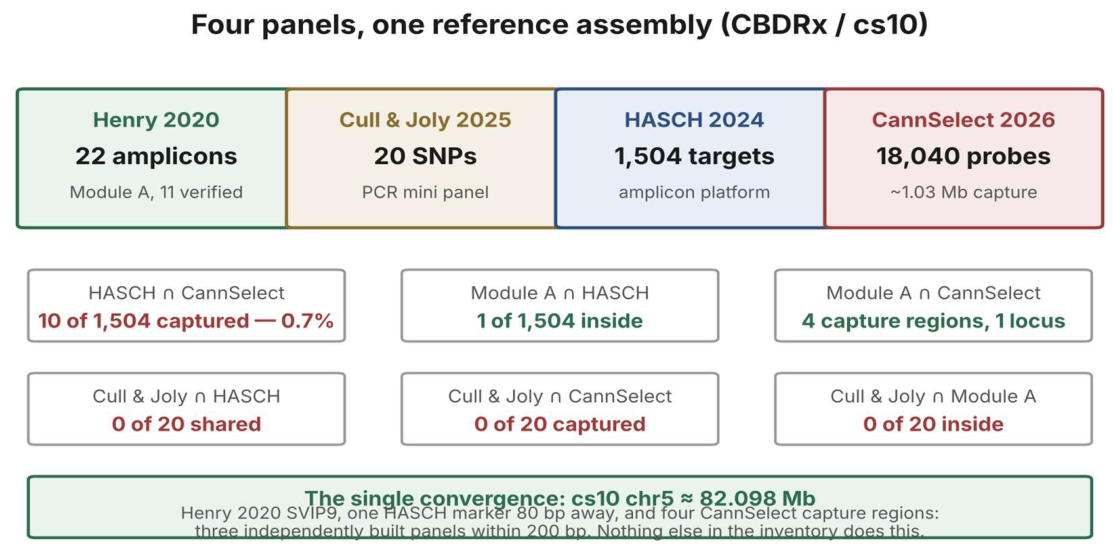
Figure 2.
Chromosome distribution of the 344 structural SNPs of Jin et al. (2021), in Purple Kush assembly coordinates (ASM23057v4), not cs10. Chromosome 6 carries the THCAS/CBDAS terminal synthase cluster in this reference and 127 of the 344 markers; 40 fall on unplaced contigs.
Figure 2.
Chromosome distribution of the 344 structural SNPs of Jin et al. (2021), in Purple Kush assembly coordinates (ASM23057v4), not cs10. Chromosome 6 carries the THCAS/CBDAS terminal synthase cluster in this reference and 127 of the 344 markers; 40 fall on unplaced contigs.
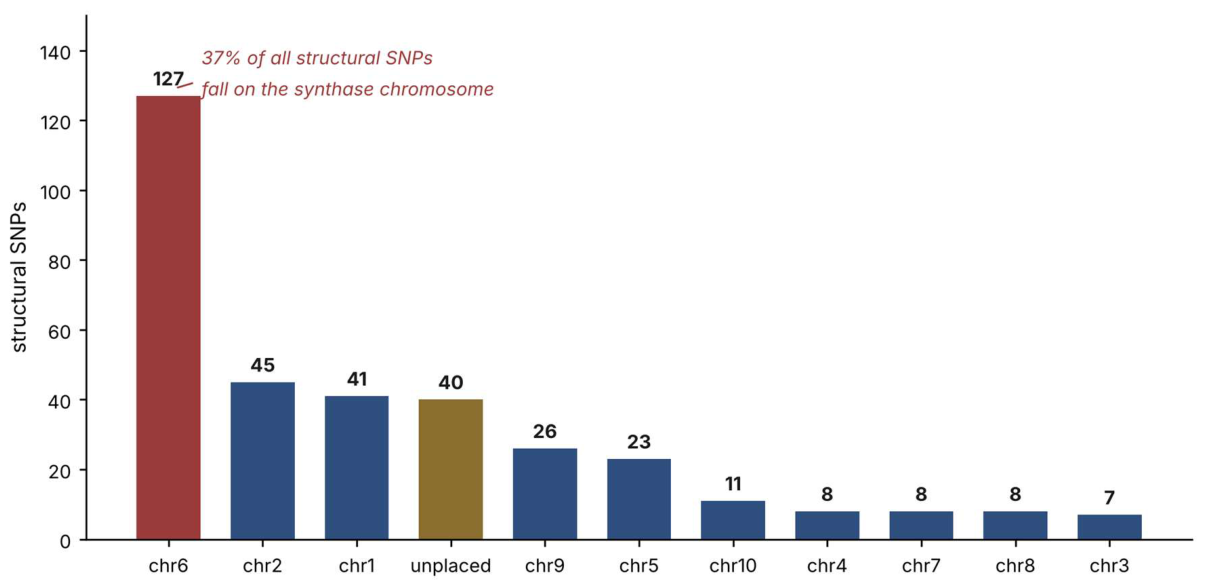
Figure 3.
The Purple Kush to cs10 seed chain. (a) Chromosome correspondence established by the ten anchors: no Purple Kush chromosome in this set maps to the cs10 chromosome of the same number. (b) Distance from each lifted Module C position to the nearest CannSelect v1.0 capture target, on a log scale; none of the ten falls inside capture space.
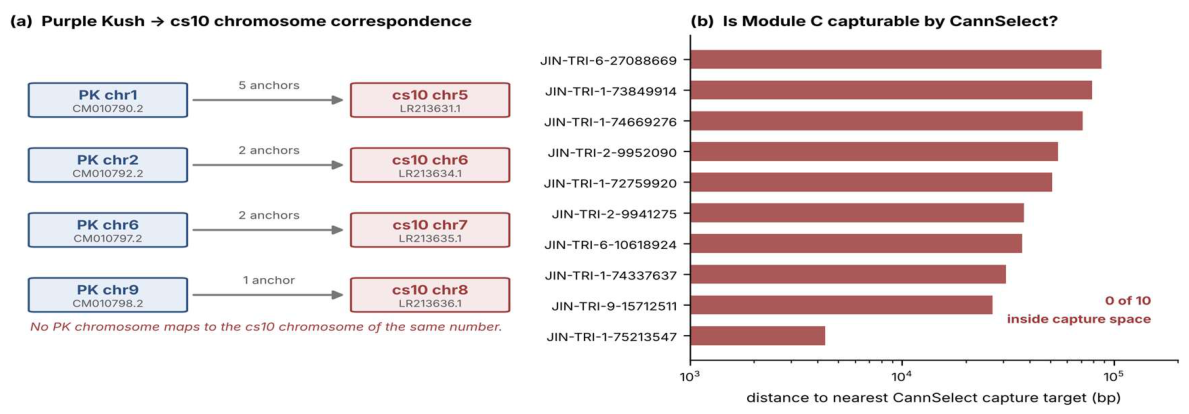
Figure 5.
In-silico validation of Module A on its full public genotype matrix (420 accessions, 22 markers, no missing calls). (a) Principal component analysis of the standardised dosage matrix, accessions coloured by their published DAPC cluster at K = 5; the hemp cluster K5 and the terpinolene-dominant cluster K4 separate from the remainder. (b) Marker rarefaction with markers added in descending expected heterozygosity: theoretical probability of identity (solid, left axis) continues to fall after the number of distinct multilocus genotypes (dotted, right axis) has plateaued, and crosses the collision rate actually observed between distinctly named cultivars (dashed). (c) Leave-one-out nearest-centroid cluster assignment accuracy on the leading four principal components, for the full module, the identity markers alone and the three synthase-interval anchors alone.
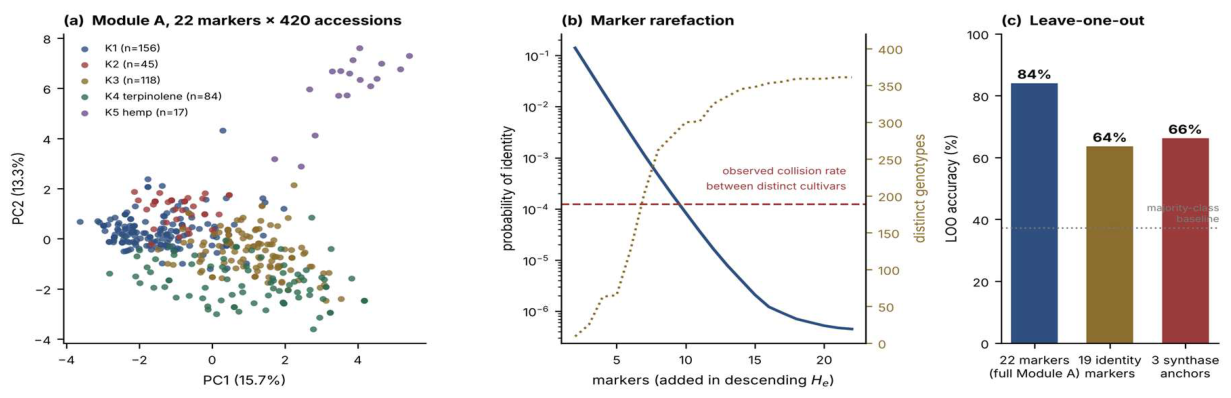
Table 1.
Inventory of published Cannabis sativa SNP marker sets, databases and discovery resources. Marker lists and probe designs were retrieved and parsed where public; otherwise a study-level record was made. Preprints are flagged.
Table 1.
Inventory of published Cannabis sativa SNP marker sets, databases and discovery resources. Marker lists and probe designs were retrieved and parsed where public; otherwise a study-level record was made. Preprints are flagged.
| Study / resource | Type | Markers or resource | Accessions | Reference assembly |
|---|---|---|---|---|
| Henry et al. 2020, J Cannabis Res 2:26 | Peer-reviewed | 23-SNP KASP panel (22 in matrix) | 420 (SK, MB, BC, NV) | CBDRx/cs10 (ordinal-index chr labels; see Table 7) |
| Jin, Henry, Shan & Chen 2021, PLoS ONE 16:e0253387 | Peer-reviewed | 137,858 WGS SNPs; 344 structural (339 tri-, 5 tetra-allelic) | 23 (PRJNA683613) | Purple Kush ASM23057v4 (CM010790–99) — corrected here |
| Jin et al. 2021, Front Plant Sci 12:699530 | Peer-reviewed | Secondary-metabolite chemotype markers | 3 chemotypes | — |
| Jin et al. 2021, HortScience 56:481–490 | Peer-reviewed | Phenotypic markers | 3 chemotype categories | — |
| Sawler et al. 2015, PLoS ONE 10:e0133292 | Peer-reviewed | 14,031 GBS SNPs | 124 (81 drug, 43 hemp) | pre-cs10 |
| Lynch et al. 2016, bioRxiv 034314 | Preprint | Genome-wide SNPs + chemistry | 340 | pre-cs10 |
| Laverty et al. 2019, Genome Res 29:146 | Peer-reviewed | Physical/genetic map; synthase rearrangements | mapping population | PK × Finola map |
| Grassa et al. 2018, bioRxiv 458083 | Preprint | CBDRx (cs10) assembly; CBD-locus haplotypes | assembly accessions | defines cs10 |
| Ren et al. 2021, Sci Adv 7:eabg2286 | Peer-reviewed | ~12M SNPs | 110 (104 retained) | cs10 |
| Vergara et al. 2021, Front Plant Sci 12:668315 | Peer-reviewed | WGS SNPs, NIDA vs market | 2 NIDA + public WGS | cs10 |
| Toth et al. 2020, GCB Bioenergy 12:525 | Peer-reviewed | Sex and chemotype markers | validation panels | assay-level |
| Torres et al. 2022, J Cannabis Res 4:57 | Technical note | Male-identification assays | validation panels | assay-level |
| Prentout et al. 2021, New Phytol 231:1599 | Peer-reviewed | X/Y sex chromosome markers | segregating populations | transcript-level |
| Mansueto et al. 2024, BMC Genomics 25:735 (HASCH) | Peer-reviewed | 1,504-target amplicon panel, MAF > 0.3 by design | 377 (116 med., 87 hemp, F2) | CBDRx/cs10, NC_044370–79 |
| Cull & Joly 2025, BMC Genomics 26:83 | Peer-reviewed | 20-SNP PCR panel incl. 3 X-linked; primers published | 34 (17 cultivars) | CBDRx/cs10 |
| Wilkerson et al. 2026, bioRxiv 2026.08.18.745408 (CannSelect) | Preprint | 18,040-probe target-enrichment design (49,560 GC-boosted); 130 gene targets | 336 (15 USDA-ARS + 321 segregating) | CBDRx/cs10; Y targets from JL-Father |
| Mostafaei Dehnavi et al. 2025, BMC Plant Biol 25:270 | Peer-reviewed | 23,266 significant trait SNPs incl. 8 sex-linked | 228 (35 Iranian pops.) | cs10 |
| Eržen et al. 2026, Plants 15:202 | Peer-reviewed | 3,670 capture SNPs; 14 THC, 12 CBG, 1 myrcene hits | 171 | cs10 |
| Devèze et al. 2024, bioRxiv/Authorea | Preprint | High-density GBS markers | 478 wild Indian | cs10 |
| KASP hemp fingerprinting 2025, Ind Crops Prod 229:122320 | Peer-reviewed | 11.55M WGS SNPs → KASP; 7-marker fingerprint | 46 fibre-type hemp | cs10 |
| Zhang et al. 2021, BMC Genomics (InDel) | Peer-reviewed | Genome-wide InDel markers (context only) | Chinese germplasm | — |
| Kannapedia / Medicinal Genomics | Database | StrainSEEK v1–v3, CannSNP90 (~89k), 222-variant high-impact catalogue, Bt/Bd calls | 1,342 strain pages (185 sampled) | MGC contigs + HGVS |
Table 2.
Accession coverage by dataset. The sum double-counts nested and overlapping collections and includes a segregating population rather than distinct accessions for CannSelect; the conservative unique union is 3,300–3,800 accessions.
Table 2.
Accession coverage by dataset. The sum double-counts nested and overlapping collections and includes a segregating population rather than distinct accessions for CannSelect; the conservative unique union is 3,300–3,800 accessions.
| Dataset | Accessions | Marker resource |
|---|---|---|
| Kannapedia (MGC) | 1,342 | StrainSEEK v1–v3, CannSNP90, WGS; 222-variant catalogue; Bt/Bd calls |
| Devèze 2024 (GBS, India; preprint) | 478 | High-density GBS |
| Henry et al. 2020 (KASP) | 420 | 23-SNP panel, 5 clusters |
| HASCH validation (Mansueto 2024) | 377 | 1,504-target amplicon panel |
| Lynch et al. 2016 (WGS; preprint) | 340 | Genome-wide SNPs + chemistry |
| CannSelect v1.0 (Wilkerson 2026; preprint) | 336 | 18,040-probe platform: 15 USDA-ARS hemp accessions + 321-individual segregating population; >1,000 samples with v0 |
| Mostafaei Dehnavi 2025 (GBS, Iran) | 228 | 23,266 trait SNPs incl. sex-linked |
| Eržen 2026 (capture, Slovenia) | 171 | 3,670 SNPs + GWAS hits |
| Sawler et al. 2015 (GBS) | 124 | 14,031 SNPs |
| Ren et al. 2021 (WGS) | 110 | ~12M SNPs |
| Henry et al. 2018 (transcriptome) | 70 | 1,409 SNPs; nested in Kannapedia |
| KASP hemp fingerprinting 2025 (China) | 46 | 11.55M SNPs → KASP panel |
| Cull & Joly 2025 (PCR) | 34 | 20-SNP validated panel |
| Jin et al. 2021 (WGS) | 23 | 137,858 SNPs; 344 structural |
| Sum of dataset accessions | 4,099 | Conservative unique union ~3,300–3,800 |
Table 3.
Henry et al. 2020 KASP panel: statistics recomputed from the published 420-accession genotype matrix, with a chi-square test of association against DAPC cluster assignment. SVIP19 is listed in the publication but carries no calls in the matrix and is excluded from all identification-power calculations.
| Marker | Alleles | Gene / function | Ho | He | MAF | χ² | p |
|---|---|---|---|---|---|---|---|
| VSSL_BtBd | C/T | Inactive THCAS/CBCAS (Bt/Bd) | 0.767 | 0.486 | 0.417 | 168.5 | < 0.001 |
| SW6 | A/G | Inactive THCAS/CBCAS | 0.657 | 0.497 | 0.464 | 245.1 | < 0.001 |
| VSSL_A250D | A/C | Inactive THCAS/CBCAS (A250D) | 0.331 | 0.319 | 0.199 | 86.5 | < 0.001 |
| VSSL_mito | A/C | Mitochondrial, downstream of trnC | 0.000 | 0.073 | 0.038 | 596.8 | < 0.001 |
| SVIP5 | A/T | LOC115717933, uncharacterized | 0.383 | 0.500 | 0.489 | 122.3 | < 0.001 |
| SVIP9 | A/G | LOC115718065, uncharacterized | 0.329 | 0.471 | 0.379 | 53.8 | < 0.001 |
| SVIP10 | C/T | Neurofilament medium polypeptide-like | 0.105 | 0.129 | 0.069 | 159.3 | < 0.001 |
| SVIP13 | A/G | LOC115705170, uncharacterized | 0.195 | 0.485 | 0.414 | 95.6 | < 0.001 |
| SVIP14 | A/T | Endo-1,4-beta-xylanase XylA-like | 0.219 | 0.355 | 0.231 | 184.6 | < 0.001 |
| SVIP15 | A/G | Ribose-phosphate pyrophosphokinase 4 | 0.479 | 0.500 | 0.487 | 61.1 | < 0.001 |
| SVIP16 | A/C | LRR receptor-like kinase At1g35710 | 0.324 | 0.448 | 0.338 | 23.3 | 0.0001 |
| SVIP21 | A/G | Membrane protein At3g27390 | 0.250 | 0.409 | 0.287 | 137.3 | < 0.001 |
| SVIP22 | A/G | Solute carrier 35 member F5 | 0.376 | 0.317 | 0.198 | 42.9 | < 0.001 |
| SVIP23 | C/T | Cs2S albumin | 0.341 | 0.388 | 0.263 | 110.3 | < 0.001 |
| VSSL_digi2 | A/C | O-glucosyltransferase rumi homolog | 0.562 | 0.404 | 0.281 | 141.9 | < 0.001 |
| VSSL_digi3 | C/T | LOC115719990, uncharacterized | 0.502 | 0.497 | 0.463 | 106.7 | < 0.001 |
| VSSL_digi4 | A/T | LOC115700304, uncharacterized | 0.619 | 0.427 | 0.310 | 116.4 | < 0.001 |
| VSSL_digi6 | C/T | Corepressor LEUNIG_HOMOLOG | 0.017 | 0.076 | 0.039 | 14.1 | 0.007 |
| VSSL_digi7 | A/G | Pentatricopeptide repeat At5g59600 | 0.226 | 0.260 | 0.154 | 38.4 | < 0.001 |
| VSSL_digi12 | C/T | K+ efflux antiporter 5-like | 0.050 | 0.049 | 0.025 | 5.5 | 0.236 |
| VSSL_digi14 | C/T | Disease resistance RPP13-like 1 | 0.133 | 0.137 | 0.074 | 19.1 | 0.0008 |
| VSSL_digi19 | A/G | LOC115722935, uncharacterized | 0.021 | 0.026 | 0.013 | 0.8 | 0.941 |
| SVIP19 | C/T | Mechanosensitive ion channel 8-like | — | — | — | — | no calls in matrix |
Mean MAF ≈ 0.26 (range 0.013–0.489); 296 unique multilocus genotypes among 420 accessions at the 22 called markers. The three markers without significant cluster association are the three rarest.
Table 4.
Recomputed summary statistics for the remaining retrievable marker sets.
| Set | Markers | Recomputed result |
|---|---|---|
| Henry 2018 (full) | 1,409 transcriptome SNPs | Mean MAF 0.342; 855 SNPs above MAF 0.3 — an unusually information-dense set |
| Henry 2018 (informative) | 38 SNPs | Mean MAF 0.348 |
| Jin 2021 structural | 344 (339 tri-, 5 tetra-allelic) | Matches the paper's declaration; chromosome distribution in Figure 1 (Purple Kush coordinates); per-SNP cluster-discrimination scores recomputed across the 23 strains |
| CannSelect v1.0 | 18,040 unique probes | 15,134 genomic probes (9,860 range-target + 2,637 SNP-centred point targets × 2, of which 498 X-linked) + 2,801 probes on 122 annotated genes + 105 on special targets; 6,786 merged capture regions spanning ~1.03 Mb (Table 7) |
| Kannapedia (185-page sample) | 222 unique high-impact variants | Synthase calls: THCAS intact 48 / deleted 19; CBDAS intact 30 / deleted 19; CBCAS not called on 78 pages; no synthase call on 107 pages |
| Kannapedia top variants | 4 most frequent | PKSG-2b p.Thr11Ser 76.9%; ELF3 p.Gly271Ala 66.1%; PKSG-4b p.Phe163fs 64.5% (HIGH-impact frameshift); aPT1 p.Ile136Val 58.5% — see Section 4.7 on the denominator discrepancy |
Table 6.
The ten HASCH markers falling inside CannSelect capture regions. Six are identical SNP target identifiers — deliberate selection of the same marker by both designs — rather than incidental capture, and three of those six are on the X chromosome.
Table 6.
The ten HASCH markers falling inside CannSelect capture regions. Six are identical SNP target identifiers — deliberate selection of the same marker by both designs — rather than incidental capture, and three of those six are on the X chromosome.
| HASCH marker ID | Chr | Position (bp) | Alleles | Match type |
|---|---|---|---|---|
| NC_044370.1_31417764 | X | 31,417,764 | G/C | Covered by a CannSelect probe region |
| NC_044370.1_73514260 | X | 73,514,260 | C/T | Identical SNP target ID |
| NC_044370.1_75985318 | X | 75,985,318 | A/T | Covered by a CannSelect probe region |
| NC_044370.1_76057514 | X | 76,057,514 | G/A | Identical SNP target ID |
| NC_044370.1_81879501 | X | 81,879,501 | T/A | Identical SNP target ID |
| NC_044370.1_104685598 | X | 104,685,598 | C/T | Covered by a CannSelect probe region |
| NC_044371.1_77610898 | 1 | 77,610,898 | T/C | Covered by a CannSelect probe region |
| NC_044374.1_20444953 | 5 | 20,444,953 | T/C | Identical SNP target ID |
| NC_044379.1_2846965 | 8 | 2,846,965 | T/C | Identical SNP target ID |
| NC_044379.1_6232106 | 8 | 6,232,106 | C/T | Identical SNP target ID |
Table 7.
The Henry 2020 panel re-placed in cs10 from its original KASP assay flanking sequences. The submitted name encodes the draft-assembly scaffold or contig and offset on which each assay was designed. Published chromosome numbers are the ordinal index of the cs10 RefSeq accession; the chromosome that index decodes to is given alongside. Verified positions are the SNP base itself, from Smith-Waterman alignment of the assay flank; identity is over the aligned flank. Markers are ordered by status, then by identity.
| Marker | Submitted name | Printed chr | Decoded chr | Verified cs10 position | Strand | Identity | Status |
|---|---|---|---|---|---|---|---|
| VSSL_digi6 | VSSL_digi6_1978_16876 | 7 | 9 | chr9:1,874,671 | + | 100.0% | Confirmed |
| SVIP15 | SVIP15.C32022897_153 | 10 | 8 | chr8:59,115,088 | + | 99.7% | Confirmed |
| VSSL_digi12 | VSSL_digi12_80291_2554 | 5 | 5 | chr5:37,070,317 | - | 99.5% | Confirmed; paralogue chr5:36,995,709 (99.8%) |
| SVIP21 | SVIP21.S38858_6883 | 10 | 8 | chr8:58,186,408 | + | 99.3% | Confirmed |
| SVIP9 | SVIP9.S127380_1323 | 5 | 5 | chr5:82,097,931 | - | 97.8% | Confirmed |
| SVIP14 | SVIP14.S31182_2450 | 3 | 3 | chr3:419,564 | + | 97.7% | Confirmed |
| SW6 | SW6.S19603_8374 | 9 | 7 | chr7:25,822,634 | + | 97.5% | Confirmed |
| SVIP16 | SVIP16.C32046013_775 | 10 | 8 | chr8:60,832,951 | - | 97.5% | Confirmed |
| VSSL_BtBd | VSSL_BtBd_19603_8928 | 9 | 7 | chr7:25,823,188 | + | 97.0% | Confirmed; paralogue chr7:26,087,109 (96.8%) |
| VSSL_A250D | VSSL_A250D_19603_ | 9 | 7 | chr7:25,822,705 | + | 96.9% | Confirmed |
| VSSL_digi4 | VSSL_digi4_50175_1104 | 10 | 8 | chr8:56,460,359 | + | 96.2% | Confirmed; paralogue chr9:48,161,737 (96.9%) |
| SVIP23 | SVIP23.S53851_4004 | 10 | 8 | chr3:94,655,821 | - | 99.4% | Published coordinate not reproduced |
| VSSL_digi3 | VSSL_digi3_127390_1263 | 6 | 2 | chr9:37,956,229 | - | 99.3% | Published coordinate not reproduced |
| VSSL_digi14 | VSSL_digi14_101128_3830 | 3 | 3 | chr4:7,038,020 | - | 99.3% | Published coordinate not reproduced |
| VSSL_digi19 | VSSL_digi19_21174_42359 | 7 | 9 | chr7:61,374,778 | + | 99.0% | Published coordinate not reproduced |
| SVIP5 | SVIP5.S10259_41758 | 5 | 5 | chrX:92,431,742 | - | 98.5% | Published coordinate not reproduced |
| SVIP13 | SVIP13.S24444_36177 | 2 | 1 | chr4:69,853,947 | + | 97.5% | Published coordinate not reproduced |
| SVIP22 | SVIP22.S51479_5158 | 4 | 4 | chr3:45,917,096 | + | 96.8% | Published coordinate not reproduced |
| VSSL_digi2 | VSSL_digi2_521_5157 | 5 | 5 | chr9:15,104,893 | - | 94.6% | Published coordinate not reproduced |
| VSSL_digi7 | VSSL_digi7_6308_21141 | 6 | 2 | chr8:5,468,192 | + | 93.0% | Published coordinate not reproduced |
| SVIP10 | SVIP10.S14846_2066 | 4 | 4 | chr6:24,847,849 | - | 92.4% | Provisional (repeat family) |
| SVIP19 | — | 1 | X | — | — | — | Not testable |
| VSSL_mito | VSSL_mito_1736 | — | — | — | — | — | Organellar |
Accession-index key: published 1–10 correspond to NC_044370–NC_044379, which are chromosomes X, 1, 3, 4, 5, 2, 9, 6, 7 and 8 respectively. Only chromosomes 3, 4 and 5 are labelled correctly, and only because those indices coincide. The key is confirmed by all eleven markers whose published coordinate reproduces, at 96.2–100% identity over at least 99.5% of the flank, with no exceptions. Nine further markers resolve at 93.0–99.4% identity at a locus other than the published one, at which they align at 75.3–82.0% or not at all; for these the coordinate, not the label, is wrong. SVIP10 lies in a repeat family with no locus above 92.4% and is provisional. Three markers carry a near-identical paralogue elsewhere in cs10, noted in the status column, which may affect assay specificity.
Table 8.
CannSelect v1.0 design, parsed probe by probe from the published files. Probe counts, merged capture targets and capture spans were computed here rather than taken from the preprint.
Table 8.
CannSelect v1.0 design, parsed probe by probe from the published files. Probe counts, merged capture targets and capture spans were computed here rather than taken from the preprint.
| Chromosome (cs10) | Probes | Merged capture targets | Capture span (bp) |
|---|---|---|---|
| X | 1,843 | 852 | 126,538 |
| 1 | 1,889 | 837 | 128,102 |
| 2 | 1,468 | 666 | 99,876 |
| 3 | 1,644 | 739 | 111,859 |
| 4 | 1,495 | 682 | 102,082 |
| 5 | 1,639 | 736 | 111,630 |
| 6 | 1,260 | 551 | 85,037 |
| 7 | 1,372 | 599 | 92,392 |
| 8 | 1,104 | 490 | 74,955 |
| 9 | 1,420 | 634 | 96,355 |
| Total (genomic probes) | 15,134 | 6,786 | 1,028,826 |
A further 2,801 probes target 122 annotated genes by cs10 transcript accession and 105 target cannabinoid synthase and other special sequences, giving 18,040 unique probes in total (49,560 after Agilent GC-boosting). Design inputs: Carlson GBS ~543,000 SNPs, McKay/IPK WGS 1.81M, Ren 2021 12.01M and Woods et al. 8.74M — 23.1M markers merged and thinned to 579,728 polymorphic sites. Reported performance: 88.5% mean capture efficiency (83.5–91.7%) across 15 USDA-ARS hemp accessions at five replicates; in-silico unique alignment 94.2% in cs10, 90.5% in Pink Pepper, 91.1% in the high-cannabinoid group and 89.3% in the U.S. feral group; maximum inter-target gap 1.31 Mb, with 72.8% of 859 one-megabase intervals carrying 10–50 probes.
Table 9.
The ten highest-scoring multi-allelic markers, adopted as Module C. Selection was on recomputed cluster-discrimination score with priority for multi-allele loci and the synthase chromosome. Coordinates are Purple Kush. Allele frequencies are not reported because 23 strains cannot support them.
| Marker | Locus (Purple Kush) | Alleles | Genotype classes | Note |
|---|---|---|---|---|
| JIN-TRI-9-15712511 | chr9:15,712,511 | T/C/G | 5 | Highest discrimination score in the set |
| JIN-TRI-6-27088669 | chr6:27,088,669 | T/C/G/A | 9 | Tetra-allelic; synthase chromosome |
| JIN-TRI-6-10618924 | chr6:10,618,924 | T/G/A/C | 6 | Tetra-allelic; synthase chromosome |
| JIN-TRI-1-72759920 | chr1:72,759,920 | A/C/T | 5 | chr1 discriminant block |
| JIN-TRI-1-73849914 | chr1:73,849,914 | A/G/T | 5 | chr1 discriminant block |
| JIN-TRI-1-74337637 | chr1:74,337,637 | C/G/T | 5 | chr1 discriminant block |
| JIN-TRI-1-74669276 | chr1:74,669,276 | A/G/T | 5 | chr1 discriminant block |
| JIN-TRI-1-75213547 | chr1:75,213,547 | A/C/G | 5 | chr1 discriminant block |
| JIN-TRI-2-9941275 | chr2:9,941,275 | G/A/T | 5 | chr2 |
| JIN-TRI-2-9952090 | chr2:9,952,090 | T/A/C | 5 | chr2 |
Five of the ten markers fall within a single 2.45 Mb block of chromosome 1 and are therefore unlikely to be independent. Section 4.3 quantifies the consequence for identification power and recommends pruning. These coordinates are Purple Kush; Section 3.7 projects them into cs10 and tests them against CannSelect capture space.
Table 10.
Purple Kush to cs10 liftOver anchors for the ten Module C markers. Identity is over the Smith-Waterman aligned portion of the 501 bp flank. The cs10 base is the allele carried by the cs10 reference at the lifted position; in all ten cases it is one of the alleles Jin et al. reported as segregating at that marker.
| Marker | Purple Kush | cs10 | Strand | Identity | cs10 base (Jin alleles) |
|---|---|---|---|---|---|
| JIN-TRI-9-15712511 | chr9:15,712,511 | chr8:26,389,856 | − | 98.1% | C (T/C/G) |
| JIN-TRI-6-27088669 | chr6:27,088,669 | chr7:51,035,881 | + | 99.8% | A (T/C/G/A) |
| JIN-TRI-6-10618924 | chr6:10,618,924 | chr7:18,143,183 | − | 99.4% | A (T/G/A/C) |
| JIN-TRI-1-72759920 | chr1:72,759,920 | chr5:79,644,391 | + | 94.8% | T (A/C/T) |
| JIN-TRI-1-73849914 | chr1:73,849,914 | chr5:81,103,549 | − | 96.3% | T (A/G/T) |
| JIN-TRI-1-74337637 | chr1:74,337,637 | chr5:81,867,875 | − | 97.6% | T (C/G/T) |
| JIN-TRI-1-74669276 | chr1:74,669,276 | chr5:81,521,669 | + | 93.6% | A (A/G/T) |
| JIN-TRI-1-75213547 | chr1:75,213,547 | chr5:82,622,093 | − | 98.0% | G (A/C/G) |
| JIN-TRI-2-9941275 | chr2:9,941,275 | chr6:65,453,148 | − | 99.8% | A (G/A/T) |
| JIN-TRI-2-9952090 | chr2:9,952,090 | chr6:65,436,239 | − | 97.0% | C (T/A/C) |
Purple Kush records: CM010790.2 (chr1), CM010792.2 (chr2), CM010797.2 (chr6), CM010798.2 (chr9). cs10 records: LR213631.1 (chr5), LR213634.1 (chr6), LR213635.1 (chr7), LR213636.1 (chr8); the RefSeq equivalents NC_044374, NC_044377, NC_044378 and NC_044379 carry identical coordinates, verified by locating a published CannSelect probe sequence in the INSDC record at its stated position.
Table 11.
Module C projected into cs10 and tested against CannSelect v1.0 capture space. None of the ten multi-allelic anchors is capturable; the module requires separate assays.
Table 11.
Module C projected into cs10 and tested against CannSelect v1.0 capture space. None of the ten multi-allelic anchors is capturable; the module requires separate assays.
| Marker | cs10 position | In capture space | Distance to nearest target |
|---|---|---|---|
| JIN-TRI-1-75213547 | chr5:82,622,093 | No | 4,338 bp |
| JIN-TRI-9-15712511 | chr8:26,389,856 | No | 26,716 bp |
| JIN-TRI-1-74337637 | chr5:81,867,875 | No | 30,885 bp |
| JIN-TRI-6-10618924 | chr7:18,143,183 | No | 36,858 bp |
| JIN-TRI-2-9941275 | chr6:65,453,148 | No | 37,509 bp |
| JIN-TRI-1-72759920 | chr5:79,644,391 | No | 51,023 bp |
| JIN-TRI-2-9952090 | chr6:65,436,239 | No | 54,418 bp |
| JIN-TRI-1-74669276 | chr5:81,521,669 | No | 71,057 bp |
| JIN-TRI-1-73849914 | chr5:81,103,549 | No | 78,703 bp |
| JIN-TRI-6-27088669 | chr7:51,035,881 | No | 87,509 bp |
Table 12.
Probability of identity for successive panel configurations. The pruned figure is a bounding estimate under the conservative assumption that the chromosome 1 block of Module C contributes as a single locus (Section 4.3).
Table 12.
Probability of identity for successive panel configurations. The pruned figure is a bounding estimate under the conservative assumption that the chromosome 1 block of Module C contributes as a single locus (Section 4.3).
| Configuration | P(collision) | Basis |
|---|---|---|
| Module A alone (22 markers) | 4.49 × 10⁻⁷ | Observed genotype frequencies, 420 accessions, 296 multilocus genotypes |
| Module A + Module C, linkage-pruned | ≈ 1.8 × 10⁻¹¹ | chr1 block treated as one locus; bounding estimate |
| Module A + Module C, independent loci | 2.13 × 10⁻¹⁴ | Chain rule across all ten anchors |
| Full Tier-1 (60 markers) | ≤ 2.1 × 10⁻¹⁴ | Chain rule; Module D presence/absence information not counted |
These are theoretical figures under chain-rule independence. Section 3.10 measures the collision rate actually observed in 420 real accessions at Module A and finds it ~280 times higher, so every value in this table should be read as an upper bound on performance. All figures are additionally conservative with respect to Module D, whose structural presence/absence calls discriminate chemotype groups strongly but are not captured by the biallelic formula. The true value for any configuration including Module C lies between the pruned and independent estimates.
Table 13.
Tier-1 universal panel specification. Every marker is published and was genotyped in a real population. Full marker-level detail, with loci, alleles, genes, minor allele frequencies and heterozygosities, is in the companion workbook.
Table 13.
Tier-1 universal panel specification. Every marker is published and was genotyped in a real population. Full marker-level detail, with loci, alleles, genes, minor allele frequencies and heterozygosities, is in the companion workbook.
| Module | Markers | Source | Validation population | Function and coordinate system |
|---|---|---|---|---|
| A. KASP identity core | 23 (22 called) | Henry et al. 2020 | 420 accessions, 5 clusters, three genotyping platforms | Identity, population structure and chemotype: SVIP5–23, VSSL series, SW6, Bt/Bd, A250D, one mitochondrial marker. CBDRx/cs10, relabelled per Table 7 |
| B. PCR complement | 20 | Cull & Joly 2025 | 34 samples, 17 cultivars, fresh and dried, triplicate assays | Independent identity core plus sex determination from three X-linked markers; primers published, lowest-cost deployable module. CBDRx/cs10 |
| C. Multi-allelic anchors | 10 | Jin et al. 2021 | 23 WGS strains | Tri- and tetra-allelic high-information loci; synthase-chromosome representation. Prune for linkage before deployment (Section 4.3). Purple Kush |
| D. Chemotype module | 7 | Kannapedia (MGC) | 1,342 strain pages, 185 sampled in detail | Bt/Bd synthase presence/absence call plus six high-impact functional variants: PKSG-2b, PKSG-4b, ELF3 × 2, HDS-1 × 2. MGC contigs, HGVS |
Module D variants as retrieved, with reported strain frequency and observed carriers in the 185-page sample: PKSG-2b c.31A>T 76.9% / 13; ELF3 c.812G>C 66.1% / 1; HDS-1 c.56C>G 66.0% / 2; PKSG-4b c.489delT 64.5% / 3; ELF3 c.358G>A 59.9% / 36; HDS-1 c.1618A>G 59.6% / 31. The two figures are computed on different denominators and are not reconciled — see Section 4.7.
Table 14.
Tier-2 high-density backbones for laboratories with sequencing capacity. These resources cannot currently be merged into a single matrix; a liftOver chain between cs10, Purple Kush, Pink Pepper and MGC coordinates is the prerequisite.
Table 14.
Tier-2 high-density backbones for laboratories with sequencing capacity. These resources cannot currently be merged into a single matrix; a liftOver chain between cs10, Purple Kush, Pink Pepper and MGC coordinates is the prerequisite.
| Resource | Scale | Role |
|---|---|---|
| CannSelect v1.0 (Wilkerson 2026; preprint) | 18,040 probes, ~1.03 Mb capture space, 130 gene targets | Largest published fixed-target backbone; 88.5% mean capture efficiency; ~194,000 on-target SNPs per run. Hemp-biased discovery population — leading choice for hemp programmes, to be run alongside rather than instead of HASCH for drug-type germplasm |
| HASCH (Mansueto 2024) | 1,504 amplicon targets | Best-validated fixed-target backbone across both germplasm types: 97% mean call rate, designed at MAF > 0.3, validated on 116 medicinal and 87 hemp accessions plus an F2 population |
| Jin 2021 structural SNPs | 344 (339 tri-, 5 tetra-allelic) | Multi-allelic extension of any capture design; requires a Purple Kush to cs10 liftOver first |
| Henry 2018 transcriptome SNPs | 1,409 (mean MAF 0.342) | Information-dense transcribed-region backbone |
| Sawler 2015 GBS | 14,031 SNPs | Historical hemp/drug-type differentiation backbone |
| Ren 2021 | ~12M SNPs, 110 genomes | Primary discovery substrate; the obvious population for re-estimating Module C, and one of CannSelect's four design inputs |
| Eržen 2026 / Iran GBS 2025 / Chinese hemp KASP 2025 | 3,670 / 23,266 / 11.55M | Trait-association discovery sets for new marker development |
| Kannapedia CannSNP90 | ~89k chip | Largest single accession resource for cross-referencing |
Table 15.
In-silico validation results. Theoretical probability of identity reproduces the published value exactly; the collisions actually present in the same 420 accessions do not follow from it.
Table 15.
In-silico validation results. Theoretical probability of identity reproduces the published value exactly; the collisions actually present in the same 420 accessions do not follow from it.
| Quantity | Value | Note |
|---|---|---|
| Accessions × markers | 420 × 22 | No missing calls; figshare 11778936 |
| Per-marker statistics reproduced | 22 of 22 | MAF, Ho and He to three decimal places against Table 3 |
| Distinct multilocus genotypes | 361 | Source reports 296 — unreconciled, see Section 4.7 |
| Theoretical P(ID), 22 markers | 4.494 × 10⁻⁷ | Reproduces the published 4.49 × 10⁻⁷ |
| Expected colliding pairs among 420 | 0.04 | From the theoretical P(ID) |
| Observed identical pairs | 111 | In 37 groups; largest group 7 accessions |
| — same cultivar name | 59 | Correct behaviour on clonally propagated material |
| — at least one unnamed accession | 41 | 164 accessions are unnamed; uninterpretable |
| — different cultivar names | 11 | Genuine identification failures |
| Observed cross-cultivar collision rate | 1.25 × 10⁻⁴ | 11 of 87,990 pairs — ~280× the theoretical P(ID) |
| PC1 / PC2 variance explained | 15.7% / 13.3% | Standardised dosage matrix |
| LOO cluster accuracy, 22 markers | 84.0% | Majority-class baseline 37.1% |
| LOO cluster accuracy, 19 identity markers | 63.6% | Identity component alone |
| LOO cluster accuracy, 3 synthase anchors | 66.2% | Three markers match nineteen — the modularity argument |
The eleven cross-cultivar collisions: AtomicalHaze ≡ PinkKush (five pairs); OriginalAmnesia ≡ SourTangie (two); AgentOrange ≡ GirlScoutCookies; TangerineDream ≡ ViolatorKush; AtomicalHaze ≡ TangerineDream; GorillaGlue ≡ HollyGrail. The concentration of five pairs on one cultivar pairing is more consistent with market synonymy than with independent assay failure — a distinction genotyping alone cannot settle (Section 4.4).
Disclaimer/Publisher’s Note: The statements, opinions and data contained in all publications are solely those of the individual author(s) and contributor(s) and not of MDPI and/or the editor(s). MDPI and/or the editor(s) disclaim responsibility for any injury to people or property resulting from any ideas, methods, instructions or products referred to in the content. |
© 2026 by the authors. Licensee MDPI, Basel, Switzerland. This article is an open access article distributed under the terms and conditions of the Creative Commons Attribution (CC BY) license (http://creativecommons.org/licenses/by/4.0/).
Copyright: This open access article is published under a Creative Commons CC BY 4.0 license, which permit the free download, distribution, and reuse, provided that the author and preprint are cited in any reuse.