
Submitted:
29 October 2026
Posted:
30 October 2026
You are already at the latest version
Abstract
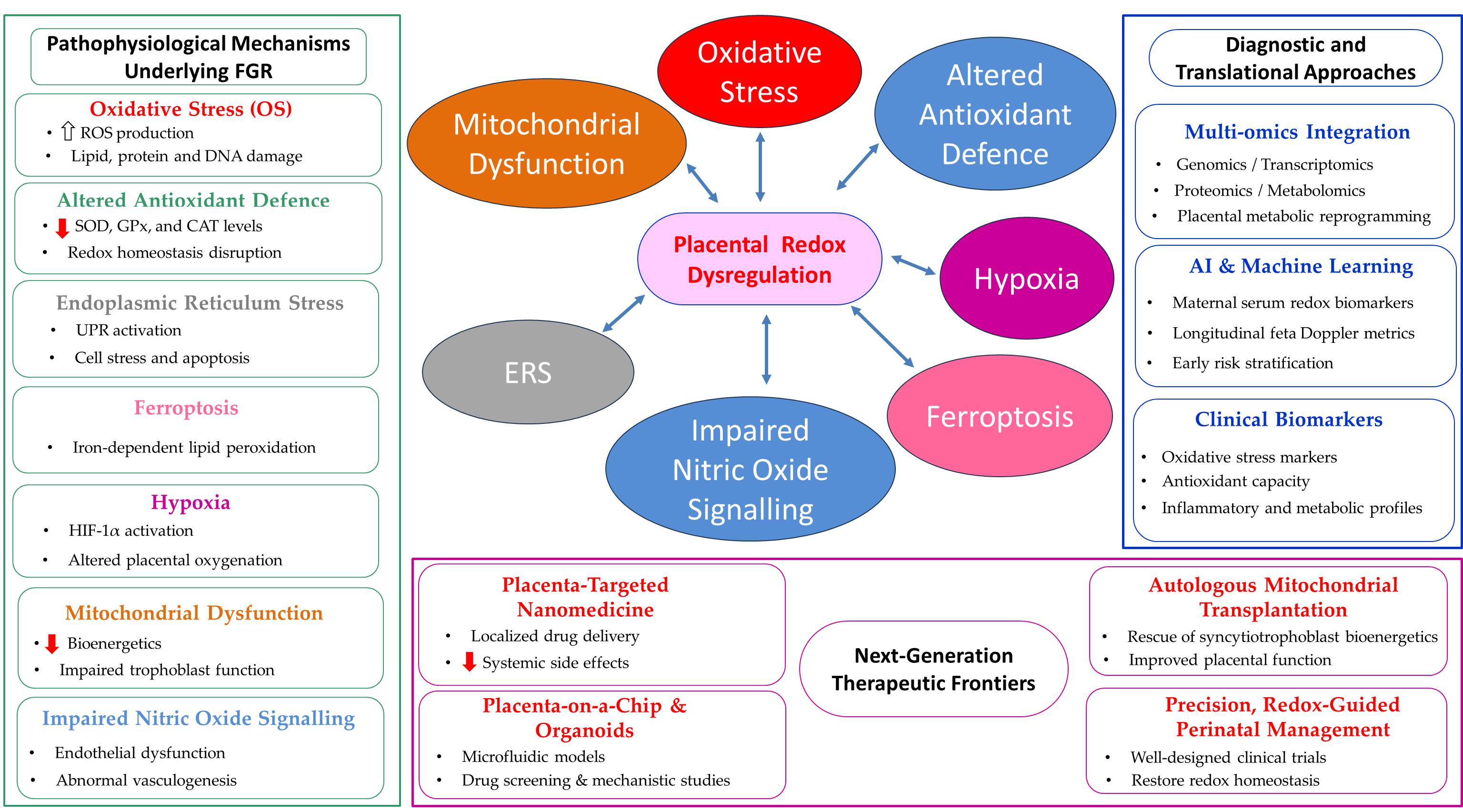
Fetal growth restriction (FGR) is a major obstetric complication associated with increased perinatal morbidity, mortality, and adverse long-term metabolic outcomes in adulthood. Placental dysfunction stands as the principal driver in a substantial proportion of cases, with accumulating evidence indicating that the disruption of placental redox homeostasis plays a central role in its pathophysiology. This review provides a comprehensive synthesis of redox dysregulation in FGR, extending beyond classical oxidative injury to incorporate emerging non-linear paradigms. Excessive production of reactive oxygen species (ROS), coupled with inadequate antioxidant defenses, promotes lipid, protein, and DNA damage, thereby impairing trophoblast function, vascular remodeling, cell survival, and nutrient transport.
Crucially, this review integrates recent breakthroughs in the fields of iron-dependent ferroptosis, endoplasmic reticulum stress, and complex redox-epigenetic cross-talk mediated by non-coding RNAs ("redox-miRs"). Furthermore, we address the translational failure of conventional systemic antioxidant therapies, highlighting the newly recognized paradox of reductive stress, where over-supplementation disrupts essential ROS-dependent signaling cascades during early placentation. To resolve these diagnostic and therapeutic limitations, this work evaluates the clinical utility of multi-omics integration for mapping placental metabolic reprogramming and artificial intelligence (AI) machine learning models that combine maternal serum redox biomarkers with longitudinal fetal Doppler metrics for early risk stratification.
Finally, we explore next-generation obstetric frontiers, including placenta-targeted nanomedicine for localized drug delivery, Placenta-on-a-Chip microfluidic and organoid screening platforms, and autologous mitochondrial transplantation aimed at rescuing syncytiotrophoblast bioenergetics. Overall, current evidence underscores placental redox dysregulation as an interconnected, systemic failure rather than an isolated molecular defect. Moving toward precision, redox-guided perinatal management requires longitudinal human studies and well-designed clinical trials to validate whether the targeted restoration of redox homeostasis can translate into improved maternal, fetal, and neonatal outcomes.
Keywords:
fetal growth restriction
; FGR
; placenta
; oxidative stress
; reductive stress
; reactive oxygen species
; antioxidant defense
; ferroptosis
; oxidative DNA damage
; mitochondrial dysfunction
; mitochondrial transplantation
; nitric oxide
; HIF-1α
; melatonin
; polyphenols
; carotenoids
; vitamin D
; vitamin E
; zinc
; placenta-targeted nanomedicine
; multi-omics
; machine learning
Copyright: This open access article is published under a Creative Commons CC BY 4.0 license, which permit the free download, distribution, and reuse, provided that the author and preprint are cited in any reuse.