

Submitted:
29 October 2026
Posted:
30 October 2026
You are already at the latest version
Abstract
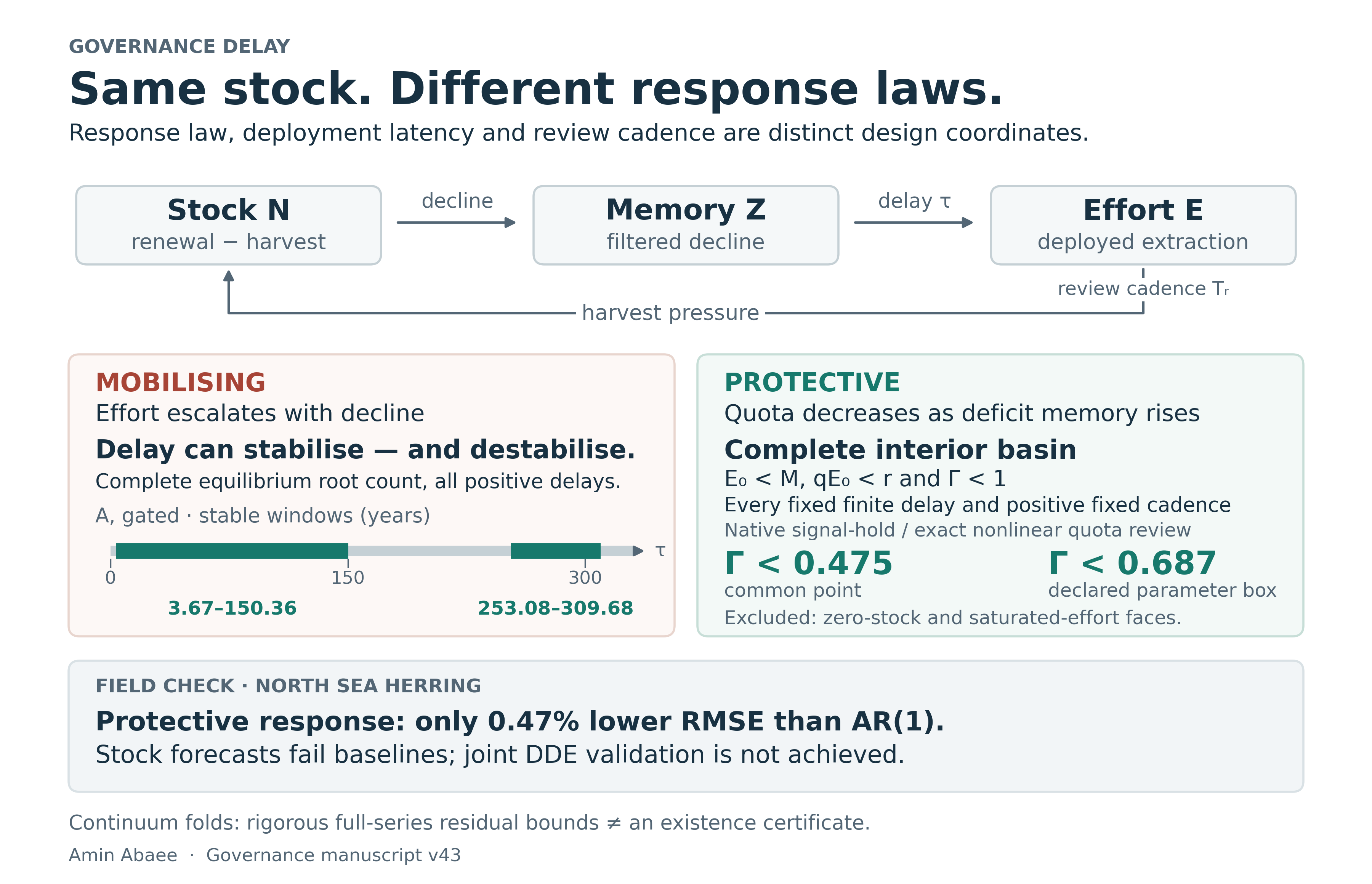
Governance delay links observed resource decline to deployed effort. A stock–memory– effort model compares mobilising effort escalation with protective quota tracking, separating deployment latency from periodic review. For four registered mobilising vectors, an analytic characteristic-root count and interval crossing-order checks classify equilibrium stability on the entire positive delay axis. Candidate A has two stable delay windows, not only the interval between the fundamental Hopf crossings. Classical nonlinear Hopf hypotheses are verified at the declared crossings; these local results do not classify all nonlinear attractors. For the protective law, a nonlinear asymptotic-gain theorem identifies the complete positive-equilibrium basin within the physical state space. It covers every fixed finite delay and every positive fixed cadence under native signal-hold and exact nonlinear quota review. A sufficient gain is below 0.475 at the common point and below 0.687 throughout a declared parameter box. The excluded extinction and saturated-effort faces remain invariant; Euler and mixed-channel laws do not inherit the result. Periodic continuation and capture checks connect the upper stable family. Odd-grid fold refinements and rigorous infinite-Fourier orbit and kernel residual bounds advance con- tinuum validation, without substituting for the missing bordered inverse and contraction proof. Retrospective North Sea herring tests add quantitative field challenges: the pro- tective response narrowly beats AR(1), but the ecological and recursive annual-surrogate stock predictions fail baseline comparisons. These mixed outcomes distinguish conditional response skill from joint dynamic validation of the autonomous delay model. Response law, latency and cadence are mathematical design coordinates whose field identification requires direct institutional measurements and an adequate ecological observation model.
Keywords:
delay differential equations
; institutional feedback
; sampled-data control
; small-gain stability
; harvested stocks
; Hopf bifurcation
; regime shifts
Copyright: This open access article is published under a Creative Commons CC BY 4.0 license, which permit the free download, distribution, and reuse, provided that the author and preprint are cited in any reuse.