

Submitted:
29 October 2026
Posted:
30 October 2026
You are already at the latest version
Abstract
This study investigates the bond behaviour of reinforced concrete incorporating fine recycled aggregate (RFA) under reinforcement corrosion, focusing on the effects of RFA replacement and radial confinement.
Four concrete mixtures were produced with 0%, 20%, 50% and 100% replacement of natural fine aggregate by RFA obtained from a demolished concrete bridge. Pull-out specimens incorporating 16 mm reinforcing bars were manufactured with specimen diameters of 100 and 150 mm to provide different levels of radial confinement. Reinforcement corrosion was accelerated by impressed current at a nominal current density of 150 μA/cm², considering non-corroded, low-corrosion and high-corrosion conditions. Corrosion-induced steel mass loss and peak bond stress were determined from the experimental tests.
The imposed corrosion exposure did not result in the same actual corrosion level for all mixtures. Steel mass loss generally decreased with increasing RFA content despite the controlled galvanostatic exposure. Bond strength was generally lower at higher RFA replacement ratios, although the effect was not monotonic across all corrosion and confinement conditions. Comparisons at similar corrosion mass losses showed a more consistent influence of specimen diameter, with the larger diameter generally providing higher bond strength.
Radial confinement had a more pronounced influence on bond behaviour than RFA content, although the percentage of RFA also affected bond strength and should be considered. The actual corrosion mass loss should also be accounted for when assessing bond degradation.
Keywords:
fine recycled aggregate
; recycled aggregate concrete
; recycled fine aggregate
; bond strength
; rein-forcement corrosion
; pull-out test
1. Introduction
Concrete is the most widely used construction material, but its production involves significant consumption of natural resources and generation of construction and demolition waste (CDW). The use of recycled aggregates (RA) in concrete is a promising strategy to reduce these environmental impacts and improve construction sustainability [1,2].
The incorporation of recycled fine aggregate (RFA) improves concrete sustainability but can negatively affect its mechanical properties, mainly due to its higher water absorption and lower density [3,4,5,6,7,8,9,10]. Proper mix design and improved RFA processing can mitigate these effects, enabling its use in structural concrete. As the use of this type of aggregate becomes more extensive, there is more interest in the underlying properties that are not well understood such as bond [11] and corrosion propagation [12].
Bond strength is essential for the structural performance of reinforced concrete, as it governs stress transfer between steel reinforcement and concrete. Extensive research has identified several key parameters affecting bond strength, including rebar geometry, concrete compressive strength, rebar position, boundary conditions, and concrete cover [11,13,14,15,16].
Corrosion of steel directly affects in a negative way the bond capacity following a well-known mechanism that can be severely affected by the environment (salinity, humidity, temperature, etc). The formation of corrosion products induces splitting stresses that can produce cracking and even spalling of the concrete cover [13,17,18]. The result is a reduction in confinement of the reinforcement, decreasing also the bond strength due to the damage of the steel-concrete interface, and finally, this degradation mechanism can lead to anchorage failures with their structural risk.
The evaluation of corrosion of reinforced concrete faces a challenge of representativity. The underlying phenomenon is complex with multiple variables that can affect (Cl- content, pH, humidity, etc) that produce even that, in the same structure, some parts are severely damaged and others are in good condition [19] uneven effects. The usual approximation in laboratory is to promote accelerated corrosion with external current, and to allow for comparability the recommendation is to limit the current to 200 μA/cm² for accelerated corrosion tests [20,21]. With this, there is a limitation on the risk of introducing excessive damage mechanisms associated with very high current densities. However, in any case, the accelerated testing can indicate trends, however they should be confirmed with natural corrosion investigations.
The incorporation of recycled aggregate on corrosion propagation has been studied scarcely. Fernandez et al. [12], with coarse aggregate, refers to negligible effects up to 50% of replacement and also reports that the initial cracking happened later in recycled concrete, and this could be beneficial to withstand corrosion degradation. Yang et al. [18], also with coarse aggregate, identifies the opposite trend, referring to a decrease in corrosion resistance. This same negative correlation of recycled aggregate content and corrosion rate is also reported by the review work of Liang et al. [22].
This study aims to investigate the bond behavior between steel reinforcement and concrete incorporating fine recycled aggregates under corrosion conditions, and to evaluate its suitability for use in structural applications. The effect of reinforcement corrosion on bond strength in concrete incorporating recycled fine aggregates (RFA) at different replacement ratios is analyzed, along with the influence of confinement.
2. Materials and Methods
2.1. Materials and Mix Proportion
The recycled aggregates used in this study were obtained from demolition waste of a structural concrete bridge (Gullspång bridge, NW Sweden), built in 1935 and demolished in 2016 due to severe corrosion damage. The most deteriorated edge beams were collected and stored at Chalmers University of Technology for research purposes [23,24]. Core tests indicated an average compressive strength of 45.6 ± 4.6 MPa [23,24,25] .
The beams were processed using a portable jaw crusher, producing a mixed recycled aggregate stream. A magnetic separator was used to recover reinforcing steel. The resulting material showed a continuous grading and was separated into sand (0/4 mm) and gravel fractions (8/16 and 16/25 mm). Only the fine fraction (<4 mm) was used in this study, incorporated at replacement levels of 0%, 20%, 50%, and 100%. Natural granitic sand (0/4 mm) and natural gravel (4/16 mm) were used as complementary aggregates.
A CEM I 42.5 R cement was used [26] , together with a naphthalene-based superplasticizer to ensure workability.
Table 1 summarizes aggregate properties, only the 0–4 mm fraction of recycled aggregate was selected. Recycled fine aggregates are known to contain higher fines content, more angular particles, and rougher texture compared to natural sand [27], with fines content reported between 1–10% depending on source and processing [28]. Increased fines content has also been associated with repeated crushing cycles [29].
Four concrete mixtures were designed: one control mix (H0) and three mixes incorporating recycled fine aggregate (RFA) at replacement levels of 20%, 50%, and 100% (H20, H50, and H100). No recycled coarse aggregate was used in order to isolate the effect of RFA on bond behavior, given its known influence on strength and stiffness.
The concrete was produced with natural aggregates: 943 kg/m3 of 0/4 natural sand and 911 kg/m3 of 8/16 gravel. The quantity of cement in the mix was 365 kg/m3 of CEM I 42.5 R (SS-EN197-1: 2011) with a water to cement ratio of 0.47, which is acceptable for aggressive environments. To achieve acceptable workability the composition included 1% of cement weight in superplasticizer (Glenium 5118).
To provide sufficient electrical conductivity within the concrete matrix and facilitate the initiation of corrosion under the applied current, 4% NaCl by mass of water (free, not absorbed) was incorporated into the concrete mixture (for all mixes). The inclusion of chloride ions ensured adequate ionic conductivity and provided the conditions necessary for corrosion initiation during the accelerated electrochemical exposure.
Due to the high water absorption of the recycled sand (10.4%, Table 1), water adjustment was required during mix design. This value is significantly higher than that of natural aggregates. In addition, natural aggregates exhibited variable moisture conditions as a result of open-air storage, reflecting typical industrial practice. To account for these factors, the mixing water was corrected considering the initial moisture content of the aggregates. The absorbed water was not included in the effective w/c ratio, as it remains within the pores of the aggregates. Following common recommendations in the literature [9,30], only 80% of the absorption capacity of the recycled aggregate was compensated through additional water.
Fresh properties (slump and density) were first evaluated, followed by hardened properties at 28 days, including density and compressive strength.
2.2. Test Specimens
Bond test specimens consisted of concrete cylinders with a centrally embedded 16 mm diameter rebar. Two specimen diameters were considered, 100 mm and 150 mm (Figure 1), while the total height was kept constant at 140 mm. This configuration provided a bonded length of 80 mm (5 times the bar diameter) and two unbonded zones of 30 mm at both ends. The unbonded regions were introduced following RILEM RC6 recommendations to clearly define the bonded length and reduce end effects. These zones were created using plastic sleeves to prevent adhesion between steel and concrete.
For each mixture, three specimens were cast, demoulded after 24 h, and cured under controlled conditions (20 °C, water immersion) until testing, in accordance with EN 12390-2. Mechanical properties were determined using 150 mm cubes and 150×300 mm cylinders for compressive strength (EN 12390-3), and 150×300 mm cylinders for tensile strength (EN 12390-6).
Specimens were cast in standard cylindrical moulds with diameters of 100 and 150 mm. Casting was carried out upside down, and polystyrene inserts were used to control specimen height (Figure 2). The two diameters represent different confinement levels: 100 mm specimens correspond to typical cover conditions in beams and columns, while 150 mm specimens simulate higher confinement, as found in bridge or marine structures.
2.3. Accelerated Corrosion Procedure
The corrosion behaviour of the recycled aggregate concrete specimens was investigated using an accelerated corrosion technique based on the application of a constant electrical current. A current density of 150 μA/cm² was maintained throughout the corrosion exposure. This value was selected to remain below the commonly recommended upper limit of 200 μA/cm² for accelerated corrosion tests [20,21], thereby promoting a controlled acceleration of the corrosion process while limiting the risk of introducing excessive damage mechanisms associated with very high current densities. The samples were connected to 4 DC sources, two for Low corrosion and two more for High corrosion (Figure 3) with a 3 samples per typology (% RFA substitution, confinement and corrosion level). The cathode was a copper mesh surrounding the electrolyte solution: water with a 4% of NaCl.
Following casting, the specimens were cured in a controlled humidity chamber at 20 °C and 95% relative humidity until reaching an age of 28 days. After the curing period, the specimens were subjected to the accelerated corrosion procedure. A part of the samples were kept in the humidity chamber for reference and two additional groups suffered from two corrosion exposure levels: Low Corrosion (LC): accelerated corrosion exposure for 7 days, and High Corrosion (HC): accelerated corrosion exposure for 28 days.
2.4. Characterization and Pull-Out Test
The bond performance between the reinforcing steel and the recycled aggregate concrete was assessed by means of pull-out tests. All specimens, irrespective of their corrosion exposure level, were tested at an age of 180 days. This testing age was selected to ensure a common reference age for the comparison of the uncorroded and corroded specimens and to assess the effect of the different corrosion durations on the steel–concrete bond behaviour.
The experimental programme therefore comprised different corrosion exposure conditions, with corrosion duration serving as the principal variable. The pull-out response obtained at 180 days was used to evaluate the influence of accelerated corrosion on the bond performance of recycled aggregate concrete.
Load and slip were recorded during testing to obtain load–slip relationships for each mixture and confinement level, allowing the assessment of bond behavior of concrete incorporating RFA under different confinement states and corrosion levels.
The experimental program covered the characterization of concrete in fresh and hardened states, together with bond performance. Slump and fresh density were measured according to EN 12350-2 [31] and EN 12350-6 [32]. Hardened density (EN 12390-7 [33]) was determined at 24 h, and compressive strength (EN 12390-3 [34]) at 28 days using 150 mm cubes (fc,cub) and cylinders (fc,cyl).
Bond behavior was evaluated by pull-out tests following RILEM TC9-RC6 [35], under displacement control at 0.01 mm/s. Load and slip were continuously recorded using a load cell and displacement transducers (±0.001 mm), enabling the load–slip response up to peak load (Figure 4).
The analysis focuses on the peak bond stress (τb,max), derived from the maximum load, as the main indicator of bond performance. Although pull-out tests do not fully reproduce anchorage conditions in structural members, they provide a controlled framework for comparing mixtures and assessing the influence of recycled fine aggregate.
3. Results
3.1. Consistency and Density
Table 2 presents the principal characteristics of the concrete mixtures analyzed. All mixes showed adequate workability, with slump values ranging between 10 and 20 cm.
A gradual reduction in density was observed as the replacement level increased. In the fresh state, the density decreased by 1.3%, 3.0%, and 6.0% for substitution ratios of 20%, 50%, and 100%, respectively. A similar trend was obtained after curing, where the hardened density was reduced by 3.4%, 2.2%, and 3.9% for the same respective replacement levels.
3.2. Compressive and Tensile Splitting Strength
Table 3 summarizes the 28-day mechanical properties of all concrete mixtures studied, including compressive and tensile strength. In general, the incorporation of recycled fine aggregate (RFA) leads to a lower mechanical performance, in line with trends reported in previous studies on recycled aggregate concrete [3,5,9].
Regarding compressive strength, the reference mixture (H0) reached 51.60 MPa. All mixtures containing RFA exhibited lower values. The 20% replacement level (H20) decreased to 42.72 MPa, while the 50% mixture (H50) showed 46.08 MPa, indicating some variability between intermediate substitution levels. For full replacement (H100), a value of 42.87 MPa was obtained, confirming an overall weakening of compressive capacity with increasing recycled content.
A similar tendency was observed for tensile strength at 28 days. The control mix (H0) reached 4.63 MPa, whereas the RFA mixtures showed lower values of 2.77 MPa (H20), 2.97 MPa (H50), and 2.90 MPa (H100). Although minor variations appear among the recycled mixtures, all results consistently indicate a lower tensile performance compared to the reference concrete. This behavior is consistent with the general response of recycled aggregate concretes reported in the literature [3,4,36,37].
3.3. Corrosion
Table 4 summarizes the corrosion mass loss results obtained for the different cases studied.
The corrosion process was accelerated by means of an imposed anodic current, with the specimens electrically connected in series to ensure a constant current flow through all samples. Under these conditions, a comparable corrosion rate would be expected for all specimens, independently of concrete cover thickness and mixture composition, since the total applied current is uniformly distributed through the circuit.
For the 100 mm specimens, the results show that corrosion-induced mass loss is higher under high corrosion conditions (HC) than under low corrosion conditions (LC). In the reference concrete (H0), the mass loss increases from 5.4% under LC to 9.2% under HC. A similar trend is observed for the mixtures incorporating recycled fine aggregate (RFA), with values increasing from 5.0% to 7.0% for H20, from 2.5% to 6.8% for H50, and from 2.9% to 6.6% for H100.
Although a similar corrosion current was imposed in all specimens, a clear reduction in corrosion-induced mass loss is observed as the RFA content increases. Under LC conditions, the mass loss decreases from 5.4% for the reference mixture to 5.0% for H20, reaching lower values of 2.5% and 2.9% for H50 and H100, respectively. A comparable trend is observed under HC conditions, although less pronounced.
For the 150 mm specimens, the same general behaviour is observed. Mass loss increases from 7.9% under LC to 10.0% under HC for the reference mixture (H0). For the recycled mixtures, values increase from 5.0% to 8.4% for H20, from 2.5% to 7.0% for H50, and from 3.2% to 7.2% for H100.
Despite the use of a controlled galvanostatic setup intended to impose a uniform corrosion driving force, the results indicate a systematic decrease in corrosion-induced mass loss with increasing recycled fine aggregate content. This suggests that the accelerated corrosion setup delivered a corrosion level not governed solely by the applied current and geometrical factors. It is a complex phenomenon and with significant uncertainties. There is not an agreement on the reasons behind of this behaviour as there are many underlying factors. Fernandez et al. [12] with recycled coarse aggregate reports negligible effect on corrosion of the recycled aggregate concrete, and on the other hand, Sirico et al. [38], also with recycled coarse aggregate, reports an slight increase in corrosion with the recycled aggregate substitution.
The observed differences may be related to changes in the electrochemical environment associated with the use of RFA, although the present experimental programme does not allow the mechanisms responsible for this behaviour to be established
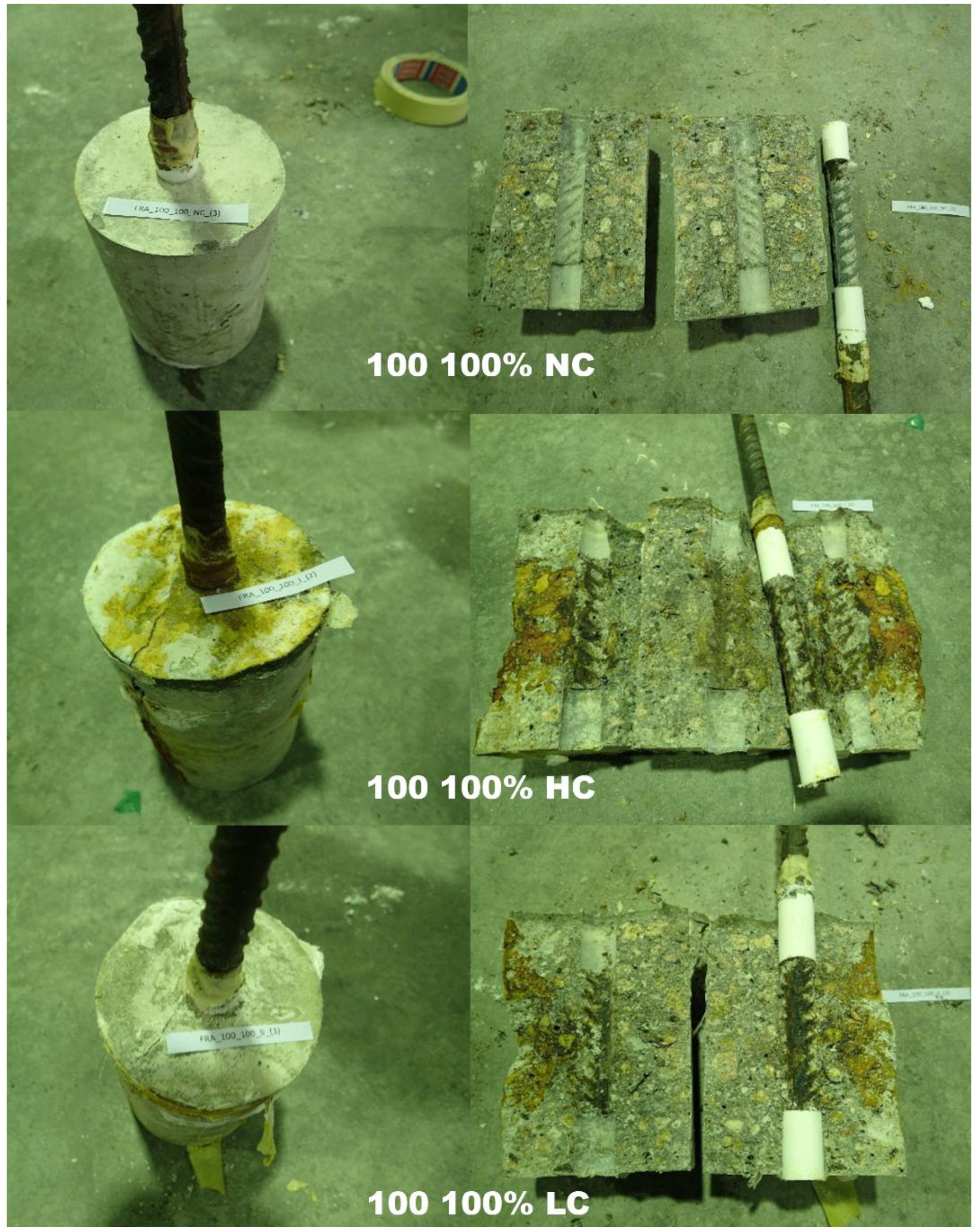
Figure 5.
Test specimens after testing.
3.4. Bond Stresses
The main objective of this work was to characterize the bond behaviour of concrete incorporating recycled fine aggregate, with particular emphasis on the influence of the fine aggregate replacement ratio (0%, 20%, 50% and 100%), the corrosion level (NC, LC and HC), and the degree of confinement (100 and 150 mm). All pull-out tests were conducted at 180 days. The results obtained from the pull-out tests are summarized in Table 5 for each concrete mixture, corrosion level, and confinement condition, where the bond stress was calculated according to the following expression:
τb=Q/(π·φ·lb)
Where τb is bond stress (MPa), Q is the experimentally recorded load (kN), φ is bar diameter (16 mm) and lb is the bond length (80 mm). The results presented represent the mean values obtained for each type of concrete.
This formulation is widely used in bond-related studies and provides a standard measure of average bond stress, enabling consistent comparison with previous literature. In this study, the analysis focuses on the bond behaviour up to the peak load, where the assumption of uniform bond stress is considered appropriate.
The bond strength (τb) generally decreases with increasing RFA replacement ratio, both in corroded and non-corroded concretes. For the 100 mm specimens under non-corroded conditions (NC), τb decreases from 12.9 MPa for the reference concrete to 10.8 MPa for the 100% RFA mixture. Under low corrosion (LC), the reduction is more pronounced, with τb decreasing from 17.2 MPa (H0) to 8.2 MPa (H100). A similar tendency is observed under high corrosion (HC), where bond strength decreases overall from 5.7 MPa for the control mix to values between 3.9 and 5.2 MPa for the recycled mixtures.
A comparable trend is observed for the 150 mm specimens. Under NC conditions, τb decreases from 24.2 MPa for H0 to 13.8 MPa for H100. Under LC conditions, bond strength remains relatively high but still tends to decrease with increasing RFA content, from 23.4 MPa for H20 to 19.9 MPa for H50. Under HC conditions, the results are more scattered, although the general tendency still indicates lower bond performance for mixtures with high RFA contents.
The results generally showed lower bond strength at higher RFA replacement ratios, although the effect was not monotonic across all corrosion and confinement conditions.
Direct comparisons of bond strength as a function of the nominal corrosion level (LC and HC) should be interpreted with caution. Due to the impressed-current corrosion procedure employed in this study, different corrosion mass losses were obtained for the various mixtures despite being subjected to the same corrosion exposure. As a result, specimens classified under the same corrosion condition did not necessarily reach the same actual degree of steel corrosion. Since bond deterioration is primarily related to the extent of corrosion rather than to the exposure category itself, a direct comparison between LC and HC specimens may not accurately reflect the influence of RFA content. Therefore, the effect of RFA replacement and confinement was assessed by comparing specimens exhibiting similar corrosion-induced mass losses.
The specimens H0-100-HC and H0-150-HC exhibited corrosion mass losses of 9.2% and 10.0%, respectively, while the corresponding bond strengths were 5.7 MPa and 11.5 MPa. Despite the similar corrosion levels, the specimen with the larger confinement length showed approximately twice the bond strength, highlighting the significant influence of confinement on bond performance.
A second comparison can be established between H0-150-LC and H20-150-HC, which exhibited corrosion mass losses of 7.9% and 8.4%, respectively. The corresponding bond strengths were 21.8 MPa and 7.9 MPa. However, the H0-150-LC and H20-150-HC specimens showed a particularly high scatter in the results, making it difficult to draw firm conclusions regarding the influence of RFA content from this comparison alone.
A larger group of specimens exhibited corrosion mass losses within a narrow range of approximately 6.6–7.2%, namely H20-100-HC, H50-100-HC, H100-100-HC, H50-150-HC and H100-150-HC. Their bond strengths were 9.5, 3.9, 5.2, 11.8 and 10.2 MPa, respectively. The results again demonstrate the strong influence of confinement, as the 150 mm specimens consistently exhibited higher bond strengths than the corresponding 100 mm specimens. Within the 100 mm series, a noticeable reduction in bond strength was observed when the RFA replacement ratio increased from 20% to 50%, whereas the difference between 50% and 100% replacement was comparatively small.
A similar trend was observed for specimens exhibiting corrosion mass losses close to 5%. The specimens H0-100-LC, H20-100-LC and H20-150-LC presented corrosion mass losses of 5.4%, 5.0% and 5.0%, respectively, with corresponding bond strengths of 17.2, 10.4 and 23.4 MPa. Comparison of the latter two specimens again highlights the beneficial effect of confinement. In addition, comparison between H0-100-LC and H20-100-LC suggests a substantial reduction in bond strength when 20% of the natural fine aggregate is replaced by RFA.
Finally, the specimens H50-100-LC, H100-100-LC, H50-150-LC and H100-150-LC exhibited corrosion mass losses between 2.5% and 3.2%, with bond strengths of 8.5, 8.2, 19.9 and 21.8 MPa, respectively. Once again, confinement appears to be the dominant parameter affecting bond performance, while only minor differences were observed between mixtures containing 50% and 100% RFA.
Overall, the comparison of specimens with similar corrosion mass losses indicates that confinement exerts a more pronounced and consistent influence on bond strength than the RFA replacement ratio. Although some reduction in bond performance is observed with increasing RFA content, this effect is less systematic and appears to be secondary to the influence of confinement. These results suggest that, beyond a replacement ratio of approximately 50%, the influence of RFA content on bond strength becomes negligible, at least for the corrosion levels considered in this study.
In summary, in this campaign, the degradation of bond strength with corrosion was targeted. At similar levels of corrosion, the RFA concrete shows higher reduction in bond strength up to 50% of substitution; with higher replacements the effect is negligible. There are no references to compare with fine recycled aggregate concrete under corrosion, however the works with RCA show two trends, some authors refer that under corrosion, the increase of recycled aggregate results in a reduction in bond strength. Other authors [12,38,39] refer to unclear or no effects whit the recycled aggregate.
4. Conclusions
This work looks forward to identifying trends of the bond behavior of concretes with different replacement ratios of recycled fine aggregate (0%, 20%, 50, 100%) in test specimens with different degrees of confinement and corrosion level. Although mean values differ, the overlap of confidence intervals suggests these differences should be interpreted cautiously. With this disclaimer, the experimental results the following conclusions can be drawn:
- The impressed-current corrosion procedure did not produce a uniform corrosion level across all mixtures, as the measured corrosion mass loss varied depending on the RFA replacement ratio.
- The bond strength is substantially affected by steel corrosion, with a clear reduction in τb observed as corrosion mass loss increases. This effect is consistent across all mixtures and confinement conditions.
- The degree of confinement has a strong and consistent influence on bond behaviour. Specimens with 150 mm specimen diameter exhibited higher bond strength than those with 100 mm, even at similar corrosion levels, confirming the beneficial role of confinement in mitigating bond degradation.
- The incorporation of recycled fine aggregate generally leads to a reduction in bond strength compared to conventional concrete. However, this effect is not strictly monotonic and depends on the corrosion level and confinement condition.
- When comparing specimens with similar corrosion mass losses, the influence of RFA content becomes less pronounced and appears secondary to that of confinement. In particular, differences between 50% and 100% RFA replacement are minimal, suggesting a threshold effect beyond which further replacement does not substantially affect bond performance.
- Overall, among the variables investigated, confinement exhibited the most consistent influence on bond strength, followed by corrosion level, while the influence of RFA content is comparatively less systematic.
Data Availability Statement
The original contributions presented in this study are included in the article. Further inquiries can be directed to the corresponding author.
Acknowledgments
The study was possible thanks to the collaboration of CITEEC (Construction laboratories of Technological Innovation Centre of Building) at Universidade da Coruña and the Division of Structural Engineering, Architecture and Civil Engineering at Chalmers University of Technology. Some results are linked to the short stay funded by the José Castillejo program of the Spanish Ministry of Education.
References
- de Brito, J.; Kurda, R. The past and future of sustainable concrete: A critical review and new strategies on cement-based materials. J. Clean. Prod. 2021, 281, 123558. [Google Scholar] [CrossRef]
- Coffetti, D.; Crotti, E.; Gazzaniga, G.; Carrara, M.; Pastore, T.; Coppola, L. Pathways towards sustainable concrete. Cem. Concr. Res. 2022, 154, 106718. [Google Scholar] [CrossRef]
- Khoshkenari, A.G.; Shafigh, P.; Moghimi, M.; Bin Mahmud, H. The role of 0-2mm fine recycled concrete aggregate on the compressive and splitting tensile strengths of recycled concrete aggregate concrete. Mater. Des. 2014, 64, 345–354. [Google Scholar] [CrossRef]
- Rahal, K. Mechanical properties of concrete with recycled coarse aggregate. Build. Environ. 2007, 42, 407–415. [Google Scholar] [CrossRef]
- Fan, C.C.; Huang, R.; Hwang, H.; Chao, S.J. The effects of different fine recycled concrete aggregates on the properties of Mortar. Materials 2015, 8, 2658–2672. [Google Scholar] [CrossRef]
- Hassanean, Y.A.; Rashwan, M.M.; Assaf, K.A.; Abd el Samee, K. Influence of Size and Replacement Ratio of Recycled Concrete Aggregate on Concrete Properties. JES. J. Eng. Sci. 2014, 42, 50–63. [Google Scholar] [CrossRef]
- Belén, G.F.; Fernando, M.A.; Diego, C.L.; Sindy, S.P. Stress-strain relationship in axial compression for concrete using recycled saturated coarse aggregate. Constr. Build. Mater. 2011, 25, 2335–2342. [Google Scholar] [CrossRef]
- González-Taboada, I.; González-Fonteboa, B.; Martínez-Abella, F.; Carro-López, D. Self-compacting recycled concrete: Relationships between empirical and rheological parameters and proposal of a workability box. Constr. Build. Mater. 2017, 143, 537–546. [Google Scholar] [CrossRef]
- Carro-López, D.; González-Fonteboa, B.; De Brito, J.; Martínez-Abella, F.; González-Taboada, I.; Silva, P. Study of the rheology of self-compacting concrete with fine recycled concrete aggregates. Constr. Build. Mater. 2015, 96, 491–501. [Google Scholar] [CrossRef]
- Tang, Y.; Xiao, J.; Zhang, H.; Duan, Z.; Xia, B. Mechanical properties and uniaxial compressive stress-strain behavior of fully recycled aggregate concrete. Constr. Build. Mater. 2022, 323, 126546. [Google Scholar] [CrossRef]
- Eiras-López, J.; Berrocal, C.G.; Fernández, I.; Carro-López, D. Bond behavior between steel reinforcement and concrete with recycled fine aggregate under different confinement levels. J. Build. Eng. 2026, 124, 116042. [Google Scholar] [CrossRef]
- Fernandez; Etxeberria, M.; Marí, A.R. Ultimate bond strength assessment of uncorroded and corroded reinforced recycled aggregate concretes. Constr. Build. Mater. 2016, 111, 543–555. [Google Scholar] [CrossRef]
- International Federation for Structural Concrete - FIB. Testing of bond for corroded reinforced concrete specimens. FIB Bull. 106 Adv. Bond Concr. State-Of.-The-Art. Rep. 2022, 230–246. [Google Scholar] [CrossRef]
- Ajdukiewicz; Kliszczewicz, A.; Kim, S.W.; Do Yun, H.; Park, W.S.; Jang, Y. Il; Jang, S.J.; Do Yun, H.; Yalciner, H.; O. Eren, S. Sensoy, Influence of recycled aggregates on mechanical properties of HS/HPC. Cem. Concr. Compos. 2012, 24, 643–655. [Google Scholar] [CrossRef]
- Seara-Paz, S.; González-Fonteboa, B.; Eiras-López, J.; Herrador, M.F. Bond behavior between steel reinforcement and recycled concrete. Mater. Struct. 2014, 47, 323–334. [Google Scholar] [CrossRef]
- Yalciner, H.; Eren, O.; Sensoy, S. An experimental study on the bond strength between reinforcement bars and concrete as a function of concrete cover, strength and corrosion level. Cem. Concr. Res. 2012, 42, 643–655. [Google Scholar] [CrossRef]
- Fernandez; Herrador, M.F.; Marí, A.R.; Bairán, J.M. Ultimate Capacity of Corroded Statically Indeterminate Reinforced Concrete Members. Int. J. Concr. Struct. Mater. 2018, 12. [Google Scholar] [CrossRef]
- Yang, H.; Deng, Z.; Ingham, J.M. Bond position function between corroded reinforcement and recycled aggregate concrete using beam tests. Constr. Build. Mater. 2016, 127, 518–526. [Google Scholar] [CrossRef]
- Becerra-Mosquera, J.A.; Carro-López, D.; Herrador, M.F. The Arousa Island bridge. Complete refurbishment and 10 years analysis description. Struct. Concr. 2024, 25, 1554–1570. [Google Scholar] [CrossRef]
- fib Task Group 2.5, fib Bulletin 106 - Advances on bond in concrete, State of art report. 2022.
- Andrade, C.; Alonso, C. Corrosion rate monitoring in the laboratory and on-site. Constr. Build. Mater. 1996, 10, 315–328. [Google Scholar] [CrossRef]
- Liang, C.; Cai, Z.; Wu, H.; Xiao, J.; Zhang, Y.; Ma, Z. Chloride transport and induced steel corrosion in recycled aggregate concrete: A review. Constr. Build. Mater. 2021, 282, 122547. [Google Scholar] [CrossRef]
- Robuschi, S.; Lundgren, K.; Fernandez, I.; Flansbjer, M. Anchorage of naturally corroded, plain reinforcement bars in flexural members. Mater. Struct. Constr. 2020, 53, 1–21. [Google Scholar] [CrossRef]
- Robuschi, S.; Sumearll, J.; Fernandez, I.; Lundgren, K. Bond of naturally corroded, plain reinforcing bars in concrete. Struct. Infrastruct. Eng. 2021, 17, 792–808. [Google Scholar] [CrossRef]
- Yu, X.; Robuschi, S.; Fernandez, I.; Lundgren, K. Numerical assessment of bond-slip relationships for naturally corroded plain reinforcement bars in concrete beams. Eng. Struct. 2021, 239, 112309. [Google Scholar] [CrossRef]
- AENOR, EN 197-1; Cement. Composition, specifications and conformity criteria for common cements. 2011.
- Nedeljković, M.; Visser, J.; Šavija, B.; Valcke, S.; Schlangen, E. Use of fine recycled concrete aggregates in concrete: A critical review. J. Build. Eng. 2021, 38. [Google Scholar] [CrossRef]
- Kirthika, S.K.; Singh, S.K.; Chourasia, A. Alternative fine aggregates in production of sustainable concrete- A review. J. Clean. Prod. 2020, 268, 122089. [Google Scholar] [CrossRef]
- Thomas, C.; de Brito, J.; Cimentada, A.; Sainz-Aja, J.A. Macro- and micro- properties of multi-recycled aggregate concrete. J. Clean. Prod. 2020, 245, 118843. [Google Scholar] [CrossRef]
- Carro-López, D.; González-Fonteboa, B.; Martínez-Abella, F.; González-Taboada, I.; de Brito, J.; Varela-Puga, F.; More, S. Proportioning, fresh-state properties and rheology of self-compacting concrete with fine recycled aggregates. Hormigón Y Acero 2018, 69, 213–221. [Google Scholar] [CrossRef]
- AENOR, UNE-EN 12350-2:2020; Testing fresh concrete - Part 2: Slump test. 2020.
- AENOR, UNE-EN 12350-6:2020; Testing fresh concrete - Part 6: Density. 2020.
- AENOR, UNE-EN 12390-7:2020; Testing hardened concrete - Part 7: Density of hardened concrete. 2020.
- AENOR, UNE-EN 12390-3:2020; Testing hardened concrete - Part 3: Compressive strength of test specimens. 2020.
- Rilem, R.C.6. Bond test for reinforcement steel. 2. Pull-Out. Test. RILEM Tech. Recomm. Test. Use Constr. Mater. 2020, 627–629. [Google Scholar] [CrossRef]
- Evangelista, L.; de Brito, J. Mechanical behaviour of concrete made with fine recycled concrete aggregates. Cem. Concr. Compos. 2007, 29, 397–401. [Google Scholar] [CrossRef]
- Dong, H.; Song, Y.; Cao, W.; Sun, W.; Zhang, J. Flexural bond behavior of reinforced recycled aggregate concrete. Constr. Build. Mater. 2019, 213, 514–527. [Google Scholar] [CrossRef]
- Sirico; Palii, O.; Belletti, B.; Bernardi, P.; Pappalardo, M.; Sanchez, J.; Plaza, P.; Medina, C. Bond performance assessment of uncorroded and corroded reinforced recycled aggregate concrete. Constr. Build. Mater. 2025, 470. [Google Scholar] [CrossRef]
- Zhao, 39 Y.; Lin, H.; Wu, K.; Jin, W. Bond behaviour of normal/recycled concrete and corroded steel bars. Constr. Build. Mater. 2013, 48, 348–359. [Google Scholar] [CrossRef]
Figure 1.
Scheme of the two confinement levels of the bond samples: 100 & 150.
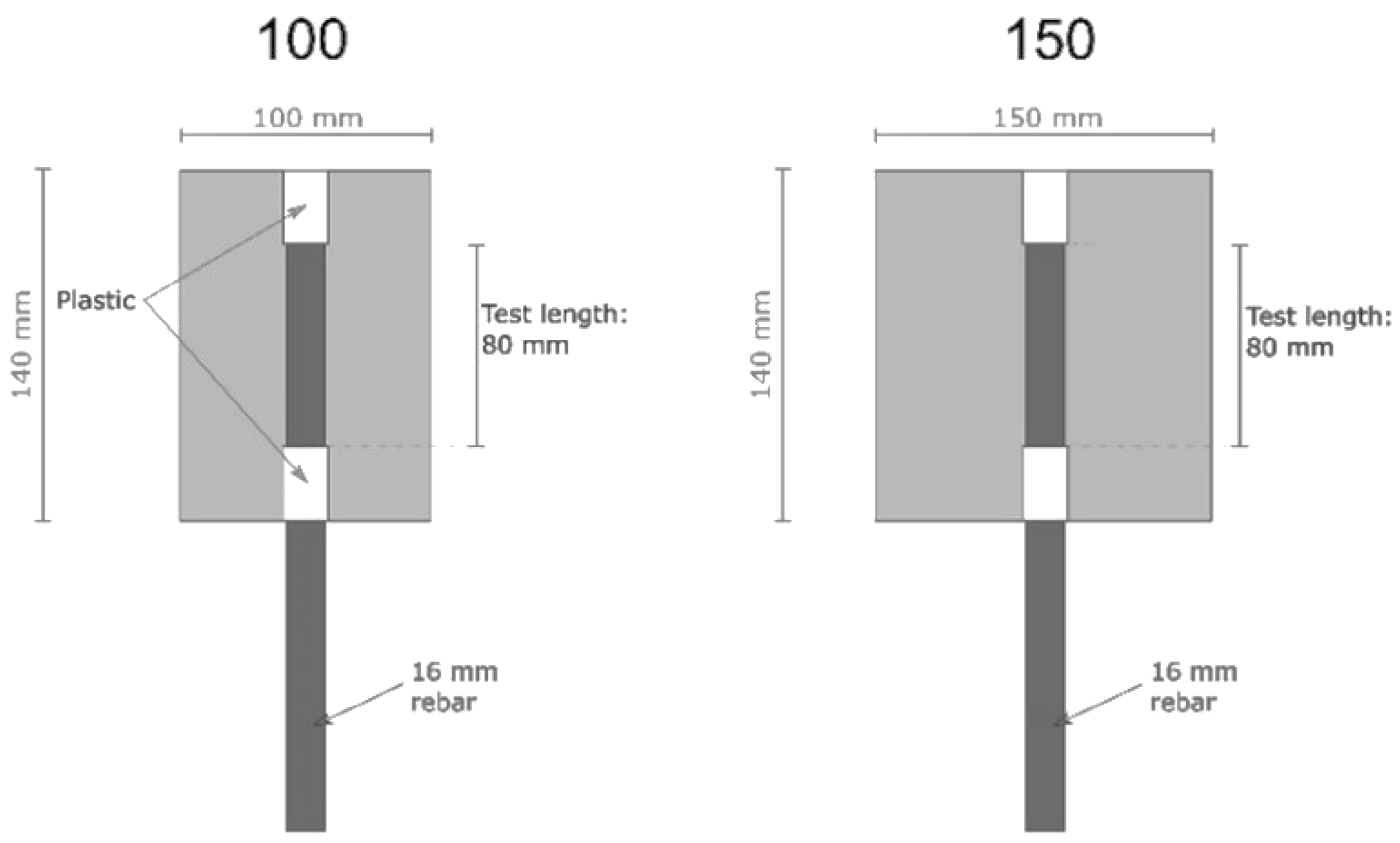
Figure 2.
Details of the casting of bond specimens.
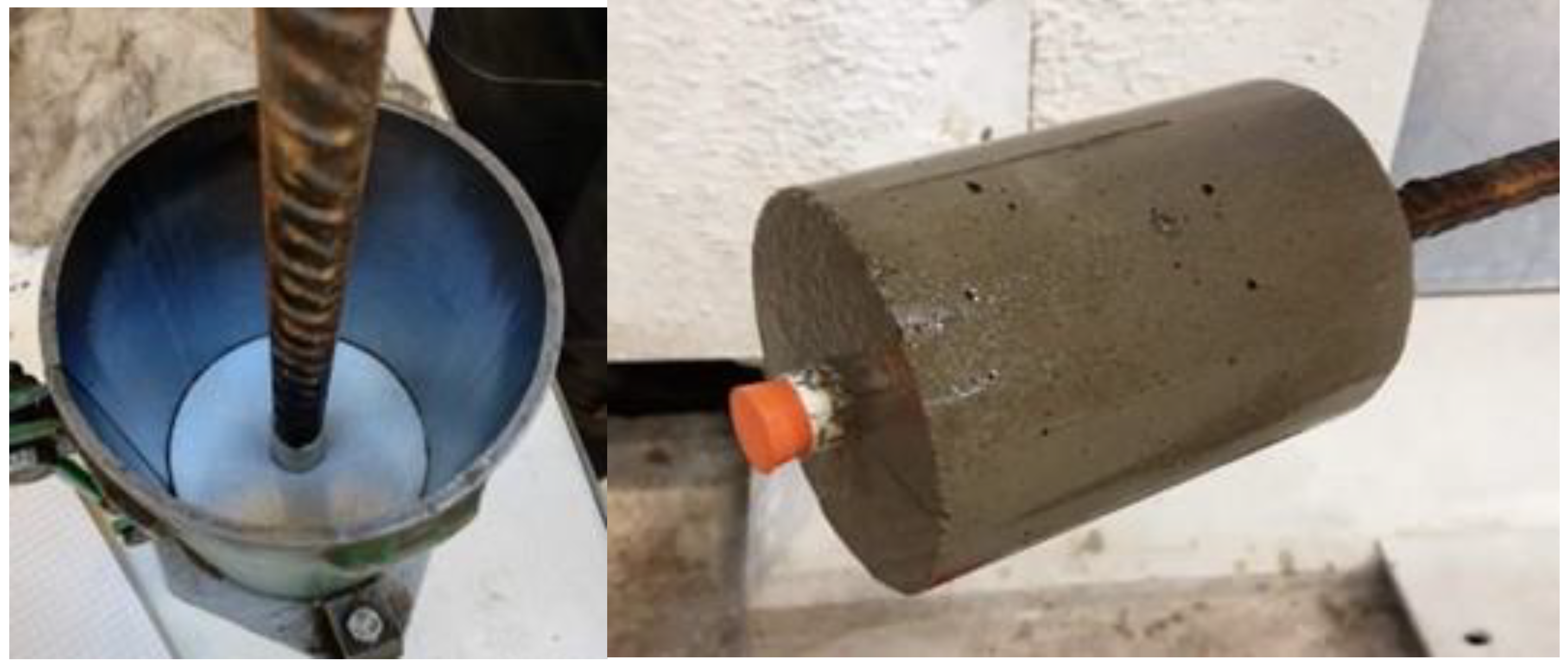
Figure 3.
Setup for corrosion exposure before the inmersion in saline solution (4% NaCl) and activation.
Figure 3.
Setup for corrosion exposure before the inmersion in saline solution (4% NaCl) and activation.
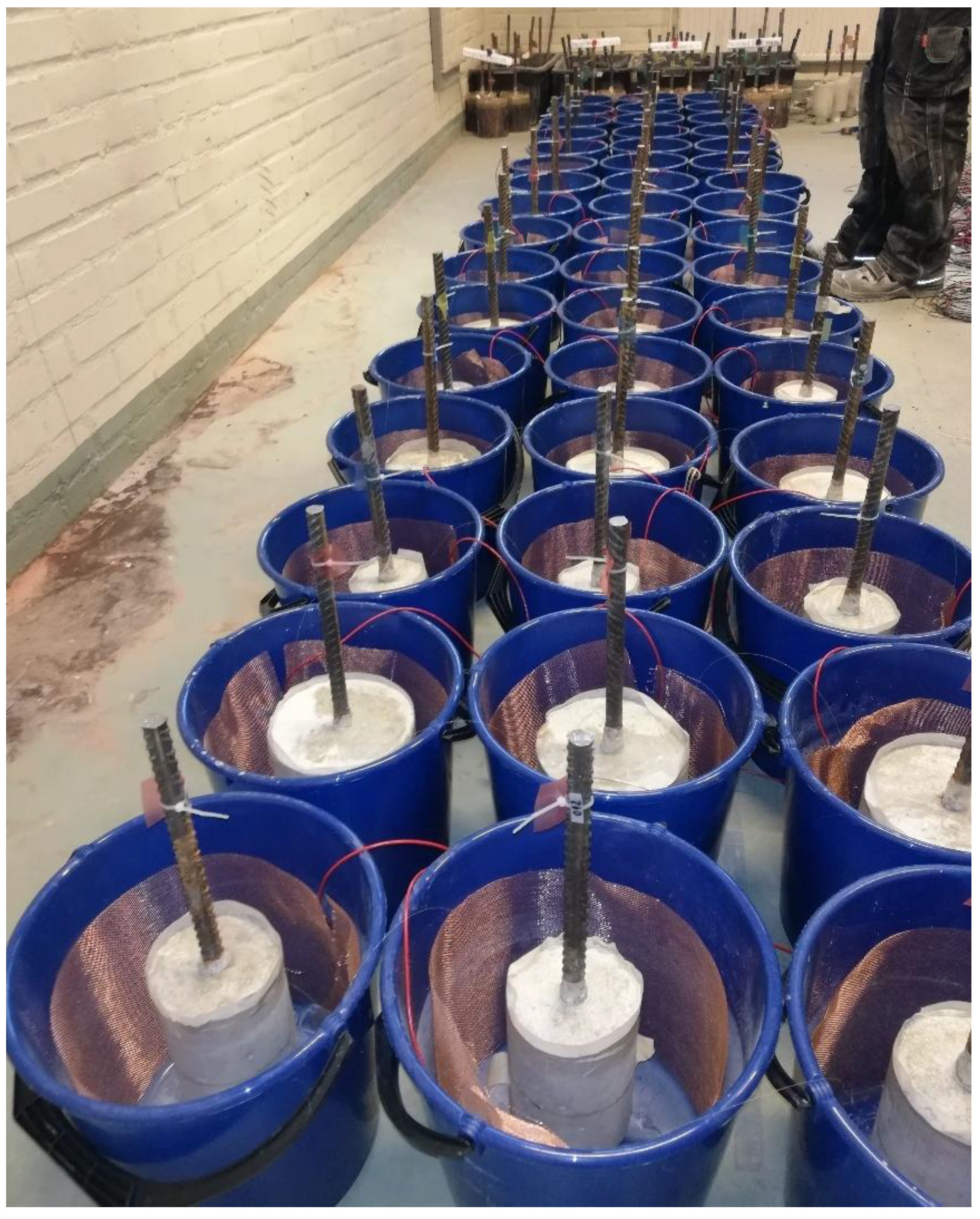
Figure 4.
Pull-out test configuration (picture and schematics).
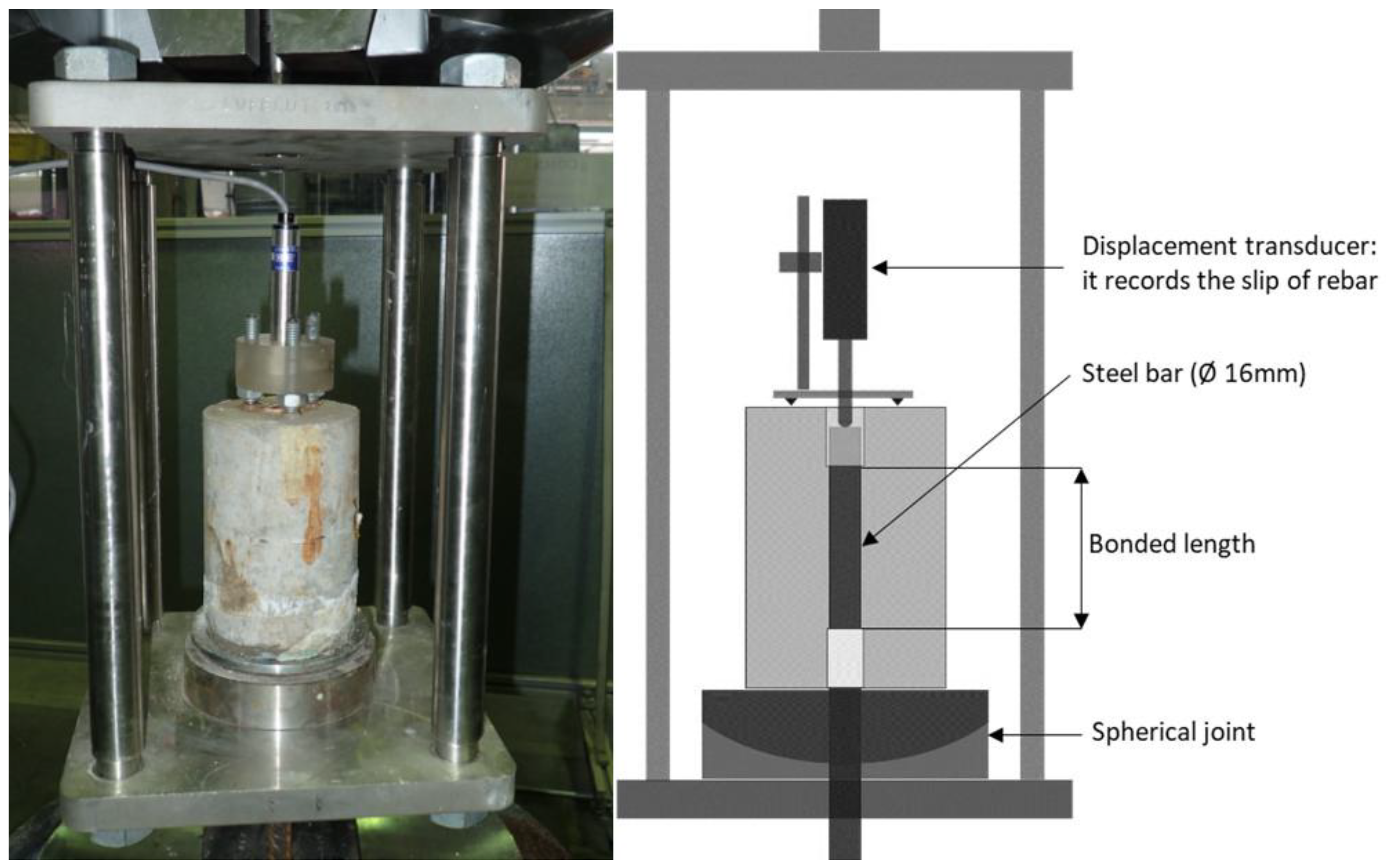

Table 1.
Aggregate properties.
| Recycled Sand 0-4 | Natural Sand 0-4 | Natural Gravel 4-16 | ||
| Density (EN 1097-6) | g/cm3 | 2.23 | 2.65 | 2.62 |
| Water Absorption (EN 1097-6) | % | 10.4 | 0.3 | 0.5 |
| Fines percentage (EN 933-1) < 63 µm | % | 4.9 | 0.2 | 0.0 |
| Moisture content (EN 933-1) | % | 0.0 | 5.0 | 1.6 |
Table 2.
Fresh/hardened properties.
| Property | H0 | H20 | H50 | H100 | |
| Slump values | cm | 10-20 | 10-20 | 10-20 | 10-20 |
| Density of fresh-state concrete | kg/dm3 | 2.39 | 2.36 | 2.32 | 2.25 |
| Density of hardened concrete at 28 days | kg/dm3 | 2.35 | 2.27 | 2.30 | 2.26 |
Table 3.
Mechanical properties.
| fc (MPa) | fct (MPa) | Ratio | |||
| Mean | SD | Mean | SD | fct/fc (%) | |
| H0 | 51.60 | 0.53 | 4.63 | 0.25 | 8.98 |
| H20 | 42.72 | 0.50 | 2.77 | 0.38 | 6.48 |
| H50 | 46.08 | 2.12 | 2.97 | 0.32 | 6.44 |
| H100 | 42.87 | 0.47 | 2.90 | 0.46 | 6.77 |
Table 4.
Corrosion mass loss.
| Corr. Mass Loss (%) | ||||||
| Name | % RFA | Diameter | Corrosion | Mean | SD | CI90 |
| 100%0 HC | 0% | 100 | HC | 9.2 | 2.2 | 3.7 |
| 100%0 LC | 0% | 100 | LC | 5.4 | 1.2 | 2.1 |
| 100%0 NC | 0% | 100 | NC | |||
| 100%20 HC | 20% | 100 | HC | 7.0 | 2.4 | 4.1 |
| 100%20 LC | 20% | 100 | LC | 5.0 | 0.7 | 1.2 |
| 100%20 NC | 20% | 100 | NC | |||
| 100%50 HC | 50% | 100 | HC | 6.8 | 0.2 | 0.3 |
| 100%50 LC | 50% | 100 | LC | 2.5 | 0.8 | 1.3 |
| 100%50 NC | 50% | 100 | NC | |||
| 100%100 HC | 100% | 100 | HC | 6.6 | 0.6 | 1.1 |
| 100%100 LC | 100% | 100 | LC | 2.9 | 0.8 | 1.3 |
| 100%100 NC | 100% | 100 | NC | |||
| Corr. Mass Loss (%) | ||||||
| Name | % RFA | Diameter | Corrosion | Mean | SD | CI90 |
| 150 0% HC | 0% | 150 | HC | 10.0 | 1.2 | 5.4 |
| 150%0 LC | 0% | 150 | LC | 7.9 | 1.4 | 6.3 |
| 150%0 NC | 0% | 150 | NC | |||
| 150 20% HC | 20% | 150 | HC | 8.4 | 0.5 | 0.9 |
| 150%20 LC | 20% | 150 | LC | 5.0 | 0.3 | 1.2 |
| 150%20 NC | 20% | 150 | NC | |||
| 150 50% HC | 50% | 150 | HC | 7.0 | 2.5 | 4.2 |
| 150%50 LC | 50% | 150 | LC | 2.5 | 0.7 | 1.2 |
| 150 50% NC | 50% | 150 | NC | |||
| 150 100% HC | 100% | 150 | HC | 7.2 | 1.3 | 2.2 |
| 150%100 LC | 100% | 150 | LC | 3.2 | 0.9 | 1.5 |
| 150 100% NC | 100% | 150 | NC | |||
Table 5.
Bond strength .
| τb (MPa) | ||||||
| Name | % RFA | Diameter | Corrosion | Mean | SD | CI90 |
| 100%0 HC | 0% | 100 | HC | 5.7 | 1.4 | 2.3 |
| 100%0 LC | 0% | 100 | LC | 17.2 | 4.5 | 7.6 |
| 100%0 NC | 0% | 100 | NC | 12.9 | 1.2 | 2.0 |
| 100%20 HC | 20% | 100 | HC | 9.5 | 2.7 | 4.6 |
| 100%20 LC | 20% | 100 | LC | 10.4 | 1.3 | 2.2 |
| 100%20 NC | 20% | 100 | NC | 14.1 | 1.7 | 2.9 |
| 100%50 HC | 50% | 100 | HC | 3.9 | 1.0 | 1.7 |
| 100%50 LC | 50% | 100 | LC | 8.5 | 2.8 | 4.7 |
| 100%50 NC | 50% | 100 | NC | 13.8 | 4.4 | 7.4 |
| 100%100 HC | 100% | 100 | HC | 5.2 | 0.7 | 1.2 |
| 100%100 LC | 100% | 100 | LC | 8.2 | 2.0 | 3.4 |
| 100%100 NC | 100% | 100 | NC | 10.8 | 4.6 | 7.8 |
| τb (MPa) | ||||||
| Name | % RFA | Diameter | Corrosion | Mean | SD | CI90 |
| 150 0% HC | 0% | 150 | HC | 11.5 | 5.9 | 10.0 |
| 150%0 LC | 0% | 150 | LC | 21.8 | 7.8 | 13.2 |
| 150%0 NC | 0% | 150 | NC | 24.2 | 3.7 | 6.2 |
| 150 20% HC | 20% | 150 | HC | 7.9 | 8.6 | 14.6 |
| 150%20 LC | 20% | 150 | LC | 23.4 | 5.3 | 8.9 |
| 150%20 NC | 20% | 150 | NC | 21.8 | 4.2 | 7.0 |
| 150 50% HC | 50% | 150 | HC | 11.8 | 4.3 | 7.2 |
| 150%50 LC | 50% | 150 | LC | 19.9 | 2.6 | 4.4 |
| 150 50% NC | 50% | 150 | NC | 19.7 | 0.6 | 1.1 |
| 150 100% HC | 100% | 150 | HC | 10.2 | 1.4 | 2.4 |
| 150%100 LC | 100% | 150 | LC | 21.8 | 2.5 | 4.2 |
| 150 100% NC | 100% | 150 | NC | 13.8 | 2.8 | 4.7 |
Disclaimer/Publisher’s Note: The statements, opinions and data contained in all publications are solely those of the individual author(s) and contributor(s) and not of MDPI and/or the editor(s). MDPI and/or the editor(s) disclaim responsibility for any injury to people or property resulting from any ideas, methods, instructions or products referred to in the content. |
© 2026 by the authors. Licensee MDPI, Basel, Switzerland. This article is an open access article distributed under the terms and conditions of the Creative Commons Attribution (CC BY) license (http://creativecommons.org/licenses/by/4.0/).
Copyright: This open access article is published under a Creative Commons CC BY 4.0 license, which permit the free download, distribution, and reuse, provided that the author and preprint are cited in any reuse.