

Submitted:
29 October 2026
Posted:
30 October 2026
You are already at the latest version
Abstract
Recent global political events have contributed to increased protest activity, visual messaging, and political expression on many university campuses. While much contemporary activism and advertising occur through algorithmically driven digital platforms, less is known about the continued role of physical visual communication in public spaces during the AI era. This study examines the presence and themes of posters, graffiti, stickers, placards, and related visual artifacts surrounding the University of British Columbia (UBC) Vancouver campus and its associated transit hubs. Using qualitative visual content analysis, we documented 782 visual items (x̄ = 78.2, σ = 107.9) across the UBC bus exchange and nine connecting transit hubs over a one-month period. Autoethnographic observations collected between 2023 and 2025 complemented the analysis. NVivo 14 was used to code the artifacts, resulting in three primary themes: (1) political activism, (2) commercial and community advertising, and (3) event and concert promotion. The findings indicate that posters, graffiti, and stickers remain important components of urban visual communication, serving multiple functions including ideological messaging, economic advertising, and community engagement. Despite the expansion of AI-driven digital media and targeted online advertising, traditional visual communication continues to shape urban semiotic landscapes and facilitate the circulation of political, commercial, and cultural messages in public spaces.
Keywords:
advertisement
; posters
; graffiti
; placards
; activism
; mural
; arts
; demonstrations
; stickers
Introduction
Public spaces have long functioned as sites where visual messages compete for attention, meaning, and influence. Posters, graffiti, stickers, and placards are forms of vernacular visual communication that turn urban surfaces into communicative environments where social actors disseminate political, cultural, and commercial messages. From a social semiotic perspective, these visual artifacts are not merely decorative elements of the built environment but meaningful signs that reflect the social practices, ideologies, and power relations embedded in specific contexts (Kress & van Leeuwen, 2006; Jewitt, 2014). Street posters, signs, and graffiti also function as advertising in public spaces, promoting political or commercial content on city streets, busy intersections, and gathering locations (Andron & Parkinson, 2025). Historically, visual advertising in public spaces predates modern media systems by thousands of years. Evidence suggests advertising practices existed as early as ancient Egypt, where papyrus notices promoted goods and services (Ezzat, 2023). Similarly, graffiti has a long history as both art and communication, with examples dating back to prehistoric cave paintings from about 40,000 years ago and to inscriptions in ancient Greek cities, where early visual advertisements have been documented (Hutcheson, 2025; Thompson, 2014). One well-known example from ancient Greece reportedly depicted a woman, a heart, a foot, and a coin purse, potentially directing visitors to a brothel (Hutcheson, 2025).
Over time, visual advertisements placed in public spaces became increasingly important tools for shaping perceptions, attitudes, and behaviour. Advertising has influenced public opinion since early public relations campaigns in European cities such as London in the seventeenth century, and later evolved into a specialized academic and professional field (Augustyn, 2022; Zhao & Ji, 2019). As communication tools, advertising and marketing strategies have proven effective at influencing public perceptions and shaping political and commercial messages (Spenkuch & Toniatti, 2018). From a multimodal communication perspective, posters, graffiti, and stickers operate as communicative artifacts that combine multiple semiotic modes—including images, typography, colour, symbols, and spatial positioning—to convey meaning within shared social environments (Kress, 2010). These artifacts function as multimodal ensembles in which visual and textual elements interact to produce meaning for audiences navigating everyday urban spaces. Within this framework, urban walls, poles, and public infrastructure become sites of communication where diverse actors—activists, advertisers, artists, and community organizations—compete to shape public discourse (Jaworski & Thurlow, 2010; Rose, 2016).
Posters, graffiti, and stickers have also become organized advertising practices in contemporary cities, with companies and contractors often hired to distribute them throughout urban areas, including college campuses and transit hubs (DHL eCommerce, 2023; Wild Posting, 2025). The effectiveness of these visual campaigns varies by location, design, and medium. High-traffic locations, for example, may amplify the visibility of posters and graffiti, while different visual styles—such as hand-painted murals, high-quality printed posters, or provocative placards—may influence how audiences interpret and engage with the messages they convey (Nysveen & Breivik, 2005; Jaworski & Thurlow, 2010). Although perceptions of graffiti and posters have evolved over time—from civic art and community expression to forms of vandalism or nuisance in some contexts—these artifacts continue to function as locally embedded communication systems. Contemporary posters persist as what Guffey (2015) describes as “a largely local and relatively low-tech alternative to screen-based media” (p. 30). Despite the associated clean-up costs, which often require cities and corporations to invest substantial resources to remove or cover such materials, posters, graffiti, and stickers remain prominent components of urban visual environments.
Scholars studying semiotic landscapes have emphasized how visual inscriptions in public spaces contribute to layers of communication that reflect social relations, identities, and political tensions within cities (Jaworski & Thurlow, 2010; Pennycook, 2019). Within these environments, posters and graffiti serve as visual, material, and semiotic forms of communication that shape how the public interprets and experiences urban spaces (Kataras, 2006; Novreica, 2022). More broadly, the study highlights how public surfaces remain active sites of meaning-making and social negotiation even within an increasingly digital media landscape. Supporting this view, previous research has found that street posters can function as a “sophisticated spatial agent that challenges simplistic associations with commercial outdoor advertising,” demonstrating how posters actively shape urban communication through spatial placement, visual design, and audience engagement (Andron & Parkinson, 2025). Although contemporary communication increasingly occurs through algorithmically mediated digital platforms, physical visual communication continues to play a crucial influence on the formation of public narratives and local identity. Research on visual culture suggests that posters, graffiti, and other forms of street media remain important channels for circulating messages in public spaces, complementing rather than replacing digital communication (Guffey, 2015; Rose, 2016).
University campuses and surrounding transit hubs represent particularly important sites for this form of visual communication. Because they have high pedestrian traffic, diverse populations, and active political engagement, campuses often serve as arenas where competing social, political, and cultural messages are publicly displayed and negotiated. Posters and graffiti in these spaces therefore serve not only as informational or promotional materials but also as visual expressions of identity, protest, advocacy, and community engagement. Despite growing scholarly attention to digital activism and algorithmically driven media ecosystems, comparatively little research has examined the continued role of physical visual communication in public urban spaces within the contemporary media environment shaped by artificial intelligence and digital platforms. While social media and algorithmic content distribution increasingly shape political communication and advertising strategies, traditional visual artifacts such as posters, stickers, and graffiti remain visible parts of everyday communication in cities.
Rationales and Research Questions
To address this gap, this study examines the visual communication environment around the University of British Columbia (UBC) Vancouver campus and its associated transit hubs. Drawing on qualitative visual content analysis, the study documents and analyzes 782 posters, stickers, graffiti, placards, and related artifacts observed across the UBC bus exchange and nine connecting transit hubs. Using NVivo-assisted coding, the study identifies dominant themes, visual messaging strategies, and communicative functions in these artifacts. By examining these visual materials through a social semiotic and multimodal lens, this research contributes to understanding how physical visual communication continues to function as a medium for political messaging, advertising, and community engagement within contemporary urban environments. This study pursues the following research questions explicitly through qualitative observations in the field:
1-How many posters, graffiti, stickers, and placards have been posted in the period one month before clean-ups by city, transit, and college campus staff?
2-What themes and messages do these posters, graffiti, stickers, and placards contain in public spaces?
3-Are these themes triangulated with the lived experience of University of British Columbia (UBC) students residing on campus during the height of the “free Palestine” movement beginning in 2023?
Methods
Data Source
Because this research relied on autoethnography and publicly available information (e.g., posters, graffiti, stickers, demonstrations, and placards), the institution or university did not require ethics approval. For instance, I conceived this research idea when, as a Doctor of Dental Medicine student, I witnessed significant protests, activities, posters, vandalism, graffiti, and occupation at UBC’s MacInnes Recreational Field and elsewhere. While the permanent occupation was officially cleared out in July 2024, the protest, vandalism, posters, stickers, and graffiti continued well past the third peace accord between Hamas and Israel. Thus, this research relied on the narrated personal experience of neutral observation of a student who resided on the UBC campus and attended the school on a daily basis, combined with gathered photographic evidence of graffiti, stickers, posters, and placards during October 2025, when a third ceasefire came into effect on the 10th of October between the Hamas militant group and Israel.
Data Collection
Data collection began in 2023 through a personal journal, where personal experiences, unique phrases on graffiti, and exceptional circumstances related to the “free Palestine” movement, counter-protesters, and numerous posters, vandalism, and placards were documented until the end of October 2025 at UBC, close to the hospital, dental school, the bus exchange, and major bus routes to UBC. Additionally, photography was conducted in October 2025, when the peace negotiations were being finalized, at all transit hubs and within a two-kilometre radius of these hubs, including the UBC bus exchange. While most transit hubs for the nine buses are located in Vancouver, two routes originating in Burnaby (Bus 25 & 49) were exceptions. Bus 68 (the Wesbrook Mall) is a community bus within UBC and was not included as a two-kilometre radius of the UBC bus exchange was already included in the data analysis. We uploaded the photographs to an iPad to better organize the content and summarize the messaging. We later categorized the photos by bus route, category (e.g., graffiti, posters, and stickers), and date in an Excel spreadsheet, as shown in Table 1.
Table 1 shows that out of the total 782 (x̄= 78.2, σ= 107.9) posters from across the city, the most significant number of posters was recorded around the Commercial-Broadway SkyTrain station, with a total of 347 items, including 309 posters, 20 pieces of graffiti, 11 stickers, and seven other items. This area serves as a central hub for two train systems (e.g., the Expo and Millennium lines) and has lower median incomes and rent prices than more affluent areas of Vancouver. As shown in Table 1, the Bus 84 transit hub had the fewest items (graffiti, stickers, posters, and other items), totalling five: four posters and one other item. Additionally, the most prevalent forms of advertising items were posters (607; x̄ = 60.7, σ = 102.19), followed by stickers (124; x̄ = 12.4, σ = 15.98), graffiti (42; x̄ = 32.45, σ = 6.58), and other items (9; x̄ = 0.90, σ = 2.07).
Material and Data Analysis
The photographs were uploaded into NVivo 14 software (Lumivero, LLC). Researchers, including those using technology, use various qualitative data analysis tools, including MaxQDA and ATLAS.ti (ATLAS.ti, 2024; Verbi Software, 2024). This research relied on NVivo, which allows analysis of photos, videos, audio, and text (QSR International, 2024). NVivo has also been highlighted for its user-friendly applications, which enable the analysis of social network content via the “sociograms” feature (QSR International, 2024). The uploaded photos were evaluated using open or inductive methods, and themes associated with the images were quickly organized into categories (Creswell & Poth, 2018). As shown in Figure 1 below, we initially identified 24 themes.
This open coding, or inductive, method facilitates defining themes or nodes (Fereday & Muir-Cochrane, 2006). According to Fereday and Muir-Cochrane (2006), this inductive method of analysis and coding “involves recognizing (seeing) an important moment and encoding it (seeing it as something) … [before] a process of interpretation” (p. 83). Boyatzis (1998) defines a theme, or node, as “a theme as a pattern in the information that at minimum describes and organizes the possible observations and at maximum interprets aspects of the phenomenon” (p. 161). This research also relied on deductive inquiry, analyzing the photographs in light of themes identified in my personal journal through autoethnography (Fereday & Muir-Cochrane, 2006; Feng & Behar-Horenstein, 2019; Finaly, 2002). While deductive inquiry in NVivo is usually based on the most frequent words, this method is impractical for visual evidence (Fereday & Muir-Cochrane, 2006; Feng & Behar-Horenstein, 2019).
Therefore, the preconstructed scheme, developed over two years through recording my personal experiences and writing key phrases from protesters’ posters, stickers, and placards, guided the research (Crabtree, 1999). Therefore, the themes identified through inductive methods, as shown in Figure 1, were reduced to fewer themes after a consolidation process that combined both deductive and inductive inquiries (Wong, 2008). The nodes/themes produced through this consolidated process now include the following themes: 1. Radical political activism, 2. Advertisements, 3. Events and concert promotions.
Finally, while survey research differs from qualitative visual analysis, validity and reliability matter to both. Unlike interview-based qualitative inquiry, which relies on triangulation, this visual-based content analysis relied on an audit trail and reflexivity to ensure validity (Nicmanis, 2024; Rodgers & Cowles, 1993; Lincoln & Guba, 1985). To ensure an audit trail, I kept and later reviewed detailed records of all coding decisions, inductive processes, autoethnography memo writing, and the development of deductive themes to support further intra-coder reliability (Rodgers & Cowles, 1993; Lincoln & Guba, 1985). To further ensure transparency and enhance the study’s credibility and validity, conducting both deductive and inductive content analyses helped maintain consistency between the identified themes and the autoethnographic findings and complemented each other (Nicmanis, 2024; Finaly, 2002). Therefore, an audit trail, reflexivity, and intra-coder reliability ensured reliability and validity. Finally, to further ensure reliability, this research was analyzed across two time periods to evaluate coherence (O’Connor & Joffe, 2020).
Findings
The findings below reflect three main themes identified through deductive and inductive processes. The quotes, visual figures, and descriptions aim to represent each theme as accurately as possible, using citations and personal experiences to triangulate and reinforce the findings.
Radical Political Activism
One of the most eye-catching forms of political activism, including posters, stickers, and graffiti, was related to fringe political movements. These included communism, anarchism, radical environmentalism, drug liberation, and the “Free Palestine” movements, which are described further below. For instance, the coloured (e.g., red), high-quality, large communist posters first appeared at the start of the 2023 school year at a busy UBC intersection, specifically near the UBC bus exchanges, as shown in Figure 2.
However, the quality of posters changed in 2025 as they became glossy and smaller to prevent tearing, while the QR code became larger with more eye-catching photos, such as those of American billionaires, including Luigi Mangione, who has been accused of killing a CEO (Brian Thompson) in New York City, as seen in Figure 3 (Wendling & Ghildial, 2025).
Beyond the graphic communist posters shown above, they advocated revolution and the overthrow of democratic economic and political institutions, including businesses, factories, large farms, and the rich, whom they defined as oligarchs. Having Luigi Mangione posters, along with those of other billionaires and trillionaires, as seen in Figure 3, clearly reveals the intentions of this fringe movement, which could gain popularity due to the AI revolution and the prospect of many people losing their jobs, reduced working hours or the need to return to education thanks to the AI-driven applications and robots taking over many jobs and tasks (West & Allen, 2018; Jozaghi, 2024a, 2024b; Jozaghi, 2025a, 2025b, 2025c). In effect, one of my friends from Cuba stated that seeing these posters in a Canadian school, after he escaped the Cuban communist regime, was very alarming to him and reminded him of the rise of Fidel Castro and Che Guevara in the 20th century. While the Canadian chapter of the Communist Party funded the above posters, other posters were directly linked to the US communist movement, as shown in Figure 4.
The Working Youth League, the Communist Party of America, and other populist poster items seen in Figure 4 try to capitalize on youth struggles at UBC, the rising cost of tuition, the affordability crisis caused by tariffs, and prospects of low-paying jobs during college years to recruit prospective members via quotes such as “does it feel you’re drowning?” and potentially further radicalize new members in a toxic online environment with misinformation, disinformation, and conspiracy theories. In effect, there is growing evidence of foreign states funding protests, movements, and activities of communist and radical left groups, further discussed below, via posters in Canada, the US, Australia, the EU, and the UK (Frazao, 2024; International Communist Current, 2012; Nomani, 2025). The director of the Canadian Security Intelligence Service (CSIS), Daniel Rogers, warned that many youths are targeted when they “lose hope for the future,” and thus easily further radicalized in an online environment that reinforces their clouded perceptions and views about the government, economic system and democracy that could further justify extremist goals (Tunney, 2025). Moreover, the anarchist movement posters carried subtle messages, blaming the misfortune of others on the system, with quotes such as “every joy that some experience is paid for with the sorrow of others,” “Landlords are leeches,” or longer quotes that challenge the legitimacy of the current economic system, as seen in Figure 5.
Along with communism, anarchism, and radical environmentalism, these themes were also prominent at many bus hubs. These items include advocating for the complete banning of all cars via numerous graffiti, stickers, or other posters or graffiti, such as “Ban Cars,” “Save Stanley Park,” “Save the Buses,” “Subsidize our A/C’s, NOT LNG,” or “Canada needs to enforce, POLLUTERS PAY” posters and stickers. Moreover, the drug liberation movement posters, better known as the Drug User Liberation Front (DULF), were prominently displayed in middle-income areas of Vancouver, near the Broadway-Commercial Bus hub, which serves the 99 route and remains a vital transportation hub connecting other train stations to numerous peripheral cities. The DULF poster was in response to recent court cases in the Canadian Federal Court that rejected the group’s request to provide tested drugs to members via compassionate clubs to at risk drug users at risk of overdose via illegal drugs purchased on street through drug dealers (Matassa-Fung, 2024; Kalicum, Nyx, Kennedy, & Kerr, 2024; Nyx & Kalicum, 2024; Bowles, Nyx, Kalicum, & Kerr, 2024). Moreover, the leaders of the DULF movement were recently convicted of drug trafficking for enacting compassionate clubs, and their case could potentially challenge the constitutionality of Canada’s current legal framework governing illegal drugs through subsequent appeals (Uguen-Csenge, Ayres, & D’Souza, 2025).
However, the most prominent forms of graffiti, posters, and stickers were linked to the “free Palestine” movement. In fact, as a university student, I noticed the movement began shortly after Hamas’s October 7th attack and the Israeli Military’s attempt to free its hostages or their bodies from various Gaza tunnels underneath civilian buildings. During this time, I noticed numerous protests erupting at various locations in Vancouver shortly after the conflict, including private malls (e.g., Metrotown mall, near the Christmas season), the Vancouver Art Gallery, and the UBC Vancouver campus, where protesters usually wore masks with keffiyehs and carried megaphones (City News, 2023). In effect, such protest activity was very alarming for me as someone who spent most of my childhood and youth in Iran, as many Iranian associates the keffiyeh with the Islamic regime of Iran’s paramilitary Basij force—who arbitrarily arrest, beat, imprison, and shoot people on the streets and college campuses to enforce sharia law—who have wore the keffiyeh scarf as part of a uniform since the late 1970s of the “revolution,” as part of their propaganda of “globalize the Intifada,” global uprising against the West and Gulf Arab state through “axis of resistance” groups as seen in Figure 6 (American Jewish Committee, 2025; Runkle, 2024; Taleblu, 2024).
As Israeli attempt to free its hostages continued, the slogans such as, “Free, free Palestine,” and “resistance rises” became more radicalized, to new slogans of ”from the river to the sea, Palestine will be free,” “globalize the Intifada,” “Long live Oct. 7,” and “Resistance by any means necessary,” that have been categorized as antisemitic and promotes the permanent removal and expulsion of the Jewish population from their ancestral land via violence and terrorism (Anti-Defamation League, 2025; CBC news, 2023; Proctor, 2024; Little, 2025; Anti-Imperialist Camp, 2001). The movement became more aggressive, using “divesting” propaganda to occupy private property across campuses, including UBC’s library and UBC’s MacInnes Recreational Field (Handley & Ma, 2025). The leaders of movements, such as Charlotte Kates, who “praised the Oct. 7 Hamas attacks on the Jewish state and referred to […several] terrorist organizations as heroes,” was spotted by me at UBC’s MacInnes Recreational Field, where shortly after she fled to the Middle East after receiving a “Human Rights” award along the leader of Palestinian Islamic Jihad from the Iranian regime in order to evade the hate speech criminal charges from Vancouver Police Department (Margolis, 2024; Little, 2025; Proctor, 2024; Middle East Media Research Institute, 2024)
During the more than two months of occupation of MacInnes Recreational Field at UBC, the movement tried to hijack the support of various groups by numerous posters that proclaimed that LGBTQIA2S+ and Iranian support the movement with posters such as “Queers for Palestine,” “Iranian for Palestine,” despite rampant human rights violations in Gaza against various freedoms via Sharia Law enforcement, and Iranians expression that they do not support their money wasted in Gaza, the West Bank of Palestinian territories, Lebanon, Iraq, Yemen or elsewhere in support of groups within the “Axis of Resistance,” including Islamic Jihad, Hezbollah, Hamas or many others (Afshari, 2024; David, 2024; Kottasová, Dahman & Kourdi, 2025; Kredo, 2025; Adesnik, 2018). Their attempt to hijack groups through messaging, posters, and the sheer numbers and organized force of their movement effectively pretends that their movement represents all people of Vancouver and Canada. Furthermore, the “free Palestine” movement turned to more hateful comments of “death to Canada” or “we are Hezbollah, we are Hamas” with some groups burning the Canadian flag despite the Palestinian flag being glorified through either the Watermelon symbols or the actual flags via various posters, graffiti, and stickers, as seen in Figure 7 (Chiang, 2024).
The IRI flag appeared prominently on numerous posters and at demonstrations in Vancouver, including the October 2025 demonstration shown in Figure 7, following the third ceasefire, even as many Iranians inside and outside the country turned to the pre-revolutionary Lion and Sun flag. The U.S. Treasury Department estimated that IRI smuggled $1 billion to Hezbollah (one of the many groups that form the axis of resistance) in 2025 alone, and Figure 7 shows IRI propaganda outreach (Hagstrom, 2025). After the third ceasefire between Israel and Hamas, the movement did not stop its activities across campuses, as a recent violent interruption of a private Jewish group at Toronto Metropolitan University, where a city councillor stated that “you cannot violently attack people you disagree with and still claim to stand for justice […] there is no excuse — none — for turning political passion into physical harm” (Fox, 2025).
Advertisements
In addition to the radical political movement discussed, the most common theme revolved around advertising. These advertisements differed by neighbourhood. More affluent neighbourhoods with bus hubs often featured luxury advertisements, such as dog-walking or pet-messaging services. In less affluent areas, ads focused on repair services, handymen, painters, carpenters, garbage removal, and Mandarin-language items. The UBC exchange bus area and the surrounding two-kilometre neighbourhood contained many advertisements related to standardized test preparation (e.g., MCAT, LSAT, DAT, & GRE), tutoring, haircuts, missing pets, making friends, driving school lessons, music lessons, sewing, seeking participants for research, private gym instructor, and assistance with permanent residency.
The major transit hubs, such as Bus 99, 49, and R4, contained various advertisements via lots of stickers advertising illegal drugs with home deliveries, such as magic mushrooms, MDMA, drug therapeutics, and even home deliveries for legal drugs such as marijuana. Other posters advertised jobs and volunteer work, especially for those seeking to start a new career through a trade apprenticeship (e.g., carpentry, plumbing, electrical work, HVAC, welding, and mechanics), as shown in Figure 8.
Moreover, many posters in major transit hubs advocated for workers’ rights: the right to form unions, refuse dangerous work, strike, and demand higher pay. Many postal workers, along with their placards and posters, could be observed near the Broadway-Commercial Skytrain during the 2024 postal strike and again in 2025. Some workers’ rights posters were in Spanish, and many highlighted the plight of workers who have been injured or died because of dangerous working conditions, as shown in the collection of posters in Figure 9.
Moreover, numerous posters advocated for housing rights, neighbours teaming up for a stronger voice, and joining together to oppose evictions and rising rents in the neighbourhood. However, some of the posters and stickers reflected current world events, such as advertisements against the recent G7 meeting in Alberta, Israel confiscating ships heading to Gaza, and anti-Tariff advocacy. Many posters also advertised health services, including vaccination information, cross-cultural health information, Two-Spirit & Gender-affirming care, self-compassion groups, Eat Well programs, disability information and support, and mental well-being promotion. Many posters promoted community events, such as clothing drives, youth recreational activities, support programs, and drop-in sessions featuring games, hangouts, chill sessions, and cooking sessions for all families.
Events and Concert Promotions
After the radical political activism and advertising, the most common themes were events and concert promotion. In effect, while some event promotions were linked to upcoming events, such as Halloween, Christmas markets, Easter prayer events, Women’s Day, or International Labour Day celebrations, many companies still prefer to promote their events via posters, stickers, and placards. For instance, some successful Vancouver candidates in the 2025 by-election used paid/volunteer placard holders at major bridges and on roads leading from Vancouver to UBC (Mooney, 2025). The City of Vancouver, West Vancouver, and many others across Canada also place Remembrance Day (November 11th) posters on central and street light poles a month before the event, promoting the importance of sacrifice and the hard-fought values of democracy, the rule of law, and an international rule-based order.
This powerful form of advertising also appears at concerts, music events, comedies, and parties, where musicians pay contractors to post posters, as shown in Figure 10.
However, many posters were not commercial but linked to community events, fundraising, art events, or other community activities. For instance, DULF posted many posters in middle-income areas near major transit hubs promoting concerts, events, and public awareness campaigns to raise money for their compassionate club, allowing them to fund court battles against the federal government and provide much-needed funding for drug testing and other activities, as shown in Figure 11.
Additionally, many posters promoted arts, poetry, paintings, community events, community radio stations, Indigenous cultural connections, learning sessions, theatres, and open submissions for rejected artwork, as shown in Figure 12.
Therefore, posters, stickers, placards, and graffiti remain powerful tools for promoting events, concerts, arts, poetry, theatre, community connections, and community celebrations in the era of AI-driven platforms and online environments. This is especially true when posters are complemented by social media advertisements.
Discussion
These findings show that posters, graffiti, stickers, and placards remain important forms of visual communication in contemporary urban environments, even as digital and algorithmically driven media platforms increasingly dominate communication practices. Addressing the first research question, documentation of 782 visual artifacts across the University of British Columbia (UBC) bus exchange and nine connecting transit hubs indicates that public surfaces remain active communication spaces where diverse messages are displayed and circulated. These findings support research suggesting that urban environments operate as semiotic landscapes in which visual signs, symbols, and texts collectively shape location-based meanings (Jaworski & Thurlow, 2010; Pennycook, 2019).
The second research question examined the dominant themes and messaging contained within these visual artifacts. The analysis identified three primary categories: radical political activism, advertising, and event or concert promotion. Together, these categories illustrate how posters and graffiti operate as multimodal communicative resources that serve multiple social functions within urban spaces. From a social semiotic perspective, these artifacts combine visual design, text, colour, symbols, and spatial placement to convey messages to audiences navigating public environments (Kress, 2010; Kress & van Leeuwen, 2006). The study found political activism to be among the most visually prominent forms of messaging. Posters and graffiti associated with movements such as communism, anarchism, radical environmentalism, drug policy reform, and the “Free Palestine” movement illustrate how public surfaces can become sites for ideological expression and political mobilization. Previous research has similarly shown that graffiti and posters frequently function as tools for political communication and resistance within contested public spaces (Moskovljevic et al., 2025; Khan, 2024). In this sense, walls, transit hubs, and urban infrastructure can serve as platforms for expressing and debating political narratives outside traditional institutional channels.
At the same time, the findings show that political messaging constituted only one component of a broader visual communication ecosystem. Many posters documented in this study related to commercial advertising and everyday services, including tutoring, trade apprenticeships, repair services, and community programs. These findings highlight posters’ continued role as localized communication networks that circulate economic and practical information within urban neighbourhoods. Studies of urban poster culture make similar observations, describing posters as spatial communication tools that connect local businesses, workers, and residents (Andron & Parkinson, 2025). The third major category identified in the analysis involved promoting events, concerts, community programs, and cultural activities. Posters advertising concerts, artistic events, and community gatherings demonstrate how physical visual media continue to support social interaction and cultural participation. These findings suggest that posters serve as vehicles for political or commercial communication and foster community engagement and cultural exchange within cities.
Together, these findings show how posters, graffiti, and stickers operate as layered forms of communication that shape the visual and symbolic character of urban environments. Scholars studying urban semiotic landscapes argue that city walls and public surfaces can be understood as palimpsests, with successive layers of communication reflecting ongoing social, political, and cultural negotiations (Jaworski & Thurlow, 2010; Khan, 2024). The diversity of messages observed in this study—from ideological activism to community events and local advertising—supports this interpretation, demonstrating how multiple forms of communication coexist and interact within shared public spaces. The third research question explored whether the observed themes corresponded with the lived experiences of individuals present in these environments. The autoethnographic observations indicate that posters, graffiti, and demonstrations formed a visible, ongoing part of daily life for students and residents moving through these transit hubs. The visual density of these materials suggests that public surfaces function not merely as background elements of urban infrastructure but as active communication sites that shape how individuals interpret and experience their surroundings.
Importantly, the findings also highlight the continued relevance of physical visual communication within a landscape increasingly influenced by digital platforms and artificial intelligence. While online platforms enable targeted advertising and algorithmically curated messaging, physical posters and graffiti remain accessible forms of communication that reach audiences as they move through shared physical environments. Rather than replacing traditional visual communication, digital media may operate alongside it, creating hybrid communication systems in which offline and online messaging interact and reinforce one another. In this context, posters and graffiti may be understood as locally embedded media forms that complement digital communication by providing spatially situated messages that are visible to broad audiences without requiring technological access or algorithmic mediation. This observation aligns with research suggesting that street posters and graffiti continue to function as important communicative resources within contemporary cities, even in highly digitized media environments (Guffey, 2015; Rose, 2016). Overall, the findings demonstrate that posters, graffiti, stickers, and placards remain powerful tools for disseminating political messages, advertising services, and promoting cultural and community events. By examining these artifacts through a social semiotic and multimodal lens, the study contributes to an expanding body of scholarship that emphasizes the contribution of visual communication in forming urban public spaces. In doing so, it highlights how city walls, transit hubs, and public infrastructure continue to function as dynamic arenas of communication and meaning-making in the evolving media landscape of the AI era.
Strengths and Limitations
A key strength of this study is its pioneering examination of posters, stickers, graffiti, and placards, complemented by an autoethnography, during the height of the global “Free Palestine” movement. Moreover, by using autoethnography, this research triangulated its findings. However, this research did not examine posters, placards, stickers, and graffiti placed outside the 2-kilometre perimeter of the UBC bus exchange or inside buildings, lecture halls, residences, student union buildings, gyms, and other student housing, potentially neglecting hundreds of similar or unique pieces of content. In addition, this research failed to document some of the placards, content, and slogans used in many “Free Palestine” demonstrations through photography. Furthermore, some themes, such as vandalism of bus stations, racist and neo-Nazis graffiti, and stickers/graffiti that made no sense, were overlooked. Moreover, the publication’s word limits and space constraints meant it did not report many graffiti, posters, and sticker figures. Additionally, this study did not estimate how long a poster remains intact before being torn or removed. However, it is essential to note that communism, anarchism, and “free Palestine” posters and stickers were more likely to be torn down and more likely to be linked with angry citizens. Finally, complementing the online content with discussions on various UBC discussion boards or social media could have further strengthened the findings through triangulation.
Conclusions
Although the rapid development of artificial intelligence and digital media has transformed many aspects of communication and advertising, this research finds that traditional forms of visual communication—such as posters, stickers, placards, and graffiti—continue to play an important role in urban communication environments. Across the University of British Columbia (UBC) transit hubs examined in this study, these visual artifacts served as accessible, highly visible communication tools for disseminating political messages, advertising services, and promoting cultural and community events. These findings reinforce research suggesting that posters and graffiti remain influential components of urban semiotic landscapes, where public surfaces serve as platforms for competing social, political, and commercial messages. The analysis identified three dominant categories of visual communication—political activism, advertising, and event promotion—showing how posters and graffiti serve multiple social functions at once. Political posters and graffiti often carried ideological messages and supported activism, showing how urban surfaces can express political identities and mobilize supporters. At the same time, many of the visual materials documented in this study were everyday advertisements for local services, employment opportunities, and community programs. Posters also widely promoted concerts, cultural activities, and community events, highlighting their role in facilitating social interaction and local cultural engagement.
Together, these findings suggest that posters, graffiti, and stickers form part of a layered communication system in which multiple actors—including activists, businesses, artists, and community organizations—compete to shape the visual character of public space. In this sense, urban walls, transit hubs, and public infrastructure serve as dynamic communication environments where messages accumulate over time and interact, contributing to what scholars describe as the city’s evolving semiotic landscape. Importantly, the findings also indicate that physical visual communication persists alongside digital media rather than being replaced by it. While social media platforms and algorithmically targeted advertising increasingly influence how information circulates online, posters and graffiti remain accessible forms of communication that reach audiences as they move through shared physical spaces. These offline media therefore complement digital communication by providing spatially embedded messages that are visible without digital mediation or algorithmic filtering. For policymakers, these findings underscore the significance of understanding how visual communication operates within public environments such as university campuses and transit hubs.
Because these spaces have high pedestrian traffic and diverse populations, they can become key sites for displaying and negotiating social, political, and cultural messages. Institutions and municipalities may therefore benefit from developing balanced approaches that protect freedom of expression while also addressing vandalism, hate speech, and the maintenance of shared public spaces. Further studies could build on these findings by investigating visual communication in additional urban settings, including other university campuses or metropolitan transit networks. Comparative studies across cities or countries may also help identify how different social, political, and regulatory contexts shape visual communication practices in public spaces. Further research exploring how offline visual communication interacts with digital media ecosystems could deepen our understanding of how hybrid communication systems operate in the contemporary media landscape. Overall, this study demonstrates that posters, graffiti, stickers, and placards remain significant forms of visual communication in the AI era. By documenting how these artifacts function within urban semiotic landscapes, the research highlights the continued importance of physical visual media as tools for political expression, economic advertising, and community engagement within contemporary cities.
References
- Adesnik, D. Iran spends $16 billion annually to support terrorists and rogue regimes. Foundation for Defense of Democracies. 2018. Available online: https://www.fdd.org/analysis/2018/01/10/iran-spends-16-billion-annually-to-support-terrorists-and-rogue-regimes/.
- Afshari, A. Why are So Many Iranians Seemingly Indifferent to the War in Gaza? The Henry L. Stimson Center. 2024. Available online: https://www.stimson.org/2024/why-are-so-many-iranians-seemingly-indifferent-to-the-war-in-gaza.
- American Jewish Committee. What does “Globalize the Intifada” mean, and how can it lead to targeting jews with violence? 2025. Available online: https://www.ajc.org/news/what-does-globalize-the-intifada-mean-and-how-can-it-lead-to-targeting-jews-with-violence.
- Andron, S.; Parkinson, C. Power, Paper, and Profit: Street Posters and the Making of Urban Visual Culture. Space Cult. 2025, 29, 4–22. [Google Scholar] [CrossRef]
- Anti-Defamation League. Slogan: “From the river to the sea Palestine will be free.”. 2025. Available online: https://www.adl.org/resources/backgrounder/slogan-river-sea-palestine-will-be-free.
- ATLAS.ti. ATLAS.ti: The qualitative data analysis & research software; ATLAS.ti Scientific Software Development GmbH, 2024; Available online: https://atlasti.com.
- Augustyn, A. The editors oeconomically via Britannica. Advertising definition, history, objectives, techniques, examples, & facts. Journal Britannica. 2022. Available online: https://www.britannica.com/money/Robinson-Patman-Act.
- Bowles, J.; Nyx, E.; Kalicum, J.; Kerr, T. Qualitative findings from North America’s first drug compassion club. PLoS ONE 2024, 19, e0315804. [Google Scholar] [CrossRef] [PubMed]
- Boyatzis, R. E. Transforming qualitative information: Thematic analysis and code development; Sage, 1998. [Google Scholar]
- CBC News. Hundreds show up for pro-Palestinian rally in Vancouver. 2023. Available online: https://www.cbc.ca/news/canada/british-columbia/pro-palestinian-rally-vancouver-1.6991125.
- Chiang, C. Leaders condemn B.C. rally where ‘death to Canada’ cry went up. CBC News. 2024. Available online: https://www.cbc.ca/news/canada/british-columbia/death-to-canada-vancouver-rally-1.7346760.
- City News. Hundreds flood Burnaby’s Metrotown mall to call for a ceasefire in Gaza. 2023. Available online: https://vancouver.citynews.ca/2023/12/16/burnaby-metrotown-mall-ceasefire-gaza/.
- Creswell, J. W.; Poth, C. N. Qualitative inquiry and research design: Choosing among five approaches; Sage publications, 2016. [Google Scholar]
- David, Y. This is how Hamas treats gay people; why is the world silent? The Algemeiner. 2024. Available online: https://www.algemeiner.com/2024/06/14/this-is-how-hamas-treats-gay-people-why-is-the-world-silent/.
- Hutcheson, M. Brothel advertisement at Ephesus. Atlas Obscura. 2025. Available online: https://www.atlasobscura.com/places/brothel-advertisement-at-ephesus.
- Crabtree, B. F. Doing qualitative research; Sage, 1999. [Google Scholar]
- Ezzat, R. History and Development of Advertising through Media Technology. J. Art. Des. Music 2023, 2, 2. [Google Scholar] [CrossRef]
- DHL eCommerce. The rise of sticker graffiti. DHL. 17 August 2023. Available online: https://www.dhl.com/discover/en-my/e-commerce-advice/e-commerce-sector-guides/sticker-graffiti.
- Feng, X.; Behar-Horenstein, L. Maximizing NVivo Utilities to Analyze Open-Ended Responses. Qual. Rep. 2019, 24, 563–571. [Google Scholar] [CrossRef]
- Fereday, J.; Muir-Cochrane, E. Demonstrating rigor using thematic analysis: A hybrid approach of inductive and deductive coding and theme development. Int. J. Qual. Methods 2006, 5, 80–92. [Google Scholar] [CrossRef]
- Fox, C. Toronto police release new details about arrest of demonstrators who allegedly forced way inside private event featuring Israeli soldiers. CTV News. 2025. Available online: https://www.ctvnews.ca/toronto/article/police-release-new-details-about-arrest-of-demonstrators-who-allegedly-forced-way-inside-private-event/.
- Frazao, K. Who are the outside groups supporting campus protests? WCTI-TV. 2024. Available online: https://wcti12.com/news/nation-world/who-are-the-outside-groups-supporting-campus-protests-israel-gaza-palestine-hamas-war-new-york-city-columbia-george-soros-neville-roy-singham-chinese-communist-party-code-pink.
- Guffey, E. E. Posters: A global history; Reaktion Books, 2015. [Google Scholar]
- Handley, V.; Ma, I. Two-day strike for Palestine sees bus loop blocked, Koerner Library occupied. The Ubyssey. 28 March 2025. Available online: https://ubyssey.ca/news/two-day-strike-for-palestine-sees-bus-loop-blocked-koerner-library-occupied/.
- Hagstrom, A. Iran smuggled $1B to Hezbollah this year despite US sanctions, Treasury official says. Fox News. 2025. Available online: https://www.foxnews.com/politics/iran-smuggled-1b-hezbollah-year-despite-us-sanctions-treasury-official-says.amp.
- International Communist Current. 2012. Workers of the world, unite! Available online: https://en.internationalism.org/files/en/wr357.pdf.
- Jaworski, A.; Thurlow, C. (Eds.) Semiotic landscapes: Language, image, space; A&C Black, 2010. [Google Scholar]
- Jewitt, C. The Routledge handbook of multimodal analysis, 2nd ed.; Routledge, 2014. [Google Scholar]
- Jozaghi, E. The Initial Stage of the Artificial Intelligence Revolution: Access to Basic Income is a Human Rights Issue. J. Health Care Poor Underserved 2024, 35. [Google Scholar] [CrossRef]
- Jozaghi, E. A Cost-benefit Analysis of Basic Income Support during the Initial Stage of the AI Revolution. 2024b. [Google Scholar] [CrossRef] [PubMed]
- Jozaghi, E. National Security During the First AI Revolution: The Case for Transforming Canada's Security Apparatus. Can. Public Adm. Publique Du. Can. 2025. [Google Scholar] [CrossRef]
- Jozaghi, E. A new innovative method to evaluate public news broadcasting: Preserving democracy, culture, and identity during the first AI revolution. Journalism 2025, 27, 1364–1385. [Google Scholar] [CrossRef]
- Jozaghi, E. Criminal code reform during the AI revolution and the age of misinformation and. 2025c. [Google Scholar] [CrossRef]
- disinformation to counter the new form of colonialism of Indigenous peoples. Decolonization Criminol. Justice 7(2), 1–30. [CrossRef]
- Kalicum, J.; Nyx, E.; Kennedy, M.C.; Kerr, T. The impact of an unsanctioned compassion club on non-fatal overdose. Int. J. Drug Policy 2024, 131, 104330. [Google Scholar] [CrossRef] [PubMed]
- Kataras, A. Advertising, propaganda, and graffiti art. Master’s thesis, Saint Martin’s, 2006. Available online: https://www.graffiti.org/faq/kataras/kataras.html.
- Khan, S.S. The writing on the wall: Identity, placemaking and territoriality in Karachi's graffiti culture. Wellbeing Space Soc. 2024, 7. [Google Scholar] [CrossRef]
- Kottasová, I.; Dahman, I.; Kourdi, E. Masked fighters seen executing men in Gaza City as Hamas fights with rival groups. CNN, 14 October 2025. Available online: https://edition.cnn.com/2025/10/14/middleeast/gaza-public-execution-gaza-city-hamas-intl.
- Kredo, A. Iran smuggling advanced weaponry to growing terrorist proxy network in West Bank. The Washington Free Beacon. 2025. Available online: https://freebeacon.com/israel/iran-smuggling-advanced-weaponry-to-growing-terrorist-proxy-network-in-west-bank/.
- Kress, G. Multimodality: A social semiotic approach to contemporary communication; Routledge, 2010. [Google Scholar]
- Kress, G.; van Leeuwen, T. Reading images: The grammar of visual design, 2nd ed.; Routledge, 2006. [Google Scholar]
- Lincoln, Y. S.; Guba, E. G. Naturalistic inquiry; Sage Publications, 1985. [Google Scholar]
- Little, S. Still no decision on hate charges for B.C. woman 1 year after praising Hamas attack. Global News. 2025. Available online: https://globalnews.ca/news/11199403/charlotte-kates-charge-decision-delay-1-year/.
- Margolis, S. Vancouver police made an arrest based on a viral video of a woman praising terrorists—a few days before she was spotted at the encampment at UBC. The Canadian Jewish News. 2024. Available online: https://thecjn.ca/news/vancouver-hate-arrest/.
- Matassa-Fung, D. B.C. drug advocates challenging Health Canada’s refusal of compassion club exemption. Global News. 2024. Available online: https://globalnews.ca/news/10343196/bc-drug-advocates-challenging-health-canadas-refusal/.
- Middle East Media Research Institute. Canadian ‘Samidoun’ activist Charlotte Kates accepts human rights award in Iran alongside Palestinian Islamic Jihad (PIJ) leader Ziyad Nakhaleh in a ceremony honouring Hamas leader Haniyeh; Kates faces hate speech charges in Canada after praising the October 7 attack. 21 August 2024. Available online: https://www.memri.org/reports/canadian-samidoun-activist-charlotte-kates-accepts-human-rights-award-iran-alongside.
- Moskovljevic, M.; Masood, M.; Skoric, M. Spraying the walls, feeds and laws: graffiti as memetic technologies of contentious politics. Commun. Cult. Crit. 2025, 18, 247–260. [Google Scholar] [CrossRef]
- Mooney, H. Sean Orr is fired up to grill Ken Sim. The Tyee. 2025. Available online: https://thetyee.ca/News/2025/04/14/Sean-Orr-Fired-Up-Grill-Ken-Sim/.
- Nicmanis, M. Reflexive Content Analysis: An Approach to Qualitative Data Analysis, Reduction, and Description. Int. J. Qual. Methods 2024, 23. [Google Scholar] [CrossRef]
- Nomani, A. Q. Anti-US protesters funded by pro-China tycoon mobilize as first bombs fall on Iran; Fox News, 28 February 2026; Available online: https://www.foxnews.com/us/nonprofits-funded-by-pro-ccp-tycoon-mobilize-pro-regime-protests-10-minutes-before-trump-even-reveals-he-launc.
- Novreica, C. The long journey of urban stickers. Grafis Nusantara. 18 June 2022. Available online: https://grafisnusantara.com/journal/the-long-journey-of-urban-stickers/.
- Nysveen, H.; Breivik, E. The Influence of Media on Advertising Effectiveness a Comparison of Internet, Posters and Radio. Int. J. Mark. Res. 2005, 47, 381–404. [Google Scholar] [CrossRef]
- Nyx, E.; Kalicum, J. A case study of the DULF compassion club and fulfillment centre—A logical step forward in harm reduction. Int. J. Drug Policy 2024, 131, 104537. [Google Scholar] [CrossRef] [PubMed]
- O’connor, C.; Joffe, H. Intercoder Reliability in Qualitative Research: Debates and Practical Guidelines. Int. J. Qual. Methods 2020, 19. [Google Scholar] [CrossRef]
- Office of Supreme Leader. Ayatollah Khamenei meets with thousands of Basij forces. 2019. Available online: https://www.leader.ir/en/pictures/24007/The-Leader-s-remarks-in-meeting-with-Basij-forces.
- Pennycook, A.; Otsuji, E. Metrolingualism: Language in the city; Routledge, 2015. [Google Scholar]
- Proctor, J. Comments at pro-Palestinian demonstration lead to hate crime investigation. CBC News. 2024. Available online: https://www.cbc.ca/news/canada/british-columbia/hate-investigation-demonstration-comments-1.7190914.
- Rodgers, B.L.; Cowles, K.V. The qualitative research audit trail: A complex collection of documentation. Res. Nurs. Health 1993, 16, 219–226. [Google Scholar] [CrossRef] [PubMed]
- Rose, G. Visual methodologies: An introduction to researching with visual materials; Edinburgh University Press Ltd: Edinburgh, UK, 2022. [Google Scholar]
- Runkle, J. The truth about Iran’s efforts to promote Gaza protests. Time. 8 April 2024. Available online: https://time.com/7005190/iran-gaza-protests-nuanced-reality/.
- Spenkuch, J.L.; Toniatti, D. Political Advertising and Election Results*. Q. J. Econ. 2018, 133, 1981–2036. [Google Scholar] [CrossRef]
- Taleblu, B. Iran supporting and funding pro-Hamas protests in the U.S. Foundation for Defense of Democracies. 10 July 2024. Available online: https://www.fdd.org/analysis/2024/07/10/iran-supporting-and-funding-pro-hamas-protests-in-the-u-s/.
- Thompson, H. Rock (Art) of ages: Indonesian cave paintings are 40,000 years old. Smithsonian Magazine. 2014. Available online: https://www.smithsonianmag.com/science-nature/rockart-ages-indonesian-cave-paintings-are-40000-years-old-180952970/.
- Tunney, C. Nearly 1 in 10 terrorism investigations at CSIS involves a minor: spy boss. CBC News. 2025. Available online: https://www.cbc.ca/news/politics/csis-director-terror-investigations-9.6977874.
- Uguen-Csenge, E.; Ayres, S.; D’Souza, S. Drug User Liberation Front founders found guilty of drug trafficking. CBC News. 2025. Available online: https://www.cbc.ca/news/canada/british-columbia/dulf-compassion-club-guilty-drug-trafficking-9.6972135.
- VERBI. Maxdqa—The Art of Data Analysis. Available online: http://www.maxqda.com/ (accessed on 7 October 2018).
- Wendling, M.; Ghildial, P. Judge dismisses terrorism charges against Luigi Mangione. BBC News, 2025. Available online: https://www.bbc.com/news/articles/cj4y2p8qq5qo.
- West, D. M.; Allen, J. R. How artificial intelligence is transforming the world; Brookings Institution, 24 April 2018; Available online: https://www.brookings.edu/articles/how-artificial-intelligence-is-transforming-the-world/.
- Wild Posting. Wild Posting® services in Los Angeles, New York & London. 2025. Available online: https://wildposting.com/.
- Wong, L. Data analysis in qualitative research: a brief guide to using nvivo. 2008, 3, 14–20. [Google Scholar] [PubMed]
- Zhao, W.; Ji, C. Advertising discipline in higher education. New Trends Issues Proc. Humanit. Soc. Sci. 2019, 6, 8–13. [Google Scholar] [CrossRef]
Figure 1.
The nodes and themes obtained via inductive coding.
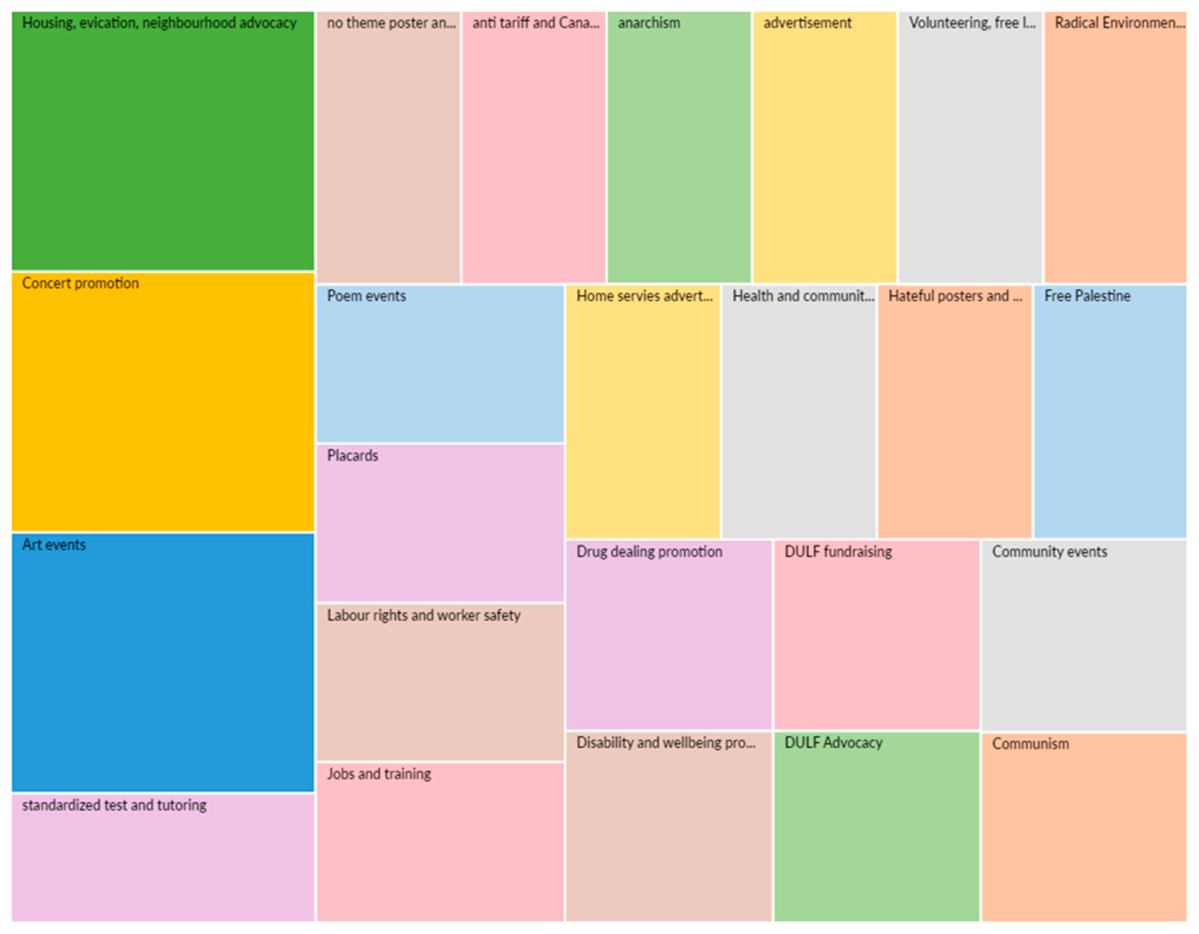
Figure 2.
The Communist posters were posted at various UBC bus exchanges in 2023 and 2024.
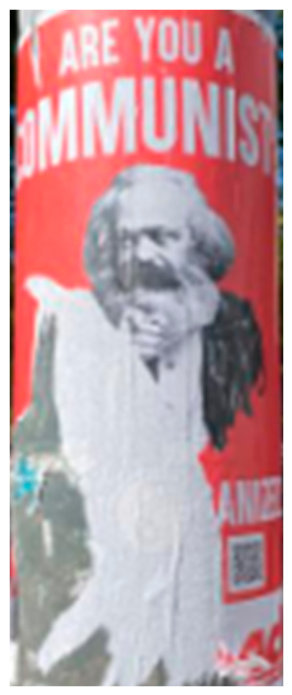
Figure 3.
Smaller posters to prevent tearing with larger QR codes, and more eye-catching slogans.
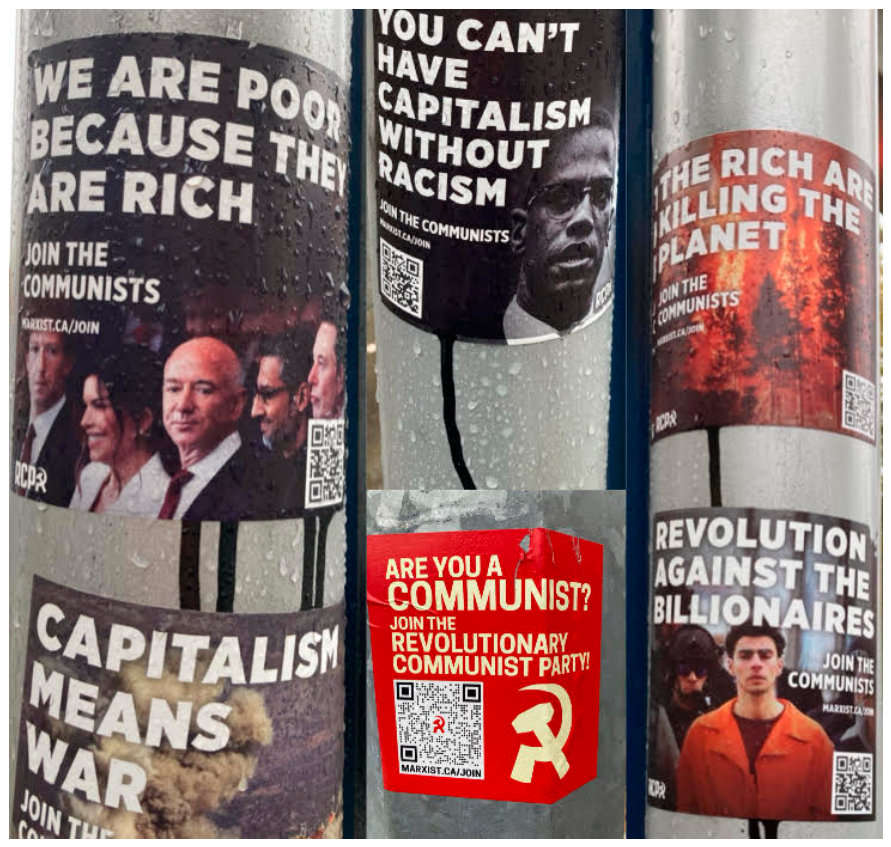
Figure 4.
The Working Youth League and the American Communist Party posters.
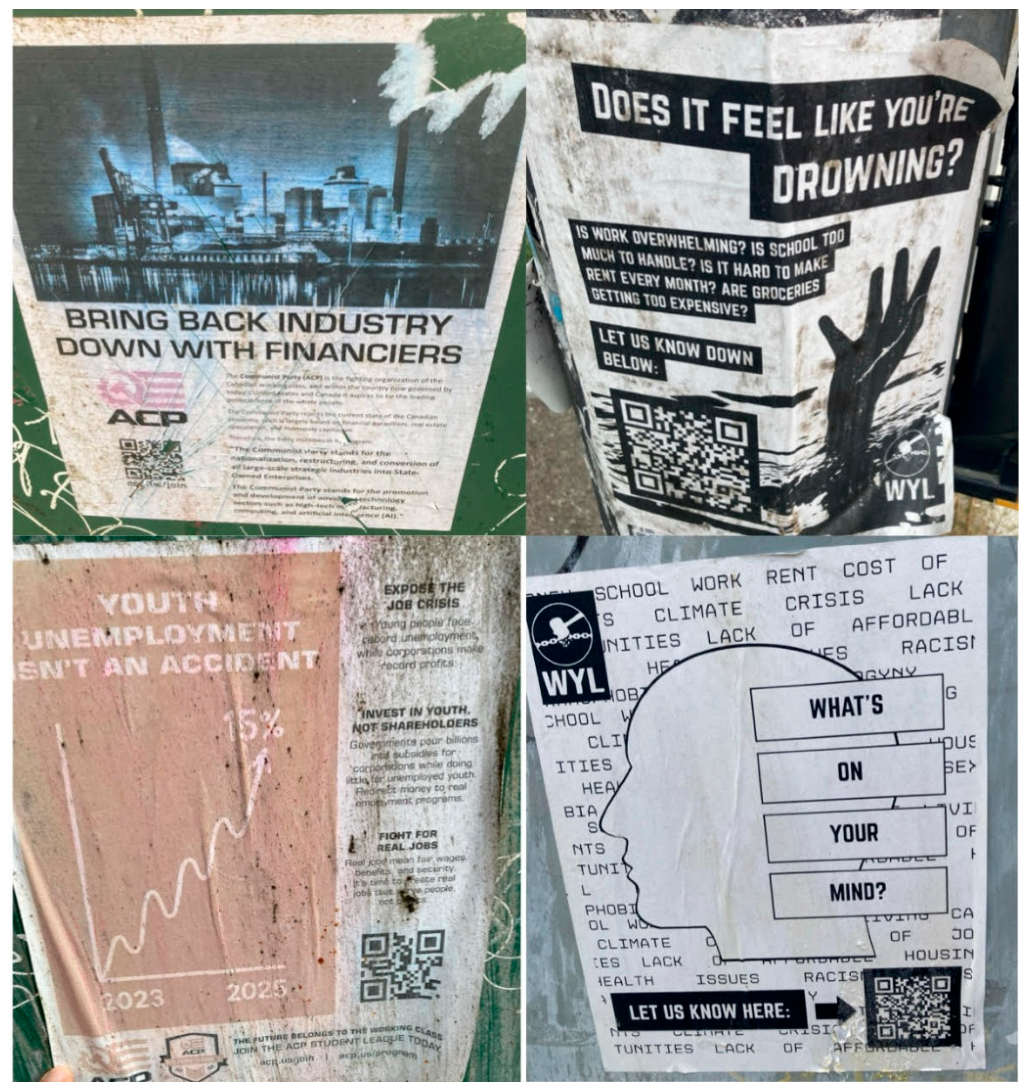
Figure 5.
Anarchist stickers promoting an alternative to the communist movement.
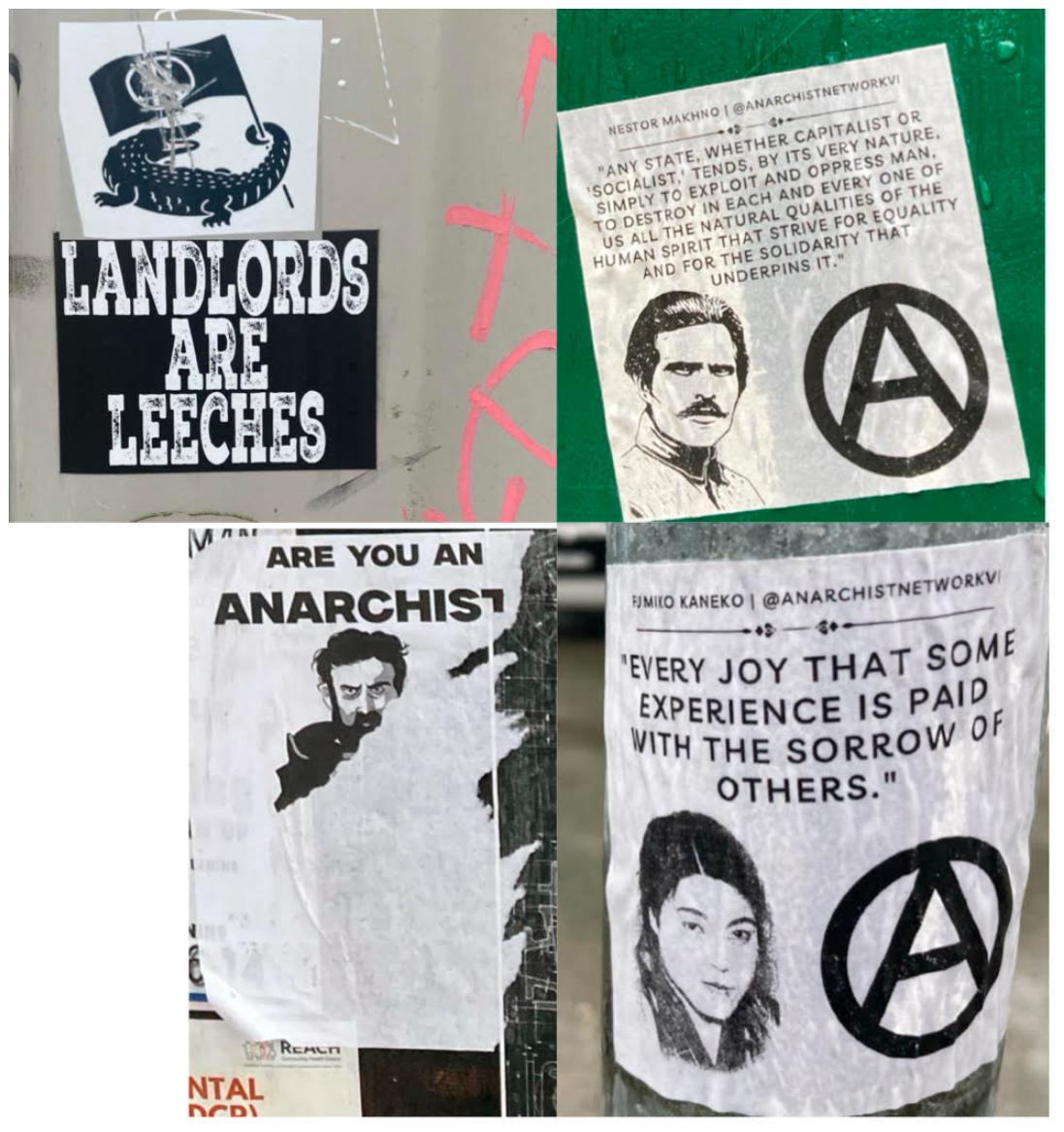
Figure 6.
Iran’s Basij militia uniform includes a Palestinian Keffiyeh, its former commander (General Mohammad Reza Naqdi), and the former Supreme Leader (The Office of Supreme Leader, 2019).
Figure 6.
Iran’s Basij militia uniform includes a Palestinian Keffiyeh, its former commander (General Mohammad Reza Naqdi), and the former Supreme Leader (The Office of Supreme Leader, 2019).
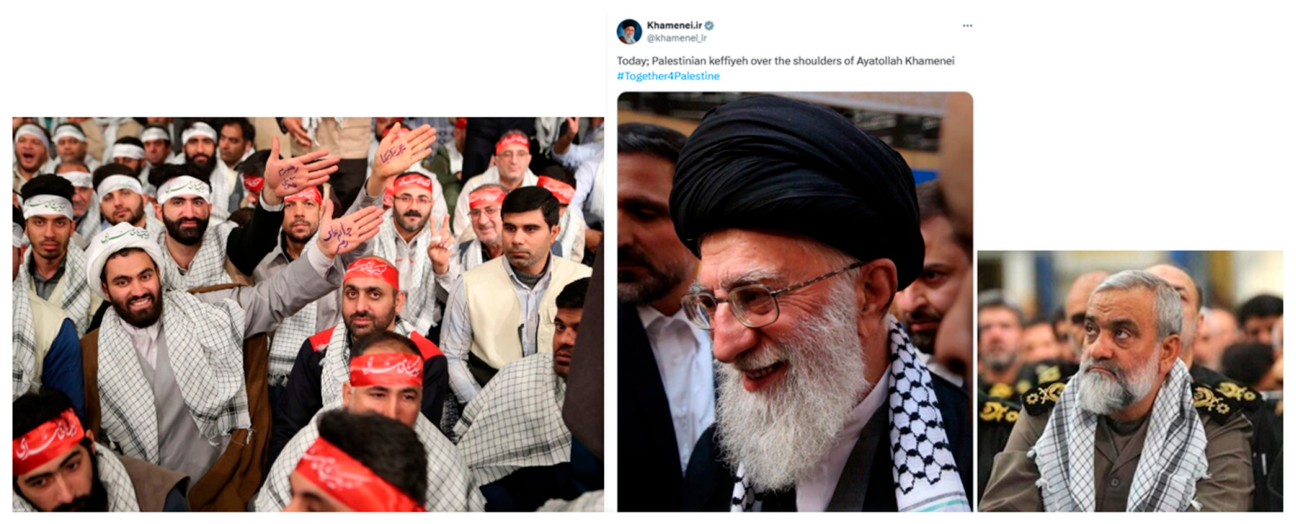
Figure 7.
The “free Palestine” movement used posters, stickers, graffiti, and flags during demonstrations.
Figure 7.
The “free Palestine” movement used posters, stickers, graffiti, and flags during demonstrations.
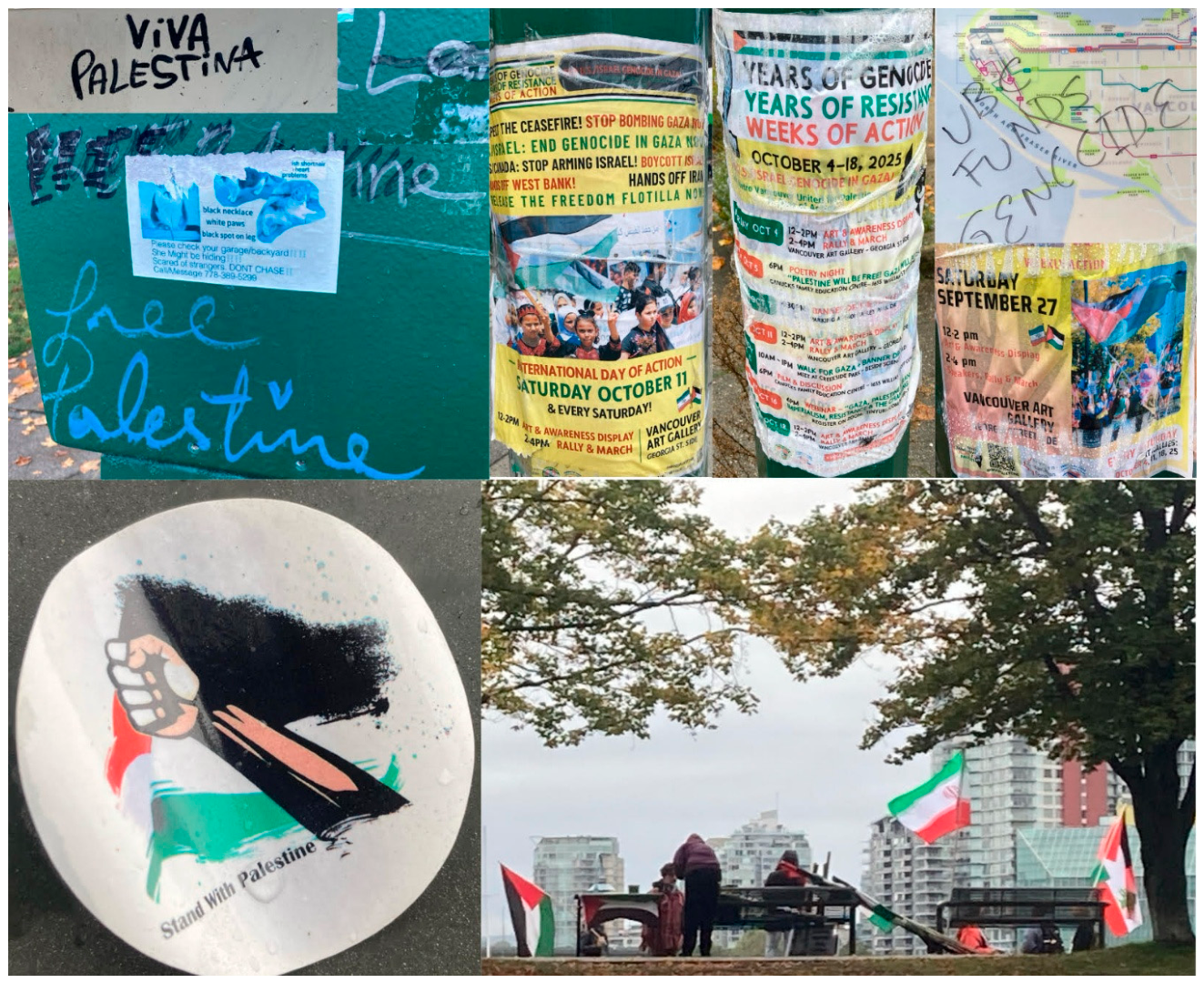
Figure 8.
Poster promoting work, career change and volunteerism.
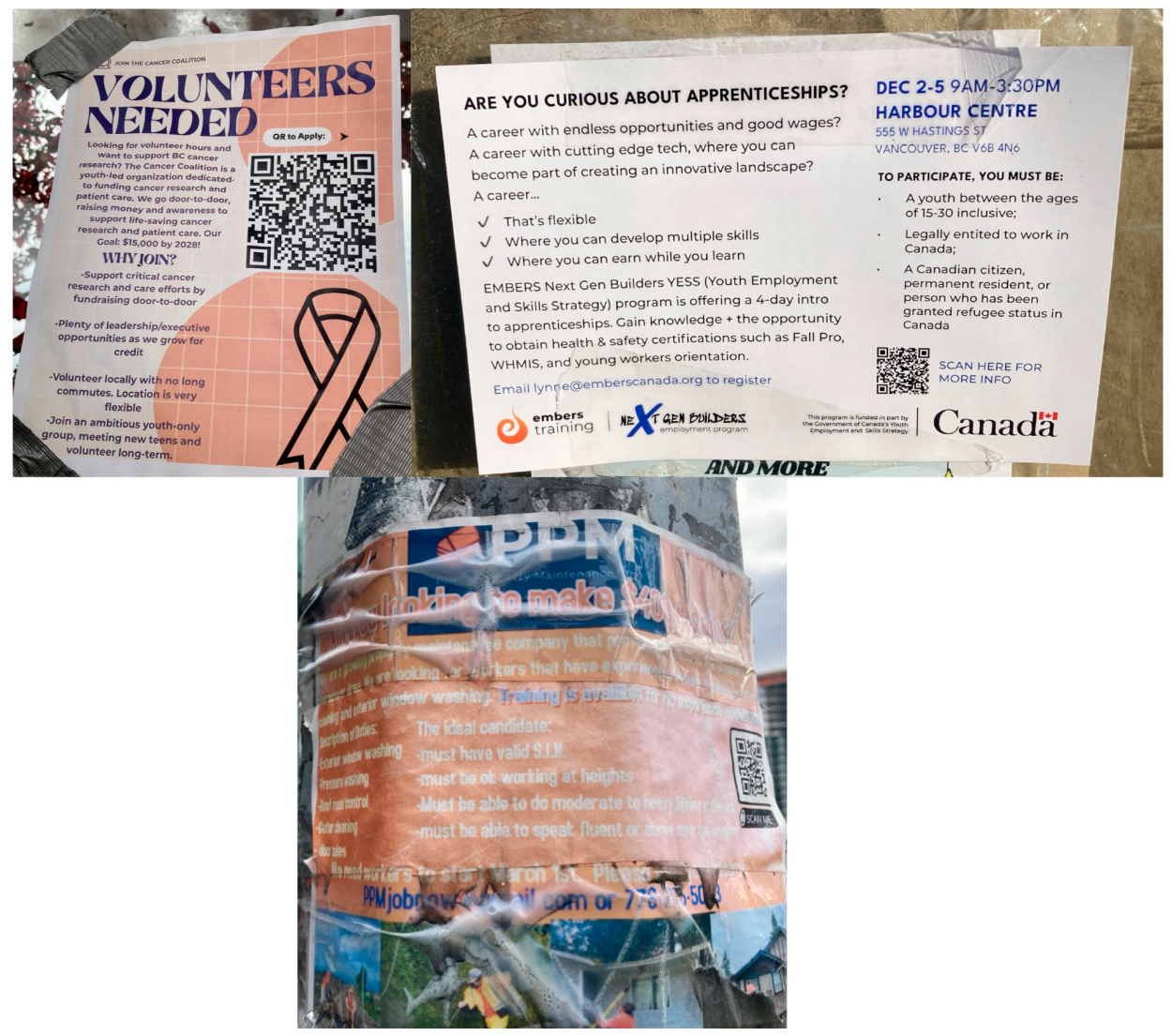
Figure 9.
Workers’ Rights, Unions, and Safety Activism Posters.
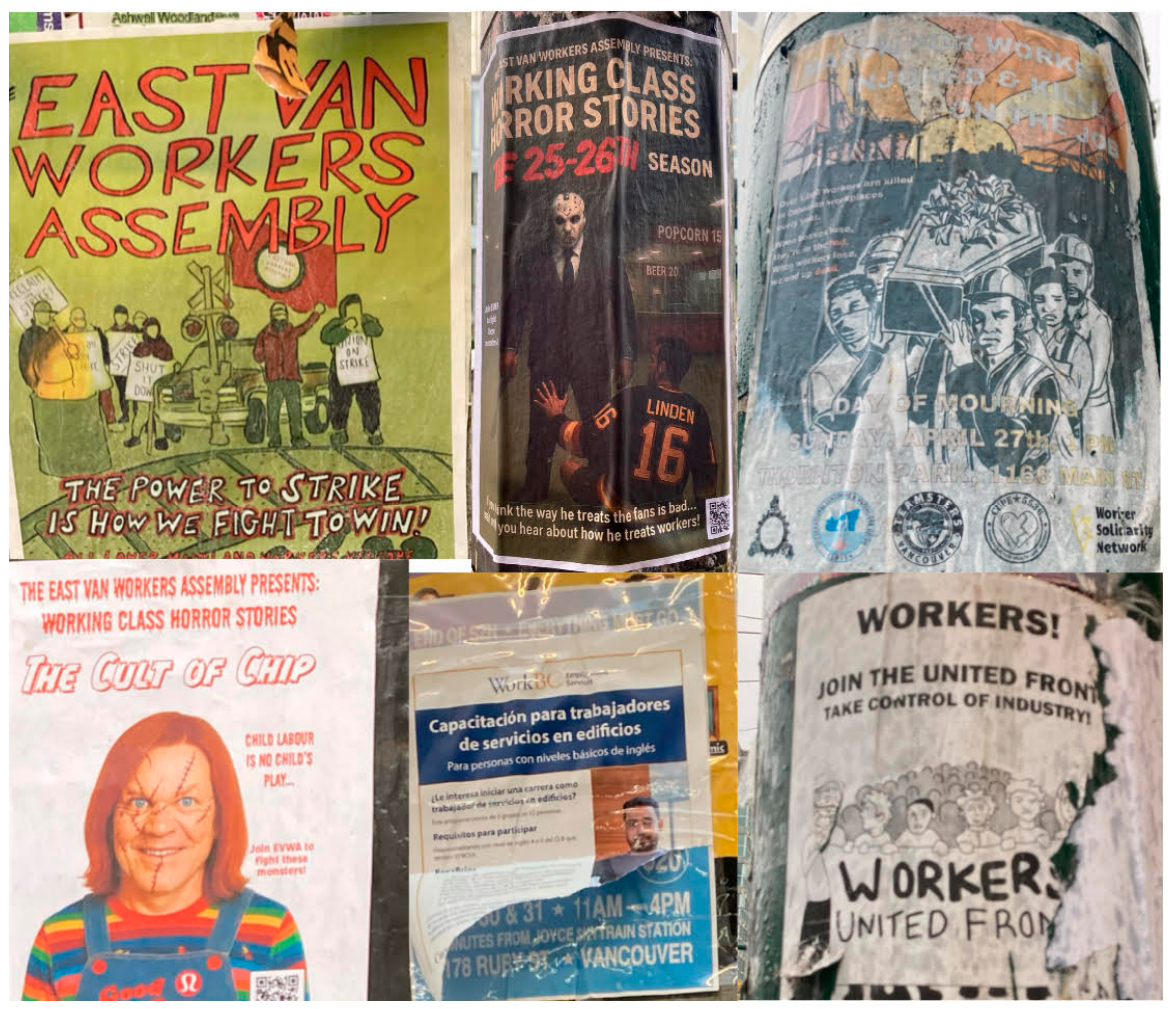
Figure 10.
The event promotions for commercial purposes.
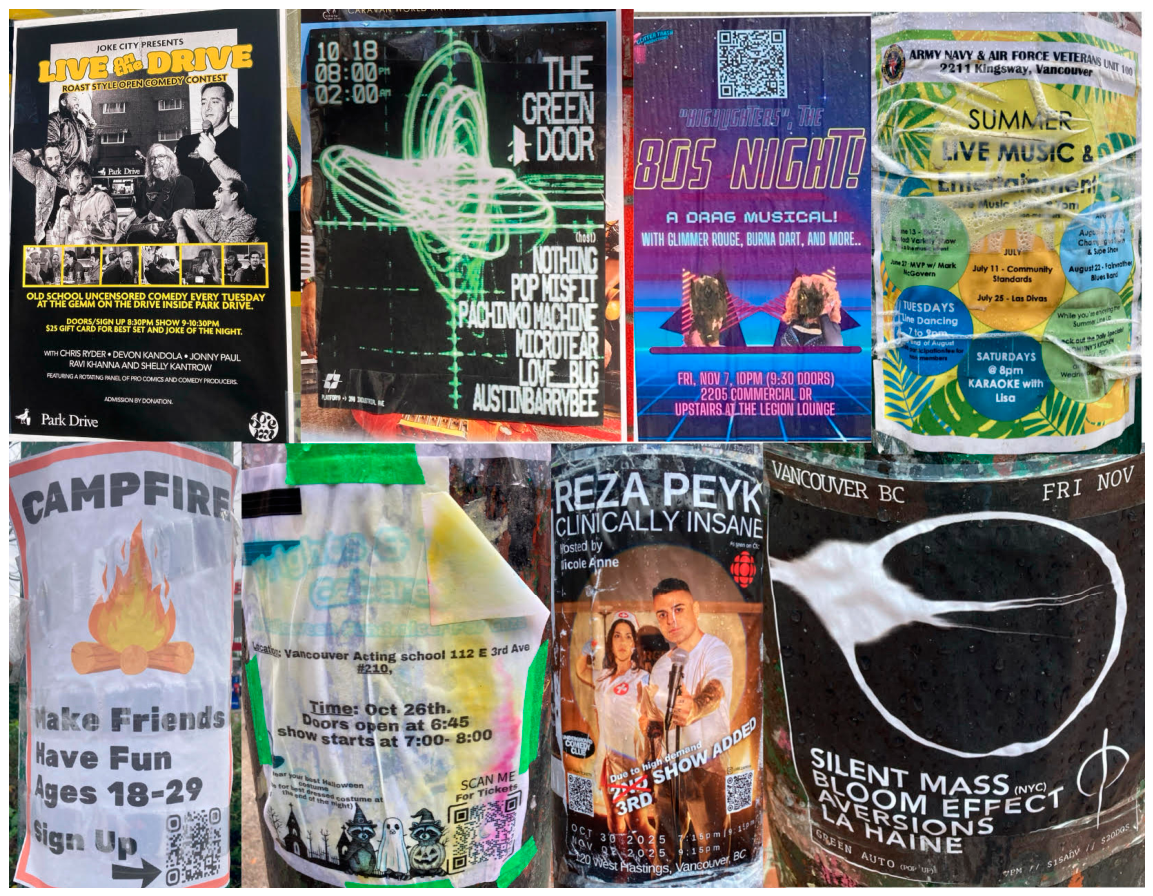
Figure 11.
Community fundraisers via concerts and awareness campaigns.
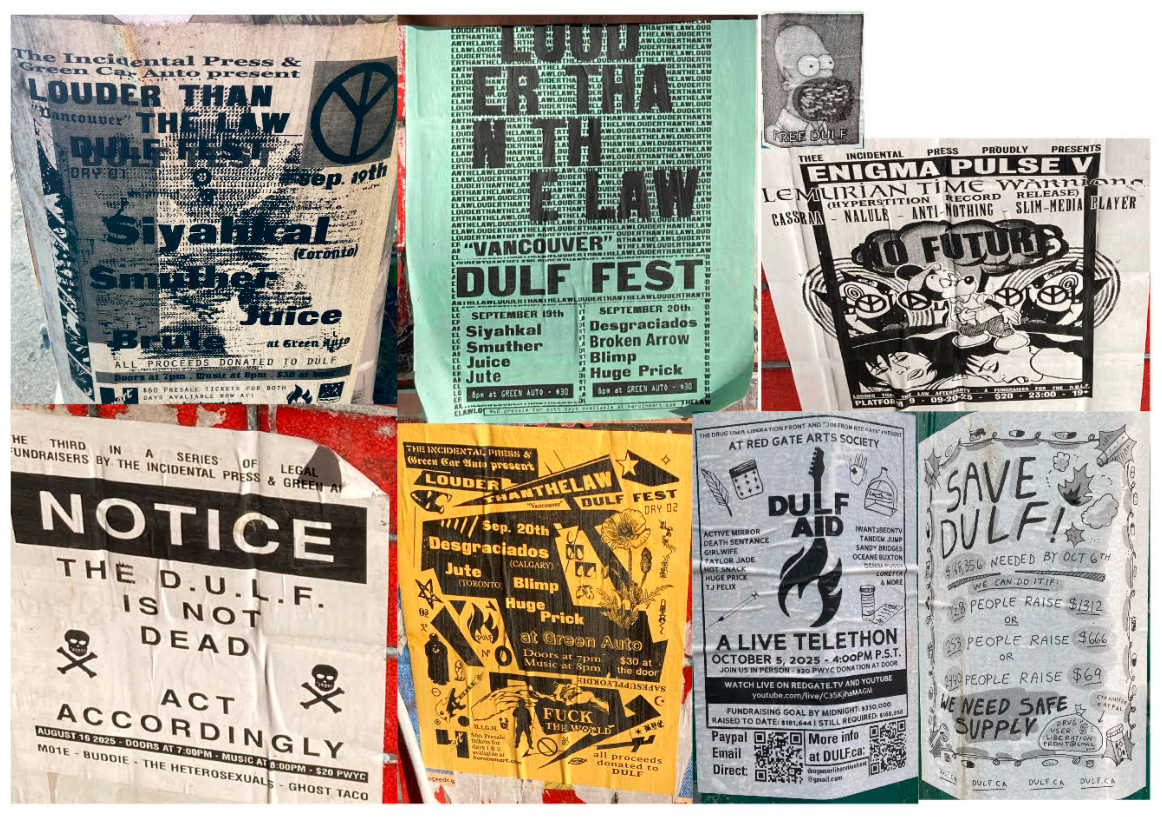
Figure 12.
Community arts, poetry, workshops, theatre, and celebrations.
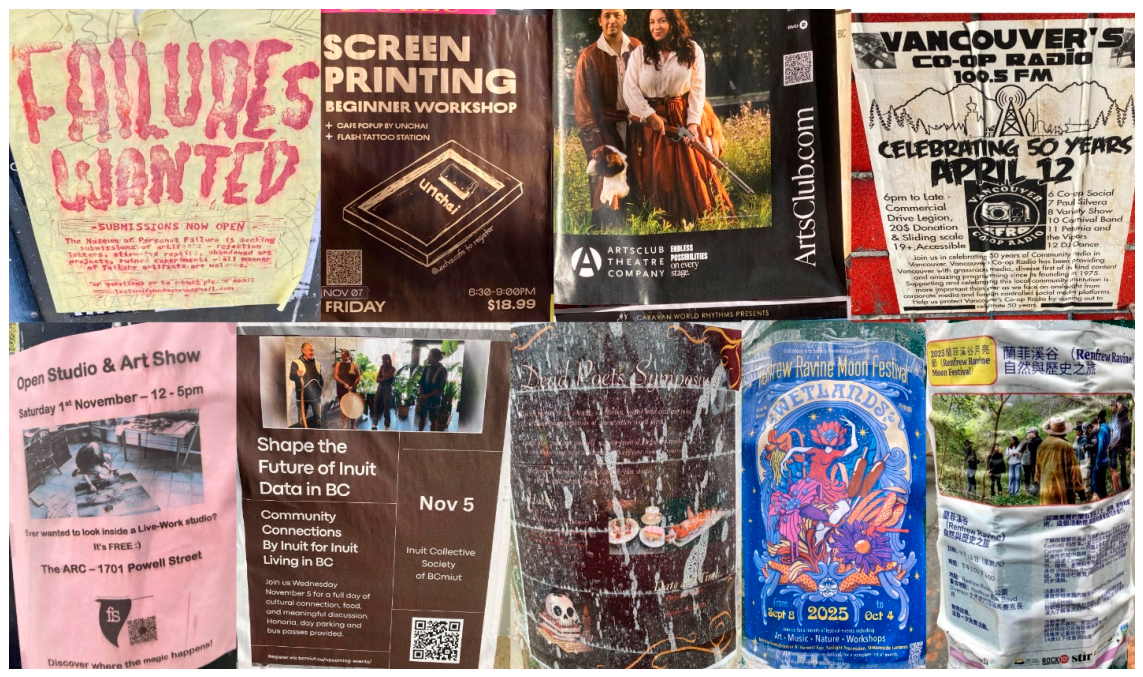

Table 1.
Posters, graffiti, and stickers are displayed at various transit hubs within a two-kilometre radius.
Table 1.
Posters, graffiti, and stickers are displayed at various transit hubs within a two-kilometre radius.
| Transit number | Number of stickers | Number of posters | Number of graffiti | Other (brochure, flags, mural, placard) | Total |
|---|---|---|---|---|---|
| UBC bus exchange (R4, 4, 14, 25, 33, 44, 49, 84, 99) | 2 | 13 | 13 | 1 | 29 |
| Bus #R4 (Joyce SkyTrain station) | 4 | 211 | 2 | 0 | 217 |
| Bus #4 (Eton St @ N Renfrew St) | 6 | 5 | 0 | 0 | 11 |
| Bus #14 (Kootenay bus loop) | 2 | 11 | 1 | 0 | 14 |
| Bus #25 (Brentwood SkyTrain station) | 2 | 8 | 0 | 0 | 10 |
| Bus #33 (29th Ave SkyTrain station) | 55 | 26 | 0 | 0 | 81 |
| Bus #44 (Waterfront SkyTrain station) | 22 | 10 | 0 | 0 | 32 |
| Bus #49 (Metrotown Skytrain Station) | 20 | 10 | 6 | 0 | 36 |
| Bus #84 (VCC Clark SkyTrain station) | 0 | 4 | 0 | 1 | 5 |
| Bus #99 (Commercial-Broadway SkyTrain station) | 11 | 309 | 20 | 7 | 347 |
| Total for all buses | 124 | 607 | 42 | 9 | 782 |
| x̄ | 12.40 | 60.70 | 32.45 | 0.90 | 78.20 |
| σ | 15.99 | 102.19 | 6.58 | 2.07 | 107.90 |
Disclaimer/Publisher’s Note: The statements, opinions and data contained in all publications are solely those of the individual author(s) and contributor(s) and not of MDPI and/or the editor(s). MDPI and/or the editor(s) disclaim responsibility for any injury to people or property resulting from any ideas, methods, instructions or products referred to in the content. |
© 2026 by the authors. Licensee MDPI, Basel, Switzerland. This article is an open access article distributed under the terms and conditions of the Creative Commons Attribution (CC BY) license (http://creativecommons.org/licenses/by/4.0/).
Copyright: This open access article is published under a Creative Commons CC BY 4.0 license, which permit the free download, distribution, and reuse, provided that the author and preprint are cited in any reuse.