

Submitted:
28 October 2026
Posted:
30 October 2026
You are already at the latest version
Abstract
This study evaluates the acoustic performance of the 14th-century Corral del Carbón courtyard in Granada, Spain, an unroofed Nasrid al-funduq used as an unamplified performance space. In-situ impulse responses following ISO 3382-1, B-format ambisonic captures, and background noise assessments were integrated with calibrated geometrical acoustic simulations in EASE/AURA. The open-sky boundary prevents late diffuse field consolidation, producing a linear energy decay (Tmid = 1.07s; EDTmid = 1.04s). Strong early lateral reflections yield high clarity (C80 = 4.37dB), definition (D50 = 59%), and speech intelligibility (STI = 0.627). The massive rammed-earth walls attenuate external urban traffic noise by up to 20 dB, securing an NC-35 rating (27.1dBA). To compensate for CAD geometry simplification, a global scattering coefficient (s = 0.80) was required, achieving precise simulation calibration (Tmid= 1.061s). Predictive scenario modelling demonstrates that installing a temporary overhead roof would trap acoustic energy, raising T30 beyond 2.0s and severely degrading acoustic definition and intelligibility. Preserving the open-sky boundary is therefore essential for safeguarding the venue’s intangible acoustic heritage.
Keywords:
room acoustics
; acoustic simulation
; heritage & acoustics
; intangible cultural heritage
1. Introduction
1.1. Sound and Soundscape as Intangible Cultural Heritage
The acoustic response of historical buildings constitutes an essential intangible dimension of their heritage value and spatial memory [1]. The preservation of this sonic behaviour through impulse response (RIR) measurements and three-dimensional research has been developed by various authors [2] [3]. The i-SOUND research project (Methodology for obtaining Inclusive SOUNDscapes as intangible heritage and its cultural protection) is situated within this framework, focusing on the documentation and cataloguing of historical soundscapes through three-dimensional ambisonic techniques [4]. The use of B-format ambisonic recordings allows for capturing the three-dimensionality of the sound field in the Corral del Carbón, facilitating both digital preservation of the monument and auralized reproduction using binaural or spatial rendering techniques [4]. This approach bridges objective physical characterisation with the conservation of the venue's historical aural architecture [4].
Over the past two decades, the international frameworks established by UNESCO have shifted the heritage conservation paradigm from focusing exclusively on physical material structures to incorporating immaterial and sensory dimensions [5]. In this context, auditory experiences are increasingly acknowledged as fundamental drivers shaping human interaction with historical environments [5]. Despite this recognition, sound and room acoustics have historically been treated merely as secondary elements contributing to physical site value rather than as distinct heritage categories worth of independent preservation [6]. This reliance on visual aesthetics has generated a mono-sensory bias in heritage management, frequently overlooking the dynamic and ephemeral sonic environments of historical monuments [7].
To address this imbalance, interdisciplinary scholarship in archaeoacoustics and historical room acoustics defines acoustical heritage as a multidimensional framework uniting physical acoustics, sound sources, and socio-cultural human practices [6]. Historic architecture (ranging from ancient performative structures to medieval worship spaces) was designed and transformed in close alignment with auditory functions such as public speech, drama, and liturgical chant [8]. For instance, classical Greek and Roman theatres demonstrate how volumetric geometry and reflective surface materials were optimized to ensure speech intelligibility and acoustic performance across complex social gatherings [8].
Similarly, virtual acoustic reconstructions of extinct monuments, such as the Romanesque Maior Ecclesia of Cluny, show how colossal spatial volumes (over 110,000 m³) and high reverberation times (about 11 s) heightened the spiritual atmosphere of Gregorian chant [9]. Researchers can recover lost sensory experiences and analyse how room acoustics functioned as an intangible bridge between physical geometry and sacred liturgy through computer modelling and virtual auralization [9]. Furthermore, the evaluation of urban heritage soundscapes highlights the importance of preserving iconic soundmarks [10], such as traditional gamelan music, which reinforce local identity but risk being masked by modern traffic noise [11]. To capture these complex sonic environments, researchers employ methodological triangulation combining physical acoustic measurements, historical archival sources, and social perception surveys [7].
Despite these methodologies, a key research gap persists in systematically connecting physical room acoustics with the broader UNESCO framework for intangible cultural heritage [6]. This paper addresses this gap by investigating how the acoustic properties of historical built heritage function as a living intangible cultural asset, synthesising computational acoustic modelling with soundscape perception to advance holistic conservation strategies [6].
To bridge these gaps, recent international initiatives advocate treating acoustics with the same conservation rigor applied to tangible built heritage focusing on the systematic cataloguing, long-term archiving, and standardization of acoustic datasets. As highlighted by Alvarez-Morales et al. [12], capturing high-resolution Room Impulse Responses (RIRs) and ambisonic soundfields provides a reproducible digital record that safeguards the ephemeral acoustic identity of historical spaces. Establishing standardized metadata and open-access repositories (such as the proposed Global Heritage Acoustics Catalogue) ensures that the aural memory of sites like the Corral del Carbón is not only characterized for current performance uses, but permanently archived and made accessible for future research and acoustic restoration.
1.2. Acoustical Problematisation in Semi-Open Spaces and Critical Review
Courtyards are present as heritage buildings around the globe. In recent years, the acoustic behaviour and soundscape of courtyard typologies have emerged as a topic of growing scientific interest. This relevance is highlighted by Eawpanich et al. [13], who demonstrated through a systematic review the critical role of urban and historical courtyards in mitigating environmental noise and preserving sensory heritage. Within this broader international framework, the functional adaptation of historical open-air courtyards for musical and theatrical performances highlights the need for acoustical assessment protocols tailored to non-standard and semi-open geometries.
Evaluating open-air or semi-open heritage spaces presents severe methodological challenges when traditional room acoustic criteria designed for enclosed auditoriums are applied. Previous research by Paini et al. [14], and Mo and Wang [15], demonstrated that conventional reverberation time (T30) cannot serve as a primary or standalone descriptor of perceived acoustic quality in unroofed venues [16], owing to the absence of an upper reflecting boundary. Consequently, open-sky evaluations require a multi-criteria approach prioritising early sound energy parameters (such as C80, D50, and STI). Nevertheless, determining T30 remains methodologically necessary within this framework for two specific reasons: first, comparing T30 against Early Decay Time (EDT) provides a quantitative measure of decay linearity (where an EDT/T30 ratio near unity confirms the absence of abrupt double-slopes or anomalous energy traps); second, T30 serves as the primary benchmark to model the impact of hypothetical enclosure interventions (such as overhead roofing in EASE simulation, Scenario C).
The absence of a ceiling prevents the formation of a diffuse sound field, in unroofed or semi-open courtyard architecture (Figure 1), resulting in energy reflections that are primarily restricted to the horizontal plane. Consequently, standard objective parameters defined in ISO 3382-1(such as early decay time (EDT) and the clarity index C80) frequently produce low values for clarity, intimacy, and listener envelopment (LEV). Paradoxically, these adverse numerical indicators contradict the highly positive feedback reported by musicians and audience members in open-air heritage venues. This disparity between classical room acoustic descriptors and perceived listening quality has been documented in monumental open-air courtyards, such as the Palace of Charles V by Almagro-Pastor et al. [17], in ancient open-air venues by Astolfi et al. [18], and in historical courtyards used for concerts by Iannace [19].
To address these limitations, recent studies advocate a paradigm shift towards holistic, multi-criteria frameworks that combine classical room acoustics, environmental noise control, and soundscape perception. For instance, a perceptual soundscape study in an open-air medieval courtyard by Almagro-Pastor et al. [4] revealed that natural sound features (such as water and vegetation) and visual-contextual attributes significantly enhance perceived acoustic pleasantness by masking external urban noise. Integrating perceptual soundscape metrics alongside physical energy parameters offers cultural heritage managers and acousticians a robust, repeatable tool for selecting and evaluating open-air concert venues.
In an open-sky or semi-open heritage space, the acoustic energy of the reflected field is drastically reduced frequently up to 20 dB lower than that generated within an enclosed opera house or concert hall of equivalent spatial volume [17] due to the complete absence of a roof and the unhindered dissipation of sound waves into the upper atmosphere [14] [20]. Consequently, directly comparing the conventional reverberation time (T30) of an unroofed courtyard or ancient open-air venue with that of large enclosed auditoriums is methodologically inappropriate and acoustically misleading [15] [17]. Under these strongly non-diffuse boundary conditions, where late reverberant energy decays prematurely or fails to consolidate, standard decay rates lose their predictive validity regarding subjective listening impression. Therefore, priority must be given to objective acoustic descriptors based on early sound energy, energy ratios, and temporal arrival patterns, such as the clarity index (C80), definition or distinctness (D50), and centre time (Ts) [21] [22] [18]. These early energy parameters offer a significantly more reliable characterisation of musical clarity, speech intelligibility, and temporal energy distribution in non-standard venues dominated by direct sound and discrete lateral boundary reflections.
1.3. An Inn Seven Centuries Old
The Corral del Carbón (Granada, Spain) is the former Alhóndiga Nueva (al-fundaq al-yadida), a Nasrid building constructed in the first half of the 14th century and documented in citations dating to 1336 [23,24]. This commercial and merchant lodging typology [25] constitutes the only fully preserved example in the Iberian Peninsula, analogous to the caravanserais of the Middle East and North Africa [26]. Strategically situated opposite the commercial district of the Alcaicería, on the other side of the Darro River via the Puente del Carbón [27], the building was structured as a typical "corrala" layout, with its porticoed interior courtyard [28].
Following the “Reconquest” of 1492 and its conversion into a coal store in 1531 [29], the property hosted theatrical uses during the Spanish Golden Age (1585–1593), operating as a corral de comedias for plays by authors such as Lope de Rueda, Lope de Vega, Luis de Góngora, Tirso de Molina, and Calderón de la Barca, utilising the rooms in the upper galleries as private boxes or aposentos [30]. After centuries of degradation, it was declared an Architectural-Artistic Monument in 1918 and acquired by the State in 1928. Restoration began under the direction of Leopoldo Torres Balbás between 1929 and 1931 [25] (Figure 2). Subsequently, the interventions by R. Soler in 1992 and the roof restoration performed by MD. Blanca in 2006 shaped its current condition [27]. In the 20th century, with the consolidation of the Granada International Festival of Music and Dance, the central courtyard became permanently established as an emblematic open-air stage for chamber music concerts, recitals, and theatrical performances without electroacoustic amplification [28].
1.4. Heritage & Architecture
In the study of heritage acoustics, non-standard historical venues present complex sound-field phenomena that challenge traditional room acoustic theories. A prominent exemplar of this architectural typology is the 14th-century Nasrid al-funduq known as the Corral del Carbón in Granada, Spain. The courtyard of this ancient building is a prismatic space with a nearly square rectangular plan measuring approximately 15 m on either side, enclosed by three levels of porticoed galleries supported by 28 tufa stone (piedra tosca) pillars on the ground floor and brick masonry with timber lintels on the upper storeys [4] [31]. The venue lacks an overhead roof, causing a permanent escape of acoustic energy outdoors and preventing the buildup of late reverberant energy [28].
This open-sky boundary condition fundamentally alters sound propagation compared to enclosed auditoriums. Because acoustic energy escapes freely through the upper aperture, the sound field lacks a consolidated, isotropic diffuse reverberant tail. As a result, applying standard room acoustic metrics defined in ISO 3382-1 (most notably conventional reverberation time (T30)) introduces severe methodological limitations [21] [14]. In such unroofed enclosures, measured T30 values fail to reflect perceived listening quality, necessitating an analytical emphasis on early sound energy parameters, energy ratios, and psychoacoustic indicators.
The spatial dimensions, courtyard geometry, and boundary materials of the Corral del Carbón raise a fundamental question regarding the predominance of direct sound and early reflections over late reverberant energy. Within a compact 15 m × 15 m footprint, listeners are positioned in close proximity to both the sound source and the surrounding vertical walls. Sound energy is thus dominated by the direct sound wave and strong, discrete early lateral reflections provided by the ground-floor stone pillars, upper brick arcades, and gallery balustrades, arriving well within the crucial early temporal window (t < 80ms) [20] [22] [17]. Consequently, objective descriptors based on early-to-late energy ratios (such as the clarity index (C80), definition or distinctness (D50), and centre time (Ts) provide a far more accurate characterisation of musical clarity and temporal energy distribution than global reverberation metrics.
Furthermore, the substantial physical mass of its 14th-century rammed-earth (tapial) masonry walls suggests a significant degree of sound attenuation against the transmission of external urban noise into the central courtyard. Located in the historic centre of Granada adjacent to high-density traffic arteries such as Calle Reyes-Católicos, the external environment exhibits high equivalent sound pressure levels (Laeq mbison 65–70dBA). However, the high surface mass density and continuous envelope of the tapial walls act as a robust acoustic barrier, reducing internal background noise levels inside the patio to approximately (46–51dBA). This structural insulation creates an acoustic refuge where external traffic noise is heavily attenuated. When combined with internal natural masking sources (such as the central stone water fountain and vegetation on the top) the courtyard achieves a marked reduction in Psychoacoustic Annoyance (PA), providing an acoustically serene environment well-suited for chamber music and vocal performances [4].
Finally, the geometric asymmetries and structural deviations accumulated over more than eight centuries of historical transformations raise the critical question of whether these irregularities (manifested at multiple spatial scales) act as natural acoustic diffusers that eliminate flutter echoes in this seemingly symmetrical space. In a perfectly square, smooth, parallel-walled enclosure, specular reflections bouncing between opposing vertical surfaces inevitably generate flutter echoes and severe comb-filtering artefacts. In the Corral del Carbón, however, macro-scale structural distortions (non-parallel gallery alignment and uneven storey heights) combined with micro-scale surface textures (rough cobblestone flooring, carved stone capitals, timber beam coffering, and climbing vines) scatter incident acoustic waves across broad frequency bands [32] [33]. This multi-scale geometric scattering effectively disrupts coherent specular reflection paths, preventing floating echoes and enhancing spatial sound diffusion without requiring modern synthetic sound-absorbing treatments.
1.5. Acoustic Simulation & EASE
Over recent decades, computer simulation based on geometrical acoustics (GA) has established itself as a fundamental methodology for analysing enclosed acoustic environments and preserving intangible cultural heritage [34]. The primary objective of virtual acoustic reconstruction is to simulate the sound field behaviour of historical, altered, or vanished architectural spaces, such as churches, cathedrals, and ancient performance venues, like the Corral del Carbón, to recover their lost sonic identity [35]. Virtually constructed three-dimensional CAD models, often generated from laser-scanning surveys or archival documentation, are typically calibrated against empirical on-site impulse response measurements by adjusting surface absorption and scattering parameters [36]. Once calibrated, these simulation models facilitate the prediction of standard room acoustic indicators defined under ISO 3382-1, including Reverberation Time (T30), Early Decay Time (EDT), Clarity (C80), and Speech Transmission Index (STI) [37].
Within the domain of room acoustic software, EASE (Enhanced Acoustic Simulator for Engineers, AFMG Technologies) was originally created for electroacoustic design and the simulation of professional sound reinforcement systems [35] [38]. To perform comprehensive room acoustic predictions and evaluate diffuse sound fields, the EASE suite incorporates the AURA simulation module [37]. The computational engine of AURA is based on the CAESAR (or CESAR) hybrid algorithms developed at RWTH Aachen University [38]. EASE AURA operates via a hybrid algorithm that combines parallel deterministic image-source methods with stochastic ray/particle tracing to calculate early specular reflections alongside late reverberant energy decays [38]. This parallel operational framework delivers a seamless, continuous transition from early specular reflections to late diffuse decay without the need of manual transition orders or secondary source definitions [38]. In historical acoustic studies, high-density particle simulations executed within EASE AURA produce detailed sound mapping and synthesized impulse responses that are strictly validated against ISO 3382-1 criteria [37].
1.6. Acoustic Simulation & Scattering Coefficient
In room acoustics and numerical modelling, the scattering coefficient (s) or (∂) serves to quantify the energetic proportion of sound power that is reflected in non-specular directions relative to the total reflected sound power [39]. It is essential to distinguish between the scattering coefficient and the diffusion coefficient (ISO 17497-2): whilst the scattering coefficient specifies how much reflected acoustic energy is redirected away from the specular reflection direction, the diffusion coefficient measures the spatial uniformity or polar distribution of that scattered energy across space [40]. However, EASE only incorporates a scattering coefficient, rather than a diffusion coefficient. Consequently, this approach provides the only means of modelling the influence of geometric irregularities on sound diffusion across the entire frequency range.
From a physical perspective, the scattering coefficient provides an energetic partition of the total reflected energy (1-α) into a specularly reflected component, (1-α)(1-s), and a diffusely scattered component, (1-α) s [39]. In geometrical acoustics algorithms such as ray tracing, image source, and hybrid room acoustic models, the scattering coefficient operates as a weighting factor or probability threshold determining whether a sound ray reflects specularly according to Snell’s law or is re-radiated diffusely, typically following Lambert’s cosine law [41]. Without implementing a scattering coefficient, purely geometrical models generate unrealistically specular sound fields, failing to represent surface roughness, structural corrugations, and edge diffraction [41]. Applying realistic scattering values redistributes reflected energy appropriately throughout the volume, which significantly enhances the prediction accuracy of key acoustic indicators such as reverberation time (T30), early decay time (EDT), and clarity (C50) when calibrating virtual models against empirical data [42].
1.7. Research Questions
RQ1. Spatial variability and early acoustic energy. To what extent do the geometry and architectural irregularities of the Corral del Carbón govern the spatial variability of early acoustic energy parameters in an unroofed heritage courtyard?
RQ2. Acoustic decay and environmental noise. How do the open-sky configuration and massive enclosure walls influence acoustic decay and urban noise attenuation within the courtyard?
RQ3. Simulation and roof enclosure. To what extent can calibrated geometrical acoustic simulation capture the measured acoustic response, and what are the implications of a temporary roof for the venue’s acoustic performance?
2. Materials and Methods
2.1. Data Acquisition According to ISO 3382
Audio samples were collected using a Brüel & Kjaer 4145 microphone mounted on a tripod, connected to its 2804 power supply. The signal is then fed into a Zoom F8 field recorder. The level was calibrated each time using a Brüel & Kjaer 4231 calibrator at 94 dB. Headroom is set depending on the conditions from 6 to 20 dB enabling the recording of 114 dB peaks; a RØDE spherical blimp was included in the setup. The signal is re-escalated using the calibration signal and then analysed using BK Connect software. This procedure complies with ISO 3382-1 [43] and ISO 12913 [44,45,46] in acoustic perception. An omnidirectional microphone, soundfield mbisonics, completed the data acquisition for the acoustic characterization according, specially, to ISO 3382-1. Other reasons to keep Ambisonic RIRs are documentation and safeguarding of the historical heritage [47], mbisonicson of spatial information such as the research by Martellotta [48] or Alary and Valimaki [49], or using different available 3D reproduction techniques to recreate concerts, as shown by Tronchin and Farina [50]. The recordings were made with chairs in the courtyard and the stage set up, as recommended by Gade [51]. However, it was not possible to make measurements under real conditions, as recommended by Dammerud [52]. In this sense, there is uncertainty in the measurement without audience, as expressed in the Giovannini and Astolfi studies [53], although the dimensions of the space and its open-air character help to control this dispersion.
An omnidirectional microphone was used in all measurements, together with a Lookline DL-203 dodecahedral source. Both were used in the acoustic characterization according to ISO 3382-1. Soundfield mbisonics microphone was completed with 360-degree video camera in soundscapes. Binaural RIRs were processed from Ambisonic RIR using Ambi Head HD [54] with a Neuman KU100 SOFA (Spatially Oriented Format for Acoustics) and then calculated using ARTA software [55].
Exponential sine sweeps were used because of their segregation of harmonic distortion, documented by Farina [56], and their higher impulse-to-noise ratio under usual test circumstances. The recorded signals were deconvolved by post-processing using Aurora plugins [57] to obtain the RIR.
Measurements were carried out in accordance with ISO 3382-1 [43], with two source positions (dodecahedron) located 1.50 m from the stage platform and nine microphone points, located at a height of 1.2 m (Figure 3 and Figure 4). The sound emitted was a frequency sweep of more than 45 dB above the background noise, as stated in the standard. The volume of the room considered is 4,300 m3, an open space on the entire floor of the courtyard and surrounded by a porticoed gallery. The chairs are usually made of plastic and, in this sense, have very little absorption. The concerts held are usually without the aid of electro-acoustics. In general, there are no decorative curtains or drapes, except for the stage itself. The recommendations of Pompoli-Prodi [58] and Astolfi et al. [59] were interpreted and followed as far as possible. Figure 3 shows the relative positions of the sound source in its two positions, as well as the nine measuring points.
Background noise measurements were carried out during business hours with heavy traffic on the adjacent Reyes-Católicos Street [4]. Equivalent sound pressure levels (LAeq) and spectral levels were evaluated according to ISO 1996-2 and compared against Beranek’s Noise Criteria (NC) curve family [60] [4]. Speech intelligibility was evaluated using the Speech Transmission Index (STI) per IEC 60268-16 [61].
2.2. Simulation Model in EASE 4.4 /AURA
All the simulations carried out in EASE were performed by replicating the same scenario of sources and measurement points as those used in the in-situ measurements. The two sources in the scenario, as well as the nine measurement points, are situated in the AURA model in the same position and at the same height as in the in-situ measurements carried out in accordance with ISO 3382 (Figure 5).
The simplified 3D model (Figure 6) comprises 822 vertices and 500 faces. To satisfy the closed computational condition of the software, the upper opening of the courtyard (215.36 m²) was represented by a totally absorbent dummy surface (Absorber material, face F438, alpha = 1.0 on both sides) modelling energy escape to the open sky.
Diffuse field and scattering simulations were run using the AURA (Analysis Utility for Room Acoustics) module, based on the CAESAR algorithm from RWTH Aachen University, employing 36.12 million particles, a time length of 3,500 ms, and a global scattering coefficient of 80% to model surface roughness and global irregularities (Table 1).
In room acoustic computer simulation, when software packages such as EASE AURA do not incorporate a specific diffusion coefficient (which defines the spatial uniformity and polar directivity of scattered sound), the computational engine fundamentally relies upon the random-incidence scattering coefficient [39]. A diffusion coefficient characterises the directional spatial distribution of scattered energy [40], whereas the scattering coefficient specifies solely the energetic proportion of sound power that is reflected away from the specular reflection path relative to the total reflected power [39].
When a detailed directional diffusion pattern is absent from the software, the directional redistribution of the scattered acoustic energy is stochastically evaluated by applying Lambert’s cosine law [41]. Under this formulation, the non-absorbed reflected sound power, represented by (1 – α), is partitioned into two distinct components: a specularly reflected portion, (1 – α)(1 – s), governed by Snell’s law, and a diffusely scattered portion, (1 – α)s, radiated across the hemisphere following a Lambertian distribution [40].
When acoustic simulation omit scattering by setting the corresponding coefficient to zero, purely geometrical ray-tracing or image-source models become susceptible to trapping acoustic rays within unphysical specular reflection loops [41]. The absence of diffuse reflections can introduce significant systematic uncertainties and discrepancies in the prediction of key room-acoustic indicators, particularly reverberation time (T30), early decay time (EDT), and clarity measures (C50 and C80) [62]. Consequently, the appropriate assignment of scattering coefficients, combined with a Lambertian directional distribution, enables geometrical room-acoustic algorithms to account for surface roughness and to approximate the effects of diffusion without requiring an explicit diffusion coefficient [63]. In practical acoustic modelling, standard scattering coefficients “c” are typically set between 0.05 and 0.10 for large, smooth plane surfaces, whereas complex or highly irregular surfaces such as audience areas, pews, or coffered ceilings require higher coefficients around 0.70 to 0.80 [41].
The in-situ acoustic characterisation was performed before the EASE simulation. The simulation was then adjusted to the empirical values, which required the use of a scattering coefficient of 80 per cent, i.e. c = 0.8. This high level of diffusion incorporated into the AURA ray-tracing model highlights that the simplified geometric model must, paradoxically, be made more complex in order to reflect the reality of the heritage building.
Three simulation scenarios were set up to contrast acoustic behavior and evaluate roof functionality: Scenario A (Baseline – Unoccupied Courtyard): Real open-air geometry with unoccupied plastic chairs. Scenario B (Occupied Courtyard): An absorption plane equivalent to full capacity (216 spectators) upholstered seats. Scenario C (Covered Courtyard): Addition of a hypothetical timber beam roof structure over face F438, with corresponding spectral absorption coefficients. Within this framework, the baseline acoustic response of the unoccupied courtyard (Scenario A) is fundamentally governed by the spatial and spectral distribution of the venue’s surface materials. In the EASE 4.4 digital model, the global mean absorption coefficient (α) varies continuously between 0.14 and 0.21 across the twenty-one 1/3-octave bands (100 Hz to 10,000 Hz), integrating 500 boundary faces over a total surface area of 2,315.56 m². At low frequencies (100–400 Hz), the global coefficient remains between 0.14 and 0.15 due to the marked predominance of high-density, rigid perimeter boundaries, notably the plastered masonry walls (26.93% of the total area) and the exposed clay brickwork of the pillars and galleries (24.51%); nevertheless, the baseline value does not fall towards near-zero levels owing to the constant contribution of the fictitious top opening (9.30% of total area), which acts as a total energy sink (α = 1.00) across the entire spectrum to simulate the escape of sound into the open sky. Across mid frequencies (500–2,000 Hz), the mean absorption progressively increase from 0.16 to 0.18, driven by the dissipative response of the exposed brick pillars (α, from 0.12 to 0.18), alongside the timber gallery arcades (6.57%) and ceramic floor tiles (18.49%). At high frequencies (2,500–10,000 Hz), global absorption reaches a flat plateau of 0.21, dictated by the central cobblestone paving (8.72% of total area), whose absorption coefficient rises sharply from 0.09 below 2 kHz and 0.75-0.80 in higher octave bands as a result of fine surface scattering and interstitial porosity1. Because the global mean absorption coefficient strictly satisfies the condition α ≤ 0.25 throughout the audible range, classical Sabine and Eyring statistical formulations remain theoretically valid for preliminary room estimates, whereas the non-specular diffusion generated by the porticoed architecture and its twenty-eight square pillars is computationally accounted for by applying an 80% global scattering coefficient in AURA Mapping.
3. Results
3.1. ITDG: Initial Time Delay Gap
The Initial Time Delay Gap (ITDG), introduced by Beranek as an indicator of acoustic intimacy, exhibits noticeable spatial variation across the seating area due to local boundary geometry (Table 2), ranging from 5 ms near front lateral walls to 44 ms in rear corner positions. Nevertheless, the spatial mean ITDG of 16 ms provides valuable insight into the overall temporal energy distribution. Comparing this average against Beranek’s reference dataset reveals that the compact 15 m × 15 m footprint and surrounding galleries generate early reflection delays identical in magnitude to prestigious European opera houses (15–17 ms) [22], while differing significantly from vast open-air Roman amphitheatres (25–36 ms) [64]. This confirms that the courtyard delivers a high degree of spatial intimacy characteristic of enclosed chamber performance venues.
Positions off the central axis and at the rear (points 4, 6, and 9) exhibit increased ITDG up to 25–44ms. The trajectory reconstruction confirms that the northwest corner and the wall behind the stage act as focusing reflectors, causing listening asymmetry in rear rows. However ITDG mid of the Corral del Carbón is similar to the Teatro alla Scala in Milan and the Vienna Staatsoper (Table 2) [22].

Table 3.
Behavior according with ITDG and intimacy.
| Point | Behavior / Dominant Reflections |
|---|---|
| 1 | High intimacy. Direct sound & immediate gallery reflections. |
| 2 | High intimacy. Excellent close lateral reflections. |
| 3 | High intimacy. Balanced response between direct sound & galleries. |
| 4 | Moderate intimacy. Delay due to distance to rear walls. |
| 5 | High intimacy. Effective diffusion from tufa stone pillars. |
| 6 | Localised delay caused by reflections at NW corner. |
| 7 | High intimacy. Direct reflections from perimeter galleries. |
| 8 | High intimacy. Homogeneous response in rear side rows. |
| 9 | Low intimacy. Concentrating reflector at stage wall & NW corner. |
| Average | Intimacy comparable to Opéra Garnier (15 ms), La Scala (16 ms), Vienna State Opera (17 ms) |
3.2. RT: Reverberation Time
With a volume of 4,300 m3, the Corral del Carbón has a very low RT of 1.10s which exhibits high acoustic performance despite the limitations set by Paini et al. [16]. It is noteworthy that according to Arau [65] the RT of the Corral del Carbón is optimal for any kind of music. Likewise, according to Larsen [66,67] the reverberation time is ideal for Pop-Rock (Table 4).
The acoustic warmth (BR) represents the ratio between the reverberation times of the low frequencies (125 and 250 Hz) and the mid frequencies (500 and 1000 Hz). The BR obtained indicates that the Corral del Carbón is an ideal venue for instrumental concert music, for opera and for theatre, in any of its versions (table 2). The BR is optimal for concerts, opera and theatre [65](Arau) although not for Pop-Rock music [67](Larsen).
Brightness (Br) represents the ratio between RTs at high frequencies (2 and 4KHz) and those at medium frequencies (500 and 1000 Hz). Beranek [22] recommends a value greater than or equal to 0.87 so that Br of Corral del Carbón is slightly lower with 0.83. Br are optimal for concerts, opera and theatre [65] even for fast music at high frequencies (Table 4).
How can we compare the reverberation time (TR) in a semi-open space with that in enclosed spaces? It is not possible; therefore, comparisons with enclosed concert halls are made solely to provide a frame of reference in terms of sound levels, bearing in mind that a proper comparison is unfeasible due to differences (Table 5). The comparison with covered spaces is based on Beranek’s data [22], whilst that with uncovered spaces is based on the work of M. Macieira et al [68], G. Iannace et al [69], and A. Bevilacqua [70].
RT in Acoustic Simulation
In Scenario A, the modelling carried out in the EASE simulation is based on an unoccupied space, yielding RTsim values very similar to those obtained from on-site measurements. In Scenario B, the presence of 216 spectators seated on upholstered chairs increases overall floor absorption, resulting in a moderate reduction in reverberation time. However, this variation is limited by the predominant escape of acoustic energy through the upper part of the venue. In Scenario C, the introduction of a timber roof substantially modifies the acoustic behaviour of the venue, with the unoccupied configuration exhibiting a reverberation time (RTsim) exceeding 2s, while the occupied, covered configuration yields a RTsim of 1.36 s. These results highlight the significant influence of the roof on the venue’s reverberant response and spatial acoustic characteristics (Table 6).
3.3. C80: Clarity Index
The ‘clarity index’ C (originally ‘Klarheitsmaß’) is introduced by Reichardt et al. in 1974 [71] although it has been preceded by other studies such as those by Abdel Alim [72] and is defined in ISO 3382-1 [43]. It is the ratio of the energy resulting from the first reflections received within the first 80 milliseconds to the energy of the late reflections with a delay longer than 80 milliseconds.
C80 reveals almost no reverberant field [73] and the energy of the first reflections and the direct field, in the first 80 ms, is much higher than the energy of the reverberant field. The Corral del Carbón’s C80, with 4.37 dB, exhibits high acoustic performance despite the measurement deviation limitations established by Paini et al. for uncovered concert halls [16]. This demonstrates high musical clarity providing optimal energy conditions for chamber music, vocal recitals, and opera without excessive reverberant masking [74] [75] [76]. Therefore, it is an optimal place to listen to opera and even jazz music.
Looking at the results in detail, of particular relevance is the slight increase in energy of the reverberant field, with respect to the direct field, between 1000 Hz and 2000 Hz when the opposite would normally be the case. This reveals that between 0.34 m (1KHz) and 0.17 m (2kHz) there is an increase in accumulated reflections (figures 4 and 5). However, at high frequencies (4KHz and 8KHz), there is a very considerable increase of C80 which reveals that at high frequency high diffusion (scattering) (Table 7).
The C80 obtained for Corral del Carbon is C80 Mid = 4.37 dB. A very high value that evidences the absence of reverberant field, making it ideal for theatre, singing and chamber music. However, it is not a suitable space for organ music and some wind instrument concerts that demand a larger reverberant field. Large RT that means heritage monumentality, as in the case of the Palace of Charles V in Granada [77]; but for the rest of the uses it is a suitable place (Table 8). The comparison with covered spaces is based on Beranek’s data [22]; with uncovered spaces is based on [68] [69] and the works of Lin et al. [78] and M. Galindo et al. [79]. Enclosed reference halls (e.g., La Scala, Opéra Garnier) are included strictly as universally recognized numerical baselines for acoustic order-of-magnitude comparisons, not as structural or architectural equivalents.
In table 8 the values obtained for C80 voice clarity in frequency have been analysed with similar values from concert halls compiled by Beranek [22]. In a first analysis we can see that the 4.37 dB C80 Mid del Corral del Carbón enables a clear perception of classical music, choral music, opera, popular music or jazz. It is also possible to play rock music with a strong presence of percussion instruments. A second frequency analysis of the Corral del Carbon reveals that the clarity is optimal for instruments that can emit at low frequencies (bassoon, trombone, tuba, bass drum, cello, bass, guitar, piano or vocals). If we compare the clarity of the Corral del Carbón with reference rooms (table 6), we can see that the frequency behaviour is better without being excessively dry (C80>6). Therefore the Corral del Carbón an ideal place to listen to choral, popular, rock and, of course, classical music, and its good behaviour at all frequencies is noteworthy.
C80 & G in Acoustic Simulation
C80 exhibited a mean value of 3.82 dB, ranging from 2.68 to 5.46 dB, confirming the energy predominance within the first 80 ms at considered measurement positions. The spatial variation in C80 suggests a non-uniform balance between early and late acoustic energy, with the lower C80 values indicating locally enhanced contributions from reflected energy arriving after the first 80 ms around point 9 (Figure 7 and Figure 8).
G reached a mean value of 10.08 dB and decreased systematically with increasing source–receiver distance, with strong negative correlations for both source positions (r = −0.959 for F1 and r = −0.935 for F2). Despite the relatively high scattering coefficient adopted in the EASE-AURA model (s = 0.80), a spatial variation of more than 2 dB was observed across the measurement positions. This indicates that the high degree of diffuse reflection assumed in the model does not result in a spatially uniform distribution of sound strength. Rather, the pronounced G gradient appears to be governed primarily by source–receiver distance and the specific geometry of the enclosure, with diffuse scattering contributing to the redistribution of the reflected energy without eliminating the spatial dependence of the sound field (Figure 9).
Figure 9 illustrates the octave-band distribution of Sound Strength (G). Below 2 kHz, G exhibits a stable response averaging 4.1dB to 5.2 dB, providing adequate acoustic amplification for unamplified performances relative to a free-field reference. Above 2 kHz, a steeper drop is observed; this represents a known numerical limitation of the simplified CAD model in EASE/AURA, where high surface scattering (s = 0.80) combined with the unroofed top boundary overestimates energy escape into the open sky at high frequencies. Since the acoustic assessment of speech intelligibility and musical clarity under ISO 3382-1 is governed by mid-frequency bands (500–1000Hz), this high-frequency roll-off does not compromise the mid-frequency energy balance (Gmid) or the overall acoustic diagnosis of the venue.
3.4. D50: Definition
This parameter shows the proportion of sound energy reaching the receiver in the first 50 ms, including the first reflections, and the total energy including the reverberant field. Values greater than 50% (0.5) show that the direct field and first reflections have most of the received energy as well as the least influence of the reverberant field. Mathematically it is defined by Thiele's expression [80]. A room with a small definition index is usually perceived as not very intimate with an excessive reverberation time, i.e. the room is very lively [65] (Table 9 and Table 10).
3.5. LF: Lateral Energy Fraction in Acoustic Simulation
The mean values of LF (Lateral Energy Fraction) and LFC (Lateral Energy Fraction Coefficient) were 27.91% and 39.91%, respectively. In both source configurations, the four measurement positions on the right-hand side exhibited consistently higher lateral-energy contributions than those on the left, with LF increasing from 25.68% to 31.00% for F1 and from 25.59% to 30.48% for F2, while LFC increased from 37.44% to 43.10% and from 38.08% to 41.15%, respectively. The persistence of this spatial pattern for both source positions indicates a systematic asymmetry in the calculated sound field that is likely related to the different reflective characteristics of the two lateral boundaries. In particular, the relatively smooth and continuous rear surface on the right-hand side may favour stronger and more coherent lateral reflections, whereas the irregular geometry of the opposite side is expected to promote greater scattering and redistribution of incident energy. Although a definitive attribution to individual surfaces would require directional analysis of the corresponding reflected energy, this interpretation is consistent with the higher LF and LFC values obtained on the right-hand side (Figure 10).
3.6. NC: Noise Criteria
The NC (Noise criteria) curves, originally developed by Beranek in 1957 [60] and revised in 1971 [81] provide a well-established method for assessing background noise in architectural spaces. The measurements were conducted during normal working hours, when Reyes Católicos Street was fully operational and subject to a high level of traffic, including several public transport bus routes running along this major urban thoroughfare.
The frequency analysis of the measured background noise indicates a comparatively greater contribution at low frequencies. This spectral distribution is consistent with the proximity of Reyes Católicos Street and the intensity of the traffic flow, whose low-frequency components are diffracting over the upper roofline, whereas mid-to-high frequencies are heavily attenuated by the building envelope. The resulting NC-35 rating indicates a relatively low background-noise level for an open-air heritage courtyard embedded within a dense urban environment. According to the reference values presented in Table 11, this rating is within ranges commonly associated with spaces requiring relatively low background-noise levels, including hospitals, educational facilities and hotels, although it does not reach the more stringent conditions typically associated with concert halls, opera houses or auditoria (Table 11).
The large mass of the building attenuates the low and high frequency noise generated by traffic, commercial activity and pedestrian movement on the adjacent streets, which are at the same level of the courtyard. Simultaneously, the low-frequency noise that penetrates via diffraction illustrates the limitations of massive construction. In this respect, the acoustic behaviour of the Corral del Carbón provides an interesting example of the enduring acoustic performance of historic construction: its massive earthen enclosure continues to contribute substantially to the control of external background noise, despite the courtyard's open-air configuration and its location within an active urban environment (Figure 11).
3.7. EDT: Early Decay Time
The EDT is the time after the sound source stops emitting and the sound pressure level decays by 10 dB, multiplied by six. It is plotted as a straight line that takes its slope at that loss of sound pressure level in the first 10 dB and is usually considerably less than the RT. When RT and EDT are similar, it indicates that the energy loss according to the different reflections is constant. In the present study the RT (1.10s) and EDT (1.04s) are very close and reveals that the sound pressure level loss is almost linear (Table 12).
A frequency analysis (Table 13) reveals a better performance in medium and high frequencies than in low frequencies, with the Teatro di San Carlo in Naples (Italy) being the most similar venue. The assimilation with other paradigmatic theatres such as the Teatro alla Scala in Milan (Italy) or the Opéra de Garnier (France) is also noteworthy [22].
The ratio of EDT and RT reveals intelligibility by highlighting the energy loss of the first reflections. In the present study, the Corral del Carbón is situated in the range of these four emblematic halls [22] and, with them, their ideal use for concert, opera and pop-rock. Of these four venues, the one that most closely matches the EDTU/ RTU ratio is the Teatro alla Scala in Milan with 0.99 compared to the 0.945 of this ancient inn.
3.8. Comparative Simulation Data VS In-Situ Measurements
Table 14 provides a brief comparison between the in situ measurements and the computer simulation results. These values confirm the validity of the acoustic simulation model using the EASE programme.
3.9. Scattering Coefficient (s=0.80) in EASE/AURA Acoustic Simulation
In room acoustics simulation software such as EASE 4.4 (specifically within the AURA / CAESAR particle-tracing module), the scattering coefficient (s), in accordance with ISO 17497-2, defines the proportion of reflected acoustic energy that is redirected away from the specular reflection path upon impacting a boundary.
The relationship between the 80% computational scattering parameter and the physical diffusing character of the venue is rooted in the necessity of geometric abstraction during digital modelling. Assigning a global scattering coefficient of (s = 0.80) (80%) establishes that 80% of the reflected acoustic energy is redistributed diffusely into multi-directional paths (governed by non-specular algorithms such as Lambert's cosine distribution). Therefore, 20% of the reflected acoustic energy (1 - s) follows pure specular paths, where the angle of reflection equals the angle of incidence. Forcing, s = 0.80 globally in EASE is a computational artifice that compensates for geometric CAD abstraction. The simulation engine approximate the cumulative, broadband physical scattering produced by macro-recesses, structural columns, and surface weathering on a simplified flat-polygon CAD mesh.
In the virtualisation of the Corral del Carbón, setting (s = 0.80) serves as a compensatory numerical calculation parameter rather than a directly measured petrographic property.
To achieve numerical airtightness (Closed condition) and maintain computational efficiency, the building's intricate historical geometry was abstracted and simplified from 3,733 intermediate faces to 500 planar, continuous CAD polygons. Because this abstraction converts weathered, irregular masonry into perfectly smooth virtual surfaces, the digital model inherently loses the natural physical diffusion of the physical monument. Rather than representing a frequency-independent physical surface property, this global setting (s = 0.80) operates as a compensatory computational parameter that restores the diffuse energy redistribution lost during CAD simplification.
The validity of this global scattering assignment was formally evaluated following the calibration criteria established by Katz and Postma (2015), which requires simulation errors relative to in-situ ISO 3382-1 measurements to remain strictly below 1 Just Noticeable Difference (JND). As demonstrated in Table 14, the calibrated model achieves excellent agreement across all primary parameters: the error in Tmid is -0.84% (<0.2 JND), C80 deviates by only -0.55dB (0.55 JND), and D50 deviates by -3.92% (0.78 JND). Meeting the <1 JND threshold across all energy and decay metrics confirms that applying s = 0.80 successfully reproduces the broadband acoustical behavior of the physical courtyard without introducing perceptible simulation biases.
4. Discussion
4.1. RQ1. Spatial Variability and Early Acoustic Energy
The spatial variability of early acoustic energy parameters across the Corral del Carbón is governed by the three-dimensional geometry, its asymmetries, and surface irregularities of its porticoed galleries, which prevent the establishment of a homogeneous late reverberant field. Assigning a scattering coefficient of 80% (s=0.80) instructs the EASE-AURA engine to model these planar CAD surfaces as highly scattering boundaries. This parameterisation enables the digital twin to reproduce the rapid redistribution of early acoustic energy, the suppression of specular flutter echoes, and the subsequent diffuse decay observed in situ, while avoiding the need to represent surface irregularities through millions of micro-polygons. The resulting simulated mid-frequency reverberation time (Tmid = 1.061 s) closely matches the in situ measurement (1.070s), indicating good agreement between the simulated and measured acoustic responses.
In unroofed heritage courtyards and open-air performance spaces, the complete absence of a solid ceiling prevents sound energy from being redirected vertically downwards to the listening plane [68]. As a result, the direct sound path and immediate reflections from surrounding vertical masonry walls dominate the early sound field [79].
The perimeter porticoed galleries introduce distinct spatial sub-domains that alter the sequence and magnitude of early energy. Reflections off perimeter clay brick walls and timber gallery roofs provide localized acoustic reinforcement for receivers situated beneath the porticos, whereas positions directly behind the heavy tufa pillars experience visual and acoustic shadowing. Furthermore, high global surface scattering (80%) assigned in EASE AURA simulations) accounts for structural surface roughness, carved wooden lintels, and pillar projections, smoothing specular reflections across the courtyard ground plane. Empirical measurements under ISO 3382-1 confirm this spatial behaviour across key descriptors.
Initial Time Delay Gap (ITDG) and Acoustic Intimacy: The courtyard yields an overall mean ITDG of 16 ms and an intimacy index Mintimacy = 0.84, demonstrating high acoustic intimacy comparable to that of major European opera houses, such as the Teatro alla Scala in Milan (16 ms) and the Vienna Staatsoper (17 ms). Spatial variability across receiver points P1 to P9 is pronounced: central and forward positions. Ray-path reconstruction confirms that the back stage wall and the north-west gallery corner act as localized specular reflectors, focusing delayed reflections towards rows 3 and 4 of the stalls and introducing a localized acoustic asymmetry.
Clarity (C80) and Definition (D50) Octave-Band Profiles: Empirical measurements yield a high mid-frequency clarity C80 = 4.37dB and a mean definition D50 = 59%. Correspondingly, the baseline EASE AURA simulations predicted a mean C80 = 3.82dB and D50 = 55.08%. The spectral distribution provides strong early-energy reinforcement at low-to-mid frequencies, enhancing vocal projection for baritones over higher registers.
Linear Energy Decay (EDT/RT): Because energy escapes permanently through the open top, sound decay is linear. The measured early decay time (EDT = 1.04s) aligns closely with reverberation time (RT = 1.10s), giving an EDT/RT ratio of 0.945. Computational AURA simulations mirror this linearity with Tmid = 1.061s, EDTmid = 1.029s, and an EDT/RTmid ratio of 0.968.
Sound Strength (G) and Early Strength (STearly): Mid-frequency sound strength (Gmid) attenuates with increasing distance from the central performance area (+4.1 dB to +2.5 dB), but local reflections from gallery walls introduce spatial variations that mitigate steep energy drops [78].
Early Lateral Energy Fractions (LF), (LFC): Because upward-propagating sound escapes freely into the atmosphere, lateral energy fraction parameters rely almost exclusively on reflections from the vertical perimeter walls [64]. Receivers located in or near lateral porticoed galleries exhibit noticeably higher lateral energy fractions (LF, LFC) than central courtyard positions due to strong lateral wall reflections [64].
The spatial distribution of the room-acoustic parameters further indicates that the courtyard does not behave as an acoustically homogeneous enclosure. The pronounced gradient in G (Sound Strength), together with the systematic difference in LF (Lateral Energy Fraction) and LFC (Lateral Energy Fraction Coefficient) between the two sides of the courtyard, suggest that the asymmetric geometry and reflective characteristics of the surrounding surfaces play an important role in shaping the sound field. In particular, the relatively smooth and continuous rear surface on the right-hand side, located behind the source positions, provides a more coherent reflecting boundary than the irregularly articulated surface on the opposite side. This difference may favour stronger and more directionally persistent reflected energy towards the right-hand measurement positions, contributing to both the higher local sound strength and to the greater proportion of early lateral energy observed there. The persistence of this pattern for both source positions supports its interpretation as a geometrically related feature of the enclosure rather than an isolated source-dependent effect. Such spatial variations are consistent with the known sensitivity of lateral acoustic parameters to room geometry, surface characteristics and measurement position.
4.2. RQ2. Acoustic Decay and Environmental Noise
The 14th-century Nasrid rammed-earth (tapial) perimeter walls insulate the central courtyard from surrounding urban traffic noise, serving as a passive acoustic filter. The courtyard is enclosed by thick, continuous double perimeter walls, constructed from Nasrid rammed earth nearly one metre thick, brick and plaster-lined on the inside.[25]. In urban acoustics, the inner courtyards of heritage buildings function as a ‘self-protecting building typology’ [34]. The tall, dense envelope forms an effective barrier that shields against and diffracts urban traffic noise from adjacent streets (such as Puente del Carbón Street) above the roofline.
Perceptual and soundscape evaluations of the monument demonstrate that the courtyard operates as an urban acoustic refuge [82]. Visitors perceive the inner acoustic environment of the Corral del Carbón as significantly quieter, calmer, and more pleasant than the surrounding city environment [82], particularly those with visual impairments [83]. Measurements taken during peak business hours along the adjacent Reyes-Católicos Street (a major arterial corridor carrying heavy bus and vehicular traffic) recorded exterior ambient levels between 65 and 70dBA. The massive rammed-earth wall envelope attenuates external noise by 18 to 20 dB, reducing interior courtyard sound pressure levels to 46-51 dBA LAeq and establishing an overall A-weighted background noise floor of 27.1 dBA [4].
The mapping of octave-band sound pressure levels against Beranek’s Noise Criteria (NC) curves demonstrates that the passive attenuation systematically satisfies the NC35 boundary. The building's rammed-earth mass provides sufficient attenuation to maintain the interior noise spectrum below the NC35 boundary across all octave bands, yielding a global rating of 27.1dBA. During evening concert hours when street traffic subsides, background noise drops further, reinforcing the courtyard's function as an urban "acoustic oasis".
4.3. RQ3. Simulation and Roof Enclosure
The simplified model consists of 822 vertices and 500 faces (2315.56 m2) surface area under a Closed condition. The open sky is represented by a fictitious face F438 (215.36m2), material ABSORBER, (α = 1.0) on both sides, modelling unconstrained energy dissipation. AURA simulations (CAESAR algorithm, 36.12 million particles, (3500ms length, 80% global scattering) predict a baseline unoccupied decay Tmid = 1.061s across 400-1250Hz. This simulated value differs by -0.009s (-0.84%) from empirical measurements (1.10s), demonstrating strong bibliographic plausibility. Discrepancies in D50 and C80 simulated vs measured are not sensitive.
The courtyard accommodates between 108 (distanced seating) and 216 spectators on plastic chairs. Simulating full audience capacity (216 spectators on upholstered chairs) introduces an equivalent absorption plane Ak(f) across the courtyard floor. Audience absorption yields a modest reverberation time reduction Delta T30 approx -0.15s at mid frequencies, lowering occupied decay to T30 approx 0.90-0.94s. This reduction is minor because primary sound dissipation occurs skyward through surface F438 rather than via floor absorption.
The open sky prevents energy trapping, maintaining reverberant field levels 20dB below those of an equivalent enclosed hall. Enclosing face F438 with a timber roof structure eliminates skyward dissipation. In the unoccupied covered courtyard, T30 increases to 2.0 to 2.4s at low-to-mid frequencies; T30 remains elevated at 1.4 to 1.7s even with full audience occupancy. Replacing the perfectly absorbing open sky (α = 1.0) with a reflective or semi-reflective roofing material (α = 0.02-0.18 for glass or thin ETFE membranes) traps acoustic energy inside the space [68]. As demonstrated in Carmo's Church, installing a unmitigated glass or membrane roof, increases the reverberation time (T30) and early decay time (EDT) multi-fold [68]. A hard overhead roof redirects late reflections back into the audience plane, which degrades clarity (C80) and speech definition (D50), lowering Speech Transmission Index (STI) scores unless acoustic absorption is incorporated [68] [70].
The recommended T30 thresholds for unamplified performances in the venue are 0.85-1.07s for spoken word/theatre, 1.15-1.35s for opera and classical chamber music, and 0.80-1.00s for acoustic jazz/pop. Increasing T30 beyond 2.0s traps late reverberant energy, causing significant reductions in musical clarity C80 falling below the optimal 2-6dB range, definition D50 dropping below 50%, and speech intelligibility STI falling below 0.60. Predictive simulations confirm that the open-sky opening is essential for maintaining acoustic clarity. Installing a temporary roof would degrade speech intelligibility and acoustic definition, making the venue unsuitable for unamplified theatrical and musical performances.
5. Conclusions
The combined in situ measurements and numerical simulations show that the acoustic character of the Corral del Carbón is governed primarily by direct sound and strong early reflections within a limited late-reverberant field. The open-sky configuration provides a substantial pathway for upward energy escape, restricting the accumulation of late reverberant energy and making early-energy parameters, EDT (Early Decay Time), C80 (Clarity), D50 (Definition), particularly relevant to the acoustic characterisation of this semi-open heritage space. The results indicate a clear and intelligible acoustic response, which is particularly suited to speech and unamplified performance, and cannot be adequately described by conventional Reverberation Time alone.
The spatial analysis demonstrates that the courtyard does not behave as an acoustically homogeneous enclosure. The observed variations in G (Sound Strength), LF (Lateral Energy Fraction) and LFC (Lateral Energy Fraction Coefficient) are consistent with the asymmetric geometry and differing reflective characteristics of its boundaries. Conversely, the combination of architectural irregularities and heterogeneous surface textures promotes the diffusion (s=0.8, scattering coefficient in EASE) and redistribution of acoustic energy across the courtyard.
The substantial mass of the historic perimeter enclosure also contributes to the attenuation of external urban noise, despite the courtyard's open-air configuration (NC35). This passive acoustic performance is particularly relevant given the site's location within an active urban environment and demonstrates how the material and constructional characteristics of historic architecture can contribute to environmental acoustic control.
The EASE model reproduced the principal acoustic behaviour of the courtyard in close agreement with the in situ measurements and provided a useful framework for testing alternative configurations. The scenario analysis confirms the strong influence of the open-sky boundary on reverberant behaviour and indicates that introducing a roof would substantially modify the existing acoustic response. Therefore, the preservation of the courtyard's open configuration is acoustically significant to its present character. Preserving the tangible heritage of this site also contributes to safeguarding its intangible cultural heritage, particularly the soundscape of the space and the music performed within it.
Finally, the identified spatial asymmetries suggest a potential, reversible acoustic intervention at the reflective-flat surface behind the stage. The use of absorbent materials, fabric drapes or curtains could reduce the strength and coherence of its reflections, thereby moderating local energy accumulation and promoting a more homogeneous sound field. Any such intervention should remain compatible with heritage-conservation principles and be assessed through further simulation and, where feasible, in situ validation.
Overall, the study highlights the importance of combining measured and simulated data to understand and preserve the acoustic characteristics of semi-open historic performance spaces as part of their intangible cultural heritage.
Author Contributions
R. García-Quesada: Conceptualization, methodology, validation and formal analysis, investigation, writing, review and editing, supervision. G. José Serna: Acoustic simulation, validation and formal analysis, investigation. J. Vida-Manzano: Resources, review and editing, supervision, project administration. A.F. Ramos-Ridao: Conceptualization, methodology, supervision, project administration. J.A. Almagro Pastor: Validation and formal analysis, investigation, resources, data curation, supervision. D. Salas-González: Conceptualization, methodology, acoustic simulation, investigation, review and editing, supervision. All authors have read and agreed to the published version of the manuscript.
Funding
This research was funded by the MICIU/AEI/10.13039/501100011033 and by ERDF, EU., (Project ref. PID2022-141874NB-I00), entitled “Methodology for obtaining Inclusive SOUNDscapes as intangible heritage and its cultural protection [i-SOUND]”.
Data Availability Statement
The data that support the findings of this study are available from the authors upon reasonable request.
Acknowledgments
The authors would like to thank the institutions who helped make this article possible: Festival Internacional de Música y Danza de Granada, Patronato de la Alhambra y el Generalife, Centro de Instrumentación Científica de la Universidad de Granada (CIC-UGR).
Conflicts of Interest
The authors declare no conflicts of interest.
References
- Gerzon, M.A. RECORDING CONCERT HALL ACOUSTICS FOR POSTERITY. AES J. Audio Eng. Soc. 1975, 23. [Google Scholar]
- Katz, B.F.G.; Murphy, D.; Farina, A. The Past Has Ears (PHE): XR Explorations of Acoustic Spaces as Cultural Heritage. In Proceedings of the Lecture Notes in Computer Science (including subseries Lecture Notes in Artificial Intelligence and Lecture Notes in Bioinformatics); Springer Science and Business Media Deutschland GmbH, 2020; Vol. 12243 LNCS, pp. 91–98. [Google Scholar]
- Farina, A.; Tronchin, L. Measurements and Reproduction of Spatial Sound Characteristics of Auditoria. Acoust. Sci. Technol. 2005, 26, 193–199. [Google Scholar] [CrossRef]
- Almagro-Pastor, J.A.; Vida-Manzano, J.; García-Quesada, R.; Ramos-Ridao, Á.F. Soundscape Approach Applied to a Heritage Open-Air Concert Hall: The Case of the Corral Del Carbón in Granada. Build. Acoust. 2025, 32, 143–163. [Google Scholar] [CrossRef]
- Alvarez-Morales, L.; Díaz-Andreu, M. Acoustics, Soundscapes and Sounds as Intangible Heritage. Acoustics 2024, 6, 408–412. [Google Scholar] [CrossRef]
- Zhu, X.; Oberman, T.; Aletta, F. Defining Acoustical Heritage: A Qualitative Approach Based on Expert Interviews. Appl. Acoust. 2024, 216, 109754. [Google Scholar] [CrossRef]
- Djimantoro, M.I.; Martokusumo, W.; Sarwono, R.J.; Poerbo, H.W. The Historical Soundscape Analysis of Fatahillah Square, Jakarta. Acoustics 2020, 2, 847–867. [Google Scholar] [CrossRef]
- Bellia, A.; Bevilacqua, A. Rediscovering the Intangible Heritage of Past Performative Spaces: Interaction between Acoustics, Performance, and Architecture. Heritage 2023, 6, 319–332. [Google Scholar] [CrossRef]
- Suárez, R.; Alonso, A.; Sendra, J.J. Archaeoacoustics of Intangible Cultural Heritage: The Sound of the Maior Ecclesia of Cluny. J. Cult. Herit. 2016, 19, 567–572. [Google Scholar] [CrossRef]
- Manzano, J.V.; Pastor, J.A.A.; Quesada, R.G.; Aletta, F.; Oberman, T.; Mitchell, A.; Kang, J. The “Sound of Silence” in Granada during the COVID-19 Lockdown. Noise Mapp. 2021, 8, 16–31. [Google Scholar] [CrossRef]
- Mediastika, C.E.; Sudarsono, A.S.; Utami, S.S.; Rachman, Z.A.; Yanti, R.J.; Ariyanto, Y.; Setiawan, T. Unveiling Iconic Sounds as Intangible Cultural Heritage of a Tourist City. J. Cult. Herit. Manag. Sustain. Dev. 2024. [Google Scholar] [CrossRef]
- Alvarez-morales, L.; López, M.J.; Antonio, J.; Pastor, A. From Concept to Archive : Defining, Recovering and Preserving Acoustics as Intangible Heritage. 2026, 1, 1–4. [Google Scholar]
- Eawpanich, V.; Aletta, F.; Kang, J. Exploring Acoustic Environment and Soundscape in Urban Courtyards: A Systematic Review. In Build. Acoust.; 2026. [Google Scholar] [CrossRef]
- Paini, D.; Gade, A.C.; Rindel, J.H. Is Reverberation Time Adequate for Testing the Acoustical Quality of Unroofed Auditoriums? In Proceedings of the Institute of Acoustics - 6th International Conference on Auditorium Acoustics 2006, 2006; pp. 66–73. [Google Scholar]
- Mo, F.; Wang, J. The Conventional RT Is Not Applicable for Testing the Acoustical Quality of Unroofed Theatres. Build. Acoust. 2013, 20, 81–86. [Google Scholar] [CrossRef]
- Paini, D.; Gade, A.C.; Rindel, J.H. Is Reverberation Time Adequate for Testing the Acoustical Quality of Unroofed Auditoriums? Inst. Acoust. - 6th Int. Conf. Audit. Acoust. 2006, Copenhagen, Denmark. 2006; 28, pp. 66–73. [Google Scholar]
- Almagro-Pastor, J.A.; García-Quesada, R.; Vida-Manzano, J.; Martínez-Irureta, F.J.; Ramos-Ridao, Á.F. The Acoustics of the Palace of Charles V as a Cultural Heritage Concert Hall. Acoustics 2022, 4, 800–820. [Google Scholar] [CrossRef]
- Astolfi, A.; Bo, E.; Aletta, F.; Shtrepi, L. Measurements of Acoustical Parameters in the Ancient Open-Air Theatre of Tyndaris (Sicily, Italy). Appl. Sci. 2020, 10. [Google Scholar] [CrossRef]
- Iannace, G. The Use of Historical Courtyards for Musical Performances. Build. Acoust. 2016, 23, 207–222. [Google Scholar] [CrossRef]
- Barron, M.; Lee, L.-J. Energy Relations in Concert Auditoriums. I. J. Acoust. Soc. Am. 1988, 84, 618–628. [Google Scholar] [CrossRef]
- ISO 3382-1:2009; Acoustics — Measurement of Room Acoustic ParametersPart 1: Performance Spaces.
- Beranek, L.L. Concert Halls and Opera Houses: Music, Acoustics, and Architecture (Second Edition); Springer Verlag: New York, USA, 2005; Vol. 117, ISBN 9781441930385. [Google Scholar]
- Gallego, Antonio; Granada, Burín. Guía Artística e Histórica de La Ciudad; Editorial Comares, Ed.; Editorial., 2015; Vol. 1. [Google Scholar]
- Mélida y Alinari, J.R.; Repullés y Vargas, E.M. E. M. Informe Sobre El Corral Del Carbón. Bol. Real. Acad. Hist. 1916, Vol. 75, 9–18. [Google Scholar]
- Torres Balbás, L. Las Alhóndigas Hispanomusulmanas y El Corral Del Carbón de Granada. Al-Andalus 1946, XI, 446–480. [Google Scholar]
- Hillenbrand, R. The Caravansarai. Islamic Architecture: Form, Function and Meaning; Columbia U., Columbia University: New York, NY, USA, 1994. [Google Scholar]
- Orihuela Uzal, A. La Alhóndiga Nueva o Corral Del Carbón, En Granada. In Obras Singul. la Arquit. y la Ing. en España. Obras sing; 2004; pp. 90–92. [Google Scholar]
- García-Quesada, R.; Almagro-Pastor, J. Posada Al-Funduq y Acústica. Convegno Internazionale ReUSO, Messin., 2018. [Google Scholar]
- Oliver Hurtado, M.; OLIVER HURTAO, J. Granada y Sus Monumentos Árabes. 2015, 53, 1689–1699. [Google Scholar]
- De la Granja, A. Datos Dispersos Sobre El Teatro de Granada Entre 1585-1604. In Proceedings of the El escritor y la escena: actas del I Congreso de la Asociación Internacional de Teatro Español y Novohispano de los Siglos de Oro; Universidad Autónoma de Ciudad Juárez: Ciudad Juárez, Mexico, 1992; pp. 13–28. [Google Scholar]
- Reinoso-Gordo, J.F.; Rodríguez-Moreno, C.; Gómez-Blanco, A.J.; León-Robles, C. Cultural Heritage Conservation and Sustainability Based on Surveying and Modeling: The Case of the 14th Century Building Corral Del Carbón (Granada, Spain). Sustain. 2018, 10. [Google Scholar] [CrossRef]
- Cox, T.J.; D’Antonio, P.; Schroeder, M. Acoustic Absorbers and Diffusers, Theory, Design and Application. J. Acoust. Soc. Am. 2005, 117, 988–988. [Google Scholar] [CrossRef]
- Martellotta, F.; Álvarez-Morales, L.; Girón, S.; Zamarreño, T. An Investigation of Multi-Rate Sound Decay under Strongly Non-Diffuse Conditions: The Crypt of the Cathedral of Cadiz. J. Sound Vib. 2018, 421, 261–274. [Google Scholar] [CrossRef]
- Mu, J.; Wang, T.; Zhang, Z. Research on the Acoustic Environment of Heritage Buildings: A Systematic Review. Buildings 2022, 12. [Google Scholar] [CrossRef]
- Đorđević, Z.; Novković, D.; Andrić, U. Archaeoacoustic Examination of Lazarica Church. Acoustics 2019, 1, 423–438. [Google Scholar] [CrossRef]
- Ricciutelli, A.; Lori, V.; Lops, C.; Serpilli, F.; Montelpare, S. Churches Acoustics as Intangible Cultural Heritage: Experimental and Numerical Characterization of the Temple of San Biagio. Int. J. Archit. Herit. 2024, 18, 1117–1130. [Google Scholar] [CrossRef]
- Pérez, J.; Quintana, S.; Ballesteros, J.A.; Fernandez, M.D. Acoustic Reconstruction of the Saint Pantaleon Church in Cuenca (Spain). Build. Acoust. 2026, 33, 277–304. [Google Scholar] [CrossRef]
- Vorländer, M. Auralization: Fundamentals of Acoustics, Modelling, Simulation; 2008; ISBN 9783540488293. [Google Scholar]
- Vorländer, M.; Mommertz, E. Definition and Measurement of Random-Incidence Scattering Coefficients. Appl. Acoust. 2000, 60, 187–199. [Google Scholar] [CrossRef]
- Summers, J.E. Auralization: Fundamentals of Acoustics, Modelling, Simulation, Algorithms, and Acoustic Virtual Reality. J. Acoust. Soc. Am. 2008, 123, 4028–4029. [Google Scholar] [CrossRef]
- Rindel, J.H. The Use of Computer Modeling in Room Acoustics. J. Vibroengineering-Pap. Int. Conf. Balt. 2000, 3, 219–224. [Google Scholar]
- Martellotta, F.; Benferhat, M.L.; Rubino, C.; Bouttout, A.; Debache Benzagouta, S. Geometrical Acoustic Modelling of Occupied Acoustic Conditions in Mosques: Application to a Case Study. Appl. Acoust. 2025, 228, 110323. [Google Scholar] [CrossRef]
- ISO ISO 3382-1Acoustics - Measurement of Room Acoustic Parameters - Part 1: Performance Spaces; International Organization for Standardization: Geneva, Switzerland, 2009; ISBN 9788578110796.
- ISO ISO 12913-1:2014; Soundscape—Part 1: Definition and Conceptual Framework. 2014.
- ISO; Acoustics - Soundscape - Part 2: Data Collection and Reporting Requirements PD ISO / TS 12913 - 2 : 2018. 2018.
- ISO ISO 12913 - 3 : 2019; Acoustics — Soundscape — Part 3: Data Analysis. 2019.
- Menzer, F.; Faller, C. Obtaining Binaural Room Impulse Responses from B-Format Impulse Responses. Audio Eng. Soc.-125th Audio Eng. Soc. Conv. 2008. San. Fr. USA 2008, 2, 912–919. [Google Scholar]
- Martellotta, F. On the Use of Microphone Arrays to Visualize Spatial Sound Field Information. Appl. Acoust. 2013, 74, 987–1000. [Google Scholar] [CrossRef]
- Alary, B.; Valimaki, V. A Method for Capturing and Reproducing Directional Reverberation in Six Degrees of Freedom; 2021; pp. 1–8. [Google Scholar] [CrossRef]
- Farina, A.; Tronchin, L. Measurements and Reproduction of Spatial Sound Characteristics of Auditoria. Acoust. Sci. Technol. 2005, 26, 193–199. [Google Scholar] [CrossRef]
- Gade, A. Investigations of Musicians’ Room Acoustic Conditions in Concert Halls. Part I: Methods and Laboratory Experiments. Acust. 65 193–203.
- Dammerud, J.J. Stage Acoustics for Symphony Orchestras in Concert Halls. degree Dr. Philos. Univ. Bath, Engl. 2009; p. 211. [Google Scholar]
- Giovannini, M.; Astolfi, A. The Acoustical Characterization of Orchestra Platforms and Uncertainty Estimation of the Results. Appl. Acoust. 2010, 71, 889–901. [Google Scholar] [CrossRef]
- Noise Makers Ambi Head HD. Available online: https://www.noisemakers.fr/ambi-head-hd/.
- Mateljan, I. ARTA User Manual. 2007. Available online: https://www.artalabs.hr/download/ARTA-user-manual.
- Farina, A. Simultaneous Measurement of Impulse Response and Distortion with a Swept-Sine Technique. Proc. AES 108th conv, Paris, Fr., 2000. [Google Scholar] [CrossRef]
- Farina, A. Aurora for Audacity. Available online: http://www.angelofarina.it/Public/Aurora-for-Audacity/ (accessed on 15 February 2020).
- Pompoli, R.; Prodi, N. Guidelines for Acoustical Measurements inside Historical Opera Houses: Procedures and Validation. J. Sound Vib. 2000, 232, 281–301. [Google Scholar] [CrossRef]
- Astolfi, A.; Bo, E.; Aletta, F.; Shtrepi, L. Measurements of Acoustical Parameters in the Ancient Open-Air Theatre of Tyndaris (Sicily, Italy). Appl. Sci. 2020, 10. [Google Scholar] [CrossRef]
- Beranek, L.L. Revised Criteria for Noise in Buildings. Noise Control [JASA Re-ed] 1957, 3, 19–27. [Google Scholar] [CrossRef]
- Commission, I.E. IEC 60268-16; Sound Syst. Equip. Part 16. 2011.
- Vorländer, M. Computer Simulations in Room Acoustics: Concepts and Uncertainties. J. Acoust. Soc. Am. 2013, 133, 1203–1213. [Google Scholar] [CrossRef] [PubMed]
- Cammarata, G.; Fichera, A.; Pagano, A.; Rizzo, G. Acoustical Prediction in Some Italian Theatres. Acoust. Res. Lett. Online 2001, 2, 61–66. [Google Scholar] [CrossRef]
- Girón, S.; Galindo, M.; Zamarreño, T. Distribution of Lateral Acoustic Energy in Mudejar-Gothic Churches. J. Sound Vib. 2008, 315, 1125–1142. [Google Scholar] [CrossRef]
- Arau-Puchades, H.; Berardi, U. A Revised Sound Energy Theory Based on a New Formula for the Reverberation Radius in Rooms with Non-Diffuse Sound Field. Arch. Acoust. 2015, 40, 33–40. [Google Scholar] [CrossRef]
- Adelman-Larsen, N.W.; Thompson, E.R.; Gade, A.C. Suitable Reverberation Times for Halls for Rock and Pop Music. J. Acoust. Soc. Am. 2010, 127, 247–255. [Google Scholar] [CrossRef] [PubMed]
- Adelman-Larsen, N.W. Rock and Pop Venues - Acoustic and Archictectural Design; Springer.: New York, USA, 2014; p. 470. ISBN 978-3-642-45235-2. [Google Scholar]
- Mónica, M.; Mendonça, P.; Miranda Guedes, J.; Carvalho, A.P.O. Roof Replacement of a Heritage Building Using Transparent Solutions: Room Acoustic Performance Comparison. Int. J. Archit. Herit. 2022, 16, 284–301. [Google Scholar] [CrossRef]
- Iannace, G.; Bevilacqua, A.; Cairoli, M. Acoustic Analysis of Two Roman Theatres in Campania: Herculaneum and Cales. Appl. Sci. 2026, 16, 1–22. [Google Scholar] [CrossRef]
- Bevilacqua, A.; Sukaj, S.; Iannace, G. The Acoustic Importance of Velaria in Roman Amphitheaters: Investigations on the Effects of Different Coverage Percentages in Durres and Capua. Build. Acoust. 2024, 31, 377–398. [Google Scholar] [CrossRef]
- Reichardt, W.; Alim, O.A.; Schmidt, W. Abhängigkeit Der Grenzen Zwischen Brauchbarer Und Unbrauchbarer Durchsichtigkeit von Der Art Des Musikmotives, Der Nachhallzeit Und Der Nachhalleinsatzzeit. Appl. Acoust. 1974, 7, 243–264. [Google Scholar] [CrossRef]
- Abdel Alim, O. Dependence of Time and Register Definition of Room Acoustical Parameters with Music Performances; Univ. Dresden: Ger., 1973. [Google Scholar]
- Sheaffer, J. Prediction and Evaluation of RT Design Criteria; 2007; pp. 2–5. [Google Scholar]
- Barron, M. Auditorium Acoustics and Architectural Design; 2010; Vol. 53, ISBN 9780203874226. [Google Scholar]
- Reichardt, W.; Abdel Alim, O.; Schmidt, W. Definition Und Messgrundlage Eines Objektiven Masses Zur Ermittlung Der Grenze Zwischen Brauchbarer Und Unbrauchbarer Durchsichtigkeit Bei Musikdarbietung. Acustica 1975, 32, 126–137. [Google Scholar]
- Lehmann, W. Technical Communication. Acustica 1986, 45. [Google Scholar]
- Almagro-Pastor, J.A.; García-Quesada, R.; Vida-Manzano, J.; Martínez-Irureta, F.J.; Ramos-Ridao, Á.F. The Acoustics of the Palace of Charles V as a Cultural Heritage Concert Hall. Acoustics 2022, 4, 800–820. [Google Scholar] [CrossRef]
- Lin, W.; Lai, Y.M.; Chen, F.Y. Reconsidering Acoustical Design for Traditional Chinese Courtyard Theater in Taiwan. Heritage 2025, 8, 1–24. [Google Scholar] [CrossRef]
- Girón, S.; Martín-Castizo, M.; Galindo, M. Echo Analysis in Iberian Bullfighting Arenas Through Objective Parameters and Acoustic Simulation †. Appl. Sci. 2025, 15, 1–27. [Google Scholar] [CrossRef]
- Thiele, R. Richtungsverteilung Und Zeitfolge Der Schallruckwurfe in Raumen. Acustica 1953, 3, 291–302. [Google Scholar]
- Beranek, L.L.; Blazier, W.E.; Figwer, J.J. Revision of Noise Criteria Curves. J. Acoust. Soc. Am. 1971, 50, 96–96. [Google Scholar] [CrossRef]
- Farina, A.; Bevilacqua, A.; Fadda, M.; Battisti, L.; Tommasino, M.C.; Tronchin, L. Immersive 3D Soundscape: Analysis of Environmental Acoustic Parameters of Historical Squares in Parma (Italy). Urban Sci. 2025, 9, 1–14. [Google Scholar] [CrossRef]
- Vida, J.; Almagro, J.A.; García-Quesada, R.; Aletta, F.; Oberman, T.; Mitchell, A.; Kang, J. Urban Soundscape Assessment by Visually Impaired People: First Methodological Approach in Granada (Spain). Sustain. 2021, 13. [Google Scholar] [CrossRef]
Figure 1.
Corral del Carbón longitudinal cross-section along courtyard. Own source.
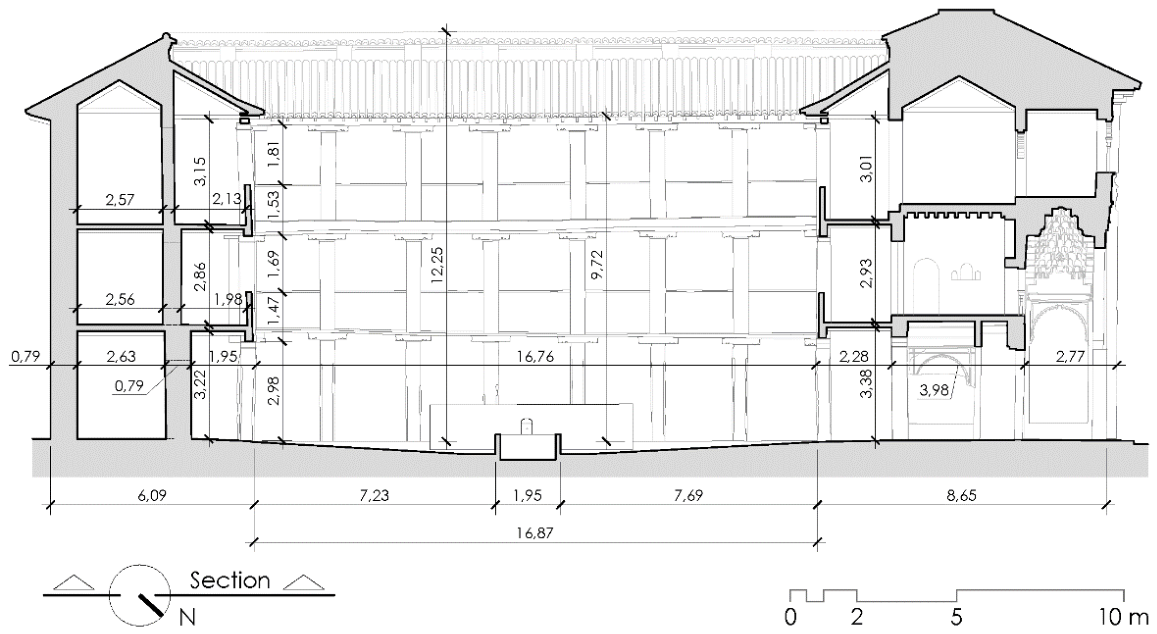
Figure 2.
Before and after T. Balbás restoration (1933). Source: P. of the Alhambra Website.
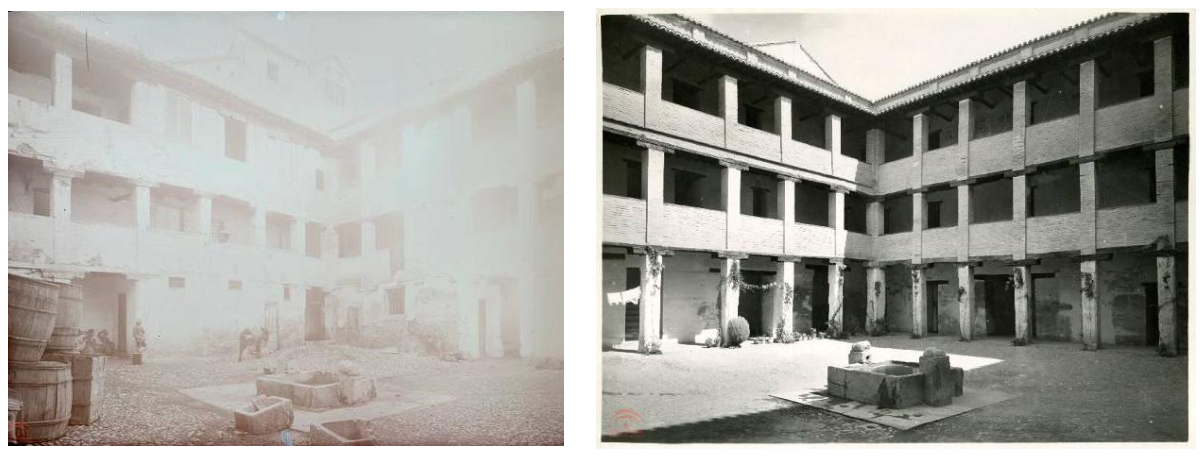
Figure 3.
Plan of the courtyard, measurement points (ISO 3382-1). Own source.
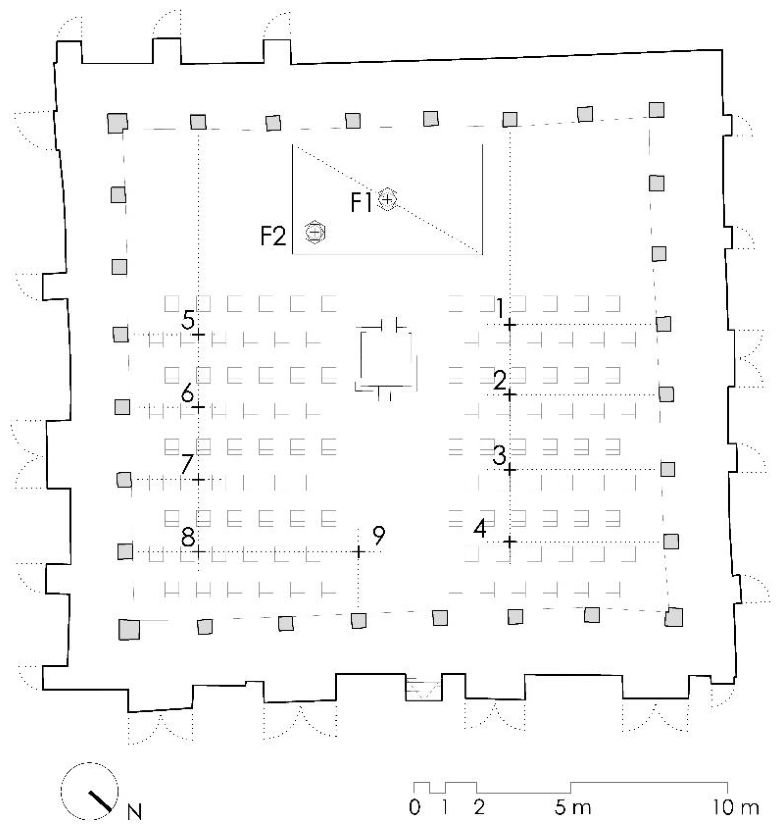
Figure 4.
Courtyard as a concert hall. Recording point 9 (left) and 4 (right). Own source.
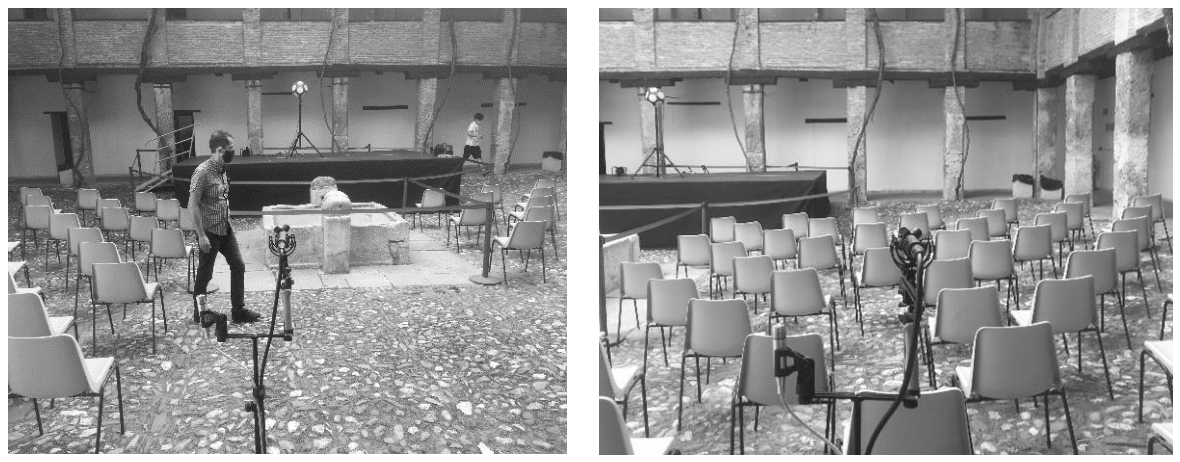
Figure 5.
3D model VS reality. Own source.
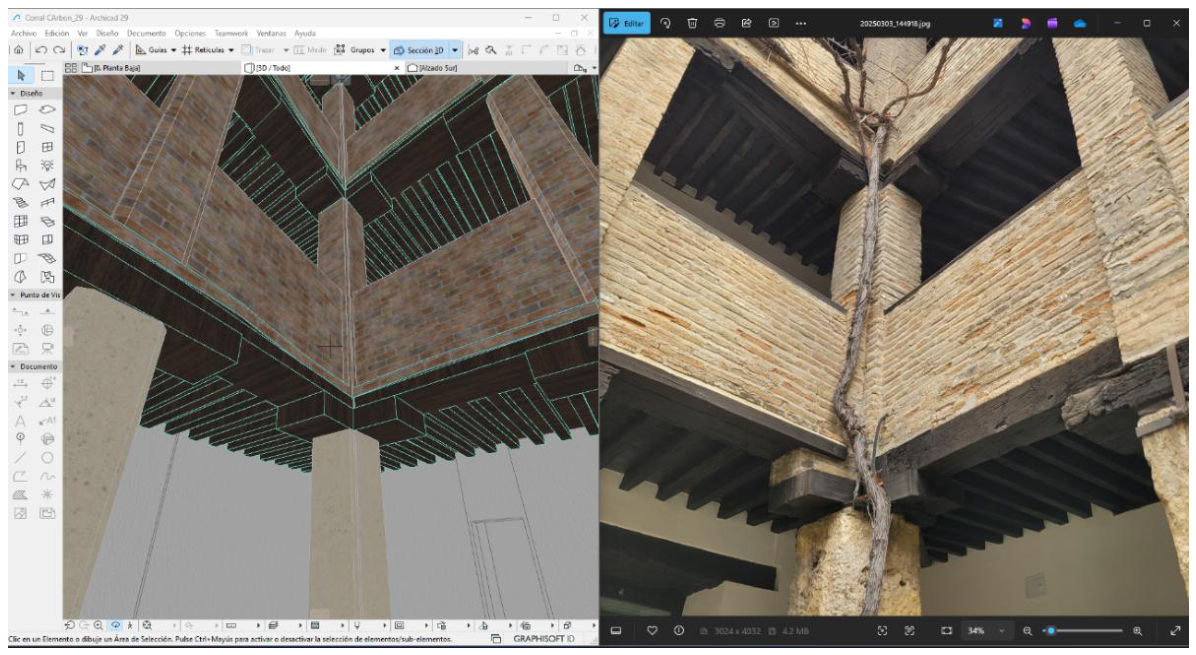
Figure 6.
From CAD 3D model (left) to SketchUp simplified 3D model (right). Own source.
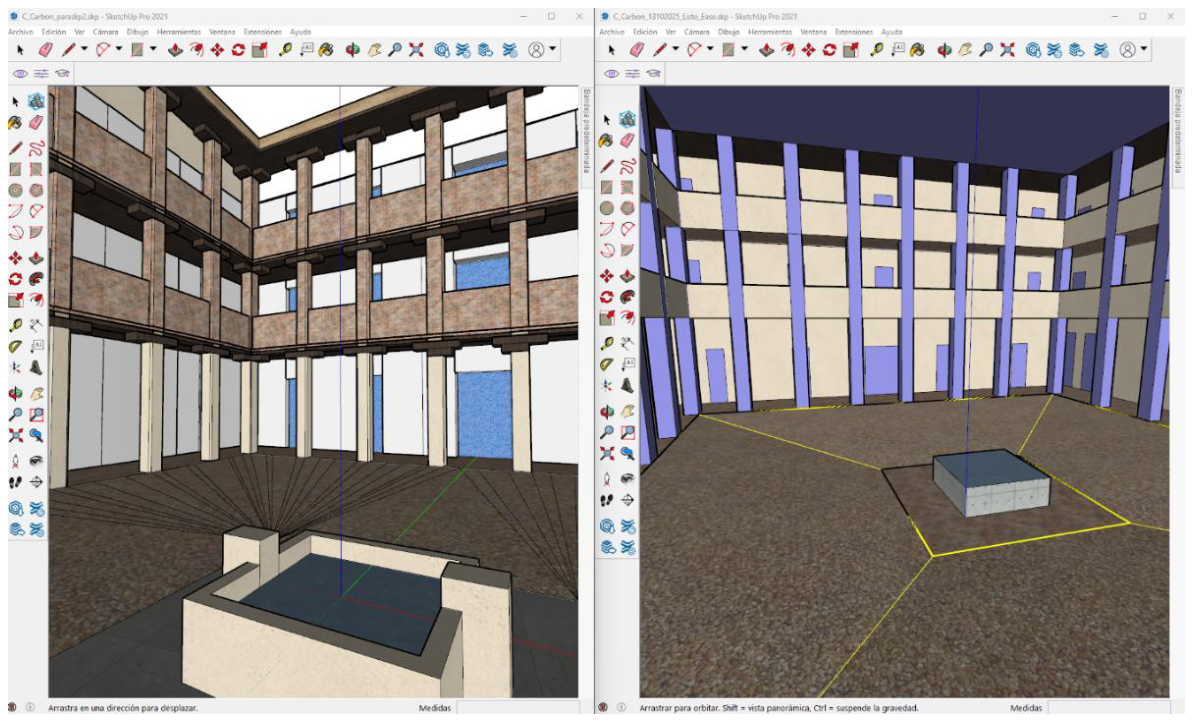
Figure 7.
C80 in EASE simulation (Standard, Reflections, AURA modeling). Own source.
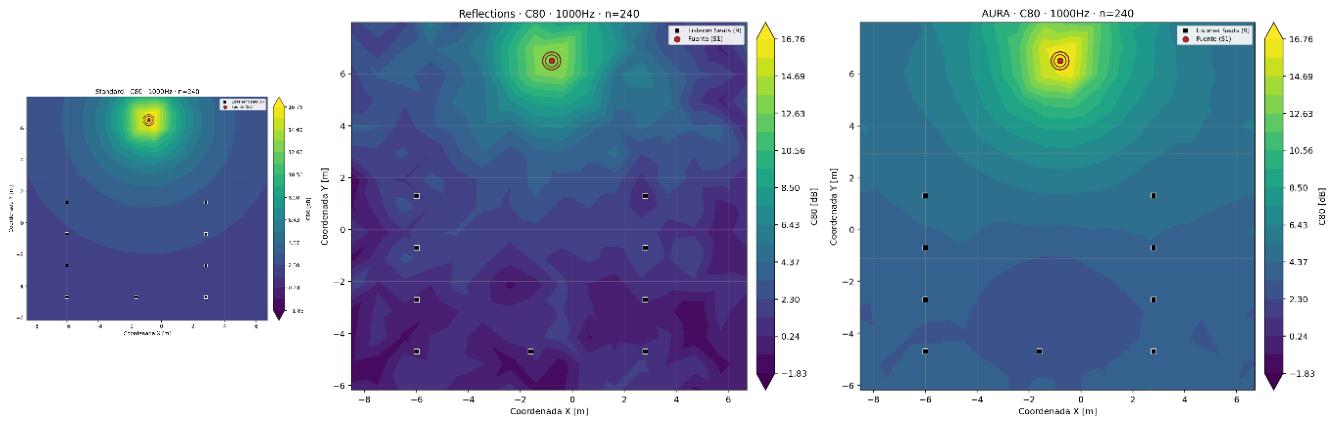
Figure 8.
Music Clarity C80 in EASE simulation. F1 + F2 combined. Own source.
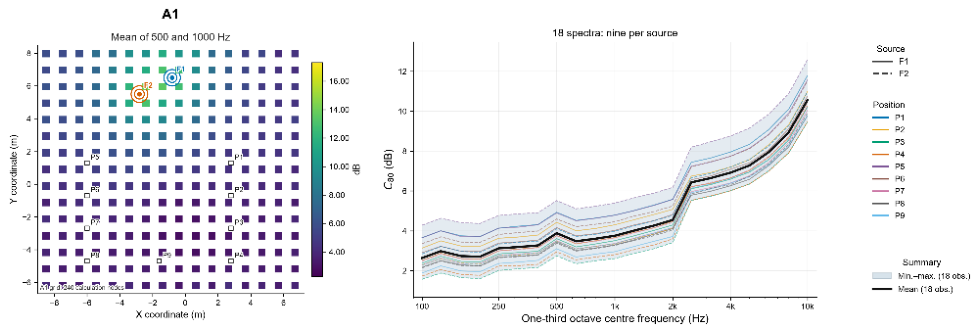
Figure 9.
Sound Strength, G in EASE simulation. F1 + F2 combined. Own source.
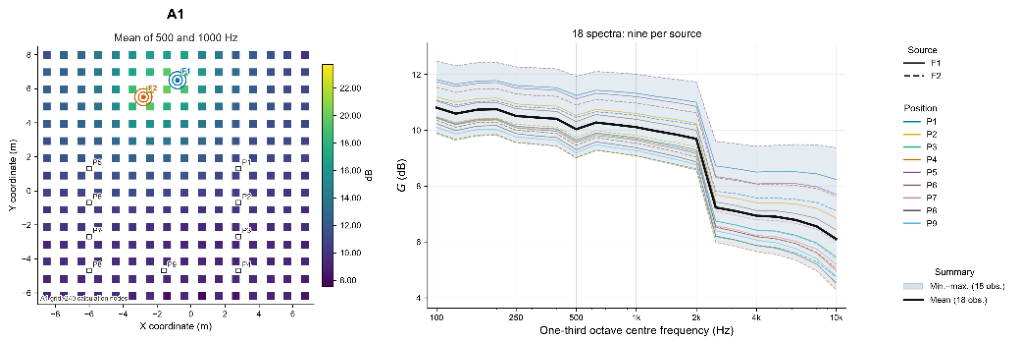
Figure 10.
Early Lateral Energy Fraction LF; EASE simulation. F1 + F2 combined. Own source.
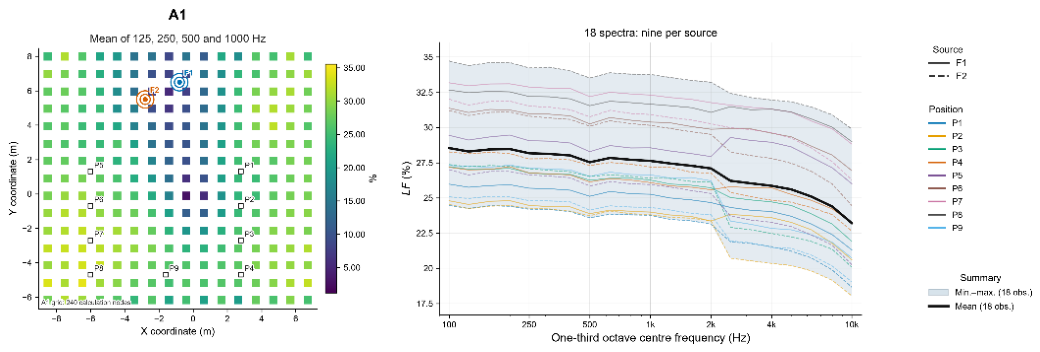
Figure 11.
Noise Criteria. The blue curve represents the Corral del Carbón under NC35. Own source.
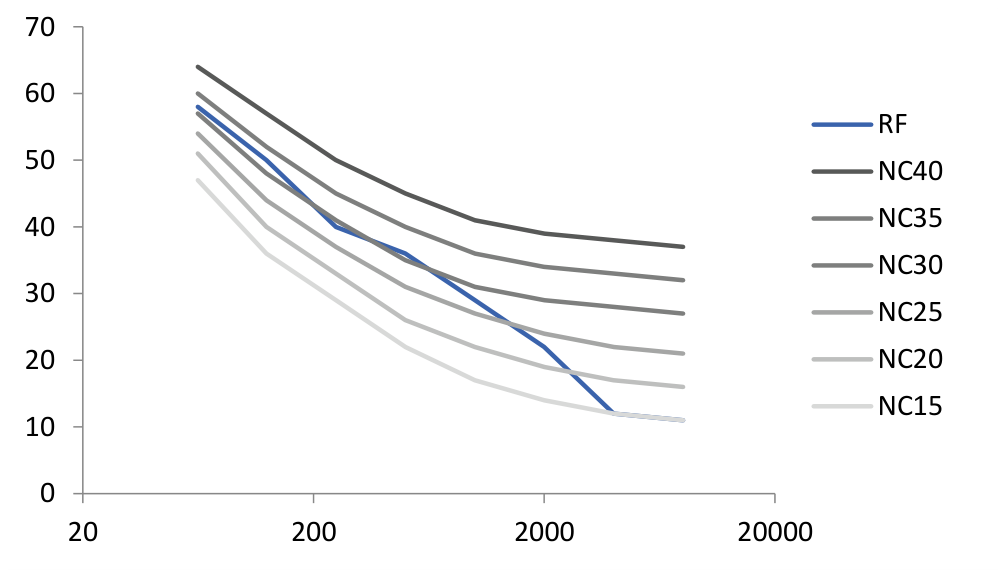
Table 1.
Inventory of assigned material families in the EASE 4.4 model.
| Material in EASE 4.4 | Faces | Area (m²) | Share (%) | Correspondence and Function in Building |
|---|---|---|---|---|
| Absorber (dummy f438) | 1 | 215.36 | 9.30% | Open sky (100% energy loss) |
| Clay brick corral carbon | 346 | 567.47 | 24.51% | Exposed brick masonry pillars and walls |
| Masonry pt corral carbon | 12 | 623.54 | 26.93% | Rendered and white-painted load-bearing walls |
| Tile, floor | 38 | 428.08 | 18.49% | Ceramic tile flooring in porticoed galleries |
| Gravel corral carbon | 8 | 201.98 | 8.72% | Traditional cobbled courtyard floor |
| Wood flr | 32 | 152.10 | 6.57% | Timber beam ceilings and upper galleries |
| Door solid | 58 | 108.42 | 4.68% | Recessed timber doors |
| Concrete | 5 | 18.61 | 0.80% | Central stone water basin |
| TOTAL | 500 | 2,315.56 | 100.00% | Complete envelope of watertight acoustic model |
| 1 | 2 | 3 | 4 | 5 | 6 | 7 | 8 | 9 | ITDG mid | |
|---|---|---|---|---|---|---|---|---|---|---|
| Corral del Carbón: ITDG [ms] (*) | 5 | 6 | 7 | 25 | 9 | 23 | 11 | 12 | 44 | 16 |
| Corral del Carbón: M intimacy | 1 | 1 | 1 | 0.75 | 1 | 0.85 | 1 | 1 | 0 | 0.84 |
| Budapest, Staatsoper | 15 | |||||||||
| Paris, Opera Garnier | 15 | |||||||||
| Milan, Teatro alla Scala | 16 | |||||||||
| Prague, Staatsoper | 16 | |||||||||
| Vienna Staatsoper | 17 | |||||||||
| Budapest, Erkel Theater | 17 | |||||||||
| Roman Theatre of Herculaneum (*) | 25 | |||||||||
| Roman Theatre of Cales (*) | 35 | |||||||||
| Roman Amphitheatre of Itálica (*) | 36 |
(*) Unroofed. Note: Comparison with enclosed auditoriums is indicative only.
Table 4.
Reverberation time parameters according to use and comparison.
| Rtmid | BR | Br | |||||||
|---|---|---|---|---|---|---|---|---|---|
| Max | Min | media | Max | Min | media | Max | Min | media | |
| Corral del Carbón | 1.27 | 0,91 | 1.10 | - | - | 1.16 | - | - | 0.83 |
| Concert (Arau) | 1.82 | 1.56 | 1.69 | 1.30 | 1.10 | 1.20 | 0.90 | 0.80 | 0.90 |
| Opera (Arau) | 1.54 | 1.15 | 1.35 | 1.30 | 1.10 | 1.20 | 0.90 | 0.80 | 0.90 |
| Word (Arau) | 1.30 | 0.85 | 1.07 | 1.30 | 0.90 | 1.10 | 0.90 | 0.80 | 0.90 |
| Pop-Rock (Larsen) | 1.20 | 0.80 | 1.00 | 1.1 | 0.90 | 1.00 | - | - | - |
Table 5.
T30 = RTU [s]. Comparison.
| Frequency [Hz] | 63 | 125 | 250 | 500 | 1000 | 2000 | 4000 | 8000 | V [m3] | RTU [s] |
| Wavelength [m] [V=343m/s] | 5.44 | 2.76 | 1.38 | 0.69 | 0.34 | 0.17 | 0.09 | 0.04 | ||
| Corral del Carbón T30 – RTU (*) | 1.60 | 1.28 | 1.26 | 1.10 | 1.10 | 1.01 | 0.81 | 0.66 | 4,300 | 1.10 |
| Best Halls (Adelman) | 1.80 | 1.25 | 1.00 | 1.15 | 1.20 | 1.50 | 1.20 | - | ||
| Worst Halls (Adelman) | 4.40 | 3.40 | 2.80 | 2.50 | 2.30 | 2.25 | 1.80 | - | ||
| Milan, Teatro alla Scala | - | 1.81 | 1.57 | 1.40 | 1.31 | 1.22 | 1.11 | - | 11,252 | 1.20 |
| Paris, Opera Garnier | - | 1.48 | 1.32 | 1.20 | 1.15 | 1.11 | 1.01 | - | 10,000 | 1.16 |
| Carmo Church (*) | 0.80 | 0.90 | 1.00 | 1.10 | 1.10 | 1.00 | 0.90 | 0.70 | 38,145 | 1.10 |
| Roman Theatre of Herculaneum (*) | - | 2.31 | 1.88 | 2.06 | 2.35 | 1.95 | 2.02 | - | 5,600 | 2.20 |
| Roman Amphitheatre of Durrës (*) | - | 0.95 | 1.15 | 1.24 | 1.22 | 1.15 | 1.12 | - | 9,460 | 1.23 |
(*) Unroofed. Note: Comparison with enclosed auditoriums is indicative only.
Table 6.
Reverberation Time (RTsim) in computer simulation across scenarios.
| Frequency (Hz) | Scenario A: Unoccupied | Scenario B: 100% Audience | Scenario C: Timber Roof (Unoccupied) | Scenario C: Timber Roof (Occupied) |
|---|---|---|---|---|
| 125 Hz | 1.28 s | 1.20 s | 2.36 s | 1.96 s |
| 250 Hz | 1.26 s | 1.12 s | 2.41 s | 1.72 s |
| 500 Hz | 1.10 s | 0.94 s | 2.09 s | 1.36 s |
| 1000 Hz | 1.11 s | 0.94 s | 2.21 s | 1.35 s |
| 2000 Hz | 1.01 s | 0.86 s | 1.84 s | 1.18 s |
| 4000 Hz | 0.82 s | 0.81 s | 1.12 s | 1.07 s |
| Tmid (400–1250 Hz) | 1.07 s | 0.94 s | 2.15 s | 1.36 s |
Table 7.
C80 recommended. Source: Arau, Barron, Lehemann, Reichardt.
| C80 min | C80 max | Recommended type of music | Corral del Carbón |
|---|---|---|---|
| -2 | 2 | Organ or Wind Instruments | No |
| 0 | 4 | Classical | Yes (Optimal < 500Hz) |
| 2 | 6 | Opera, Folk, Popular or Jazz | Yes |
| 4 | 8 | Fast Percusión | Yes (Optimal > 500Hz) |
Table 8.
C80Mid: Musical Clarity Index comparison with reference halls [125Hz-4000Hz] [dB].
| Frequency [Hz] | 63 | 125 | 250 | 500 | 1000 | 2000 | 4000 | 8000 | Mid |
| Wavelength [m] [V=343m/s] | 5.44 | 2.74 | 1.37 | 0.69 | 0.34 | 0.17 | 0.09 | 0.04 | |
| Granada, Corral del Carbón(*) | 1.58 | 2.80 | 2.12 | 4.86 | 5.31 | 5.13 | 6.01 | 8.24 | 4.37 |
| Milan, Teatro Alla Scala | - | 1.00 | 1.40 | 2.00 | 3.80 | 4.70 | 1.40 | - | 2.38 |
| Naples, Teatro di San Carlo | - | 0.70 | 1.10 | 2.60 | 3.70 | 3.80 | 5.00 | - | 2.82 |
| Paris, Opera Garnier | - | 1.40 | 1.50 | 3.60 | 5.10 | 5.00 | 5.50 | - | 3.68 |
| Carmo Church (*) | -1.0 | -1.5 | -2.0 | -2.5 | -2.7 | -2.8 | -3.5 | -5.0 | -2.60 |
| Roman Theatre of Herculaneum (*) | - | -1.00 | 0.50 | 1.00 | 1.50 | 2.00 | 1.80 | - | 1.25 |
| Zhaomutang Theatre (*) | - | 4.70 | 9.00 | 5.10 | 4.50 | 4.50 | 4.40 | - | 4.80 |
| Bullring of Ronda (*) | - | 3.80 | 4.50 | 5.20 | 6.10 | 7.00 | 8.20 | - | 5.65 |
(*) Unroofed. Note: Comparison with enclosed auditoriums is indicative only.
Table 9.
D50 recommended (based on Arau* & SMPTE EG 18-1994**).
| D50 min | D50 max | Recommended type of music | Corral del Carbón |
|---|---|---|---|
| 70 | - | Conferences* | No |
| 50 | 60 | Opera* | Yes (Optimal < 500Hz) |
| 30 | 70 | Cinemas** | Yes |
Table 10.
D50 & D50 Mid [125Hz-4000Hz] [%].
| Frequency [Hz] | 63 | 125 | 250 | 500 | 1000 | 2000 | 4000 | 8000 | Mid |
| Wavelength [m] | 5.44 | 2.76 | 1.38 | 0.69 | 0.34 | 0.17 | 0.09 | 0.04 | |
| Corral del Carbón | 49 | 52 | 44 | 62 | 65 | 62 | 64 | 73 | 59 |
Table 11.
Noise Criteria standards.
| Case studies & Recommended uses | NC | dBA |
|---|---|---|
| Corral del Carbón | NC35 | |
| Concert halls, opera halls, recording studios, auditoriums | NC15 | <30 |
| Small auditoriums, theatres, music rehearsal halls, large meeting rooms | NC20 a NC30 | 30-38 |
| Dormitories, hospitals, residences, flats, hotel rooms, motels | NC25 a NC35 | 34-42 |
| Offices, small conference rooms, libraries, classrooms | NC30 a NC35 | 38-42 |
| Large offices, reception areas, shops, cafeterias, gymnasiums | NC35 a NC40 | 42-47 |
| Waiting rooms, laboratories, drafting and engineering rooms, maintenance | NC40 a NC45 | 47-52 |
Table 12.
Early Decay Time EDTU (unoccupied) [125Hz-4000Hz] [s].
| Frequency (Hz) | 63 | 125 | 250 | 500 | 1000 | 2000 | 4000 | 8000 | Mid |
| Wavelength (m) | 5.44 | 2.76 | 1.38 | 0.69 | 0.34 | 0.17 | 0.09 | 0.04 | |
| Granada, Corral del Carbón (*) | 1.87 | 1.39 | 1.15 | 1.08 | 0.99 | 0.90 | 0.74 | 0.55 | 1.04 |
| Milan, Teatro Alla Scala | - | 1.47 | 1.22 | 1.20 | 1.17 | 1.15 | 1.05 | - | 1.19 |
| Naples, Teatro di San Carlo | - | 1.40 | 1.20 | 1.00 | 0.90 | 0.85 | 0.75 | - | 0.95 |
| Paris, Opera Garnier | - | 1.43 | 1.30 | 1.20 | 1.12 | 1.12 | 1.04 | - | 1.16 |
| Carmo Church (*) | 2.20 | 2.50 | 2.60 | 2.40 | 2.40 | 2.30 | 2.20 | 1.50 | 2.40 |
| Roman Theatre of Herculaneum (*) | - | 2.18 | 1.74 | 1.95 | 2.20 | 1.81 | 1.90 | - | 2.08 |
| Roman Amphitheatre of Durrës (*) | - | 1.85 | 1.95 | 2.05 | 2.00 | 1.90 | 1.75 | - | 2.02 |
(*) Unroofed. Note: Comparison with enclosed auditoriums is indicative only.
Table 13.
Parameters relating to [EDTU/ RTU] according to use and comparison.
| Max | Min | media | |
| Granada, Corral del Carbón (*) | 0.94 | ||
| Concert (Arau) | >1 | 0.90 | 1.00 |
| Opera (Arau) | 1.00 | 0.75 | 0.88 |
| Word (Arau) | 0.75 | 0.60 | 0.68 |
| Pop-Rock (.-Larsen) | 1.30 | 0.80 | <1 |
| Milan, Teatro alla Scala | 0.99 | ||
| Paris, Opera Garnier | 1 | ||
| Carmo Church (*) [68] | 2.18 | ||
| Roman Theatre of Herculaneum (*) [69] | 0.95 | ||
| Roman Amphitheatre of Durrës (*) [70] | 1.64 |
(*) Unroofed. Note: Comparison with enclosed auditoriums is indicative only.
Table 14.
Comparative in-situ measured VS EASE AURA simulation. Indicators (ISO 3382-1).
| Acoustic Indicator | In-Situ | EASE | Difference | Comparative Interpretation |
|---|---|---|---|---|
| RTmid | 1.10 s | 1.061 s | -0.009 s | Optimal agreement (< 0.2 JND) |
| EDTmid | 1.040 s | 1.029 s | -0.011 s | Excellent initial decay; no tails |
| BR | 1.16 | 1.24 | +0.08 | Slightly low warmth; excellent LF response |
| Br | 0.83 | — | — | Slight HF attenuation from open sky |
| EDT / RTmid | 0.945 | 0.968 | +0.023 | Nearly linear decay; no late tails |
| C80 | 4.37 dB | 3.82 dB | -0.55 dB | Negligible difference; very high definition (0.55 JND) |
| D50 | 59.00% | 55.08% | -3.92 pp | Negligible difference; excellent intelligibility (0.78 JND) |
| C50 | — | 1.71 dB | — | Early energy dominance in vocal band |
| Ts | — | 64.92 ms | — | Energy concentrated in early milliseconds |
| G | — | 10.08 dB | — | Significant perimeter-reflection contribution |
| LF | — | 27.91% | — | Lateral envelopment effect |
| LFC | — | 39.91% | — | Persistent wall-induced asymmetry |
| STI | — | 0.627 | — | Very good intelligibility without external noise |
| %ALCons | — | 5.74% | — | Low consonant loss; suitable for theatre |
Disclaimer/Publisher’s Note: The statements, opinions and data contained in all publications are solely those of the individual author(s) and contributor(s) and not of MDPI and/or the editor(s). MDPI and/or the editor(s) disclaim responsibility for any injury to people or property resulting from any ideas, methods, instructions or products referred to in the content. |
© 2026 by the authors. Licensee MDPI, Basel, Switzerland. This article is an open access article distributed under the terms and conditions of the Creative Commons Attribution (CC BY) license (http://creativecommons.org/licenses/by/4.0/).
Copyright: This open access article is published under a Creative Commons CC BY 4.0 license, which permit the free download, distribution, and reuse, provided that the author and preprint are cited in any reuse.