
Submitted:
29 October 2026
Posted:
30 October 2026
You are already at the latest version
Abstract
Historical textile fragments from the eighteenth and nineteenth centuries, preserved in museum, ecclesiastical and private collections in Dubrovnik, Croatia, were examined for the first time using a multi-analytical approach integrated with historical and provenance data to elucidate the region’s chromatic legacy. The results formed the basis of a preliminary Dubrovnik Natural Dye Reference Database, providing a methodological model for the development of comparable natural dye databases in the eastern Adriatic region and beyond. A combination of instrumental techniques, including SEM-EDX, FTIR-ATR, UV-Vis spectroscopy and high-performance liquid chromatography (HPLC), was employed to analyze the dyes, with the resulting data integrated into analytical profiles that constitute individual database entries. Red and purple hues were associated with madder (Rubia tinctorum L.), cochineal (Dactylopius coccus) and Tyrian purple derived from Hexaplex trunculus. Yellow and green samples showed profiles consistent with weld (Reseda luteola L.), while blue colourants were attributed to a plant-derived indigoid dye, most probably woad (Isatis tinctoria L.), and, notably, a blue indigoid dye derived from H. trunculus. The approach distinguished visually similar colors of different chemical and biological origins and revealed complex dye combinations that were not apparent from color alone.
Keywords:
database of natural dyes
; analytical reference profiles
; Dubrovnik
; historical textile
; UV/Vis
; SEM-EDX
; FTIR-ATR
; HPLC
1. Introduction
In the age of synthetic dyes, natural dye research is not solely focused on economic aspects. The modern era has seen a rise in researchers’ interest in identifying and analyzing organic dyes in archaeological and historical textile artifacts [1,2,3]. The complementary use of different analytical techniques, which are non-invasive or micro-invasive, enables an in-depth understanding of the original coloring materials used in our heritage objects. Dye analysis serves as one of the methods to date objects and confirm their provenance, to plan appropriate conservation and restoration treatment, and to obtain useful information to distinguish original from non-original materials, which is of great interest for historical and conservation research [2,4,5,6].
Cultural heritage science is the interdisciplinary field of scientific study of fine arts, historical and archaeological objects. Among its principal research areas is the identification and characterization of historical colorants, which provide valuable information on historical technologies, provenance, trade routes and conservation strategies. Since 1982, Dyes in History and Archaeology (DHA, https://www.dyesinhistoryandarchaeology.com/proceedings.php) has been organized annually by an international group of researchers to discuss dyes and organic pigments used in the past. The conference has become one of the leading international forums dedicated to the study of historical dyes and analytical methodologies applied to cultural heritage. The importance of color research is also reflected in the activities of the International Color Association (AIC), founded in 1967, which promotes interdisciplinary research on color science and its applications [7].
Natural dyes may contain more than ten chemically related components, whose composition and relative abundance vary according to the biological source, geographical origin, cultivation conditions, extraction procedures and dyeing technology [8]. The combination of these colorants, and their relative proportions forms a characteristic chemical “fingerprint” that can assist in identifying the dye source [9]. However, the identification of natural dyes in historical textiles is often complicated by molecular degradation processes associated with ageing. These processes may alter the original chemical composition of the colorants, reduce the concentration of diagnostic compounds and generate degradation products, thereby hindering unequivocal identification [10]. Consequently, the analysis and identification of dyes in cultural heritage materials constitute a challenging and increasingly important area of research in both heritage science and forensic investigation [6].
By analyzing numerous textile materials from historical sources and obtaining useful datasets that support the identification of natural dyes, in some cases a database was establish to facilitate the future identification of dyes and the understanding of historical textiles. An example of excellent cooperation in this direction is the multidisciplinary scientific project Halltex I, launched in 2002 with the aim of investigating archaeological fragments of colored textiles from the Bronze Age (1400 to 400 BC) found in the salt mines of Hallstatt, Austria [11]. The aim of the project was to investigate the dyes and dyeing techniques used to color the woolen fragments. Another five-year project, which contributed to dye research, was funded by the European Community: Eu-ARTECH - Analytical Strategies for Natural Colorants in Cultural Heritage Objects, which began in January 2005 [12]. The aim was to develop a strategy for the analysis of natural dyes and pigments on cultural heritage objects using modern analytical techniques based on the analysis of reference materials.
Several complementary strategies have been developed to support the identification of natural dyes in historical textiles. These include reference libraries that compile authenticated information on dye materials and their analytical characteristics (e.g., CAMEO, IRUG, SDBS); and reference databases that integrate analytical results from specific historical collections or geographical regions to support dye identification. The analytical information incorporated into these databases is typically obtained by complementary instrumental techniques such as UV–Vis spectroscopy, FTIR-ATR, SEM-EDX, and HPLC, which provide the primary data used to construct and validate them. The establishment of reference dye databases is an essential step in identifying colorants in historical textiles and has been pursued following two principal approaches. The need for standardized databases containing detailed chemical profiles of reliably identified dye sources from different geographical regions was emphasized at the 12th Biennial Symposium of the Textile Society of America in 2010 [9].
One approach involves developing comprehensive molecular databases and reference libraries based on authenticated dye sources. These resources compile analytical data on natural dyes and their degradation products, identifying compounds that can serve as reliable molecular markers for the identification of colorants in historical and archaeological textiles [10,13,14,15,16,17]. The second approach focuses on the creation of regional reference datasets derived from dyes and colorants identified in cultural heritage objects [18,19,20,21]. Such datasets integrate chromatographic, spectroscopic, elemental and colorimetric data obtained from historical textile fibers and provide an important framework for the interpretation, comparison and validation of analytical results. By combining information from authentic dye sources with data obtained from historical artefacts, these reference databases contribute not only to more reliable identification of colorants in cultural heritage materials, but also to the reconstruction of regional dyeing practices and the assessment of locally available and imported dye sources used during specific historical periods.
This study adopts the latter approach by incorporating analytical data from historical textiles associated with the Dubrovnik region into a reference dataset of natural dyes and their characteristic analytical profiles. The aim was to initiate the development of a preliminary database of natural dyes identified on eighteenth- and nineteenth-century historical textiles from the Dubrovnik area. Besides aiding dye identification, the database provides a framework for examining the historical use, availability, and circulation of dye sources in Dubrovnik and its broader cultural and trade context. The first step was to conduct an extensive archive research of the production, technology of dyeing and the trade of textile in the historic city of Dubrovnik (lat. Respublica Ragusina). The results of this historical research were published previously in the journal “Naše More” and provided the historical context for interpreting the analytical data [22]. Following the archival investigation, a preliminary examination of the historical textiles was carried out using a digital microscope (Dino-Lite Pro AM413T) to document weave structure, thread density, surface degradation and other morphological characteristics, and to identify the most suitable locations for fiber sampling prior to analytical investigation. The research results obtained by means of multi-analytical techniques were compared with the data collected on the basis of historical and archival research. This study addresses these challenges by establishing a preliminary Dubrovnik Natural Dye Reference Database based on a multi-analytical approach that integrates historical research with complementary analytical datasets. The database is intended to improve the identification and interpretation of natural dyes used in historical textiles from the Dubrovnik region and to provide a reference framework for future investigations of natural dyes from the eastern Adriatic.
2. Materials and Methods
The textile artefacts examined in this study are part of Dubrovnik’s cultural heritage and date from the 18th and 19th centuries (Table 1). They are examples from ecclesiastical and secular authorities as well as textile fragments from private collections.
Figure 1 presents the conceptual framework of the study, illustrating how historical and archival research, together with complementary analytical techniques, are integrated to establish the Dubrovnik Natural Dye Reference Database.
Individual samples were assigned to the same database entry based on the combined interpretation of colorimetric, UV–Vis, FTIR–ATR, SEM–EDX and HPLC data, together with historical information and comparison with reference materials.
The identification of dyes in colored textile samples dating from the eighteenth and nineteenth centuries from Dubrovnik contributes to the development of a reference dye database for the specified historical period. International reference databases were consulted (Eu-ARTECH Project, ICN-standard-25-11-2005, OADC_standard-24-3-2006, KIK-standard-27-4-2006.), together with publicly accessible online spectral databases from relevant sources, such as IRUG – Infrared and Raman Users Group Spectral Database (http://www.irug.org) and SDBS – Spectral Database for Organic Compounds (https://sdbs.db.aist.go.jp/) [5,12]. In addition, a reference collection of source materials originating from the Dubrovnik region was established, comprising plant and other natural resources documented in the literature as potential sources of natural dyes [18,19,23,24,25,26,27,28,29,30,31,32,33,34,35,36,37,38,39,40,41,42,43].
3. Instrumentation
CIELAB color scale measurements was performed by DataColor; Spectraflash SF 600 plus + CV UV. CIELAB System was used for measuring, specifying, and categorizing colors on historic artefacts.
FTIR-ATR analysis: The samples of fibers were recorded by FTIR-ATR (Perkin Elmer Spectrum 100, USA) in four scans at a resolution of 4 cm-1 in a wavelength range from 4000 to 400 cm-1. Using OMNIC Spectra Software 9.1.24. reference fiber spectrum was subtracted from the spectrum of the colored sample. The resulting difference spectra facilitated interpretation of the spectral contribution of the dye by minimizing the dominant spectral contribution of the silk fiber.
Elemental analysis: Traces of metals in the samples were analyzed by means of energy dispersive spectroscopy (SEM-EDX). The samples were investigated using a TESCAN Scanning Electron Microscope (FE-SEM, MIRA\LMU, Czech Republic, program Mira TC, In-Flight Beam TracingTM, EasySEMTM, Wide Field OpticsTM) equipped with energy dispersion spectroscopy (EDX with detector Quantax, Bruker SC7620-CF Mini AXS Microanalysis).
UV–vis spectroscopy: UV–vis absorbances of the dye extracts were measured in a Varian Cary® 50 Spectrophotometer (Shimadzu Europe, Duisburg, Germany). The samples were appropriately diluted with the extraction solvent to maintain absorbance values below the saturation limit of the detector.
Chromatographic measurements were carried out using an Agilent 1200 Series system (Agilent Technologies, Germany) equipped with a diode-array detector and controlled by ChemStation software.
4. Results
The present database integrates analytical data generated during the doctoral research “Identification of Dyes on Historic Textiles of the 18th and 19th Century from Dubrovnik” [24], together with selected results subsequently published in a series of scientific papers [5,22,25,44,45,46].
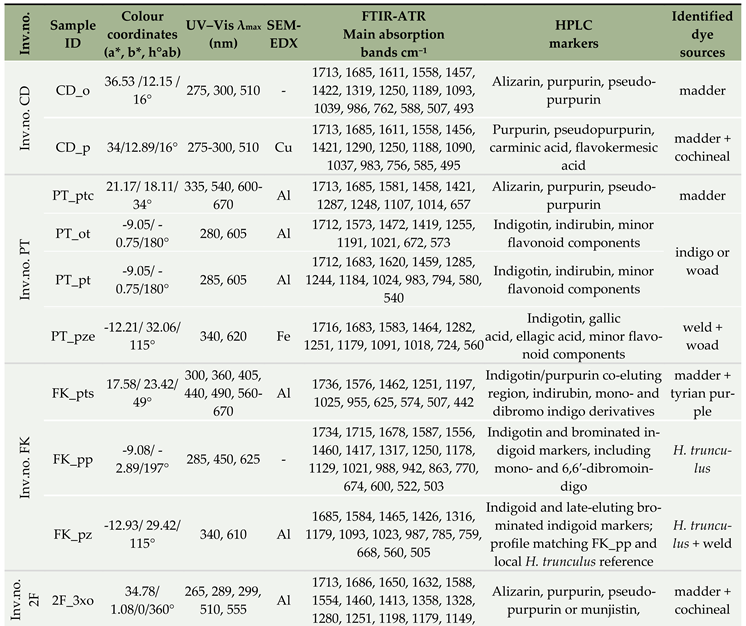
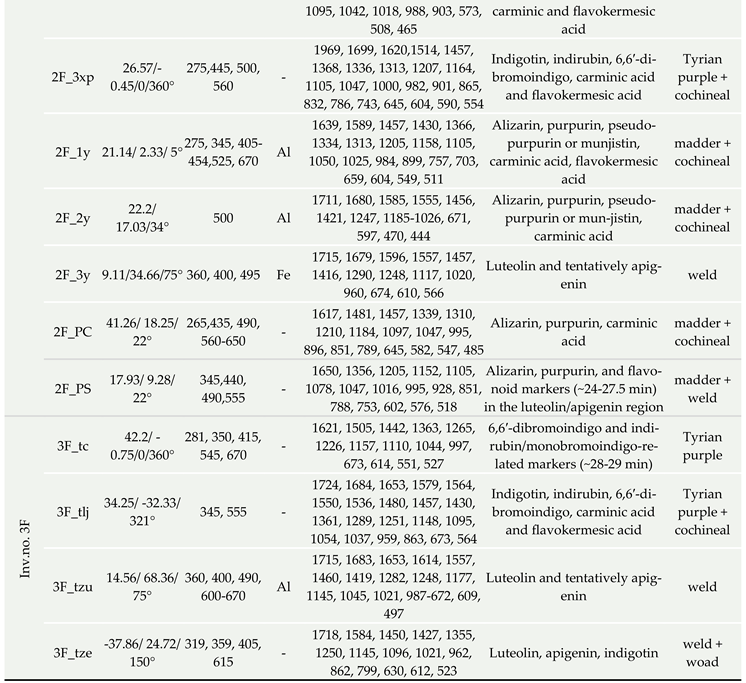
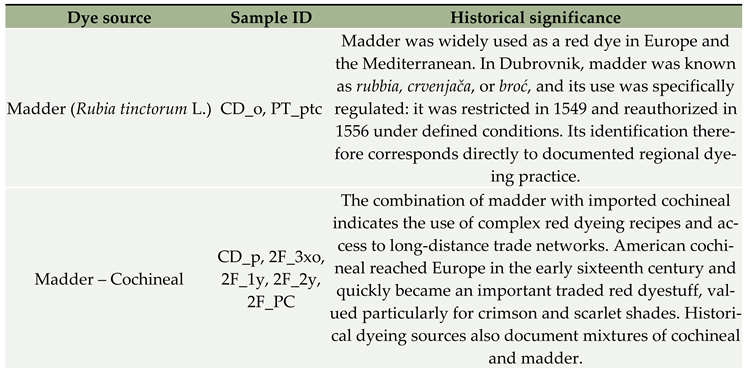
The aim of this study is to integrate and systematize these data within a unified analytical framework and to establish a reference database of natural dyes and their characteristic analytical profiles. The integrated analytical results were organized into the Dubrovnik Natural Dye Reference Database (Table 2), which links each historical sample and object identifier with colorimetric, spectroscopic, elemental and chromatographic data, and to the assigned dye source or dye combination.
5. Discussion
The Republic of Dubrovnik was abolished in 1808; however, the city of Dubrovnik, whose historic core is inscribed on the UNESCO World Heritage List, continued to play an important regional commercial and cultural role throughout the nineteenth century. Dubrovnik’s geographical position between the eastern Mediterranean and Central Europe, together with its historical role in the circulation of textiles, dyestuffs and dyeing knowledge, make the textile collections preserved in the city particularly suitable for the development of a regional reference database.
The establishment of regional reference databases is an important step toward improving the reliability of natural dye identification by integrating analytical evidence with historical, geographical, and technological information specific to a particular area. These databases complement existing molecular reference libraries by providing analytical profiles obtained directly from historical objects of known provenance.
Obtaining comprehensive information on organic materials in textile cultural objects requires a multi-analytical approach and a special sampling procedure. Collecting reference samples has always been a challenging task due to the limited amount of material that can be sampled. When sampling for scientific investigations of heritage objects the Heritage Science Group committee of the Institute for Conservation (ICON) has developed this Ethical Sampling Guidance for materials research [47]. The scientist is entrusted with the responsibility of sampling material from the object without compromising its integrity, while accepting the sample loss during preparation and analysis, depending on the analytical techniques used [48].
The identification of natural dyes in historical textiles is often complicated by ageing and degradation processes that alter the original molecular structure and relative abundance of the colorant compounds. As a result, the colorimetric and analytical characteristics of cultural heritage materials may differ significantly from those of the original dyes. In addition, the typically low concentrations of dye molecules in historical textiles, combined with the formation of degradation products over time, present additional challenges for analytical identification. In some cases, the abundance of molecular ageing products may exceed that of the original dye compounds, making unequivocal determination of the dye source particularly difficult [10,49].
Sample FK_pp illustrates the importance of integrating complementary analytical techniques in the construction of the Dubrovnik Natural Dye Reference Database. Furthermore, the successful identification of the dye despite the advanced degradation of the silk fibers confirms that reliable analytical data can be obtained even from highly deteriorated historical materials when a multi-analytical approach is applied (Figure 2).
The fiber structure exhibits severe surface degradation, including longitudinal cracking, fibrillation and local surface deformation. Adherent deposits and particulate contaminants are present on the fiber surface, locally forming continuous layers. Such advanced deterioration may interfere with both microscopic observation and analytical identification of the original dye compounds.
Color measurements provided an objective classification of the preserved hues, while UV–Vis spectra of the extracted dyes supplied preliminary information on their absorption characteristics. However, neither approach alone provided sufficient source-specific information for reliable dye identification. Overlapping spectral features, low colorant concentrations and degradation-related changes confirms the complexity of dye identification in historical textile fibers and highlights the need for integration of spectroscopic, elemental and chromatographic evidence.
These analytical limitations have stimulated the development of reference databases and analytical libraries that combine information obtained from authenticated dye sources with analytical data derived from historical textiles.
5.1. Multi-Analytical Evidence as the Basis for Database Construction
Complementary analytical results obtained from eighteenth- and nineteenth-century historical textiles were integrated into reference analytical profiles that constitute individual entries in the preliminary Dubrovnik Natural Dye Reference Database (Figure 3).
Analytical evidence obtained using complementary techniques formed the basis for establishing individual database entries representing characteristic natural dye compositions identified in historical textiles from Dubrovnik.
As shown in Figure 3, each instrumental method contributes a specific type of information: UV–Vis spectroscopy provides the absorption color profile of the extracted dye, FTIR-ATR provides information on characteristic spectral features and functional groups potentially associated with colorants, SEM-EDX detects inorganic elements potentially associated with historical mordants, while HPLC provides molecular markers that support the identification of dye source. The combined evaluation of these datasets enables more reliable identification of single and mixed dye systems and supports their historical interpretation.
The chromatic coordinates a* and b* of each historical textile sample were determined in the CIELAB color space (Figure 4). The L* parameter was excluded because of the varying degrees of fading and uneven color preservation observed in the historical textiles. Color measurements provided the initial classification of the analyzed samples into chromatic groups (red, blue, yellow and green), which served as a framework for the subsequent interpretation of complementary analytical evidence. These chromatic groups formed the first level of sample classification prior to establishing the analytical database entries in the Dubrovnik Natural Dye Reference Database.
The contribution of each analytical technique is discussed below according to the identified color groups. Within each group, however, the analytical evidence is integrated according to the identified dye source or dye combination, and the resulting analytical profile is incorporated as an individual entry in the Dubrovnik Natural Dye Reference Database.
5.1.1. Red Dyes
Red was the most frequently represented chromatic group among the analyzed historical textiles 18th and 19th centuries and showed the greatest diversity of dye sources and dye combinations (Table 2, Figure 4). Although several samples appeared visually similar, their color coordinates and UV–Vis absorption profiles revealed measurable differences in their chromatic characteristics. Absorption maxima recorded between approximately 510 and 555 nm were consistent with red anthraquinone-based colorants, while additional absorption bands observed in selected samples suggested the presence of mixed dye compositions.
Aluminum was the most frequently detected mordant and occurred predominantly in red-colored samples (Table 2). According to Cardon, alum was the most widely used mordant in historical dyeing practices with plant-based dyes to achieve a range of hues [50].
Madder–cochineal analytical profile
The first and most frequently represented analytical profile was characterized by the simultaneous presence of madder-derived anthraquinones and cochineal markers.
Sample 2F_3xo (inv. no. 2F) was selected as the representative example of this group. Comparison of its fiber-subtracted FTIR–ATR spectrum with that of the sample CD_o revealed several corresponding absorption bands, including those at approximately 1554/1558, 1459/1456, 1419/1422, 1253/1248, 1180/1186 and 1042/1040 cm⁻¹ (Figure 5). These shared spectral features are consistent with the presence of a common anthraquinone-based madder component in both samples. Comparison with the aluminum-complexed madder prepared in this study showed similarities in the fingerprint region around 1100 cm⁻¹.
The FTIR–ATR spectra of sample 2F_3xo exhibited additional features, particularly at approximately 1586, 1494, 1359, 1332, 1284, 1152, 1098 and 1014 cm⁻¹, resulting in a more complex spectral profile than that of CD_o. This greater spectral complexity is consistent with the presence of an additional colorant component but does not, by itself, permit its identification as cochineal. Owing to the extensive overlap among the FTIR bands of anthraquinone-based red dyes and the limitations associated with spectral subtraction, identification of the madder–cochineal mixture was based primarily on the molecular markers detected by HPLC.
HPLC analysis provided the most specific analytical evidence for dye identification through the detection of characteristic molecular markers. The chromatographic profile of sample 2F_3xo exhibited peaks at retention times of 26.84 and 28.14 assigned to alizarin and purpurin, together with a later-eluting madder-related compound at approximately 33 min, attributed to pseudopurpurin or munjistin (Figure 6).
The presence of aluminum detected by SEM–EDX analysis further supports the use of an aluminum-mordanted madder dye while the UV–Vis absorption maximum in the visible region λmax ≈ 555 nm was consistent with purpurin-related chromophores reported for Rubia tinctorum L (Table 2). In addition, two less pronounced peaks at approximately 18 and 21 min may correspond to carminic acid and flavokermesic acid, respectively. Together, these molecular markers support the identification of a madder–cochineal mixture. A detailed chromatographic interpretation of this sample was reported previously [5].
Samples 2F_1y, 2F_2y, 2F_PC and CD_p showed highly similar chromatographic profiles, characterized by the same principal molecular markers. Minor differences in peak intensities are most likely related to variations in dye concentration, degradation processes or extraction efficiency, rather than differences in dye composition. Together with sample 2F_3xo, these samples define the principal madder–cochineal analytical entry in the Dubrovnik Natural Dye Reference Database. This analytical group provides a reference dataset for identifying similar red dye compositions in historical textiles from Dubrovnik and the eastern Adriatic region.
Madder analytical profile
The second analytical profile was represented by samples CD_o and PT_ptc (Figure 7 (1)) Both samples contained madder-derived anthraquinone markers without chromatographic evidence of an additional red dye source. The detailed analytical interpretation of sample CD_o was published previously [46], while the present study identified the same analytical profile in sample PT_ptc. These two samples therefore constitute the database entry for madder-derived red dyes.
Madder–Tyrian purple analytical profile
Sample FK_pts represented a third analytical profile, combining madder-derived anthraquinone markers with indigoid and brominated indigoid markers associated with Tyrian purple (Figure 7 (2)). SEM–EDX detection of aluminum supported the presence of an aluminum-mordanted anthraquinone component. HPLC analysis revealed indigotin and indirubin at approximately 28 - 30 min, together with later-eluting brominated indigoid derivatives, including dibromoindigo. Although the co-elution of purpurin and indigotin limits chromatographic interpretation, the combined UV–Vis, FTIR–ATR, SEM–EDX, and HPLC evidence supports the interpretation of a mixed dye composition consisting of madder (Rubia tinctorum L.) and Tyrian purple derived from H. trunculus. This analytical profile represents a third database entry within the Dubrovnik Natural Dye Reference Database.
Madder–Weld analytical profile
Sample 2F_PS exhibited an orange-red hue (a* = 17.93, b* = 9.28, h°ab = 22°). The UV–Vis spectrum showed absorption maxima at 439, 490, and 554 nm, indicating the presence of yellow and red chromophores (Table 2). FTIR–ATR analysis of the fiber-subtracted spectrum revealed a broad O–H absorption band together with pronounced absorption features between approximately 1600 and 1100 cm⁻¹, consistent with functional groups characteristic of plant-derived flavonoid dyes (Table 2). HPLC analysis revealed peaks in the flavonoid region between approximately 24 and 27.5 min and madder-related anthraquinone peaks between approximately 28 and 29.5 min. The combined results support the interpretation of a flavonoid-based yellow dye, most probably weld (Reseda luteola L.), combined with madder (Rubia tinctorum L.). Sample 2F_PS therefore represents a probable madder–weld entry in the database.
Tyrian purple–Cochineal analytical profile
The fifth analytical profile was identified in samples 2F_3xp and 3F_tlj. HPLC analysis revealed the characteristic molecular markers of Tyrian purple, including indigotin (~28 min.), indirubin (~29 min.), and dibromoindigo (~33 min.), while carminic acid (~18 min.) and flavokermesic acid (~21 min.) indicated the simultaneous presence of cochineal. The detailed chromatographic interpretation of sample 2F_3xp has been reported previously [5].
Tyrian purple analytical profile
The sixth analytical profile was represented by sample 3F_tc. Dibromoindigo was detected as the principal diagnostic molecular marker, supporting the use of Tyrian purple, most consistent with an H. trunculus-derived dye, with no evidence of an additional red colorant. Sample 3F_tc therefore constitutes the database entry for Tyrian purple.
On the basis of the integrated analytical evidence, six characteristic red and purple dye profiles were distinguished: (i) madder–cochineal, (ii) madder, (iii) madder–Tyrian purple, (iv) madder–weld, (v) Tyrian purple–cochineal, and (vi) Tyrian purple. Their incorporation into the Dubrovnik Natural Dye Reference Database documents both single dye sources and complex dye combinations used in eighteenth- and nineteenth-century historical textiles preserved in Dubrovnik collections.
5.1.2. Blue Dyes
Blue dyes used in the Dubrovnik region were most commonly derived from woad (Isatis tinctoria L.) and certain lichen species, while indigo (Indigofera tinctoria L.) was largely imported through trade networks [22].
Blue-colored fibers were identified in eighteenth-century samples from artefacts inv. no. PT. and inv. no. FK. Samples PT_pt, PT_ot and FK_pp exhibited comparable colorimetric characteristics, with hue angles (h°ab) in the blue region of the CIELAB color space (approximately 180–197°), negative a* and b* values, and UV–Vis absorption maxima between approximately 605 and 625 nm (Table 2). Samples PT_ot and PT_pt had identical colorimetric values and therefore occupy the same position in the CIELAB a/b diagram.
For all blue samples, the Na₂S₂O₄/NaOH reduction test produced the characteristic color change from blue to yellow, followed by restoration of the blue color after oxidation with H₂O₂, supporting the presence of an indigoid chromophore.
Comparison of the obtained FTIR–ATR spectra with reference databases revealed spectral features consistent with indigoid dyes, particularly in the carbonyl and aromatic spectral region consistent with the presence of indigoid colorants. However, the considerable similarity between the FTIR spectra of plant-derived and mollusk-derived indigoids prevented differentiation of their biological sources by FTIR–ATR alone.
Despite these similar colorimetric UV-Vis and FTIR-ATR characteristics, HPLC analysis distinguished two different blue-day analytical profiles (Figure 8).
Woad analytical profile
Samples PT_ot i PT_pt constituted the first analytical profile. Their chromatographic data showed indigotin and indirubin as the principal indigoid components, together with several lower-intensity peaks between approximately 16 and 26 min, attributed to accompanying flavonoid components (Figure 8). This chromatographic profile was previously reported and attributed to woad (Isatis tinctoria L.) [25]. This interpretation is further supported by historical and archival research on dyeing materials used in the Dubrovnik region, which documents woad, locally known as guado, as a source of blue color, while indigo was imported as a powdered dye material [22]. The presence of minor accompanying flavonoid components, together with this historical evidence, supports the attribution of the PT samples to woad rather than imported indigo.
Hexaplex trunculus-derived blue indigoid analytical profile
Sample FK_pp displayed a chromatographic profile closely matching the locally prepared reference extract obtained from an Adriatic specimen of Hexaplex trunculus (formerly Murex trunculus), and analyzed under identical HPLC conditions. This comparison, particularly the correspondence of the late-eluting peaks characteristic of brominated indigoids, supports attributing FK_pp to an H. trunculus-derived blue indigoid dye (Figure 8 and Figure 9).
The presence of 6,6′-dibromoindigo distinguished the chromatographic profile of FK_pp from the plant-derived indigoid profile represented by the PT samples. The marine mollusks Hexaplex trunculus can produce blue indigoid shades as well as purple hues, depending on the dyeing conditions and the photochemical conversion of the dye precursors [51,52].
On the basis of the integrated analytical evidence, two characteristic blue dye profiles were distinguished: (i) Woad, a plant-derived indigoid profile, represented by samples PT_ot and PT_pt; and (ii) an H. trunculus-derived blue indigoid profile, represented by sample FK_pp. These profiles constitute two separate entries in the Dubrovnik Natural Dye Reference Database. Their differentiation demonstrates that visually and colorimetrically similar blue textiles may originate from botanically and zoologically different dye sources and highlights the source-specific contribution of HPLC within the multi-analytical workflow.
5.1.3. Yellow Dyes
Historical and archival sources document the use of several yellow dye materials in the Dubrovnik region, including wild apple bark (Malus sylvestris L.), pomegranate peel (Punica granatum L.), yellowwood or sumac (Cotinus coggyria L*) and weld (Reseda luteola L.) was among the most widely used yellow days in Europe [22].
Yellow hues were identified exclusively in the nineteenth century samples 3F_tzu and 2F_3y, although a yellow dye component was also identified in the eighteenth-century green samples.
Weld analytical profile
The UV–Vis spectra of the yellow samples were consistent with flavonoid-containing yellow dyes. Their FTIR–ATR spectra showed the closest similarity to the weld reference spectrum, particularly between approximately 1653 and 1100 cm⁻¹. However, because comparable absorption bands occur in several plant-derived yellow dyes, UV–Vis and FTIR–ATR did not permit unequivocal identification of the botanical source. SEM–EDX detected Fe in sample 2F_3y and Al in sample 3F_tzu, providing complementary information on the different mordanting practices but not directly identifying the dye source (Table 2). HPLC analysis provided the principal analytical evidence for interpreting the yellow colorants. Samples 3F_tzu and 2F_3y exhibited highly similar chromatographic profiles, indicating the use of the same flavonoid-based yellow dye. Peaks at approximately 24–25 min and 27–28 min were assigned to luteolin and apigenin, respectively, and the overall chromatographic profiles showed the closest agreement with weld (Reseda luteola L.). Because luteolin and apigenin also occur in other yellow dye plants, the identification is most appropriately described as a flavonoid-based yellow dye, most probably weld.
Samples 3F_tzu and 2F_3y therefore constitute a probable weld analytical entry in the Dubrovnik Natural Dye Reference Database.
5.1.4. Green Dyes
Green shades were identified in both eighteenth-century (FK_pz and PT_pze samples) and nineteenth-century (3F_tze sample) textiles. Historical and archival sources indicate that green shades in the Dubrovnik region were commonly produced by combining yellow and blue dyes [22]. The interpretation of these samples as composite dye systems was based on the combined evaluation of HPLC, FTIR–ATR, UV–Vis and SEM–EDX results alongside historical evidence. The resulting analytical profiles contribute to the characterization of complex historical dye combinations within the Dubrovnik Natural Dye Reference Database.
Colorimetric measurements distinguished the greener hue of sample 3F_tze (h°ab ≈ 150), from the more yellowish-green hues of samples FK_pz and PT_pze (h°ab ≈ 115). These results were consistent with the presence of combined blue and yellow colorants (Figure 2).
The UV–Vis spectra of the eighteenth- and nineteenth-century green samples exhibited a pronounced absorption maximum in the blue region (λmax 609–619 nm), along with a less pronounced absorption band in the yellow region, characteristic of mixed dye systems.
FTIR–ATR analysis of the green samples proved particularly challenging because of the superposition of spectral features originating from both blue and yellow dye components. To facilitate interpretation the spectrum of the blue sample FK_pp was subtracted from the green sample FK_pz (Figure 10).
The resulting difference spectrum supported the presence of a yellow component and showed the closest similarity to weld (Reseda luteola L.), particularly between 1653 and 1100 cm⁻¹. However, because similar absorption bands occur in several plant-derived yellow dyes, FTIR–ATR alone cannot provide unequivocal botanical identification.
SEM–EDX analysis detected Fe in sample PT_pze and Al in sample FK_pz (Table 2). These elements are consistent with historical mordanting practices and support the interpretation that flavonoid-based yellow dyes were used in combination with indigoid blue dyes to produce green shades.
HPLC analysis confirmed that the green samples represent composite dye systems rather than individual colorants. In all samples, the chromatographic profiles indicated the simultaneous presence of indigoid and flavonoid compounds, consistent with the historical practice of producing green shades by combining blue and yellow dyes.
Weld–woad analytical profile
Sample 3F_tze exhibited a multicomponent chromatographic profile assigned to a weld (Reseda luteola L.) and woad-derived dye (Isatis tinctoria L.) (Figure 11). Based on comparison with published chromatographic data, the peaks at 24.952 and 26.723 min were attributed to luteolin and apigenin, respectively, supporting the presence of a flavonoid-based yellow dye component. The dominant peak at 27.995 min was assigned to indigotin, while the smaller peak at 29.230 min was tentatively assigned to indirubin.
Sample PT_pze, previously reported, also exhibited an indigoid–flavonoid analytical profile and was interpreted as a combination of woad and weld [25]. The combined HPLC, UV–Vis and FTIR–ATR evidence therefore supports a combination of a flavonoid-based yellow dye, most probably weld, and a plant-derived indigoid dye, most probably woad (Isatis tinctoria L.).
Hexaplex trunculus-derived blue indigoid–weld analytical profile
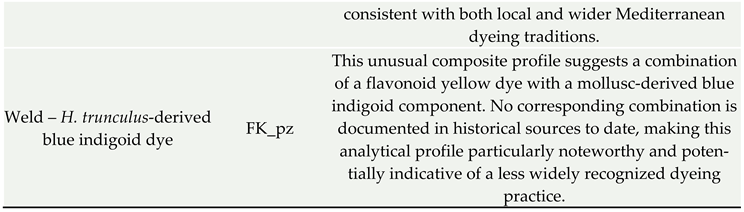
The chromatographic profile of sample FK_pz, closely matched both the locally prepared Adriatic H. trunculus reference extract and the blue sample FK_pp, analyzed under identical chromatographic conditions. Together with the FTIR–ATR subtraction analysis, which supported the presence of a flavonoid-based yellow dye component, these findings suggest that the green color was most likely obtained by combining an H. trunculus-derived blue indigoid dye with yellow dye, most probably weld (Reseda luteola L.)
On the basis of the integrated analytical evidence, two characteristic green-dye profiles were distinguished: (i) probable weld–woad, represented by samples 3F_tze and PT_pze; and (ii) an H. trunculus-derived blue indigoid dye combined with weld, represented by sample FK_pz. These profiles constitute two composite dye entries in the Dubrovnik Natural Dye Reference Database.
5.2. Preliminary Dubrovnik Natural Dye Reference Database: Structure and Significance
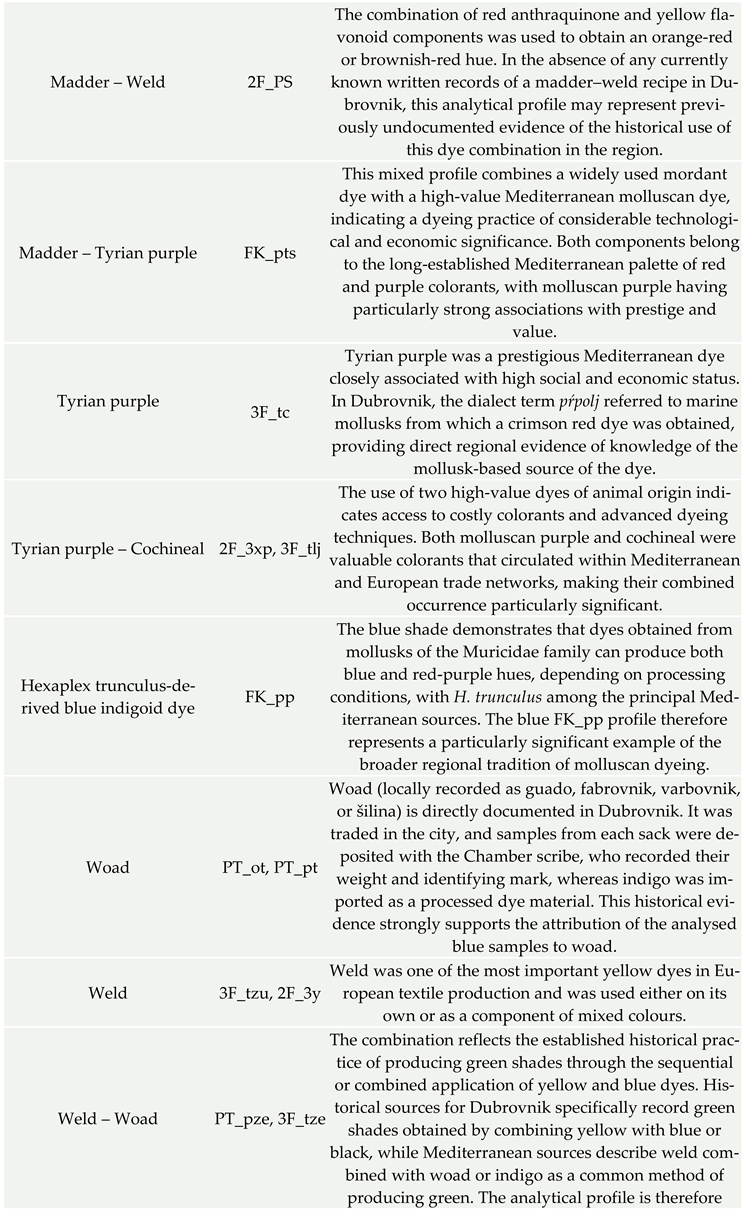
The integrated analytical results were organized into the preliminary Dubrovnik Natural Dye Reference Database (Table 2), which links each historical sample and object identifier with colorimetric, spectroscopic, elemental and chromatographic data, and to the assigned dye source or dye combination. Samples with concordant analytical profiles were grouped into shared dye-source categories, whose historical interpretation is summarized in Table 4. This two-level structure enables future samples to be compared with both individual analytical records and broader historical dye profiles.
By combining analytical evidence with provenance and historical information, the database provides a regional reference framework for identifying and interpreting natural dyes in historical textiles from Dubrovnik and the eastern Adriatic. Its historical interpretation draws on the archival research [22,24], which documents the production, use and circulation of natural dyes and textiles through the Mediterranean and European trade networks connected with Dubrovnik from the fourteenth to the nineteenth century. As a preliminary resource, the database can be expanded through the addition of authenticated reference materials and further well-documented historical samples.
5. Conclusions
The proposed Dubrovnik Natural Dye Reference Database presents a conceptual and methodological model for integrating multi-analytical, historical, and provenance data. Its structure organizes individual analytical records into comparable dye-source profiles, providing a basis for the future development of a dedicated digital database or software tool for the systematic comparison, retrieval, and expansion of natural dye reference data.
An important aspect of the study was the selection of historical textiles that had not previously been scientifically investigated, introducing entirely new material evidence into the study of Dubrovnik’s chromatic heritage. The study demonstrates that such a regional database cannot be based solely on the compilation of analytical values, but requires the systematic integration of colorimetric, spectroscopic, elemental, and chromatographic evidence with provenance and historical research. Color served as the initial level of classification, while the concordance of complementary analytical results enabled individual historical samples to be grouped into reference profiles representing both single dye sources and complex dye combinations.
The value of this approach was most clearly demonstrated by samples that appeared visually and colorimetrically similar but proved to have different chemical and biological origins. One of the most interesting findings was a blue textile sample whose chromatographic profile closely matched a locally prepared reference extract obtained from the Adriatic marine mollusk Hexaplex trunculus. This finding demonstrates that the same molluscan source historically associated with Tyrian purple may also produce distinctly blue indigoid shades. HPLC also revealed complex combinations of madder, cochineal, and Tyrian purple in red and purple textiles, while the green samples were shown to represent composite dye systems produced by combining flavonoid-based yellow dyes with either plant- or mollusk-derived indigoids. These findings demonstrate that historical color cannot be interpreted reliably from visual appearance or a single analytical technique.
The proposed database thus provides a regional reference framework linking chemical evidence with historical textile practices in Dubrovnik and the eastern Adriatic. Its future development into a dedicated digital database, together with the inclusion of authenticated reference materials, additional well-documented historical samples, and LC–DAD–MS/MS or related high-resolution techniques, will enable systematic data retrieval and comparison, verification of tentative molecular assignments, and improve the botanical and zoological specificity of the database records.
Author Contributions
Conceptualization, D.J. and D.P-O.; methodology, D.J. and D.P-O.; software, D.J.; validation, D.J. and D.P-O.; formal analysis, D.J.; investigation, D.J. and D.P-O.; resources, D.J. and D.P-O.; data curation, D.J. and D.P-O.; writing—original draft preparation, D.J.; writing—review and editing, D.J. and D.P-O.; visualization, D.J.; supervision, D.P-O.; project administration, D.J; All authors have read and agreed to the published version of the manuscript.
Funding
This research received no external funding.
Data Availability Statement
The data supporting the findings of this study are contained within the article, including its tables and figures. Additional underlying analytical data, including chromatographic and spectroscopic records, are available from the corresponding author upon reasonable request. Part of the analytical dataset originates from the author’s PhD thesis and previously published studies, all of which are cited in the relevant sections of the manuscript.
Acknowledgments
The authors gratefully acknowledge Dubrovnik Museums, the Diocese of Dubrovnik, and private collector Nada Skatolini for providing access to the historical textile objects and for sharing relevant information about the objects and collections. The authors also thank the University of Zagreb Faculty of Textile Technology and the Forensic Science Centre “Ivan Vučetić” Zagreb, Cratia for providing laboratory facilities, instrumentation, and technical support that made the analytical research possible. During the preparation of this manuscript, the authors used ChatGPT (OpenAI), GPT -5 series, for the purposes of language editing, improving clarity and conciseness, checking terminological and internal consistency, and assisting with the verification of the literature and references. The authors have reviewed and edited the output and take full responsibility for the content of this publication.
Conflicts of Interest
The authors declare no conflicts of interest.
References
- Timar-Balazsy, A.; Eastop, D. Chemical Principles of Textile Conservation, 1st ed.; Butterworth-Heinemann: Oxford, UK, 1998. [Google Scholar] [CrossRef]
- Do, K.L.; Su, M.; Zhao, F. From historical dye to bio-colourant: Processing, identification in historical textiles and potential applications of anthraquinone-based morindone. Dye. Pigment. 2022, 205, 110482. [Google Scholar] [CrossRef]
- Karadag, R.; Torgan, E. Advantages and importance of natural dyes in the restoration of textile cultural heritage. Int. J. Conserv. Sci. 2016, 7(Special Issue 1), 357–366. [Google Scholar]
- Gouda, M.; Atiaa, M.; Abdel-Kareem, O. Investigation and Analysis of Ancient Dyed Textiles. In Preservation and Restoration Techniques for Ancient Egyptian Textiles; Ahmed, H., Al-Zahrani, A., Eds.; IGI Global: Hershey, PA, USA, 2023; pp. 93–118. [Google Scholar] [CrossRef]
- Jemo, D.; Parac-Osterman, D. Revealing the Origin: The Secrets of Textile Fragments Hidden inside the 19th Century Chasuble from Dubrovnik. Materials 2021, 14, 4650. [Google Scholar] [CrossRef] [PubMed]
- Smith, G.D.; Esson, J.M.; Chen, V.J.; Hanson, R.M. Forensic dye analysis in cultural heritage: Unraveling the authenticity of the earliest Persian knotted-pile silk carpet. Forensic Sci. Int. Synerg. 2021, 3, 100130. [Google Scholar] [CrossRef] [PubMed]
- Tonnquist, G. The Early History of the Association Internationale de la Couleur (AIC). In AIC Color 77: Proceedings of the Third Congress, Troy, NY, USA, 10–15 July 1977; Adam Hilger: Bristol, UK, 1978; pp. 13–32. Available online: https://aic-color.org/history (accessed on 21 February 2020).
- Wouters, J. Possible future developments in the analysis of organic dyes. Dye. Hist. Archaeol. 2005, 20, 24. [Google Scholar]
- Cardon, D. Natural Dyes, Our Global Heritage of Colors. In Proceedings of the 12th Biennial Symposium of the Textile Society of America, Lincon, USA, 6-9 october 2010; Paper 12. Available online: https://digitalcommons.unl.edu/cgi/viewcontent.cgi?article=1011&context=tsaconf (accessed on 28 October 2025).
- Domínguez-Castillo, C.; Jiménez-Hidalgo, M.; López-Gámez, J.; Rodríguez-Hortal, A.; Alzaga-García, M.; Gallardo-Abárzuza, M.; Higueras-Milena, J.M.; Gómez-Morón, A.; García-Viñas, E.; Bernáldez-Sánchez, E.; Martínez-Haya, B. High-Resolution Mass Spectrometry Identification of Dye Compounds and Their Degradation Products in American Cochineal from a Historic Shipping Cargo. Dye. Pigment. 2023, 216, 111313. [Google Scholar] [CrossRef]
- Joosten, I.; van Bommel, M.R.; Hofmann-de Keijzer, R.; Reschreiter, H. Micro Analysis on Hallstatt Textiles: Colour and Condition. Microchim. Acta 2006, 155, 169–174. [Google Scholar] [CrossRef]
- Eu-ARTECH project - Analytical strategies for Natural Dyestuffs and Cultural Heritage Objects: HPLC-PDA protocol ICN, HPLC-PDA protocol KIK, HPLC-PDA protocol NGL, HPLC-PDA protocol OADC, HPLC-PDA protocol NMS, HPLC-MS protocol. Available online: http://www.organic-colorants.org/ (accessed on 10 May 2013).
- Vlachou-Mogire, C.; Danskin, J.; Gilchrist, J.R.; Hallett, K. Mapping Materials and Dyes on Historic Tapestries Using Hyperspectral Imaging. Heritage 2023, 6, 3159–3182. [Google Scholar] [CrossRef]
- Tamburini, D. Investigating Asian colourants in Chinese textiles from Dunhuang (7th–10th century AD) by high performance liquid chromatography tandem mass spectrometry – Towards the creation of a mass spectra database. Dye. Pigment. 2019, 163, 454–474. [Google Scholar] [CrossRef]
- Peggie, D.A. The Development and Application of Analytical Methods for the Identification of Dyes on Historical Textiles. Ph.D. Thesis, University of Edinburgh, Edinburgh, UK, 2006. [Google Scholar]
- Ferreira, E.S.B.; Hulme, A.N.; McNab, H.; Quye, A. The Natural Constituents of Historical Textile Dyes. Chem. Soc. Rev. 2004, 33, 329–336. [Google Scholar] [CrossRef] [PubMed]
- Derrick, M. CAMEO: A Free Internet Reference on Materials Used in the Production and Conservation of Historic and Artistic Works. First Monday 2004, 9(5). [Google Scholar] [CrossRef]
- Lech, K. Dataset supporting the identification of natural dyes in yellow, orange, brown and green fibres from Krakow liturgical vestments. Data Brief. 2020, 31, 105735. [Google Scholar] [CrossRef] [PubMed]
- Petroviciu, I.; Vanden Berghe, I.; Cretu, I.; Albu, F.; Medvedovici, A. Identification of Natural Dyes in Historical Textiles from Romanian Collections by LC-DAD and LC-MS (single stage and tandem MS). J. Cult. Herit. 2012, 13, 89–97. [Google Scholar] [CrossRef]
- Petroviciu, I.; Teodorescu, I.; Albu, F.; Virgolici, M.; Nagoda, E.; Medvedovici, A. Dyes and biological sources in nineteenth to twentieth century ethnographic textiles from Transylvania, Romania. Herit. Sci. 2019, 7, 15. [Google Scholar] [CrossRef]
- Diaz-Granados, K.S.; Bergemann, L.J.; Ballard, M.; Newsome, G.A.; Kavich, G.M.; Caldwell, J.D.; Cleland, T.P. Investigation of Natural Dyes and Taxonomic Identification of Fibers Used in Chancay Textiles by Vibrational Spectroscopy and Mass Spectrometry. J. Proteome Res. 2025, 24(2), 710–728. [Google Scholar] [CrossRef] [PubMed]
- Jemo, D.; i Parac-Osterman, Đ. Production, Technology, Dyeing and Textile Trading in the Context of Maritime - Trade Routes of Dubrovnik. Naše More 2016, 63(1 Supplement), 36–43. [Google Scholar] [CrossRef]
- Schweppe, H. Handbuch der Naturfarbstoffe; Nikol Verlagsgesellschaft mbH & Co.: Hamburg, Germany, 1992. [Google Scholar]
- Jemo, D. Indentification of Dyes on Historic Textiles of 18th and 19th Century from Dubrovnik. Ph.D. Thesis, Faculty of Textile Technology, University of Zagreb, Zagreb, Croatia, 2014. [Google Scholar]
- Jemo, D.; Parac-Osterman, Ð. Identification of Natural Dyes on 18th Century Liturgical Textiles from Dubrovnik. Fibres Text. East. Eur. 2017, 25(1), 113–120. [Google Scholar] [CrossRef]
- Szostek, B.; Orska-Gawryś, J.; Surowiec, I.; Trojanowicz, M. Investigation of natural dyes occurring in historical Coptic textiles by high-performance liquid chromatography with UV–Vis and mass spectrometric detection. J. Chromatogr. A 2003, 1012(2), 179–192. [Google Scholar] [CrossRef] [PubMed]
- Trojanowicz, M.; Orska-Gawryś, J.; Surowiec, I.; Szostek, B.; Urbaniak-Walczak, K.; Kehl, J.; Wróbel, M. Chromatographic Investigation of Dyes Extracted from Coptic Textiles from the National Museum in Warsaw. Stud. Conserv. 2004, 49(2), 115–130. [Google Scholar] [CrossRef]
- Hofenk de Graaff, J. The Colourful Past, Origins, Chemistry, and Identification of Natural Dyestuffs; Archetype Publications: London, UK, 2004. [Google Scholar]
- Orska-Gawryś, J.; Surowiec, I.; Kehl, J.; Rejniak, H.; Urbaniak-Walczak, K.; Trojanowicz, M. Identification of natural dyes in archeological Coptic textiles by liquid chromatography with diode array detection. J. Chromatogr. A 2003, 989(2), 239–248. [Google Scholar] [CrossRef] [PubMed]
- Zhang, X.; Laursen, R.A. Application of LC–MS to the analysis of dyes in objects of historical interest. Int. J. Mass Spectrom. 2009, 284, 108–114. [Google Scholar] [CrossRef]
- Valianou, L.; Karapanagiotis, I.; Chryssoulakis, Y. Comparison of extraction methods for the analysis of natural dyes in historical textiles by high-performance liquid chromatography. Anal. Bioanal. Chem. 2009, 395, 2175–2189. [Google Scholar] [CrossRef] [PubMed]
- Deveoglu, O.; Torgan, E.; Karadag, R. Identification of Dyestuffs in the Natural Pigments Produced with Al3+, Fe2+ and Sn2+ Mordant Metals from Cochineal (Dactylopius coccus Costa) and Walloon oak (Quercus ithaburensis Decaisne) by HPLC-DAD. Asian J. Chem. 2010, 22(9), 7021–7030. [Google Scholar]
- Koren, Z.C. Chromatographic Analyses of Selected Historic Dyeings from Ancient Israel’. In Scientific Analysis of Ancient and Historic Textiles: Informing, Preservation, Display and Interpretation; Janaway, R., Wyeth, P., Eds.; Archetype Publications: London, UK, 2005; pp. 194–201. [Google Scholar]
- Koren, Z.C. HPLC-PDA analysis of brominated indirubinoid, indigoid, and isatinoid dyes. In Indirubin, the Red Shade of Indigo; Meijer, L., Guyard, N., Skaltsounis, L., Eisenbrand, G., Eds.; Life in Progress Editions: Roscoff, France, 2006; Chapter 5; pp. 45–53. [Google Scholar]
- Koren, Z.C. Non-Destructive vs. Microchemical Analyses: The Case of Dyes and Pigments. In Proceedings of the ART2008, 9th International Conference: Non-destructive Investigations and Microanalysis for the Diagnostics and Conservation of Cultural and Environmental Heritage, Jerusalem, Israel, 25–30 May 2008; pp. 37.1–37.10. [Google Scholar]
- Wouters, J.; Grzywacz, C.M.; Claro, A. A Comparative Investigation of Hydrolysis Methods to Analyze Natural Organic Dyes by HPLC-PDA—Nine Methods, Twelve Biological Sources, Ten Dye Classes, Dyed Yarns, Pigments and Paints. Stud. Conserv. 2011, 56(3), 231–249. [Google Scholar] [CrossRef]
- Deveoglu, O.; Karadag, R.; Yurdun, T. Preparation and HPLC Analysis of the Natural Pigments Obtained from Buckthorn (Rhamnus petiolaris Boiss) Dye Plants. Jordan J. Chem. 2009, 4(4), 377–385. [Google Scholar]
- Laitonjam, W. S.; Wangkheirakpam, S. D. Comparative study of the major components of the indigo dye obtained from Strobilanthes flaccidifolius Nees. and Indigofera tinctoria Linn. Int. J. Plant Physiol. Biochem. 2011, 3(5), 108–116. [Google Scholar]
- Balakina, G.G.; Vasiliev, V.G.; Karpova, E.V.; Mamatyuk, V.I. HPLC and molecular spectroscopic investigations of the red dye obtained from an ancient Pazyryk textile. Dye. Pigment. 2006, 71(1), 54–60. [Google Scholar] [CrossRef]
- Chen, X.-Q.; Xiao, J.-B. RP-HPLC-DAD Detrmination of Flavonoids: Separation of Quercetin, luteolin and Apigenin in Marchantia Convoluta. Iran. J. Pharm. Res. 2005, 4(3), 175–181. [Google Scholar] [CrossRef]
- Deveoglu, O.; Torgan, E.; Karadag, R. Identification by RP-HPLC-DAD of natural dyestuffs from lake pigments prepared with a mixture of weld and dyer’s oak dye plants. J. Liq. Chromatogr. Relat. Technol. 2012, 35(3), 331–342. [Google Scholar] [CrossRef]
- Lioe, H.N.; Adawiyah, D.R.; Anggraeni, R. Isolation and characterization of the major natural dyestuff component of Brazilwood (Caesalpinia sappan L.). Int. Food Res. J. 2012, 19(2), 537–542. [Google Scholar]
- Parac-Osterman, Đ.; Ficović, A.; Đurašević, V.; Sutlović, A. Process of Obtaining and Analyses of Purple Dye from Murex trunculus. In Proceedings of the 6th International Textile, Clothing & Design Conference—Magic World of Textiles, Dubrovnik, Croatia, 7–10 October 2012; University of Zagreb, Faculty of Textile Technology: Zagreb, Croatia, 2012; pp. 262–265. [Google Scholar]
- Parac-Osterman, Đ.; Jemo, D. Indentification of red dyes on historic textiles 18 th /19 th century from Dubrovnik (Croatia). In Proceedings of 2013 AASRI International Conference on Social Sciences; Deng, W., Ma, M., Eds.; American Applied Sciences Research Institute: Miramar, USA, 2013; pp. 76–81. [Google Scholar]
- Parac-Osterman, Đ.; Sutlović, A.; Jemo, D.; Bodart, M. Identification of Natural Dyes in the Historical Textiles from Dubrovnik. In AIC Colour 2013 Conference Proceedings; MacDonald, L., Westland, S., Wuerger, S., Eds.; The Colour Group UK and AIC International Colour Association: Newcastle upon Tyne, UK, 2013; pp. 1021–1024. [Google Scholar]
- Jemo, D.; Parac-Osterman, Đ. HPLC and FTIR-ATR spectroscopic investigations of the red dye obtained from a historical textile from Dubrovnik Cathedral and Rector’s Palace. In Book of Proceedings of the 7th International Textile, Clothing & Design Conference—Magic World of Textiles; University of Zagreb, Faculty of Textile Technology: Zagreb, Croatia, 2014; pp. 387–391. [Google Scholar]
- Quye, A.; Strlič, M. Ethical Sampling Guidance; Institute of Conservation: London, UK, 2019; Available online: https://www.icon.org.uk/resource/ethical-sampling-guidance.html (accessed on 14 October 2025).
- Sandström, E.; Vettorazzo, C.; Mackay, C.L.; Troalen, L.G.; Hulme, A.N. Historical Textile Dye Analysis Using DESI-MS. Heritage 2023, 6, 4042–4053. [Google Scholar] [CrossRef]
- Degano, I.; Biesaga, M.; Colombini, M.P.; Trojanowicz, M. Historical and archaeological textiles: An insight on degradation products of wool and silk yarns. J. Chromatogr. A 2011, 1218(34), 5837–5847. [Google Scholar] [CrossRef] [PubMed]
- Cardon, D. Natural Dyes: Sources, Tradition, Technology, and Science; Archetype publications: London, UK, 2007. [Google Scholar]
- Sukenik, N.; Varvak, A.; Amar, Z.; Iluz, D. Chemical analysis of Murex-dyed textiles from Wadi Murabba’at, Israel. J. Archaeol. Sci. Rep. 2015, 3, 565–570. [Google Scholar] [CrossRef]
- Elsner, O. Solution of the enigmas of dyeing with Tyrian purple and the Biblical tekhelet. Dye. Hist. Archaeol. 1992, 10, 14ff. [Google Scholar]
Figure 1.
Methodological framework for establishing the Dubrovnik Natural Dye Reference Database.
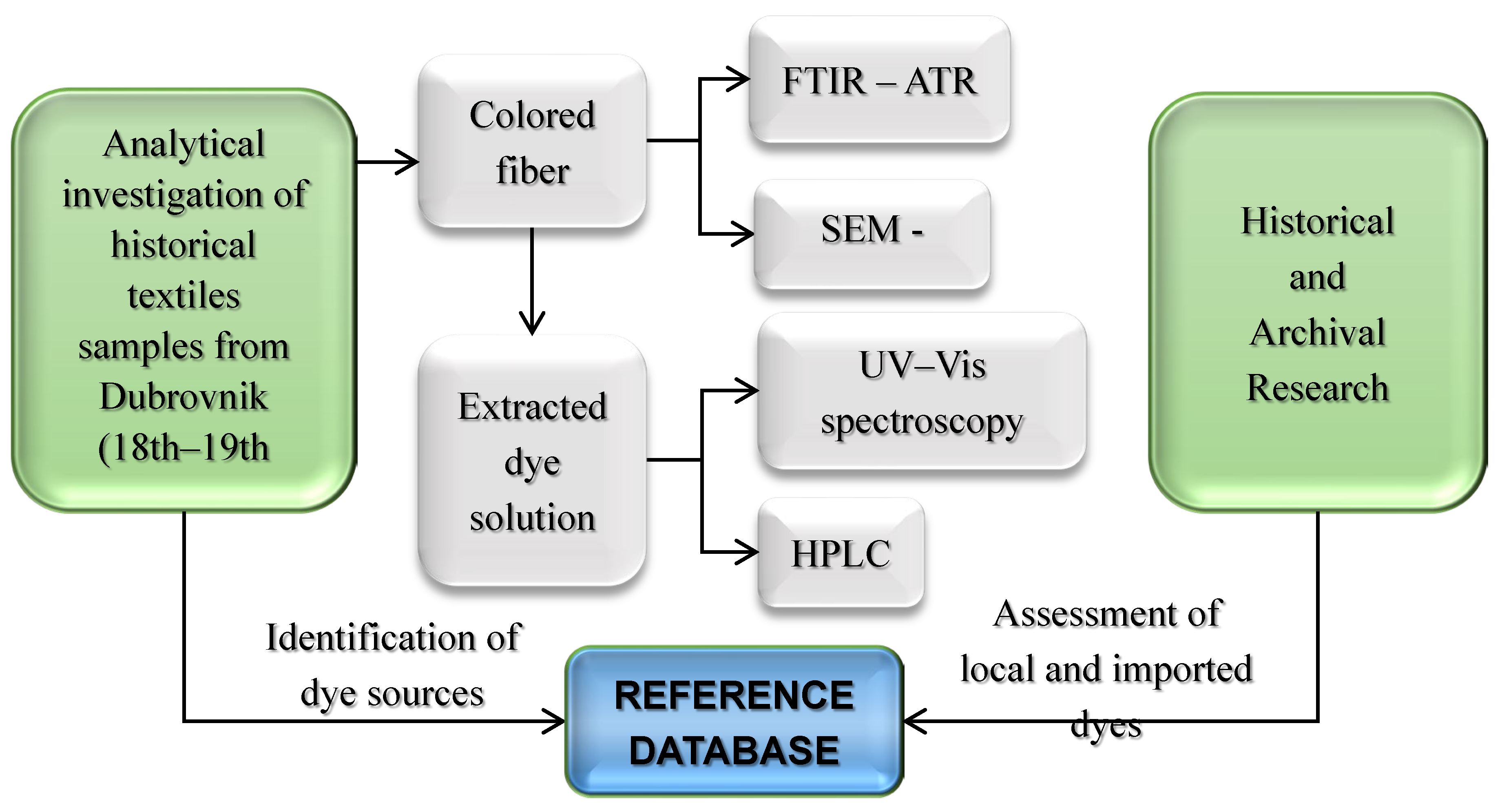
Figure 2.
SEM micrograph of sample FK_pp (inv. no. FK, 18th century).
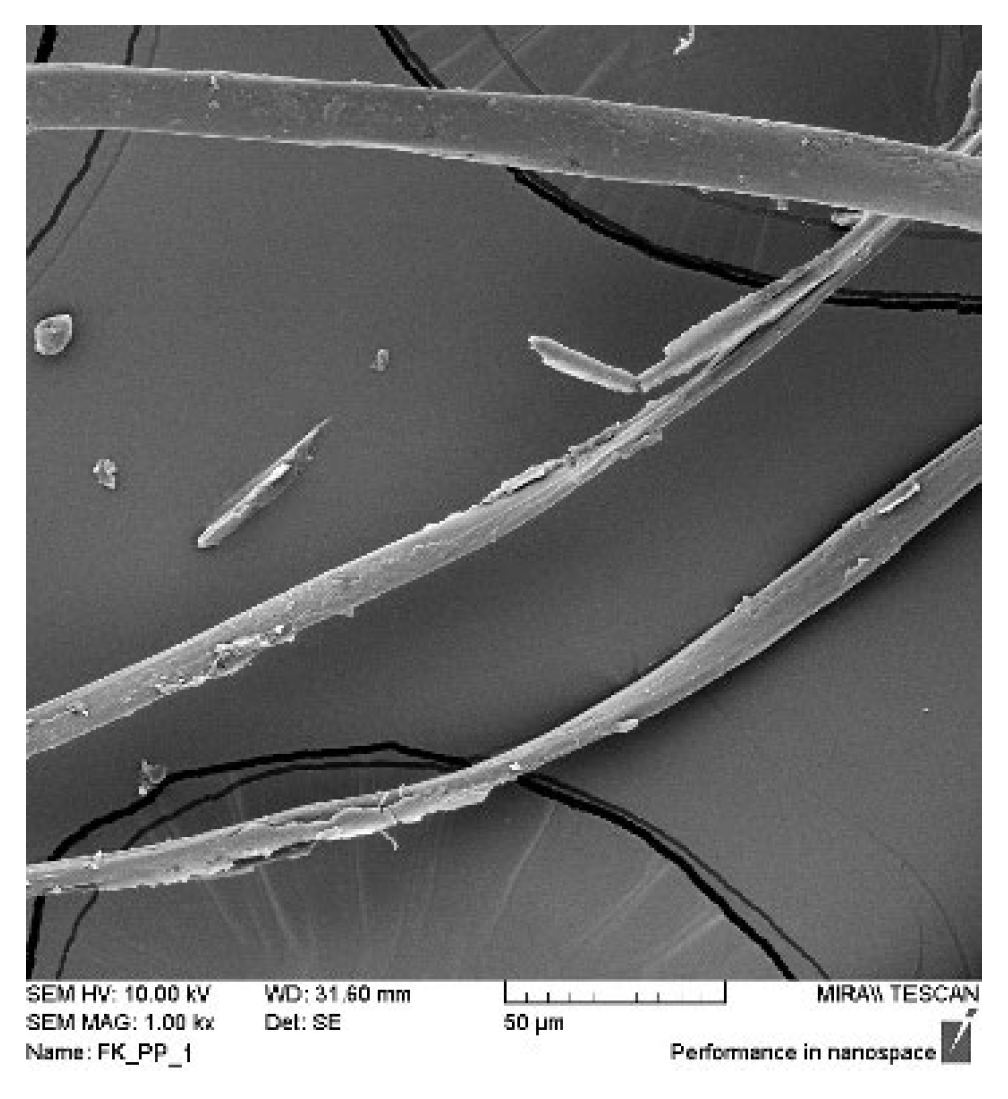
Figure 3.
Multi-analytical workflow for establishing an entry in the preliminary Dubrovnik Natural Dye Reference Database.
Figure 3.
Multi-analytical workflow for establishing an entry in the preliminary Dubrovnik Natural Dye Reference Database.
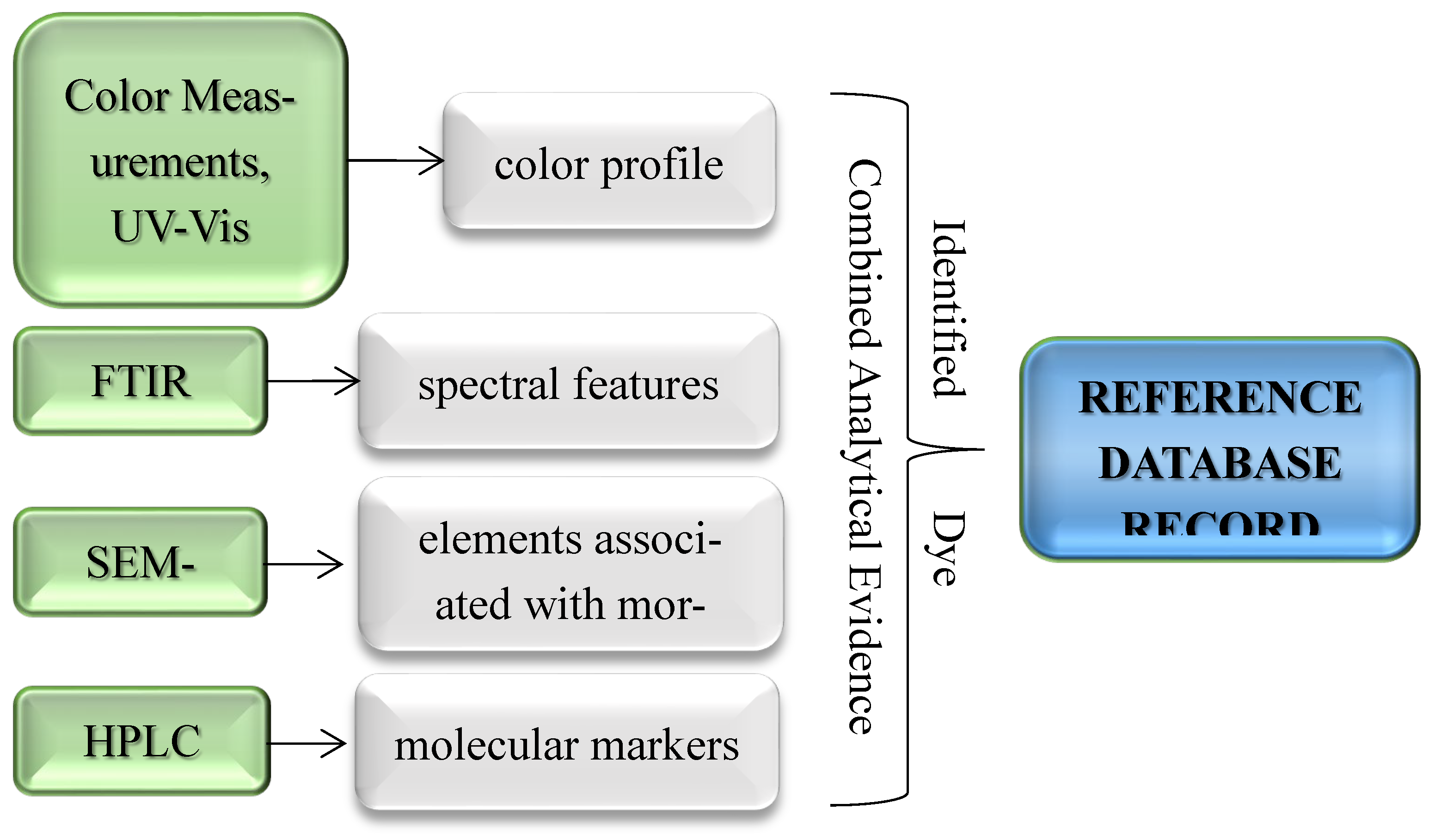
Figure 4.
Distribution of the analyzed samples in the CIELAB a–b color space, illustrating the initial chromatic classification used in the Dubrovnik Natural Dye Reference Database.
Figure 4.
Distribution of the analyzed samples in the CIELAB a–b color space, illustrating the initial chromatic classification used in the Dubrovnik Natural Dye Reference Database.
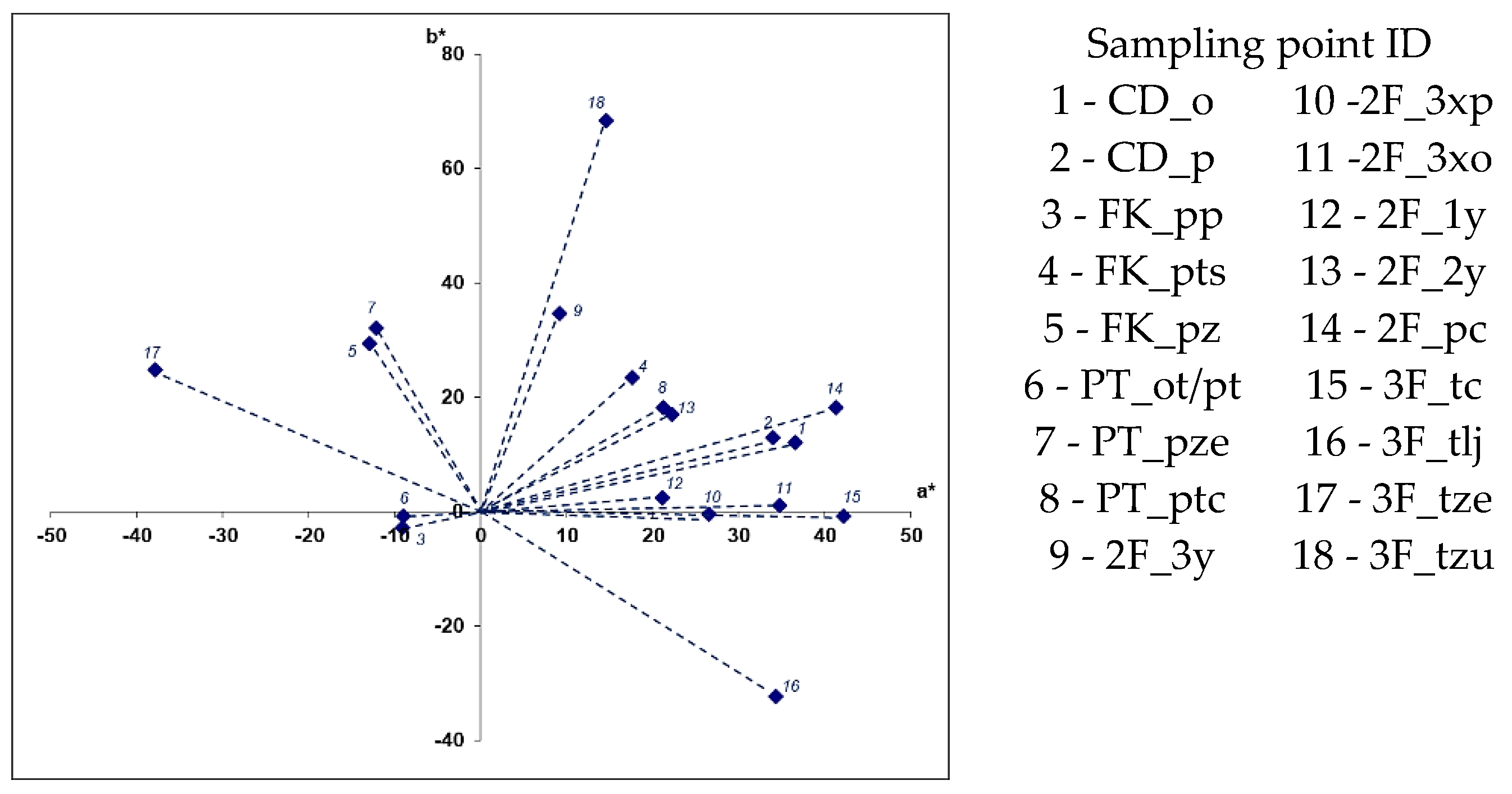
Figure 5.
Comparison of FTIR–ATR spectra of historical red-colored silk samples: (1) sample 2F_3xo, containing madder and cochineal (inv. no. 2F, 19th century); (2) sample CD_o, containing madder (inv. no. CD, 18th century).
Figure 5.
Comparison of FTIR–ATR spectra of historical red-colored silk samples: (1) sample 2F_3xo, containing madder and cochineal (inv. no. 2F, 19th century); (2) sample CD_o, containing madder (inv. no. CD, 18th century).
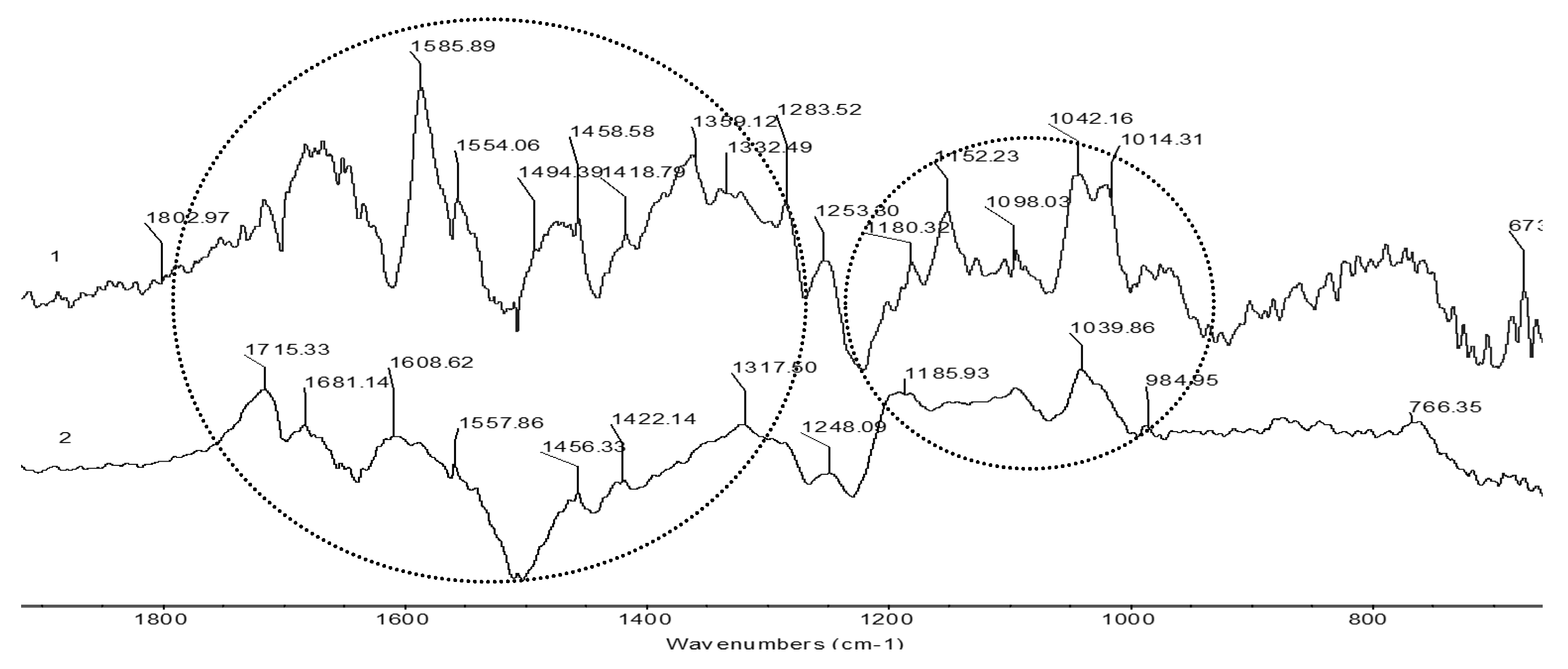
Figure 6.
Comparison of HPLC chromatographic profiles: (a) Reference aluminum-mordanted local Rubia tinctorum L. extract. (b) Historical textile sample 2F_3xo (inv. no. 2F, 19th century).
Figure 6.
Comparison of HPLC chromatographic profiles: (a) Reference aluminum-mordanted local Rubia tinctorum L. extract. (b) Historical textile sample 2F_3xo (inv. no. 2F, 19th century).
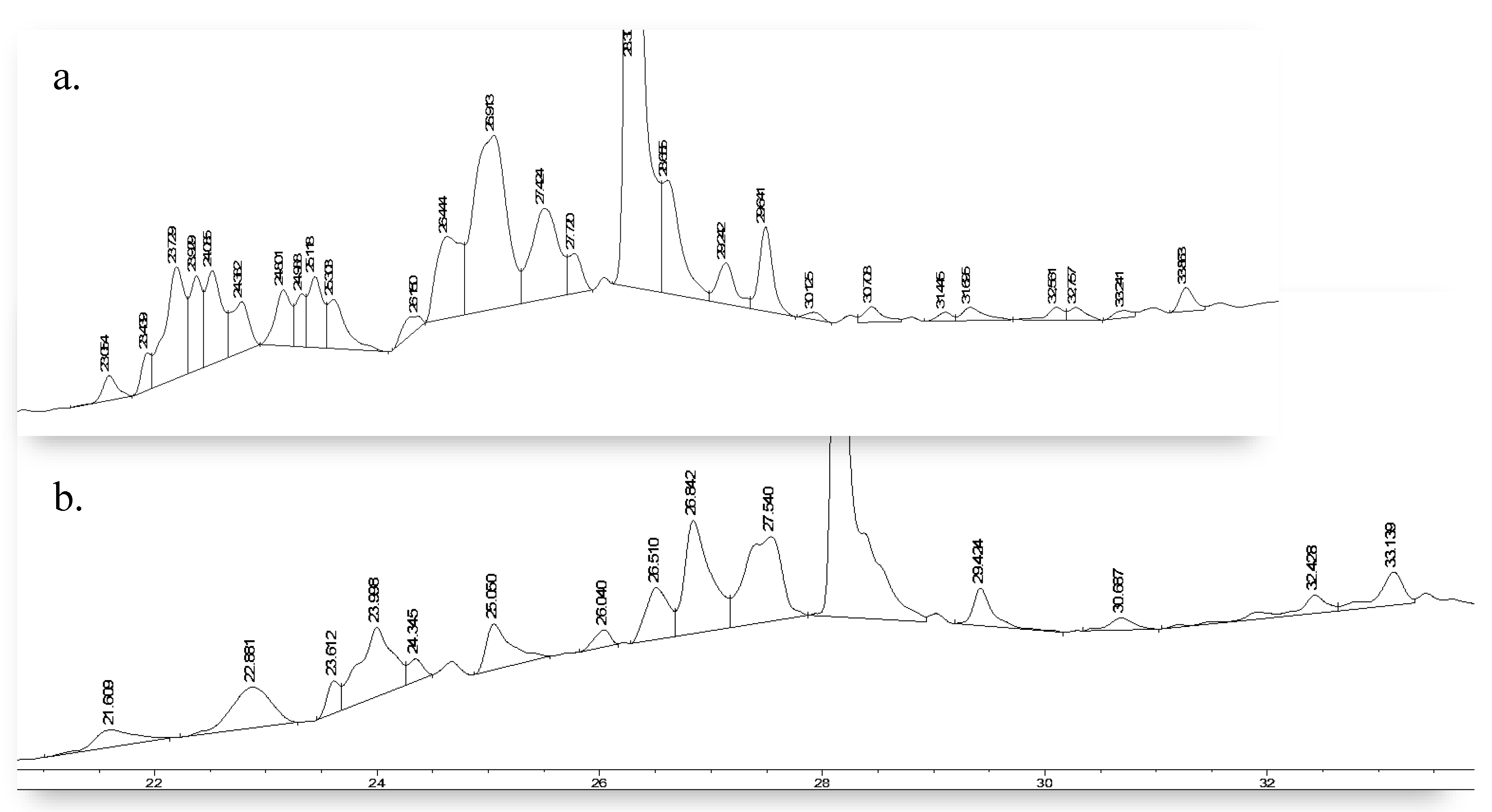
Figure 7.
Representative HPLC chromatographic profiles of historical red-colored samples: (1) PT_ptc – madder; (2) FK_pts – madder + Tyrian purple; (3) CD_p – madder + cochineal.
Figure 7.
Representative HPLC chromatographic profiles of historical red-colored samples: (1) PT_ptc – madder; (2) FK_pts – madder + Tyrian purple; (3) CD_p – madder + cochineal.
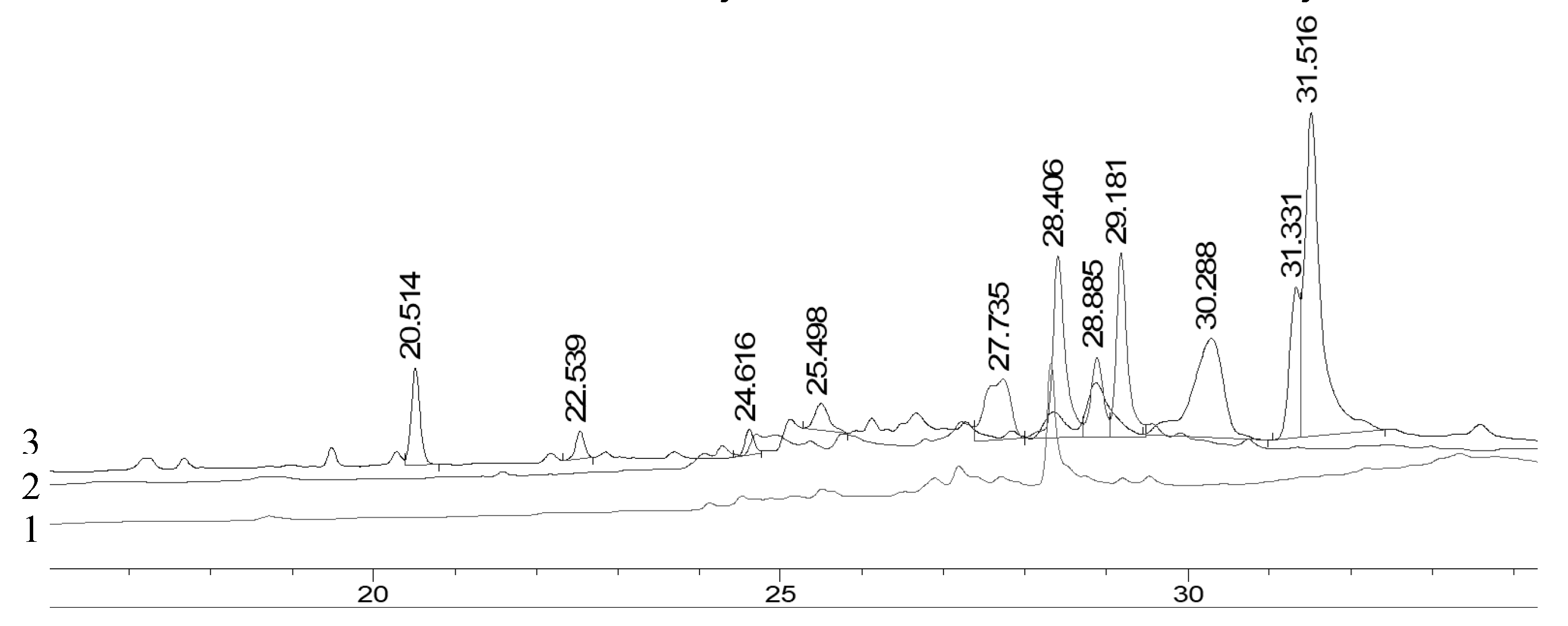
Figure 8.
HPLC chromatograms of 18th-century samples: 1 – PT_ot (inv. no. PT), 2 – FK_pp (inv. no. FK).
Figure 8.
HPLC chromatograms of 18th-century samples: 1 – PT_ot (inv. no. PT), 2 – FK_pp (inv. no. FK).
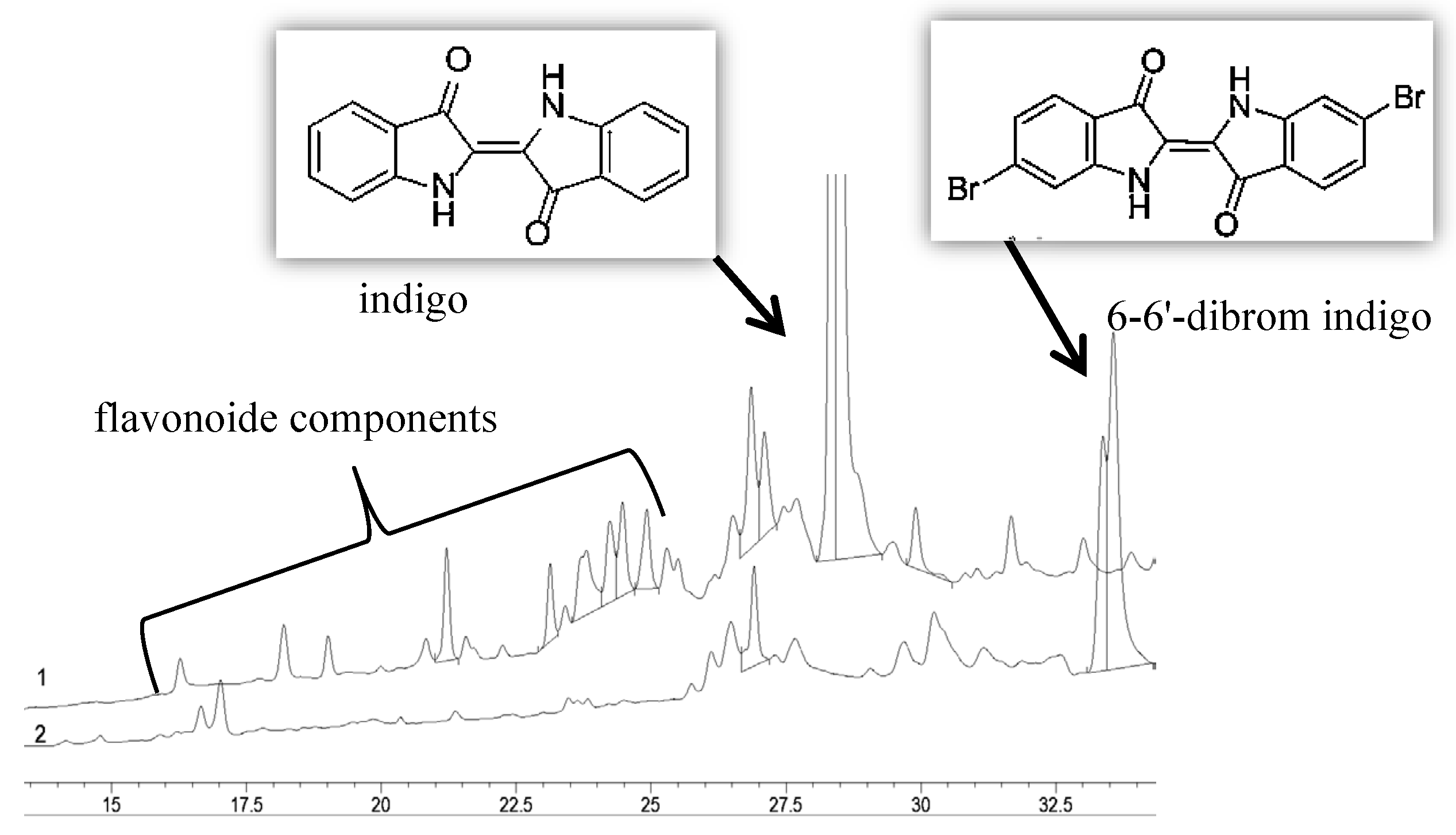
Figure 9.
Comparison of the HPLC chromatographic profiles: (a) Locally prepared Adriatic H. trunculus reference extract. (b) Eighteenth-century historical blue textile sample FK_pp.
Figure 9.
Comparison of the HPLC chromatographic profiles: (a) Locally prepared Adriatic H. trunculus reference extract. (b) Eighteenth-century historical blue textile sample FK_pp.
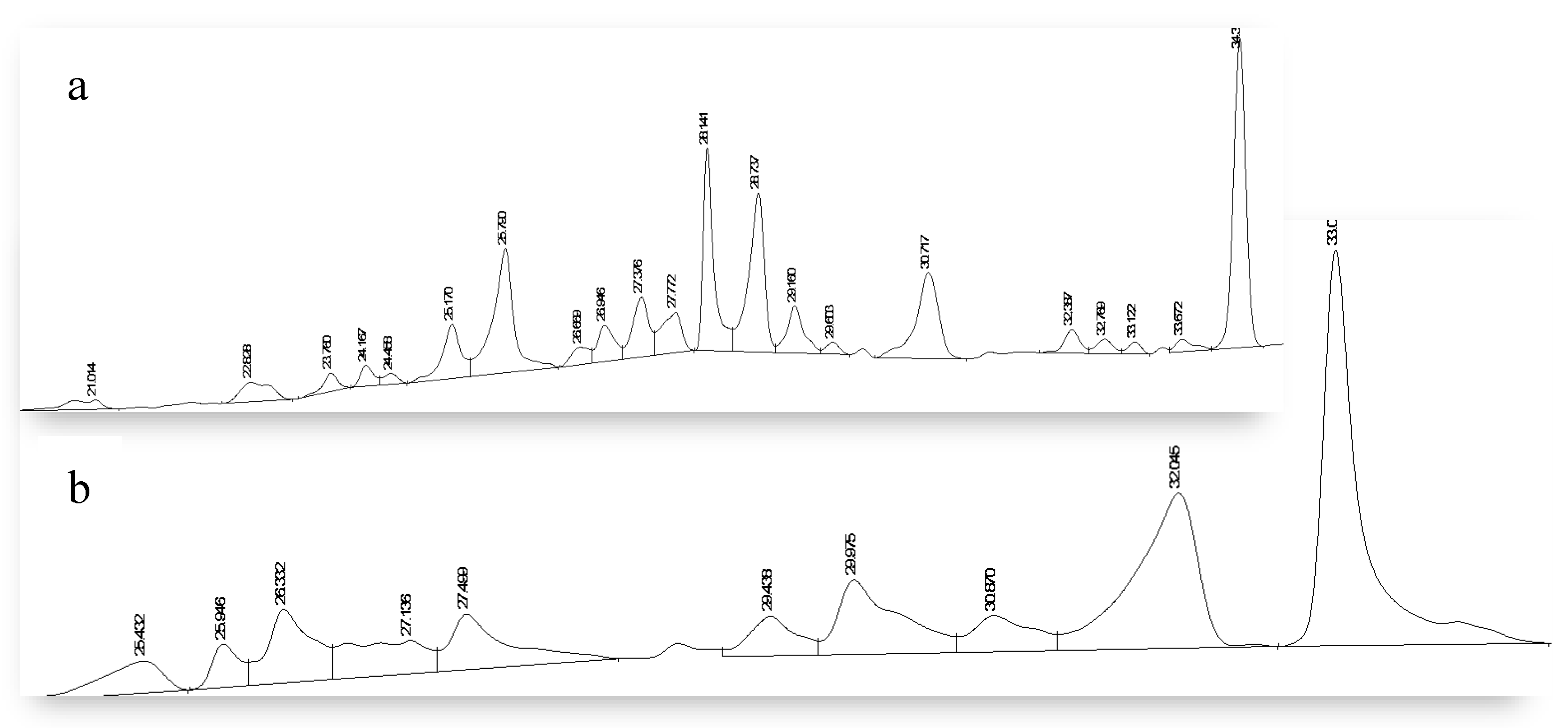
Figure 10.
FTIR–ATR spectra of samples from textile fragment inv. no. FK (18th century): (1) Green silk weft (FK_pz). (2) Blue silk weft (FK_pp). (3) Spectrum obtained by spectral subtraction of FK_pp from FK_pz, representing the spectral contribution of the yellow dye component.
Figure 10.
FTIR–ATR spectra of samples from textile fragment inv. no. FK (18th century): (1) Green silk weft (FK_pz). (2) Blue silk weft (FK_pp). (3) Spectrum obtained by spectral subtraction of FK_pp from FK_pz, representing the spectral contribution of the yellow dye component.
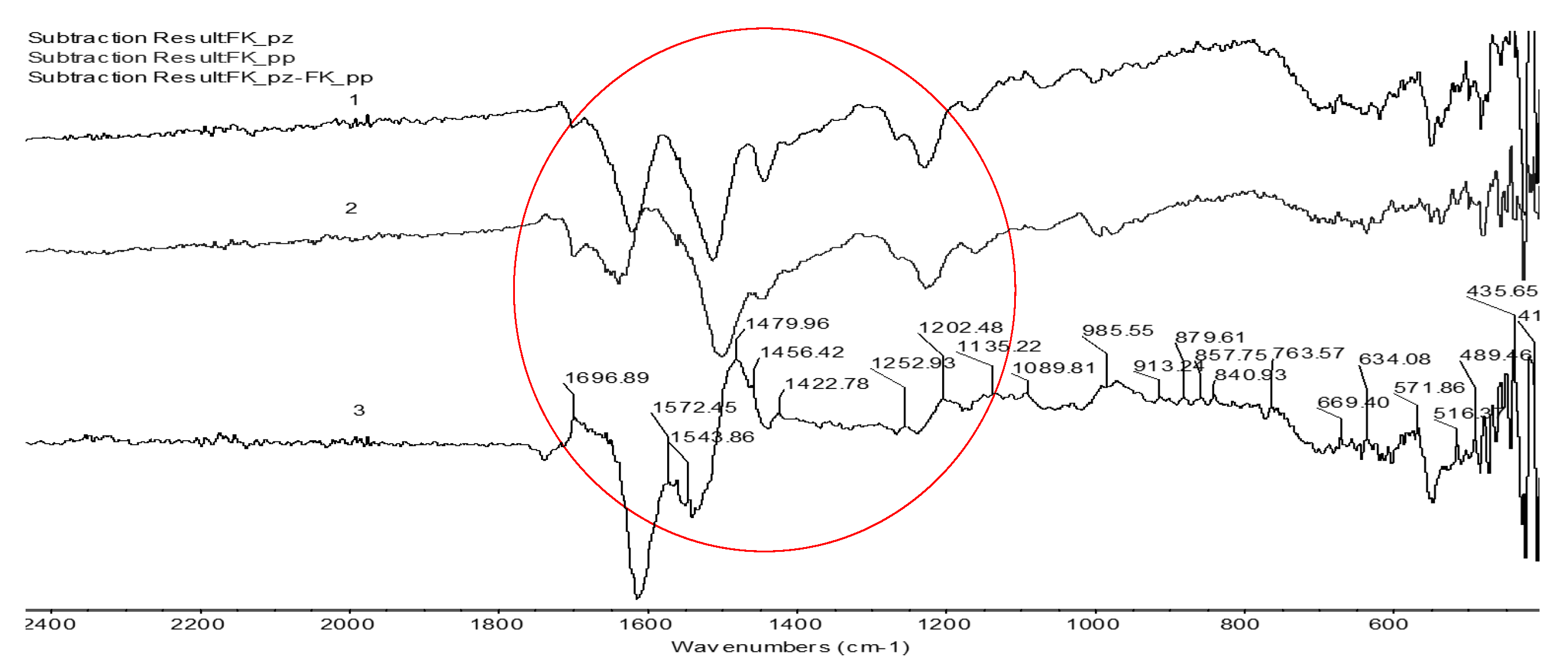
Figure 11.
HPLC chromatogram of the green sample 3F_tze showing the chromatographic profile consistent with a woad–weld dye mixture.
Figure 11.
HPLC chromatogram of the green sample 3F_tze showing the chromatographic profile consistent with a woad–weld dye mixture.
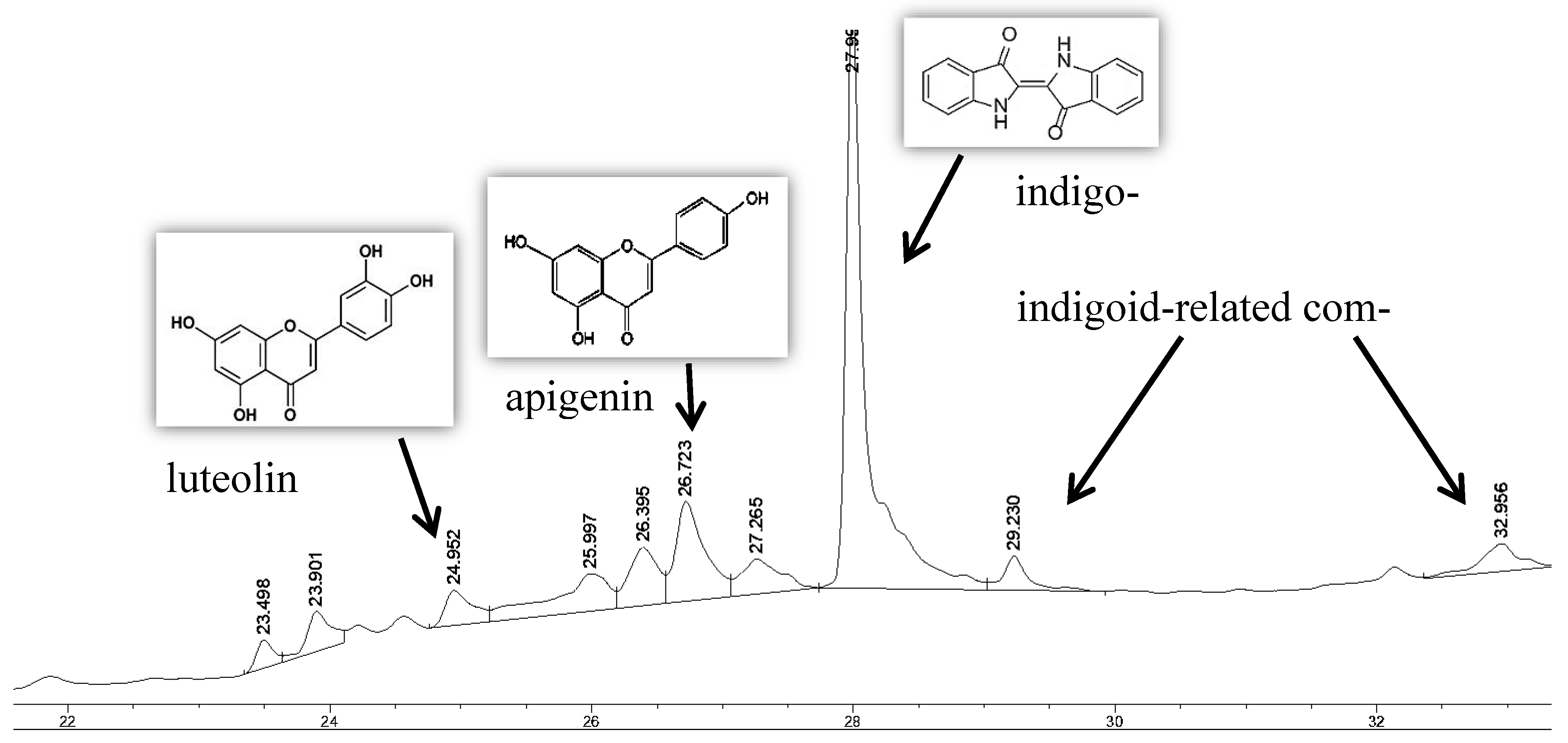

Table 1.
Textile artefacts from Dubrovnik (18th-19th century).
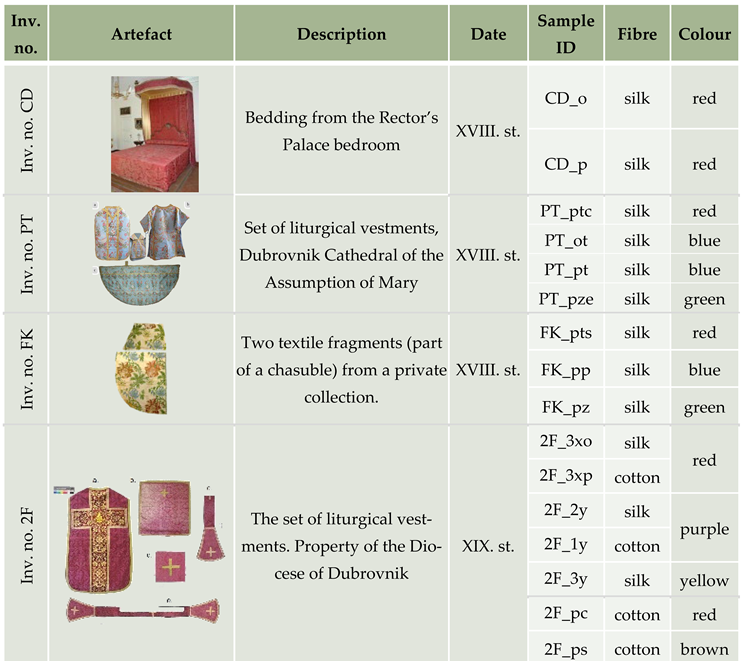

Table 2.
Overview of integrated analytical results included in the Dubrovnik Natural Dye Reference Database.
Table 2.
Overview of integrated analytical results included in the Dubrovnik Natural Dye Reference Database.
Disclaimer/Publisher’s Note: The statements, opinions and data contained in all publications are solely those of the individual author(s) and contributor(s) and not of MDPI and/or the editor(s). MDPI and/or the editor(s) disclaim responsibility for any injury to people or property resulting from any ideas, methods, instructions or products referred to in the content. |
© 2026 by the authors. Licensee MDPI, Basel, Switzerland. This article is an open access article distributed under the terms and conditions of the Creative Commons Attribution (CC BY) license.
Copyright: This open access article is published under a Creative Commons CC BY 4.0 license, which permit the free download, distribution, and reuse, provided that the author and preprint are cited in any reuse.