
Submitted:
28 October 2026
Posted:
29 October 2026
You are already at the latest version
Abstract
The organization of the lower limb exoskeleton robot (LLRER) is a highly nonlinear system and there is key difficulties including the stability issue and the complex control design. This article uses the feedback linearization method to robustly stabilize LLRER that takes the place of nonlinear function approximator, such as the fuzzy control and the neural network control. The current work “firstly” proposes the difficult nonlinear exponential convergence rate formula of LLRER. The effective operating range of presented algorithm is “global”, whereas the Jacobian linearization method is “locally” valid. The proposed approach simultaneously possesses some features including the almost disturbance rejection feature that replaces the singular perturbation approach without the sufficient requirement that original system should have “complete” condition, and the system stability feature without addressing the difficult Hamilton-Jacobin equation for the H-infinity method. To rigorously verify the effectiveness of the proposed approach, this study uses the AI software “Python” to build a controller-design human–machine interaction package of general nonlinear system. Finally, a comparative example, that cannot be solved for the first paper of almost disturbance decoupling problem, is used to show that the effectiveness of proposed algorithm is better than the singular perturbation method.
Keywords:
the lower limb rehabilitation exoskeleton robot system
; human–machine interaction package
; feedback linearization method
; almost disturbance decoupling problem
; nonlinear exponential convergence rate
; nonlinear exponential convergence radius
1. Introduction
Lower limb rehabilitation exoskeleton robots have attracted a great deal of attention due to the fact that LLRER have good precision performance as well as effectively help physically handicapped patients to implement rehabilitation training process [1,2]. Physically handicapped patients move according to a pre-specified gait trajectory with the driving force proposed by LLRER. After possessing some moving abilities, physically handicapped patients implement the walking ability with the aid of LLRER [3,4]. Among above investigations, the most significant topic is focused on robustly tracking a pre-specified gait trajectory and then it is important to construct the desired tracking control for robots.
Nowadays, investigations on tracking topic for LLRER are mainly focused on dynamic modelling, that is similar to robotic investigations [5]. Most widely used effective control approaches address the global stability problem of LLRER, such as the proportional-integral-derivative control [6], the model predictive control [7,8], the adaptive control [9,10] and the sliding mode control [11,12]. Proportional-integral-derivative control needs to transform the dynamic equations of LLRER into “linearized” systems by compensating nonlinear parts and is realized by linear system theory. However, LLRER are highly nonlinear systems, which dynamic equations cannot be completely represented by the transformed linearization systems. Model predictive control is widely used for LLRER due to its appealing properties [13]. However, the model predictive control effectively works only for linear range near the equilibrium point. Adaptive control is often utilized to design the tracking controller for LLRER [14]. The adaptive control is largely restricted owing to the complicated updating rule. Sliding mode control proposes appealing robust performance for the LLRER [15]. However, the severe chattering property is the significant drawback that may destroy the overall stability of the LLRER.
For the trajectory tracking control of LLRER, the external disturbance rejection performance and the stability performance will be required to be simultaneously solved [5]. In order to simultaneously address both above performances for LLRER, some effective methods have been widely used, such as the linear parameter varying control [16,17], the model predictive control [7], the deep reinforcement learning [18,19,20], the backstepping control [21] and so on. Nevertheless, the aforementioned methods are effective only for a linear region near the operating quiet point of the practical nonlinear LLRER via the Jacobian linearization technique. To solve the severe restriction of the practical nonlinear LLRER, a lot of engineers use the function approximators technique to improve practical drawback, such as the neural network approach [15,22] and the fuzzy logic approach [9,23,24]. The neural network approach possesses significant performances for nonlinear LLRER [22]. Nevertheless, it has the following impractical shortcomings: (1)the complicated coupling neural network rules is impractical; (2)the related input control of the LLRER is constructed only by applying current states of neural network; (3)the neural network approach belongs to a supervised learning method and then needs the LLRER to support lots of sampling points. The main shortcoming of the fuzzy logic control is that the fuzzy classified data-mapping rules are completely built by many accumulated expert experiences in the past [9]. Motivated by aforementioned analysis and discussion, it reveals an important fact that the robustness of controlling the LLRER still is a challenging topic for the external disturbance rejection performance and the stability performance. In this article, we “firstly” apply the feedback linearization approach to solve well above traditional difficulties with multi-performances, such as the disturbance rejection, the freely adjustable exponential convergence rate and the better closed-loop stability. Recently, the feedback linearization approach has drawn a great of attention for many industrial applications including the synchronous motor [25], the psychrometric testing chamber [26], the hydraulic cylinder [27], the micro tandem helicopter [28] and the electrical vehicle DC charging pile [29].
More rigorous analysis and discussion for the impact of disturbance, more stricter definition of the tracking error, called as almost disturbance decoupling, had been proposed in [30,31]. Nevertheless, both above references exploit the fact that some control systems cannot obtain the almost disturbance decoupling performance due to the sufficient condition that the considered functions should have “complete” characteristic property such as the following system: , , yop_1 = xst_1≡Oop_1, where Φn,Oop_1 and Inp are the disturbance, output and input, respectively. Conversely, the presented feedback linearization approach will well address the almost disturbance decoupling performance for the trajectory tracking control of LLRER in this article and main contributions are totally listed as follows:
- (i)
- This study has “firstly” proposed the significant result of the exponential convergence rate for the highly nonlinear LLRER system.
- (ii)
- (iii)
- A robust tracking control of LLRER system is derived in this article to obtain the exponential stability performance without addressing the difficult Hamilton-Jacobi equation that is necessary work for the H-infinity method [32].
- (iv)
- The presented control algorithm will improve the severe shortcomings of traditional function approximators, including the fuzzy control and the neural network control without relying on the accumulated expert experience in the past and complicated coupling neural network rules.
- (v)
- The current research in this study is “globally” valid in the overall dynamic plane and takes the place of Jacobian linearization method that is only “locally” valid near the operating quiet point.
- (vi)
- This study designs a powerful artificial intelligence human–machine interaction package of robust controller design for nonlinear LLRER system via AI Python software based on the proposed algorithm.
2. Complete Mathematical Model of Nonlinear LLRER Robot
Based on the lower limb rehabilitation exoskeleton robots considered in this article, the LLRER kinematic model is derived to show the interconnection for the LLRER and all joint torques via the Lagrange equation and the Newton Euler equation. The Lagrange equation and the Newton Euler equation focus on the energy investigation and the force investigation, respectively. The schematic diagrams for three-link and simplified two-link of the LLRER are depicted as Figure 1, Figure 2 and Figure 3. Thus the Lagrange equation is shown by
and
where Ekinetic is the overall kinetic energy of the LLRER; Epotential is the overall potential energy of the LLRER; La is the Lagrange function of the LLRER; τi,i = 1,2,3 is the i-joint torque; θi,i = 1,2,3 is the angle of link1~link3; is the velocity of link1~link3. Based on the geometric coordinate of the LLRER, the coordinate (xi,yi) and the velocity of each link will be derived to be
La = Ekinetic − Epotential
According to (2)~(14), the overall kinetic energy and the overall potential energy of the LLRER can be obtained as
i.e.,
where m1s(i.e. m1+M1),m2s(i.e. m2+M2),m3s(i.e. m3+M3) are the summing masses of link1~link3, m1 denotes the mass of exoskeleton thigh, M1 denotes the mass of patient thigh, m2 denotes the mass of exoskeleton shank, M2 denotes the mass of patient shank, M3 denotes the summing mass of patient foot, l1,l2,l3 are the lengths of link1 ~ link3, d1,d2,d3 are the centroid position distances of link1 ~ link3, I1,I2,I3 are the rotational inertias of link1 ~ link3 and g is the acceleration of gravity.
Substituting (15) ~ (17) into (1) ~ (2) yields
Integrating equations from (18) ~ (20) yields the kinematic mathematical model of LLRER to be
where
H11≡0
H22≡0
H33≡0
G3≡−m3sd3g(sinθ3)
Applying d3 = l3 = I3 = 0 and θ3 = 90° simplifies the 3-link LLRER to be 2-link LLRER as follows
Define the input, the output and state variables of the LLRER to be , , , xst_1 = θ1, xst_2 = θ2 , and . Assume the desired tracking signals to be
Then the state equation and the output equation of the LLRER can be easily obtained as
where
Oop_1 = xst_1
Oop_2 = xst_2
f1≡xst_3
f2≡xst_4
Δ≡D11D22 − D12D21
Φn_1 = sint,Φun_1 = 0
Noting that Φn_1 and Φun_1 denote the noise and the uncertainty, respectively.
Table 1 lists all the parameters of the considered LLRER. Then, the state equation and the output equation of the LLRER can be shown by (51) based on the following physical parameters:
D11≡2.3788
D12≡0.514(cos(xst_1 − xst_2)) + 0.196(cos(xst_1 − xst_2))
D21≡0.514(cos(xst_1 − xst_2)) + 0.196(cos(xst_1 − xst_2))
D22≡0.418051
H11≡0
H22≡0
G1≡−58.0351(sinxst_1)
G2≡−14.0379(sinxst_2)
Define the nominal system of above nonlinear LLRER to be
with the relative degree {drd_1,drd_2} = {2,2} meeting
<i>the following Lie equation is established:
for 1 ≤ i ≤ 2,1 ≤ j ≤ 2, k < drd_i − 1, where the operator L involves the Lie differentiation.
<ii>the following Lie matrix
is a nonsingular matrix and the spanning distribution
is involutive [33].
3. Tracking Controller Design of Nonlinear LLRER Robot
Reference [33] and reference [34] propose the theorem that under the well-defined relative degree drd≡drd_1 + drd_2 = 4 and the involutive spanning distribution, an infinitely differentiable and bijective mapping ϕ defined as follows can transform the nonlinear LLRER system into partially linear subsystems [33,34] as follows:
drd≡drd_1 + drd_2
Since
then the transformed system can be given by
Hence
Then we can transform the nonlinear LLRER system into the following mathematical model
From (91), (93), (96) and (100), we get
We build the desired tracking control by to be [33]
where denotes the pre-specified tracking signal and are elements of the following Hurwitz matrix described by
Then we propose the desired robust control with the desired tracking signals according to the feedback linearization approach as follows:
Inp_1=(D11)(-Inp_b1+Inp_v1)+(D12)(-Inp_b2+Inp_v2)
Inp_2=(D12)(-Inp_b1+Inp_v1)+(D22)(-Inp_b2+Inp_v2)
Based on the convenience of the following discussions, let’s define
where the Lyapunov matrix belongs to be a Hurwitz matrix and one can apply software Matlab to find the adjointing Lyapunov matrix of the famous Lyapunov equation:
and
To elaborate further the detailed design of the robust controller for nonlinear LLRER sytem, let’s make the following definitions:
Definition I.
Consider a nonlinear system with the input vector , the state vector and the dynamic vector . The nonlinear system is defined to have the input-to-state stable property if
Definition II.
[34]. A nonlinear system with the external noise input is defined to have the almost disturbance decoupling performance if the following requirements are established:
(a)The nonlinear system has the input-to-state stable property, i.e., (125) holds.
(b)
and
where is the initial state, κ1 belongs to KL-class function, κ3,κ5 belong to K-class funtions and κ2 > 0,κ4 > 0.
From (101), we obtain
Combining (112), (114) and (128) yields
Substituting (102) and (103) into (129) obtains
Then, we can get
where
Appropriately choose Lf to play the role of the Lyapunov functions for transformed system (131) by
and
Then, we can obtain the derivative of the overall Lyapunov function Lf for the transformed system by
where
i.e.,
Define
F≡2αs(ε)
Then
Define the error vector of the transformed system by
Then we can get
Next, we will prove the fact that the robust tracking control in Figure 4 possesses the almost disturbance decoupling performance, and the globally exponential stability of the LLRER system in Appendix A.
Noting that we can extend aforementioned complete control-design process to get two more general theorems for general nonlinear uncertain systems with external disturbances and uncertainties as follows:
i.e.,
where , , , , denote the system states vector, the input vector, the output vector, the noise vector, the uncertain vector, the noise-adjointing vector of the nonlinear system, respectively. Consider the system relating vectors , and to be differentially continuous and the uncertain vector to be .
Assumption I.
The inequality is established:
Define the nominal system of above nonlinear system to be
with the relative degree {drd_1,drd_2,…,drd_m} meeting
<i>the following Lie equation is established:
for 1 ≤ i ≤ m,1 ≤ j ≤ m, k < drd_i − 1, where m is the input number and the operator L involves the Lie differentiation.
<ii>the following Lie matrix
is a nonsingular matrix and the spanning distribution
is involutive [33].
Assume that the considered nonlinear system possesses the well-defined relative degree and the involutive spanning distribution and then the following mapping ϕ described as
and
is an infinitely differentiable and bijective mapping that transforms the complicated nonlinear system to be both subsystems including the partially nonlinear Πn_k subsystem and partially linear subsystem , respectively [33].
ϕ:ℜn → ℜn
Appropriately choose and to play the role of the Lyapunov functions for the transformed nonlinear subsystem and the transformed linear subsystem, respectively and then compositely design an overall Lyapunov function of the transformed system by
and
Theorem I.
Exist an infinitely differentiable and bijective function for the transformed system (Πn_k, ) such that the following criteria hold:
F≡2αs(ε)
Then the nonlinear system based on the proposed robust tracking controller (168) has the almost disturbance decoupling performance. Moreover, the desired tracking errors will be exponentially reduced by the criterion F ⋅ F2 > 1 with the exponential convergence rate
and the exponential convergence radius of the global final attractor is equal to be
If the dimension of the nonlinear system is same to the relative degree, i.e., the considered system belongs to be complete feedback linearizable, then the simplified version of Theorem I can be summarized as follows.
Theorem II.
The robust tracking problem of the nonlinear system with almost decoupling disturbance performance can be well achieved via the proposed controller (248) by tuning the following variables F ⋅ F2 > 1 with
F≡2αs(ε)
Moreover, the tracking errors of the transformed subsystem can be reduced by adjusting the variable F ⋅ F2 > 1 with the exponential convergence rate
where
and the exponential convergence radius of the global final attractor
To systematically design the proposed robust tracking controller for LLRER, an useful algorithm of Theorem I is depicted as follows. An effective AI Python program is applied to construct the proposed robust tracking controller in section III.
(Step i)According to the given outputs for LLRER, one firstly obtain the relative degree drd_1,…,drd_m.
(Step ii)Applying (158) gets the infinitely differentiable and bijective mapping.
(Step iii)Properly choose parameters such that is Hurwitz via (103) and (119) and apply software Matlab to calculate the adjointing Lyapunov matrix .
(Step iv)Appropriately design the Lyapunov function Lf_n of the nonlinear transformed subsystem to establish the requirements (152) and (165) ~ (167). It is worth noting that if the dimension of the nonlinear system is same to the relative degree, i.e., the considered system belongs to be complete feedback linearizable [34], then immediately jump to (Step v).
(Step v)According to (172) ~ (181), (182) and (184), properly select parameters k,αs(ε),ε such that F ⋅ F2 > 1.
(Step vi)Immediately construct the proposed robust tracking controller by (168).
4. Simulation of Nonlinear LLRER Robot
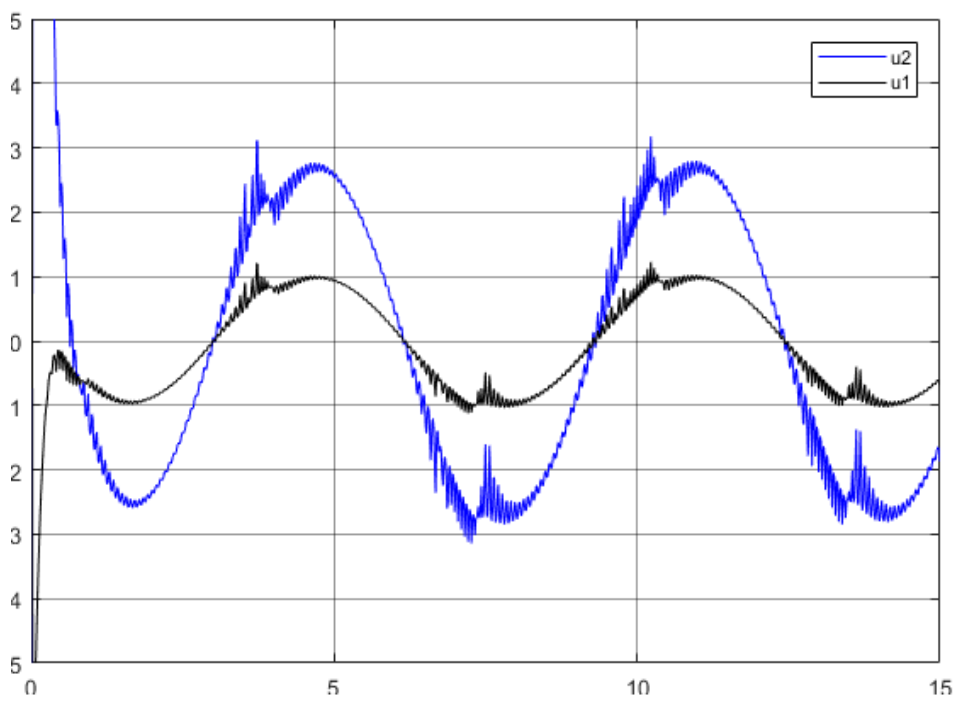
Designing ε = 1, , drd_1 = 2, drd_2 = 2, αs = 0.495625, Q = 0.99125, F = 0.99125, F1 = 0.067 and F2 = 1.25 yields the fact that all the requirements of Theorem II are established. The output trajectories and the input trajectories (ε = 1) of the LLRER system are shown by software Matlab in Figure 5 and Figure 6, respectively. Noting that the proposed rotational inertias of link1~link2 indeed drive the outputs to robustly track the pre-specified angles , for link1 and link2, respectively. Based on the observations of (192) ~ (193) , Figure 5 and Figure 7, it is obvious to see the fact that the exponentially convergent rates of system tracking errors for the LLRER system with smaller ε (ε = 0.4) is better than larger ε (ε = 1).
Figure 5.
The state trajectories for ε = 1.
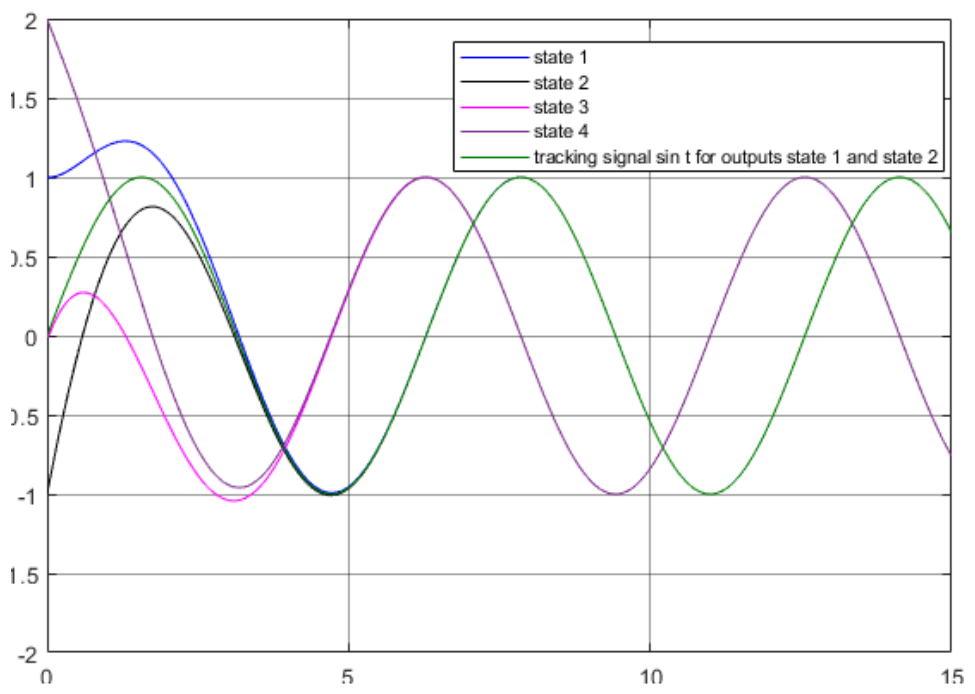
Figure 6.
The input trajectories for ε = 1.
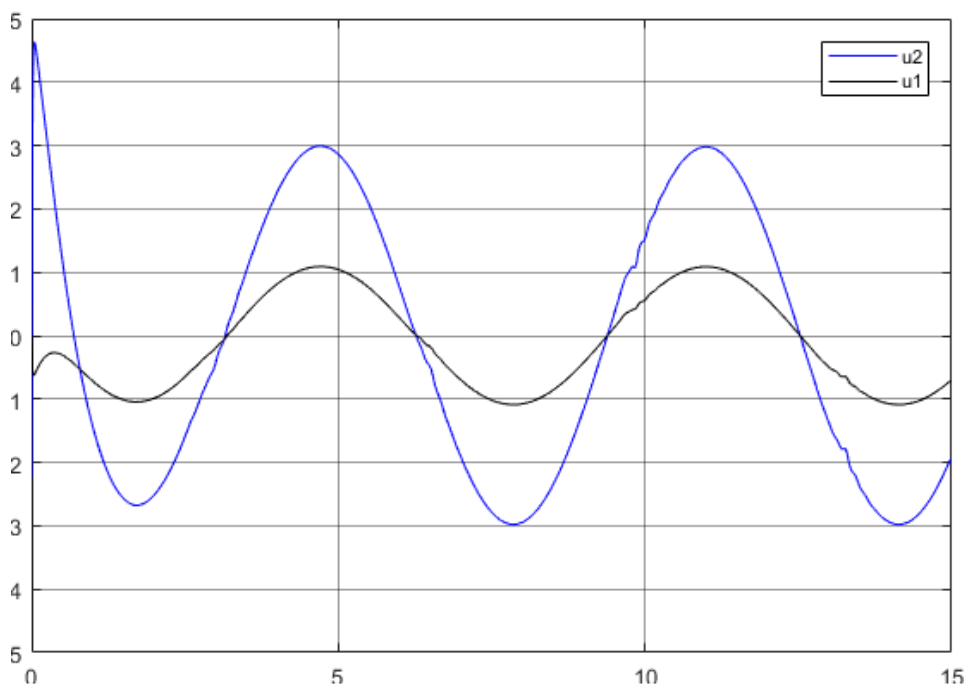
Figure 7.
The state trajectories for ε = 0.4.
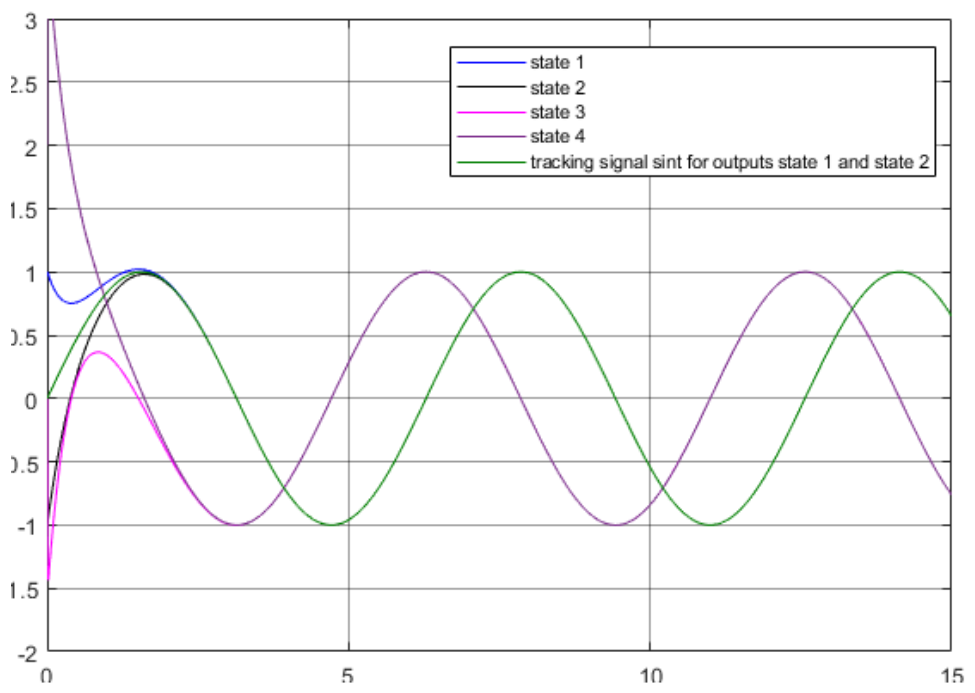
Figure 8.
The input trajectories for ε = 0.4.
In order to show the outstanding features that allow engineers to systematically build proposed robust tracking control, we use the famous AI language “Python” to generate an effective system in this study, where this effective controller-design human–machine interaction package includes inputs: (i)the state equation and output equation of the nonlinear LLRER system; (ii)the items of the state number, the output number, the input number and the desired pre-specified tracking signals ; (iii)the disturbances, the Lyapunov functions for transformed nonlinear and linear subsystems. The controller-design human–machine interaction package will exert its excellent symbol-operation function of AI “Python” to generate both Matlab working files (cytquadff_new1.m and cytquadsimulation_new1.m) as shown in Figure 9 for the LLRER system. Then, we can implement these both working Matlab files to depict the complete trajectories before, on and after entering the exponential convergent radius symbolized by blue circles as shown in Figure 10, Figure 11 and Figure 12, respectively, with the exponential convergent radius .
5. Comparison to Traditional Approach
In this section, we will compare the proposed feedback linearization method with the singular perturbation approach with high feedback-gain [30,31] that “firstly” address the almost disturbance decoupling problem. The severe drawback of the singular perturbation method with high feedback-gain needs to establish the sufficient condition that the considered dynamics multiplied by the disturbance should meet the famous “structural triangle condition” for the almost disturbance decoupling problem. [30,31] had pointed out the fact that the following nonlinear system cannot solve the almost disturbance decoupling problem:
Oop_1 = xst_1,Φn(t) = 0.6sint
From (195) and (196), it is easy to obtain the following results: , , , and
Therefore, the main sufficient condition of [30,31] is not well established since the distribution is not complete. In contrast, the following proposed robust tracking controller can well address the almost disturbance decoupling problem:
The system output trajectory of the considered noniliear system shown by (195) with the proposed controller (198) is depicted in Figure 13. From the observation of Figure 13, one can conclude the fact that the presented robust tracking controller described by (198) can indeed make the system output trajectory track the pre-specified signal cost with the almost disturbance decoupling performance.
6. Conclusions
This study presents the well robust tracking control design of the highly nonlinear lower limb rehabilitation exoskeleton robot system via the feedback linearization method to replace the singular perturbation approach with high feedback-gain that needs to satisfy the difficult sufficient condition that some distributions should be complete, and proposes the global exponential stability without addressing the complex Hamilton-Jacobin equation. Since the disturbance plays important role for the lower limb rehabilitation exoskeleton robot system, this article uses more stricter restriction of the disturbance with simultaneous absolute-value sense, integration-value sense and input-to-state stable sense.
To show the outstanding superiority of current research and let one easily design the robust tracking control, we apply the powerful AI “Python” to design a powerful controller-design human–machine interaction package. This current research firstly proposes the significant formula of nonlinear exponential convergence rate and the important formula of exponential convergent radius for the highly nonlinear LLRER system. At last, based on the proposed model, the effectiveness of proposed theorem is rigorously validated for the nonlinear LLRER by carrying out some simulations.
Author Contributions
Conceptualization, Chung-Cheng Chen; methodology, Chung-Cheng Chen; software, Chu-Chun Tang; validation, Chung-Cheng Chen; formal analysis, Chu-Chun Tang; investigation, Chu-Chun Tang; resources, Chu-Chun Tang; data curation, Chu-Chun Tang; writing—original draft preparation, Chung-Cheng Chen; writing—review and editing, Chung-Cheng Chen and Chu-Chun Tang; visualization, Chu-Chun Tang; supervision, Chung-Cheng Chen; project administration, Chung-Cheng Chen.
Funding
This research received no external funding.
Data Availability Statement
The original contributions presented in this study are included in the article/supplementary material. Further inquiries can be directed to the corresponding author(s).
Conflicts of Interest
The authors declared no conflicts of interest.
Appendix A
We will prove the fact that the robust tracking control can achieve the almost disturbance decoupling performance, and the globally exponential stability of the LLRER system in this appendix. Firstly, from (147), we obtain
i.e.,
Integrating both sides of (A.2) yields
i.e.,
Then we can get
We can obtain similar tracking error in integral sense for Oop_1,i = 2to be
Therefore, we will conclude that the third criterion of the almost disturbance decoupling definition is completely verified. Applying (145) yields
Define the total tracking error to be
Combining (A.7) and (A.8) gets
i.e.,
The output trajectory is located in the outside of the global ultimate attractor subject to (A.11)
Then
From (136) and (137), we get
Define and we get
We similarly obtain
Define and we obtain
Combining (A.14) and (A.16) obtains
Then the input-to-state stable criterion [34], (A.9) and (A.17) conclude that the first criterion of the almost disturbance decoupling definition is completely proved. Utilizing (143), (145) and (A.17) obtains
Applying the comparison criterion in [34] for (A.18) yields
Then
and
Therefore, (A.21) proves the fact that the second criterion of the almost disturbance de coupling definition is completely verified and the exponential convergence rate is equal to beF ⋅ F2/2ξmax. Using (A.7), (A.8) and (143) obtains
For , it is easy routine to get d(Lf)/dt, and then the global final attractor of the transformed system is given by
with the convergent radius .
From (A.17) and (A.19), we obtain
and
Then
Then the globally exponential stability of the transformed system is well verified.
References
- Zhou, X.; Yu, Z.; Wang, M.; Chen, D.; Ye, X. Design of Control System for Lower Limb Exoskeleton Robot. In 2022 8th International Conference on Control, Automation and Robotics (ICCAR), pp. 122-126, Xiamen, China, 8-10 April, 2022. [CrossRef]
- Tu, Y.; Zhu, A.; Song, J.; Zhang, X.; Cao, G. Design and Experimental Evaluation of a Lower-Limb Exoskeleton for Assisting Workers With Motorized Tuning of Squat Heights. IEEE Transactions on Neural Systems and Rehabilitation Engineering 2022, vol. 30, pp. 184-193. [CrossRef]
- Sharifi, M.; Mehr, J. K.; Mushahwar, V. K.; Tavakoli, M. Autonomous Locomotion Trajectory Shaping and Nonlinear Control for Lower Limb Exoskeletons. IEEE/ASME Transactions on Mechatronics 2022, vol. 27, no. 2, pp. 645-655. [CrossRef]
- Cao, W.; Ma, Y.; Chen, C.; Zhang, J.; Wu, X. Hardware Circuits Design and Performance Evaluation of a Soft Lower Limb Exoskeleton. IEEE Transactions on Biomedical Circuits and Systems 2022, vol. 16, no. 3, pp. 384-394. [CrossRef]
- Sun, W.; Su, S.; Xia, J.; Nguyen, V. Adaptive fuzzy tracking control of flexible-joint robots with full-state constraints. IEEE Trans Syst Man Cybern Syst 2019, vol. 49, no. 11, pp. 2201-2209. [CrossRef]
- Amiri, M.; Ramli, R.; Ibrahim, M. Hybrid design of PID controller for four DOF lower limb exoskeleton. Appl. Math. Model. 2019, vol. 72, pp. 17-27. [CrossRef]
- Caulcrick, Huo, C.; W.; Franco, E.; Mohammed, S.; Hoult, W.; Vaidyanathan, R. Model Predictive Control for Human-Centred Lower Limb Robotic Assistance. IEEE Transactions on Medical Robotics and Bionics 2021, vol. 3, no. 4, pp. 980-991. [CrossRef]
- Cao, Y.; Huang, J.; Xiong, C. Single-Layer Learning-Based Predictive Control With Echo State Network for Pneumatic-Muscle-Actuators-Driven Exoskeleton. IEEE Transactions on Cognitive and Developmental Systems 2021, vol. 13, no. 1, pp. 80-90. [CrossRef]
- Han, J.; Yang, S.; Xia, L.; Chen, Y. H. Deterministic Adaptive Robust Control With a Novel Optimal Gain Design Approach for a Fuzzy 2-DOF Lower Limb Exoskeleton Robot System. IEEE Transactions on Fuzzy Systems 2021, vol. 29, no. 8, pp. 2373-2387. [CrossRef]
- Sadoun, M. S. N.; Yacef, F. Optimal Adaptive Control of a Knee Joint Exoskeleton for Lower Limb Functional Rehabilitation. In 2021 International Conference on Recent Advances in Mathematics and Informatics (ICRAMI), pp. 1-6, Tebessa, Algeria, 21-22 September, 2021. [CrossRef]
- Cao, S. B.; Cao, G. Z.; Zhang, Y. P.; Ling, Z. Q.; He, B. B.; Huang, S. D. Fast-terminal sliding mode control based on dynamic boundary layer for lower limb exoskeleton rehabilitation robot. In 2021 IEEE 11th Annual International Conference on CYBER Technology in Automation, Control, and Intelligent Systems (CYBER), pp. 453-458, Jiaxing, China, 27-31 July, 2021. [CrossRef]
- Wang, Y. L.; Wang, K. Li, Y.; X.; Mo, Z. J.; Wang, K. C. Control Strategy and Experimental Research of Cable-Driven Lower Limb Rehabilitation Robot. IEEE Access 2021, vol. 9, pp. 79182-79195. [CrossRef]
- Chen, W.; Zhang, B.; Yao, J.; Zhao, X. Control of SEA Modular Joint for Rehabilitation Exoskeleton Based on Modified Model Predictive Control. In 2021 IEEE 11th Annual International Conference on CYBER Technology in Automation, Control, and Intelligent Systems (CYBER), pp. 527-532, Jiaxing, China, 27-31 July, 2021. [CrossRef]
- Lanotte, F.; McKinney, Z.; Grazi, L.; Chen, B.; Crea, S.; Vitiello, N. Adaptive Control Method for Dynamic Synchronization of Wearable Robotic Assistance to Discrete Movements: Validation for Use Case of Lifting Tasks. IEEE Transactions on Robotics 2021, vol. 37, no. 6, pp. 2193-2209. [CrossRef]
- Zhang, P.; Zhang, J.; Zhang, Z. Design of RBFNN-Based Adaptive Sliding Mode Control Strategy for Active Rehabilitation Robot. IEEE Access 2020, vol. 8, pp. 155538-155547. [CrossRef]
- Hoffmann, C.; Werner, H. A survey of linear parameter-varying control applications validated by experiments or high-fidelity simulations. IEEE Trans Control Syst Technol 2015, vol. 23, no. 2, pp. 416-433. [CrossRef]
- Yu, Z.; Chen, H.; Wang, Y. Robot manipulator LPV robust H1 controller design based on LMI approach. Control and Decision 2001, vol. 16, no. 2, pp. 146-150.
- Rose, L.; Bazzocchi, M. C.; Nejat, G. End-to-end deep reinforcement learning for exoskeleton control. In 2020 IEEE International Conference on Systems, Man, and Cybernetics (SMC), pp. 4294-4301, Toronto, Canada, 11-14 October, 2020. [CrossRef]
- Abbasi, M.; Karami, M. ;Koushki, A.; Vossoughi, G. AutoEncoder-based Safe Reinforcement Learning for Power Augmentation in a Lower-limb Exoskeleton. In 2021 9th RSI International Conference on Robotics and Mechatronics (ICRoM), pp. 138-143, Tehran, Iran, 19 November, 2021. [CrossRef]
- Luo, R.; Sun, S. Simulation of Assisted Human Walking Using Musculoskeletal Model Coupled with Exoskeleton via Deep Reinforcement Learning. In 2021 International Conference on Computer, Control and Robotics (ICCCR), pp. 204-209, Shanghai, China, 8-10 January, 2021. [CrossRef]
- Wang, J.; Ai, P.; Zhang, J.; Chen, W.; Chen, W. An Adaptive Backstepping Control Method for Lower-Limb Exoskeleton Robot. In 2020 15th IEEE Conference on Industrial Electronics and Applications (ICIEA), pp. 574-578, Kristiansand, Norway, 9-13 November, 2020. [CrossRef]
- Lee, T.; Inwoo, K.; Lee, S. H. Estimation of the Continuous Walking Angle of Knee and Ankle of a Lower-Limb Exoskeleton Robot Using a Neural Network. Sensors 2021, vol. 21, no. 8, pp. 1-16. [CrossRef]
- Maalej, B.; Medhaffar, H.; Chemori, A.; Derbel, N. A Fuzzy Sliding Mode Controller for Reducing Torques Applied to a Rehabilitation Robot. In 2020 17th International Multi-Conference on Systems, Signals & Devices (SSD), pp. 740-746, Monastir, Tunisia, 20-24 July, 2020. [CrossRef]
- Kunyou, H.; Lumin, C. Research of Fuzzy PID Control for Lower Limb Wearable Exoskeleton Robot. In 2021 4th International Conference on Intelligent Autonomous Systems (ICoIAS), pp. 385-389, Wuhan, China, 14-16 May, 2021. [CrossRef]
- Téczely, Z.; Somogyi, D. On Practical Aspects of Feedback Linearization for Synchronous Motors. In 2026 IEEE 23rd International Multi-Conference on Systems, Signals & Devices (SSD), pp. 66-71, Catania, Italy, 30 March-2 April, 2026. [CrossRef]
- Kakani, R.; Shaikh, M. A.; Rhee, S.; Kim, D.; Kircher, K. J. Feedback-linearization control for psychrometric testing chambers. In 2026 American Control Conference (ACC), pp. 1526-1532, Louisiana, USA, 26-29 May, 2026.
- Jia, L.; Chen, Chen, C.; T.; Rong, X. Feedback Linearization Control of Hydraulic Cylinder Based on Extended State Observer with Parameter Tracking. In 2026 IEEE International Conference on Mechatronics and Automation (ICMA), pp. 727-732, Jilin, China, 2-5 August, 2026. [CrossRef]
- Horn, J. Feedback Linearization of a Micro Tandem Helicopter. In 2026 European Control Conference (ECC), pp. 3460-3467, Reykjavík, Iceland, 7-10 July, 2026.
- Bai, J.; Li, L.; Qin, Z.; He, S.; Du, C.; Liu, W.; Yao, L.; Zou, Y. Research on control strategy based on feedback linearization for electrical vehicle DC charging pile. In International Conference for Green Electric Machinery and Industrial Energy Conservation (GEMIEC 2025), pp. 128-133, Guangxi University, China, 21–23 November, 2025. [CrossRef]
- Marino, R.; Respondek, W.; Van Der Schaft, A. J. Almost disturbance decoupling for single-input single-output nonlinear systems. IEEE Trans Automat Contr 1989, vol.34, no. 9, pp. 1013-1017. [CrossRef]
- Marino, R.; Tomei, P. Nonlinear output feedback tracking with almost disturbance decoupling. IEEE Trans Automat Contr 1999, vol.44, no. 1, pp. 18-28. [CrossRef]
- Gadewadikar, J., Lewis, F. L., Subbarao, K. H-Infinity Static Output-feedback Control for Rotorcraft. J Intell Robot Syst 2009, vol. 54, pp. 629–646. [CrossRef]
- Isidori, A. Nonlinear control system. New York: Springer Verlag, 1989.
- Khalil, H. K. Nonlinear systems. New Jersey: Prentice-Hall, 1996.
Short Biography of Authors
 |
Chung-Cheng Chen grew up in Taiwan. He received the Bachelor’s degree from National Taiwan Normal University, Taiwan, in 1982, the Master’s and Ph. D. degrees of electrical engineering from National Sun Yat-Sen University, Taiwan, in 1987 and 1994, respectively. He joined the faculty of the Department of Electrical Engineering, National Formosa University in 1989 as a lecturer. He received the Ph. D degree and became a professor there in 2000. Since 2008, he has joined the faculty of the Department of Electrical Engineering, National Chiayi University. He joined the faculty of the Department of Electrical Engineering, Hwa Hsia University of Technology in 2011 as a professor and the Dean of College of Information Technology and Engineering (02/2015~07/2015), CEO of the General Knowledge Committee (08/2015~07/2016) and Principal secretary(08/2016~07/2017), and invited as the dean of College of Electronic Engineering and Intelligent Manufacturing, City College of Dongguan University of Technology, China in 2017. His research interests include biomedical engineering (HIV and cancer), Neural Network, fuzzy control, nonlinear control theory and design, feedback linearization control, singularly perturbed system and signal processing. He is currently the head of the Chen’s Electric Unifying Approach R&D team. |
 |
Chu-Chun Tang grew up in Taiwan. He is currently pursuing the B.S. degree in electronic engineering at National Formosa University, Taiwan, and is expected to graduate in 2028. He holds the Python ITS Professional Certification and the Level C Technician Certificate in Industrial Wiring. His academic interests include electronic circuit design, embedded systems, digital system design, and programming. His research interests include robotics control, biomedical engineering, medical technology, and intelligent electronic systems. He is currently key member of the Chen’s Electric Unifying Approach R&D team. |
Figure 1.
Three-link of the lower limb rehabilitation exoskeleton robots.
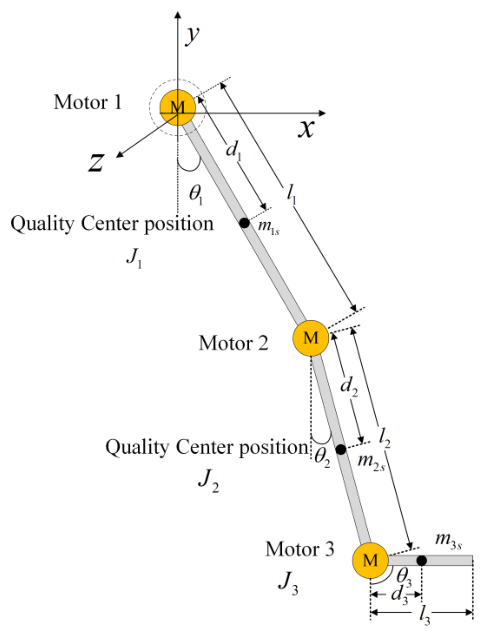
Figure 2.
Schematic diagram of the lower limb rehabilitation exoskeleton robots.
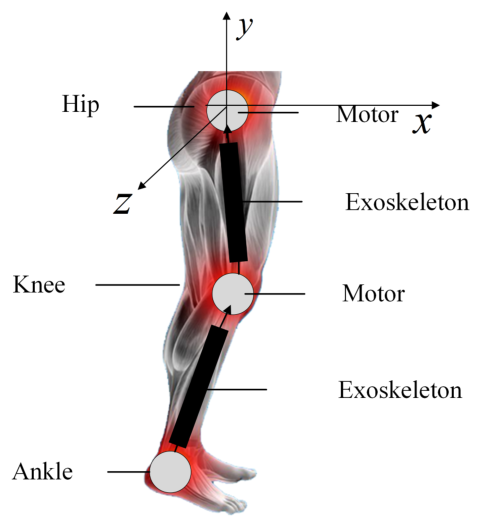
Figure 3.
Two-link of the lower limb rehabilitation exoskeleton robots.
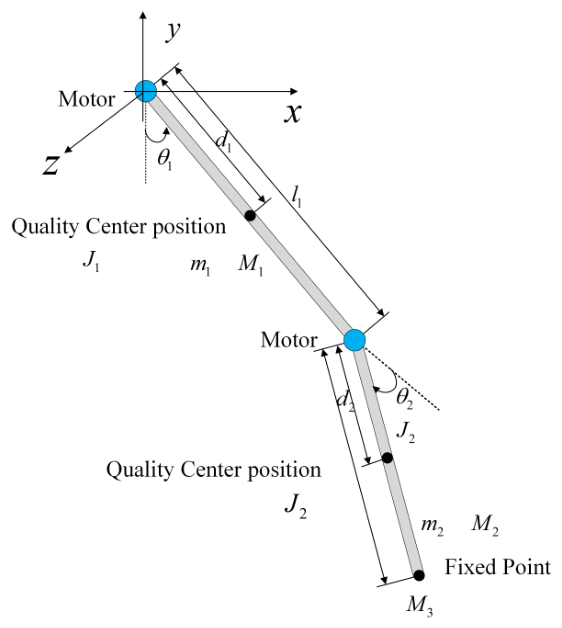
Figure 4.
Feedback linearization control of the lower limb rehabilitation exoskeleton robots.
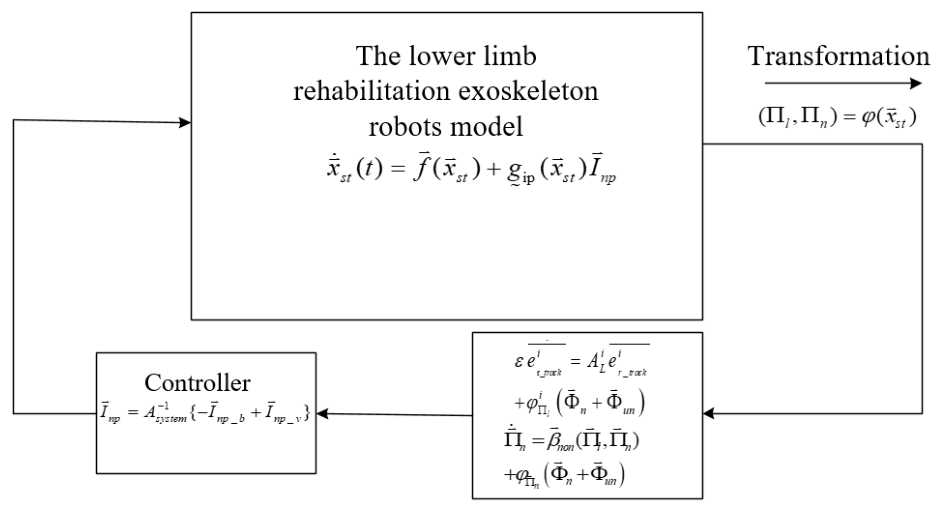
Figure 9.
Generated both Matlab working files of the robust tracking controller by AI language “Python”.
Figure 9.
Generated both Matlab working files of the robust tracking controller by AI language “Python”.
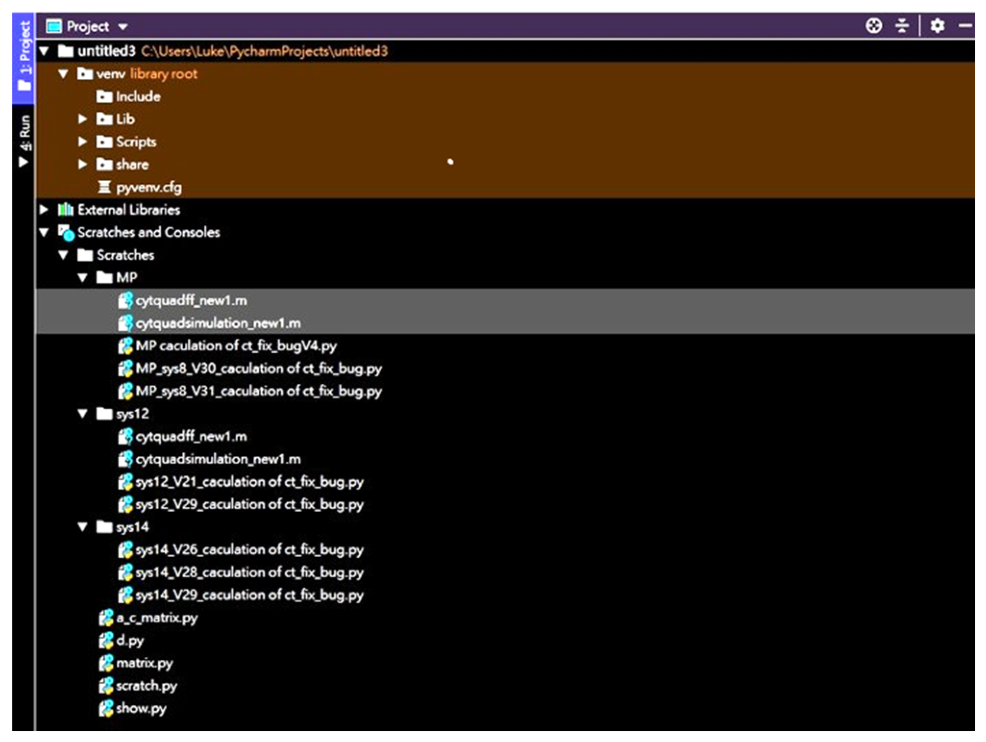
Figure 10.
Instantaneous state values before entering the exponential convergent radius.
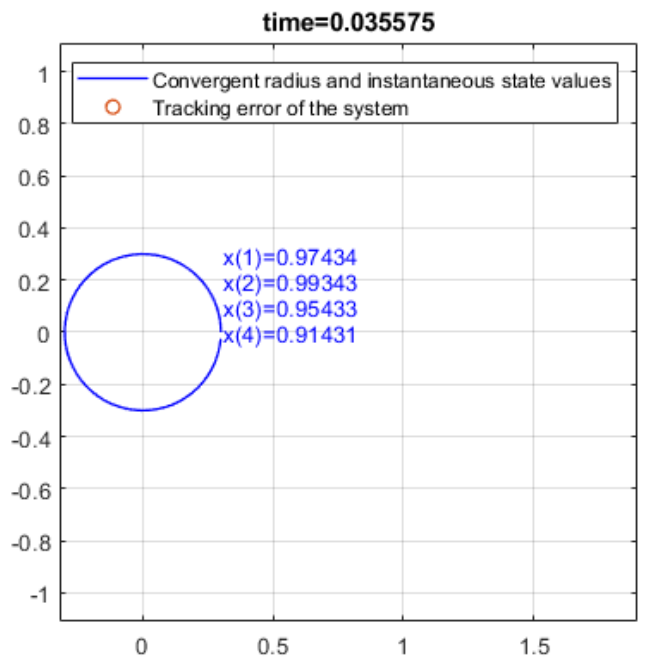
Figure 11.
Instantaneous state values on entering the exponential convergent radius.
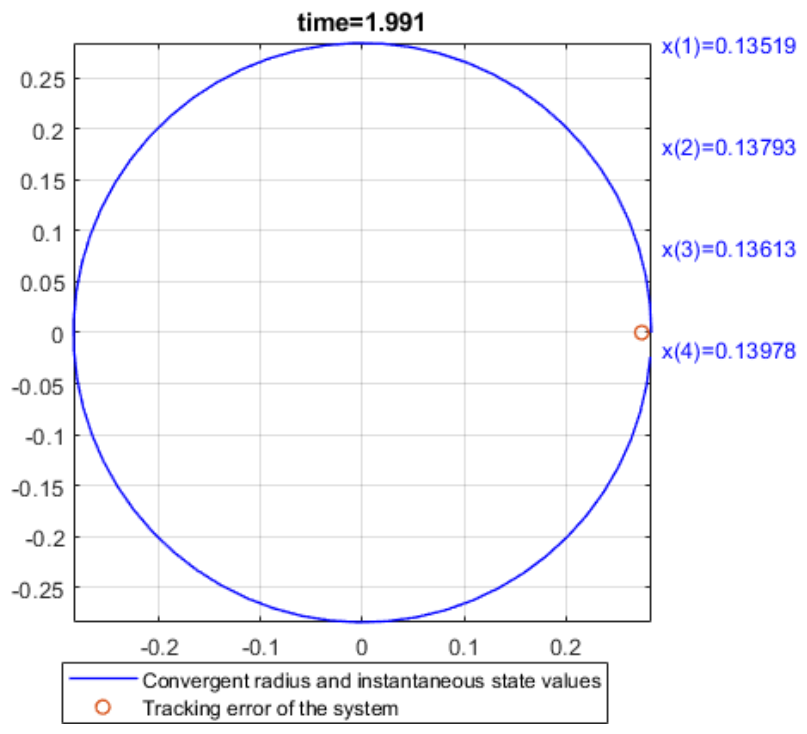
Figure 12.
Instantaneous state values after entering the exponential convergent radius.
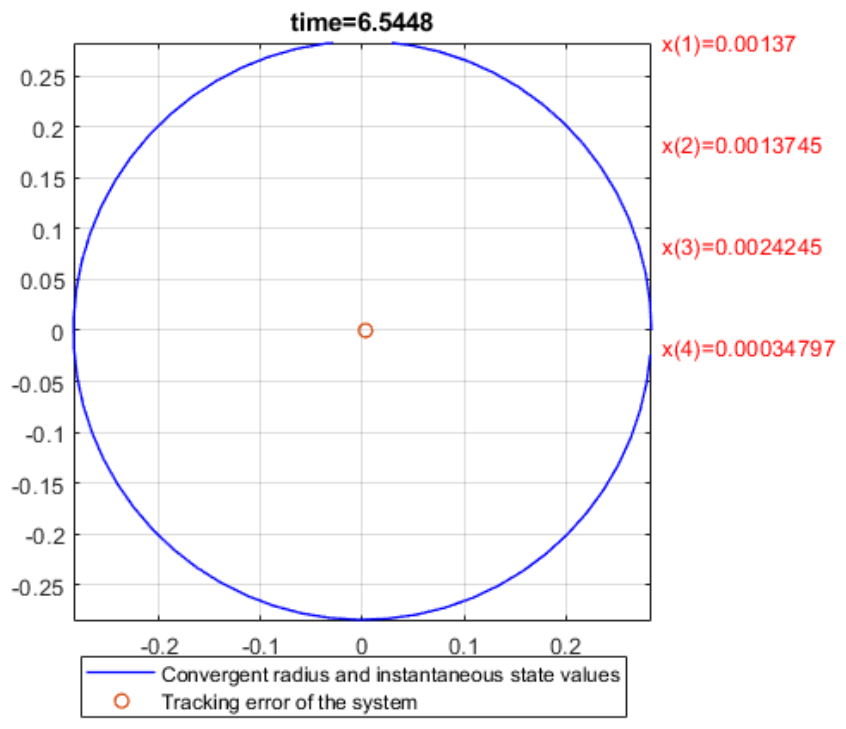
Figure 13.
The system output trajectory for (195).
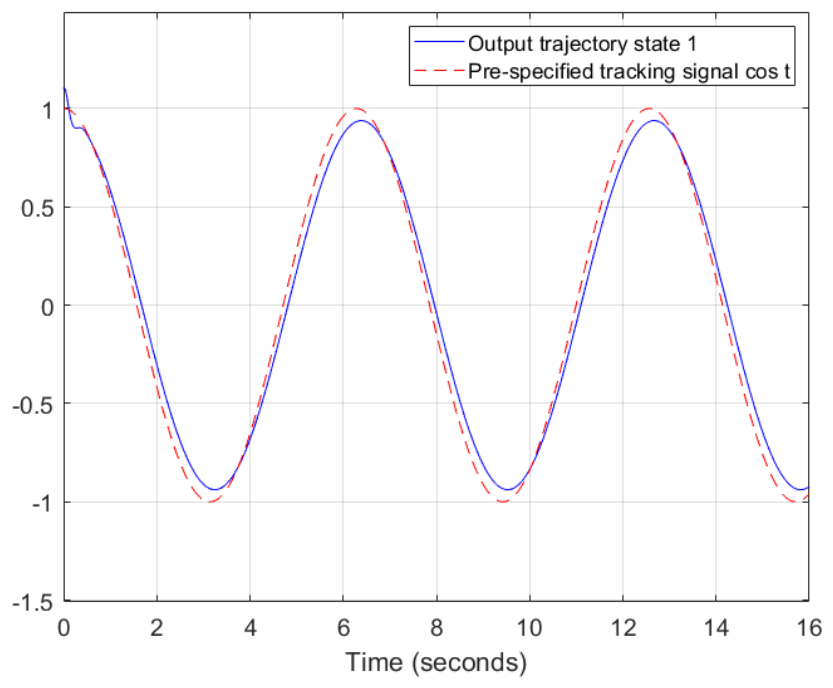

Table 1.
The parameters of the considered LLRER.
| i=1 | i=1 | i=1 |
| m1 = 2(kg) | m2 = 1.5(kg) | m3 = 0 |
| M1 = 9.847(kg) | M2 = 3.086(kg) | M3 = 1(kg) |
| m1s = 11.847(kg) | m2s = 4.586(kg) | m3s = 1(kg) |
| l1 = 0.496(m) | l2 = 0.396(m) | l3 = 0 |
| d1 = 0.266(m) | d2 = 0.226(m) | d3 = 0 |
| I1 = 0.166(kg ⋅ m2) | I2 = 0.027(kg ⋅ m2) | I3 = 0 |
Disclaimer/Publisher’s Note: The statements, opinions and data contained in all publications are solely those of the individual author(s) and contributor(s) and not of MDPI and/or the editor(s). MDPI and/or the editor(s) disclaim responsibility for any injury to people or property resulting from any ideas, methods, instructions or products referred to in the content. |
© 2026 by the authors. Licensee MDPI, Basel, Switzerland. This article is an open access article distributed under the terms and conditions of the Creative Commons Attribution (CC BY) license (http://creativecommons.org/licenses/by/4.0/).
Copyright: This open access article is published under a Creative Commons CC BY 4.0 license, which permit the free download, distribution, and reuse, provided that the author and preprint are cited in any reuse.