

Submitted:
28 October 2026
Posted:
29 October 2026
You are already at the latest version
Abstract
In this work, we investigate the atomic-scale mechanical behavior of key metals (Al, Au, Cu, and Ni) used in drilling alloy and structural components for smart mining systems. Molecular dynamics (MD) simulations were performed to explore their stress-strain behavior under uniaxial compression from 300 K to 1000 K. The results display a linear decrease in uniaxial compressive strength (UCS) and Young’s modulus with increasing temperature due to lattice expansion and weakened interatomic potential derived from the Embedded Atom Method (EAM) formalism. Among all the metal studied, Ni exhibits the highest mechanical performance, maintaining a compressive strength of 7.40 GPa at 1000 K, which makes it a promising candidate for high-performance drilling alloys operating in severe thermal environments. Cu shows moderate thermal stability with a UCS of 5.54 GPa at 1000 K, whereas Au demonstrates the lowest thermal resistance and the greatest softening tendency, reaching only 2.21 GPa at the same temperature. Common neighbor analysis (CNA) and Radial Distribution Function (RDF) reveal that Ni preserves stronger atomic ordering because of its higher cohesive energy, while structural degradation is associated with the reduction of perfect Face Centered Cubic (FCC) configurations and the formation of defects and dislocations under compression. In comparison, Al shows stable defect recovery on heating, giving better resistance to thermal fatigue in automated mining sensor housings. These atomistic results that are temperature dependent are valuable input parameters for predictive algorithms and digital twins in advanced mining engineering.
Keywords:
mining materials
; mechanical properties
; optimization at atomic scale
; computational MD simulation
1. Introduction
The mining industry is experiencing a technological transformation as never before, driven by the emergence of the concept of smart mining. In this exciting field, the combination of artificial intelligence and digital twins aims to optimize every phase of the value chain, from exploration to rock fragmentation. At the core of this revolution is the need to build incredibly durable mining and drilling tools. The premature failure of mechanical components exposed to extreme lithostatic stresses in deep mines is not only a major economic cost in terms of maintenance, but also a significant energy challenge. Hence, a fundamental knowledge of the mechanical behavior of materials at the nanoscale has become a strategic lever to enhance productivity and sustainability of mining operations.
Al‚ Au‚ Cu‚ Ni and other metals with face-centered cubic structure are the mainstay for most modern mining industry alloys and coatings․ Single crystal mechanical properties at the nanometer scale are not well characterized‚ and the compressive strength and plastic flow mechanisms are closely tied to surface effects and dislocation phenomena that are very different from macroscopic behavior [1,2,3]. In automated mining systems, these materials are often integrated into micro-electromechanical systems (MEMS) for structural monitoring or used as reinforcing phases in metallic matrices to withstand severe abrasion during interaction with heterogeneous rock masses [4,5,6].
The behavior of these metals under uniaxial compressive stress particularly in the [100] crystallographic direction is a critical indicator of their ability to absorb impact energy without catastrophic failure [7,8,9]. However, the experimental study of these phenomena in situ, under the ultra-rapid strain rates typical of drilling impacts remain extremely complex and costly. Conventional characterization techniques do not allow for real-time visualization of the atomic reorganization and phase transitions that precede material failure [10,11,12].
Here, MD simulation emerges as an indispensable research tool. It allows for the modeling of the individual trajectories of millions of atoms, offering a unique insight into nucleation processes, the sliding of atomic planes, and the evolution of the radial distribution function (RDF) under constraint. [13,14]. Although scientific literature has extensively documented the behavior of certain isolated metals, there is a pressing need for a rigorous comparative study of different FCC metals (Al, Au, Cu, Ni) to identify the most stable candidates for harsh mining environments.
This work aims to overcome the current limitations in our understanding of the thermomechanical behavior of metal nanocrystals with a FCC crystal structure by using large-scale MD simulations to study the behavior of Al, Au, Cu, and Ni to uniaxial compression. The investigation begins with a reference analysis at 300 K and extends to elevated temperatures between 500 K and 1000 K in order to evaluate the evolution of stress–strain behavior, UCS, and Young’s modulus. To better understand the atomistic mechanisms associated with deformation and structural degradation under severe loading conditions, the study combines EAM potentials with RDF and CNA techniques.
This work correlates the atomic scale deformation mechanisms to the practical demands of drilling tools and structural components for continuous mining operation. This study characterizes the thermal softening behavior of each metal, from the high mechanical stability of nickel to the ability to recover from defects of aluminum, supplying reliable constitutive data for the design of more robust automated mining machinery. Furthermore, the obtained temperature-dependent microstructural data can be used as a basis for predictive modeling, digital twin technologies, and real-time monitoring systems for next-generation smart mining applications that operate under extreme tribological conditions.
2. Methodology
In this study, a MD approach was adopted to investigate the mechanical behavior of single-crystal metals with a FCC structure, specifically Al, Au, Cu, Ni, subjected to uniaxial compressive deformation. This method provides an in-depth understanding of deformation mechanisms at the atomic scale, which are difficult to access using conventional experimental approaches. The initial structures were constructed as perfect single crystals with a FCC crystal structure, oriented along the [100] crystallographic direction, which is known for its importance in the study of plasticity mechanisms. Each simulation cell has dimensions of 198.5Å × 198.5 Å × 198.5 Å, containing approximately 664.774 atoms as shown in Figure 1, which ensures good statistical representativeness and limits effects related to the finite size of the system. To reproduce the behavior of a bulk material and eliminate surface effects, periodic boundary conditions were applied in all three spatial directions (X, Y, and Z). Prior to any mechanical loading, the systems underwent an equilibration phase in the NPT thermodynamic ensemble (constant number of particles, pressure, and temperature). This simulation was performed at a temperature of 300 K and a pressure of 0 bar with a time step of 1 femtosecond (1 fs). This stage aims at equilibration of the crystal structure and driving the system to the state of thermodynamic equilibrium. The simulation is performed with proper thermostats and barostats for temperature and pressure control. Once equilibrium is reached a uniaxial compressive strain is applied along the x-axis, corresponding to the [100] direction, at a constant strain rate of 1 × 10 s−1. The strain is defined by the following expression: ϵ = L − L0/L0, where L0 represents the initial length of the simulation cell and L its instantaneous length during deformation. During this process, the load is applied only in the x-direction, while the transverse directions (y and z) are kept unloaded in order to simulate realistic uniaxial loading conditions. The temperature of the system is also kept constant in order to isolate the purely mechanical effect of the deformation.
In addition, the internal stresses of the system are evaluated using the virial stress tensor formulation, which allows for the determination of stress–strain curves and the calculation of mechanical properties such as Young’s modulus and compressive strength. The CNA method was used to examine the structural changes at the atomic scale during deformation [15].
This technique allows the local structure of each atom to be identified and classified into different crystal configurations such as FCC, HC (HCP), CC (BCC), or amorphous. This analysis is vital to understanding the mechanism of phase transformation, the formation of crystal defects, and the nucleation of dislocation.
In this simulation, modeling of atomic systems is based on an accurate description of interatomic interactions. We model these interactions in this work by means of the EAM potential [16] which is particularly well-suited for metallic systems. This potential accounts for many-body effects through the local electron density surrounding each atom. It thus allows for the reliable reproduction of the mechanical, elastic, and thermodynamic properties of metallic materials. Table 1 lists the appropriate EAM potential parameters for individual metals Al, Au, Cu and Ni.
3. Results and Discussion
3.1. Strain-Stress Analysis
Figure 2 display, the stress-strain curve and Young modulus of different metals under uniaxial compression along the x-axis. It is revealed distinct mechanical regimes, elastic and plastic, as shown in Figure 2a. During initial loading, atomic spacing decreases slightly, producing volumetric contraction. Within this elastic domain, metals recover fully upon unloading, indicating reversibility of atomic positions. Ni demonstrates higher elastic resistance compared to Au, before transitioning abruptly into plastic deformation during unloading.
The calculated Young’s modulus from the slope of the elastic region is different for the metals. These distinct properties also provide insight into how each material behaves once plastic deformation sets in. Although they all crystallize in an FCC structure, the nature of the atomic bonds differs from one crystal to another, leading to variations in the lattice parameters.
These structural differences influence how atoms rearrange and deform under applied stress. Specifically, Al, Au, Cu, and the Ni demonstrate distinct slip systems that the crystallographic plane and direction along which dislocations propagate as well as difference in resistance to plastic flow, ductility that enables deformation without fracture, and sensitivity to temperature. For example, when Au is compressed, the atoms in its lattice reorganize to accommodate stress. In the plastic regime, the applied load is high enough to displace atoms from their original positions, allowing them to slide past one another and producing permanent deformation.
Figure 3 shows that the UCS value for Al, Au, Cu, and Ni align closely with previously published findings. Ni has the highest compressive strength and Young’s modulus, followed in decreasing order by Al, Cu, and Au.
The overall consistency between the simulated compressive strengths and established data validates the accuracy of the computational framework employed in this research for predicting mechanical behavior under compressive loading.
As seen in Table 2, the simulated ultimate compressive strengths agree well with those found in the existing literature. Among the four metals, Ni exhibits the highest UCS and the highest Young’s modulus.
The calculated compressive strengths compare favorably with existing experimental and numerical data, thereby reinforcing the validity of the simulation approach adopted in this study. These finding suggest that the current modeling framework is capable of reliably predicting mechanical behavior under compressive loading conditions.
3.2. Structure Analysis
Figure 4 shows structural snapshots of Al, Au, Cu, and Ni during uniaxial compression at strain of 0.2. The CNA was used to characterize the evolution of atomic configuration of each element.
This method identified four distinct local atomic environments: FCC, HCP, BCC, and amorphous structures. The atoms are color-coded based on their CNA classification: FCC atoms appear in green, HCP atoms in red, BCC atoms in blue, and amorphous atoms in gray.
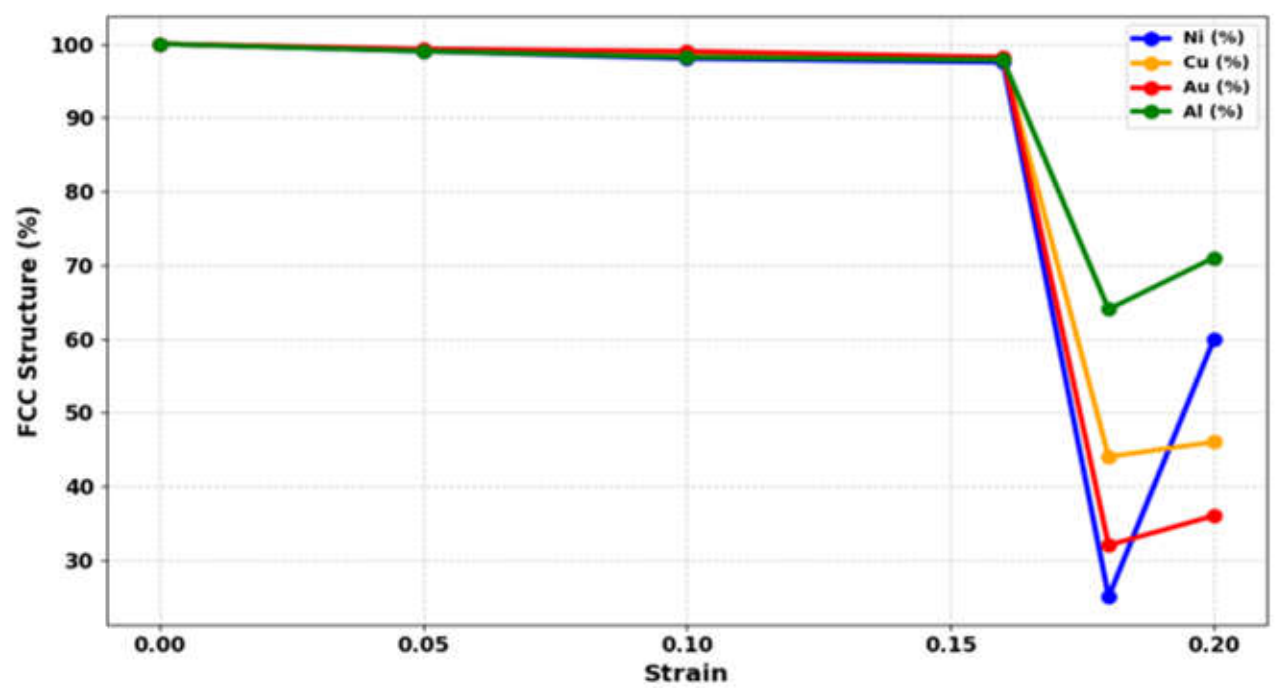
Before applying stress, all metal stayed in a stable state with no propagation of structural changes. They exhibited zero stress and maintained their undeformed lattice structures. As the applied stress increases, various structural modifications apparent. Lower deformation leads to slight, random particle displacements from their equilibrium positions, causing alteration in the crystalline structure. However, these initial changes include only low defect that are insufficient to induce significant structural propagation. At a strain of 0.15, the atoms specifically those in Al, Au, and Cu undergo substantial displacement, leading to significant alterations in their local crystalline environments. The appearance of mixed-phase regions, signaling the initial stages of structural transformation. As the strain exceeds 0.2, the density of HCP, BCC, and ‘OTHER’ structures increases, as shown in Figure 4.
Figure 5.
Variation of FCC phase concentration (%) during uniaxial compression.
The RDF [26], denoted as g(r) is used to characterize the atomic arrangement of nearest neighbors around a reference atom by determining the probability of finding an atom at a specific distance r. RDF gives a detailed description of atomic bonding, represented by the probability of occupation within successive coordination shells. This probability remains high for the first and second shells but decreases gradually as the distance increases, indicating a transition toward a loss of long-range atomic correlation. Consequently, the RDF serves as a fundamental metric for assessing the local structural order and phase stability of the investigated materials. The mathematical definition of the RDF is expressed as follows:
where dn is the number of atoms in a spherical shell, dv is a spherical shell volume, r is the distance of the shell from an arbitrary atom selected as the origin, < ρ> is the average particle density.
Figure 6 illustrates RDF for each metal. The first peak for all metals indicates the nearest-neighbor distance. This similarity across metals is notable, as experimental values vary (Al: 2.86 Å, Ni: 2.49 Å), suggesting possible compression effects in the simulation. The peak height, which reflects local structural order and bonding strength, follows the order Ni > Cu > Au > Al, matching their relative Young’s moduli and melting temperatures. Secondary peaks at 3.5 − 4.0 Å and 4.5 − 5.0 Å confirm preserved FCC long-range order, though broadening in Al and Au implies higher atomic mobility or lower stability.
The insect reveals that Ni exhibits a narrow, tall primary peak indicative of a rigid lattice, while Al shows a broader, shorter peak consistent with softer bonding and the previously observed underestimation of its Young’s modulus. Overall, the RDF results validate the simulation’s ability to model crystalline behavior and explain certain discrepancies with experimental mechanical properties.
3.3. Effect of Temperature on the Mechanical Properties
An understanding of the role of thermal effects on the crystalline stability and lifetime of mining equipment is crucial to assessing the deformation of FCC nanocrystals. High-friction contact during excavation causes significant thermal spikes that compromise the integrity of cutting tools [27]. It is therefore essential to study mechanical responses at different temperatures, given that heat governs dislocation motion and phase stability in metals [28]. In addition, it is necessary to accurately map temperature-induced softening in order to provide digital twins with the reliable data required for real-time machine monitoring [29]. By establishing this baseline, we provide the physical framework needed to analyze the loss of strength and structural collapse observed in the molecular dynamics data that will follow.
Figure 7 shows the stress-strain curve of various elements under a temperature range of 500 K to 1000 K, revealing a consistent mechanical hierarchy independent of temperature. Ni indicate the highest tensile strength (greater than10 GPa at 500 K) due to its high Young’s modulus and high stacking fault energy, which restrict dislocation mobility, followed sequentially by Cu, Al, and finally Au, which exhibit the lowest strength due to its highly compliant interatomic bonds [25]. Increasing temperature induces significant thermal softening, marked by a systematic reduction in both yield strength and peak stress such as the ultimate tensile strength of Ni dropping from ~10.5 GPa at 500 K to ~ 7.5 GPa at 1000 K.
This behavior can be explained by increased thermal activation, which lowers the energy barriers required to trigger dislocation nucleation and crystal slip mechanisms [30]. The curves exhibit a classical atomistic deformation profile, transitioning from an initial linear elastic regime into a distinct stress peak governed by the homogeneous nucleation of the first dislocations, followed by a sharp post-peak drop and a flow stress plateau characteristic of defect-driven strain softening [31]. Finally, the fact that these curve profiles remain stable up to 1,000 K confirms that the systems remain below their melting points, while the exceptionally high stress values indicate nearly perfect crystalline structures. At this scale, the extreme rarity of pre-existing defects forces the nanostructures to reach their theoretical strengths before yielding to plastic deformation. Figure 8 displays the temperature-dependent variation of Young’s modulus between 500 K and 1000 K. From these figures, the elastic modulus exhibits a monotonic, linear decline as thermal energy increases. At the baseline temperature of 500 K, Ni demonstrates the highest structural rigidity (170.5 GPa), followed sequentially by Cu (108.4 GPa), Au (71.3 GPa), and Al (63.2 GPa).
This specific mechanical ranking corresponds directly to the intrinsic interatomic bond energies characteristic of each face centered cubic lattice configuration [32]. Physically, the progressive reduction in elastic stiffness at elevated temperatures stems from intensified atomic vibrations. This enhanced thermal agitation triggers lattice expansion, thereby stretching the equilibrium separation distances between neighboring atoms and lowering the cohesive bond energy. As a result, the curvature of the interatomic potential well flattens, diminishing the material’s fundamental resistance to reversible elastic strain [33]. To gain a deeper atomic-level insight into these macroscopic trends, the corresponding variations in the interatomic energy profiles derived from the EAM formalism are depicted in Figure 9. The variation in the well depths between the metallic species directly clarify the initial room-to-intermediate temperature elastic hierarchy (Ni > Cu > Au > Al). The significantly deeper energy valley of Ni (~-5.0 eV/atom) compared to that of Al (~-2.8 eV/atom) confirms a substantially higher cohesive energy [34]. Crucially, the observed thermal degradation of the elastic modules is governed by two simultaneous phenomena visible in the EAM potential shifts: thermal lattice expansion and well flattening.
When temperature increases to 1000 K, the equilibrium interatomic distance shifts from its ground state r0 to an expanded value. This structural dilation forces the atomic configurations to occupy a higher, more compliant region of the energy well where the curvature is markedly reduced [35]. Because the material’s structural rigidity is fundamentally proportional to this second derivative of the potential well at equilibrium, the flatter energy profiles at 1000 K provide a rigorous physical explanation for the linear loss of stiffness quantified in the mechanical stress-strain analysis.
The variation in UCS for different metal is shown in Figure 10. The UCS exhibits a monotonic and nearly linear decrease for various elements as the input of thermal energy increases. At the initial temperature of 500 K, Ni exhibits the highest compressive strength with a remarkable value of 10.35 GPa, followed by Cu (8.43 GPa), Al (4.63 GPa), and finally Au (3.87 GPa). When the system reaches 1000 K, this strength drops significantly to 7.40 GPa for Ni (5.54 GPa) for Cu (2.84 GPa) and for Al (2.21 GPa) for Au, respectively. This mechanical hierarchy and the thermal vulnerability of the UCS are explained in a unified manner by interatomic potential energy profiles based on the EAM formalism. The high initial resistance of Ni stems directly from the steep depth of its potential well (-5.0 eV/atom), which reflects a cohesive energy and interatomic bonding force significantly greater than those of Al or Au [34].
At the microscopic level, the UCS is closely connected to the lowering of the energy barrier required to initiate dislocation motion under stress. The increase in thermal agitation between 500 K and 1000 K alters the EAM potential in two ways: first, the expansion of the lattice moves the atoms away from their equilibrium distance, which directly weakens the crystal’s overall cohesive energy. On the other hand, the atomic bonds, which are pre-stretched and associated with a weakened restoring force, then offer much lower critical resistance, facilitating dislocation slip and explaining the linear drop in UCS at high temperatures.
4. Conclusion
In this paper, MD simulations were performed to explore the thermomechanical operating limits of four FCC metals, including Al, Au, Cu, and Ni under the uniaxial compressive. The stress–strain curves were evaluated over a temperature range from 300 K to 1000 K, demonstrating a consistent, near-linear decline in both elastic modulus and ultimate compressive strength across all four materials. At temperature of 500 K, Ni reveals the highest compressive strength with a remarkable value of 10.35 GPa, followed by 8.43 GPa, 4.63 GPa, and 3.87 GPa for Cu, Al and Au respectively. When the system reaches 1000 K, this strength drops significantly to 7.40 GPa for Ni, 5.54 GPa for Cu (2.84 GPa) and for Al (2.21 GPa) for Au, respectively. Characterization at the atomic level, performed using the CNA and RDF, indicates that the loss of strength stems from heat-induced expansion of the crystal lattice and a reduction in the curvature of the interatomic potential wells. Ni was identified as the strongest availability option as it could hold up to high integrity at 1000 K and thus be used as a base material for heavy duty drill-bit components. In addition, Al under thermal strain showed a one-step more stable and reproducible defect-recovery response and thereby had the potential to be a material of structural parts mainly depending on thermal fatigue tolerance. Overall, the atomistic thresholds obtained serve as physics-grounded constitutive inputs to the calibration of real-time predictive models that lead to higher reliability of autonomous digital-twin deployment in advanced mining engineering.
Author Contributions
Conceptualization, Methodology, Software, Writing- original draft, H. M. and A. Am.; Supervision, Project administration, Resources, Validation, review and editing, A. Al.; Supervision, Software, Formal analysis, Validation, review and editing, K. M.; Validation, Funding acquisition, Project administration, review and editing, E.T.
Conflicts of Interest
The authors confirm that there are no conflicts of interest.
Data Availability Statement
Data available on reasonable request.
Acknowledgments
The authors extend their appreciation to the Northern Border University, Saudi Arabia for supporting this work through project number “NBU-CRP-2026-2448”.
References
- S. Mitchell, R. Qin, N. Zheng, J. Pérez-Ramírez, Nanoscale engineering of catalytic materials for sustainable technologies, Nat. Nanotechnol. 16 (2021) 129–139. [CrossRef]
- N.M. Nurazzi, F.A. Sabaruddin, M.M. Harussani, S.H. Kamarudin, M. Rayung, M.R.M. Asyraf, H.A. Aisyah, M.N.F. Norrrahim, R.A. Ilyas, N. Abdullah, Mechanical performance and applications of cnts reinforced polymer composites—A review, Nanomaterials. 11 (2021) 2186. [CrossRef]
- N.C. Burtch, J. Heinen, T.D. Bennett, D. Dubbeldam, M.D. Allendorf, Mechanical properties in metal–organic frameworks: emerging opportunities and challenges for device functionality and technological applications, Adv. Mater. 30 (2018) 1704124. [CrossRef]
- C. Bîrleanu, M. Pustan, F. Șerdean, V. Merie, AFM nanotribomechanical characterization of thin films for MEMS applications, Micromachines. 13 (2021) 23. [CrossRef]
- M.J. Madou, Fundamentals of microfabrication and nanotechnology, three-volume set, CRC Press, 2018.
- X. Yang, M. Zhang, Review of flexible microelectromechanical system sensors and devices, Nanotechnol. Precis. Eng. 4 (2021). [CrossRef]
- D. Samantaray, S. Mandal, A.K. Bhaduri, A critical comparison of various data processing methods in simple uni-axial compression testing, Mater. Des. 32 (2011) 2797–2802. [CrossRef]
- C. Du, J.P.M. Hoefnagels, L. Bergers, M.G.D. Geers, A uni-axial nano-displacement micro-tensile test of individual constituents from bulk material, Exp. Mech. 57 (2017) 1249–1263. [CrossRef]
- P.H. Bischoff, S.H. Perry, Impact behavior of plain concrete loaded in uniaxial compression, J. Eng. Mech. 121 (1995) 685–693. [CrossRef]
- G.G. Yapici, I.J. Beyerlein, I. Karaman, C.N. Tomé, Tension–compression asymmetry in severely deformed pure copper, Acta Mater. 55 (2007) 4603–4613. [CrossRef]
- C.Y. Yu, P.L. Sun, P.W. Kao, C.P. Chang, Mechanical properties of submicron-grained aluminum, Scr. Mater. 52 (2005) 359–363. [CrossRef]
- G.J. Fan, Y.D. Wang, L.F. Fu, H. Choo, P.K. Liaw, Y. Ren, N.D. Browning, Orientation-dependent grain growth in a bulk nanocrystalline alloy during the uniaxial compressive deformation, Appl. Phys. Lett. 88 (2006). [CrossRef]
- M.S. Szczerba, S. Kopacz, M.J. Szczerba, A study on crystal plasticity of face-centered cubic structures induced by deformation twinning, Acta Mater. 197 (2020) 146–162. [CrossRef]
- B. Li, K. Chen, Grain boundary migration facilitated by phase transformation and twinning in face-centered cubic metals, J. Mater. Sci. 58 (2023) 14740–14757. [CrossRef]
- H. Tsuzuki, P.S. Branicio, J.P. Rino, Structural characterization of deformed crystals by analysis of common atomic neighborhood, Comput. Phys. Commun. 177 (2007) 518–523. [CrossRef]
- M.S. Daw, M.I. Baskes, Embedded-atom method: Derivation and application to impurities, surfaces, and other defects in metals, Phys. Rev. B. 29 (1984) 6443. [CrossRef]
- M.I. Mendelev, M.J. Kramer, C.A. Becker, M. Asta, Analysis of semi-empirical interatomic potentials appropriate for simulation of crystalline and liquid Al and Cu, Philos. Mag. 88 (2008) 1723–1750. [CrossRef]
- G. Grochola, S.P. Russo, I.K. Snook, On fitting a gold embedded atom method potential using the force matching method, J. Chem. Phys. 123 (2005). [CrossRef]
- Y. Mishin, M.J. Mehl, D.A. Papaconstantopoulos, A.F. Voter, J.D. Kress, Structural stability and lattice defects in copper: Ab initio, tight-binding, and embedded-atom calculations, Phys. Rev. B - Condens. Matter Mater. Phys. 63 (2001) 2241061–22410616. [CrossRef]
- Y. Zhou, M. Hu, P. Yan, X. Shi, X. Chong, J. Feng, A first-principles calculation of structural, mechanical, thermodynamic and electronic properties of binary Ni–Y compounds, RSC Adv. 8 (2018) 41575–41586. [CrossRef]
- M. Rashad, F. Pan, A. Tang, M. Asif, Effect of Graphene Nanoplatelets addition on mechanical properties of pure aluminum using a semi-powder method, Prog. Nat. Sci. Mater. Int. 24 (2014) 101–108. [CrossRef]
- M.N. Esfahani, M. Jabbari, Molecular dynamics simulations of deformation mechanisms in the mechanical response of nanoporous gold, Materials (Basel). 13 (2020). [CrossRef]
- H.S. Park, K. Gall, J.A. Zimmerman, Deformation of FCC nanowires by twinning and slip, J. Mech. Phys. Solids. 54 (2006) 1862–1881. [CrossRef]
- R.G. Craig, F.A. Peyton, D.W. Johnson, Compressive Properties of Enamel, Dental Cements, and Gold, J. Dent. Res. 40 (1961) 936–945. [CrossRef]
- S. Yazdani, V. Vitry, Using Molecular Dynamic Simulation to Understand the Deformation Mechanism in Cu, Ni, and Equimolar Cu-Ni Polycrystalline Alloys, Alloys. 2 (2023) 77–88. [CrossRef]
- M.P. Allen, D.J. Tildesley, Computer Simulation of Liquids, (2017). [CrossRef]
- Y. Cao, Q. Zhang, S. Zhang, Y. Tian, X. Dong, X. Song, D. Wang, Optimization of Rock-Cutting Tools: Improvements in Structural Design and Process Efficiency, Computation. 13 (2025) 152. [CrossRef]
- P. Chowdhury, H. Sehitoglu, Atomistic energetics and critical twinning stress prediction in face and body centered cubic metals: recent progress, J. Eng. Mater. Technol. 140 (2018) 20801. [CrossRef]
- L. Rojas, Á. Peña, J. Garcia, AI-driven predictive maintenance in mining: A systematic literature review on fault detection, digital twins, and intelligent asset management, Appl. Sci. 15 (2025) 3337. [CrossRef]
- X. Qin, W. Yan, Y. Liang, F. Li, Effects of the temperature, strain rate, and loading conditions on the deformation behaviors and mechanical properties of the Ni/Ni 3 Al superalloy, RSC Adv. 14 (2024) 21821–21831. [CrossRef]
- Q. Li, C. Jiang, Y. Du, Molecular dynamics study on dynamic mechanical behaviour of FeCoCrCuNi high entropy alloy, Mater. Technol. 38 (2023) 2200660. [CrossRef]
- N. Gao, J.E. Smeltzer, V. Tomar, An assessment of the effect of temperature on elastic properties of FCC metals using molecular dynamics simulations, Comput. Mater. Sci. 191 (2021) 110325. [CrossRef]
- B. Marchand, G.J. Tucker, D.L. McDowell, Atomistic modeling of temperature-dependent elastic constants and collective atomic fluctuations in face-centered cubic crystals, Acta Mater. 186 (2020) 212–225. [CrossRef]
- G.P. Purja Pun, V. Yamakov, Y. Mishin, Interatomic potential for the ternary Ni–Al–Co system and application to atomistic modeling of the B2–L10 martensitic transformation, Model. Simul. Mater. Sci. Eng. 23 (2015) 65006. [CrossRef]
- R.R. Zope, T. Baruah, Y. Mishin, Temperature dependence of elastic constants and lattice parameters from atomistic potentials: An EAM study of FCC metals, Phys. Rev. B. 105 (2022) 144102.
Figure 1.
Atomic configuration of each FCC metal.
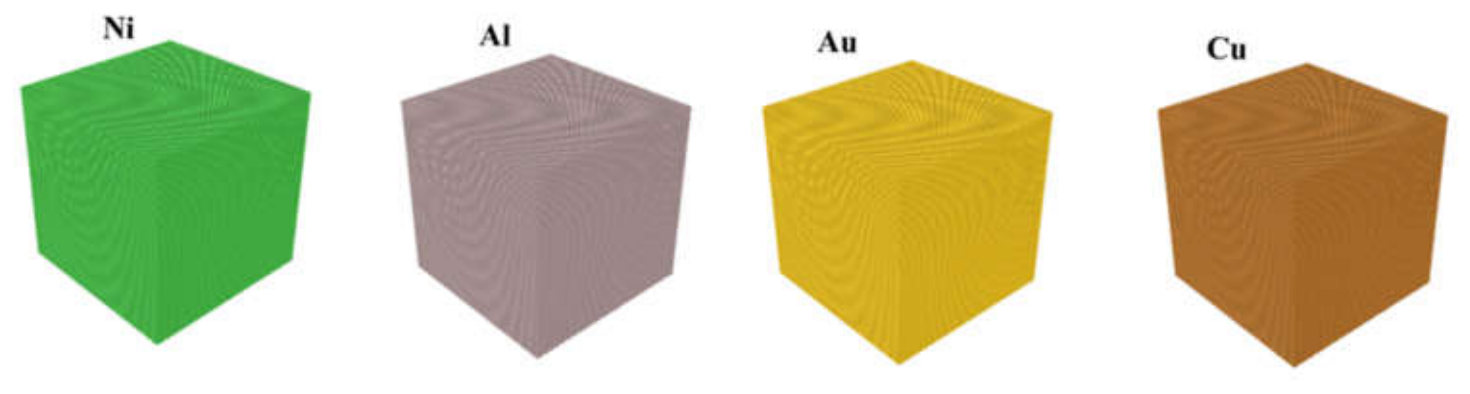
Figure 2.
(a) Stress-strain curve, (b) Young’s Modulus for each specific element.
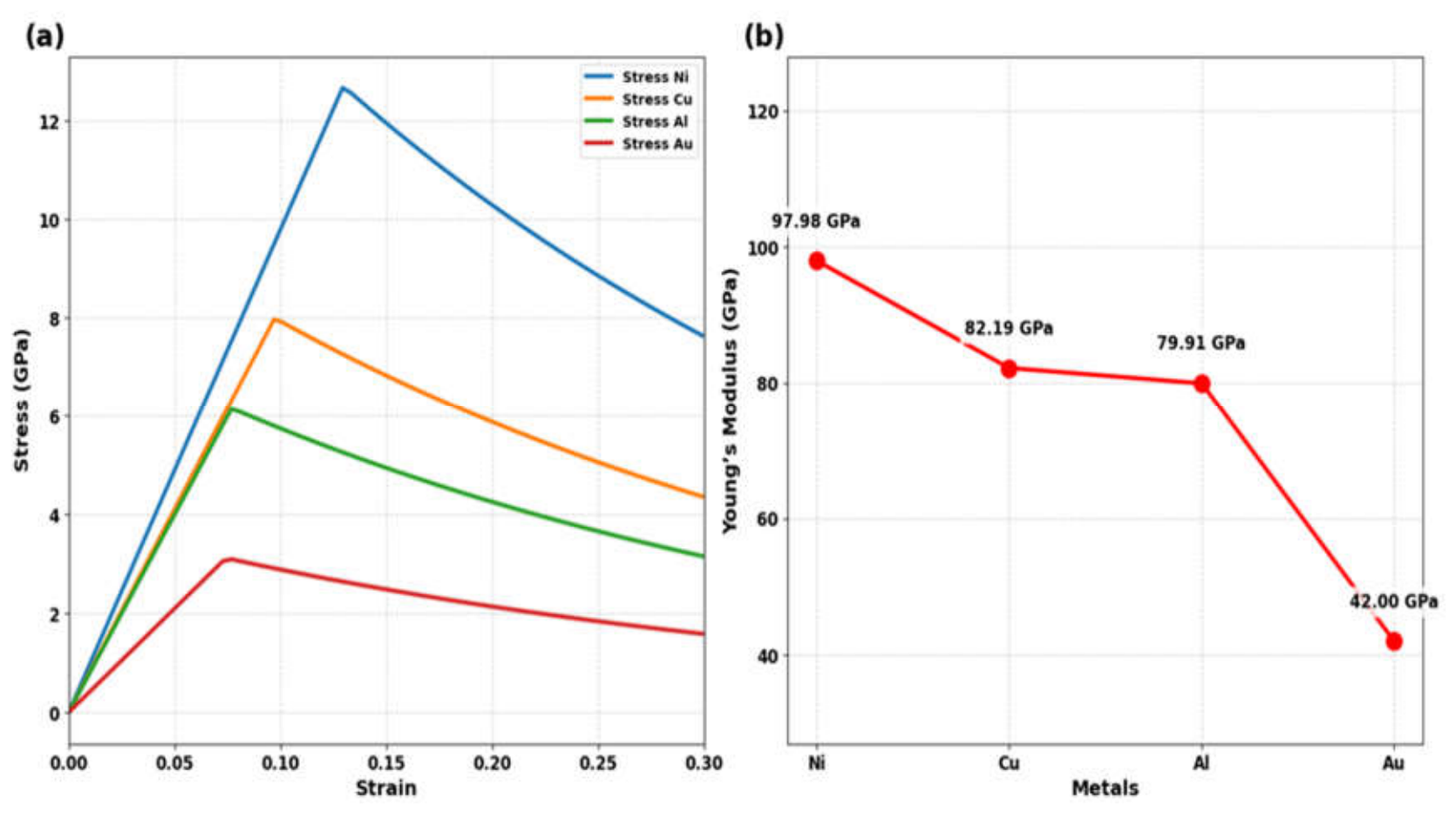
Figure 3.
Ultimate Compressive Strength of various metal.
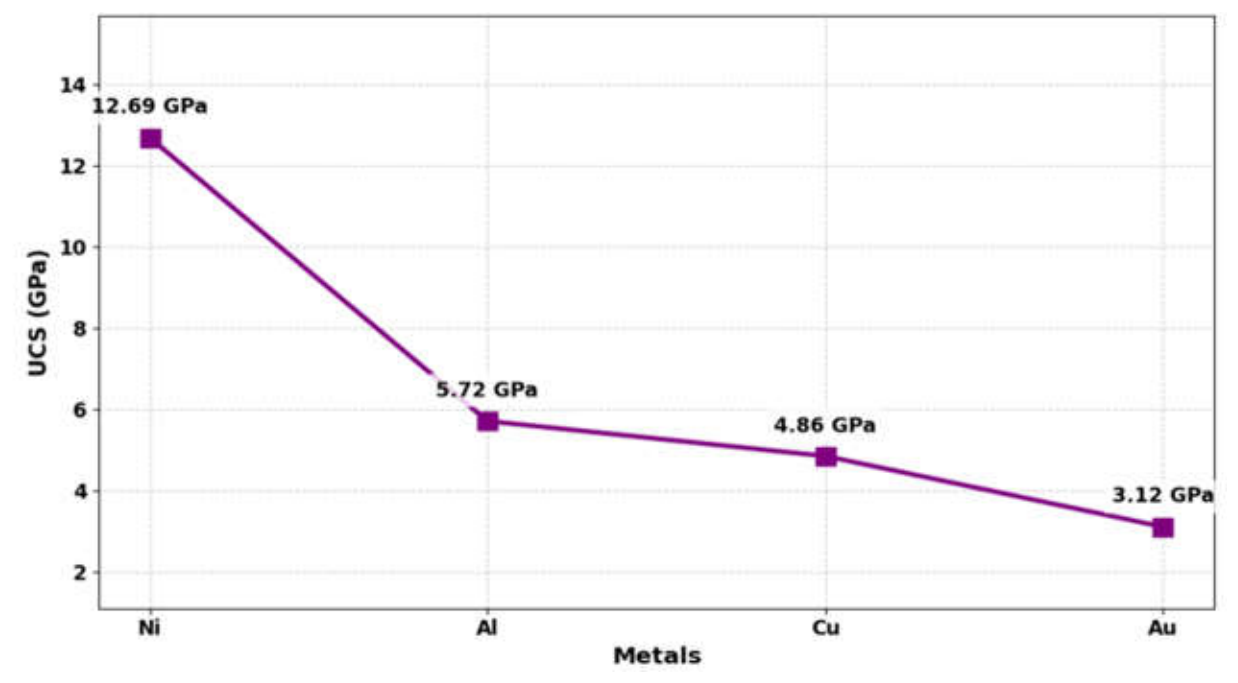
Figure 4.
Evolution of structural atomics using CNA under uniaxial compression.
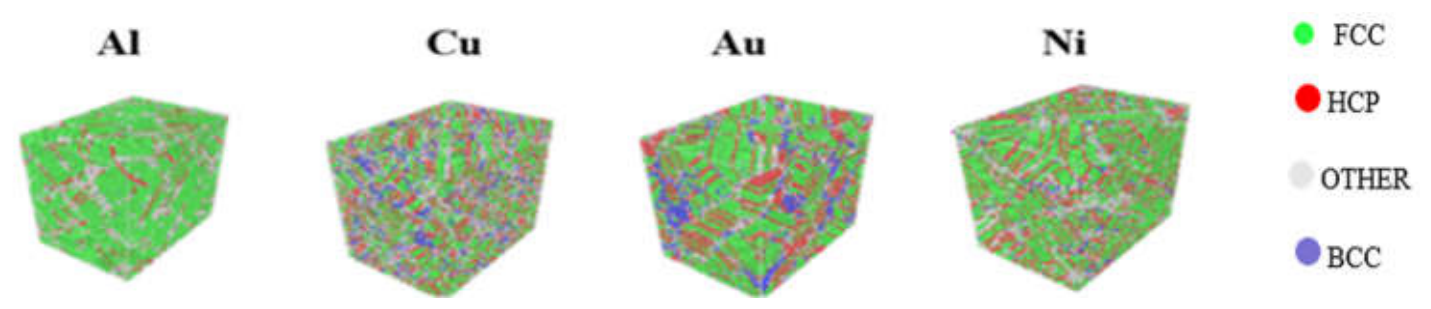
Figure 6.
Comparative RDF profiles for various metals.
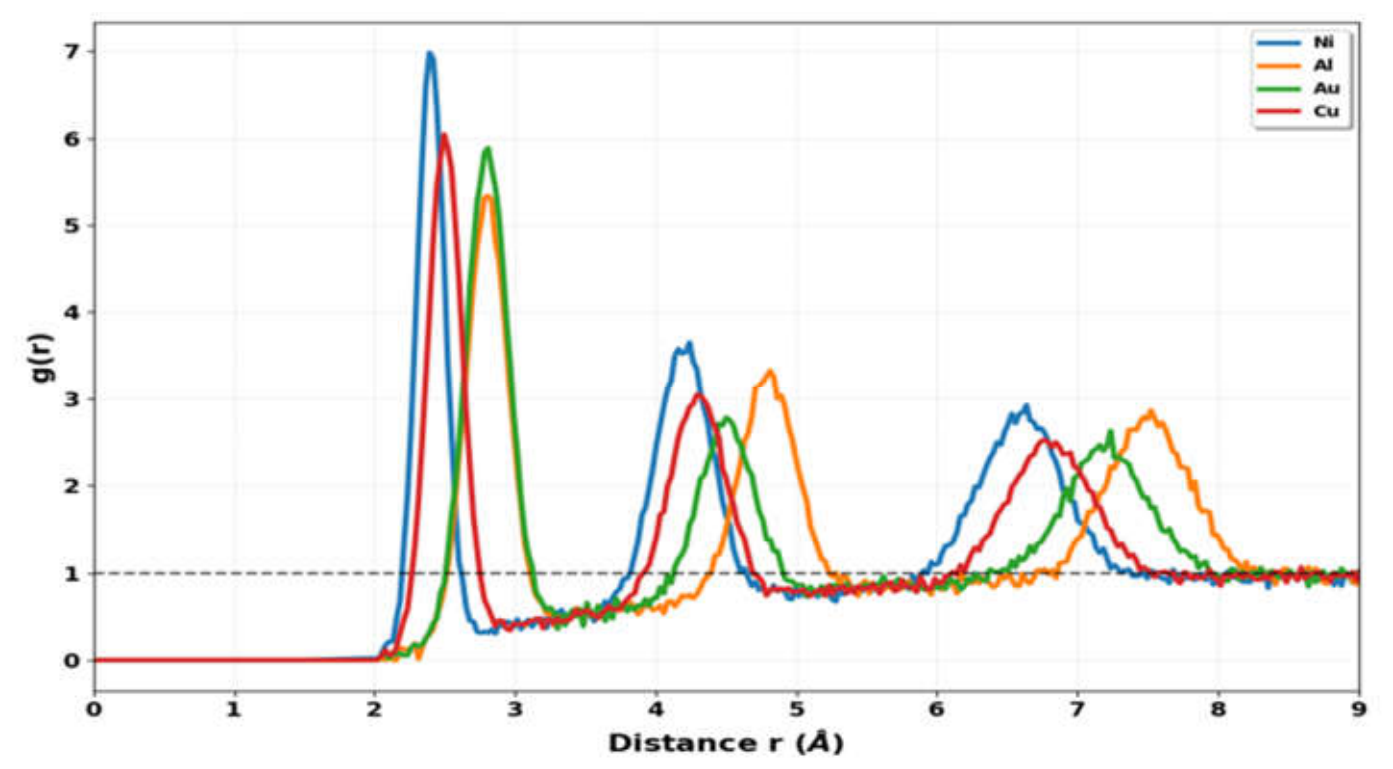
Figure 7.
Temperature dependence of the compressive stress–strain curves for Al, Cu, Ni, and Au metals.
Figure 7.
Temperature dependence of the compressive stress–strain curves for Al, Cu, Ni, and Au metals.
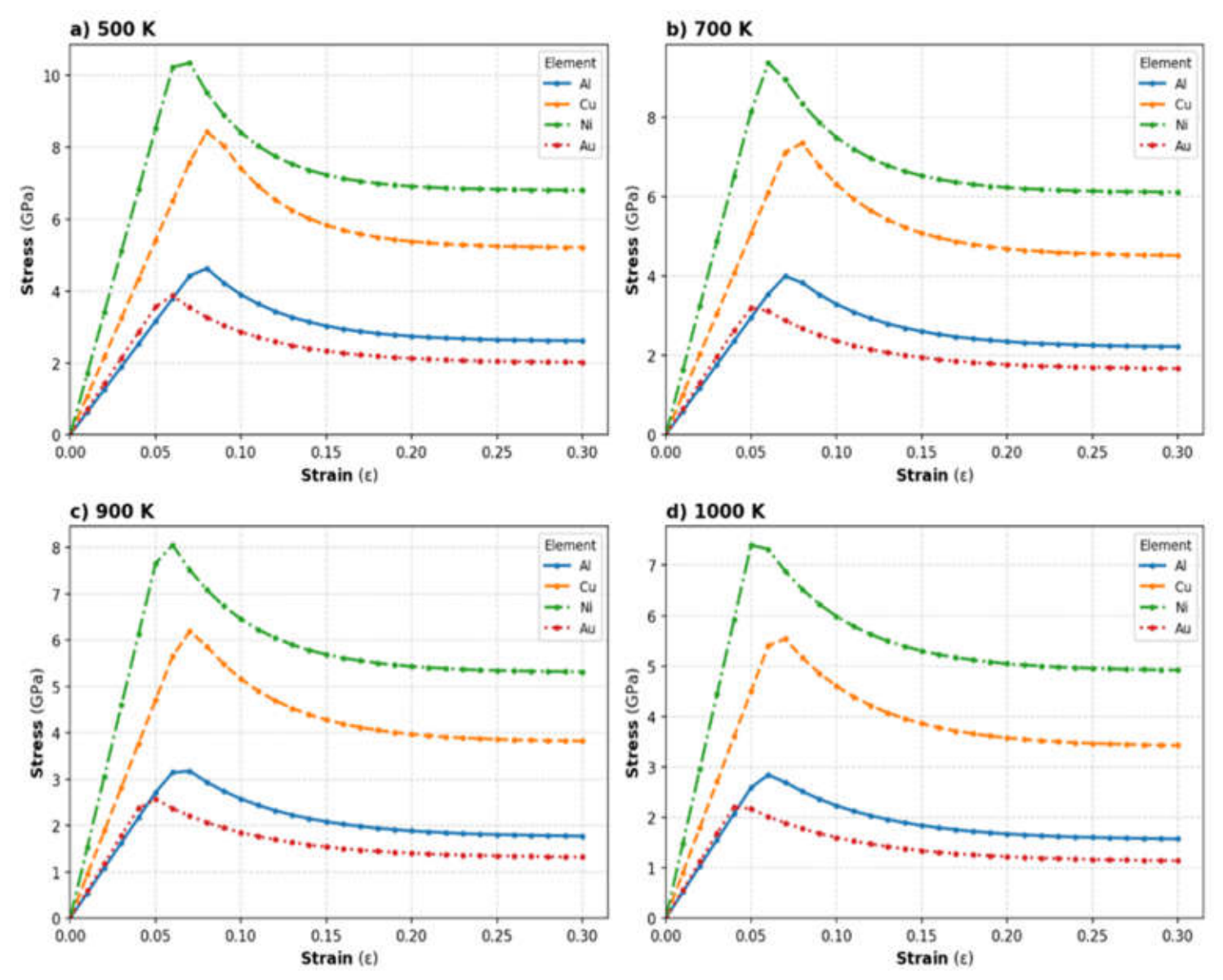
Figure 8.
Young’s modulus value at temperature range of 500 K and 1000 K for different metals.
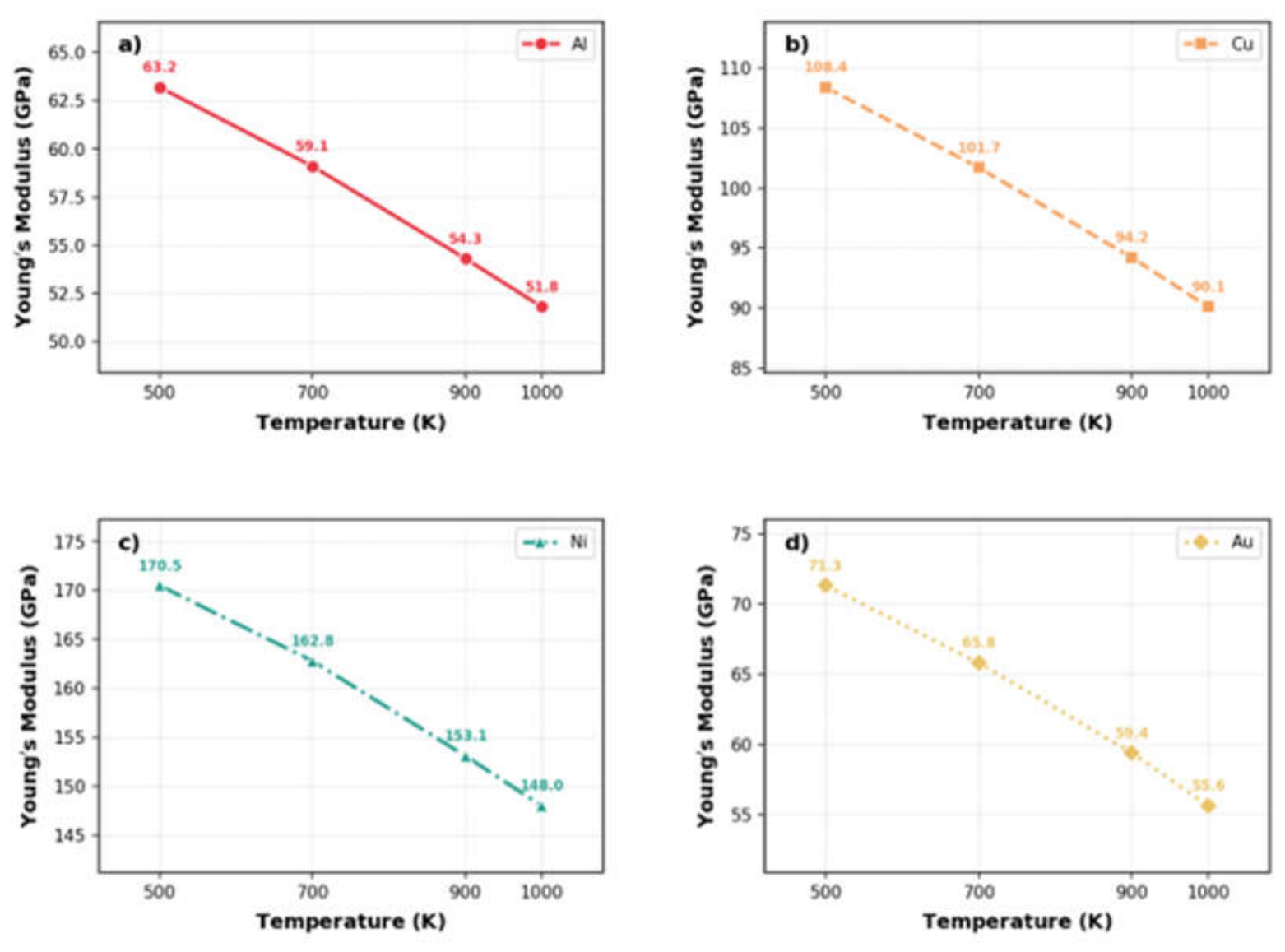
Figure 9.
Variation of potential energy under temperature range of 500 K and 1000 K.
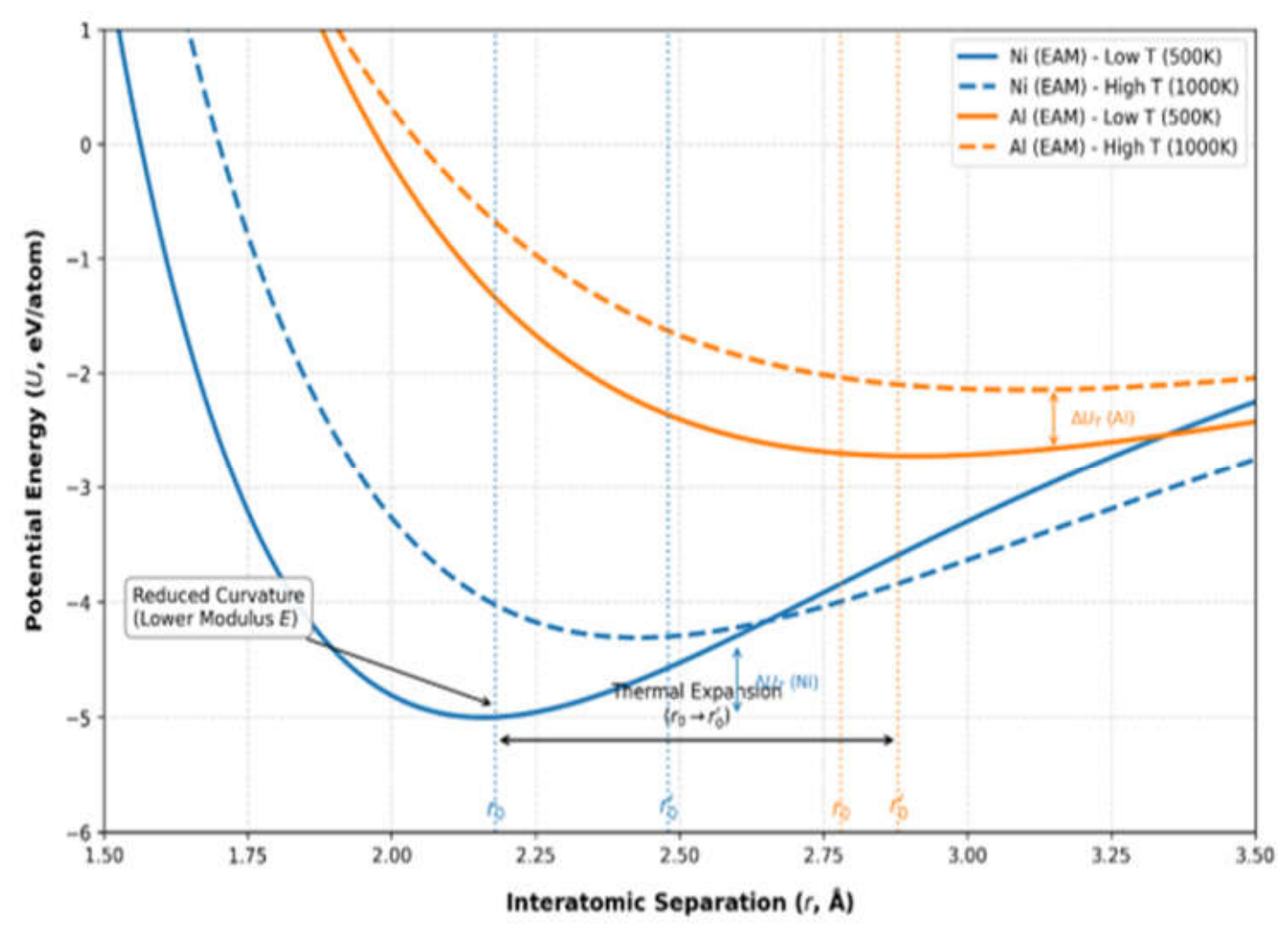
Figure 10.
Evolution of UCS under temperature between 500 K and 1000 K.
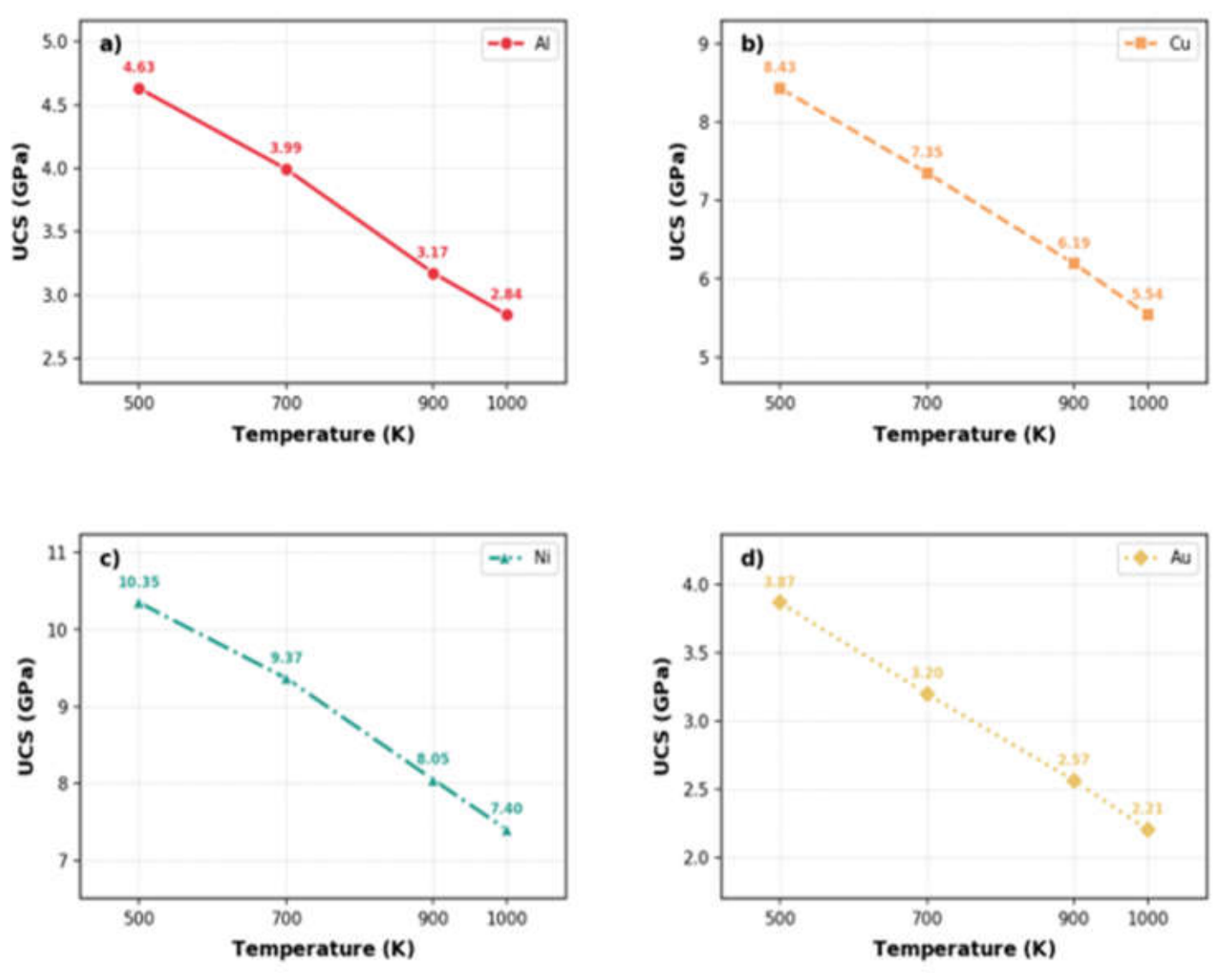

Table 1.
Set the properties of different metal using EAM potential.
| Parameters | Reference | Ec[eV] | a0[Å] | Ev(eV) | C11 | C12 | C44 | BVRH | Tm(K) |
|---|---|---|---|---|---|---|---|---|---|
| Al | [17] | -3.466 | 4.045 | 0.69 | 112 | 62 | 37 | 74 | 929 |
| Au | [18] | -3.924 | 4.0701 | 1.125 | 230 | 180 | 0.459 | 1.8026 | 1159 |
| Cu | [17,19] | -3.283 | 3.639 | 1.065 | 175 | 128 | 84 | 119 | 1353 |
| Ni | [16] | -3.61 | 3.52 | 1.4 | 246.5 | 147.3 | 124.7 | 180 | - |
Disclaimer/Publisher’s Note: The statements, opinions and data contained in all publications are solely those of the individual author(s) and contributor(s) and not of MDPI and/or the editor(s). MDPI and/or the editor(s) disclaim responsibility for any injury to people or property resulting from any ideas, methods, instructions or products referred to in the content. |
© 2026 by the authors. Licensee MDPI, Basel, Switzerland. This article is an open access article distributed under the terms and conditions of the Creative Commons Attribution (CC BY) license (http://creativecommons.org/licenses/by/4.0/).
Copyright: This open access article is published under a Creative Commons CC BY 4.0 license, which permit the free download, distribution, and reuse, provided that the author and preprint are cited in any reuse.