

Submitted:
28 October 2026
Posted:
29 October 2026
You are already at the latest version
Abstract
Metal–organic frameworks (MOFs) have tunable adsorption and transport properties, but the fact that a material performs well does not mean that the process is ready for implementation. This critical narrative review examines membrane and adsorbent results regarding CO₂/CH₄ separation and methane delivery. Literature up to 21 August 2026 has been selected and analysed according to measurement, device architectures, operating conditions and process boundaries. Membrane benefits are dependent on formulation, fabrication, pressure, humidity and contaminants. The practical value of equilibrium uptake and selectivity can be altered by the way the adsorbent is shaped, the feed and regeneration. Laboratory cycling and process modelling relate material properties to purity, recovery and energy requirements; industrial-scale and multibed scenarios remain modelled outcomes. Material composites, sequential adsorbers and membrane–adsorption trains need to be interpreted separately. Among the studies reviewed, there is no evidence of continuous household operation of an integrated MOF membrane–adsorption system. A qualitative framework links process readiness to matched controls, realistic feed conditions, complete-cycle balances and service requirements. Generalisation is limited by selection bias, shared data, incomplete reporting and unresolved source conflicts. Development should prioritise testing the intended device, durability under relevant regeneration conditions, and transparent assessment of net methane delivery, utilities and replacement.
Keywords:
metal–organic framework
; biogas upgrading
; mixed-matrix membrane
; cyclic adsorption
; process readiness
1. Introduction
Biogas is produced from biodegradable residues. Most biogas is produced through the so-called anaerobic digestion process in which some raw materials are mineralized anaerobically. The wastewater treatment of slurry (separative and non-separative) is a good example of a common practice of biogas production. However, separation of the biogas from the production is not as easy as it may sound. Besides the desired methane, the following gases can also be present and thus constitute contaminants: carbon dioxide, which may dilute the methane content of the biogas and create a cost for the downstream biogas treatment; water vapour, which can condense and cause depositions in pipes and other mechanical systems; hydrogen sulfide, which is a toxic gas causing corrosion in transport and application systems; and further others. In addition, biogas production is highly dependent on the feedstock(s) that the system is supplied with, which means that such gas has a variable composition. The upgrade technologies for contaminants separation from biogas are evaluated in terms of efficiency, simplicity and practical usage. Based on the different upgrade types, the contaminants separation performance is outlined in correlation with the market competitiveness of the upgraded biogas depending on the country or market for the developed upgrading technology.[1,2].
The research domains of cleaning and upgrading are often confused although they can be viewed complementary. Cleaning refers to the removal of harmful trace constituents, whereas upgrading refers to the separation of bulk CO₂ content from CH₄. Cleaning is performed to increase system robustness and life time. Cleaning is imperative to reduce the presence of compounds such as H₂S and H₂O because they cannot be tolerated due to their corrosive nature[3].
Metal-organic frameworks (MOFs) are a class of crystalline porous materials that have attracted considerable interest and have been widely studied in the last several decades. The synthetical chemistry avenues with creating these materials offers great opportunities for inducing diverse chemical functionalities and control over frameworks’ topology and pore size/shape. Besides gas storage, also an interesting area of application of MOFs is the separation of biogas presents a major challenge for the environment and is currently investigated in both laboratory and industrial fields. It should be noted here that the applications of MOFs in biogas separations are not limited to mixing MOFs and polymers to produce continuous selective layers for mixed-matrix membranes(MMMs) or using them directly as adsorbents for fixed beds. Even adjustment of adsorption and transport by choosing appropriate linker and organic linkers, one can extend to developing an entirely different and new material with porous framework in the structure. The performance of adsorbent and membrane is drastically influenced by the structure and also interfaces between the molecules.. In an adsorption process, competitive uptake, mass transfer, thermal effects and regeneration all matter. An uptake measurement at a single equilibrium state captures only part of that behaviour [2,4,5].
MOF sorbents and MMMs for biogas cleaning and CO₂/CH₄ separation, cellulose–MOF processing, UiO-66 chemistry and membrane-based upgrading have already been covered in recent reviews [2,4,5,6]. The purpose here is not to present the first catalogue of these materials. It is to ask how far a reported material result supports the process claim drawn from it. Table 1 places this emphasis alongside that of closely related reviews. The comparison does not assume that a subject is absent from a review merely because it is not mentioned in its title.
The comparison sets out the scope and emphasis adopted here. It does not suggest that the cited reviews overlook all of these issues, or that the proposed framework takes priority over earlier work.
The analysis is based on three questions. The first is which modifications to molecular design or to the fabrication process lead to better separation when the test conditions are matched. The second question is to what extent does that improvement survive afterwards when shaping or support is applied, when the membrane is exposed to real gas and then regenerated? The third question is what further evidence is required before a device result can be used to support a claim regarding an upgraded process or for decentralised use? By posing these questions to both membranes and adsorbents, a common discussion can be had without treating different metrics as if they were the same. Traditional technologies continue to serve as essential controls and the fact that a MOF is incorporated does not by itself mean that the system is better.
Here, process readiness describes a qualitative assessment of evidence for a particular application, rather than a numerical technology-readiness level. Two claims need to be distinguished: that a material can separate gases, and that a complete system can consistently deliver a useful product. The second claim also requires evidence on methane recovery, utilities, replacement and residual-stream management. Off-gas treatment illustrates the distinction. It may reduce methane emissions, yet consume energy without increasing product recovery [7]. A material or flowsheet that looks favourable on selective transport or uptake can therefore lose that advantage when judged by the gas service delivered.
The review begins with its scope and comparison conventions, followed by the findings on membranes and adsorption.
2. Scope of the Review and Basis for Analysis
2.1. Literature Collection and Selection
We purposively selected literature through 21 August 2026 for this critical narrative review. It was not a systematic or scoping review or meta-analysis; we claim no exhaustive search, registered protocol, dual screening, or formal risk-of-bias assessment. We judged relevance from titles, abstracts, and selected full-text passages, including only accessible full texts. This may have caused access-related selection bias but does not reflect the retained studies’ methodological quality.
We focused on primary studies of MOF-containing membranes and adsorbents for CO₂/CH₄ separation. The examples selected were based on their relevance to the engineering questions, the specific materials involved and the test conditions, as well as their connection with fabrication, mixture response, shaping, regeneration, or process performance. Traditional systems served as benchmarks. Investigations into other gas pairs, storage, biological coupling, and transport techniques helped to establish mechanisms or define boundaries; however, the numerical results from these studies were not used in the context of biogas upgrading.
Each study was counted as a single evidence unit, and formulations and operating cases were regarded as related observations rather than as separate publications. Even though the reviews provided some background information, they did not retell the studies as experiments. In instances where the same polymer controls were used, the isotherms were reused and process models were based on previous measurements, these were not considered to be independent replications. The tables give only representative examples rather than a full list, and it therefore wasn't necessary to refer to the number of examples when evaluating field maturity.
In all the studies we recorded the architectural design, the material form, the feed, the pressure, the temperature, the type of measurement or model, how performance was defined, the durability protocol, and the process boundary. Supplementary Material S1 includes some of the details about extraction and the interpretive conflicts. Conditions that were missing were not reported, even if they could have been deduced. In cases where conflicts occurred, they were noted together with the results or the result was left out of the main quantitative comparison. These records are meant to ensure traceability, not to enable the independent reproduction or reappraisal of the raw data, the calculations, or the publications.
2.2. What Is Being Compared?
A continuous MOF membrane, an MMM, and a membrane–adsorption treatment train are different system classes. In an MMM, the framework is embedded within the membrane material; this alone does not demonstrate integration of a membrane module with a separately regenerated adsorption bed. Similarly, a MOF–MOF composite is one adsorbent, and a membrane contactor employing a liquid absorbent is a gas–liquid absorption device. Classification follows the unit operations and transfer mechanism, not the use of the word “hybrid” [8,9].
Membrane permeability is retained separately from permeance. Converting between them requires an appropriate selective-layer thickness, which is not necessarily the total membrane thickness or an apparent thickness inferred from transport. Pure-gas ideal selectivity, a ratio of mixture permeabilities, and a composition-based mixed-gas separation factor retain their original definitions. They cannot be pooled into a single ranking merely because each is called selectivity. Supported asymmetric films in particular require an explicit distinction between physical and transport-equivalent thicknesses [10].
The differences between unary uptake, mixture loading, working capacity, and breakthrough capacity can be seen through adsorption comparisons. By means of the Ideal Adsorbed Solution Theory (IAST), unary isotherms are used to estimate the competitive equilibrium; the selectivity that is predicted in this way is thus different from the mixture separation factor actually measured in an experiment. Similarly, the difference between two assumed equilibrium loadings is not necessarily equal to the working capacity obtained during an operating cycle. The dynamic response is also influenced by transport phenomena, thermal behaviour, the packing used, and the outlet threshold chosen. Even if a combined capacity–selectivity screening criterion is employed, it still depends on its idealised assumptions and therefore cannot take the place of a full-cycle analysis [11,12].
The methane product can be described in terms of both purity and recovery. Methane product purity is the mole fraction of CH₄ in the specified product stream. For steady-state operation, it is the ratio of the methane molar flow rate to the total product molar flow rate, multiplied by 100 when expressed as a percentage [13]. Recovery refers to the net quantity of CH₄ in that product divided by the amount of CH₄ entering in the fresh feed over the same period. When the process is cyclic or intermittent, the quantities are integrated over complete cycles or a specified service period. Recycle is neither included as fresh feed nor as a saleable product. The methane going to the off-gas is considered separately from the methane that is emitted following off-gas treatment. For a separation process that is non-reactive, compatible measurements of the inlet, outlet and inventory are required in order to distinguish actual loss from that due to accumulation or measurement error [7,13].
The denominator must also be stated when reporting energy or cost. Per feed volume, per product volume and per mole of methane are different quantities; volumetric units also require a stated reference state. Heat and electricity are reported separately unless a justified conversion is supplied. Utilities generated from biogas remain process demands, and that gas cannot simultaneously be credited as exported methane. Environmental comparisons require material-production and replacement inventories, a defined service life and a functional unit consistent with the delivered service, not only the mass of an isolated sorbent [14,15].
Product purity should be interpreted on a total-stream, flow-weighted basis, with binary-normalized methane fractions identified separately. For cyclic or intermittent operation, comparisons should account for changes in methane inventory and assess product delivery and utility demand over a consistent interval, including start-up, regeneration, and standby where relevant. Balance discrepancies should be evaluated against measurement uncertainty. These conventions guide the interpretation of the reviewed studies; they do not imply that published results have been recalculated or converted to a common numerical basis.
2.3. Evidence Maturity Without an Unsupported Readiness Score
Figure 1 separates five types of evidence: molecular or unary screening, measured mixture separation, repeated device operation, complete process assessment and application-relevant operation. These categories are an organising framework proposed by this review, not a validated scoring instrument. A study may occupy different categories for different properties. For example, it may demonstrate kilogram-scale synthesis and water exposure but provide only equilibrium predictions of separation, or validate breakthrough while simulating multibed product recovery [16,17].
A better screening value cannot, by itself, support a stronger process claim; that requires additional measurements. A model checked against a breakthrough experiment can be used to explore process designs, but industrial-scale results from that model remain simulations. Durability evidence also depends on the test: humid-air storage, measurements after exposure, continuous humid separation and repeated humid regeneration answer different questions. We assess what each study demonstrated, the conditions of the test and the work still needed, rather than assigning a single maturity label to an entire MOF family.
3. MOF Membranes: From Selective Formulations to Credible Devices
3.1. Framework Chemistry in the Complete Membrane
Membrane separation is influenced not only by the nature of the framework but also by the polymer, the interfaces, and the method of fabrication. Thür et al. [18] incorporated bipyridine functionality into UiO-67/Matrimid MMMs. With 10 wt% UiO-67-33, the mixed-gas CO₂/CH₄ selectivity amounted to 75, as opposed to 38 for unfilled Matrimid, when a 50:50 feed was used at 5 bar and 30 °C. However, the selectivity decreased at higher loadings and when the membranes were operated at 10 bar. The advantage was therefore specific to the formulation and operating conditions that were tested, not a general property of UiO-67 composites.
Controlled comparisons demonstrate that fabrication can affect transport even if the components remain the same. M. Z. Ahmad et al. [19] tested 15 wt% ZIF-8/6FDA-bisP at a pressure of 5 bar and a temperature of 25 °C; the direct process yielded a value of 47.7 ± 2.5 Barrer and a selectivity of 29.1 ± 1.5, whereas the process involving precipitation followed by redissolution produced 81.2 ± 3.3 Barrer and a selectivity of 35.0 ± 2.9. When the latter formulation was increased to 20 wt%, selectivity decreased, which is in agreement with a useful loading range that is limited by the interface. Guo et al. [20] also found an optimum at 27 wt% ZIF-8/P84 and a loss of discrimination at 31 wt%. Loading should therefore be assessed in conjunction with particle dispersion and the manufacturing history rather than being maximised as a separate objective.
The attribution of a performance gain also requires controls between the neat polymer and the final composite. Y. Zhang et al. [21], for example, found a substantial rise in selectivity when modifying polyimide with an ionic liquid, before UiO-66-NH₂ was added. The MOF contributed an additional gain, but the entire difference from unmodified polymer cannot be assigned to it. Chemical crosslinking of a non-MOF polyimide provides another example of simultaneous permeability and selectivity improvement [22]. The final formulation should therefore be compared with the best suitable polymer or alternative-filler control, not only with an untreated baseline.
Anticipated defects can result from synthesis or intentionally introduced into material, thereby providing tunability of the material properties. The examples of such defects are framework defects, which alter properties such as adsorption sites or pore environments and membrane defects, which create a path for gas bypass or reduction of solubility selectivity due to a lack of CO₂ affinity. These differences can significantly enhance diffusion discrimination across particles and thus can increase performance. Composite materials with better pore access can also enhance gas selective embedding in polymers while promoting performance, particularly in thin membranes or in applications that benefit from particle–polymer interface. Thus, a specialized focus on the impact of defects and their influence on each other is important for perspicuous comparisons across polymers and composite materials with fillers. Thus, both framework defects and membrane defects must be well understood to properly describe and utilize their filler effects [5,23,24].
Establishing the mechanism therefore calls for complementary measurements on a controlled formulation series, rather than an explanation inferred solely from a rise or fall in permeability.
3.2. Throughput Depends on Thickness, Supports and Manufacturing
Although a thin selective layer can achieve a useful level of permeance, its performance is still influenced by the structure of the surrounding membrane. Cheng et al. [25] applied a layer of PIM-1 660 nm thick containing 10 wt% CuBDC nanosheets onto porous alumina. When tested with an equimolar feed and an argon sweep at 25 °C and a reported pressure of 1 bar, the supported layer showed a CO₂ permeance of 407 ± 12 GPU and a mixture selectivity of 15.6 ± 0.3. The thick filled membrane, by contrast, gave a value of 196 ± 3 GPU and 10.7 ± 0.2. The fact that the orientation of the nanosheets changed with thickness means that the improvement cannot be due simply to the layer being thin.
Functional testing is just as necessary when dealing with continuous MOF layers. Ji et al. [26] increased the time taken for deposition of ZIF-8 from 40 to 60 minutes, and as a result the CO₂ permeance dropped from 1358 to 334 GPU while the measured CO₂/CH₄ separation factor rose from about unity to 8.8. Although both surfaces showed an intergrown structure, there was a significant difference in their selective integrity. This distinction could have been missed using only microscopy, and a choice based on the highest permeance would have led to the poorer separator.
The manufactured area must not be confused with the validated separation area. Although T. H. Lee et al. [27] showed how to prepare a large-area polyMOF/PIM-1 composite, their evaluation of the mixture and scale-up dealt with CO₂/N₂; the CO₂/CH₄ results were pure-gas benchmarks. The study shows that the process is viable but does not prove the feasibility of a large-area biogas module.. Similarly, the asymmetric PES/ZIF-8 work of Tüzün-Antepli et al. [10] shows that thickness inferred from permeability and permeance need not match microscopy-derived skin thickness. Device modelling should use properties and geometry measured for the actual supported configuration.
These comparisons suggest a practical manufacturing criterion: throughput gains should survive scale-up of the same architecture, with defined support resistance, defect control and mechanical integrity. A high-performing small film remains valuable evidence, but its relevance depends on reproducibility, handling, sealing and the pressure range over which it can operate. Failed formulations should remain visible. In the work of Ortiz-Albo et al. [28], one low-ionic-liquid ZIF-8/PSf formulation could not be tested at the mixture-pressure condition, whereas a higher-loading analogue survived. Leaving out the failed formulation would overstate the robustness of the tested designs.
The performance of gas separation membranes is affected by various factors: the feed pressure, the permeate side pressure, the composition of the sweep-gas, etc. Therefore, it is important to realize that in addition to the intrinsic properties of the membrane material, these factors can significantly influence the membrane performance as well. To evaluate a membrane, these must be comprehensively tested as well and should be considered for future applications.The following issues are to be tested before considering a membrane to be adequate or warranting to be tested further: How strong is the material? Does it support the pressures needed? What is its pure gas permeance? What is its selectivity?; However, the resulting performance can also be influenced by other factors inherent to the membrane device, like pressure losses due to the support layer resistance. In addition, changes in gas concentrations that occur throughout the membrane will have to be evaluated as well. Large-area fabrication and supported-layer tests address different steps in this assessment; neither should be treated as equivalent evidence of industrial performance [25,26,27].
3.3. Separation Under Humidity and Contaminant Exposure
Formulations do not respond uniformly when dry test gas is replaced by a realistic feed. Water can affect polymer transport, framework access and competitive adsorption differently. Ahmadi et al. [29] tested MOF-801/Pebax using a humid 10:90 CO₂/CH₄ feed with a dry sweep. At 10 bar, CO₂ permeability was 196 Barrer and the separation factor was 19.12 for the 20 wt% MMM, compared with 75 Barrer and 14.4 for neat Pebax. The results support further development for combined dehydration and CO₂ removal. They are, however, film-scale measurements rather than a complete methane balance for wet-biogas upgrading.
Tests involving contaminants should report separation metrics for each relevant component. M. Z. Ahmad et al. [30] examined UiO-66-derived 6FDA-DAM MMMs at 20 bar and 35 °C, replacing a 30:70 CO₂/CH₄ feed with a 30:5:65 CO₂/H₂S/CH₄ feed. With the contaminant-containing feed, the acetamide-containing formulation showed a decrease in CO₂ permeability from 291 to 193 Barrer and in CO₂/CH₄ selectivity from 19.7 to 18.2. By contrast, combined acid-gas/CH₄ selectivity describes a different quantity and is not a substitute for CO₂/CH₄ selectivity. Restoring the binary feed restored transport. That recovery demonstrates reversibility during the tested exposure, not an established service lifetime.
Negi and Suresh [31] carried out a comparison between the polysulfone/ZIF-8 material and a polymer without filler when using pure gases, synthetic gas mixtures and plant biogas. When tested with plant biogas, the film containing the MOF performed better than the control but worse than it had in its individual pure-gas tests. Consequently, the penalty linked with the use of realistic feed gas did not eliminate its advantage compared to the polymer; yet this interpretation is limited by two problems in the way the results are presented: the percentages of the main components do not total 100%, and the manuscript provides inconsistent values concerning the decrease in permeability. Although the study highlights the importance of testing with plant gas, it does not balance the methane content or prove that it was solely the H₂S that caused the deterioration.
Mixture selectivity may exceed ideal selectivity when the mixture suppresses methane transport more strongly. Raza et al. [32] observed this behaviour for amine-functionalised ZIF-8 in a cellulose-acetate blend. Their pure-gas and mixture tests used different total pressures, however; matching nominal component partial pressure does not make the tests equivalent in all other respects. Humid hollow-fibre studies also underline the importance of composite architecture and feed composition. Unresolved definitions of composition and pressure limit the extent to which their numerical results can be pooled [33].
Each formulation therefore needs a sequence of clearly defined feed challenges: dry binary mixtures, humid mixtures, controlled contaminant exposure and representative biogas. Crystallinity after exposure, recovery of permeability and retention of a separation factor describe different outcomes. Rather than grouping them under “water stable”, durability testing should relate retained performance to the gas pair, flow, pressure, exposure interval and regeneration history. Table 2 gives selected examples of these distinctions; Supplementary Material S1 contains the extended records.
Comparisons pair results from the same reported test; they do not rank different studies. GPU denotes gas permeation units; AAO, anodic aluminium oxide; and Ar, argon. Supplementary Material S1 gives further test conditions and source-reporting flags.
3.4. From Membrane Metrics to Product Quality and Recovery
Permeability and selectivity are not enough to select a membrane. Stage cut, pressure ratio, recycle and membrane area also determine the product streams. Abejón et al. [13] illustrated this using a non-MOF hollow-fibre model. With feed/permeate pressures fixed at 20/1 atm, two optimisation criteria led to different combinations of methane purity, recovery and membrane area. The comparison is useful because the chosen objective function changes the preferred solution, not because the simulated high-pressure result validates a MOF membrane at that pressure.
Multistage modelling shows why material properties need to be assessed within the relevant process boundary. An analysis of a three-stage chitosan-based composite membrane process varied pressure ratio and scale; both replacement and utilities had a substantial effect on cost [14]. Reducing membrane area through higher permeability may offer little benefit if lifetime falls or compression demand rises. Results measured with sweep gas raise a further question: what will provide the driving force in the proposed process? Removing the laboratory sweep from the flowsheet changes the separation problem unless a realistic alternative is specified.
When data are available, the device models should take into account the way in which transport varies with both pressure and ageing. Wang et al. [34] found that ZIF-301/6FDA-DAM maintained a fairly stable mixed-gas performance over a period of 120 hours. However, in a separate series of experiments involving different mixtures and pressures, its performance declined as the pressure increased. It follows that the time-stability result alone does not prove that the transport is independent of pressure. Further studies should therefore confirm the transport behaviour under the intended conditions using a supported-device model, and then measure the net product flow and the methane recovery. While a material's position with respect to an upper bound is helpful for screening purposes, it does not mean that the entire upgrader will be competitive.
4. MOF Adsorption: From Equilibrium Preference to Cyclic Performance
4.1. Apparent Selectivity Depends on Composition and Metric Definition
The ranking produced by adsorption screening depends on temperature, pressure, feed composition and the chosen metric. Ismail et al. [35] reported exceptionally high IAST selectivity for equimolar CO₂/CH₄ in Mg-gallate, while noting possible overprediction and extrapolation beyond the measured isotherms. Mixture experiments are needed before that prediction can justify a process ranking. Particular care is needed when the less strongly adsorbed gas has very low uptake, because the fitted model may then strongly influence the selectivity ratio.
Measured mixtures illustrate how strongly feed composition can affect selectivity. For pelletised CCP-1 at 2 bar, Giménez-Marqués et al. [36] reported a mass-balance selectivity of 89 with a 5:95 CO₂/CH₄ feed, but only 2 with an equimolar feed. The dilute-CO₂ result cannot therefore serve as an equimolar-biogas benchmark. Humby and others [37] gave temperature-dependent IAST predictions for MFM-126 and, on their own, carried out an equimolar breakthrough experiment at 298 K and 1 bar; this experiment shows dynamic discrimination since it does not provide evidence of measured cyclic recovery from the low-temperature prediction.
Altering a framework might lead to an improvement in selectivity at the cost of another property. Calculations together with unary adsorption measurements for ionic-liquid/ZIF-8 composites show that a stronger affinity or higher selectivity can be associated with a reduced accessible uptake. Whether the uptake is given as excess or as total also influences the comparison [38,39,40]. The fact that a material has a high capacity at high pressure and a low selectivity at low pressure does not mean that there is a single optimal condition for operation. In the case of MIL-101(Cr)@MIL-53(Al), the highest unary capacity and the predicted mixture selectivity were achieved for different pressure ranges [8].
When selecting engineering solutions, account should be taken of the mixture working inventory, front propagation, and regeneration all under the proposed cycle. Although Krishna's separation-potential metric helps link the screening process to this evaluation, its assumptions regarding an idealised bed and equilibrium leave some issues concerning kinetic behaviour, impurities, and regeneration undecided [11]. Adsorption heat can be of use in facilitating a mechanistic interpretation and in energy modelling, but neither moderate heat nor high selectivity results in low measured regeneration energy.
4.2. How Shaping Changes Adsorbent Performance
Just because powder measurements are made does not mean that they will predict how a packed bed will perform; the binder and the processes involved in washing, activating and shaping can affect access to the pores, the strength of the particles, the packing density and transport. Rozaini et al. [41] used thermoplastic polyurethane to extrude HKUST-1 and found low attrition, but the key factor affecting adsorption was the methanol-washed powder and not the powder as received. The apparent improvement of the composite compared to the latter did not show that there was a gain in capacity due to the binder: when the capacity was compared on an active-MOF basis, it was in fact lower than that of the washed control.
In the other study involving polylactic-acid extrudates, gravimetric uptake was generally maintained, but the bulk density and volumetric capacity fell [42]. As a result, a particular separation duty would need a different bed volume. This is also the reason why capacity, when expressed on a per unit of active MOF, per unit of whole composite mass, and per unit of packed-bed volume, should still be identifiable. Although low attrition provides some mechanical evidence, it does not mean that the material has the same durability when subjected to repeated pressure cycling or that a definite replacement interval can be established.
Narang Landström and others [43] looked at shaped Cu-MOF pellets which have hierarchical porosity, carrying out mechanical tests together with five dry CO₂/CH₄ adsorption–desorption cycles. While this offers a more direct connection between the processing and dynamic separation than a unary isotherm, differences in bed mass, height and flow make it difficult to compare breakthrough times. Bordonhos et al. [16] produced and shaped MIL-120(Al) on a kilogram scale, noting a loss of capacity after shaping as well as repeated breakthrough and water-exposure tests. Although these studies provide evidence regarding manufacture and durability, complete-cycle methane recovery and energy demand still need to be measured separately.
Adsorbents which have been prepared should be compared having regard to the same method of preparation and testing. They have to satisfy the mechanical requirements without at the same time losing the volumetric working capacity and the transportability required for service. The use of a renewable binder or the fact that the synthesis is carried out on a kilogram scale does not by itself show that the process is low cost. Production yield, solvent consumption, activation, waste handling and replacement must still be included in the process.
If the material states are compatible, then multiplying the whole-body gravimetric capacity by the measured packed bulk density will yield a volumetric capacity. When normalising with an active-MOF the mass of the binder is omitted and with crystal density the volume of the interparticle voids is omitted. The volume basis that is stated therefore has to correspond to the design question—whether it is for crystals, particles or a packed bed. Nevertheless, even a favourable packed inventory may not be fully usable if the cycle is restricted by pressure drop, transport or heat removal.. The HKUST-1 extrudate comparisons illustrate the practical consequence: a material preferred on a sorbent-mass basis may no longer be preferred when vessel volume is the constraint [41,42].
4.3. Wet-Gas Durability Under the Stated Regeneration Protocol
A stability claim needs to be tied to the test behind it. Qazvini et al. [44] measured CO₂/CH₄ breakthrough for MUF-16, whereas the article's twelve-cycle test used CO₂/C₂H₂. Its prolonged humid-exposure result came from storage followed by a further sorption measurement. Neither is a demonstration of repeated wet-biogas operation. These distinctions separate evidence of storage tolerance from evidence about a separation mechanism or reuse in an operating process.
With regard to the separation of CO₂ from CH₄ in humid conditions, the tests on TAMOF-1 offer more direct evidence. Capelo-Avilés et al. [45] found a CO₂ capacity of about 2.3 mmol g⁻¹ at a relative humidity of approximately 72%, this being roughly 15% less than the dry value, and the dynamic selectivity was about 4–6. However, in the five cycles of wet adsorption and regeneration carried out between the tests, a temperature of 80 °C and a pressure of 10⁻² mbar were used for a period of 15 h. The mild regeneration mentioned in a separate dry experiment does not apply to this wet process. Although the separation performance is valuable, the efficiency of service delivery also depends on how long regeneration takes and the vacuum it demands.
The activated-carbon benchmark that has been modified with nitrogen cautions against the assumption that humidity always leads to a decrease in performance. According to Abou Alfa et al. [46], the material CNR-115-ox-am showed greater dynamic selectivity and a higher CO₂ capacity when tested with a feed consisting of 39% CO₂, 59% CH₄ and 2% H₂O at a temperature of 303 K and a pressure of 0.1 MPa than it did with dry gas. The authors offered an explanation based on bicarbonate formation, although this was not confirmed by direct spectroscopic evidence, and regeneration had to be carried out by subjecting the material to prolonged heating under vacuum. This conventional benchmark refers to the specific formulation that was tested and it does not prove that moisture in general has any advantage, nor does it demonstrate that good separation performance in wet gas conditions results in an inexpensive cycle.
Abdoli and others [47] made the same connection between improved breakthrough performance in Ni20-UTSA-16 and a lower adsorption heat together with the ability to restore its capacity under partial vacuum. Taken as a whole, these findings go beyond what can be said on the basis of equilibrium selectivity alone; nevertheless, the effects of humid and trace-contaminant cycling as well as the overall methane recovery still have to be evaluated separately. A useful record of durability should therefore include the capacity, selectivity and regeneration requirements for a specific protocol. To simply describe a material as being stable or unstable would mask these differences..
4.4. Process Trade-Offs in Models and Measurements
The link between material preparation, the equilibrium data and the dynamic experiments and cycle modelling enhances the adsorption evidence. Karimi et al. [48] carried out tests on shaped MIL-160(Al), carried out a laboratory pressure swing adsorption (PSA) process and then used the obtained data for modelling on an industrial scale. The outputs from the industrial case are approximately 99% methane purity and 63% recovery. When these results are considered together, they show the weakness of evaluating solely on purity: it is possible for a highly enriched product to still leave a large portion of the feed methane unrecovered.
Bordonhos et al. [49] used a validated modelling framework to compare PSA and vacuum-assisted PSA for MIL-160(Al). Adding vacuum raised modelled recovery from about 52% to about 82%, while product-specific energy was similar: roughly 11 and 12 Wh mol⁻¹ of methane product, respectively. Vacuum regeneration was not thereby shown to be free of energy demand. The larger methane product changes the normalisation denominator. Both total cycle demand and product-normalised energy are needed to interpret the trade-off.
Yang et al. [17] studied AlFFiVE-1-Ni through material experiments and simulations of multibed vacuum swing adsorption (VSA), temperature swing adsorption (TSA), and combined thermal/vacuum cycles. Their four-bed dual-cycle model achieved paired CH₄ and CO₂ product targets, but its energy demand exceeded that of the simpler three-bed VSA case. The final reported CH₄ purity and recovery of 96.2% and 96.7% are simulated process outputs, not measurements of an operated four-bed MOF pilot. The additional complexity should be judged against the value of both products, rather than described as a universal energy improvement.
Similar distinctions apply to ZIF-7, UiO-66 and ZIF-8 studies in which breakthrough data validate non-isothermal models before optimisation [50,51,52]. Optimised purity and recovery should remain paired with their model assumptions and constraints. A fitted breakthrough curve does not independently validate every extrapolated flow, cycle sequence or industrial operating point. Model-led comparisons with borrowed transport parameters are especially useful as sensitivity studies but weaker as evidence for the specific material whose kinetics were not measured [53].
Table 3 contrasts selected adsorption and process findings without ranking unlike evidence. More recent integrated experimental and techno-economic work links laboratory cycling to industrial scenarios and identifies sensitivity to MOF price, replacement and electricity [54]. The development of laboratory-scale technology and process design in scale-up simulations (SUS) cannot occur in isolation. For processes built for sustained device measurements and a fixed set of variables, successful SUS requires careful evaluation of component balances and model predictions. For example, if the model merely predicts the operating range for a single component, this does not guarantee or provide information on the purity of the product from this range of operating points. Optimizing this one component thus may be misleading as it does not yield the desired result of maximizing purity. Alternatively, if the model is able to predict not just operating range, but predicted purity over this range, then the ability to optimize purity is available. Time-domain experiments and fits need to include sufficient perturbations and noise levels such that any differences between the model and actual results do not bias SUS..
Cycle productivity links adsorption capacity to the gas service delivered. It should express specification-compliant net product relative to a stated adsorbent inventory or bed volume and the duration of the full cycle. Longer regeneration may improve the following adsorption step yet reduce daily throughput. Ending adsorption sooner may prevent breakthrough and improve product quality, but can leave part of the equilibrium capacity unused. A single isotherm reveals neither trade-off. Purity and recovery should therefore be reported with cycle time, step sequence, product-collection interval and any recovery through equalisation or purge. The pressure-swing comparisons reviewed here show that the adsorbent and the cycle are a coupled design problem, not separable rankings of material and equipment [17,48,49].
RH, relative humidity; PSA, pressure swing adsorption; VPSA, vacuum pressure swing adsorption; VSA, vacuum swing adsorption; CMS, carbon molecular sieve. The labels separate observations reported by the sources from model outputs. The listed values are not a combined performance ranking.
5. System Integration and Whole-Process Comparisons
5.1. Assigning Stage Duties in a Hybrid Process
In a membrane–adsorption process each stage must have a specific function: the stream it acts upon, the component it removes, and the method by which it is regenerated. Adsorption carried out upstream might be intended to protect the membrane against impurities rather than to remove most of the CO₂; on the other hand, downstream adsorption could be used to polish a methane-rich product, to recover methane from a different stream, or to assist in the production of a CO₂ by-product. Since these various functions call for different balances, simply combining the adsorption materials does not tell us which function is being carried out. Figure 2 shows various alternative concepts for treatment trains and the boundaries within which their assessment should be made. The concepts are not presented as being part of an experimentally validated household system.
A benchmark for integration has been provided by a non-MOF membrane–VPSA model developed by Azadi Tabar et al. [9]. This model incorporates a membrane module together with two carbon-molecular-sieve beds and includes compression, vacuum and recycling. When the feed is dry and has been cleaned, the authors compared a polyimide membrane with a conceptual high-performance membrane; the transport characteristics of the conceptual membrane are taken as design inputs and are not based on measurements obtained from a fabricated MOF membrane. The study demonstrates how coupled models can be used to investigate architecture and recycling, without involving experimental operation of MOF integration.
The choice of reference flowsheet also affects the comparison. The modelled polyimide hybrid does not automatically consume less energy than every membrane-only comparator, whereas the conceptual high-performance hybrid gives a different result. The economic analysis assumes upstream pretreatment but excludes its cost. Those omitted duties must be restored before applying either the absolute cost or the relative saving to untreated biogas or another scale. To isolate the value of a MOF in a hybrid, feed conditions, product specifications and utility boundaries need to be held constant. Any benefit can then be tested against that of the configuration itself.
An extra adsorption stage may correct a particular separation failure without constituting membrane–adsorption integration. Hiraide et al. [56] used HKUST-1 downstream of ELM-11 to capture early CO₂ leakage caused by the flexible framework's gate-opening behaviour. Breakthrough measurements support this sequential-adsorber polishing concept, whereas the reported reduction in bed size comes from a separate calculation. The reason to add a stage should therefore be a defined problem that it can remedy. Its methane cost, inventory and regeneration requirements must then be tested, rather than assuming that different materials justify a more complex train.
5.2. Distinguishing Related Architectures and Carbon Conversion
Porous liquids and slurries also provide other methods of contacting, but they do not involve a membrane module connected to a solid adsorption bed. Cahir et al. [57] showed that porous-solid dispersions have accessible porosity and can be regenerated with respect to their capacity. H. Liu et al. [58] investigated absorption–adsorption in a ZIF-8 slurry. These findings deal with phase compatibility and contacting, not with the performance of a membrane–adsorption system which has separate regeneration. Regenerating the adsorption capacity by desorption is not equivalent to recovering methane in the product stream.
When considering biological coupling it is necessary to concentrate on inventory and on the fate of carbon; Lu et al. [59] carried out a study in a recirculating laboratory system using a membrane which contained a MOF and had a microalgal liquid phase.. The circulation flow rate is not the same as the fresh-feed throughput, and the highest methane fraction does not indicate a state of continuous production. Their accounting of carbon showed that the majority of the CO₂ taken out of the gas phase stayed in a liquid inorganic-carbon reservoir rather than being incorporated into the biomass. Since the reservoir itself was not measured directly, the loss of CO₂ from the gas phase cannot be regarded as proof of permanent fixation.
The same accounting problem occurs in systems other than biological ones. Gas may become enriched as a result of selective removal, temporary storage, changes in the total inventory or a combination of these factors. It is therefore necessary to carry out a time-resolved accounting of the fresh feed, the recycle, the sampled gas, the dissolved components and the net product, including any carbon-containing media and chemically active additives. Although the architectures discussed here extend the range of possible processes, they do not show an experimentally integrated membrane–adsorption household system containing a MOF. This conclusion applies only to the collection of work reviewed and does not rule out such demonstrations being carried out elsewhere.
5.3. What Conventional Systems Demonstrate
Traditional systems are used to determine if the target values for a process are realistic and to assess whether a MOF provides value. Azadi Tabar et al. [55] ran a four-column, twelve-step carbon-molecular-sieve VPSA unit using a dry mixture of 60:40 CH₄/CO₂ as feed at 298 K and 4 bar; at a flow rate of 2 standard L min⁻¹, with a vacuum pressure of 0.1 bar and an evacuation time of 300 s, the unit achieved a reported CH₄ purity of 96.6% and a recovery of 98.5%; these results come from an operated laboratory multicolumn system supplied with synthetic gas and are not of the same kind as the results obtained from simulating a four-bed MOF.
The fact that the cycle was changed revealed the compromise involved. When the pressure of the feed and the vacuum remained the same, longer evacuation led to a higher methane recovery but at the cost of a considerable decrease in purity [55]. If only the highest recovery was chosen, this deterioration in the quality of the product would be hidden. Furthermore, the study determined the specific energy from the operational data rather than carrying out a full electrical balance. Hence, even this more advanced device test needs to make a clear distinction between the streams that are measured and those whose demand is calculated.
Wantz and some other researchers [60] acquired field data from a high-pressure water scrubber that had been installed on a farm. As air ingress was a problem, they adjusted the relevant compositions on the basis of the ratio CH₄/(CH₄ + CO₂). In this instance, the normalisation resulted in a methane fraction of 0.97 and a total-stream fraction of 0.95. The amount of electricity measured—about 0.8 kWh per Nm³ of raw biogas—must also be set aside when compared with the lower electricity demands which are calculated for the proposed redesigns. The study serves as a useful benchmark exactly since it highlights the problems entailed in practical measurement and utility.
Material controls can only be applied to a smaller number of questions; for example, coconut-shell activated carbon has been tested in equimolar CO₂/CH₄ breakthrough tests and in repeated adsorption–desorption experiments [61]. While this kind of information gives a better insight into dynamic separation than the maximum unary uptake, it still does not establish a full PSA product balance. The type of control had to match the claim: a non-MOF filler is useful for identifying the source of a formulation gain, a shaped conventional sorbent is used to examine bed performance, and a full conventional process is employed to test gas-service delivery. No single benchmark can answer all three questions..
5.4. Net Value After Methane Losses, Regeneration and Auxiliary Demand
This section looks at how methane should be accounted for both in the use of the fuels and in the emissions during treatment of off-gassed, in the overall assessment of the use and emissions of the fuel.. Agostini et al. [7] showed that off-gas treatment adds utility demand and may require supplementary fuel. Their scenarios are useful for defining the assessment boundary, but do not supply current household costs or universal emission thresholds. Emission of net exported methane needs to be accounted for within the system boundary of the process being assessed..
Pretreatment media must be evaluated in both fresh and regenerated states. Aguilera and Gutiérrez Ortiz [62] found that a higher initial H₂S capacity did not necessarily translate into a higher capacity after regeneration. Related modelling and cost studies examine different scales and operating conditions; they are not independent confirmations of a single process result [63,64].
Pressure generation, vacuum, purge, heating, cooling and product conditioning should all be assessed over one operating interval. For intermittent service, start-up or regeneration may demand substantial utilities even when the separation duty is modest. Similarly, replacement affects both financial cost and environmental inventory. The preferred flowsheet is consequently the simplest one that delivers the specified service with acceptable recovery and durability. The best material metric, or the greatest number of separations in a train, need not identify that flowsheet.
6. A Decision Framework for Readiness and Decentralised Use
6.1. Defining the Application Before Judging Readiness
Decentralised operation does not necessarily mean household use. A small laboratory bed may still need pressures, vacuum, purge supplies or operator attention that do not suit the proposed application. A farm-scale plant can supply valuable field evidence without representing an individual household. Assessment should begin by specifying end use, fresh-feed throughput, variability in composition, delivery pressure, operating schedule and acceptable product quality. When cleaning alone can meet the service requirement, it should provide the reference for deciding whether deep CO₂ removal is justified [3,60].
No universal household flow range, methane-purity target or cost threshold is proposed here; these depend on the site and end-use specification. Table 4 instead sets out decision gates for identifying the evidence needed to advance a claim. Each gate applies to a particular formulation and treatment train under stated conditions, not to a MOF family in general. Missing information leaves a requirement unresolved rather than passed or failed. The framework is intended to guide reporting and development. It is neither a certified safety assessment nor a validated technology-readiness score.
The framework is a qualitative proposal; it does not provide a validated score, certification or an assigned technology-readiness level. A missing field is unresolved, not an automatic pass or fail.
Regardless of the requirements of the intermittent operation, service continuity demands of gas for compliant gas throughput during the start-up, regeneration, and standby phases of the process. A gas delivery and handling system must also be able to handle off-specification gas, an essential requirement for any of the services supplied during these inevitable conditions. Moreover, in the case of loss of supply from the main service to the process, the system must be capable of supplying media replacement required by the process. These are design questions raised by the review; the literature examples do not establish that the relevant requirements have been met by a household MOF upgrader.
6.2. Design Validation Around Comparisons That Can Change a Decision
The most informative membrane experiment compares the final MOF formulation with the relevant polymer and co-additive controls using the same support, thickness basis, feed and pressure range. It should distinguish specimen reproducibility from repeated readings on one specimen and record unsuccessful formulations. For an adsorbent, the corresponding comparison uses the same washing and activation history, binder fraction where appropriate, bed geometry and outlet criterion. Whole-body and active-MOF normalisations should be retained, with packing density providing the link to bed volume [19,21,41,42].
An integrated train should be tested against the corresponding single-stage systems and a conventional train at the same product constraints. Comparing adsorption-first with membrane-first arrangements is meaningful only when every stage has a specified duty. Measurements must separately account for net methane product, rejected and recycled methane, inventory changes and added purge gas. The balances need to cover start-up and regeneration as well as steady operation. Balance closure should be evaluated against the uncertainties associated with component flow rates and composition measurements. During transient operation, an apparent methane recovery above unity may reflect the release of methane previously stored within the system. For a non-reactive system with fresh feed as the only external methane input and negligible net inventory change over the reporting interval, such as over complete cycles at cyclic steady state, values above unity should prompt an assessment of balance closure against measurement uncertainty. Such values should not be interpreted as enhanced separation performance [9,55,60].
6.3. Validating Models Against the Intended Claim
Aghaji et al. [65] used labels derived from simulation to identify MOFs with favourable working capacity or selectivity. Identifying candidates within that computational library is not a measurement of methane recovery or validation of an experimental bed. Guan et al. [66] predicted self-diffusion and ideal diffusion ratios instead. Accuracy for those targets does not directly validate competitive adsorption, membrane transport or process operation.
Claims about generalisation depend on how the data are split for validation. Randomly withholding observations from a dataset with several conditions for the same material differs from withholding whole materials, source studies or operating periods. Models intended for new frameworks or studies therefore need grouped validation and explicit uncertainty. Even good grouped performance on molecular-simulation targets, however, does not show that those targets accurately represent humid multicomponent experiments [67,68]. Uncertainty in the prediction and uncertainty in the underlying physical model should be reported separately.
Mechanistic process models also demand the same level of care. The fact that a model agrees with unary isotherms does not by itself confirm the adsorption heat, the equilibrium for mixtures or the kinetics. Furthermore, experimental self-diffusion cannot be used in place of every transport coefficient employed in a membrane or bed model. The reasons why the definitions of coefficients and the ranges within which they are applicable are important are illustrated by studies on occupancy, coupled diffusion and non-ideal equilibrium [12,69,70,71,72]. When taking parameters from a related MOF, it is necessary to give reference to the source and to carry out a sensitivity analysis to see how these values influence the model's predictions. The values that are adopted are not measurements of the material being modelled [53].
The justification for claiming that a process is ready is more solid when the model is calibrated using one experimental dataset and its predictions are then verified in separate tests that involve different operating conditions, cycles, or devices. Each parameter must be traceable to its original measurement source, and simulated scale-up has to be clearly indicated in the abstract, in the main text and in the tables. The design that results from the optimisation also varies according to the constraints and the cost assumptions used; rather than saying that it is the best option in all situations, the researchers should verify that it continues to be the preferred choice when the recovery requirements, the lifetime, and the feed quality change within reasonable limits [14,54].
The process of fitting parameters should be kept separate from carrying out predictive validation; a transport coefficient obtained from a breakthrough front may not be uniquely identifiable or suitable for use in another bed. If more than one set of parameter values fits equally well, it is necessary for sensitivity and uncertainty analyses to indicate which of the scale-up predictions remain robust. Independent verifications of the flow, dead volume and temperature responses can help in distinguishing between effects due to the apparatus and those due to material kinetics. Reports must therefore differentiate between parameters that are measured, fitted, borrowed and varied. This approach to reporting is based on the comparisons between the adsorption and transport models; it is not asserted that all of the studies cited have followed this practice [53,63,70].
6.4. Research Priorities and Limits of the Review
Membranes with reproducible layers and characterised pressure response are required for separation of humid mixtures. Many adsorbents can be used, but those with greater interaction with the mixture suffer from the loss of their capacity after shaping, increasing their regeneration time. In integrated systems, to ascertain the efficiency of the investigations, there is an essential need of measured balances of mass and energy, which can result in convenience in identifying how the potential of synthesised adsorbent materials is affected by the interfering gas component and the working conditions. Resolving such gaps may do more for practical deployment than further improving an already favourable equilibrium or pure-gas selectivity.
The first requirement for economic and environmental assessments is to define the gas service and system boundary. The preliminary inventories inform development of the scope and thus the definitions for the assessments. For example, membrane replacement, adsorbent lifetime, synthesis scale, and the utilities are separate assumptions in the inventory. Here a common delivered-gas functional unit is defined for the system to conform to deliver gas services from the point of view of the downstream user process. This includes material production, pretreatment, regeneration, off-gas treatment, and end-of-life. The fact that improving one component or developing an alternative renewable precursor does not lower the burden for the whole system is consistent with this approach to system delineation [7,14,15].
Comparisons require detailed specifications, price year, currency, plant utilisation, product denominator. Specifics are important, because the industrial capital cost of one site compared with another is not enough. A plant with a greater throughput may be able to achieve a more advantageous capital cost than a plant of small-scale feasibility, perhaps due to the economic advantages of scale, the capital cost of auxiliary equipment or the labour requirements for basic servicing. To gain a useful cost comparison, the potential cost of replacement, the lifetime assumptions of the processing plant and post-commissioning operating evidence of throughput need to be established. On occasion, the cost of the processing plant falls below economic levels, at which point it would be uneconomical to replace and the lifetime assumption would not be achieved, thus providing an indication of what the optimum cost might be [14,54].
The conclusions of this critical narrative review are limited by purposive and access-related selection, shared measurements, unreported conditions and unresolved source conflicts. Supplementary Material S1 contains selected evidence records rather than an exhaustive register. Conflicting values and missing fields are retained explicitly; where appropriate, the synthesis uses unambiguous source-reported results or excludes disputed values from quantitative comparisons, as documented in Table S4 of Supplementary Material S1. These records do not imply complete independent verification of every supporting file, equation or experimental result, and no independent reproduction of underlying data or calculations is claimed. Metrics retain their source definitions and are not pooled into a harmonised numerical ranking. The conclusions concern the reviewed studies and stated conditions and do not establish how widespread the findings are across the field.
Within those limits, development can follow a practical sequence: define the service, establish a material advantage against matched controls, test the actual device with relevant gas, and close complete-cycle balances. Sustained delivery and total burdens can then be evaluated. Progress requires evidence for a stronger claim under specified conditions, not a new readiness label for an unchanged result.
7. Conclusions
The studies cited show that there have been developments in membranes and adsorbents containing MOFS for the separation of CO₂ and CH₄ under the conditions in question. The practical value of these developments will depend on whether the advantage that has been measured is still present when the materials are used in the intended device, with the actual feed and over the duty cycle in question. In the case of membranes, the method of fabrication, the polymer chemistry, the use of co-additives, the geometry of the selective layer and the pressure response all affect the amount of contribution that can be attributed to the MOF. Tests involving supported CuBDC-nanosheet layers and those with humid-feed MOF-801/Pebax provide relevant evidence relating to devices and to mixtures, although the sweep conditions and the limits of the tests are still part of the interpretation. Moreover, the reversible responses to contaminants and the finite dry-gas stability tests do not prove the service lifetime [19,21,25,29,30,34].
With adsorbents, both shaping and packing can affect the volumetric performance even if the gravimetric uptake is maintained. The TAMOF-1 results link humid separation with a rigorous regeneration process, whereas the shaped MIL-120(Al) shows advances in manufacturing and in the carrying out of repeated tests. The findings have to be supported by complete-cycle methane recovery and utility measurements taken under the conditions intended for use [16,42,45]. The studies on MIL-160(Al) relate laboratory breakthrough and cycling to process design; however, their industrial projections and the AlFFiVE-1-Ni multibed results are still simulated. These comparisons illustrate the need to assess purity, recovery, productivity and energy demand together [17,48,49,54].
Integrated treatment trains need to specify the duties at each stage, include the recycle paths and define the regeneration boundaries [9]. While material composites and sequential adsorption beds do serve as evidence for their respective structures, they do not show that an integrated membrane–adsorption process has taken place [8,56]. Traditional pilot and field systems do provide useful reference points, as long as the material, feed and measurement boundaries of these systems are kept [55,60]. However, within the collection of studies reviewed, there has been no sustained household operation of an integrated MOF membrane–adsorption system.
The qualitative framework suggested makes connection with a specific gas service, using matched control measures, realistic feed testing and complete-cycle balances that are evaluated in relation to measurement uncertainty. The comparisons undertaken should cover pretreatment, off-gas handling, productive uptime, utilities, maintenance and replacement, together with economic and environmental evaluations being linked to the final product. The ability to generalise is limited by factors such as purposive selection, the use of shared measurements, the presence of missing conditions and unresolved conflicts in the reporting. Supplementary Material S1 contains all these qualifications; nevertheless, the review does not provide a harmonised numerical ranking. Further advances should be evaluated according to the continued delivery of gas that meets the specified requirements and by demonstrating an advantage over a suitable conventional system.
Supplementary Materials
The following supporting information can be downloaded at the website of this paper posted on Preprints.org.
Author Contributions
Conceptualization, L.M. and V.N.; methodology, L.M. and V.N.; software, V.N.; formal analysis, L.M. and V.N.; investigation, L.M. and V.N.; resources, L.M. and V.N.; writing original draft preparation, L.M. and V.N.; writing review and editing, L.M. and V.N.; visualization, VN.; supervision, VN.; project administration, L.M. and V.N. All authors have read and agreed to the published version of the manuscript.
Funding
University of Venda funded the APC.
Institutional Review Board Statement
Not applicable. The review examines published literature and involves no human participants, animals or identifiable private data.
Data Availability Statement
Supplementary Material S1 provides selected extended study summaries, extraction conventions and qualifications about source reporting. This review generated no new experimental datasets. The supplement is not an exhaustive dataset of systematic reviews.
Declaration of Generative AI and AI-Assisted Technologies in the Manuscript Preparation Process: Rayyan was used for article screening, and Grammarly was used for language editing. During the preparation of this manuscript, the authors used ChatGPT (OpenAI) to assist with the visual refinement of illustrations based on their own original drawings and to correct grammatical errors in selected passages. The authors reviewed and edited the outputs and take full responsibility for the content of this publication.
Conflicts of Interest
No competing interests.
References
- Achinas, S.; Achinas, V.; Euverink, G. J. W. A Technological Overview of Biogas Production from Biowaste. Engineering 2017, 3, 299–307. [Google Scholar] [CrossRef]
- Duma, Z.; Makgwane, P. R.; Masukume, M.; Swartbooi, A.; Rambau, K.; Mehlo, T.; Mavhungu, T. A comprehensive review of metal-organic frameworks sorbents and their mixed-matrix membranes composites for biogas cleaning and CO2/CH4 separation. Mater. Today Sustain. 2024, 27, 100812. [Google Scholar] [CrossRef]
- Adnane, I.; Taoumi, H.; Lahrech, K.; Fertahi, S. E.; Ghodbane, M. From waste to resource: Biogas and digestate valorization strategies for sustainable energy and agriculture. Biomass Bioenergy 2025, 200, 108006. [Google Scholar] [CrossRef]
- Adegoke, K. A.; Oyedotun, K. O.; Ighalo, J. O.; Amaku, J. F.; Olisah, C.; Adeola, A. O.; Iwuozor, K. O.; Akpomie, K. G.; Conradie, J. Cellulose derivatives and cellulose-metal-organic frameworks for CO2 adsorption and separation. J. CO2 Util. 2022, 64, 102163. [Google Scholar] [CrossRef]
- Adegoke, K. A.; Akpomie, K. G.; Okeke, E. S.; Olisah, C.; Malloum, A.; Maxakato, N. W.; Ighalo, J. O.; Conradie, J.; Ohoro, C. R.; Amaku, J. F.; Oyedotun, K. O. UiO-66-based metal-organic frameworks for CO₂ catalytic conversion, adsorption and separation. Sep. Purif. Technol. 2024, 331, 125456. [Google Scholar] [CrossRef]
- Ahmad, J.; Nasir, R.; Faheem, M.; Alsaady, M.; Maqsood, K.; Ngamcharussrivichai, C. Biogas upgrading technologies with emphasis on membrane separation performance. Biomass Bioenergy 2026, 210, 109078. [Google Scholar] [CrossRef]
- Agostini, A.; Buffi, M.; Hurtig, O.; Carbone, C.; Zanoni, F.; Monteleone, G. Techno-economic evaluation of GHG emissions mitigation of biomethane upgrading technologies. J. Environ. Manag. 2024, 364, 121459. [Google Scholar] [CrossRef] [PubMed]
- Taheri, A.; Ganji Babakhani, E.; Towfighi Darian, J.; Pakseresht, S. Hybrid MIL-101(Cr)@MIL-53(Al) composite for carbon dioxide capture from biogas. RSC Adv. 2019, 9, 15141–15150. [Google Scholar] [CrossRef] [PubMed]
- Azadi Tabar, M.; Maghsoudi, H.; Denayer, J. F. M. Hybrid membrane-vacuum pressure swing adsorption: Low-cost technology for simultaneous biomethane and carbon dioxide production from biogas. Bioresour. Technol. 2025, 422, 132241. [Google Scholar] [CrossRef] [PubMed]
- Tüzün-Antepli, B.; Yılmaz, L.; Kalıpçılar, H. Investigating the state of skin layer of asymmetric polyethersulfone (PES)–zeolitic imidazole framework-8 (ZIF-8) mixed matrix gas separation membranes and its effect on gas separation performance. ChemistrySelect 2022, 7, e202200014. [Google Scholar] [CrossRef]
- Krishna, R. Screening metal–organic frameworks for mixture separations in fixed-bed adsorbers using a combined selectivity/capacity metric. RSC Adv. 2017, 7, 35724–35737. [Google Scholar] [CrossRef]
- Kundu, A.; Sillar, K.; Sauer, J. Predicting adsorption selectivities from pure gas isotherms for gas mixtures in metal–organic frameworks. Chem. Sci. 2020, 11, 643–655. [Google Scholar] [CrossRef] [PubMed]
- Abejón, R.; Casado-Coterillo, C.; Garea, A. Multiobjective optimization based on “distance-to-target” approach of membrane units for separation of CO₂/CH₄. Processes 2021, 9(11), 1871. [Google Scholar] [CrossRef]
- Abejón, R.; Torre-Celeizabal, A.; Casado-Coterillo, C.; Garea, A. Analysis of the techno-economic competitiveness of a three-stage membrane separation process for biogas upgrading using a biopolymer-based mixed-matrix membrane. ACS Sustain. Chem. Eng. 2024, 12, 1297–1308. [Google Scholar] [CrossRef]
- Adlak, K.; Chandra, R.; Kumar, V.; Pant, K. K.; Vijay, V. K. Life cycle assessment as a comparison tool for activated carbon preparations and biomethane storage for vehicular applications. Int. J. Energy Res. 2022, 46, 17362–17375. [Google Scholar] [CrossRef]
- Bordonhos, M.; Pinto, R. V.; Frade, T.; Chen, B.; Nouar, F.; Mouchaham, G.; Gomes, J. R. B.; Serre, C.; Pinto, M. L. Towards sustainable biogas upgrading: MIL-120(Al) as a cost-effective water stable MOF for CO2/CH4 separation. J. Mater. Chem. A 2026, 14(21), 12856–12866. [Google Scholar] [CrossRef]
- Yang, W.; Wang, Q.; Min, X.; Wang, S.; Wei, L.; Wang, G.; Sun, T. Biogas upgrading using AlFFiVE-1-Ni via four-bed dual cycle VSA process for co-producing CO2 and CH4. Sep. Purif. Technol. 2026, 387, 136682. [Google Scholar] [CrossRef]
- Thür, R.; Van Velthoven, N.; Slootmaekers, S.; Didden, J.; Verbeke, R.; Smolders, S.; Dickmann, M.; Egger, W.; De Vos, D.; Vankelecom, I. F. J. Bipyridine-based UiO-67 as novel filler in mixed-matrix membranes for CO₂-selective gas separation. J. Membr. Sci. 2019, 576, 78–87. [Google Scholar] [CrossRef]
- Ahmad, M. Z.; Martin-Gil, V.; Perfilov, V.; Sysel, P.; Fila, V. Investigation of a new co-polyimide, 6FDA-bisP and its ZIF-8 mixed matrix membranes for CO₂/CH₄ separation. Sep. Purif. Technol. 2018, 207, 523–534. [Google Scholar] [CrossRef]
- Guo, A.; Ban, Y.; Yang, K.; Yang, W. Metal-organic framework-based mixed matrix membranes: Synergetic effect of adsorption and diffusion for CO2/CH4 separation. J. Membr. Sci. 2018, 562, 76–84. [Google Scholar] [CrossRef]
- Zhang, Y.; Jia, H.; Wang, Q.; Ma, W.; Yang, G.; Xu, S.; Li, S.; Su, G.; Qu, Y.; Zhang, M.; Jiang, P. Optimization of a MOF Blended with Modified Polyimide Membrane for High-Performance Gas Separation. Membranes 2022, 12, 34. [Google Scholar] [CrossRef] [PubMed]
- Ahmad, M. Z.; Pelletier, H.; Martin-Gil, V.; Castro-Muñoz, R.; Fila, V. Chemical crosslinking of 6FDA-ODA and 6FDA-ODA:DABA for improved CO₂/CH₄ separation. Membranes 2018, 8(3), 67. [Google Scholar] [CrossRef] [PubMed]
- Polak, D.; Szwast, M. Material and Process Tests of Heterogeneous Membranes Containing ZIF-8, SiO2 and POSS-Ph. Materials 2022, 15, 6455. [Google Scholar] [CrossRef] [PubMed]
- Esposito, E.; Bruno, R.; Monteleone, M.; Fuoco, A.; Ferrando Soria, J.; Pardo, E.; Armentano, D.; Jansen, J. C. Glassy PEEK-WC vs. Rubbery Pebax®1657 Polymers: Effect on the Gas Transport in CuNi-MOF Based Mixed Matrix Membranes. Appl. Sci. 2020, 10, 1310. [Google Scholar] [CrossRef]
- Cheng, Y.; Wang, X.; Jia, C.; Wang, Y.; Zhai, L.; Wang, Q.; Zhao, D. Ultrathin mixed matrix membranes containing two-dimensional metal-organic framework nanosheets for efficient CO2/CH4 separation. J. Membr. Sci. 2017, 539, 213–223. [Google Scholar] [CrossRef]
- Ji, Y.; Song, Y.; Huang, Y.; Zhu, H.; Yue, C.; Liu, F.; Zhao, J. One-Step Synthesis of Ultrathin Zeolitic Imidazole Framework-8 (ZIF-8) Membrane on Unmodified Porous Support via Electrophoretic Deposition. Membranes 2022, 12, 1062. [Google Scholar] [CrossRef] [PubMed]
- Lee, T. H.; Lee, B. K.; Yoo, S. Y.; Lee, H.; Wu, W.-N.; Smith, Z. P.; Park, H. B. PolyMOF nanoparticles constructed from intrinsically microporous polymer ligand towards scalable composite membranes for CO2 separation. Nat. Commun. 2023, 14, 8330. [Google Scholar] [CrossRef] [PubMed]
- Ortiz-Albo, P.; Ferreira, T. J.; Martins, C. F.; Alves, V.; Esteves, I. A. A. C.; Cunha-Silva, L.; Kumakiri, I.; Crespo, J.; Neves, L. A. Impact of Ionic Liquid Structure and Loading on Gas Sorption and Permeation for ZIF-8-Based Composites and Mixed Matrix Membranes. Membranes 2022, 12, 13. [Google Scholar] [CrossRef] [PubMed]
- Ahmadi, M.; Janakiram, S.; Velioglu, S.; Lindbrathen, A.; Grimes, B. A.; Hillestad, M.; Deng, L. Enabling simultaneous CO2 and water vapor removal by MOF-801/Pebax mixed matrix membranes: Molecular simulation and experimental study. Carbon Capture Sci. Technol. 2024, 13, 100307. [Google Scholar] [CrossRef]
- Ahmad, M. Z.; Peters, T. A.; Konnertz, N. M.; Visser, T.; Tellez, C.; Coronas, J.; Fila, V.; de Vos, W. M.; Benes, N. E. High-pressure CO2/CH4 separation of Zr-MOFs based mixed matrix membranes. Sep. Purif. Technol. 2020, 230, 115858. [Google Scholar] [CrossRef]
- Negi, S.; Suresh, A. K. Intricacies of CO2 removal from mixed gases and biogas using polysulfone/ZIF-8 mixed matrix membranes - part 1: Experimental. RSC Adv. 2024, 14(42), 30529–30542. [Google Scholar] [CrossRef] [PubMed]
- Raza, A.; Japip, S.; Liang, C. Z.; Farrukh, S.; Hussain, A.; Chung, T.-S. Novel Cellulose Triacetate (CTA)/Cellulose Diacetate (CDA) Blend Membranes Enhanced by Amine Functionalized ZIF-8 for CO2 Separation. Polymers 2021, 13, 2946. [Google Scholar] [CrossRef] [PubMed]
- Casado-Coterillo, C.; Fernández-Barquín, A.; Irabien, A. Effect of Humidity on CO₂/N₂ and CO₂/CH₄ Separation Using Novel Robust Mixed Matrix Composite Hollow Fiber Membranes: Experimental and Model Evaluation. Membranes 2020, 10, 6. [Google Scholar] [CrossRef] [PubMed]
- Wang, Z.; Yuan, J.; Li, R.; Zhu, H.; Duan, J.; Guo, Y.; Liu, G.; Jin, W. ZIF-301 MOF/6FDA-DAM polyimide mixed-matrix membranes for CO2/CH4 separation. Sep. Purif. Technol. 2021, 264, 118431. [Google Scholar] [CrossRef]
- Ismail, M.; Bustam, M. A.; Kari, N. E. F.; Yeong, Y. F. Ideal Adsorbed Solution Theory (IAST) of Carbon Dioxide and Methane Adsorption Using Magnesium Gallate Metal-Organic Framework (Mg-gallate). Molecules 2023, 28, 3016. [Google Scholar] [CrossRef] [PubMed]
- Giménez-Marqués, M.; Calvo Galve, N.; Palomino, M.; Valencia, S.; Rey, F.; Sastre, G.; Vitórica-Yrezábal, I. J.; Jiménez-Ruiz, M.; Rodríguez-Velamazán, J. A.; González, M. A.; Jordá, J. L.; Coronado, E.; Mínguez Espallargas, G. Gas confinement in compartmentalized coordination polymers for highly selective sorption. Chem. Sci. 2017, 8, 3109–3120. [Google Scholar] [CrossRef] [PubMed]
- Humby, J. D.; Benson, O.; Smith, G. L.; Argent, S. P.; da Silva, I.; Cheng, Y.; Rudić, S.; Manuel, P.; Frogley, M. D.; Cinque, G.; Saunders, L. K.; Vitorica-Yrezabal, I. J.; Whitehead, G. F. S.; Easun, T. L.; Lewis, W.; Blake, A. J.; Ramirez-Cuesta, A. J.; Yang, S.; Schröder, M. Host–guest selectivity in a series of isoreticular metal–organic frameworks: observation of acetylene-to-alkyne and carbon dioxide-to-amide interactions. Chem. Sci. 2019, 10, 1098–1106. [Google Scholar] [CrossRef] [PubMed]
- Thomas, A.; Ahamed, R.; Prakash, M. Selection of a suitable ZIF-8/ionic liquid (IL) based composite for selective CO₂ capture: the role of anions at the interface. RSC Adv. 2020, 10, 39160–39170. [Google Scholar] [CrossRef] [PubMed]
- Ferreira, T. J.; Vera, A. T.; de Moura, B. A.; Esteves, L. M.; Tariq, M.; Esperança, J. M. S. S.; Esteves, I. A. A. C. Paramagnetic Ionic Liquid/Metal Organic Framework Composites for CO2/CH4 and CO2/N2 Separations. Front. Chem. 2020, 8, 590191. [Google Scholar] [CrossRef] [PubMed]
- Ferreira, T. J.; Esteves, L. M.; Esperança, J. M. S. S.; Esteves, I. A. A. C. Unveiling the Temperature Influence on the Sorptive Behaviour of ZIF-8 Composite Materials Impregnated with [CnMIM][B(CN)4] Ionic Liquids. Processes 2022, 10, 247. [Google Scholar] [CrossRef]
- Rozaini, M. T.; Grekov, D. I.; Bustam, M. A.; Pré, P. Low-Hydrophilic HKUST−1/Polymer Extrudates for the PSA Separation of CO₂/CH₄. Molecules 2024, 29, 2069. [Google Scholar] [CrossRef] [PubMed]
- Rozaini, M. T.; Grekov, D. I.; Bustam, M. A.; Pré, P. Shaping of HKUST-1 via Extrusion for the Separation of CO2/CH4 in Biogas. Separations 2023, 10, 487. [Google Scholar] [CrossRef]
- Narang Landström, K.; Nambi, A.; Kaiser, A.; Akhtar, F. Inducing hierarchical pores in nano-MOFs for efficient gas separation. RSC Adv. 2023, 13, 16039–16046. [Google Scholar] [CrossRef] [PubMed]
- Qazvini, O. T.; Babarao, R.; Telfer, S. G. Selective capture of carbon dioxide from hydrocarbons using a metal-organic framework. Nat. Commun. 2021, 12, 197. [Google Scholar] [CrossRef] [PubMed]
- Capelo-Avilés, S.; de Fez-Febré, M.; Balestra, S. R. G.; Cabezas-Giménez, J.; Tomazini de Oliveira, R.; Gallo Stampino, I. I.; Vidal-Ferran, A.; González-Cobos, J.; Lillo, V.; Fabelo, O.; Escudero-Adán, E. C.; Falvello, L. R.; Parra, J. B.; Rumori, P.; Turnes Palomino, G.; Palomino Cabello, C.; Giancola, S.; Calero, S.; Galán-Mascarós, J. R. Selective adsorption of CO2 in TAMOF-1 for the separation of CO2/CH4 gas mixtures. Nat. Commun. 2025, 16, 3243. [Google Scholar] [CrossRef] [PubMed]
- Abou Alfa, K.; Abou Saleh, N.; Matei Ghimbeu, C.; Réty, B.; Platel, V.; Hort, C. Comparative study of biogas treatment in dry and wet conditions using modified activated carbons of CNR-115 family. Chem. Eng. J. Adv. 2025, 23, 100797. [Google Scholar] [CrossRef]
- Abdoli, Y.; Razavian, M.; Fatemi, S. Bimetallic Ni–Co-based metal–organic framework: An open metal site adsorbent for enhancing CO₂ capture. Appl. Organomet. Chem. 2019, 33, e5004. [Google Scholar] [CrossRef]
- Karimi, M.; Siqueira, R. M.; Rodrigues, A. E.; Nouar, F.; Silva, J. A. C.; Serre, C.; Ferreira, A. Biogas upgrading using shaped MOF MIL-160(Al) by pressure swing adsorption process: Experimental and dynamic modelling assessment. Sep. Purif. Technol. 2024, 344, 127260. [Google Scholar] [CrossRef]
- Bordonhos, M.; Neves, M. I. S.; Marandi, A.; Nouar, F.; Jorge, M.; Gomes, J. R. B.; Serre, C.; Pinto, M. L. Spanning the molecular to industrial scale of the adsorption-based separation of CO2/CH4 by MIL-160(Al). Chem. Eng. J. 2025, 524, 169276. [Google Scholar] [CrossRef]
- Abd, A. A.; Othman, M. R.; Majdi, H. S.; Helwani, Z.; Shamsudin, I. K. Evaluation of ZIF-7 media for biogas upgrading into vehicular fuel quality standard by pressure swing adsorption through experiment and dynamic simulation under non-isothermal conditions. Fuel 2023, 350, 128863. [Google Scholar] [CrossRef]
- Abd, A. A.; Othman, M. R.; Shamsudin, I. K.; Helwani, Z.; Idris, I. Biogas upgrading to natural gas pipeline quality using pressure swing adsorption for CO2 separation over UiO-66: Experimental and dynamic modelling assessment. Chem. Eng. J. 2023, 453, 139774. [Google Scholar] [CrossRef]
- Abd, A. A.; Kim, J.; Jasim, D. J.; Othman, M. R. Production of green methane by carbon dioxide capture from landfill biogas via pressure swing adsorption mediated by MOF ZIF-8. Energy Convers. Manag. 2024, 321, 119090. [Google Scholar] [CrossRef]
- Mohamed, O.; Al-Dadah, R.; Mahmoud, S. Advanced metal-organic framework materials for efficient CO2/CH4 separation using pressure swing adsorption - numerical study. Adsorption 2026, 32(2), 9. [Google Scholar] [CrossRef]
- Karimi, M.; Siqueira, R. M.; Shirzad, M.; Ferreira, A. F. P.; Rodrigues, A. E.; Silva, J. A. C. Integrated experimental, process simulation, and techno-economic assessment of biogas upgrading via pressure/vacuum swing adsorption. Sep. Purif. Technol. 2026, 386, 136571. [Google Scholar] [CrossRef]
- Azadi Tabar, M.; Pancione, E.; Peter, S. A.; Denayer, J. F. M. Four-column vacuum pressure swing adsorption for biogas upgrading with co-production of high-purity biogenic CO2: Experimental and simulation study. J. CO2 Util. 2026, 105, 103348. [Google Scholar] [CrossRef]
- Hiraide, S.; Sakanaka, Y.; Kajiro, H.; Kawaguchi, S.; Miyahara, M. T.; Tanaka, H. High-throughput gas separation by flexible metal–organic frameworks with fast gating and thermal management capabilities. Nat. Commun. 2020, 11, 3867. [Google Scholar] [CrossRef] [PubMed]
- Cahir, J.; Tsang, M. Y.; Lai, B.; Hughes, D.; Alam, M. A.; Jacquemin, J.; Rooney, D.; James, S. L. Type 3 porous liquids based on non-ionic liquid phases – a broad and tailorable platform of selective, fluid gas sorbents. Chem. Sci. 2020, 11, 2077–2084. [Google Scholar] [CrossRef] [PubMed]
- Liu, H.; Liu, B.; Lin, L.-C.; Chen, G.; Wu, Y.; Wang, J.; Gao, X.; Lv, Y.; Pan, Y.; Zhang, X.; Zhang, X.; Yang, L.; Sun, C.; Smit, B.; Wang, W. A hybrid absorption–adsorption method to efficiently capture carbon. Nat. Commun. 2014, 5, 5147. [Google Scholar] [CrossRef] [PubMed]
- Lu, Y.; Wang, X.; Zhu, M.; Chen, S.; Hu, Z.; Li, N. A Dual-Functional CO2-Selective Membrane for Biogas Upgrading in a Microalgae Membrane Bioreactor. Membranes 2026, 16, 279. [Google Scholar] [CrossRef] [PubMed]
- Wantz, E.; Lemonnier, M.; Benizri, D.; Dietrich, N.; Hebrard, G. Innovative high-pressure water scrubber for biogas upgrading at farm-scale using vacuum for water regeneration. Appl. Energy 2023, 350, 121781. [Google Scholar] [CrossRef]
- Abdeljaoued, A.; Querejeta, N.; Durán, I.; Álvarez-Gutiérrez, N.; Pevida, C.; Chahbani, M. H. Preparation and evaluation of a coconut shell-based activated carbon for CO₂/CH₄ separation. Energies 2018, 11, 1748. [Google Scholar] [CrossRef]
- Aguilera, P. G.; Gutiérrez Ortiz, F. J. High performance regenerative adsorption of hydrogen sulfide from biogas on thermally-treated sewage-sludge. Fuel Process. Technol. 2016, 145, 148–156. [Google Scholar] [CrossRef]
- Aguilera, P. G.; Gutiérrez Ortiz, F. J. Prediction of fixed-bed breakthrough curves for H₂S adsorption from biogas: Importance of axial dispersion for design. Chem. Eng. J. 2016, 289, 93–98. [Google Scholar] [CrossRef]
- Aguilera, P. G.; Gutiérrez Ortiz, F. J. Techno-economic assessment of biogas plant upgrading by adsorption of hydrogen sulfide on treated sewage–sludge. Energy Convers. Manag. 2016, 126, 411–420. [Google Scholar] [CrossRef]
- Aghaji, M. Z.; Fernandez, M.; Boyd, P. G.; Daff, T. D.; Woo, T. K. Quantitative structure-property relationship models for recognizing metal organic frameworks (MOFs) with high CO2 working capacity and CO2/CH4 selectivity for methane purification. Eur. J. Inorg. Chem. 2016, 2016(27), 4505–4511. [Google Scholar] [CrossRef]
- Guan, Y.; Huang, X.; Xu, F.; Wang, W.; Li, H.; Gong, L.; Zhao, Y.; Guo, S.; Liang, H.; Qiao, Z. Data-Driven and Machine Learning to Screen Metal–Organic Frameworks for the Efficient Separation of Methane. Nanomaterials 2024, 14, 1074. [Google Scholar] [CrossRef] [PubMed]
- Sun, H.; Shen, H.; Tao, W.; Zhao, Q.; Chen, Q.; Lin, D.; Xiao, Y. Integrated Machine Learning with Molecular Simulation for Screening MOF Adsorbents toward High-Performance Separation of CO2/CH4. ACS Omega 2026, 11, 35291–35301. [Google Scholar] [CrossRef] [PubMed]
- Sezgin, P.; Yüngül, F. N.; Karaca, B. N.; Gulbalkan, H. C.; Keskin, S. Molecular Modeling-Based Machine Learning for Accurate Prediction of Gas Diffusivity and Permeability in Metal–Organic Frameworks. ACS Mater. Au 2026, 6, 140–153. [Google Scholar] [CrossRef] [PubMed]
- Krishna, R. Occupancy Dependency of Maxwell–Stefan Diffusivities in Ordered Crystalline Microporous Materials. ACS Omega 2018, 3, 15743–15753. [Google Scholar] [CrossRef] [PubMed]
- Krishna, R. Thermodynamically Consistent Methodology for Estimation of Diffusivities of Mixtures of Guest Molecules in Microporous Materials. ACS Omega 2019, 4, 13520–13529. [Google Scholar] [CrossRef] [PubMed]
- Schlayer, S.; Pusch, A.-K.; Pielenz, F.; Beckert, S.; Peksa, M.; Horch, C.; Moschkowitz, L.; Einicke, W.-D.; Stallmach, F. X-Nuclei NMR Self-Diffusion Studies in Mesoporous Silica Foam and Microporous MOF CuBTC. Materials 2012, 5, 617–633. [Google Scholar] [CrossRef] [PubMed]
- Maia, J. M. M.; Ribeiro, R. P. P. L.; Mota, J. P. B. Prediction of Carbon Dioxide and Methane Adsorption on UiO-66 Metal–Organic Framework via Molecular Simulation. Crystals 2023, 13, 1523. [Google Scholar] [CrossRef]
Figure 1.
Proposed evidence-maturity map for MOF-enabled biogas separation. Each category identifies the claim supported by a result and the evidence still needed. The categories are not numerical technology-readiness levels, and no counts or maturity scores are inferred. No experimental data are shown.
Figure 1.
Proposed evidence-maturity map for MOF-enabled biogas separation. Each category identifies the claim supported by a result and the evidence still needed. The categories are not numerical technology-readiness levels, and no counts or maturity scores are inferred. No experimental data are shown.
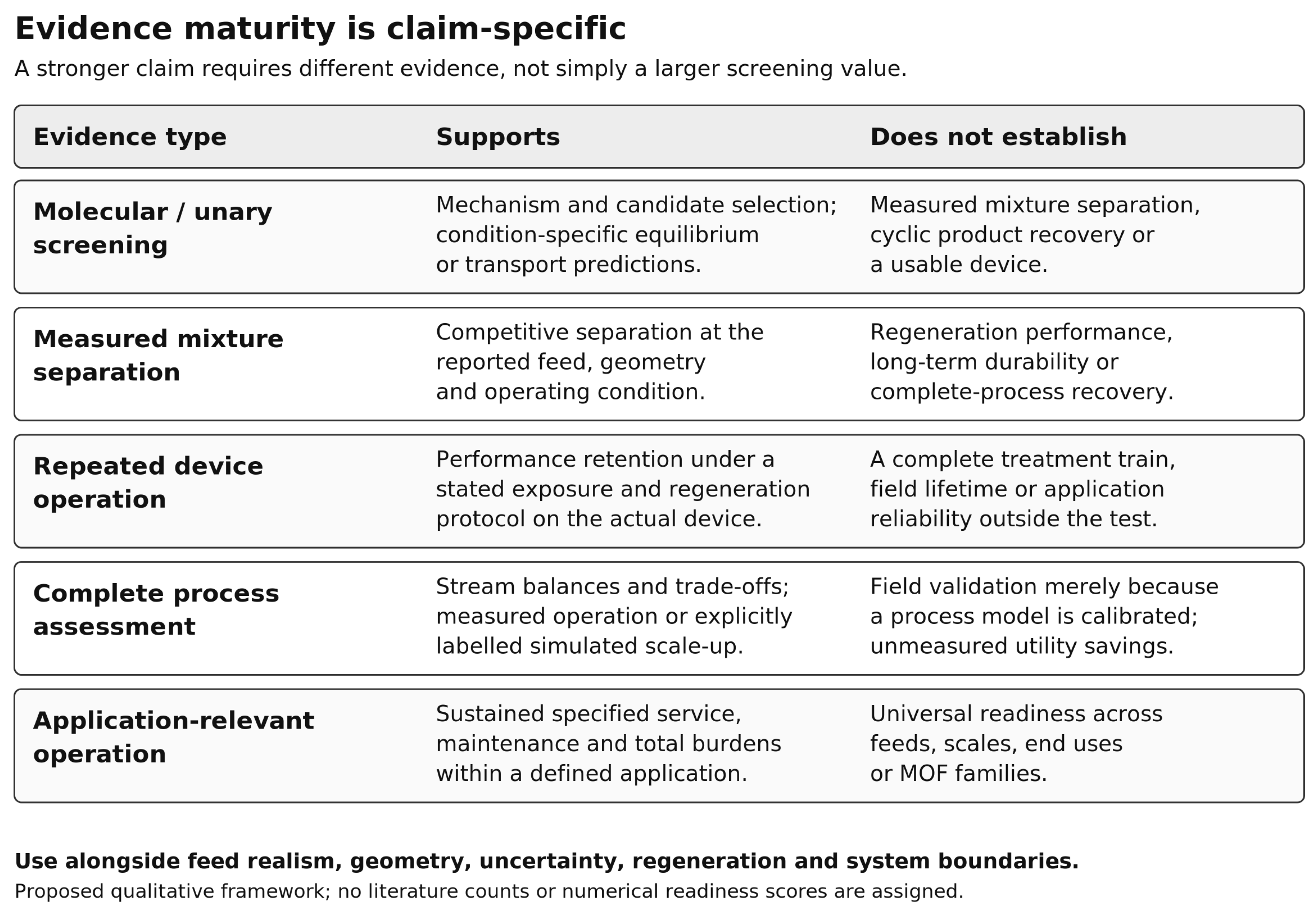
Figure 2.
shows alternative membrane adsorption treatment trains and the suggested boundary for a complete-system comparison. For each design it is necessary to specify the stage duties, the route of the recycle and that of the off-gas. Both of these options are conceptual and not validated household systems. The assessment takes into account utilities, regeneration, losses and replacement; the diagram is not a measured process flowsheet.
Figure 2.
shows alternative membrane adsorption treatment trains and the suggested boundary for a complete-system comparison. For each design it is necessary to specify the stage duties, the route of the recycle and that of the off-gas. Both of these options are conceptual and not validated household systems. The assessment takes into account utilities, regeneration, losses and replacement; the diagram is not a measured process flowsheet.
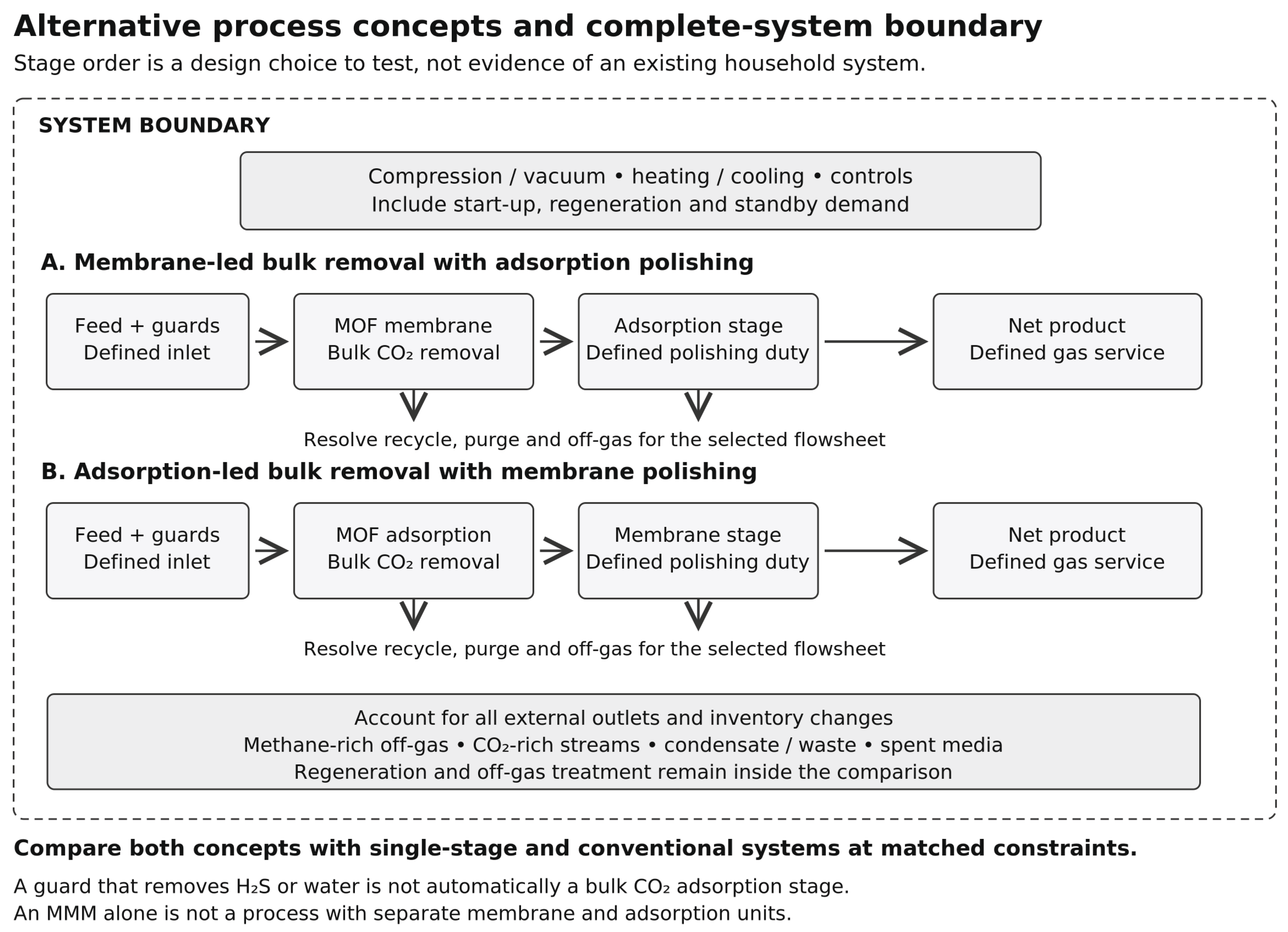

Table 1.
Scope of closely related reviews and the focus of the present synthesis.
| Review | Established emphasis | Relationship to the present synthesis |
| Duma et al. [2] | MOF sorbents and mixed-matrix membranes for biogas cleaning and CO₂/CH₄ separation. | Provides the closest materials-and-application context. The present synthesis centres on the validity of material-to-process claims. |
| Adegoke et al. [4] | Cellulose derivatives and cellulose–MOF composites for CO₂ adsorption and separation. | Provides a processing perspective. Here, support or binder choice is connected to test conditions, shaping and device evidence. |
| Adegoke et al. [5] | UiO-66 chemistry across adsorption, separation and catalytic conversion. | Provides framework-specific context. Here, separation is kept distinct from conversion and compared across device architectures. |
| Ahmad et al. [6] | Biogas-upgrading technologies with an emphasis on membrane performance. | Provides the broader process landscape. Here, membrane and adsorption evidence are assessed with common recovery and boundary conventions. |
Table 2.
Selected membrane results, the engineering claims they support and the limits of that evidence.
Table 2.
Selected membrane results, the engineering claims they support and the limits of that evidence.
| System/study | Conditions and selected result | Interpretation and remaining boundary |
| UiO-67-33/Matrimid [18] | 10 wt%; 50:50 CO₂/CH₄; 5 bar; 30 °C. Mixed-gas selectivity 75 versus 38 for neat polymer. | Chemistry-dependent gain within a loading and pressure window. Conflicting permeability values are not used here. |
| CuBDC-nanosheet/PIM-1 [25] | 10 wt%; 660 nm supported layer; equimolar feed; 25 °C; 1 bar reported; Ar sweep. 407 ± 12 GPU and 15.6 ± 0.3 selectivity. | Thin-layer and orientation effects act together. The 100 h dry-mixture test is not long-term humid-module validation. |
| ZIF-8/AAO [26] | Equimolar mixture; 1 bar feed; Ar sweep. Longer deposition changes 1358 to 334 GPU and separation factor approximately 1 to 8.8. | Functional selectivity reveals defects not resolved by surface appearance. Temperature is not specified in the examined method record. |
| MOF-801/Pebax [29] | 20 wt%; humid 10:90 CO₂/CH₄; 10 bar; dry sweep. 196 Barrer and separation factor 19.12. | Measured humid-film evidence for combined CO₂/water removal; no complete module methane balance. |
| UiO-66–NH–COCH₃/6FDA-DAM [30] | 16 wt%; 20 bar; 35 °C. Changing binary to H₂S-containing feed reduces CO₂ permeability 291 to 193 Barrer and selectivity 19.7 to 18.2. | Contaminant-specific response and partial reversibility; combined acid-gas selectivity is a different metric. |
| ZIF-8/polysulfone [31] | 1 wt%; pure gas, synthetic mixtures and plant biogas; 2–6 bar. Better than the polymer control under biogas, worse than its own pure-gas benchmark. | Real-feed relevance is increased, but reported feed composition does not close and source percentage statements conflict. |
Table 3.
Selected adsorption and process evidence, classified by the claim demonstrated.
| System / study | Evidence and selected finding | What remains unresolved |
| TAMOF-1 [45] | Humid CO₂/CH₄ breakthrough: approximately 2.3 mmol g⁻¹ CO₂ at approximately 72% RH. Five wet repetitions use 80 °C, 10⁻² mbar and 15 h regeneration. | Wet separation is demonstrated under a demanding regeneration protocol; low-burden cyclic service is not established. |
| MIL-120(Al) [16] | Kilogram-scale synthesis, shaped bodies, approximately 7% capacity loss after shaping, repeated breakthrough and water-exposure tests. | Manufacture and exposure tests do not establish full pressure-swing recovery or an energy balance. |
| MIL-160(Al) [48] | Laboratory breakthrough and PSA support scale-up modelling. Industrial model: approximately 99% CH₄ purity and 63% recovery. | Industrial results are simulated. High purity masks substantial methane rejection. |
| MIL-160(Al) [49] | Validated cycle modelling: recovery approximately 52% for PSA and 82% for VPSA; product-normalised energy approximately 11 and 12 Wh mol⁻¹ CH₄. | Comparable specific energy can accompany a different total cycle demand. |
| AlFFiVE-1-Ni [17] | Material experiments plus four-bed model: 96.2% CH₄ purity, 96.7% recovery and 0.238 MJ kg⁻¹ CH₄. | Multibed results are simulated and require more energy than the compared three-bed VSA case. |
| Conventional CMS VPSA [55] | Operated four-column laboratory unit: dry 60:40 CH₄/CO₂, 298 K, 4 bar, 2 standard L min⁻¹, 0.1 bar vacuum, 300 s evacuation; 96.6% purity and 98.5% recovery. | Pilot tests use synthetic gas, not field-operated MOFs. Specific energy is calculated, not fully metered. |
Table 4.
Decision gates and the evidence needed to support process-readiness claims.
| Decision gate | Evidence needed to support the claim | When evidence is missing |
| Defined service | End use, fresh-feed flow and variability, delivery conditions, operating schedule and product specification; a suitable comparator. | No application-readiness claim. Do not substitute a generic household purity or flow threshold. |
| Material advantage | Matched polymer/co-additive or sorbent controls; test conditions, normalisation and reproducibility; unsuccessful formulations retained. | Treat the result as candidate screening, not proof of a MOF-specific advantage. |
| Device performance | Actual supported membrane or shaped bed; measured mixed-gas response, pressure range, geometry, flow and integrity. | Do not transfer powder, ideal-gas or fabrication-area results to an operating device. |
| Reusable operation | Relevant humid/contaminant feed, complete regeneration protocol, capacity/transport retention, productive time and replacement evidence. | Durability remains protocol-specific; storage tolerance is not operating lifetime. |
| Complete process | Net methane and contaminant balances; recycle and inventory; measured versus calculated utilities; control at required product quality. | Label scale-up as simulated or conceptual. Do not infer recovery from enrichment. |
| Application-relevant delivery | Sustained service at the defined scale and duty cycle, maintenance and failure handling, safety assessment, total cost and environmental boundary. | Decentralised feasibility remains unestablished, even when a small laboratory device performs well. |
Disclaimer/Publisher’s Note: The statements, opinions and data contained in all publications are solely those of the individual author(s) and contributor(s) and not of MDPI and/or the editor(s). MDPI and/or the editor(s) disclaim responsibility for any injury to people or property resulting from any ideas, methods, instructions or products referred to in the content. |
© 2026 by the authors. Licensee MDPI, Basel, Switzerland. This article is an open access article distributed under the terms and conditions of the Creative Commons Attribution (CC BY) license.
Copyright: This open access article is published under a Creative Commons CC BY 4.0 license, which permit the free download, distribution, and reuse, provided that the author and preprint are cited in any reuse.