Preprint
Article

This version is not peer-reviewed.

Chemotype-Dependent Bioactivity of Amazonian Piper Essential Oils: Linking Chemical Composition to Selective Phytotoxic and Antifeedant Effects

Submitted:

19 October 2026

Posted:

29 October 2026

You are already at the latest version

Abstract

Plant essential oils (EOs) are promising sources of botanical biopesticides, and the genus Piper is particularly rich in bioactive constituents. This study investigated the chemical composition and biopesticidal potential of the EOs from seven Amazonian Piper species. The oils were characterized by GC–MS and evaluated for their phytotoxicity against Lolium perenne and Lactuca sativa, their antifeedant activity against Spodoptera littoralis, Myzus persicae and Rhopalosiphum padi, their antifungal activity against Aspergillus niger and Alternaria alternata, and their nematicidal activity against Meloidogyne javanica; composition–activity relationships were explored by multivariate analysis. The oils resolved into two chemotypes, one dominated by phenylpropanoids (mainly apiol) and the other by sesquiterpenes. Notably, all oils selectively inhibited the growth of the grass L. perenne while sparing or stimulating the dicot L. sativa. The apiol-rich oils of P. hispidum, P. stellipilum and P. demeraranum showed the strongest antifeedant effects on aphids, and all oils inhibited spore germination of both fungi. Principal component analysis associated apiol, but not dillapiol, with the phytotoxic and antifeedant activities, whereas antifungal activity was unrelated to the main compositional gradient. No nematicidal activity was observed. These results identify apiol-rich Amazonian Piper EOs as promising candidates for managing grass weeds, aphids and phytopathogenic fungi.

Keywords: 
;  ;  ;  ;  ;  ;  ;  

1. Introduction

Plant pests and diseases are among the main constraints to global food production and food security [1,2]. The Food and Agriculture Organization estimates that plant pests and diseases are responsible for the loss of up to 40% of global crop production each year, with trade losses associated with plant pests exceeding USD 220 billion annually [3], among these, weeds are consistently reported as one of the most damaging pest categories, responsible for potential yield losses of around 34% [4,5]. Among the different causes of agricultural losses, biotic factors—mainly pests, pathogens and weeds—are the most important, accounting for approximately 50% of the total, whereas abiotic and anthropogenic factors contribute around 30% and 17%, respectively [2]. These threats are well illustrated by the insect pests targeted in the present study: the polyphagous cotton leafworm Spodoptera littoralis, which feeds on more than 40 plant families and can cause yield losses ranging from about 26% to complete crop destruction [6], and the green peach aphid Myzus persicae, which attacks host plants from more than 40 plant families and transmits more than 100 plant viruses [7]. For decades, these losses have been managed mainly with synthetic pesticides, whose global consumption now exceeds four million tonnes per year [8]; however, their intensive use has raised serious concerns regarding human health, environmental contamination, the persistence of residues in soil and water, and toxicity to pollinators and other non-target organisms [8,9]. A further and increasingly critical limitation is the emergence of resistance in weeds, insect pests and phytopathogenic fungi, which progressively reduces the efficacy of conventional treatments [9,10,11]. These challenges have driven the search for sustainable, environmentally friendly alternatives that are less prone to inducing resistance [9,11].
Plant essential oils (EOs) have emerged as promising candidates for the development of botanical biopesticides. Being complex mixtures of volatile terpenes and phenylpropanoids, they can act through multiple mechanisms of action, which reduces the likelihood of pests developing resistance while maintaining low toxicity towards non-target organisms [12]. Together with their volatility, biodegradability into non-toxic products and low toxicity to non-target organisms, these properties make EOs attractive tools for integrated pest and weed management [10,12]. Of particular interest, some EOs exhibit selective phytotoxicity, strongly inhibiting monocotyledonous weeds while sparing or even stimulating dicotyledonous species, a selectivity of clear agronomic value for weed management in broad-leaved crops [13].
The genus Piper L. (Piperaceae), one of the largest genera of basal angiosperms with more than 2000 species distributed across the pantropical region, is an especially rich source of bioactive EOs [14,15]. It is particularly diverse in the Neotropics and in the Amazon basin, and Peru is one of its centers of diversity; the Piperaceae are represented in the country by around 830 species, with Piper being the most species-rich genus and including a high proportion of endemics [16]. Piper EOs are chemically characterized by monoterpene and sesquiterpene hydrocarbons, their oxygenated derivatives and, notably, large amounts of phenylpropanoids, and their composition varies widely among and within species, giving rise to distinct chemotypes that strongly influence their biological activities [14,15]. These oils have been reported to display antimicrobial, antifungal, insecticidal, nematicidal, antifeedant and phytotoxic activities, supporting their potential as multi-purpose crop-protection agents [14,15,17,18].
Among Piper constituents, the phenylpropanoids apiol, dillapiol, myristicin and safrole, are considered largely responsible for the biological activity of many Amazonian species [17,18,19]. Apiol (1-allyl-2,5-dimethoxy-3,4-methylenedioxybenzene) has been shown to inhibit the phytopathogenic fungus Botrytis cinerea [17,20] , and its activity against Aspergillus species has also been reported [17]. This antifungal effect has been attributed to the two electron-donating methoxy groups of its aromatic ring [17]. In addition, apiol displays selective phytotoxicity towards monocotyledonous plants [20], as well as insect antifeedant and ixodicidal effects [18]. Consequently, apiol-rich Piper oils are of particular interest for the simultaneous control of weeds, phytopathogens and insect pests [17,18].
Despite the exceptional richness of Amazonian Piper, most Peruvian species remain chemically and functionally uncharacterized, and integrated studies relating their essential-oil composition to several biological activities are still scarce. In previous work, our group described the antifungal, herbicidal, antifeedant and ixodicidal activities of essential oils from ten Amazonian Peruvian Piper species of their major constituents [17,18]. Building on this line of research, the present study examines the essential oils of seven additional Piper species from the Peruvian Amazon, with the aim of (i) characterizing their chemical composition by GC–MS; (ii) evaluating their insect antifeedant activity against Spodoptera littoralis, Myzus persicae and Rhopalosiphum padi, their phytotoxicity against Lolium perenne and Lactuca sativa, their antifungal activity against Aspergillus niger and Alternaria alternata, and their nematicidal activity against Meloidogyne javanica; and (iii) identifying, through multivariate analysis, the chemical groups responsible for each activity. This integrated composition–activity approach seeks to reveal the biopesticidal potential of these Amazonian Piper oils as selective, naturally derived crop-protection agents.

2. Materials and Methods

2.1. Plant Material and Essential Oil Extraction

Seven Piper species native to the Peruvian Amazon were investigated: Piper hispidum Sw. (voucher 40658), P. barbicuspe C. DC. (voucher 40312), P. stellipilum C. DC. (voucher 39893), P. demeraranum (Miq.) C. DC. (voucher 22628), P. aequale Vahl (voucher 39956), P. xanthostachyum C. DC. (voucher 10491), and P. jalapense C. DC. (voucher 002177). For each species, vegetative aerial parts (leaves, young stems and inflorescences) were collected from wild-growing plants in the Loreto Department (Peruvian Amazon). Voucher specimens were deposited at the AMAZ Herbarium of the Universidad Nacional de la Amazonía Peruana (UNAP, Iquitos, Peru) for taxonomic authentication. Plant collection was authorised under Regional Management Resolution No. 035-2021-GRL-GGR-GRDFFS.
The plant material was shade-dried at room temperature until a constant weight was attained and subsequently subjected to hydrodistillation in a Clevenger-type apparatus. The essential oils were separated by decantation, dried over anhydrous sodium sulfate (Na₂SO₄) to remove traces of water, and stored in amber vials at −20 °C until further analysis. Oil yields were calculated as a percentage relative to the dry weight of the plant material. Detailed information on the collection sites (including geographic coordinates), the amount of biomass processed and the complete extraction procedure has been reported previously by our group [17,18].

2.2. Gas Chromatography–Mass Spectrometry (GC-MS) Analysis

The chemical composition of the Piper essential oils was determined by gas chromatography–mass spectrometry (GC–MS) using a Shimadzu GC-2010 gas chromatograph coupled to a Shimadzu GCMS-QP2010 Ultra mass spectrometer operating in electron-ionisation mode (70 eV). Each sample (1 µL) was injected with an AOC-20i autosampler in split mode (split ratio 20:1). Separation was performed on a MEGA-5 MS capillary column (5% phenyl, 95% methylpolysiloxane; 30 m × 0.25 mm i.d., 0.25 µm film thickness). Helium was used as the carrier gas at a total flow of 17.5 mL/min and a column flow of 0.69 mL/min. The injector and the transfer line to the mass spectrometer were maintained at 300 °C and 250 °C, respectively. The oven temperature was held initially at 70 °C and then raised to 290 °C at 6 °C/min. Mass spectra were acquired in full-scan mode over an m/z range of 35–450 [17,18].
The essential oils were dissolved in dichloromethane (DCM) to a concentration of 4 µg/µL prior to injection. Individual constituents were identified by comparing their electron-ionisation mass spectra and retention data with those of the Wiley 229 and NIST 17 mass spectral libraries. Quantification was based on the relative peak areas (% area) of all peaks detected in the chromatograms [17,18].

2.3. Phytotoxic Activity

The phytotoxic potential of the essential oils was evaluated on two standard target species, the dicotyledon Lactuca sativa L. and the monocotyledon Lolium perenne L., according to the method previously reported by our group [17]. The assays were performed in 12-well microplates containing 40 seeds per treatment, and each essential oil was tested at a single final concentration of 0.2 mg/mL. Juglone (0.1 mg/mL), which caused complete inhibition of germination (100%), was used as a positive control. Germination was monitored daily over six days for L. sativa and seven days for L. perenne. At the end of the experiment, the root and leaf lengths of 25 randomly chosen seedlings were determined from digitalised images using ImageJ software. All measurements were expressed as percentages relative to the untreated control, and the root and leaf length data were subjected to non-parametric analysis of variance (ANOVA).

2.4. Antifungal Activity: Spore Germination Inhibition Assay

Antifungal activity was tested against two phytopathogenic fungi, Aspergillus niger van Tieghem and Alternaria alternata (Fr.) Keissl., using a microplate-based spore germination inhibition assay adapted from the procedure described in [17]. Conidial suspensions in potato dextrose broth (PDB) were standardized to a density of 1 × 10⁵ spores mL⁻¹ and dispensed into 96-well microplates. Serial dilutions of each oil in DMSO yielded nominal final concentrations of 25, 50, 100, 200, and 400 µg mL⁻¹; solvent at the maximum corresponding concentration served as the control. Plates were sealed and incubated at 25 °C for 48 h (A. niger) or 72 h (A. alternata), after which germination was assessed by optical microscopy. Inhibition was expressed as a percentage relative to the solvent control, and half-maximal inhibitory concentrations (IC₅₀) were estimated by non-linear regression.

2.5. Nematicidal Bioassays

The nematicidal activity of the essential oils was evaluated against infective second-stage juveniles (J2) of the root-knot nematode Meloidogyne javanica (Treub) Chitwood. A reference nematode stock, propagated on tomato (Solanum lycopersicum) under greenhouse conditions at ICA, CSIC (Madrid, Spain), provided the biological material [18]. To obtain synchronized juvenile populations, egg masses were hand-picked from infected root systems and transferred to aerated distilled water, where hatching was allowed to proceed for 24 h at 25 °C.
Test formulations were prepared by dissolving each oil in an aqueous vehicle containing 5% of a DMSO/Tween 20 mixture (0.5% v/v Tween 20 in DMSO) to a working concentration of 1 µg µL⁻¹; the corresponding solvent mixture without oil served as the negative control. Freshly hatched J2 suspensions were added to each well in microplates, and experiments were conducted in four independent replicates per treatment. Sealed plates were incubated under the same temperature conditions used for egg hatching. Immobile juveniles were enumerated under a stereomicroscope after 72 h, and mortality values were adjusted for natural mortality in controls using the Schneider–Orelli correction formula [18].

2.6. Antifeedant Bioassays

The antifeedant potential of the seven essential oils was evaluated against three economically relevant pest species: the chewing lepidopteran Spodoptera littoralis (Boisduval) (Noctuidae) and the sap-sucking aphids Myzus persicae (Sulzer) and Rhopalosiphum padi (L.) (Aphididae). The insect colonies were maintained at the Instituto de Ciencias Agrarias (ICA-CSIC, Madrid, Spain), rearing S. littoralis on an artificial diet, M. persicae on bell pepper (Capsicum annuum L.) and R. padi on barley (Hordeum vulgare L.), all held in a growth chamber at 22 ± 1 °C, >70% relative humidity and a 16:8 h light:dark photoperiod.
Antifeedant responses were determined by dual-choice feeding and settling assays [18,21], in which paired plant surfaces—one treated with the test solution and the other with solvent alone (control)—were offered simultaneously and each received 10 µL of the corresponding solution. For the lepidopteran assay, newly moulted sixth-instar (L6) larvae (>24 h post-moult) were used; each C. annuum leaf disk (1.0 cm²) was surface-treated, and six replicate Petri dishes were prepared per treatment, each containing two treated disks, two control disks and two larvae, which were allowed to feed until approximately 75% of the control surface had been consumed. Consumed leaf areas were quantified by image analysis (ImageJ), and feeding inhibition was expressed as %FI = [1—(T/C)] × 100, where T and C are the areas consumed on the treated and control disks, respectively.
For the aphid assays, apterous adults (24–48 h old) were confined in ventilated plastic boxes (3 × 3 × 1.5 cm) lined with a thin layer of 2.5% agar to preserve leaf turgor; two leaf half-disks of C. annuum (for M. persicae) or two barley leaf fragments of 1.0 cm² (for R. padi) were placed in each box, one treated and one control. Twenty replicate boxes, each with 10 aphids, were used per treatment, and the boxes were incubated inverted under indirect light at 22 ± 1 °C and a 16:8 h light:dark photoperiod for 24 h, after which the aphids settled on each surface were counted. Settling inhibition was calculated as %SI = [1—(%T/%C)] × 100, where %T and %C are the percentages of aphids settled on the treated and control surfaces, respectively.
Essential oils were tested at an initial dose of 100 µg/cm² (10 µg/µL × 10 µL) dissolved in solvent, and dose–response assays were subsequently carried out for those oils exceeding 70% inhibition at this concentration in order to estimate their effective doses (EC₅₀).

2.7. Statistical Analysis

Antifeedant and settling responses (%FI and %SI) were tested for significance using the non-parametric Wilcoxon signed-rank test (p < 0.05). For those essential oils producing at least 70% inhibition at the initial screening dose, dose–response assays were performed and the effective concentrations (EC₅₀), with their 95% confidence intervals, were estimated by linear regression of the inhibition values against the logarithm of the concentration.
For the antifungal assays, the median inhibitory concentrations (CI₅₀) of spore germination, with their 95% confidence limits, were calculated by regression of the percentage of inhibition on the log-transformed dose; CI₅₀ values were determined only for essential oils reaching ≥50% inhibition at the highest dose tested. These dose–response computations were carried out using STATGRAPHICS Centurion XVI (v. 16.1.02).
For the phytotoxicity assays, seed germination and root and leaf length were expressed as percentages relative to the untreated control, and the data were analysed by non-parametric analysis of variance (Kruskal–Wallis test) followed by Dunn’s multiple-comparison test with Bonferroni correction (p < 0.05) to compare each essential oil with the control.
The relationships between chemical composition and biological activity were explored by principal component analysis (PCA). The input matrix combined the relative abundances of the 15 major constituents (≥ 5% in at least one oil; Table 1) with six activity variables: the inhibition (%) of L. perenne root and leaf growth, the antifungal activity against A. niger and A. alternata, expressed as (800—CI₅₀), and the antifeedant activity against M. persicae and R. padi, expressed as (100—EC₅₀). Censored values (CI₅₀ > 800 µg/mL; EC₅₀ > 50 or ~50 µg/cm²) were set to the corresponding limit, and all data were mean-centered and scaled to unit variance (autoscaling) prior to analysis. Associations between individual constituents and activities were evaluated by Spearman’s rank correlation (n = 7). PCA computations and visualizations were performed in Python (v. 3.11.6) with the assistance of the Julius AI platform (https://julius.ai/).

3. Results

3.1. Chemical Composition of Essential Oils

3.1.1. Chemical Composition

The complete composition of the seven essential oils, determined by GC–MS, is given in Table S1. Of the 56 constituents detected (20–32 per oil, accounting for 77.6–96.6% of the total peak area), 51 were identified and assigned to eight chemical classes. Sesquiterpenes were the most diverse (24 hydrocarbons and 15 oxygenated derivatives), followed by monoterpene hydrocarbons, oxygenated monoterpenes and phenylpropanoids (three each), and one fatty acid, one diterpene and one aliphatic hydrocarbon. Six terpenoids (limonene, α-cubebene, α-copaene, trans-caryophyllene, α-amorphene and spathulenol) occurred in all oils. The main sesquiterpene hydrocarbons were δ-cadinene, α-copaene, germacrene-D, trans-caryophyllene and bicyclogermacrene. Among the oxygenated sesquiterpenes, α-cadinol and τ-muurolol were most abundant in Pxa and caryophyllene oxide in Pja. The three phenylpropanoids showed the most contrasting distribution: apiol was detected in six oils, dillapiol in four and myristicin only in Pst and Pde. Monoterpenes were minor except for limonene in Pja, and the remaining classes, together with the five unidentified compounds, accounted for less than 7% of any oil.
Table 1 lists the major constituents of each oil (≥ 5%) in decreasing order of abundance. Apiol dominated the oils of Phi, Pst, Pde and Pae: it was the only major compound in Phi, and it was accompanied by myristicin in Pst and Pde and by dillapiol in Pae. Dillapiol was also the main constituent of Pba, whereas Pxa and Pja showed distinct sesquiterpene profiles, led by α-cadinol and δ-cadinene and by limonene and α-copaene, respectively. The phenylpropanoid-rich oils were concentrated in a few compounds, with apiol and myristicin accounting for approximately 71% of the oil of Pst and 80% of that of Pde. In contrast, the major constituents of Pxa and Pja represented only about half of each oil.
At the chemical-class level, the seven essential oils were dominated by two groups (Table 2). Sesquiterpenes were the most diverse fraction, comprising 24 sesquiterpene hydrocarbons and 15 oxygenated sesquiterpenes out of the 56 constituents; however, phenylpropanoids, despite being represented by only three compounds, were the most abundant class in four of the oils, reaching 80.3% in Pde, 71.2% in Pst and 69.1% in Phi. This contrast between compound number and relative abundance reflects the strong quantitative contribution of apiol and dillapiol. Sesquiterpene hydrocarbons dominated the composition of Pxa (46.3%), Pba (45.3%) and Pja (36.3%), and oxygenated sesquiterpenes were particularly abundant in Pxa (37.1%) and Pja (22.2%). Monoterpene hydrocarbons were generally minor (≤3.4%) except in Pja, where they reached 15.0% owing to limonene, whereas oxygenated monoterpenes, fatty acids, diterpenes and aliphatic hydrocarbons together accounted for less than 5% in all species. The total identified fraction ranged from 77.6% (Pja) to 96.6% (Pde). These class-level patterns confirmed two well-defined chemotypes—a phenylpropanoid-dominated group (Phi, Pst, Pde and, to a lesser extent, Pae) and a sesquiterpene-dominated group (Pba, Pxa, Pja).

3.2. Pairwise Similarity Analysis of the Essential Oils (Jaccard and Bray–Curtis)

To determine whether the chemotypic differences described above were also reflected in the overall composition of the oils, their pairwise resemblance was quantified using two complementary metrics based on the complete compositional data (Table S1; Figure 1). The Jaccard similarity index considers only the presence or absence of constituents, whereas the Bray–Curtis dissimilarity also accounts for their relative abundances. Both metrics identified Pst and Pde as the most closely related pair, with the highest Jaccard similarity (0.806) and the lowest Bray–Curtis dissimilarity (0.137). This indicates that these two oils shared not only most of their constituents but also their relative proportions. Likewise, both metrics identified Pja as the most distinct oil. It exhibited the lowest Jaccard values against all other species (0.136–0.355) and consistently high Bray–Curtis dissimilarities (0.770–0.935), the maximum being recorded against Pde.
However, the two metrics diverged for some species pairs, and this divergence provides further insight into the nature of their chemical differences. Phi showed a low qualitative similarity to Pst and Pde (Jaccard = 0.405 in both cases), but also a low Bray–Curtis dissimilarity to these oils (0.225 with Pde and 0.329 with Pst). This indicates that, although the three oils differ in many minor constituents, their overall composition is quantitatively similar owing to the dominance of apiol. Conversely, Pba shared a relatively high proportion of constituents with Pde and Pst (Jaccard = 0.657 and 0.568, respectively), yet it was strongly dissimilar from them in quantitative terms (Bray–Curtis ≥ 0.870). This reflects the replacement of apiol by dillapiol and sesquiterpenes as its major components. Pae occupied an intermediate position, with moderate Bray–Curtis values (0.513–0.586) against the phenylpropanoid-rich oils and Pba, in agreement with its mixed phenylpropanoid–sesquiterpene profile. Pxa, in turn, was markedly dissimilar from the three apiol-rich oils (Bray–Curtis = 0.843–0.882). Overall, these results indicate that compositional resemblance among the oils is determined by the abundance of a few major constituents rather than by the number of shared compounds. On this basis, the apiol-rich oils (Phi, Pst and Pde) are separated from the sesquiterpene-dominated oils (Pxa and Pja), a pattern further examined by hierarchical clustering (Section 2.3).

3.3. Hierarchical Clustering and Compound Distribution

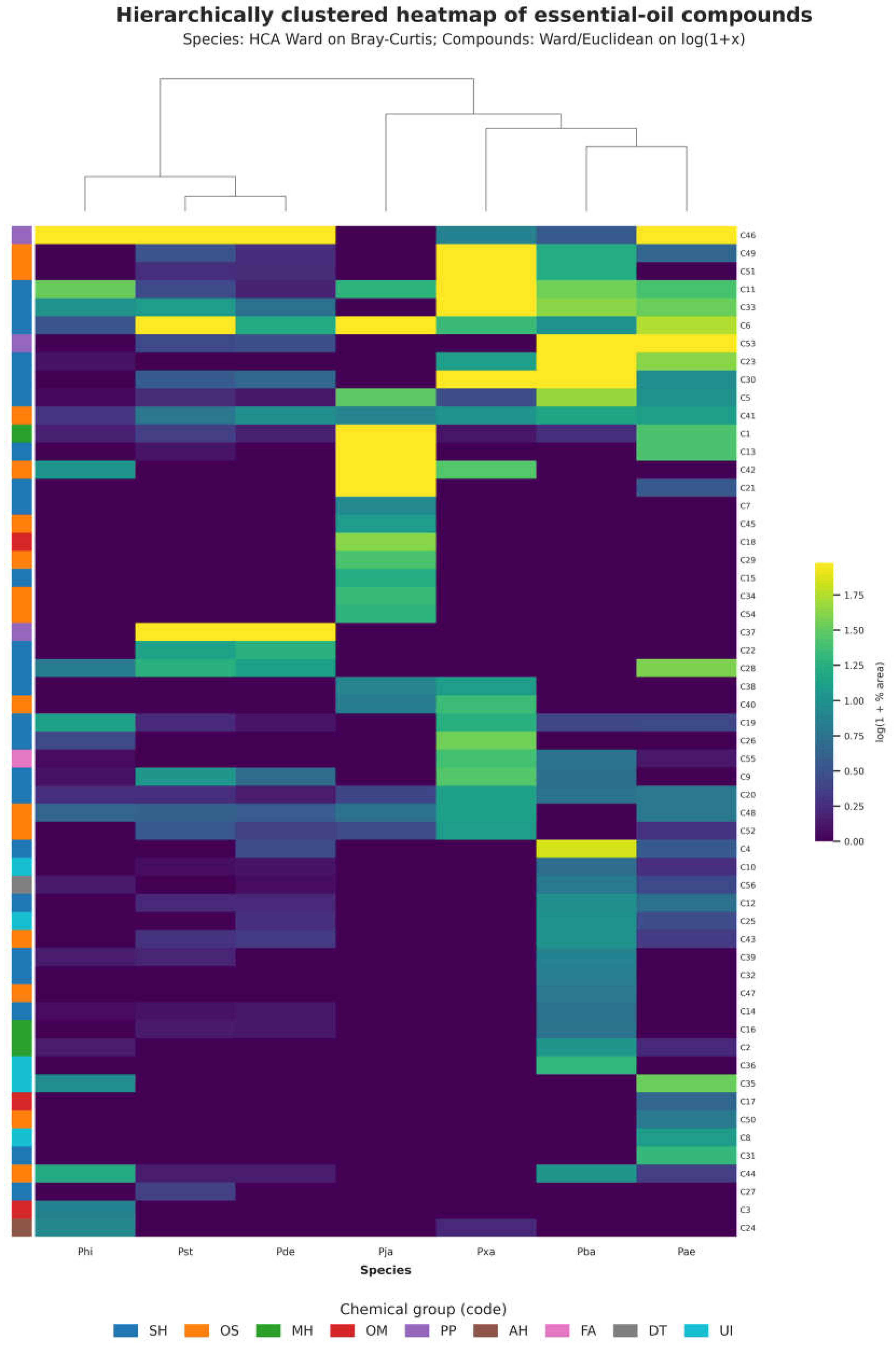
Whereas the similarity analysis compared the oils as a whole, the hierarchically clustered heatmap (Figure 2) made it possible to identify the individual constituents underlying these relationships. Species were clustered by Ward’s linkage on the Bray–Curtis dissimilarity, whereas compounds were ordered by Ward’s linkage on the Euclidean distance of the log(x+1)-transformed data.
The species dendrogram resolved two main clusters, which merged at the highest fusion distance (1.203). The first comprised Phi, Pst and Pde. Within it, Pst and Pde fused at a very low distance (0.137) and Phi joined them at 0.316, reflecting their shared apiol-rich, phenylpropanoid-dominated composition. The second cluster was more heterogeneous: Pba and Pae merged first (0.586), followed by Pxa (0.754), whereas Pja joined last (0.885), consistent with its position as the most distinct oil (Section 2.2). The inclusion of Pae in this cluster, despite its relatively low Bray–Curtis dissimilarity to Pst (0.513), reflects its intermediate, mixed phenylpropanoid–sesquiterpene profile, which shares dillapiol and several sesquiterpenes with Pba.
The ordering of the compounds, together with the chemical-group color bar, revealed well-defined, species-related blocks of constituents. The most distinctive block consisted of seven constituents detected exclusively in Pja: two sesquiterpene hydrocarbons (C7 and C15), four oxygenated sesquiterpenes (C29, C34, C45 and C54) and geranyl acetone (C18). Pae also contained a small group of exclusive constituents (C8, C17, C31 and C50). In contrast, Pxa contained no exclusive compounds and was instead distinguished by the highest levels of trans-caryophyllene (C11), δ-cadinene (C33), τ-muurolol (C49) and α-cadinol (C51). Similarly, Pba showed the highest levels of elixene (C4), germacrene-D (C23), bicyclogermacrene (C30) and dillapiol (C53), several of which were also present in Pae, which accounts for the grouping of these two oils. Finally, apiol (C46) formed a high-intensity band shared by Phi, Pst, Pde and Pae, while myristicin (C37) was restricted to Pst and Pde, supporting their close association. Taken together, these blocks provide a visual chemical fingerprint of each chemotype and identify the constituents responsible for the separation of the species.

3.4. Phytotoxic Activity and Selectivity Between Monocot and Dicot Species

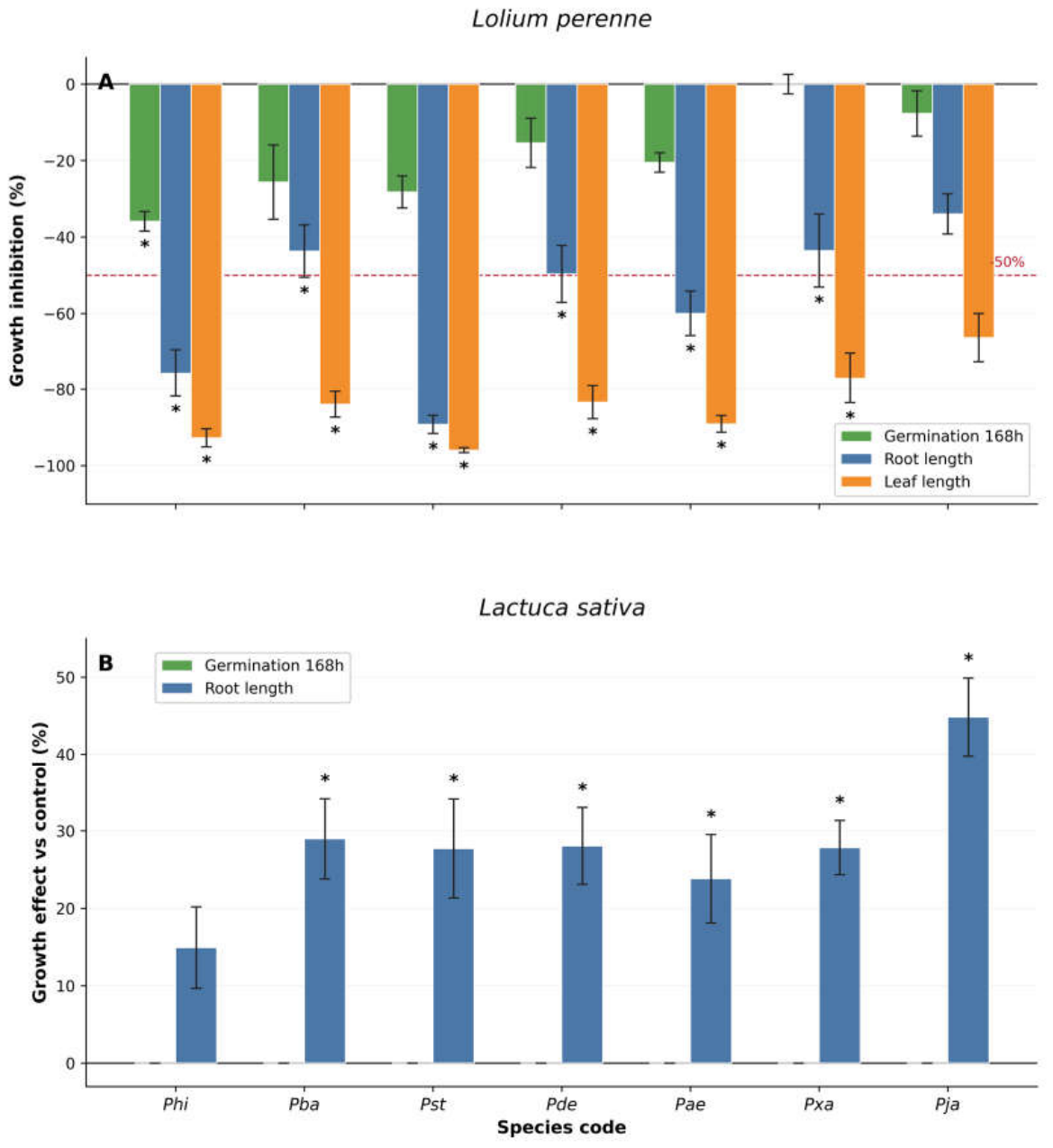
The phytotoxic potential of the seven Piper essential oils was evaluated against a monocotyledonous weed, Lolium perenne, and a dicotyledonous species, Lactuca sativa, by measuring seed germination and seedling root and leaf elongation relative to the control (Figure 5).
All essential oils exerted a strong and consistent phytotoxic effect on Lolium perenne (Figure 5A). Leaf elongation was the most sensitive parameter, being inhibited by 66.3–96.0% relative to the control, followed by root elongation (34.0–89.2%), whereas seed germination was affected to a lesser extent (0–35.9%). Root and leaf growth were significantly reduced by all species except Pja (Kruskal–Wallis followed by Dunn’s test with Bonferroni correction, p < 0.05), while germination was significantly inhibited only by Phi. The oils of Pst, Phi and Pae were the most phytotoxic, exceeding 50% inhibition for both root and leaf growth; Pst produced the strongest effect on root elongation (89.2%), and several oils reduced leaf growth by more than 90%. In contrast, Pja was consistently the least active oil, with inhibition values below the 50% threshold for all parameters.
A markedly different response was observed in the dicotyledon Lactuca sativa (Figure 5B). None of the oils inhibited its growth; seed germination was unaffected in all cases (0% inhibition), and root elongation was not reduced but significantly stimulated, by 14.9–44.8% relative to the control (all species except Phi; p < 0.05). This opposite behaviour of the two target species constitutes the most relevant outcome of the assay: the same oils that suppressed the growth of the monocotyledonous weed by up to 96% simultaneously enhanced, rather than impaired, the growth of the dicotyledonous species.
Overall, these results reveal a clear selectivity of the Piper essential oils towards the monocotyledonous weed L. perenne. This selective profile is of considerable agronomic interest, since an effective bioherbicide should suppress target grass weeds without harming broad-leaved crops. The strong, selective inhibition of L. perenne—particularly by the phenylpropanoid-rich oils of Pst, Phi and Pae—together with the absence of phytotoxicity towards L. sativa, identifies these Amazonian Piper essential oils as promising candidates for the development of selective, naturally derived herbicides.

3.5. Antifungal (Spore Germination Inhibition) and Nematicidal Activity

The antifungal activity of the seven Piper essential oils was evaluated against the phytopathogenic fungi Aspergillus niger and Alternaria alternata by measuring the inhibition of spore germination, and the results are expressed as CI₅₀ values (Table 3). At the screening dose of 800 µg/mL, all oils were highly active, inhibiting spore germination by 78–89% against A. niger and by 68.8–88% against A. alternata. Against A. niger, the most potent oil was that of P. stellipilum (CI₅₀ = 58.4 µg/mL), followed by P. hispidum (116.7 µg/mL) and P. xanthostachyum (120.5 µg/mL), whereas P. barbicuspe and P. demeraranum were the least active (CI₅₀ = 211.9 and 252.2 µg/mL, respectively). Against A. alternata, P. hispidum was the most effective oil (CI₅₀ = 64.7 µg/mL), again followed by P. stellipilum (96.3 µg/mL), while P. demeraranum showed the weakest activity, with a CI₅₀ above 800 µg/mL. Overall, the oils of P. stellipilum and P. hispidum were the most active against both fungi, consistent with their high phenylpropanoid (apiol) content, whereas the sesquiterpene-rich oils were generally less potent.
In contrast to the antifungal results, none of the seven essential oils exhibited nematicidal activity against Meloidogyne javanica J2 juveniles, with inhibition values below 21% across all species at the concentration tested.

3.6. Antifeedant Activity

The essential oils were tested for antifeedant activity against the chewing insect Spodoptera littoralis and for settling-inhibition activity against the aphids Myzus persicae and Rhaphalosiphum padi (Table 4). The oils were markedly more active against the two aphid species than against S. littoralis. Against the lepidopteran, feeding inhibition (%FI) was generally low to moderate (7–69%) and only P. hispidum reached a high value (69%), so that EC₅₀ values could not be determined (>50 µg/cm²) for most oils. In contrast, all oils strongly inhibited aphid settling, with %SI values of 64–88% against M. persicae and 61–99% against R. padi. Against R. padi, the most potent oils were those of P. hispidum (EC₅₀ = 26.5 µg/cm²), P. stellipilum (27.9 µg/cm²) and P. demeraranum (29.4 µg/cm²), whereas against M. persicae the strongest effect was shown by P. demeraranum (EC₅₀ = 13.5 µg/cm²), followed by P. aequale (25.2 µg/cm²) and P. hispidum (32.3 µg/cm²). The sesquiterpene-rich oils P. xanthostachyum and P. jalapensis were the least active, with EC₅₀ values above 50 µg/cm² against R. padi. As observed for the antifungal and herbicidal assays, the most active oils were the phenylpropanoid-rich ones (P. hispidum, P. stellipilum, P. demeraranum), pointing again to apiol as a major contributor to the biological activity of these Piper essential oils.

3.7. Relationship between Chemical Composition and Bioactivity

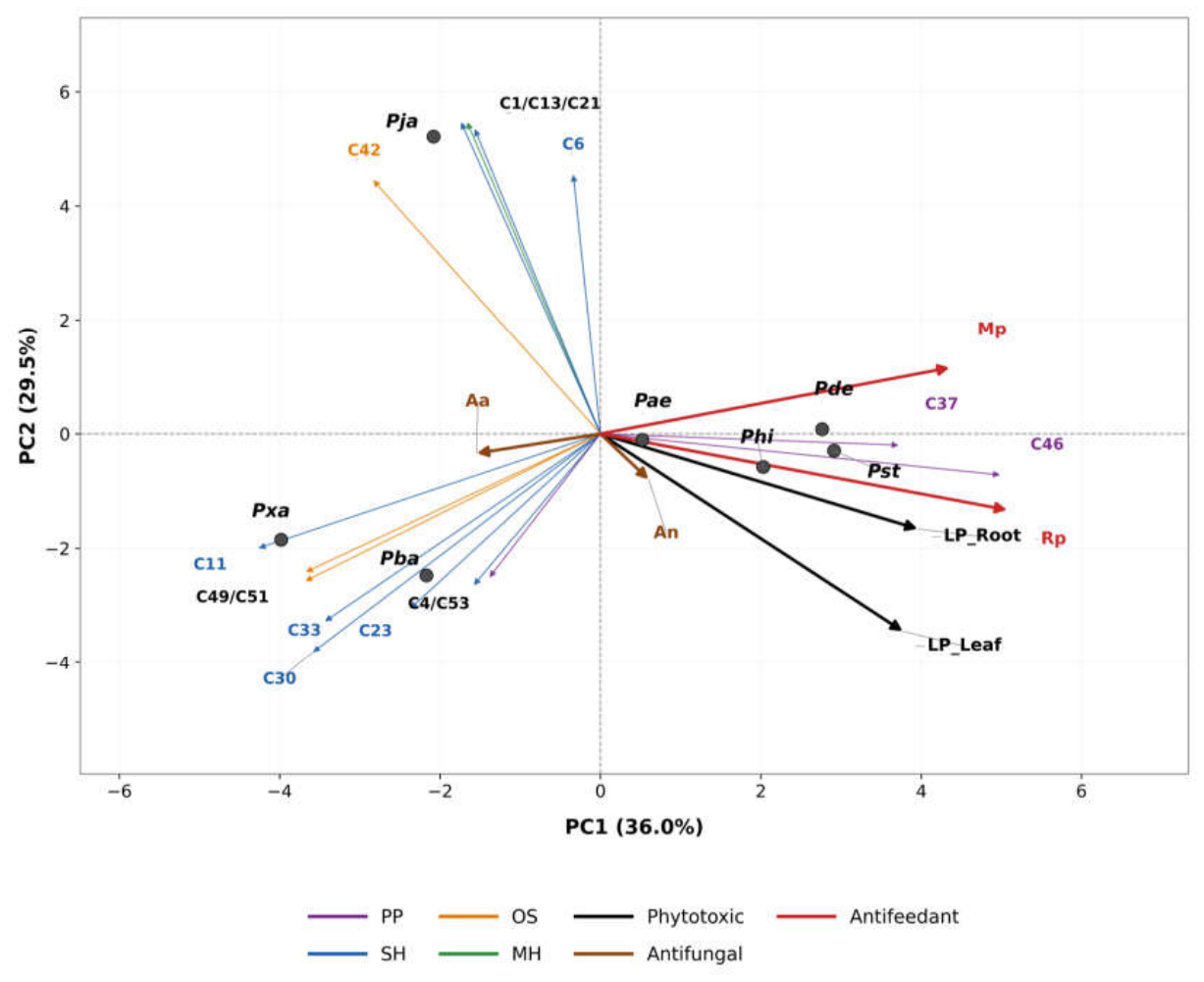
To identify the constituents associated with the biological effects of the oils, the major compounds (Table 1) and the three bioactivities were jointly analyzed by principal component analysis (Figure 4). Phytotoxic activity was represented by the inhibition of root and leaf growth of L. perenne (LP_Root and LP_Leaf), antifungal activity by the CI₅₀ values against A. niger (An) and A. alternata (Aa), and antifeedant activity by the EC₅₀ values against M. persicae (Mp) and R. padi (Rp). All activity variables were transformed so that higher values denoted greater activity, and the data were autoscaled to remove differences in units and scale between assays. Seed germination of L. perenne was not included, as it was strongly correlated with root and leaf growth inhibition (ρ = 0.74–0.89). The responses of L. sativa, which reflected growth stimulation rather than inhibition, were likewise excluded, the selectivity of the oils having been addressed in Section 2.4. S. littoralis was also excluded because none of the oils reached an EC₅₀ value against this insect. The first two principal components accounted for 65.5% of the total variance (PC1 = 36.0%; PC2 = 29.5%).
PC1 was associated with the biological activity of the oils. The apiol-rich oils of Pst, Pde and Phi were located on the positive side of this component, together with apiol (C46) and myristicin (C37), and the vectors of phytotoxic (LP_Root, LP_Leaf) and antifeedant (Mp, Rp) activity pointed in the same direction. Conversely, the sesquiterpene-rich oils of Pxa and Pba were located on the negative side, associated with trans-caryophyllene (C11), bicyclogermacrene (C30), δ-cadinene (C33), germacrene-D (C23), τ-muurolol (C49) and α-cadinol (C51). Pja, also located on the negative side of PC1, was separated from them along PC2. Pae occupied a position close to the origin, in agreement with its mixed phenylpropanoid–sesquiterpene profile. The association between apiol and bioactivity was supported by significant positive correlations with the antifeedant activity against R. padi (Spearman ρ = 0.90, p = 0.006) and with the inhibition of root growth of L. perenne (ρ = 0.79, p = 0.036). Positive, although non-significant, trends were also observed for the activity against M. persicae (ρ = 0.68, p = 0.094) and for the inhibition of leaf growth (ρ = 0.64, p = 0.119).
Several further observations refine this relationship. Myristicin projected in the same direction as the activity vectors, although its individual correlation with the activities evaluated was not significant (ρ ≤ 0.53), most likely because it was detected in only two oils. In contrast, dillapiol (C53), although also a phenylpropanoid, did not project with the activity vectors but towards the negative side of PC1, close to Pba, and showed no correlation with either phytotoxic or antifeedant activity (ρ = 0.07–0.26). This indicates that these effects are associated specifically with apiol rather than with the phenylpropanoid fraction as a whole. The antifungal vectors (An and Aa), for their part, were short and located near the origin, and their quality of representation on the PC1–PC2 plane was very low (cos² = 0.03 and 0.09, respectively). Their variation was mainly captured by PC3 (17.9% of the total variance), and apiol was not significantly correlated with either antifungal variable (ρ = 0.32–0.39). Antifungal activity is therefore not explained by the main compositional gradient of the oils. Finally, PC2 was defined mainly by the constituents characteristic of Pja, namely limonene, cis-α-bergamotene and curcumene (C1/C13/C21), caryophyllene oxide (C42) and α-copaene (C6), none of which was positively associated with any of the biological activities evaluated.

4. Discussion

The present study shows that the phytotoxic and antifeedant activities of the essential oils of seven Amazonian Piper species are closely linked to their chemotype and, in particular, to their apiol content. The oils resolved into a phenylpropanoid-dominated chemotype, in which apiol was the principal constituent (P. hispidum, P. stellipilum and P. demeraranum), and a sesquiterpene-dominated chemotype (P. barbicuspe, P. xanthostachyum and P. jalapensis), with P. aequale showing a mixed profile. Such chemical variability is characteristic of the genus Piper, whose essential oils may be dominated by monoterpenes, sesquiterpenes or phenylpropanoids depending on the species, population and geographic origin [14,15]. Notably, other populations of P. hispidum, P. demeraranum and P. aequale have been reported to produce essential oils dominated by sesquiterpenes, monoterpenes or dillapiole [14,15], which highlights the distinctive apiol-rich chemotypes found in the Peruvian Amazon. The predominance of apiol is particularly relevant, since this methylenedioxyphenyl (MDP) phenylpropanoid has been identified as the main constituent of other Amazonian Piper oils and linked to their biocidal activity [17,18].
The multivariate analyses showed that the chemical differentiation of these oils is structured mainly along the balance between phenylpropanoids and sesquiterpenes. A comparable partition has been reported for other Amazonian Piper species. In a composition-based cluster analysis of ten Peruvian species, the apiol-rich oils of P. sancti-felicis and P. mituense formed a phenylpropanoid group, separated from groups dominated by sesquiterpenes or by monoterpenes and sesquiterpenes [17]. A subsequent principal component analysis of the same oils again separated the apiol-rich chemotype from the bisabolene-type, mixed sesquiterpene and oxygenated caryophyllane-rich oils [18]. The recurrence of this pattern in a different set of species suggests that the phenylpropanoid/sesquiterpene balance is a general feature of the chemical diversity of Amazonian Piper. In the present oils, moreover, the divergence between the Jaccard and Bray–Curtis metrics indicated that their resemblance depends on the abundance of a few major constituents, notably apiol, rather than on the number of shared compounds. This was also reflected in the heatmap, in which apiol and myristicin characterized the phenylpropanoid-rich oils, whereas P. jalapensis was distinguished by a block of exclusive sesquiterpenes. Because the chemotypes are thus defined by a small number of abundant constituents, they provide a sound basis for relating composition to biological activity, as discussed below.
The phytotoxicity assays revealed the most relevant finding of this study, namely a clear selectivity between the two plant models. All oils strongly inhibited the growth of the grass Lolium perenne (up to 96% for leaf and 89% for root elongation), whereas the growth of the dicot Lactuca sativa was not inhibited but stimulated. The apiol-rich oils of P. stellipilum and P. hispidum, together with that of P. aequale, were the most phytotoxic. This agrees with previous reports on the phytotoxicity of Piper oils against the same plant models [17,22]. Among the oils from the Colombian Chocó, selectivity towards L. perenne was observed for P. divaricatum, whereas the apiol-rich oil of P. dilatatum inhibited L. sativa root growth at the highest dose tested [22], in contrast with the stimulation of L. sativa produced by the apiol-rich oils studied here. The selectivity observed in the present study is, however, consistent with the phytotoxic profile of pure apiol, which was markedly more toxic to the monocots Agrostis stolonifera and Festuca rubra than to lettuce [20]. A comparable selectivity, consisting of strong inhibition of a monocot with little or no effect on a dicot, has been described for other essential oils, such as the thymol chemotype of Origanum vulgare [13]. This is a desirable property for bioherbicides intended to control grass weeds in broad-leaved crops. At the cellular level, the phytotoxicity of essential-oil constituents is generally attributed to the disruption of membrane integrity and the induction of oxidative stress through the accumulation of reactive oxygen species (ROS), which impairs meristematic activity and seedling growth. Differences in uptake, metabolism and antioxidant capacity among plant species may explain the differential susceptibility of the monocot and dicot models [9,23]. The stimulation of L. sativa root growth is probably a hormetic response to the oils at the concentration tested, a phenomenon also reported for apiol at low doses [20].
All seven oils inhibited the spore germination of Aspergillus niger and Alternaria alternata, P. stellipilum and P. hispidum being the most active against both fungi. However, the antifungal response showed no clear relationship with the chemotype. The most potent oil differed between the two fungi, and P. demeraranum, although rich in apiol, was the least active. In previous work, the antifungal activity of Amazonian Piper oils was associated not only with apiol but also with monoterpenes such as β-pinene and limonene [17]. which suggests that this effect results from the combined action of several constituents whose contribution differs between fungal targets. The antifungal action of essential-oil terpenes and phenylpropanoids is mainly related to their lipophilicity, which allows them to interact with the fungal plasma membrane, disrupt its permeability and interfere with ergosterol biosynthesis, ultimately preventing spore germination and hyphal development [24,25]. Notably, this mechanism has been described for an apiol-containing essential oil [24]. In contrast, none of the oils was active against the root-knot nematode Meloidogyne javanica (inhibition below 21%). This agrees with the lack of nematicidal activity reported for related Amazonian Piper oils and for pure apiol [18], and highlights the target-specific nature of these oils.
In the insect antifeedant assays, the oils were markedly more active against the aphids Myzus persicae and Rhopalosiphum padi than against Spodoptera littoralis, for which EC₅₀ values could not be precisely determined. A similar pattern was reported for other Amazonian Piper oils, in which aphids were the most sensitive targets and only a few oils were active against S. littoralis [18]. As in the phytotoxicity assays, the apiol-rich oils (P. hispidum, P. stellipilum and P. demeraranum) were the most active against the aphids, whereas the sesquiterpene-rich oils were the least active. These results are consistent with the broad-spectrum antifeedant activity reported for apiol-rich Piper chemotypes and for pure apiol [18], and with the strong settling inhibition of R. padi (EC₅₀ = 8.4 µg/cm²) caused by the apiol-rich essential oil of Piper dilatatum (79.0% apiol) from the Colombian Chocó [22]. In the same study, an oil of P. aff. hispidum rich in limonene, elemol and p-cymene, and therefore chemically distinct from the apiol-rich oil of P. hispidum analyzed here, was active against the three insect species. Moreover, the strongest effect against S. littoralis was produced by a δ-3-carene- and limonene-rich oil of P. sanctifelicis rather than by the apiol-rich oil [22]. These observations illustrate the influence of chemotype on the antifeedant response of Piper essential oils and support the view that the response of this lepidopteran is not driven by apiol. MDP phenylpropanoids and lignans, such as dillapiol and myristicin, inhibit the polysubstrate monooxygenases (cytochrome P450) involved in insect detoxification and act as insecticide synergists, like the structurally related piperonyl butoxide [26]. Apiol, which shares this pharmacophore, has also been shown to interact with P450 targets, and docking studies have further revealed its interaction with acetylcholinesterase, a key enzyme in insect neurotransmission, suggesting that its activity may involve more than one molecular target [18].
The integrated PCA confirmed and refined these relationships at the level of individual constituents. Apiol projected with the phytotoxic and antifeedant vectors, and its content was positively correlated with the inhibition of root growth of L. perenne (Spearman ρ = 0.79, p = 0.036) and with the activity against R. padi (ρ = 0.90, p = 0.006). In contrast, dillapiol, although also an MDP phenylpropanoid, was not associated with either activity. This indicates that these activities cannot be attributed to the phenylpropanoid fraction as a whole but specifically to apiol [18]. which suggests that apiol acts as the main active constituent but that its effect may be modulated by the accompanying compounds. The antifungal variables, by contrast, were poorly represented on the main compositional gradient and uncorrelated with apiol content. This supports the view that antifungal activity depends on the combined action of several constituents, as previously proposed for Amazonian Piper oils, in which β-pinene, limonene and apiol were active against Botrytis cinerea and β-caryophyllene was suggested to act as a synergist [17].
Overall, the apiol-rich oils of P. hispidum and P. stellipilum were the most versatile, combining selective phytotoxicity, aphid antifeedant activity and the strongest antifungal effects. The oil of P. demeraranum, by contrast, was the most potent against M. persicae but only moderately phytotoxic and weakly antifungal. From an applied perspective, the combination of selective phytotoxicity against a grass weed, strong aphid antifeedant activity and antifungal effects against two phytopathogens identifies these Amazonian Piper oils, particularly the apiol-rich chemotypes, as promising candidates for the integrated and sustainable management of grass weeds, aphids and phytopathogenic fungi. Further studies with isolated compounds and defined mixtures, together with field trials and non-target safety assessments, are needed to confirm the role of apiol and its interactions with the other constituents and to advance the practical development of these oils.

5. Conclusions

The essential oils of the seven Amazonian Piper species investigated in this study exhibited a chemical composition that resolved into two well-defined chemotypes, one dominated by phenylpropanoids and the other by sesquiterpenes, and this chemotypic differentiation was closely related to their phytotoxic and antifeedant activities. Multivariate analysis associated apiol, rather than the phenylpropanoid fraction as a whole, with these two activities, thereby identifying this compound as their main contributor. In contrast, antifungal activity was not related to the main compositional gradient of the oils and appears to depend on the combined action of several constituents.
The most relevant outcome was the selective phytotoxicity of the oils, which strongly suppressed the growth of the monocotyledonous weed Lolium perenne while sparing, or even stimulating, the dicotyledonous Lactuca sativa. Together with their marked antifeedant activity against aphids and their antifungal effect against two important phytopathogens, this selectivity highlights the apiol-rich oils as the most promising. Among them, the oils of P. hispidum and P. stellipilum were the most versatile, combining phytotoxic, antifeedant and antifungal activities, whereas that of P. demeraranum stood out for its antifeedant potency against Myzus persicae.
Overall, these findings show that Amazonian Piper essential oils, particularly the apiol-rich chemotypes, are promising naturally derived candidates for the integrated and sustainable management of grass weeds, aphids and phytopathogenic fungi. Further work with isolated compounds and defined mixtures, along with field trials and non-target safety assessments, will be needed to confirm the role of apiol and its interactions with the accompanying constituents, and to support the practical development of these oils as biopesticides.

Supplementary Materials

The following supporting information can be downloaded at the website of this paper posted on Preprints.org. Table 1S: Chemical composition (relative peak area, %) of the essential oils of seven Amazonian Piper species (P. hispidum; P. barbicuspe; P. stellipilum; P. demeraranum; P. aequale; P. xantophyllum; P. jalapensis.:

Author Contributions

Conceptualization, L.R.-V. and A.G.-C.; methodology, J.R.N., L.R.-V., H.R.C., M.M.M.L., A.G.-C., M.F.A.Y., W.R.M., M.E.V.V. and L.R.M.; formal analysis, L.R.-V.; investigation, L.R.-V., A.G.-C., L.R.M., M.F.A.Y. and W.R.M.; writing—original draft preparation, L.R.-V. and A.G.-C.; writing—review and editing, A.G.-C. and L.R.-V.; project administration, L.R.-V.; funding acquisition, L.R.-V. and A.G.-C. All authors have read and agreed to the published version of the manuscript.

Funding

This work was financed by Universidad Nacional de la Amazonía Peruana (RR N° 0449, 2024, UNAP), Peru.

Data Availability Statement

The original contributions presented in this study are included in the article. Further inquiries can be directed to the corresponding authors.

Acknowledgments

The authors are grateful to Juan Ruiz for his help with the collection of the plant material and to Rubén Molina for his assistance with the gas chromatography–mass spectrometry (GC–MS) analyses.

Conflicts of Interest

The authors declare no conflicts of interest.

References

  1. Savary, S.; Willocquet, L.; Pethybridge, S.J.; Esker, P.; McRoberts, N.; Nelson, A. The Global Burden of Pathogens and Pests on Major Food Crops. Nat. Ecol. Evol. 2019, 3, 430–439. [Google Scholar] [CrossRef] [PubMed]
  2. Shahbazi, F.; Shahbazi, S.; Zare, D. Losses in Agricultural Produce: Causes and Effects on Food Security. Food Energy Secur. 2025, 14, e70086. [Google Scholar] [CrossRef]
  3. The Hidden Health Crisis: How Plant Diseases Threaten Global Food Security. Available online: http://www.fao.org/one-health/highlights/how-plant-diseases-threaten-global-food-security (accessed on 14 September 2026).
  4. Junaid, M.; Gokce, A. Global Agricultural Losses and Their Causes. Bull. Biol. Allied Sci. Res. 2024, 2024, 66–66. [Google Scholar] [CrossRef]
  5. Oerke, E.-C. Crop Losses to Pests. J. Agric. Sci. 2006, 144, 31–43. [Google Scholar] [CrossRef]
  6. Hagar, M.A.; El Sharkawy, A.Z.; Abd-Allah, G.E.; Kadada, H.M.; Farghaly, D.S. Pesticidal Effect of Leaves Extract of Different Plants on the Larvae of Cotton Leaf Worm, Spodoptera littoralis. Pak. J. Biol. Sci. 2022, 25, 1058–1065. [Google Scholar] [CrossRef]
  7. Ward, S.; Jalali, T.; van Rooyen, A.; Reidy-Crofts, J.; Moore, K.; Edwards, O.; Umina, P.A. The Evolving Story of Sulfoxaflor Resistance in the Green Peach Aphid, Myzus persicae (Sulzer). Pest Manag Sci. 2024, 80, 866–873. [Google Scholar] [CrossRef]
  8. Understanding the Context | Pest and Pesticide Management | Food and Agriculture Organization of the United Nations | IPM and Pesticide Risk Reduction | Food and Agriculture Organization of the United Nations. Available online: https://www.fao.org/pest-and-pesticide-management/about/understanding-the-context/en/ (accessed on 14 September 2026).
  9. Verdeguer, M.; Sánchez-Moreiras, A.M.; Araniti, F. Phytotoxic Effects and Mechanism of Action of Essential Oils and Terpenoids. Plants 2020, 9, 1571. [Google Scholar] [CrossRef]
  10. Hu, M.; Chen, S. Non-Target Site Mechanisms of Fungicide Resistance in Crop Pathogens: A Review. Microorganisms 2021, 9, 502. [Google Scholar] [CrossRef]
  11. Isman, M.B. Botanical Insecticides in the Twenty-First Century-Fulfilling Their Promise? Annu Rev. Entomol. 2020, 65, 233–249. [Google Scholar] [CrossRef]
  12. Pavela, R.; Benelli, G. Essential Oils as Ecofriendly Biopesticides? Challenges and Constraints. Trends Plant Sci. 2016, 21, 1000–1007. [Google Scholar] [CrossRef]
  13. Gruľová, D.; Caputo, L.; Elshafie, H.S.; Baranová, B.; De Martino, L.; Sedlák, V.; Gogaľová, Z.; Poráčová, J.; Camele, I.; De Feo, V. Thymol Chemotype Origanum vulgare L. Essential Oil as a Potential Selective Bio-Based Herbicide on Monocot Plant Species. Molecules 2020, 25, 595. [Google Scholar] [CrossRef]
  14. da Silva, J.K.; da Trindade, R.; Alves, N.S.; Figueiredo, P.L.; Maia, J.G.S.; Setzer, W.N. Essential Oils from Neotropical Piper Species and Their Biological Activities. Int. J. Mol. Sci. 2017, 18, 2571. [Google Scholar] [CrossRef]
  15. Salehi, B.; Zakaria, Z.A.; Gyawali, R.; Ibrahim, S.A.; Rajkovic, J.; Shinwari, Z.K.; Khan, T.; Sharifi-Rad, J.; Ozleyen, A.; Turkdonmez, E.; et al. Piper Species: A Comprehensive Review on Their Phytochemistry, Biological Activities and Applications. Molecules 2019, 24, 1364. [Google Scholar] [CrossRef]
  16. León, B. Piperaceae endémicas del Perú. Rev. Peru. De Biol. 2006, 13, 492s–563s. [Google Scholar] [CrossRef]
  17. Ruiz-Vásquez, L.; Mesia, L.R.; Ceferino, H.D.C.; Mesia, W.R.; Andrés, M.F.; Díaz, C.E.; Gonzalez-Coloma, A. Antifungal and Herbicidal Potential of Piper Essential Oils from the Peruvian Amazonia. Plants 2022, 11. [Google Scholar] [CrossRef]
  18. Ruiz-Vásquez, L.; Andrés Yeves, M.F.; Vela Mendoza, M.D.J.; Ruiz Mesia, L.; Ruiz Mesia, W.; Ricopa Cotrina, H.; Tapia, D.; Valcarcel, F.; Gonzalez-Coloma, A. Apiol-Rich and Caryophyllene-Oxygenated Essential Oils from Amazonian Piper Species as Dual-Action Biopesticides: Broad-Spectrum and Selective Antifeedant. Molecules 2026, 31, 2177. [Google Scholar] [CrossRef]
  19. Parmar, V.S.; Jain, S.C.; Bisht, K.S.; Jain, R.; Taneja, P.; Jha, A.; Tyagi, O.D.; Prasad, A.K.; Wengel, J.; Olsen, C.E.; et al. Phytochemistry of the Genus Piper. Phytochemistry 1997, 46, 597–673. [Google Scholar] [CrossRef]
  20. Meepagala, K.M.; Sturtz, G.; Wedge, D.E.; Schrader, K.K.; Duke, S.O. Phytotoxic and Antifungal Compounds from Two Apiaceae Species, Lomatium californicum and Ligusticum hultenii, Rich Sources of Z-Ligustilide and Apiol, Respectively. J. Chem. Ecol. 2005, 31, 1567–1578. [Google Scholar] [CrossRef]
  21. Valcárcel, F.; Olmeda, A.S.; González, M.G.; Andrés, M.F.; Navarro-Rocha, J.; González-Coloma, A. Acaricidal and Insect Antifeedant Effects of Essential Oils From Selected Aromatic Plants and Their Main Components. Front. Agron. 2021, 0. [Google Scholar] [CrossRef]
  22. Jaramillo-Colorado, B.E.; Pino-Benitez, N.; González-Coloma, A. Volatile Composition and Biocidal (Antifeedant and Phytotoxic) Activity of the Essential Oils of Four Piperaceae Species from Choco-Colombia. Ind. Crops Prod. 2019, 138, 111463. [Google Scholar] [CrossRef]
  23. Werrie, P.-Y.; Durenne, B.; Delaplace, P.; Fauconnier, M.-L. Phytotoxicity of Essential Oils: Opportunities and Constraints for the Development of Biopesticides. A Review. Foods 2020, 9, E1291. [Google Scholar] [CrossRef]
  24. Tian, J.; Ban, X.; Zeng, H.; He, J.; Chen, Y.; Wang, Y. The Mechanism of Antifungal Action of Essential Oil from Dill (Anethum Graveolens L.) on Aspergillus flavus. PLoS ONE 2012, 7, e30147. [Google Scholar] [CrossRef]
  25. Elshafie, H.S.; Crescenzi, A.; Camele, I. Investigating the Biological Effects of Plant Essential Oils on Plant-Decaying Pathogens. Plants 2026, 15, 542. [Google Scholar] [CrossRef]
  26. Bernard, C.B.; Krishanmurty, H.G.; Chauret, D.; Durst, T.; Philogène, B.J.; Sánchez-Vindas, P.; Hasbun, C.; Poveda, L.; San Román, L.; Arnason, J.T. Insecticidal Defenses of Piperaceae from the Neotropics. J. Chem. Ecol. 1995, 21, 801–814. [Google Scholar] [CrossRef]
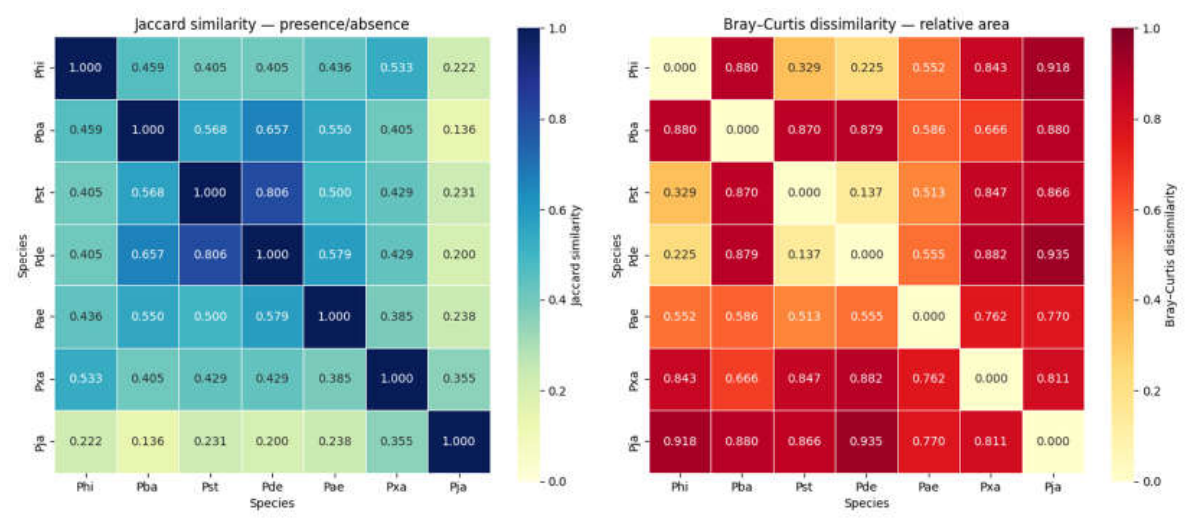
Figure 1. Pairwise compositional resemblance among the essential oils of seven Amazonian Piper species, calculated from the complete compositional data set (56 constituents; Table S1). (a) Jaccard similarity index based on the presence/absence of constituents; higher values (darker blue) indicate greater similarity. (b) Bray–Curtis dissimilarity based on relative peak areas; higher values (darker red) indicate greater dissimilarity. Species codes: Phi, P. hispidum; Pba, P. barbicuspe; Pst, P. stellipilum; Pde, P. demeraranum; Pae, P. aequale; Pxa, P. xanthostachyum; Pja, P. jalapensis.
Preprints 239205 g001
Figure 2. Hierarchically clustered heatmap of the 56 constituents (rows; compound codes C1–C56, Table S1) across the seven Amazonian Piper species (columns). Color intensity represents log(1 + relative peak area); the color scale was capped at the 95th percentile to enhance the visibility of minor constituents. The species dendrogram (top) was obtained by Ward’s linkage on the Bray–Curtis dissimilarity, and compounds were ordered by Ward’s linkage on the Euclidean distance of the log(x+1)-transformed data (dendrogram not shown). The lateral color bar indicates the chemical group of each compound (SH, sesquiterpene hydrocarbons; OS, oxygenated sesquiterpenes; MH, monoterpene hydrocarbons; OM, oxygenated monoterpenes; PP, phenylpropanoids; AH, aliphatic hydrocarbons; FA, fatty acids; DT, diterpenes; UI, unidentified). Species codes: Phi, P. hispidum; Pba, P. barbicuspe; Pst, P. stellipilum; Pde, P. demeraranum; Pae, P. aequale; Pxa, P. xanthostachyum; Pja, P. jalapensis.
Preprints 239205 g002
Figure 5. Phytotoxic effects (% relative to the control) of the essential oils of seven Piper species on (A) Lolium perenne and (B) Lactuca sativa, evaluated as seed germination (168 h), root length and leaf length. Bars represent mean values ± standard error of the mean (germination, n = 4 replicate plates; root and leaf length, n = 25 seedlings). In (A), values below zero indicate growth inhibition relative to the control, and the dashed red line marks the 50% inhibition threshold; in (B), positive values indicate growth stimulation relative to the control. Note that leaf length was not measured in L. sativa. Asterisks indicate a significant difference from the control (Kruskal–Wallis followed by Dunn’s test with Bonferroni correction, p < 0.05). Species codes: Phi, P. hispidum; Pba, P. barbicuspe; Pst, P. stellipilum; Pde, P. demeraranum; Pae, P. aequale; Pxa, P. xanthostachyum; Pja, P. jalapensis.
Preprints 239205 g005
Figure 4. Principal component analysis (PCA) biplot of the major constituents (≥ 5% in at least one species; Table 1) and the biological activities of the essential oils of seven Amazonian Piper species. All variables were autoscaled (z-score) prior to analysis. Species are shown as grey points. Thin vectors represent the compounds, colored by chemical class: PP, phenylpropanoids; SH, sesquiterpene hydrocarbons; OS, oxygenated sesquiterpenes; MH, monoterpene hydrocarbons. Thick vectors represent the biological activities, expressed so that higher values indicate greater activity: phytotoxic activity (black), as the inhibition (%) of root (LP_Root) and leaf (LP_Leaf) growth of Lolium perenne; antifungal activity (brown) against Aspergillus niger (An) and Alternaria alternata (Aa), expressed as (800—CI₅₀); and antifeedant activity (red) against Myzus persicae (Mp) and Rhopalosiphum padi (Rp), expressed as (100—EC₅₀). Vectors with nearly identical loadings are labeled jointly (C1/C13/C21, C4/C53 and C49/C51). Compound codes: C1, limonene; C4, elixene; C6, α-copaene; C11, trans-caryophyllene; C13, cis-α-bergamotene; C21, curcumene; C23, germacrene-D; C30, bicyclogermacrene; C33, δ-cadinene; C37, myristicin; C42, caryophyllene oxide; C46, apiol; C49, τ-muurolol; C51, α-cadinol; C53, dillapiol. Species codes: Phi, P. hispidum; Pba, P. barbicuspe; Pst, P. stellipilum; Pde, P. demeraranum; Pae, P. aequale; Pxa, P. xanthostachyum; Pja, P. jalapensis.
Preprints 239205 g004
Table 1. Major constituents (≥ 5% relative peak area) of the essential oils of seven Amazonian Piper species, listed in decreasing order of abundance.
Code Species Chemotype Major constituents (% ; RT, min)
Phi P. hispidum Phenylpropanoid Apiol (69.14 ; 19.49)
Pst P. stellipilum Phenylpropanoid Apiol (55.48 ; 19.49); Myristicin (15.17 ; 17.39); α-Copaene (7.37 ; 14.13)
Pde P. demeraranum Phenylpropanoid Apiol (67.13 ; 19.49); Myristicin (12.54 ; 17.39)
Pae P. aequale Mixed phenylpropanoid–sesquiterpene Apiol (29.10 ; 19.49); Dillapiol (11.33 ; 20.56)
Pba P. barbicuspe Sesquiterpene Dillapiol (20.13 ; 20.56); Germacrene-D (9.63 ; 16.54); Bicyclogermacrene (8.25 ; 16.87); Elixene (5.38 ; 13.07)
Pxa P. xanthostachyum Sesquiterpene α-Cadinol (13.76 ; 20.23); δ-Cadinene (12.63 ; 17.27); τ-Muurolol (11.49 ; 19.98); trans-Caryophyllene (8.48 ; 15.19); Bicyclogermacrene (6.19 ; 16.87)
Pja P. jalapensis Sesquiterpene Limonene (14.97 ; 6.19); α-Copaene (9.64 ; 14.13); cis-α-Bergamotene (8.52 ; 15.34); Caryophyllene oxide (7.38 ; 18.80); Curcumene (6.28 ; 16.45)
RT, retention time. The complete composition of the oils is given in Table S1.
Table 2. Summary of the chemical composition of the essential oils of seven Piper species, expressed as the sum of the relative peak area (%) of each chemical group per species based on Table S1. “No.” indicates the number of constituents assigned to each group. Species codes: Phi, P. hispidum; Pba, P. barbicuspe; Pst, P. stellipilum; Pde, P. demeraranum; Pae, P. aequale; Pxa, P. xanthostachyum; Pja, P. jalapensis.
Chemical group Code Phi Pba Pst Pde Pae Pxa Pja
Phenylpropanoids PP 69.14 20.88 71.2 80.28 40.43 1.38 0
Sesquiterpene hydrocarbons SH 10.6 45.33 19.17 11.48 32.85 46.26 36.32
Oxygenated sesquiterpenes OS 5.37 11.72 4.16 4.04 6.54 37.13 22.16
Monoterpene hydrocarbons MH 0.35 3.29 0.59 0.33 3.39 0.12 14.97
Unidentified UI 1.6 5.36 0.08 0.41 6.45 0 0
Oxygenated monoterpenes OM 1.36 0 0 0 0.91 0 4.1
Fatty acids FA 0.06 1.1 0 0 0.14 2.97 0
Diterpenes DT 0.15 1.22 0 0.07 0.55 0 0
Aliphatic hydrocarbons AH 1.49 0 0 0 0 0.26 0
Total identified 90.12 88.9 95.2 96.61 91.26 88.12 77.55
Table 3. Spore germination inhibition (%) and CI₅₀ values (µg/mL) of essential oils from seven Amazonian Piper species against Aspergillus niger and Alternaria alternata.
Species Aspergillus niger
(800 µg/mL), CI₅₀ ᵃ
Alternaria alternata
(800 µg/mL), CI₅₀ ᵃ
P. hispidum 83 ± 2 74 ± 3
116.7 (93.8–145.3) 64.7 (39.2–106.6)
P. barbicuspe 78 ± 5 80 ± 1
211.9 (156.0–287.8) 240.0 (177.2–325.1)
P. stellipilum 84 ± 1 70 ± 3
58.4 (38.6–88.3) 96.3 (65.2–142.0)
P. demeraranum 81.2 ± 0.6 68.8 ± 1.0
252.2 (214.1–297.2) >800
P. aequale 89 ± 2 86 ± 1
183.0 (131.2–255.3) 156.9 (121.8–202.1)
P. xanthostachyum 82 ± 2 84 ± 1
120.5 (92.2 (157.6) 135.2 (111.5-163.9)
P. jalapensis 85 ± 2 88 ± 1
184.8 (155.1-220.2) 207.1 (166.5-257.6)
aDose needed to inhibit 50% of spore germination and 95% confidence limits (CL).
Table 4. Antifeedant effects of essential oils from seven Amazonian Piper species against Spodoptera littoralis, Myzus persicae, and Rhopalosiphum padi.
Species %FI-SI ᵃ /
EC₅₀ ᵇ
S. littoralis M. persicae R. padi
P. hispidum %FI-SI 69 ± 13 83 ± 6 99 ± 1
EC₅₀ ~50 32.3 (22.5–46.7) 26.5 (21.4–32.9)
P. barbicuspe %FI-SI 34 ± 11 64 ± 9 74 ± 6
EC₅₀ >50 ~50 43.9 (25.5–62.1)
P. stellipilum %FI-SI 43 ± 10 88 ± 5 97 ± 1
EC₅₀ >50 36.3 (29.9–44.0) 27.9 (21.6–36.2)
P. demeraranum %FI-SI 43 ± 18 88 ± 5 97 ± 3
EC₅₀ >50 13.5 (7.2–25.3) 29.4 (16.4–38.4)
P. aequale %FI-SI 18 ± 7 81 ± 8 93 ± 2
EC₅₀ >50 25.2 (16.1–39.3) 33.2 (27.3–40.3)
P. xanthostachyum %FI-SI 47 ± 15 77 ± 5 61 ± 8
EC₅₀ >50 57.1 (43.1-75.7) >50
P. jalapensis %FI-SI 7 ± 7 75 ± 8 61 ± 8
EC₅₀ >50 41.5 (30.9-55.8) >50
ᵃ Feeding inhibition (%FR) was calculated as %FR = [1—(T/C)] × 100, where T and C represent the leaf disk area consumed in the treated and control arenas, respectively (initial concentration: 100 µg/cm²). Settling inhibition (%SI) was calculated as %SI = [1—(%T/%C)] × 100, where %T and %C denote the percentage of aphids recorded on the treated and control leaf surfaces, respectively (initial concentration: 100 µg/cm²). b EC₅₀: concentration producing 50% antifeedant activity (µg/cm²); 95% confidence limits (lower, upper) are given in parentheses. >50: EC₅₀ not determined, as inhibition did not reach the 70% threshold at 100 µg/cm². ~50: approximate EC₅₀ near 50 µg/cm².
Disclaimer/Publisher’s Note: The statements, opinions and data contained in all publications are solely those of the individual author(s) and contributor(s) and not of MDPI and/or the editor(s). MDPI and/or the editor(s) disclaim responsibility for any injury to people or property resulting from any ideas, methods, instructions or products referred to in the content.
Copyright: This open access article is published under a Creative Commons CC BY 4.0 license, which permit the free download, distribution, and reuse, provided that the author and preprint are cited in any reuse.