

Submitted:
27 October 2026
Posted:
28 October 2026
You are already at the latest version
Abstract
Antibiotic disturbance of the human microbiome is usually judged by whether community composition returns to baseline. We argue that this endpoint runs on the wrong clock. The same exposures, read at two levels, give opposite answers: composition recovers in weeks, while resistance persists for months. In a 2015 trial, salivary composition recovered within about 30 days while faecal communities stayed altered for up to 12 months; in a 2007 trial, one course of azithromycin or clarithromycin raised pharyngeal carriage of macrolide-resistant streptococci by 53·4 points at day 4 with azithromycin and 50·0 points at day 8 with clarithromycin, still above baseline at day 180. We call this asymmetry composition–resistance decoupling, and propose a minimum standard that measures both clocks, with denominators, until resistance returns to baseline.
Keywords:
microbiome resilience
; antimicrobial resistance
; composition–resistance decoupling
; oral microbiome
; resistome
; recovery endpoints
Introduction
One exposure, two answers
Ask whether the human microbiome recovers after antibiotics, and the literature gives two answers. Both come from randomized trials. The difference is not the drug, the dose, or the cohort. The difference is what was measured, and for how long.
Measured at the level of community composition, recovery is fast. Measured at the level of resistance, recovery is slow, and in every study where resistance rose and follow-up extended beyond exposure, decay was incomplete within the window, save the erythromycin arm of the Burr trial, which returned to baseline by week 8. We call this asymmetry composition–resistance decoupling. It is not a niche observation. It appears in the largest randomized trial of macrolides in healthy volunteers [1], in paired saliva and feces from the same individuals [2], in a small trial of four-week macrolide exposure [3], and in two companion papers that followed the same 20 patients and reported opposite conclusions at the two levels [4,5].
The two answers are possible because recovery has at least three measurable levels, and they do not recover together. The first is composition: which taxa are present and at what relative abundance. The second is diversity: indices such as richness and evenness that summarize how the community is structured. The third is the resistome: the full set of antibiotic resistance genes carried by the community, whether measured by culture of resistant isolates, targeted PCR, or metagenomics. A study that declares recovery has always declared it at a specific level, on a specific clock. Much of the confusion in this literature comes from treating the three levels as interchangeable.
The composition endpoint won by default, not by argument. Culture counts and, later, 16S rRNA sequencing were the cheap, standardized readouts of the microbiome era, so they became the default measure of disturbance and of recovery. Resistance measurement lived in a different tradition, in clinical microbiology and infectious disease trials, and the two traditions rarely met in the same study. The result is a literature in which the question “did the microbiome recover?” is usually answered with the instrument that was on the shelf, not with the instrument that answers the question.
The decoupling has a practical consequence. Most microbiome resilience studies, and most antibiotic trials that include a microbiome endpoint, measure composition. Composition returns to baseline within weeks. The study then closes with a message of recovery, while the resistance cost is still running. This Perspective lays out the evidence for the two clocks, examines why they diverge, and proposes a minimum standard for how recovery should be measured.
Results
The composition clock runs in weeks
Zaura and colleagues randomized 66 healthy adults to clindamycin, ciprofloxacin, amoxicillin, minocycline, or placebo, and sequenced saliva and feces for 12 months [2]. The trial, published in 2015, remains the most direct comparison of two body sites under identical exposure. Salivary species richness fell in the first week, showing that the hit was real. By day 30 the salivary community had largely returned to its pre-treatment state. The authors described the salivary microbiome as strikingly robust. The fecal community in the same volunteers told a different story, with butyrate-producing bacteria suppressed for months and species richness in the ciprofloxacin arm still below baseline at 12 months. A review of the wider evidence reached the same directional verdict: the oral community is more resilient than the colonic one [6].
Composition-level recovery is not confined to sequencing studies. In 1999, Feres and colleagues randomized 20 adults with periodontitis to scaling plus doxycycline 100 mg daily for 14 days (10 patients) or scaling alone (10 patients) [4]. Subgingival composition in the treated arm returned to baseline, and the major periodontal pathogens were not significantly altered. In 2022, Burr and colleagues randomized 20 healthy adults to four weeks of azithromycin or erythromycin (10 per arm), with 20 close contacts sampled in parallel [3]. Neither drug changed oropharyngeal composition significantly at week 4 or at week 8. Culture-era work points the same way. Penicillin V at full therapeutic doses for 7 days produced no statistically detectable change in the oral and throat flora of 10 volunteers in 1979 [7]. In a household-matched study from 2016, salivary diversity after a 3- to 7-day course of azithromycin had largely recovered within 6 months, although the amoxicillin arm stayed below baseline [8]. In the same households, gut diversity had not returned to baseline at 6 months with either drug [8].
Read at this level, the message is reassuring. Antibiotics disturb the oral community, and the community bounces back in weeks. This message now appears, in one form or another, in review articles, in stewardship materials, and in the discussion sections of trials. It is accurate as far as it goes. The question is where it stops.
The resistance clock runs in months
The same exposures, read at the level of resistance, give the opposite message.
The strongest evidence is the randomized, double-blind, placebo-controlled trial published in The Lancet in 2007 [1]. Malhotra-Kumar and colleagues randomized 224 healthy adults to azithromycin 500 mg daily for 3 days (74 participants), clarithromycin 500 mg twice daily for 7 days (74 participants), or placebo (76 participants). One course of either drug drove pharyngeal carriage of macrolide-resistant streptococci up by 53·4 percentage points at day 4 in the azithromycin arm (95% CI 43·4 to 63·5) and by 50·0 percentage points at day 8 in the clarithromycin arm (95% CI 41·7 to 58·2). The elevation had not returned to baseline at day 180, the last follow-up, in an intention-to-treat analysis that retained all randomized participants despite 105 dropouts. The clarithromycin arm also showed significant enrichment of erm(B), a gene that methylates the ribosomal target of macrolides.
The finding has been replicated at every scale of exposure. In 2004, Berg and colleagues randomized 296 patients with coronary artery disease to slow-release clarithromycin 500 mg daily or placebo for about two weeks before cardiac surgery [9]. The mean resistant fraction of the indigenous oropharyngeal flora rose from 3·4% at baseline to 21·1% at the end of treatment, versus 1·1% on placebo, and the fraction of participants carrying resistant flora rose from 31% to 69%. Eight weeks after the last dose, the figures were 11·4% versus 2·6% (P<0·0001). More than 90% of the resistant isolates carried Tn916-family mobile elements.
The clearest demonstration of decoupling comes from the Feres companion papers of 1999. Paper I reported that subgingival composition returned to baseline after 14 days of doxycycline [4]. Paper II, from the same 20 patients, reported that the proportion of doxycycline-resistant isolates in saliva rose from 13±1% at baseline to 81±10% during dosing, fell to 46±8% two weeks after dosing, and still stood at 22±5% at day 90 [5]. Subgingival plaque followed the same shape at a lower amplitude, from 6±2% resistant isolates to 48±9% during dosing and back to 9±2% at day 90 [5]. One trial supplied both sides of the argument, depending on which clock the authors read.
Small trials agree. In the Burr trial, proportional macrolide resistance in oropharyngeal streptococci increased with both drugs, and in the azithromycin arm erm(B) and mef gene levels remained above baseline four weeks after the last dose; in the erythromycin arm they had returned to baseline by the same date[3]. Composition in that trial never moved. Khalil and colleagues followed 29 healthy volunteers after a single 2 g dose of amoxicillin, the routine prophylactic dose before dental procedures, and published the results in 2016[10]. Counts of Streptococcus salivarius fell on days 2 and 5, and the proportion of viridans streptococci with reduced amoxicillin susceptibility rose over the same window. Selection does not require a course. A single dose registers. Dental prophylaxis on this schedule is delivered to large numbers of patients every year, so even a small per-dose effect repeats at scale. Earlier still, in 1982, erythromycin 500 mg twice daily for 7 days left 8 of 10 volunteers newly colonized by erythromycin-resistant enterobacteria, even though total flora counts barely changed[11].
Long-term exposure raises the ceiling. The AZISAST trial randomized 109 patients with severe asthma to 26 weeks of low-dose azithromycin (55 participants) or placebo (54 participants) and reported results in 2013 [12]. Oropharyngeal carriage of erythromycin-resistant streptococci rose from 47·8% (11/23) to 87% (20/23) on azithromycin, while the placebo arm moved from 39·1% to 35%. The MACRO trial randomized 1142 patients with COPD to a year of azithromycin 250 mg daily or placebo [13]. Among participants who acquired new nasopharyngeal colonization during the study, 81% of colonizing strains in the azithromycin group were macrolide-resistant, versus 41% on placebo (P<0·001). In a cross-sectional study of 105 acne patients in 2003, antibiotic use beyond three months was associated with a 33% oropharyngeal carriage rate of Streptococcus pyogenes (13 of 39), versus 10% in non-users (6 of 63), and 85% of the isolates from users (11 of 13) were resistant to at least one tetracycline, versus 20% (1 of 5) from non-users [14].
The pattern is not confined to the mouth. In the gut, a 7-day course of clindamycin selected for resistant Bacteroides clones that were still detectable 2 years later
[15]
. Extrapolation across niches needs care, but the direction of the asymmetry is the same wherever both clocks have been read.
One honest exception keeps the pattern sharp. In the Zaura trial, the salivary resistance-gene load stayed statistically flat between baseline and post-treatment samples (mean 0·99 relative to baseline), while resistance genes accumulated in feces [2]. Decoupling is compartment-specific. It is strongest where drug reaches the niche, and weakest where it does not.
Why the clocks diverge
Three mechanisms explain why the two clocks run at different speeds.
Selection is not destruction. Antibiotics rarely sterilize a niche. They change proportions. Susceptible cells are killed, resistant cells remain, and the community regrows from survivors and from re-inoculation. The regrown community can match the pre-exposure roster species by species while differing in gene content. A composition endpoint, whether culture-based or sequence-based, reads the roster. It does not read the genes.
Resistance genes ride on vehicles with inertia. The macrolide resistance gene erm(B) sits on Tn916-family conjugative transposons, and mef(E) sits on the MEGA element. These are mobile DNA that copies itself between strains and species. In the Berg trial, over 90% of resistant oropharyngeal isolates carried Tn916-like elements [9]. Once an element has spread into new hosts, stopping the drug does not remove it on the composition clock. Decay requires the slower process of displacement by susceptible strains, which competes on a timescale of months.
Pharmacology sets the local dose. An antibiotic can only disturb a niche it reaches. Ciprofloxacin reaches saliva at bactericidal concentrations: two 750 mg doses cut total salivary colony counts by a mean of 94·9% (range 79·6 to 99·9) in 16 volunteers in 1988 [16], and steady-state salivary concentrations of 1·29 µg/mL were measured at 750 mg twice daily in 1989 [17]. Penicillin V barely enters saliva at all [18], which explains its negligible oral disturbance at full therapeutic doses [7]. Azithromycin has a half-life of about 68 hours, so a 3-day course exposes tissue for roughly a week beyond the last pill. This pharmacology fits the Burr result exactly: azithromycin left erm(B) and mef elevated four weeks after dosing stopped, while short-half-life erythromycin had already washed out [3]. Concentration time matters as well as peak concentration. Doses that hold a community below the inhibitory threshold for longer apply more selection, which is why a year of maintenance azithromycin [12,13] moves resistance further than a single course [1].
The structure of the oral community adds a fourth mechanism. Oral bacteria live in biofilms, embedded in an extracellular matrix of polysaccharides, proteins, and DNA that slows drug penetration and shelters slow-growing persister cells in the deeper layers [6,19]. Biofilm structure protects the community during exposure and supplies survivors for regrowth afterward. This helps explain the fast composition clock. It does nothing for the resistance clock, because the survivors that reseed the niche are disproportionately the ones that tolerated the drug.
Two measurement artifacts widen the apparent gap. Composition metrics are coarse: a species-level roster can hide strain-level turnover, and culture-based rosters are coarser still. Saliva, the most common oral sample, is a pooled effluent of every oral niche. Studies that sample saliva can miss what happened in subgingival biofilm or tonsillar crypts, where drug penetration and biofilm protection are most uneven. The same openness that speeds composition recovery may also move resistance. In an analysis of 9715 metagenomes from 20 countries published in 2023, cohabiting adults shared a median of 32% of oral strains, versus 12% of gut strains [20]. The channel that reseeds susceptible strains after antibiotics can, in principle, move resistant ones as well. A second non-commensurability sits one level down: the resistance endpoint itself was measured differently across trials—culture-based carriage proportions (Malhotra-Kumar, Berg, AZISAST), fixed-concentration doxycycline selection at 4 µg/mL (Feres), and qPCR-normalized gene abundance (Burr)—so the percentages in Table 1 and Figure 1 are each exact within their own assay and not strictly interchangeable across studies.
Discussion
What the wrong clock costs
The quantified consequences are mapped in Figure 1b.
The practical stakes sit in three places. The first is the individual prescription. A course judged harmless because composition recovers may still leave a pharyngeal reservoir of resistant streptococci for months [1,9]. The resistance genes recovered in these trials, including erm(B) on mobile elements, are the same genes found in respiratory pathogens [9]. The commensal reservoir is therefore not a private matter for the patient. It is a standing stock of transferable resistance in a shared airway ecosystem.
The second is the trial. Long-term macrolide programs in COPD and severe asthma are justified by fewer exacerbations, and that benefit is real [12,13]. But a benefit-harm assessment that counts exacerbations and audiograms while ignoring an oropharyngeal resistance rate of 87% [12] is incomplete arithmetic. Whether the reservoir converts into harder-to-treat infection has not been proven in these cohorts. That gap is an argument for measuring, not for assuming the cost is zero.
The third is the evidence base itself. Reviews and guidelines that summarize antibiotic effects on the microbiome inherit the endpoint choices of the primary studies. If the primary studies stop at composition, the summary will read as reassurance. Decoupling means the reassurance is an artifact of the follow-up window. Bacterial fitness supplies the deeper reason the two clocks separate at all. Resistance that imposes no growth cost persists; resistance that costs is compensated rather than lost. In the framing of Andersson and Hughes, reversal fails whenever the cost of resistance is low or a compensatory mutation absorbs it, which is why so few documented reversals exist to cite [21].
A minimum standard for measuring recovery
The asymmetry would be a curiosity if recovery studies measured both clocks. Most do not. The composition endpoint is cheap, familiar, and quick to resolve. The resistance endpoint is slower and less standardized. The result is a literature that systematically reports recovery where the full accounting would show a residual cost. We propose five changes.
First, dual endpoints. Any study that claims recovery after antibiotics should report composition and resistance at every follow-up point, from the same samples. The Feres companion papers show what happens when the two are separated into different reports: each paper is accurate, and together they describe a different reality [4,5].
Second, resistome metrics as routine secondary endpoints in antibiotic trials that include a microbiome arm, and in antimicrobial stewardship evaluations. AZISAST and MACRO collected oropharyngeal resistance data and found the largest effects in the field [12,13]. Most trials of long-term antibiotics still report efficacy and adverse events only.
Third, follow-up of at least 180 days after exposure. The Lancet trial stopped at day 180 with the effect still present [1]. The clarithromycin trial stopped at 8 weeks [9]. The Burr trial stopped 4 weeks after dosing [3]. With the exception of the erythromycin arm of [3], where gene levels returned to baseline within four weeks of dosing cessation, no oral study has followed a macrolide-driven resistance rise back to baseline within the published windows. The full length of the resistance clock is unknown by design, not by evidence of rapid decay.
Fourth, report with denominators. Carriage prevalence, resistant fraction, and gene abundance should each carry per-arm counts, calendar dates, and attrition numbers. Aggregate statements about recovery without denominators should be treated as uninterpretable.
Fifth, strain-level resolution where recovery is claimed. Species rosters can conceal the replacement of susceptible strains by resistant congeners within the same species.
None of these changes requires new technology. Culture on selective media, targeted PCR, and shallow shotgun sequencing are already routine. Trial sponsors can add a resistome sub-study to long-term antibiotic programs at marginal cost, as AZISAST and MACRO showed [12,13]. Journals can require dual endpoints for papers that claim recovery. Guideline panels that weigh the single 2 g amoxicillin prophylactic dose [10] or maintenance azithromycin in COPD [13] already balance benefit against harm; the harm side of that ledger currently omits the resistance clock.
Two populations deserve earlier adoption of these standards. In children, whose communities are still assembling, antibiotic exposure in the first two years of life was associated with altered oral composition at age 7 in a 90-child Swedish cohort published in 2018, without loss of diversity [22]. In the same cohort, breastfeeding partly attenuated the association, which suggests the trajectory is modifiable [22]. In long-term users, including patients with COPD or severe asthma on maintenance azithromycin and patients with acne on months of tetracyclines, the exposure is continuous and the resistance signal is the strongest on record [12,13,14]. For these groups, the composition clock is not merely optimistic. It measures the wrong thing.
Limitations
This Perspective draws mainly on macrolides and on oral and pharyngeal sampling, and the strength of decoupling for other drug classes and other niches is less certain. The largest trials stopped follow-up while resistance was still elevated, so we cannot state when, or whether, the resistance clock reaches baseline. Several supporting studies are small, culture-based, or observational, and we have treated their results as corroborating rather than causal.
The question of whether the microbiome recovers after antibiotics is two questions wearing one coat. The first question has been answered repeatedly, on a clock of weeks. The second has rarely been asked, and has never been followed to its end. Studies that stop at composition will keep reporting recovery. The resistance cost will keep accruing off the clock.
Methods
This is a secondary analysis of published studies; no primary data were generated and no protocol was registered, as this is not a systematic review. We searched PubMed and publisher platforms for randomized trials and cohort studies reporting microbial community composition or antimicrobial resistance after systemic antibiotic exposure in healthy humans, with emphasis on studies that measured both levels within the same cohort. The 22 studies listed in the reference list met this bar; each carries a DOI locator. From each study we extracted the drug, dose, duration, cohort size, sampling site, and the composition-level and resistance-level outcomes at every reported timepoint, quoting the original trial arms and denominators throughout.
Supplementary Materials
The following supporting information can be downloaded at the website of this paper posted on Preprints.org.
Contributors
SC conceived, researched, and wrote the manuscript.
Declaration of interests
I declare no competing interests.
Acknowledgments
The author takes full responsibility for the content. This work was supported by the Beijing Science and Technology Nova Program Interdisciplinary Project (20230484439) and the Beijing High-Level Public Health Technical Talents Project (2023-02-33). The funders had no role in study design, data collection and analysis, decision to publish, or preparation of the manuscript.
Data Availability
No primary data were generated for this article. All data cited are drawn from the 22 published sources listed in the reference list, each of which carries a DOI locator; all were publicly available before the initiation of this work.
References
- Malhotra-Kumar, S.; Lammens, C.; Coenen, S.; Van Herck, K.; Goossens, H. Effect of azithromycin and clarithromycin therapy on pharyngeal carriage of macrolide-resistant streptococci in healthy volunteers: A randomised, double-blind, placebo-controlled study. Lancet 2007, 369, 482–490. [Google Scholar] [CrossRef] [PubMed]
- Zaura, E.; Brandt, B.W.; Teixeira de Mattos, M.J.; et al. Same exposure but two radically different responses to antibiotics: Resilience of the salivary microbiome versus long-term microbial shifts in feces. mBio 2015, 6, e01693–15. [Google Scholar] [CrossRef] [PubMed]
- Burr, L.D.; Taylor, S.L.; Richard, A.; et al. Assessment of long-term macrolide exposure on the oropharyngeal microbiome and macrolide resistance in healthy adults and consequences for onward transmission of resistance. Antimicrob. Agents Chemother. 2022, 66, e0224621. [Google Scholar] [CrossRef] [PubMed]
- Feres, M.; Haffajee, A.D.; Goncalves, C.; et al. Systemic doxycycline administration in the treatment of periodontal infections (I). Effect on the subgingival microbiota. J. Clin. Periodontol. 1999, 26, 775–783. [Google Scholar] [CrossRef] [PubMed]
- Feres, M.; Haffajee, A.D.; Goncalves, C.; et al. Systemic doxycycline administration in the treatment of periodontal infections (II). Effect on antibiotic resistance of subgingival species. J. Clin. Periodontol. 1999, 26, 784–792. [Google Scholar] [CrossRef] [PubMed]
- Wade, W.G. Resilience of the oral microbiome. Periodontol 2000 2021, 86, 113–122. [Google Scholar] [CrossRef] [PubMed]
- Heimdahl, A.; Nord, C.E. Effect of phenoxymethylpenicillin and clindamycin on the oral, throat and faecal microflora of man. Scand. J. Infect. Dis. 1979, 11, 233–242. [Google Scholar] [CrossRef] [PubMed]
- Abeles, S.R.; Jones, M.B.; Santiago-Rodriguez, T.M.; et al. Microbial diversity in individuals and their household contacts following typical antibiotic courses. Microbiome 2016, 4, 39. [Google Scholar] [CrossRef] [PubMed]
- Berg, H.F.; Tjhie, J.H.T.; Scheffer, G.J.; et al. Emergence and persistence of macrolide resistance in oropharyngeal flora and elimination of nasal carriage of Staphylococcus aureus after therapy with slow-release clarithromycin: A randomized, double-blind, placebo-controlled study. Antimicrob. Agents Chemother. 2004, 48, 4183–4188. [Google Scholar] [CrossRef] [PubMed]
- Khalil, D.; Hultin, M.; Rashid, M.U.; Lund, B. Oral microflora and selection of resistance after a single dose of amoxicillin. Clin. Microbiol. Infect. 2016, 22, 949.e1–949.e4. [Google Scholar] [CrossRef] [PubMed]
- Heimdahl, A.; Nord, C.E. Influence of erythromycin on the normal human flora and colonization of the oral cavity, throat and colon. Scand. J. Infect. Dis. 1982, 14, 49–56. [Google Scholar] [CrossRef] [PubMed]
- Brusselle, G.G.; VanderStichele, C.; Jordens, P.; et al. Azithromycin for prevention of exacerbations in severe asthma (AZISAST): A multicentre randomised double-blind placebo-controlled trial. Thorax 2013, 68, 322–329. [Google Scholar] [CrossRef] [PubMed]
- Albert, R.K.; Connett, J.; Bailey, W.C.; et al. Azithromycin for prevention of exacerbations of COPD. N Engl. J. Med. 2011, 365, 689–698. [Google Scholar] [CrossRef] [PubMed]
- Levy, R.M.; Huang, E.Y.; Roling, D.; Leyden, J.J.; Margolis, D.J. Effect of antibiotics on the oropharyngeal flora in patients with acne. Arch. Dermatol. 2003, 139, 467–471. [Google Scholar] [CrossRef] [PubMed]
- Jernberg, C.; Löfmark, S.; Edlund, C.; Jansson, J.K. Long-term ecological impacts of antibiotic administration on the human intestinal microbiota. ISME J. 2007, 1, 56–66. [Google Scholar] [CrossRef] [PubMed]
- Appelbaum, P.C.; Spangler, S.K.; Strauss, M. Reduction of oral flora with ciprofloxacin in healthy volunteers. J. Antimicrob. Chemother. 1988, 21, 243–249. [Google Scholar] [CrossRef] [PubMed]
- Piercy, E.A.; Bawdon, R.E.; Mackowiak, P.A. Penetration of ciprofloxacin into saliva and nasal secretions and effect of the drug on the oropharyngeal flora of ill subjects. Antimicrob. Agents Chemother. 1989, 33, 1645–1646. [Google Scholar] [CrossRef] [PubMed]
- Troeltzsch, M.; Pache, C.; Probst, F.A.; Troeltzsch, M.; Ehrenfeld, M.; Otto, S. Antibiotic concentrations in saliva: A systematic review of the literature, with clinical implications for the treatment of sialadenitis. J. Oral Maxillofac. Surg. 2014, 72, 67–75. [Google Scholar] [CrossRef] [PubMed]
- Lv, C.; Wang, Z.; Li, Z.; Shi, X.; Xiao, M.; Xu, Y. Formation, architecture, and persistence of oral biofilms: Recent scientific discoveries and new strategies for their regulation. Front Microbiol. 2025, 16, 1602962. [Google Scholar] [CrossRef] [PubMed]
- Valles-Colomer, M.; Blanco-Míguez, A.; Manghi, P.; et al. The person-to-person transmission landscape of the gut and oral microbiomes. Nature 2023, 614, 125–135. [Google Scholar] [CrossRef] [PubMed]
- Andersson, D.I.; Hughes, D. Antibiotic resistance and its cost: Is it possible to reverse resistance? Nat. Rev. Microbiol. 2010, 8, 260–271. [Google Scholar] [CrossRef] [PubMed]
- Dzidic, M.; Collado, M.C.; Abrahamsson, T.; et al. Oral microbiome development during childhood: An ecological succession influenced by postnatal factors and associated with tooth decay. ISME J. 2018, 12, 2292–2306. [Google Scholar] [CrossRef] [PubMed]
Figure 1.
Two clocks in the same trials, and what the wrong clock costs. (a) For each of eight studies, the composition endpoint (upper marker: open circle = recovered, filled square = still abnormal, purple diamond = on-treatment acquisition suppressed, not a recovery endpoint, gray triangle = not measured or not the primary readout) and the resistance endpoint (lower red marker: still above baseline) are plotted on a shared log-scaled timeline; marker size is proportional to log10 trial size (N = 20 to 1,142); the connecting band is the gap between the two clocks. (b) The same eight studies judged by composition (left, blue) versus by resistance (right, red); arrows mark endpoints beyond the last follow-up, hatched or dotted bars are not recovery endpoints (Khalil, not recovered by day 5; MACRO, on-treatment acquisition suppressed); the arm-level exceptions (Zaura salivary load stable; Burr erythromycin arm returned to baseline by week 8) are marked in green. Resistance was still above baseline when observation ended in 6 of 8 studies—the count excludes Zaura (salivary resistance-gene load stayed flat at 0·99 relative to baseline) and MACRO (an on-treatment acquisition endpoint, not a recovery readout); Burr counts through its azithromycin arm. Values and denominators in Table 1.
Figure 1.
Two clocks in the same trials, and what the wrong clock costs. (a) For each of eight studies, the composition endpoint (upper marker: open circle = recovered, filled square = still abnormal, purple diamond = on-treatment acquisition suppressed, not a recovery endpoint, gray triangle = not measured or not the primary readout) and the resistance endpoint (lower red marker: still above baseline) are plotted on a shared log-scaled timeline; marker size is proportional to log10 trial size (N = 20 to 1,142); the connecting band is the gap between the two clocks. (b) The same eight studies judged by composition (left, blue) versus by resistance (right, red); arrows mark endpoints beyond the last follow-up, hatched or dotted bars are not recovery endpoints (Khalil, not recovered by day 5; MACRO, on-treatment acquisition suppressed); the arm-level exceptions (Zaura salivary load stable; Burr erythromycin arm returned to baseline by week 8) are marked in green. Resistance was still above baseline when observation ended in 6 of 8 studies—the count excludes Zaura (salivary resistance-gene load stayed flat at 0·99 relative to baseline) and MACRO (an on-treatment acquisition endpoint, not a recovery readout); Burr counts through its azithromycin arm. Values and denominators in Table 1.
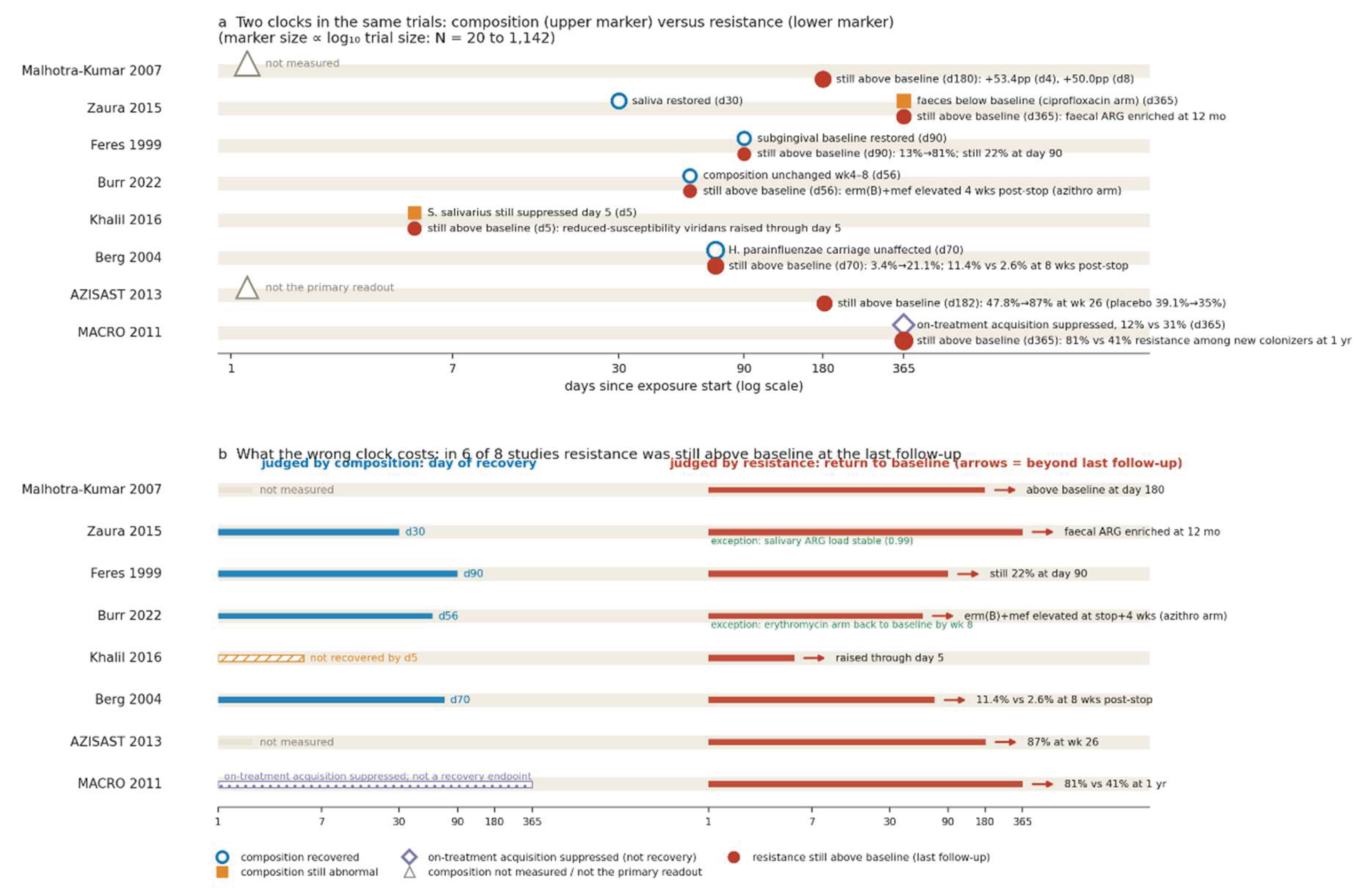

Table 1.
Two clocks in the same studies: composition recovery versus resistance persistence after antibiotics.
Table 1.
Two clocks in the same studies: composition recovery versus resistance persistence after antibiotics.
| Study (year) | Design and N | Exposure | Composition clock | Resistance clock |
|---|---|---|---|---|
| Malhotra-Kumar 2007 [1] | Randomized double-blind placebo-controlled trial; 224 healthy adults (74 azithromycin, 74 clarithromycin, 76 placebo) | One course: azithromycin 500 mg/day for 3 days, or clarithromycin 500 mg twice daily for 7 days | Not reported (resistance was the trial endpoint; composition was not measured) | Carriage of macrolide-resistant streptococci up 53·4 percentage points (day 4) and 50·0 points (day 8); still above baseline at day 180, the last follow-up; erm(B) enriched in the clarithromycin arm |
| Zaura 2015 [2] | Randomized placebo-controlled trial; 66 healthy adults | Clindamycin, ciprofloxacin, amoxicillin, or minocycline | Salivary composition largely restored by day 30; fecal richness in the ciprofloxacin arm below baseline at 12 months | Salivary resistance-gene load stable (mean 0·99); resistance genes enriched in feces |
| Feres 1999, papers I and II [4,5] | Randomized controlled trial; 20 adults with periodontitis (10 doxycycline, 10 control) | Doxycycline 100 mg/day for 14 days | Subgingival composition back to baseline by day 90; major periodontal pathogens unchanged | Salivary doxycycline-resistant isolates 13% to 81% during dosing; 22% at day 90 |
| Burr 2022 [3] | Randomized single-blind parallel-group trial; 20 healthy adults (10 per arm) plus 20 close contacts | Azithromycin or erythromycin for 4 weeks | Oropharyngeal composition unchanged at week 4 and week 8 | Azithromycin arm: erm(B) and mef above baseline 4 weeks after stopping; erythromycin arm: back to baseline |
| Khalil 2016 [10] | Prospective single-arm study; 29 healthy volunteers | Amoxicillin 2 g, single dose | Streptococcus salivarius counts suppressed on days 2 and 5 | Proportion of reduced-susceptibility viridans streptococci raised through day 5 |
| Berg 2004 [9] | Randomized double-blind placebo-controlled trial; 296 patients with coronary artery disease | Slow-release clarithromycin 500 mg/day, about 2 weeks | Haemophilus parainfluenzae carriage unaffected in either arm | Resistant fraction of oropharyngeal flora 3·4% to 21·1% (placebo 1·1%); 11·4% versus 2·6% eight weeks after stopping; over 90% of resistant isolates carried Tn916-family elements |
| Brusselle 2013 (AZISAST) [12] | Randomized double-blind placebo-controlled trial; 109 patients with severe asthma (55 azithromycin, 54 placebo); the resistance endpoint was measured in a 46-participant substudy (23 per arm) | Low-dose azithromycin for 26 weeks | Not the primary readout | Oropharyngeal erythromycin-resistant streptococci 47·8% to 87% (placebo 39·1% to 35%) |
| Albert 2011 (MACRO) [13] | Randomized placebo-controlled trial; 1142 patients with COPD | Azithromycin 250 mg/day for 1 year | New colonization less frequent on azithromycin (12% versus 31%; an on-treatment acquisition effect, not a recovery endpoint) | Macrolide resistance among newly colonizing strains 81% versus 41% (P<0·001) |
Disclaimer/Publisher’s Note: The statements, opinions and data contained in all publications are solely those of the individual author(s) and contributor(s) and not of MDPI and/or the editor(s). MDPI and/or the editor(s) disclaim responsibility for any injury to people or property resulting from any ideas, methods, instructions or products referred to in the content. |
© 2026 by the authors. Licensee MDPI, Basel, Switzerland. This article is an open access article distributed under the terms and conditions of the Creative Commons Attribution (CC BY) license (http://creativecommons.org/licenses/by/4.0/).
Copyright: This open access article is published under a Creative Commons CC BY 4.0 license, which permit the free download, distribution, and reuse, provided that the author and preprint are cited in any reuse.