

Submitted:
27 October 2026
Posted:
28 October 2026
You are already at the latest version
Abstract
This review systematically examines the mechanisms underlying the efficacy of Cold atmospheric plasma (CAP), with particular emphasis on the interaction pathways between reactive oxygen and nitrogen species (RONS) and biological or chemical contaminants. It evaluates the impact of key processing parameters and food matrices on treatment outcomes and synthesizes recent advances in CAP applications for mitigating diverse food hazards. Limitations and current research gaps are discussed, especially regarding the complex interactions between plasma-generated species and food components. Future research directions are outlined, focusing on molecular-level mechanistic studies, the development of tailored treatment protocols for specific food categories, and the integration of real-time monitoring systems to enable precise, optimized plasma processing.
Keywords:
cold atmospheric plasma
; food safety
; reactive species
; food characteristics
; food quality preservation
1. Introduction
The food supply chain—encompassing cultivation, processing, preservation, and distribution—is vulnerable to contamination at multiple stages [1]. World Health Organization (WHO) (2023) reports that contaminated food causes over 200 diseases, affecting approximately 10% of the global population annually through foodborne illnesses [2,3]. Conventional food safety interventions, while effective against certain hazards, often compromise the sensory, nutritional, and structural qualities of food products. Therefore, a central challenge in modern food science lies in developing technologies that can ensure microbiological and chemical safety while simultaneously preserving the inherent quality attributes of food.
Biological and chemical contaminants cause foodborne diseases, among which pathogenic microorganisms (bacteria, viruses, fungi) account for an estimated 600 million cases [4], resulting in 420 000 global deaths each year [5]. Equally concerning are chemical contaminants such as mycotoxins—persistent, toxic metabolites produced by fungi—and pesticide residues, which enter the food chain through agricultural practices and exhibit environmental stability, posing long-term health risks [6]. Traditional decontamination methods, including thermal processing, high-pressure treatment, and freezing, frequently induce undesirable changes in food texture, flavor, and nutrient content. Moreover, their unitary modes of action often fall short of addressing the coexistence of diverse contaminants in complex food matrices [7,8,9].
CAP is a typical non-heat treatment technology that can be carried out at room temperature [4], effectively avoiding the adverse effects of high and low temperatures on food [10]. CAP generates a large amount of ROS, RNS, and charged particles during the processing. CAP generates a cocktail of RONS, ultraviolet photons, and charged particles, which collectively inactivate microorganisms and degrade chemical contaminants through oxidative damage, DNA disruption, and bond cleavage [11,12,13]. Its efficacy is highly tunable; by modulating processing parameters such as voltage, exposure time, and gas composition, the output of active species can be precisely controlled to balance safety and quality outcomes. Appropriately optimized CAP treatments can not only ensure safety but have also been shown to positively influence certain food quality attributes, such as texture and flavor enhancement [14,15]. While earlier reviews have firmly established the efficacy of CAP in ensuring food safety, they have largely overlooked its concurrent impact on food quality attributes. Therefore, based on our work experience in this field, we discussed the mechanisms by which CAP affects microorganisms, mycotoxins, and pesticides, as well as the effects of CAP on proteins, lipids, vitamins, and carbohydrates, which have important impacts on food structure, flavor, texture, and nutrition. Finally, the application of CAP in food safety control was discussed, and future prospects were proposed (Figure 1).
2. Cold Atmospheric Plasma (CAP): Fundamentals
2.1. Definition and Mechanism of CAP
Plasma is a gas that is at least partially ionized. This state is where the energy level of the material continuously increases, causing the phase of the material to transition from solid to liquid, then to gas, and finally to ionized state [16]. Therefore, it is called the fourth state of matter [17]. It is achieved by applying a certain amount of energy to the gas, causing electrons in atoms to be stripped away, resulting in a mixture of free radicals, free electrons, neutral substances, and positively charged substances [18]. According to Maxwell-Boltzmann thermodynamic equilibrium, it can be divided into thermal plasma and non-thermal plasma. Thermal plasma is a gas that is almost completely ionized, and its electron temperature is similar to that of neutral substances and ions, much higher than room temperature [19]. In contrast, CAP- the focus of this review — is a type of non-thermal plasma where the electron temperature is significantly higher than that of the heavier ions and neutral particles, while the bulk gas remains near ambient temperature [20]. This unique property allows CAP to be generated and applied at atmospheric pressure and room temperature [21,22], minimizing thermal damage to heat-sensitive materials like biological tissues and food products, thus making it particularly suitable for applications in food preservation and safety [23,24], agriculture [25,26,27], and medical fields[25,28,29,30,31].
The ways in which plasma is generated include energy-inducing fragmentation, excitation of molecules, and ionization, making it highly reactive and not requiring vacuum equipment [32,33]. The formation of plasma requires sufficient power supply, specific electrodes, and carrier gases, which are usually oxygen, nitrogen, and helium [17]. Devices for generating CAP are primarily classified according to their discharge mechanisms [34], with the main categories being dielectric barrier discharge (DBD) [35], plasma jet systems [36], corona discharge, and arc discharge. In addition, indirect CAP treatment primarily relies on plasma-activated media, including systems such as plasma-activated water [34,37], activated hydrogels [31], nanoparticles [38] and activated patches [39]; the target does not come into contact with the discharge zone, and biological effects are mediated by long-lived RONS pre-enriched by the medium, thereby avoiding direct exposure to electric fields, ultraviolet radiation, and charged particles.
2.2. Historical Development of CAP Technology
As a new type of molecular activation method, cold plasma technology enables reactions that are difficult to occur under thermodynamic equilibrium conditions to occur under mild conditions [43], and the activated substances produced have bactericidal effects without damaging the original nutritional components and sensory characteristics of food, gradually catching the attention of food safety scientists. The use of plasma for cleaning dates back to the 1850s, when dielectric barrier discharge was first used to remove biological pollutants from water. But for a long time, how CAP interacts with living cells remained unclear. It was not until about 130 years later that this mystery began to be solved. Since the 1960s, CAP has been increasingly used for killing microbes, and over the next three decades, the sterilization mechanisms became progressively clearer [44].
In 2002, Montenegro et al. applied cold plasma to food safety for the first time. They reduced the number of Escherichia coli O157:H7 in apple juice by 7 logs [45]. This work proved that CAP can be effectively used for food sterilization. Mendis et al. proposed that charged particles in plasma gather on the surface of bacterial cells, and the repulsion between particles with the same charge breaks the cell membrane and wall, leading to cell death [46]. In 2007, Perni et al. used microbiological methods to measure how much each component in cold plasma contributes to killing. They found that oxygen atoms are the main contributor, followed by UV photons, OH radicals, singlet oxygen, and nitric oxide [47].
Unlike the well-studied area of sterilization, research on using CAP to break down mycotoxins and pesticides only started to appear around 2010. Park et al. showed early on that microwave-induced argon plasma can effectively degrade aflatoxin B1, deoxynivalenol, and nivalenol. They achieved complete removal in just 5 seconds, and the cytotoxicity of these mycotoxins dropped significantly [48]. Pu et al. studied how CAP breaks down carbofuran in water. They found that plasma treatment not only degraded carbofuran effectively but also lowered the chemical oxygen demand of the solution [49]. As the field moved into the early 2010s, studies got more systematic and started to look at real practical issues. For mycotoxins, Wielogorska et al. did a thorough study on detoxifying maize using CAP. They cut aflatoxin B1 and fumonisin B1 by more than 60% within 10 minutes [50]. Sarangapani et al. achieved degradation efficiencies of 80.18% for boscalid and 75.62% for imidacloprid using cold plasma at 80 kV for 5 min [51].
By the late 2010s, it was clear that CAP had real potential for degrading both mycotoxins and pesticides. Still, for many contaminants, we don't fully understand the breakdown pathways or what the degradation products are. Even so, more and more studies have started digging into this area in just the past five years.
3. CAP’s Mechanisms of Action in Food Safety
While numerous methods exist for food contaminant removal, they often compromise flavor and nutritional quality. As a non-thermal technology, CAP preserves food quality while ensuring safety, making it increasingly valuable in food safety applications [52,53].
The efficacy of CAP stems from the synergistic interaction between plasma-generated reactive species and foodborne hazards [54]. Among them, RONS are directly lethal to microorganisms. Their action is further potentiated by various metastable compounds and neutral reactive species (both short- and long-lived) (Figure 2) [23,55].
3.1. CAP’s Mechanisms of Action in Antimicrobial
The antimicrobial of RONS primarily stems from their potent oxidative capacity. They can oxidize key biomolecules including polysaccharides, lipids, proteins, and nucleic acids, leading to membrane disruption, enzyme inactivation, DNA strand breaks, and ultimately apoptosis or necrosis in microbial cells [56]. Beyond direct oxidation, many RONS also participate in cascading reactions that generate secondary reactive agents, amplifying their overall bactericidal and detoxifying impact. Despite their established role, the specific interaction pathways and synergistic effects among different RONS—especially under complex food matrix conditions—remain an area requiring deeper mechanistic investigation [57].
3.1.1. The Impact of CAP on Lipids
As the primary components comprising cell membranes, lipids exhibit high susceptibility to RONS oxidation [58,59]. This oxidation compromises the integrity and functionality of biological membranes, which are essential for maintaining cellular homeostasis by regulating the passage of substances and preserving intracellular stability.
The oxidative damage to lipids involves multiple RONS, including O₃, •OH, O₂⁻, and H₂O₂. These species preferentially attack unsaturated bonds in lipid molecules. For instance, •OH can abstract hydrogen atoms from fatty acid chains to initiate lipid radical formation, which subsequently reacts with oxygen to produce lipid hydroperoxides. These peroxides are unstable and decompose into shorter-chain products such as aldehydes (malondialdehyde, MDA, and 4-hydroxynonenal, 4-HNE), ketones, and hydrocarbons [60], —which can further modify proteins and exacerbate cellular damage [61]. MDA and 4-HNE, for example, are capable of cross-linking with proteins and DNA, leading to functional impairment and contributing to cytotoxicity [62,63]. Concurrently, RNS contribute to membrane disruption through nitration reactions, further altering membrane fluidity and creating structural defects [64].
The extent and pathways of lipid oxidation are modulated by multiple factors, particularly the environmental conditions during plasma treatment. Liu et al. compared CAP treatment in humid versus dry air and found distinct oxidation profiles. In dry air, O₃, NO₂, NO₃, and ¹O₂ were the predominant reactive species, with treatment time, power, and distance serving as decisive parameters influencing oxidation degree. In humid air, ONOOH and O₂NOOH played major roles. Mechanistic studies have elucidated the action pathways of these species: ozone primarily forms carbonyl compounds through the trioxane pathway, while reactive nitrogen species promote hydroperoxide formation (Figure 3A) [65]. Using selective scavengers for different reactive species, Xu et al. further confirmed that •OH is the primary contributor to lipid peroxidation (Figure 3B)[45].
The phospholipid bilayer is the basic skeleton that makes up the cell membrane. With lipids abundant in membranes, plasma-induced oxidation causes pore formation, causing leakage of intracellular contents such as DNA and proteins, and making it easier for active species to enter the cell and cause further oxidative damage. Hu et al. employed TEM to track the temporal progression of membrane damage. They observed that propidium iodide (PI) had already entered cells after just 0.5 minutes of CAP treatment, indicating that lipid oxidation and subsequent membrane compromise occur rapidly. By 10 minutes, substantial fluorescent dye leakage was evident, confirming progressive membrane deterioration and content release (Figure 3C) [66].
Wang et al. proposed that the antibacterial mechanism of CAP can be attributed to the large amount of RONS produced by CAP, inducing lipid peroxidation and membrane disruption, resulting in protein/nucleic acid efflux, while accumulating a large amount of RONS, resulting in cell apoptosis. After three minutes of CAP treatment, there was a significant decrease in intracellular proteins and nucleic acids, and the proportion of ROS positive cells increased significantly from 0.68% to 99.22% (Figure 3D) [67]. Hu et al. established that RONS-mediated membrane damage precedes critical enzyme inactivation and DNA lesions, which is the key to killing bacteria. Through molecular docking, they characterized H₂O₂/HNO₂ interactions with key metabolic targets: malate dehydrogenase (MDH) and dsDNA, highlighting the sequence of oxidative events that follow initial membrane compromise.
3.1.2. The Impact of CAP on Protein
The oxidation reaction process between RONS and proteins includes dehydrogenation, electron transfer, addition, cleavage and rearrangement, dimerization, dismutation, and substitution. RONS either directly oxidize proteins or indirectly modify them via reactive intermediates from polysaccharide/lipid oxidation [69,70].
Oxidative damage targets both amino acid side chains and the peptide backbone. A critical mechanism involves the oxidation of cysteine residues, leading to the formation of disulfide bridges that disrupt protein folding and impair enzymatic function. Additionally, the reaction of RNS with tyrosine produces toxic nitrotyrosine, which can further damage proteins and cross-link with DNA [58,71]. RNS also modifies proteins through nitration, adding nitro groups to various amino acid residues, which alters protein structure and increases susceptibility to proteolytic degradation [72].
The damage of proteins by RONS is of great significance for killing microorganisms. Before being attacked by RONS, organisms will regulate their antioxidant levels through a series of self-defense mechanisms, such as superoxide dismutase (SOD) and catalase (CAT), which can convert active species into oxygen or water. Maybin et al. found that after CAP treatment of Pseudomonas aeruginosa, its superoxide dismutase, cbb3 oxidase, catalase, peroxidase, and denitrification genes were significantly upregulated, indicating that bacteria use these enzymes to degrade excess RONS to maintain their own homeostasis. A more interesting finding is that genes related to iron uptake are significantly downregulated, possibly through the use of Fenton like biochemical reactions to reduce the production of •OH [73]. However, this regulatory ability is limited. When RONS reaches a certain threshold, it will destroy enzyme activity and ultimately break the redox homeostasis in cells [74,75]. The active species generated by CAP first change the conformation of functional proteins on the membrane, disrupting their activity and causing membrane damage. The remaining RONS will continue to attack key enzymes involved in DNA replication, folate metabolism, and stress response, thereby enhancing their ability to kill bacteria. In molecular docking simulations, H₂O₂, O3, •OH and NO• can specifically bind to DNA gyrases, but O3 has the strongest affinity; And all four active species can stably interact with the active regions involved in antioxidant kinases (Figure 4A) [76].
Notably, studies have shown that plasma treatment can profoundly affect protein function without completely destroying structure. For instance, a dose of 4 J/cm² reduced trypsin activity by >99%, while the protein retained its structural integrity at doses below 20 J/cm², suggesting that plasma primarily alters tertiary conformation rather than cleaving peptide bonds[ 68].
3.1.3. The Impact of CAP on DNA
RONS induce DNA damage through multiple distinct pathways. ROS can not only react with pentose sugars, but also with bases, and bases located on the outer side of the DNA double helix are more susceptible to damage. In addition to reacting with pentose sugars, ROS can also react with bases, and bases located on the outer side of the DNA double helix are more susceptible to damage, which can cause hydrogen bonds, single or double strand breaks, ultimately hindering the processes of replication, transcription, and translation [77,78]. Similarly, RNS nitrifies nitrogen-containing bases to lose their ability to match with other bases [72].
In the comet experiment, it was found that CAP can cause DNA fragmentation. After treatment, the tail length of DNA increased significantly, and the tail length of Gram negative bacteria was longer, indicating more severe damage (Figure 4C) [79]. A large part of the fragmentation can be attributed to the breakage of double chains, which has been confirmed in the gamma γ-H2AX detection method. After 30 s of CAP treatment, the proportion of double chain breakage has reached more than half (Figure 4B) [80]. The fragmentation of DNA can be attributed to the breakage of the DNA backbone. Lackmann et al. compared single stranded DNA treated with CAP using confocal Raman spectroscopy and found that the 1416 cm-1 peak generated by vibrations in the ribose backbone decreased, indicating that the DNA backbone had undergone strand breakage. In addition, the peak at 674 cm-1 has also decreased, which is the result of the base being modified by RONS (Figure 4D) [81].
Beyond direct DNA oxidation, a significant indirect pathway involving DNA-protein crosslinks (DPCs) has been identified. Guo et al. demonstrated that the genotoxicity of CAP and plasma-activated liquids is not solely due to direct DNA attack. Instead, plasma-generated RONS—particularly ¹O₂—preferentially oxidize intracellular proteins to form reactive intermediates, such as protein hydroperoxides. These oxidized proteins subsequently crosslink covalently with genomic DNA, generating abundant DPCs in both prokaryotic and eukaryotic cells. Notably, the quantity of DPCs induced by plasma far exceeds that of concurrent direct DNA strand breaks, highlighting DPC formation as a major mechanism of plasma-induced genomic damage [82].
The mutagenic potential and specific mechanisms of plasma-induced DNA damage have been further characterized. Using a Modified Ames Test, Patenall et al. analyzed the mutation spectrum in E. coli and found it closely resembled that caused by ionizing radiation (X-rays), but was distinct from damage induced by UV radiation. This finding strongly implicates RONS, rather than UV photons, as the primary agents responsible for plasma-induced genetic mutations [83].
Separately, other research has indicated that hydrogen peroxide (H₂O₂) generated by CAP plays a dominant role in the direct oxidation of host genomic DNA, further elucidating the specific chemical pathways involved in RONS-mediated DNA damage [84].
3.2. CAP’s Mechanisms of Action in Degradation of Chemical Contaminants
The degradation of chemical contaminants (pesticide residues and mycotoxins) by CAP is primarily driven by the oxidative and reductive capacity of plasma-generated reactive species, especially RONS [85]. These active agents attack characteristic functional groups and unsaturated bonds in contaminant molecules through mechanisms such as hydroxylation, dealkylation, oxidation, and bond cleavage, thereby converting toxic compounds into less harmful or non-toxic degradation products. Beyond direct chemical decomposition, RONS can also initiate free-radical chain reactions that further promote the breakdown of complex contaminant structures. Although the effectiveness of CAP in degrading various pesticides and mycotoxins has been widely documented, the precise reaction pathways, intermediate products, and long-term safety of degradation by-products—particularly in diverse and heterogeneous food systems—require further systematic investigation and validation.
3.2.1. The Impact of CAP on Mycotoxin
The mechanism of toxin degradation by cold plasma technology is still unclear [48,86], but preliminary research has already been conducted on some mycotoxin. Studies demonstrate that RONS generated by CAP play a central role in decomposing mycotoxin structures through oxidation, ring-opening, and bond cleavage.
For aflatoxin B1 (AFB1), analytical techniques such as HPLC-TOF-MS have identified multiple degradation routes. Shi et al. revealed two primary pathways: one initiated by H•, •OH, and CHO• radicals through oxidation, and another involving epoxidation by HO₂• radicals combined with the action of •OH, H₂O₂, and O₃, underscoring the crucial role of ROS [87]. Further mechanistic insights were provided by Xu et al., who combined CAP and plasma-activated water (PAW). Their work showed that CAP-derived •OH hydroxylates the furan ring of AFB1, while PAW-generated singlet oxygen (¹O₂) oxidizes both the benzene methyl group and the terminal furan double bond. Supporting these findings, reactive molecular dynamics simulations by Li et al. confirmed that ROS dominate AFB1 degradation via addition to the C8=C9 bond, furan ring opening, and lactone ring cleavage [88].
Beyond direct chemical degradation, CAP also influences mycotoxin biosynthesis at the genetic level. Zhao et al. used qRT-PCR to monitor the expression of 12 key aflatoxin biosynthesis genes. Short CAP treatments (<120 s) transiently upregulated some genes, but prolonged exposure significantly suppressed the expression of core biosynthetic genes, thereby inhibiting toxin production [89]. Complementing this molecular perspective, Wang et al. employed reactive molecular dynamics to investigate the atomic-level interactions of RONS with six major mycotoxins (AFB1, DON, ZEN, OTA, PAT). Their simulations revealed that degradation predominantly occurs through addition and reduction reactions at C=C double bonds, ring-opening of lactone and epoxide groups, and oxidation of hydroxyl groups. The toxin skeleton may undergo bond scission, and side chains are prone to detachment, providing a theoretical framework for plasma-based mycotoxin detoxification [90].
3.2.2. The Impact of CAP on Pesticide
CAP technology breaks the chemical bonds of pesticides by generating reactive species, decomposing them into non-toxic or less toxic compounds [91]. Degradation proceeds not only via direct oxidation but also through radical chain reactions that generate secondary oxidants such as •OH and H₂O₂, amplifying the detoxification process. Reactive nitrogen species further contribute through nitration and nitrosation reactions [92].
Specific degradation pathways have been elucidated for various pesticides. For imidacloprid, Ni et al. identified •OH and O₃ as the main reactive species. The initial and most critical step is the cycloaddition of these species to the nitroimine group. The resulting intermediates are unstable and undergo further oxidative attacks, yielding smaller, less toxic molecules whose final structures depend on environmental pH [93].
Similarly, Mishra et al. used reactive molecular dynamics to simulate carbendazim degradation by O atoms, •OH, and O₃. The process begins with dehydrogenation, followed by oxidation, decarbonylation, and decarboxylation. Their study highlighted that low ROS concentrations cannot cleave stable C–N bonds; however, as concentration increases, hydrogen abstraction and C–O bond formation are enhanced. Different ROS also exhibit distinct degradation efficiencies at the same concentration, suggesting that tailoring RONS composition to match specific pesticide structures could optimize treatment [94].
A growing challenge is the removal of nanopesticides, whose small size and high surface area enhance pest control but also increase environmental persistence. Song et al. compared the removal of conventional and nanopesticides from tomato surfaces using PAW, achieving degradation rates of 94.18% and 86.18%, respectively. The lower efficiency for nanopesticides was attributed to their ability to form a denser, more stable coating on the produce surface. Importantly, PAW treatment simultaneously reduced surface microbial load, extending shelf life without increasing susceptibility to infection [95]. Future work may require parameter optimization or hybrid approaches to improve nanopesticide degradation.
3.2.3. Safety Evaluation of Degradation Products and By-Products
The effective removal of pesticide residues and mycotoxins from food matrices by CAP does not, in itself, guarantee the safety of the treated products. A critical and often overlooked aspect is the breakdown of parent compounds may yield intermediate or final products with toxicity profiles that differ from—or in some cases exceed—those of the original contaminants. Therefore, rigorous safety validation of CAP-mediated degradation is essential to confirm that treatment achieves genuine risk mitigation rather than merely transforming one hazard into another.
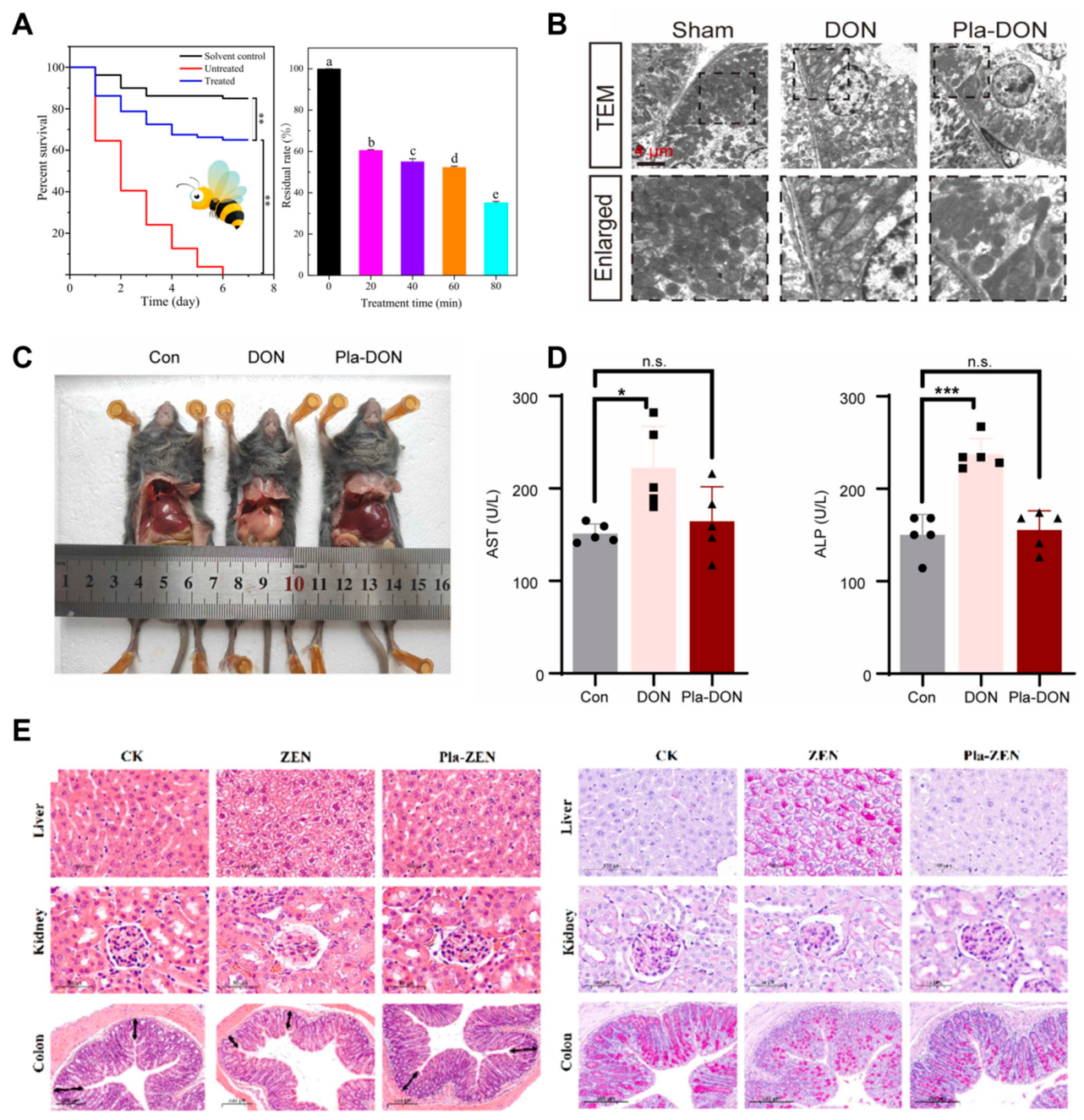
For the insecticide imidacloprid, Ni et al. employed three-dimensional excitation-emission matrix (3D-EEM) fluorescence spectroscopy to monitor degradation kinetics. After 40 minutes of CAP treatment, the methylene, amine, and nitro functional groups of imidacloprid were effectively destroyed. Using the Toxicity Estimation Software Tool (T.E.S.T.) for the first time in this context, the team demonstrated a significant reduction in acute oral toxicity and developmental toxicity of the degradation products. Furthermore, the treated imidacloprid solution increased the 7-day survival rate of honeybees by 65%, and in contaminated male bee pupae samples, an 80-minute CAP treatment achieved a 65% degradation efficiency, confirming the practical relevance of this approach (Figure 4A) [93].
The detoxification efficacy of CAP has also been validated for mycotoxins with established organ toxicity. DON, a trichothecene mycotoxin known to induce nephrotoxicity and hepatotoxicity, was investigated by Ma et al. using a mouse renal tubular cell model. Mitochondria in cells exposed to untreated DON exhibited pronounced fragmentation and structural holes, whereas those treated with plasma-processed DON (Pla-DON) displayed a dense, uniform matrix with regularly distributed cristae, indicating effective mitigation of mitochondrial damage (Figure 4B) [96]. In a previous study, the same group reported that mice administered DON showed visibly paler liver morphology, while the Pla-DON group maintained normal liver appearance, accompanied by significantly decreased serum levels of aspartate aminotransferase (AST) and alkaline phosphatase (ALP), confirming that CAP treatment substantially attenuates DON-induced hepatotoxicity. In a previous study, the same group reported that mice administered DON showed visibly paler liver morphology, while the Pla-DON group maintained normal liver appearance, accompanied by significantly decreased serum levels of AST and ALP, confirming that CAP treatment substantially attenuates DON-induced hepatotoxicity (Figure 4C) [96].
Similarly, the safety of CAP-treated zearalenone (ZEN) has been demonstrated in vivo. Liu et al. examined the tissue architecture of liver, kidney, and colon in mice exposed to either ZEN or plasma-treated ZEN (Pla-ZEN) using hematoxylin and eosin (H&E) staining. Histopathological analysis revealed that tissue damage in the Pla-ZEN group was markedly reduced compared to the ZEN group, further supporting the capacity of CAP to transform mycotoxins into less toxic derivatives while preserving organismal health (Figure 4D) [97].
Collectively, these findings underscore that CAP-mediated degradation can translate into demonstrable detoxification at both the cellular and organismal levels. However, the diversity of degradation pathways, the potential for matrix-dependent effects, and the need for comprehensive toxicity screening across a broader range of contaminants and model systems remain important directions for future research.
Figure 5.
Comprehensive safety evaluation of plasma-treated mycotoxins and pesticides: In vitro and in vivo assessments. (A) Detoxification efficacy of plasma treatment on imidacloprid: honeybee survival and degradation in biological samples [93]. Copyright 2024, Elsevier. (B) Electron microscopy images showing mitochondrial morphology in proximal tubular cells after exposure to different treatment conditions [96]. Copyright 2025, Elsevier. (C) In vivo toxicity assessment of DON and Pla-DON in mice [98]. Copyright 2024, Elsevier.
Figure 5.
Comprehensive safety evaluation of plasma-treated mycotoxins and pesticides: In vitro and in vivo assessments. (A) Detoxification efficacy of plasma treatment on imidacloprid: honeybee survival and degradation in biological samples [93]. Copyright 2024, Elsevier. (B) Electron microscopy images showing mitochondrial morphology in proximal tubular cells after exposure to different treatment conditions [96]. Copyright 2025, Elsevier. (C) In vivo toxicity assessment of DON and Pla-DON in mice [98]. Copyright 2024, Elsevier.
4. Synergistic Effects and Influence Factors
4.1. Synergistic Effects Among Reactive Species in CAP
The antimicrobial efficacy of CAP arises not from a single dominant factor, but from the complex and coordinated interplay among reactive species and their mutual interactions. RONS initiate oxidative damage by cleaving cell wall bonds and oxidizing membrane lipids and proteins, thereby disrupting membrane integrity and function. Once intracellular RONS concentrations overwhelm cellular defense systems, these species proceed to attack essential biomolecules—including enzymes, structural proteins, and DNA—ultimately triggering apoptotic pathways. These multiple pathways converge on a common outcome: the destruction of intracellular components and the induction of microbial death.
A defining characteristic of CAP-mediated inactivation is that the combined action of multiple factors yields antimicrobial effects substantially greater than the sum of individual contributions, suggesting underlying synergistic mechanisms that warrant systematic investigation. Xu et al. provided mechanistic insight into ROS synergy using a fungal model [99]. By employing D-mannitol and L-histidine as selective scavengers for •OH and ¹O₂, respectively, they dissected the contributions of individual reactive species. Their findings revealed a multi-layered synergistic cascade: •OH and ¹O₂ cooperatively induce lipid peroxidation, compromising cell membrane integrity. Due to the short lifetime of •OH, it is primarily ¹O₂ that penetrates the cell and triggers depolarization of the mitochondrial membrane potential. Under prolonged plasma exposure, intracellular levels of O₂⁻ and Fe²⁺ increase substantially. These species react with plasma-generated H₂O₂ via Fenton and Haber–Weiss reactions to produce endogenous •OH within the cell. The newly formed •OH, together with ¹O₂, induces cytoplasmic protein oxidation and aggregation, accompanied by an increase in RIP1/RIP3 necrosomes—key markers of programmed necrosis. This cascade ultimately leads to necroptosis, a regulated form of cell death distinct from classical apoptosis.
A persistent challenge in CAP research has been the difficulty of studying short-lived reactive species due to their rapid dissipation. Wang et al. addressed this limitation by developing a device that modulates the ratio of long-lived to short-lived species through programmable gas flow rates. Their system demonstrated that higher gas flow rates generate greater quantities of short-lived reactive species while producing less nitrite. Crucially, they found that short-lived species exhibit greater efficacy in inhibiting cell growth and follow the same trend in sterilization outcomes, highlighting their dominant role in microbial inactivation (Figure 5A) [100].
The other study further elucidated the cooperative action of long-lived and short-lived species. Removing any single exogenous RONS (•OH, H₂O₂, ¹O₂, O₂⁻, NO, or O₃) did not significantly alter the extent of damage to the cell wall and membrane, indicating functional redundancy and synergy among multiple species. Fourier-transform infrared (FTIR) spectroscopy revealed that following plasma treatment, the characteristic peak vibrations of phospholipids, fatty acids, and amino acids in the cell membrane were substantially weakened, confirming the cumulative oxidative damage inflicted by the combined RONS cocktail (Figure 5B) [101].
The antimicrobial power of CAP resides not in any single component but in the orchestrated synergy among diverse chemical mechanisms. RONS cooperate across spatial and temporal scales—from immediate membrane disruption to delayed intracellular oxidative cascades.
4.2. Factors Influencing the CAP Treatment Process
The efficacy of CAP for food safety applications is critically dependent on plasma generation parameters. Input power, voltage, and processing time all substantially influence decontamination outcomes [92]. Higher power and voltage promote molecular dissociation, consequently elevating RONS concentrations. Extended treatment duration increases accumulated RONS exposure. However, beyond a threshold concentration, RONS undergo mutual quenching reactions, forming stable compounds with diminished oxidative capacity and potentially reducing treatment efficacy [102,103,104]. Carrier gas composition is another pivotal determinant of CAP treatment efficiency. In microbial inactivation, higher oxygen proportions in the carrier gas generally yield greater processing efficiency by generating more ROS, which are primarily responsible for antimicrobial effects. Olatunde et al. demonstrated that using an Ar:O₂ ratio of 90:10 as carrier gas for plasma treatment reduced microbial counts by more than one log cycle; increasing oxygen to 20% achieved complete microbial inactivation [105]. Lin et al. compared helium and argon carrier gases in plasma jet systems for water activation and bacterial inactivation, finding that argon yielded faster jet propagation and higher reactive species concentrations, thereby enhancing antimicrobial efficacy [106].
5. Applications of CAP in Food Safety
Over the past decade, CAP has gained increasing attention for controlling food safety hazards. Its key advantage lies in simultaneously reducing microorganisms, mycotoxins, and pesticide residues while preserving food quality. This section summarizes recent progress from three perspectives: antimicrobial efficacy across different food matrices, degradation of mycotoxins with emphasis on matrix effects and product safety, and removal of pesticide residues focusing on degradation pathways.These points show that CAP offers a non-thermal way to reduce major food safety risks while keeping quality
5.1. Reduction of Harmful Microorganisms
CAP has been extensively investigated for microbial decontamination across diverse food matrices, with its ability to inactivate pathogens while preserving food quality emerging as a central research focus. This section systematically reviews recent advances in CAP applications for microbial control, organized around three thematic dimensions: validation of antimicrobial efficacy, mechanisms of quality preservation, and strategies for enhanced inactivation.
5.1.1. Validation of Antimicrobial Efficacy Across Food Matrices
The antimicrobial efficacy of CAP has been validated across a wide range of food products. Wei et al. employed transmission electron microscopy to observe morphological changes in Aspergillus niger spores on CAP-treated dried jujube as a function of exposure duration, revealing that prolonged treatment induced progressively severe cellular structural damage and ultimately led to intracellular substance leakage [107]. Park et al. applied atmospheric pressure plasma to decontaminate Escherichia coli in wheat flour, demonstrating that the bactericidal efficacy depended significantly on the distance and contact area between the plasma jet and the sample [108]. Sobhan et al. observed that CAP treatment effectively suppressed fungal proliferation on strawberries over 30 days of storage, whereas untreated strawberries exhibited extensive Botrytis cinerea growth on their surfaces [109]. Wang et al. subjected goat milk to CAP treatment and found that 300 s exposure achieved sterilization efficiency comparable to conventional pasteurization [110]. On ham surfaces, 180 s CAP treatment reduced non-pathogenic lactobacilli from 10⁷ log CFU/cm² to 1.43 CFU/cm² [111].
Beyond these empirical demonstrations of efficacy, emerging evidence reveals that CAP's antimicrobial action extends beyond immediate inactivation during treatment. Hu et al. investigated CAP-induced changes in bacterial communities using red shrimp as a model, revealing that treatment does not simply kill target bacteria but also forces microbial adaptation through oxidative stress, slowing overall growth dynamics via reciprocal or competitive interactions among surviving populations [111]. This modulation of microbial ecology contributes to prolonged preservation outcomes beyond what direct inactivation alone would predict. Similarly, Liu et al. demonstrated that combining CAP with modified atmosphere packaging not only achieved immediate microbial reduction but also significantly decreased respiration rate, contributing to extended shelf life (Figure 6C) [112]. Chanioti et al. showed that CAP-treated ice cubes used as a cooling medium for fish slices provided continuous antimicrobial protection throughout 27 days of storage (Figure 6D) [113]. These sustained effects cannot be attributed solely to initial microbial kill but rather reflect the lasting influence of CAP treatment on the post-processing microbial environment. Collectively, these studies confirm the broad applicability of CAP across solid, liquid, and complex food matrices while revealing that its antimicrobial impact encompasses both immediate inactivation and prolonged preservation effects.
5.1.2. Low-Temperature Inactivation and Quality Preservation
A key advantage of CAP lies in its ability to achieve efficient microbial inactivation at ambient temperatures, thereby avoiding the quality deterioration associated with thermal processing. During ham treatment, 180 s CAP exposure increased surface temperature only marginally from 22.6°C to 25.2°C, with the electrode temperature remaining at 29°C, confirming that microbial inactivation was not thermally induced and that protein integrity was largely preserved [111]. In goat milk, CAP treatment achieved pasteurization-equivalent sterilization while better maintaining protein secondary structure stability, with treated samples exhibiting improved microstructural uniformity and enhanced protein dispersion [110]. Hu et al. demonstrated that introducing CAP into packaging containing red shrimp effectively inhibited spoilage bacterial growth through day eight of storage while maximally preserving muscle protein quality [114]. This in-package approach enables post-packaging decontamination, minimizes recontamination risk, and provides continuous protection throughout storage.
However, CAP treatment may also induce adverse quality changes, and the mechanisms underlying these effects are matrix-dependent. Yagual et al. found that direct plasma treatment induced black spot formation on banana surfaces, whereas indirect treatment avoided this undesirable effect [115]. Zhong et al. reported that CAP treatment increased L* and b* values of sea bass while decreasing a*, indicating surface protein denaturation and accelerated lipid oxidation (Figure 6B) [116]. Understanding the mechanistic basis of these matrix-dependent effects is essential for optimizing treatment parameters. Wang et al. investigated the inactivation of Aeromonas hydrophila in aqueous systems and found that ¹O₂, •OH, and •O₂⁻ were the primary antimicrobial species, attributable to their longer lifespans and enhanced diffusion capacity in liquid matrices. These species first compromise cell membrane integrity, causing leakage of intracellular contents; they subsequently inactivate key antioxidant enzymes including catalase and superoxide dismutase, ultimately leading to the decomposition and mineralization of intracellular substances. The biological relevance of this mechanism was validated in silver carp tissues—gills, stomach, spleen, and intestine—where infected fish developed pronounced sepsis while CAP-treated groups remained symptom-free (Figure 6A) [117]. This matrix-dependent mechanistic insight has important practical implications: optimal treatment parameters for liquid systems may not directly translate to solid food matrices, and the choice of plasma source, carrier gas composition, and exposure conditions should be guided by the dominant inactivation pathways operative in the target food matrix. These findings collectively underscore the need for matrix-specific optimization of treatment parameters to balance antimicrobial efficacy with quality preservation.
5.1.3. Combination Strategies to Overcome Efficacy Limitations
While increasing voltage, extending treatment time, or modifying carrier gas composition can enhance plasma efficacy, these parameter adjustments ultimately reach performance limits. Breaking through these limitations may require combining CAP with complementary technologies. When single high-voltage atmospheric cold plasma, single ultraviolet-cold plasma, and their combination were compared for treating Aspergillus flavus spores in peanuts, the combined treatment achieved superior sterilization efficiency, with spore counts being reduced by 0.79–2.97 log₁₀ CFU/g within eight minutes and antifungal effects sustained for six days post-treatment, demonstrating that complementary effects can be exerted by multiple plasma modalities [118]. Arcot et al. introduced essential oil vapor during plasma treatment of tomato surfaces, achieving an additional 1.7 ± 0.27 log₁₀ CFU/cm² reduction in bacterial counts [119]. This confirms the feasibility of combining plasma with other antimicrobial substances, although the underlying mechanisms of enhanced bactericidal action remain unclear and warrant further investigation. Ke et al. employed a distinctive strategy by introducing potassium iodide during CAP treatment of Pseudomonas aeruginosa and Escherichia coli to mitigate potential health risks associated with RNS generation. Surprisingly, KI addition dramatically enhanced bactericidal efficacy in a concentration-dependent manner. Mechanistic investigation revealed that H₂O₂ in the reactive species cocktail oxidized I⁻ to I₃⁻, generating additional antimicrobial iodine species that amplified overall killing efficiency [120].
5.2. Reduction of Mycotoxin
CAP effectively reduces multiple mycotoxin contaminants. Guo et al. reported that treating rice grains at 25 kV for 8 min decreased DON and ochratoxin A (OTA) by 61.25 ± 2.37% and 55.64 ± 2.17%, respectively [121]. Wang et al. achieved 83.62% OTA reduction in raisins after 10 min of 18 kV plasma treatment, with no detectable changes in moisture, acidity, sugars, vitamin C, color, or aroma [122]. Wang et al. found that the degradation rate of alternariol and alternariol monomethyl ether was highest under alkaline conditions, and lower under neutral and acidic conditions. Surprisingly, introducing FeSO4 or H2O2 can greatly accelerate the degradation rate of toxins, suggesting potential for process intensification [123]. Fang et al. evaluated the efficiency of different CAP gases in degrading methyl parathion in water and found that the degradation efficiency was He>O2>N2, demonstrating the importance of carrier gas selection through practical examples (Figure 7D) [124].
Degradation efficiency is highly condition-dependent. Wang et al. investigated the effect of food matrix on the degradation rate when using cold plasma to degrade Alternariol and alternariol monomethyl ether. The results showed that only 6% whey protein or ovalbumin almost inhibited the degradation of toxins by cold plasma, polyphenols inhibited the degradation of AOH and AME of 90.8% and 83.4%, and organic acids and vitamin C had some inhibitory effects on the degradation of AME, but had almost no effect on the degradation of AOH [13].
A striking illustration comes from Soulier et al., who isolated four fungal genera (Fusarium, Alternaria, Aspergillus, Penicillium) from wheat and identified DON, OTA, fumonisins, and aflatoxins as dominant contaminants. Using microwave plasma, 60-min treatment degraded 98% of toxins on glass but only 50% on wheat [125]. This gap highlights a critical challenge: translating laboratory efficacy to real food systems requires overcoming matrix interference.
Reactive species target distinct chemical sites, and combining approaches broadens attack. Xu et al. compared standalone CAP, PAW, and their combination for AFB₁ degradation. The dual treatment proved most effective: CAP-generated •OH hydroxylates the furan ring, while PAW-derived ¹O₂ destroys the methoxy group and oxidizes furan double bonds [126].
Configuration choice further influences outcomes. Gandhi et al. compared surface dielectric barrier discharge (SDBD) and corona discharge (CD) for AFB₁ degradation on peanuts. CD produced intense reactive species suitable for precision work but etched peanut surfaces. SDBD generated uniform, large-area plasma, achieved better degradation, and caused no surface damage (Figure 7A) [127]. To avoid direct plasma etching, Ma et al. used PAW on peanuts, achieving 50% and 86% AFB₁ reduction after 30 and 60 min, respectively. Interestingly, PAW also ruptured seed coat cells, facilitating oil extraction—an unexpected processing benefit (Figure 7C) [128].
5.3. Reduction of Pesticide
Cold atmospheric plasma offers an effective approach for degrading pesticide residues in food, sharing mechanistic similarities with mycotoxin detoxification while presenting distinct challenges related to pesticide localization and food surface properties.
The mechanism of cold plasma in degrading pesticides is similar to that of degrading toxins, degrading toxic compounds into non-toxic or less toxic intermediates. Ali et al. demonstrated through GC-MS testing that the thiram fungicide in tomato juice can degrade 74.1% after 5 minutes of DBD treatment, and suggested that this may be attributed to the breaking of C=S, S-S, and C-N bonds [129]. Sreelakshmi et al. found that the degradation rate of chlorpyrifos and malathion on the surface of spinach could reach up to 90% when using cold plasma purification. In addition, it also reduces the decay rate, microbial count, and enzyme activity, extending the shelf life of spinach [130]. Misra et al. used 80kV DBD plasma to treat strawberries, and in just five minutes, they were able to reduce the concentrations of azoxystrobin, cyclopropylene, fipronil, and pyriproxyfen by 69%, 45%, 71%, and 46%, respectively, and demonstrated that ozone played a major role in them [131]. But in another work, it was found that ozone had poor degradation effect on pyrethroids [132]. This proves that suitable generation devices and carrier gases should be selected when degrading different pesticides. In order to visually observe the effect of cold plasma treatment on pesticides, Fukuda et al. immersed oranges in pesticide thiabendazole and then treated them with cold plasma and air separately. The results showed that the samples treated with plasma had mold on the surface after 3-4 days, while those treated with air did not [133]. This proves that plasma effectively degraded pesticides.
Unlike sterilization and mycotoxin degradation, pesticides mostly remain on the surface of food, so there is little research on the effect of food components on the rate of pesticide degradation by cold plasma. The thickness of the food surface has become a key factor determining the efficiency of cold plasma degradation of pesticides. The thicker the skin, the greater the resistance to the entry of reactive species. Fruits usually have a thicker skin than vegetables, so applying this technique to vegetables may have better results. Mousavi et al. found that the degradation rate of residual diazinon in cucumber and apple was about 6% higher than that in cucumber when treated with cold plasma under the same conditions. This is because apples have a thinner outer skin, making it easier for reactive species to enter, resulting in stronger oxidation [134]. The penetration depth of reactive oxygen species is shallow, which still poses challenges when dealing with foods with thick skin.
Du et al. found that appropriate treatment effectively degraded the residues of furandan and imidacloprid when treating goji berries with DBD, but some black spots appeared on the surface of goji berries when the treatment time reached 300 seconds (Figure 7B) [135]. Plasma-activated water (PAW) offers a gentler alternative to direct plasma exposure. Mishra et al. demonstrated that PAW reduced pesticide levels in fresh apple slices by 52.18% after 15 minutes. Notably, PAW-treated slices exhibited superior appearance, color, and texture, attributed to PAW's inhibition of polyphenol oxidase activity and suppression of spoilage bacteria (Figure 7E) [136]. This dual action—pesticide degradation combined with quality preservation—positions PAW as particularly promising for fresh produce applications.

Table 1.
Applications of CAP for decontamination of foodborne hazards: microorganisms, pesticides and mycotoxins.
Table 1.
Applications of CAP for decontamination of foodborne hazards: microorganisms, pesticides and mycotoxins.
| foodborne hazards | Food Matrix | Plasma type | Voltage (kV) | Time (min) | Effect | Reference |
| L.monocytogenes | Instant ham | DBD | 28 | 3 | Reduced by 1.78-1.43 log CFU/cm² | [111] |
| L.monocytogenes | Lettuce | DBD | 80 | 2 | Reduced by 2.2 and 4.2 log CFU/ml | [137] |
| P. fluorescens | ||||||
| Escherichia coli | Beef Jerky | DBD | 8.4 | 4 | Reduced by 1.78 log CFU/ml | [138] |
| Bacillus spp. | Blueberry juice | APPJ | 11 | 6 | Reduced by 7.2 log CFU/g | [139] |
| Salmonella | Tender coconut water | DBD | 90 | 2 | Reduced by 1.3 log CFU/ml | [140] |
| Malathion | Lettuce | DBD | 80 | 2 | The degradation rates are 53.1% and 51.4% | [141] |
| Chlorpyrifos | ||||||
| Azoxystrobin | Strawberries | DBD | 80 | 5 | The degradation rates are 69%, 45%, 71% and 46% | [131] |
| Cyprodinil | ||||||
| Fludioxonil | ||||||
| Pyriproxyfen | ||||||
| Boscalid Imidacloprid |
Blueberries | DBD | 80 | 5 | The degradation rates are 80.18% and 75.62% | [51] |
| DON | Rice grain | DBD | 25 | 8 | The degradation rates are 61.25% and 55.64% | [121] |
| OTA | ||||||
| AFB1 | Maize | DBD | 6 | 10 | The degradation rates are 65% and 64% | |
| FB1 | [50] | |||||
| AFM1 | milk | DBD | 90 | 3 | The degradation rate is 87% | [142] |
6. Impact of CAP on Food Quality and Safety
The efficacy of cold plasma in ensuring food safety is strongly dependent on treatment intensity, yet excessive treatment may compromise food quality. These outcomes are further modulated by food matrix properties, exposure duration, and plasma generator configuration. This chapter synthesizes recent advances in cold plasma applications for controlling both food quality and safety, with particular emphasis on the intricate relationships between processing parameters and their effects on food components.
6.1. The Impact on Proteins
Food proteins possess high nutritional value and are intimately linked to functional properties such as emulsification, water-holding capacity, oil retention, and gel-forming ability [143]. As discussed in previous sections, plasma can modify amino acid side chains or protein spatial conformations through oxidation, cross-linking, or structural unfolding. These modifications—whether beneficial or detrimental—are governed by a complex interplay of processing parameters including treatment duration, applied voltage, plasma configuration, and food matrix composition, highlighting the need for precise process control.
Treatment time serves as a critical determinant of protein outcomes, often exhibiting a dualistic effect. Gong et al. demonstrated that brief plasma exposure (20-60 s) significantly reduced oil-water interfacial tension in blue-green algae protein by transforming α-helices into random coils, a structural change that could enhance functional properties. However, extending treatment time induced protein aggregation, shifting the effect from beneficial to detrimental [144]. This temporal duality was similarly observed by Zhang et al. in goat milk, where 3-4 min of cold plasma treatment increased casein phosphorylation and improved water-holding capacity, solubility, foaming ability, and foam stability. Beyond this optimal window, protein conformation destabilized, underscoring that precise timing is essential for achieving desired modifications without compromising quality [145].
Applied voltage adds another layer of complexity, as it modulates protein structure with consequences for digestibility and functionality. When coconut globulin was treated at 50, 60, and 70 kV, yielded superior digestion and hydrolysis rates in both gastric and intestinal phases. This enhancement in digestibility is attributed to ACP treatment altering the cleavage sites for digestive enzymes (pepsin and trypsin), leading to the generation of distinct peptide profiles compared to native CG. The appearance of these unique peptides confirms that the structural modifications induced by the plasma directly influence the subsequent digestion patterns (Figure 8D) [146]. Luo et al. extended this voltage-dependent understanding to meat quality, showing that treating pork myofibrillar protein with increasing voltages enhanced particle size, oxidation, surface hydrophobicity, and emulsifying properties as hydrophobic groups became exposed and enhanced protein-oil binding. Remarkably, raising the voltage to 70 kV physically disrupted sarcomere structures—damaging the I band, Z line, and M line—which translated into increased meat tenderness, a desirable textural modification that illustrates how controlled protein oxidation can be harnessed for quality improvement [147].
The oxidation pathways underlying these changes operate at the molecular level through distinct mechanisms. Chen et al. elucidated that •OH serves as the primary oxidant attacking amino acid side chains, with L-Cys, Met, and L-Arg each following characteristic oxidation routes: L-Arg oxidation produced carbonyl compounds, L-Cys formed disulfide cross-links, and Met oxidation predominantly yielded Met-O [148]. These molecular transformations cascade into higher-order structural changes that determine protein functionality. Chen et al. further demonstrated that in fish mince, reactive species oxidized sulfhydryl groups to disulfide bonds, influencing gel network formation, while extensively disrupting ionic bonds led to more dispersed muscle fiber proteins. Notably, hydrogen bonds remained largely unaffected, helping maintain gel network integrity. Plasma-induced myosin unfolding exposed non-polar amino acid side chains that promoted protein aggregation through hydrophobic interactions, which strengthened with prolonged treatment [149].
Beyond these functional changes, plasma-induced structural modifications can simultaneously influence multiple quality-related protein attributes. Zhang et al. demonstrated that moderate dielectric barrier discharge plasma treatment of casein enabled reactive oxygen species to attack and disrupt non-covalent bonds, altering spatial conformation and oxidizing amino acid side chains, which collectively modified the linear epitope structure. These structural rearrangements not only masked or disrupted antigenic epitopes—thereby reducing allergenicity—but also interfered with enzyme recognition and cleavage sites, leading to decreased digestibility. Principal component analysis revealed that these concurrent changes in antigenicity and digestibility were not coincidental but rather governed by the same primary determinant (PC1), illustrating how a single plasma treatment can induce multiple, interconnected modifications that collectively reshape protein functionality and safety attributes (Figure 8A) [150].
Recognizing the potential for protein damage, researchers have developed strategies to mitigate adverse effects while preserving beneficial modifications. Low-pressure (16 Pa) plasma and carrier gases that minimize reactive species generation offer one approach to reducing oxidation and aggregation [151]. Alternatively, controlled plasma intensity can be deliberately manipulated to harness structural changes for functional improvement. Adjusting treatment parameters allows controlled unfolding and aggregation of soy protein isolate, modulating solubility and emulsifying properties as exposed hydrophobic groups enhance these functional attributes (Figure 8C) [152]. Acid combined with CAP treatment represents another synergistic strategy: Qu et al. demonstrated that hydrochloric acid, tartaric acid, and glucono-δ-lactone regulated proton catalytic rates and ionization equilibria during zein deamidation, while CAP enhanced overall deamidation rates. The resulting irregular protein aggregates exhibited improved particle adsorption and swelling properties, demonstrating how combined approaches can yield functionally superior proteins (Figure 8B) [153].
The implications of protein modification extend beyond texture and functionality to include visual quality attributes that influence consumer acceptance. Plasma-generated H₂O₂ reacts with myoglobin, leading to bilirubin formation, while reactive species oxidize deoxymyoglobin or oxymyoglobin to methemoglobin, ultimately altering meat color [143]. These color changes, together with the texture modifications described earlier, illustrate the complex relationship between plasma treatment and food quality. Balancing antimicrobial efficacy against quality preservation requires careful consideration of these interconnected effects across different food matrices and processing conditions. Only by understanding these relationships can we develop protocols that achieve safety goals while maintaining the qualities that consumers expect.
6.2. The Impact on Vitamins
Vitamins are essential nutrients in food, yet current research on the effects of cold plasma treatment remains largely confined to vitamin C, with the behavior and underlying mechanisms of other vitamins still poorly understood [154,155]. Following plasma exposure, vitamin content in food may increase, decrease, or remain unchanged depending on treatment conditions and food matrices [156,157,158].
Plants possess intrinsic antioxidant mechanisms that protect against oxidative damage from metabolic processes, respiration, stress responses, and reactive oxygen species. These systems maintain ROS concentrations within tolerable limits, but when ROS levels exceed the regulatory capacity of cells, oxidative stress ensues [154]. Guo et al. observed that vitamin C content in Agaricus bisporus decreased after cold plasma treatment, attributing this decline to vitamin C consumption during antioxidative defense against reactive species. As reactive species gradually decomposed, vitamin C levels eventually stabilized [156].
The decay of vitamin C is essentially its deprotonation to form dehydroascorbic acid. On the other hand, reactive oxygen species activate dehydroascorbic acid reductase, which helps to convert dehydroascorbic acid into ascorbic acid through the ascorbic acid glutathione cycle. Dong et al. used cold plasma to treat blueberries in order to extend their storage period, and found that the vitamins increased by 1.5 times compared to before treatment [159]. In another study, Jia et al. found that cold plasma had almost no effect on the vitamin C content in winter jujube [160]. The variation of vitamin C depends on the amount of reactive species generated by cold plasma, and the process parameters need to be modified according to actual needs. The destructive behavior of cold plasma may be specific to the content of vitamins. Pour et al. found that the concentration of vitamin B6 in bananas increased from 0.6 mg/100 g to 0.8 mg/100 g after cold plasma treatment, because the cell wall was damaged and the contents flowed out [161]. Ke et al. found that the treatment with cold plasma would reduce the content of vitamin A in milkshake powder, and as the treatment time increased, the content became lower and lower [162].
6.3. The Impact on Lipids
Food lipids comprise both saturated and unsaturated fatty acids. As noted in previous sections, cold plasma treatment can induce lipid oxidation, with oxidation primarily targeting C-H bonds and methyl groups of fatty acids—particularly those adjacent to double bonds [163]. Following plasma exposure, unsaturated fatty acid content generally decreases while oxidation products accumulate.
Sang et al. treated tilapia fillets with cold plasma and observed increased lipid oxidation values and saturated fatty acid content, accompanied by decreased unsaturated fatty acids—with the decline being most pronounced for polyunsaturated species. Higher oxygen concentrations in the carrier gas exacerbated lipid oxidation, demonstrating the role of ROS in driving these reactions [164].
Lipid oxidation proceeds through two distinct stages. The secondary oxidation phase generates aldehydes, alcohols, ketones, acids, and other small molecules that can seriously impair food flavor. Notably, the activation energy required for primary oxidation exceeds that of secondary oxidation, and increasing voltage has a greater impact on primary oxidation than extending treatment time [165]. This distinction carries practical implications: careful control of processing intensity is essential to prevent flavor deterioration while achieving desired antimicrobial effects.
Food components can modulate lipid oxidation through complex interactions. Ke et al. found that cold plasma treatment induced heme degradation in myoglobin, and the released iron subsequently accelerated lipid oxidation [166]. This finding illustrates how plasma effects on one food component can cascade into secondary effects on others, underscoring the interconnected nature of quality changes during plasma processing.
6.4. The Impact on Carbohydrate
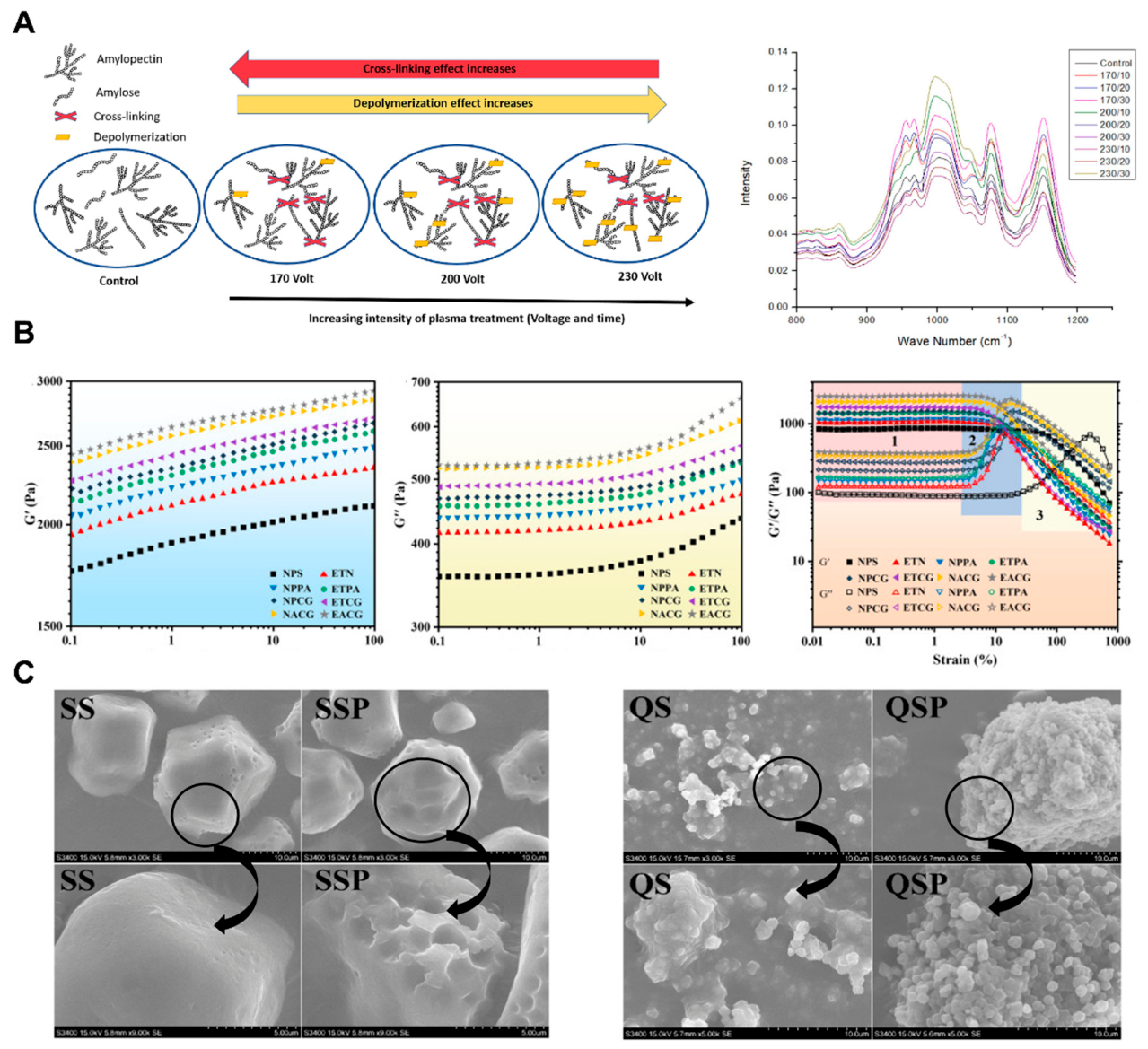
Starch, a high molecular weight carbohydrate essential in daily diets, exists in two primary forms: amylose (linear) and amylopectin (branched). When exposed to cold plasma, starch undergoes multiple structural modifications including cross-linking, depolymerization, surface etching, and the introduction of functional groups [167].
The reactive species and high-energy electrons generated during plasma treatment target both the main chains and side chains of starch molecules. High-energy electrons preferentially cleave glycosidic bonds near side chains, inducing depolymerization and generating smaller molecular fragments. Notably, the sites most susceptible to cross-linking depend on both the carrier gas composition and the starch type employed [167]. For glucose molecules, the C-2 position exhibits the highest cross-linking propensity, as argon plasma polarizes the hydroxyl group into its ionic form [168].
These molecular-level transformations—cross-linking and depolymerization—directly influence starch's macroscopic properties, particularly fluidity and viscosity. Zhang et al. treated cassava starch with cold plasma using four different carrier gases (air, carbon dioxide, argon, and helium) and found that cross-linking reduced water absorption capacity while increasing viscosity. Helium plasma induced stronger cross-linking, whereas air plasma produced weaker cross-linking effects [169]. Kaur et al. investigated needle-plate atmospheric pressure cold plasma modification of pearl millet starch and observed that processing parameters dictate the dominant modification pathway: high-intensity plasma promoted depolymerization with corresponding viscosity reduction, while cross-linking and depolymerization were governed by treatment time and voltage intensity. Specifically, cross-linking predominated under short exposure times and low voltages, whereas depolymerization occurred under opposite conditions [170]. Under the same treatment conditions, smaller starch granules are more prone to aggregation, while larger ones tend to develop pores [171].
This parameter-dependent behavior was further elucidated through voltage gradient studies. At low voltages (below 14 kV), the absorption peak area at 924 cm⁻¹ increased with rising voltage, indicating enhanced cross-linking through glycosidic bond formation. However, at high voltage (20 kV), glycosidic bond cleavage became dominant, manifesting as dissociation. The water solubility index and water absorption index exhibited parallel trends, confirming their close relationship with the cross-linking and depolymerization state of starch [172].
Liu et al. found that with extended processing time, A-type starch initially underwent cross-linking followed by depolymerization, while B-type starch predominantly depolymerized throughout. This divergence stems from B-type starch's looser crystal cell structure and its fewer short and long chains, which provide more accessible sites for plasma interaction [173].
The physical consequences of depolymerization include the generation of smaller starch molecules that disperse and dissolve more readily during gelation, consequently reducing starch turbidity [174]. Surface etching, observed by Thirumdas et al. in rice starch under SEM, creates cracks and cavities that facilitate reactive species penetration into starch molecules, promoting both cross-linking and depolymerization while simultaneously increasing solubility and modifying rheological properties [175]. Importantly, subsequent work confirmed that while etching induces surface cracks and pores, it does not compromise overall starch integrit [176]. Cheng et al. reported that cold plasma-induced etching of corn starch increases particle size, reduces rigid structure, and decreases crystallinity [177].
The practical significance of etching extends beyond direct modification: starch rupture facilitates penetration by other modifying agents, enabling more efficient subsequent modifications. Etching efficiency is modulated by starch moisture content. Deng et al. demonstrated that after cold plasma treatment of potato starch, surface roughness correlated positively with moisture content, yet surfaces remained smooth at maximum moisture levels [178].
Given these multifaceted effects, combining CAP with complementary technologies offers promising avenues for starch modification. Zou et al. integrated PAW, cyclodextrin glycosyltransferase (CGTase), and extrusion to modify starch, achieving substantial improvements in gel elasticity and viscosity modulus. This synergistic enhancement resulted from PAW-induced oxidation, extrusion-mediated disruption of starch granule crystal structure, and CGTase-catalyzed changes in molecular chain architecture [146].
Figure 9.
The impact of CAP on carbohydrates in food. (A) Schematic diagram and FTIR characterization of cross-linking and depolymerization in starch induced by CAP treatment [170]. Copyright 2023, Elsevier. (B) Rheological properties and structural changes of potato starch under different modification treatments [179]. Copyright 2025, Elsevier. (C) Scanning electron micrographs of native and plasma-modified starches [171]. Copyright 2019, Elsevier.
Figure 9.
The impact of CAP on carbohydrates in food. (A) Schematic diagram and FTIR characterization of cross-linking and depolymerization in starch induced by CAP treatment [170]. Copyright 2023, Elsevier. (B) Rheological properties and structural changes of potato starch under different modification treatments [179]. Copyright 2025, Elsevier. (C) Scanning electron micrographs of native and plasma-modified starches [171]. Copyright 2019, Elsevier.
6.5. The Impact on Sensory Attributes: Color, Flavor, and Texture
Food color directly influences consumer acceptance and serves as a key indicator of food quality. In meat products, color primarily depends on the oxidation state of myoglobin—brown in its oxidized form and red when reduced. Wang et al. treated beef patties with dielectric barrier discharge cold plasma at 50, 60, and 70 kV, observing a voltage-dependent decrease in L* values at higher voltages while 50 kV treatment produced no significant change, confirming that L* value reduction correlates positively with applied voltage. The a* values decreased under both high and low pressure treatments, though pickling prior to treatment may lead to opposite effects [180]. Meng et al. found that in smoked sausages treated with cold plasma, adding only 75 mg/kg sodium nitrite significantly reduced L* and b* values while increasing a* values [181].
Color responses to cold plasma vary considerably across different foods, and drying history further modulates these effects. Dried goji berries exhibited more severe color deterioration after plasma treatment compared to fresh berries, with their L, a, and b* values all increasing relative to untreated controls [182]. Interestingly, ginger showed no detectable color change following identical treatment [183]. For vegetables and fruits, enzymatic browning drives color changes, and cold plasma can delay this process by reducing the activity of enzymes such as polyphenol oxidase and pectin methylesterase [184]. These foods contain diverse pigments including anthocyanins, carotenoids, and chlorophyll, with final color determined by their relative concentrations. Cold plasma alters food color primarily through oxidation, and its capacity to degrade specific pigments depends on their chemical structures. Carotenoids, for instance, possess highly unsaturated conjugated double bonds that render them particularly susceptible to oxidative attack [185].
Flavor serves as a critical parameter for evaluating food freshness, and cold plasma can modify flavor profiles through its effects on lipids, proteins, and volatile compounds. Oxidation of beef fat generates 2-pentyl, hexyl, heptyl, and octylfurans, along with 5-pentyldihydro-2(3H)-furanone—compounds associated with caramel, sweet, fruity, and nutty notes that alter beef's characteristic flavor. Concurrently, plasma treatment reduces the generation of sulfur-containing volatile organic compounds, thereby minimizing sulfurous and rubbery off-odors [186].
In ewe milk, cold plasma-induced lipid peroxidation produces hydrogen peroxide, which further decomposes into aldehydes. These aldehydes can mask the unpleasant lamb flavors typically associated with carboxylic acids, resulting in improved overall flavor [187]. Carrier gas composition significantly influences lipid oxidation pathways and subsequent flavor changes. When using dielectric barrier discharge with a helium-oxygen mixture as carrier gas, cooked pork tenderloin showed no detectable flavor alteration [188]. In contrast, argon carrier gas enhanced the flavor of both raw and cooked chicken breast [189]. These differential effects suggest that flavor enhancement following plasma treatment interacts with the inherent flavor characteristics of each food matrix. For example, in black whole wheat flour, plasma treatment decreased esters and alkanes while increasing alcohols and acids, collectively contributing to enhanced flavor profiles [190].
Changes in food texture are closely linked to modifications in internal structure and composition. Hardness, a key parameter for evaluating food texture, is altered by cold plasma through its effects on intercellular adhesion and cell wall structural integrity. Liu et al. found that treating apricots with cold plasma for 20 seconds increased hardness by 56%, attributing this change to plasma-generated reactive species that disrupted degrading enzyme structures and inhibited cell wall degradation [191]. Similarly, cold plasma can reduce the activity of pectin-degrading enzymes, contributing to increased fruit hardness [192]. In almonds, plasma treatment enhanced hardness in a time-dependent manner, possibly due to moisture reduction or lipid oxidation during processing [192]. Beyond compositional changes, surface morphology also influences texture perception. Zeng et al. examined cold plasma-treated rough rice noodles using scanning electron microscopy and observed surface roughening with microporous structures, providing evidence that etching effects may contribute to textural changes on food surfaces [193].
7. Future Perspectives and Research Directions
7.1. Large-Scale Industrial Applications
The number of patents related to cold plasma devices has exceeded one million, but most of them are still at the laboratory level, and there are still relatively few practical applications in the food industry [194]. Ziuzina et al. designed a pilot scale high-voltage dielectric barrier discharge cold plasma device for sterilization of packaged food. The device consists of two parallel 1-meter-long electrodes with adjustable gaps to allow different sizes of processed items to pass through [53]. Toyokawa et al. developed a roller conveyor plasma device for killing Xanthomonas campestris pv. campestris (Xcc) on cabbage, which can achieve good sterilization efficiency in just five minutes and has a simple structure that meets the requirements of industrial large-scale production [195]. Misra built a set of stainless steel equipment for sterilizing agricultural products, which is driven by an inline reducer and a helical gearbox to drive the conveyor belt, and can operate in ambient air [196]. S. Katsigiannis et al. tested the bactericidal ability of cold plasma against foodborne pathogens Salmonella typhimurium and Listeria monocytogenes on stainless steel surfaces under simulated conditions in a food processing plant according to the EN 13697:2015 protocol. The results did not meet the requirements of chemical disinfectants, but provided the possibility for the successful application of cold plasma in industrial food sterilization [197]. R. Souza et al. integrated cold plasma with the meat cutting machine to avoid cross infection during the cutting process. The device consists of a high-voltage transformer with a voltage output of 30-130 kV and a frequency of 60 Hz, a voltage regulator, and two circular aluminum electrodes for generating cold plasma [198]. The combination of cold plasma and equipment in food processing can reduce pollution.
7.2. Regulatory Pathways and Consumer Acceptance
Cold plasma, as a non-thermal processing method, preserves the inherent characteristics and nutritional quality of food to the greatest extent possible while ensuring food safety. However, there are still some issues in the regulatory approval process. According to reports, currently no country in the world has introduced relevant laws and regulatory guidance for cold plasma treatment of food [199]. The approval process for new technologies by regulatory authorities depends on the country and its legislation, which requires relevant data on the toxicity of cold plasma treatment of food, but this data is very scarce. In 2018, the United States approved a consideration for a new DBD plasma treatment of whole wheat grains, with the approval process involving three departments: Federal Grain Inspection Service (USDA-FGIS), US Environmental Protection Agency (EPA), and US Food and Drug Administration (FDA), who respectively oversee the approval of treatment efficacy, product labeling, and residue testing [200]. Cold plasma can generate various reactive species, and ozone has been approved as a food additive in the United States. The approval of this cold plasma provides a possibility [199].
7.3. Research Priorities for Future Development
Based on the findings summarized in this review, several research priorities should be pursued to advance the field. First, degradation pathways for pesticides and mycotoxins need to be elucidated in greater detail. The identification of intermediate products and their toxicological profiles remains a critical knowledge gap. Future work should combine computational predictions with biological assays to systematically evaluate the safety of degradation products formed during CAP treatment. Second, more attention should be paid to matrix effects. Current understanding is largely based on simple model systems, but real food matrices are far more complex. Future research should move beyond these simplified systems to investigate how actual food components—proteins, lipids, carbohydrates, and their interactions—affect reactive species penetration, scavenging, and overall decontamination outcomes. Developing a predictive framework for matrix effects would greatly facilitate the design of treatment protocols tailored to specific food categories.
Third, the development of standardized protocols and performance metrics is urgently needed. The lack of standardization across research groups makes cross-study comparison difficult and hinders the translation of laboratory findings into industrial practice. Fourth, combining CAP with other preservation technologies offers promising possibilities. Integration with modified atmosphere packaging, natural antimicrobials, mild heat may produce synergistic effects that enhance overall efficacy while minimizing adverse impacts on food quality. Plasma-activated water, which can be generated separately and applied like a conventional sanitizer, also deserves further exploration. Finally, advances in plasma source design and real-time process monitoring will help overcome current limitations. Better control over reactive species composition and treatment uniformity is essential for scaling up to industrial applications. Continued interdisciplinary collaboration across plasma physics, food science, and microbiology, will be key to translating CAP from laboratory research to practical food industry use.
8. Conclusions
This review has systematically examined the application of CAP for food safety control, focusing on three interconnected aspects: antimicrobial and chemical degradation mechanisms, the dual impact on food quality, and current challenges for practical implementation. For antimicrobial mechanisms, RONS act synergistically to attack multiple cellular targets. Lipid peroxidation disrupts membrane integrity, causing leakage of intracellular contents. Protein oxidation modifies amino acid side chains such as cysteine, methionine, and tyrosine, altering conformation and impairing enzyme function. DNA damage includes base modifications, strand breaks, and crosslinks that interfere with replication and transcription. Short-lived species like •OH and ¹O₂ cause immediate damage, while long-lived species like H₂O₂ and O₃ sustain oxidative stress. This multi-target action explains CAP's effectiveness against resistant microorganisms. For chemical contaminants, degradation pathways involve oxidation, hydroxylation, and bond cleavage driven by RONS. Aflatoxin B₁ degradation proceeds through furan ring hydroxylation, methoxy oxidation, and lactone ring opening. Deoxynivalenol and zearalenone degradation targets epoxide rings and double bonds. Pesticide degradation typically involves dehydrogenation, oxidation, decarboxylation, and ring-opening. However, identification of intermediate products and their toxicological profiles remains a critical knowledge gap, though some in vivo studies have confirmed reduced toxicity of CAP-treated mycotoxins.
Regarding food quality, CAP effects depend strongly on treatment parameters and the food matrix. Moderate treatment can improve solubility, emulsifying capacity, water-holding capacity, and digestibility through controlled protein unfolding. Excessive treatment leads to protein aggregation, lipid rancidity, pigment degradation, and texture hardening. The food matrix itself plays a crucial role—surface properties affect reactive species penetration, while components such as proteins and polyphenols can scavenge reactive species before they reach target contaminants. Several obstacles currently hinder industrial adoption, including the lack of standardized protocols, regulatory approval requirements for degradation product safety, and challenges in scaling up while maintaining treatment uniformity. With continued research addressing these issues, CAP has the potential to become a practical tool for the food industry to ensure food safety without compromising food quality.
Funding
This study was funded by Shenzhen Science and Technology Major Project (KJZD20230923114406014, to Z.C.), Shenzhen Medical Academy of Research and Translation (C2301011, to Z.C.), Shenzhen Key Laboratory for Magnetic Resonance Physics and Imaging (SYSPG20241211173949066, to Z.C.), Shenzhen Outstanding Talents Training Fund (to Z.C.), and National Science Foundation of China (52530002 and 52473109, to L.W.).
Conflicts of Interest
The authors declare no competing interests.
References
- Van Boxstael, S.; et al. Food safety issues in fresh produce: Bacterial pathogens, viruses and pesticide residues indicated as major concerns by stakeholders in the fresh produce chain. Food Control 2013, 32, 190–197. [Google Scholar] [CrossRef]
- Isaac-Bamgboye, F. J.; Mgbechidinma, C. L.; Onyeaka, H.; Isaac-Bamgboye, I. T.; Chukwugozie, D. C. Exploring the Potential of Postbiotics for Food Safety and Human Health Improvement. J. Nutr. Metab. 2024, 2024, 1868161. [Google Scholar] [CrossRef]
- WHO. Food Saf. Asp. Cell-Based Food 2023. [CrossRef]
- Fang, T.; Chen, Z.; Chen, G. Advances in cold atmospheric plasma therapy for cancer. Bioact. Mater. 2025, 53, 433–458. [Google Scholar] [CrossRef]
- Havelaar, A. H.; et al. WHO Initiative to Estimate the Global Burden of Foodborne Diseases. The Lancet 2013, 381, S59. [Google Scholar] [CrossRef]
- Xue, M.; et al. Aspergillus Mycotoxins: The Major Food Contaminants. Adv. Sci. 2025, 12, 2412757. [Google Scholar] [CrossRef]
- Wang, K.; et al. Evaluation of Pilot-Scale Radio Frequency Heating Uniformity for Beef Sausage Pasteurization Process. Foods 2022, 11, 1317. [Google Scholar] [CrossRef]
- Jordan, P. J.; Morison, K. R. Pasteurisation of particles in milk. Int. Dairy J. 2022, 128, 105316. [Google Scholar] [CrossRef]
- Gonçalves, G. A. S.; Resende, N. S.; Carvalho, E. E. N.; Resende, J. V. d.; Vilas Boas, E. V. d. B. Effect of pasteurisation and freezing method on bioactive compounds and antioxidant activity of strawberry pulp. Int. J. Food Sci. Nutr. 2017, 68, 682–694. [Google Scholar] [CrossRef]
- Jiang, H.; Lin, Q.; Shi, W.; Yu, X.; Wang, S. Food preservation by cold plasma from dielectric barrier discharges in agri-food industries. Front. Nutr. 2022, 9–2022. [Google Scholar] [CrossRef]
- Lee, Y.; et al. Enhancement of seed germination and microbial disinfection on ginseng by cold plasma treatment. J. Ginseng Res. 2021, 45, 519–526. [Google Scholar] [CrossRef]
- Esmaeili, Z.; Hosseinzadeh Samani, B.; Nemati, A.; Nazari, F.; Rostami, S. Development of novel green pesticide system by using cold plasma to control Plodia interpunctella in pistachio. J. Food Process. Preserv. 2021, 45, e15621. [Google Scholar] [CrossRef]
- Wang, X.; et al. Removal of Alternaria mycotoxins exposed to different food components by cold plasma. Food Chem. 2022, 397, 133770. [Google Scholar] [CrossRef]
- Campelo, P. H.; et al. Modulation of aroma and flavor using glow discharge plasma technology. Innov. Food Sci. Emerg. Technol. 2020, 62, 102363. [Google Scholar] [CrossRef]
- Gallego, M.; Barat, J. M.; Grau, R.; Talens, P. Compositional, structural design and nutritional aspects of texture-modified foods for the elderly. Trends Food Sci. Technol. 2022, 119, 152–163. [Google Scholar] [CrossRef]
- Fu, D.; et al. Cold atmospheric plasma as a novel “drug” for cancer therapy. J. Control. Release 2025, 386, 114118. [Google Scholar] [CrossRef]
- Akhtar, J.; Abrha, M. G.; Teklehaimanot, K.; Gebrekirstos, G. Cold plasma technology: fundamentals and effect on quality of meat and its products. Food Agric. Immunol. 2022, 33, 451–478. [Google Scholar] [CrossRef]
- Browning, P. K. Introduction to Plasma Physics: With Space and Laboratory Applications. Plasma Phys. Control. Fusion 2005, 47, 1109. [Google Scholar] [CrossRef]
- Chen, Z.; et al. Cold atmospheric plasma delivery for biomedical applications. Mater. Today 2022, 54, 153–188. [Google Scholar] [CrossRef]
- Chen, Z.; Obenchain, R.; Wirz, R. E. Tiny Cold Atmospheric Plasma Jet for Biomedical Applications. Processes 2021, 9, 249. [Google Scholar] [CrossRef]
- Cao, X.; et al. RSL3-loaded nanoparticles amplify the therapeutic potential of cold atmospheric plasma. J. Nanobiotechnology 2025, 23, 136. [Google Scholar] [CrossRef]
- Chen, Z.; Garcia, G., Jr.; Arumugaswami, V.; Wirz, R. E. Cold atmospheric plasma for SARS-CoV-2 inactivation. Phys. Fluids 2020, 32, 111702. [Google Scholar] [CrossRef]
- Misra, N. N.; Jo, C. Applications of cold plasma technology for microbiological safety in meat industry. Trends Food Sci. Technol. 2017, 64, 74–86. [Google Scholar] [CrossRef]
- Ravash, N.; Hesari, J.; Feizollahi, E.; Dhaliwal, H. K.; Roopesh, M. S. Valorization of Cold Plasma Technologies for Eliminating Biological and Chemical Food Hazards. Food Eng. Rev. 2024, 16, 22–58. [Google Scholar] [CrossRef]
- Lin, S.-P.; et al. Applications of atmospheric cold plasma in agricultural, medical, and bioprocessing industries. Appl. Microbiol. Biotechnol. 2022, 106, 7737–7750. [Google Scholar] [CrossRef]
- Bourke, P.; Ziuzina, D.; Boehm, D.; Cullen, P. J.; Keener, K. The Potential of Cold Plasma for Safe and Sustainable Food Production. Trends Biotechnol. 2018, 36, 615–626. [Google Scholar] [CrossRef]
- Tang, T.; Lu, Y.; Bai, F.; Xu, R.-G.; Chen, Z. Pulsed Discharge Plasmas: Characteristics and Applications; Shao, Tao, Zhang, Cheng, Eds.; Springer Nature Singapore, 2023; pp. 761–788. [Google Scholar]
- Chen, M.; et al. Sprayed low-temperature plasma-infused hydrogel dressing for skin-wound management. Med 2026, 7, 100935. [Google Scholar] [CrossRef]
- Huang, Y.; et al. Cold Atmospheric Plasma Combines With Zirconia Nanoparticles for Lung Cancer Therapy via TGF- β Signaling Pathway. IEEE Trans. Radiat. Plasma Med. Sci. 2026, 10, 144–158. [Google Scholar] [CrossRef]
- Cao, X.; et al. Trehalose enhanced cold atmospheric plasma-mediated cancer treatment. Biomaterials 2024, 309, 122582. [Google Scholar] [CrossRef]
- Fang, T.; Cao, X.; Shen, B.; Chen, Z.; Chen, G. Injectable cold atmospheric plasma-activated immunotherapeutic hydrogel for enhanced cancer treatment. Biomaterials 2023, 300, 122189. [Google Scholar] [CrossRef]
- Keidar, M.; Weltmann, K.-D.; Macheret, S. Fundamentals and Applications of Atmospheric Pressure Plasmas. J. Appl. Phys. 2021, 130, 080401. [Google Scholar] [CrossRef]
- Lu, X.; Naidis, G. V.; Laroussi, M.; Ostrikov, K. Guided ionization waves: Theory and experiments. Phys. Rep. 2014, 540, 123–166. [Google Scholar] [CrossRef]
- Chen, Z.; Cheng, X.; Lin, L.; Keidar, M. Cold atmospheric plasma discharged in water and its potential use in cancer therapy. J. Phys. D. Appl. Phys. 2017, 50, 015208. [Google Scholar] [CrossRef]
- Chen, G.; et al. Portable air-fed cold atmospheric plasma device for postsurgical cancer treatment. Sci. Adv. 7, eabg5686. [CrossRef]
- Chen, Z.; et al. A Novel Micro Cold Atmospheric Plasma Device for Glioblastoma Both In Vitro and In Vivo. Cancers 2017, 9, 61. [Google Scholar] [CrossRef]
- Chen, Z.; Lin, L.; Cheng, X.; Gjika, E.; Keidar, M. Effects of cold atmospheric plasma generated in deionized water in cell cancer therapy. Plasma Process. Polym. 2016, 13, 1151–1156. [Google Scholar] [CrossRef]
- Li, W.; et al. Cold atmospheric plasma and iron oxide-based magnetic nanoparticles for synergetic lung cancer therapy. Free Radic. Biol. Med. 2019, 130, 71–81. [Google Scholar] [CrossRef]
- Chen, G.; et al. Transdermal cold atmospheric plasma-mediated immune checkpoint blockade therapy. Proc. Natl. Acad. Sci. 2020, 117, 3687–3692. [Google Scholar] [CrossRef]
- Liao, X.; et al. Bacterial spore inactivation induced by cold plasma. Crit. Rev. Food Sci. Nutr. 2019, 59, 2562–2572. [Google Scholar] [CrossRef]
- Gavahian, M.; Khaneghah, A. M. Cold plasma as a tool for the elimination of food contaminants: Recent advances and future trends. Crit. Rev. Food Sci. Nutr. 2020, 60, 1581–1592. [Google Scholar] [CrossRef]
- Chen, Z.; Bai, F.; Jonas, S. J.; Wirz, R. E. Cold atmospheric plasma for addressing the COVID-19 pandemic. Plasma Process. Polym. 2022, 19, 2200012. [Google Scholar] [CrossRef]
- Cao, F.; et al. Air-fed cold atmospheric plasma device as a safe and effective anti-SARS-CoV-2 air filter. Sci. Rep. 2026, 16, 5038. [Google Scholar] [CrossRef]
- Laroussi, M. The Biomedical Applications of Plasma: A Brief History of the Development of a New Field of Research. IEEE Trans. Plasma Sci. 2008, 36, 1612–1614. [Google Scholar] [CrossRef]
- Montenegro, J.; Ruan, R.; Ma, H.; Chen, P. Inactivation of E. coli O157:H7 Using a Pulsed Nonthermal Plasma System. J. Food Sci. 2002, 67, 646–648. [Google Scholar] [CrossRef]
- Mendis, D. A.; Rosenberg, M.; Azam, F. A note on the possible electrostatic disruption of bacteria. IEEE Trans. Plasma Sci. 2000, 28, 1304–1306. [Google Scholar] [CrossRef]
- Perni, S.; et al. Probing bactericidal mechanisms induced by cold atmospheric plasmas with Escherichia coli mutants. Appl. Phys. Lett. 2007, 90, 073902. [Google Scholar] [CrossRef]
- Park, B. J.; et al. Degradation of mycotoxins using microwave-induced argon plasma at atmospheric pressure. Surf. Coat. Technol. 2007, 201, 5733–5737. [Google Scholar] [CrossRef]
- Pu, L.; et al. Oxidation Degradation of Aqueous Carbofuran Induced by Low Temperature Plasma. Plasma Sci. Technol. 2008, 10, 348. [Google Scholar] [CrossRef]
- Wielogorska, E.; et al. A holistic study to understand the detoxification of mycotoxins in maize and impact on its molecular integrity using cold atmospheric plasma treatment. Food Chem. 2019, 301, 125281. [Google Scholar] [CrossRef]
- Sarangapani, C.; O'Toole, G.; Cullen, P. J.; Bourke, P. Atmospheric cold plasma dissipation efficiency of agrochemicals on blueberries. Innov. Food Sci. Emerg. Technol. 2017, 44, 235–241. [Google Scholar] [CrossRef]
- Ziuzina, D.; et al. Demonstrating the Potential of Industrial Scale In-Package Atmospheric Cold Plasma for Decontamination of Cherry Tomatoes. 2016, 6, 397–412. [Google Scholar] [CrossRef]
- Ziuzina, D.; et al. Investigation of a large gap cold plasma reactor for continuous in-package decontamination of fresh strawberries and spinach. Innov. Food Sci. Emerg. Technol. 2020, 59, 102229. [Google Scholar] [CrossRef]
- Sainz-García, E.; et al. Effect of the Atmospheric Pressure Cold Plasma Treatment on Tempranillo Red Wine Quality in Batch and Flow Systems. Beverages 2019, 5, 50. [Google Scholar] [CrossRef]
- Deng, L.-Z.; et al. Emerging chemical and physical disinfection technologies of fruits and vegetables: a comprehensive review. Crit. Rev. Food Sci. Nutr. 2020, 60, 2481–2508. [Google Scholar] [CrossRef]
- Fernández, A.; Thompson, A. The inactivation of Salmonella by cold atmospheric plasma treatment. Food Res. Int. 2012, 45, 678–684. [Google Scholar] [CrossRef]
- Chen, Z.; Xu, R. G.; Chen, P.; Wang, Q. Potential Agricultural and Biomedical Applications of Cold Atmospheric Plasma-Activated Liquids With Self-Organized Patterns Formed at the Interface. IEEE Trans. Plasma Sci. 2020, 48, 3455–3471. [Google Scholar] [CrossRef]
- Cabiscol, E.; Tamarit, J.; Ros, J. Oxidative stress in bacteria and protein damage by reactive oxygen species. Int. Microbiol. 2000, 3, 3–8. [Google Scholar]
- Yamashiro, R.; Misawa, T.; Sakudo, A. Key role of singlet oxygen and peroxynitrite in viral RNA damage during virucidal effect of plasma torch on feline calicivirus. Sci. Rep. 2018, 8, 17947. [Google Scholar] [CrossRef]
- Tero, R.; et al. Nanopore formation process in artificial cell membrane induced by plasma-generated reactive oxygen species. Arch. Biochem. Biophys. 2016, 605, 26–33. [Google Scholar] [CrossRef]
- Singh, A.; Singh, H. Time-scale and nature of radiation-biological damage: Approaches to radiation protection and post-irradiation therapy. Prog. Biophys. Mol. Biol. 1982, 39, 69–107. [Google Scholar] [CrossRef]
- Ayala, A.; Muñoz, M. F.; Argüelles, S. Lipid peroxidation: production, metabolism, and signaling mechanisms of malondialdehyde and 4-hydroxy-2-nonenal. Oxid. Med. Cell Longev. 2014, 360438. [Google Scholar]
- Thirumdas, R.; et al. Plasma activated water (PAW): Chemistry, physico-chemical properties, applications in food and agriculture. Trends Food Sci. Technol. 2018, 77, 21–31. [Google Scholar] [CrossRef]
- Kaushik, N.; et al. The inactivation and destruction of viruses by reactive oxygen species generated through physical and cold atmospheric plasma techniques: Current status and perspectives. J. Adv. Res. 2023, 43, 59–71. [Google Scholar] [CrossRef]
- Liu, D.; et al. Impact of Nonthermal Plasma on Lipid Oxidation from the Perspective of Plasma Treatment Parameters and Plasma Species: Identification of Key Reactive Species. J. Agric. Food Chem. 2023, 71, 14057–14067. [Google Scholar] [CrossRef]
- Hu, S.; et al. Simultaneous removal of antibiotic-resistant Escherichia coli and its resistance genes by dielectric barrier discharge plasma. Environ. Res. 2023, 231, 116163. [Google Scholar] [CrossRef]
- Wang, Y.; et al. Effective inhibition of fungal growth, deoxynivalenol biosynthesis and pathogenicity in cereal pathogen Fusarium spp. by cold atmospheric plasma. Chem. Eng. J. 2022, 437, 135307. [Google Scholar] [CrossRef]
- Xu, H.; et al. Subcellular mechanism of microbial inactivation during water disinfection by cold atmospheric-pressure plasma. Water Res. 2021, 188, 116513. [Google Scholar] [CrossRef]
- Berlett, B. S.; Stadtman, E. R. Protein Oxidation in Aging, Disease, and Oxidative Stress*. J. Biol. Chem. 1997, 272, 20313–20316. [Google Scholar] [CrossRef]
- Stadtman, E. R. Protein Oxidation and Aging. Science 1992, 257, 1220–1224. [Google Scholar] [CrossRef]
- P. R, S.; K, S.; S, Y. Cold atmospheric plasma-induced oxidative stress and ensuing immunological response – a Neo-Vista in immunotherapy. Free Radic. Res. 2022, 56, 498–510. [Google Scholar] [CrossRef]
- Lan, C.; et al. Disinfection of viruses with cold atmospheric-pressure plasmas: Sources, mechanisms, and efficacy. Plasma Process. Polym. 2024, 21, 2300183. [Google Scholar] [CrossRef]
- Maybin, J.-A.; et al. Cold atmospheric pressure plasma-antibiotic synergy in Pseudomonas aeruginosa biofilms is mediated via oxidative stress response. Biofilm 2023, 5, 100122. [Google Scholar] [CrossRef]
- Pan, Q.; et al. Unveiling the complexity of cellular senescence in cancers: From mechanism to therapeutic opportunities. BMEMat 2025, 3, e12137. [Google Scholar] [CrossRef]
- Zhou, L.; et al. Regulated cell death-amplified sonodynamic anti-tumor immune nanotherapeutics. BMEMat 2024, 2, e12079-null. [Google Scholar] [CrossRef]
- Yang, T.; et al. A novel non-thermal hurdle strategy: Cold stress potentiated cold plasma to control Pseudomonas aeruginosa via integrated oxidative and metabolic disruption. Int. J. Food Microbiol. 2026, 450, 111651. [Google Scholar] [CrossRef]
- Melidou, M.; Riganakos, K.; Galaris, D. Protection against nuclear DNA damage offered by flavonoids in cells exposed to hydrogen peroxide: The role of iron chelation. Free Radic. Biol. Med. 2005, 39, 1591–1600. [Google Scholar] [CrossRef]
- Camini, F. C.; da Silva Caetano, C. C.; Almeida, L. T.; de Brito Magalhães, C. L. Implications of oxidative stress on viral pathogenesis. Arch. Virol. 2017, 162, 907–917. [Google Scholar] [CrossRef]
- Khatami, S.; Pour, G. B.; Aval, S. F.; Amini, M. Cold Atmospheric Plasma Brush Effect on Population Reduction of Different Bacterial Spectrums. Plasma Chem. Plasma Process. 2023, 43, 1131–1147. [Google Scholar] [CrossRef]
- Gaur, N.; et al. On cold atmospheric-pressure plasma jet induced DNA damage in cells. J. Phys. D. Appl. Phys. 2021, 54, 035203. [Google Scholar] [CrossRef]
- Lackmann, J. W.; et al. Photons and particles emitted from cold atmospheric-pressure plasma inactivate bacteria and biomolecules independently and synergistically. J. R Soc. Interface 2013, 10, 20130591. [Google Scholar] [CrossRef]
- Guo, L.; et al. Cold atmospheric-pressure plasma induces DNA–protein crosslinks through protein oxidation. Free Radic. Res. 2018, 52, 783–798. [Google Scholar] [CrossRef]
- Patenall, B. L.; et al. Assessment of mutations induced by cold atmospheric plasma jet treatment relative to known mutagens in Escherichia coli. Mutagenesis 2021, 36, 380–387. [Google Scholar] [CrossRef]
- Sakudo, A.; Toyokawa, Y.; Nakamura, T.; Yagyu, Y.; Imanishi, Y. Nitrogen gas plasma treatment of bacterial spores induces oxidative stress that damages the genomic DNA. Mol. Med. Rep. 2017, 15 1, 396–402. [Google Scholar] [CrossRef]
- Kaur, S.; Kumar, Y.; Singh, V.; Kaur, J.; Panesar, P. S. Cold plasma technology: Reshaping food preservation and safety. Food Control 2024, 163, 110537. [Google Scholar] [CrossRef]
- Zada, S.; et al. Biological Transformation of Zearalenone by Some Bacterial Isolates Associated with Ruminant and Food Samples. Toxins 2021, 13, 712. [Google Scholar] [CrossRef]
- Shi, H.; Cooper, B.; Stroshine, R. L.; Ileleji, K. E.; Keener, K. M. Structures of Degradation Products and Degradation Pathways of Aflatoxin B1 by High-Voltage Atmospheric Cold Plasma (HVACP) Treatment. J. Agric. Food Chem. 2017, 65, 6222–6230. [Google Scholar] [CrossRef]
- Li, S.; Yao, X.; Wang, X.; Tian, S.; Zhang, Y. Reactive molecular dynamics simulation on degradation of aflatoxin B1 by cold atmospheric plasmas. Innov. Food Sci. Emerg. Technol. 2022, 80, 103101. [Google Scholar] [CrossRef]
- Zhao, L.; et al. Non-thermal plasma inhibited the growth and aflatoxins production of Aspergillus flavus, degraded aflatoxin B1 and its potential mechanisms. Chem. Eng. J. 2023, 475, 146017. [Google Scholar] [CrossRef]
- Wang, X.; et al. Mycotoxins degradation by reactive oxygen species in plasma: Reactive molecular dynamics insights. LWT 2023, 184, 115058. [Google Scholar] [CrossRef]
- Feizollahi, E.; Roopesh, M. S. Mechanisms of deoxynivalenol (DON) degradation during different treatments: a review. Crit. Rev. Food Sci. Nutr. 2022, 62, 5903–5924. [Google Scholar] [CrossRef]
- Sarangapani, C.; Scally, L.; Gulan, M.; Cullen, P. J. Dissipation of Pesticide Residues on Grapes and Strawberries Using Plasma-Activated Water. Food Bioprocess Technol. 2020, 13, 1728–1741. [Google Scholar] [CrossRef]
- Ni, J.-B.; et al. Efficient degradation of imidacloprid by surface discharge cold plasma: Mechanism of interaction between ROS and molecular structure and evaluation of residual toxicity. J. Hazard. Mater. 2024, 465, 133066. [Google Scholar] [CrossRef]
- Mishra, R.; Vaid, A.; Joseph, A. Reactive molecular dynamics simulation of the carbendazim degradation induced by reactive oxygen plasma species. Comput. Theor. Chem. 2025, 1245, 115092. [Google Scholar] [CrossRef]
- Song, Z.; Cai, L.; Zhang, Y.; Liu, Y. Effective removal of ordinary and nano clothianidin pesticide and shelf-life extension for tomatoes via plasma activated water. J. Hazard. Mater. 2025, 494, 138782. [Google Scholar] [CrossRef]
- Ma, R.; et al. Cold atmospheric plasma-derived ROS detoxifies deoxynivalenol-induced nephrotoxicity. J. Hazard. Mater. 2025, 495, 139047. [Google Scholar] [CrossRef]
- Liu, M.; et al. Application of atmospheric cold plasma for zearalenone detoxification in cereals: Kinetics, mechanisms, and cytotoxicity analysis. J. Adv. Res. 2025, 70, 1–13. [Google Scholar] [CrossRef]
- Ma, R.; et al. Detoxification of DON-induced hepatotoxicity in mice by cold atmospheric plasma. Ecotoxicol. Environ. Saf. 2024, 280, 116547. [Google Scholar] [CrossRef]
- Xu, H.; Fang, C.; Shao, C.; Li, L.; Huang, Q. Study of the synergistic effect of singlet oxygen with other plasma-generated ROS in fungi inactivation during water disinfection. Sci. Total Environ. 2022, 838, 156576. [Google Scholar] [CrossRef]
- Wang, F.; et al. Fluidic-manipulation-enabled multiplexed dose delivery of RONS by a CAP chip for dose optimization enhancement. Microsyst. Nanoeng. 2025, 11, 123. [Google Scholar] [CrossRef]
- Ni, J.-B.; Ding, C.-J.; Zhang, J.-S.; Fang, X.-M.; Xiao, H.-W. Insight into the surface discharge cold plasma efficient inactivation of Pseudomonas fluorescens in water based on exogenous reactive oxygen and nitrogen species: Synergistic mechanism and energy benefits. J. Hazard. Mater. 2024, 476, 134984. [Google Scholar] [CrossRef]
- Feizollahi, E.; Arshad, M.; Yadav, B.; Ullah, A.; Roopesh, M. S. Degradation of Deoxynivalenol by Atmospheric-Pressure Cold Plasma and Sequential Treatments with Heat and UV Light. Food Eng. Rev. 2021, 13, 696–705. [Google Scholar] [CrossRef]
- Feizollahi, E.; Iqdiam, B.; Vasanthan, T.; Thilakarathna, M. S.; Roopesh, M. S. Effects of Atmospheric-Pressure Cold Plasma Treatment on Deoxynivalenol Degradation, Quality Parameters, and Germination of Barley Grains. Appl. Sci. 2020, 10, 3530. [Google Scholar] [CrossRef]
- Feizollahi, E.; Misra, N. N.; Roopesh, M. S. Factors influencing the antimicrobial efficacy of Dielectric Barrier Discharge (DBD) Atmospheric Cold Plasma (ACP) in food processing applications. Crit. Rev. Food Sci. Nutr. 2021, 61, 666–689. [Google Scholar] [CrossRef]
- Olatunde, O. O.; Benjakul, S.; Vongkamjan, K. High voltage cold atmospheric plasma: Antibacterial properties and its effect on quality of Asian sea bass slices. Innov. Food Sci. Emerg. Technol. 2019, 52, 305–312. [Google Scholar] [CrossRef]
- Lin, J.; et al. Insights into reactivity and bactericidal effects of water activated by He and Ar plasma jets. Plasma Process. Polym. 2023, 20, 2200173. [Google Scholar] [CrossRef]
- Wei, Q.; Yuan, Y.; Zhang, J.; Wang, J. Fungicidal efficiency of DBD cold plasma against Aspergillus niger on dried jujube. Food Microbiol. 2024, 121, 104523. [Google Scholar] [CrossRef]
- Park, S.-K.; Lee, D.-J.; Baik, O.-D. Factors influencing bactericidal efficacy using atmospheric cold plasma (ACP) against Escherichia coli in wheat flour. Food Res. Int. 2022, 162, 111985. [Google Scholar] [CrossRef]
- Sobhan, A.; Sher, M.; Muthukumarappan, K.; Zhou, R.; Wei, L. Cold plasma treatment for E. coli inactivation and characterization for fresh food safety. J. Agric. Food Res. 2024, 18, 101403. [Google Scholar] [CrossRef]
- Wang, S.; et al. Processing sheep milk by cold plasma technology: Impacts on the microbial inactivation, physicochemical characteristics, and protein structure. LWT 2022, 153, 112573. [Google Scholar] [CrossRef]
- Yadav, B.; et al. Cold plasma treatment of ready-to-eat ham: Influence of process conditions and storage on inactivation of Listeria innocua. Food Res. Int. 2019, 123, 276–285. [Google Scholar] [CrossRef]
- Liu, Q.; et al. Impact of Indirect Cold Plasma Combined with Modified Atmosphere Packaging on Quality Attributes of Fresh Produce. ACS Food Sci. Technol. 2024, 4, 1690–1699. [Google Scholar] [CrossRef]
- Chanioti, S.; et al. Cold-atmospheric-plasma activated-ice as a cooling medium with antimicrobial properties: Case study on fish fillet preservation. Food Res. Int. 2023, 167, 112639. [Google Scholar] [CrossRef]
- Hu, J.; et al. Effect of atmospheric cold plasma treatment modes on the quality of red shrimp (Solenocera crassicornis) during cold chain storage. LWT 2023, 190, 115543. [Google Scholar] [CrossRef]
- Yagual, D.; et al. Control of crown rot on Cavendish banana by high voltage atmospheric cold plasma treatment. J. Food Eng. 2023, 357, 111654. [Google Scholar] [CrossRef]
- Zhong, C.; et al. Combined application of cold plasma irradiation and tryptophan solution on biofilm removal and inhibition efficacy and its effect on the storage quality of Micropterus salmoides. Food Control 2026, 182, 111884. [Google Scholar] [CrossRef]
- Zhai, Y.; et al. The impacts of cold plasma on the taste and odor formation of dried silver carp products. Food Chem. 2024, 454, 139775. [Google Scholar] [CrossRef]
- Zhao, L.; et al. Combined high voltage atmospheric cold plasma and ultraviolet-cold plasma inhibited Aspergillus flavus growth and improved physicochemical properties of protein in peanuts. Food Chem. 2025, 464, 141607. [Google Scholar] [CrossRef]
- Arcot, Y.; et al. Essential Oil Vapors Assisted Plasma for Rapid, Enhanced Sanitization of Food-Associated Pathogenic Bacteria. Food Bioprocess Technol. 2024, 17, 1507–1524. [Google Scholar] [CrossRef]
- Ke, Z.; Zhang, Q.; Huang, Q. Potassium Iodide Potentiates Bacterial Killing by Helium Atmospheric Pressure Plasma Jet. ACS Omega 2019, 4, 8365–8372. [Google Scholar] [CrossRef]
- Guo, J.; et al. Evaluation of cold plasma for decontamination of molds and mycotoxins in rice grain. Food Chem. 2023, 402, 134159. [Google Scholar] [CrossRef]
- Wang, Ying; et al. Effect of plasma on ochratoxin degradation and raisin properties. J. Food Eng. 2024, 375, 112051. [Google Scholar] [CrossRef]
- Wang, X.; Wang, S.; Yan, Y.; Wang, W.; Zong, W. The degradation of Alternaria mycotoxins by dielectric barrier discharge cold plasma. Food Control 2020, 117, 107333. [Google Scholar] [CrossRef]
- Fang, C.; et al. Study of detoxification of methyl parathion by dielectric barrier discharge (DBD) non-thermal plasma at gas-liquid interface:mechanism and bio-toxicity evaluation. Chemosphere 2022, 307, 135620. [Google Scholar] [CrossRef]
- Soulier, M.; Maho, T.; Lo, J.; Guillot, P.; Muja, C. Bread wheat (Triticum aestivum L.) fungal and mycotoxin contamination control enhanced by a dual-frequency cold plasma. Food Control 2024, 163, 110477. [Google Scholar] [CrossRef]
- Xu, H.; Fang, C.; Huang, Q. Achieving improved efficiency for removal of aflatoxin B1 by combination use of cold atmospheric-pressure plasma and plasma-activated water. J. Water Process Eng. 2023, 54, 104004. [Google Scholar] [CrossRef]
- Gandhi, T. P.; Srikar, P. S. N. S. R.; Allabakshi, S. M.; Gangwar, R. K.; Maliyekkal, S. M. Removal of Aflatoxin B1 from solid and liquid matrices using cold atmospheric plasma reactors: Insights into reactor configurations and food quality testing. Innov. Food Sci. Emerg. Technol. 2025, 105, 104203. [Google Scholar] [CrossRef]
- Ma, R.; et al. Potential use of plasma-activated water cleaning for aflatoxin B1 degradation in peanuts. Food Chem. 2025, 493, 145694. [Google Scholar] [CrossRef]
- Ali, M.; et al. Dielectric barrier discharge plasma processing: Impact on thiram fungicide degradation and quality of tomato juice. J. Agric. Food Res. 2024, 16, 101061. [Google Scholar] [CrossRef]
- Sreelakshmi, V. P.; Vendan, S. E.; Negi, P. S. Cold plasma treatment for decontamination of pesticide residues and preservation of spinach leaves. Postharvest Biol. Technol. 2025, 220, 113322. [Google Scholar] [CrossRef]
- Misra, N. N.; et al. In-package nonthermal plasma degradation of pesticides on fresh produce. J. Hazard. Mater. 2014, 271, 33–40. [Google Scholar] [CrossRef]
- Phan, K. T. K.; et al. Non-thermal plasma for elimination of pesticide residues in mango. Innov. Food Sci. Emerg. Technol. 2018, 48, 164–171. [Google Scholar] [CrossRef]
- Fukuda, S.; Sakurai, Y.; Izawa, S. Detoxification of the post-harvest antifungal pesticide thiabendazole by cold atmospheric plasma. J. Biosci. Bioeng. 2023, 136, 123–128. [Google Scholar] [CrossRef]
- Mousavi, S. M.; Imani, S.; Dorranian, D.; Larijani, K.; Shojaee, M. Effect of cold plasma on degradation of organophosphorus pesticides used on some agricultural products. J. Plant Prot. Res. 2017, vol. 57. [Google Scholar] [CrossRef]
- Du, Y.; et al. Degradation of carbofuran and acetamiprid in wolfberry by dielectric barrier discharge plasma: Kinetics, pathways, toxicity and molecular dynamics simulation. Chemosphere 2024, 353, 141561. [Google Scholar] [CrossRef]
- Mishra, R.; et al. Effective microbial control, enhancing antioxidant activity and pesticide removal in fresh cut apples with plasma activated water. Postharvest Biol. Technol. 2025, 228, 113660. [Google Scholar] [CrossRef]
- Patange, A.; et al. High voltage atmospheric cold air plasma control of bacterial biofilms on fresh produce. Int. J. Food Microbiol. 2019, 293, 137–145. [Google Scholar] [CrossRef]
- Yoo, J. H.; Baek, K. H.; Heo, Y. S.; Yong, H. I.; Jo, C. Synergistic bactericidal effect of clove oil and encapsulated atmospheric pressure plasma against Escherichia coli O157:H7 and Staphylococcus aureus and its mechanism of action. Food Microbiol. 2021, 93, 103611. [Google Scholar] [CrossRef]
- Hou, Y.; et al. Effect of cold plasma on blueberry juice quality. Food Chem. 2019, 290, 79–86. [Google Scholar] [CrossRef]
- Mahnot, N. K.; Mahanta, C. L.; Keener, K. M.; Misra, N. N. Strategy to achieve a 5-log Salmonella inactivation in tender coconut water using high voltage atmospheric cold plasma (HVACP). Food Chem. 2019, 284, 303–311. [Google Scholar] [CrossRef]
- Cong, L.; Huang, M.; Zhang, J.; Yan, W. Effect of dielectric barrier discharge plasma on the degradation of malathion and chlorpyrifos on lettuce. J. Sci. Food Agric. 2021, 101, 424–432. [Google Scholar] [CrossRef]
- Nikmaram, N.; Keener, K. M. Degradation of Aflatoxin M1 in skim and whole milk using high voltage atmospheric cold plasma (HVACP) and quality assessment. Food Res. Int. 2022, 162, 112009. [Google Scholar] [CrossRef]
- Saremnezhad, S.; Soltani, M.; Faraji, A.; Hayaloglu, A. A. Chemical changes of food constituents during cold plasma processing: A review. Food Res. Int. 2021, 147, 110552. [Google Scholar] [CrossRef]
- Gong, W.; Yang, T.-q.; Chen, T.; Hu, J.-n. Effect of cold plasma treatment on the structure and emulsifying activities of phycocyanin. J. Food Eng. 2025, 388, 112355. [Google Scholar] [CrossRef]
- Zhang, J.; et al. The casein in sheep milk processed by cold plasma technology: Phosphorylation degree, functional properties, oxidation characteristics, and structure. Food Chem. 2024, 457, 140140. [Google Scholar] [CrossRef]
- Chen, Y.; Chen, Y.; Jiang, L.; Huang, Z.; Zhang, W. Mechanism of improving the digestibility of coconut globulin by atmospheric cold plasma treatment: The perspective of protein structure. Food Hydrocoll. 2024, 152, 109886. [Google Scholar] [CrossRef]
- Luo, J.; et al. Dielectric barrier discharge cold plasma treatment of pork loin: Effects on muscle physicochemical properties and emulsifying properties of pork myofibrillar protein. LWT 2022, 162, 113484. [Google Scholar] [CrossRef]
- Chen, Y.; Li, T.; Li, T.; Luo, Y.; Zhang, W. Insight into the oxidation mechanism of coconut globulin by atmospheric cold plasma focusing on side chain amino acids. Food Chem. 2025, 464, 141647. [Google Scholar] [CrossRef]
- Chen, Y.; et al. Gelatinous quality and quantitative proteomic analyses of snakehead (Channa argus) surimi treated by atmospheric cold plasma. Food Chem. 2024, 459, 140412. [Google Scholar] [CrossRef]
- Zhang, Y.; et al. Effects of moderate dielectric barrier discharge (DBD) plasma treatment on the structure, antigenicity, and digestibility of casein. Food Hydrocoll. 2024, 153, 109973. [Google Scholar] [CrossRef]
- Nikmaram, N.; Keener, K. M. The effects of cold plasma technology on physical, nutritional, and sensory properties of milk and milk products. LWT 2022, 154, 112729. [Google Scholar] [CrossRef]
- Tan, L.; Hua, X.; Yin, L.; Jia, X.; Liu, H. Effect of corona discharge cold plasma on the structure and emulsification properties of soybean protein isolate. Food Hydrocoll. 2024, 156, 110337. [Google Scholar] [CrossRef]
- Qu, Z.; Chen, G.; Yang, T.; Li, S.; Chen, Y. Mechanisms underlying the formation of non-thermal deamidated zein via synergistic treatment of cold plasma with acid: Improved foam performance. Food Hydrocoll. 2024, 146, 109195. [Google Scholar] [CrossRef]
- Fernandes, F. A. N.; Rodrigues, S. Cold Plasma Processing on Fruits and Fruit Juices: A Review on the Effects of Plasma on Nutritional Quality. Processes 2021, 9, 2098. [Google Scholar] [CrossRef]
- Sruthi, N. U.; et al. Impacts of cold plasma treatment on physicochemical, functional, bioactive, textural, and sensory attributes of food: A comprehensive review. Food Chem. 2022, 368, 130809. [Google Scholar] [CrossRef]
- Guo, Y.; et al. The Effect of Cold Plasma Treatment on the Storage Stability of Mushrooms (Agaricus bisporus). Foods 2024, 13, 3393. [Google Scholar] [CrossRef]
- K. F. Leite, A.; et al. Atmospheric cold plasma frequency imparts changes on cashew apple juice composition and improves vitamin C bioaccessibility. Food Res. Int. 2021, 147, 110479. [Google Scholar] [CrossRef]
- Subrahmanyam, K.; Gul, K.; Sehrawat, R.; Allai, F. M. Impact of in-package cold plasma treatment on the physicochemical properties and shelf life of button mushrooms (Agaricus bisporus). Food Biosci. 2023, 52, 102425. [Google Scholar] [CrossRef]
- Dong, X. Y.; Yang, Y. L. A Novel Approach to Enhance Blueberry Quality During Storage Using Cold Plasma at Atmospheric Air Pressure. Food Bioprocess Technol. 2019, 12, 1409–1421. [Google Scholar] [CrossRef]
- Jia, S.; et al. The effect of cold plasma treatment on the fruit quality and aroma components of winter jujubes (Ziziphus jujuba Mill. ‘Dongzao’). 2024, 89, 6350–6361. [Google Scholar] [CrossRef]
- Khoshkalam Pour, A.; Khorram, S.; Ehsani, A.; Ostadrahimi, A.; Ghasempour, Z. Atmospheric cold plasma effect on quality attributes of banana slices: Its potential use in blanching process. Innov. Food Sci. Emerg. Technol. 2022, 76, 102945. [Google Scholar] [CrossRef]
- Ke, Z.; et al. Combined effect of cold plasma-activated oxygen (CPAO) and microwave on microbial decontamination and quality of milkshake powder. Food Chem. 2024, 450, 139276. [Google Scholar] [CrossRef]
- Surowsky, B.; Bußler, S.; Schlüter, O. K. Cold Plasma in Food and Agriculture; Misra, N. N., Schlüter, Oliver, Cullen, P. J., Eds.; Academic Press, 2016; pp. 179–203. [Google Scholar]
- Sang, X.; et al. Effects of Gas Composition on the Lipid Oxidation and Fatty Acid Concentration of Tilapia Fillets Treated with In-Package Atmospheric Cold Plasma. Foods 2024, 13, 165. [Google Scholar] [CrossRef]
- Liu, C.; Wang, J.; Wang, Y.; Chen, G. Effects of Cold Plasma Treatment Conditions on the Lipid Oxidation Kinetics of Tilapia Fillets. Foods 2023, 12, 2845. [Google Scholar] [CrossRef]
- Ke, Z.; et al. Characteristics of myoglobin degradation by cold plasma and its pro-oxidative activity on lipid in washed fish muscle. Food Chem. 2022, 389, 132972. [Google Scholar] [CrossRef]
- Ma, S.; Jiang, H. The effect of cold plasma on starch: Structure and performance. Carbohydr. Polym. 2024, 340, 122254. [Google Scholar] [CrossRef]
- Khorram, S.; Zakerhamidi, M. S.; Karimzadeh, Z. Polarity functions’ characterization and the mechanism of starch modification by DC glow discharge plasma. Carbohydr. Polym. 2015, 127, 72–78. [Google Scholar] [CrossRef]
- Zhang, K.; et al. Low-pressure plasma modification of the rheological properties of tapioca starch. Food Hydrocoll. 2022, 125, 107380. [Google Scholar] [CrossRef]
- Kaur, P.; Annapure, U. S. Effects of pin-to-plate atmospheric cold plasma for modification of pearl millet (Pennisetum glaucum) starch. Food Res. Int. 2023, 169, 112930. [Google Scholar] [CrossRef]
- Gao, S.; et al. The effects of dielectric barrier discharge plasma on physicochemical and digestion properties of starch. Int. J. Biol. Macromol. 2019, 138, 819–830. [Google Scholar] [CrossRef]
- Carvalho, A. P. M. G.; et al. Dielectric barrier atmospheric cold plasma applied to the modification of Ariá (Goeppertia allouia) starch: Effect of plasma generation voltage. Int. J. Biol. Macromol. 2021, 182, 1618–1627. [Google Scholar] [CrossRef]
- Liu, Z.; et al. New insights into cold plasma-induced starch modification: A comparative analysis of microstructure and physicochemical properties in A-type and B-type starches. Food Chem. 2025, 478, 143708. [Google Scholar] [CrossRef]
- Wongsagonsup, R.; et al. Modification of tapioca starch by non-chemical route using jet atmospheric argon plasma. Carbohydr. Polym. 2014, 102, 790–798. [Google Scholar] [CrossRef]
- Thirumdas, R.; Trimukhe, A.; Deshmukh, R. R.; Annapure, U. S. Functional and rheological properties of cold plasma treated rice starch. Carbohydr. Polym. 2017, 157, 1723–1731. [Google Scholar] [CrossRef]
- Guo, Z.; Gou, Q.; Yang, L.; Yu, Q.-l.; Han, L. Dielectric barrier discharge plasma: A green method to change structure of potato starch and improve physicochemical properties of potato starch films. Food Chem. 2022, 370, 130992. [Google Scholar] [CrossRef]
- Cheng, J.-H.; Ai, X.; Ma, J.; Sun, D.-W. Effects of cold plasma pretreatment combined with sodium periodate on property enhancement of dialdehyde starch prepared using native maize starch. Int. J. Biol. Macromol. 2024, 267, 131435. [Google Scholar] [CrossRef]
- Deng, J.; et al. The properties of potato starch with different moisture content treated by cold plasma:Structure, physicochemical and digestive properties. Int. J. Biol. Macromol. 2024, 282, 137541. [Google Scholar] [CrossRef]
- Zou, F.; et al. Enhancing cyclodextrin glycosyltransferase-mediated potato starch modification via plasma-activated water and twin-screw extrusion treatment. Food Chem. 2025, 491, 145247. [Google Scholar] [CrossRef]
- Wang, X.; et al. Changes in color, myoglobin, and lipid oxidation in beef patties treated by dielectric barrier discharge cold plasma during storage. Meat Sci. 2021, 176, 108456. [Google Scholar] [CrossRef]
- Meng, D.; et al. Effect of Cold-Plasma-Treated Phosphate Solution to Substitute Partial Nitrite on the Color, Texture, and Flavor of Smoked Sausage. Bioengineering 2022, 9, 794. [Google Scholar] [CrossRef]
- Zhou, Y.-H.; et al. Cold plasma enhances drying and color, rehydration ratio and polyphenols of wolfberry via microstructure and ultrastructure alteration. LWT 2020, 134, 110173. [Google Scholar] [CrossRef]
- Zargarchi, S.; Esatbeyoglu, T. Assessing the impact of cold plasma rotational dynamics on ginger's total phenolic content, antioxidant activity, surface structure and color using response surface methodology. LWT 2024, 208, 116682. [Google Scholar] [CrossRef]
- Shankar, M. U.; Levitan, C. A.; Spence, C. Grape expectations: The role of cognitive influences in color–flavor interactions. Conscious. Cogn. 2010, 19, 380–390. [Google Scholar] [CrossRef]
- Ramezan, Y.; Kamkari, A.; Lashkari, A.; Moradi, D.; Tabrizi, A. N. A review on mechanisms and impacts of cold plasma treatment as a non-thermal technology on food pigments. Food Sci. Nutr. 2024, 12, 1502–1527. [Google Scholar] [CrossRef]
- Lee, D.; Kim, H.-J.; Kim, S.-S.; Park, N.; Jo, C. Changes in the flavor formation and sensory attributes of Maillard reaction products by different oxidation degrees of beef tallow via cold plasma. Food Res. Int. 2024, 196, 115118. [Google Scholar] [CrossRef]
- Wang, S.; et al. Changes of bacterial microbiota and volatile flavor compounds in ewe milk during dielectric barrier discharge cold plasma processing. Food Res. Int. 2022, 159, 111607. [Google Scholar] [CrossRef]
- Kim, H.-J.; Yong, H. I.; Park, S.; Choe, W.; Jo, C. Effects of dielectric barrier discharge plasma on pathogen inactivation and the physicochemical and sensory characteristics of pork loin. Curr. Appl. Phys. 2013, 13, 1420–1425. [Google Scholar] [CrossRef]
- Abdel-Naeem, H. H. S.; et al. Decontamination of chicken meat using dielectric barrier discharge cold plasma technology: The effect on microbial quality, physicochemical properties, topographical structure, and sensory attributes. LWT 2022, 165, 113739. [Google Scholar] [CrossRef]
- Zhang, T.; He, L.; Zhang, M.; Jiang, H. Physicochemical characterization and sensory enhancement of cold plasma treated black whole wheat flour. Sci. Rep. 2024, 14, 24366. [Google Scholar] [CrossRef]
- Liu, M.; et al. Cold plasma treatment delays the texture softening of apricot fruit through PAPL-PL-pectin changes. Food Biosci. 2024, 61, 104693. [Google Scholar] [CrossRef]
- Zhang, Y.; et al. Effects of in-package atmospheric cold plasma treatment on the qualitative, metabolic and microbial stability of fresh-cut pears. J. Sci. Food Agric. 2021, 101, 4473–4480. [Google Scholar] [CrossRef]
- Zeng, Z.; et al. Peroxidase inactivation by cold plasma and its effects on the storage, physicochemical and bioactive properties of brown rice. Food Biosci. 2023, 52, 102383. [Google Scholar] [CrossRef]
- Rao, W.; et al. The Application of Cold Plasma Technology in Low-Moisture Foods. Food Eng. Rev. 2023, 15, 86–112. [Google Scholar] [CrossRef]
- Toyokawa, Y.; Yagyu, Y.; Misawa, T.; Sakudo, A. A new roller conveyer system of non-thermal gas plasma as a potential control measure of plant pathogenic bacteria in primary food production. Food Control 2017, 72, 62–72. [Google Scholar] [CrossRef]
- Misra, N. N.; Sreelakshmi, V. P.; Naladala, T.; Alzahrani, K. J.; Negi, P. S. Design and construction of a continuous industrial scale cold plasma equipment for fresh produce industry. Innov. Food Sci. Emerg. Technol. 2024, 97, 103840. [Google Scholar] [CrossRef]
- Katsigiannis, A. S.; Bayliss, D. L.; Walsh, J. L. Cold plasma decontamination of stainless steel food processing surfaces assessed using an industrial disinfection protocol. Food Control 2021, 121, 107543. [Google Scholar] [CrossRef]
- Souza, V. R.; Illera, A. E.; Keener, K. M. High voltage atmospheric cold plasma technology as a food safety intervention for decontamination of cutting tools during ready-to-eat poultry meat slicing. Innov. Food Sci. Emerg. Technol. 2022, 80, 103065. [Google Scholar] [CrossRef]
- Cullen, P. J.; et al. Translation of plasma technology from the lab to the food industry. Plasma Process. Polym. 2018, 15, 1700085. [Google Scholar] [CrossRef]
- Laroque, D. A.; Seó, S. T.; Valencia, G. A.; Laurindo, J. B.; Carciofi, B. A. M. Cold plasma in food processing: Design, mechanisms, and application. J. Food Eng. 2022, 312, 110748. [Google Scholar] [CrossRef]
Figure 1.
Mechanism, application, and industrialization of cold plasma in the field of food safety control. A key feature of CAP is its generation of a diverse cocktail of RONS, such as ozone (O₃), atomic oxygen (O), hydroxyl radicals (•OH), superoxide (O₂⁻), nitric oxide (NO), and nitrogen dioxide (NO₂) [40]. The composition and concentration of these reactive species are influenced by multiple factors, including the discharge parameters (e.g., voltage, frequency), the type of carrier gas, and the surrounding atmosphere [41]. These RONS, along with UV photons and charged particles, act synergistically to inactivate microorganisms and degrade chemical contaminants through oxidative reactions, simultaneously achieving sterilization, degradation of pesticides and mycotoxins [42], preservation, and regulation of food texture and flavor, making CAP a potent tool for decontamination while preserving food quality.
Figure 1.
Mechanism, application, and industrialization of cold plasma in the field of food safety control. A key feature of CAP is its generation of a diverse cocktail of RONS, such as ozone (O₃), atomic oxygen (O), hydroxyl radicals (•OH), superoxide (O₂⁻), nitric oxide (NO), and nitrogen dioxide (NO₂) [40]. The composition and concentration of these reactive species are influenced by multiple factors, including the discharge parameters (e.g., voltage, frequency), the type of carrier gas, and the surrounding atmosphere [41]. These RONS, along with UV photons and charged particles, act synergistically to inactivate microorganisms and degrade chemical contaminants through oxidative reactions, simultaneously achieving sterilization, degradation of pesticides and mycotoxins [42], preservation, and regulation of food texture and flavor, making CAP a potent tool for decontamination while preserving food quality.
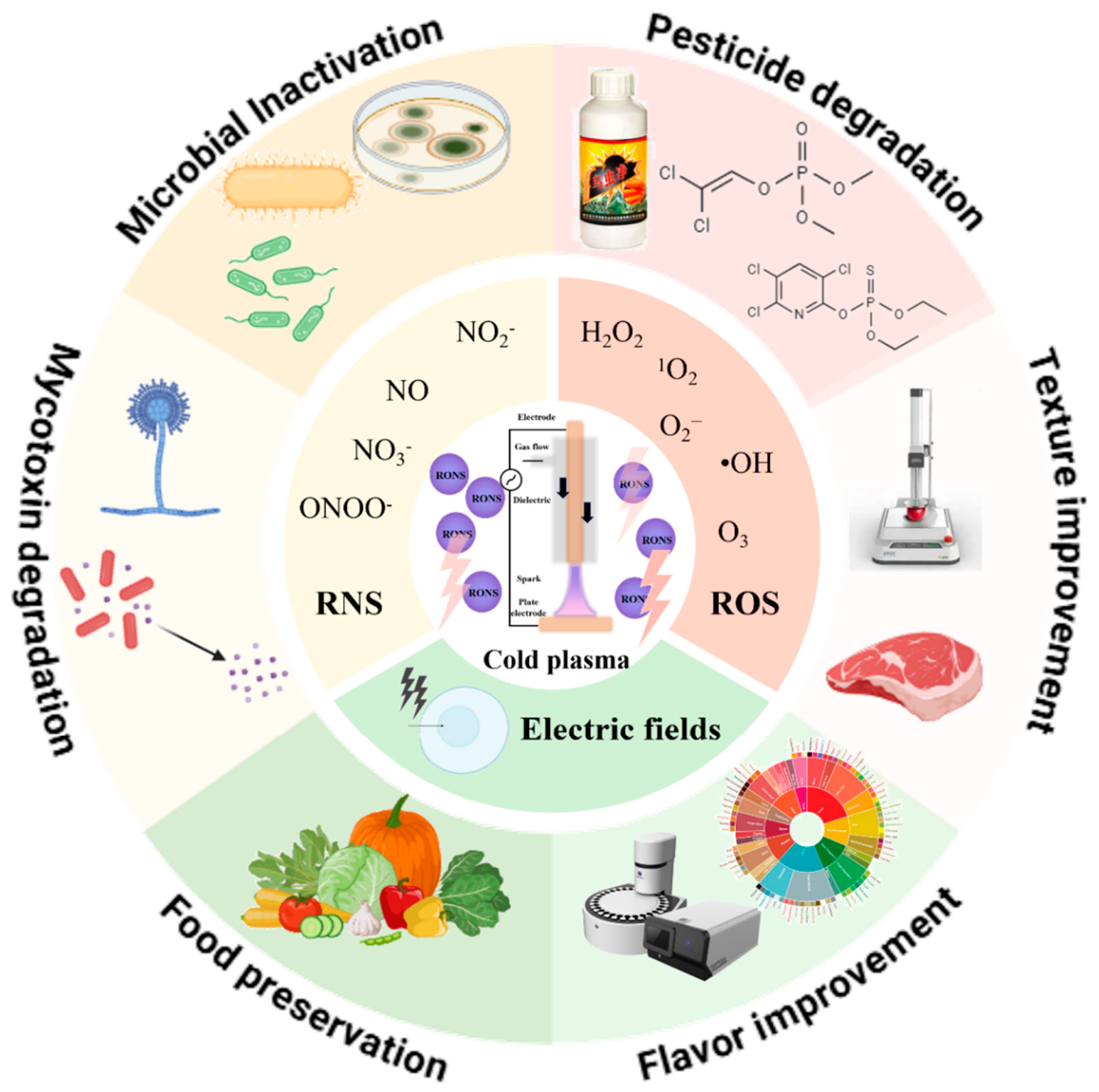
Figure 2.
Overview of the mechanism of plasma-based microbial inactivation.
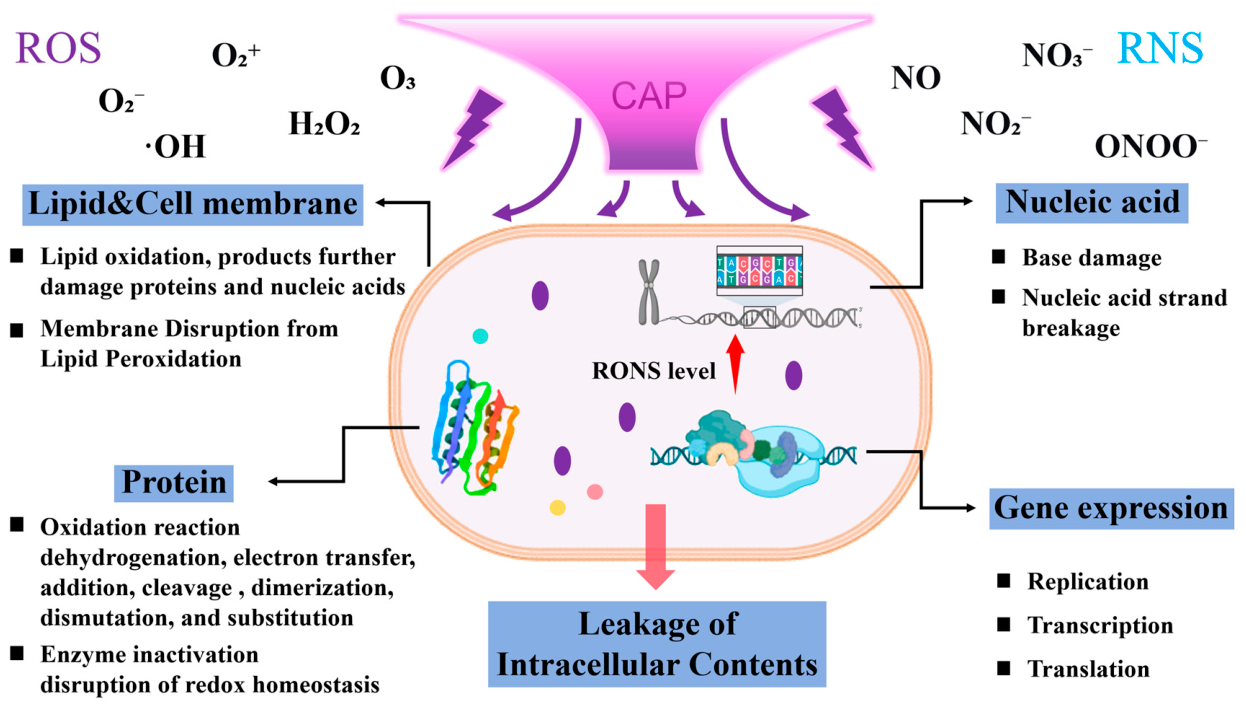
Figure 3.
The effect of RONS on lipids. (A) Schematic illustration of plasma treatment under dry and humid conditions and the contribution of reactive species to lipid oxidation [65]. Copyright 2023, Journal of Agricultural and Food Chemistry. (B) Schematic diagram of plasma sterilization in d-Man, l-His, PBS, and SOD solutions [68]. Copyright 2021, Elsevier. (C) Fluorescence microscope images of AR E. coli at different discharge times [66]. Copyright 2023, Elsevier. (D) Effect of CAP treatment time on lipid oxidation, membrane integrity, and intracellular ROS accumulation in F. graminearum HX01 [67]. Copyright 2022, Elsevier.
Figure 3.
The effect of RONS on lipids. (A) Schematic illustration of plasma treatment under dry and humid conditions and the contribution of reactive species to lipid oxidation [65]. Copyright 2023, Journal of Agricultural and Food Chemistry. (B) Schematic diagram of plasma sterilization in d-Man, l-His, PBS, and SOD solutions [68]. Copyright 2021, Elsevier. (C) Fluorescence microscope images of AR E. coli at different discharge times [66]. Copyright 2023, Elsevier. (D) Effect of CAP treatment time on lipid oxidation, membrane integrity, and intracellular ROS accumulation in F. graminearum HX01 [67]. Copyright 2022, Elsevier.
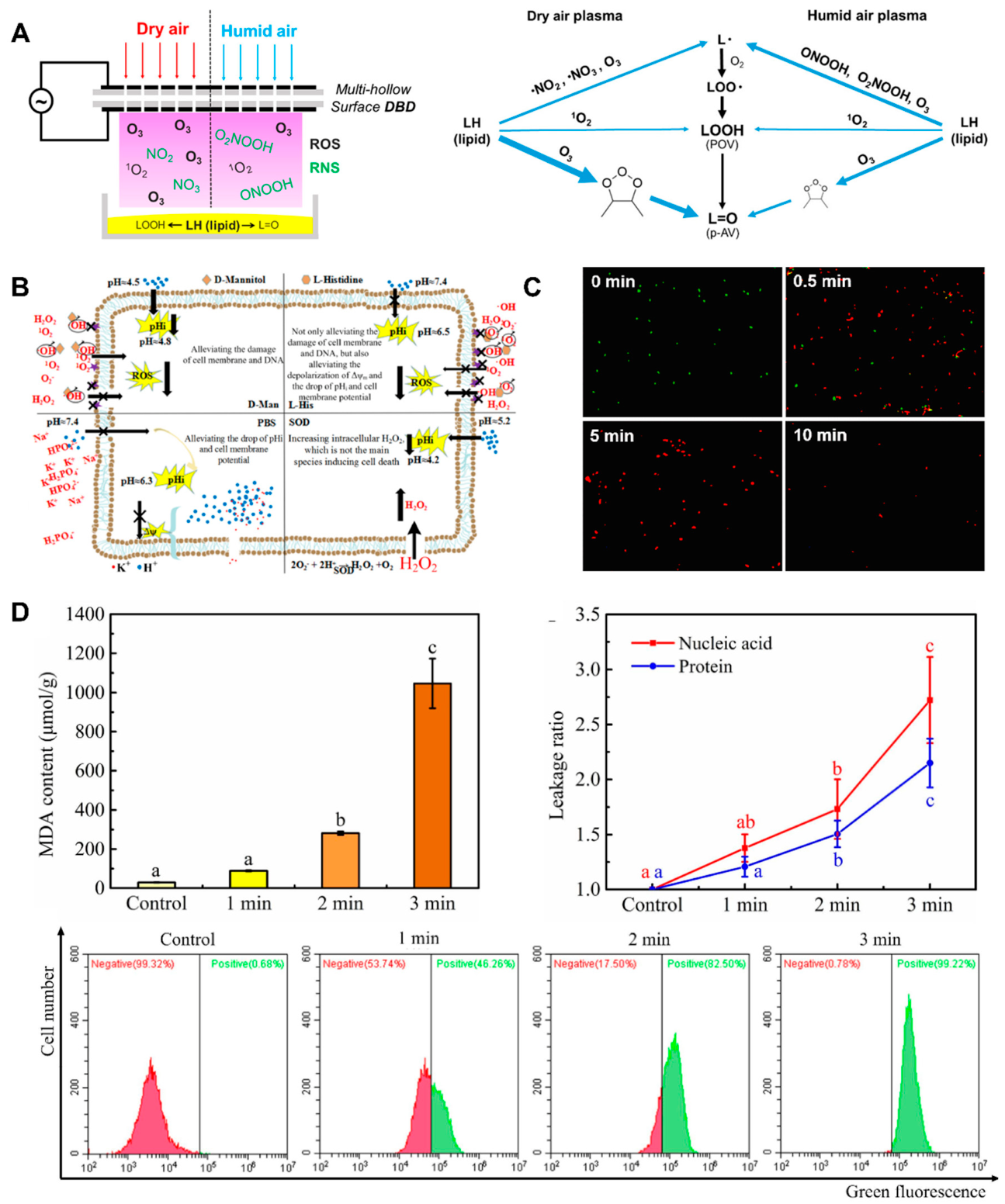
Figure 4.
The effect of RONS on protein and DNA. (A) Spectroscopic and molecular docking analysis of CAP with bacterial targets [76]. Copyright 2026, Elsevier. (B) γ-H2AX assay micrographs for CAP treatments [80]. Copyright 2020, Journal of Physics D: Applied Physics. (C) DNA tail length changes of Gram-positive and Gram-negative at 25 kV [79]. Copyright 2023, Plasma Chemistry and Plasma Processing. (D) Raman spectroscopic analysis of double-stranded G:C DNA oligomers after treatment [81]. Copyright 2013, Journal of the Royal Society Interface.
Figure 4.
The effect of RONS on protein and DNA. (A) Spectroscopic and molecular docking analysis of CAP with bacterial targets [76]. Copyright 2026, Elsevier. (B) γ-H2AX assay micrographs for CAP treatments [80]. Copyright 2020, Journal of Physics D: Applied Physics. (C) DNA tail length changes of Gram-positive and Gram-negative at 25 kV [79]. Copyright 2023, Plasma Chemistry and Plasma Processing. (D) Raman spectroscopic analysis of double-stranded G:C DNA oligomers after treatment [81]. Copyright 2013, Journal of the Royal Society Interface.
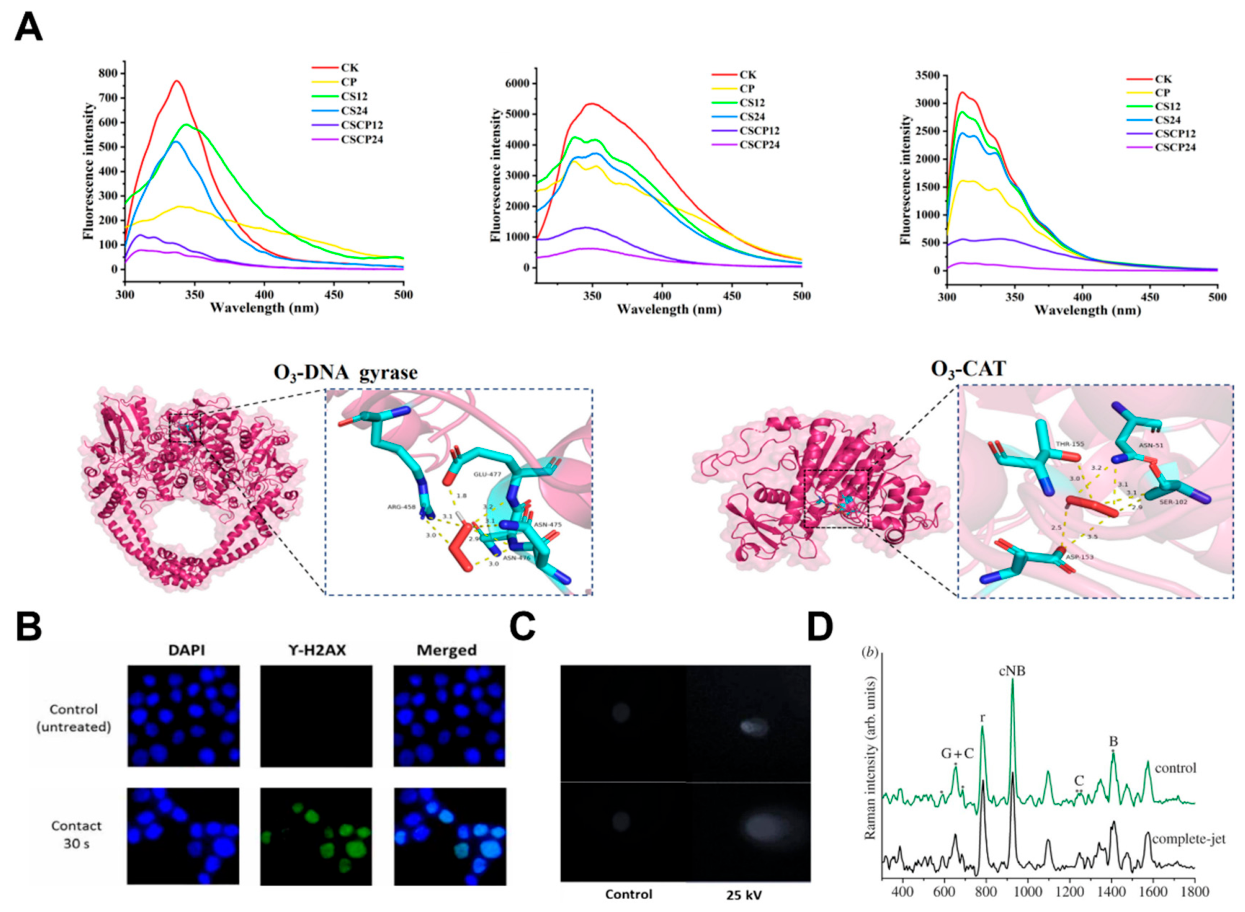
Figure 5.
(A) Effects of gas flow velocity on reactive species generation and antimicrobial efficacy of CAP [100]. Copyright 2025, Microsystems & Nanoengineering. (B) Microstructural and chemical evidence for the contribution of individual RONS to plasma-induced bacterial damage [101]. Copyright 2024, Elsevier.
Figure 5.
(A) Effects of gas flow velocity on reactive species generation and antimicrobial efficacy of CAP [100]. Copyright 2025, Microsystems & Nanoengineering. (B) Microstructural and chemical evidence for the contribution of individual RONS to plasma-induced bacterial damage [101]. Copyright 2024, Elsevier.
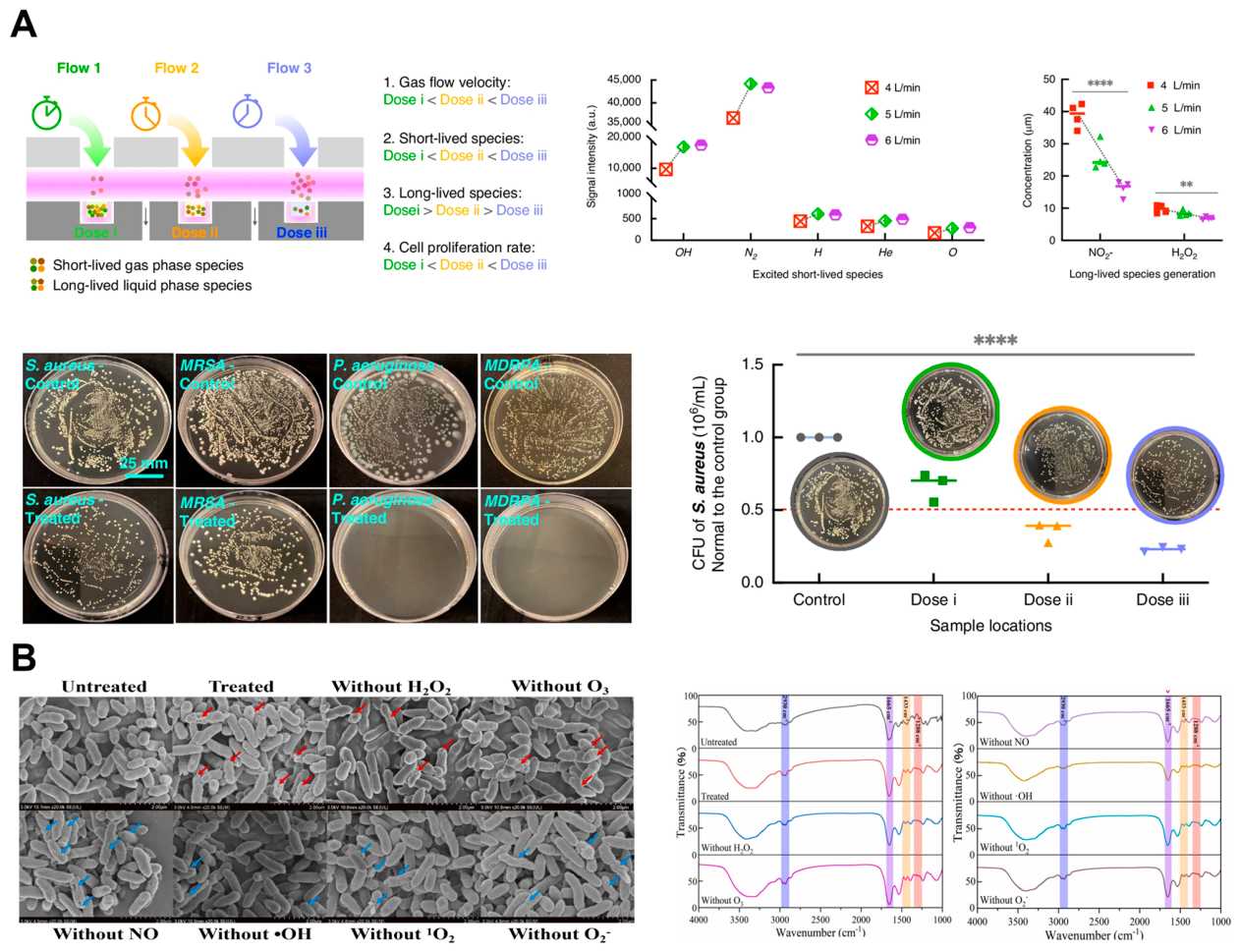
Figure 6.
The application of CAP in reducing microorganisms. (A) Inactivation mechanism of DBDP on Aeromonas hydrophila in water and infection verification of main organs in crucian carp [117]. Copyright 2024, Elsevier. (B) Changes in color parameters (a*, b*, ΔE) of fish fillets during storage [116]. Copyright 2026, Elsevier. (C) Schematic depiction of the indirect cold plasma treatment system [112]. Copyright 2024, ACS Food Science & Technology. (D) Comparative effects of plasma-activated ice versus artificial ice with equivalent H₂O₂ concentrations on the quality parameters of sea bream fillets during storage [113]. Copyright 2023, Elsevier.
Figure 6.
The application of CAP in reducing microorganisms. (A) Inactivation mechanism of DBDP on Aeromonas hydrophila in water and infection verification of main organs in crucian carp [117]. Copyright 2024, Elsevier. (B) Changes in color parameters (a*, b*, ΔE) of fish fillets during storage [116]. Copyright 2026, Elsevier. (C) Schematic depiction of the indirect cold plasma treatment system [112]. Copyright 2024, ACS Food Science & Technology. (D) Comparative effects of plasma-activated ice versus artificial ice with equivalent H₂O₂ concentrations on the quality parameters of sea bream fillets during storage [113]. Copyright 2023, Elsevier.
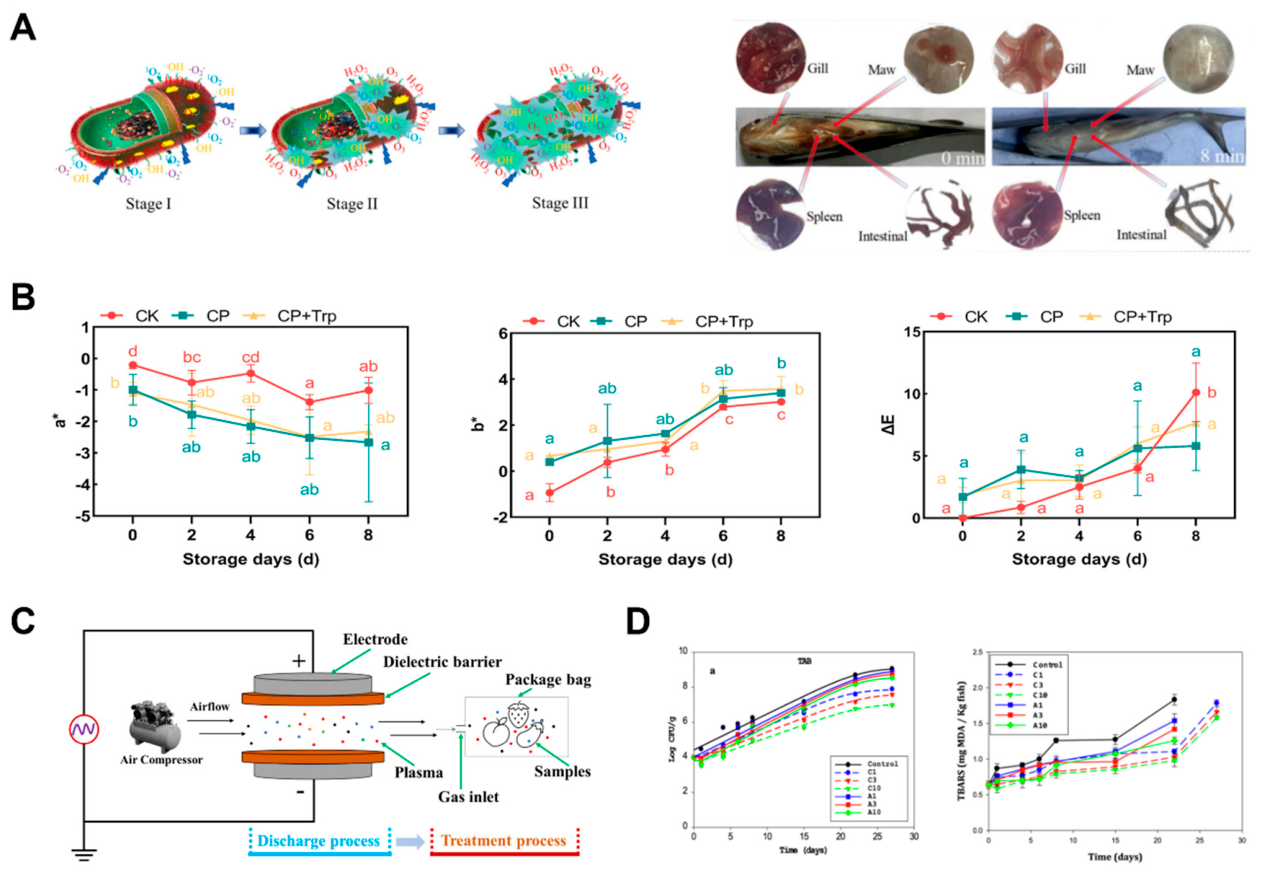
Figure 7.
The application of CAP in reducing mycotoxin and pesticide. (A) Comparative optical imaging of reactive species in CD and SDBD [127]. Copyright 2025, Elsevier. (B) Real photos of goji berries under different processing times [135]. Copyright 2024, Elsevier. (C) Effects of specific ROS/RNS scavengers on PAW detoxification of AFB₁ and SEM observations of peanut surface morphology post-treatment [128]. Copyright 2025, Elsevier. (D) Schematic diagram of DBD plasma generation with three different working gases and their corresponding MP removal rates [124]. Copyright 2022, Elsevier. (E) Evaluation of sensory quality changes in fresh-cut apples [136]. Copyright 2025, Elsevier.
Figure 7.
The application of CAP in reducing mycotoxin and pesticide. (A) Comparative optical imaging of reactive species in CD and SDBD [127]. Copyright 2025, Elsevier. (B) Real photos of goji berries under different processing times [135]. Copyright 2024, Elsevier. (C) Effects of specific ROS/RNS scavengers on PAW detoxification of AFB₁ and SEM observations of peanut surface morphology post-treatment [128]. Copyright 2025, Elsevier. (D) Schematic diagram of DBD plasma generation with three different working gases and their corresponding MP removal rates [124]. Copyright 2022, Elsevier. (E) Evaluation of sensory quality changes in fresh-cut apples [136]. Copyright 2025, Elsevier.
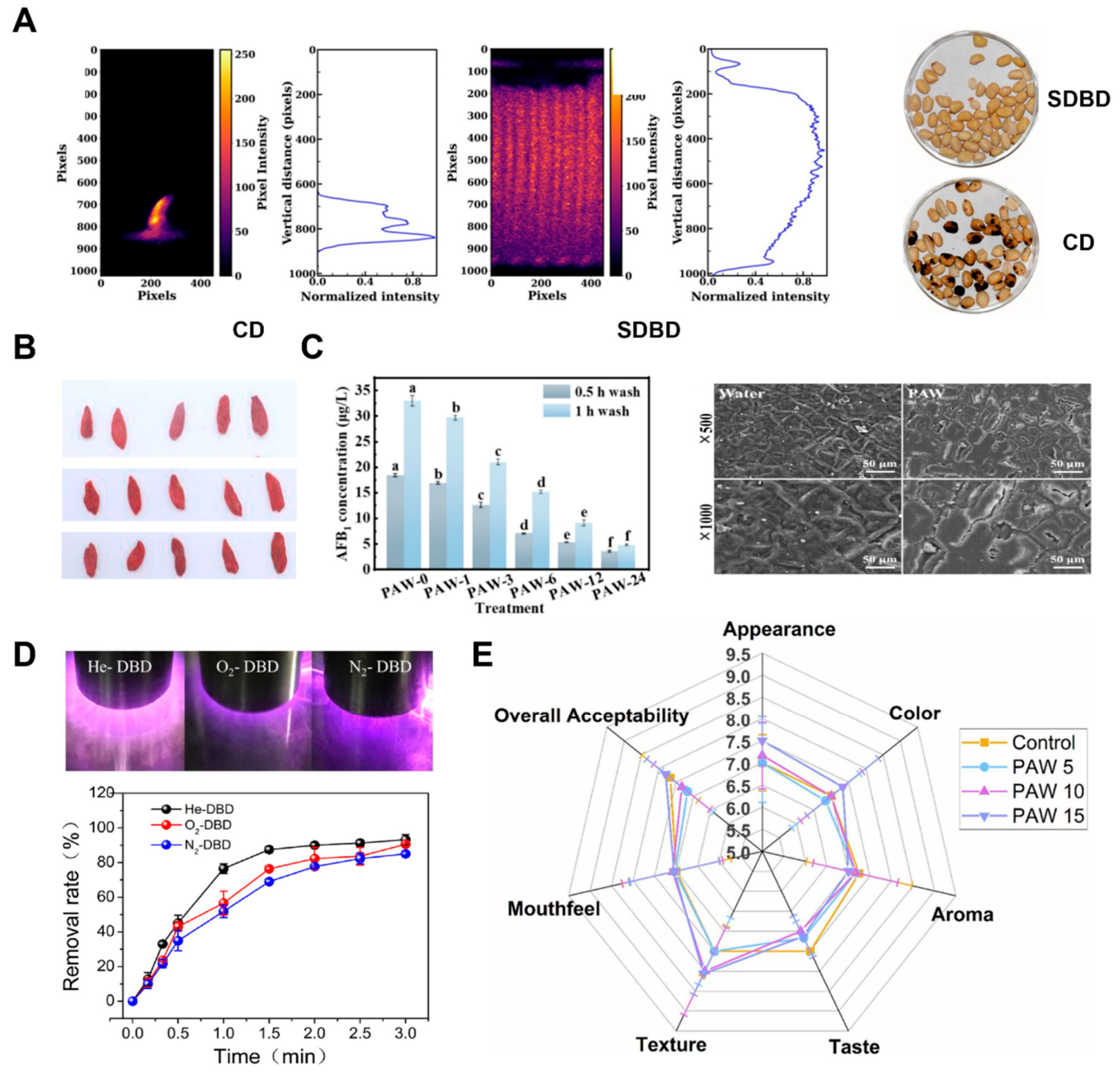
Figure 8.
Structural and functional modifications of food proteins induced by CAP. (A) Principal component analysis of protein structural and functional parameters and schematic illustration of DBD plasma mechanism [150]. Copyright 2024, Elsevier. (B) Physicochemical and functional properties of deamidated zein after cold plasma synergistic acid treatments [153]. Copyright 2024, Elsevier. (C) Physicochemical properties of emulsions prepared with cold plasma-treated soy protein isolate [152]. Copyright 2024, Elsevier. (D) Peptide profiles and digestibility of coconut globulin after ACP treatment at different voltages [146]. Copyright 2024, Elsevier.
Figure 8.
Structural and functional modifications of food proteins induced by CAP. (A) Principal component analysis of protein structural and functional parameters and schematic illustration of DBD plasma mechanism [150]. Copyright 2024, Elsevier. (B) Physicochemical and functional properties of deamidated zein after cold plasma synergistic acid treatments [153]. Copyright 2024, Elsevier. (C) Physicochemical properties of emulsions prepared with cold plasma-treated soy protein isolate [152]. Copyright 2024, Elsevier. (D) Peptide profiles and digestibility of coconut globulin after ACP treatment at different voltages [146]. Copyright 2024, Elsevier.
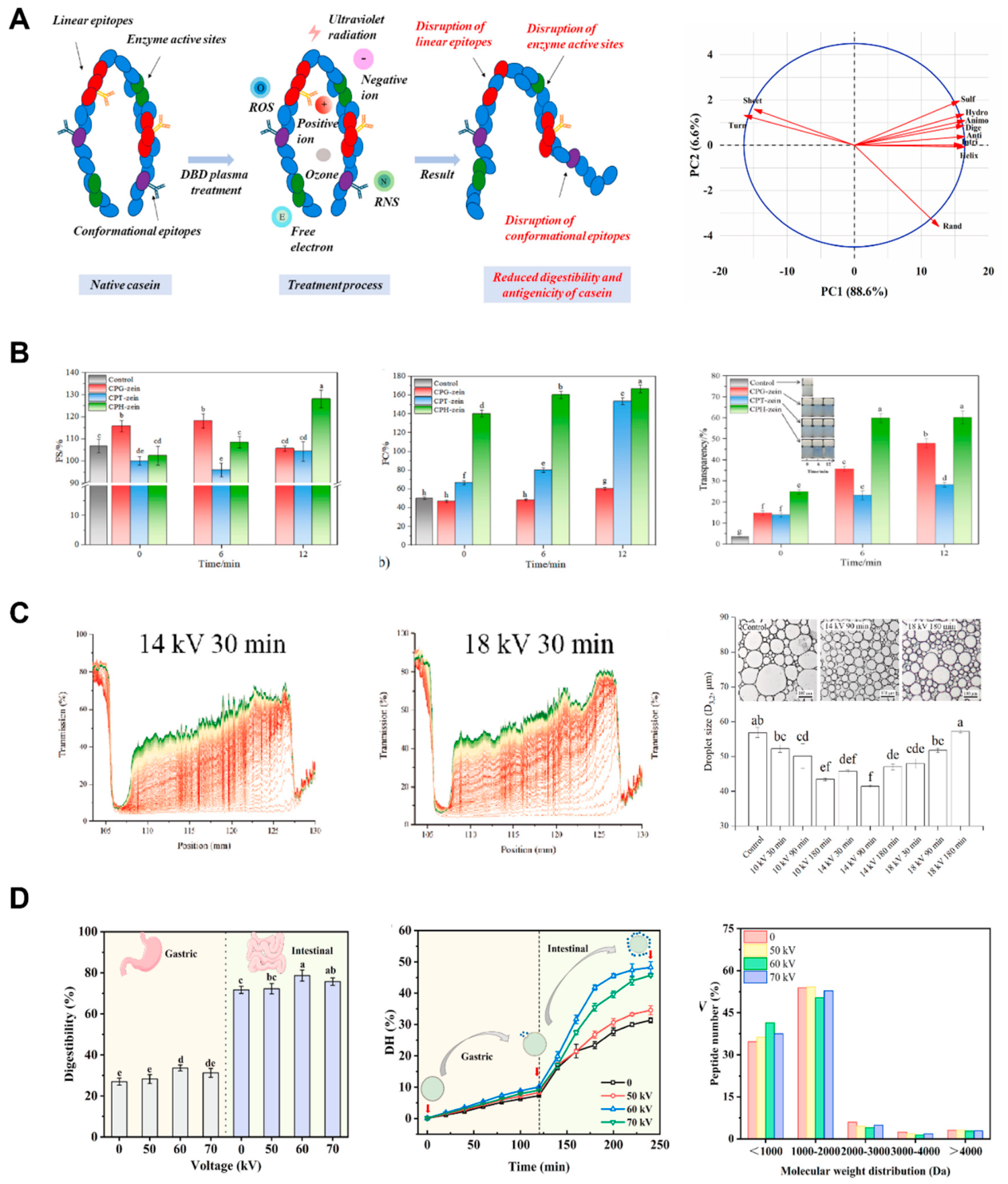
Disclaimer/Publisher’s Note: The statements, opinions and data contained in all publications are solely those of the individual author(s) and contributor(s) and not of MDPI and/or the editor(s). MDPI and/or the editor(s) disclaim responsibility for any injury to people or property resulting from any ideas, methods, instructions or products referred to in the content. |
© 2026 by the authors. Licensee MDPI, Basel, Switzerland. This article is an open access article distributed under the terms and conditions of the Creative Commons Attribution (CC BY) license.
Copyright: This open access article is published under a Creative Commons CC BY 4.0 license, which permit the free download, distribution, and reuse, provided that the author and preprint are cited in any reuse.