
Submitted:
26 October 2026
Posted:
28 October 2026
You are already at the latest version
Abstract
This paper reframes the infrastructure-technology mismatch in Brazilian freight railways as an alignment and sequencing challenge rather than as a static structural deficiency. The analysis combines a green-logistics perspective with a systems view of rail transport and current Brazilian evidence on infrastructure investment, operating efficiency and decarbonisation. Recent data from the National Land Transport Agency (ANTT) and the National Association of Railway Carriers (ANTF), together with the FICO-FIOL East-West Corridor and FIOL 1 projects, indicate that network expansion, regulatory coordination and rolling-stock innovation are advancing simultaneously, although not always at the same pace. The paper therefore proposes a balanced interpretation: technology can generate substantial benefits when it is matched by corridor capacity, intermodal terminals, energy supply, digital control and predictable regulation. The Brazilian decarbonisation agenda also extends beyond traction technology. Capacity expansion, network modernisation, wagon and locomotive renewal, renewable fuels, electrification and operational digitalisation form a complementary portfolio. The main contribution is an infrastructure-technology alignment framework that converts the original mismatch hypothesis into a constructive agenda for investment, policy and performance measurement. The FICO-FIOL programme is presented as a strategic test of this co-development approach.
Keywords:
freight railways
; sustainable transport
; sustainable logistics
; green logistics
; decarbonisation
; infrastructure
; railway technology
; Brazil
1. Introduction: From Mismatch to Alignment
Freight railways occupy a distinctive position in the transition to lower-carbon logistics because their environmental performance depends on both the intrinsic efficiency of rail transport and the ability of the wider logistics system to transfer and handle freight at scale. In Brazil, this systems perspective is particularly important: long-distance flows of iron ore, agricultural bulk, steel products, cellulose and fuels make rail capacity a strategic component of national competitiveness. The recent Brazilian experience also provides evidence of progress. Private participation and the concession model have supported investment, operational capacity and logistics efficiency over recent decades, while a new project pipeline is extending the network towards major production regions (Bastos and Marujo, 2026; ANTT, 2025a).
The starting point of the original manuscript was the possibility of an infrastructure-technology mismatch: rolling-stock and propulsion technologies may evolve more rapidly than the infrastructure needed to deploy them at scale. This remains a useful analytical risk, but it should not be treated as a predetermined diagnosis. A more constructive question is whether infrastructure, rolling stock, terminals, energy systems, digital technologies and regulation are being sequenced in a way that allows the productivity and environmental benefits of rail to materialize. The concept of infrastructure-technology alignment used here therefore treats mismatch as one possible state within a dynamic investment process rather than as the defining condition of the Brazilian railway sector.
This reframing is supported by recent developments. ANTF maintains annual historical series for freight moved, investment, fuel consumption, accidents and employment, providing a performance base for the sector (ANTF, 2026a). ANTT, in turn, is structuring and supervising projects such as the FICO-FIOL East-West Corridor and FIOL 1. At the same time, operators and manufacturers are testing battery traction, improving rolling-stock efficiency, automating terminals and adopting data-intensive operating practices. The relevant research problem is consequently one of co-development: how can infrastructure and technology reinforce each other so that rail expansion improves both logistics performance and decarbonisation?
The paper addresses this question through a conceptual review and a focused institutional case analysis. Project figures are treated according to their status: observed operational indicators are distinguished from planned investment, regulatory schedules and model-based forecasts. This distinction is necessary because many benefits associated with new corridors - including demand, emissions reduction, employment and logistics savings - are prospective outcomes rather than realized results.
2. Conceptual Framework: Green Logistics and Sustainable Rail Systems
2.1. Green Logistics as a Portfolio of Complementary Interventions
Green logistics is most useful when it is interpreted as a portfolio rather than as a single-technology transition. McKinnon et al. (2015) organise the environmental improvement of logistics around interacting decisions involving modal allocation, vehicle and asset utilisation, energy and fuel choices, network design, freight demand and public policy. For rail freight, this implies that lower-carbon traction is only one lever. A cleaner locomotive produces greater system-level value when trains are well utilised, terminals minimise dwell, corridors have adequate capacity, intermodal transfers are efficient and the electricity or fuel supply is available where operations require it.
This portfolio logic also changes the interpretation of infrastructure investment. New track is not merely a civil-engineering input; it can enable modal shift, larger traffic volumes and new network configurations. Conversely, operational improvements can release capacity from existing assets. The environmental contribution of rail therefore emerges from the interaction between physical infrastructure, operating rules, rolling stock, energy supply and the logistics network served by the railway.
2.2. Sustainable Rail Transport as a Multidisciplinary System
Marinov (2018; first published online in 2017) presents sustainable rail transport as a multidisciplinary field spanning railway operations, engineering, logistics, communications and safety. This broad scope is important for freight decarbonisation because sustainability cannot be reduced to propulsion technology or a single emissions indicator. A railway must remain safe, reliable, technically robust and economically usable while its energy and environmental performance improves. In heavy-haul systems, where axle loads, train length, gradients and asset availability strongly affect production, technical compatibility is a central condition for sustainability.
The resulting conceptual implication is that infrastructure-technology alignment should be assessed at system level. In this paper, alignment refers to the degree to which network capacity, rolling-stock capability, intermodal interfaces, energy infrastructure, digital control, maintenance systems and regulation jointly support the intended operating model. This definition accommodates both greenfield corridors and incremental modernisation of mature networks.
2.3. Operations Research, Terminals and System Performance
Marinov et al. (2013) provide a particularly relevant bridge between these systems view and the Brazilian context. Their comparison of rail freight research in Brazil and the European Union emphasizes system performance, collaborative research and the use of modelling and simulation to evaluate railway operations. The Brazilian examples reviewed in that study include simulation of yard capacity, infrastructure changes, crossing arrangements, asset allocation and traffic conflicts. The authors also stress that intermodal terminals are critical points in integrated transport chains because transhipment capacity and operational variability influence the performance of the entire system (Marinov et al., 2013).
A second implication follows from their discussion of variability and predictability. Productivity gains may come not only from physical expansion but also from reducing operational variability, improving predictability and applying decision-support models with a systemic view. This is directly applicable to the contemporary Brazilian decarbonisation agenda: higher effective capacity can be created through signalling, yard design, train planning, terminal coordination, predictive maintenance and digital decision support, while new infrastructure expands the longer-term capacity envelope. In this sense, infrastructure and technology are complements rather than competing explanations for performance.
3. Brazilian Freight Railways: A Positive Baseline and an Alignment Challenge
A less critical assessment of the Brazilian freight railway sector begins with its measured efficiency. ANTF reports that in 2023 Brazilian freight railways consumed, on average, 3.33 litres of diesel per 1,000 tonne-kilometres (TKU). On the same institutional comparison, estimated road-freight consumption lies between 21 and 44 litres per 1,000 TKU. ANTF also reports an emissions intensity of 8.35 gCO2/TKU for freight rail compared with 52.77 gCO2/TKU for road freight, corresponding to an approximately 85% reduction on this indicator when freight is shifted to rail (ANTF, 2026b). These values are based on ANTT/SAFF, ONTL and related datasets and should be interpreted according to the methodologies described by ANTF.
The same source estimates that each additional percentage point of rail participation in the Brazilian freight transport matrix can avoid roughly 2 million tonnes of CO2 annually. Bastos and Marujo (2026) reproduce this estimate and place it within a broader scenario in which the National Logistics Plan 2035 projects rail participation rising from 17.7% of TKU in the 2017 base year to as much as 42.9% under a 2035 scenario. These figures do not guarantee that modal shift will occur, but they show why network capacity is itself a decarbonisation variable rather than only an infrastructure variable.
Investment trends also support a positive agenda. ANTF reports approximately R$173.2 billion invested in freight railways since the beginning of the concession period, expressed in December 2023 values, including R$9.4 billion invested in concession networks and R$1.1 billion in network expansion during 2023. It also published an estimate of R$45 billion for the 2024-2026 period (ANTF, 2026b). The latter is a forward-looking estimate and should not be interpreted as a final audited total for the period.

Table 1.
Selected indicators for infrastructure-technology alignment in Brazilian freight railways.
| Indicator | Value / status | Reference period | Analytical use |
|---|---|---|---|
| Freight-rail diesel intensity | 3.33 L/1,000 TKU | 2023 | Observed efficiency baseline |
| Freight-rail CO2 intensity | 8.35 gCO2/TKU | 2022/2023 methodology | Environmental performance baseline |
| Road-freight CO2 intensity | 52.77 gCO2/TKU | 2022/2023 methodology | Modal-shift comparator |
| East-West Corridor project | 1,708 km; CAPEX R$28.5 bn; long-run potential about 40 Mt | ANTT project page updated 2025 | Strategic capacity expansion |
| FIOL 1 | 537.2 km, Ilhéus-Caetité; 35-year subconcession | Subconcession from 2021 | Existing project interface with East-West Corridor |
| FICO 1 Lot 1 regulatory milestone | km 0-104.5 scheduled for 31 Oct 2026 | Decision SUFER 66/2026 | Near-term delivery / monitoring milestone |
Sources: ANTF (2026a, 2026b); ANTT (2025a, 2026b). Project values and schedules are not treated as realised outcomes unless explicitly stated.
Technological progress is also visible in rolling stock. In March 2026, MRS Logistica reported operational experiments on its network with the SD70J-BB battery-electric locomotive developed by Progress Rail. The tests generated real operating data on energy use, regenerative braking, gradients and tractive effort; the locomotive had been designed and built in Brazil before its planned deployment in Australia (MRS Logistica, 2026). Rather than demonstrating that battery traction is immediately scalable across the Brazilian network, the case is more usefully interpreted as evidence of learning capability: operators can test emerging technologies under heavy-haul conditions and use the results to define the infrastructure, operating procedures and energy systems required for future adoption.
4. Strategic Infrastructure Pipeline: FICO-FIOL and FIOL
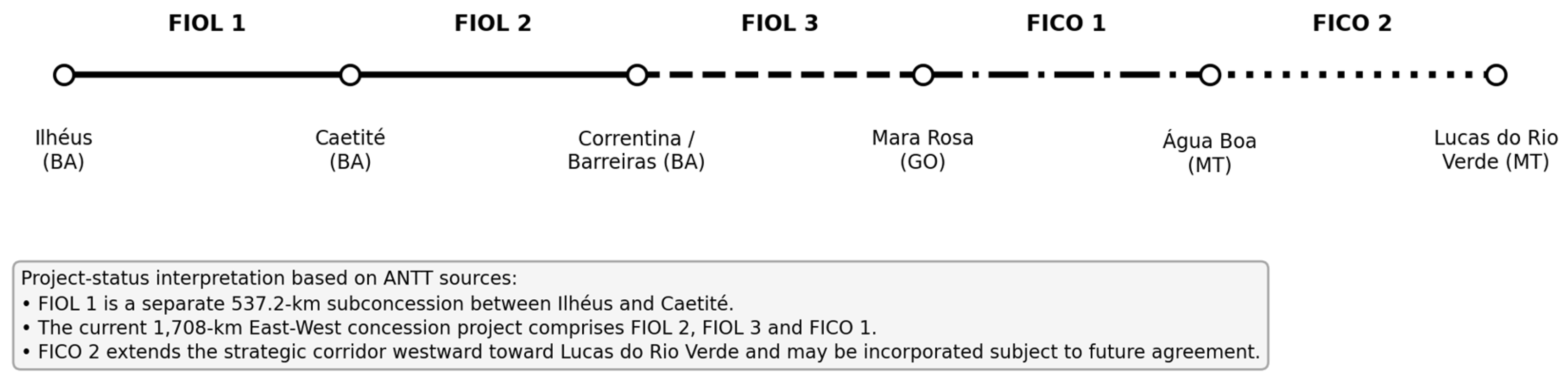
The FICO-FIOL programme provides a strong example of the positive infrastructure agenda now being developed. ANTT describes the East-West Corridor concession project as a 1,708-km system crossing Bahia, Goiás and Mato Grosso, with planned CAPEX of R$28.5 billion, planned OPEX of R$79.5 billion and long-run operating potential of approximately 40 million tonnes (ANTT, 2025a). The current concession scope combines FIOL 2, FIOL 3 and FICO 1. FIOL 1, between Ilhéus and Caetite, is a separate 537.2-km subconcession that began in September 2021 (ANTT, 2026c).
This distinction is important when the corridor is described geographically as extending from Bahia towards Lucas do Rio Verde in Mato Grosso. The official ANTT project gallery represents the strategic westward continuity through FICO 2, while the 1,708-km base concession scope published by ANTT comprises FIOL 2, FIOL 3 and FICO 1. ANTT states that FICO 2 may be included through a future agreement subject to maintenance of the economic-financial balance of the contract (ANTT, 2025a). Figure 1 therefore separates current project scope from the strategic extension rather than treating the whole axis as a single contracted project.
The project also illustrates the scale at which infrastructure can support modal rebalancing. ANTT demand studies indicate that approximately 80% of the projected corridor flow would consist of vegetable bulk commodities, including soybeans (46%), corn (28.5%) and soybean meal (6.2%), with fertilizers representing about 15.3%. The agency reports a projected average annual demand growth of 1.9% after 2035, reaching around 41 million useful tonnes by 2060 (ANTT, 2025a; ANTT, 2026a). These are planning forecasts, not realised traffic, but they provide a basis for sizing track, crossing yards, terminals, rolling stock and operating plans.
In 2026, FICO 1 was also associated with concrete regulatory milestones. ANTT reported that the 366-km project was advancing and that the superstructure of Lot 1 was expected in October 2026. The consolidated regulatory schedule subsequently set 31 October 2026 as the completion date for Lot 1 (km 0 to km 104.5), with later lots extending into 2027 and 2028 (ANTT, 2026a; ANTT, 2026b). As of the date of this manuscript revision, the milestone should therefore be treated as a regulatory schedule rather than as a completed delivery unless a later acceptance record is available.
Figure 1.
Strategic FICO-FIOL corridor: current project scope and westward extension. Source: authors’ schematic adapted from the official ANTT FICO-FIOL (2026).
Figure 1.
Strategic FICO-FIOL corridor: current project scope and westward extension. Source: authors’ schematic adapted from the official ANTT FICO-FIOL (2026).
The FIOL component adds a regulatory-learning dimension. FIOL 1 links Ilhéus and Caetite and is governed by a 35-year subconcession. In June 2025, ANTT formalized a first contract addendum that explicitly differentiated the construction and operating phases, aligning the regulatory framework more closely with the project’s implementation reality (ANTT, 2025c). In 2026, ANTT also updated FIOL 1 tariff documentation. These actions are relevant to infrastructure-technology alignment because project delivery depends not only on engineering but also on contractual clarity, predictable interfaces and a regulatory model capable of accompanying the transition from construction to commercial operation.
The positive case should nevertheless be presented with analytical discipline. During the 2025 public-participation process, ANTT presented modelled project impacts that included logistics savings of about R$500 million per year, reforestation of 6,717 hectares, approximately 11 million seedlings and a cumulative reduction of 85 million tonnes of CO2 over 35 years, together with employment estimates for construction and operation (ANTT, 2025b). These figures are project-study projections. Their value in the present paper is to show the intended scale of economic and environmental benefits and to identify variables that should be monitored ex post, not to claim that the benefits have already occurred.
5. Decarbonisation as Co-Development of Capacity, Assets and Operations
Bastos and Marujo (2026) offer a useful sectoral formulation of this co-development logic. Drawing on ANTF material, they organise the Brazilian freight-rail decarbonisation agenda around six levers: new railway capacity, wagon renewal, locomotive renewal, network modernisation, electrification and renewable fuels. This framework is inherently more balanced than a propulsion-only narrative because it recognises that emissions can be reduced by carrying more freight per train, improving specific fuel consumption, removing operational bottlenecks, substituting energy sources and expanding the share of freight that can move by rail.
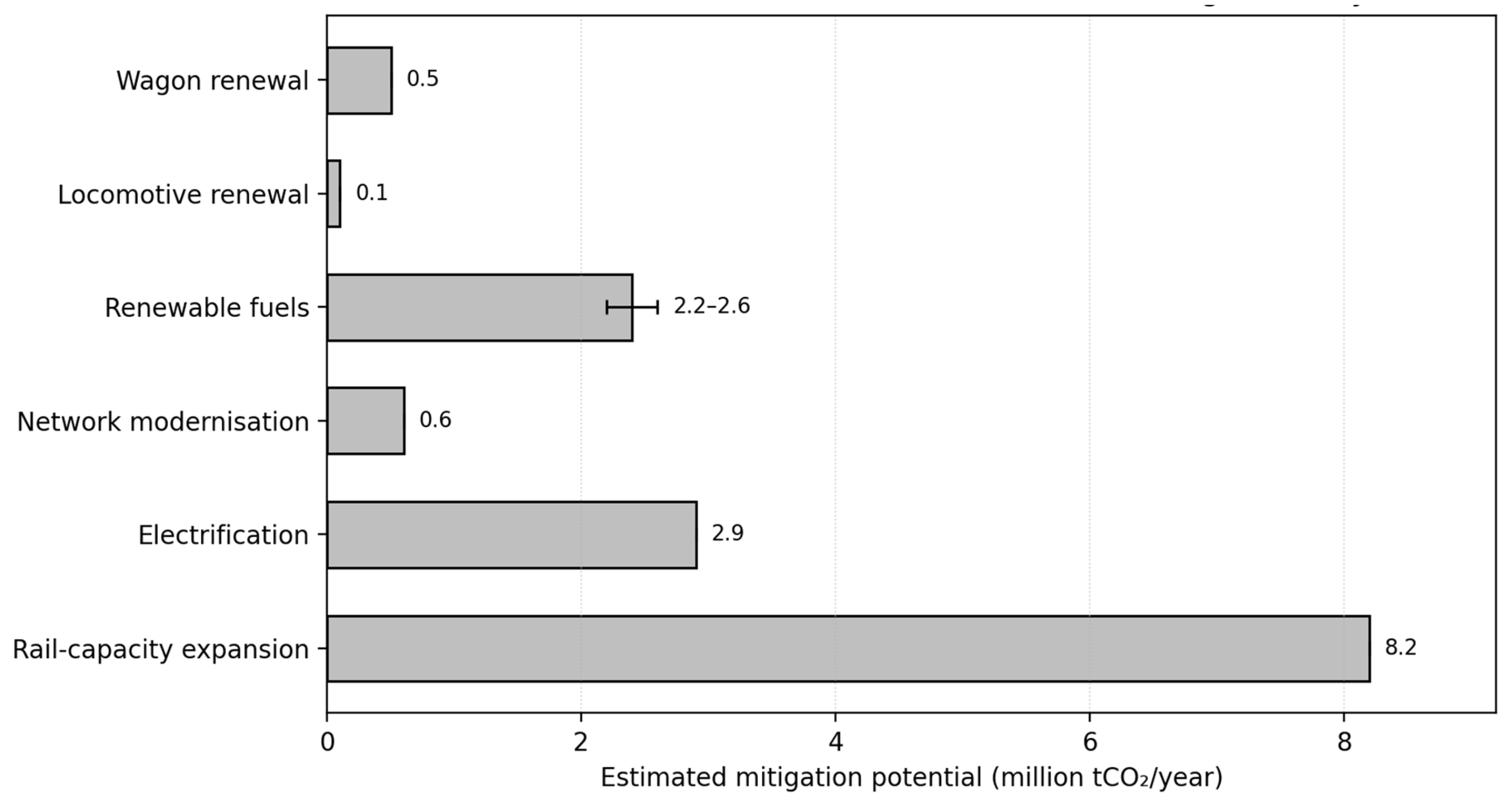
Within that illustrative set, capacity expansion is associated with the largest estimated mitigation potential, about 8.2 million tCO2/year. Electrification is estimated at about 2.9 million tCO2/year; renewable fuels at 2.2-2.6 million tCO2/year; network modernisation at about 0.6 million tCO2/year; wagon renewal at about 0.5 million tCO2/year; and locomotive renewal at about 0.1 million tCO2/year (Bastos and Marujo, 2026). These values should not be summed mechanically because measures can overlap and are conditional on implementation assumptions. Their main analytical value is the ranking signal: infrastructure capacity and operational modernisation can be as important to decarbonisation as changes in traction energy.
Figure 2.
Illustrative mitigation potential of selected freight-rail decarbonisation levers in Brazil. Source: adapted from Bastos and Marujo (2026), based on ANTF (2026). Values are scenario estimates; renewable fuels are reported as a range of 2.2-2.6 MtCO2/year.
Figure 2.
Illustrative mitigation potential of selected freight-rail decarbonisation levers in Brazil. Source: adapted from Bastos and Marujo (2026), based on ANTF (2026). Values are scenario estimates; renewable fuels are reported as a range of 2.2-2.6 MtCO2/year.
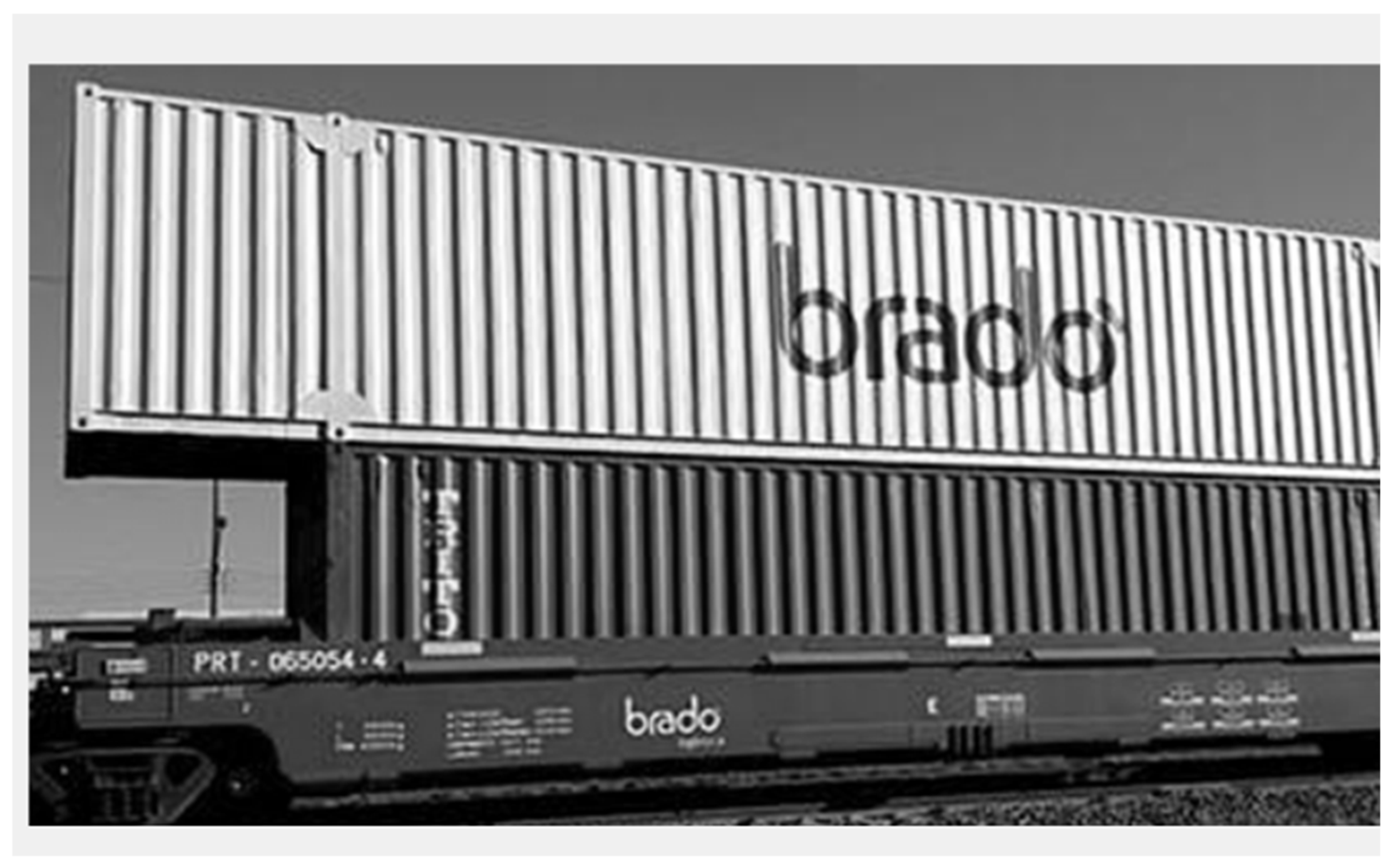
The same technical note provides practical examples of how capacity and technology interact. Double-stack container wagons can increase train container capacity by about 40% in suitable operations, potentially reducing the number of trips and energy use per transported unit. However, this gain is infrastructure-dependent: loading gauge, structures, terminal equipment, clearances and operating rules must accommodate the higher profile. The example therefore illustrates the central argument of this paper - asset innovation produces system benefits only when infrastructure and terminals are compatible with it.
Figure 3.
Double-stack wagon example used to illustrate capacity-oriented decarbonisation. Source: Bastos and Marujo (2026), p. 4.
Figure 3.
Double-stack wagon example used to illustrate capacity-oriented decarbonisation. Source: Bastos and Marujo (2026), p. 4.
Further examples reinforce the same positive agenda. Bastos and Marujo (2026) report that Brado ended 2025 with 100% of its electricity consumption sourced from renewable energy contracts, reduced total electricity consumption by 16% relative to the previous year and planned three remotely operated gantry cranes at the Sumare terminal for 2026, progressively replacing diesel-powered stackers with electric equipment. In the rolling-stock manufacturing link, the authors highlight lighter and more aerodynamic wagons, improved steels, tare optimisation, premium bogies and longer asset life as routes to lower fuel consumption and emissions.
Digitalisation is equally relevant. The technical note identifies robotics, artificial intelligence and automated welding, assembly and painting as manufacturing trends, while digital operating control can reduce cycle times and equipment idleness. This is consistent with Marinov et al. (2013), who emphasise modelling, simulation and decision support as mechanisms for improving utilisation, reducing variability and increasing predictability. The alignment agenda thus extends from track and locomotives to a data-intensive operating system in which capacity, maintenance, safety, energy and emissions are monitored together.
6. A Positive Infrastructure-Technology Alignment Agenda
The evidence above suggests that the policy and management question is no longer whether Brazil should choose between infrastructure and technology. The more productive agenda is to sequence them deliberately. Six priorities can convert current investment momentum into durable system performance.
Table 2.
Positive agenda for infrastructure-technology alignment.
| Priority | Management logic | Illustrative actions | Performance evidence |
|---|---|---|---|
| 1. Deliver strategic corridors as integrated systems | Treat track, terminals and port interfaces as one capacity chain | Complete FIOL/FICO interfaces; crossing yards; terminal and Porto Sul readiness | Commissioned km, effective capacity, terminal dwell, corridor TKU |
| 2. Modernize existing networks while expanding | Release capacity before or alongside greenfield additions | Signalling, yards, train length, maintenance, bottleneck removal | Train speed, cycle time, utilisation, reliability |
| 3. Match rolling stock to infrastructure | Avoid technology deployment without clearance, axle-load or maintenance compatibility | Double-stack clearances; heavy-haul axle-load design; battery/electric operating studies | Payload/train, energy/TKU, availability, asset life |
| 4. Build an energy transition by operating domain | Use the lowest-carbon solution compatible with range, robustness and duty cycle | Renewable fuels, selective electrification, battery/hybrid pilots, electric terminal equipment | Fuel mix, gCO2/TKU, regenerative energy, energy cost |
| 5. Use digital decision support to increase effective capacity | Reduce variability and improve predictability | Simulation, predictive maintenance, traffic management, terminal coordination | Dwell, failure rate, schedule adherence, capacity utilisation |
| 6. Strengthen regulatory and institutional sequencing | Align project milestones, contracts, authorizations and monitoring | Clear construction/operation phases; stable milestones; benefit tracking | Milestone compliance, investment execution, realised vs forecast benefits |
Source: synthesis developed in this paper from McKinnon et al. (2015), Marinov (2018), ANTT (2025a, 2026a, 2026b) and Bastos and Marujo (2026).
First, strategic corridors should be delivered as integrated logistics systems rather than as isolated track sections. The functionality of FICO-FIOL depends on the completion and interoperability of its segments, as well as on port and terminal interfaces. Second, infrastructure modernisation should accompany greenfield expansion: signalling, yard capacity, train length, maintenance practices and terminal design can increase effective capacity before the full benefits of new corridors are available.
Third, technology choices should be conditioned by operating requirements. Heavy-haul freight needs autonomy, robustness and high availability, so battery, electrification and alternative-fuel strategies should be matched to specific duty cycles rather than adopted as universal solutions. Fourth, asset innovation should be linked to infrastructure standards. Double-stack wagons, higher axle loads and new locomotive technologies can produce substantial gains, but only when structures, track, maintenance facilities and terminals are designed to support them.
Fifth, digital decision support should be treated as a capacity technology. Simulation, predictive maintenance, traffic management and data integration can improve utilisation and reduce variability, echoing the operations-research agenda identified by Marinov et al. (2013). Finally, regulatory governance should make sequencing visible. Contract milestones, acceptance criteria, investment execution and realised benefits should be monitored in a way that allows projected outcomes to be compared with actual performance over time.
7. Discussion
The revised evidence base changes the interpretation of the infrastructure-technology mismatch in two ways. First, it reduces the risk of an excessively critical narrative. Brazil is not characterized only by infrastructure scarcity: it has a freight-rail system with favourable energy and emissions indicators, a substantial history of private investment, active corridor projects, regulatory learning and ongoing technology trials. Second, the evidence does not justify the opposite conclusion that alignment is already complete. Major project benefits remain conditional on construction, interconnection, terminal readiness, operational integration and commercial utilisation.
The concept of alignment is therefore more analytically useful than a binary judgement of mismatch versus no mismatch. At any point in time, one component may lead another. A battery locomotive can be tested before charging or power systems exist at scale; a new corridor can be built before traffic fully develops; a digital operating platform can release capacity from legacy infrastructure. The policy objective is to manage these lead-lag relationships so that they converge into a coherent operating system.
FICO-FIOL is an especially useful empirical test. The corridor combines greenfield construction, interfaces with existing and separately subconceded infrastructure, agricultural demand, port connectivity, regulatory structuring and long-term environmental expectations. A longitudinal research design should therefore track not only kilometres delivered but also effective capacity, freight volumes, train productivity, terminal dwell, fuel consumption, emissions intensity and modal-shift outcomes. This would convert the alignment concept from a qualitative framework into a testable performance model.
8. Conclusions
Brazilian freight railways should be analysed through a balanced transition lens. The sector already presents strong energy-efficiency and emissions advantages relative to road freight on the metrics reported by ANTF, while current investment programmes can expand the amount of freight that benefits from those advantages. FICO-FIOL and FIOL illustrate an infrastructure agenda that, if completed and integrated, can reinforce the technological and operational modernisation already visible in the sector.
The central argument is consequently revised from a predominantly critical mismatch thesis to an infrastructure-technology alignment agenda. Low-carbon locomotives and fuels remain relevant, but sustainable rail performance depends equally on corridor capacity, terminals, rolling-stock design, operational efficiency, digitalisation, maintenance, energy supply and regulatory governance. Capacity expansion itself can be a decarbonisation lever when it enables modal shift and higher network productivity.
For policy and management, the implication is positive but conditional: Brazil has a credible opportunity to use the current railway investment cycle to create a more integrated, competitive and lower-carbon freight system. The quality of that transition should be evaluated by realised system performance, not by technology adoption or infrastructure delivery in isolation. Future research should therefore compare planned and actual outcomes across the 2026-2035 horizon and test whether infrastructure, technology and operating performance are converging at corridor level.
References
- AGENCIA NACIONAL DE TRANSPORTES TERRESTRES - ANTT. (2025a). Corredor Ferroviario Leste-Oeste (FICO-FIOL). Project page, updated 10 September 2025. Available at: https://www.gov.br/antt/pt-br/assuntos/ferrovias/novos-projetos-ferroviarios/Corredor%20Leste-Oeste/ef-334-fiol-ii-e-fiol-iii-capa.
- AGENCIA NACIONAL DE TRANSPORTES TERRESTRES - ANTT. (2025b). ANTT conclui serie de sessoes para ouvir sociedade sobre a concessao das ferrovias FICO e FIOL. 14 March 2025. Available at: https://www.gov.br/antt/pt-br/assuntos/ultimas-noticias/antt-conclui-serie-de-sessoes-para-ouvir-sociedade-sobre-a-concessao-das-ferrovias-fico-e-fiol.
- AGENCIA NACIONAL DE TRANSPORTES TERRESTRES - ANTT. (2025c). ANTT formaliza 1o Termo Aditivo da FIOL e da passo decisivo para avanco da ferrovia no Brasil. 11 June 2025. Available at: https://www.gov.br/antt/pt-br/assuntos/ultimas-noticias/antt-formaliza-1o-termo-aditivo-da-fiol-e-da-passo-decisivo-para-avanco-da-ferrovia-no-brasil.
- AGENCIA NACIONAL DE TRANSPORTES TERRESTRES - ANTT. (2026a). Projeto da FICO avanca e consolida corredor estrategico para o transporte de cargas no pais. 8 May 2026. Available at: https://www.gov.br/antt/pt-br/assuntos/ultimas-noticias/projeto-da-fico-avanca-e-consolida-corredor-estrategico-para-o-transporte-de-cargas-no-pais.
- AGENCIA NACIONAL DE TRANSPORTES TERRESTRES - ANTT. (2026b). Decisao SUFER no. 66, de 6 de julho de 2026: Cronograma Regulatorio de Implantacao da FICO. DOU, 13 July 2026. Available at: https://anttlegis.antt.gov.br/action/TematicaAction.php?acao=abrirVinculos&cod_menu=8228&cod_modulo=423&cotematica=17481644.
- AGENCIA NACIONAL DE TRANSPORTES TERRESTRES - ANTT. (2026c). Ferrovia de Integracao Oeste-Leste FIOL - Trecho 1. Concession information. Accessed 21 October 2026. Available at: https://www.gov.br/antt/pt-br/assuntos/ferrovias/concessoes-ferroviarias/ferrovia-de-integracao-oeste-leste-fiol-trecho-1/ferrovia-de-integracao-oeste-leste-fiol-2013-trecho-1-capa.
- ASSOCIACAO NACIONAL DOS TRANSPORTADORES FERROVIARIOS - ANTF. (2026a). Painel ANTF. Annual historical indicators for the freight railway sector. Accessed 21 October 2026. Available at: https://www.antf.org.br/boletim-antf/painel-antf/.
- ASSOCIACAO NACIONAL DOS TRANSPORTADORES FERROVIARIOS - ANTF. (2026b). Por que o Brasil vai bem de Trem. Sector indicators and methodological notes. Accessed 21 October 2026. Available at: https://www.antf.org.br/por-que-o-brasil-vai-bem-de-trem/.
- BASTOS, G.; MARUJO, L. (2026). Descarbonizacao da industria ferroviaria de carga no Brasil [Decarbonisation of the freight railway industry in Brazil]. Programa de Logistica Verde Brasil, Informativo Tecnico no. 009/2026, 10 June 2026, 8 p.
- MARINOV, M.; WORONIUK, C.; DINIZ DE OLIVEIRA, A.; SILVEIRA LOPES, L. A.; MARUJO, L. G. (2013). Rail Freight Research in Brazil and the EU. 13th World Conference on Transport Research - WCTR, Rio de Janeiro, 15-18 July 2013. Available at: https://www.wctrs-society.com/wp-content/uploads/abstracts/rio/general/1155.pdf.
- MARINOV, M. (2018; first published online 2017). Sustainable Rail Transport. In: Marinov, M. (ed.), Sustainable Rail Transport: Proceedings of RailNewcastle Talks 2016. Lecture Notes in Mobility. Cham: Springer, pp. 1-5. [CrossRef]
- MCKINNON, A.; BROWNE, M.; WHITEING, A.; PIECYK, M. (2015). Green Logistics: Improving the Environmental Sustainability of Logistics. 3rd ed. London: Kogan Page. ISBN 978-0-7494-7185-9. Publisher record: https://www.koganpage.com/logistics-supplychain-operations/green-logistics-9780749471859.
- MRS LOGISTICA. (2026). MRS Logistica faz demonstracao com maior locomotiva a baterias do mundo. March 2026. Available at: https://www.mrs.com.br/wp-content/uploads/2026/03/03_2026_MRS-Logistica-faz-demonstracao-com-maior-locomotiva-a-baterias-do-mundo-VF.pdf.
Disclaimer/Publisher’s Note: The statements, opinions and data contained in all publications are solely those of the individual author(s) and contributor(s) and not of MDPI and/or the editor(s). MDPI and/or the editor(s) disclaim responsibility for any injury to people or property resulting from any ideas, methods, instructions or products referred to in the content. |
© 2026 by the authors. Licensee MDPI, Basel, Switzerland. This article is an open access article distributed under the terms and conditions of the Creative Commons Attribution (CC BY) license (http://creativecommons.org/licenses/by/4.0/).
Copyright: This open access article is published under a Creative Commons CC BY 4.0 license, which permit the free download, distribution, and reuse, provided that the author and preprint are cited in any reuse.