

Submitted:
26 October 2026
Posted:
27 October 2026
You are already at the latest version
Abstract
Biological function depends on constrained transitions between physiological states, yet a biomarker sampled at a single time point describes only an occupied state, not the pathways accessible from it; capacity to respond, recover or tolerate further challenge is inferred accordingly. To address this distinction, a framework drawing on concepts of entropy and symmetry is postulated, in which molecular, structural, energetic, immune, and temporal constraints shape the integrity of the occupied state and access to a repertoire of viable states.A symmetry-integrity function, Φ(t), serves as a latent descriptor of a currently occupied multiscale state. Adaptive reserve describes the breadth, connectivity, traversability and recoverability of viable state-space; resilience defines its effective deployment during perturbation. Ordinary physiological capacity is distinguished from failsafe responses, through which unresolved burden may be contained or damaged components eliminated while higher-order function is sustained. Such compensation can preserve current output despite restricted transitions, maintenance expenditures and reduced capacity to absorb subsequent challenges. Physiological and failsafe responses may draw on pre-existing capacity and challenge-induced mechanisms.In this context, ageing is hypothesised to alter state accessibility through loss of viable states, altered transition barriers, slower restoration, increased stochastic dispersion in state-space or pathological trapping. Cancer presents a nested-scale problem in which malignant reserve can be preserved while constraints that sustain host function deteriorate. Quiescence, reproductive transitions and comparative longevity illustrate the distinction between contemporaneous activity, integrity of the occupied state and retained response capacity.An operational schema is developed using spatially specified measurements, graded perturbations, recovery dynamics and repeated challenges. Membrane organisation, multivariate molecular profiles and spatial tumour states afford candidate descriptions of occupied states, with measured states distinguished from inferred trajectories. Testable predictions concern compensated function, activation thresholds, response ceilings and whether niche context adds predictive information. The framework is a testable synthesis whose explanatory and predictive value lies in its assessment against simpler models based on baseline state, damage burden and recovery. It gives a basis for subsequent evaluation of therapeutic strategies.
Keywords:
ageing
; cancer
; adaptive reserve
; resilience
; state-space
; entropy
; symmetry
; quiescence
1. Introduction
1.1. Biological Order Is Not Static
Living systems persist far from thermodynamic equilibrium by consuming free energy, performing work and exporting entropy; nonequilibrium thermodynamics and theories of biological autonomy describe this organisation as an active process maintained through constrained flows and regulation [1,2,3,4]. The challenge is to connect this physical account with the diverse functional changes observed during ageing and disease, without equating biological order with static regularity or minimal variability.
Metabolic, circadian and immune function each require the system to alternate between distinct operating modes: fed and fasted, asleep and awake, activated and resolved. A healthy system is defined by its preserved ability to traverse these modes without losing higher-order organisation, because any observed state is only one point in that space; it underdetermines the system’s response capacity.
Healthy physiology can exhibit complex temporal fluctuations within strong structural constraints, while ageing and disease can produce more regular time series as tissue organisation deteriorates [5,6]. Entropy, variability, complexity, symmetry and resilience are not interchangeable. The biological meaning of these fluctuations depends on scale, modality, timing and trajectory: a transient departure may be adaptive, a low-variance state pathological, and a substantial response evidence of preserved capacity. These distinctions prevent assigning a single directional biomarker change universal biological meaning.
Cellular quiescence illustrates this distinction: apparently inactive cells can occupy heterogeneous, actively maintained states with different capacities and kinetics of reactivation [7]. Low activity alone does not establish occupied-state integrity or retained adaptive reserve.
1.2. Proposal for an Entropy-Symmetry Framework
An entropy-symmetry framework is proposed in which evolution has generated and retained nested constraints that channel energetic and informational flux while limiting disorder propagation. These constraints can arise through selection, neutral processes, historical contingency or compensation; they need not each represent a direct adaptation. Membrane compartments, extracellular-matrix (ECM) organisation, tissue boundaries, regulatory coupling and biological rhythms restrict some configurations while preserving functionally useful degrees of freedom.
“Symmetry” is used operationally to encompass structural, functional and temporal relationships preserved through transformation or repeated cycling and does not imply maximal geometric regularity. Differentiation, polarity and repair require controlled symmetry-breaking; biological order depends on preserving appropriate constraints during and after such departures. Exact invariance, as in a viral capsid, is only one case and at broader scales, the relevant question is which relationships must remain coherent for function to persist as the system changes state.
The resulting state-space representation treats a viable organism as capable of occupying multiple coherent states. The central hypothesis is that changes in occupied-state integrity and in the accessibility and recoverability of viable states help explain functional trajectories across heterogeneous mechanisms of ageing and disease. Cancer exemplifies a nested-scale case in which local adaptive capacity becomes uncoupled from host-level constraint.
1.3. Relationship to the Hallmarks Frameworks
The Hallmarks of Cancer identify recurrent malignant capabilities and enabling processes [8,9,10]. The present framework complements that mechanistic taxonomy by asking how these capabilities alter the accessibility, connectivity and stability of malignant and host state-space. A capability may stabilise a malignant state, facilitate phenotypic transitions or create alternative routes for acquiring resources.
The Hallmarks of Aging likewise organise interdependent processes associated with decline [11,12]. Here, their consequences are considered via changes in reserve, perturbational load, restoring forces and coupling between scales. Different mechanisms can converge on similar functional deficits, while the consequences of a given change depend on tissue, prior exposure and remaining reserve.
The environmental dependence of ageing signatures reinforces this distinction; for example, a coherent inflammaging axis can be prominent in industrialised populations yet fail to generalise structurally or pathologically to non-industrialised cohorts [13]. Such findings do not make inflammation irrelevant; they indicate that the interpretation of a molecular signature depends on the physiological and environmental context in which it occurs, and that declining reserve may be reached through different routes.
Ageing-rate indicators (ARIs) emphasise responses shared by interventions that extend mouse lifespan [14]. An associated signature or hallmark designation itself does not establish a causal mechanism or show that targeting the feature improves function. Their value depends on evaluation against explicit outcomes involving state transitions, recovery and independent functional performance.
1.4. Ageing and Cancer as Complementary Boundary Cases
Ageing and cancer expose different failures of multiscale constraint: ageing is associated with interacting molecular and cellular changes and declining resilience [11,15]. These changes do not need to be synchronous or uniformly progressive. A verified 117-year-old individual displayed telomere attrition and clonal haematopoiesis alongside comparatively preserved metabolic, inflammatory, microbiome and epigenetic features [16]. This coexistence is consistent with survival depending on partially redundant constraints. Cancer illustrates why pathology cannot be equated with undifferentiated disorder: malignant organisation and adaptive responses can persist while tissue architecture and organism-level control deteriorate. Pancreatic cancer illustrates this plasticity through transitions among developmental and mitogen-activated protein kinase (MAPK)-responsive states [17]. The relevant scale must therefore be specified before interpreting greater stability or adaptability as beneficial.
The same qualification applies to cancer metabolism. Oxidative phosphorylation can remain functional or become advantageous, and some cancers use alternative fuels [18]. Metabolism is consequently treated as one axis of a multifactorial adaptive system.
1.5. Scope, Novelty, and Structure of the Framework
The proposed framework introduces three linked constructs: First, a time-dependent symmetry-integrity function, Φ(t), is defined as a latent descriptor of the integrity of the currently occupied multiscale state; Second, adaptive reserve, Radapt, is defined by the breadth, connectivity, traversability, and recoverability of viable state-space; Third, resilience is defined as the realised ability to deploy that reserve during and after perturbation. These quantities are related but deliberately non-identical.
The framework describes physiological state transitions within the hierarchy linking genes, organismal traits, vital rates and fitness [19]. Its proposed contribution is to connect heterogeneous mechanisms through measurable state and response properties; it does not explain the evolutionary origin of each ageing mechanism. The account remains conditional on identifying which constraints and transitions matter for a specified biological system and timescale.
Reserve includes coordinated entry into a low-flux state, maintenance without progressive organisational loss and accessible reactivation; these capacities cannot be inferred from resting integrity alone. Likewise, resolving a perturbation and containing a persistent burden can both sustain function while preserving different future state repertoires.
The effect of a challenge is proposed to depend on its magnitude and structure relative to the receiving system’s reserve. This defines a state-dependent adaptive envelope, allowing the same challenge to have different consequences without requiring exercise, fasting, injury or reproductive demand to share a molecular mechanism.
The framework is intended to be falsifiable: Φ(t) is a latent state variable inferred from prespecified proxy families, while drift, diffusion, restoring strength, recovery time, coherence and trajectory curvature stay as distinct measures. Comparative biology, human exercise and longitudinal multiomics give settings for testing whether these distinctions improve prediction of functional response. Cancer brings a stringent test of divergent local and host-level trajectories. The explanatory value of these constructs depends on prospective measurements that distinguish competing interpretations, and neither a favourable biomarker profile nor an apparently stable baseline is sufficient evidence of preserved reserve without an appropriate test of response and recovery. Figure 1 introduces a schematic landscape representation of these relationships, situating contrasting biological strategies within a broader landscape (Panel A) and illustrating how access to viable states can differ between a resilient adaptive patch (Panel B) and an age-constrained configuration (Panel C).
Supplementary Information gives comparative and evolutionary evidence (Tables S1 and S2), a cross-scale mechanism summary (Table S3), candidate measurements (Table S4 and Expanded Box S1), the full prediction set (Supplementary Box S2), mathematical implementation (Text S4), and epithelial jamming–unjamming as a physical state-transition exemplar (Text S3 and Table S5).
2. Theoretical Foundations
2.1. Open-System Thermodynamics and Nested Constraints
In an open biological system, internal entropy production and net entropy export determine the change in system entropy. A coarse balance is
where Ssys is system entropy, σprod is internal entropy production, and JS,exp is net entropy export. This expression does not imply that living systems avoid the second law of thermodynamics; they sustain local organisation by remaining open and by coupling free-energy consumption to constrained work and entropy export [1,20].
Nested constraints channel free-energy dissipation: molecular geometry governs binding and folding; membranes and organelles separate biochemical domains; cytoskeleton and extracellular matrix transmit force; vascular and immune systems regulate exchange and clearance; and biological rhythms coordinate timing. These constraints can reduce locally accessible microstates while enabling higher-order function.
Removal or isolation at one scale can preserve function at another. Degradation and clearance remove damaged material; sequestration restricts access to vulnerable compartments. Fibrotic repair can stabilise tissue while imposing persistent architectural and functional restriction [21]. Burden resolution, containment integrity, recovery and larger-system consequences distinguish these responses operationally. Organismal death remains a system-level absorbing boundary.
Some benign tumours illustrate containment: capsule, adhesion, differentiation, immune or vascular constraints can bound proliferative potential. Stability does not establish protection, however, because a benign state may permit later progression. Benignisation is treated as a testable containment architecture, not a universal thermodynamic law.
2.2. Symmetry, Controlled Symmetry Breaking, and Temporal Organisation
Symmetry denotes invariance of relevant relationships under specified transformations: exact rotational or translational symmetry in molecular systems, or preservation of polarity, architecture, anisotropy, phase relationships and functional coupling despite turnover at higher scales. Appropriate invariance under change, rather than maximal symmetry, is the objective.
Controlled symmetry breaking enables differentiation, epithelial polarity and physiological transitions such as immune activation, exercise and gravidity. These reorganise cellular or systemic function and are adaptive when new constraints are established coherently, and the capacity to exit or recover from the induced state is preserved [22].
Temporal organisation constrains function: circadian and ultradian rhythms separate antagonistic processes and coordinate tissues [23,24]. A stable mean can conceal lost pulse structure, while a large excursion may reflect ordered function. Quality control can precede rebuilding, mitophagy precede biogenesis, and inflammation precede resolution. Phase, amplitude, recovery and coupling should be measured to distinguish adaptive oscillation from noise or chronic forcing. Reproducible rhythms do not, however, establish the benefit of timing interventions to their peaks: older adults training at individual peak performance times gained no greater strength or lean mass than those training at their troughs [25].
Torpor illustrates why resilience is not inversely proportional to excursion amplitude because temperature, metabolism and perfusion change markedly, yet architecture supporting restoration of euthermic function is retained. Resilience depends on coordinated transitions, recoverability and freedom from accumulating residual displacement.
2.3. State-Space, Energy Landscapes, and the Adaptive Patch
A high-dimensional state vector x(t) represents molecular through to environmental variables, only some of which are observed experimentally. Energy landscapes provide a reduced representation: basins denote locally stable configurations, ridges separate them, and saddles permit transitions. Saddle height relative to the starting basin is analogous to an activation barrier; landscape deformation represents altered stability or accessibility [26,27]. The representation also inherits the developmental intuition of Waddington’s epigenetic landscape, in which canalisation and branching trajectories describe constrained cell-fate transitions, while extending the landscape concept here to multiscale physiological state-space [28]. The landscape is conceptual unless a potential is inferred from defined dynamics; interpreting that potential as thermodynamic free energy requires a degree of further physical justification.
Human ageing supports a non-linear representation: comparatively clock-like primary processes coexist with rapid remodelling and strongly non-linear downstream functional changes [29]. Redundancy, compensation and repair may buffer accumulating perturbations until reserve is depleted, after which small changes produce disproportionate effects. Thus, gradual molecular change can yield thresholds and abrupt changes in physiological accessibility through the architecture of the constrained system.
Heterochronic heart transplantation is a pertinent illustration of contextual dependence. In mice, graft biological age shifted towards recipient age in DNA methylation and gene expression; human graft age was likewise associated more strongly with recipient than donor age [30]. Little reciprocal systemic change was observed in recipients, and these findings suggest that the surrounding organism can remodel a tissue’s occupied state and influence its molecular age estimates. This interpretation remains provisional: the report is a preprint, and not all features appear equally reversible.
Instantaneous state function can be sustained in symbiotic partners while potentially altering access to viable states [31,32]. But prevailing support alone does not establish additional reserve, which requires evidence of response or recovery capacity. Partners enter the model explicitly as context or as components of a coupled system; dependence and experimental interpretation are developed in Supplementary S2.8.
Coupled metabolic constraints provide a further illustration. In primary human fibroblasts, normalisation of NADH/NAD+ was insufficient to restore proliferation while NADPH depletion persisted. Restoration of NADPH-dependent metabolic flux reversed growth arrest and senescence-associated features [33].
A complementary ageing model centres on progressive decanalisation of cellular identity as developmental constraints deteriorate [34]. The present framework additionally distinguishes occupied-state integrity, adaptive reserve, transition accessibility and realised resilience.
The desirable region is a connected adaptive patch, not just one healthy basin. Resting, fasting, exercise, recovery and other context-dependent states may occupy discrete minima. Resilience requires accessible routes among them without the loss of cross-scale coherence.
Quiescence comprises related basins with differing depth, activation thresholds and exit kinetics [7]. Similar endpoints may retain different transcriptional records of prior history [35]. Adequate state vectors include relevant memory-bearing variables; otherwise, apparently matched states can differ in stability and exit probability. The extended example and candidate memory variables are consolidated in Supplementary S1.3.
Ageing need not uniformly flatten the landscape: useful basins may disappear, barriers rise or collapse, connectivity fragment, diffusion increase, or maladaptive basins deepen. Different tissues may undergo different changes at the same age; critical slowing in one subsystem can coexist with robustness elsewhere.
Attractor interpretation also requires a reference system. A metastatic state can be locally stable within malignant state-space while costly to the host; subsystem stability is not necessarily beneficial to the organism.
2.4. Definition of the Symmetry-Integrity Function Φ(T)
A state-space model requires a descriptor of the integrity of the state currently occupied. The symmetry-integrity function Φ(t) is introduced for this purpose. Φ(t) is defined as a latent quantity reflecting the degree to which relevant multiscale constraints remain coherent in the occupied state at time t.
Current activity alone is inadequate because molecular and structural organisation can encode history and alter future behaviour [35]. Φ(t) remains a state descriptor when relevant memory variables are included; otherwise, path dependence appears as hidden-state uncertainty that requires explicit modelling.
The reference subsystem, tissue location and microenvironment must be specified: similar profiles can occupy different interaction networks, and bulk averages can mix states with opposing host implications. Relevant spatial context belongs in the state and observation models; spatial distributions alone establish neither transition direction nor residence time or restoring force.
Φ(t) is distinct from thermodynamic entropy, potential-energy height, path length, reserve, resilience and trajectory curvature. It is inferred from observable families interpreted at the relevant scale, including redox stability, proteostatic burden, ECM anisotropy, immune organisation, circadian coherence and physiological complexity.
No universal rule equates high or low variance with function: spatial ECM disorder may indicate lost constraint, whereas temporal heart-rate complexity may indicate adaptability. Low variance can reflect physiological stability or pathological canalisation, and proxy mapping to Φ(t) requires prespecified biological interpretation.
Conceptually, Φ(t) can be written as a latent function of the observed or inferred state and its constraint relationships,
where (t) denotes scale-specific coupling or constraint structure and is an empirically specified mapping. The bounded interval is a normalisation convention, not a claim that biological order is intrinsically one-dimensional.
Φ(t) = [x(t),(t)], 0 ≤ Φ(t) ≤ 1
2.5. Adaptive Reserve, Failsafe Containment and Realised Resilience
Adaptive reserve, Radapt, is the latent capacity to access, sustain and exit viable states while preserving higher-order coherence. Tier 1 comprises physiological regulation, repair, clearance, replacement and coordinated transitions. Tier 2 comprises failsafe containment, sequestering unresolved burden or restricting its propagation when ordinary resolution is insufficient. Containment may preserve viability without restoring the physiological repertoire.
Classification depends on function in context. Routine compartmentalisation is not necessarily an emergency response, and stable fibrosis or encapsulation is not inevitably protective. Containment requires reduced coupling to vulnerable compartments and preserved higher-order function relative to an appropriate alternative. Maintenance demands, residual burden, leakage and restricted transitions retain relevance as outcomes [21,36].
Regulation, buffering, containment and decompensation may form a progression, but sequential recruitment or a common threshold is not assumed. Components can coexist; containment can itself impose load, concealing declining reserve beneath preserved resting output. Constitutive versus inducible capacity is an independent distinction applicable to either tier.
For reversible low-flux states, reserve specifically includes entry fidelity, maintenance stability, retained adaptive bandwidth, reactivation threshold, exit latency, and the probability of returning to an appropriate active trajectory. A quiet system can be highly prepared or trapped and unable to respond.
Resilience is defined as the realised deployment of reserve during and after perturbation. High resting integrity may coexist with an inadequate response, slow recovery or residual displacement, while a large, coordinated and reversible excursion may indicate sustained reserve. Integrity describes current-state coherence, reserve the capacity to access and recover viable states, and resilience how effectively that capacity is used.
Reserve is initially a structured set: physiological repertoire, accessibility and recovery remain distinct from unresolved burden, containment integrity and remaining containment capacity. Challenge-specific scalar summaries may be useful, but physiological and failsafe capacities are not assumed to be interchangeable or additive. Their contributions require response and burden measurements. Table 1 summarises the constructs.
2.6. The Adaptive Envelope and Perturbation-Coupled Maintenance
For a specified challenge and reference subsystem, an illustrative control relation can compare effective perturbational load, Peff, with a prespecified scalar projection of adaptive capacity, Radapt:
Here Radapt is load-relevant capacity on a compatible scale, not an unweighted summation of physiological reserve and containment capacity. Λ(t) is not a universal biomarker; resolution and containment may require separate quantities. Within the recovery envelope, challenge may invoke maintenance and rebuilding. Beyond the recovery envelope, containment may sustain viability despite residual burden and restricted flexibility. An apparently stable output can coexist with loss of ordinary recoverability, and separate limiting processes must be identified before combining capacities.
The low-flux state does not necessarily represent underchallenge; quiescence, diapause and torpor can reduce unnecessary throughput while preserving maintenance and reactivation. Underchallenge is failure to invoke or retain capacity needed over time. Integrity during occupancy and performance at entry, perturbation and exit distinguish these states; metabolic rate alone cannot [7].
The resulting dynamic is a Goldilocks principle that permits the same challenge to be adaptive or excessive depending on the recipient. Boundaries shift with age, genotype, development, prior load, nutrition, sleep, disease, environmental and psychosocial context, and training history.
A minimal phenomenological representation can also be written for a selected physiological reserve component:
Here adaptive reserve denotes a specified scalar physiological capacity. The non-negative coefficients λ, α and β describe proportional reserve loss and scale the maintenance and overload terms, respectively, with units chosen so that each term represents capacity change per unit time. For the specified challenge and receiving state, f represents capacity maintenance or gain during recoverable exposure. The critical effective load defines the state-dependent overload threshold; g(z) is non-negative, equals zero for z ≤ 0 and represents reserve erosion for z > 0. The functions and threshold require empirical specification and do not imply that every challenge has a beneficial range. The expression applies before the defined failure boundary; accumulation, leakage and saturation of contained burden require additional state variables.
Perturbation-coupled maintenance proposes that periodic invocation, testing, repair and rebuilding preserve capacities better than chronic non-use, if recovery is sufficiently complete. Flux-coupled maintenance is the biochemical subset in which energetic or substrate flux exposes defects and activates quality control. The cycle is: invoke → expose → correct or remove → rebuild → retain capacity.
This does not imply a beneficial dose for every injurious exposure; some are unrecoverably damaging across the feasible range. Outcomes depend on challenge composition relative to recipient reserve and recovery architecture.
2.7. Scaling the Perturbation-Reserve Principle: Toxins, Injury, and Mutation
Mechanistically different challenges can be compared without equating their substrates. Toxins raise effective load; detoxification, excretion and replacement may resolve it, whereas sequestration limits exposure while burden persists. Vacuolar handling illustrates regulated compartmentalisation [36]. Classification as ordinary buffering or failsafe containment depends on context, residual burden and tolerance of further loading.
Injury consumes structural, regenerative, vascular and immune capacity. Repair may restore function, whereas persistent injury can induce stabilising but restrictive fibrosis [21]. Interpretation depends on severity, repair competence, containment cost and recovery interval. Limited residual displacement after repair and persistent remodelling are different outcomes even where resting output appears similar.
Mutation can reduce reserve, increase proteotoxic or metabolic load, remove redundancy, increase diffusion or reshape transition barriers. Mutation-specific effects of sleep and exercise on clonal haematopoiesis illustrate how similar exposures meet different receiving states and adaptive envelopes [37].
2.8. Evolutionary Selection, Life History, and Reproductive Resilience
The framework accommodates weaker selection against late-life costs, including the persistence of traits whose reproductive benefits outweigh their later disadvantages. Human genetic evidence supports antagonistic pleiotropy: disease-risk alleles are associated with shorter lifespan on average but greater fertility, and a subset of fertility-increasing risk alleles shows evidence of positive selection [38]. The relevant evolutionary criterion is reproductive fitness under ecological constraints, which cannot be inferred from lifespan alone.
Architectural features need not originate as adaptations: neutral processes, including genetic drift, can permit their accumulation, especially under weak purifying selection; subsequent compensatory adaptations may integrate them into functional systems [39]. Current functional integration does not establish adaptive origin. The framework concerns how inherited architecture constrains current state-space and reserve, regardless of its evolutionary origin.
The reproductive-resilience hypothesis qualifies a simple reproduction–maintenance trade-off: prolonged survival, repeated reproduction, or caregiving can couple reproductive success to enhanced somatic maintenance [40]. Female-biased longevity and extreme fecundity combined with longevity in eusocial systems constitute boundary cases. Naked mole-rats combine exceptional species-level longevity with breeder-associated reinforcement of longevity-related expression programmes and prolonged queen fertility [41,42,43]. The demographic, metabolic and ovarian evidence is consolidated in Supplementary S1.2.
This phenotype suggests constitutive and state-inducible reserve: when prolonged reproductive competence remains coupled to fitness, entering a demanding state may recruit or remodel maintenance architecture as well as draw on existing capacity. Constitutive and inducible components can coexist; the total capacity observed after reproductive transition does not resolve their relative contributions.
Sexual maturation, pregnancy, lactation, reproductive recovery and menopause impose distinct demands, so chronological age alone does not specify the receiving state. These transitions require coordinated endocrine, immune, vascular, metabolic and structural remodelling. Reproductive resilience entails traversing them without cumulative loss of coherence. Reproductive competence may nevertheless precede mature adult reserve: very early pregnancy could combine developmental and reproductive loads beyond the current recovery envelope. This developmental-overlap hypothesis remains a falsifiable proposal, not an established explanation of later-life mortality differences (Supplementary S2.5).
3. Comparative and Mechanistic Evidence
3.1. Cross-Kingdom Recurrence of Reserve Mechanisms
Comparative biology evaluates whether the framework captures recurrent systems logic beyond individual mammalian pathways. Supplementary Table S1 spans capsids, spores, anhydrobiosis, renewal, plant adaptation, vertebrate longevity, torpor, social buffering and symbiosis. Despite different substrates and scales, these systems repeatedly employ structural enforcement, sequestration, redundancy, repair, selective removal, temporal gating, metabolic suppression, resource buffering and coordinated switching [32,44,45,46].
Supplementary Table S2 complements this comparison with longevity and cancer resistance: naked mole-rat hyaluronan, elephant p53-network expansion, bowhead whale repair, bat immune-metabolic regulation, bivalve proteome stability, Hydra renewal, plant modularity and Turritopsis transdifferentiation illustrate alternative architectures for preserving viable state-space. These examples span durable structural protection, active repair and renewal, and reversible suppression of activity and should not be considered equivalent routes to longevity.
Average metabolic throughput is insufficient to predict longevity: some long-lived species suppress flux, while bats and birds can sustain high metabolic rates during activity. Redox control, quality maintenance, behavioural energy optimisation and, in some species, torpor may help accommodate these demands. Organisation, timing and recoverability of flux also matter.
3.2. Structural and Compartmental Buffering
Structural constraints bound perturbation: capsids restrict conformations, cell walls and pollen exines form barriers, vacuoles and ferritin confine disruptive species, organelles separate incompatible reactions, and extracellular matrix regulates orientation, migration and mechanotransduction [46,47]. Their common function is to restrict propagation while preserving useful higher-order degrees of freedom.
Compartmental accessibility can change the effects of the same molecular species. In senescent cells, global R-loop abundance falls, yet selected alpha-satellite-enriched nuclear R-loops are exported through exportin-1 (XPO1) and DEAD-Box helicase 1 (DDX1). Localisation to cytoplasmic chromatin fragments permits GMP–AMP synthase–Stimulator of Interferon Genes (cGAS–STING) activation and senescence-associated secretory phenotype (SASP) signalling [48]. Pathological signalling reflects altered interaction access rather than simple accumulation.
Naked mole-rat very-high-molecular-weight hyaluronan supports cancer resistance through contact inhibition and matrix-associated signalling [49]. Conversely, ECM fragments can activate innate immunity [50]. These findings suggest that reserve depends on matrix integrity, not merely production: fragmentation can become a secondary load. This constitutive phenotype complements the proposed inducible reproductive reserve in Section 2.8.
At similar resting function, greater unresolved burden and dependence on containment are predicted to reduce repeated-challenge capacity or slow recovery. Fibrosis and mineralisation are candidate settings, without presuming protective initiation or universal saturation. The test concerns functional dependence on containment, not lesion presence alone.
Bowhead high-fidelity DNA repair and elephant sensitivity to damaged-cell elimination illustrate distinct genomic strategies: resolving errors versus selectively removing cells to preserve multicellular integrity under mutational load. The distinction matters because an organism can reduce propagated damage either by retaining repaired components or by sacrificing damaged components to protect the larger system.
3.3. Hypometabolism, Dormancy, Torpor, and Reversible Large Excursions
Dormancy and hypometabolism dissociate resilience from constancy or high throughput. Tardigrada anhydrobiosis combines metabolic suppression with protective restructuring [51]; echidnas and bats repeatedly change temperature and metabolism, while seeds, spores, embryos and somatic cells suppress selected activities. The shared requirement is retained architecture for maintenance, context-sensitive response and reactivation.
Quiescence can deepen heterogeneously: re-entry thresholds and exit delays increase unevenly. Deeply quiescent stem-cell reservoirs can coexist with primed states, potentially combining long-term preservation with rapid population responsiveness [7]. Consequently, an apparently quiet population can contain protected reserves and rapidly recruitable cells; average activity obscures differences in the accessibility and timing of response.
Selection history distinguishes morphologically similar quiescent Saccharomyces cerevisiae populations. Frequent-reactivation histories favoured exit readiness, whereas other histories produced programmes consistent with prolonged survival [35]. Morphology and proliferative arrest did not uniquely determine future behaviour. The molecular detail is consolidated in Supplementary S1.3.
Killifish diapause demonstrates inducible capacity during profound metabolic suppression. Anoxia-tolerant Diapause II embryos mounted a temporally organised response despite marked ATP decline and stability of most transcripts [52]. Pre-positioned protection thus coexisted with stimulus-specific adjustment; pathway and quantitative details are retained in Supplementary S1.3.
Physical organisation also matters. Chromatin compaction, polymerase redistribution, nucleolar condensation, chromosome repositioning and RNA regulation link quiescence to genome stability and reactivation readiness [53]. Dormant yeast spores develop acidic, viscous, crowded cytoplasm; altered diffusion, phase behaviour and mobility may stabilise components until germination reverses these properties [44]. These observations identify state variables beyond transcript abundance.
A low-flux basin is not intrinsically deeper, healthier or more resilient, and entry itself can fail. Healthy dormancy requires controlled entry, stable maintenance, stimulus-specific responsiveness and accessible exit. Failure can involve deterioration during occupancy or delayed, incomplete or misdirected reactivation. Senescence is not simply deeper quiescence: its entry can lead to heterogeneous fates, while malignant cells can use transient proliferative pauses to survive organ-specific stress without canonical senescence [54,55]. Resolution is likewise state-dependent: age-related loss of chaperone-mediated autophagy can alter the senescent secretory state and impair macrophage clearance, prolonging senescent-cell persistence [56].
3.4. Mitochondrial Quality Control and Flux-Coupled Maintenance
Mitochondria connect energetic challenge to reserve maintenance [57]. Mitophagy remodels physiological states as well as removing damage: basal and induced pathways include routes independent of PTEN-induced kinase 1 (PINK1) and Parkin, and different fission signatures direct material towards degradation or biogenesis [58]. Selective turnover supports thermogenesis, differentiation, immune transitions and cardiac maturation. mtDNA heteroplasmy changes through stochastic segregation and developmental bottlenecks, while purifying selection and quality control constrain deleterious variants [59]. Selective filtering can help preserve integrity.
Mitochondrial translation inhibition elicited its strongest transcriptional response in glucose-grown stationary-phase fission yeast, with stress/retrograde-like signalling and carbon rerouting towards cytoplasmic pathways; proliferating cells responded less under several tested conditions [60]. The same organelle insult can elicit different operating modes depending on receiver state.
These findings support the hypothesis of flux-coupled maintenance. Changing flux challenges membrane potential, electron transfer, redox balance, calcium handling, transport and proteostasis, exposing latent defects. Recoverable challenge can recruit AMP-activated protein kinase–Unc-51-like kinase 1 signalling, mitophagy, proteostasis, integrated stress responses and biogenesis. Repeated demand may sustain investment in reserve.
Human evidence limits extrapolation: reduced mechanistic target of rapamycin complex 1 (mTORC1) activity is a candidate ARI [14], but signalling does not establish completed clearance. Moderate protein restriction did not increase basal autophagic flux in circulating immune cells in a randomised crossover trial [61]. This null result concerns the sampled cells and tested conditions but does not exclude responses in other tissues or under different challenge conditions. Basal flux, inducible capacity and recovery require separate measurements that distinguish pathway markers from completed turnover [62].
Cancer can exploit mitophagy, mitochondrial remodelling and intercellular mitochondrial transfer under therapeutic pressure. Benefit depends on the preserved hierarchical level; this host-versus-pathology distinction constrains therapeutic interpretation.
3.5. Exercise as a Controlled Human Perturbation Experiment
Exercise is an exceptionally tractable human model because perturbation magnitude, duration, substrate use, mechanical load, and recovery are all manipulable. Multiomic profiling of skeletal muscle shows that exercise-trained older adults retain substantial preservation of energy-metabolism programmes and that acute exercise responses in older muscle are associated with fitness [63]. This pattern is consistent with preservation of baseline organisation and response competence.
Exercise intensity alters the topology and timing of interorgan communication [64]. Physiological demand matters more than protocol labels: the study’s repeated 30-second all-out cycling bouts involved substantial glycolytic and increasing oxidative contributions, unlike an alactic sprint. Companion muscle work found mitochondrial ultrastructural disruption and a distinct stress/remodelling response [65].
For the framework, an exercise perturbation is represented as
Pexercise(t) = f(power, duration, ATP − PCr, glycolysis,
OXPHOS, mechanical load, redox/metabolite load, recovery, repetition)
Time under load or a single intensity label cannot adequately characterise this perturbation: two protocols with similar work or nominal intensity may invoke different maintenance programmes because they traverse metabolic and mechanical state-space differently.
A systematic review and meta-analysis reported modest age-associated reductions in post-absorptive and post-prandial muscle protein synthesis, although several exercise and exercise-plus-feeding studies found no significant age difference [66]. Exercise findings were heterogeneous and synthesised qualitatively; non-significance does not establish equivalence. These observations motivate graded challenges that discriminate an elevated activation threshold from reduced maximal response, without assuming universally preserved capacity.
The autophagy and anabolic-response discoveries concern different tissues and endpoints but ask a common question: how do baseline state and stimulus structure govern capacity recruitment? A null response to protein restriction cannot establish absent autophagic reserve, just as reduced resting or feeding-associated muscle protein synthesis does not establish loss of all inducible anabolic capacity. Interpretation depends on tissue, age, prior state, stimulus magnitude and timing; these comparisons do not establish superiority of intermittent over sustained exposure.
3.6. Longitudinal Human State Trajectories and Exceptional Longevity
Deep longitudinal profiling exemplifies empirical precedent for treating individual trajectories as biological objects. The iPOP programme demonstrated that repeated multiomic measurements can resolve individual disease transitions, ageing markers, and ageotypes that are obscured by cross-sectional averaging [67,68]. Although these studies do not measure Φ(t), they establish that personal baseline manifolds and trajectory departures can be reconstructed experimentally.
Cross-sectional proteomics connects visceral adiposity to a broad inflammatory signature overlapping cardiometabolic traits; adiposity adjustment attenuated many trait–protein associations [69]. This supports coupled-state description, without establishing mediation or causal direction. Longitudinal perturbation studies can help distinguish variables tracking state change from mechanisms governing it. Correlated inflammatory features may describe a shared physiological configuration without identifying the process that produced it.
Exceptional longevity further challenges a static youth-reference model. Supercentenarians show marked expansion of CD4 cytotoxic T lymphocytes, including highly clonal populations, without a simple exhausted phenotype [70]. A large departure from young immune composition can coexist with extreme survival. The relevant criteria are coherence, function, appropriate coupling, and capacity for further transition rather than youth-like composition.
Large-scale single-cell profiling provides complementary evidence of heterogeneous immune ageing. Across 2,609 individuals, the ratio of granzyme K-positive (GZMK+) to granzyme B-positive (GZMB+) CD8+ effector memory T cells distinguished relatively healthy from pathology-associated trajectories, with variation linked to chronic viral exposure and immune dysregulation. A GZMB+-associated plasma proteomic signature also predicted mortality and several chronic disease outcomes [71]. These associations identify potentially informative immune-state markers but do not establish whether the observed configurations differ in adaptive reserve or reversibility.
T-cell differentiation, exhaustion and senescence are distinct: terminal differentiation need not eliminate cytotoxic or proliferative capacity, and exhausted populations range from responsive progenitor-like to severely restricted terminal states [72]. Divergence from youthful composition requires functional, repertoire and reversibility assessment before implying lost integrity. Exhaustion, terminal differentiation and senescence can arise in parallel rather than constituting a single obligatory progression towards irreversible dysfunction. The detailed taxonomy is consolidated in Supplementary S1.6.
Immunosenescence, however, impairs reserve through thymic involution, naïve-repertoire contraction, altered B-cell function, innate dysregulation and chronic inflammatory or secretory programmes [73]. These affect different state-space properties, requiring repertoire, transition and recovery measures alongside resting inflammatory markers.
Immune organisation can also change through recruitment of new tissue architecture. A recent Perspective proposes that immunogenic cell death can instigate inflammatory vascular niches, with additional lymphotoxin β receptor-dependent stromal reprogramming supporting tertiary lymphoid structure maturation [74]. This proposed sequence may represent adaptive reorganisation; it is not classified as failsafe containment merely because spatial structure is formed, and its functional value remains dependent on tumour and host context.
3.7. Cancer as a Pathological Adaptive System
The Hallmarks of Cancer provide the mechanistic scaffold [8,9,10]; the present question is how capabilities reshape pathological state-space. Proliferation and death resistance stabilise malignant basins; instability and plasticity create states or lower transition barriers [75]; metabolic changes expand usable resources; immune evasion weakens host barriers; and vascular or stromal remodelling enables acquisition and invasion.
Cancer dormancy brings the strongest caution against assigning organismal value from cell-level integrity. Dormant disseminated or drug-tolerant cells can enter reversible growth arrest, survive therapy, and later reactivate. Their identities, entry routes, microenvironmental dependence, and awakening mechanisms are heterogeneous, and snapshot signatures incompletely resolve these temporal processes [76]. A malignant cell may preserve its own Φ and reactivation reserve while accelerating future risk to the host.
Spatial colorectal cancer profiling distinguished early-diverging, quiescent, stem-like liver micrometastases in immunosuppressive niches from macrometastases encapsulated by myofibroblasts [77]. This supports spatial conditioning of malignant states: size and bulk activity incompletely specify persistence. It establishes neither host benefit from encapsulation nor a directly measured temporal sequence between lesions. Present spatial organisation constrains interpretation of persistence but cannot, by itself, distinguish the routes through which those states were reached.
Pancreatic developmental lineage states and MAPK-responsive substates coexist and transition under endogenous and therapeutic pressure [17]; single-cell and spatial profiling further shows that genetically distinct clones can occupy overlapping transcriptional states and distinct microenvironmental programmes, with MYC-associated classical-to-basal transitions [78].
Vascular adaptation offers an independent example: antiangiogenic pressure can favour co-option, mimicry, intussusception, or alternative routes that preserve blood supply [79]. A perturbation can close one route while leaving neighbouring states accessible.
Resistance to inhibitors of the small guanosine triphosphatase (GTPase) KRAS carrying a glycine-to-cysteine substitution at position 12 (G12C) illustrates signalling-network escape. Feedback, bypass signalling, secondary alterations and histological transformation can preserve viability after a dominant node is inhibited [80]. The expanded pathway inventory is consolidated in Supplementary S1.5; alternative-state accessibility and substitutability may matter more than baseline target activity.
The framework predicts that malignant fitness under treatment often depends more on escape-state connectivity than initial target activity. Locally preserved pathological reserve can coexist with declining host reserve; interventions supporting mitochondrial quality, vasculature or stress tolerance may benefit host tissue or strengthen malignancy, depending on context.
3.8. Jamming-Unjamming as a Physical State-Transition Exemplar
The epithelial jamming-unjamming transition is a concrete physical analogue of landscape transitions. In jammed epithelia, geometry, junctional adhesion, cortical tension, and packing constrain collective motion. Mechanical compression can induce unjamming and migratory behaviour without requiring a classical epithelial-to-mesenchymal transition [81,82,83,84].
Measurable geometry and mechanics provide a usable testbed for basin stability, barrier crossing, hysteresis and connectivity. Constraint changes enable collective migration, illustrating why organised local behaviour, including invasion, need not benefit the host (Supplementary Text S3 and Table S5). It has value in that inferred changes in transition accessibility can be compared with independently measured tissue mechanics.
3.9. Cross-Scale Synthesis of Reserve Mechanisms
Across scales, barriers restrict propagation, sequestration localises burden, redundancy absorbs failure, repair or elimination controls damage, temporal cycling separates programmes, and metabolic or ecological strategies sustain resources or reduce load. Different substrates implement the relationship between perturbation, reserve, and recoverable state space. Supplementary Table S3 summarises representative mechanisms.
4. Operationalisation, Measurement, and Falsifiability
4.1. Observed State, Individual Reference, and Inference of Φ(T)
No single assay is expected to quantify Φ(t). Let xi(t) denote the observed multivariate state of an individual or a system i. Longitudinal measurements favour an individual healthy baseline or baseline manifold because individuals differ. Population controls remain necessary for calibration and to identify potentially pathological individual baselines.
One illustrative distance from an individual baseline is the covariance-weighted displacement
Here μi and Σi describe the baseline mean and covariance. Displacement does not define Φ(t): a learned or mechanistic mapping can combine it with directed integrity features to estimate Φi(t). Nonlinear manifolds, multimodal baselines, state-dependent covariance or mechanistically constrained embeddings may replace the Mahalanobis form when better supported.
Feature direction and role must be prespecified biologically: greater ECM orientation dispersion can indicate structural disorder, whereas greater multiscale temporal complexity can indicate healthier dynamics. Statistical distance alone cannot assign integrity.
Path-dependent systems require an adequacy test. If apparently matched observations show reproducibly different exit kinetics or stress responses after different exposures, the embedding omits relevant state variables. Longitudinal history or validated molecular memory features should be incorporated before attributing these differences to stochasticity [35].
Spatial and compositional adequacy also require testing; altered cell proportions, relocation or sampling can mimic intracellular transitions. Model evaluation requires distinguishing these possibilities and testing whether niche information improves held-out prediction beyond bulk composition and baseline burden.
Clocks, ARIs and Φ have distinct measurement roles; a clock or composite is interpreted against its training target: chronological age, risk or physiological change. DunedinPACE, trained on repeated organ-system measurements, provides a calibrated single-sample estimate of ageing pace, not direct reconstruction of an individual trajectory [85]. Likewise, graft biological-age shifts (Section 2.3) register molecular displacement without identifying the systemic constraints producing or maintaining it [30]. Here Φ describes occupied-state integrity, drift expected movement, reserve available transitions, and perturbation response realised resilience. Shared features do not make these constructs interchangeable.
4.2. Stochastic State Dynamics and the Φ Operator
A high-dimensional biological trajectory can be represented generically as a stochastic dynamical system,
where F is the drift field, u represents endogenous or external inputs, B defines state-dependent stochastic forcing, and D = BBT is the diffusion tensor. For a sufficiently smooth Φ(x,t), the local expected evolution is described by the generator
dx = F(x,t,u) dt + B(x,t) dWt
This representation separates directed movement from stochastic spreading. Declining state integrity can arise through adverse drift, increased diffusion, altered landscape geometry, or combinations of these effects: a stable mean may conceal increasing fragility.
Near critical thresholds, first-order linearisation can be inconclusive: nonlinear terms may determine stability even when a leading eigenvalue vanishes [86]. A honey-bee model provides a biological application, not an analogue of ageing [87]. Weak first-order drift consequently does not establish neutral or preserved stability. The technical conditions and application are described in Supplementary Text S4.
4.3. Distinct Trajectory Measurands
Velocity, acceleration and geometric curvature refer here to sufficiently smooth reconstructed trajectories; stochastic evolution is characterised separately through conditional drift and diffusion.
Several quantities that can be conflated under a generic resilience score are separated here: projected velocity, , describes the direction and rate of change in the latent integrity coordinate; projected acceleration, , describes change in that rate; geometric curvature, κ, describes bending of the embedded multivariate trajectory and is not equivalent to . A universal directional sign is not assigned to curvature because interpretation depends on local geometry and the perturbation applied.
Effective diffusion, Deff, represents local stochastic spread; coherence, C(t), alignment among domains expected to coordinate; restoring strength, K(t), the tendency to return towards or consolidate within a viable state; and recovery time, τR, return to a prespecified neighbourhood. Critical slowing predicts prolonged τR and increasing autocorrelation near stability boundaries [15,89]. Observation direction, dynamics and noise can mask or amplify these signatures, so their presence or absence alone does not establish transition proximity [90].
Variance, covariance and changing rates can reveal non-linear ageing before a mean biomarker departs its reference interval [29]. Diffusion, coherence, restoration and recovery should be interpreted jointly with occupied-state variables.
Transition risk may also depend on temporal delay and spatial coupling, as illustrated by a delayed diffusive predation model [91]. Retain these features where they change inferred stability; the worked example is in Supplementary Text S4.
Low-flux-state measurements should capture entry, activation threshold, maintenance drift, stress responsiveness and the distribution and fidelity of reactivation. These distinguish latent capacity from metabolic suppression [7,52]; detailed observables are in Supplementary Table S4.
Similar resting Φ can coexist with different diffusion, restoration and recovery. These dynamic differences can reveal impaired resilience before a conventional disease threshold is crossed.
ARIs may identify a slow-ageing signature [14], but rate claims require longitudinal validation. Neither a static signature nor a calibrated trajectory surrogate establishes reserve without response and recovery tests.
MultiMuTHER identified divergent individual trajectories for 136 metabolites lacking a significant population trend [92]. Population stability thus need not imply individual stability; distinguishing deterioration, adaptation and compensation requires independent functional evidence.
4.4. Operationalising Adaptive Reserve
Adaptive reserve should initially be represented as a vector or structured set of properties. Candidate components include viable-state repertoire, transition connectivity, saddle accessibility, restoring strength, local diffusion, cross-scale coherence, recovery time, and residual displacement after repeated challenges. Reserve is predicted to be greater when several coherent states remain accessible and when repeated transitions do not produce cumulative drift.
Containment also requires unresolved burden, accessibility, barrier integrity, leakage, maintenance demand and remaining load tolerance. Maintained function despite burden supports compensation; physiological reserve requires demonstrable response and recovery. Deposit size alone does not constitute remaining capacity.
Low-flux states allow a complete-cycle assay: controlled entry, organised maintenance, selective response to superimposed stress and cued exit without residual displacement. A singular quiescent observation may miss failure at any stage.
Figure 1B–C depicts a connected viable state-space; its age-constrained deformation is one possibility; barrier collapse, pathological deepening, increased diffusion or uncoupling can produce different topologies.
Graded perturbations should estimate response onset, response upper-limit and recovery as distinct properties. A shifted onset with a preserved ceiling is compatible with an altered activation threshold; a lower maximum is compatible with diminished capacity, although delivery and signalling defects must first be considered. Repeated challenges can then test whether apparently adequate initial performance is sustained or is achieved at the cost of cumulative displacement.
4.5. Measurement Domains and Supplementary Implementation
Supplementary Table S4 and Expanded Box S1 organise mitochondrial, cellular, tissue and systemic measurements into observable groupings; no single index is imposed.
Representative readouts include mitochondrial potential and turnover, transcriptional and proteostatic state, tissue anisotropy and mechanics, perfusion, and serial blood, activity, sleep and metabolic profiles. Detailed assay and construct mappings are consolidated in S4 Table.
Immune membrane-order distributions offer an accessible physical state measure [93]. Distribution shape and dispersion may be informative, but their significance requires assessment against functional measurements and perturbation responses, without assuming a universally healthy distribution.
Quiescent-state assays add nuclear organisation, RNA handling, cytoplasmic material properties and reactivation kinetics [44,53]. These test stabilisation versus degradation or trapping; S4 Table specifies candidate measurements.
Aortic-wall infrared spectroscopy illustrates compositional measurement [94]. Spectral group separation is neither a recovery trajectory nor restored reserve without temporal and functional validation. Joint measurements of composition, spatial distribution and molecular organisation can help determine which physical properties distinguish the observed states [95]. At a finer scale, subcellular protein localisation can alter molecular interactions and function without changes in total protein abundance [96]. Spatial proteomic methods and controlled protein relocalisation provide approaches for measuring these distributions and testing their functional consequences [97]. Compartment-specific localisation patterns may therefore enrich candidate descriptions of the occupied state associated with Φ(t). In contrast, inferences about adaptive reserve require temporal measurements, recovery dynamics and context-specific functional validation.
The blood-count-derived dynamic organism state indicator (DOSI) provides precedent for estimating variance and recovery from clinical data [15]; it is distinct from Φ(t). Heart-rate variability and complexity can serve as secondary trend signals, subject to controlled acquisition and interpretation [6,98,99,100].
Sampling must account for biological timescales: fast signals can change within hours, whereas structural remodelling may take months. Plausible temporal ordering matters: cadence and series length depend on noise and identifiability.
Dynamic measures require comparison with ARIs, clocks and baseline impairment. Among similar baseline profiles, do activation thresholds, recovery and repeated-challenge tolerance improve prediction of later function? Failure to add predictive information constrains the reserve-based extension.
Abundance, pathway engagement, completed flux and restored function are distinct: autophagy markers alone do not establish clearance [62]. Optical oxygenation and blood-count DOSI describe different properties. Supplementary Table S4 links each observable to its intended construct and measurement method.
4.6. Individual Baselines, Manifolds, and Trajectory Reconstruction
A useful embedding preserves biologically relevant neighbourhoods, relative state geometry and temporal ordering sufficiently to estimate transition direction, drift, diffusion, curvature and recovery. Group separation alone does not establish a dynamical model or identify the constraints producing it. Method selection and implementation are developed in Supplementary Text S4.
A cross-national speech clock linked acoustic and linguistic features to cognitive, dementia and biological measures [101]. Its cross-sectional age-gap score is not a trajectory; repeated feature-vector sampling could test geometry and dynamics beyond that scalar projection (Supplementary S1.6).
Individual baselines can expose departures obscured by population reference ranges, as illustrated by iPOP and ageotype studies [67,68]. Population calibration remains essential to identify individual baselines that already reflect disease.
Machine learning can estimate embeddings and regimes, but dynamical interpretation requires meaningful derivatives and biologically interpretable directions of change. Physics-informed or constrained models can support these tests [102]. Failure to reproduce biologically relevant geometry or prespecified dynamical predictions across suitable methods or independent data would challenge the proposed operationalisation.
4.7. Perturbation-Response Experiments as the Primary Test of Resilience
A central prediction is that resilience is revealed more effectively by controlled perturbation than by static measurement alone. A useful design includes repeated baseline sampling, a standardised challenge, dense early sampling, and sufficient follow-up to quantify recovery and consolidation. Candidate perturbations include exercise, meal-to-fasting transitions, vaccination or other controlled immune stimulation, orthostatic challenge, sleep disruption and recovery, thermal exposure, and clinically appropriate pharmacological interventions.
Serial proteomics during a seven-day human fast revealed delayed and heterogeneous response programmes [103]. Duration and prior state can determine which programmes become accessible; the worked example is detailed in Supplementary S2.2.
Exercise challenges are characterised by power, duration, energy systems, mechanical load and recovery; metabolic challenges by feeding state, composition and timing; and immune challenges by composition and antigenic history. Receiver state contributes to effective dose.
Bounded challenges should evoke coordinated, recoverable excursions; repetition may maintain reserve without cumulative displacement. Excessive or poorly timed exposure should impair recovery or connectivity and increase diffusion or maladaptive occupancy. Chronic underchallenge should erode selected unused capacities.
Quiescence experiments are a complementary design in which the imposed perturbation is a complete state cycle. Entry should be induced reproducibly, maintenance sampled across several dwell times, a secondary stress applied where appropriate, and reactivation followed at single-cell or high temporal resolution. Primary outcomes should encompass survival, mean expression, and the distribution and fidelity of successful return trajectories.
Containment experiments should assess burden and function concurrently before and after a graded challenge. A useful comparison matches resting output and initial burden while testing whether barrier integrity or physiological clearance adds information about recovery and failure. Where direct perturbation of a containment structure is inappropriate, longitudinal changes in burden, leakage and performance can be studied, with causal claims limited by the design.
Partner depletion and reconstitution can separate baseline support from response capacity [31,104]. With comparable baseline function and controls for manipulation effects, impaired recovery after loss and restoration after reconstitution would support partner-dependent reserve. Graded and repeated challenges and limiting outcomes are specified in Supplementary S2.8.
4.8. Falsifiable Predictions
T-cell exhaustion is a tractable test: progenitor-like states retain response capacity, whereas terminal states are more restricted [72]. The framework predicts declining future-state accessibility and reversibility along this hierarchy. Preserving progenitor-like states should retain a broader repertoire than achieving similar short-term effector activity through accelerated terminal differentiation. Box 1 summarises selected predictions and falsifiers; Supplementary Box S2 details the full set. More generally, failure of dynamic measures to improve adequately controlled prediction, or failure to reproduce prespecified state geometry and responses, would constrain or falsify the corresponding claims. Tests should prespecify the comparison and endpoint: baseline reserve should predict recovery after matched challenge; malignant escape connectivity should predict resistance after controlling treatment intensity and target inhibition. Failure of history or spatial context to add information beyond current state or bulk composition would constrain those specific extensions.
5. Discussion
5.1. Overall Synthesis
Resilience depends on access to coherent alternative states, beyond the integrity of the state currently occupied. The interpretive question is whether preserved function reflects flexible capacity, compensation or constrained persistence.
This distinction forestalls equating variability, large excursions or nonstationarity with disorder. Ageing may selectively restrict transitions or destabilise viable states; cancer may preserve local coherence and adaptability while degrading host function. Neither process requires a uniform change in landscape geometry.
Quiescence renders reactivation competence particularly informative: low activity can preserve latent function when organisation and selective responsiveness are maintained, and coherent exit remains possible.
Adaptive value consequently depends on the system level being stabilised, the alternatives remaining accessible and the consequences for higher-order function. Mechanisms that preserve healthy reserve can also sustain pathological persistence.
5.2. Relationship to Established Theories of Ageing and Cancer
The framework links established theories while retaining their mechanistic distinctions. Disposable-soma theory addresses resource allocation; antagonistic pleiotropy explains early benefits despite later costs [38]; hyperfunction and developmental theories address persistence or re-entry beyond an appropriate context. Hallmarks of Aging identify processes that reshape state-space, whereas critical-slowing models predict consequences of weakening restoration.
The Hallmarks of Cancer provide a mechanistic anchor [8,9,10]. The additional proposition is that resistance and progression depend on how hallmark capabilities jointly preserve access to alternative malignant states. This proposition is experimentally separable from the taxonomy and can fail independently.
Added explanatory value requires prespecified comparisons against baseline impairment, cumulative damage and recovery dynamics. State accessibility, spatial context or containment dependence must improve reproducible prediction beyond these simpler variables; relabelling a known response is insufficient. Failure would constrain the relevant extension without invalidating the underlying observations.
Reproductive-resilience theory challenges an obligatory trade-off between reproduction and somatic maintenance [40]. The layered longevity and breeder-state phenotypes of naked mole-rats suggest that reserve need not be static: transitions may recruit, remodel or expand it. The adaptive-envelope denominator may thus include accessible and inducible reserve.
This links reproductive resilience with training adaptation and immune memory: age-related decline may reflect both reserve depletion and impaired capacity-restoration response to challenge.
Reserve may also depend on the distribution of deep reservoir and primed quiescent states. Losing this balance could impair persistence or rapid response despite unchanged mean activity [7].
5.3. The Adaptive Envelope as a Scale-Independent Goldilocks Principle
The adaptive envelope relates perturbation to available reserve across scales without requiring identical physical substrates. Its application depends on identifying the relevant capacity and failure boundary in each system.
The SASP illustrates why adaptive value depends on state and duration: temporally bounded signalling can support premalignant-cell clearance, whereas persistence can promote inflammaging and fibrosis. Benefits of late-life pathway suppression in mice reinforce this context dependence [48].
Underchallenge may erode costly, unused capacity; bounded perturbation may support its maintenance through mechanisms including flux-coupled repair and rebuilding. Physiological quiescence need not constitute underchallenge: deconditioning is predicted when capacity maintenance or deployability deteriorates, not simply when is low.
The tolerable range changes with reserve: ageing, disease and prior adversity may make an unchanged challenge excessive, while successful training and recovery may expand it. Frailty can partly reflect ordinary perturbations approaching the recovery boundary.
Psychosocial loading follows the same relational logic: acute stress responses can be adaptive, whereas sustained or poorly recovered activation can become maladaptive; stress-related disorders are associated with excess mortality, while social relationships may modify effective load and recovery and are prospectively associated with survival [105,106,107].
T-cell senescence and exhaustion impose different qualifications. Senescence reflects replicative and genotoxic burden relative to proliferative reserve; exhaustion reflects the magnitude and duration of antigenic stimulation [72]. Even moderate stimulation, if sustained, may produce dysfunction, with cumulative exposure favouring more constrained terminal states. Nominal intensity alone cannot capture the interaction between burden, history and remaining reserve.
5.4. Implications for Therapeutic Research
Therapeutic research may use the framework to formulate hypotheses that distinguish strengthening physiological stability, reopening viable transitions and constricting malignant escape routes.
Their evaluation requires attention to host and pathological reserve, state dependence, timing, recovery and containment versus trapping: apparent restoration at one scale may strengthen pathology at another; rescue strategies and safety envelopes warrant separate treatment.
Restoring ordinary capacity differs from maintaining compensation: removing a barrier may fail if clearance remains inadequate, while persistent containment may restrict flexibility. Activation thresholds and response ceilings could help distinguish residual capacity recruitment from a need for repair or replacement, subject to prospective validation.
Dormancy exposes competing objectives: deepening quiescence may protect healthy reservoirs or stabilise drug-tolerant cancer, while reactivation might sensitise malignant cells or deplete normal reserve. Protection, durable containment, sensitised reactivation and eradication require separate evaluation of host and malignant entry–exit dynamics [76].
Shared molecular responses to lifespan-extending interventions suggest a possible convergence towards a slow-ageing state [14]. Indicator change alone cannot establish such convergence or functional benefit: it may be causal, adaptive or just associated. Evaluation requires distinguishing indicator change from durable improvement in function and reserve, and assessing necessity or sufficiency within a specified system.
5.5. Boundary Conditions and Limitations
The landscape is illustrative, not a depiction of thermodynamic potential, unless derived from defined state variables and stochastic dynamics. The normalised potential energy in Figure 1 is purely schematic.
Latent Φ(t) risks unfalsifiability if favourable observations are retrospectively labelled high integrity: feature direction, aggregation, perturbations, sampling windows and primary outcomes must be prespecified.
Adaptive reserve may resist scalar reduction. Initial studies should retain separate estimates of repertoire, connectivity, restoration, diffusion, recovery, coherence and inducibility.
The Goldilocks analogy does not imply a beneficial low dose for every exposure: some perturbations are harmful throughout the feasible range. It states only that outcome depends on load and reserve.
Coupled energetic, informational, structural and immune processes do not need to follow one causal direction. Neither mitochondrial nor glycolytic dysfunction is assumed to initiate cancer universally; no interacting variable is assigned primacy.
An established tumour reflects selection and adaptation as well as origin, so its current state cannot uniquely identify the initiating lesion. Phylogenetic, spatial and longitudinal evidence can constrain competing histories, but sensitivity to targeting a current dependency does not indicate the dependency was the original cause [77].
Scale can reverse interpretation; stable pathological subsystems may coexist with declining host function; trajectories should be modelled separately when objectives diverge.
Low flux or survival alone cannot establish reserve. Distinguishing quiescence from senescence, terminal arrest, energetic failure and pathological dormancy requires assessing reversibility, integrity, response bandwidth and higher-scale consequences.
Partial observability makes hidden-state inference and dimensionality reduction model-dependent. Robustness across modalities and analytic methods is part of falsification.
The two-tier model is a functional partition; protective containment requires a specified scale and comparator; a lesion alone cannot establish remaining reserve or prior benefit.
5.6. Research Agenda
Longitudinal human perturbation mapping is a primary priority. Repeated standardised challenges should test whether individual state-space dynamics predict recovery beyond baseline impairment. Exercise permits structured, repeated exposure if energetic composition is specified; feeding–fasting, vaccination, orthostatic and thermal challenges complement this approach.
A complementary priority is dense longitudinal mapping across naturally occurring life-course transitions. Puberty, reproductive transitions, midlife and later-life shifts allow investigation of whether changes in reserve and state-space geometry are continuous or concentrated around identifiable inflection points [29]. Such studies should distinguish changes in mean state from changes in velocity, variance, covariance, recovery and connectivity, and should preferentially follow individuals through transitions. A strong test of the present framework would be whether molecular or physiological changes in these dynamic quantities consistently precede overt functional deterioration and identify transition boundaries that are not recoverable from chronological age alone.
A second priority is direct entry-maintenance-exit mapping of quiescence and dormancy. Single-cell longitudinal studies should compare states induced by different triggers and histories, quantify depth and activation thresholds across dwell times, challenge cells during occupancy, and follow reactivation to a defined functional endpoint. Concomitant measurement of transcriptomic, nuclear, mitochondrial, cytoplasmic-material, and kinetic features would allow inference of latent capacity before exit [7,35,44,52,53,60].
Comparative longevity studies should test retained restoration, reduced maladaptive drift or reliable large excursions, rather than equating longevity with deeper basins. The mechanistically diverse panel in Supplementary Tables S1 and S2 supports complementary tests across species.
Within-species contrasts may be particularly rigorous: naked mole-rats combine exceptional species-level longevity with marked physiological remodelling after transition to reproductive status. Breeder versus non-breeder comparisons, ideally stratified by sex, could characterise changes in the topology and recoverability of adaptive state-space after entry into a fitness-relevant physiological state while holding much of the species-level longevity architecture constant. Such studies could distinguish constitutive from state-inducible reserve.
Malignant-state mapping should test whether alternative-state accessibility predicts treatment response beyond baseline pathway activity. Lineage tracing, spatial and metabolic measurements and controlled perturbations should encompass dormancy, pancreatic lineage/MAPK states, vascular alternatives and KRAS G12C bypass networks [17,76,79,80].
A further priority is explicit study of maturation and reproductive transitions. If the developmental-overlap hypothesis is correct, the physiological cost of pregnancy should depend on maturation status and baseline reserve, not chronological age alone. Longitudinal measures before, during, and after pregnancy could examine incomplete somatic maturation as a predictor of residual displacement and restoration rate.
Jamming–unjamming systems combine controllable perturbations with measurable geometry. They can test whether landscape descriptions improve prediction of transition probability, hysteresis and recoverability beyond descriptive mechanics.
Restoration and compensated containment should be compared at matched resting function, using repeated challenges alongside burden and barrier-integrity measurements. The critical test is whether the two-component description predicts remaining capacity better than function or damage alone.
Indicator validation can be integrated into these experiments by measuring ARIs or calibrated clock and pace estimates alongside longitudinal function and standardised perturbation responses. Prespecified analyses should compare the prediction supplied by the indicator panel alone, dynamic measures alone and their combination. Intervention-associated shifts should be followed beyond the immediate response window to distinguish transient assay changes from sustained differences in decline or recovery. Transfer across tissues, sexes and species requires independent validation.
6. Materials and Methods
6.1. Study Design
This framework was developed through an extensive, non-systematic narrative review spanning physical, molecular, cellular, organismal and evolutionary perspectives on biological organisation, ageing and cancer. Evidence was integrated to formulate testable relationships among occupied-state integrity, adaptive reserve and realised resilience. The review sought conceptual integration rather than exhaustive coverage or a pooled quantitative estimate. No new human or animal experiments were performed.
6.2. Literature Identification and Evidence Handling
Question-driven database and journal searches were combined with citation chaining, manual journal browsing and examination of emerging literature. Coverage included nonequilibrium thermodynamics, systems biology, evolutionary and developmental ageing theories, comparative longevity, cancer suppression and plasticity, longitudinal measurement, recovery dynamics, mitochondrial quality control, exercise, chronobiology, immune adaptation, quiescence and dormancy, cellular material states, vascularisation, tissue mechanics and reproductive trade-offs. Reviews supplied context; primary studies were prioritised for quantitative findings and causal assessment.
Evidence was assessed for relevance to the constructs and their measurement, including findings that challenged proposed relationships or restricted generality. Conceptual development distinguished ordinary capacity from failsafe responses, state indicators from longitudinal dynamics, and subsystem persistence from organismal benefit. Quiescence studies informed distinctions among low flux, integrity, history and reactivation competence. Spatial tumour studies and heterochronic transplantation informed local and systemic context; comparative and evolutionary evidence tested the limits of generalisation across species and life histories.
Interpretation accounted for design, biological scale, compartment, exposure and observation timescale. Associations were distinguished from causality, markers from demonstrated function, and inferred trajectories from measured variables. Molecular change was not assumed to establish functional deterioration or restoration. Ageing-rate indicators and clock or pace estimates were interpreted against their validation targets, without equating them with Φ(t), reserve or resilience. Findings motivated or constrained the framework; terminological compatibility was not validation, and predictions beyond reported observations were identified as hypotheses, with extrapolation limits acknowledged.
7. Conclusions
- Biological function is proposed to depend on constrained access to multiple coherent states. Φ describes occupied-state integrity, adaptive reserve describes accessible and recoverable state-space, and resilience describes realised response. These constructs require separate operational definitions.
- Ordinary physiological capacity is distinguished from failsafe containment of unresolved burden. Continued function can reflect compensation while recovery options narrow. Constitutive versus inducible capacity is an independent distinction; protective containment must be demonstrated in context.
- Quiescence and dormancy require joint assessment of entry, maintenance, selective responsiveness and coordinated exit. Instantaneous flux alone cannot establish latent capacity, and these properties may sustain malignancy at host expense.
- Ageing may alter repertoire, barriers, recovery and cross-scale coupling. Graded challenges can distinguish shifted activation thresholds from reduced response ceilings; repeated challenges may expose reserve loss despite stable initial output.
- Spatial and multivariate measurements can improve state description, but differences between samples do not establish temporal trajectories or causal transitions. Valid inference depends on tissue composition, niche context and observation timescale. Calibrated indicators of ageing pace remain distinct from observed trajectories and measured reserve.
- Cancer tests the coexistence of local organisation and escape capacity with host decline. Malignant states constrain inferences about initiating history but cannot uniquely identify it; treatment dependence does not establish initiating cause.
- Added predictive value requires prospective comparison against simpler models of impairment, damage and recovery. Reproducible measurement and explicit failure criteria are also required. The framework supplies testable constraints for therapeutic research without establishing intervention efficacy.
Supplementary Materials
The following supporting information can be downloaded at the website of this paper posted on Preprints.org, Supplementary Tables S1 and S2 collate comparative evidence; Table S3 summarises cross-scale mechanisms; Table S4 and Expanded Box S1 support measurement; Supplementary Box S2 retains the full predictions; Text S4 develops mathematical implementation; Text S3/Table S5 address physical transitions. Detailed intervention protocols and systematic therapeutic evaluation remain outside scope.
Data Availability Statement
The mathematical expressions are operational scaffolds. The open-system entropy balance gives thermodynamic context; the stochastic state equation and Φ generator provide a general framework for inference under partial observation; the covariance-weighted individual-baseline distance is one candidate implementation; and Λ(t) is a conceptual control relation. None is claimed to be a validated clinical biomarker without prospective testing. Figure 1 is a schematic reduced-dimensional visualisation, not a measured potential landscape.
Acknowledgments
ChatGPT (OpenAI; multiple model versions used during manuscript development) assisted literature discovery, preliminary organisation of source comparisons, drafting, language editing and terminology checks. The author critically reviewed, fact-checked and edited all outputs, and verified all cited sources against the original literature. The author defined the framework and literature scope, selected sources, developed the mechanistic interpretation, comparative synthesis and conclusions, and accepts full responsibility for the article’s accuracy, integrity, originality and final content. Generative AI did not generate primary data, perform analyses or determine conclusions. Figure 1’s organismal elements were AI-generated.
References
- Fang X, Wang J. Nonequilibrium Thermodynamics in Cell Biology: Extending Equilibrium Formalism to Cover Living Systems. Annual Review of Biophysics. 2020;49(1):227–246. [CrossRef]
- Raginsky M. Biological Autonomy. Biological Theory. 2023;18(4):303–308. [CrossRef]
- Friston K. Life as we know it. Journal of The Royal Society Interface. 2013;10(86):20130475. [CrossRef]
- Kondepudi DK, De Bari B, Dixon JA. Dissipative Structures, Organisms and Evolution. Entropy. 2020;22(11):1305. [CrossRef]
- Siciliano R. Entropy as a method to investigate complex biological systems. An alternative view on the biological transition from healthy aging to frailty. Geriatric Care. 2017;3(2). [CrossRef]
- Costa M, Goldberger AL, Peng CK. Multiscale Entropy Analysis of Complex Physiologic Time Series. Physical Review Letters. 2002;89(6):068102. [CrossRef]
- Laporte D, Sagot I. Quiescence Multiverse. Biomolecules. 2025;15(7):960. [CrossRef]
- Hanahan D, Weinberg RA. The hallmarks of cancer. Cell. 2000;100(1):57–70. [CrossRef]
- Hanahan D, Weinberg RA. Hallmarks of cancer: the next generation. Cell. 2011;144(5):646–674. [CrossRef]
- Hanahan D. Hallmarks of Cancer: New Dimensions. Cancer Discovery. 2022;12(1):31–46. [CrossRef]
- López-Otín C, Blasco MA, Partridge L, Serrano M, Kroemer G. The hallmarks of aging. Cell. 2013;153(6):1194–1217. [CrossRef]
- López-Otín C, Blasco MA, Partridge L, Serrano M, Kroemer G. Hallmarks of aging: An expanding universe. Cell. 2023;186(2):243–278. [CrossRef]
- Franck M, Tanner KT, Tennyson RL, Daunizeau C, Ferrucci L, Bandinelli S, et al. Nonuniversality of inflammaging across human populations. Nature Aging. 2025;5(8):1471–1480. [CrossRef]
- Austad SN, Kaeberlein M, Miller RA. Aging rate indicators and the search for anti-aging drugs. Frontiers in Science. 2026;4:1821393. [CrossRef]
- Pyrkov TV, Avchaciov K, Tarkhov AE, Menshikov LI, Gudkov AV, Fedichev PO. Longitudinal analysis of blood markers reveals progressive loss of resilience and predicts human lifespan limit. Nature Communications. 2021;12(1):2765. [CrossRef]
- Santos-Pujol E, Noguera-Castells A, Casado-Pelaez M, García-Prieto CA, Vasallo C, Campillo-Marcos I, et al. The multiomics blueprint of the individual with the most extreme lifespan. Cell Reports Medicine. 2025;6(10):102368. [CrossRef]
- Laise P, Turunen M, Curiel-Garcia A, Tomassoni L, Maurer HC, Elyada E, et al. Developmental and MAPK-responsive transcription factors regulate distinct malignant cell states and associated genetic dependencies in pancreatic cancer. Nature Genetics. 2026;58(9):2226–2239. [CrossRef]
- Awad AM, Abdul Karim N. Dysregulation of Mitochondrial Function in Cancer Cells. International Journal of Molecular Sciences. 2025;26(14):6750. [CrossRef]
- Lemaître JF, Moorad J, Gaillard JM, Maklakov AA, Nussey DH. A unified framework for evolutionary genetic and physiological theories of aging. PLOS Biology. 2024;22(2):e3002513. [CrossRef]
- Prigogine I. Introduction to Thermodynamics of Irreversible Processes. New York: John Wiley; 1967. https://books.google.com.au/books?id=wXcLtQEACAAJ.
- Wynn TA. Cellular and molecular mechanisms of fibrosis. The Journal of Pathology. 2008;214(2):199–210. [CrossRef]
- Igamberdiev AU. Toward the Relational Formulation of Biological Thermodynamics. Entropy. 2024;26(1):43. [CrossRef]
- Hastings MH, Reddy AB, Maywood ES. A clockwork web: circadian timing in brain and periphery, in health and disease. Nature Reviews Neuroscience. 2003;4(8):649–661. [CrossRef]
- Lightman SL, Conway-Campbell BL. Circadian and ultradian rhythms: Clinical implications. Journal of Internal Medicine. 2024;296(2):121–138. [CrossRef]
- Bruggisser F, Ritter S, Roth R, Ritter ET, Infanger D, Ledergerber R, et al. Effects of Daily Rhythm-Aligned Training on Skeletal Muscle Adaptation in Older Adults: A Randomized Controlled Trial. Journal of Cachexia, Sarcopenia and Muscle. 2026;17(5):e70390. [CrossRef]
- Wales DJ, Doye JPK, Miller MA, Mortenson PN, Walsh TR. Energy Landscapes: From Clusters to Biomolecules. Advances in Chemical Physics. Wiley; 2000:1–111. [CrossRef]
- Roach TNF. Use and Abuse of Entropy in Biology: A Case for Caliber. Entropy. 2020;22(12):1335. [CrossRef]
- Waddington CH. The Strategy of the Genes: A Discussion of Some Aspects of Theoretical Biology. London: George Allen & Unwin; 1957.
- Grolaux R, Teschendorff AE, Eynon N. Embracing non-linearity in human ageing. Nature Reviews Genetics. 2026. [CrossRef]
- Poganik JR, Matsunaga T, Tyshkovskiy A, Lu A, Haghani A, Zhou H, et al. Transplanted hearts assimilate the recipient’s biological age. bioRxiv [preprint]. 2026:2026.09.15.751836. [CrossRef]
- Kiers ET, Rousseau RA, West SA, Denison RF. Host sanctions and the legume-rhizobium mutualism. Nature. 2003;425(6953):78–81. [CrossRef]
- Rädecker N, Pogoreutz C, Gegner HM, Cárdenas A, Roth F, Bougoure J, et al. Heat stress destabilizes symbiotic nutrient cycling in corals. Proceedings of the National Academy of Sciences of the United States of America. 2021;118(5):e2022653118. [CrossRef]
- Pan X, Zuckerman AL, Miller KN, Teneche MG, Munan S, Pon A, et al. Genetic modulation of NAD(P)H homeostasis reveals distinct redox-coupled metabolic vulnerabilities. Nature Metabolism. 2026. [CrossRef]
- Yücel AD, Molière A, Gladyshev VN. Written in development and lost in ageing: the grammar of cellular identity. Nature. 2026;658(8134):45–54. [CrossRef]
- Marek A, Tomala K, Wloch-Salamon D. Ecological History Shapes Transcriptome Variation in Quiescent Saccharomyces cerevisiae. Biomolecules. 2025;15(11):1588. [CrossRef]
- Martinoia E, Meyer S, De Angeli A, Nagy R. Vacuolar transporters in their physiological context. Annual Review of Plant Biology. 2012;63:183–213. [CrossRef]
- Gerhardt T, Jacob W, Gaebel L, Heiser M, Wolfram C, Huynh P, et al. Mutation-dependent responses to sleep and exercise in clonal haematopoiesis. Nature. 2026;655(8125):1309–1319. [CrossRef]
- Brigos-Barril E, Vasallo C, Farré X, Morcillo-Suárez C, Polo-Alonso S, Rodríguez-Fernández B, et al. Genetic trade-offs in fertility and longevity explain the maintenance of disease-associated alleles in humans. Nature Ecology & Evolution. 2026;10(9):1774–1785. [CrossRef]
- Koonin EV. Neutrality as the null hypothesis of biological evolution. Nature Reviews Molecular Cell Biology. 2026. [CrossRef]
- Singh P, Tanwar V, Xiang Y, Enriquez Najera L, Austad SN, Kapahi P. Why studying females reveals more about aging: The reproductive resilience hypothesis for the evolution of sex-specific aging. Cell. 2026;189(16):4832–4856. [CrossRef]
- Ruby JG, Smith M, Buffenstein R. Five years later, with double the demographic data, naked mole-rat mortality rates continue to defy Gompertzian laws by not increasing with age. GeroScience. 2024;46(5):5321–5341. [CrossRef]
- Bens M, Szafranski K, Holtze S, Sahm A, Groth M, Kestler HA, et al. Naked mole-rat transcriptome signatures of socially suppressed sexual maturation and links of reproduction to aging. BMC Biology. 2018;16(1):77. [CrossRef]
- Pearson AC, Barreñada O, Brieño-Enríquez MA. Mechanisms and Evolutionary Advantages of Unlimited Reproductive Lifespans in Naked Mole-Rat Queens. Annual Review of Genetics. 2026. [CrossRef]
- Sakai K, Kondo Y, Aoki K, Goto Y. Molecular and Biophysical Perspectives on Dormancy Breaking: Lessons from Yeast Spore. Biomolecules. 2025;15(5):701. [CrossRef]
- Oren A. Halophilic microbial communities and their environments. Current Opinion in Biotechnology. 2015;33:119–124. [CrossRef]
- Grienenberger E, Quilichini TD. The Toughest Material in the Plant Kingdom: An Update on Sporopollenin. Frontiers in Plant Science. 2021;12:703864. [CrossRef]
- Hynes RO. The extracellular matrix: not just pretty fibrils. Science. 2009;326(5957):1216–1219. [CrossRef]
- Hao X, Zhao B, Yan Q, Yano M, Matsuoka A, Qi Y, et al. Nuclear export of R-loop by the DDX1 and XPO1 complex promotes senescence-associated secretory phenotype and inflammaging. Nature Aging. 2026;6(6):1208–1226. [CrossRef]
- Tian X, Azpurua J, Hine C, Vaidya A, Myakishev-Rempel M, Ablaeva J, et al. High-molecular-mass hyaluronan mediates the cancer resistance of the naked mole rat. Nature. 2013;499(7458):346–349. [CrossRef]
- Yi J, Wang Y, Sui H, Chen Z, Ye T, Zhong Y, et al. Elastin-derived extracellular matrix fragments drive aging through innate immune activation. Nature Aging. 2025;5(12):2380–2398. [CrossRef]
- Hashimoto T, Horikawa DD, Saito Y, Kuwahara H, Kozuka-Hata H, Shin-I T, et al. Extremotolerant tardigrade genome and improved radiotolerance of human cultured cells by tardigrade-unique protein. Nature Communications. 2016;7(1):12808. [CrossRef]
- Clouser PR, Riggs CL, Romney ALT, Podrabsky JE. Diapause and Anoxia-Induced Quiescence Are Unique States in Embryos of the Annual Killifish, Austrofundulus limnaeus. Biomolecules. 2025;15(4):515. [CrossRef]
- Braun S, Kilchert C, Bulut-Karslioglu A, Ruault M, Taddei A, Rabbani F, et al. Nuclear Dynamics in Quiescent Cells: Conserved Mechanisms from Yeasts to Mammals. Biomolecules. 2026;16(2):203. [CrossRef]
- Wang G, Meng Y, Han J. Beyond senescence entry: Individual-cell fates, population outcomes and therapeutic implications in ageing and disease. Ageing Research Reviews. 2026;121:103293. [CrossRef]
- García-Gómez P, Retana D, Hernández-Oliver C, Sánchez O, Priego N, Álvaro-Espinosa L, et al. A transient MXD4-dependent proliferative pause enables survival of brain micrometastases. Cancer Cell. 2026;44:2063–2082.e19. [CrossRef]
- Sereda R, Lindenau K, Diaz A, Liu Z, Santiago-Fernández O, Khawaja RR, et al. Decline of chaperone-mediated autophagy in aging impairs macrophage clearance of senescent cells. Nature Aging. 2026. [CrossRef]
- Chmielewski PP. Mitochondrial homeodynamics in ageing: mechanisms, resilience, and interventions. Biogerontology. 2026;27(5):160. [CrossRef]
- Martens S, Ganley IG. Regulation and roles of mammalian mitophagy. Nature Reviews Molecular Cell Biology. 2026;27:821–838. [CrossRef]
- Xie Q, Walker HE, Minczuk M, Chiaratti MR, Chinnery PF. Inheritance and selection of the mitochondrial genome. Nature Reviews Genetics. 2026. [CrossRef]
- Luo Y, Hassan S, Raut S, Bähler J. Mitochondrial Translation Inhibition Triggers an Rst2-Controlled Transcriptional Reprogramming of Carbon Metabolism in Stationary-Phase Cells of Fission Yeast. Biomolecules. 2025;15(10):1354. [CrossRef]
- Singh S, Fourrier C, Hein LK, Bensalem J, Martin A, Hattersley KJ, et al. Reduced dietary protein intake does not alter autophagy in human blood: A randomized crossover study in healthy adults. Clinical Nutrition. 2026;65:106778. [CrossRef]
- Klionsky DJ, Abdel-Aziz AK, Abdelfatah S, Abdellatif M, Abdoli A, Abel S, et al. Guidelines for the use and interpretation of assays for monitoring autophagy (4th edition). Autophagy. 2021;17(1):1–382. [CrossRef]
- Janssens GE, Trętowicz MM, Grevendonk L, Kotte M, Scantlebery A, Schomakers BV, et al. Delayed molecular aging, preservation of energy metabolism and enhanced exercise response in exercise-trained human muscle. Nature Aging. 2026;6(7):1482–1500. [CrossRef]
- Olsen L, Botella J, Barrows D, Romero E, Baird K, Katayama M, et al. Exercise intensity modulates interorgan communication and is associated with cardiometabolic health outcomes in humans. Cell Reports Medicine. 2026;7(9):102988. [CrossRef]
- Botella J, Perri E, Caruana NJ, López-Calcerrada S, Brischigliaro M, Jamnick NA, et al. Sprint interval exercise disrupts mitochondrial ultrastructure driving a unique mitochondrial stress response and remodelling in men. Nature Communications. 2025;17(1):71. [CrossRef]
- Kristiansen JB, Vissing K, Nielsen JL. Age-related anabolic resistance and post-absorptive muscle protein synthesis: integrative evidence from a systematic review and meta-analysis. Frontiers in Physiology. 2026;17:1740284. [CrossRef]
- Schüssler-Fiorenza Rose SM, Contrepois K, Moneghetti KJ, Zhou W, Mishra T, Mataraso S, et al. A longitudinal big data approach for precision health. Nature Medicine. 2019;25(5):792–804. [CrossRef]
- Ahadi S, Zhou W, Schüssler-Fiorenza Rose SM, Sailani MR, Contrepois K, Avina M, et al. Personal aging markers and ageotypes revealed by deep longitudinal profiling. Nature Medicine. 2020;26(1):83–90. [CrossRef]
- Yazdani A, Wang C, Demler O, Osifala O, Sesso HD, LeBoff MS, et al. Inflammatory Proteomic Signatures of Cardiometabolic Traits and the Contribution of Visceral Adipose Tissue: A Cross-Sectional and Network Proteomic Analysis. The American Journal of Clinical Nutrition. 2026;124:101517. [CrossRef]
- Hashimoto K, Kojima-Ishiyama M, Inokuchi H, Tagami M, Sasaki T, Mizuguchi K, et al. CD4 CTLs in supercentenarians: Signs of adaptive expansion in healthy aging. Cell Reports. 2026;45(9):117728. [CrossRef]
- Terekhova M, Kleverov M, Francis T, Usoltsev D, Bohacova P, Arthur L, et al. Single-cell analyses of global cohorts outline determinants of immune aging and link the ratio of GZMK+ to GZMB+ Tem cells to health trajectories. Immunity. 2026. [CrossRef]
- van den Broecke L, Van der Vreken A, Watté F, Meeus F, De Veirman K, Breckpot K, et al. T cell senescence and exhaustion: molecular mechanisms and immune rejuvenation for cancer immunotherapy. Signal Transduction and Targeted Therapy. 2026;11(1):362. [CrossRef]
- Fetarayani D, Kahdina M, Waitupu A, Pratiwi L, Ningtyas MC, Adytia GJ, et al. Immunosenescence and the Geriatric Giants: Molecular Insights into Aging and Healthspan. Medical Sciences. 2025;13(3):100. [CrossRef]
- Hanc R, Demuynck R, Krysko DV. Immunogenic cell death and tertiary lymphoid structures: bridging tumour cell death and immune organization. Nature Reviews Immunology. 2026. [CrossRef]
- Sohn MH, Dubocanin D, Vollger MR, Kwon Y, Minkina A, Munson KM, et al. A telomere-to-telomere map of somatic mutation burden and functional impact in a cancer. Cell. 2026;189:6630–6647.e8. [CrossRef]
- Spink LGN, Pan S, Kim M, Yener B, Bánfalvi B, Secrier M. Computational Approaches to Cancer Cell Dormancy: From Detection to Dynamic Modelling. Biomolecules. 2026;16(5):633. [CrossRef]
- Liu Y, Jadhav AS, Pan Y, Liao J, Khanduri I, Liu Y, et al. Spatial multi-omics landscape of colorectal cancer macro- and micrometastases. Cancer Cell. 2026;44(8):1568–1586.e11. [CrossRef]
- Kalfakakou D, Cameron DC, Kawaler EA, Tsuda M, Wang L, Su Q, et al. Clonal heterogeneity in human pancreatic ductal adenocarcinoma and its impact on tumor progression. Nature Genetics. 2026. [CrossRef]
- Zhang R, Yao Y, Gao H, Hu X. Mechanisms of angiogenesis in tumour. Frontiers in Oncology. 2024;14:1359069. [CrossRef]
- Miyashita H, Kato S, Hong DS. KRAS G12C inhibitor combination therapies: current evidence and challenge. Frontiers in Oncology. 2024;14:1380584. [CrossRef]
- Atia L, Bi D, Sharma Y, Mitchel JA, Gweon B, Koehler SA, et al. Geometric Constraints during Epithelial Jamming. Nature Physics. 2018;14(6):613–620. [CrossRef]
- Park JA, Kim JH, Bi D, Mitchel JA, Qazvini NT, Tantisira K, et al. Unjamming and cell shape in the asthmatic airway epithelium. Nature Materials. 2015;14(10):1040–1048. [CrossRef]
- Mitchel JA, Das A, O’Sullivan MJ, Stancil IT, DeCamp SJ, Koehler S, et al. In primary airway epithelial cells, the unjamming transition is distinct from the epithelial-to-mesenchymal transition. Nature Communications. 2020;11(1):5053. [CrossRef]
- Narwade N, Nieto MA. Decoding epithelial–mesenchymal transitions with multi-omics. Nature Reviews Genetics. 2026. [CrossRef]
- Belsky DW, Caspi A, Corcoran DL, Sugden K, Poulton R, Arseneault L, et al. DunedinPACE, a DNA methylation biomarker of the pace of aging. eLife. 2022;11:e73420. [CrossRef]
- Mahbuba JE, Wang XS. Stability Analysis of Biological Systems Under Threshold Conditions. Symmetry. 2025;17(8):1193. [CrossRef]
- Rahaman MM, Wang XS. Threshold Dynamics of Honey Bee Colonies with General Eclosion and Social Inhibition. Axioms. 2025;14(10):773. [CrossRef]
- Movilla Miangolarra O, Eldesoukey A, Georgiou TT. Inferring potential landscapes: A Schrödinger bridge approach to maximum caliber. Physical Review Research. 2024;6(3):033070. [CrossRef]
- Scheffer M, Bascompte J, Brock WA, Brovkin V, Carpenter SR, Dakos V, et al. Early-warning signals for critical transitions. Nature. 2009;461(7260):53–59. [CrossRef]
- Ditlevsen S, Ditlevsen P. Early Warning Signals Can Vanish or Amplify: Dimensionality in Complex Systems. arXiv [preprint]. 2026:2609.01164. https://arxiv.org/abs/2609.01164.
- Xu W, Shu H, Wang L, Wang XS, Yu J. Complex spatiotemporal dynamics in a diffusive intraguild predation model with digestion delay. Journal of Differential Equations. 2026;461:114107. [CrossRef]
- El-Sayed Moustafa JS, Ramisch A, Raza YN, Leday GGR, Jiao Y, Wang D, et al. Longitudinal dynamics of gene expression and metabolomics in an aging population cohort. Science. 2026;393(6815):eaed6452. [CrossRef]
- Andronico LA, Gurdap CO, Arora A, Ragaller F, Sandoz PA, Jiang Y, et al. Plasma membrane order maps functional diversity in immune cells. Nature Chemical Biology. 2026. [CrossRef]
- Smoday IM, Vukovic V, Oroz K, Vranes H, Kalogjera L, Gamulin O, et al. Fourier Transform Infrared Spectroscopic Characterization of Aortic Wall Remodeling by Stable Gastric Pentadecapeptide BPC 157 After Unilateral Adrenalectomy in Rats. Pharmaceuticals. 2026;19(1):191. [CrossRef]
- Wang LJ, Yang H, Song J, Zhao R, Liu S, Hou H, et al. Spatial multi-omic atlas profiles early organogenesis of a Carnegie stage 12 human embryo. Nature Cell Biology. 2026. [CrossRef]
- Sigaeva A, Hutchings C, Cesnik A, Lilley KS, Lundberg E. Subcellular localization as a driver of protein function. Nature Reviews Molecular Cell Biology. 2026;27(7):493–510. [CrossRef]
- Leineweber W, Tei R, Mäkiniemi A, Ting A, Lundberg E. Technologies to measure and modulate protein subcellular localization. Nature Reviews Molecular Cell Biology. 2026;27(7):511–527. [CrossRef]
- Malik M, Bigger JT, Camm AJ, Kleiger RE, Malliani A, Moss AJ, et al. Heart rate variability: Standards of measurement, physiological interpretation, and clinical use. European Heart Journal. 1996;17(3):354–381. [CrossRef]
- Shaffer F, Ginsberg JP. An Overview of Heart Rate Variability Metrics and Norms. Frontiers in Public Health. 2017;5:258. [CrossRef]
- Peng CK, Havlin S, Stanley HE, Goldberger AL. Quantification of scaling exponents and crossover phenomena in nonstationary heartbeat time series. Chaos. 1995;5(1):82–87. [CrossRef]
- Hernandez H, Pedraza LK, Santamaria-Garcia H, Moguilner S, Legaz A, Prado P, et al. Speech clocks decode dementia phenotypes, social exposome, and biological aging. Science Advances. 2026;12(40):eaef9864. [CrossRef]
- Karniadakis GE, Kevrekidis IG, Lu L, Perdikaris P, Wang S, Yang L. Physics-informed machine learning. Nature Reviews Physics. 2021;3(6):422–440. [CrossRef]
- Pietzner M, Uluvar B, Kolnes KJ, Jeppesen PB, Frivold SV, Skattebo Ø, et al. Systemic proteome adaptions to 7-day complete caloric restriction in humans. Nature Metabolism. 2024;6(4):764–777. [CrossRef]
- Szczebak JT, Henry RP, Al-Horani FA, Chadwick NE. Anemonefish oxygenate their anemone hosts at night. Journal of Experimental Biology. 2013;216(Pt 6):970–976. [CrossRef]
- Russell G, Lightman S. The human stress response. Nature Reviews Endocrinology. 2019;15:525–534. [CrossRef]
- Tian F, Shen Q, Hu Y, Ye W, Valdimarsdóttir UA, Song H, et al. Association of stress-related disorders with subsequent risk of all-cause and cause-specific mortality: A population-based and sibling-controlled cohort study. The Lancet Regional Health - Europe. 2022;18:100402. [CrossRef]
- Holt-Lunstad J, Smith TB, Layton JB. Social Relationships and Mortality Risk: A Meta-analytic Review. PLoS Medicine. 2010;7:e1000316. [CrossRef]
Figure 1.
Conceptual energy-symmetry landscape and local adaptive state-space. Panel A depicts a schematic macro landscape spanning energy availability, entropy-buffer depth, and normalised potential energy. Representative evolutionary and pathological strategies are placed for conceptual comparison, not as empirically calibrated coordinates. Panel B zooms in on a local region and shows a resilient adaptive patch with several locally stable basins of unequal depth, connected by accessible saddle pathways (S1-S5). Movement between basins represents context-appropriate physiological state transitions, not loss of order. Panel C depicts one possible age-constrained deformation in which selected basins are narrowed or weakened, one state is relatively deepened, and saddle connectivity is reduced. The horizontal axes in Panels B and C retain Energy Availability and Entropy Buffer Depth for continuity with Panel A; tick marks indicate relative local position and are not independently calibrated. The restricted local range of normalised potential energy situates the micro-landscapes within the macro representation. Φ(t) is not the vertical coordinate. The surface represents state-space geometry, whereas Φ(t) describes inferred integrity of the occupied multiscale state. A malignant state can be locally stable within a tumour-specific subspace while remaining globally adverse on the host-level landscape. The adaptive patch is also distinguished from a compensated containment state. A state can remain locally stable while physiological transition routes become restricted or maintenance demands increase. The two-tier interpretation concerns the mechanism and cost of continued viability, not an additional calibrated axis on the schematic surface.
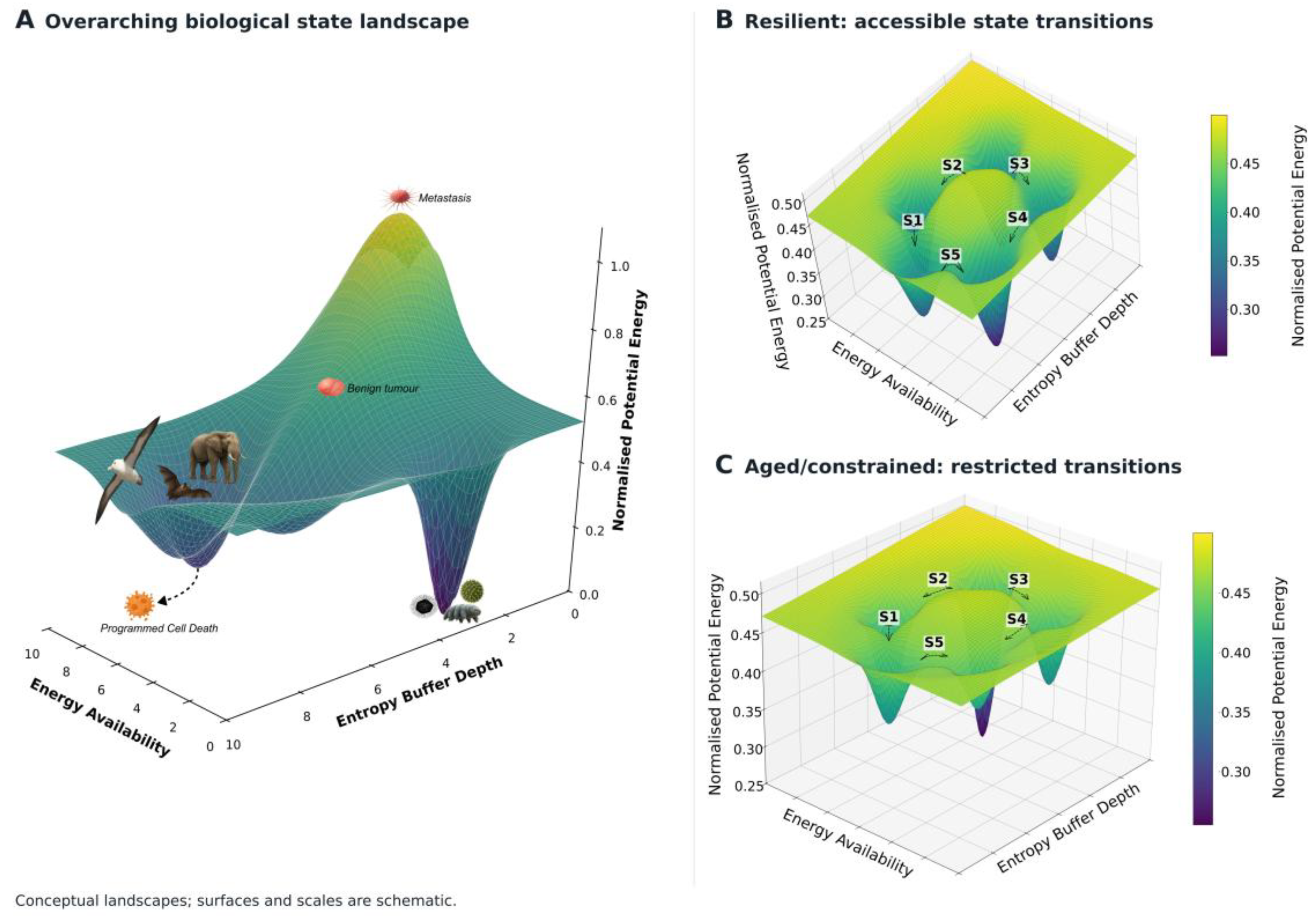

Table 1.
Core construct summary.
| Construct | Definition in the present framework | What it is not | Representative inference |
|---|---|---|---|
| Φ(t) | Latent integrity of the currently occupied multiscale state | Entropy itself, path length, resilience, or landscape height | Multiscale proxy ensemble referenced to an individual or appropriate control state |
| Radapt | Accessible physiological state repertoire and response capacity; failsafe containment is estimated separately when unresolved burden persists | A single spare-capacity biomarker | State repertoire, graded-response threshold and ceiling, recovery; burden, integrity and remaining containment capacity |
| Resilience | Realised use of reserve during perturbation and recovery | A static baseline value | Recovery time, restoring strength, residual displacement, coherence |
| Peff | Effective challenge delivered to the system | Nominal dose alone | Energetic, mechanical, chemical, immune, toxic, developmental or psychosocial load |
| Λ(t) | State-dependent challenge-to-reserve relation | A universal hormetic constant | Position relative to the current adaptive envelope |
| κ | Geometric curvature of an embedded state trajectory | d2Φ/dt2 | Direction change in multivariate state-space |
| Deff | Local stochastic spread or diffusion | Physiological complexity per se | Covariance growth, ensemble spread, trajectory imprecision |
| C(t) | Cross-scale coherence among domains expected to coordinate | Uniformity of all signals | Phase alignment, coupling, coordinated recovery |
| K(t), τR | Restoring strength and recovery time | Static state integrity | Return dynamics after standardised perturbation |
| Failsafe containment | Capacity to limit propagation of unresolved burden while sustaining higher-order function | Lesion size, successful clearance, or a guarantee of long-term benefit | Residual burden, leakage, structural integrity, maintenance cost and repeated-load tolerance |
Box 1.
Selected testable predictions; full architecture in Supplementary Box S2.
Box 1.
Selected testable predictions; full architecture in Supplementary Box S2.
| Prediction | Expected observation | Potential falsifier |
|---|---|---|
| Dynamic response | Recovery, diffusion, coherence or restoration predicts decline beyond baseline biomarkers. | Prespecified static models consistently match or exceed dynamic prediction. |
| Receiver state | Identical nominal challenges produce different trajectories with genotype, developmental stage, age, reserve or disease. | Dose normalisation alone removes reproducible state-dependent differences. |
| Malignant escape | Escape-state accessibility improves held-out prediction of treatment failure beyond burden, target inhibition and baseline phenotype. | Accessibility adds no reproducible value over the simpler model. |
| Latent capacity | Equally suppressed metabolic states differ in responsiveness, activation threshold, exit timing or post-exit fidelity. | Flux alone consistently predicts maintenance and reactivation across quiescent states. |
| Compensated function | At matched resting function, containment dependence predicts poorer repeated-challenge recovery after adjustment for burden. | Containment measures add no information beyond function and burden in adequately powered comparisons. |
| Spatial context | Niche information improves prediction of malignant persistence or escape beyond composition, lesion size and baseline state. | Spatial information adds no reproducible predictive value after adjustment. |
Tests require a prespecified biological scale, explicit comparator and independent functional outcome. Failure constrains the corresponding extension. Supplementary Box S2 retains all 15 predictions, including state repertoire, bounded challenge, developmental overlap, inducibility, history and threshold–ceiling separation.
Disclaimer/Publisher’s Note: The statements, opinions and data contained in all publications are solely those of the individual author(s) and contributor(s) and not of MDPI and/or the editor(s). MDPI and/or the editor(s) disclaim responsibility for any injury to people or property resulting from any ideas, methods, instructions or products referred to in the content. |
© 2026 by the authors. Licensee MDPI, Basel, Switzerland. This article is an open access article distributed under the terms and conditions of the Creative Commons Attribution (CC BY) license (http://creativecommons.org/licenses/by/4.0/).
Copyright: This open access article is published under a Creative Commons CC BY 4.0 license, which permit the free download, distribution, and reuse, provided that the author and preprint are cited in any reuse.