
Submitted:
26 October 2026
Posted:
27 October 2026
You are already at the latest version
Abstract
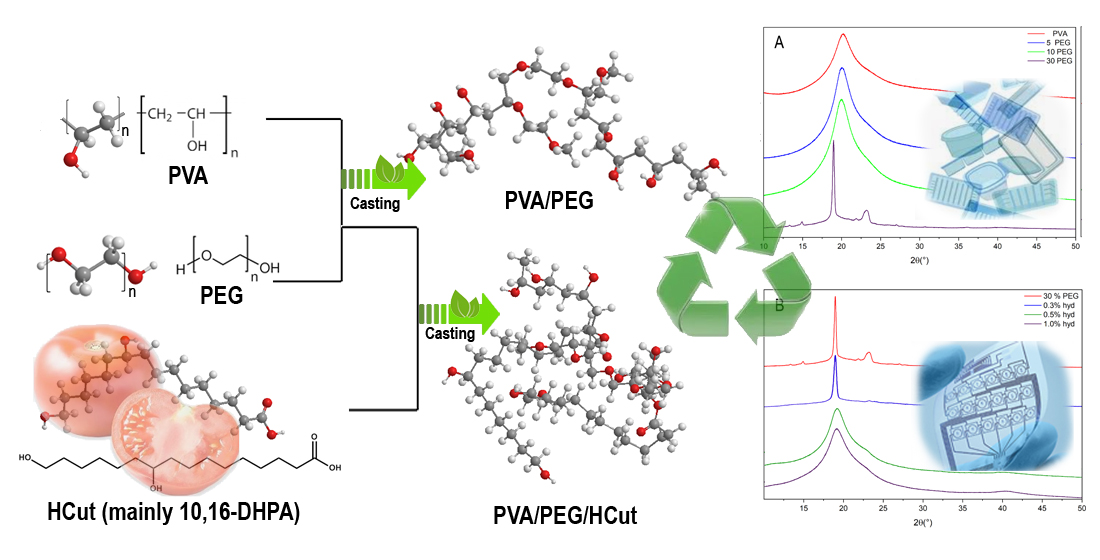
Polyvinyl alcohol (PVA) and polyethylene glycol (PEG 1500 and 3350) films plasticized with hydrolyzed cutin (HCut) were investigated to elucidate the structure-property relationship in the resulting biofilms. Cutin was extracted from tomato residual wastes according to reported methods and hydrolyzed for use in the PVA/PEG blends. Films were prepared by solution casting to obtain pure PVA and PVA/PEG blends with 5, 10, and 30 wt% PEG (3350 o 1500). The PVA/PEG mixture with 30 wt% PEG was the optimum blend used to analyze the effect of HCut on the structural organization of the films. PVA/30% PEG films with HCut loadings of 0.3, 0.5, and 1% produced homogeneous films, which were analyzed using atomic force microscopy (AFM), X-ray diffraction (XRD), and Attenuated Total Reflectance-Fourier Transform Infrared (ATR-FTIR). AFM shows a slight variation in roughness (Rq 1.3 nm for PVA to 5.3 nm for PVA/PEG 30%), which recovers as cutin hydrolysate is added (Rq 5.3 nm for PVA/PEG 30%-HCut 0.3% to 1.7 nm for PVA/PEG 30%-HCut 1.0%). XRD shows that HCut acts as an important plasticizer, especially in PVA/PEG-1500, where crystallinity increases with PEG concentration and is modified when HCut is added. These analyses demonstrate that cutin hydrolysate can modify the structure of PVA/PEG films, enabling their use in multifunctional applications.
Keywords:
tomato cutin
; PVA
; PEG
; biofilms
; plasticizer
Copyright: This open access article is published under a Creative Commons CC BY 4.0 license, which permit the free download, distribution, and reuse, provided that the author and preprint are cited in any reuse.