

Submitted:
25 October 2026
Posted:
27 October 2026
You are already at the latest version
Abstract
Almost half of the human population lives in areas where dengue virus (DENV) is endemic and are at risk of infection. The aim of the current study was to analyze 65 publicly available bulk RNA-sequencing samples from the GEO NCBI database. We hypothesized that investigating gene expression in patients with DENV infection compared to healthy controls could identify potential therapeutic targets and augment our understanding of the intracellular transcriptomic response to DENV infection. We report various genes with significant differential expression and multiple predicted drug targets that could be repurposed to reduce the signs and symptoms associated with DENV infection.
Keywords:
dengue virus
; bulk RNA sequencing
; secondary analysis
; differentially expressed genes
; host response
1. Introduction
Dengue virus, a member of the Flavivirus genus, consists of four distinct subtypes and is transmitted through a mosquito vector. This arthropod-borne virus causes an estimated 100-400 million clinical infections annually (Roy & Bhattacharjee, 2021), of which only a fraction are reported (Malik et al., 2023). In over 90% of cases, dengue fever is associated with mild symptoms and does not require hospitalization. Although the fatality rate of hemorrhagic severe dengue is relatively low (1-5%), its increasing prevalence remains a global concern (Witte et al., 2024). Climate change allows the mosquito vectors of DENV (primarily Aedes aegypti) to expand into new geographical regions (Hales et al., 2002; Wilder-Smith et al., 2019; Codeco et al., 2022). Further spread is facilitated by urbanization, travel, and globalization (Lee et al., 2021; Harish et al., 2024; Poongavanan et al., 2024).
Treatment of DENV infection generally involves supportive therapy to replace lost plasma volume, with blood transfusions recommended for patients with severe hemorrhaging (Tayal et al., 2023). In parallel, anti-inflammatory therapeutics aid in pain management but can aggravate hemorrhaging (Deen & Seidlein, 2019; Kellstein & Fernandes, 2019). Currently, there are no approved disease-specific drugs or antivirals for treating dengue, although several are being investigated (Dussupt et al., 2020; Martins et al., 2022; Natali et al., 2021).
Previous studies have generated bulk RNA-sequencing data to identify transcriptional markers, mechanisms of disease, and potential host-based therapeutic targets for DENV (Al Noman et al., 2025; Pozzi et al., 2020; Mehta et al., 2024). However, relatively few studies have been conducted on clinical samples collected directly from infected patients (Suppiah et al., 2025; Tsalik et al., 2021). This study aims to analyze high-throughput bulk RNA-sequencing data from peripheral blood mononuclear cells (PBMCs) to identify relevant differentially expressed genes (DEGs), associated cellular pathways, immune cell counts, and existing drug therapies that may be repurposed as potential treatment options for DENV infection.
2. Description
Public RNA-sequencing (RNA-seq) data generated from clinical samples were acquired from the National Center for Biotechnology Information (NCBI) Gene Expression Omnibus (GEO) database (Clough et al., 2024). Fifty-seven studies met the inclusion criteria and were manually reviewed. Samples that did not consist of PBMCs from acutely infected patients were excluded.
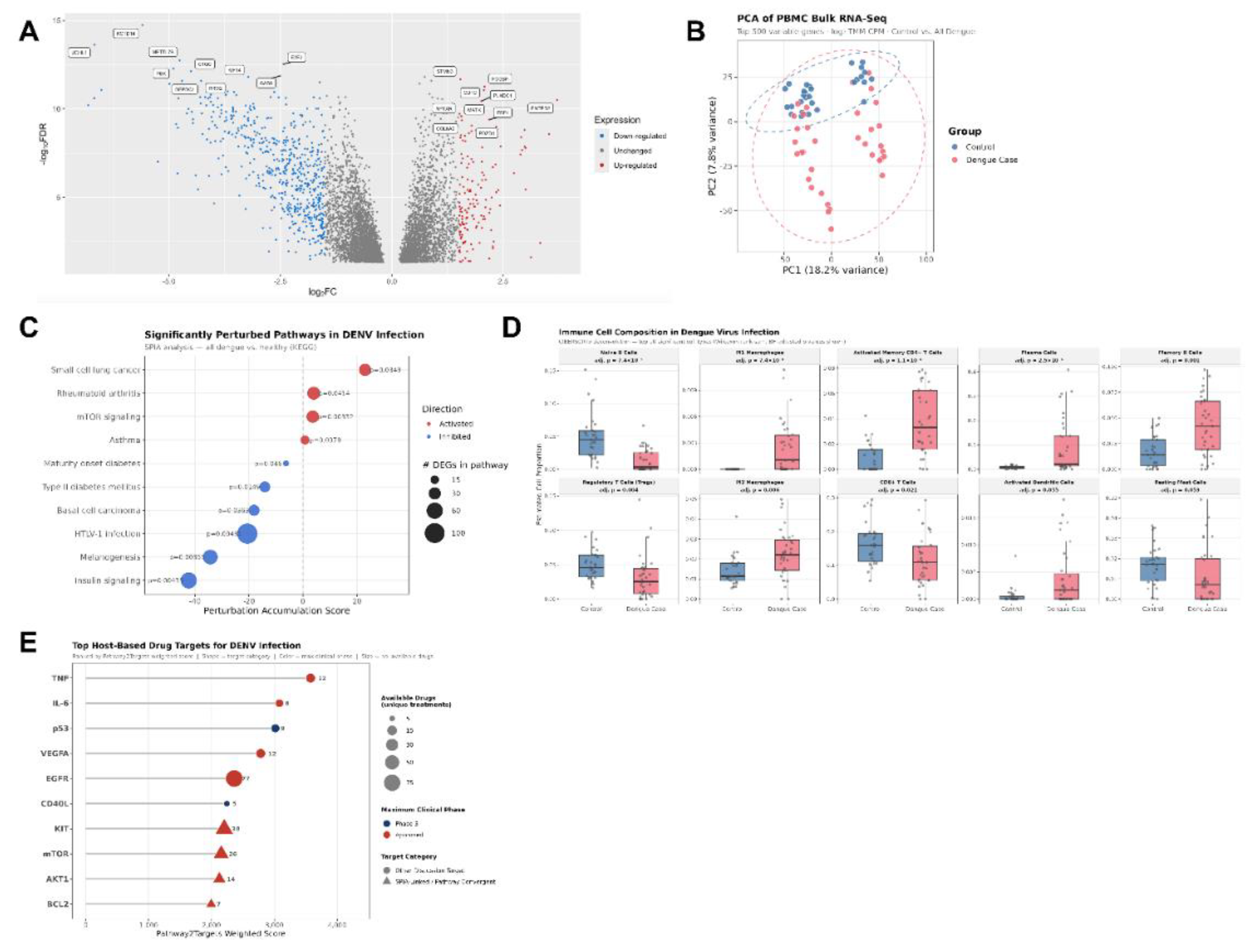
Our analysis consisted of two studies (Suppiah et al., 2025; Tsalik et al., 2021) characterizing the host transcriptional response to dengue infection and contained a total of 65 bulk RNA-sequencing samples. We began by performing quality control (FastQC) and trimming (TrimGalore!), mapping and quantification (Salmon), and differential expression (edgeR) between dengue-infected and healthy control patients. The comparison yielded 5921 (2413 upregulated and 3508 downregulated) differentially expressed genes that surpassed our significance threshold of FDR-corrected p-value ≤ 0.05 (Figure 1A).
To assess transcriptional separation between groups, we performed PCA on the top 500 most variable genes across all 65 samples following TMM normalization. While we observed some stratification between batches, PC1 explained 18.2% of the total variance, and there was visible clustering of the control and dengue-infected cohorts, indicating that DENV infection is the dominant source of transcriptional signaling in this dataset (Figure 1B).
We then evaluated pathway-level perturbations using the signaling pathway impact analysis (SPIA) algorithm and the KEGG and Reactome databases. We found forty-three pathways that reached nominal significance (p ≤ 0.05) across both databases, although none maintained significance after multiple hypothesis correction. Given the exploratory nature of this secondary analysis, we report all 10 nominally significant KEGG pathways with strong biological coherence, which should be interpreted as useful for hypothesis generation (Figure 1C). The most significant pathways were related to the cell cycle, the immune system, and metabolism.
We applied CIBERSORTx, a machine learning-based immune cell deconvolution platform for bulk RNA-seq data, to our dataset to determine the immune cell populations most responsible for the changes observed in the DEG and SPIA analyses. Our results were analogous with the current scientific understanding of the immune response to dengue infection, including the increased prevalence of macrophages, dendritic cells, CD4+ T cells, and memory B cells. The observed decrease in CD8+ T cells is likely due to immune exhaustion (Chandele et al., 2016; Estrada-Jiménez et al., 2022; Matos et al., 2015) (Figure 1D).
We then applied the Pathways2Targets algorithm, which uses modulated pathways to predict and prioritize therapeutic targets based on disease association, pathway membership, drug tractability, and other metrics. As dengue fever is characterized by an upregulated immune response, we found that immunosuppressive drugs were frequently among the highest-scoring targets (Figure 1E). Notable targets with literature-backed therapeutic potential include epidermal growth factor receptor (EGFR), mechanistic target of rapamycin kinase (mTOR), and vascular endothelial growth factor A (VEGFA). DENV uses the EGFR signaling cascade during its replication cycle (Duran et al., 2017; Chuang et al., 2020; Srikiatkhachorn et al., 2007), and disruption of this pathway has been shown to have antiviral activity in cell culture studies (Smith et al., 2014; Bhakt et al., 2026). The DENV NS5 protein stimulates mTORC2 signaling to counteract apoptosis (Carter et al., 2022), which justifies the evaluation of mTOR inhibitors as antivirals. However, systematic therapeutic suppression of mTOR is complex, as mTOR activation is essential for both innate and adaptive immune processes (Maiese, 2020). While there is no direct interaction between DENV and VEGFA, this host factor is a primary driver of angiogenesis and increased vasopermeability when upregulated. Inhibition of VEGFA activity may halt and consequently reduce the progression from non-severe to severe dengue and can potentially help treat hemorrhagic symptoms without suppressing immune function (Carter et al., 2022).
3. Conclusions
Our secondary analysis of bulk RNA-seq samples from patients with acute dengue infection revealed broad transcriptional responses compared to healthy controls, providing a transcriptomic framework for understanding the pathology of dengue fever and therapeutic targets that could be repurposed for DENV infection, as supported by emerging scientific literature. For all our predicted therapeutic candidates, the direction of observed perturbation does not directly indicate the appropriate therapeutic strategy. Further functional validation is required to determine whether a given target should be pursued through inhibition, restoration of function, or as a disease state marker. The targets reported should be interpreted as computationally produced hypotheses intended to reinforce ongoing experimental attempts to identify targets that can be repurposed for DENV infection.
4. Methods
Following curation of the RNA-seq samples, the corresponding FASTQ files were downloaded from the Sequence Read Archive (SRA) using sra-tools (version 2.10.8). The FASTQ files, associated metadata file, and configuration file were used as inputs to the Snakemake-based Automated Reproducible Modular workflow for preprocessing and differential analysis of RNA-seq data (ARMOR; version 1.5.10) (Orjuela et al., 2019). The ARMOR workflow includes the following steps: trimming sequencing adapters and poor-quality regions of the reads with TrimGalore! (version 0.6.6) (Singh et al., n.d.), calculating quality control metrics with FastQC (Bonney et al., 2024), performing read pseudomapping and quantifying to the human transcriptome (GRCh38 build 98) with Salmon (version 1.4.0) (Yadav et al., 2023), calculating significant differential gene expression using a negative binomial distribution implemented in edgeR (version 4.0.16) (Robinson et al., 2010), and performing Gene Ontology (GO) enrichment against terms in the Molecular Signatures Database (MSigDB) (Aggarwal et al., n.d.) while adjusting for inter-gene correlation using the Camera algorithm (version 3.50.3) (Moncunill et al., n.d.).
Signaling Pathway Impact Analysis algorithm (SPIA; version 2.58.0) was used to enrich DEGs against intracellular signaling pathways from two databases, KEGG and Reactome (Kanehisa et al., 2025; Milacic et al., 2024; Tarca et al., 2009). SPIA accounts for pathway topology and uses permutation and bootstrapping to calculate the level to which each pathway is significantly perturbed in the comparison. The threshold for significant pathways using the SPIA algorithm was FDR p-values < 0.05.
Digital cytometry was performed using CIBERSORTx (Steen et al., 2020) (Newman et al., 2019). Raw gene counts from Salmon were used as the mixture input, and the LM22 signature matrix was used as a reference panel. B-mode batch correction was applied to account for technical variations between the two source datasets. Cell type fractions were estimated in relative mode using 100 permutations for significance testing. Samples with a CIBERSORTx p-value > 0.05 were excluded from downstream analysis. Three samples (SRR12561101, SRR12561253, and SRR12561274) failed deconvolution and were removed prior to statistical comparisons.
Pathways predicted to be significantly modulated by the SPIA were applied to the Pathway2Targets algorithm (Dobbs Spendlove et al., 2023; Gray et al., 2022). The Pathway2Targets algorithm (version 2.2) takes significantly affected pathways, retrieves the protein members of those pathways, searches the Open Targets drug database (Koscielny et al., 2017) for therapeutics known to target the proteins in each pathway, and prioritizes drug targets based on their relevance to the disease according to more than 20 attributes.
Author Contributions
Annelise K. Eldredge: Investigation, Formal analysis, Validation, Visualization, Writing—review & editing, Writing—original draft. Brett E. Pickett: Software, Supervision, Writing—review & editing. Nathan D. Walker: Conceptualization, Data curation, Investigation.
Funding
The author’s received no external funding for this work.
Conflicts of interest
The authors declare that there are no conflicts of interest present.
References
- Aggarwal, C.; Saini, K.; Reddy, E.S.; Singla, M.; Nayak, K.; Chawla, Y.M.; Chandele, A.; et al. Immunophenotyping and Transcriptional Profiling of Human Plasmablasts in Dengue. J. Virol. 95, e00610. [CrossRef] [PubMed]
- Al Noman, M.; Latif, M.A.; Ahmed, M.F.; Islam, M.S.; Al Amin Pappu, M.; Hossain, M.S.; Mollah, M.N.H.; et al. In-silico discovery of druggable molecular signatures that drive dengue fever to severe dengue fever highlighting common pathogenesis through single-cell RNA-Seq analysis. Sci. Rep. 2025, 15, 39449. [Google Scholar] [CrossRef] [PubMed]
- Bhakt, P.; Pokharel, S.M.; Li, Y.; Srivastava, T.; Miller, J.; Dittmar, M.; Cherry, S.; et al. NS5-targeting nucleoside analogs inhibit dengue virus and other flaviviruses. PLoS Pathog. 2026, 22, e1013970. [Google Scholar] [CrossRef] [PubMed]
- Bonney, J.H.K.; Pratt, D.; Ofori, M.; Hayashi, T.; Abankwa, A.; Awuku Larbi, Y.; Suzuki, T.; et al. Molecular detection of dengue virus from febrile patients in Ghana. BMC Infect. Dis. 2024, 24, 1382. [Google Scholar] [CrossRef] [PubMed]
- Carter, C.C.; Mast, F.D.; Olivier, J.P.; Bourgeois, N.M.; Kaushansky, A.; Aitchison, J.D. Dengue activates mTORC2 signaling to counteract apoptosis and maximize viral replication. Front. Cell. Infect. Microbiol. 2022, 12, 979996. [Google Scholar] [CrossRef] [PubMed]
- Chandele, A.; Sewatanon, J.; Gunisetty, S.; Singla, M.; Onlamoon, N.; Akondy, R.S.; Murali Krishna, K.; et al. Characterization of Human CD8 T Cell Responses in Dengue Virus-Infected Patients from India. J. Virol. 2016, 90, 11259. [Google Scholar] [CrossRef] [PubMed]
- Chu, J.J.H.; Yang, P.L. c-Src protein kinase inhibitors block assembly and maturation of dengue virus. Proc. Natl. Acad. Sci. USA 2007, 104, 3520. [Google Scholar] [CrossRef] [PubMed]
- Chuang, F.K.; Liao, C.L.; Hu, M.K.; Chiu, Y.L.; Lee, A.R.; Huang, S.M.; Yen, L.C.; et al. Antiviral Activity of Compound L3 against Dengue and Zika Viruses In Vitro and In Vivo. Int. J. Mol. Sci. 2020, 21, 4050. [Google Scholar] [CrossRef] [PubMed]
- Clough, E.; Barrett, T.; Wilhite, S.E.; Ledoux, P.; Evangelista, C.; Kim, I.F.; Soboleva, A.; et al. NCBI GEO: archive for gene expression and epigenomics data sets: 23-year update. Nucleic Acids Res. 2024, 52, D138. [Google Scholar] [CrossRef] [PubMed]
- Codeco, C.T.; Oliveira, S.S.; Ferreira, D.A.C.; Riback, T.I.S.; Bastos, L.S.; Lana, R.M.; Coelho, F.C.; et al. Fast expansion of dengue in Brazil. Lancet Reg. Health Am. 2022, 12, 100274. [Google Scholar] [CrossRef] [PubMed]
- Deen, J.; Seidlein, L. Paracetamol for dengue fever: no benefit and potential harm? Lancet Glob. Health 2019, 7, e552. [Google Scholar] [CrossRef] [PubMed]
- Dobbs Spendlove, M.; M Gibson, T.; Mc Cain, S.; Stone, B.C.; Gill, T.; Pickett, B.E. Pathway2Targets: an open-source pathway-based approach to repurpose therapeutic drugs and prioritize human targets. PeerJ. 2023, 11, e16088. [Google Scholar] [CrossRef] [PubMed]
- Duran, A.; Valero, N.; Mosquera, J.; Fuenmayor, E.; Alvarez Mon, M. Gefitinib and pyrrolidine dithiocarbamate decrease viral replication and cytokine production in dengue virus infected human monocyte cultures. Life Sci. 2017, 191, 180. [Google Scholar] [CrossRef] [PubMed]
- Dussupt, V.; Modjarrad, K.; Krebs, S.J. Landscape of Monoclonal Antibodies Targeting Zika and Dengue: Therapeutic Solutions and Critical Insights for Vaccine Development. Front. Immunol. 2020, 11, 621043. [Google Scholar] [CrossRef] [PubMed]
- Estrada Jimenez, T.; Flores Mendoza, L.; Avila Jimenez, L.; Vazquez Rodriguez, C.F.; Sanchez Burgos, G.G.; Vallejo Ruiz, V.; Reyes Leyva, J. Low Activation of CD8+ T Cells in response to Viral Peptides in Mexican Patients with Severe Dengue. J. Immunol. Res. 2022, 2022, 9967594. [Google Scholar] [CrossRef] [PubMed]
- Haider, N.; Hasan, M.N.; Onyango, J.; Asaduzzaman, M. Global landmark: 2023 marks the worst year for dengue cases with millions infected and thousands of deaths reported. IJID Reg. 2024, 13, 100459. [Google Scholar] [CrossRef] [PubMed]
- Hales, S.; De Wet, N.; Maindonald, J.; Woodward, A. Potential effect of population and climate changes on global distribution of dengue fever: an empirical model. Lancet 2002, 360, 830. [Google Scholar] [CrossRef] [PubMed]
- Harish, V.; Colon Gonzalez, F.J.; Moreira, F.R.R.; Gibb, R.; Kraemer, M.U.G.; Davis, M.; Brady, O.J.; et al. Human movement and environmental barriers shape the emergence of dengue. Nat. Commun. 2024, 15, 4205. [Google Scholar] [CrossRef] [PubMed]
- Kajimoto, Y.; Kitajima, T. Clinical Management of Patients with Dengue Infection in Japan: Results from National Database of Health Insurance Claims. Am. J. Trop. Med. Hyg. 2020, 102, 191. [Google Scholar] [CrossRef] [PubMed]
- Kanehisa, M.; Furumichi, M.; Sato, Y.; Matsuura, Y.; Ishiguro Watanabe, M. KEGG: biological systems database as a model of the real world. Nucleic Acids Res. 2025, 53, D672. [Google Scholar] [CrossRef] [PubMed]
- Kellstein, D.; Fernandes, L. Symptomatic treatment of dengue: should the NSAID contraindication be reconsidered? Postgrad. Med. 2019, 131, 109. [Google Scholar] [CrossRef] [PubMed]
- Koscielny, G.; An, P.; Carvalho Silva, D.; Cham, J.A.; Fumis, L.; Gasparyan, R.; Dunham, I.; et al. Open Targets: a platform for therapeutic target identification and validation. Nucleic Acids Res. 2017, 45, D985. [Google Scholar] [CrossRef] [PubMed]
- Lee, S.A.; Economou, T.; De Castro Catao, R.; Barcellos, C.; Lowe, R. The impact of climate suitability, urbanisation, and connectivity on the expansion of dengue in 21st century Brazil. PLoS Neglected Trop. Dis. 2021, 15, e0009773. [Google Scholar] [CrossRef] [PubMed]
- Lim, S.J.; Gan, S.C.; Ong, H.T.; Ngeow, Y.F. In vitro analysis of VEGF-mediated endothelial permeability and the potential therapeutic role of Anti-VEGF in severe dengue. Biochem. Biophys. Rep. 2024, 39, 101814. [Google Scholar] [CrossRef] [PubMed]
- Maiese, K. The Mechanistic Target of Rapamycin (mTOR): Novel Considerations as an Antiviral Treatment. Curr. Neurovascular Res. 2020, 17, 332. [Google Scholar] [CrossRef] [PubMed]
- Malik, S.; Ahsan, O.; Mumtaz, H.; Tahir Khan, M.; Sah, R.; Waheed, Y. Tracing down the Updates on Dengue Virus-Molecular Biology, Antivirals, and Vaccine Strategies. Vaccines 2023, 11, 1328. [Google Scholar] [CrossRef] [PubMed]
- Martins, I.C.; Ricardo, R.C.; Santos, N.C. Dengue, West Nile, and Zika Viruses: Potential Novel Antiviral Biologics Drugs Currently at Discovery and Preclinical Development Stages. Pharmaceutics 2022, 14, 2535. [Google Scholar] [CrossRef] [PubMed]
- Matos, A.M.; Carvalho, K.I.; Rosa, D.S.; Villas Boas, L.S.; Silva, W.C.; Rodrigues, C.L.L.; Kallas, E.G.; et al. CD8+ T Lymphocyte Expansion, Proliferation and Activation in Dengue Fever. PLoS Neglected Trop. Dis. 2015, 9, e0003520. [Google Scholar] [CrossRef] [PubMed]
- Mehta, P.; Liu, C.S.C.; Sinha, S.; Mohite, R.; Arora, S.; Chattopadhyay, P.; Pandey, R.; et al. Reduced protein-coding transcript diversity in severe dengue emphasises the role of alternative splicing. Life Sci. Alliance 2024, 7, e202402683. [Google Scholar] [CrossRef] [PubMed]
- Milacic, M.; Beavers, D.; Conley, P.; Gong, C.; Gillespie, M.; Griss, J.; D Eustachio, P.; et al. The Reactome Pathway Knowledgebase 2024. Nucleic Acids Res. 2024, 52, D672. [Google Scholar] [CrossRef] [PubMed]
- Moncunill, G.; Carnes, J.; Chad Young, W.; Carpp, L.; De Rosa, S.; Campo, J.J.; Gottardo, R.; et al. Transcriptional correlates of malaria in RTS,S/AS01-vaccinated African children: a matched case–control study. eLife 11, e70393. [CrossRef] [PubMed]
- Natali, E.N.; Babrak, L.M.; Miho, E. Prospective Artificial Intelligence to Dissect the Dengue Immune Response and Discover Therapeutics. Front. Immunol. 2021, 12, 574411. [Google Scholar] [CrossRef] [PubMed]
- Newman, A.M.; Steen, C.B.; Liu, C.L.; Gentles, A.J.; Chaudhuri, A.A.; Scherer, F.; Alizadeh, A.A.; et al. Determining cell type abundance and expression from bulk tissues with digital cytometry. Nat. Biotechnol. 2019, 37, 773. [Google Scholar] [CrossRef] [PubMed]
- Orjuela, S.; Huang, R.; Hembach, K.M.; Robinson, M.D.; Soneson, C. ARMOR: An Automated Reproducible MOdular Workflow for Preprocessing and Differential Analysis of RNA-seq Data. G3 Genes|Genomes|Genetics 2019, 9, 2089. [Google Scholar] [CrossRef] [PubMed]
- Poongavanan, J.; Lourenco, J.; Tsui, J.L.H.; Colizza, V.; Ramphal, Y.; Baxter, C.; Tegally, H.; et al. Dengue virus importation risks in Africa: a modelling study. Lancet. Planet. Health 2024, 8, e1043. [Google Scholar] [CrossRef] [PubMed]
- Pozzi, B.; Bragado, L.; Mammi, P.; Torti, M.F.; Gaioli, N.; Gebhard, L.G.; Srebrow, A.; et al. Dengue virus targets RBM10 deregulating host cell splicing and innate immune response. Nucleic Acids Res. 2020, 48, 6824. [Google Scholar] [CrossRef] [PubMed]
- Robinson, M.D.; Mc Carthy, D.J.; Smyth, G.K. edgeR: a Bioconductor package for differential expression analysis of digital gene expression data. Bioinformatics 2010, 26, 139. [Google Scholar] [CrossRef] [PubMed]
- Roy, S.K.; Bhattacharjee, S. Dengue virus: epidemiology, biology, and disease aetiology. Can. J. Microbiol. 2021, 67, 687. [Google Scholar] [CrossRef] [PubMed]
- Singh, P.; Bajpai, P.; Maheshwari, D.; Chawla, Y.M.; Saini, K.; Reddy, E.S.; Chandele, A.; et al. Functional and transcriptional heterogeneity within the massively expanding HLADR+CD38+ CD8 T cell population in acute febrile dengue patients. J. Virol. 97, e00746. [CrossRef] [PubMed]
- Smith, J.L.; Stein, D.A.; Shum, D.; Fischer, M.A.; Radu, C.; Bhinder, B.; Hirsch, A.J.; et al. Inhibition of Dengue Virus Replication by a Class of Small-Molecule Compounds That Antagonize Dopamine Receptor D4 and Downstream Mitogen-Activated Protein Kinase Signaling. J. Virol. 2014, 88, 5533. [Google Scholar] [CrossRef] [PubMed]
- Srikiatkhachorn, A.; Ajariyakhajorn, C.; Endy, T.P.; Kalayanarooj, S.; Libraty, D.H.; Green, S.; Ennis, F.A.; Rothman, A.L. Virus-Induced Decline in Soluble Vascular Endothelial Growth Receptor 2 Is Associated with Plasma Leakage in Dengue Hemorrhagic Fever. J. Virol. 2007, 81, 1592. [Google Scholar] [CrossRef] [PubMed]
- Steen, C.B.; Liu, C.L.; Alizadeh, A.A.; Newman, A.M. Profiling Cell Type Abundance and Expression in Bulk Tissues with CIBERSORTx. In Methods in molecular biology; Clifton, N.J., 2020; Volume 2117, p. 135. [Google Scholar] [CrossRef] [PubMed]
- Suppiah, J.; Md Sani, S.S.; Hassan, S.S.; Nadzar, N.I.F.; Ibrahim, N.I.; Thayan, R.; Mohd Zain, R. Unraveling potential gene biomarkers for dengue infection through RNA sequencing. Virus Genes 2025, 61, 26. [Google Scholar] [CrossRef] [PubMed]
- Tarca, A.L.; Draghici, S.; Khatri, P.; Hassan, S.S.; Mittal, P.; Kim, J.S.; Romero, R.; et al. A novel signaling pathway impact analysis. Bioinformatics 2009, 25, 75. [Google Scholar] [CrossRef] [PubMed]
- Tayal, A.; Kabra, S.K.; Lodha, R. Management of Dengue: An Updated Review. Indian J. Pediatr. 2023, 90, 168. [Google Scholar] [CrossRef] [PubMed]
- Tsalik, E.L.; Fiorino, C.; Aqeel, A.; Liu, Y.; Henao, R.; Ko, E.R.; Schughart, K.; et al. The Host Response to Viral Infections Reveals Common and Virus-Specific Signatures in the Peripheral Blood. Front. Immunol. 2021, 12, 741837. [Google Scholar] [CrossRef] [PubMed]
- Usuda, J.N.; Placa, D.R.; Fonseca, D.L.M.; Marques, A.H.C.; Filgueiras, I.S.; Chaves, V.G.B.; Cabral Marques, O.; et al. Interferome signature dynamics during the anti-dengue immune response: a systems biology characterization. Front. Immunol. 2023, 14, 1243516. [Google Scholar] [CrossRef] [PubMed]
- Wilder Smith, A.; Ooi, E.E.; Horstick, O.; Wills, B. Dengue. Lancet 2019, 393, 350. [Google Scholar] [CrossRef] [PubMed]
- Witte, P.; Venturini, S.; Meyer, H.; Zeller, A.; Christ, M. Dengue Fever—Diagnosis, Risk Stratification, and Treatment. Dtsch. Ärzteblatt Int. 2024, 121, 773. [Google Scholar] [CrossRef] [PubMed]
- Xie, S.; Zhang, H.; Liang, Z.; Yang, X.; Cao, R. AXL, an Important Host Factor for DENV and ZIKV Replication. Front. Cell. Infect. Microbiol. 2021, 11, 575346. [Google Scholar] [CrossRef] [PubMed]
- Yadav, A.; Shamim, U.; Ravi, V.; Devi, P.; Kumari, P.; Maurya, R.; Pandey, R.; et al. Early transcriptomic host response signatures in the serum of dengue patients provides insights into clinical pathogenesis and disease severity. Sci. Rep. 2023, 13, 14170. [Google Scholar] [CrossRef] [PubMed]
- Zhang, L.; Shim, B.S.; Kitzmiller, C.; Kwon, Y.C.; Richard, A.S.; Farzan, M.R.; Choe, H. Variation in virion phosphatidylserine content drives differential GAS6 binding among closely related flaviviruses. J. Virol. 99, e01111. [CrossRef] [PubMed]
Figure 1.
Analysis results from bulk RNA-seq of DENV-infected patients compared against healthy controls: A) Volcano plot shows altered transcriptional response to DENV-infected patients. Genes with log2FC > 1 and adjusted p < 0.05 are highlighted. Dots represent upregulated (red) or downregulated (blue) genes, and the ten most significant genes in each direction are labeled. B) Principal Component Analysis (PCA) plot shows distinct clustering (shown in ellipses), suggesting sufficient separation between DENV-infected and control groups, as well as differences between the two separate studies. C) Dot plot of SPIA pathway enrichment from differentially expressed genes, showing top 10 identified pathways. X-axis shows activation score. Dot size correlates with the number of DEGs in each pathway. D) Box plots of the 10 most significant immune cell types identified by CIBERSORTx (Wilcoxon rank-sum test, BH-adjusted p < 0.05). E) Top 10 Host-based drug targets for DENV Infection, ranked by the weighted score generated by the Pathways2Targets algorithm.
Disclaimer/Publisher’s Note: The statements, opinions and data contained in all publications are solely those of the individual author(s) and contributor(s) and not of MDPI and/or the editor(s). MDPI and/or the editor(s) disclaim responsibility for any injury to people or property resulting from any ideas, methods, instructions or products referred to in the content. |
© 2026 by the authors. Licensee MDPI, Basel, Switzerland. This article is an open access article distributed under the terms and conditions of the Creative Commons Attribution (CC BY) license (http://creativecommons.org/licenses/by/4.0/).
Copyright: This open access article is published under a Creative Commons CC BY 4.0 license, which permit the free download, distribution, and reuse, provided that the author and preprint are cited in any reuse.