

Submitted:
24 October 2026
Posted:
27 October 2026
You are already at the latest version
Abstract
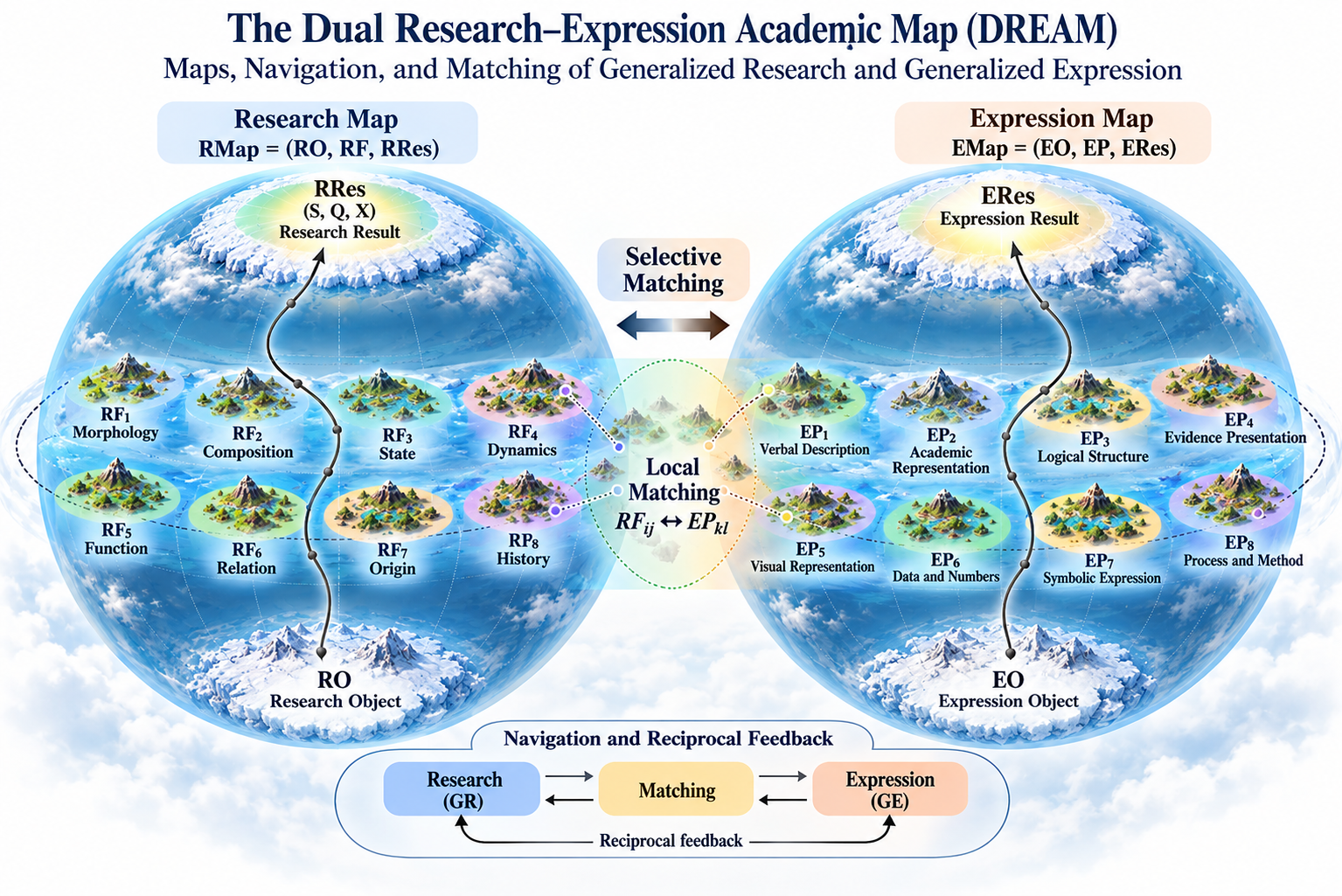
Research and academic expression are often treated as separate or sequential activities, yet in practice each can reshape the other. This paper introduces the Dual Research--Expression Academic Map (DREAM) model, a spatial framework for coordinating previously introduced Generalized Research (GR) and Generalized Expression (GE) through two distinct but compatible maps. The Research Map organizes the Research Object (RO), Research Features (RF), and Research Results (RRes); the Expression Map organizes the Expression Object (EO), Expression Perspectives (EP), and Expression Result (ERes). In both maps, the object occupies the southern region, multiple analytical features or expression perspectives span the broad equatorial region, and results occupy the northern region. The pathways of GR and GE are interpreted as navigation, including movement within or across regions and re-anchoring for further work. DREAM enables three levels of correspondence: global alignment of the maps' coordinate structures, selective matching between general regions (RF\ensuremath{_{i}} \ensuremath{\leftrightarrow} EP\ensuremath{_{j}}), and local matching between concrete contents (RF\ensuremath{_{i}}\ensuremath{_{j}} \ensuremath{\leftrightarrow} EP\ensuremath{_{k}}\ensuremath{_{l}}). The current inventories yield 64 general and 4,350 potential local pairings, but matching remains task-dependent and need not be exhaustive or one-to-one. The framework also makes visible how research and expression may develop synchronously or asynchronously and improve one another through reciprocal feedback before formal communication. The paired maps further suggest parallel spindle models in which a focused object expands into multiple analytical or expression possibilities before converging toward a result---a structure distinct from the broad--narrow--broad scope of the traditional research-writing hourglass. DREAM offers a conceptual basis for navigating the research--expression space and may support future AI-assisted exploration of candidate matches, subject to scholarly judgment.
Keywords:
DREAM model
; generalized research
; generalized expression
; academic map
; navigation
; selective matching
; reciprocal feedback
; spindle model
1. Introduction
Academic research and academic writing are closely intertwined: research generates questions, methods, results, and conclusions, while academic writing organizes and communicates these contents.
Accordingly, major works on research and academic writing often address both the conduct of research and the organization and communication of research outcomes (cf. Day, 1998; Booth et al., 2024; Cargill & O’Connor, 2013; O’Leary, 2021). As Day (1998) emphasized, scientific work must be communicated in a form that makes clear what was done, why and how it was done, and what was learned, with reproducibility as a central requirement.
Research and writing may therefore be viewed not simply as two consecutive activities, but as mutually connected processes. Writing organizes existing research while also helping researchers clarify questions, relations, reasoning, evidence, and knowledge. Conversely, developments in research may require corresponding changes in expression. A more general and unified perspective on research and expression may consequently facilitate their connection.
On the research side, previous studies (Wu, 2026a, 2026b) developed the Generalized Coordinate System (GCS), the Generalized Analytical Method (GAM), and the Generalized Analytical Pathway (GAP), which together define Generalized Research (GR). GCS, as shown in Figure 1, represents research through the Analytical Object RO, Analytical Feature RF, and Analytical Result RRes ≡ (S, Q, X), where S, Q, and X denote qualitative characteristic, quantitative characteristic, and knowledge formulation, respectively. In the original GCS, these coordinates were denoted O, F, and Res (Wu, 2026a, 2026b). In the present paper, the prefix R is added to indicate the research side and to distinguish these coordinates from the expression-side coordinates introduced below. GAM provides a superordinate, or generalized, analytical framework based on analytical features and their concrete analytical contents . It includes Local Analysis (LA) within a single analytical feature and Cross Analysis (CA) across different analytical features. GAP organizes research through generalized adjustment (ADJ), the Main-node Analytical Path (MAP), and re-anchoring (Ra). Research conducted through GAP is defined as Generalized Research (GR).
The RO axis denotes Analytical Object, the RF axis denotes Analytical Feature, and the RRes axis denotes Analytical Result RRes ≡ (S, Q, X).
The connection between research and expression was previously considered in the Generalized Research–Expression Model (GREM) (Wu, 2026e), which coupled research and expression through discourse modes, drawing on the generalized coordinate system for rhetorical modes (Wu, 2026c). The GREM model provided an initial way of unifying research and expression.
On the expression side, a subsequent study (Wu, 2026d) developed the Generalized Expression Coordinate System (GECS) and Generalized Expression (GE), providing a superordinate framework for expression. As shown in Figure 2, GECS is defined as GECS ≡ (EO, EP, ERes), where EO, EP, and ERes denote Expression Object, Expression Perspective, and Expression Result, respectively. GE organizes expression through the Main-node Expression Path (MEP) and, when required, re-anchors an existing expression result as a new expression object. GECS, MEP, and re-anchoring together define the Generalized Expression (GE) model.
The EO axis denotes Expression Object, the EP axis denotes Expression Perspective, and the ERes axis denotes Expression Result.
To connect GR and GE, it is useful to examine the similarities between them and to consider whether they can be treated within a unified academic activity, much as different coordinate systems can be related or unified (cf. Wu, 2002). To do this, the present study places both GR and GE on maps. A map need not be limited to the geographical surface of the Earth; it can also be constructed in spaces defined by other variables or coordinates, such as a velocity–altitude map (Hu et al., 2009) or a body-fixed map around an airfoil (Li & Wu, 2018). Such maps can make positions, regions, boundaries, and relations more visible and may help reveal patterns that are not immediately apparent.
On such maps, the structural similarity between the research-side GR framework and the expression-side GE framework becomes particularly visible. Both contain an object-related coordinate, an intermediate coordinate through which the object is approached, and a result-related coordinate. Their pathways also display comparable organizational forms. Such similarity makes coordinated consideration of GR and GE possible, but it does not imply that the two systems are semantically identical or that every coordinate and operation has a strict one-to-one counterpart.
Once generalized coordinates are spatially positioned, they can be located, compared, enlarged, rotated, connected, and navigated. GCS can therefore be represented as a Research Map, while GECS can be represented as an Expression Map. Their respective pathways can then be interpreted as navigation on these maps.
DREAM—the Dual Research–Expression Academic Map—is formed when the Research Map and Expression Map are considered together. The two maps can be superposed and rotated so that selected research-feature regions and expression-perspective regions can be locally aligned and examined together. In this sense, DREAM is not based on a fixed one-to-one mapping between GR and GE, but on two distinct academic maps that can be navigated and selectively matched.
The following sections place the generalized coordinates on the two maps, introduce navigation on them, examine matching between the maps, and finally discuss a further implication of their spatial structure: the spindle models of generalized expression and generalized research.
2. The Two Academic Maps
A coordinate system identifies positions. A map makes these positions spatially visible. The principal coordinates of GR and GE are placed on two globe-like maps. In both maps, the object-related coordinate is placed near the South Pole, the feature- or perspective-related coordinate occupies the broad equatorial region, and the result-related coordinate is placed near the North Pole. The equatorial region is intentionally the broadest region of the map. Research and expression both contain their greatest range of possible perspectives at this intermediate level.
2.1. The Research Map RMap ≡ (RO, RF, RRes)
The research map spatializes the research-side generalized coordinates. Figure 3 shows the front side of the research map over which the generalized coordinates are displayed.
The Research Object RO is placed near the South Pole. It represents the object selected for research. Research Features RF occupy the equatorial region. The eight general analytical features are:
- = Morphology
- = Composition
- = State
- = Dynamics
- = Function
- = Relation
- = Origin
- = History
These eight regions are equally distributed around the equator. Because only part of a globe is visible from one viewpoint, four other regions may be displayed after the globe is rotated, as shown in Figure 4.
Each region contains more concrete analytical contents . For example, Morphology contains such analytical contents as shape, external contour, boundary morphology, surface topography, and spatial distribution. Composition, State, Dynamics, and the other analytical features similarly contain their own concrete analytical contents. The concrete analytical contents displayed in Figure 3 and Figure 4 are typical ones and are not exclusive. Determining more concrete analytical contents is what a researcher can do to deepen or broaden the perspective of the research. As pointed out by Wu (2026a), there are two open problems worthy of consideration. The first is the completeness of the eight analytical features. Are morphology, composition, state, dynamics, function, relation, origin, and history sufficient to cover the basic analytical directions that different research objects may need to enter? In other words, is there a research object or analytical task that cannot be entered from these eight analytical features and requires adding new analytical features? The second problem is whether concrete analytical contents can continue to unfold downward, i.e., to be further decomposed into analytical contents at smaller levels, thereby making analytical positions more concrete and obtaining analytical results more effectively?
The Research Result RRes occupies the northern polar region and retains the structure
RRes ≡ (S, Q, X).
The three result regions may overlap because a research result may contain qualitative characteristics, quantitative characteristics, knowledge formulations, or combinations of them.
2.2. The Expression Map EMap ≡ (EO, EP, ERes).
The same spatial operation can be applied to the expression-side generalized coordinates. Figure 5 shows the front side of the expression map over which the generalized expression coordinates are displayed.
The Expression Object EO is placed near the South Pole. It represents the object selected for expression. Expression Perspectives EP occupy the equatorial region. The eight general expression perspectives are:
- = Discourse Mode
- = Academic Representation
- = Expression Structure
- = Expression Quality
- = Expression Level
- = Academic Function
- = Cognitive Function
- = Purpose
These eight regions are equally distributed around the equator. Because only part of a globe is visible from one viewpoint, another four regions may be displayed after the globe is rotated, as shown in Figure 6.
Each region contains more concrete expression contents . For example, Discourse Mode contains such concrete expression contents as narration, description, exposition, definition, exemplification, classification, decomposition, comparison, contrast, and related modes. Academic Representation, Expression Structure, Expression Quality, Expression Level, and the other expression perspectives similarly contain their own concrete expression contents. The concrete expression contents displayed in the regional maps are typical ones and are not exclusive. Determining more concrete expression contents is what a researcher or writer can do to deepen or broaden the perspective of expression.
The Expression Result ERes occupies the northern polar region. It denotes the realized expression product, such as an article, thesis, report, presentation, poster, or other expression outcome. Unlike RRes on the research side, which is represented as overlapping qualitative, quantitative, and knowledge-formulation regions, ERes refers more generally to the resulting expression product formed through the expression process.
Like the Research Map, the Expression Map can be examined globally or locally. The global map provides an overall expression space, whereas regional maps show the internal contents of particular expression perspectives.
2.3. Map, Region, and Local Position
The map representation introduces three spatial scales.
- At the largest scale, the entire globe represents the academic map.
- At the intermediate scale, or represents a region.
- At the local scale, or represents a more specific position within that region.
Thus, RMap ⊃ ⊃ , and EMap ⊃ ⊃ . This nested organization allows research and expression to be located at different levels of detail without changing the underlying map.
4. Matching the Research Map and Expression Map
The central idea of DREAM emerges when the Research Map and Expression Map are considered together. The two maps do not need to be merged into one map, because their coordinates have different meanings. Instead, they can be superposed, rotated, aligned, and examined together.
4.1. Global Matching Through Rotation
When the Research Map and Expression Map are superposed, they share a comparable spatial organization at the broadest level:
RO ↔ EO
RF ↔ EP
RRes ↔ ERes
The first pair occupies the object-related southern region, the second pair occupies the broad intermediate equatorial region, and the third pair occupies the result-related northern region. These relationships represent positional correspondence, not semantic identity.
The navigation pathways discussed in Section 3 provide a further basis for coordinating GR and GE. Research and expression can be considered together during an academic task, allowing analytical activities and expression activities to inform and support each other.
Research and expression can develop concurrently and improve one another through reciprocal feedback before the resulting work is formally communicated. This interaction is a central aspect of DREAM and is discussed further in Section 4.3.
The more important matching occurs within the equatorial regions. The Research Map contains eight general Research Feature regions, –, while the Expression Map contains eight general Expression Perspective regions, –. There is no reason to assume that every has one permanently fixed counterpart among the . Instead, the maps can be rotated relative to each other to examine different positional correspondences.
At the general perspective level, a selected research region can be brought into alignment with a selected expression region :
↔ .
This alignment does not imply that the two regions are equivalent. It means that they are considered together for a particular academic task. The same research region may be aligned with different expression perspectives according to the purpose and requirements of the task.
Figure 11 is a schematic matching of the Research Map and Expression Map, showing corresponding general regions ↔ , where i = 1, 2, …, 8.
Figure 11 illustrates a positional arrangement in which regions with the same index are aligned. After relative rotation, a different arrangement can be obtained, as illustrated in Figure 12.
These two arrangements illustrate that matching is not restricted to a single predetermined correspondence. Rotation allows different research features to be considered alongside different expression perspectives, depending on the academic task.
A simple quantitative estimate illustrates the number of possible pairings at this general level. The Research Map contains eight general Research Features (–), and the Expression Map contains eight general Expression Perspectives (–). If every research feature is considered in combination with every expression perspective, the number of possible feature-level pairings is
8 × 8 = 64.
These 64 pairings represent possible combinations of general research and expression perspectives, not 64 necessarily distinct or equally useful mappings. Their suitability depends on the research question, the expression task, and the context in which the two maps are used.
4.2. Local Mapping Through Overlap
Beyond the alignment of general regions, the two maps can also be examined at the level of concrete contents. A specific analytical content may be brought into local correspondence with a specific expression content :
↔ .
Figure 13 illustrates this local matching schematically. The analytical contents within a Research Feature region and the expression contents within an Expression Perspective region are represented as distinct sets of regions, with selected contents brought into partial overlap. The overlap represents a possible correspondence for a particular academic task, rather than an assertion that the two contents are equivalent.
Such matching need not be one-to-one. One analytical content may be expressed through several forms, several analytical contents may contribute to one expression content, and some contents may have no direct counterpart. DREAM therefore allows selective local matching without requiring complete correspondence between the two maps.
The potential scale of this matching can be illustrated quantitatively. The current GR framework contains 58 concrete analytical contents, while the current GE framework contains 75 concrete expression contents. If every analytical content is considered against every expression content, the number of possible pairwise combinations is
58 × 75 = 4,350.
This number represents the potential matching space, not the number of meaningful or necessary matches. The actual correspondence depends on the academic task and the contents selected for consideration.
Local matching thus extends DREAM from the alignment of general perspectives to the selective correspondence of concrete contents. More importantly, matching the two maps creates an opportunity for research and expression to inform and improve one another through reciprocal feedback before the resulting work is formally communicated. This interaction is discussed further in Section 4.3.
5. Matching During Academic Activity and the Spindle Models
5.1. Meaning of Matching in the Global Sense
DREAM connects the Generalized Research (GR) and Generalized Expression (GE) frameworks by placing them on two academic maps. Matching between these maps can occur at different levels, from the overall coordinate structure to individual analytical and expression contents.
At the global level, the principal correspondence is
RO ↔ EO
RF ↔ EP
RRes ↔ ERes
RO and EO represent the object-related starting coordinates of research and expression, respectively. RF and EP represent the intermediate spaces of analytical features and expression perspectives. RRes and ERes represent the resulting research outcomes and expression products. These correspondences establish a common spatial framework, but do not imply that the corresponding coordinates have identical meanings.
At the feature or perspective level, matching occurs between selected regions of the two maps:
↔ .
The eight Research Features and eight Expression Perspectives yield 8 × 8 = 64 possible pairings. These pairings are potential matches rather than predetermined correspondences. Rotating the maps allows different regions to be brought into alignment according to the academic task.
At the local level, matching occurs between concrete analytical and expression contents:
↔ .
The relation may be one-to-one, one-to-many, many-to-one, or absent. The current GR framework contains 58 concrete analytical contents, while the current GE framework contains 75 concrete expression contents. Thus, 58 × 75 = 4,350 potential pairwise alignments can be considered. Only a subset will be relevant to a particular task.
Matching is also dynamic. An initial – alignment may change as research and expression develop. A research finding may require a new expression perspective, while an attempt to express an idea may expose a gap in the analysis.
This interaction can be understood through the concepts of synchronous and asynchronous coordination. Synchronous coordination occurs when research and expression advance in close coordination, with developments on one side promptly informing the other. Asynchronous coordination occurs when one side temporarily advances ahead of the other. Research may proceed before its results can be adequately expressed, or an emerging expression may reveal the need for further research. Such asynchrony is not necessarily a deficiency; it can stimulate further development through reciprocal feedback.
For example, when investigating the function of an airplane, a researcher may examine its functional performance (), morphology (), and relationships with other features (). Meanwhile, appropriate expression perspectives can be selected to organize explanations, represent evidence, and structure the developing account. An attempt to formulate an explanation may expose gaps in the analysis, prompting further investigation. Conversely, new findings may require the expression to be reorganized or refined. Through repeated interaction, research and expression can improve one another before the resulting work is formally communicated to its intended audience.
AI may assist this process by identifying candidate correspondences between analytical and expression contents, comparing possible alignments, and exploring combinations that would be difficult to examine manually. However, identifying a plausible match does not establish its academic validity. The relevance and adequacy of the proposed correspondence still require evaluation in relation to the research object, purpose, evidence, and disciplinary context.
DREAM can therefore be summarized as
DREAM = Two Maps + Navigation + Global Correspondence + Selective Matching + Reciprocal Feedback.
The two maps provide distinct but compatible academic spaces; navigation enables movement within and across their regions; selective matching establishes task-dependent correspondences; and reciprocal feedback allows research and expression to inform and improve each other. DREAM does not require complete or permanent correspondence. It provides a spatial framework for their flexible coordination throughout academic activity.
5.2. From the Hourglass to the Spindle
The spatial structure of DREAM suggests a further implication for understanding research and expression.
Research articles have often been represented through an hourglass model, see Figure 14 for a schematic display . In its familiar form, a paper moves from a broad background toward a specific study and then expands again toward broader discussion and implications (Hill et al., 1982; Swales, 1990; Schulte, 2003; Fetters & Freshwater, 2015).
Its basic structure can be represented as
broad → narrow → broad.
The two generalized maps developed in DREAM suggest a different spatial configuration: a spindle. Rather than describing the narrowing and broadening of thematic or rhetorical scope, the spindle represents the expansion and subsequent convergence of analytical or expression possibilities.
5.2.1. Spindle Model of Generalized Expression
Generalized Expression (GE) begins from a selected Expression Object EO. The object can then be approached through multiple Expression Perspectives. The equatorial EP region therefore represents the widest range of expression possibilities. Expression subsequently converges toward an Expression Result ERes.
The overall structure is
EO → expanded EP → ERes.
In spatial form, the structure is narrow at the beginning, broad in the middle, and narrow again at the end. It therefore resembles a spindle rather than an hourglass.
This paper introduces this configuration as the Spindle Model of Generalized Expression, as shown in Figure 15.
The model is visible on the Expression Map because the multiple regions occupy the broad equatorial belt, while EO and ERes occupy the narrower polar regions. For GE as formulated here, the spindle provides a new spatial interpretation of its generalized coordinate structure rather than a reinterpretation of an established GE hourglass model.
5.2.2. Why the Spindle Matters for DREAM
The spindle is not merely a graphical alternative to the hourglass. Its middle expansion has a specific theoretical meaning.
In GE, the broad middle region represents the range of possible expression perspectives. In GR, the broad middle region represents the range of possible analytical features. The equatorial region of each map therefore visualizes the greatest perspectival breadth of the corresponding activity.
The two structures are parallel:
EO → expanded EP → ERes
RO → expanded RF → RRes
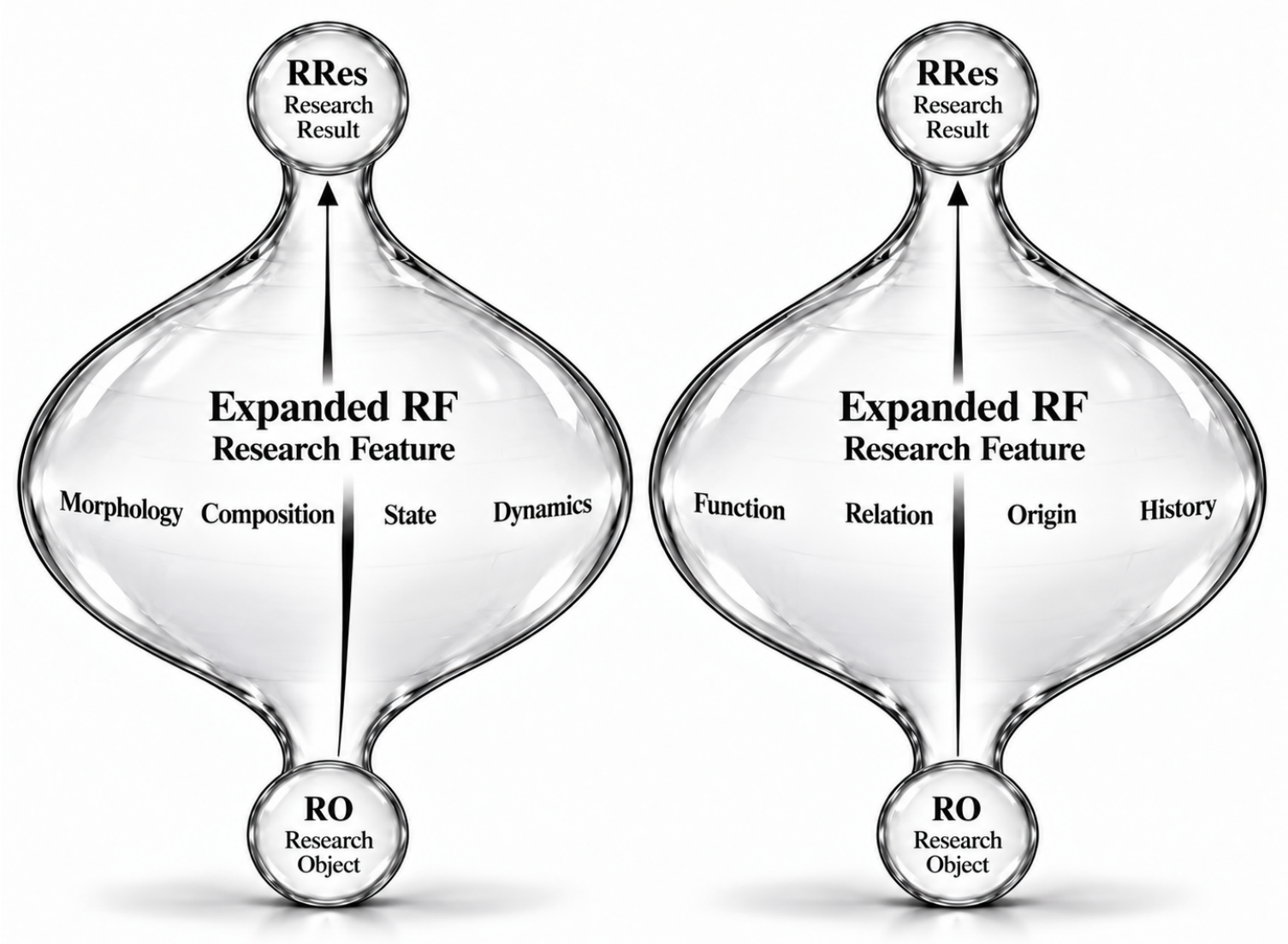
This parallelism helps explain why the two maps can be considered together and why selected and regions can be brought into alignment. The spindle is thus both a geometric property of the maps and a conceptual representation of how research and expression expand through multiple perspectives before converging toward results.
5.2.3. From the Research Hourglass to a Research Spindle
The traditional hourglass model is commonly used to describe the organization of research writing and, in some accounts, the progression of scientific inquiry associated with that organization.
Generalized Research (GR) provides another perspective. Research begins from a Research Object RO. The object can then be analyzed through multiple Research Features and their concrete analytical contents . The analytical possibility space is therefore widest in the intermediate RF region. Research subsequently converges toward Research Results RRes.
Thus,
RO → expanded RF → RRes.
This configuration forms the Spindle Model of Generalized Research, as shown in Figure 16.
The traditional hourglass and the GR spindle describe different dimensions and are not mutually exclusive.
The hourglass mainly describes a change in thematic or rhetorical scope:
broad context → specific study → broad implications.
The GR spindle describes a change in the breadth of analytical possibilities:
focused object → expanded analytical perspectives → focused results.
A research project may therefore possess both structures. Its article may follow an hourglass-shaped rhetorical organization, while the underlying analytical activity follows a spindle-shaped research structure.
The introduction of the spindle model for GE, together with its corresponding interpretation for GR, extends the spatial framework of DREAM. It also suggests that research traditionally interpreted through the hourglass can be reconsidered from the GR perspective as an expansion of analytical possibilities followed by convergence toward research results.
5.3. Combinatorial Expansion of the Intermediate Space
The broad middle region of the spindle model also has a combinatorial interpretation. The number of possible analytical and expression combinations helps explain why the intermediate regions cannot be adequately represented as a small, fixed set of predetermined pathways.
In the current GR framework, the eight Research Features contain 58 concrete analytical contents. If a research task can select any non-empty subset of these contents, and the order of selection is disregarded, the number of possible selections is
C(58, 1) + C(58, 2) + … + C(58, 58) = – 1.
This gives
288,230,376,151,711,743 possible non-empty selections.
Similarly, the current GE framework contains 75 concrete expression contents. Under the same assumptions, the number of possible non-empty selections is
2 – 1 = 37,778,931,862,957,161,709,567.
If every non-empty research selection could, in principle, be considered together with every non-empty expression selection, the number of paired selections would be
( – 1)( – 1) ≈ 1.09 × .
This estimate assumes that the order of selected contents is disregarded and that each non-empty selection on one side can be paired with each non-empty selection on the other. It does not count different navigation sequences or all possible structures of correspondence, which would require additional assumptions.
These numbers do not imply that every combination is meaningful or useful. Actual academic activity selects only a small subset according to the research object, purpose, disciplinary context, available evidence, and other constraints. Nevertheless, the estimates illustrate the scale of the potential research–expression space.
This combinatorial expansion provides an additional interpretation of the spindle model. A focused object does not normally lead to only one predetermined perspective. Instead, it opens into a potentially vast space of analytical or expression possibilities before selected possibilities converge toward a result.
The broad equatorial region of the spindle therefore represents not only the diversity of perspectives but also their expanding combinatorial possibilities. The two maps make these spaces spatially visible, while navigation and selective matching help identify relevant regions within them. AI may further assist by exploring candidate combinations and suggesting possible correspondences, although academic judgment remains necessary to determine which combinations are appropriate.
The purpose of DREAM is not to enumerate every possible combination. It is to provide a unified spatial framework for locating, selecting, combining, and matching relevant research and expression contents within an otherwise extremely large possibility space.
6. Conclusions and Perspective
This paper introduces DREAM as a spatial framework for bringing Generalized Research (GR) and Generalized Expression (GE) into coordinated view while preserving their distinct meanings.
The Research Map organizes the Research Object (RO), Research Features (RF), and Research Results (RRes); the Expression Map organizes the Expression Object (EO), Expression Perspectives (EP), and Expression Result (ERes). In both maps, the object occupies the southern region, the broadest range of analytical or expression possibilities lies in the equatorial region, and results occupy the northern region.
The pathways of GR and GE can be interpreted as navigation: local operations move within a feature or perspective region, cross operations move between regions, and re-anchoring allows an existing result or expression to become a new starting object.
DREAM supports matching at three levels: global coordinate correspondence (RO ↔ EO, RF ↔ EP, RRes ↔ ERes), feature-level matching (↔ ), and local matching between concrete contents (↔ ). These correspondences are selective and task-dependent, not fixed semantic equivalences; they need not be exhaustive or one-to-one.
Matching is also dynamic. Research and expression may proceed synchronously or asynchronously and can improve one another through reciprocal feedback before formal communication. AI may help identify candidate matches and explore combinations that are difficult to inspect manually, while the relevance and validity of each match remain matters for scholarly evaluation.
The maps further reveal parallel spindle structures: a focused object opens into a broad range of analytical or expression perspectives before converging toward a result. This differs from the traditional hourglass, which primarily represents broad–narrow–broad rhetorical or thematic scope. The two models describe different dimensions and can coexist within one academic project.
DREAM can therefore be summarized as:
DREAM = Two Maps + Navigation + Global Correspondence + Selective Matching + Reciprocal Feedback.
By providing an intuitive, navigable reference for coordinating research and expression, DREAM may offer a conceptual basis for future AI-assisted tools that explore research–expression correspondences and support reciprocal development. As a conceptual framework, its practical value and the adequacy of particular matches still require evaluation through concrete applications across disciplines.
Beyond its spatial representation, DREAM also suggests a set of potential operations for coordinating research and expression. When a selected analytical feature or expression perspective proves insufficient, switching to an alternative or combining multiple contents may provide a new route forward. Matching between the Research Map and the Expression Map may further help identify useful research–expression configurations and support reciprocal feedback. These possibilities are outlined in Appendix A as directions for operational development. Artificial intelligence may assist in exploring the large space of candidate configurations, although their relevance and effectiveness require task-dependent assessment.
Finally, the DREAM model should be regarded as an initial attempt to develop a broader framework rather than a definitive or fully validated model. The acronym DREAM is used primarily as a convenient mnemonic, not as the result of deliberately constructing the framework around a preselected word. The framework presented here is therefore open to further refinement, critical examination, and application across different contexts. Its value will ultimately depend on the extent to which it helps clarify relevant concepts, support systematic analysis, and facilitate practical applications.
Acknowledgments
Ma Xin-Yu and Wu Yu-Qin assisted with the design of the maps. ChatGPT (OpenAI) was used to help generate and refine schematic figures in response to detailed prompts provided by the author, edit the manuscript for English language and readability, and substantially assist in drafting and refining the appendix. The author reviewed the resulting figures and text and takes full responsibility for the final content.
Appendix A. Operational Extensions of DREAM: Switching, Combination, and Research–Expression Matching
Appendix A.1. Motivation and Scope
DREAM provides a spatial framework for representing and coordinating research and expression. Its two maps contain general coordinates and more concrete contents, while navigation and selective matching allow relevant regions to be explored and considered together. These structures also suggest a further operational question: what should be done when a selected analytical feature, analytical content, or expression perspective does not adequately support the task at hand?
One possibility is to change the selected coordinate or content. Another is to consider multiple contents jointly. A further possibility is to examine whether a different alignment between the Research Map and the Expression Map may provide a more effective way to develop the research or communicate its results.
This appendix outlines three corresponding operational extensions: switching, combination, and research–expression matching. They are proposed as a basis for further operational development of DREAM rather than as an exhaustive or fully validated set of operations.
Appendix A.2. Switching and Combination on the Research Map
In GR, a research task may initially be approached through a selected Research Feature or one of its concrete analytical contents . If the selected perspective does not adequately address the research question, the analytical pathway need not remain confined to that choice.
Two basic adjustments can be distinguished.
Switching.
The researcher may move from one Research Feature to another, or from one concrete analytical content to another. For example, an investigation of an airplane may shift from morphology () to function () when the shape of the object alone does not adequately explain its performance. At a more concrete level, the researcher may replace one analytical content with another within the same feature or select a content belonging to a different feature.
Switching can be represented schematically as
or, at the level of concrete analytical contents,
Here, denotes a research-side switching operation. The selected alternative may belong to the same Research Feature or to another one, depending on the analytical need.
Combination.
Alternatively, a researcher may consider two or more analytical contents jointly rather than replacing the original content with another. For example, explaining an airplane’s lift may require considering both airfoil shape and the relevant flow conditions. Neither content necessarily provides a sufficient account on its own.
A schematic representation is
where denotes a research-side combination operation. The combined contents may belong to the same Research Feature or to different Research Features.
Switching and combination serve different purposes. Switching changes the selected analytical route, whereas combination expands the set of contents considered jointly. Both may be used when a current analytical configuration does not adequately address the research task.
Appendix A.3. Switching and Combination on the Expression Map
Corresponding operations may be considered on the expression side. An expression task may initially rely on a selected Expression Perspective or a concrete expression content . If this choice does not adequately communicate the intended meaning, the expression pathway may be adjusted.
Switching.
An expression may move from one perspective to another or replace one concrete expression content with another. For example, a verbal description may be supplemented by, or replaced with, a mathematical expression when a quantitative relationship needs to be communicated more precisely.
This operation can be represented as
or, at the level of concrete expression contents,
Here, denotes an expression-side switching operation.
Combination.
Multiple expression contents may also be used jointly. For example, a scientific explanation may combine natural language, a figure, and a mathematical expression to communicate a physical relationship.
A schematic representation is
where denotes an expression-side combination operation.
These operations do not prescribe a universally optimal expression. Their purpose is to make alternative expression configurations available for consideration. Their suitability depends on the expression task, the intended audience, the available evidence, and the requirements of the resulting academic product.
Appendix A.4. Research–Expression Matching as an Operational Question
Switching and combination within each map can be extended to the relationship between the two maps. A research feature or analytical content may be considered together with an appropriate expression perspective or concrete expression content.
Three levels of matching can be distinguished:
- Feature–perspective matching: .
- Analytical-content–perspective matching: .
- Content–content matching: .
The first level considers the relationship between general research and expression coordinates. The second relates a specific analytical content to a general expression perspective. The third examines a more concrete relationship between an analytical content and an expression content.
These relations do not imply semantic identity or fixed one-to-one correspondence. They identify combinations that may be worth examining in the context of a particular academic task.
To express this operationally, let denote the relevant task conditions, including the research question, expression purpose, available evidence, disciplinary requirements, and intended audience. A matching operator may then be provisionally defined as
for feature–perspective matching, and
for concrete content–content matching.
Here, M denotes a research–expression matching operator, and V denotes an assessment of the selected combination. Possible outcomes include:
- Effective: the combination adequately supports the intended task.
- Ineffective: the combination does not adequately support the intended task.
- Conditionally effective: the combination is useful only under specified conditions.
- Undetermined: the available evidence is insufficient to assess the combination.
These outcomes are illustrative rather than an exhaustive classification. Their operational use would require criteria appropriate to the task and, where necessary, evidence-based assessment. Matching should therefore not be understood as an automatic judgment derived solely from the coordinates.
Appendix A.5. Reciprocal Feedback and Iterative Adjustment
The matching operation also suggests a mechanism for reciprocal feedback between research and expression.
If a selected expression configuration does not adequately communicate an analytical finding, the researcher may reconsider the analytical content, examine an additional Research Feature, or combine several contents. Conversely, if an analytical result cannot be clearly represented through the selected expression configuration, the expression may be revised by switching perspectives or combining different expression contents.
The process can be represented schematically as
The arrows indicate a possible iterative process rather than a mandatory sequence. Research and expression may develop concurrently, and adjustment may occur on either map or on both maps.
The resulting process is consistent with the central premise of DREAM: research and expression remain distinct but can be coordinated through selective matching and reciprocal feedback. Switching and combination expand the available configurations, while matching provides a way to examine their suitability for a particular task.
Appendix A.6. Prospects for Further Development
The operations outlined above provide a starting point for making DREAM more operational. Further work could specify the conditions under which switching or combination is appropriate, establish task-dependent criteria for evaluating matches, and investigate how the proposed operations can be implemented in different disciplines.
Artificial intelligence may also assist this process. Given a research question, an analytical configuration, and an emerging expression, an AI system could suggest alternative analytical contents, candidate expression perspectives, possible combinations, or potential matches between the two maps. Such assistance may be especially useful when the number of candidate configurations exceeds what a researcher can readily examine manually.
However, the generation of candidate matches must be distinguished from their validation. AI-generated suggestions would require assessment against the research objective, supporting evidence, disciplinary knowledge, and expression requirements. The purpose would be to assist human navigation and selection within the large possibility space represented by DREAM, not to assume that every suggested match is meaningful or effective.
Accordingly, switching, combination, matching, and reciprocal feedback may be developed as complementary operations for future versions of DREAM. Their formalization and empirical evaluation remain open directions for further research.
References
- Booth, W. C., Colomb, G. G., Williams, J. M., Bizup, J., & FitzGerald, W. T. The Craft of Research, 5th ed.; University of Chicago Press: 2024.
- Cargill, M., & O’Connor, P. Writing Scientific Research Articles: Strategy and Steps, 2nd ed.; Wiley-Blackwell: 2013.
- Creswell, J. W., & Creswell, J. D. Research Design: Qualitative, Quantitative, and Mixed Methods Approaches, 6th ed.; SAGE Publications: 2023.
- Day, R. A. How to Write and Publish a Scientific Paper, 5th ed.; Oryx Press: 1998.
- Fetters, M. D., & Freshwater, D. Publishing a methodological mixed methods research article. Journal of Mixed Methods Research 2015, 9, 203–213. [CrossRef]
- Hill, S. S., Soppelsa, B. F., & West, G. K. Teaching ESL students to read and write experimental-research papers. TESOL Quarterly 1982, 16, 333–347. [CrossRef]
- Hu, R.-F., Wu, Z.-N., Wu, Z., Wang, X.-X., & Tian, Z.-W. Aerodynamic map for soft and hard hypersonic level flight in near space. Acta Mechanica Sinica 2009, 25, 571–575. [CrossRef]
- Li, J., & Wu, Z.-N. Vortex force map method for viscous flows of general airfoils. Journal of Fluid Mechanics 2018, 836, 145–166. [CrossRef]
- O’Leary, Z. The Essential Guide to Doing Your Research Project, 4th ed.; SAGE Publications: 2021.
- Schulte, B. A. Scientific writing & the scientific method: Parallel “hourglass” structure in form & content. The American Biology Teacher 2003, 65, 591–594. [CrossRef]
- Swales, J. M. Genre Analysis: English in Academic and Research Settings; Cambridge University Press: 1990.
- Wu, Z.-N. A note on the unified coordinate system for computing shock waves. Journal of Computational Physics 2002, 180, 110–119. [CrossRef]
- Wu, Z.-N. Generalized Analytical Method (GAM) Based on the Generalized Coordinate System (GCS). Preprints.org 2026. [CrossRef]
- Wu, Z.-N. Generalized Analytical Pathway (GAP) and Generalized Research (GR). Preprints.org 2026. [CrossRef]
- Wu, Z.-N. The Generalized Coordinate System for Rhetorical Modes. Preprints.org 2026. [CrossRef]
- Wu, Z.-N. Generalized Expression (GE) Based on the Generalized Expression Coordinate System (GECS). Preprints.org 2026. [CrossRef]
- Wu, Z.-N. Generalized Research–Expression Model (GREM). Preprints.org 2026. [CrossRef]
Figure 1.
Generalized Coordinate System.
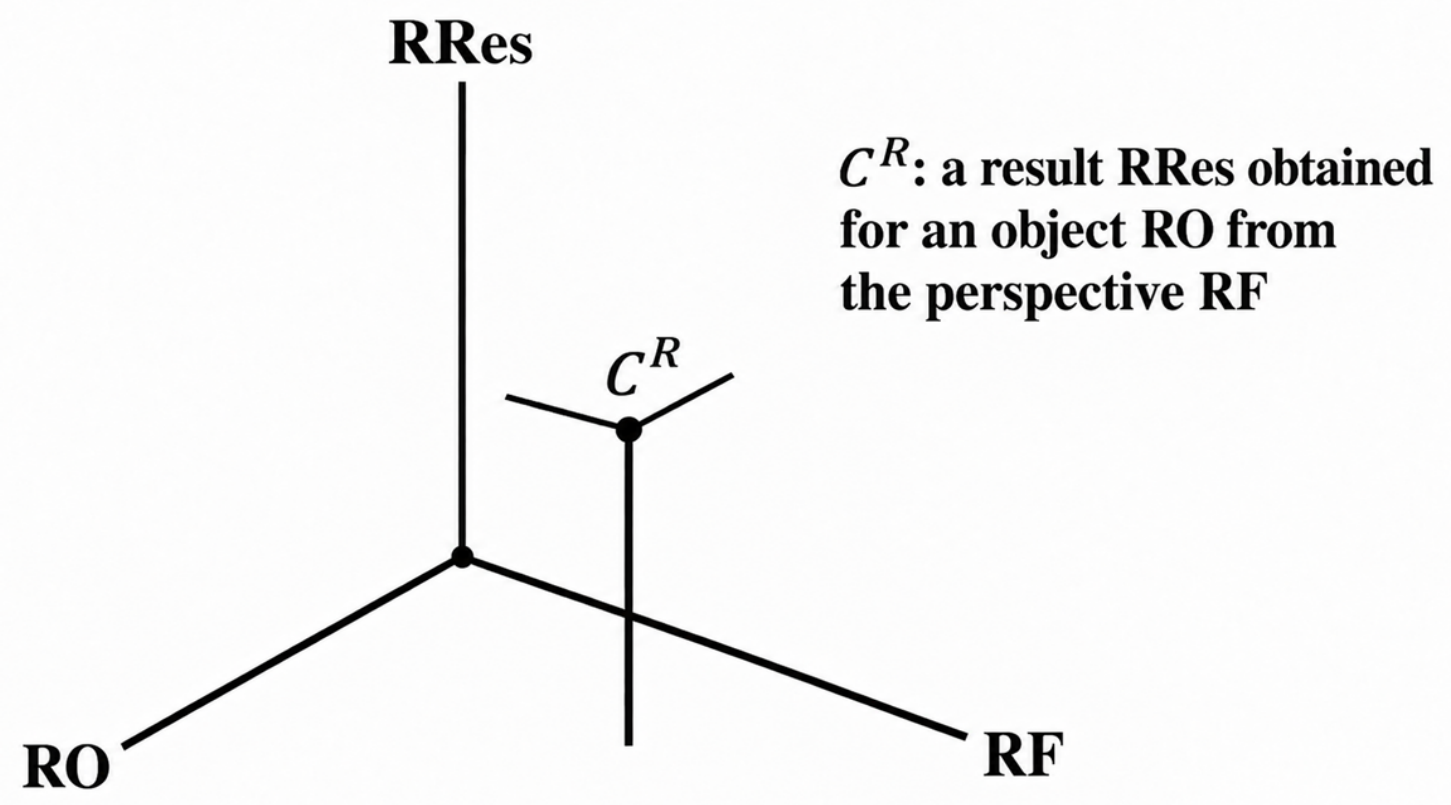
Figure 2.
The Generalized Expression Coordinate System (GECS).
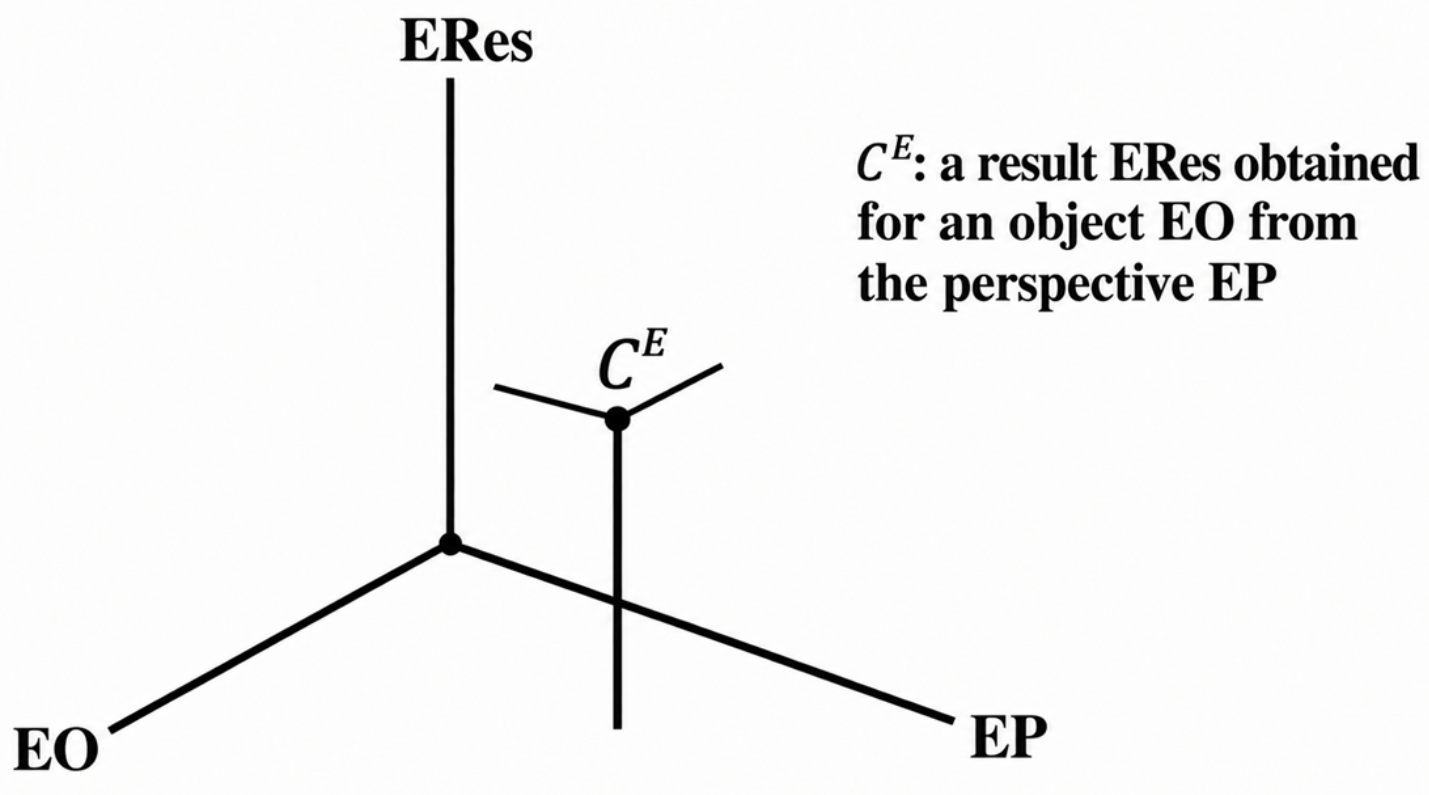
Figure 3.
Front view of the Research Map.
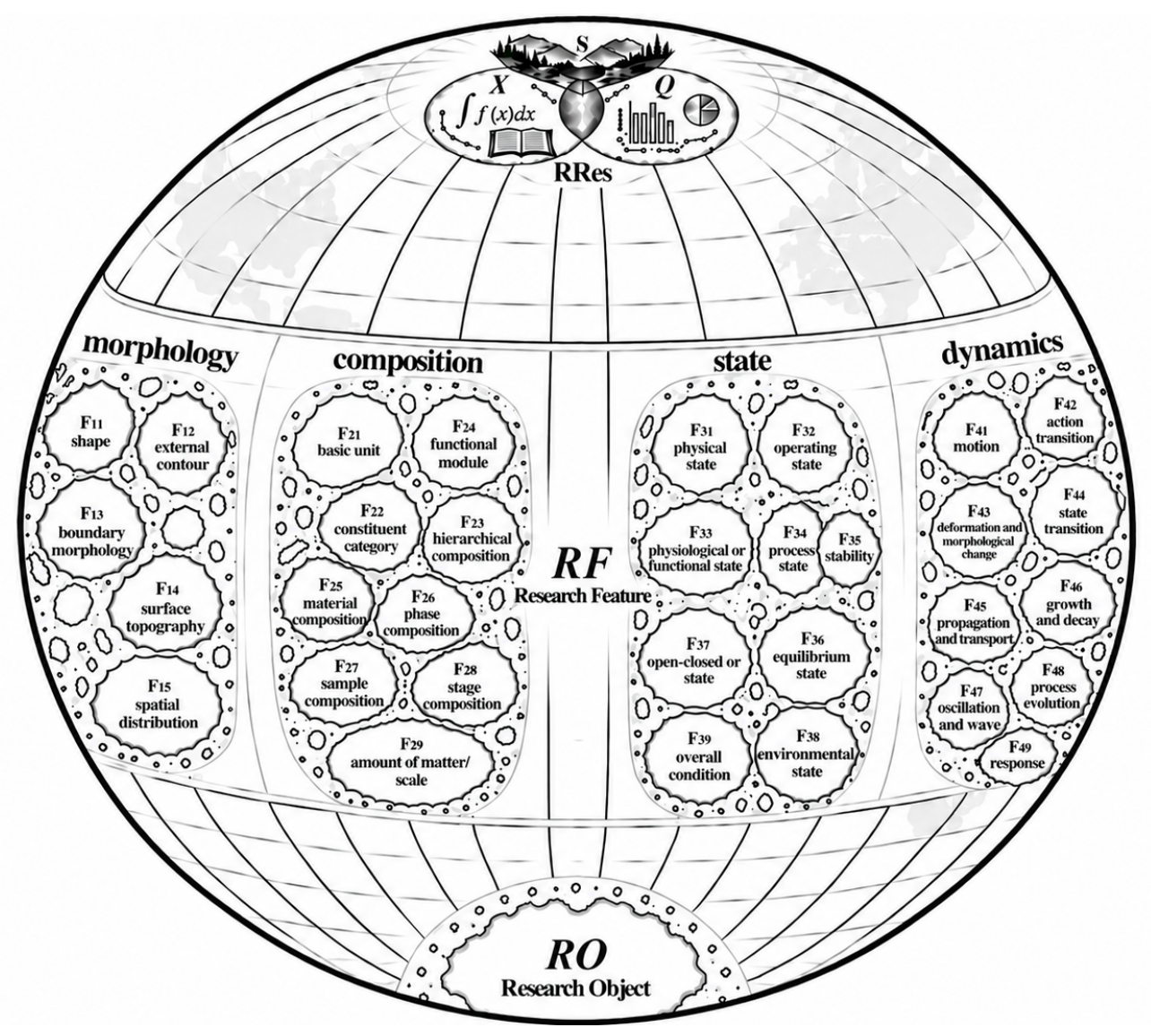
Figure 4.
Back view of the Research Map.
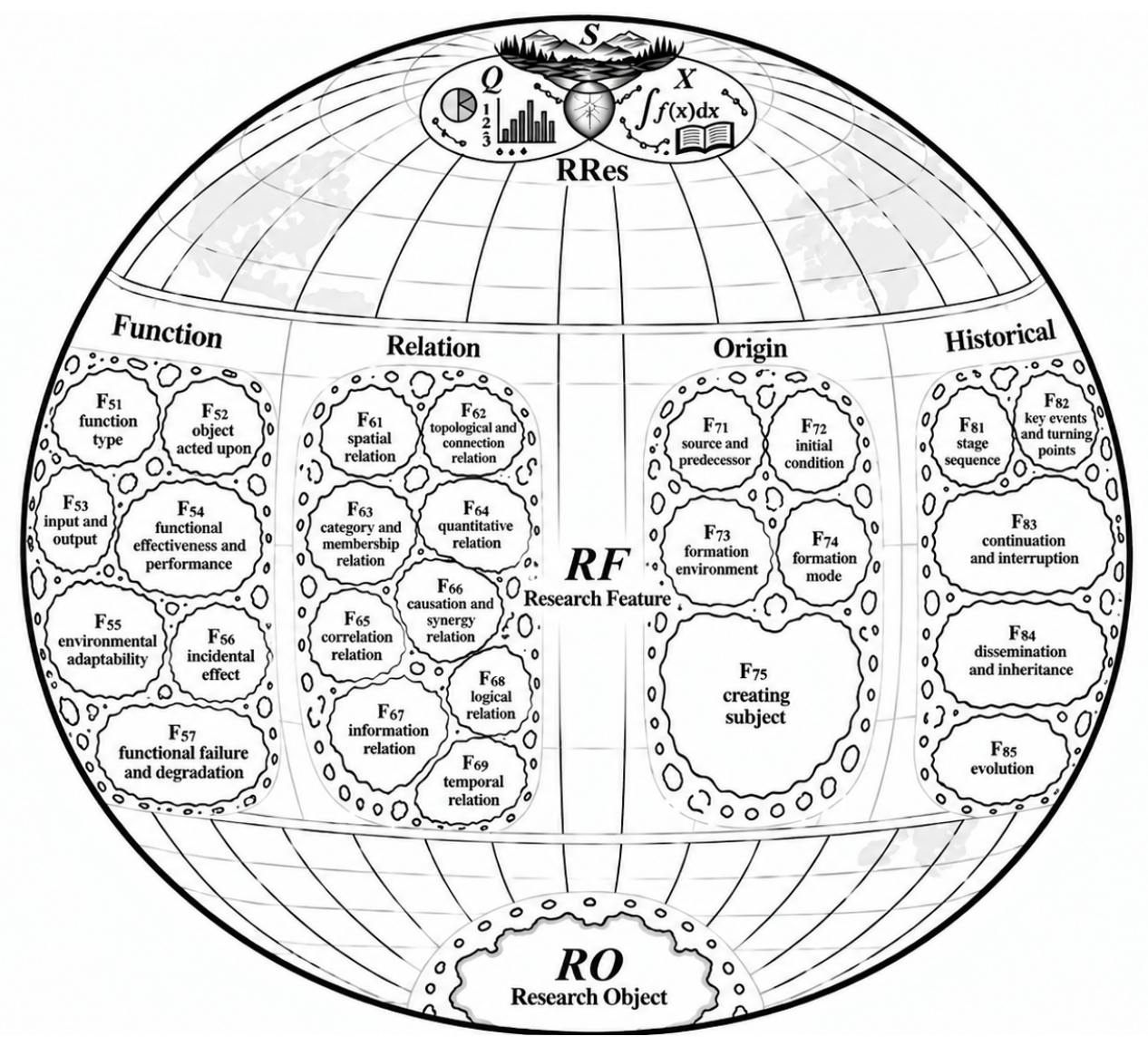
Figure 5.
Front view of the Expression Map.
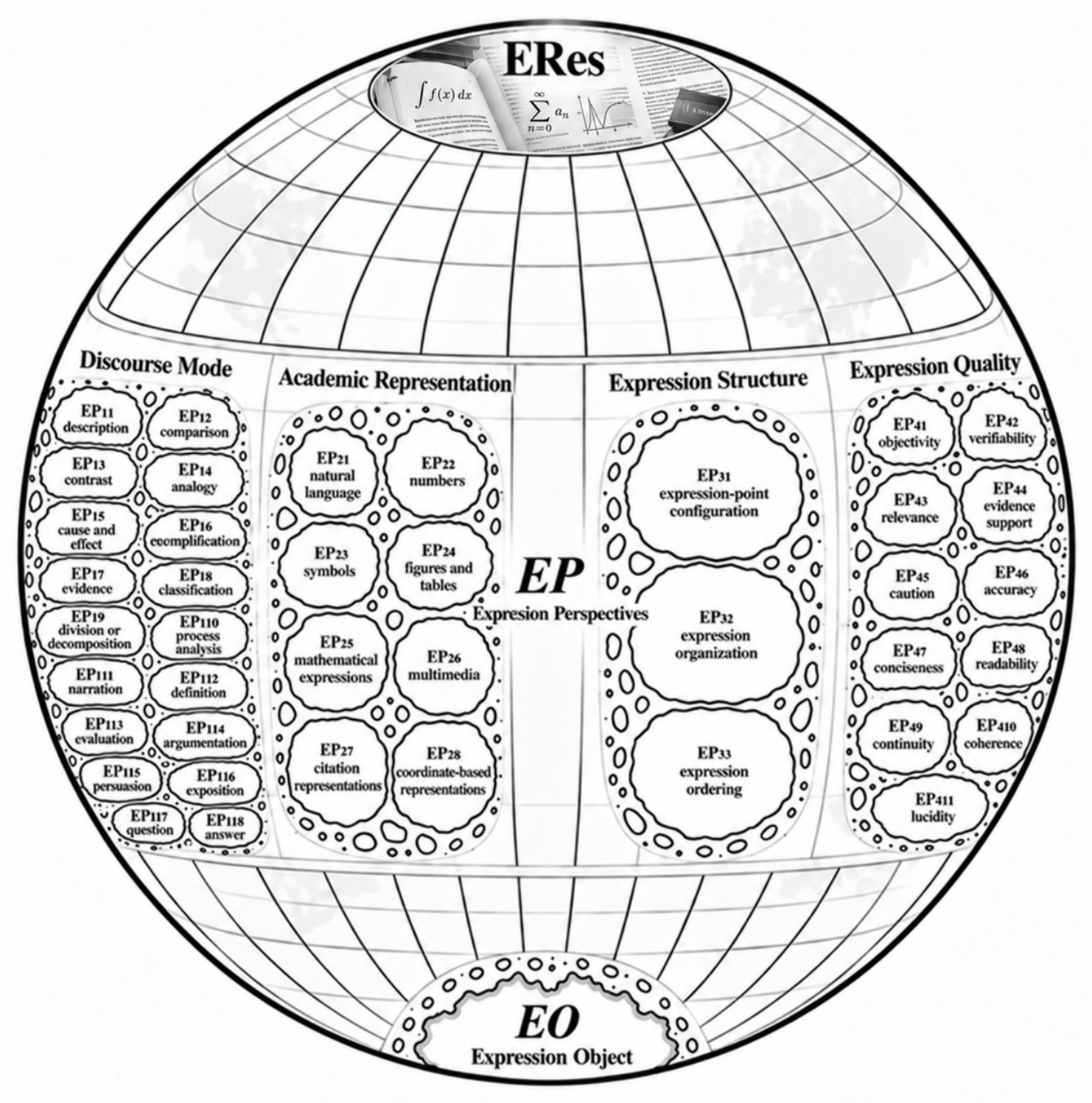
Figure 6.
Back view of the Expression Map.
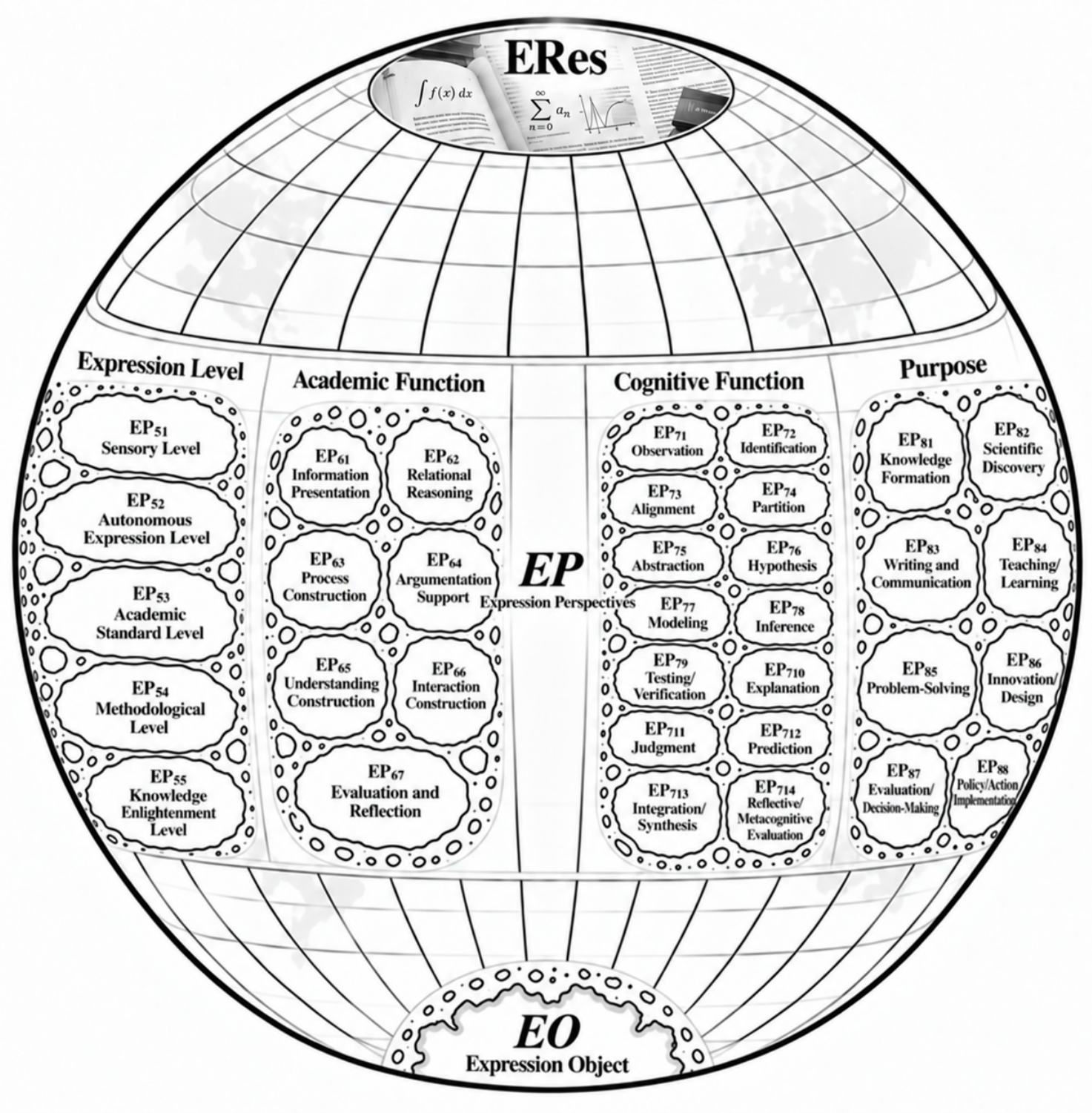
Figure 7.
Navigation Trajectories in the Research Map for LA in GAP.
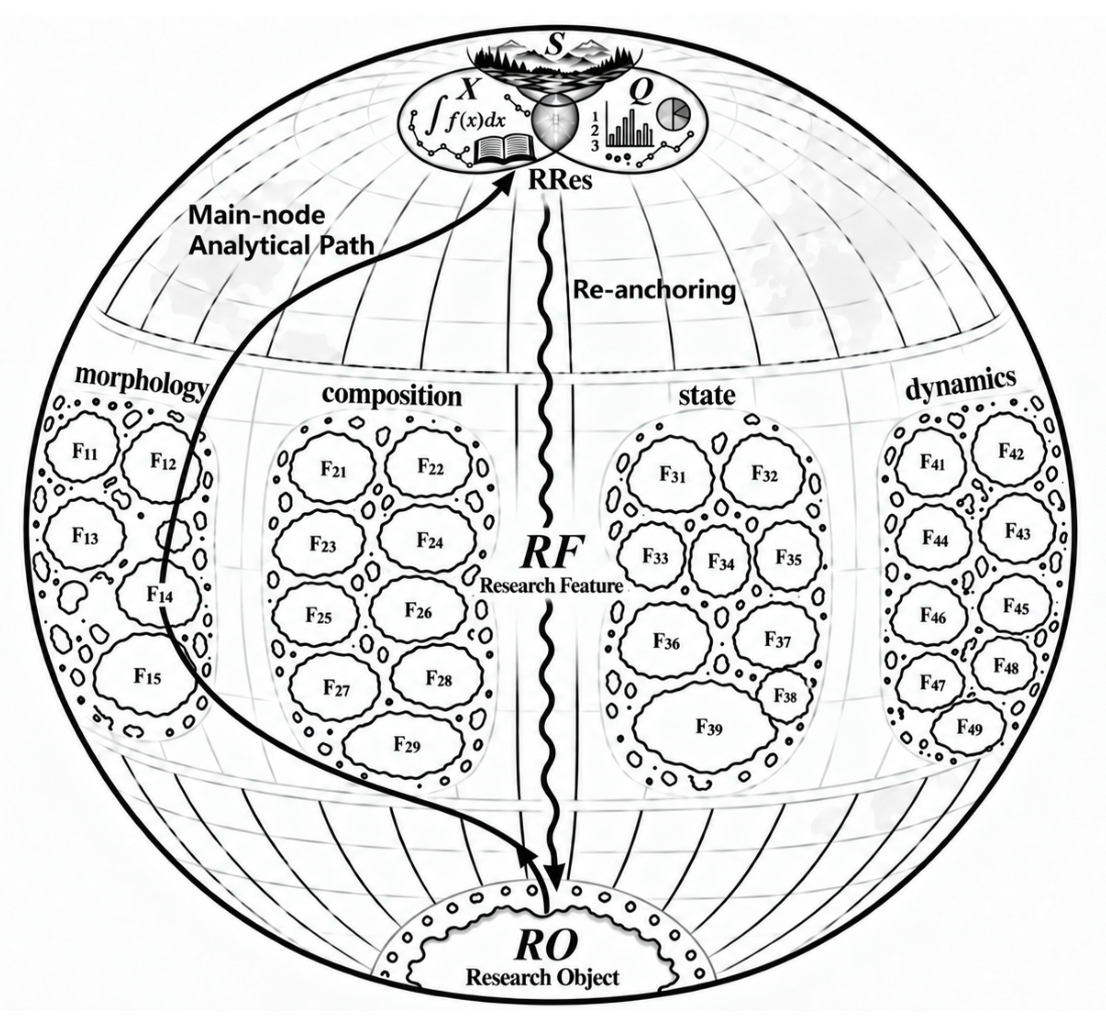
Figure 8.
Navigation Trajectories in the Research Map for CA in GAP.
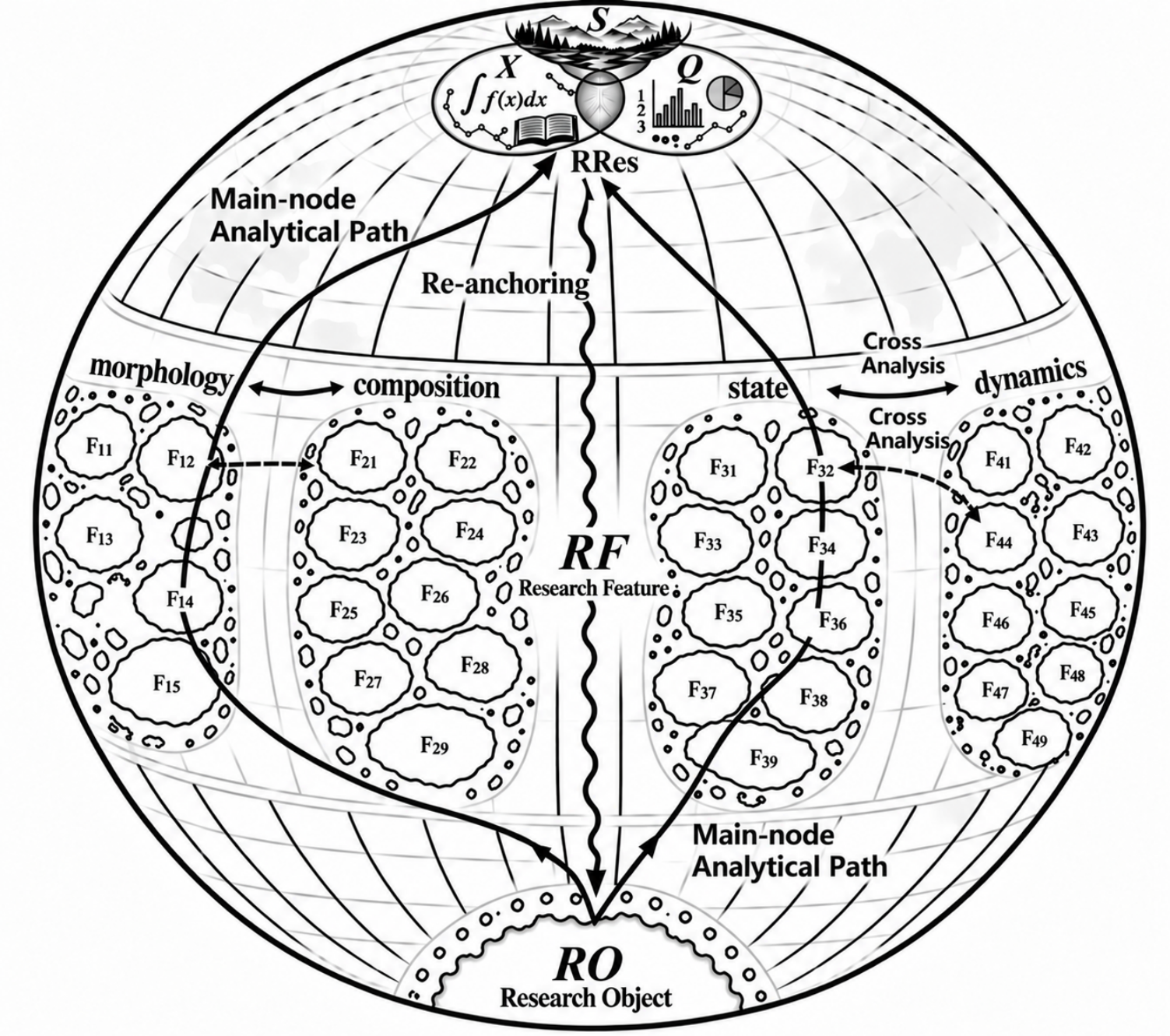
Figure 9.
Navigation Trajectories in the Expression Map for LE in GEP.
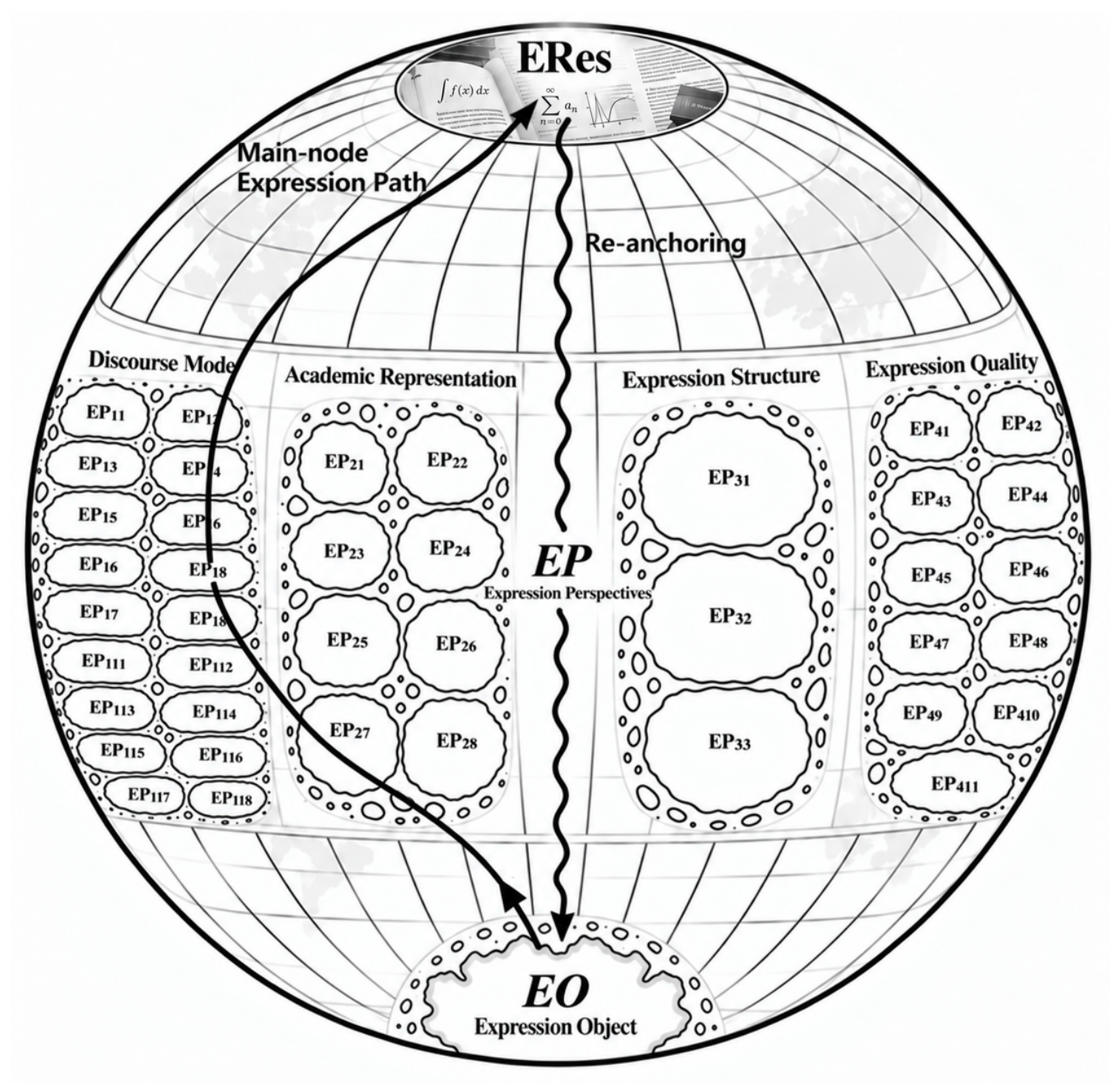
Figure 10.
Navigation Trajectories in the Expression Map for CE in GEP.
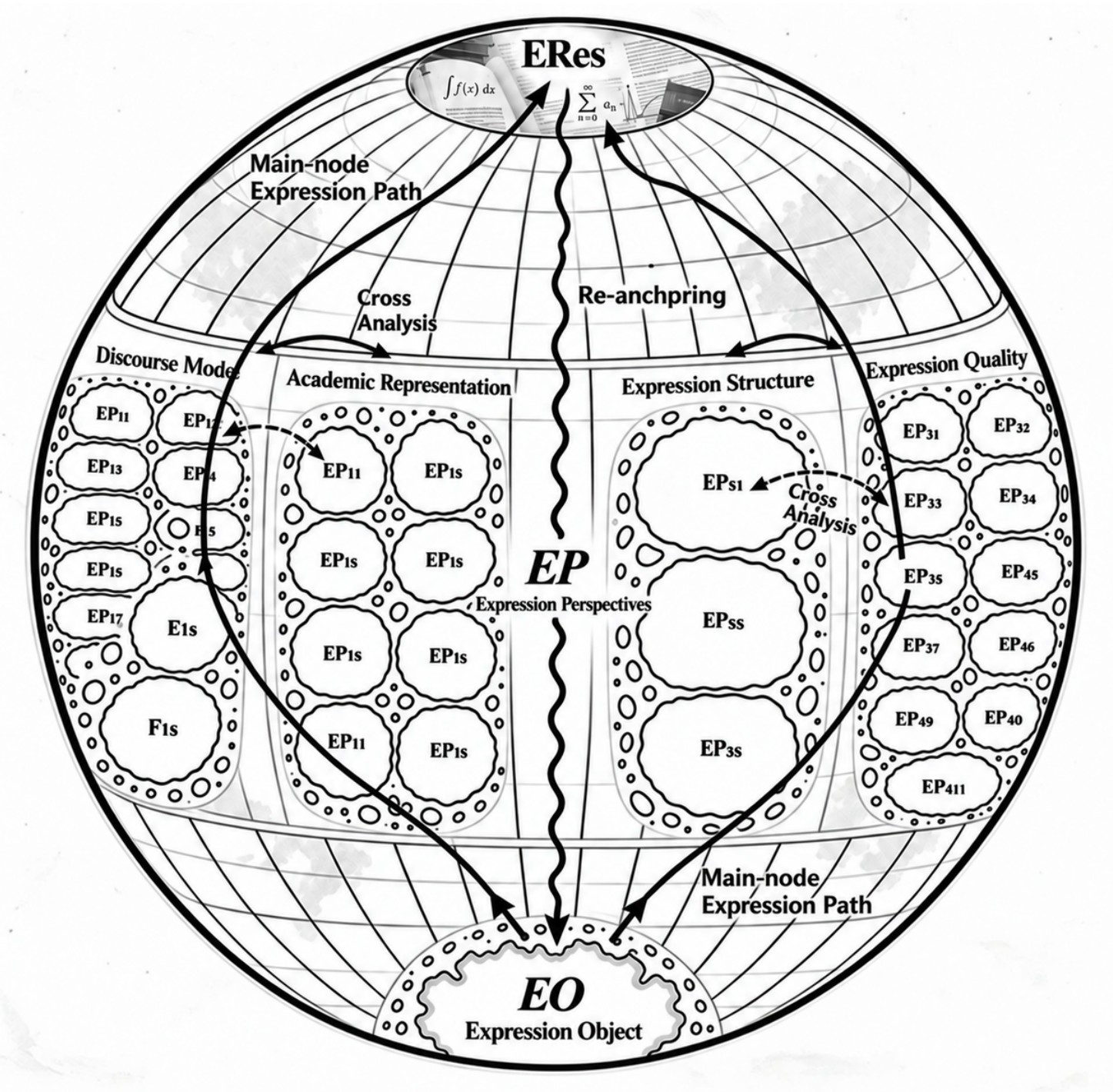
Figure 11.
Schematic Matching with ↔ .
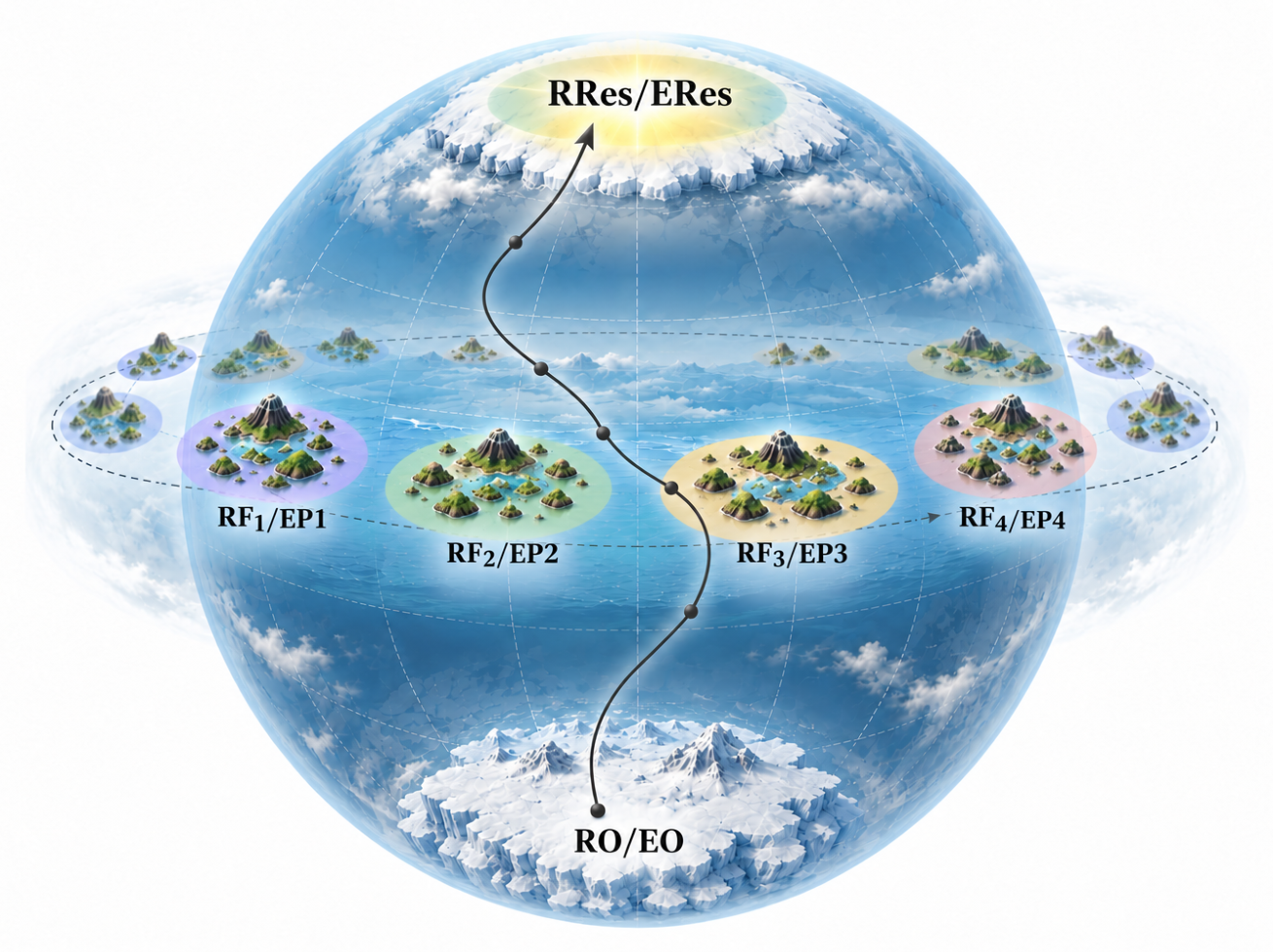
Figure 12.
Schematic Matching with ↔ , .
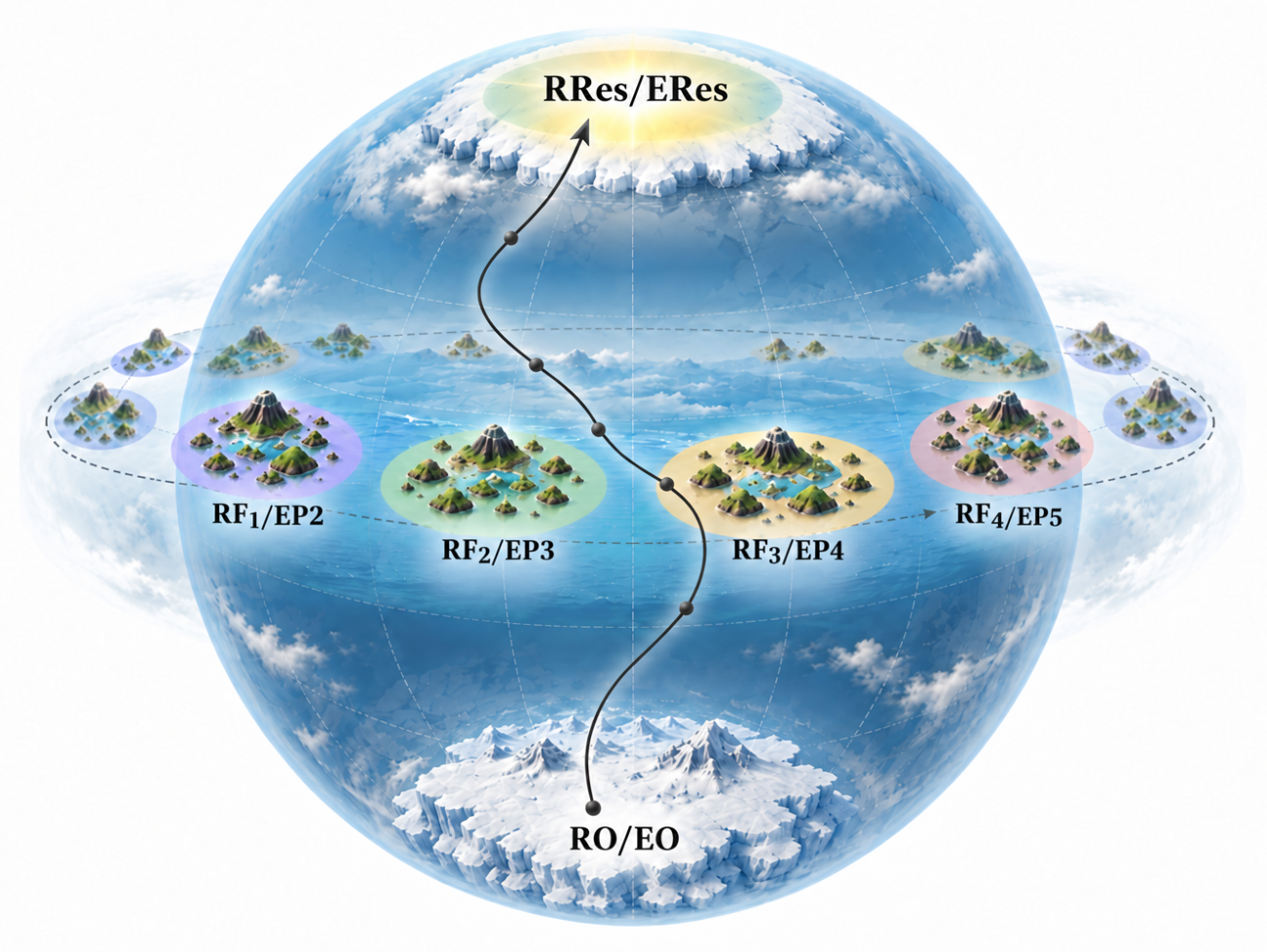
Figure 13.
Schematic illustration of local matching between concrete analytical contents and concrete expression contents .
Figure 13.
Schematic illustration of local matching between concrete analytical contents and concrete expression contents .
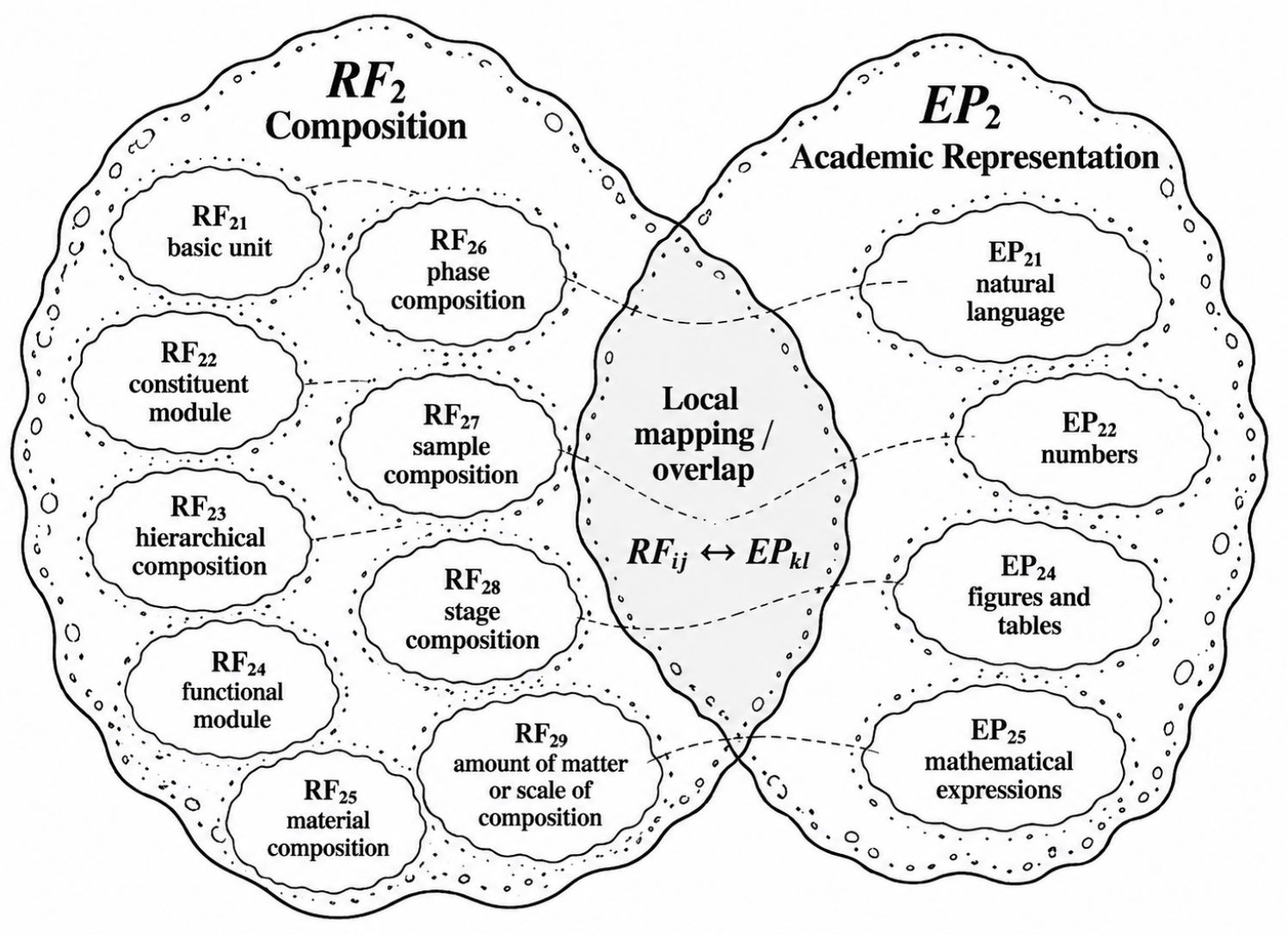
Figure 14.
Traditional hourglass model: broad research context → specific study → broader interpretation and implications.
Figure 14.
Traditional hourglass model: broad research context → specific study → broader interpretation and implications.
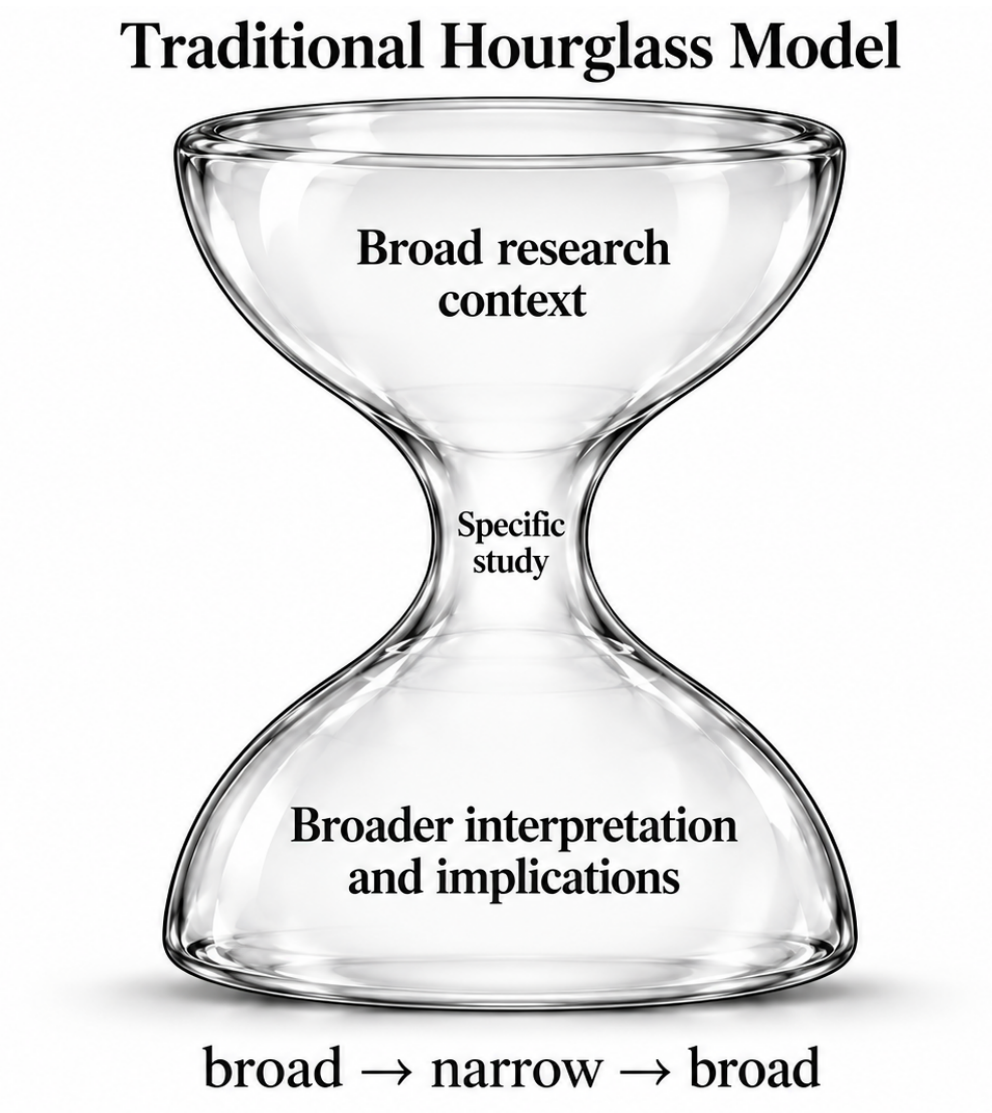
Figure 15.
Spindle Model of Generalized Expression: a focused expression object expands into multiple expression perspectives and converges toward an expression result.
Figure 15.
Spindle Model of Generalized Expression: a focused expression object expands into multiple expression perspectives and converges toward an expression result.
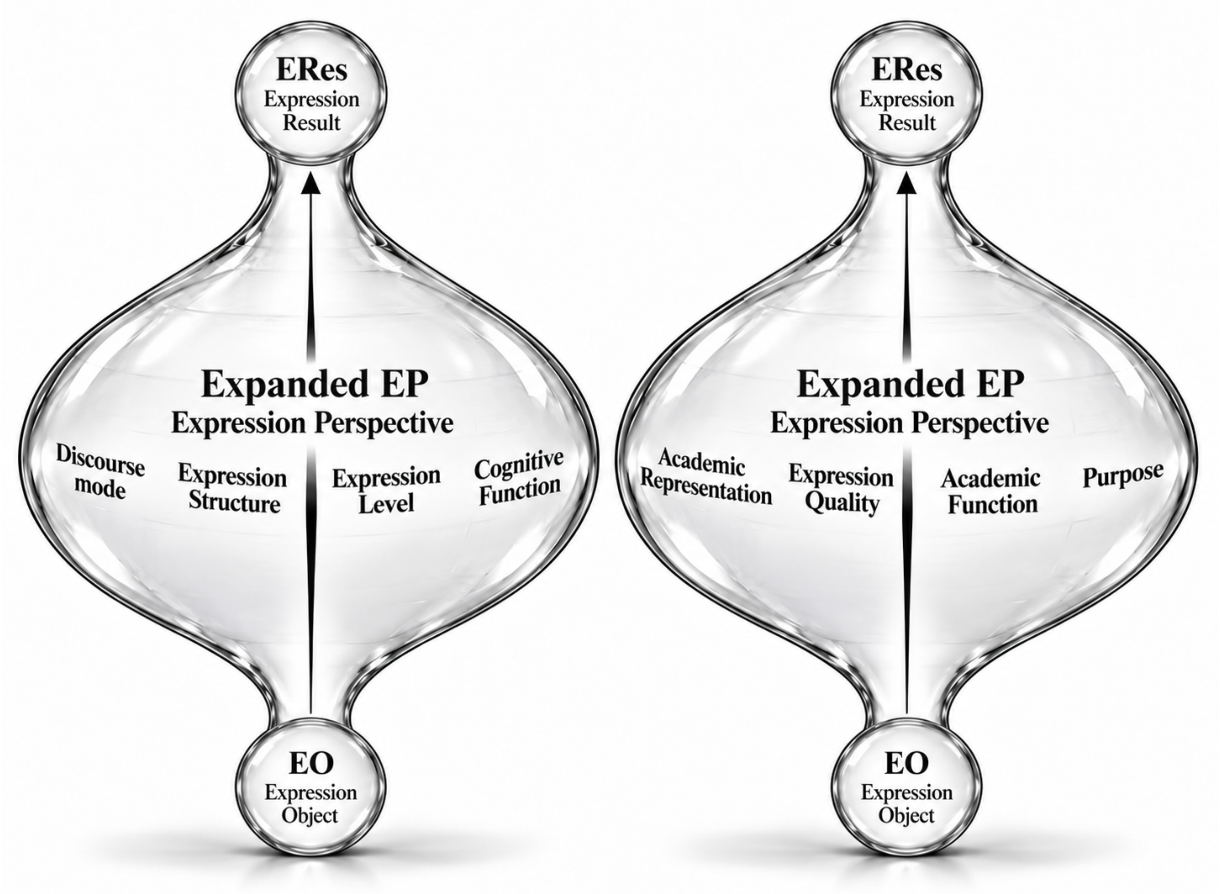
Figure 16.
Spindle Model of Generalized Research: a focused research object expands into multiple analytical perspectives and converges toward research results.
Figure 16.
Spindle Model of Generalized Research: a focused research object expands into multiple analytical perspectives and converges toward research results.
Disclaimer/Publisher’s Note: The statements, opinions and data contained in all publications are solely those of the individual author(s) and contributor(s) and not of MDPI and/or the editor(s). MDPI and/or the editor(s) disclaim responsibility for any injury to people or property resulting from any ideas, methods, instructions or products referred to in the content. |
© 2026 by the authors. Licensee MDPI, Basel, Switzerland. This article is an open access article distributed under the terms and conditions of the Creative Commons Attribution (CC BY) license (http://creativecommons.org/licenses/by/4.0/).
Copyright: This open access article is published under a Creative Commons CC BY 4.0 license, which permit the free download, distribution, and reuse, provided that the author and preprint are cited in any reuse.