
Submitted:
23 October 2026
Posted:
26 October 2026
You are already at the latest version
Abstract
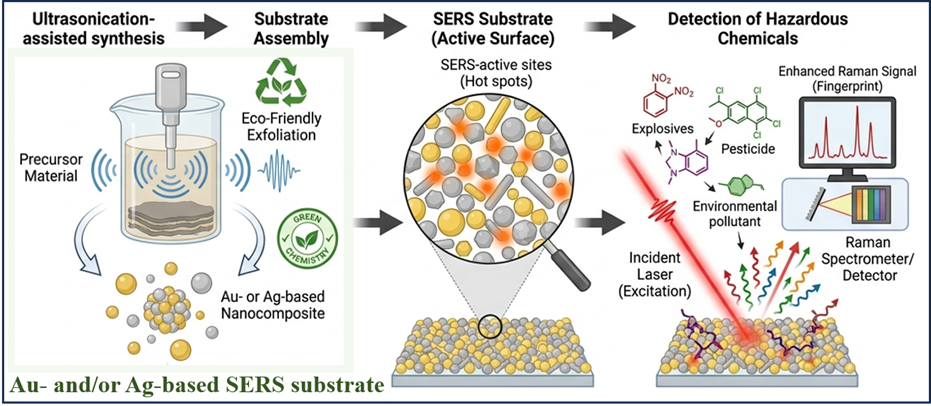
Ultrasound has become a pioneering, efficient, and economical technology for nanomaterial fabrication, revolutionizing materials nanoscience. Ultrasound enhances mass and heat transfer through acoustic cavitation and mechanical vibrations, enabling shorter synthesis times and diverse structures. As a nonthermal method, ultrasound preserves the physical and chemical properties of materials, making it a greener alternative to conventional processing. Surface-enhanced Raman scattering (SERS) has broad potential for environmental, materials, food, and biomedical analysis. SERS is highly sensitive and provides unique molecular fingerprints, enabling miniaturized, integrated, high-throughput sample control. Ultrasonication-assisted fabrication of gold- and/or silver-based hybrid SERS substrates leverages the self-assembly of plasmonic noble metals (Au and Ag), generating numerous "hot spots" in structural substrates; these channels are promising for enhancing detection sensitivity. Environmental pollutants (e.g., pesticides, micro- or nano-plastics) harm ecosystems and threaten human and wildlife health and life, so monitoring these hazardous chemicals is essential. This review comprehensively summarizes the latest updates on well-established Au- and/or Ag-based hybrid SERS substrates for monitoring hazardous chemicals and key progress in their development under ultrasonication-assisted synthesis. It also describes the challenges encountered and future directions for development. This detailed overview is designed to support scholars and professionals working toward breakthroughs in ultrasound-assisted SERS monitoring for environmental protection.
Keywords:
acoustic cavitation
; sonochemistry
; ultrasonication‐assisted fabrication
; surface‐enhanced Raman scattering
; SERS detection
Copyright: This open access article is published under a Creative Commons CC BY 4.0 license, which permit the free download, distribution, and reuse, provided that the author and preprint are cited in any reuse.