

Submitted:
24 October 2026
Posted:
26 October 2026
You are already at the latest version
Abstract
Coordination of organic biradicals to transition metals is a promising route to multifunctional materials, but controlling the metal oxidation state during complexation remains challenging. Here we attempted to prepare a ruthenium(III) complex with the 2,6-bis(1-oxyl-4,4,5,5-tetramethyl-4,5-dihydro-1-H-imidazol-2-yl)pyridine (bisimpy), tridentate imino-nitroxide, from [RuCl3(PhCN)3]. Instead, redox processes between the ligand and the ruthenium precursor in solution yielded the ruthenium(II) complex [Ru(bisimpy)(PhCN)Cl2]. The product was characterized by single-crystal X-ray diffraction and UV-vis absorption in solution supported by TD-DFT and BS-DFT calculations. Structural analysis confirms the tridentate coordination of bisimpy to a centrosymmetric Ru(II) ion, rendering the two iminonitroxide fragments equivalent. UV-vis spectra show intense ligand-centered bands in the UV region and MLCT transitions in the near-IR region absent in the free biradical. TD-DFT computation reproduces the experimental spectra assigning the features to metal-to-ligand, and mixed ligand–ligand/metal–ligand transitions. Notably, BS-DFT computation predicts a dramatic change in the intramolecular exchange between the two radical centers: whereas the free biradical is weakly ferromagnetic, coordination to the diamagnetic Ru(II) center switches the coupling to strongly antiferromagnetic through a metal-mediated superexchange pathway. These results show that the imino-nitroxide biradical directs the reaction toward Ru(II) rather than the targeted Ru(III) species and demonstrate that a formally diamagnetic d⁶ metal can actively modulate radical–radical magnetic communication. In the Ru(II) complex, the diamagnetic low-spin 4d⁶ center (S = 0) does not participate in direct magnetic exchange with the radicals, but it mediates a strong antiferromagnetic coupling between the two radical centers through superexchange involving the 4d metal orbitals.
Keywords:
2
; 6-bis(1-oxyl-4
; 4
; 5
; 5-tetramethyl-4
; 5-dihydro-1-H-imidazol-2-yl)pyridine
; ruthenium(II)
; coordination
; imino-nitroxyl biradical
; UV-vis absorption
; TD-DFT computation
1. Introduction
1.1. Ruthenium Complexes with Paramagnetic Organic Ligands: Status Quo
1.1.1. Complexes with Non-Innocent Species
In the literature, the electronic structure of ruthenium complexes with redox-active (non-innocent) ligands has been discussed earlier in terms of the mixing of metal dπ and ligand π orbitals, which makes the oxidation state assignment ambiguous and gives rise to low-energy charge-transfer transitions, valence tautomerism and switchable absorption in the visible and near-infrared [1]. In these systems, the ligand is diamagnetic in its free state, and the radical form is generated only after coordination, either electrochemically or by chemical redox conversion. This is the case for the o-dioxolene complexes [Ru(acac)2(Q)], where the quinone, semiquinone and catecholate forms are interconverted electrochemically, and the process is monitored by UV-vis-NIR spectroscopy [2]. The neutral complexes are best described as [RuIII(acac)2Q•–] with an S = 1 ground state and low-energy bands assigned as mixed MLCT/intra-quinone and LMCT transitions. In the 1,2-diaminoanthraquinone complexes [3], the thermodynamically stable form under ordinary conditions is the closed-shell quinonoid tautomer. The radical semiquinonate form is isolable only when π-accepting CO/PPh3 coligands are used to stabilize Ru(II). The reduced diamido form, in turn, is accessible only electrochemically. The same situation was observed for the quinone-bridged Ru2–systems [4], where the one-electron-oxidized dinuclear complexes exhibit strong NIR absorptions, and class–III mixed–valent behavior (~39% spin on each Ru), while the reduced forms show LLCT bands in the NIR. In the [Ru(Q•–)(L)(NOx)] (x = 1 or 2, L = mer-tridentate ligand) platforms, where the competition between metal- and ligand-centered oxidation is not determined by the formal metal oxidation state alone and the assignment remains ambiguous without EPR data [5]. In all these systems, the radical state is generated after coordination, and the free ligand is not paramagnetic. A related, but structurally different, example is the ruthenium oxyl radical complex [RuII(tpy)(Bu2SQ)O•–] [6], where tpy = 2,2′:6′,2″-terpyridine and Bu2SQ = 3,5-di-tert-butyl-1,2-benzosemiquinone. In this complex, double deprotonation of the aqua ligand of [RuII(tpy)(Bu2SQ)(OH2)]2+ induces intramolecular electron transfer from the resulting O2– to the Ru–dioxolene moiety, giving a Ru(II)–semiquinone core and an oxyl radical. The complex shows antiferromagnetic coupling between the Ru(II)–semiquinone moiety and the oxyl radical, with 2J = –0.67 cm–1. This example is relevant because it shows that a diamagnetic Ru(II) center can stabilize a ligand-centered radical and mediate a weak exchange interaction, although the radical is an oxyl O•– rather than an N–O• center and the exchange is intramolecular within a single Ru center.
1.1.2. Complexes Containing Stable Organic Radicals
The coordination chemistry of ruthenium with nitronyl nitroxyl (NN) is limited to compounds in which the radical binds through a diamagnetic N-donor substituent, leaving the paramagnetic N–O• centers uncoordinated. Only two Ru(III) complexes of this type have been described, with the NN radical coordinating through a pyridine [7] or imidazole [8] nitrogen. For Ru(II), only three compounds were obtained. One is a cyclopentadienyl complex in which the NN radicals are covalently attached to the Cp-ligands [9]. The other two contain a nitrosyl group, Na[RuNO(p-PyNN)Cl4] [10] and Na[RuNO(m-PyNN)Cl4] [11], in which the NN radical binds through the pyridine nitrogen. The only Ru(III) compound with direct coordination of a nitroxyl group is the complex, Octaethylporphyrinato-N,N’,N″,N‴)-(2,2,6,6-tetramethylpiperidine-1-oxyl)-carbonyl-ruthenium(III) with TEMPO as radical [12].
In contrast to the mononuclear species discussed above, ruthenium–nitroxide chemistry with binuclear cores has been dominated by Ru2(II,III) paddlewheel dimers bearing axially coordinated nitronyl nitroxide radicals. In these compounds, three unpaired electrons are localized on the Ru2 core (S = 3/2), and each coordinated radical adds one more unpaired electron (S = 1/2). In the bis-NN adducts with R = MeNN or EtNN, two radicals occupy both axial positions, and magnetic studies reveal a ferromagnetic Ru2–radical coupling (JM–R = +5 cm–1) competing with an antiferromagnetic radical–radical coupling through the Ru—Ru bond (JR–R = –40 cm–1), both strongly dependent on the Ru—O—N bond angle [13] In the mono-NN adduct [Ru2(Piv)4(R)(H2O)]BF4 with R = PhNN, the second axial site is occupied by a water molecule, and the Ru–radical coupling is antiferromagnetic (JRu–ON = –45 cm–1) [14]. In [Ru2(Piv)4(PhNN)]n(BF4)n, the related chain compound, the Ru2 cores and radicals alternate [15], but the magnetic moment decreases steadily confirming antiferromagnetic coupling (JRu-R = –100 cm–1) with ZFS playing an important role [16]. In addition, compounds [Ru2(tfac)4Tempo2] and [Ru2(pfbz)4empo2] were obtained, where tfa and pfbz denote trifluoroacetate and perfluorobenzoate, and the exchange interaction JRu–•O—N in these molecules reaches ≈ 300 cm–1 [17].
For the pivalate (Piv) and propionate (Pro) series, the reaction of Ru2 carboxylate with pyridyl derivatives of nitronyl nitroxides (PyNN) gives both dimer and chain ([Ru2(L)4(m or pPyNN)2]X and {[Ru2(L)4(m or pPyNN)]X}n) complexes depending on the Ru2:radical ratio [14,16,18]. In the chains, each PyNN bridges two Ru2 units through the pyridyl N and one nitroxyl O, giving two exchange pathways: a coupling through the nitroxyl group (JRu–•O—N = 5, 12, 20 cm–1 for the complexes {[Ru2(Pro)4(mPyNN)]PF6}n, {[Ru₂(Pro)4(pPyNN)]BF4}n and {[Ru₂(Piv)4(pPyNN)]BF4}n respectively, and a coupling through the pyridyl substituent (JRu–Py = –1.7 and +0.35 cm–1) for complexes {[Ru2(Pro)4(mPyNN)]PF6}n) and {[Ru₂(Pro)4(pPyNN)]BF4}n [18]. The sign of JRu–Py is determined by the position of the coordinating NPy: for the complexes with meta-substituted NN, {[Ru₂(Pro)₄(mPyNN)]PF6}n—antiferromagnetic (JRu–Py = –1.7 cm–1), whereas for the para-derivative {[Ru₂(Pro)₄(pPyNN)]BF₄}n, coupling constant is ferromagnetic (JRu–Py = +0.35 cm–1). In the dimers, the radicals coordinate only through the pyridyl nitrogen, while the N–O• groups remain free. For pivalate and propionate derivatives, JRu–Py for the m-PyNN complexes are in the range of –1.0÷ –1.6 cm–1 and ferromagnetic for the pPyNN compounds (JRu–Py ≈ 0.45 ÷ 1.45), opposite to the trend found in purely organic biradicals linked by a phenylene spacer.
Verdazyl radicals are stable organic radicals that can coordinate to transition metals and remain redox-active in the complex [19]]. A stable organic radical is already present in the isolated ruthenium complex, without electrochemical generation, in the mononuclear [Ru(acac)2(verdazyl)] and [Ru(hfac)2(verdazyl)] complexes, where verdazyl is 1,5-diisopropyl-3-(4,6-dimethyl-2-pyridinyl)-6-oxoverdazyl [20]. In these complexes, the natural population analysis (NPA) spin density on Ru is 0.39 for the acac (acetylacetonates) derivative and 0.11 for the hfac (hexafluoroacetylacetonate) derivative, and the low-energy bands are mainly Ru(dπ)→verdazyl(π*) MLCT. In the binuclear [(acac)2Ru(μ-verdazyl)Ru(acac)2] and [(hfac)2Ru(μ-verdazyl)Ru(hfac)2] complexes, the same verdazyl ligand bridges the two Ru centers [21]. The neutral hfac derivative is [RuII–Vd(0)•–RuII], whereas the acac derivative is a mixed-valent Ru(II)/Ru(III) species with a reduced verdazyl bridge, and the mono-cation is a broken-symmetry [RuIII–Vd(–1)–RuIII] biradical with J = –218 cm–1. In both cases, however, the radical center is directly coordinated to the metal and verdazyl is a monoradical, so that the question of metal-mediated exchange between two uncoordinated N=C–N–O• fragments cannot be addressed in these systems.
1.2. Imino-Nitroxide Biradical and Its Complexes
The tridentate biradical bisimpy, 2,6-bis(1-oxyl-4,4,5,5-tetramethyl-4,5-dihydro-1-H-imidazol-2-yl)pyridine (Scheme 1), differs from the ligands discussed in Section 1.1 in that it is stable in its uncoordinated form and carries two iminonitroxide N–O• centers [22]. It coordinates in a tridentate N,N,N fashion through the pyridine and the two imine nitrogens, leaving both N–O• centers uncoordinated, and the spin density is delocalized over the N=C–N–O fragments, including the imine nitrogens.
The coordination chemistry of 3d metals with the tridentate biradical ligand bisimpy has been explored in enough depth, revealing a rich variety of magnetic behaviours governed by the electronic configuration of the metal. For Cu2+ (3d9, S = 1/2), a strong ferromagnetic Cu–rad coupling (+165 cm–1) coexists with a weak intraligand rad–rad interaction (+6.5 cm–1), and multifrequency EPR studies attributed this strong ferromagnetic coupling to σ-type covalent bonding between Cu2+ and the radical [23]. The Ni2+ (d8, S = 1) analogue also exhibits ferromagnetic Ni–Rad coupling from +109 cm–1 [24] to 450 cm–1 [25]. In the Co2+ (3d7, S = 3/2) series, the sign of the Co–rad coupling depends strongly on the auxiliary ligands: ferromagnetic coupling (J ≈ +49 K) is observed in [Co(bisimpy)Cl(MeOH)2]X (X = PF6, ClO4) [26], whereas antiferromagnetic coupling (−3.13 cm–1) is found in [Co(hfac)2bisimpy] [27]. For Mn2+ (3d5 high-spin, S = 5/2) with hfac as anionic ligands, both Mn–rad (−4.56 cm–1) and intraligand rad–rad (−2.51 cm–1) couplings are antiferromagnetic [27]]. The diamagnetic Zn2+ (3d10, S = 0) complex serves as a valuable reference, confirming weak intraligand ferromagnetic exchange (+6.5 cm–1) [24]. In all these 3d complexes, the radical–radical exchange is dominated by the metal–radical coupling. The question of whether a diamagnetic 4d metal can mediate radical–radical exchange between the two N=C–N–O• fragments, without direct metal–N–O• bonding, remains open.
1.3. Aim of the Present Study
The ruthenium complexes of imino nitroxyl (IN) radicals remain unknown. The purpose of this study is to fill this gap. In this study, we attempted to synthesize and investigate the properties of a trivalent ruthenium complex with the tridentate biradical bisimpy, in which a weak ferromagnetic exchange interaction takes place (2JR–R = 4.9 cm–1) [22]. The reaction of [RuCl3(PhCN)3] with bisimpy in CH2Cl2 did not give the targeted [RuIII(bisimpy)Cl3]; instead, it yielded [RuII(bisimpy)(PhCN)Cl2], in which the neutral N–O• radical form is retained without any special stabilizing coligand [CCDC 2589239]. The paper therefore analyses the electronic structure and UV-vis-NIR absorption of this stable biradical Ru(II) complex by TD-DFT, including Boltzmann weighting over the S and T states, and the metal-mediated intraligand exchange between the two N=C–N–O• fragments by BS-DFT (J≈–150 to –250 cm–1), comparing both with the Ru-dioxolene [2], Ru-iminosemiquinone [3] and Ru-verdazyl systems [20,21], as well as with the Ru-quinone-bridged [4] and Ru-NO2 [5] platforms..
The coordination chemistry of stable nitroxide radicals has attracted considerable interest due to their ability to mediate strong magnetic exchange interactions and their potential applications in molecular magnetism. Among these, the tridentate nitroxyl biradical 2,6-bis(1-oxyl-4,4,5,5-tetramethyl-4,5-dihydro-1H-imidazol-2-yl)pyridine, bisimpy has proven to be a versatile ligand, coordinating through three nitrogen atoms and leaving the nitroxyl oxygens [5] available for secondary interactions.
2. Results and Discussion
2.1. Synthesis and Characterization
Previously reported ruthenium complexes with nitroxide radicals were typically prepared from chloride or carboxylate precursors in alcoholic or aqueous media [5,6,7,8,9,10,11,12,13,14,15,16]. In contrast to these systems, the starting complex [RuCl3(PhCN)3] is well soluble in dichloromethane, whereas the biradical bisimpy is soluble moderately in it. Therefore, the synthesis of [Ru(bisimpy)(PhCN)Cl2] was carried out in CH2Cl2 under gentle reflux; after cooling and filtration, the product was isolated by slow diffusion of hexane into the filtrate. Notably, the reaction is accompanied by reduction of the ruthenium center from Ru(III) to Ru(II), so that the final product contains the diamagnetic low-spin d⁶ Ru(II) ion rather than the targeted Ru(III) species. This result is due to the well-known ability of nitroxide radicals to disproportionate under mild conditions.
2.1.1. Disproportionation of Iminonitroxide and Its Relevance to [Ru(bisimpy)(PhCN)Cl₂] Formation
Stable iminonitroxide radicals (INRs) are amphoteric redox species: the unpaired electron on the antibonding π* orbital of the N–O group can be either removed or added. In the presence of 4d-metal cations (Ru3+, Rh3+, Pd2+, Ag+), disproportionation 2R–N–O• → R–N=O+ + R–N–O⁻ [28,29,30] is strongly promoted. The metal acts as a Lewis acid, coordinating to the N–O (or imino) group, polarizing the N–O bond, shifting spin density, and lowering the barrier for electron (and proton) transfer. Diffuse 4d orbitals provide efficient covalent metal–radical overlap and enable inner-sphere electron transfer through the bridging cation, with the metal temporarily changing its oxidation state and acting as a redox mediator. The metal also stabilizes the resulting oxoammonium cation or hydroxylamine anion, shifting the equilibrium toward the disproportionation products. This general picture directly applies to the reaction of [RuIIICl3(PhCN)3] with the biradical bisimpy, which yields [RuII(bisimpy)(PhCN)Cl2]. Here Ru³⁺ acts not as a catalyst but as a stoichiometric oxidant: the metal is reduced to Ru²⁺, while bisimpy undergoes disproportionation into its cationic (>N=O⁺) and anionic (>N–O–) forms. The latter reduces Ru3+ to Ru²⁺, and the cationic form is hydrolyzed by residual water to the corresponding hydroxylamine, which can further reduce Ru3+. After reduction, Ru²⁺ coordinates the biradical form of bisimpy with displacement of two PhCN molecules through the chelate effect of the tridentate ligand, leaving one PhCN to stabilize the low-spin d⁶ configuration. The biradical character of bisimpy is retained in the product, as confirmed by the molecular symmetry in the crystal structure.
2.1.2. IR Spectra of the Complex [Ru(bisimpy)(PhCN)Cl2] and Free Bisimpy Ligand
The IR spectrum (Figure S1) of the complex retains all the main bands of the free ligand, indicating that its framework is preserved upon coordination. The most characteristic changes concern the ν(C=N) and ν(C=C) regions of the imino-nitroxide and pyridine fragments (1603, 1586, 1570, 1541, 1487, 1463, and 1441 cm–1): the positions of these bands in the complex change only slightly, but their shape and relative intensities differ somewhat from those of the free ligand, which is consistent with coordination of the ligand to the Ru(II) ion. The ν(N–O) band of the nitroxide groups at 1373 cm–1 is retained in the spectrum of the complex without a noticeable shift, which may indicate that the N–O groups are not directly involved in binding to the metal and that coordination occurs through the imine nitrogen atoms. In the 2989–2862 cm–1 region, the ν(C–H) bands of the methyl groups are observed, while the 3117–3065 cm–1 region contains the ν(C–H) bands of the aromatic rings; their positions remain essentially unchanged upon coordination. The most important spectral signature of complex formation is the appearance, in the spectrum of the complex, of the ν(C≡N) band of coordinated benzonitrile at about 2230 cm–1, which is absent from the spectrum of the free ligand. The retention of this band in the region characteristic of terminally coordinated PhCN confirms the coordination of benzonitrile to Ru(II) through the nitrogen atom of the nitrile group. The low-frequency bands at 428 and 419 cm–1 can be assigned to the ν(Ru–N) and ν(Ru–O) stretching vibrations.
2.2. Crystal and Molecular Structure
The complex [Ru(bisimpy)(PhCN)Cl2] crystallizes in the monoclinic space group C2/c with four formula units per unit cell (Z = 4). The asymmetric unit contains one-half of the molecule, as the atom Ru1 lies on a crystallographic inversion center (special position 2d). The molecular structure is shown in Figure 1 and the bond lengths and angles for the complex coordination environment are listed in Table S2. The Ru(II) center adopts a distorted octahedral coordination geometry. The equatorial plane is defined by two nitrogen atoms (N2 and N2i of the chelating bisimpy ligand and two chloride ions (Cl1 and Cl1i), while the axial positions are occupied by the pyridine nitrogen N1 and the nitrile nitrogen N4 of the PhCN ligand. The Ru—N bond distances are 1.965(2), 2.0064(17), 2.058(3) Å for NPhCN, Nimine and Npy correspondingly. The Ru–Cl bond length is 2.3915(5) Å. These values are consistent with a low-spin Ru(II) (d6, S = 0). The coordination geometry is close to ideal octahedral, with the axial ligands arranged almost linearly: the N1–Ru1–N4 angle is 180.0°, and the Cl1–Ru1–Cl1i angle is 179.07(3)°. The equatorial N2–Ru1–N2i angle is 160.00(10)°, reflecting a slight compression due to the chelating nature of the bisimpy ligand. A similar distortion is observed in the related complex with diamagnetic ligand [RuL(PhCN)Cl2] (2) L=2,6-bis((dimethylamino)methyl)pyridine (CCDC 112403) [31], where the equatorial N2–Ru1–N2 angle is 159.84(11)° and the axial N1–Ru1–N3 angle is 180.0°. The Ru–NNMe2 and Ru–Cl distances in 2 (1.969(2) Å and 2.4265(7) Å, respectively) are comparable to those found for 1, confirming the structural consistency of the Ru(II) coordination sphere across these systems.
The bisimpy ligand coordinates in a tridentate manner through the pyridine nitrogen N1 and the two imine nitrogens N2 and N2i. The iminonitroxide fragments adopt an almost planar arrangement with respect to the pyridine ring, as indicated by the torsion angles Ru1–N2–C8–N3 = −176.71(14)° and N2–C8–N3–O1 = 177.5(2)°. The nitroxide N–O bond length is 1.272(2) Å, which is typical for a nitroxide radical. The C8–N3 (1.343(3) Å) and N2–C8 (1.345(3) Å) bond lengths indicate delocalization of spin density within the iminonitroxide fragment. This planar arrangement differs from the structure of the free bisimpy (CCDC 251139) [22], where the pyridine ring is strongly twisted relative to the imidazoline rings (e.g., torsion angle C5–C13–N4–C14 = 166.6°, and the pyridine–imidazole linkages show torsions of ~120–130° and ~−50 to −60°), indicating that the flat π-system of the ligand is not present in the free biradical but is enforced upon coordination to Ru. In the free biradical, the nitroxide N–O bond lengths are 1.263(6) and 1.256(6) Å, and the C–N bond lengths within the imidazoline rings (N2–C6 = 1.283(7) Å, N4–C13 = 1.282(7) Å) are comparable to those in the coordinated ligand (N3–O1 = 1.272(2) Å; N2–C8 = 1.345(3) Å, N3–C8 = 1.343(3) Å), indicating that the radical character is retained.
The crystal packing is stabilized by van der Waals interactions and weak C–H···Cl contacts. No significant π–π stacking between the pyridine rings of neighboring molecules is observed. The orientation of the axial PhCN ligand in the present complex differs from that in [RuL(PhCN)Cl2] (CCDC 112403) [31]. In both complexes, PhCN is coordinated through its nitrile nitrogen in an axial position with a strictly linear Ru–N≡C arrangement (180.0°). The two complexes differ, however, in the relative orientation of the tridentate ligand plane and the plane defined by the three coordinating nitrogen atoms: this angle is 2.1° in the present complex and 14.2° in [RuL(PhCN)Cl2]. In addition, the angle between the pyridine and phenyl rings is 20.3° in the present complex and 35.4° in [RuL(PhCN)Cl2]. These differences reflect the distinct tridentate coordination modes of bisimpy and the ligand in [RuL(PhCN)Cl2] and distinguish the present complex from the latter.
2.3. UV-Vis Absorption Spectra
In this study, the emphasis was placed on the study of UV-vis-NIR absorption spectra as the primary and most accessible method for probing the electronic structure of complex [Ru(bisimpy)(PhCN)Cl2]. To interpret the experimental spectrum of the latter, it was necessary to examine not only the free biradical ligand but also the precursor [RuCl3(PhCN)3].
2.3.1. Spectral Study of 2,6-bis(1-oxyl-4,4,5,5-tetramethyl-4,5-dihydro-1-H-imidazol-2-yl)pyridine
The experimental absorption spectrum (Figure 2) of bisimpy in CH₂Cl₂ exhibits two broad bands in the UV region, with maxima at ~235 and ~283 nm, separated by a shallow minimum at ~270 nm. Above 300 nm the absorbance decays smoothly, and no absorption is observed beyond ~500 nm. The TD-DFT calculated spectrum reproduces this two-band pattern, with the most intense transitions labeled 14 and 10. Transition 14, located at ~240 nm, is associated with the higher-energy band, whereas transition 10, located at ~260–270 nm, gives rise to the lower-energy band. The calculated spectrum is systematically blue-shifted by ~10–25 nm relative to experiment, which is a known limitation of the TD-DFT method. The best agreement with the experimental spectrum was obtained using a line width (broadening) of 4500 cm⁻¹.
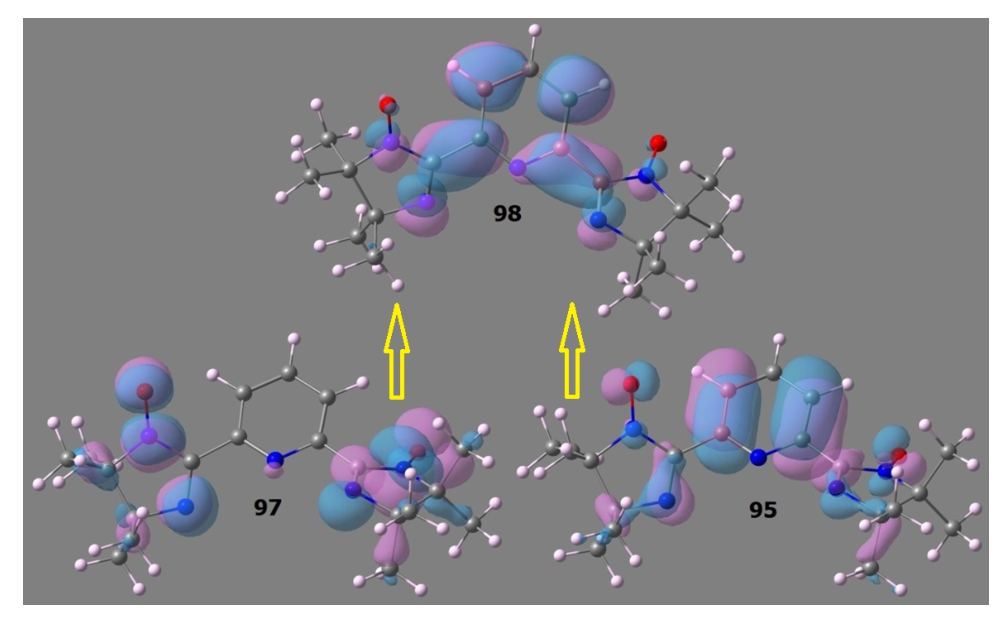
For bisimpy, the frontier molecular orbitals are MOs 96 and 97 (Figure 3). The intense line 10 corresponds to the transition between MOs 97→98, which is responsible for electron transfer from the NN radicals to the pyridine fragment of the biradical molecule. The other intense line 14 corresponds to the transition 95→98.
2.3.2. Spectral Study of [RuCI3(PhCN)3]
The UV-vis absorption spectrum of [RuCl3(PhCN)3] in CH2Cl2 calculated by the TD-DFT method is presented in Figure 5. The Ru(III) ion in [RuCl3(PhCN)3] adopts a d⁵ configuration with one unpaired electron, while the ligand environment remains diamagnetic. The corresponding singly occupied molecular orbital (SOMO) of the unpaired electron is MO 129 (Figure 6). Among the calculated transitions, three are the most intensive and have numbers 22, 72, and 81. The least intense of them, long-wavelength transition 22 (MOs 128 → 134), involves electron transfer from a hybrid 4p orbital of ruthenium to the π system delocalized over all three benzonitrile ligands, giving it a clear metal-to-ligand (MLCT) character. The most intensive transition 72 (MOs 125 → 130) has a significant metal-ligand transfer contribution and can be also referred to MLCT. Finally, the third transition, 81 (MOs 122 → 129), arises almost exclusively from excitation within the π system of the central benzonitrile ligand. The corresponding molecular orbitals involved to the transitions are shown in Figure 7.
It should be noted that in the TD-DFT calculations of [RuCl₃(PhCN)₃] we did not include spin-orbit interactions assuming the electron orbital angular momentum of the 4d5 Ru(III) ion to be frozen due to the low C2v symmetry of the studied complex. According to Figure 5, this approximation sufficiently accurately captures the qualitative features of the experimental absorption spectrum. The long-wavelength band of the spectrum corresponds to MLCT transitions, while the short-wavelength one primarily corresponds to LMCT transitions.
2.3.3. Spectral Study of [Ru(bisimpy)(PhCN)Cl₂]
The experimental UV-vis spectrum of [Ru(bisimpy)(PhCN)Cl2] in CH2Cl2 (Figure 8) shows intense ligand-centered bands in the UV region (< 300 nm) and a broad band in the near-IR region (700–1000 nm), which is absent in the free biradical. The TD-DFT calculation reproduces the experimental spectrum well, with a systematic blue shift of all bands due to limitations of the TD-DFT method. Since the [Ru(bisimpy)(PhCN)Cl2] complex is a biradical, its absorption spectrum contains two components: absorption from the singlet spin state Abs(S) and absorption from the triplet spin state Abs(T). Both contributions were calculated, and then the total absorption spectrum Abs(tot) was obtained as Boltzmann weighting of Abs(S) and Abs(T) components: Abs(tot) = w(S)Abs(S) + w(T)Abs(T), where w(S) = 1/(1+3exp(2J/kBT)) is the Boltzmann probability of singlet state for [Ru(bisimpy) (PhCN)Cl2], w(T) = 1 − w(S) is the corresponding probability of the triplet state and J is the magnetic exchange integral in the complex. It was found that the best range for J to approximate the experimental data with these two contributions is J = –100 ± 20 cm–1. The calculated value of J, obtained independently with the BS-DFT method employing various functionals, is presented in Section 2.4. Next, the most important spectral components for the complex under study are described, using the symbol “s” for singlet lines and “t” for triplet lines. The low-energy band at ~900 nm is assigned to the HOMO → LUMO transition (3s, 148 → 149) with significant LMCT character. The 400–500 nm region contains contributions from LLCT (7s) and MLCT (7t) transitions. The intense band near 300 nm arises from MLCT transitions (29t, 18s, 25t). The MOs corresponding to the transitions in Figure 9 are shown in Figure 10.
The calculated spectrum of the benzonitrile derivative reproduces the main features of the experimental curve, including the intense 3s band near 900 nm, the series of bands in the 400–500 nm region, and the strong UV absorption below 400 nm. At the same time, it shows a systematic blue shift of all bands typical for the TD-DFT method. The small shoulders observed in the experimental spectrum at about 900 and 500 nm are not reproduced by the benzonitrile complex alone. They are, however, well described by a contribution from the calculated spectrum of [Ru(bisimpy)(H2O)Cl2] (dashed line in Figure8), which suggests partial hydrolysis of the starting complex in solution. The superposition of the two calculated spectra in the appropriate ratio should reproduce the experimental spectrum reasonably well, although with a small shift. This indicates that the experimental spectrum is well described as a weighted sum of the spectra of the PhCN and H2O derivatives, rather than by either of them alone.
2.4. Calculation of the Exchange Integrals for [Ru(bisimpy)(PhCN)Cl2] and Bisimpy
The Ru²⁺ in [Ru(bisimpy)(PhCN)Cl2] has a d⁶ electron configuration, and is therefore diamagnetic. The BS-DFT computed magnetic exchange interaction between the unpaired electrons in the coordinated bisimpy, using the Hamiltonian H = −2J·S₁S₂, is given in Table 1. For comparison, the same values J calculated for isolated bisimpy in CH2Cl2 is given in Table 2.
Table 1 clearly demonstrates that the range-separated ωB97m-D4 functional yields the closest value for the magnetic exchange integral J in [Ru(bisimpy)(PhCN)Cl₂] complex, obtained from fitting the experimental absorption spectrum data: J = –100 ± 20 cm–1.
2.5. What the Present Complex [Ru(bisimpy)(PhCN)Cl2] Adds to Ruthenium–Radical Systems
The results presented above can be compared with those reported for related Ru–non-innocent and Ru–radical systems. Three aspects are considered: the preservation of the radical character upon coordination, the nature of the low-energy transitions, and the metal-mediated exchange.
The first aspect concerns the preservation of the radical character. In [Ru(bisimpy)(PhCN)Cl2], the N–O bond length of 1.272(2) Å is typical for a neutral nitroxide radical and is essentially unchanged from the free bisimpy (1.256–1.263 Å) [22] and the C8–N3 and N2–C8 bond lengths (1.343(3) and 1.345(3) Å) indicate delocalization of spin density over the N=C–N–O fragments. This behavior differs from that of the 1,2-diaminoanthraquinone complexes, where the stable form under ordinary conditions is the closed-shell quinone, and the radical form is isolable only with stabilizing CO/PPh3 coligands or generated electrochemically [3]. It also differs from the o-dioxolene complexes, where the neutral species are best described as Ru(III) with a semiquinone radical ligand, and the ligand radical is generated during the reaction or electrochemically [2]. In the mononuclear complexes, the radical is directly coordinated to Ru, and the metal–radical interaction is controlled by the ancillary coligands [20]. a stable radical is already present in the isolated complex, but the radical center is directly coordinated to the metal and verdazyl is a monoradical [20]. In the binuclear verdazyl-bridged Ru2 complexes, the radical bridge is also directly coordinated to the two metals, and the mixed-valent state is accessed through a reduced verdazyl bridge [21]. In the nitrosyl-ruthenium complex Na[RuNOCl4NN], the nitroxide is coordinated through the pyridine nitrogens and the N–O• centers remain free, but the complex is a monoradical [10]. In the present case, a stable biradical coordinates to Ru(II) through the pyridine and imine nitrogens, both N–O• centers remain uncoordinated.
The second aspect concerns the nature of the low-energy transitions. In the o-dioxolene complexes, the low-energy bands at 797 and 576 nm were assigned, with the help of TD-DFT, as mixed MLCT/intra-quinone and LMCT transitions [2]. In the quinone-bridged Ru2 systems, the one-electron-oxidized forms show strong NIR absorptions with class-III mixed valence, while the reduced forms show LLCT bands in the NIR [4]. In the verdazyl complexes, the low-energy bands are mainly Ru(dπ)→verdazyl(π*) MLCT, and the NPA spin density on Ru is 0.39 for the acac derivative and 0.11 for the hfac derivative [20]. In our complex the 3s band at ~900 nm is assigned as HOMO→LUMO with significant LMCT character, and the 7s and 7t bands at 400–500 nm as LLCT and MLCT, respectively. Thus, the low-energy absorption of [Ru(bisimpy)(PhCN)Cl2] is neither a pure MLCT nor a pure ligand-centered transition, but a composite of LMCT, LLCT and MLCT character, which is consistent with the strong mixing of Ru 4d and N=C–N–O π orbitals revealed by TD-DFT. This composite character is similar to that reported for Ru–dioxolene and Ru–verdazyl systems, but in our case it arises from a neutral biradical coordinated to a diamagnetic Ru(II)-center, rather than from a radical generated electrochemically or from a directly coordinated monoradical.
The third aspect concerns the metal-mediated exchange. In the free biradical bisimpy, the exchange is weakly ferromagnetic, 2JR–R = 4.9 cm–1 [22], and the BS-DFT values for the free ligand in Table 2 (4.0–9.5 cm–1) are consistent with this. In the mononuclear verdazyl complexes, the radical is directly coordinated to Ru, and the metal–radical interaction is controlled by the ancillary coligands [20]. In the binuclear verdazyl-bridged ruthenium complexes, the acac derivative is a mixed-valent Ru(II)/Ru(III) species with a reduced verdazyl bridge, and the mono-cation is a broken-symmetry [RuIII–Vd(–1)–RuIII] biradical with a calculated J = –218 cm–1 [21]. In the mono-NN adduct [Ru2(Piv)4(PhNN)(H2O)]BF4, the Ru–radical coupling is antiferromagnetic, JRu–ON = –45 cm–1 [14], and in [Ru2(Piv)4(PhNN)]n(BF4)n the coupling through the nitroxide group is antiferromagnetic, JRu–R = –100 cm–1 [16]. Against this background, the J ≈ –150 to –250 cm–1 computed for [Ru(bisimpy)(PhCN)Cl2] is remarkable since in this complex the metal is diamagnetic, yet the exchange coupling between the two radical fragments is as strong as in systems where the coupling is carried by paramagnetic metal centers or by a reduced bridging radical. The magnitude is comparable to the coupling in the mono-cation of the verdazyl-bridged complex, [RuIII–Vd(–1)–RuIII]– (J = –218 cm–1). However, the two systems achieve this coupling through different mechanisms. In the verdazyl-bridged complex, the two paramagnetic Ru(III) are coupled through the filled orbitals of the reduced verdazyl bridge, which acts as a diamagnetic mediator between them. In our complex, the roles are inverted: the two radical centers are on the ligand and the imine nitrogen atoms of the N=C–N–O• fragments are coordinated to Ru and carry part of the spin density. It is the filled 4d orbitals of the diamagnetic metal center that provide the exchange pathway between the two fragments. In both cases, the exchange is mediated by a diamagnetic, closed-shell fragment, but the nature of that fragment and the location of the radical centers are opposite.
Taken together, these comparisons show that [Ru(bisimpy)(PhCN)Cl2] combines three features that have not been reported together in a single Ru complex: a stable neutral biradical that retains its radical character upon coordination without electrochemical generation; low-energy transitions of composite LMCT/LLCT/MLCT character; and a strong antiferromagnetic inter-radical exchange mediated by a diamagnetic 4d metal. These features make the present complex a benchmark for the design of related Ru–biradical systems.
3. Materials and Methods
3.1. Instrumental and Physical Measurements
Elemental (C,H,N) analysis was performed on a Euro-Vector 3000 analyzer (Eurovector, Redavalle, Italy). FTIR spectra were registered with a NICOLET spectrophotometer (Thermo Electron Scientific Instruments LLC, Madison, WI, USA) in the 4000–400 cm–1 range. Single-crystal XRD experimental details are presented in Table S1 (SI). Crystallographic data were deposited with the Cambridge Crystallographic Data Centre (deposit number CCDC 2589239).
3.2. Theoretical Calculations
All quantum-chemical calculations were performed using the ORCA 6.1 software package [23]. All molecular structures considered in this work were first geometry-optimized by DFT at the B3LYP/def2-TZVP level of theory, taking solvation effects into account within the CPCM (Conductor-like Polarizable Continuum Model) [24]. In all DFT calculations, the def2-TZVP basis set was used, while the def2-QZVPP basis set was chosen for ruthenium. Magnetic exchange integrals and excited states were calculated by BS-DFT and TD-DFT, respectively. In the TD-DFT calculations, the range-separated wB97m-D4 functional was used, since among the functionals listed in Table 1 it provided the best agreement with the experimental UV-vis(-NIR) absorption spectra. All absorption data were calculated in the electric-dipole approximation with a broadening of w = 4000–4500 cm⁻¹ applied to all spectral lines, the broadening value being chosen so as to bring the shape of the calculated spectrum as close as possible to the experimental data.
3.3. Preparations
Solvents of the reagent grade (EKOS-1, Moscow, Russia) were distilled prior to use. The complex was synthesized under ambient conditions. The starting complex, [RuCI3(PhCN)3], was obtained according to the procedure published in [32]. The biradical, 2,6-bis(1-oxyl-4,4,5,5-tetramethyl-4,5-dihydro-1-H-imidazol-2-yl)pyridine was synthesized according to a literature procedure [25] adapted from [33].
3.3.1. Synthesis of [Ru(bisimpy)(PhCN)Cl2]
To an orange solution of [RuCl3(PhCN)3] (40 mg, 0.077 mmol) in CH2Cl2 (5 mL) was added solid biradical bisimpy (30 mg, 0.084 mmol, orange). The mixture was stirred and heated to gentle reflux, during which the reddish-brown reaction mixture gradually darkened. After refluxing for 10 min, the solution was cooled to room temperature and filtered. Hexane (2.5 mL) was carefully layered onto the filtrate. After two days, dark crystals suitable for X-ray diffraction were formed, which were filtered off and dried in air. Anal Calcd. for C26H32Cl2N6O2Ru (M = 632.55 g/mol): C, 49.37; H, 5.10; N, 13.29%. Found: C, 49.44; H, 5.00; N 13.33%. IR spectrum (KBr, ν, cm−1): 3440, 3065, 3025, 2970, 2930, 2865, 2248, 1600, 1530, 1478, 1452, 1414, 1380, 1348, 1320, 1290, 1262, 1225, 1076, 766, 428, 419 cm⁻¹
4. Conclusions and Perspectives
Our initial attempt to prepare a Ru(III) complex of the tridentate iminonitroxide biradical bisimpy from [RuCl3(PhCN)3] in CH2Cl2 instead yielded the Ru(II) complex [Ru(bisimpy)(PhCN)Cl2]. The reduction of Ru(III) to Ru(II) is attributed to the well-known ability of nitroxide radicals to disproportionate under mild conditions, with the metal acting as a stoichiometric oxidant rather than a catalyst. Single-crystal X-ray diffraction confirms tridentate coordination of bisimpy to a centrosymmetric Ru(II) ion, with the two iminonitroxide fragments rendered equivalent. While the free biradical was studied by UV-vis absorption spectroscopy, the Ru(II) complex required UV-vis-NIR measurements, which revealed intense ligand-centered bands in the UV region and MLCT bands in the near-IR region absent in the free biradical. TD-DFT calculations reproduce the experimental spectrum and assign the key features to metal-to-ligand and mixed ligand-ligand/metal-ligand bands; the small shoulders at ~500 and ~900 nm are attributed to partial hydrolysis of the complex to [Ru(bisimpy)(H2O)Cl2]. Most importantly, BS-DFT calculations predict a dramatic change in the intramolecular exchange between the two radical centers: whereas the free biradical is weakly ferromagnetic (J ≈ +4.9 cm–1), coordination to the diamagnetic Ru(II) center switches the magnetic coupling to strongly antiferromagnetic (J ≈ −150...−250 cm–1) due to a metal-mediated superexchange pathway involving intermediate 4d orbitals of Ru(II). These results demonstrate that a formally diamagnetic d6 metal does actively modulate radical-radical magnetic communication. They also highlight the importance of redox processes between nitroxide radicals and 4d metal precursors in directing the outcome of complexation reactions.
Finally, although the targeted Ru(III) complex was not obtained in this work, this does not preclude its formation under different conditions. The reduction of Ru(III) to Ru(II) observed here reflects the solution chemistry of the reaction rather than an intrinsic limitation of the coordination sphere: the disproportionation of the biradical occurs before coordination and depends on the solvent, counterion, order of mixing, and traces of water. Predictive ab initio calculations are currently in progress, starting with the free paramagnetic ligand and then extending to its coordination compounds. In particular, computations on hypothetical [Ru(bisimpy)Cl3] are already underway. These calculations are ongoing and will be reported separately. They will be continued and extended to a series of related derivatives in order to identify the structural and electronic factors that govern the sign and magnitude of the radical-radical exchange in both free ligands and their metal complexes.
From a synthetic perspective, this opens the possibility of designing a family of related biradicals, as well as coordination compounds based on them, in which the magnetic and optical properties are tuned in a predictable way. Since the pyridine ring of bisimpy is part of the conjugated bridge that mediates the radical-radical exchange, introducing substituents at this ring should modulate the electronic structure of the bridge and, consequently, the sign and magnitude ofJ. The choice of substituents can also affect the coordination ability of the ligand, its solubility, and the crystal packing of the final complex, all of which are known to influence magnetic behavior in the solid state. The reliability of modern computational methods for such comparative predictions is already sufficient to guide the synthesis: DFT and BS-DFT calculations can rank a series of candidate substituents by their expected effect on J, allowing the most promising derivatives to be selected before any synthetic effort is made. Absolute predictions of J for systems with more than two paramagnetic centers remain challenging and require multiconfigurational ab initio methods, but for the two-center radical-radical exchange considered here, the computational approach is both practical and informative.
Supplementary Materials
The following supporting information can be downloaded at the website of this paper posted on Preprints.org, Figure S1: FT-IR spectra of the free bisimpy ligand and [Ru(bisimpy)(PhCN)Cl2]; Figure S2: Molecular structure of [Ru(bisimpy)(PhCN)Cl2], benzonitrile, dichloro [2,6-bis(1-oxyl-4,4,5,5-tetramethyl-4,5-dihydro-1H-imidazol-2-yl)pyridine-κ3N,N′,N″]ruthenium(II); Table S1: Crystal data and structure refinement for complex 1; Table S2: Coordination bond lengths (Å) and angles (°) for [Ru(bisimpy)(PhCN)Cl2].
Author Contributions
Conceptualization, K.E.V. and V.A.M; methodology, K.E.V.; software, X.X.; validation, X.X., Y.Y. and Z.Z.; formal analysis, X.X.; investigation, K.E.V. and Ph.R.; resources, V.A.M and K.E.V.; data curation, X.X.; writing—original draft preparation, V.A.M and K.E.V.; writing—review and editing, V.A.M and K.E.V.; visualization, Ph.R.; supervision, K.E.V.;. All authors have read and agreed to the published version of the manuscript.
Funding
The work was supported by the Ministry of Science and Higher Education of the Russian Federation.
Data Availability Statement
CCDC 2589239 entry contains the supplementary crystallographic data for this paper. This original data presented in the study are openly available in The Cambridge Crystallographic Data Center at https://www.ccdc.cam.ac.uk/structures/2451012. The original contributions presented in this study are included in the article/Supplementary Materials. Further inquiries can be directed to the corresponding author.
Conflicts of Interest
The authors declare no conflicts of interest.
References
- Lever, A.B.P.; Gorelsky, S.I. Ruthenium Complexes of Non-Innocent Ligands: Aspects of Charge Transfer Spectroscopy 2004, 77–114.
- Das, D.; Sarkar, B.; Kumbhakar, D.; Mondal, T.K.; Mobin, S.M.; Fiedler, J.; Urbanos, F.A.; Jiménez-Aparicio, R.; Kaim, W.; Lahiri, G.K. Bis(Acetylacetonato)Ruthenium Complexes of Noninnocent 1,2-Dioxolene Ligands: Qualitatively Different Bonding in Relation to Monoimino and Diimino Analogues. Chem.—A Eur. J. 2011, 17, 11030–11040. [Google Scholar] [CrossRef]
- Maji, K.; Ghosh, S.; Sett, S.; Saha, P.; Laha, P.; Ghosh, P. 1,2-Diimino-9,10-Anthraquinone-Semiquinonate Anion and 1-Aminyl-2-Amino-9,10-Anthraquinone π-Radical Complexes of Ruthenium and Osmium: An Account of Electronic Structures. Inorg. Chem. 2026, 65, 4980–4996. [Google Scholar] [CrossRef]
- Das, H.S.; Schweinfurth, D.; Fiedler, J.; Khusniyarov, M.M.; Mobin, S.M.; Sarkar, B. Tuning the Electronic Properties in Ruthenium–Quinone Complexes through Metal Coordination and Substitution at the Bridge. Chem.—A Eur. J. 2014, 20, 4334–4346. [Google Scholar] [CrossRef]
- Kaim, W.; Das, A.; Fiedler, J.; Záliš, S.; Sarkar, B. NO and NO2 as Non-Innocent Ligands: A Comparison. Coord. Chem. Rev. 2020, 404, 213114. [Google Scholar] [CrossRef]
- Kobayashi, K.; Ohtsu, H.; Wada, T.; Kato, T.; Tanaka, K. Characterization of a Stable Ruthenium Complex with an Oxyl Radical. J. Am. Chem. Soc. 2003, 125, 6729–6739. [Google Scholar] [CrossRef]
- Pointillart, F.; Bernot, K.; Sorace, L.; Sessoli, R.; Gatteschi, D. Ferromagnetic Interactions in Ru(III)–Nitronyl Nitroxide Radical Complex: A Potential 2p4d Building Block for Molecular Magnets. Dalt. Trans. 2007, 2689–2695. [Google Scholar] [CrossRef]
- Pointillart, F.; Bernot, K.; Colas, J.; Sorace, L.; Sessoli, R. Rational Enhancement of the Coordination Capability of Ru(III)(Salen)-Nitronyl Nitroxide Building Block: A Step towards 2p–3d–4d Magnetic Edifices. Inorganica Chim. Acta 2008, 361, 3427–3431. [Google Scholar] [CrossRef]
- Sporer, C.; Heise, H.; Wurst, K.; Ruiz-Molina, D.; Kopacka, H.; Jaitner, P.; Köhler, F.; Novoa, J.J.; Veciana, J. Magneto-Structural Characterization of Metallocene-Bridged Nitronyl Nitroxide Diradicals by X-Ray, Magnetic Measurements, Solid-state NMR Spectroscopy, and Ab Initio Calculations. Chem.—A Eur. J. 2004, 10, 1355–1365. [Google Scholar] [CrossRef]
- Kostin, G.A.; Tolstikov, S.E.; Kuratieva, N. V.; Nadolinny, V.A.; Ovcharenko, V.I. First Example of Ruthenium Nitroso Complexes with a Nitroxyl Radical as a Ligand. J. Struct. Chem. 2023, 64, 169–178. [Google Scholar] [CrossRef]
- Kostin, G.A.; Kozlov, R.; Bogomyakov, A.; Tolstikov, S.; Sheven, D.; Korenev, S. New Ruthenium Nitrosyl Complexes Combining Potentially Photoactive Nitrosyl Group with the Magnetic Nitroxide Radicals as Ligands. Int. J. Mol. Sci. 2023, 24, 13371. [Google Scholar] [CrossRef]
- Seyler, J.W.; Fanwick, P.E.; Leidner, C.R. The Chemistry of Methyl(Octaethylporphyrinato)Ruthenium. A Methyl to Carbon Monoxide Transformation. Inorg. Chem. 1992, 31, 3699–3700. [Google Scholar] [CrossRef]
- Sayama, Y.; Handa, M.; Mikuriya, M.; Hiromitsu, I.; Kasuga, K. Syntheses and Magnetic Properties of Ruthenium(II,III) Pivalate Dimers Axially Coordinated by Nitronyl Nitroxide Radicals [Ru2(O2CCMe3)4(L)2]BF4 and [{Ru2(O2CCMe3)4(L)2}{Ru2(O2CCMe3)4(H2O)2}]n(BF4)2n, L = 2,4,4,5,5-Pentamethyl-4,5-Dihydro-1-H-Imidazol. Bull. Chem. Soc. Jpn. 2003, 76, 769–779. [Google Scholar] [CrossRef]
- Sayama, Y.; Handa, M.; Mikuriya, M.; Hiromitsu, I.; Kasuga, K. Structure and Magnetic Property of Ru(II,III) Dimer Axially Coordinated by the Niroxide Radical and Water [Ru2(O2CCMe3)4(Nitph)(H2O)]BF4, Nitph = 2-Phenyl-4,4,5,5-Tetramethyl-4,5-Dihydro-1-H-Imidazolyl-1-Oxyl3-N-Oxide. Bull. Chem. Soc. Jpn. 2001, 74, 2129–2130. [Google Scholar] [CrossRef]
- Handa, M.; Sayama, Y.; Mikuriya, M.; Nukada, R.; Hiromitsu, I.; Kasuga, K. A Chain Complex of Ruthenium(II,III) Cation Dimer Linked by a Nitroxide Radical, [Ru2(O2CCMe3)4(NITPh)n(BF4)n (NITPh = 2-Phenyl-4,4,5,5-Tetramethyl-4,5-Dihydro-1-H-Imidazolyl-1-Oxy-3-Oxide). Chem. Lett. 1996, 25, 201–202. [Google Scholar] [CrossRef]
- Handa, M.; Sayama, Y.; Mikuriya, M.; Nukada, R.; Hiromitsu, I.; Kasuga, K. Structure and Magnetic Properties of a Chain Complex with Alternating Ru(II,III) Dimer and Nitroxide Radical Arrangement [Ru2(O2CCMe3)4(Nitph)]n(BF4)n, Nitph = 2-Phenyl-4,4,5,5-Tetramethyl-4,5-Dihydro-1H-Imidazol-1-Oxyl3-N-Oxide. Bull. Chem. Soc. Jpn. 1998, 71, 119–125. [Google Scholar] [CrossRef]
- Cogne, A.; Belorizky, E.; Laugier, J.; Rey, P. Nitroxide Complexes of Diruthenium(II,II) Carboxylates. Structural and Magnetic Properties. Inorg. Chem. 1994, 33, 3364–3369. [Google Scholar] [CrossRef]
- Mikuriya, M.; Tanaka, K.; Handa, M.; Hiromitsu, I.; Yoshioka, D.; Luneau, D. Adduct Complexes of Ruthenium(II,III) Propionate Dimer with Pyridyl Nitroxides. Polyhedron 2005, 24, 2658–2664. [Google Scholar] [CrossRef]
- Brook, D.J.R. Coordination Chemistry of Verdazyl Radicals. Comments Inorg. Chem. 2015, 35, 1–17. [Google Scholar] [CrossRef]
- McKinnon, S.D.J.; Patrick, B.O.; Lever, A.B.P.; Hicks, R.G. Verdazyl Radicals as Redox-Active, Non-Innocent, Ligands: Contrasting Electronic Structures as a Function of Electron-Poor and Electron-Rich Ruthenium Bis(β-Diketonate) Co-Ligands. Chem. Commun. 2010, 46, 773–775. [Google Scholar] [CrossRef]
- McKinnon, S.D.J.; Patrick, B.O.; Lever, A.B.P.; Hicks, R.G. Binuclear Ruthenium Complexes of a Neutral Radical Bridging Ligand. A New “Spin” on Mixed Valency. Inorg. Chem. 2013, 52, 8053–8066. [Google Scholar] [CrossRef]
- Hayakawa, K.; Shiomi, D.; Ise, T.; Sato, K.; Takui, T. Stable Iminonitroxide Biradical in the Triplet Ground State. Chem. Lett. 2004, 33, 1494–1495. [Google Scholar] [CrossRef]
- Ikoma, T.; Oshio, H.; Yamamoto, M.; Ohba, Y.; Nihei, M. Peculiarity in the Electronic Structure of Cu(II) Complex Ferromagnetically Coupled with Bisimino Nitroxides. J. Phys. Chem. A 2008, 112, 8641–8648. [Google Scholar] [CrossRef]
- Oshio, H.; Yamamoto, M.; Ito, T.; Kawauchi, H.; Koga, N.; Ikoma, T.; Tero-Kubota, S. Experimental and Theoretical Studies on Ferromagnetically Coupled Metal Complexes with Imino Nitroxides. Inorg. Chem. 2001, 40, 5518–5525. [Google Scholar] [CrossRef]
- Babailov, S.P.; Peresypkina, E. V.; Journaux, Y.; Vostrikova, K.E. Nickel(II) Complex of a Biradical: Structure, Magnetic Properties, High NMR Temperature Sensitivity and Moderately Fast Molecular Dynamics. Sens. Actuators B Chem. 2017, 239, 405–412. [Google Scholar] [CrossRef]
- Mitsumoto, K.; Shiga, T.; Nakano, M.; Nihei, M.; Nishikawa, H.; Oshio, H. Spin Canting in a Cobalt(II) Radical Complex with an Acentric Counter Anion. Eur. J. Inorg. Chem. 2008, 2008, 4851–4855. [Google Scholar] [CrossRef]
- Zhou, S.Y.; Li, T.; Li, X.; Sun, Y.Q.; Wang, Q.L.; Liao, D.Z.; Tian, L. Syntheses, Structures, and Magnetic Characterizations of Five Mn(II) and Co(II) Complexes Based on 2,6-Pyridyl-Substituted Nitronyl and Imino Nitroxide Radical. Inorganica Chim. Acta 2016, 444, 131–140. [Google Scholar] [CrossRef]
- Sen’, V.D.; Tikhonov, I. V.; Borodin, L.I.; Pliss, E.M.; Golubev, V.A.; Syroeshkin, M.A.; Rusakov, A.I. Kinetics and Thermodynamics of Reversible Disproportionation–Comproportionation in Redox Triad Oxoammonium Cations—Nitroxyl Radicals—Hydroxylamines. J. Phys. Org. Chem. 2015, 28, 17–24. [Google Scholar] [CrossRef]
- Rozantsev, E.G.; Sholle, V.D. Progress in the Chemistry of Nitroxyl Radicals. Russ. Chem. Rev. 1971, 40, 233–246. [Google Scholar] [CrossRef]
- Likhtenshtein, G.I. Nitroxides; Springer Series in Materials Science; Springer International Publishing: Cham, 2020; Vol. 292, ISBN 978-3-030-34821-2. [Google Scholar]
- del Rı́o, I.; Back, S.; Hannu, M.S.; Rheinwald, G.; Lang, H.; van Koten, G. Reactivity of the Binuclear Ruthenium ‘Pincer’ Complex [{RuCl2(H3-NN′N)}2(μ-N2)] towards N-Donor Ligands. The X-Ray Crystal Structure of [RuCl2(H3-NN′N)(NCPh)] (NN′N=2,6-Bis[(Dimethylamino)Methyl]Pyridine). Inorganica Chim. Acta 2000, 300–302, 1094–1098. [Google Scholar] [CrossRef]
- Duff, C.M.; Heath, G.A.; Willis, A.C. Structural Characterization of the RuIII Benzonitrile Complexes (Bu4N)[RuCl4(C6H5CN)2] and [RuCl3(C6H5CN)3]. Acta Crystallogr. Sect. C Cryst. Struct. Commun. 1990, 46, 2320–2324. [Google Scholar] [CrossRef]
- Ulrich, G.; Ziessel, R. Selective Synthesis of a Novel Family of Oligopyridine Based Imino-Nitroxide Biradicals Catalysed by Selenium Dioxide. Tetrahedron Lett. 1994, 35, 1215–1218. [Google Scholar] [CrossRef]
Scheme 1.
[2,6-bis(1-oxyl-4,4,5,5-tetramethyl-4,5-dihydro-1-H-imidazol-2-yl)pyridine—tridentate imino-nitroxide biradical ligand.
Scheme 1.
[2,6-bis(1-oxyl-4,4,5,5-tetramethyl-4,5-dihydro-1-H-imidazol-2-yl)pyridine—tridentate imino-nitroxide biradical ligand.
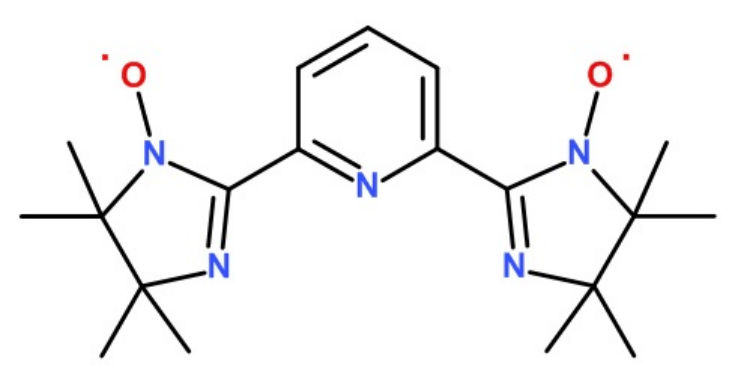
Figure 1.
Molecular structure of [Ru(bisimpy)(PhCN)Cl2], benzonitrile, dichloro-[2,6-bis(1-oxyl- 4,4,5,5-tetramethyl-4,5-dihydro-1H-imidazol-2-yl)pyridine-κ3N,N’,N″]ruthenium(II). Hydrogen atoms omitted; the second half of the molecule is generated by the symmetry operation (i) –x, y, –z+1/2.
Figure 1.
Molecular structure of [Ru(bisimpy)(PhCN)Cl2], benzonitrile, dichloro-[2,6-bis(1-oxyl- 4,4,5,5-tetramethyl-4,5-dihydro-1H-imidazol-2-yl)pyridine-κ3N,N’,N″]ruthenium(II). Hydrogen atoms omitted; the second half of the molecule is generated by the symmetry operation (i) –x, y, –z+1/2.
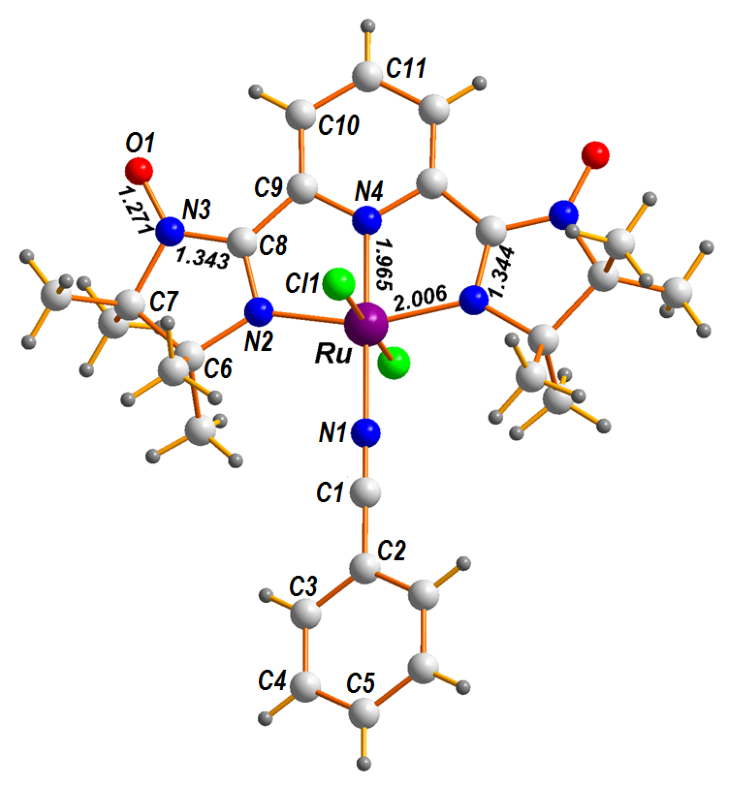
Figure 2.
Absorption spectrum of bisimpy (blue) and its TD-DFT calculation (orange). Spectral line positions are shown in black; given near the most intense calculated lines numbers of the corresponding transitions (14 and 10) are depicted in Figure 3. Transitions corresponding to the most intense lines in the absorption spectrum of bisimpy involving orbitals 95–98.
Figure 2.
Absorption spectrum of bisimpy (blue) and its TD-DFT calculation (orange). Spectral line positions are shown in black; given near the most intense calculated lines numbers of the corresponding transitions (14 and 10) are depicted in Figure 3. Transitions corresponding to the most intense lines in the absorption spectrum of bisimpy involving orbitals 95–98.
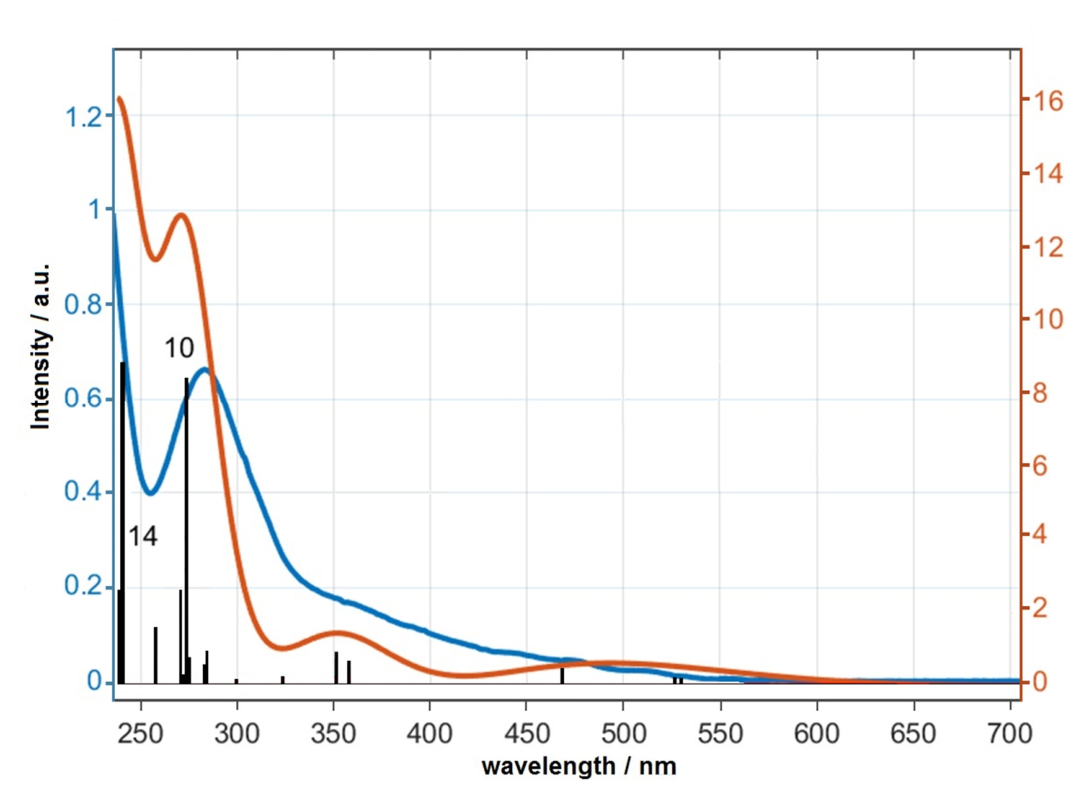
Figure 3.
Transitions 10 (97 → 98) and 14 (95 → 98) corresponding to the most intense lines in the absorption spectrum of bisimpy.
Figure 3.
Transitions 10 (97 → 98) and 14 (95 → 98) corresponding to the most intense lines in the absorption spectrum of bisimpy.
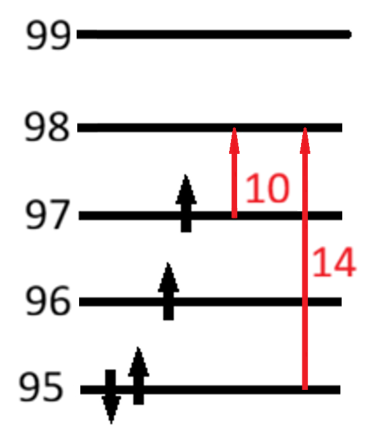
Figure 5.
UV-vis absorption spectrum of the [RuCl3(PhCN)3] complex (blue line) and its TD-DFT calculation (orange line). The positions of the spectral lines are shown in black. Numbers of the most intense lines corresponding to transitions 81, 72, and 22 are indicated.
Figure 5.
UV-vis absorption spectrum of the [RuCl3(PhCN)3] complex (blue line) and its TD-DFT calculation (orange line). The positions of the spectral lines are shown in black. Numbers of the most intense lines corresponding to transitions 81, 72, and 22 are indicated.
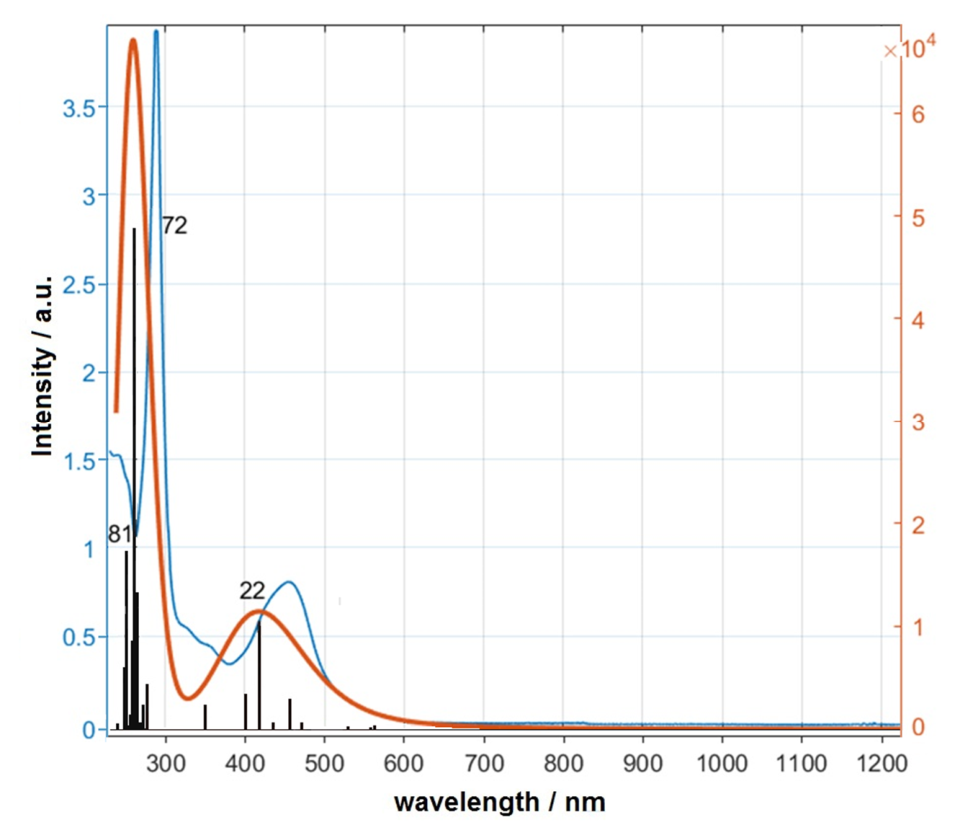
Figure 6.
Transitions corresponding to the most intense lines in the UV-vis absorption spectrum of [RuCl3(PhCN)3]. The digits near the transitions (red arrows ) refer to the numbering of the spectral lines in Figure 5. MOs 122–134 are shown, along with the transitions 22 (128 → 134), 72 (125 → 130), and 81 (122 → 129).
Figure 6.
Transitions corresponding to the most intense lines in the UV-vis absorption spectrum of [RuCl3(PhCN)3]. The digits near the transitions (red arrows ) refer to the numbering of the spectral lines in Figure 5. MOs 122–134 are shown, along with the transitions 22 (128 → 134), 72 (125 → 130), and 81 (122 → 129).
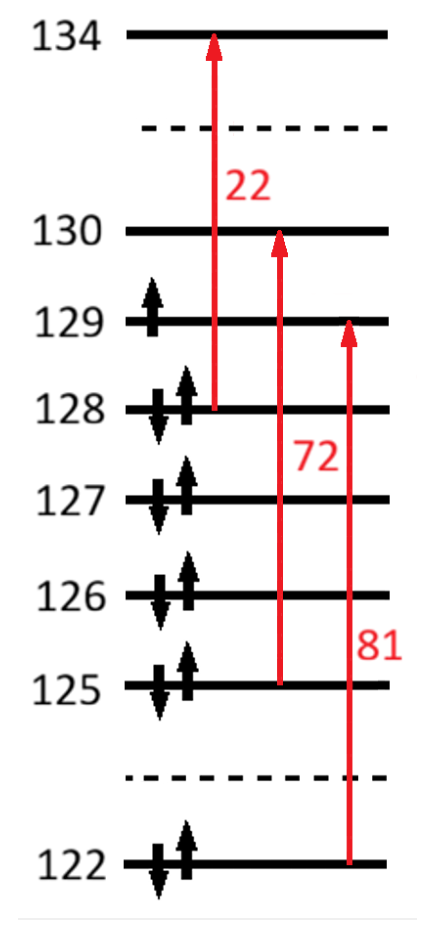
Figure 7.
Initial and final MOs for depicted in Figure 6 the transitions contributing to the UV-vis absorption spectrum of [RuCl3(PhCN)3] presented in Figure 5. The surfaces correspond to an isovalue of r = 0.03.
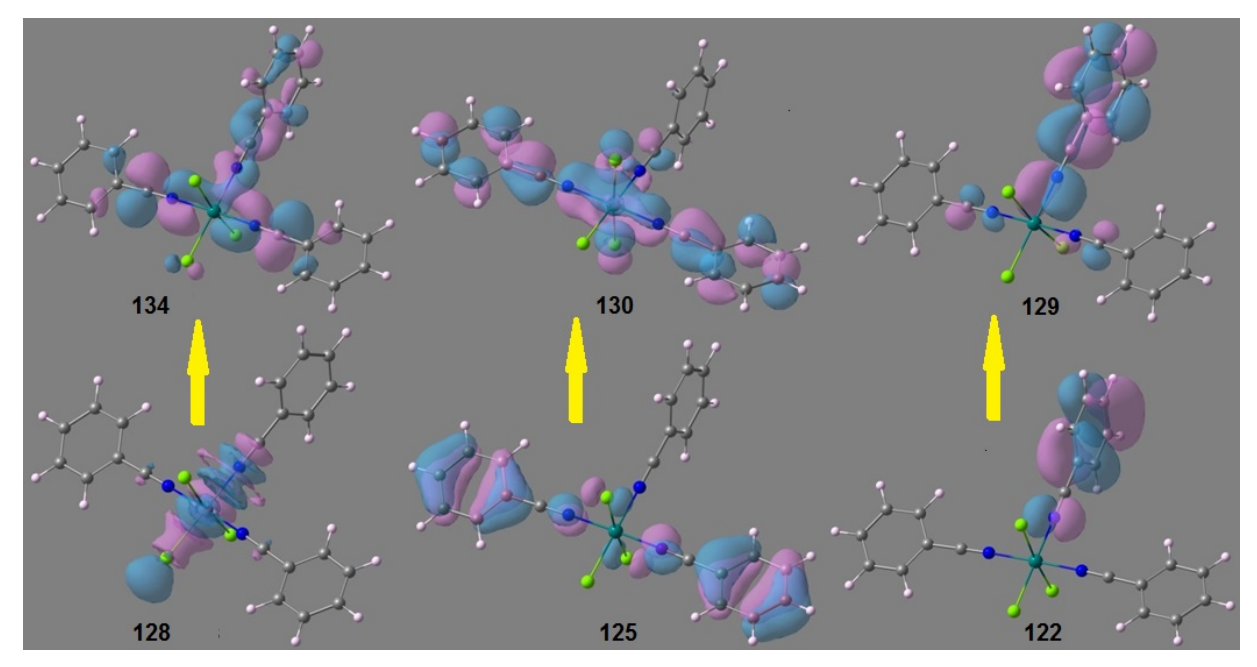
Figure 8.
UV-vis-NIR absorption spectrum of [Ru(bisimpy)(PhCN)Cl2] (blue line) and its TD-DFT calculation (orange line). The dashed line is the absorption spectrum of the [Ru(bisimpy)(H2O)Cl2] complex, in which the benzonitrile ligand is replaced by an H2O molecule. The positions of the spectral lines are shown in black. The numbers and types of the corresponding transitions (singlet (s) or triplet (t)) are indicated near the most intense lines. Selected transitions 35s, 47t, 25s, 29t, 18s, 25t, 7s, 7t, 5t, 4s, 1t, and 3s corresponding to the most important singlet and triplet spectral lines are shown in Figure 9.
Figure 8.
UV-vis-NIR absorption spectrum of [Ru(bisimpy)(PhCN)Cl2] (blue line) and its TD-DFT calculation (orange line). The dashed line is the absorption spectrum of the [Ru(bisimpy)(H2O)Cl2] complex, in which the benzonitrile ligand is replaced by an H2O molecule. The positions of the spectral lines are shown in black. The numbers and types of the corresponding transitions (singlet (s) or triplet (t)) are indicated near the most intense lines. Selected transitions 35s, 47t, 25s, 29t, 18s, 25t, 7s, 7t, 5t, 4s, 1t, and 3s corresponding to the most important singlet and triplet spectral lines are shown in Figure 9.
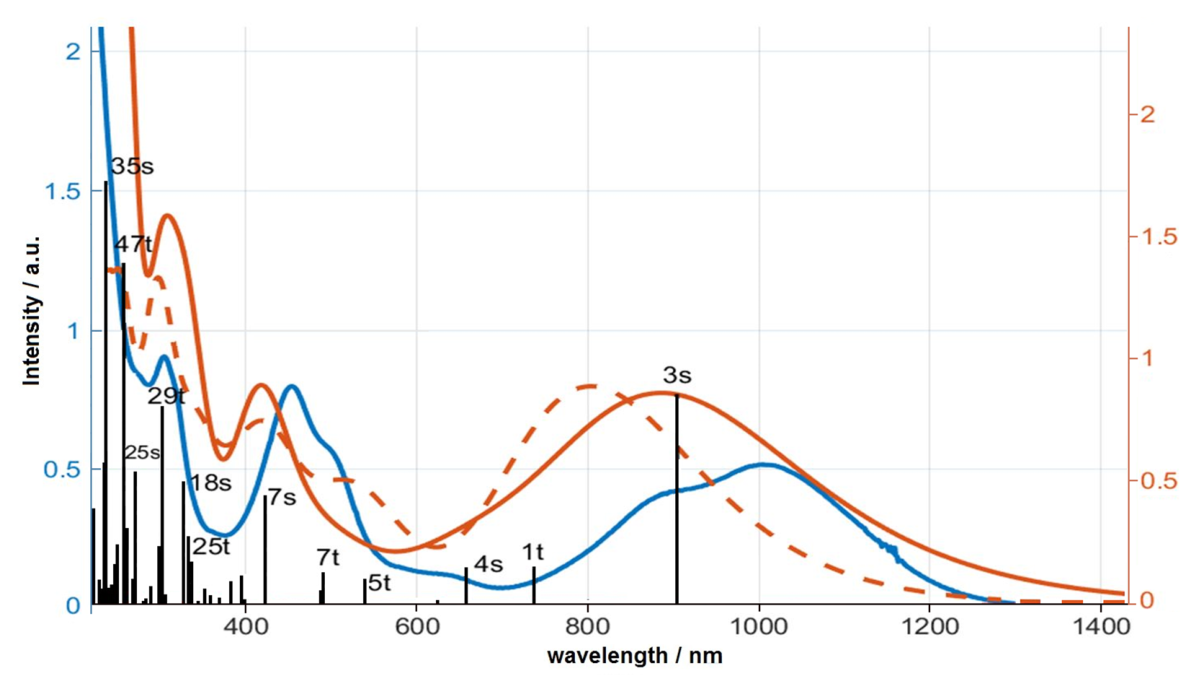
Figure 9.
Transitions corresponding to the most intense spectral lines in the absorption spectrum of [Ru(bisimpy)(PhCN)Cl2]: singlet lines on the left, triplet lines on the right. The numbers near the transitions correspond to the numbering of the spectral lines in Figure 8. Eight levels (145–152) between which the main transitions occur are shown.
Figure 9.
Transitions corresponding to the most intense spectral lines in the absorption spectrum of [Ru(bisimpy)(PhCN)Cl2]: singlet lines on the left, triplet lines on the right. The numbers near the transitions correspond to the numbering of the spectral lines in Figure 8. Eight levels (145–152) between which the main transitions occur are shown.
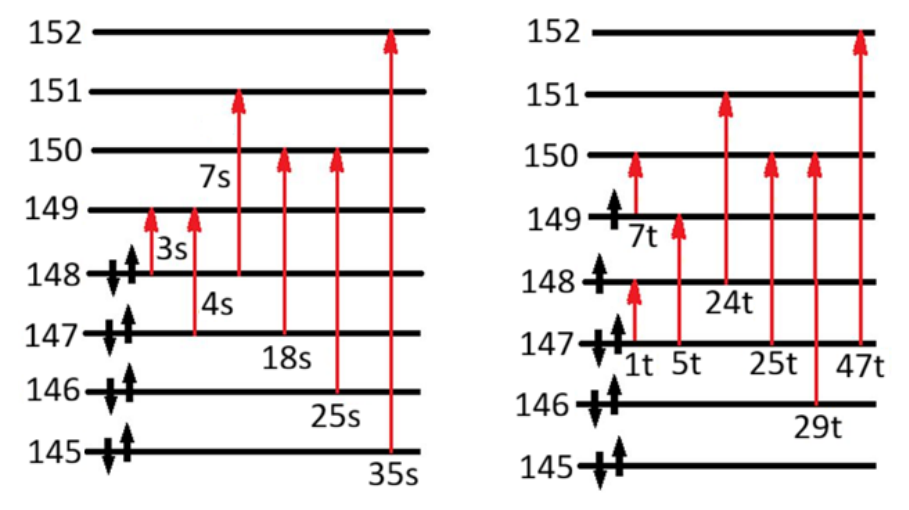
Figure 10.
Representations of the MOs of [Ru(bisimpy)(PhCN)Cl2] involved in the transitions (Figure 9) that form the UV-vis absorption spectrum (Figure 8). The surfaces correspond to an isovalue of 0.03. Eight MOs, numbered 145 to 152, are shown.
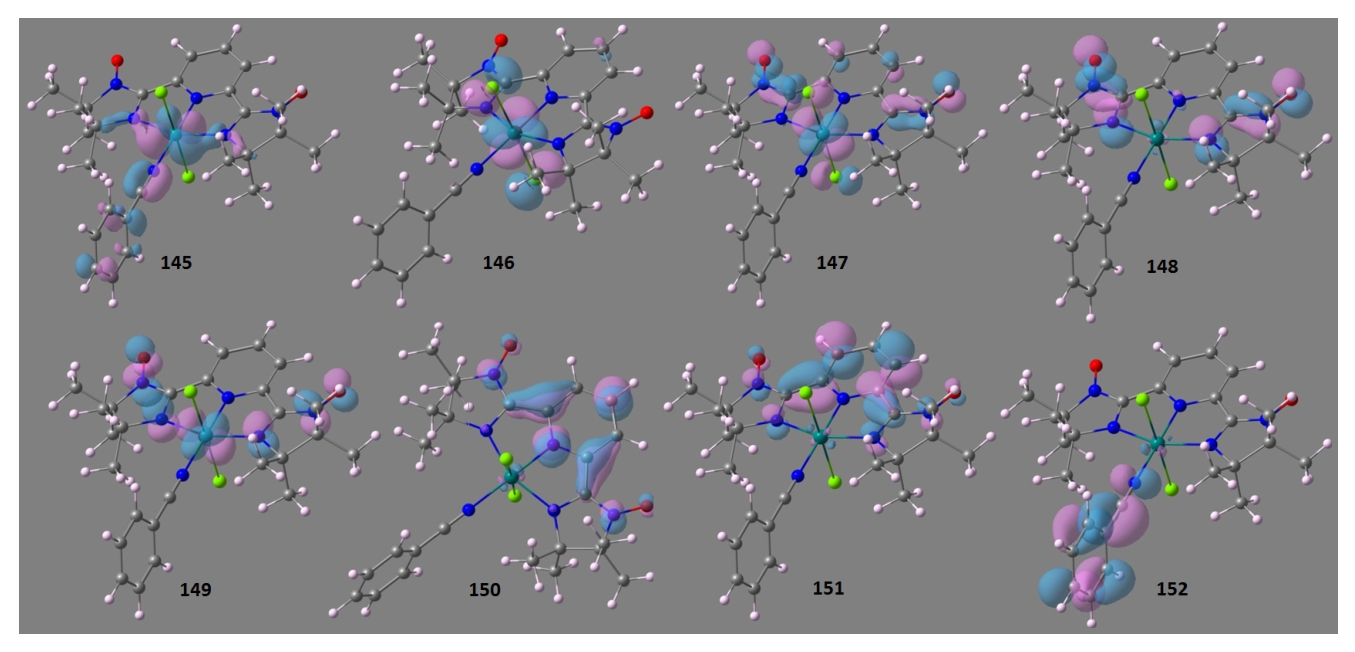

Table 1.
Calculated exchange constants J(cm–1) for the [Ru(bisimpy)(PhCN)Cl2] complex.
| DFT | J | J (CPCM)* |
| B3LYP | –296 | –350 |
| cam-B3LYP | –168 | –195 |
| LC-BLYP | –223 | –238 |
| TPSSh | –419 | –472 |
| wB97m-D4 | –156 | –171 |
* with the solvent effect in CH2Cl2 taken into account.
Table 2.
Calculated internal magnetic exchange constants J (cm–1) for the free biradical bisimpy.
| DFT | B3LYP | cam-B3LYP | LC-BLYP | TPSSh | wB97m-D4 |
| J (CPCM)* | 4.0 | 9.5 | 6.0 | 4.4 | 4.4 |
Disclaimer/Publisher’s Note: The statements, opinions and data contained in all publications are solely those of the individual author(s) and contributor(s) and not of MDPI and/or the editor(s). MDPI and/or the editor(s) disclaim responsibility for any injury to people or property resulting from any ideas, methods, instructions or products referred to in the content. |
© 2026 by the authors. Licensee MDPI, Basel, Switzerland. This article is an open access article distributed under the terms and conditions of the Creative Commons Attribution (CC BY) license (http://creativecommons.org/licenses/by/4.0/).
Copyright: This open access article is published under a Creative Commons CC BY 4.0 license, which permit the free download, distribution, and reuse, provided that the author and preprint are cited in any reuse.