

Submitted:
23 October 2026
Posted:
26 October 2026
You are already at the latest version
Abstract
Introduction: Widowhood in South African and related African contexts is shaped by mourning obligations, gendered authority, inheritance insecurity, economic responsibility and culturally specific expectations. However, the relationship between these conditions and widows’ navigation of work and family life remains insufficiently understood. This systematic review examined how South African widows experience and navigate the intersection of work and family within sociocultural and traditional contexts, including challenges, opportunities, coping strategies, enabling conditions and.Methods: The researcher-selected databases and information sources were ERIC, PubMed (MEDLINE) and Google Scholar. The eligibility protocol restricted publication years to 2015–2026. The exact calendar date of search execution was not recorded in the verified identification provenance; this is distinct from the publication-year eligibility range. ERIC, PubMed (MEDLINE) and Google Scholar were searched using a specified Boolean strategy for English-language peer-reviewed studies published from 2015 to 2026.Results: The synthesis identified four themes: widowhood is socially regulated through gendered cultural expectations; economic survival links work, family responsibility and wellbeing; agency is exercised through rights negotiation and collective resistance; and support needs to be culturally responsive and practically accessible. Rituals could restrict autonomy and participation, but culturally grounded ritual could also be experienced as empowering. Direct evidence on how South African widows combine paid work, unpaid care, household duties and cultural obligations was sparse. Work-family evidence from general South African employee populations was contextual rather than widow-specific.Discussion/Conclusion: South African widows navigate work and family through an interaction of cultural regulation, economic pressure, institutional constraint and individual or collective agency. Effective responses should protect rights, strengthen economic and psychosocial support, and remain culturally responsive.
Keywords:
sociocultural context
; South African widows
; thematic synthesis
; widowhood
; work-family intersection
1. Introduction
Widowhood is a social, economic and cultural transition rather than solely an event of bereavement. The supplied literature describes widows as managing emotional distress, altered household responsibilities, loss of income, social expectations and changing relationships with family and community institutions. In African contexts, mourning and cleansing practices may be understood as restoring spiritual and social order, while also producing isolation, restrictions and psychological strain (Mphephu & Muthivhi, 2025; Khosa-Nkatini, 2026). South African evidence further indicates that widows may encounter dependence on in-laws and customary decision-makers, challenges to inheritance and household authority, and economic vulnerability following the death of a spouse (Ndlovu, 2024; Osman, 2022).
The supplied evidence also indicates that widowhood is not experienced only as constraint. Widows may negotiate inheritance through state interventions, family institutions and egalitarian claims, and may participate in activism against dispossession and harmful ritual practices (Ndlovu, 2024; Osman, 2022). Culturally grounded religious practice may be empowering where it engages local spiritual worldviews rather than simply imposing external meanings (Khosa-Nkatini, 2020). Broader South African work-family research shows that work pressure, overload, exhaustion and time demands are associated with work-family conflict, while organisational support may reduce conflict among employees (Heyns, 2016; Harunavamwe & Kanengoni, 2023; Harunavamwe & Ward, 2022). These findings provide useful context but do not establish how widows specifically organise paid work, livelihoods, unpaid care and family obligations.
The evident gap is therefore relational and contextual: the available literature does not sufficiently explain how South African widows experience and negotiate work and family simultaneously within culturally regulated settings. Direct empirical evidence is sparse, and the supplied studies do not permit systematic comparison by ethnicity, age, rural or urban location, employment status, household composition or specific cultural tradition. A systematic review was consequently needed to bring together evidence on lived experience, sociocultural challenge, coping, agency, institutional conditions and support while distinguishing direct evidence about South African widows from contextual evidence about other populations.
2. Research Objectives
- To examine how Lived experiences of navigating work and family roles influences Perceptions, sociocultural challenges, coping strategies, and dual-role negotiation among South African widowed women within South African sociocultural and traditional contexts.
- To identify the principal opportunities, benefits and enabling conditions associated with lived experiences of navigating work and family roles in relation to perceptions, sociocultural challenges, coping strategies, and dual-role negotiation.
- To analyse the challenges, risks, ethical considerations and implementation barriers associated with Lived experiences of navigating work and family roles for South African widowed women.
- To examine the contextual, institutional and practice-related factors that shape the adoption and effective use of lived experiences of navigating work and family roles within South African sociocultural and traditional contexts.
- To identify gaps in the available evidence and derive implications for future research, policy and practice.
3. Research Methods
3.1. Review Design
The selected review type was Systematic Review. The review examined evidence concerning South African widows, lived experience, work or livelihoods, family dynamics, coping, sociocultural challenges and role negotiation. The review was interpretive because the supplied evidence included qualitative, conceptual, policy-oriented and contextual material.
3.2. Search Strategy and Information Sources
The researcher-selected databases and information sources were ERIC, PubMed (MEDLINE) and Google Scholar. The eligibility protocol restricted publication years to 2015–2026. The exact calendar date of search execution was not recorded in the verified identification provenance; this is distinct from the publication-year eligibility range.
3.3. Inclusion and Exclusion Criteria
Inclusion
- Studies focusing specifically on South African widows (women who have experienced the death of a spouse or partner).
- Studies exploring lived experiences, personal accounts, or perspectives regarding the intersection of work (employment, informal labor, livelihoods) and family dynamics.
- Studies examining socio-cultural challenges, coping mechanisms, or strategies used to navigate work and family roles following widowhood.
- Studies conducted within the South African socio-cultural context.
- Studies published between 2015 and 2026.
- Studies published in the English language.
- Studies published as peer-reviewed journal articles.
Exclusion
- Studies focusing on widowers (men), non-widowed women, or widows located outside of South Africa.
- Studies that do not address the interaction or intersection between work/livelihoods and family life.
- Studies exclusively focusing on clinical, physiological, legal, or purely macroeconomic outcomes without exploring widows’ socio-cultural experiences, coping mechanisms, or role navigation.
- Studies conducted outside the South African socio-cultural context.
- Studies published prior to 2015 or after 2026.
- Studies published in languages other than English.
- Document types other than peer-reviewed journal articles, such as grey literature, conference proceedings, dissertations, book reviews, editorials, or opinion pieces.
3.4. Screening and Study Selection
The PRISMA selection counts are persisted, but the decision rule used during title/abstract screening is not available in the verified audit payload. COSTAQDA therefore reports the recorded workflow counts without reconstructing an unverified screening procedure.
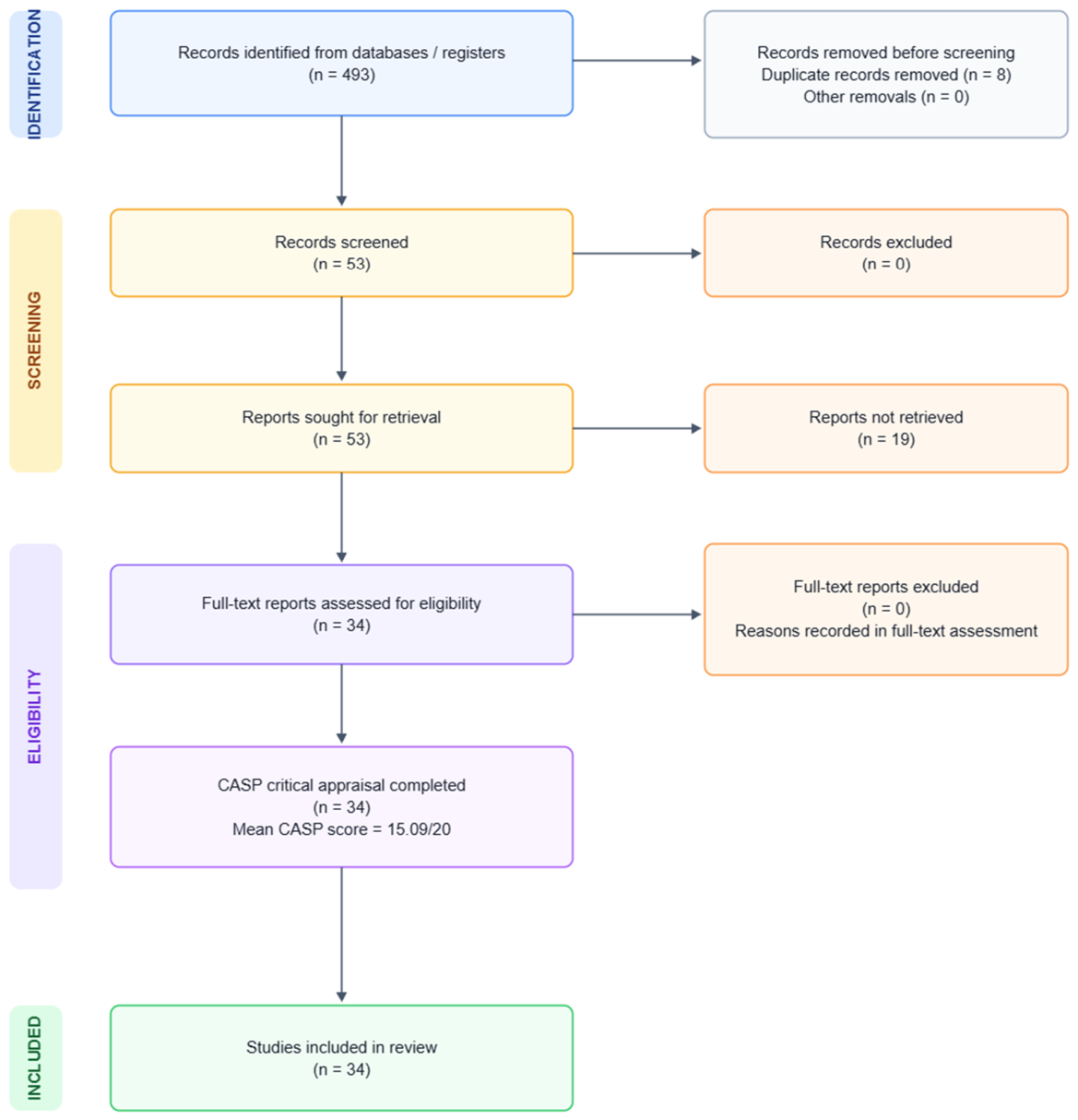
The persisted PRISMA workflow records 493 identified records, 8 duplicates, 53 records screened, 53 reports sought for retrieval, 0 records excluded at the title/abstract stage, 34 full texts assessed, 0 full-text exclusions and 34 included records. These counts describe study selection and are not substantive review findings.
Figure 1.
PRISMA 2020 Flow Diagram—Identification, Screening, Eligibility and Included.Source: COSTAQDA PRISMA Workflow, navigation item 8: PRISMA Flow Diagram; four-stage structure showing Identification, Screening, Eligibility (including CASP critical appraisal) and Included; adapted from PRISMA 2020 (Page et al., 2021).
3.5. Critical Appraisal
The Critical Appraisal Skills Programme (CASP) was used in the PRISMA full-text workspace, and 34 of 34 included studies had completed appraisals. The recorded mean appraisal score was 15.09, but scores were not treated as an unquestioned total-quality measure. Appraisal interpretation considered study design, directness, reporting limitations and methodological concerns. Several records had multiple CASP concerns, particularly where they were protocols, conceptual or policy-oriented sources, non-journal materials, or provided limited empirical detail.
Figure 2.
CASP Critical Appraisal Intelligence—PRISMA Workflow, Step 6: Full-Text Screening.Source: COSTAQDA PRISMA Workflow, navigation item 6: Full-Text Screening (CASP critical appraisal outputs). The Word figure is generated from the same deterministic COSTAQDA CASP visual.
Figure 2.
CASP Critical Appraisal Intelligence—PRISMA Workflow, Step 6: Full-Text Screening.Source: COSTAQDA PRISMA Workflow, navigation item 6: Full-Text Screening (CASP critical appraisal outputs). The Word figure is generated from the same deterministic COSTAQDA CASP visual.
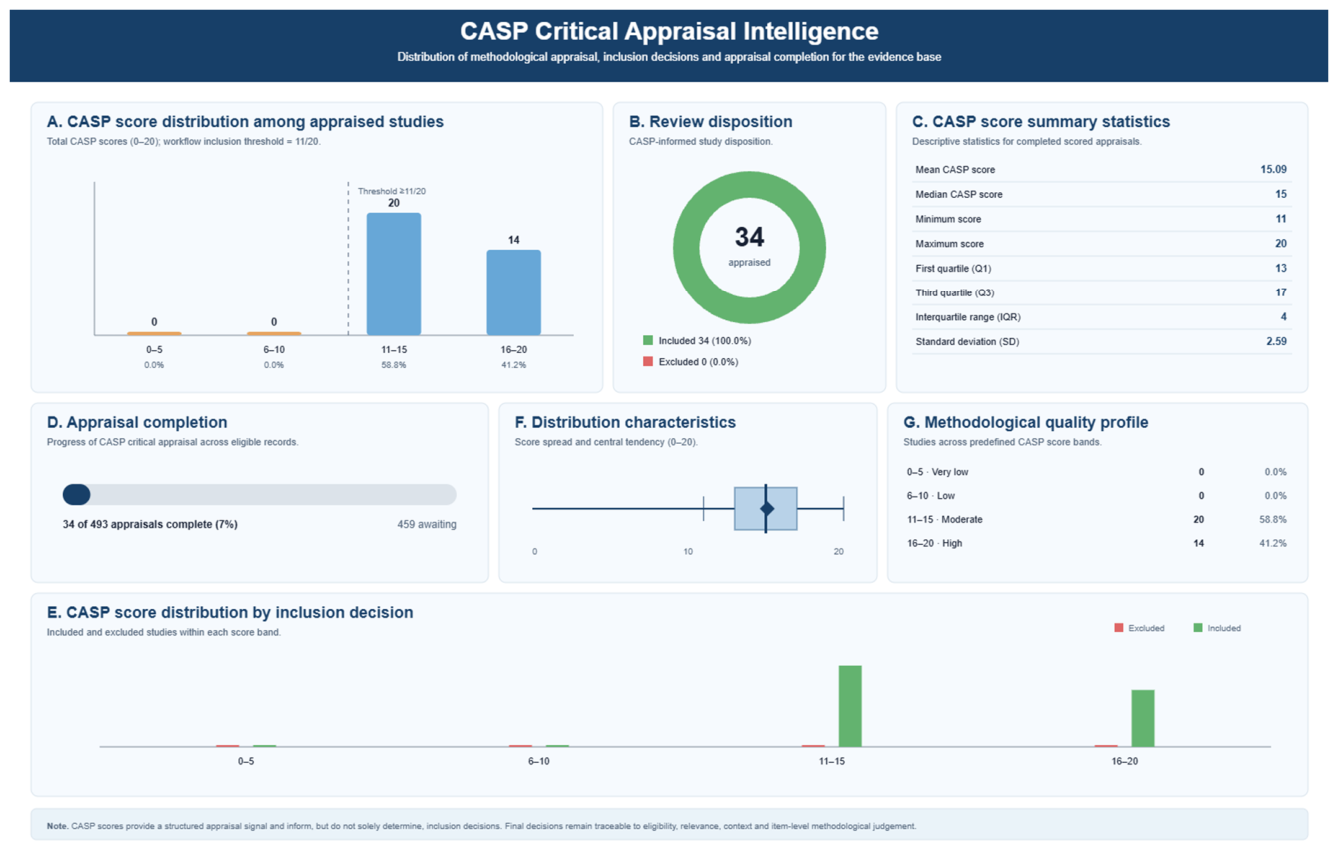
The CASP workspace records completed appraisals for all 34 included studies. The appraisal pattern was heterogeneous: some studies had relatively few recorded concerns, whereas others had concerns across several CASP criteria. The appraisal therefore informed cautious interpretation rather than a binary quality ranking. For example, the South African activism study had one recorded methodological concern, while several contextual or non-South-African sources had multiple concerns (Ndlovu, 2024; Pande, 2018; Nickerson, 2018).
3.6. Data Extraction
A formal data-extraction procedure was not recorded in the supplied workspace. Nevertheless, the verified synthesis demonstrates that finding-level evidence was available: 140 extracted findings from 20 studies were used in thematic synthesis. Extracted material included study identity, context where available, methodological information, and finding-level text. The absence of a recorded extraction protocol limits reproducibility and confidence in the completeness of extracted study characteristics.
3.7. Data Synthesis and Analysis
Qualitative evidence synthesis was conducted on 140 extracted findings contributed by 20 studies. The COSTAQDA synthesis engine applied thematic synthesis, moving from traceable finding-level evidence to 6 initial codes, 3 categories, 2 descriptive themes and 2 analytical themes.
Theme development was constrained to the extracted finding-level evidence supplied by eligible studies. Each synthesised theme retained supporting study IDs and finding IDs, while contradictory evidence was preserved where identified. Titles, abstracts and bibliographic prominence were not treated as substitutes for extracted qualitative findings.
Recorded synthesis limitations included: The evidence base is heterogeneous and includes a Southern African scoping-review protocol, conceptual or policy-oriented material, and studies from outside South Africa; findings from non-South-African studies were not used to make direct claims about South African widows.; Several supplied findings concern general South African employees rather than widows, so work-family conflict evidence is contextual and cannot be assumed to describe widows’ experiences.; Direct empirical evidence on how South African widows combine paid work, unpaid care, household responsibilities and cultural obligations is sparse in the supplied extraction.; Some records provide methods, recommendations or bibliographic material rather than substantive participant findings, limiting confidence in claims about lived experience.; The supplied extraction does not provide sufficient evidence to compare experiences systematically by ethnicity, age, rural or urban location, employment status, household composition or specific cultural tradition..
3.8. Bibliometric Intelligence and Confidence in the Evidence Base
Bibliometric intelligence provides a structural view of the evidence base that complements PRISMA selection, critical appraisal and qualitative synthesis. The following analyses examine citation relationships, scholarly influence, evidence connectivity and knowledge development within the included corpus. They provide contextual evidence about the intellectual structure and provenance of the literature and are not substitutes for methodological quality appraisal.
3.8.1. Local Citation Network
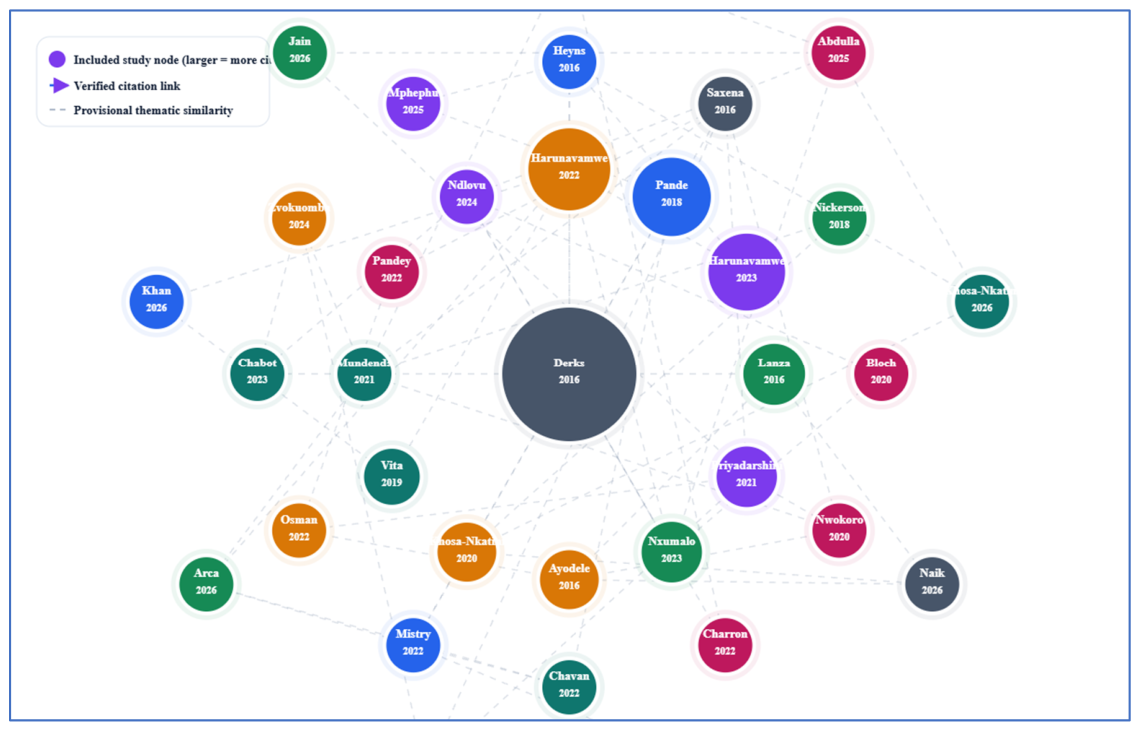
The Local Citation Network maps citation relationships within the included evidence base. It shows how studies are connected within the review corpus and supports examination of intellectual connectedness, centrality, bridging and isolation. These citation relationships describe the structure of the literature and do not, by themselves, establish methodological quality or validity.
Figure 3.
Local Citation Network.Source: COSTAQDA PRISMA Workflow, navigation item 12: Bibliometric Intelligence—Local Citation Network.
Figure 3.
Local Citation Network.Source: COSTAQDA PRISMA Workflow, navigation item 12: Bibliometric Intelligence—Local Citation Network.
3.8.2. Influence Pyramid
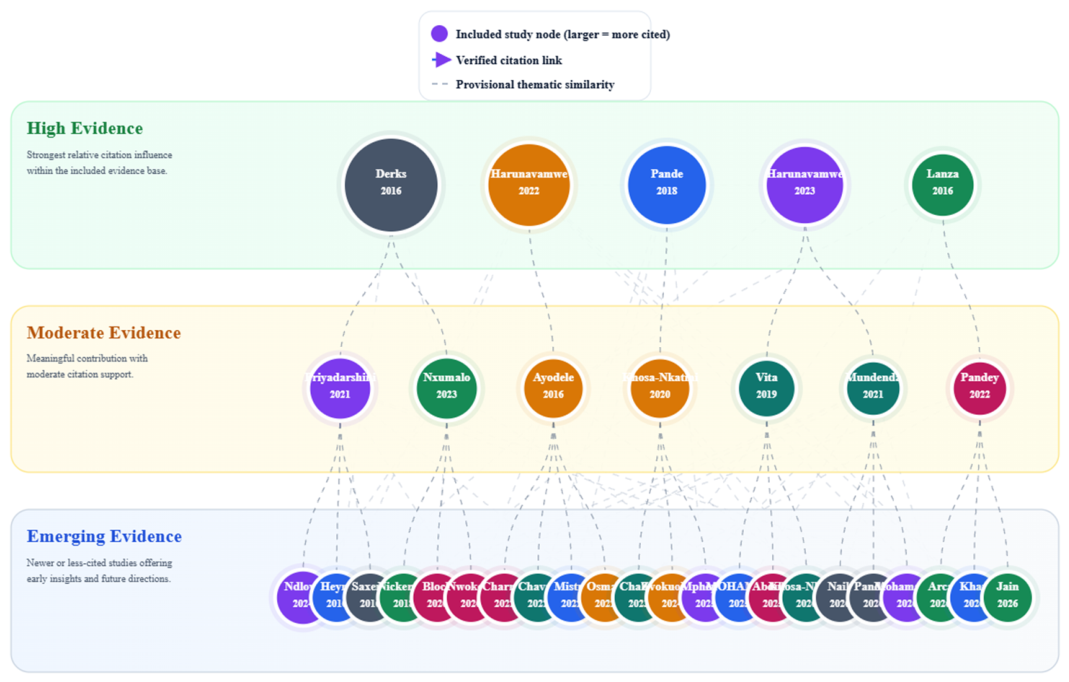
The Influence Pyramid represents the distribution of scholarly influence within the included evidence base. It helps identify how bibliometric prominence is distributed across the reviewed studies. Influence is interpreted separately from methodological quality, which is assessed through critical appraisal.
Figure 4.
Influence Pyramid.Source: COSTAQDA PRISMA Workflow, navigation item 12: Bibliometric Intelligence—Influence Pyramid.
Figure 4.
Influence Pyramid.Source: COSTAQDA PRISMA Workflow, navigation item 12: Bibliometric Intelligence—Influence Pyramid.
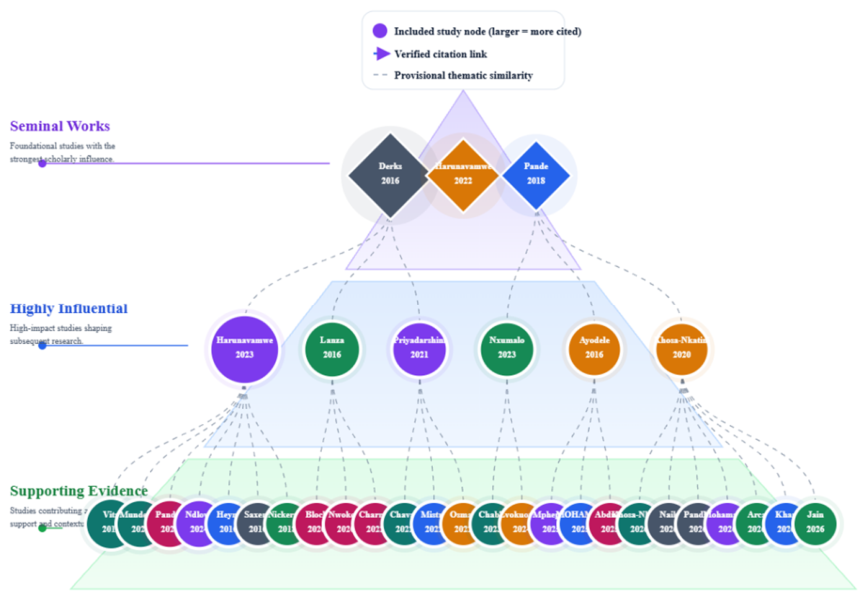
The available Influence Pyramid represents bibliometric prominence or influence within the supplied evidence ecosystem, not methodological quality. OpenAlex reported 581 global citations, 59 links, 34 clusters and 34 included works. Prominent works included Derks et al.(2016)., Harunavamwe and Ward (2022), and Pande (2018), but bibliometric prominence was not used to upgrade their methodological credibility or to substitute for CASP appraisal.
3.8.3. Evidence Strength
The Evidence Strength analysis examines the structure and strength of relationships within the evidence ecosystem assembled for the review. It complements, but does not replace, CASP methodological appraisal and must not be interpreted as a direct estimate of causal effect.
Figure 5.
Evidence Strength Network.Source: COSTAQDA PRISMA Workflow, navigation item 12: Bibliometric Intelligence—Evidence Strength Network.
Figure 5.
Evidence Strength Network.Source: COSTAQDA PRISMA Workflow, navigation item 12: Bibliometric Intelligence—Evidence Strength Network.
The Evidence Strength Network represents the structure and strength of relationships within the evidence ecosystem and does not replace critical appraisal. Its relationships helped contextualise convergence among work-family, cultural, inheritance and widowhood literature, but network connectivity was not interpreted as proof of causal, empirical or methodological strength. Confidence instead depended on the convergence of appropriately appraised, directly relevant findings.
3.8.4. Knowledge Evolution
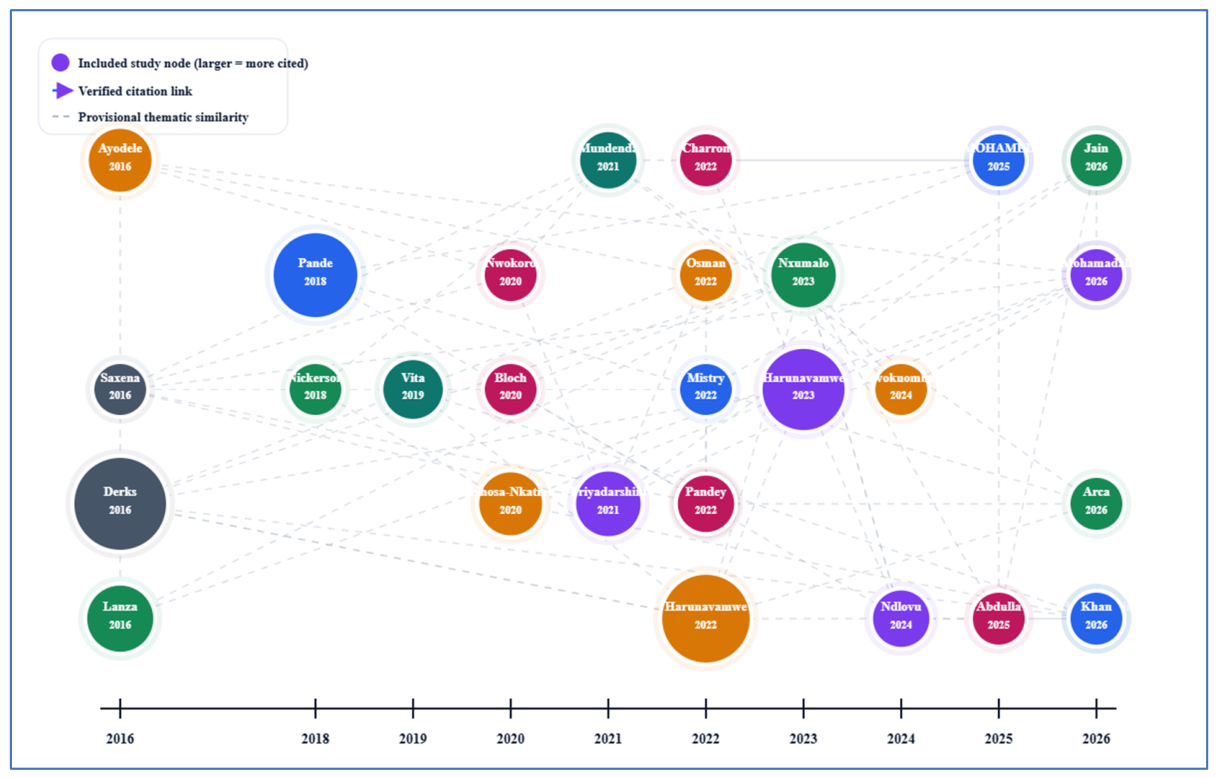
Knowledge Evolution examines the temporal and intellectual development of the included evidence base. It traces how research contributions develop over time and, where supported by the Step 12 data, how later studies extend, connect, challenge or consolidate earlier contributions.
Figure 6.
Knowledge Evolution.Source: COSTAQDA PRISMA Workflow, navigation item 12: Bibliometric Intelligence—Knowledge Evolution.
Figure 6.
Knowledge Evolution.Source: COSTAQDA PRISMA Workflow, navigation item 12: Bibliometric Intelligence—Knowledge Evolution.
3.8.5. Integrated Confidence in the Synthesised Evidence
Confidence was assessed by triangulating transparent PRISMA selection, CASP methodological appraisal, evidence convergence and divergence, and bibliometric intelligence rather than citation counts alone. Confidence was reduced where evidence was indirect, heterogeneous, conceptually oriented or drawn from non-South-African settings. Direct South African evidence from Ndlovu (2024), Osman (2022), Khosa-Nkatini (2020, 2026) and Mphephu and Muthivhi (2025) was distinguished from contextual work-family evidence involving general employees (Heyns, 2016; Harunavamwe & Kanengoni, 2023; Harunavamwe & Ward, 2022).
4. Findings
4.1. Search and Selection Results
The recorded selection process yielded 34 included records from 493 identified records after 8 duplicates were removed. Fifty-three records were screened and 34 full texts were assessed. Because the structured title and abstract decision rule was not available in the verified audit, the absence of recorded exclusions should not be interpreted as evidence that all initially identified records were equally relevant.
4.2. Characteristics of Included Studies
The 34-record evidence base was heterogeneous. It included South African studies on widowhood activism, inheritance and Tsonga mourning practices; South African work-family studies involving employees; studies from other African settings; international widowhood research; conceptual, historical, policy-oriented and book-based sources; and a scoping-review protocol. Direct South African evidence was concentrated in cultural regulation, dispossession, inheritance and ritual, while direct evidence on widows’ paid work, unpaid care and household role negotiation was limited (Khosa-Nkatini, 2020, 2026; Ndlovu, 2024; Osman, 2022).
4.3. Methodological Strengths and Limitations of Included Studies
Methodological strengths included the use of an explicit search strategy, recorded PRISMA counts, completed CASP appraisals for all 34 included studies, and a traceable thematic synthesis based on 140 findings from 20 studies. Limitations included heterogeneous source types, incomplete study-level methodological metadata, multiple CASP concerns in several records, and indirect evidence. In particular, South African work-family studies examined general employees rather than widows, so their results cannot be assumed to describe widows’ experiences (Heyns, 2016; Harunavamwe & Kanengoni, 2023; Harunavamwe & Ward, 2022).
4.4. Thematic Synthesis
Thematic synthesis is a systematic qualitative evidence-synthesis method used to integrate findings across multiple studies while retaining a transparent connection to the underlying evidence. The process moves iteratively from extracted study findings to coding, the grouping of related codes into descriptive categories or themes, and the development of higher-order analytical themes that answer the review question and research objectives. Its purpose is not merely to count how often an idea appears, but to identify patterned meaning across studies, examine convergence and divergence, preserve contextual differences, and develop an auditable interpretation that remains traceable to the contributing evidence.
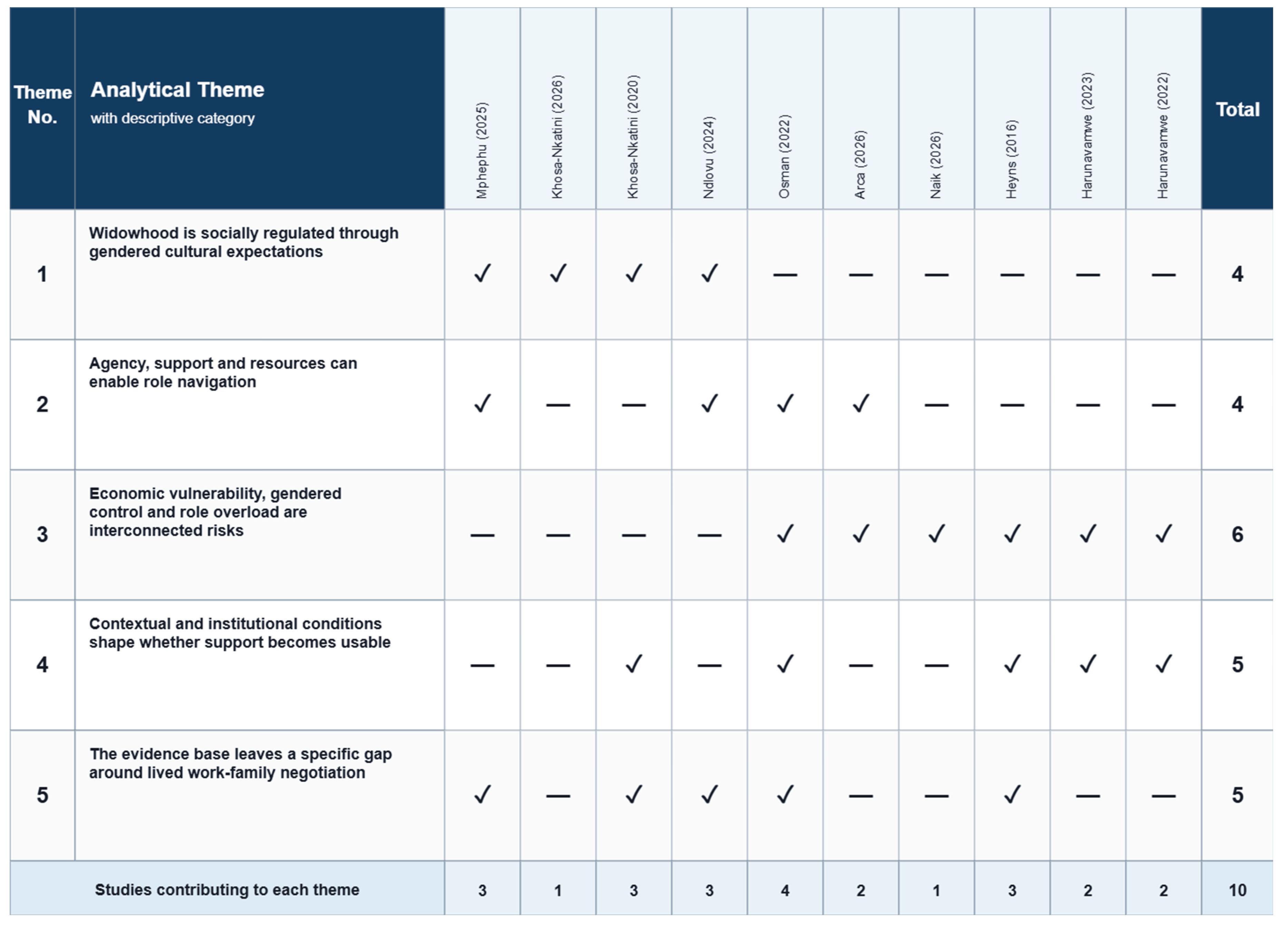
In this review, thematic synthesis was applied to the verified extracted findings retained in the active COSTAQDA project. Findings were compared across eligible studies, coded and grouped according to conceptual similarity, and then developed into 5 analytical themes represented across 10 evidence-contributing studies. The active synthesis retained 24 verified theme-to-study support assignments, allowing the analytical interpretation to remain traceable to the underlying studies rather than being reconstructed from titles or bibliographic prominence. The resulting analytical themes include “Widowhood is socially regulated through gendered cultural expectations”, “Agency, support and resources can enable role navigation”, “Economic vulnerability, gendered control and role overload are interconnected risks”, “Contextual and institutional conditions shape whether support becomes usable”, with the widest cross-study support recorded for “Economic vulnerability, gendered control and role overload are interconnected risks” (6 contributing studies). Table 1 therefore operationalises the synthesis as an auditable evidence map linking each analytical theme to the studies that supplied verified supporting findings.
Table 1 presents the thematic synthesis matrix linking the verified analytical themes only to studies with verified extracted evidence supporting at least one of the themes displayed in the matrix. Any study with no verified supporting contribution to any displayed theme is excluded, even if it was included elsewhere in the systematic review or qualitative evidence base. Rows represent analytical themes and columns represent theme-contributing studies. A check mark (✓) indicates that at least one verified extracted finding from that study was assigned to the theme; an em dash (—) indicates that the study contributed evidence to the synthesis overall but no supporting extracted finding from that study was assigned to that particular theme. The absence of a supporting assignment must not be interpreted as contradictory evidence. The totals report the number of evidence-contributing studies providing verified support to each theme. The matrix therefore functions as an audit trail between thematic interpretation and the underlying finding-level evidence rather than as a measure of methodological quality or effect size.
The most widely supported analytical theme was “Economic vulnerability, gendered control and role overload are interconnected risks”, with verified support from 6 of 10 studies. The least widely distributed theme was “Agency, support and resources can enable role navigation”, with verified support from 4 of 10 studies. Differences in the number of supporting studies indicate the distribution of traceable thematic evidence across the included literature, not the relative importance or quality of a theme. Themes supported by fewer studies may still be analytically important when the underlying findings are conceptually rich, contextually distinctive or directly relevant to the review question. Conversely, wider study support indicates cross-study recurrence but does not by itself establish stronger methodological quality. The thematic patterns shown in Table 1 should therefore be interpreted alongside critical appraisal, contextual variation, contradictory findings where verified, and the detailed theme-led discussion that follows.
4.5. RO1: Widowhood Is Socially Regulated Through Gendered Cultural Expectations
The synthesis indicates that South African widowhood is shaped by prescribed mourning, cleansing, dress, isolation and expectations about appropriate conduct. These practices are intended to restore spiritual and social order, but may restrict autonomy, mobility and ordinary participation. Gendered authority is reinforced when in-laws, men or customary decision-makers influence a widow’s conduct, resources and household position (Mphephu & Muthivhi, 2025; Khosa-Nkatini, 2026).
The evidence was not uniformly negative. Tsonga inculturation was described as potentially empowering when ritual engages African spiritual worldviews, while activism demonstrates that widows can contest ritualised dispossession and enforced silence (Khosa-Nkatini, 2020; Ndlovu, 2024). Thus, the same broad category of cultural practice may constrain or support dual-role negotiation depending on who controls it, how it is interpreted and whether widows can participate in shaping it.
4.6. RO2: Agency, Support and Resources Can Enable Role Navigation
The principal enabling conditions were access to rights, family or state institutions, culturally congruent support, economic resources and collective action. In a rural Eastern Cape case, widows were described as leveraging state interventions, family institutions and egalitarian claims to secure greater access to inheritance and property (Osman, 2022). Activism similarly created a means of challenging dispossession and converting widowhood from enforced silence into collective resistance (Ndlovu, 2024).
Support was most consistently described as useful when it was culturally sensitive, accessible, timely and connected to everyday realities. Proposed forms included counselling, economic empowerment, rights protection and locally accessible support systems (Mphephu & Muthivhi, 2025; Arca, 2026). These are enabling directions rather than evaluated work-family interventions for South African widows, and the evidence is therefore insufficient to establish which support models are most effective.
4.7. RO3: Economic Vulnerability, Gendered Control and Role Overload Are Interconnected Risks
The death of a spouse may remove household income while increasing responsibility for children’s and household needs. The supplied widowhood literature links bereavement with psychological distress, economic insecurity and intensified family responsibility (Naik, 2026; Arca, 2026). South African work-family research indicates that work pressure, exhaustion, overload and time demands are associated with work-family conflict among employees, but these findings are contextual rather than direct evidence about widows (Heyns, 2016; Harunavamwe & Kanengoni, 2023).
Property and inheritance insecurity constitute a further risk. South African evidence describes restrictions in widows’ enjoyment of inheritance and the need to negotiate access through state and family institutions (Osman, 2022). The broader African evidence on inheritance hijacking supports the economic significance of dispossession but is not South African and therefore cannot be generalised directly (Ayodele, 2016). The ethical and implementation concern is that formal rights may not be usable where widows remain economically dependent on relatives or customary authorities.
4.8. RO4: Contextual and Institutional Conditions Shape Whether Support Becomes Usable
The evidence suggests that institutional arrangements shape the practical meaning of cultural expectations and rights. State interventions can widen widows’ inheritance claims, while family and customary institutions may either support or restrict access to resources (Osman, 2022). Culturally grounded ritual can also become a resource when widows’ meanings and spiritual worldviews are recognised, rather than treated as obstacles to be removed (Khosa-Nkatini, 2020).
The work-family studies indicate that organisational pressure, technostress and perceived organisational support shape conflict and flourishing among South African employees (Harunavamwe & Kanengoni, 2023; Harunavamwe & Ward, 2022). However, no supplied study directly evaluated organisational practices for widowed women. It is therefore not possible to conclude that these arrangements would produce equivalent effects for widows managing bereavement, care and culturally regulated obligations.
4.9. RO5: The Evidence Base Leaves a Specific Gap Around Lived Work-Family Negotiation
The central evidence gap is the lack of direct, sufficiently detailed empirical research on how South African widows combine paid employment, informal livelihood activity, unpaid care, household management and cultural obligations. The reviewed synthesis could identify pressures, resources and forms of agency, but could not systematically compare experiences by ethnicity, age, location, employment status, household composition or cultural tradition (Ndlovu, 2024; Khosa-Nkatini, 2020; Osman, 2022).
The evidence base also contains contextual studies, protocols, conceptual material and sources outside South Africa. These sources can illuminate mechanisms but cannot substitute for direct South African evidence. Consequently, the review supports cautious implications for culturally responsive practice and rights protection, but not a definitive model of widowhood, employment and family life.
5. Discussion
The findings return to all five objectives by showing that the intersection of work and family for South African widows cannot be understood through employment conditions alone. RO1 is addressed by evidence that mourning, cleansing, gendered authority and dispossession shape autonomy and household participation (Mphephu & Muthivhi, 2025; Khosa-Nkatini, 2026; Ndlovu, 2024). These findings extend the meaning of dual-role negotiation: widows may be negotiating not only employment and family care, but also ritual obligations, property claims and social legitimacy.
RO2 and RO4 are addressed through evidence of agency, institutional access and culturally congruent support. The Eastern Cape inheritance evidence shows that state and family institutions can be resources rather than only constraints, while Tsonga inculturation demonstrates that culturally grounded practice may support empowerment (Osman, 2022; Khosa-Nkatini, 2020). This complicates a simple deficit account of widowhood. At the same time, the evidence does not demonstrate that agency reliably overcomes patriarchal or economic power. Rights and support remain conditional on access, dependence and the local organisation of authority.
RO3 is addressed by the convergence of evidence on income loss, intensified family responsibility, psychological burden and work pressure (Naik, 2026; Arca, 2026; Heyns, 2016). The important divergence concerns directness: work-family studies involving South African employees provide evidence of relevant pressures but not of widows’ experiences, while widowhood studies provide evidence of vulnerability and responsibility without adequately documenting paid work or livelihood routines. This methodological difference prevents strong claims about the prevalence or form of work-family conflict among widows.
RO5 is therefore central to interpreting the review. The synthesis contributes a defensible explanation of how cultural regulation, economic survival and agency are connected, but it also shows that the available evidence is not yet sufficiently specific to support subgroup comparisons or evaluated interventions. CASP concerns, heterogeneous source types and indirect evidence reduce confidence in broad generalisation. Bibliometric prominence may indicate that some works are influential or connected within the evidence ecosystem, but it cannot resolve these limitations.
6. Conclusions
South African widows experience and navigate work and family within a sociocultural environment that regulates mourning, gender, household authority and access to resources. Economic responsibility and work-family pressure are important, but the direct evidence documenting how widows combine paid work, livelihoods, unpaid care and cultural obligations remains limited. Agency is evident through inheritance negotiation, activism and culturally grounded practice, yet it operates within continuing institutional and economic constraints. The review therefore supports culturally responsive, rights-based and practically accessible responses, while concluding that a more direct and methodologically rigorous South African evidence base is required.
7. Recommendations
Practice recommendations should prioritise culturally responsive counselling, economic empowerment, rights information and support that is accessible in widows’ everyday settings. Practitioners should recognise that cultural practices may be experienced differently and should involve widows in determining whether and how ritual, family and community resources are used (Mphephu & Muthivhi, 2025; Khosa-Nkatini, 2020).
Policy recommendations should strengthen protection against dispossession and gender discrimination, improve practical access to inheritance and social protection, and coordinate services across community, family and state institutions. Policies should address implementation and accessibility rather than relying only on formal rights, consistent with the evidence on inheritance negotiation and support gaps (Osman, 2022; Ndlovu, 2024; Arca, 2026).
Future research should use South African qualitative, mixed-methods and longitudinal designs to examine how widows combine paid work, informal livelihoods, unpaid care, household management and cultural obligations. Studies should report ethnicity, age, rural or urban setting, employment status, household composition and cultural tradition, and should evaluate culturally responsive work-family, psychosocial, livelihood and rights-based interventions.
Funding
Not applicable.
References
- Mphephu, P.; Muthivhi, M. E. Psychosocial experiences of Widows during the cleansing ritual: A scoping review Protocol of Southern African. F1000Research 2025. [Google Scholar] [CrossRef]
- Pande, R. The Forgotten Widows of Vrindavan in India. In Advances in human and social aspects of technology book series; 2018. [Google Scholar] [CrossRef]
- Nickerson, R. A. The Formidable Widow: Comparing the Representations and Life Accounts of Widows in 17th Century England. the general brock university Undergraduate journal of history 2018. [Google Scholar] [CrossRef]
- Khosa-Nkatini, H. P. Liturgical Inculturation for Tsonga Widows’ Mourning Rituals. In Yearbook for Ritual and Liturgical Studies; 2020. [Google Scholar] [CrossRef]
- Khosa-Nkatini, H. P. Women mourn, men carry on: Gendered dimensions of mourning in African contexts. In Theologia Viatorum; 2026. [Google Scholar] [CrossRef]
- Charron, S. E. Not Really a Whining Widow: Sophie of Bavaria in her Cultural Context. In TSpace (University of Toronto); 2022. [Google Scholar]
- Naik, M. Y. B. Psychological Well-Being of Widows: A Narrative Construct. International Journal of All Research Education & Scientific Methods 2026. [Google Scholar] [CrossRef]
- Harunavamwe, M.; Kanengoni, H. Hybrid and virtual work settings; the interaction between technostress, perceived organisational support, work-family conflict and the impact on work engagement. African Journal of Economic and Management Studies 2023. [Google Scholar] [CrossRef]
- Heyns, T. The influence of work pressure and industry on work-family conflict: A meta-analytic review of South African research. In UpSpace Institutional Repository (University of Pretoria); 2016. [Google Scholar]
- Lanza, J. From Wives to Widows in Early Modern Paris; Routledge eBooks, 2016. [Google Scholar] [CrossRef]
- Ayodele, J. O. Widows and Inheritance Hijacking Practices in Ilara Mokin, Ondo State, Nigeria. In Digital Scholarship—Texas Southern University; 2016. [Google Scholar]
- Chabot, I. Can widows live on their dowry? Mélanges de l’École française de Rome. Moyen Age. 2023. [Google Scholar] [CrossRef]
- Bloch, J. Unseen: Exploring the Lived Experience of Visually Impaired South Africans. European Journal of Life Writing 2020. [Google Scholar] [CrossRef]
- Derks, D.; Bakker, A. B.; Peters, P.; Wingerden, P. V. Work-related smartphone use, work–family conflict and family role performance: The role of segmentation preference. In Human Relations; 2016. [Google Scholar] [CrossRef]
- Ndlovu, T. Standing Their Ground While Seated: Narratives of Widowhood Activism Against the Ritual of Widow Dispossession in South Africa. OMEGA—Journal of Death and Dying 2024. [Google Scholar] [CrossRef]
- MOHAMED, A. G. A. K. The Human Journey of the Widow. Zenodo 2025. [Google Scholar] [CrossRef]
- Nxumalo, C. T.; Tokwe, L.; Ngcobo, S. J.; Gam, N. P.; Mchunu, G. G.; Makhado, L. Exploring the perceptions and lived experiences of family members living with people diagnosed with COVID-19 in South Africa: A descriptive phenomenological study. International Journal of Qualitative Studies on Health and Well-Being 2023. [Google Scholar] [CrossRef]
- Zvokuomba, K. Widows, Widowhood and Sustainable Land Use in the Post Land Reform Era in Zimbabwe: Case for the Mushandike Smallholder Irrigation Scheme Exceptionalism. Ngenani The Zimbabwe Ezekiel Guti Journal of Community Engagement and Societal Transformations 2024. [Google Scholar] [CrossRef]
- Chavan, M. K. R. WIDOWS IN INDIA AND POVERTY; Zenodo, 2022. [Google Scholar] [CrossRef]
- Abdulla, F.; Lourens, H. South African Participants’ Journey Through Their Sibling’s Autism Diagnosis. In Research Square; 2025. [Google Scholar] [CrossRef]
- Panday, S.; Shrestha, S. Red Colour, Widowhood, and the Struggle for Social Citizenship in Nepal: A Qualitative Social Work Inquiry. Khwopa Journal 2026. [Google Scholar] [CrossRef]
- Mohamadali, R. M. Navigating Widowhood: Economic Struggles and Livelihood Challenges of Widows of Conflict in Lanao del Sur, Magindanao, Sulu, Tawi-Tawi and Basilan in Mindanao, Philippines. Journal of Contemporary Social Issues 2026. [Google Scholar]
- Mistry, P. A. S. A STUDY OF SOCIAL SECURITY AND GOVERNMENT SCHEMES FOR WIDOWS IN INDIA; Zenodo, 2022. [Google Scholar] [CrossRef]
- Arca, E. Policy vs. Poverty: Evaluating Support Gaps and the Implementation of the Solo Parents Act Among Widows. International Journal of Multidisciplinary Applied Business and Education Research 2026. [Google Scholar] [CrossRef]
- Harunavamwe, M.; Ward, C. E. The influence of technostress, work–family conflict, and perceived organisational support on workplace flourishing amidst COVID-19. In Frontiers in Psychology; 2022. [Google Scholar] [CrossRef]
- Mundenda, D.; Eck, E. V. The parable of the persistent widow and the unjust judge: A replica of the suffering of widows in Zimbabwe. In Verbum et Ecclesia; 2021. [Google Scholar] [CrossRef]
- Nwokoro, C. V.; Igwe, P. A. A Cultural-Institutional Perspective on Widows’ Empowerment in Rural Nigeria. In Gender questions; 2020. [Google Scholar] [CrossRef]
- Saxena, M. S. M.; Sane, A. S. A. Social, Environmental and Health Issues of Widows: Status and Policies: Exploring the Challenges Faced by Widows in Disaster-affected Areas. International Journal of Information Technology and Management 2016. [Google Scholar]
- Priyadarshini, U.; Pande, R. Exploring the Politics of Widowhood in Vrindavan: An Analysis of Life Narratives of Vrindavan Widows. Advances in Applied Sociology 2021. [Google Scholar] [CrossRef]
- Khan, I. B.; Batool, D. T. Family and Social Impacts on Widowed Women in Tehsil Jand. Sociology & Cultural Research Review 2026. [Google Scholar]
- Jain, R. Water and Blue Necked God: A Topsy-Turvy Journey of Widowhood. Integrated Journal for Research in Arts and Humanities 2026. [Google Scholar] [CrossRef]
- Osman, F. Negotiation of inheritance rights by widows; Routledge eBooks, 2022. [Google Scholar] [CrossRef]
- Vita, L. D.; Mari, M.; Poggesi, S. Work-family conflicts and satisfaction among Italian women entrepreneurs; Routledge eBooks, 2019. [Google Scholar] [CrossRef]
- Pandey, A. D.; Tripathy, S. Exclusion of Widows and State Welfare Policies: Some Insights from Odisha; Springer eBooks, 2022. [Google Scholar] [CrossRef]
- Nickerson, R. A. The Formidable Widow: Comparing the Representations and Life Accounts of Widows in 17th Century England. the general brock university Undergraduate journal of history 2018. [Google Scholar] [CrossRef]
- Heyns, T. The influence of work pressure and industry on work-family conflict: a meta-analytic review of South African research. In UpSpace Institutional Repository (University of Pretoria); 2016. [Google Scholar]
- Ayodele, J. O. Widows and Inheritance Hijacking Practices in Ilara Mokin, Ondo State, Nigeria. In Digital Scholarship—Texas Southern University (Texas Southern University); 2016. [Google Scholar]
- Chabot, I. Can widows live on their dowry? In Mélanges de l’École française de Rome. Moyen Age.; 2023. [Google Scholar] [CrossRef]
- MOHAMED, A. G. A. K. The Human Journey of the Widow. In Zenodo; CERN European Organization for Nuclear Research, 2025. [Google Scholar] [CrossRef]
- Nxumalo, C. T.; Tokwe, L.; Ngcobo, S. J.; Gam, N. P.; Mchunu, G. G.; Makhado, L. Exploring the perceptions and lived experiences of family members living with people diagnosed with COVID-19 in South Africa: a descriptive phenomenological study. International Journal of Qualitative Studies on Health and Well-Being 2023. [Google Scholar] [CrossRef]
- Zvokuomba, K. Widows, Widowhood and Sustainable Land Use in the Post Land Reform Era in In Zimbabwe: Case for the Mushandike Smallholder Irrigation Scheme Exceptionalism. Ngenani The Zimbabwe Ezekiel Guti Journal of Community Engagement and Societal Transformations 2024. [Google Scholar] [CrossRef]
- Chavan, M. K. R. WIDOWS IN INDIA AND POVERTY. In Zenodo (CERN European Organization for Nuclear Research); 2022. [Google Scholar] [CrossRef]
- Mistry, P. A. S. A STUDY OF SOCIAL SECURITY AND GOVERNMENT SCHEMES FOR WIDOWS IN INDIA. In Zenodo; CERN European Organization for Nuclear Research, 2022. [Google Scholar] [CrossRef]
- Grant, M. J.; Booth, A. A typology of reviews: An analysis of 14 review types and associated methodologies. Health Information & Libraries Journal 2009, 26(2), 91–108. [Google Scholar] [CrossRef]
- Mfolo, L.; Costa, K. Qualitative Evidence Synthesis Using COSTAQDA; 2024. [Google Scholar]
- Page, M. J.; McKenzie, J. E.; Bossuyt, P. M.; Boutron, I.; Hoffmann, T. C.; Mulrow, C. D.; et al. The PRISMA 2020 statement: an updated guideline for reporting systematic reviews. BMJ 2021, 372, n71. [Google Scholar] [CrossRef]

Table 1.
Thematic Synthesis Matrix.
Legend: Only studies contributing verified extracted qualitative evidence are displayed. ✓ = verified extracted evidence from the study supports the theme;—= the study contributed to the synthesis but no supporting extracted finding from that study was assigned to this theme. An em dash does not indicate contradictory evidence.
Disclaimer/Publisher’s Note: The statements, opinions and data contained in all publications are solely those of the individual author(s) and contributor(s) and not of MDPI and/or the editor(s). MDPI and/or the editor(s) disclaim responsibility for any injury to people or property resulting from any ideas, methods, instructions or products referred to in the content. |
© 2026 by the authors. Licensee MDPI, Basel, Switzerland. This article is an open access article distributed under the terms and conditions of the Creative Commons Attribution (CC BY) license.
Copyright: This open access article is published under a Creative Commons CC BY 4.0 license, which permit the free download, distribution, and reuse, provided that the author and preprint are cited in any reuse.