

Submitted:
22 October 2026
Posted:
26 October 2026
You are already at the latest version
Abstract
Lignin is the most abundant renewable source of aromatic compounds and has attracted considerable industrial interest. However, owing to its complex and heterogeneous structure, as well as its recalcitrant nature, lignin has been less extensively valorized than other components of lignocellulosic biomass, such as cellulose and hemicellulose. Oxidative depolymerization has emerged as a promising strategy for converting lignin into value added chemicals. This process involves the oxidation of lignin in acidic or alkaline media using suitable oxidants and catalytic systems to produce high-value platform chemicals traditionally derived from petroleum resources. This review highlights recent advances in the oxidative depolymerization of lignin, with particular emphasis on the conversion of technical lignins into two main categories of valuable products: aromatic and aliphatic monomers. The catalytic systems and operating conditions that influence product selectivity are discussed, along with the potential of these products as renewable alternatives to fossil-derived chemicals in various industrial applications. Finally, opportunities for integrating lignin oxidative depolymerization into lignin biorefineries and pulp and paper mills are explored.
Keywords:
technical lignin
; depolymerization
; oxidative
; catalyst
; aromatic monomers
; aliphatic monomers
1. Introduction
The use of fossil resources and their derivatives for energy and the production of value-added chemicals has significant environmental impacts and contributes to climate change [1,2]. Moreover, petroleum resources are becoming increasingly limited, a situation further exacerbated by geopolitical tensions, such as the war in Ukraine and, more recently, conflicts involving Iran, which can negatively affect global economies. Therefore, there is an urgent need to efficiently utilize renewable resources and valorize industrial by-products to reduce dependence on fossil fuels and accelerate the transition toward a circular economy [1]. Lignocellulosic biomass, including hardwood, softwood, and herbaceous crops, is the most abundant renewable resource in Earth and consists mainly of cellulose, hemicellulose, and lignin [3]. As a renewable feedstock, lignocellulosic biomass has considerable potential to replace numerous petroleum-based chemicals [4,5]. Cellulose and hemicellulose have been extensively investigated, and several mature technologies have been developed and industrialized for the production of biofuels and value-added chemicals from these biopolymers [6]. In contrast, lignin remains the most underutilized biopolymer of lignocellulosic biomass. Almost 98-99% of industrial lignin is currently used for energy generation, with only a small fraction being valorized into low-value products such as dispersants or binding agents [6,7]. Lignin accounts for approximately 15-40% of the dry weight of woody plants, and its annual production is estimated to be on the order of 150–180 million tons, making it one of the most abundant renewable sources of aromatic carbon on Earth [8]. Despite this abundance and its considerable potential as a source of renewable aromatic compounds, the industrial valorization of lignin remains challenging because of its complex and heterogeneous three-dimensional structure and the high energy of its interunit bonds [9]. Consequently, biorefineries as well as pulp and paper industries are increasingly exploring opportunities to move beyond the conventional low-value applications of lignin toward the production of higher-value chemicals, materials, and other value-added products, thereby opening access to new market. There is therefore a pressing need to develop efficient lignin-processing strategies for the selective production of high-value chemicals [6].
Several chemical and thermochemical approaches have been developed to depolymerize lignin into value-added products and biofuel. The main approaches reported in the literature include pyrolysis [10], liquefaction [11], catalytic reduction and catalytic oxidation [12]. Hydrothermal liquefaction and pyrolysis are among the most widely investigated thermochemical approaches for lignin conversion and can produce bio-oils containing complex mixtures of phenolic and other oxygenated compounds. However, the separation and purification of individual value-added phenolic compounds from these complex mixtures remain major challenges [13]. In addition, pyrolysis typically requires high temperatures, which can promote secondary reactions, including repolymerization, condensation, and aromatization of lignin-derived intermediates [13,14]. These reactions can result in substantial char and coke formation, thereby reducing the yield of desirable monomeric products and potentially causing catalyst deactivation [15]. In contrast, reductive depolymerization of lignin typically employs redox-active catalysts to cleave ether and ester linkages, particularly the β-O-4 aryl ether bond, using external hydrogen (H₂) or hydrogen-donor solvents, such as methanol, ethanol, and isopropanol, as reducing agents [16,17]. These processes can convert lignin into aromatic monomers and hydrocarbons while simultaneously stabilizing the reactive intermediates formed during lignin depolymerization. Although the use of hydrogen-donor solvents can eliminate or reduce the need for external H₂, processes relying on molecular hydrogen generally require elevated pressures and appropriate hydrogenation catalysts. In addition, reductive depolymerization often requires relatively high reaction temperatures, particularly when hydrogen-donor solvents are used under supercritical or catalytic transfer hydrogenation conditions, which can increase process energy requirements and operational complexity [16]. Catalytic oxidative depolymerization offers an alternative approach to lignin valorization by promoting lignin solubilization and the oxidative cleavage of interunit linkages, potentially enabling the selective production of oxygenated compounds under relatively mild reaction conditions (below 180 °C and 30 bar) [18,19]. Depending on the lignin substrate, catalyst, oxidant, solvent, and reaction conditions, oxidative depolymerization can yield valuable products such as aromatic aldehydes, aromatic carboxylic acids, and aliphatic carboxylic acids [20], which have applications in the pharmaceutical, polymer, food, and fragrance industries [21]. The use of air or O₂, as well as other potentially sustainable oxidants, together with advances in redox-active catalysts and solvent systems, makes oxidative depolymerization a promising strategy for the sustainable conversion of lignin into value-added chemicals, although substantial challenges remain before its widespread implementation at industrial scale [22].
Several reviews have already addressed various aspects of lignin oxidation, and readers are referred to these studies for broader context [18,20,21,22,23,24,25]. This review complements the existing literature by highlighting recent advances and the most promising approaches for lignin valorization through oxidative depolymerization. It should be emphasized that a substantial portion of the existing literature relies on studies using lignin model compounds to evaluate the performance of specific processes, catalysts, or operating conditions. In contrast, the present review focuses primarily on studies addressing the oxidative conversion of technical or industrial lignins into high-value compounds for various industrial applications. Process parameters, catalytic systems, and methodologies associated with the oxidative valorization of technical lignins are critically examined to assess their potential for integration into lignin biorefineries or pulp and paper mills generating significant lignin streams that have, to date, been primarily used for combustion. These approaches are therefore aligned with the development of emerging lignocellulosic biorefineries, in which lignin valorization represents a major challenge and opportunity.
2. Lignin: Sources, Composition and Structure
Lignin is an amorphous, highly cross-linked macromolecule characterized by a complex three-dimensional network built upon an aromatic, phenolic backbone. From a quantitative standpoint, it ranks as the second most abundant macromolecular compound on Earth, with a content ranging from 25 to 35% in softwoods, 20 to 25% in hardwoods, and 15 to 25% in herbaceous plants [26].
As a defining feature of vascular plants, or tracheophytes, lignin fulfills several critical biological functions. Its pronounced hydrophobicity ensures the impermeability of sap-conducting vessels, while its role in cell wall rigidity provides the structural support necessary for plants to maintain an upright growth habit. Given the remarkable variability of its molecular architecture, the term "lignins"(used in the plural) is generally preferred in the scientific literature [27].
Indeed, the structural diversity of lignins, encompassing both the nature of their constituent units and the variety of inter-unit linkages, precludes any simple, unified definition. A more meaningful approach consists in characterizing them through their building units, the bond types connecting these units, their principal functional groups, and the major lignin classes arising from different structural arrangements or isolation methods.
With this framework in mind, the following sections first introduce the monomeric precursors of lignins, known as monolignols, along with the inter-unit bonds and key functional groups they give rise to. The major lignin classes are then examined, organized either by their structural and chemical characteristics or by their method of extraction.
2.1. Monolignol Units
Lignins are macromolecules built from phenylpropane units. Their biosynthesis relies on the enzymatic dehydrogenation of three phenylpropanoid monomers [27], commonly referred to as monolignols. Since they are all derived from cinnamyl alcohol, these precursors are often grouped under the collective term cinnamyl alcohols. As illustrated in Figure 1, the three monolignols (p-coumaryl alcohol, coniferyl alcohol, and sinapyl alcohol) all share the same phenylpropane backbone that forms the structural foundation of lignins.
While these monomers share an identical phenylpropanoid skeleton, they differ in the degree of oxygen substitution on the phenyl ring [28]. Their relative abundance within the lignin molecule varies considerably depending on both the plant species and the specific location within the plant [29]. Phenoxyl radicals derived from these three monolignols undergo random polymerization, giving rise to a complex three-dimensional network biopolymer, the lignin identified [30].
Within the lignin macromolecule, each monolignol corresponds to a distinct structural unit: p-coumaryl alcohol, coniferyl alcohol, and sinapyl alcohol give rise to p-hydroxyphenyl (H), guaiacyl (G), and syringyl (S) units, respectively (Figure 2) [31]. Additionally, G- and S-units bearing a Cα-carbonyl group (G' and S') have also been identified [30].
This compositional distinction is reflected across plant types: softwood lignins are predominantly G-type with only minor contributions from H-units, hardwood lignins contain a mixture of G- and S-units, while herbaceous plants present all three unit types alongside p-coumarate and ferulate moieties [32]. Analyses of degradation products have further revealed several end-units in lignin, including p-coumarate, ferulate, hydroxycinnamyl alcohol, hydroxycinnamaldehyde, and dihydrocinnamyl alcohol units (Figure 3) [26,33,34,35].
Given this structural complexity, understanding lignin's chemical architecture is essential for developing effective valorization processes. Different isolation techniques have been developed to better preserve the native structure, including milled wood lignin(MWL) [36] and cellulolytic enzymatic lignin (CEL) [37], which are considered the most representative of lignin's natural structure. Despite extensive research, the complete chemical structure of lignin remains undetermined, though analytical and degradation methods have collectively provided considerable insight into this complex polymer [30]. The nature of the interunit linkages has been further investigated through a range of complementary analytical techniques.
2.2. Interunit Linkages
Interunit linkages in lignin are typically characterized by degrading the polymer into low-molecular-weight fragments (monomers, dimers, and oligomers), which are subsequently analyzed by different techniques as GC-MS, LC-MS, NMR spectroscopy, and computational modeling [38,39]. Together, they enable the identification and quantification of the various interunit linkages present in the macromolecule (Figure 4). Among these, the β-O-4′, β-β′, β-5′, and 5-5′ linkages represent the dominant structural motifs. Less common linkages, including β-1′, 4-O-5′ diphenyl ether, and α-O-4′, are also present but occur at significantly lower frequencies [40]. The carbon numbering (1–6) and the identification of the main-chain carbons (α, β, and γ) in the phenylpropane structure of lignin are shown in Figure 1. Notably, the relative distribution of these linkages is not universal and varies considerably depending on the plant species, lignin type, and isolation method employed [30].
2.2.1. β-O-4′ Linkage
The aryl ether (β-O-4′) bond is the most frequent interunit linkage in lignin, occurring at levels of 40–60% in both softwood and hardwood [27,41,42]. It connects two lignin monomers via an ether bond between the β-carbon of one unit and the 4-position of another aromatic ring. Its content can be estimated through chemical and spectroscopic approaches. Chemically, acidolysis and the derivatization followed by reductive cleavage (DFRC) method are commonly used to cleave and quantify β-O-4′ units across various lignin samples and biomass species [26,43]. Spectroscopically, β-O-4′ content can be quantified by ¹H NMR [44,45,46], quantitative ¹³C NMR on non-derivatized samples [46,47], or by 2D HSQC NMR directly on whole cell walls [32]. Together, these methods confirm that the β-O-4′ linkage is the predominant interunit bond in lignin. Being weaker than the C–C bonds also present in lignin, this linkage represents a primary target for lignin depolymerization strategies [48].
2.2.2. β-β′ Linkage
A bicyclic structure results from the combination of a β-β′ carbon-carbon bond between two symmetrical phenylpropane units and two oxygen bridges (α-O-γ′ and γ-O-α′) formed between the hydroxyl groups at the α- and γ-carbons of each unit, giving rise to the characteristic furofuran ring system that defines the resinol structural class. Although not very common, this linkage enhances lignin’s resistance to degradation [49]. Pinoresinol was the first resinol unit to be identified, followed by the discovery of other representatives such as syringaresinol, episyringaresinol, lariciresinol, and dimethoxylariciresinol [30]. Quantitative analysis of these units further revealed that hardwood lignin is significantly richer in resinol substructures than its softwood counterpart [32]. Studies using density functional theory have further shown that β-β′ linkages undergo ring-opening reactions during thermal deconstruction [48].
2.2.3. β-5′ Linkage
The β-5′ motif predominantly occurs as cyclic phenylcoumaran structures, accounting for roughly 4–12% of linkages in both softwood and hardwood [42], in which the α-carbon is tethered to the 4-position via an oxygen ring. This carbon-carbon linkage connects the β-carbon of one lignin unit to the 5-position of another aromatic ring and, despite its relatively low abundance compared to the β-O-4′ bond, the resulting phenylcoumaran substructure plays a major role in lignin’s structural complexity and reactivity during depolymerization [48,49]. Non-cyclic variations, such as ethyl forms lacking the α-O-4′ ether bond, represent a considerably smaller and more specialized subset, occurring either natively or through tailored hydrogenolysis pathways, and are most commonly encountered as degradation intermediates or model dimers [50,51,52,53].
2.2.4. 5-5′ Linkage
The biphenyl unit (5-5′) is one of the most resistant C–C linkages found in lignin, formed by the oxidative coupling of two monolignol-derived aromatic rings at their 5-position. Its presence in native lignin was first confirmed by the isolation of dehydrodivanillin from nitrobenzene oxidation products of wood lignin [54], and subsequent studies demonstrated its occurrence in both softwood and hardwood lignins [55,56], ruling out the early hypothesis that such biphenyl dimers were merely secondary artefacts of the degradation process used to isolate them. The Caryl–Caryl bond has a bond dissociation energy exceeding 110 kcal/mol [57], among the highest of all interunit linkages in lignin, which confers exceptional resistance to chemical and thermal cleavage. This stability explains the linkage’s structural significance: it contributes substantially to lignin rigidity, is concentrated mainly within condensed lignin domains [58], and is one of the principal reasons lignin depolymerization remains so difficult. Its relative content is also generally higher in technical (processed) lignins than in native lignin, since pulping and extraction conditions tend to cleave weaker interunit bonds while promoting condensation reactions that generate additional biphenyl-type linkages [56,59].
2.3. Lignin Functional Groups
Lignin contains a variety of functional groups, including phenolic hydroxyl, aliphatic hydroxyl, benzyl ether, benzyl alcohol, and carbonyl groups (Figure 5). Their content has a direct influence on lignin's reactivity in different chemical reactions [30]. This section discusses the role played by each of these main functional groups.
2.3.1. Phenolic and Aliphatic Hydroxyl Groups
Lignin contains phenolic and aliphatic hydroxyl groups. Phenolic hydroxyl groups play a central role in both lignin biosynthesis and degradation [30]. They are converted into phenoxy radicals that drive coupling and chain growth during polymerization [26]. Their amount also increases upon β-O-4′ cleavage during depolymerization, [60,61] and influences pulp brightness and stability. Aliphatic hydroxyl groups, located at the α- and γ-carbon positions, play a more limited role, mainly influencing catalytic and chemical depolymerization reactions, especially acidolysis [26].
2.3.2. Benzyl Ether and Benzyl Alcohol Groups
Benzyl ether and benzyl alcohol groups are critical to lignin chemistry, as most degradation reactions, including β-O-4′ cleavage, are initiated at the benzylic position [30]. This reactivity arises because the benzylic carbon, being adjacent to the aromatic ring, can stabilize the carbocation or radical intermediates formed during bond cleavage. Three types of benzyl ether linkages can be distinguished in lignin: non-cyclic benzyl aryl ethers, cyclic benzyl aryl ethers such as those found in phenylcoumaran and pinoresinol structures, and benzyl alkyl ethers [30].
2.3.3. Carbonyl Groups
Lignin side chains contain three main types of carbonyl groups [30]. Two of these are conjugated carbonyls, the Cα=O ketone and the Cγ-HO aldehyde found in cinnamaldehyde-type structures, both of which are in direct conjugation with the aromatic ring, extending the π-electron system and thereby influencing the chromophoric properties of lignin. The third type is the non-conjugated Cβ=O carbonyl, which lacks this direct conjugation and is therefore chemically less reactive and optically less significant (Figure 2 (G′, S′) and Figure 3). In addition to these side-chain carbonyls, other carbonyl-containing structures can occur directly on the aromatic ring itself, most notably quinones, which form through oxidation of phenolic units [26].
2.4. Type of Lignin
The considerable structural differences between hardwood and softwood lignins, as well as among the various forms of lignin themselves, underscore the need for precise and consistent terminology. The term "lignin" is frequently used indiscriminately to describe both the native polymer found in living wood (commonly referred to as protolignin or in situ lignin) and the isolated lignins recovered through various extraction processes [7]. However, these isolated forms have invariably undergone treatments of varying severity that may substantially alter the polymer's native structure [27]. It is therefore essential to systematically specify the isolation method when referring to any lignin sample, as each procedure imparts distinct structural characteristics to the resulting material. With this terminological framework in mind, the following section presents the principal types of lignin, classified either by their botanical origin (Botanical Source) or by their extraction process (Technical Lignins).
2.4.1. Botanical Source
Lignin characteristics display marked heterogeneity across plant types (Table 1). Notable differences in composition, structure, and reactivity distinguish softwoods (gymnosperms), hardwoods (angiosperms), and grasses (monocots). Such variation can be attributed to differences in monolignol precursor ratios, the nature of inter-unit linkages, the degree of branching and cross-linking, and the polymer's interactions with other cell wall constituents [49].
Softwood lignin is derived predominantly from coniferyl alcohol and is characteristic of gymnosperms. It consists almost exclusively of guaiacyl (G) units, which retain a free position at carbon-5 on the aromatic ring [7]. This availability of free ortho positions promotes extensive 5-5′ and other condensed inter-unit linkages, resulting in a highly branched and condensed polymer network.
Hardwood lignin originates from both coniferyl and sinapyl alcohol and is found in angiosperms. It comprises a mixture of guaiacyl (G) and syringyl (S) units, the latter derived from sinapyl alcohol and bearing methoxy substituents at both ortho positions (carbon-3 and carbon-5) [7]. Because these positions are unavailable for condensation, S units favor β-O-4′ ether linkages over carbon–carbon bonds, yielding a comparatively linear and less condensed polymer structure. The proportion of S to G units consequently governs the degree of branching, with higher S-unit content correlating with greater linearity.
Grass lignin incorporates all three monolignols, guaiacyl (G), syringyl (S), and p-hydroxyphenyl (H) units derived from p-coumaryl alcohol, and is generally present at lower overall content than in woody species. Beyond this canonical H-G-S composition, grass lignins are further distinguished by the presence of non-canonical components, notably p-coumarate and ferulate esters, which are not found in significant quantities in softwood or hardwood lignins. These hydroxycinnamic acid derivatives introduce additional ester and ether linkages and mediate cross-linking between lignin and cell wall polysaccharides (notably arabinoxylans), making grass lignins both chemically more diverse and structurally distinct from their woody counterparts [62,63].
2.4.2. Technical Lignins
Various isolation techniques have been developed to recover lignin from plant biomass, each preserving the native structure to a different extent [64]. Methods such as milled wood lignin (MWL) and cellulolytic enzymatic lignin (CEL) are widely regarded as the most representative of lignin's structure in planta, as they involve minimal chemical alteration. In contrast, industrial extraction processes, including kraft, sulfite, soda, and organosolv treatments, introduce substantial additional heterogeneity into the resulting technical lignins. These processes cleave native inter-unit linkages and generate new functional groups, including phenolic hydroxyls, carbonyls, and, in some cases, sulfur-containing moieties, causing the isolated material to deviate, often considerably, from its native structure. The severity and chemistry of each process thus directly determine the functional properties of the resulting technical lignin.
Kraft lignin (KL) is a by-product of the pulp and paper industry, generated during the kraft (sulfate) pulping process used to isolate cellulose fibers from lignocellulosic biomass [65,66]. Wood chips are digested at elevated temperature (~170°C) and pressure in "white liquor," an aqueous solution of sodium hydroxide and sodium sulfide, to remove lignin and liberate cellulose fibers for papermaking. Under these alkaline, sulfur-rich conditions, hydroxide and hydrosulfide ions fragment the native lignin into smaller, soluble units, while competing condensation reactions generate new alkali-stable C–C linkages that reduce delignification efficiency. As a result, kraft lignin is highly condensed, with strong ether bonds and abundant refractory C–C linkages such as biphenyl and methylene bridges [67]. It features a high density of phenolic hydroxyl groups and low ash and carbohydrate content, but also retains sulfur impurities, mainly as thiols, which can poison downstream catalysts and hinder valorization [67]. Available from both hardwood and softwood, kraft lignin is by far the most abundant technical lignin worldwide, with 50–90 million tons produced annually, mostly burned for energy, with only about 2% used in value-added applications [68]. Despite this dominance, the process remains limited by relatively low lignin recovery and a lack of advanced isolation techniques [69].
Lignosulfonates (LS) result from the sulfite pulping process, which can be conducted across the entire pH range depending on the chemicals used [5,70]. Wood is typically treated with calcium (pH ~1–2) or magnesium sulfite (pH ~3–5) at 125–170°C for 3–7 hours, during which sulfonation, hydrolysis, and condensation reactions occur simultaneously, cleaving α- and β-ether linkages in lignin. Lignosulfonates can also be produced by reacting kraft lignin with sodium sulfite below 200°C, introducing –SO₃H groups and yielding a water-soluble derivative. These sulfonate groups are located mainly at the α-position of the propyl side chain, conferring an anionic charge and water solubility that distinguishes lignosulfonates from other technical lignins [67,71]. They are characterized by relatively high molecular weight, substantial ash content, and a significant proportion of carbohydrates, and are commercially available from both softwood and hardwood sources. Historically the dominant pulping process worldwide, sulfite pulping has since been largely displaced by kraft pulping in regions such as North America, Europe, and Japan, although it remains significant in countries like China and India [69]. Nonetheless, lignosulfonates remain the most widely exploited technical lignin for industrial applications, owing to their dense functional groups and unique colloidal properties: they are used as dispersants, surfactants, binders, stabilizers, and adhesives, including in concrete admixtures, animal feed, oil drilling additives, and mineral flotation [71,72].
Soda lignin (SL) is obtained through the soda pulping process, the first chemical pulping method [5]. Sodium hydroxide serves as the active pulping agent, used both to produce pulp and to increase the digestibility of hardwood and agricultural residues [73]. Biomass is treated in a pressurized reactor at 160–170°C in the presence of 10–15% w/w sodium hydroxide [70], during which ether bonds are cleaved, depolymerizing the lignin and solubilizing it in the cooking liquor [74]. This process effectively opens the lignocellulosic structure, allowing recovery of large amounts of lignin characterized by high purity and a comparatively low molecular weight [75]. The process is now mainly applied to non-woody and agricultural feedstocks and, to a lesser extent, hardwood, since these materials are more easily impregnated and require lower chemical loads than wood pulping [70,72]. Unlike kraft and sulfite pulping, the soda process uses no sulfur-containing chemicals, yielding a sulfur-free alkaline lignin further distinguished by the presence of vinyl ether structures [67]. The relatively harsh alkaline conditions promote a more condensed and recalcitrant structure, though the resulting lignin contains comparatively little ash, carbohydrate, and hemicellulose content, and is largely free of oxidized defect structures [67]. These features make soda lignin an attractive candidate for high-value applications [28]. It is commercially available from a limited number of annual and hardwood crops and is often produced via the soda-anthraquinone variant of the process, notably in South American and Asian countries, where it serves as a fiber source for packaging paper and board applications.
Organosolv lignin (OL) is recovered through the organosolv fractionation of lignocellulosic biomass, a pulping process that uses a wide range of organic solvents, including ethanol, acetic acid, and other alcohols, ketones, or esters, sometimes combined with acidic or alkaline aqueous components to enhance delignification rates [66,76,77,78,79]. Mechanistically, organosolv extraction predominantly cleaves α-aryl ether bonds, with β-aryl ether bonds cleaved to a lesser extent [80], generating new phenolic groups and a resulting lignin that is comparatively rich in phenolic hydroxyls; the final structure depends strongly on the specific pretreatment conditions applied [67]. As a result, Organosolv lignin is the technical lignin that most closely resembles native lignin, retaining a high proportion of easily cleavable β-O-4′ aryl ether linkages alongside carbonyl and phenolic hydroxyl groups, and is comparatively homogeneous, with low molecular weight and low polydispersity [67]. It is soluble in basic solutions and most polar organic solvents, though insoluble in acidic aqueous media [5]. Its high purity, reflected in negligible ash and carbohydrate content and the absence of sulfur, combined with its relatively hydrophobic character, makes organosolv lignin one of the purest and most attractive technical lignins for biorefinery and biomaterial applications [81,82,83,84]. It can also be further chemically converted into soda- or kraft-like lignin, and is produced at both pilot and demonstration scale from various wood species, with limited commercial availability [67]; however, the high cost of solvent recovery remains a major barrier to industrial-scale implementation [5].
3. Catalytic Oxidative Depolymerization of Lignin
The conversion of lignin into value-added chemicals is a central step of lignin valorization following its isolation. However, the inherent heterogeneity of lignin itself and its high degree of condensation during the industrial process remain the main challenge [67,74]. In this context, the oxidative depolymerization is regards as the promising method due to its ability to efficiently cleave lignin under relatively mild reaction conditions, such as temperatures and pressures lower than 180 °C and 30 bar, respectively [25], converting it into high-value aromatic monomers (e.g., vanillin, syringaldehyde) and dicarboxylic acids (e.g., succinic acid, malonic acid). The process involves a complex network of oxidation, bond cleavage, and, in some cases, condensation reactions as well as the opening of aromatic rings [21]. Mechanistically, the process aims to cleave more reactive interunit linkages, particularly β-O-4 ether bonds, as well as the most resistance linkages such as β-5, β-β, and 5-5 motifs. The activity and the selectivity of process strongly depend on oxidation state of lignin, the reaction medium, the oxidizing agents, and the catalyst system [85,86]. Typically, lignin oxidative depolymerization is conducted in an alkaline aqueous system, but it has also been performed in acidic solutions, such as diluted inorganic acids or concentrated acetic acid, organic solvents, and ionic liquids [87]. As Sun et al. shout out alkaline conditions facilitate lignin solubility and enhance the reactivity of oxidizing agents [88]. High concentrations of sodium hydroxide or potassium hydroxide (up to 1–2 M) are used to dissolve lignin, mainly on condensed lignin substrates such as lignosulfonates and Kraft lignins, and increase oxidants reactivity to effectively cleave C-O and some C-C bonds in lignin [21]. For instance, the alkaline wet oxidation technique can exhibit a significantly wide range of vanillin yield up to 12 % depending on the kinds of lignin sources, oxidants and catalysts. However, the high alkali input leads to increased purification costs, along with concerns regarding equipment corrosion, environmental pollution, and operational safety.
3.1. Oxidizing Agents for Depolymerization
The choice of oxidizing agent is very important, as oxidation can induce the cleavage of lignin side chains, producing phenolic aldehydes and acids. It can also promote the cleavage of aromatic rings, resulting in the formation of aliphatic carboxylic acids. The most common oxidizing agents used in lignin depolymerization processes include nitrobenzene, air, oxygen (O₂), ozone, and hydrogen peroxide (H₂O₂). Nitrobenzene is well known as a mild oxidant that preserves lignin aromatic rings and primarily produces high-value aromatic monomers, often with higher selectivity than molecular oxygen. However, nitrobenzene is an expensive and hazardous chemical, and its reduction products can be difficult to separate from the reaction medium [47]. Consequently, its use in the literature is often limited to its role as a reference oxidant in lignin oxidation studies.
Atmospheric air or O₂ is advantageous for lignin depolymerization from both economic and environmental perspectives. Similar to nitrobenzene, these oxidants can preserve lignin aromatic rings during oxidation while providing relatively high oxidation efficiency per unit mass of oxidant. Molecular O₂ generally provides better results than air under milder conditions while remaining relatively inexpensive [23]. Because of the low concentration of O₂ in air, lignin oxidation with air generally requires higher temperatures and pressures ((5–20 bar) to achieve a comparable dissolved O₂ concentration in the reaction medium and, consequently, to promote similar oxidation reactions. These conditions impose greater requirements on reactor strength and sealing and may increase safety risks [88]. The limited solubility of air and oxygen in the liquid phase can also result in low reaction selectivity and reduced reaction efficiency [23,25]. Under highly alkaline conditions, O₂ can generate reactive oxygen species that may promote the repolymerization of lignin-derived fragments or the formation of undesired products.
Hydrogen peroxide (H₂O₂) has also attracted increasing attention because of its relatively low cost and environmentally benign nature. However, its strong oxidizing ability can promote aromatic ring opening more readily than milder oxidants such as air, oxygen, and nitrobenzene. This often results in low yields of aromatic monomers, typically below 5%, with over-oxidized aliphatic carboxylic acids dominating the product spectrum [18]. H₂O₂ can be employed under both alkaline and acidic conditions [89]. H2O2 has been shown to depolymerize lignin under both acidic and alkaline conditions under different mechanisms [11]. The difference resides on the solubility of lignin, which is insoluble in acidic environments but becomes soluble in alkaline conditions [90]. Similar product yields (approximately 98 wt%) have been reported at higher temperatures (130–160 °C) under acidic conditions, whereas alkaline conditions allow the reaction to proceed at lower temperatures (80–90 °C) [89]. Lin et al. (2024) reported an oxidative cleavage process that achieved a maximum lignin degradation of 77% from Toona sinensis branches using H₂O₂ and acetic acid, demonstrating high degradation efficiency under oxidative conditions [91]. The process produced significant amounts of aliphatic carboxylic acids, including formic, oxalic, and acetic acids, while generating only limited amounts of aromatic aldehydes. These results indicate that H₂O₂ may not be the ideal oxidant when the selective production of phenolic aldehydes is the primary objective [89].
3.2. Catalyst for Depolymerization
To enhance selectivity, recent studies have focused on catalytic systems that can better direct the oxidation pathway. The catalysts widely used for the oxidative depolymerization of lignin can be broadly categorized into two groups: homogeneous and heterogeneous catalysts. Both types of catalysts have been frequently employed in alkaline oxidative depolymerization. The homogeneous catalysts that are capable of selectively inducing lignin oxidation have been reported in the literature. The most common catalytic systems include oxovanadium complexes, salen complexes, and metalloporphyrins [23] and have a variety of ligands that increase the activity and stability of the catalysts and facilitate the selective cleavage of specific lignin linkages. However, reported homogeneous catalysts also include metal ion systems without auxiliary ligands. These catalysts have a moderate redox potential but high enough to oxidize the phenolate anion, which appeared in the reaction media as intermediate species, during lignin depolymerization. The influence of metal salts on lignin upgrading, with copper, iron, cobalt, and manganese being the most studied and shown that the catalysts commonly show high activity in producing aromatic compounds from lignin [92]. For instance, catalyzing the oxidation of native spruce lignin with either copper or manganese oxides yields practically the same amounts of vanillin (18–19 wt%). Catalysts such as Cu are good candidates for the production of phenolic aldehydes from lignin, due to its redox potential. They have probably delivered the highest yields, as demonstrated by their application in the Borregaard process for the production of vanillin from lignosulfonates [29]. Nonetheless, the main challenges associated with the use of homogeneous catalysts are their separation, regeneration, and recyclability.
Heterogeneous catalytic systems have been developed because of their advantages in achieving relatively high product yields, combined with easy catalyst separation and recyclability. However, they may also face diffusional limitations associated with the lignin fragments produced during alkaline homolysis. Some reported heterogeneous catalysts include supported noble metals such as Pd and Au, supported transition metals such as Cu and Mn, as well as unsupported mixed oxides such as perovskites containing Mn and Co [93,94]. Metal oxides are common oxidation catalysts used in the oxidative depolymerization of lignin, with CuO, rhenium oxides, and associated MTO systems being among the most extensively documented. While good activity can be achieved, selectivity is generally not very high, particularly toward vanillin. Besides metal oxides, carbon-based catalysts have emerged as a promising solution because of their tunable properties, chemical stability, and potential for heteroatom modification. Supported noble metals also represent an attractive area of research. Vanillin was produced from Kraft lignin using heterogeneous catalysts based on activated carbon prepared by the chemical activation of sodium lignosulfonate with H₃PO₄. The novel redox catalytic system, obtained by HNO₃ treatment, allows the heterogenization of the nitrobenzene structure on the activated carbon, resulting in a vanillin yield 30% higher than that obtained without a heterogeneous catalyst (about 3.1 wt%). Although promising results have been obtained, loss of catalytic activity upon catalyst reuse, due to the leaching of active metals, has been reported in the majority of these studies. Therefore, a major challenge in the field of lignin oxidation lies in finding an effective heterogeneous catalyst that remains stable under the required reaction conditions. However, heterogeneous catalysts also pose challenges that must be overcome, including leaching, reduction in surface area, poisoning of active sites, and coking of the catalyst surface [48] as described below. It can be concluded that both homogeneous and heterogeneous catalysts for the oxidative solvolysis of lignin should be further developed because of the generally low selectivity and yields toward specific target compounds.
4. Oxidative Depolymerization of Lignin-Related Compounds
Oxidative depolymerization of lignin generates a complex mixture of products. Most studies have primarily focused on the selective production of high-value platform chemicals, such as aromatic aldehydes/acids and alkyl carboxylic acids. This section focuses on these functional chemicals, which can be used in numerous applications, including plastics, adhesives, coatings, textiles, and pharmaceutical precursors.
4.1. High-Value Aromatic Monomer Production
An increasing number of studies have investigated the oxidative depolymerization of lignin, both in the presence or absence of catalysts, with a particular focus on the production of high-value aromatic monomers. Table 2 summarizes the operating conditions employed in selected studies reported in the literature.
4.1.1. Catalyst-Free Lignin Oxidation
Studies have reported the catalyst-free alkaline oxidation of lignin under aerobic conditions, generally using a lignin concentration of 60 g·L⁻¹, aqueous NaOH (2 N), temperatures ranging from 130 to 250 °C, and air pressures of 3-9 bar, resulting in aromatic product yields of 3–10% [95,96,97]. Notably, such processes have been investigated for the production of vanillin, syringaldehyde, and other oxidation products from pulping liquors. For instance, Pinto et al. evaluated the potential of industrial Eucalyptus globulus sulfite and kraft liquors, as well as isolated lignins, including lignins produced using LignoBoost technology, for the production of syringaldehyde and vanillin through O₂ oxidation under alkaline conditions. Sulfite liquor was identified as the most promising feedstock, providing the highest yields through direct oxidation, corresponding to 33 kg of syringaldehyde and 15 kg of vanillin per tonne of lignin. In other study, Hafezisefat et al. reported the non-catalytic oxidative degradation of lignin using perfluorodecalin as a solvent [98]. The effectiveness of perfluorodecalin in promoting the oxidative degradation of lignin was benchmarked against that of four organic solvents at 250 °C and an O₂ pressure of 300 psi, with a reaction time of 10 min. Under these conditions, perfluorodecalin afforded a 10.5 wt% yield of identifiable phenolic monomers, substantially higher than those obtained with conventional organic solvents. This enhanced oxidation performance was attributed to the use of perfluorodecalin, a perfluorocarbon characterized by high chemical stability and exceptionally high O₂ solubility. However, increasing the temperature not only accelerated lignin depolymerization but also promoted the further oxidation of lignin-derived products to phenolic aldehydes and carboxylic acids. A similar trend was observed by Jensen et al. (2025) in their study of the oxidative depolymerization of beechwood lignin obtained via an aldehyde-assisted fractionation process [99]. Under the optimal operating conditions (191 °C and an O₂ partial pressure of 5 bar), the main products were syringaldehyde (5.78 wt%) and vanillin (2.31 wt%), together with smaller amounts of acetovanillone, acetosyringone, syringol, and guaiacol. This lignin was selected because of its high structural quality and its ability to provide high molar yields in other depolymerization approaches, owing to aldehyde stabilization during AAF, which limits lignin condensation [100]. Although promising results were obtained, the authors acknowledged that the over-oxidation of aromatic products during lignin oxidation remains one of the main challenges to be addressed [17]. According to Tarabanko, alkaline media can help prevent the over-oxidation of aromatic products, although catalytic approaches can also be hepful [20].
4.1.2. Catalytic Oxidation of Lignin
Metal-based catalysts are among the most widely investigated catalysts for lignin oxidation because of their diversity, tunability, and strong redox activity. A wide range of metals has been explored for the oxidative depolymerization of lignin, including transition metals, noble metals, and bimetallic systems. Among them, Cu-based catalysts, such as CuSO₄ and Cu-containing metal oxides, have attracted considerable attention for vanillin production because of their suitable redox properties [101,102]. Notably, Cu-based catalytic systems have been commercially employed for the production of vanillin as a flavoring agent from sulfite pulping liquors by Borregaard, with reported vanillin yields of approximately 5-7% relative to the starting material [87]. For technical lignins, studies have generally shown that the addition of metal catalysts can increase the reaction rate; however, improvements in phenolic product yields are not always significant. Tarabanko et al. extensively investigated the kinetics and mechanisms of lignin oxidative depolymerization in the presence of copper salts using either O₂ or hydrogen peroxide as the oxidant [103,104]. They reported vanillin yields of up to 18 wt% when pine wood was directly oxidized with H₂O₂ in the presence of copper hydroxide, whereas a vanillin yield of 5.4 wt% was obtained when isolated lignin was used as the starting material. This difference in yield may be attributed to the higher reactivity of lignin within the native wood matrix compared with isolated lignin, which can undergo significant structural modifications during the isolation process, including degradation, condensation, and cleavage of labile ether linkages. These modifications can result in a lower content of readily cleavable β-O-4 linkages and a higher abundance of condensed C–C structures, thereby decreasing the susceptibility of isolated lignin to selective oxidative depolymerization. In addition, the performance of the catalytic oxidation has been evaluated on kraft lignin and industrial kraft black liquor in a basic aqueous medium, using air as the oxidant at 150 °C and 20 bar [105] in presence of a CuO/TiO₂. The results shown that under optimized conditions, the vanillin yield reached 5.1 wt% and replacing kraft black liquor with purified kraft lignin did not improve the performance of the catalytic oxidation, suggesting that lignin purification may not be necessary under the investigated conditions.
To improve the high of vanillin or syringaldehyde and other per production from kraft lignin, several catalyst design Cu-based catalysts such as bimetallic systems, Spinel-type catalysts and Perovskite-type mixed metal oxides. For instance, the effect Cu-Mn mixed oxide catalysts(Cu1.5Mn1.5O4) was investigated in converting Kraft lignin through alkaline oxidative depolymerisation at between 120-180 °C using H2O2 as an oxidizing agent [19]. The maximum of vanillin of 6,8% was achieved at optimal temperature of 150 °C. This best performance of the catalyst is due to its better redox properties on kraft lignin than classical ones. The flexible valence in Cu1+/2+ and Mn3+/4+ can induce the formation of unique lattice and surface structures in Cu-Mn mixed oxides, exhibiting an outstanding catalytic performance in chemical reactions. However, Higher Cu contents in the mixed oxide catalysts can promoted the over-oxidation of vanillin producing vanillic acid along with the formation of more surface oxygen species on the catalyst surface. In addition, perovskite oxides doped with copper can improve lignin conversion. Cu-doped LaFeO₃ perovskites, particularly LaFe₀.₂Cu₀.₈O₃ was investigated for the production of syringaldehyde and vanillin from kraft lignin using molten phenol as the solvent [106]. In the absence of Cu doping, LaFeO₃ afforded a syringaldehyde yield of 1.80%. Increasing the Cu content to 0.8 resulted in a substantially higher syringaldehyde yield of 10.0%. Under the optimized conditions (0.60 g lignin, 0.60 g of a 5 wt% LaFe₀.₂Cu₀.₈O₃ catalyst supported on a θ-ring structure, 30 mL of 1 mol·L⁻¹ NaOH, 160 °C, and 2.5 h), the catalyst maintained high catalytic activity after four consecutive cycles.
Beyond catalyst design, modifying the lignin feedstock prior to oxidation can also substantially improve product yields. Zhang et al. developed a two-step process by combining single-solvent fractionation with a CuSO₄-catalyzed oxidation system using H₂O₂ as the oxidant [102]. The fractionation step generated a more homogeneous and reactive lignin fraction, which served as a more suitable substrate for subsequent CuSO₄-catalyzed oxidation. Under optimized conditions, including a reaction temperature of 120 °C, a vanillin yield of 10.9 wt% was achieved, representing an approximately 40% improvement over the oxidation of unfractionated kraft lignin. This result highlights the importance of controlling lignin molecular structure and heterogeneity prior to oxidative depolymerization. Lignin oxidation can also be conducted using particular catalysts in addition to the classic oxidizing agents. In the study conducted by Maeda et al. lignin degradation method with the Bu4NOH aq and the additives (Bu₄NCl) [107] at 120 °C for 72 h with 1.25 mol/L Bu4N+ and 3.75 mol/L OH−. In these conditions, the vanillin yield was 7.2% (w/w) and vanillic acid (0,6%), similar to the yield obtained via alkaline nitrobenzene oxidation, one of the most selective methods of transforming lignin into vanillin. This high yield indicated that the tetrabutylammonium ion was a specific catalyst for lignin degradation and vanillin formation. Zirbes et al. have just published a new two-step method for the oxidation of Kraft lignin with the green sodium peroxodicarbonate Na2C2O6 prepared in situ via the electrolysis of aqueous sodium carbonate and a subsequent thermal treatment which resulted in vanillin yields up to 6.2% and up to 92% referring to the maximum yield obtained from the quantification reaction using nitrobenzene [108]. Finally, Peng et al. proposed a co-solvent system to oxidize an alkaline lignin using a molybdenum-based solid as a catalyst and hydrogen peroxide as an oxidant. In particular, for lignin depolymerization, major yields were obtained when the water–THF system was used, increasing the total depolymerization products by 61%, with a total vanillin production of 6.5%.
4.2. High-Value-Added Aliphatic Monomers
Aliphatic monomers, mainly C1-C6 carboxylic acids, are produced during the oxidative conversion of lignin through the cleavage of aromatic rings in lignin or its degradation fragments under more severe reaction conditions and/or in the presence of stronger oxidizing agents [109,110], as reported in Table 3. The first step in the ring-opening process is the oxidation of aromatic structures to quinone intermediates, which subsequently undergo ring opening to form C6 dicarboxylic acids (DCA), notably muconic acid and its derivatives [111]. As these C6-DCA are highly unstable, they can be rapidly degraded into lower-molecular-weight carboxylic acids, mainly C2-C4 acids, which are relatively more stable and can be readily separated at the end of the reaction [111]. In particular, C4- DCA have been identified as one of the 12 key building blocks for a future bio-based economy and have received considerable attention in recent years [112]. The major C4- DCA identified during lignin oxidation are succinic (SA), malic (MAL), and maleic (MA) acids, with smaller amounts of fumaric (FA) and tartaric (TA) acids [109,111]. The selectivity toward these products depends on several factors, including the oxidizing agent, catalyst type, operating conditions (e.g., pressure, temperature, lignin concentration, and stirring rate), lignin characteristics, and reactor configuration. Different oxidants, such as O₂, H₂O₂, O₃, and peroxy acids, possess sufficient oxidative power to cleave, in the presence or absence of a catalyst, most ether linkages and some C–C bonds in lignin. However, stronger oxidative conditions are generally required to promote aromatic ring-opening reactions and achieve the formation of dicarboxylic acids.
4.2.1. Using Molecular O₂ and Ozone as the Oxidizing Agent
Molecular O₂ is widely employed under alkaline conditions for the oxidative conversion of lignin into phenolic compounds because its relatively low oxidative power allows the phenolic ring to be preserved. However, it can cause ring-opening reactions under severe reaction conditions [21]. Its oxidizing power is lower than that of other oxidants, making it less effective for the further oxidation of C1–C6 carboxylic acids. In studies using O₂ as the oxidizing agent, higher reaction temperatures and oxygen partial pressures generally contribute to increasing the yields of carboxylic acids, particularly C4-DCA. For instance, Demesa et al. investigated the alkaline oxidative conversion of alkali lignin into dicarboxylic acids in a batch autoclave reactor at an oxygen partial pressure of 10 bar and 200 °C for 15–20 min [113]. Formic acid, acetic acid, succinic acid, oxalic acid, and glutaconic acid were identified as the main carboxylic acids. Among these products, oxalic acid and glutaconic acid achieved the highest yields, reaching 7.5% and 5.7%, respectively. Succinic acid was the only C4-DCA detected in significant amounts, reaching up to 3 wt%. A similar study was conducted by Abdelaziz et al. on LignoBoost kraft lignin to identify the optimal conditions for obtaining a biocompatible, oxidatively depolymerized lignin stream. Oxidation reactions were performed at various temperatures (120-200 °C) and O₂ partial pressures (3-15 bar) [114]. The yield of carboxylic acids increased with both increasing temperature and O₂ pressure, exceeding 13% under the harshest conditions investigated, while the yield of aromatic monomers was around 3 wt%. In comparison with Demesa et al., no more than 0.5% succinic acid was produced. Using ozone as the oxidizing agent, Figueirêdo et al. (2019) reported the oxidative depolymerization of pine-derived pyrolytic lignin dissolved in methanol (33 wt%), which led to yields of 2.0 wt% succinic acid and 2.3 wt% maleic acid under mild conditions (0 °C, atmospheric pressure) without the need for catalysts [115]. Overall, the production of DCAs using either O₂ or ozone as oxidants remains relatively limited, despite the different oxidation mechanisms and reaction conditions employed. In the case of O₂, the relatively low DCA yields may be partly associated with mass-transfer limitations inherent to gas–liquid systems, which can restrict the availability of dissolved O₂ for lignin oxidation [116].
4.2.2. Using Peroxides as the Oxidizing Agent
Hydrogen peroxide (H₂O₂) has received considerable attention for lignin oxidation because of its ability to promote aromatic ring-opening reactions and the formation of dicarboxylic acids (DCAs). Compared with gaseous O₂, H₂O₂ can offer advantages in liquid-phase oxidation by reducing gas–liquid mass-transfer limitations and, in the presence of appropriate catalysts or under specific reaction conditions, generating reactive oxygen species (ROS), such as •OH, •O₂⁻, and ¹O₂. These highly reactive species can promote lignin oxidation under relatively mild conditions. H₂O₂ has been shown to depolymerize lignin under both acidic and alkaline conditions through different reaction pathways [117]. In the absence of a catalyst, the distribution of oxidation products depends not only on the pH of the reaction medium but also on the structural characteristics of lignin and the severity of the reaction conditions. Hasegawa et al. , for example, investigated the hydrothermal oxidative degradation of alkali lignin using a 0.1 wt% H₂O₂ solution in a flow reactor at 150–200 °C [118]. At 200 °C, a total organic acid yield of approximately 45 wt% was obtained from alkali lignin. When organosolv lignin was oxidized at 160 °C, the lignin was depolymerized into oligomeric products, and approximately 20 wt% of organic acids was recovered. Under both conditions, the organic acids consisted mainly of formic, acetic, and succinic acids. The highest succinic acid yield, 13 wt%, was obtained from alkali lignin at 200 °C with a reaction time of 3.6 min. In contrast, Lourenço et al. investigated the depolymerization of LignoBoost lignin using H₂O₂ under acidic and alkaline conditions at 50–70 °C, without the addition of solvents or catalysts [90]. Particular attention was given to the effect of pH. At 60 °C and 3 h, acidic conditions resulted in greater lignin depolymerization and functionalization than alkaline conditions, while also facilitating product recovery. The resulting depolymerized products consisted predominantly of aliphatic dicarboxylic acids, which accounted for 53.4 wt% of the products. Among these compounds, glycolic acid (8.88%), oxalic acid (18.23%), and malonic acid (9.94%) were the predominant products. Depolymerization under acidic conditions was further enhanced by stirring, which improved contact between the lignin particles and H₂O₂. In contrast, alkaline depolymerization resulted in lower monomer recovery, likely because of a combination of repolymerization, incomplete depolymerization, and product losses during precipitation. Kim et al. (2020) further investigated the potential advantages of acidic over alkaline conditions by combining acetic acid with H₂O₂ for lignin depolymerization [119]. This oxidative system promoted aromatic ring cleavage and the incorporation of carboxyl groups (–COOH), resulting in the formation of polycarboxylated products with potential applications as plasticizers.
In catalytic lignin oxidation, transition-metal-based catalysts, including Fenton and Fenton-like systems, are widely employed because of their ability to activate H₂O₂ and generate highly reactive oxygen species. In particular, Fe²⁺- and Cu²⁺-based catalysts can promote the decomposition of H₂O₂ to generate highly reactive species, especially •OH, which facilitate the oxidative conversion of lignin into low-molecular-weight products and carboxylic acids [116]. In this context, Bi et al. synthesized CuFeS₂ nanoparticles as an Fe²⁺ source for H₂O₂ activation and investigated their performance for the oxidative degradation of industrial lignin at 60 °C for 5 h [120]. The process converted lignin into several DCAs, including oxalic acid (OA), fumaric acid, maleic acid, and succinic acid (SA). Among the DCAs formed, OA, with a selectivity of up to 30%, and SA were the predominant products. Similarly, Zeng et al. investigated lignin depolymerization using CuFeS₂ in supercritical ethanol under 7 MPa N₂ at 250 °C [110]. The formation of lignin–Fe chelates in supercritical ethanol was proposed to suppress the recombination of lignin-derived fragments, thereby reducing char formation and increasing the yield of liquid-phase products, including phenolics, DCAs, monoaromatic compounds, and oligomeric aromatics. Depolymerization of Fenton-treated lignin selectively produced monoethyl adipate, with a yield of 10.2%. Adipic acid is an industrially important C6 dicarboxylic acid and a key precursor for nylon-6,6 production. In this system, monoethyl adipate was formed through esterification of one of the carboxylic acid groups of adipic acid with ethanol [121,122].
Despite their potential for producing DCAs, Fe-based Fenton processes face important limitations, particularly sludge formation resulting from the precipitation of Fe(OH)x at elevated pH [116]. This phenomenon restricts their practical applicability to a relatively narrow acidic pH range and complicates catalyst recovery and process operation. To overcome these limitations, Rangarajan et al. developed a biochar-based solid-acid photo-Fenton catalyst derived from rice straw through pyrolysis followed by H₂SO₄ treatment [116]. The catalyst enabled H₂O₂ activation under near-neutral pH, visible-light irradiation, and Fe-free conditions. Using 40 mM H₂O₂, a catalyst loading of 1 g/L, and a reaction time of 4 h, a maximum cumulative DCA yield of approximately 10.2% was obtained, with malonic, maleic, fumaric, and succinic acids identified as the major products. Interestingly, the addition of NaN₃ as a ¹O₂ scavenger increased the cumulative DCA yield to 56%, suggesting that ¹O₂ plays an important role in the oxidation pathway. After five consecutive reaction cycles, lignin conversion and cumulative DCA yield decreased by 19.7% and 23%, respectively, indicating a moderate loss of catalytic activity upon reuse.
Other Fe-free catalysts, such as titanium silicalite-1 (TS-1), have also been investigated for enhancing the oxidative activity of H₂O₂. Vega-Aguilar et al. investigated the catalytic oxidation of lignin using TS-1 as a catalyst [123]. The active species proposed for TS-1-catalyzed peroxide oxidation is a Ti–OOH hydroperoxo species, which exhibits higher reactivity toward organic substrates than molecular H₂O₂ itself [124]. In their study, lignins from different sources, including Indulin AT, Lignol, alkali lignin, and Eucalyptus globulus kraft lignin, were oxidized with H₂O₂ in the presence of TS-1 under various operating conditions, including temperature, pH, reaction time, H₂O₂ concentration, and catalyst loading [125]. Indulin AT produced the highest succinic acid yield, reaching 11.3 wt%, whereas malic acid was also obtained in relatively high yields, particularly from Lignol lignin.
The potential of Fe-free catalytic systems was further demonstrated by Sun et al. (2023), who employed H₂O₂ in the direct electrochemical conversion of enzymatic hydrolysis lignin into short-chain carboxylic acids (SCCAs) [32]. Reactive species generated from H₂O₂ selectively attacked lignin side chains, promoting cleavage of the conjugated C3 side-chain structures and oxidative ring opening of the aromatic moieties of phenylpropane units, thereby generating SCCAs. Among the SCCA products, formic, acetic, and propionic acids accounted for more than 80% of the total products, with propionic acid alone representing more than 60%. These SCCAs have potential applications as organic reagents, esterification agents, plasticizers, preservatives, pharmaceutical intermediates, and other value-added chemicals [116,117].
Besides TS-1, other Fe-free catalysts, particularly vanadium (V)- and molybdenum (Mo)-based oxides and pyrophosphates supported on materials such as Al₂O₃, TiO₂, and HZSM-5, have been investigated for the gas-phase oxidation of lignin. These systems generally produced relatively low yields of succinic acid, typically no more than 2% on a lignin basis. Significant amounts of oxalic, formic, and acetic acids were also detected, likely as a result of further degradation or over-oxidation of lignin-derived intermediates. Overall, the yield and distribution of C4-DCAs varied considerably with catalyst composition and reaction conditions. In most cases, succinic acid yields ranged from trace amounts to approximately 2–3 wt% based on lignin, whereas maleic and fumaric acids were generally obtained at yields below 1% [126,127].
5. Challenges and Opportunities for Oxidative Lignin Valorization
Catalytic oxidative depolymerization is a promising approach for converting lignin into value-added products, owing to its relatively mild reaction conditions and the possibility of using inexpensive and environmentally benign oxidants such as air, molecular oxygen, and hydrogen peroxide. Among the wide range of products that can be obtained, this review focuses primarily on phenolic compounds, dicarboxylic acids, and other oxygenated products formed during lignin oxidation [123]. In the context of the transition toward a bio-based economy, these compounds can serve as renewable building blocks for the production of chemicals, fuels, and materials. Despite significant progress in oxidative lignin depolymerization, several challenges remain to be addressed before these processes can be effectively translated into practical applications.
The first challenge identified in this review is the limited selectivity of catalytic systems, which is closely related to the structural heterogeneity and complexity of native and technical lignins. Although lignin can be converted with relatively high overall conversion, achieving selective formation of specific target products remains difficult. In particular, the yields of individual aromatic compounds and high-value dicarboxylic acids are generally relatively low, which limits their recovery and subsequent valorization.
The second challenge is the stability of catalysts used for oxidative lignin depolymerization. Many catalytic systems have been successfully evaluated using lignin model compounds or relatively simple lignin substrates but perform less effectively when applied to native or technical lignins, largely because of their complex and heterogeneous structures. Catalyst deactivation can also occur in the presence of impurities or through the deposition of carbonaceous materials formed during lignin oxidation or degradation. In addition, the mechanisms governing catalyst activity, deactivation, and regeneration are still not fully understood.
The third major challenge concerns the recovery and purification of products generated during oxidative lignin depolymerization. These downstream operations are often complex because the reaction mixture contains a wide range of products and intermediates with similar physicochemical properties. The separation and purification of target aromatic monomers, such as vanillin and syringaldehyde, have therefore received considerable attention. However, these operations can require substantial amounts of solvents, energy, and unit operations, potentially reducing the overall economic viability of the process.
Finally, lignin conversion and depolymerization have been studied predominantly at the laboratory scale. Studies addressing the scale-up of promising processes to the pilot and, ultimately, industrial scale remain relatively limited. This gap between laboratory-scale performance and industrial implementation represents one of the major barriers to the commercialization of oxidative lignin valorization technologies.
In light of these challenges, future research should focus on several key areas:
(i) Developing more selective and stable catalytic systems. The development of catalytic systems capable of selectively cleaving specific lignin linkages, particularly C–C and C–O bonds, while minimizing side reactions and maintaining stability under reaction conditions, should be a priority. The ultimate goal is to improve selectivity toward target products and achieve better control over their distribution. Catalysts with well-defined active sites, together with the use of porous materials and single-atom catalysts, may provide promising opportunities to enhance both catalytic selectivity and stability.
(ii) Developing continuous processes that integrate depolymerization with product recovery. The development of continuous oxidative depolymerization processes directly coupled with product recovery or purification steps could enable the rapid removal of target products from the reaction medium, thereby limiting their overoxidation or subsequent degradation. Integrating techniques such as membrane separation, selective extraction, or other in situ separation approaches could further improve the selectivity and overall efficiency of the process.
(iii) Deepening the understanding of depolymerization mechanisms and minimizing secondary reactions. A better understanding of the underlying reaction mechanisms remains essential, particularly for native and technical lignins, whose structures are considerably more complex than those of lignin model compounds. Future research should aim to identify key reaction intermediates, elucidate the pathways involved in the cleavage of different carbon–carbon and carbon–oxygen bonds, and determine the factors governing the formation of secondary products. At the same time, strategies should be developed to minimize the repolymerization and condensation of lignin fragments generated during depolymerization.
(vi) Integrating oxidative lignin depolymerization at the process-system level. The overall process could be integrated into an industrial pulp and paper mill by diverting a portion of the lignin contained in side streams, such as spent pulping liquors [85,86], toward the production of high-value chemicals rather than using it solely as a fuel for energy generation, as illustrated in Figure 6. In this context, the success of oxidative lignin valorization will depend not only on improving catalytic performance but also on its effective integration within the broader biorefinery system. This includes optimizing material and energy flows alongside the conversion of carbohydrates and other biomass fractions. Such an integrated approach will help ensure that advances in catalytic performance translate into processes that are not only scientifically innovative, but also economically viable and environmentally sustainable.
Author Contributions
Conceptualization P.B.K.; literature search, P.B.K. and N.A.; writing-original draft preparation, P.B.K. and N.A.; writing-review and editing, P.B.K. and N.A.; visualization, P.B.K. and N.A; supervision, P.B.K. All authors have read and agreed to the published version of the manuscript.
Funding
This review received no external funding.
Data Availability Statement
No new data were created or analyzed in this study.
Conflicts of Interest
The authors declare no conflicts of interest.
References
- Levi, P.G.; Cullen, J.M. Mapping Global Flows of Chemicals: From Fossil Fuel Feedstocks to Chemical Products. Environ. Sci. Technol. 2018, 52(4), 1725–1734. [Google Scholar] [CrossRef] [PubMed]
- Zanon-Zotin, M.; Baptista, L.B.; Draeger, R.; Rochedo, P.R.R.; Szklo, A.; Schaeffer, R. Unaddressed non-energy use in the chemical industry can undermine fossil fuels phase-out. Nat. Commun. 2024, 15(1), 8050. [Google Scholar] [CrossRef] [PubMed]
- Alonso, D.M.; et al. Increasing the revenue from lignocellulosic biomass: Maximizing feedstock utilization. Sci. Adv. 2017, 3(5), e1603301. [Google Scholar] [CrossRef] [PubMed]
- Ponnusamy, V.K.; et al. A review on lignin structure, pretreatments, fermentation reactions and biorefinery potential. Bioresour. Technol. 2019, 271, 462–472. [Google Scholar] [CrossRef] [PubMed]
- Saratale, R.G.; et al. Pretreatment of kenaf (Hibiscus cannabinus L.) biomass feedstock for polyhydroxybutyrate (PHB) production and characterization. Bioresour. Technol. 2019, 282, 75–80. [Google Scholar] [CrossRef] [PubMed]
- Gomes, F.J.B.; et al. Lignin Sources and Uses: A Review. In Novel Aspects on Chemistry and Biochemistry; Anatolyivna, T.V., Ed.; B P International, 2023; Vol. 1, pp. 65–76. [Google Scholar] [CrossRef]
- Zevallos Torres, L.A.; et al. Lignin as a potential source of high-added value compounds: A review. J. Clean. Prod. 2020, 263, 121499. [Google Scholar] [CrossRef]
- Pei, Z.; Liu, X.; Chen, J.; Wang, H.; Li, H. Research Progress on Lignin Depolymerization Strategies: A Review. Polymers 2024, 16(17), 2388. [Google Scholar] [CrossRef] [PubMed]
- Tang, R.; et al. Regulating Lignin-Based Epoxy Vitrimer Performance by Fine-Tuning the Lignin Structure. ACS Appl. Polym. Mater. 2022, 4(2), 1117–1125. [Google Scholar] [CrossRef]
- Liu, C.; Wang, H.; Karim, A.M.; Sun, J.; Wang, Y. Catalytic fast pyrolysis of lignocellulosic biomass. Chem. Soc. Rev. 2014, 43(22), 7594–7623. [Google Scholar] [CrossRef] [PubMed]
- Kang, S.; Li, X.; Fan, J.; Chang, J. Hydrothermal conversion of lignin: A review. Renew. Sustain. Energy Rev. 2013, 27, 546–558. [Google Scholar] [CrossRef]
- Cao, J.; Liu, Y.; Liu, H.; Liu, C.; Shi, J.; Li, N. Oxidative depolymerization of lignin enhanced by synergy of polyoxometalate and acetic acid. Chin. J. Catal. 2025, 74, 352–364. [Google Scholar] [CrossRef]
- Kim, J.-S. Production, separation and applications of phenolic-rich bio-oil—A review. Bioresour. Technol. 2015, 178, 90–98. [Google Scholar] [CrossRef] [PubMed]
- Lu, X.; Gu, X. A review on lignin pyrolysis: Pyrolytic behavior, mechanism, and relevant upgrading for improving process efficiency. Biotechnol. Biofuels 2022, 15(1), 106. [Google Scholar] [CrossRef] [PubMed]
- Shen, D.; Jin, W.; Hu, J.; Xiao, R.; Luo, K. An overview on fast pyrolysis of the main constituents in lignocellulosic biomass to valued-added chemicals: Structures, pathways and interactions. Renew. Sustain. Energy Rev. 2015, 51, 761–774. [Google Scholar] [CrossRef]
- Sang, Y.; Chen, H.; Khalifeh, M.; Li, Y. Catalysis and chemistry of lignin depolymerization in alcohol solvents—A review. Catal. Today 2023, 408, 168–181. [Google Scholar] [CrossRef]
- Yu, Z.; et al. Heterogeneously Catalyzed Reductive Depolymerization of Lignin to Value-Added Chemicals. ChemSusChem 2025, 18(3), e202401399. [Google Scholar] [CrossRef] [PubMed]
- He, Y.; Li, R.; Hu, M.; Liu, Y. Selective oxidative cleavage of lignin through tailored reactive oxygen species. Tetrahedron Green Chem. 2026, 7, 100090. [Google Scholar] [CrossRef]
- Jeon, W.; Choi, I.-H.; Park, J.-Y.; Lee, J.-S.; Hwang, K.-R. Alkaline wet oxidation of lignin over Cu-Mn mixed oxide catalysts for production of vanillin. Catal. Today 2020, 352, 95–103. [Google Scholar] [CrossRef]
- Tarabanko, V.; Tarabanko, N. Catalytic Oxidation of Lignins into the Aromatic Aldehydes: General Process Trends and Development Prospects. Int. J. Mol. Sci. 2017, 18(11), 2421. [Google Scholar] [CrossRef] [PubMed]
- Costa, C.A.E.; Vega-Aguilar, C.A.; Rodrigues, A.E. Added-Value Chemicals from Lignin Oxidation. Molecules 2021, 26(15), 4602. [Google Scholar] [CrossRef] [PubMed]
- Islam, Md.K.; Ratthiwal, J.; Kongparakul, S.; Samart, C. Advances in oxidative fractionation and depolymerization for sustainable lignin valorization. Mol. Catal. 2025, 586, 115436. [Google Scholar] [CrossRef]
- Abdelaziz, O.Y.; et al. On the Oxidative Valorization of Lignin to High-Value Chemicals: A Critical Review of Opportunities and Challenges. ChemSusChem 2022, 15(20), e202201232. [Google Scholar] [CrossRef] [PubMed]
- Liu, C.; Wu, S.; Zhang, H.; Xiao, R. Catalytic oxidation of lignin to valuable biomass-based platform chemicals: A review. Fuel Process. Technol. 2019, 191, 181–201. [Google Scholar] [CrossRef]
- Wang, Y.; Wei, L.; Hou, Q.; Mo, Z.; Liu, X.; Li, W. A Review on Catalytic Depolymerization of Lignin towards High-Value Chemicals: Solvent and Catalyst. Fermentation 2023, 9(4), 386. [Google Scholar] [CrossRef]
- Lin, S.Y.; Dence, C.W. (Eds.) Methods in Lignin Chemistry. In Springer Series in Wood Science; Springer: Berlin, Heidelberg, 1992. [Google Scholar] [CrossRef]
- Stevanovic, T.; Perrin, D. Chimie du bois; Presses polytechniques et universitaires romandes: Lausanne, 2009. [Google Scholar]
- Doherty, W.O.S.; Mousavioun, P.; Fellows, C.M. Value-adding to cellulosic ethanol: Lignin polymers. Ind. Crops Prod. 2011, 33(2), 259–276. [Google Scholar] [CrossRef]
- Wong, D.W.S. Structure and Action Mechanism of Ligninolytic Enzymes. Appl. Biochem. Biotechnol. 2009, 157(2), 174–209. [Google Scholar] [CrossRef] [PubMed]
- Katahira, R.; Elder, T.J.; Beckham, G.T. Chapter 1. A Brief Introduction to Lignin Structure. In Energy and Environment Series; Beckham, G.T., Ed.; Royal Society of Chemistry: Cambridge, 2018; pp. 1–20. [Google Scholar] [CrossRef]
- Gibson, A.; Grochowski, J.; Malek, L.; Dekker, R.F.H. The effects of Changing Growth Conditions on the Demethylation of a Lignin-Related Compound by Absidia cylindrospora, Fomes fomentarius, Ischnoderma resinosum and Cylindrocladium camelliae. Res. J. Biotechnol. 2013, 8(12), 42–48. [Google Scholar] [CrossRef]
- Mansfield, S.D.; Kim, H.; Lu, F.; Ralph, J. Whole plant cell wall characterization using solution-state 2D NMR. Nat. Protoc. 2012, 7(9), 1579–1589. [Google Scholar] [CrossRef] [PubMed]
- Pepper, J.M.; Baylis, P.E.T.; Adler, E. The isolation and properties of lignins obtained by the acidolysis of spruce and aspen woods in dioxane–water medium. Can. J. Chem. 1959, 37(8), 1241–1248. [Google Scholar] [CrossRef]
- Evtuguin, D.V.; et al. Comprehensive Study on the Chemical Structure of Dioxane Lignin from Plantation Eucalyptus globulus Wood. J. Agric. Food Chem. 2001, 49(9), 4252–4261. [Google Scholar] [CrossRef] [PubMed]
- Brunow, G. Methods to Reveal the Structure of Lignin. In Biopolymers Online; Steinbüchel, A., Ed.; Wiley, 2001. [Google Scholar] [CrossRef]
- El Hage, R.; Brosse, N.; Chrusciel, L.; Sanchez, C.; Sannigrahi, P.; Ragauskas, A. Characterization of milled wood lignin and ethanol organosolv lignin from miscanthus. Polym. Degrad. Stab. 2009, 94(10), 1632–1638. [Google Scholar] [CrossRef]
- Madhavan, M.; Uppuluri, K.B. Lignin Extraction Using Cellulolytic Enzymes. In Handbook of Lignin; Jawaid, M., Ahmad, A., Meraj, A., Eds.; Springer Nature Singapore: Singapore, 2025; pp. 97–127. [Google Scholar] [CrossRef]
- Chakar, F.S.; Ragauskas, A.J. Review of current and future softwood kraft lignin process chemistry. Ind. Crops Prod. 2004, 20(2), 131–141. [Google Scholar] [CrossRef]
- El Mansouri, N.-E.; Salvadó, J. Analytical methods for determining functional groups in various technical lignins. Ind. Crops Prod. 2007, 26(2), 116–124. [Google Scholar] [CrossRef]
- Pu, Y.; Zhang, D.; Singh, P.M.; Ragauskas, A.J. The new forestry biofuels sector. Biofuels Bioprod. Biorefin. 2008, 2(1), 58–73. [Google Scholar] [CrossRef]
- Azadi, P.; Inderwildi, O.R.; Farnood, R.; King, D.A. Liquid fuels, hydrogen and chemicals from lignin: A critical review. Renew. Sustain. Energy Rev. 2013, 21, 506–523. [Google Scholar] [CrossRef]
- Liu, J.; et al. Exploring the Photocatalytic Cleavage Pathway of the β-5 Linkage Lignin Model Compound on Carbon Nitride. ChemSusChem 2025, 18(3), e202400955. [Google Scholar] [CrossRef] [PubMed]
- Lu, F.; Ralph, J. DFRC Method for Lignin Analysis. 1. New Method for β-Aryl Ether Cleavage: Lignin Model Studies. J. Agric. Food Chem. 1997, 45(12), 4655–4660. [Google Scholar] [CrossRef]
- Ralph, J.; Helm, R.F. Rapid proton NMR method for determination of threo ratios in lignin model compounds and examination of reduction stereochemistry. J. Agric. Food Chem. 1991, 39(4), 705–709. [Google Scholar] [CrossRef]
- Ralph, J. 1H NMR of acetylated β-ether/β-ether lignin model trimers. Magn. Reson. Chem. 1993, 31(4), 357–363. [Google Scholar] [CrossRef]
- Krivdin, L.B. NMR studies of lignin and lignin-derived products: Recent advances and perspectives. Russ. Chem. Rev. 2025, 94(3), RCR5159. [Google Scholar] [CrossRef]
- Balakshin, M.Yu.; Capanema, E.A.; Santos, R.B.; Chang, H.; Jameel, H. Structural analysis of hardwood native lignins by quantitative 13C NMR spectroscopy. Holzforschung 2016, 70(2), 95–108. [Google Scholar] [CrossRef]
- Houston, R.W.; Abdoulmoumine, N.H. Investigation of the thermal deconstruction of β–β′ and 4-O-5 linkages in lignin model oligomers by density functional theory (DFT). RSC Adv. 2023, 13(9), 6181–6190. [Google Scholar] [CrossRef] [PubMed]
- Odili, C.C.; et al. Chemistry of Lignin. In Lignin—Renewable Materials: Chemistry, Trends, Technology and Applications; IntechOpen; 2025. [Google Scholar] [CrossRef]
- Matsushita, Y.; Ioka, K.; Saito, K.; Takama, R.; Aoki, D.; Fukushima, K. Fragmentation mechanism of the phenylcoumaran-type lignin model compound by ToF-SIMS. Holzforschung 2013, 67(4), 365–370. [Google Scholar] [CrossRef]
- Li, Z.; Sutandar, E.; Goihl, T.; Zhang, X.; Pan, X. Cleavage of ethers and demethylation of lignin in acidic concentrated lithium bromide (ACLB) solution. Green Chem. 2020, 22(22), 7989–8001. [Google Scholar] [CrossRef]
- Palumbo, C.T.; et al. Catalytic carbon–carbon bond cleavage in lignin via manganese–zirconium-mediated autoxidation. Nat. Commun. 2024, 15, 862. [Google Scholar] [CrossRef] [PubMed]
- Rashid, G.M.M.; et al. Ether Bond Cleavage of a Phenylcoumaran β-5 Lignin Model Compound and Polymeric Lignin Catalysed by a LigE-Type Etherase from Agrobacterium sp. ChemBioChem 2024, 25(8), e202400132. [Google Scholar] [CrossRef] [PubMed]
- Pew, J.C. Nitrobenzene Oxidation of Lignin Model Compounds, Spruce Wood and Spruce. J. Am. Chem. Soc. 1955, 77(10), 2831–2833. [Google Scholar] [CrossRef]
- Hirayama, H.; et al. Variation of the contents of biphenyl structures in lignins among wood species. Holzforschung 2019, 73(6), 569–578. [Google Scholar] [CrossRef]
- Lei, M.; Wu, S.; Liu, C.; Liang, J.; Xiao, R. Revealing the pyrolysis behavior of 5-5′ biphenyl-type lignin fragment. Part I: A mechanistic study on fragmentation via experiments and theoretical calculation. Fuel Process. Technol. 2021, 217, 106812. [Google Scholar] [CrossRef]
- Kim, S.; et al. Computational Study of Bond Dissociation Enthalpies for a Large Range of Native and Modified Lignins. J. Phys. Chem. Lett. 2011, 2(22), 2846–2852. [Google Scholar] [CrossRef]
- Ralph, J.; et al. Lignins: Natural polymers from oxidative coupling of 4-hydroxyphenyl-propanoids. Phytochem. Rev. 2004, 3(1–2), 29–60. [Google Scholar] [CrossRef]
- Crestini, C.; Lange, H.; Sette, M.; Argyropoulos, D.S. On the structure of softwood kraft lignin. Green Chem. 2017, 19(17), 4104–4121. [Google Scholar] [CrossRef]
- Gierer, J. Chemistry of delignification: Part 1: General concept and reactions during pulping. Wood Sci. Technol. 1985, 19(4), 289–312. [Google Scholar] [CrossRef]
- Gierer, J. Chemistry of delignification: Part 2: Reactions of lignins during bleaching. Wood Sci. Technol. 1986, 20(1), 1–33. [Google Scholar] [CrossRef]
- Hatfield, R.D.; Rancour, D.M.; Marita, J.M. Grass Cell Walls: A Story of Cross-Linking. Front. Plant Sci. 2017, 7, 2056. [Google Scholar] [CrossRef] [PubMed]
- Barros, J.; Serk, H.; Granlund, I.; Pesquet, E. The cell biology of lignification in higher plants. Ann. Bot. 2015, 115(7), 1053–1074. [Google Scholar] [CrossRef] [PubMed]
- Sarkanen, K.V. (Ed.) Lignins: Occurrence, Formation, Structure and Reactions; Wiley-Interscience: New York, 1971. [Google Scholar]
- Mahmood, N.; Yuan, Z.; Schmidt, J.; Xu, C. Depolymerization of lignins and their applications for the preparation of polyols and rigid polyurethane foams: A review. Renew. Sustain. Energy Rev. 2016, 60, 317–329. [Google Scholar] [CrossRef]
- Haq, I.; Mazumder, P.; Kalamdhad, A.S. Recent advances in removal of lignin from paper industry wastewater and its industrial applications—A review. Bioresour. Technol. 2020, 312, 123636. [Google Scholar] [CrossRef] [PubMed]
- Kumar, A.; Anushree; Kumar, J.; Bhaskar, T. Utilization of lignin: A sustainable and eco-friendly approach. J. Energy Inst. 2020, 93(1), 235–271. [Google Scholar] [CrossRef]
- Christopher, L.P. Integrated Forest Biorefineries: Current State and Development Potential. In Integrated Forest Biorefineries; Christopher, L., Ed.; Royal Society of Chemistry, 2012; pp. 1–66. [Google Scholar] [CrossRef]
- Lora, J. Industrial Commercial Lignins: Sources, Properties and Applications. In Monomers, Polymers and Composites from Renewable Resources; 2008; pp. 225–241. [Google Scholar] [CrossRef]
- Patt, R.; et al. Paper and Pulp. In Ullmann’s Encyclopedia of Industrial Chemistry; Wiley-VCH Verlag GmbH & Co. KGaA: Weinheim, Germany, 2000. [Google Scholar] [CrossRef]
- Aro, T.; Fatehi, P. Production and Application of Lignosulfonates and Sulfonated Lignin. ChemSusChem 2017, 10(9), 1861–1877. [Google Scholar] [CrossRef] [PubMed]
- Laurichesse, S.; Avérous, L. Chemical modification of lignins: Towards biobased polymers. Prog. Polym. Sci. 2014, 39(7), 1266–1290. [Google Scholar] [CrossRef]
- Gupta, R.; Lee, Y.Y. Pretreatment of corn stover and hybrid poplar by sodium hydroxide and hydrogen peroxide. Biotechnol. Prog. 2010, 26(4), 1180–1186. [Google Scholar] [CrossRef] [PubMed]
- Ruwoldt, J.; Syverud, K.; Tanase-Opedal, M. Purification of soda lignin. Sustain. Chem. Environ. 2024, 6, 100102. [Google Scholar] [CrossRef]
- Xu, J.-K.; Sun, R.-C. Recent Advances in Alkaline Pretreatment of Lignocellulosic Biomass. In Biomass Fractionation Technologies for a Lignocellulosic Feedstock Based Biorefinery; Elsevier, 2016; pp. 431–459. [Google Scholar] [CrossRef]
- Lange, H.; Decina, S.; Crestini, C. Oxidative upgrade of lignin—Recent routes reviewed. Eur. Polym. J. 2013, 49(6), 1151–1173. [Google Scholar] [CrossRef]
- Kabir, M.M.; Rajendran, K.; Taherzadeh, M.J.; Sárvári Horváth, I. Experimental and economical evaluation of bioconversion of forest residues to biogas using organosolv pretreatment. Bioresour. Technol. 2015, 178, 201–208. [Google Scholar] [CrossRef] [PubMed]
- Wildschut, J.; Smit, A.T.; Reith, J.H.; Huijgen, W.J.J. Ethanol-based organosolv fractionation of wheat straw for the production of lignin and enzymatically digestible cellulose. Bioresour. Technol. 2013, 135, 58–66. [Google Scholar] [CrossRef] [PubMed]
- Boeriu, C.G.; Fiţigău, F.I.; Gosselink, R.J.A.; Frissen, A.E.; Stoutjesdijk, J.; Peter, F. Fractionation of five technical lignins by selective extraction in green solvents and characterisation of isolated fractions. Ind. Crops Prod. 2014, 62, 481–490. [Google Scholar] [CrossRef]
- Lancefield, C.S.; Panovic, I.; Deuss, P.J.; Barta, K.; Westwood, N.J. Pre-treatment of lignocellulosic feedstocks using biorenewable alcohols: Towards complete biomass valorisation. Green Chem. 2017, 19(1), 202–214. [Google Scholar] [CrossRef]
- Asawaworarit, P.; Daorattanachai, P.; Laosiripojana, W.; Sakdaronnarong, C.; Shotipruk, A.; Laosiripojana, N. Catalytic depolymerization of organosolv lignin from bagasse by carbonaceous solid acids derived from hydrothermal treatment of lignocellulosic compounds. Chem. Eng. J. 2019, 356, 461–471. [Google Scholar] [CrossRef]
- Zijlstra, D.S.; De Santi, A.; Oldenburger, B.; De Vries, J.; Barta, K.; Deuss, P.J. Extraction of Lignin with High β-O-4 Content by Mild Ethanol Extraction and Its Effect on the Depolymerization Yield. J. Vis. Exp. 2019, (143), 58575. [Google Scholar] [CrossRef] [PubMed]
- Bauer, S.; Sorek, H.; Mitchell, V.D.; Ibáñez, A.B.; Wemmer, D.E. Characterization of Miscanthus giganteus Lignin Isolated by Ethanol Organosolv Process under Reflux Condition. J. Agric. Food Chem. 2012, 60(33), 8203–8212. [Google Scholar] [CrossRef] [PubMed]
- Kasangana, P.B.; Bhatta, S.; Stevanovic, T. Effect of Pre-Extraction on Composition of Residual Liquor Obtained from Catalytic Organosolv Pulping of Sugar Maple Bark. Sustain. Chem. 2020, 1(1), 23–32. [Google Scholar] [CrossRef]
- Tarigan, M.Y.; Ebrahimi, M. Separation and Purification of Vanillin and Syringaldehyde from an Oxidized Kraft Liquor—A Mini Review. Chem. Ing. Tech. 2024, 96(4), 418–431. [Google Scholar] [CrossRef]
- Ntunka, M.G.; Vallabh, S.T. Advances in Integrated Lignin Valorization Pathways for Sustainable Biorefineries. Molecules 2026, 31(2), 380. [Google Scholar] [CrossRef] [PubMed]
- Schutyser, W.; et al. Revisiting alkaline aerobic lignin oxidation. Green Chem. 2018, 20(16), 3828–3844. [Google Scholar] [CrossRef]
- Sun, D.; et al. Oxidative depolymerization of lignin in a fixed-bed tubular membrane reactor. Sep. Purif. Technol. 2025, 364, 132478. [Google Scholar] [CrossRef]
- Jiju, P.S.; Patel, A.K.; Shruthy, N.S.; Shalu, S.; Dong, C.-D.; Singhania, R.R. Sustainability through lignin valorization: Recent innovations and applications driving industrial transformation. Bioresour. Bioprocess. 2025, 12(1), 88. [Google Scholar] [CrossRef] [PubMed]
- Lourenço, M.C.; Nascimento, T.; Filho, P.J.S.; Marques, A.C.; Ramos-Andrés, M. Acidic Oxidative Depolymerization Towards Functionalized Low-Molecular-Weight Lignin and High-Value-Added Aliphatic Monomers: Operating Conditions, Scale-Up, and Crosslinking. Int. J. Mol. Sci. 2025, 26(10), 4872. [Google Scholar] [CrossRef] [PubMed]
- Lin, J.; Wen, P.; Ying, W.; Yu, J.; Zhang, J. Comparison of lactic and propionic acid hydrolysis for production of xylo-oligosaccharides and ethanol from polysaccharides in Toona sinensis branch. Int. J. Biol. Macromol. 2024, 270, 132339. [Google Scholar] [CrossRef] [PubMed]
- Cabral Almada, C.; Kazachenko, A.; Fongarland, P.; Da Silva Perez, D.; Kuznetsov, B.N.; Djakovitch, L. Supported-Metal Catalysts in Upgrading Lignin to Aromatics by Oxidative Depolymerization. Catalysts 2021, 11(4), 467. [Google Scholar] [CrossRef]
- Abdelaziz, O.Y.; Clemmensen, I.; Meier, S.; Bjelić, S.; Hulteberg, C.P.; Riisager, A. Oxidative Depolymerization of Kraft Lignin to Aromatics Over Bimetallic V–Cu/ZrO₂ Catalysts. Top. Catal. 2023, 66(17–18), 1369–1380. [Google Scholar] [CrossRef]
- Abdelaziz, O.Y.; Meier, S.; Prothmann, J.; Turner, C.; Riisager, A.; Hulteberg, C.P. Oxidative Depolymerisation of Lignosulphonate Lignin into Low-Molecular-Weight Products with Cu–Mn/δ-Al₂O₃. Top. Catal. 2019, 62(7–11), 639–648. [Google Scholar] [CrossRef]
- Silva, E.A.B.D.; et al. An integrated process to produce vanillin and lignin-based polyurethanes from Kraft lignin. Chem. Eng. Res. Des. 2009, 87(9), 1276–1292. [Google Scholar] [CrossRef]
- Villar, J.C.; Caperos, A.; García-Ochoa, F. Oxidation of hardwood kraft-lignin to phenolic derivatives with oxygen as oxidant. Wood Sci. Technol. 2001, 35(3), 245–255. [Google Scholar] [CrossRef]
- Pinto, P.C.R.; Costa, C.E.; Rodrigues, A.E. Oxidation of Lignin from Eucalyptus globulus Pulping Liquors to Produce Syringaldehyde and Vanillin. Ind. Eng. Chem. Res. 2013, 52(12), 4421–4428. [Google Scholar] [CrossRef]
- Hafezisefat, P.; Lindstrom, J.K.; Brown, R.C.; Qi, L. Non-catalytic oxidative depolymerization of lignin in perfluorodecalin to produce phenolic monomers. Green Chem. 2020, 22(19), 6567–6578. [Google Scholar] [CrossRef]
- Ajakaiye Jensen, L.I.; et al. Oxidative Depolymerization of Hardwood Lignin to High-Value Aromatics: Optimization by Response Surface Methodology and DFT Study of the Monomers. Top. Catal. 2025, 68(20), 2536–2548. [Google Scholar] [CrossRef]
- Shuai, L.; et al. Formaldehyde stabilization facilitates lignin monomer production during biomass depolymerization. Science 2016, 354(6310), 329–333. [Google Scholar] [CrossRef] [PubMed]
- Yang, G.; Gong, Z.; Luo, X.; Shuai, L. Revisiting alkaline cupric oxide oxidation method for lignin structural analysis. Front. Bioeng. Biotechnol. 2022, 10, 1002145. [Google Scholar] [CrossRef] [PubMed]
- Zhang, R.; Maltari, R.; Guo, M.; Kontro, J.; Eronen, A.; Repo, T. Facile synthesis of vanillin from fractionated Kraft lignin. Ind. Crops Prod. 2020, 145, 112095. [Google Scholar] [CrossRef]
- Tarabanko, V.E.; et al. Processing Pine Wood into Vanillin and Glucose by Sequential Catalytic Oxidation and Enzymatic Hydrolysis. J. Wood Chem. Technol. 2017, 37(1), 43–51. [Google Scholar] [CrossRef]
- Kuznetsov, B.N.; et al. Processes of catalytic oxidation for the production of chemicals from softwood biomass. Catal. Today 2021, 375, 132–144. [Google Scholar] [CrossRef]
- Hernández Mañas, A.; Vilcocq, L.; Fongarland, P.; Djakovitch, L. Lignin Catalytic Oxidation by CuO/TiO₂: Role of Catalyst in Phenolics Formation. Waste Biomass Valor 2023, 14(11), 3789–3809. [Google Scholar] [CrossRef]
- Li, Y.; Zhu, J.; Zhang, Z.; Qu, Y.-S. Preparation of Syringaldehyde from Lignin by Catalytic Oxidation of Perovskite-Type Oxides. ACS Omega 2020, 5(5), 2107–2113. [Google Scholar] [CrossRef] [PubMed]
- Maeda, M.; Hosoya, T.; Yoshioka, K.; Miyafuji, H.; Ohno, H.; Yamada, T. Vanillin production from native softwood lignin in the presence of tetrabutylammonium ion. J. Wood Sci. 2018, 64(6), 810–815. [Google Scholar] [CrossRef]
- Zirbes, M.; Graßl, T.; Neuber, R.; Waldvogel, S.R. Peroxodicarbonate as a Green Oxidizer for the Selective Degradation of Kraft Lignin into Vanillin. Angew. Chem. Int. Ed. 2023, 62(14), e202219217. [Google Scholar] [CrossRef] [PubMed]
- Ma, R.; Guo, M.; Zhang, X. Selective Conversion of Biorefinery Lignin into Dicarboxylic Acids. ChemSusChem 2014, 7(2), 412–415. [Google Scholar] [CrossRef] [PubMed]
- Zeng, J.; Yoo, C.G.; Wang, F.; Pan, X.; Vermerris, W.; Tong, Z. Biomimetic Fenton-Catalyzed Lignin Depolymerization to High-Value Aromatics and Dicarboxylic Acids. ChemSusChem 2015, 8(5), 861–871. [Google Scholar] [CrossRef] [PubMed]
- Gérardy, R.; Debecker, D.P.; Estager, J.; Luis, P.; Monbaliu, J.-C.M. Continuous Flow Upgrading of Selected C2–C6 Platform Chemicals Derived from Biomass. Chem. Rev. 2020, 120(15), 7219–7347. [Google Scholar] [CrossRef] [PubMed]
- Werpy, T.; Petersen, G. DOE/GO-102004-15008859; Top Value Added Chemicals from Biomass: Volume I—Results of Screening for Potential Candidates from Sugars and Synthesis Gas. 2004. [CrossRef]
- Demesa, A.G.; Laari, A.; Turunen, I.; Sillanpää, M. Alkaline Partial Wet Oxidation of Lignin for the Production of Carboxylic Acids. Chem. Eng. Technol. 2015, 38(12), 2270–2278. [Google Scholar] [CrossRef]
- Abdelaziz, O.Y.; et al. Oxidative Depolymerization of Kraft Lignin for Microbial Conversion. ACS Sustain. Chem. Eng. 2019, 7(13), 11640–11652. [Google Scholar] [CrossRef]
- Figueirêdo, M.B.; Deuss, P.J.; Venderbosch, R.H.; Heeres, H.J. Valorization of Pyrolysis Liquids: Ozonation of the Pyrolytic Lignin Fraction and Model Components. ACS Sustain. Chem. Eng. 2019, 7(5), 4755–4765. [Google Scholar] [CrossRef]
- Rangarajan, G.; Koh, J.M.; Farnood, R. Touch wood: Conversion of lignin to dicarboxylic acids using biochar-based solid-acid photo-Fenton catalysts. J. Clean. Prod. 2023, 415, 137816. [Google Scholar] [CrossRef]
- More, A.; Elder, T.; Jiang, Z. A review of lignin hydrogen peroxide oxidation chemistry with emphasis on aromatic aldehydes and acids. Holzforschung 2021, 75(9), 806–823. [Google Scholar] [CrossRef]
- Hasegawa, I.; Inoue, Y.; Muranaka, Y.; Yasukawa, T.; Mae, K. Selective Production of Organic Acids and Depolymerization of Lignin by Hydrothermal Oxidation with Diluted Hydrogen Peroxide. Energy Fuels 2011, 25(2), 791–796. [Google Scholar] [CrossRef]
- Kim, J.-C.; et al. Development of lignin-based polycarboxylates as a plasticizer for cement paste via peracetic acid oxidation. BioResources 2020, 15(4), 8133–8145. [Google Scholar] [CrossRef]
- Bi, Z.; Li, Z.; Yan, L. Catalytic oxidation of lignin to dicarboxylic acid over the CuFeS₂ nanoparticle catalyst. Green Process. Synth. 2018, 7(4), 306–315. [Google Scholar] [CrossRef]
- Petersen, H.A.; Myren, T.H.T.; O’Sullivan, S.J.; Luca, O.R. Electrochemical methods for materials recycling. Mater. Adv. 2021, 2(4), 1113–1138. [Google Scholar] [CrossRef]
- Polen, T.; Spelberg, M.; Bott, M. Toward biotechnological production of adipic acid and precursors from biorenewables. J. Biotechnol. 2013, 167(2), 75–84. [Google Scholar] [CrossRef] [PubMed]
- Vega-Aguilar, C.A.; Barreiro, M.F.; Rodrigues, A.E. Lignin conversion into C4 dicarboxylic acids by catalytic wet peroxide oxidation using titanium silicalite-1. Ind. Crops Prod. 2021, 173, 114155. [Google Scholar] [CrossRef]
- Clerici, M.G. The activity of titanium silicalite-1 (TS-1): Some considerations on its origin. Kinet. Catal. 2015, 56(4), 450–455. [Google Scholar] [CrossRef]
- Sun, S.; Qiu, X.; Hao, S.; Ravichandran, S.; Song, J.; Zhang, W. Electrochemical conversion of lignin to short-chain carboxylic acids. Green Chem. 2023, 25(8), 3127–3136. [Google Scholar] [CrossRef]
- Lotfi, S.; Boffito, D.C.; Patience, G.S. Gas–solid conversion of lignin to carboxylic acids. React. Chem. Eng. 2016, 1(4), 397–408. [Google Scholar] [CrossRef]
- Lotfi, S.; Boffito, D.C.; Patience, G.S. Gas-Phase Partial Oxidation of Lignin to Carboxylic Acids over Vanadium Pyrophosphate and Aluminum–Vanadium–Molybdenum. ChemSusChem 2015, 8(20), 3424–3432. [Google Scholar] [CrossRef] [PubMed]
- Wang, R.; et al. Oxidative Depolymerization of Lignin to Aromatic Monomers Catalyzed by MgFe₂O₄ Under Alkaline Conditions. ChemistrySelect 2026, 11(1), e05099. [Google Scholar] [CrossRef]
- Walch, F.; Abdelaziz, O.Y.; Meier, S.; Bjelić, S.; Hulteberg, C.P.; Riisager, A. Oxidative depolymerization of Kraft lignin to high-value aromatics using a homogeneous vanadium–copper catalyst. Catal. Sci. Technol. 2021, 11(5), 1843–1853. [Google Scholar] [CrossRef]
- Wan, Z.; Zhang, H.; Niu, M.; Guo, Y.; Li, H. Production of vanillin via oxidation depolymerization of lignin over Fe- and Mn-modified TS-1 zeolites. Int. J. Biol. Macromol. 2024, 272, 132922. [Google Scholar] [CrossRef] [PubMed]
Figure 1.
Phenylpropane unit and the three precursors derived from cinnamic alcohols.
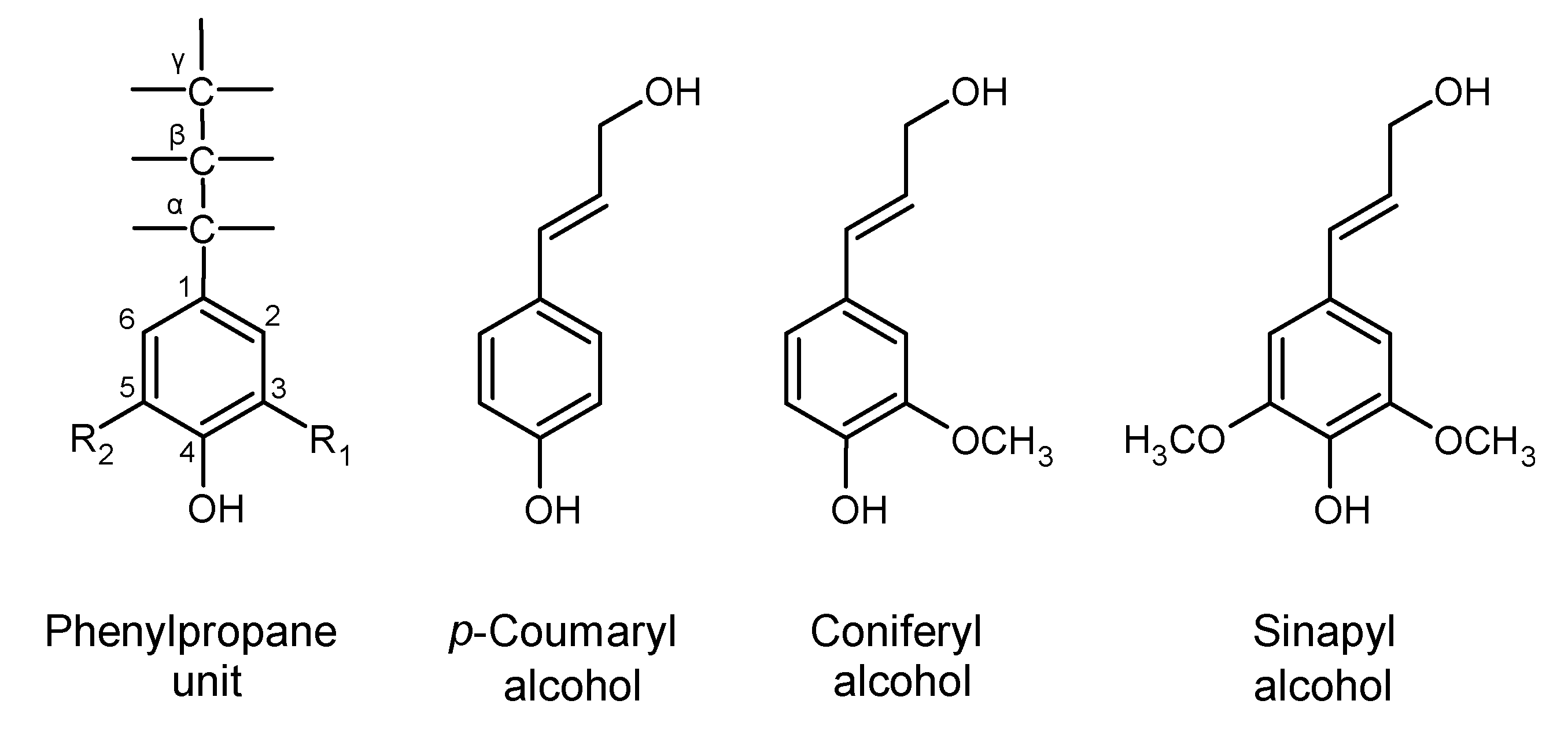
Figure 2.
Corresponding structural units in lignin (H-, G-, and S-units) and some alternative structures (G'- and S'- units).
Figure 2.
Corresponding structural units in lignin (H-, G-, and S-units) and some alternative structures (G'- and S'- units).
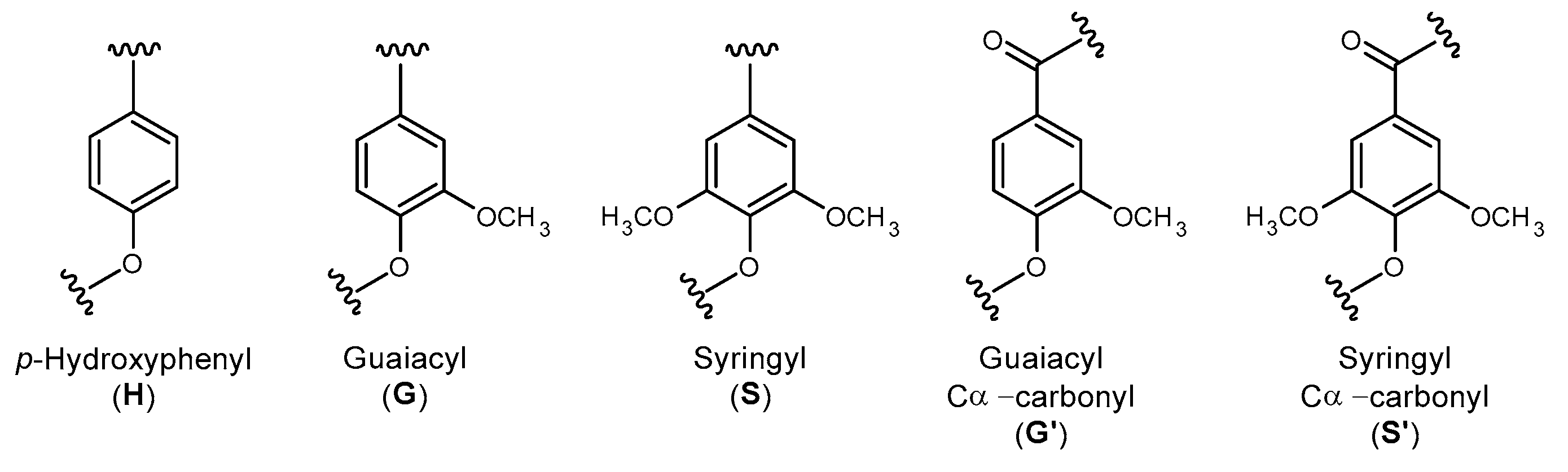
Figure 3.
Examples of side chain structure in end-groups in lignin.
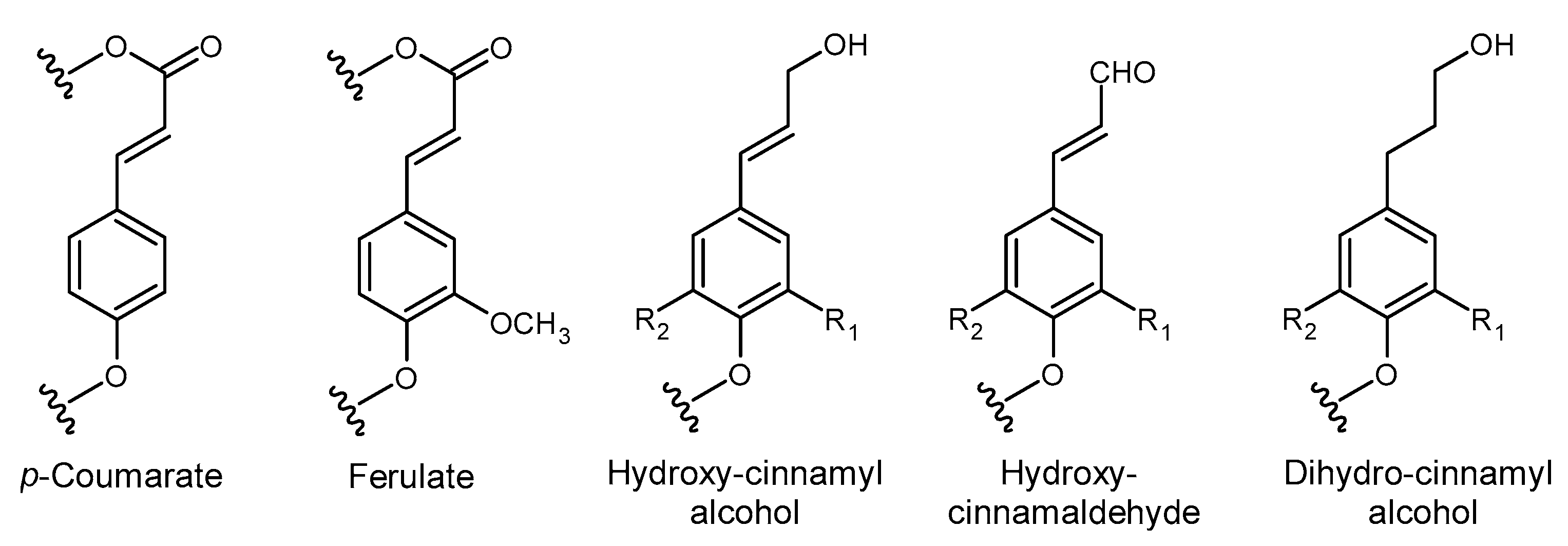
Figure 4.
Main interunit linkages in lignin.
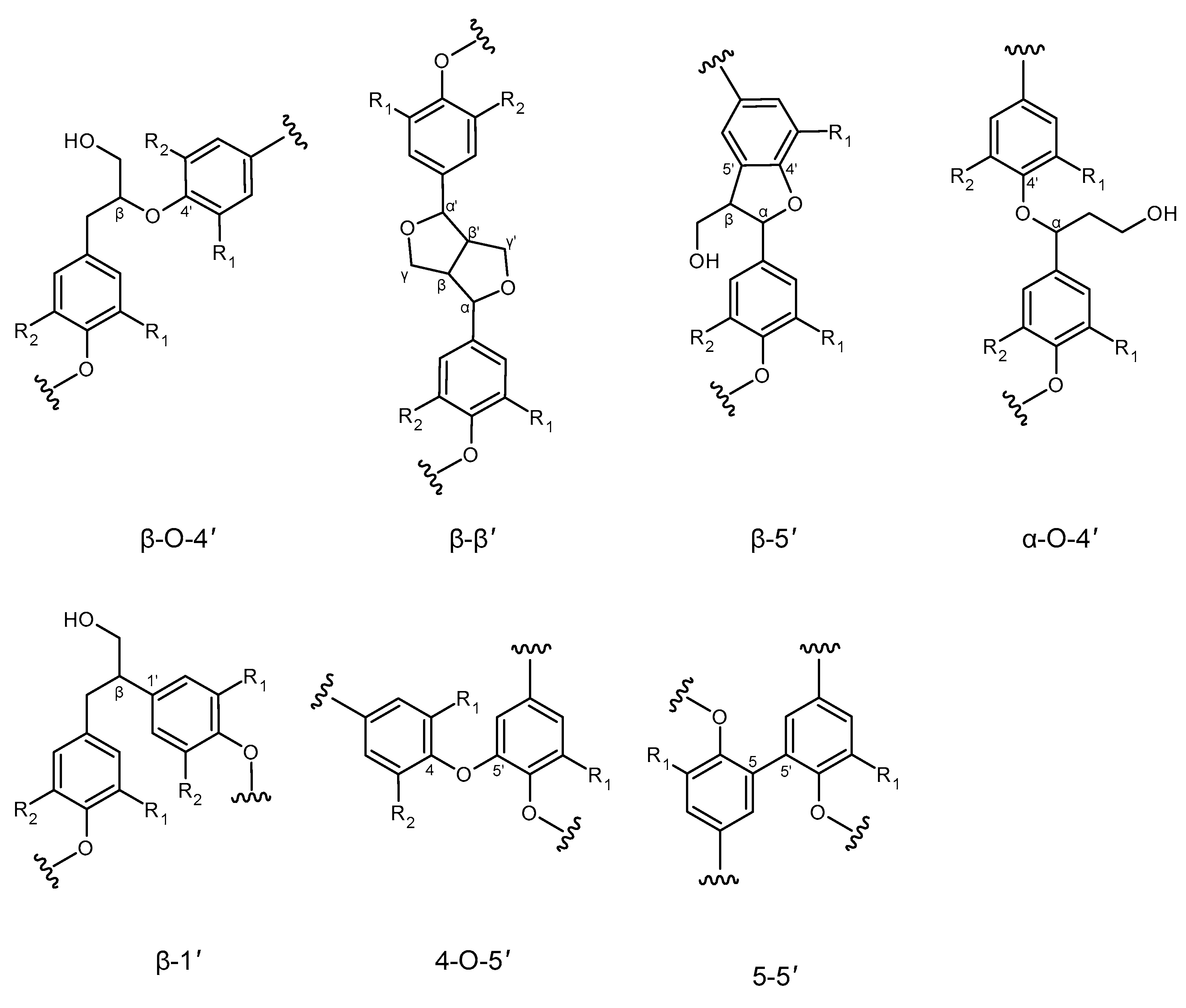
Figure 5.
Main functional groups in lignin.
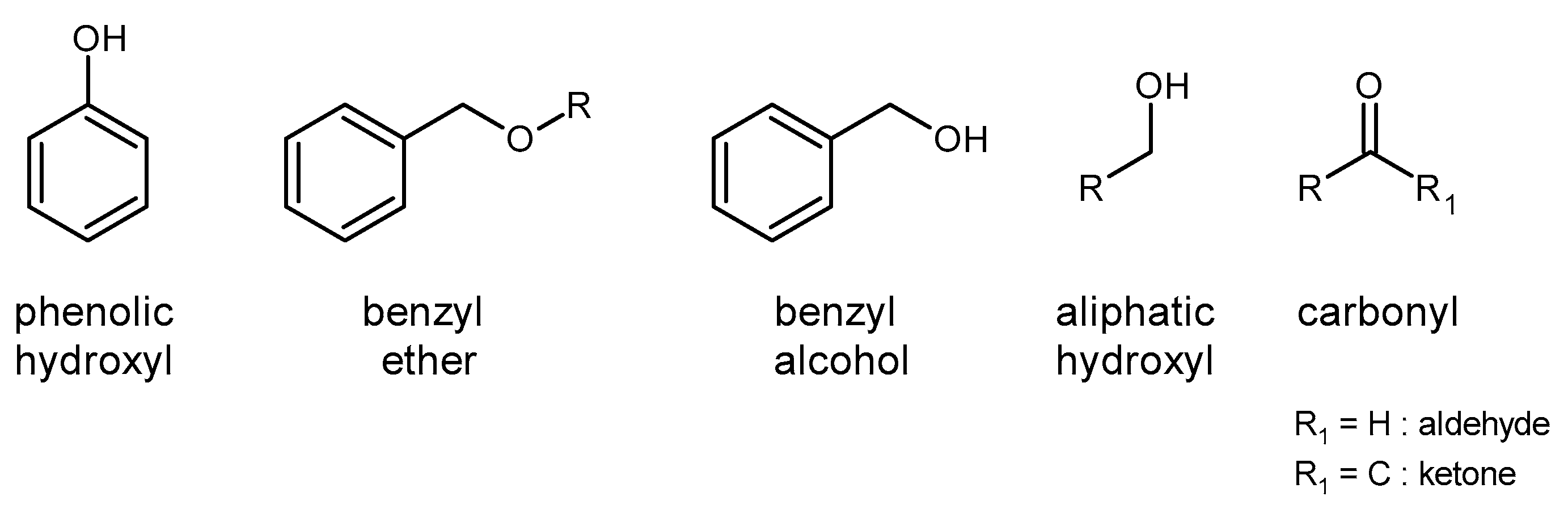
Figure 6.
A flow chart of the proposed process for the extraction and further processing of Kraft lignin and its degradation products [85].
Figure 6.
A flow chart of the proposed process for the extraction and further processing of Kraft lignin and its degradation products [85].
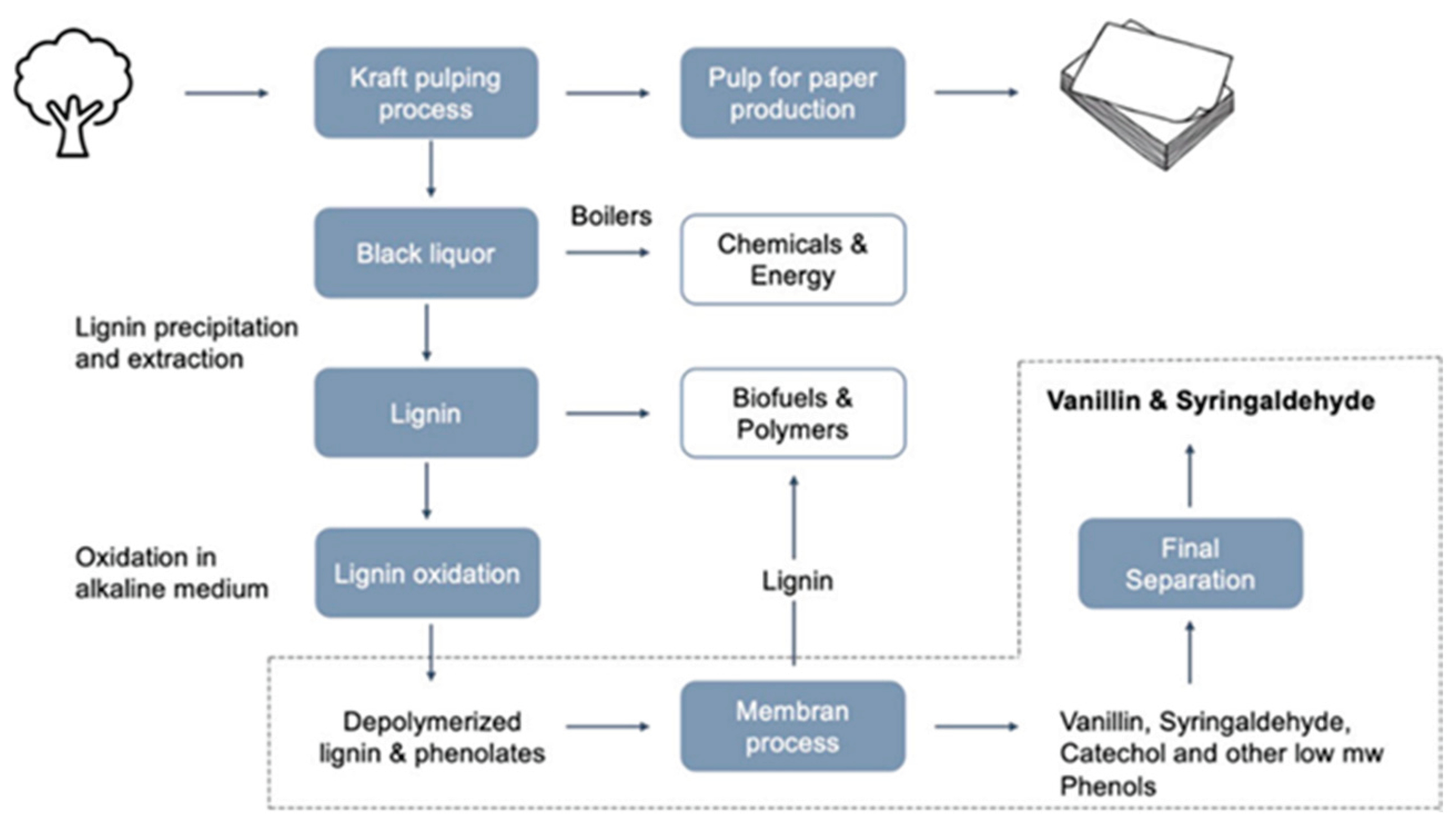

Table 1.
Monolignol content in various plant species (adapted from Odili et al. [49]).
Table 1.
Monolignol content in various plant species (adapted from Odili et al. [49]).
| Plant type | Syringyl (S) Units | Guaiacyl (G) Units | p-hydroxyphenyl (H) Units |
| Gymnosperms (Softwoods) | ~0% | 90–95% | 5–10% |
| Angiosperms (Hardwoods) | 45–65% | 35–55% | < 2% |
| Monocots (Grasses) | 25–50% | 25–50% | 5–35% |
Table 2.
Summary of catalysts and reaction conditions reported for the oxidative depolymerization of lignin to aromatic monomers.
Table 2.
Summary of catalysts and reaction conditions reported for the oxidative depolymerization of lignin to aromatic monomers.
| Type of lignin used | Reaction condition | Oxidant | Solvent / medium | Catalyst | Main products | Momomer yield (%) | Ref. |
| Enzymatic hydrolysis lignin | 80◦C, 4 h,0.1MPa | 10% H2O2 | MgFe2O4 (0.075g) | 13.4 | [128] | ||
| Kraft lignin | 150◦C, 10 min, 0.5MPa | O2 | VO(acac)2 -Cu(OAc)2 | Vanillin, vanillic acid and acetovanillone | 27,0 | [129] | |
| Kraft lignin | 150◦C, 10 min, 0.5 MPa | O2 | V-Cu/ZrO2 | 9,0 | [93,94] | ||
| Alkali lignin | 160◦C, 4 h | H2O2 | Fe-Mn/TS-1 | vanillin (8.36 wt% | 12.2 | [130] | |
| Hardwood, Fraunhofer | 120 °C, 3 bar, | O2 | 2 M NaOH(aq | 3,7 | [21] | ||
| Eucalyptus globulus sulfite liquor | 120 °C, 3 bar,15–20 min | O2 | 2 M NaOH(aq | 28 kg of syringaldehyde and 12 kg of vanillin per ton of lignin | 5,7 | [97] | |
| Beech lignin | 191 °C, 5 bar, 25 min | O2 | 2 M NaOH(aq) | Syringaldehyde (5.78 wt%), vanillin (2.31 wt%), Acetovanillone (0.48 wt%) acetosyringone (1.02 wt%) | 9.9 | [99] | |
| Lignin from lignocellulosic biomass | 250 °C, 300 psi, 10 min | O₂ | Perfluorodecalin | Vanillin, syringaldehyde, vanillic acid, syringic acid | 10.5 | [98] | |
| In situ lignin from eucalyptus, Masson pine and corn stover | 210 °C, 40 min | O₂/CuO oxidation | 2.5 M NaOH | CuO nanoparticles | Vanillin, vanillic acid, acetovanillone, syringaldehyde | 71.9 | [101] |
| Beechwood lignin | 191 °C, 5 bar | O₂ | Syringaldehyde (5.78 wt%) vanillin (2.31 wt%) | [99] | |||
| Native poplar lignin | 10 min, 175 °C ,, 5 bar O2 | O₂ | 2 M NaOH | Cu-containing catalysts tested | Syringaldehyde (13 wt%) and vanillin (7 wt%) and p-hydroxybenzoic acid (6 wt%) | 30,0 | [87] |
| Softwood biomass | 160–180 °C variable time | O₂/H₂O₂ | water–alkaline medium | catalyst Cu(OH)2 | Vanillin (4.7 wt% ) | [104] | |
| Kraft/technical lignin | 150°C, | Air (20 bar) | 0.25 N NaOH | CuO/TiO2 | Vanillin (5.1%) | [105] | |
| Kraft lignin | 150 °C, 60 min | H₂O₂ | Alkaline aqueous medium | Cu–Mn mixed oxide | Vanillin (6.8 %) | [19] | |
| Dealkali lignin | 160 °C 0.80 MPa, 2.5 h time. | O₂ | 1.0 mol/L NaOH solution, | LaFe0.2Cu0.8O3 | Syringaldehyde (10%) | [106] | |
| Fractionated Kraft lignin | 1-propanol, 130 °C, 60 min. | H₂O₂ | 2 M NaOH | CuSO₄ | Vanillin(10.9 wt%) | 46 | [102] |
| Native softwood lignin, Japanese cedar | 120 °C, 72 h | O₂/air | 1.25 mol/L Bu4N+ and 3.75 mol/L OH−. | Tetrabutylammonium ion | Vanillin (7.2% w/w) and vanillic acid (0,6% w/w) | [107] | |
| Kraft lignin | 180 °C | Peroxodicarbonate Na2C2O6 | Alkaline aqueous medium | — | Vanillin( 6.2 wt %) | [108] | |
| LignoBoost kraft lignin | 160 °C, 3 bar | O₂/H₂O₂ | Alkaline aqueous medium | Oxidation system | Vanillin and related aromatics | 3 | [114] |
Table 3.
Summary of catalysts and reaction conditions reported for the oxidative depolymerization of lignin to aliphatic Monomers.
Table 3.
Summary of catalysts and reaction conditions reported for the oxidative depolymerization of lignin to aliphatic Monomers.
| Type of lignin used | Reaction condition | Oxidant | Solvent / medium | Catalyst | Main products | Type de mononer | Ref. |
| LignoBoost lignin | 60 °C and 3h | H₂O₂ | Acidic conditions | Glycolic acid (8.88%), oxalic acid (18.23%), and malonic acid (9.94%) | Aliphatic dicarboxylic acids 53.4 wt% | [90] | |
| kraft lignin | (120-200 °C (3-15 bar | O₂ | Succinic acid (0.5%) | Carboxylic acids of 13% | [114] | ||
| Alkali lignin | 10 bar and 200 °C for 15–20 min | O₂ | Water / alkaline medium | NaOH | Oxalic acid (7.5%), glutaconic acid( 5.7%,) Succinic acid (3 wt%) | 44.0 wt% total acids | [113] |
| Pyrolytic lignin from pine pyrolysis liquid | 0 °C, 15–240 min | O₃ | Methanol | — | Succinic acid (2.0 wt%) and maleic acid (2.3 wt%) | Up to 40% molecular-weight reduction | [115] |
| Alkali lignin | 4 h; visible-light irradiation | H₂O₂/ addition of NaN₃ | Acetonitrile/water | Biochar-based solid-acid catalyst | Malonic, maleic, fumaric, succinic acids | 4 DCA yield to 56%, | [116] |
| Alkali lignin and organosolv lignin | 160–200 °C; optimum 200 °C, 2 min | 0.1% H₂O₂ | Water; hydrothermal flow reactor | — | Succinic acid (13 wt%) | Total organic acid yield of approximately 45 wt% | [118] |
| Industrial lignin | 60 °C for 5 h | H₂O₂ | Aqueous medium | CuFeS₂ nanoparticles | Succinic (~12 wt%), malic, fumaric, maleic acids | [120] | |
| Lignin | 7 MPa N₂ at 250 °C | CuFeS₂ in supercritical ethanol | Monoethyl adipate (10.2%) | [110] | |||
| Indulin AT, Lignol, E. globulus kraft and alkali lignins | Catalytic wet peroxide oxidation; variable T, pH and time | H₂O₂ | Aqueous medium | Titanium silicalite-1 (TS-1) | Succinic acid (11.3 wt% for Indulin AT) | [123] | |
| Industrial lignin | ~95 °C optimum | Electrochemically generated H₂O₂ | 1 M H₂SO₄ aqueous medium | TS-1 / electrochemical system | Succinic, maleic, fumaric, malic + short-chain carboxylic acids | Up to 32.9 wt% short-chain carboxylic acids | [125] |
| Softwood Kraft lignin (LignoForce) | Up to 550 °C; ~105 min | Air + steam | Gas phase | V₂P₂O₇ / mixed oxides | Maleic acid, butyric acid and other carboxylic acids | [126] | |
Disclaimer/Publisher’s Note: The statements, opinions and data contained in all publications are solely those of the individual author(s) and contributor(s) and not of MDPI and/or the editor(s). MDPI and/or the editor(s) disclaim responsibility for any injury to people or property resulting from any ideas, methods, instructions or products referred to in the content. |
© 2026 by the authors. Licensee MDPI, Basel, Switzerland. This article is an open access article distributed under the terms and conditions of the Creative Commons Attribution (CC BY) license.
Copyright: This open access article is published under a Creative Commons CC BY 4.0 license, which permit the free download, distribution, and reuse, provided that the author and preprint are cited in any reuse.