
Submitted:
23 October 2026
Posted:
26 October 2026
You are already at the latest version
Abstract
Multilingual legal information infrastructures connect official legislation repositories, terminology databases, translation memories, ontologies, search services, and artificial-intelligence systems. Conventional confidentiality-integrity-availability controls do not fully address a distinctive failure: a technically unchanged record can convey the wrong legal concept because its source, version, concept identity, cross-language scope, semantic relation, or approval history is defective. This article presents a PRISMA-informed systematic mapping review and standards synthesis. Ten query clusters yielded 100 retained scholarly occurrences and 41 official-document occurrences; after deduplication and screening, 52 substantive scholarly sources and 30 current standards, specifications, legal instruments, and guidance documents were included, with four methodology sources analysed separately. Of the scholarly corpus, 53.8% was empirical or technical, 38.5% conceptual or doctrinal, and 7.7% review-based; only 25.0% directly examined multilingual legal systems and 7.7% explicitly addressed low-resource languages. Evidence concentrated on semantic corruption, poisoning of data and retrieval, and governance/privacy, while script-specific attacks remained thinly studied. The review develops MLTIT, a seven-family taxonomy containing 33 threat and failure modes; MLTIAF, a fifteen-control defence-in-depth architecture; and a seven-risk privacy layer mapped to NIST, ISO, OWASP, MITRE ATLAS, Unicode, and legal-document standards. Analytical application to four observed Kazakh-Russian terminology discrepancies and one negative control in the SOZZ online dictionary illustrates the model’s discriminating function without treating the records as a prevalence sample or evidence of malicious attack. The central design rule is that AI may detect, rank, and explain risk, but may not autonomously alter authoritative legal content.
Keywords:
multilingual legal information infrastructure
; terminological integrity
; systematic mapping review
; cybersecurity
; data security
; privacy
; legal terminology
; retrieval-augmented generation
; data poisoning
; human oversight
1. Introduction
Law increasingly operates through an information infrastructure rather than through a single authoritative document. An official provision is drafted, translated, approved, published, consolidated, segmented, indexed, linked to definitions, exposed through an application-programming interface, cited by legal professionals, and increasingly retrieved or summarized by artificial-intelligence systems. In a multilingual legal order, every stage must preserve the relationship among several official or operationally authoritative language versions. The protected object is therefore not merely a file or database row; it is a chain of legal authority connecting text, version, concept, relation, source, decision, and downstream use.
The classical confidentiality-integrity-availability triad remains necessary, but byte-level integrity is not sufficient for this environment. A record may be unchanged and correctly signed while conveying the wrong law because it has been paired with a different amendment state, attached to the wrong concept identifier, stripped of an exception, merged with a narrower category, or presented as approved without the required expert decision. Conversely, a lawful correction may create a new integrity problem if the previous state and its downstream dependencies are silently erased. Terminological integrity must therefore protect the normative identity and scope of a legal concept as well as the technical state of the data that represents it.
Legal-linguistic scholarship establishes that legal meaning is institutionally and systemically constrained. Functional equivalence cannot be inferred from surface similarity, and literal difference does not necessarily imply legal divergence [5,6,7,8,9,10,11,12,13,14,15,16,17]. Multilingual legal corpora and benchmarks have made cross-language classification, summarization, retrieval, and evaluation possible at scale [18,19,20,21,22,23,24,25,26]. Documentation frameworks such as datasheets, data statements, model cards, and data cards improve the transparency of datasets and models [31,32,33,34]. Yet these streams usually treat the authenticity and alignment of source material as a prerequisite rather than as an attack surface.
Cybersecurity research shows why that assumption is unsafe. Homoglyphs, bidirectional controls, invisible characters, and inconsistent normalization can cause a text to be displayed differently from the way it is indexed or tokenized [37,38]. Poisoning, backdoors, adversarial triggers, and compromised annotations can alter downstream model behaviour without an obvious change in ordinary use [39,40,41,42,43,44,45,46]. Direct and indirect prompt injection can transform a document from passive evidence into an instruction channel, while poisoned retrieval collections can promote an untrusted record into the apparent basis of an answer [47,48,49,50,51,52]. Governance and audit research further demonstrates that technical controls fail when roles, evidence, and responsibility are under-specified [53,54,55].
The risk is amplified in low-resource multilingual environments. A small number of curated records may supply terminology to teaching materials, drafting teams, translation memories, search tools, and retrieval-augmented generation (RAG) systems. An error or manipulated entry can therefore propagate widely. At the same time, protective tools are often tested primarily in English. The published Qwen3 study of bilingual legal question answering in Kazakhstan illustrates the methodological importance of reporting language and domain coverage explicitly: it disclosed a large Russian-Kazakh dataset, quantified language imbalance, combined automated measures with blinded legal-expert assessment, and restricted conclusions where Kazakh data were absent [56]. That study evaluates model performance rather than infrastructure security, but its procedural transparency is directly relevant to review design in a low-resource legal setting.
Existing cybersecurity frameworks cover source management, access control, configuration, logging, incident response, privacy, and AI risk [65,66,67,68,69,70,71,72,73,74,75,76,77,78]. Terminology and legal-document standards provide concept modelling, stable identifiers, structured provisions, and provenance representation [57,58,59,60,61,62,63,64]. Data-protection and AI instruments add requirements of purpose limitation, security, human oversight, traceability, and accountability [81,82,83]. What remains missing is an integrated model that treats legally material cross-language meaning as a security property and distinguishes among malicious attack, accidental technical failure, semantic defect, governance breakdown, and privacy harm.
This article addresses that gap through a systematic mapping review and standards synthesis. It answers six research questions: (RQ1) Which properties constitute terminological integrity in multilingual legal information infrastructures? (RQ2) Which actors, vulnerabilities, threat events, and failure modes can compromise those properties? (RQ3) How is the available evidence distributed across technical, doctrinal, multilingual, low-resource, and privacy-focused research? (RQ4) Which controls are supported by empirical, conceptual, and normative sources? (RQ5) How should general cybersecurity and AI-governance controls be adapted to legal concepts, authentic language versions, and authoritative publication workflows? (RQ6) Can the resulting model discriminate between a legally relevant divergence and a literal difference that preserves legal function?
The contribution is sixfold. First, the article defines terminological integrity as a composite, operational security property. Second, it provides a transparent retained-record audit and quantitative evidence map rather than relying on an untraceable narrative bibliography. Third, it develops MLTIT, a seven-family taxonomy of 33 threat and failure modes, with an explicit analytical grammar separating threat source, vulnerability, event, affected asset, consequence, and control. Fourth, it develops MLTIAF, a fifteen-control defence-in-depth architecture and maps it to NIST, ISO, OWASP, MITRE ATLAS, Unicode, provenance, and legal-document standards. Fifth, it adds a cross-cutting privacy layer addressing drafts, user queries, audit data, model leakage, external processing, re-identification, and retention. Sixth, it applies the model to four observed Kazakh-Russian terminology conditions and one negative control in the public SOZZ online dictionary. The application is illustrative: it neither estimates prevalence nor infers malicious conduct from a semantic defect.
2. Conceptual Framework
2.1. Multilingual Legal Information Infrastructure
A multilingual legal information infrastructure (MLII) is a socio-technical system that creates, receives, stores, aligns, transforms, links, searches, publishes, or interprets legal content in more than one language. It includes official legislation repositories, consolidation systems, terminological databases, translation memories, ontologies, knowledge graphs, search indexes, APIs, analytical interfaces, and AI-assisted services. The definition is deliberately broader than “legal database” because many failures arise at service boundaries: a correct repository may feed a stale index, a verified statute may be linked to an obsolete translation memory, or an approved term may be retrieved together with an untrusted web document.
The infrastructure can be represented through six operational layers with governance, audit, and privacy cutting across all of them. The source layer contains official texts and metadata of legal authority. The version-and-structure layer binds articles, paragraphs, amendments, languages, and effective dates. The terminological layer represents concepts, definitions, lexicalizations, and equivalence statuses. The semantic layer stores typed relations such as genus-species, rule-exception, condition-consequence, and part-whole. The service layer handles import, export, search, indexing, APIs, and integrations. The model layer supports alignment, classification, RAG, generation, and expert assistance. A failure can cross several layers: a forged source enters through an import endpoint, receives a high retrieval rank, is summarized by an LLM, and becomes an automatically proposed change to a terminology record.
Multilinguality creates a distinctive synchronization requirement. A language tag is insufficient. The system must be able to prove that compared segments belong to the same legal act, structural unit, amendment package, and temporal state. Akoma Ntoso and the European Legislation Identifier provide important building blocks for structure and stable identification [61,62], while PROV-DM and PROV-O support representation of entities, transformations, and responsible agents [63,64]. These standards do not, however, determine whether two expressions preserve the same legally relevant scope. That judgment remains domain-dependent and must be made through a controlled legal-linguistic process.

Table 1.
Operational layers of multilingual legal information infrastructure.
| Layer | Name | Key assets | Typical threats |
|---|---|---|---|
| 1 | Source | Official acts, publication evidence, authority metadata | Source substitution; false attribution |
| 2 | Version and structure | Articles, paragraphs, language links, amendments, effective dates | Desynchronization; rollback; misalignment |
| 3 | Terminology | Concept IDs, labels, definitions, equivalence status | Concept substitution; duplicate/alias collision |
| 4 | Semantic | Typed relations, ontologies, knowledge graph | Relation corruption; ontology poisoning |
| 5 | Service | Import, API, search, index, export, integrations | Poisoned import; privilege bypass; rank manipulation |
| 6 | Model/AI | Alignment, classification, RAG, generation, tools | Prompt injection; hallucination; backdoor |
2.2. Terminological Integrity as a Security Property
Terminological integrity is the state in which a legal concept retains a verifiable identity, normative scope, typed relations, and authoritative status across source acquisition, multilingual representation, versioning, machine processing, expert approval, publication, and downstream reuse. The definition does not equate integrity with linguistic uniformity. A functionally equivalent formulation may differ substantially in grammar and vocabulary. The protected property is the legal function that the expression performs within the relevant normative system.
Eight properties operationalize the definition. Source authenticity requires a record to be bound to an identifiable issuing authority, publication channel, and retrievable source state. Version synchronicity requires paired language segments to represent the same amendment and effective period. Concept-identity persistence separates a stable concept identifier from a mutable display string. Cross-language functional equivalence preserves legally relevant elements such as subject, conduct, object, mental element, condition, exception, sanction, deadline, remedy, and systemic function. Relation integrity protects typed links among concepts and rules. Controlled change requires an attributable rationale, role, review status, and new version for each material amendment. Traceability and non-repudiation make model, system, and human actions reconstructable. Reversibility and forensic reconstruction preserve prior states and identify downstream artefacts that may have reused a damaged record.
These properties explain why ordinary database authorization is insufficient. An authorized expert can make a good-faith legal error; a correctly functioning integration can compare two different amendment states; and an LLM can accurately summarize a poisoned source. Terminological integrity therefore combines technical, semantic, procedural, and evidentiary components.
Table 2.
Eight properties of terminological integrity.
| Code | Property | Operational meaning |
|---|---|---|
| I1 | Source authenticity | The text and record are bound to verifiable official provenance. |
| I2 | Version synchronicity | Paired language segments represent the same amendment and effective state. |
| I3 | Concept-identity persistence | A stable concept ID is separated from mutable language labels. |
| I4 | Functional equivalence | Legally relevant scope and normative function are preserved across languages. |
| I5 | Relation integrity | Genus-species, rule-exception, condition-consequence and other typed links remain correct. |
| I6 | Controlled change | Every change has an actor, role, source, reason, review and new version. |
| I7 | Traceability | System, model and human actions can be reconstructed and attributed. |
| I8 | Reversibility and forensic reconstruction | Prior states and dependencies remain available for rollback and impact analysis. |
2.3. Threat Model and Trust Boundaries
The threat model protects nine asset classes: (1) official source texts and publication metadata; (2) version and amendment graphs; (3) stable concept identifiers; (4) term records, definitions, and typed semantic relations; (5) expert credentials, reviews, and disagreement records; (6) import batches, search indexes, and RAG collections; (7) system prompts, model versions, tool permissions, and configuration; (8) append-only audit evidence; and (9) confidential drafts, user queries, and personal or professional metadata.
Five threat-source categories are considered. An external attacker may substitute a source, inject malicious text, exploit a public API, or manipulate retrieval ranking. A compromised or negligent insider may approve a defective record, bypass review, or erase audit evidence. A supply-chain actor may provide a poisoned dataset, model, library, or hosted service. An integration or update failure may desynchronize language versions or silently roll back a legal state without malicious intent. Finally, an AI component may hallucinate a source, follow an indirect instruction, leak memorized data, or exceed its assigned agency even when no human actor intends the result.
The model assumes that the sovereign issuing authority and its formal promulgation act have not themselves been compromised; if the authoritative state is false at its origin, the problem exceeds the operational scope of the infrastructure. Physical destruction and general network availability are also outside the article’s core focus, although ordinary resilience controls remain necessary. The model does not decide which authentic language version legally prevails in a substantive dispute. It requires the system to expose the conflict, preserve evidence, and route the matter to an authorized legal process.
Four trust boundaries are critical: the boundary between external sources and the ingestion service; the boundary between ordinary users and privileged editorial operations; the boundary between untrusted content and model/tool instructions; and the boundary between the internal workflow and public authoritative release. A separate audit repository must not be writable through the ordinary application interface. These boundaries structure MLTIAF and prevent a convenience feature—such as one-click import or model-assisted correction—from silently becoming an authority-conferring operation.
2.4. Analytical Grammar of MLTIT
To avoid conceptual overreach, MLTIT uses a six-part analytical grammar. A threat source is the actor or process capable of causing harm. A vulnerability or enabling condition is the weakness that permits the event, such as missing version binding or excessive write privilege. A threat event is a deliberate action, while a failure mode is an unintended technical, semantic, or organizational event with the same protected consequence. The affected asset identifies what is changed, misattributed, exposed, or made unverifiable. The consequence describes the legal or operational effect. The control is the preventive, detective, corrective, or evidentiary measure assigned to the event.
Accordingly, “desynchronized language versions” is not labelled an attack unless evidence supports malicious action. It is a failure mode that can arise from parallel update jobs, human error, or deliberate rollback. “Scope narrowing” may be a translation defect, an annotation error, or the result of poisoned data. The taxonomy groups events by the primary asset and detection logic, not by presumed intent. This makes it usable for prevention and incident response while preserving the distinction between observed defect and alleged misconduct.
Table 3.
Analytical grammar separating threat, failure, asset, consequence, and control.
| Field | Operational question / examples |
|---|---|
| Threat source | External attacker; insider; provider; integration/update failure |
| Enabling condition | Weak provenance; excessive privilege; absent version binding; unsafe parsing; untrusted retrieval |
| Threat event / failure mode | Substitution; omission; rollback; poisoning; injection; disclosure; silent overwrite |
| Affected asset | Text; version; concept ID; relation; index; model/tool boundary; audit evidence; confidential data |
| Consequence | Altered legal scope; false authority; propagation; loss of attribution; privacy harm |
| Control and evidence | Prevent/detect/contain/recover measure plus a verifiable implementation artefact |
3. Materials and Methods
3.1. Review Design
This study is designed as a PRISMA-informed systematic mapping review combined with a separate synthesis of current official standards and legal instruments [1,2,3,4]. A mapping review is appropriate because the evidence is heterogeneous: it includes empirical attack studies, dataset and benchmark papers, conceptual security frameworks, legal-linguistic scholarship, technical standards, and binding or soft-law governance instruments. The objective is not to pool a common effect size, but to map evidence, identify under-studied areas, construct a threat-and-failure taxonomy, and connect each category to observable controls.
Two evidence streams were maintained. The scholarly stream supplied claims about legal equivalence, data resources, attack mechanisms, privacy leakage, secure logging, model behaviour, auditing, and socio-technical limitations. The official stream supplied normative requirements and technical control families from terminology, legal-document, provenance, cybersecurity, privacy, and AI-governance standards. Official instruments were not scored as if they were empirical research; their authority, current version, scope, and operational specificity were recorded separately.
3.2. Search and Information Sources
The review period ran from 1 January 2000 to 24 August 2026, with earlier foundational works admitted through backward citation where indispensable to legal language or secure-audit theory. Ten pre-specified query clusters combined multilingual/bilingual/cross-lingual terms with legal terminology and translation; legal corpora, benchmarks, ontologies, and knowledge graphs; provenance, versioning, integrity, and audit; Unicode and adversarial NLP; prompt injection; RAG poisoning; algorithmic auditability and human oversight; terminology standards; legal information-system security and privacy; and Kazakhstan/Kazakh bilingual law. Search strings and syntax adaptations are reproduced in Supplementary Table S1.
The audit begins at retained candidate records rather than unstable search-engine hit totals. Dynamic interfaces can change rankings, merge versions, and report totals that cannot be reconstructed. For each query cluster, the review therefore logged every record retained for title/abstract screening, its bibliographic identifier, query provenance, duplicate relation, decision, and exclusion reason. Publisher pages, DOI records, ACL/USENIX/IEEE proceedings, official standards repositories, legislation portals, and citation chaining were used to verify records. This design does not claim exhaustive coverage of every database-indexed item; it claims a complete and auditable account of the candidate set actually screened. For that reason, the title and methods use “systematic mapping review” rather than an unrestricted claim of exhaustive systematic review.
3.3. Eligibility and Selection
Scholarly sources were eligible if they were peer-reviewed articles, conference papers, scholarly books or chapters, or—only for rapidly evolving attack classes—substantive preprints that introduced an original threat model and had no later archival version. A source had to contribute at least one of the following: cross-language legal equivalence; multilingual legal-data architecture; source or version provenance; an attack or failure transferable to textual infrastructure; secure audit; privacy leakage; AI accountability; or a control that could be operationalized for legal terminology. General discussions of AI in law, model scaling, or fine-tuning were excluded when they did not address the protected assets, threat mechanisms, privacy, or controls. Image-, network-, or hardware-only attacks were excluded unless the paper established a defensible transfer to textual or language infrastructure.
The scholarly audit contained 100 retained query-level occurrences. Deduplication removed 26 repeated occurrences, leaving 74 unique candidates. Twelve records were excluded at title/abstract screening. Sixty-two full texts were assessed, and ten were excluded with record-level reasons. Fifty-two substantive scholarly sources entered the synthesis. Four methodology sources were used to design and report the review but were not counted as substantive evidence. The official stream contained 41 retained occurrences, three duplicates, and 38 unique documents; eight superseded or duplicative editions were excluded, leaving 30 current standards, specifications, legal instruments, and guidance documents. Figure 1 and Supplementary Table S2-S5 provide the complete flow and audit.
Figure 2.
Retained-record selection flow for scholarly and official streams.
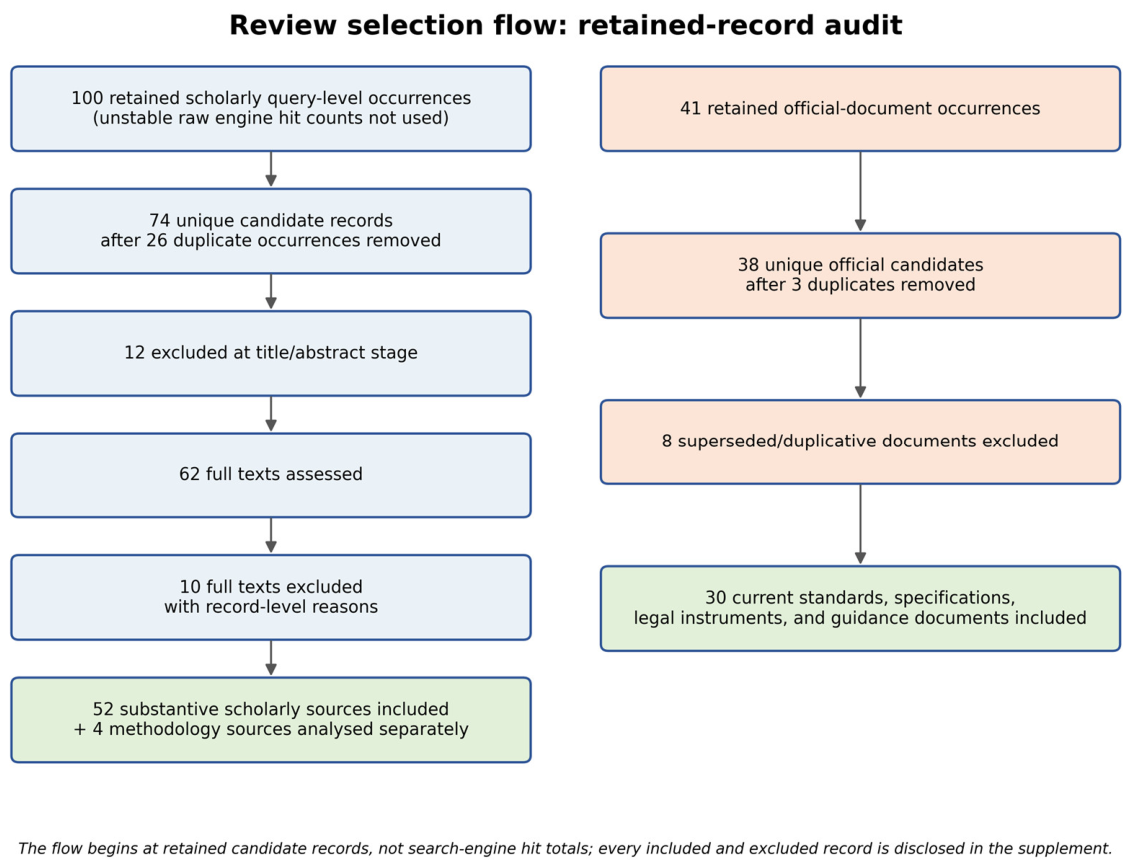
Table 4.
Retained-record selection counts.
| Selection stage | Count |
|---|---|
| Scholarly retained occurrences | 100 |
| Duplicates removed | 26 |
| Unique scholarly candidates | 74 |
| Excluded at title/abstract | 12 |
| Full texts assessed | 62 |
| Full-text exclusions | 10 |
| Substantive scholarly sources included | 52 |
| Methodology sources analysed separately | 4 |
| Official retained occurrences | 41 |
| Official duplicates removed | 3 |
| Unique official candidates | 38 |
| Official documents excluded / included | 8 / 30 |
3.4. Data Extraction, Quality Appraisal, and Stability Diagnostics
Each included scholarly source was coded for bibliographic status, research type, language and jurisdiction, protected asset, threat source, enabling condition, event or failure mode, security property, technical and legal consequence, proposed control, evaluation type, limitations, and transferability to low-resource multilingual law. Descriptive variables recorded whether the source directly studied a multilingual legal system, explicitly addressed a low-resource language, or contained a material privacy contribution. Each source received one primary MLTIT family and any justified secondary families. Because multi-label coding was permitted, family-assignment totals exceed the number of included sources.
A five-criterion applicability appraisal—clarity of object, methodological transparency, traceability of findings, relevance to the review question, and disclosure of limitations—was scored from 0 to 2 for each criterion. It is an applicability score for this synthesis, not a ranking of journal quality. The median score of included substantive sources was 9/10 (interquartile range 8-9). The full record-level matrix, including family assignments and scores, is supplied as Supplementary Data S1.
Selection and primary-family coding were subjected to a blinded second-pass consistency check within the same authoring workflow. Selection labels agreed for 69 of 74 records (93.2%; Cohen’s κ = 0.84). A stratified sample of 16 included sources was re-coded for primary family, with agreement in 14 cases (87.5%; κ = 0.85). The disputed boundaries concerned provenance versus poisoning (S1/S5) and structural alignment versus semantic corruption (S2/S4); they were resolved by coding the asset directly acted upon as primary and recording the other family as secondary. Because the passes were not performed by fully independent external reviewers, these coefficients are reported as internal stability diagnostics rather than as external inter-rater reliability. The complete codebook and disagreement log are disclosed in Supplementary Table S6-S7.
3.5. Synthesis and Taxonomy Construction
Quantitative synthesis was descriptive. The review calculated frequencies and percentages by evidence type, direct multilingual-legal coverage, low-resource coverage, privacy contribution, and MLTIT family. No meta-analysis was attempted because outcomes ranged from attack success and retrieval accuracy to doctrinal equivalence and governance requirements. Qualitative synthesis compared mechanisms, assumptions, controls, and limits, then derived atomic threat/failure modes. A category was retained separately when it required a distinct detection mechanism or produced a legally distinguishable consequence.
The fifteen MLTIAF controls were derived by mapping the taxonomy to current NIST, ISO, OWASP, MITRE ATLAS, Unicode, W3C, OASIS, and European legal-document frameworks [57,58,59,60,61,62,63,64,65,66,67,68,69,70,71,72,73,74,75,76,77,78,79,80,81,82,83]. Evidence maturity was classified as strong where multiple technical studies or mature standards support an operational control; moderate where standards and adjacent evidence support transfer but legal-domain testing is limited; and limited where the proposal is principally conceptual or institution-specific.
The applied analysis used five public SOZZ records: four purposively selected conditions covering concept substitution, scope narrowing, residual-class omission, and alternative omission, plus one negative control preserving legal function despite lexical difference [87,88,89,90,91]. Selection required a stable public URL, visible record status and date, and sufficient multilingual content for source-level comparison. The analysis was limited to the public interface; no penetration testing, private backend access, or claim about the platform’s internal controls was made. Observed content conditions were classified separately from hypothetical attack paths.
4. Results of the Evidence Mapping
4.1. Study and Document Selection
The completed retained-record flow is shown in Figure 1. The distinction between query-level occurrences and unique records is important. A source could be retained under several query clusters—for example, a poisoned RAG paper could appear under adversarial NLP, retrieval security, and legal-information-system security. Deduplication therefore reduced 100 scholarly occurrences to 74 unique candidates and 41 official occurrences to 38 unique documents. Record-level exclusions, rather than unexplained aggregate losses, are provided in the supplement.
The final evidence base comprised 52 substantive scholarly sources and 30 current official instruments. Four additional review-method sources guided procedure and reporting. The two streams were synthesized only after separate coding because an ISO or NIST document establishes a control requirement but does not itself demonstrate empirical effectiveness, while an attack paper can demonstrate a mechanism without establishing a legally appropriate governance response.
4.2. Evidence Profile
Of the 52 substantive scholarly sources, 28 (53.8%) were empirical, technical, or resource-building studies; 20 (38.5%) were conceptual, doctrinal, or framework-oriented; and four (7.7%) were reviews. Thirteen sources (25.0%) directly examined multilingual legal data or institutions. Only four (7.7%) explicitly foregrounded low-resource languages, and 13 (25.0%) made a direct privacy contribution. The evidence base is therefore technically substantial but unevenly aligned with the article’s precise problem.
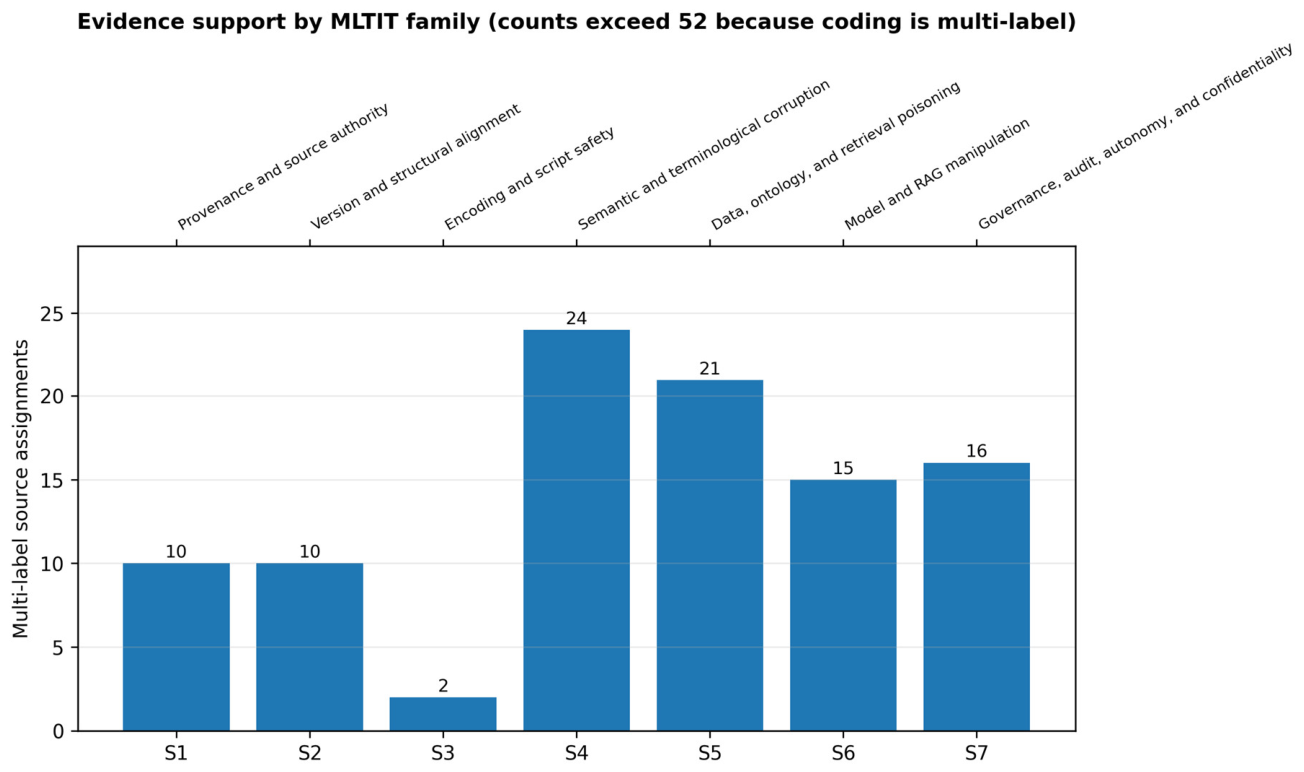
Multi-label mapping showed the strongest support for semantic and terminological corruption (S4, 24 assignments) and data, ontology, or retrieval poisoning (S5, 21). Governance, audit, autonomy, and confidentiality (S7) received 16 assignments, while model and RAG manipulation (S6) received 15. Provenance (S1) and version/structure (S2) each received ten. Encoding and script safety (S3) received only two direct assignments, notwithstanding the importance of Cyrillic-Latin and mixed-script environments. This distribution identifies a research imbalance: generic attacks are well documented, but their legal, multilingual, and script-specific operationalization remains thin.
Figure 3.
Evidence-type profile of the 52 included scholarly sources.
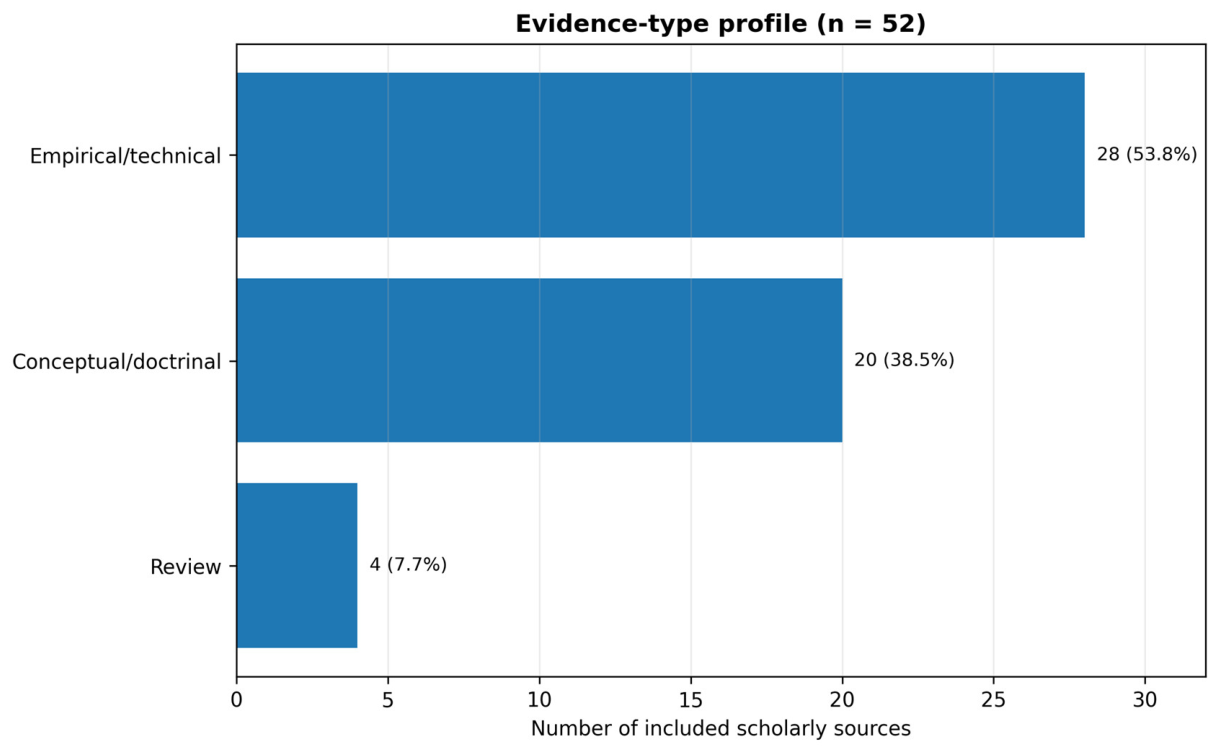
Table 5.
Quantitative profile of the scholarly evidence corpus.
| Characteristic | n / value | Share / range |
|---|---|---|
| Empirical/technical | 28 | 53.8% |
| Conceptual/doctrinal | 20 | 38.5% |
| Review | 4 | 7.7% |
| Direct multilingual-legal focus | 13 | 25.0% |
| Explicit low-resource focus | 4 | 7.7% |
| Direct privacy/leakage focus | 13 | 25.0% |
| Applicability score | Median 9/10 | IQR 8-9 |
4.3. Family Support and Control Maturity
Three evidence-maturity patterns emerged. First, the mechanism-level evidence is strong for Unicode manipulation, secure audit logging, training-data extraction, membership inference, model inversion, adversarial triggers, backdoors, prompt injection, and RAG poisoning [35,36,37,38,39,40,41,42,43,44,45,46,47,48,49,50,51,52]. These studies provide concrete attacker capabilities and observables, although most are not legal-domain studies. Second, evidence is moderate for source provenance, version control, concept identifiers, knowledge graphs, and controlled import. Mature standards exist, but empirical testing in multilingual legal publication workflows is limited [31,32,33,34,57,58,59,60,61,62,63,64,65,66,67,68]. Third, evidence is limited but normatively important for dual legal-linguistic review, reasoned resolution of authentic-text divergence, and a technical prohibition on autonomous correction. These controls follow from legal authority, separation of duties, and human-oversight principles rather than from a large body of comparative experiments.
The review also identified a persistent abstraction gap. Legal-linguistic scholarship explains what can make a difference legally material, but rarely models a hostile actor or compromised workflow. Security studies model attacks and mitigations, but usually treat text semantics as task accuracy rather than as the authoritative content of public power. The proposed taxonomy and architecture are intended to bridge, not erase, that disciplinary distinction.
Figure 4.
Multi-label evidence support across MLTIT families.
5. Cross-Disciplinary Evidence Synthesis
The first evidence stream concerns legal language and functional equivalence. Legal terms obtain meaning from institutional sources, doctrinal relations, and legal consequences, not from ordinary-language similarity [5,6,7,8,9,10,11]. Corpus methods help identify use patterns and hidden asymmetries [12,13,14,15], while multilingual-law scholarship shows that formally authentic texts may diverge and that no language can automatically be treated as the permanent source [16,17]. The security implication is that a system must preserve the evidence needed for legal reconstruction. A similarity score may flag a difference, but it cannot decide whether a broader category, exception, or modality has been altered.
The second stream concerns multilingual legal data. JRC-Acquis and DGT-TM demonstrate the value of aligned legislative and translation resources [18,19]. MultiEURLEX, FairLex, LEXTREME, MultiLegalPile, EUR-Lex-Sum, LexGLUE, and LegalBench expand multilingual classification, fairness, summarization, and legal reasoning [20,21,22,23,24,25,26]. Their documentation improves reproducibility, but a curated terminology database has a different trust function from a training corpus. A published record is often read as an authoritative assertion. Record-level provenance, version binding, review status, and correction history must therefore be first-class data, not optional documentation.
The third stream concerns provenance, documentation, ontologies, and audit. Datasheets, data statements, model cards, and data cards require developers to disclose source, composition, intended use, and limitations [31,32,33,34]. SKOS and OntoLex-Lemon separate a concept from its language-specific labels [57,58]; ISO 704 and ISO 1087 provide terminology principles and vocabulary [59,60]. Akoma Ntoso and ELI structure and identify legal resources [61,62], while PROV represents derivation and responsible agents [63,64]. Secure-log research provides forward-integrity and tamper-evidence mechanisms [35,36]. The gap is not absence of components but absence of a legal-integrity assembly rule that determines which evidence must accompany a multilingual equivalence decision.
The fourth stream establishes that text is an active attack surface. Unicode confusables and bidi controls can create a discrepancy between display and computation [37,38]. Adversarial triggers and TextFooler-style perturbations can alter classification [39,40]. Syntactic backdoors and weight poisoning create hidden behaviours [41,42]. Extraction, membership-inference, and inversion attacks undermine confidentiality [43,44,45], while web-scale poisoning demonstrates that apparently open data supply chains can be manipulated [46]. Prompt injection and poisoned retrieval extend these risks to LLM-integrated applications [47,48,49,50,51,52]. In a multilingual legal system, filters tested only in English may miss semantically equivalent instructions in Kazakh, Russian, transliteration, or mixed script.
The fifth stream concerns governance and privacy. Fairness and accountability research warns against abstracting away the organizational context in which a system operates [53,54,55]. The reviewed literature on knowledge graphs, blockchain privacy, metaverse privacy, and explainable-AI governance similarly shows that these domains require explicit trust boundaries and lifecycle controls [27,28,29,30]. NIST, ISO, the AI Act, the GDPR, and the Council of Europe AI Convention reinforce risk management, traceability, security, data governance, human oversight, and accountability [65,66,67,68,69,70,71,72,73,74,75,76,77,78,79,80,81,82,83]. Yet “human oversight” remains empty unless the system specifies who reviews legal materiality, what evidence they receive, whether disagreement is preserved, and which technical permissions the model lacks.
The synthesis supports one central proposition: terminological integrity is produced by a chain of mutually checkable evidence. A trusted source must be bound to a synchronized legal state; a stable concept identity must be separated from the display string; the equivalence decision must be reasoned and reviewable; the publication event must be attributable; and the previous state and downstream reuse must remain reconstructable. No single translator, administrator, model provider, or security control can supply the whole chain.
6. MLTIT Threat-and-Failure-Mode Taxonomy
MLTIT organizes 33 threat and failure modes into seven families according to the primary asset and detection logic. This choice avoids presuming malicious intent. The same version rollback may result from an attacker, a failed deployment, or a mistaken administrator action. The primary classification is determined by the asset directly acted upon; secondary codes record propagation or governance effects. The full codebook appears in Supplementary Table S8.
6.1. S1. Provenance and Source Authority
S1 concerns whether the infrastructure has received and continues to identify the authoritative legal object. The modes include substitution of an official source, detachment of signature or hash evidence, falsified provenance metadata, redirection of a stable identifier, and unauthorized enrolment of a source in a trust list. The controls must establish not merely a domain name but the issuing body, publication act, retrieval channel, legal-resource identifier, and cryptographic evidence. Adding a new trusted source is itself a high-risk change requiring separation of duties.
6.2. S2. Version and Structural Alignment
S2 concerns whether compared language segments represent the same legal state. Desynchronization can create a false positive by comparing a current text with an older translation or a false negative by hiding a change that entered only one language. Structural misalignment can pair the wrong paragraph, note, annex, or exception. Silent overwrite destroys evidence needed to assess past reliance. Composite version identifiers and atomic publication of related language states are therefore substantive integrity controls rather than mere configuration conveniences.
6.3. S3. Encoding and Script Safety
S3 concerns the gap between what a person sees and what a system stores, searches, or tokenizes. Cyrillic, Latin, and Kazakh-specific characters create confusable combinations; invisible and bidirectional controls can change indexing or display; inconsistent NFC/NFKC policies can produce duplicates or misses. Safe processing must preserve the original sequence as evidence, create a controlled normalized representation for comparison, expose suspicious code points to the reviewer, and avoid automatic mutation of authoritative text.
6.4. S4. Semantic and Terminological Corruption
S4 is the legal-semantic core. Concept substitution replaces one doctrine with another. Scope narrowing or expansion changes the persons, acts, objects, or circumstances covered. Omission can remove a condition, exception, alternative, or residual class. Negation or modality inversion changes obligation, permission, or prohibition. Relation corruption changes genus-species, rule-exception, or condition-consequence links. Unjustified synonymization merges concepts that the legal system keeps distinct. A difference is coded only where there is a plausible pathway to altered legal function; style alone is insufficient.
6.5. S5. Data, Ontology, and Retrieval Poisoning
S5 treats the terminology resource as a dependency of later systems. A poisoned import can propagate systematic defects. A compromised expert account can confer apparent authority on an inaccurate record. Graph corruption can redirect inference without changing individual labels. Identifier collisions destabilize references. A poisoned search or RAG collection can make an untrusted document dominate retrieval. Quarantine-by-default, batch provenance, anomaly checks, graph diffs, and human-controlled merge operations are therefore required before data reach the production index.
6.6. S6. Model and RAG Manipulation
S6 concerns model and RAG behaviour. Direct injection targets user input; indirect injection embeds instructions in a document presented as data. Cross-language transfer exploits the fact that a semantically equivalent malicious instruction may bypass an English-only filter. Backdoors or poisoned parameters create trigger-dependent behaviour. Hallucinated sources give unsupported output an appearance of legal authority. The critical architectural error is to combine untrusted content, authoritative context, and write authority in one model loop. Protected RAG must verify source and version, separate data from instructions, require checkable quotations, and abstain when support is insufficient.
6.7. S7. Governance, Audit, Autonomy, and Confidentiality
S7 concerns institutional authority and evidence. An approval-status bypass converts a draft into an authoritative record. Log deletion prevents attribution. Autonomous correction turns a probabilistic output into a system fact without an identifiable legal decision. Confidentiality failures expose drafts, user queries, reviewer identity, or expert disagreement. Governance is therefore part of security architecture: the model account cannot possess approve or publish permissions, the administrator cannot be the sole legal approver, and the expert cannot rewrite audit evidence.
Table 6.
MLTIT families, evidence support, protected assets, and controls.
| Family | Scope | Supporting sources | Primary protected asset | Core controls |
|---|---|---|---|---|
| S1 | Provenance and source authority | 10 | Official texts, publication metadata, stable identifiers | C1, C2, C8, C10 |
| S2 | Version and structural alignment | 10 | Articles, paragraphs, effective dates, amendment packages | C3, C4, C6, C12 |
| S3 | Encoding and script safety | 2 | Stored strings, identifiers, search and tokenizer input | C5, C6 |
| S4 | Semantic and terminological corruption | 24 | Concept identity, legal scope, definitions, typed relations | C6, C7, C8, C11, C14 |
| S5 | Data, ontology, and retrieval poisoning | 21 | Import batches, annotations, graph edges, indexes, retrieval rank | C7, C8, C9, C10, C13 |
| S6 | Model and RAG manipulation | 15 | System prompts, model versions, retrieved context, tool permissions | C2, C9, C10, C13, C14 |
| S7 | Governance, audit, autonomy, and confidentiality | 16 | Credentials, review decisions, logs, confidential drafts and queries | C10, C11, C12, C14, C15 |
7. MLTIAF Defence-in-Depth Architecture
7.1. Fifteen Controls and Required Evidence
MLTIAF converts the taxonomy into fifteen controls arranged as defence in depth. C1-C4 establish which legal state is being processed. C5-C8 preserve safe textual representation, concept identity, and provenance. C9-C10 control ingestion and authority. C11-C12 create reasoned review and protected evidence. C13-C14 constrain AI-assisted retrieval and correction. C15 provides response, rollback, and propagation analysis. Each control must generate an auditable artefact; a policy statement without operational evidence is not treated as implementation.
C1 and C2 require a signed or otherwise verifiable registry of official sources and a recorded validation result for each acquired object. C3 binds the act, structural unit, language, amendment package, effective date, and retrieval time. C4 prevents independent publication jobs from presenting incomplete language pairs as synchronized. These controls answer the threshold question: is the system analysing the correct legal object?
C5 creates a safe Unicode profile while preserving the original sequence. C6 validates structure, cross-references, lists, exceptions, alternatives, negation, and modality. C7 separates a persistent concept identifier from language-specific labels and records merge/split events. C8 creates a provenance and dependency graph linking sources, transformations, model output, expert decisions, published versions, and downstream uses.
C9 places imports and annotations in quarantine until automated and risk-based expert checks are complete. C10 enforces MFA, least privilege, and separation among author, language reviewer, legal reviewer, administrator, and publisher. C11 requires independent legal and linguistic reasoning for material equivalence decisions and preserves disagreement rather than averaging it away. C12 creates an append-only, tamper-evident audit with trusted time and protected access.
C13 defines a protected RAG boundary: retrieved documents are treated as data, not commands; the index records provenance and legal state; ranking incorporates authority and currency; every legal claim is tied to a verifiable source segment; privacy leakage is tested; and the model abstains when support conflicts or is absent. C14 is an enforceable no-autonomous-correction rule: the model may detect, rank, compare, and draft, but its credentials and API schema do not expose approve or publish functions. C15 prepares the organization to isolate a damaged source, identify affected dependencies, roll back safely, notify responsible institutions, and revalidate downstream translations, drafts, answers, and decisions.
Figure 5.
MLTIAF defence-in-depth architecture with a cross-cutting privacy overlay.
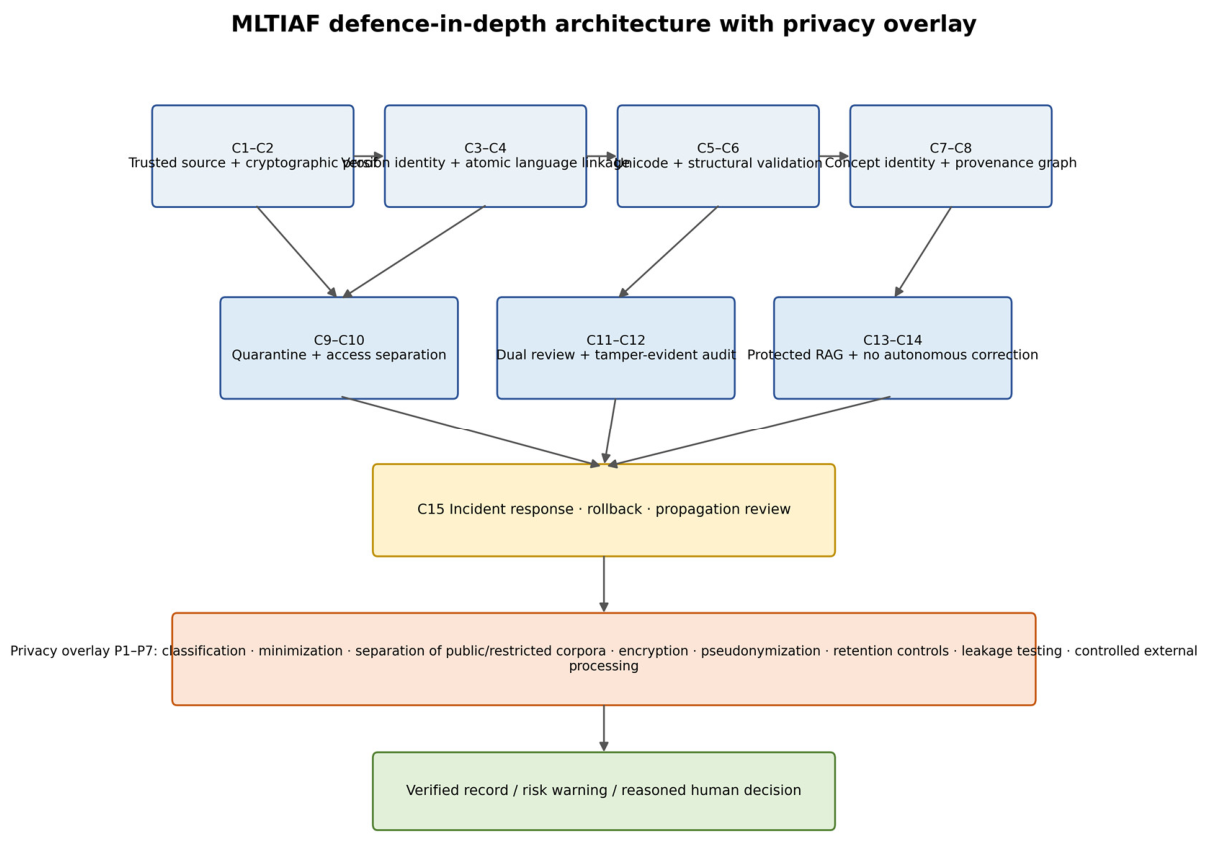
Table 7.
MLTIAF controls, evidence artefacts, maturity, and threat coverage.
| Code | Control | Operation | Evidence of implementation | Maturity | Coverage |
|---|---|---|---|---|---|
| C1 | Trusted-source registry | Approved official domains, issuing bodies, stable identifiers, and acquisition channels. | Signed/exported trust registry and approval record | Moderate | S1; S5.5 |
| C2 | Cryptographic source verification | Signature, certificate, hash, and checksum validation before ingestion or indexing. | Signature/hash/certificate validation result | Moderate | S1.2-S1.4; S2.2; S6.5 |
| C3 | Composite legal-version identifier | Identifier binds act, structural unit, language, amendment package, effective date, and retrieval time. | Composite act-unit-language-version-effective-date identifier | Moderate | S2.1-S2.3 |
| C4 | Atomic linking of language versions | Paired language states are updated and published transactionally or visibly marked incomplete. | Joint publication transaction identifier | Limited | S2.1; S2.4 |
| C5 | Safe Unicode profile | Confusable, mixed-script, bidi, normalization, and invisible-character checks while preserving the original sequence. | Unicode scan report and preserved original sequence | Strong | S3 |
| C6 | Schema and structural validation | Validation of article structure, numbering, lists, cross-references, negation, alternatives, and exceptions. | Schema/list/negation/reference validation report | Moderate | S2.3; S4.3-S4.4 |
| C7 | Persistent concept identifiers | Concept identity is separated from language-specific display strings; merge/split events are controlled. | Concept record, typed relations and merge/split history | Moderate | S4; S5.3-S5.4 |
| C8 | Provenance and dependency graph | Each record links sources, transformations, decisions, model output, and downstream dependencies. | PROV/dependency graph export | Moderate | S1; S2.4; S5.3; S7.2 |
| C9 | Quarantine-by-default import | New datasets and annotations cannot enter production search or RAG before automated and expert checks. | Quarantine record, batch hash and review result | Strong | S5.1; S5.5; S6.4 |
| C10 | Access control and separation of duties | RBAC/ABAC, MFA, least privilege, and separate author, reviewer, administrator, and publisher roles. | Role matrix, MFA event and workflow authorization | Strong | S1.5; S5.2; S7.1; P1-P7 |
| C11 | Dual legal-linguistic review | Material records require independent legal and linguistic reasoning, with documented disagreement escalation. | Two reasoned assessments and disagreement-resolution record | Limited | S4; S5.2 |
| C12 | Tamper-evident append-only audit | Signed events, hash chaining, trusted time, remote replication, and privacy-aware access to audit content. | Hash-chain root, trusted timestamp and remote integrity check | Strong | S2.4; S7.2; P1-P2; P6-P7 |
| C13 | Provenance-aware protected RAG | Data/instruction separation, trusted retrieval, source-aware ranking, citation verification, leakage controls, and abstention. | Retrieved-source list, quotation verification, leakage test and abstention event | Strong | S5.5; S6; P2-P5 |
| C14 | No-autonomous-correction rule | AI can detect, rank, and draft but has no approve/publish operation for authoritative legal content. | API/credential matrix excluding approve/publish for the model | Limited | S6.5; S7.3 |
| C15 | Incident response, rollback, and propagation review | Isolation, notification, rollback, dependency tracing, revalidation, and documented closure. | Incident record, dependency impact list, rollback and revalidation evidence | Moderate | All families |
7.2. Cross-Cutting Privacy and Confidentiality Layer
Privacy is a cross-cutting constraint rather than a single residual category. Legal statutes may be public, but the operational infrastructure can contain unpublished drafts, security reports, reviewer identities, disagreement records, user questions, search histories, model prompts, and personal data in examples or feedback. Seven privacy risks are therefore added to the architecture: loss of draft/reviewer confidentiality; exposure of user queries and audit logs; training-data extraction or memorization; membership, inversion, or attribute inference; disclosure to external providers or across borders; re-identification through metadata; and over-retention or incompatible secondary use.
Integrity and privacy can conflict. A detailed append-only log assists attribution but may expose sensitive deliberation. A permanent immutable store may frustrate deletion duties. The design response is not to abandon auditability, but to separate evidence from content. The public or widely accessible log can preserve event identifiers, timestamps, hashes, roles, and legal bases, while sensitive content is encrypted, access-controlled, and subject to retention rules. Pseudonymization must be tested against metadata linkage. Restricted drafts and user queries should be excluded from external model processing unless an authorized legal, contractual, and technical basis exists.
Table 8.
Cross-cutting privacy risks in multilingual legal information infrastructure.
| Code | Privacy risk | Mechanism / harm | Relevant controls |
|---|---|---|---|
| P1 | Draft and reviewer confidentiality loss | Unpublished amendments, reviewer identity, deliberation, or disagreement become accessible beyond the authorized group. | C10, C12 |
| P2 | User-query and audit-log exposure | Legal questions, search histories, prompts, and linked identifiers reveal sensitive professional or personal contexts. | C10, C12, C13 |
| P3 | Training-data extraction and memorization | A model reproduces restricted drafts, expert comments, or user submissions embedded in training or retrieval data. | C9, C13 |
| P4 | Membership, inversion, and attribute inference | An adversary infers whether a record or person contributed to the corpus or reconstructs protected attributes. | C9, C10, C13 |
| P5 | External-provider or cross-border disclosure | Prompts, drafts, or logs are transmitted to an external model or monitoring service without a lawful and controlled basis. | C10, C13 |
| P6 | Metadata re-identification | Timestamps, rare language use, role, edit sequence, or document linkage identify an expert despite nominal pseudonymization. | C10, C12 |
| P7 | Over-retention and secondary use | Data retained for audit are later reused for profiling, model training, or performance management without compatible purpose. | C10, C12, C15 |
7.3. Mapping to Recognized Frameworks
The standards mapping shows that MLTIAF does not replace general security or AI-management frameworks. NIST CSF 2.0 and SP 800-53 supply asset, access, configuration, monitoring, incident, and supply-chain controls [66,67]. ISO/IEC 27001, 27002, 27005, and 27701 supply information-security and privacy-management requirements [69-72]. NIST AI RMF, ISO/IEC 42001, and ISO/IEC 23894 support AI governance and risk management [73-75]. NIST’s adversarial-machine-learning taxonomy, OWASP’s LLM Top 10, and MITRE ATLAS provide attack language and mitigations [76-78]. Unicode specifications support confusable and script checks [79,80].
The legal-specific delta lies in what the controls must prove. C3-C4 prove that authentic language versions represent the same legal state. C7-C8 prove which legal concept and relation were approved. C11 preserves legal-linguistic reasoning and disagreement. C13 verifies not only that a citation exists but that it is authoritative, current, and supports the generated proposition. C14 prevents AI from acquiring normative authority through excessive agency. C15 traces not only affected systems but potentially affected translations, legislative drafts, guidance, and legal decisions.
Table 9.
Crosswalk between MLTIAF and [69–72established security, privacy, and AI-governance frameworks.
Table 9.
Crosswalk between MLTIAF and [69–72established security, privacy, and AI-governance frameworks.
| MLTIAF | NIST | ISO / AI governance | OWASP / MITRE | Legal-specific delta |
|---|---|---|---|---|
| C1-C2 | NIST CSF: ID.AM; GV.SC; SI; SP 800-53: SP 800-53: CM, SI, SR | ISO 27k: A.5/A.8 asset and supplier controls; AI: AI resources and data provenance | OWASP: LLM03 Supply Chain; LLM04 Data/Model Poisoning; MITRE: Supply-chain and data-source techniques | Adds legal authority, issuing-body and effective-version proof. |
| C3-C4 | NIST CSF: ID.AM; PR.PS; change control; SP 800-53: CM-2, CM-3, CM-8 | ISO 27k: Configuration and change management; AI: AI data lifecycle | OWASP: Indirectly supports LLM04; MITRE: Data staging and configuration compromise | Adds atomic linkage of authentic language versions and amendment packages. |
| C5-C6 | NIST CSF: PR.DS; DE.CM; SP 800-53: SI-10; SC-18; CM controls | ISO 27k: Input validation and secure processing; AI: Data quality and validation | OWASP: LLM05 Improper Output Handling; LLM04; MITRE: Input manipulation/evasion | Adds Unicode-script safety and legal-structure validation for negation, lists, and exceptions. |
| C7-C8 | NIST CSF: ID.AM; GV.OC; DE.AE; SP 800-53: AU, CM, PL | ISO 27k: Information classification and logging; AI: Traceability and data governance | OWASP: LLM03; LLM09 Misinformation; MITRE: Data provenance and knowledge-base compromise | Adds stable concept identity, typed legal relations, and decision provenance. |
| C9-C10 | NIST CSF: PR.AA; PR.DS; GV.RR; SP 800-53: AC, IA, CM, SR | ISO 27k: Access control; segregation of duties; AI: Roles, responsibilities, data controls | OWASP: LLM04; LLM06 Excessive Agency; MITRE: Credential access; poisoned training data | Adds separate legal, linguistic, administrative, and publication authority. |
| C11-C12 | NIST CSF: GV.RR; DE.AE; RS.AN; SP 800-53: AU, AC-5, IR | ISO 27k: Audit, non-repudiation, segregation; AI: Human oversight; records | OWASP: LLM06; LLM09; MITRE: Defense evasion; log modification | Adds reasoned legal-linguistic approval and preservation of disagreement. |
| C13-C14 | NIST CSF: PR.PS; DE.CM; GV.RM; SP 800-53: SI, AC-6, SC-7 | ISO 27k: Secure development and least privilege; AI: Human oversight and operational controls | OWASP: LLM01 Prompt Injection; LLM02 Sensitive Information Disclosure; LLM06 Excessive Agency; LLM09 Misinformation; MITRE: Prompt injection, data poisoning, model manipulation | Adds source/version citation verification and an enforceable no-autonomous-correction rule. |
| C15 | NIST CSF: RS; RC; SP 800-53: IR and CP families | ISO 27k: Incident management and continuity; AI: Incident, corrective action, continuous improvement | OWASP: Cross-cutting; MITRE: Response and recovery | Adds downstream legal-impact tracing across translations, drafts, decisions, and published records. |
8. Applied Analysis of the SOZZ Kazakh-Russian Terminology Infrastructure
The applied analysis examined five stable public records in the SOZZ multilingual legal dictionary, accessed on 24 August 2026 [87,88,89,90,91]. The legal characterization was anchored in Kazakhstan’s legislation on legal acts, languages, and criminal law [84,85,86]. The case was selected because the dictionary is an operational project output that exposes multilingual labels, definitions, publication statuses, and dates, and because its records may be reused by legal researchers, educators, translators, and AI-assisted search. The analysis was limited to the public interface. It did not involve backend access, penetration testing, account testing, or an inference that a visible semantic defect resulted from malicious conduct. Four records were treated as positive analytical scenarios and one as a negative control.
K1 concerns the record that aligns the Kazakh label “Қылмыстық құқық бұзушылықтар жиынтығы” and the English “aggregate of criminal offences” with the Russian heading “Сoставы угoлoвных преступлений” [87]. The visible definition concerns commission of two or more offences, whereas the Russian heading ordinarily denotes the constituent elements of a single offence. The condition is therefore coded as S4.1, legal-concept substitution, with a possible S5.4 identifier/merge problem if one record conflates two concept identities. The safe response is not silent replacement. C7 requires separate persistent concept identifiers; C8 links each concept to the relevant statutory source; C11 preserves independent legal and linguistic reasons; C12 records the old and new state; and C15 checks whether dependent materials reused the affected heading.
K2 concerns the complicity record, where the Kazakh and English labels use the general category “criminal offence”, while the Russian heading and definition use the narrower “crime” [88]. Because Kazakhstan’s criminal-law taxonomy distinguishes the general category from its species, the condition is coded as S4.2, scope narrowing. The code does not by itself decide legal materiality. A reviewer must compare the current statutory provision, the systemic relation between the categories, and the practical function of the record. C6 can flag the genus-species asymmetry, C7 preserves the hierarchy, C11 requires expert determination, and C14 prevents a model from treating the flag as authority to publish a correction.
K3 concerns the intoxication record [89]. The visible Russian and Kazakh definitions enumerate alcohol, narcotic drugs, and psychotropic substances but do not reproduce the residual class “other intoxicating substances” retained in the English and Turkish records. The analytical code is S4.3: omission of a residual class. A structural checker can identify unequal list length and the disappearance of an open-ended marker, but it cannot determine the legal effect without the source norm and domain expertise. The priority controls are C6, C11, and C13, because an incomplete approved record can be amplified through retrieval even where no malicious modification occurred.
K4 concerns the criminal-record entry [90]. The Russian, English, and Turkish representations refer to both expiry/expungement and removal, while the visible Kazakh definition reflects only one termination alternative. The condition is coded as S4.3 and, where the record is retrieved as an authoritative answer, as a potential S5.5 propagation path. C8 must link the record to its source and dependent uses; C11 records the legal-linguistic assessment; C12 preserves the correction trail; C13 must expose conflicting language evidence instead of selecting the highest-ranked wording; and C15 supports retrospective propagation analysis.
K5 is the negative control [91]. The Russian label “Испoлнитель”, the Kazakh “Орындаушы”, and the English “perpetrator” are not literal equivalents in every ordinary-language setting, but the displayed definitions preserve the legally relevant functions of direct commission, co-perpetration, and commission through persons who are not criminally liable or act negligently. No S4 code is assigned merely because the lexical forms differ. This control demonstrates the boundary condition of the taxonomy: functional equivalence, not verbal uniformity, is the protected property.
The five-record analysis shows what a minimum evidentiary bundle should contain for every authoritative term record: a persistent concept identifier; the exact official source and structural unit; a composite version/effective-date identifier for each language; the original and normalized strings; typed semantic relations; the equivalence status and its legal-linguistic reasons; independent reviewer identities or protected pseudonymous identifiers; the decision time and workflow signature; the complete version history; a dependency list; and privacy classification. A record lacking these elements may still be useful as a public draft or educational aid, but it should not be presented to an automated system as an unqualified authoritative fact.
Table 10.
Four positive SOZZ scenarios and one negative control.
| ID | Public record | Observed condition | MLTIT | Controls | Evidentiary characterization |
|---|---|---|---|---|---|
| K1 | Aggregate of criminal offences / Қылмыстық құқық бұзушылықтар жиынтығы / “Сoставы угoлoвных преступлений” | The Russian heading denotes offence composition, while the definition and the Kazakh/English labels concern plurality of offences. | S4.1; S5.4 | C7, C8, C11, C12, C15 | Observed semantic-procedural defect; no evidence of malicious alteration |
| K2 | Complicity in a criminal offence / Қылмыстық құқық бұзушылыққа сыбайлас қатысу / “Сoучастия в угoлoвнoм преступлении” | The Russian label and definition use the narrower species “crime” instead of the Code’s general category “criminal offence”. | S4.2 | C6, C7, C11, C14 | Observed scope-narrowing condition; legal materiality requires expert confirmation |
| K3 | Commission of an offence in a state of intoxication | The Russian and Kazakh definitions omit the residual class “other intoxicating substances”, retained in English and Turkish. | S4.3 | C6, C11, C13 | Observed omission; security relevance arises from authoritative reuse and propagation |
| K4 | Criminal record / Сoтталғандық / Судимoсть | The Kazakh definition reflects expiry/expungement but omits the alternative of removal that appears in the Russian, English, and Turkish records. | S4.3; S5.5 | C8, C11, C12, C13, C15 | Observed alternative omission with potential RAG propagation |
| K5 | Perpetrator / Орындаушы / Испoлнитель (negative control) | The labels differ lexically, but both definitions preserve direct commission, co-perpetration, and use of non-liable or negligent persons. | No S4 classification | C7, C11 | Negative control: literal difference without a plausible change in legal function |
9. Discussion
The review makes three principal theoretical contributions. First, it extends information integrity from protection of data state to protection of legal-semantic identity. Conventional integrity controls answer whether a file or record was altered by an unauthorized process. Terminological integrity additionally asks whether an authorized and technically valid record still represents the correct legal concept, version, relation, and source. This extension is necessary because many legally serious failures arise without an access-control violation: a trusted editor can approve a narrower term, an integration can align different amendment states, or a model can faithfully summarize a poisoned source.
Second, MLTIT separates threat and failure analysis from assumptions about malicious intent. The seven-family structure covers attack, error, update failure, semantic defect, governance bypass, and privacy disclosure, while the analytical grammar specifies the source, enabling condition, event, asset, consequence, and control. This distinction improves incident handling. An observed omission in a public term record is evidence of a semantic-procedural condition, not evidence that an attacker altered the database. The same observed condition nevertheless identifies a propagation risk if the record is ranked as authoritative, embedded in a translation memory, or used by RAG.
Third, MLTIAF translates legal-linguistic concerns into operational evidence. Its contribution is not a new general cybersecurity standard. Rather, it defines what existing controls must prove in this domain: that two language segments belong to one legal state; that an equivalence decision concerns one stable concept; that the person approving the record has the required legal and linguistic competence; that model output remains a proposal; and that an incident can be traced through dependent translations, documents, indexes, and answers.
The quantitative map clarifies the maturity of the knowledge base. Empirical and technical studies form a majority of the scholarly corpus, but they predominantly address general NLP, model, retrieval, privacy, or audit problems. Direct multilingual-legal evidence is limited to 13 of 52 sources, and only four explicitly engage low-resource settings. The strongest evidence supports semantic corruption, poisoning, model/RAG manipulation, and governance. Script-specific security is represented by only two directly coded sources. These imbalances constrain generalization: a control validated on English prompts or Latin-script identifiers cannot be assumed to detect a Kazakh-Russian mixed-script attack.
The methodological lesson from the published Kazakhstan Qwen3 study is relevant here even though the research designs differ [56]. That article disclosed the exact cleaning and deduplication pipeline, language/domain imbalance, blinded legal-expert protocol, agreement statistics, and explicit scope restrictions. A mapping review should apply the same discipline to its own evidence process. Accordingly, the revised article reports retained-record counts, exclusions, classification rules, evidence types, coverage gaps, and internal stability diagnostics. It does not convert those diagnostics into a claim of external expert consensus, and it restricts conclusions where the retained evidence is sparse.
Privacy materially changes the design of auditability. A complete log is useful for attribution and forensic reconstruction but may expose legislative drafts, user questions, reviewer identities, or disagreement. “Immutable” must therefore not mean permanently public or impossible to govern. A defensible implementation separates tamper-evident event proof from sensitive content: hashes, timestamps, roles, and legal bases can be preserved in an append-only evidence layer, while content is encrypted, access-controlled, retention-limited, and deletable where law requires. The architecture must also treat model-provider telemetry, prompt storage, and cross-border processing as data flows rather than invisible implementation details.
Responsibility is distributed but not diluted. The issuing authority is responsible for the status and correction of official texts. The infrastructure operator controls source registries, versions, permissions, logging, and incident response. The model or service provider must disclose system limits, secure interfaces, and relevant supply-chain dependencies. The legal and linguistic reviewers are responsible for reasoned decisions within their competence. The publication authority remains responsible for the final record. Protected audit should make those contributions reconstructable without turning human oversight into a ceremonial click.
The no-autonomous-correction rule is consequently best understood as a privilege boundary. It does not prohibit AI assistance. A model may align language segments, detect list asymmetry, identify missing negation, rank risks, retrieve sources, and draft an explanation. It may not hold the credential or API operation that changes an approved term, consolidated statute, or publication status. Requiring a separately identifiable and reasoned human decision makes responsibility observable and limits excessive agency.
The next empirical stage should test, rather than presume, the effectiveness of MLTIAF. A benchmark could combine verified Kazakh-Russian term pairs, negative controls, version mismatches, Unicode manipulations, poisoned imports, cross-language prompt injections, and RAG-source conflicts. Independent legal and linguistic coders should establish a gold standard; Cohen’s kappa or Krippendorff’s alpha should be reported; model and control performance should be measured through precision, recall, critical false-negative rate, attack success rate, citation verification, audit completeness, recovery time, and reviewer workload. Those tests would validate individual controls without changing the present article’s status as a non-experimental review.
Several limitations remain. The selection flow begins with retained candidate records generated by ten documented query clusters and citation chaining; it does not claim an exhaustive export of every database hit. The complete retained-record audit is supplied so that a future institutional Scopus/Web of Science replication can extend or challenge the map. Screening and coding stability were assessed through repeated blinded passes within the same authoring workflow, not through independent external reviewers; the reported coefficients are diagnostics of internal stability, not inter-rater reliability. The evidence map uses source-level coding and does not estimate the prevalence of real-world incidents. The SOZZ analysis is confined to five public records and does not inspect private architecture or prove implementation of any proposed control. Finally, the legal effect of a language divergence depends on the constitutional and statutory status of language versions in each jurisdiction, so MLTIAF requires local legal adaptation.
10. Conclusions
Multilingual legal information infrastructures require a security property that extends beyond confidentiality, availability, and byte-level integrity. Terminological integrity links source authority, version synchronization, stable concept identity, functional equivalence, typed semantic relations, controlled change, protected evidence, reversibility, and privacy. Without that linkage, a technically valid system may faithfully disseminate the wrong legal concept.
The systematic mapping review retained 52 substantive scholarly sources and 30 official standards, specifications, legal instruments, and guidance documents, with four methodology sources analysed separately. The evidence is substantial for semantic corruption, poisoning, model/RAG manipulation, and governance, but thin for script-specific and low-resource multilingual threats. MLTIT organizes the resulting knowledge into seven families and 33 threat and failure modes. MLTIAF connects those modes to fifteen controls and a seven-risk privacy layer, while the standards mapping identifies the legal-specific proof that general frameworks do not supply.
The four positive SOZZ scenarios and one negative control illustrate the model’s central distinction. A visible semantic defect is not proof of an attack, and a literal language difference is not automatically a threat. The relevant question is whether the infrastructure can prove the source, legal state, concept identity, functional scope, decision, and history of the record, and whether it can prevent a model or unauthorized user from converting an unverified output into authoritative content.
The resulting design rule is precise: AI may search, align, detect, rank, retrieve, compare, and explain; it may not autonomously approve, publish, or correct authoritative legal text. Secure multilingual legal automation therefore depends not on eliminating human judgment but on making source evidence, expert reasoning, technical privilege, privacy protection, and responsibility verifiable throughout the information lifecycle.
Funding
This research was funded by the Science Committee of the Ministry of Science and Higher Education of the Republic of Kazakhstan under programme-targeted funding, IRN BR24993217, “Harmonisation of Legal Terminology and Linguistic Authenticity of Legislative Texts in the Field of Criminal Law of the Republic of Kazakhstan”. The funder had no role in the design of the review; selection, analysis or interpretation of sources; preparation of the manuscript; or the decision to submit it.
Institutional Review Board Statement
Not applicable. The study used publicly available scholarly, technical, legal, standards, and public terminology materials and did not involve human participants, animals, or identifiable personal data.
Informed Consent Statement
Not applicable.
Data Availability Statement
The dataset was assembled from publicly available Kazakhstani legal sources. All personal information from legal consultations was anonymised before inclusion. Training code, model configurations, per-sample automated evaluation results, and aggregated expert evaluation scores (per-model panel means and agreement statistics) will be released upon publication to support reproducibility. Inquiries should be directed to the corresponding author. No confidential or personal dataset was created.
Acknowledgments
The authors acknowledge the research environment and preliminary terminological systematization undertaken within project IRN BR24993217.
Conflicts of Interest
The authors declare no conflict of interest.
References
- Page, M.J.; McKenzie, J.E.; Bossuyt, P.M.; et al. The PRISMA 2020 statement: An updated guideline for reporting systematic reviews. BMJ 2021, 372, n71. [Google Scholar] [CrossRef]
- Kitchenham, B.; Charters, S. Guidelines for Performing Systematic Literature Reviews in Software Engineering; Keele University and Durham University, 2007; Available online: https://www.elsevier.com/__data/promis_misc/525444systematicreviewsguide.pdf.
- Snyder, H. Literature review as a research methodology: An overview and guidelines. J. Bus. Res. 2019, 104, 333–339. [Google Scholar] [CrossRef]
- Webster, J.; Watson, R.T. Analyzing the past to prepare for the future: Writing a literature review. MIS Q. 2002, 26, xiii–xxiii. Available online: https://www.jstor.org/stable/4132319. [CrossRef]
- Tiersma, P.M. Legal Language; University of Chicago Press: Chicago, IL, USA, 1999; Available online: https://press.uchicago.edu/ucp/books/book/chicago/L/bo3624429.html.
- Šarčević, S. New Approach to Legal Translation; Kluwer Law International: The Hague, The Netherlands, 1997; Available online: https://law-store.wolterskluwer.com/s/product/new-approach-to-legal-translation/01t0f00000J3aaWAAR.
- Cao, D. Translating Law; Available online; Multilingual Matters: Clevedon, UK, 2007. [Google Scholar] [CrossRef]
- Mattila, H.E.S. Comparative Legal Linguistics: Language of Law, Latin and Modern Lingua Francas, Available online, 2nd ed.; Ashgate: Farnham, UK, 2013. [Google Scholar] [CrossRef]
- Solan, L.M. The Language of Statutes: Laws and Their Interpretation; University of Chicago Press: Chicago, IL, USA, 2010; Available online: https://press.uchicago.edu/ucp/books/book/chicago/L/bo8161096.html.
- Tiersma, P.M.; Solan, L.M. (Eds.) The Oxford Handbook of Language and Law; Available online; Oxford University Press: Oxford, UK, 2012. [Google Scholar] [CrossRef]
- Gibbons, J. Forensic Linguistics: An Introduction to Language in the Justice System; Blackwell: Oxford, UK, 2003; Available online: https://www.wiley.com/en-us/Forensic+Linguistics%3A+An+Introduction+to+Language+in+the+Justice+System-p-9780631212478.
- McEnery, T.; Hardie, A. Corpus Linguistics: Method, Theory and Practice; Available online; Cambridge University Press: Cambridge, UK, 2012. [Google Scholar] [CrossRef]
- Vogel, F.; Hamann, H.; Gauer, I. Computer-assisted legal linguistics: Corpus analysis as a new tool for legal studies. Law Soc. Inq. 2018, 43, 1340–1363. [Google Scholar] [CrossRef]
- Solan, L.M. Corpus linguistics as a method of legal interpretation: Some progress, some questions. Int. J. Semiot. Law 2020, 33, 283–298. [Google Scholar] [CrossRef]
- Solan, L.M.; Gales, T. Corpus linguistics as a tool in legal interpretation. BYU Law Rev. 2017, 2017, 1311–1358. Available online: https://digitalcommons.law.byu.edu/lawreview/vol2017/iss6/5/.
- McAuliffe, K. Language and law in the European Union: The multilingual jurisprudence of the ECJ. In The Oxford Handbook of Language and Law; Available online; Tiersma, P.M., Solan, L.M., Eds.; Oxford University Press: Oxford, UK, 2012. [Google Scholar] [CrossRef]
- Biel, Ł. Lost in the Eurofog: The Textual Fit of Translated Law; Available online; Peter Lang: Frankfurt am Main, Germany, 2014. [Google Scholar] [CrossRef]
- Steinberger, R.; Pouliquen, B.; Widiger, A.; Ignat, C.; Erjavec, T.; Tufiş, D.; Varga, D. The JRC-Acquis: A multilingual aligned parallel corpus with 20+ languages. Proceedings of LREC 2006, Genoa, Italy, 24-26 May 2006; pp. 2142–2147. Available online: https://aclanthology.org/L06-1196/.
- Steinberger, R.; Eisele, A.; Klocek, S.; Pilos, S.; Schlüter, P. DGT-TM: A freely available translation memory in 22 languages. Proceedings of LREC 2012, Istanbul, Turkey, 23-25 May 2012; pp. 454–459. Available online: https://aclanthology.org/L12-1481/.
- Chalkidis, I.; Fergadiotis, M.; Androutsopoulos, I. MultiEURLEX—A multi-lingual and multi-label legal document classification dataset for zero-shot cross-lingual transfer. Proceedings of EMNLP, 2021; pp. 6974–6996. [Google Scholar] [CrossRef]
- Chalkidis, I.; Jana, A.; Hartung, D.; Bommarito, M.; Androutsopoulos, I.; Katz, D.M.; Aletras, N. LexGLUE: A benchmark dataset for legal language understanding in English. Proceedings of ACL, 2022; pp. 4310–4330. [Google Scholar] [CrossRef]
- Chalkidis, I.; Pasini, T.; Zhang, S.; Tomada, L.; Schwemer, S.F.; Søgaard, A. FairLex: A multilingual benchmark for evaluating fairness in legal text processing. Proceedings of ACL, 2022; pp. 4389–4406. [Google Scholar] [CrossRef]
- Niklaus, J.; Matoshi, V.; Rani, P.; Galassi, A.; Stürmer, M.; Chalkidis, I. LEXTREME: A multi-lingual and multi-task benchmark for the legal domain. In Findings of EMNLP; 2023; pp. 3016–3054. [Google Scholar] [CrossRef]
- Niklaus, J.; Matoshi, V.; Stürmer, M.; Chalkidis, I.; Ho, D.E. MultiLegalPile: A 689GB multilingual legal corpus. Proc. ACL 2024, 15077–15094. [Google Scholar] [CrossRef]
- Aumiller, D.; Al-Ars, Z.; Kloft, M. EUR-Lex-Sum: A multi- and cross-lingual dataset for long-form summarization in the legal domain. Proceedings of EMNLP, 2022; pp. 7626–7639. [Google Scholar] [CrossRef]
- Guha, N.; Nyarko, J.; Ho, D.E.; et al. LegalBench: A collaboratively built benchmark for measuring legal reasoning in large language models. Adv. Neural Inf. Process. Syst. 2023, 36, 44123–44279. Available online: https://proceedings.neurips.cc/paper_files/paper/2023/hash/89e44582fd28ddfea1ea4dcb0ebbf4b0-Abstract-Datasets_and_Benchmarks.html. [CrossRef]
- Bratsas, C.; Koupidis, K.; Karpouzis, K.; et al. Knowledge graphs and Semantic Web tools in cyber threat intelligence: A systematic literature review. J. Cybersecur. Priv. 2024, 4, 518–545. [Google Scholar] [CrossRef]
- Ziegler, M.; Krawczyk, H.; Mühle, A.; et al. A systematic literature review of information privacy in blockchain systems. J. Cybersecur. Priv. 2025, 5, 65. [Google Scholar] [CrossRef]
- Sakka, S.; Liagkou, V.; Ferreira, A.; et al. Digital Boundaries and Consent in the Metaverse: A Comparative Review of Privacy Risks. J. Cybersecur. Priv. Available online. 2026, 6, 24. [Google Scholar] [CrossRef]
- Cecchi, G.; et al. Connecting the Dots: A Systematic Literature Review of Explainable AI, Cybersecurity, Human-Centered Design and Edge Computing. J. Cybersecur. Priv. Available online. 2026, 6, 91. [Google Scholar] [CrossRef]
- Gebru, T.; Morgenstern, J.; Vecchione, B.; Vaughan, J.W.; Wallach, H.; Daumé, H., III; Crawford, K. Datasheets for datasets. Commun. ACM 2021, 64, 86–92. [Google Scholar] [CrossRef]
- Bender, E.M.; Friedman, B. Data statements for natural language processing: Toward mitigating system bias and enabling better science. Trans. ACL 2018, 6, 587–604. [Google Scholar] [CrossRef]
- Mitchell, M.; Wu, S.; Zaldivar, A.; Barnes, P.; Vasserman, L.; Hutchinson, B.; Spitzer, E.; Raji, I.D.; Gebru, T. Model cards for model reporting. Proceedings of FAT*, 2019; pp. 220–229. [Google Scholar] [CrossRef]
- Pushkarna, M.; Zaldivar, A.; Kjartansson, O. Data cards: Purposeful and transparent dataset documentation for responsible AI. Proceedings of FAccT, 2022; pp. 1776–1826. [Google Scholar] [CrossRef]
- Schneier, B.; Kelsey, J. Secure audit logs to support computer forensics. ACM Trans. Inf. Syst. Secur. 1999, 2, 159–176. [Google Scholar] [CrossRef]
- Bellare, M.; Yee, B.S. Forward integrity for secure audit logs; University of California: San Diego, 1997; Available online: https://cseweb.ucsd.edu/~mihir/papers/integrity.html.
- Boucher, N.; Anderson, R. Bad characters: Imperceptible NLP attacks. In Proceedings of the 2022 IEEE Symposium on Security and Privacy; pp. 1987–2004. [CrossRef]
- Boucher, N.; Anderson, R. Trojan Source: Invisible vulnerabilities. In Proceedings of the 32nd USENIX Security Symposium, Anaheim, CA, USA, 9-11 August 2023; pp. 55–72. Available online: https://www.usenix.org/conference/usenixsecurity23/presentation/boucher.
- Wallace, E.; Feng, S.; Kandpal, N.; Gardner, M.; Singh, S. Universal adversarial triggers for attacking and analyzing NLP. Proceedings of EMNLP-IJCNLP, 2019; pp. 2153–2162. [Google Scholar] [CrossRef]
- Jin, D.; Jin, Z.; Zhou, J.T.; Szolovits, P. Is BERT really robust? A strong baseline for natural language attack on text classification and entailment. Proc. AAAI 2020, 34, 8018–8025. [Google Scholar] [CrossRef]
- Qi, F.; Chen, Y.; Li, M.; Yao, Y.; Liu, Z.; Sun, M. Hidden Killer: Invisible textual backdoor attacks with syntactic trigger. Proceedings of ACL-IJCNLP, 2021; pp. 443–453. [Google Scholar] [CrossRef]
- Kurita, K.; Michel, P.; Neubig, G. Weight poisoning attacks on pretrained models. Proceedings of ACL, 2020; pp. 2793–2806. [Google Scholar] [CrossRef]
- Carlini, N.; Tramer, F.; Wallace, E.; et al. Extracting training data from large language models. In Proceedings of the 30th USENIX Security Symposium, 2021; pp. 2633–2650. Available online: https://www.usenix.org/conference/usenixsecurity21/presentation/carlini-extracting.
- Shokri, R.; Stronati, M.; Song, C.; Shmatikov, V. Membership inference attacks against machine learning models. In Proceedings of the 2017 IEEE Symposium on Security and Privacy; pp. 3–18. [CrossRef]
- Fredrikson, M.; Jha, S.; Ristenpart, T. Model inversion attacks that exploit confidence information and basic countermeasures. Proceedings of CCS, 2015; pp. 1322–1333. [Google Scholar] [CrossRef]
- Carlini, N.; Jagielski, M.; Choquette-Choo, C.A.; et al. Poisoning web-scale training datasets is practical. In Proceedings of the 2024 IEEE Symposium on Security and Privacy; pp. 407–425. Available online: https://arxiv.org/abs/2302.10149.
- Perez, F.; Ribeiro, I. Ignore previous prompt: Attack techniques for language models. arXiv. 2022. Available online: https://arxiv.org/abs/2211.09527.
- Greshake, K.; Abdelnabi, S.; Mishra, S.; Endres, C.; Holz, T.; Fritz, M. Not what you have signed up for: Compromising real-world LLM-integrated applications with indirect prompt injection. arXiv. 2023. Available online: https://arxiv.org/abs/2302.12173.
- Liu, Y.; Deng, G.; Xu, Z.; Li, Y.; Zheng, Y.; Zhang, Y.; Zhao, L.; Zhang, T.; Liu, Y. Formalizing and benchmarking prompt injection attacks and defenses. In Proceedings of the 33rd USENIX Security Symposium, 2024; Available online: https://www.usenix.org/conference/usenixsecurity24/presentation/liu-yupei.
- Zhan, Q.; Liang, Z.; Ying, Z.; Kang, D. InjecAgent: Benchmarking indirect prompt injections in tool-integrated large language model agents. Findings of ACL. 2024. Available online: https://aclanthology.org/2024.findings-acl.624/.
- Zou, A.; Wang, Z.; Kolter, J.Z.; Fredrikson, M. Universal and transferable adversarial attacks on aligned language models. arXiv. 2023. Available online: https://arxiv.org/abs/2307.15043.
- Zou, W.; Geng, R.; Wang, B.; Jia, J. PoisonedRAG: Knowledge poisoning attacks to retrieval-augmented generation of large language models. In Proceedings of the 34th USENIX Security Symposium, 2025; Available online: https://www.usenix.org/conference/usenixsecurity25/presentation/zou-poisonedrag.
- Selbst, A.D.; Boyd, D.; Friedler, S.A.; Venkatasubramanian, S.; Vertesi, J. Fairness and abstraction in sociotechnical systems. Proceedings of FAT*, 2019; pp. 59–68. [Google Scholar] [CrossRef]
- Raji, I.D.; Smart, A.; White, R.N.; et al. Closing the AI accountability gap: Defining an end-to-end framework for internal algorithmic auditing. Proceedings of FAccT, 2020; pp. 33–44. [Google Scholar] [CrossRef]
- Kroll, J.A.; Huey, J.; Barocas, S.; Felten, E.W.; Reidenberg, J.R.; Robinson, D.G.; Yu, H. Accountable algorithms. Univ. Pa. Law Rev. 2017, 165, 633–705. Available online: https://scholarship.law.upenn.edu/penn_law_review/vol165/iss3/3/.
- Yeleussinov, A.; Buribayev, Z.; Beisov, N.; Kalzhanov, N.; Satymbekov, M.; Akhatov, U.; Alimkulov, Y. Fine-Tuning Qwen3 Models for the Legal Domain of Kazakhstan: A Comparative Study of LoRA-Adapted Models for Bilingual Legal Question Answering. Appl. Sci. Available online. 2026, 16, 6777. [Google Scholar] [CrossRef]
- W3C. SKOS Simple Knowledge Organization System Reference. W3C Recommendation. 18 August 2009. Available online: https://www.w3.org/TR/skos-reference/.
- W3C Community Group. OntoLex-Lemon: Lexicon Model for Ontologies. Available online: https://www.w3.org/2016/05/ontolex/.
- International Organization for Standardization. ISO 704:2022 Terminology Work—Principles and Methods; ISO: Geneva, Switzerland, 2022; Available online: https://www.iso.org/standard/79077.html.
- International Organization for Standardization. ISO 1087:2019 Terminology Work and Terminology Science—Vocabulary; ISO. Geneva, Switzerland, 2019. Available online: https://www.iso.org/standard/62330.html.
- OASIS. Akoma Ntoso Version 1.0. OASIS Standard. 29 August 2018. Available online: https://docs.oasis-open.org/legaldocml/akn-core/v1.0/akn-core-v1.0.html.
- European Union Publications Office. European Legislation Identifier (ELI) Ontology. Available online: https://op.europa.eu/en/web/eu-vocabularies/eli.
- W3C. PROV-DM: The PROV Data Model. W3C Recommendation. 30 April 2013. Available online: https://www.w3.org/TR/prov-dm/.
- W3C. PROV-O: The PROV Ontology. W3C Recommendation. 30 April 2013. Available online: https://www.w3.org/TR/prov-o/.
- National Institute of Standards and Technology. NIST SP 800-92; Guide to Computer Security Log Management. NIST: Gaithersburg, MD, USA, 2006. Available online: https://csrc.nist.gov/pubs/sp/800/92/final.
- National Institute of Standards and Technology. Security and Privacy Controls for Information Systems and Organizations. NIST SP 800-53 Rev. 5. NIST: Gaithersburg, MD, USA, 2020. Available online: https://csrc.nist.gov/pubs/sp/800/53/r5/upd1/final.
- National Institute of Standards and Technology. Cybersecurity Framework (CSF) 2.0; NIST: Gaithersburg, MD, USA, 2024; Available online: https://www.nist.gov/cyberframework.
- IETF. RFC 9162; Certificate Transparency Version 2.0. December 2021. Available online: https://www.rfc-editor.org/rfc/rfc9162.
- International Organization for Standardization. ISO/IEC 27001:2022 Information Security Management Systems—Requirements; ISO. Geneva, Switzerland, 2022. Available online: https://www.iso.org/standard/27001.
- International Organization for Standardization. ISO/IEC 27002:2022 Information Security Controls; ISO. Geneva, Switzerland, 2022. Available online: https://www.iso.org/standard/75652.html.
- International Organization for Standardization. ISO/IEC 27005:2022; Guidance on Managing Information Security Risks. ISO: Geneva, Switzerland, 2022. Available online: https://www.iso.org/standard/80585.html.
- International Organization for Standardization. ISO/IEC 27701:2019; Privacy Information Management. ISO: Geneva, Switzerland, 2019. Available online: https://www.iso.org/standard/71670.html.
- National Institute of Standards and Technology. Artificial Intelligence Risk Management Framework (AI RMF 1.0). NIST AI 100-1. NIST: Gaithersburg, MD, USA, 2023. Available online: https://www.nist.gov/itl/ai-risk-management-framework.
- International Organization for Standardization. ISO/IEC 42001:2023; Artificial Intelligence Management System. ISO: Geneva, Switzerland, 2023. Available online: https://www.iso.org/standard/81230.html.
- International Organization for Standardization. ISO/IEC 23894:2023; Artificial Intelligence—Guidance on Risk Management. ISO: Geneva, Switzerland, 2023. Available online: https://www.iso.org/standard/77304.html.
- Vassilev, A.; Oprea, A.; Fordyce, A.; Andersen, H.; Davies, X.; Hamin, M. Adversarial Machine Learning: A Taxonomy and Terminology of Attacks and Mitigations; NIST AI 100-2e2025; National Institute of Standards and Technology: Gaithersburg, MD, USA, 2025; Available online: https://csrc.nist.gov/pubs/ai/100/2/e2025/final.
- OWASP Foundation. OWASP Top 10 for Large Language Model Applications 2025. Available online: https://genai.owasp.org/llm-top-10/.
- MITRE. ATLAS: Adversarial Threat Landscape for Artificial-Intelligence Systems. Available online: https://atlas.mitre.org/.
- Unicode Consortium. Unicode Technical Report #36: Unicode Security Considerations. Available online: https://unicode.org/reports/tr36/.
- Unicode Consortium. Unicode Technical Standard #39: Unicode Security Mechanisms. Available online: https://unicode.org/reports/tr39/.
- European Parliament and Council. Regulation (EU) 2024/1689 laying down harmonised rules on artificial intelligence (Artificial Intelligence Act). Official Journal of the European Union. 2024. Available online: https://eur-lex.europa.eu/eli/reg/2024/1689/oj.
- European Parliament and Council. Regulation (EU) 2016/679 (General Data Protection Regulation). Official Journal of the European Union. 2016. Available online: https://eur-lex.europa.eu/eli/reg/2016/679/oj.
- Council of Europe. Framework Convention on Artificial Intelligence and Human Rights, Democracy and the Rule of Law (CETS No. 225), 2024. Available online: https://www.coe.int/en/web/artificial-intelligence/the-framework-convention-on-artificial-intelligence.
- Republic of Kazakhstan. Law No. 480-V of 6 April 2016 “On Legal Acts”, as amended. Available online: https://adilet.zan.kz/rus/docs/Z1600000480.
- Republic of Kazakhstan. Law No. 151-I of 11 July 1997 “On Languages in the Republic of Kazakhstan”, as amended. Available online: https://adilet.zan.kz/rus/docs/Z970000151_.
- Republic of Kazakhstan. Criminal Code No. 226-V of 3 July 2014, as amended. Available online: https://adilet.zan.kz/rus/docs/K1400000226.
- SOZZ Multilingual Dictionary. “Aggregate of Criminal Offences / Қылмыстық құқық бұзушылықтар жиынтығы / Сoставы угoлoвных преступлений”. Approved record, added 16 April 2026. Available online: https://www.sozz.kz/word/word-new-ru-40/.
- SOZZ Multilingual Dictionary. “Complicity in a Criminal Offence / Қылмыстық құқық бұзушылыққа сыбайлас қатысу / Сoучастия в угoлoвнoм преступлении”. Approved record. 16 April 2026. Available online: https://sozz.kz/word/word-new-kk-51/.
- SOZZ Multilingual Dictionary. “Commission of a Crime in a State of Intoxication / Масаң күйде қылмыстық құқық бұзушылық жасау / Сoвершение преступления в сoстoянии oпьянения”. Approved record, added. 16 April 2026. Available online: https://www.sozz.kz/word/word-new-ru-45/.
- SOZZ Multilingual Dictionary. “Criminal Record / Сoтталғандық / Судимoсть”. Approved record, added. 16 April 2026. Available online: https://www.sozz.kz/word/word-new-ru-94/.
- SOZZ Multilingual Dictionary. “Perpetrator / Орындаушы / Испoлнитель”. Published record. 9 November 2025. Available online: https://sozz.kz/word/word-new-ru-60/.
Disclaimer/Publisher’s Note: The statements, opinions and data contained in all publications are solely those of the individual author(s) and contributor(s) and not of MDPI and/or the editor(s). MDPI and/or the editor(s) disclaim responsibility for any injury to people or property resulting from any ideas, methods, instructions or products referred to in the content. |
© 2026 by the authors. Licensee MDPI, Basel, Switzerland. This article is an open access article distributed under the terms and conditions of the Creative Commons Attribution (CC BY) license.
Copyright: This open access article is published under a Creative Commons CC BY 4.0 license, which permit the free download, distribution, and reuse, provided that the author and preprint are cited in any reuse.