

Submitted:
22 October 2026
Posted:
23 October 2026
You are already at the latest version
Abstract
Background/Objectives: Bruxism is a parafunctional habit characterized by clenching or grinding of the teeth. Anxiety, stress, and depression contribute to its etiology, and physiotherapists play an important role in its multidisciplinary management. This study aimed to analyze the association between bruxism and symptoms of anxiety, stress, and depression in university students, and to assess students’ knowledge of bruxism and of the physiotherapist’s role in its management. Methods: This cross-sectional study included 219 students, who completed an online questionnaire with three Oral Behaviors Checklist items (DC/TMD Axis II) and the 21-item Depression, Anxiety and Stress Scale (DASS-21). Results: The median age was 22 years, and most participants were female (76.7%). The prevalence of possible bruxism was 60.3%. Stress was the predominant psychological profile (56.6%), followed by anxiety (24.3%). Possible bruxism was significantly associated with anxiety (p = 0.043) and stress (p = 0.018), but not with depression, lifestyle habits, or gender. Knowledge was associated with field and year of study (p < 0.05), being highest among dental medicine and physiotherapy students and senior students. Conclusions: Possible bruxism was highly prevalent in this student sample and was associated with anxiety and stress. These findings support early attention to psychological symptoms in this population.
Keywords:
bruxism
; anxiety
; stress
; depression
; physiotherapy
; university students
1. Introduction
Bruxism is a parafunctional habit, largely unconscious, characterized by involuntary contractions of the masticatory muscles [1]. In 2013, an international group of experts defined bruxism as a repetitive jaw-muscle activity characterized by clenching or grinding of the teeth, with a circadian pattern that distinguishes sleep bruxism (SB) from awake bruxism (AB) [2]. In addition to this distinction, bruxism can also be classified as primary or secondary [1].
Lobbezoo et al. [3] defined SB as phasic or tonic masticatory muscle activity during sleep, and AB as masticatory muscle activity during wakefulness, characterized by repetitive contact between the maxillary and mandibular teeth. Grinding is the most frequent parafunction in SB, whereas clenching predominates in AB [4]. According to Yap and Chua [5], more than 80% of individuals with SB are unaware that they clench or grind their teeth. In otherwise healthy individuals, neither AB nor SB should necessarily be regarded as a disorder, but rather as a risk factor that may affect oral health [3]. Winocur et al. [6] noted that AB increases the likelihood of developing SB, and vice versa.
Primary (idiopathic) bruxism is not associated with any medical condition [7] and has no identifiable cause [8]. Secondary (iatrogenic) bruxism, in contrast, is associated with neurological disorders such as epilepsy and oral dystonia [1], with adverse effects of medication, particularly antidepressants [1,7], and with the consumption of coffee, alcohol, drugs, and tobacco [1].
According to Goldstein et al. [9], the prevalence of SB in adults ranges from 8% to 31.4%, while that of AB ranges from 22.1% to 31%. A more recent meta-analysis estimated a global prevalence of 20.99% for SB and 23.29% for AB, with higher values among women than among men [10].
The etiology of bruxism is multifactorial, involving genetic, neurological, behavioral (praxis), exogenous (tobacco, alcohol, drugs, and medication), and psychological factors (anxiety, stress, and depression) [1]. Among the psychological factors, anxiety is defined as a psychological state associated with worrying or negative thoughts about the future, which may cause physical and psychological discomfort [11]. Stress is characterized as a nonspecific response of the individual to an intrinsic or extrinsic event, which may lead to cognitive and physiological changes, whereas depression corresponds to a marked disturbance involving sadness, lowered self-esteem, loss of pleasure and interest, and changes in sleep and appetite [12]. These factors can be assessed using scales that measure the levels of anxiety, depression, and stress experienced by individuals over a given period [13]. There is scientific evidence supporting an association between bruxism and anxiety in the adult population [14], and the studies by Alves et al. [15] and Garrigós-Pedrón et al. [16] corroborate this association. A meta-analysis also found that individuals exposed to stress had approximately twice the odds of bruxism [17]. However, Polmann et al. [11] considered the literature on the relationship between SB and anxiety in adults to be inconsistent and concluded that further research is needed before a clear association can be established.
According to Duminil et al. [1], the repetitive mechanical trauma generated by bruxism may cause tooth wear with repercussions on the dentin–pulp complex. Beyond dental damage, bruxers may present symptoms involving the masticatory muscles (muscle fatigue, increased tension in the masseter and lateral pterygoid muscles, asymmetric motor activity, pain, spasm, and contracture), as well as intracapsular and disc changes in the temporomandibular joint (TMJ), manifested as TMJ pain, clicking, and lateral deviation. Bruxism may also affect the postural muscles of the cervical region, leading to chronic pain [18]. Diagnostic tools for bruxism remain scarce [2]. Lobbezoo et al. [3] proposed a grading system for SB and AB that classifies the diagnosis as “possible,” “probable,” or “definite.” A possible diagnosis is based on self-report obtained through questionnaires and/or clinical history; a probable diagnosis combines self-report with clinical examination; and a definite diagnosis requires self-report, clinical examination, and polysomnography (for SB) or electromyography (for AB). More recently, the Standardized Tool for the Assessment of Bruxism (STAB) was proposed as a multidimensional instrument to evaluate bruxism status, its risk factors, and its consequences [19].
The management of bruxism calls for a multidisciplinary approach in which the physiotherapist plays an important role [20,21]. Physiotherapy interventions include therapeutic exercise, such as isokinetic exercises [22]; electrotherapy, namely transcutaneous electrical nerve stimulation and low-level laser therapy [23]; biofeedback, aimed at relearning muscle awareness and control [1,24]; cognitive-behavioral therapy [25]; and manual therapy, consisting of intraoral and extraoral soft-tissue mobilization and stretching of the masticatory muscles [26]. The main goals of physiotherapy in this condition are to reduce the adverse effects of bruxism on the masticatory system and to increase the bruxer’s awareness of the habit [27]. By acting on symptoms, physiotherapy helps reduce the negative impact of bruxism [20] and improves the quality of life of those affected [26]. According to Gama et al. [28], an appropriate multidisciplinary intervention can mitigate the damage caused by bruxism, and the physiotherapist is a key partner in this approach, contributing to the restoration of the masticatory system and to pain relief. Clarifying the role of the physiotherapist in this field, based on scientific literature, is therefore important to improve the care provided to bruxers, ensuring that they are informed about and aware of their parafunction so that the different interventions can achieve the best possible outcomes [29].
Accordingly, the primary aims of this study were to characterize the sample, to analyze the association between bruxism and symptoms of anxiety, stress, and depression in a student population, and to assess students’ knowledge of the role of the physiotherapist in this area. The secondary aims were to determine the prevalence of bruxism and of psychological factors (anxiety, depression, and stress) and to analyze the association of bruxism with behavioral variables and gender.
2. Materials and Methods
2.1. Study Design and Participants
This was an observational, analytical, cross-sectional study.
The target population comprised students of the Cooperativa de Ensino Superior Politécnico e Universitário (CESPU) (n = 3728). A convenience sample was obtained from the individuals who agreed to participate, who were then screened against the established inclusion and exclusion criteria. Of the 254 students initially recruited, 35 were excluded for not meeting the eligibility criteria, resulting in a final sample of 219 students.
Students were included if they were enrolled at CESPU, agreed to participate voluntarily, and were over 18 years of age. Exclusion criteria were wearing an orthodontic appliance [30], previous temporomandibular joint surgery [1], and any neuropsychiatric disorder other than depression or anxiety [1].
2.2. Ethical Considerations
The study protocol was submitted to the Ethics Committee of the Instituto Politécnico de Saúde do Norte (IPSN), CESPU, for review. The submission described the study objectives, the data collection methods, the potential benefits and risks to participants, and the procedures used to ensure confidentiality and anonymity. The study was approved by the Ethics Committee under reference number 1/CE-IPSN/2022.
All participants were provided with an informed consent statement explaining the topic and aims of the study, together with the principal investigator’s e-mail address for any questions. In accordance with the Declaration of Helsinki, the statement guaranteed the confidentiality of the data collected, the anonymity of participants, the voluntary nature of participation, and the right to withdraw at any time, and it requested authorization for the dissemination of the results. This information was included in the introductory section of the online questionnaire.
2.3. Data Collection Instruments
Data was collected using a questionnaire developed for this study to characterize the sample. Its section on parafunctional habits included bruxism-related items taken from the Oral Behaviors Checklist, an Axis II instrument of the Diagnostic Criteria for Temporomandibular Disorders (DC/TMD), validated for the Portuguese population. The 21-item Depression, Anxiety and Stress Scale (DASS-21), also validated for the Portuguese population, was additionally administered.
2.3.1. Characterization Questionnaire
The questionnaire included the items required for participant selection and sample characterization and was organized into five parts. The first part covered sociodemographic data: age, gender, nationality, educational institution, degree program and year of study, whether the student had needed to change country or place of residence to attend the program, and whether they lived with anyone. The second part addressed habits and lifestyle, namely smoking and alcohol and caffeine consumption. The third part concerned medical history, including previous trauma and use of orthodontic appliances, among other aspects. The fourth part comprised items on parafunctional habits taken from the DC/TMD. The fifth part assessed students’ knowledge of the role of physiotherapy in this area. The items were developed based on a selection of articles on bruxism and on the role of the physiotherapist in its management.
2.3.2. Diagnostic Criteria for Temporomandibular Disorders (DC/TMD)
The fourth part of the questionnaire addressed parafunctional habits, specifically bruxism. As described in the Introduction, Lobbezoo et al. [3] proposed a grading system that classifies SB and AB as “possible,” “probable,” or “definite.” This system was modeled on the grading of neuropathic pain into possible, probable, and definite [2,31]. In the present study, only self-report was used, through the oral behavior items for SB and AB from the DC/TMD, to identify habits consistent with “possible” bruxism [3]. Three items from the parafunction section of the Oral Behaviors Checklist (DC/TMD, Axis II) were used to assess the frequency of these behaviors.
The DC/TMD has been validated for the Portuguese population [32]. It was published in 2014 by an international panel of experts in temporomandibular disorders (TMD), with the aim of providing a valid tool for the assessment of TMD in both clinical and research settings [33]. The DC/TMD evolved from the Research Diagnostic Criteria for Temporomandibular Disorders (RDC/TMD), developed in 1992 by Dworkin and LeResche [34,35], and was designed to improve the assessment of TMD. It comprises two axes. Axis I addresses physical assessment and includes the TMD Pain Screener, the DC/TMD Symptom Questionnaire, DC/TMD Demographics, the Pain-Related Interview and Examiner Commands, the Clinical Examination Form (North American and FDI versions), the Decision Tree, and the Diagnostic Criteria Table [33]. Axis II includes five recommended instruments for screening psychosocial and behavioral factors: the Graded Chronic Pain Scale (GCPS), the Pain Drawing, the Jaw Functional Limitation Scale (JFLS), the Patient Health Questionnaire-4 (PHQ-4), and the Oral Behaviors Checklist (OBC) [33,36].
The following OBC items were selected: (1) “Clench or grind teeth when asleep, based on any information you may have”; (2) “Grind teeth together during waking hours”; and (3) “Clench teeth together during waking hours.” The first item had three response options (“None of the time,” “1–3 nights/week,” and “4–7 nights/week”), and the second and third items had five (“None of the time,” “A little of the time,” “Some of the time,” “Most of the time,” and “All of the time”). These items do not yield a score or allow bruxism to be graded; rather, they use self-report to identify habits consistent with “possible” bruxism.
2.3.3. Knowledge Questions
The fifth part of the questionnaire assessed students’ knowledge of the role of physiotherapy in bruxism, using dichotomous (yes/no) responses. The items were developed based on a selection of articles on bruxism and on the role of the physiotherapist in its management. Students were asked whether they knew:
- what the role of the physiotherapist in the therapeutic management of people with bruxism may be;
- that one of the therapeutic exercises aims to balance the jaw-depressor and jaw-elevator muscles [22];
- that the treatment of bruxism is not exclusive to dentists and that conservative management may involve a multidisciplinary approach that includes the physiotherapist [20];
- that bruxism is diagnosed using the classification “possible,” “probable,” and “definite” [3];
- that bruxism can occur during both wakefulness and sleep [3];
- that bruxism consists of grinding and/or clenching the teeth [2];
- that bruxism is mostly unconscious [1];
- that caffeine, alcohol, and drug consumption are risk factors for bruxism [37];
- that bruxism may affect the cervical muscles, leading to chronic pain [18];
- that temporomandibular joint dysfunction is one of the changes induced by bruxism [18].
2.3.4. Depression, Anxiety and Stress Scale (DASS-21)
The DASS-21 is the short form of the 42-item Depression, Anxiety and Stress Scale (DASS-42) developed by Lovibond and Lovibond [38]. The version translated and validated for the Portuguese population was used [13]. The scale assesses the severity of depression, anxiety, and stress in young adults and adults through three subscales of seven items each, for a total of 21 items (Table 1) [12].
Each item is rated on a 4-point Likert scale: 0, “did not apply to me at all”; 1, “applied to me some of the time”; 2, “applied to me a good part of the time”; and 3, “applied to me most of the time.” Responses refer to the severity and frequency of symptoms experienced during the previous week [39]. Each subscale score is obtained by summing its seven items, giving a range of 0 to 21, with higher scores indicating greater emotional distress [12]. To determine severity levels, each subscale sum is multiplied by two [38,39].
In the Portuguese validation study, the DASS-21 showed good internal consistency, with Cronbach’s alpha values of 0.74 for anxiety, 0.85 for depression, and 0.81 for stress (seven items per subscale). The corresponding values for DASS-42 were 0.83, 0.93, and 0.88, respectively (14 items per subscale), consistent with the expected increase in internal consistency as the number of items increases. The two versions were also highly correlated, indicating that the DASS-21 is equivalent to the full DASS-42 [13].
2.4. Data Collection Procedures
Before data collection, the informed consent statement, the characterization questionnaire, and the DASS-21 were submitted to the Ethics Committee, first in paper format and then, at the Committee’s request, as an online version created in Google Forms.
A pilot study was conducted with four CESPU students using this initial online version, to estimate completion time and to check that the items were understood. Their feedback led to several changes. In the sociodemographic section, the question on educational attainment was removed, since all participants were enrolled in their first higher education degree. In the parafunctional habits section, the item “Hold jaw in rigid or tense position, such as to brace or protect the jaw” was removed because students could not distinguish it from the preceding item. In the medical history section, the time reference “(currently)” was added to the question on orthodontic appliances, as students were unsure whether it referred to current or past use. In the knowledge section, items were mainly rewarded to make them understandable to students from all degree programs and nationalities. Finally, students reported that, on mobile phones, the last response option of DASS-21 was not visible; a note was therefore added asking respondents completing the questionnaire on a phone to scroll horizontally to view all options, to reduce response bias. The pilot study also allowed a more accurate estimate of completion time, which was set at approximately 8 minutes.
The final version of the questionnaire was then made available on Google Forms. The informed consent statement was presented on the first page, and participants could only access the remaining sections after giving their consent. The link was distributed to CESPU students by institutional e-mail through the offices of the Instituto Politécnico de Saúde do Norte (IPSN) and the Instituto Universitário de Ciências da Saúde (IUCS). The questionnaire was available from February 3 to March 6, 2022. Data were exported to Microsoft Excel, version 16 (Microsoft Corp., Redmond, WA, USA), and then imported into IBM SPSS Statistics, version 28 (IBM Corp., Armonk, NY, USA), for statistical analysis.
2.5. Statistical Analysis
The sample was first characterized using univariate descriptive statistics: absolute and relative frequencies for qualitative variables, and measures of central tendency and dispersion for quantitative variables [40].
For DASS-21, the items of each subscale were summed to create three discrete numerical variables (depression, anxiety, and stress), each ranging from 0 to 21, with higher scores indicating greater emotional distress [12]. To determine severity levels, each subscale score was multiplied by two and categorized as normal, mild, moderate, severe, or extremely severe (Table 1), yielding three ordinal variables. These were described using absolute and relative frequencies.
DASS-21 subscale scores were compared by gender (female and male). As the Shapiro–Wilk test indicated that the scores were not normally distributed in either group, the Mann–Whitney U test was used [40].
For the three OBC items, absolute and relative frequencies were calculated for each response option. Responses were then combined into a dichotomous “bruxism” variable: students who answered “None of the time” to all three items were classified as non-bruxers, and the remaining students as having possible bruxism. Absolute and relative frequencies were calculated for this variable.
The association between bruxism and the severity levels of anxiety, depression, and stress was assessed with the chi-square test of independence. Associations between bruxism and gender, smoking, alcohol consumption, and caffeine consumption were assessed with Fisher’s exact test [40]. Finally, the chi-square test of independence was used to assess the association of students’ knowledge of the physiotherapist’s role in bruxism with field of study and year of study [40].
The significance level was set at α = 0.05 [40].
3. Results
Of the CESPU students, 254 participated in the study. Thirty-five were excluded: 11 because of neuropsychiatric disorders, 22 because they were currently wearing an orthodontic appliance, and 2 because of previous TMJ surgery. The final sample therefore comprised 219 students (Figure 1).
3.1. Sample Characteristics
The sample comprised 219 students, most of whom were female (76.7%) and Portuguese (67.1%). The median age was 22 years (interquartile range [IQR], 4). The most represented degree programs were physiotherapy (32.9%), nursing (22.4%), and dental medicine (22.4%). Regarding year of study, participation was highest among fourth year (29.7%), second-year (23.3%), and first-year students (22.8%). Most students did not smoke (78.1%) or drink alcohol (67.1%), whereas the majority consumed caffeine (67.6%) (Table 2).
3.2. Anxiety, Depression, and Stress
Slightly more than half of the students (56.6%) had their highest score on the stress subscale, and 27.9% of these were classified as normal. Regarding anxiety, 24.3% of students had their highest score on this subscale, of whom 9.6% were classified as normal. Only 19.2% of students had their highest score on the depression subscale, of whom 5.9% were classified as moderate (Table 3).
Self-reported anxiety (p = 0.013), depression (p = 0.040), and stress (p < 0.001) differed significantly by gender, with female students scoring higher than male students on all three subscales (Table 4).
3.3. Bruxism
Regarding sleep bruxism, 24.7% of students reported clenching or grinding their teeth during sleep on 1–3 nights per week, and 11.4% on 4–7 nights per week. Regarding awake bruxism, 31.5% reported clenching their teeth “a little of the time” during waking hours (Table 5).
Of the 219 students, 60.3% were classified as having possible bruxism and 39.7% as non-bruxers (Table 6). Awake bruxism alone was reported by 24.2% of students, while sleep bruxism alone was the least frequent presentation (4.6%).
Bruxism was significantly associated with anxiety (p = 0.043) and stress (p = 0.018) (Table 7). When subscale scores were compared, students with possible bruxism had significantly higher anxiety (p < 0.001), depression (p = 0.005), and stress (p = 0.001) scores than non-bruxers.
Bruxism was not significantly associated with gender (p = 0.745), smoking (p = 0.323), alcohol consumption (p = 0.307), or caffeine consumption (p = 0.240) (Table 8).
3.4. Knowledge of Bruxism and of the Physiotherapist’s Role
Students’ knowledge of bruxism and of the physiotherapist’s role in its management was significantly associated with both field of study and year of study (Table 9). The only exception was knowledge of the circadian presentation of bruxism (item 6), which was not significantly associated with year of study (p = 0.063). Overall, dental medicine students, followed by physiotherapy students, as well as fourth- and fifth-year students and students from other programs, showed greater knowledge of both bruxism and the physiotherapist’s role.
4. Discussion
Psychological distress among students is internationally recognized as an important health problem, and students are considered a high-risk population [41]. In a study of 6479 university students in Brisbane, Australia, Stallman [42] found that psychological distress was significantly more prevalent among students than in the general population. Bruxism, in turn, is an important health problem in adults, with sleep bruxism affecting between 8% and 31.4% of this population, yet it remains overlooked in terms of early diagnosis and treatment [1,28,43].
This study analyzed the association between possible bruxism and symptoms of anxiety, stress, and depression in university students, as well as students’ knowledge of bruxism and of the physiotherapist’s role in its management.
The sample was predominantly female (76.7%), in line with the study by Mota et al. [37], in which female students were also the majority. The median age of 22 years (IQR, 4) was likewise similar to that reported by Mota et al. [37] (median, 21.5 years; IQR, 4.53). That cross-sectional study aimed to determine the prevalence of self-reported bruxism, anxiety, and stress, and to analyze the association between bruxism and these psychological factors, in 714 Brazilian university students aged 18 to 40 years, 482 of whom were female. The authors found that most students did not report possible bruxism or stress but did report anxiety, and that bruxism was associated with anxiety.
Several studies have documented psychological distress among students [39,42,44]. According to Martins et al. [45], relocation, distance from family, the transition to higher education, adapting to social, personal, and academic demands, interpersonal relationships, and expectations about the future may all contribute to anxiety, stress, and depression in this population.
In the present study, anxiety was the predominant emotional state in 24.3% of students and was more frequent among women. Gender differences in anxiety among university students are consistent with the literature [41,42]. Using the DASS-21, Mahmoud et al. [43] found a slightly higher prevalence of anxiety (27%) among university students in the southeastern United States, also predominantly among women.
Stress and depression were also assessed. Stress was the predominant emotional state in most of the sample (56.6%), whereas depression predominated in only 19.2%, and both were more frequent among women. These findings differ from those of Mahmoud et al. [48], who reported a lower prevalence of stress (24%) and a higher prevalence of depression (29%), both predominantly among women. These differences may reflect differences in the variables studied and in sample size, as the study by Mahmoud et al. [48] included 508 participants.
Diagnostic tools for bruxism remain scarce, and no questionnaire or clinical history alone allows bruxers to be diagnosed [2]. Using the self-report approach that corresponds to the “possible” level of the grading system proposed by Lobbezoo et al. [3], based on the OBC items of DC/TMD Axis II, 60.3% of students in this study were classified as having possible bruxism. This figure is higher than the 46.9% reported by Mota et al. [37] among 714 Brazilian university students, who used the same approach but assessed bruxism with the Fonseca Anamnestic Index. In another study of 253 Brazilian university students, Soares et al. [49] found a prevalence of probable bruxism of 31.6%. Comparisons across studies are nevertheless difficult, given the limited research in this area, the use of different assessment instruments, and the reliance on possible bruxism alone. Even so, the literature points to a high prevalence of bruxism among students: Quadri et al. [50], for example, reported a self-reported prevalence of 85% among university students in Saudi Arabia.
The masticatory system is regulated by central nervous system structures, including the brainstem and the limbic system, as well as by the sympathetic nervous system. Emotional regulation involves the limbic and sympathetic systems, both of which are interconnected with the masticatory system. Anxiety, stress, and depression involve altered levels of catecholamines (adrenaline, noradrenaline, and dopamine), which affect motor modulation. In bruxism, altered dopaminergic neurotransmission has been proposed to underline this parafunction as an adaptive behavioral response through which individuals externalize their emotions [1,8,51].
Associations between bruxism and psychological factors in students have been reported in several studies [14,15,37,44,49]. Ahlberg et al. [14] concluded that bruxism, anxiety, and stress are associated in the working-age population.
In the present sample, bruxism was significantly associated with anxiety (p = 0.043), in agreement with several previous studies. Mota et al. [37] also found an association between bruxism and anxiety. Ahlberg et al. [14] investigated self-reported anxiety and possible bruxism in Finnish adults and found a significant association regardless of whether bruxism occurred during sleep or wakefulness. A similar association was reported by Alves et al. [15]. Tavares et al. [52], studying self-reported anxiety and probable bruxism in adults, found a significant association with AB but not with SB. In contrast, Przystańska et al. [53], in adults, and Correia et al. [39], in students, found no significant association between probable bruxism and anxiety.
Bruxism was also significantly associated with stress (p = 0.018), but not with depression (p = 0.691).
The association between bruxism and stress is consistent with previous research. Mota et al. [37] found an association between these two variables, and Cavallo et al. [44], who distinguished between AB and SB in Italian university students, reported a significant association between AB and stress. Ahlberg et al. [14] also suggested a link between possible bruxism and stress, and Soares et al. [49] found an association between probable bruxism and stress. Similarly, Vlăduțu et al. [54] found a strong association between possible bruxism and self-reported stress in dental students, particularly for awake bruxism, and Costa et al. [55] reported that stress was associated with possible sleep bruxism among female university students.
Few studies have analyzed the association between depression and possible bruxism. In a large sample of Brazilian university students, Costa et al. [55] found that depressive symptoms were associated with a higher prevalence of possible sleep bruxism. In contrast,
Correia et al. [39] reported no significant association between probable bruxism and depression.
The literature suggests that bruxism is more common in women than in men [1,10,56]. However, Soares et al. [49], who assessed Brazilian university students (147 women and 106 men) through subjective and objective examination, concluded that probable bruxism was independent of gender, as did Correia et al. [39] and Vlăduțu et al. [54]. Likewise, no significant association between possible bruxism and gender was found in the present study (p = 0.745). This may be explained by the imbalance between women (n = 168) and men (n = 51) in our sample.
Smokers and consumers of alcohol and caffeine have been reported to present bruxism more often than non-users [1]. However, Costa et al. [30], who assessed Brazilian university students through subjective and objective examination, found no association between probable bruxism and smoking or alcohol consumption. Similarly, Quadri et al. [50], using self-report in Saudi university students, found no significant association between possible bruxism and smoking or caffeine consumption. Consistent with these studies, no significant association was found in the present study between possible bruxism and smoking (p = 0.323), alcohol consumption (p = 0.307), or caffeine consumption (p = 0.240). The discrepancy with part of the literature may be explained by the uneven distribution of users and non-users of tobacco, alcohol, and caffeine in our sample.
Knowledge of bruxism and of the physiotherapist’s role was significantly associated with both field and year of study. Dental medicine students showed the greatest knowledge of both bruxism and the physiotherapist’s role, followed by physiotherapy students.
Wilmont et al. [20] recommend a multidisciplinary approach to the care of patients with bruxism, since its consequences are not limited to the teeth but also involve the musculoskeletal system, which justifies the involvement of the physiotherapist. In a Dutch study, Gouw et al. [43] noted that one of the main obstacles to multidisciplinary management of bruxism is that each professional tends to view treatment solely from the perspective of their own practice, and they advocated combining the knowledge and practices of different professionals to develop effective treatment strategies. Several studies share this view and have reported benefits of physiotherapy [22,23,25,26,57].
In a quasi-experimental study of nine participants with SB, Nunes et al. [26] examined whether manual therapy affected the signs and symptoms of sleep bruxism. They found that it improved symptoms and quality of life, reducing muscle fatigue and masseter pain, but had no significant effect on clinical signs such as facial asymmetry. Cunha and Sousa [23] described several therapeutic interventions for bruxism and reported the effects of transcutaneous electrical nerve stimulation and low-level laser therapy in one patient, with reduced pain and muscle fatigue and an additional benefit when these were combined with an occlusal splint.
Taken together, these studies [22,23,25,26,57] suggest that physiotherapist plays an important role in multidisciplinary care, mitigating the consequences of bruxism [28] and relieving its symptoms [26]. The main goals of physiotherapy are to raise the patient’s awareness of the habit and to reduce the adverse effects of bruxism on the masticatory system [27]. However, a systematic review by Amorim et al. [58] found that most studies on physiotherapy for bruxism provide limited evidence because of methodological weaknesses. A more recent systematic review reached a similar conclusion, reporting that physiotherapy may reduce bruxism-related pain and muscle tenderness, although the certainty of the evidence is mostly very low [21].
Several authors also stress the need for prevention. According to Gama et al. [28], patients with bruxism are often informed about and made aware of the condition late, when tooth wear and musculoskeletal changes are already present.
This study has some limitations. Bruxism was assessed by self-report only; future studies should involve an interdisciplinary team, including a dentist to confirm bruxism by clinical examination, as well as a physiotherapist. In addition, the scientific evidence on the association between bruxism and anxiety, stress, and depression remains limited. Longitudinal studies with well-defined and structured methodologies are therefore needed to clarify these associations and to support earlier diagnosis and multidisciplinary management of bruxism. Other limitations should be acknowledged. The cross-sectional design precludes causal inferences. The convenience sample was drawn from a single institution, with a low response rate (6.8%) and a predominance of female students, which limits generalizability. The knowledge questionnaire was developed for this study and was pretested in only four students, without formal validation. Classifying participants by their predominant DASS-21 subscale does not account for the different cut-off values of each subscale. Finally, multiple statistical tests were performed without correction for multiple comparisons, which increases the risk of type I error.
5. Conclusions
In this sample of CESPU university students, most students had possible bruxism, and stress was the predominant psychological profile, followed by anxiety and depression. Female students had higher scores on all three psychological dimensions. Bruxism was significantly associated with anxiety and stress, suggesting that early management of these symptoms may have potential in the prevention of bruxism, although further research is needed to support this hypothesis. No association was found between bruxism and depression, lifestyle habits, or gender.
Students’ knowledge of bruxism and of the physiotherapist’s role was associated with field and year of study, with dental medicine students, followed by physiotherapy students, and fourth- and fifth-year students showing the greatest knowledge. These findings highlight the potential of preventive interventions and of involving different health professionals in the care of people with bruxism, both to raise awareness of this parafunction and to enable its early, multidisciplinary management, with treatment tailored to each patient.
Author Contributions
Conceptualization, S.R.L. and S.L.; methodology, S.R.L. And S.L; formal analysis, S.R.L. and S.L.; investigation, S.R.L. and S.L.; data curation, S.R.L. and S.L.; writing—original draft preparation, S.R.L. and S.L.; writing—review and editing, S.R.L., S.L., A.V. and N.N.; supervision, S.R.L. All authors have read and agreed to the published version of the manuscript.
Funding
This research received no external funding.
Institutional Review Board Statement
The study was conducted in accordance with the Declaration of Helsinki and approved by the Ethics Committee of the Instituto Politécnico de Saúde do Norte (IPSN), CESPU (protocol code 1/CE-IPSN/2022, date of approval: 20 January 2022).
Informed Consent Statement
Informed consent was obtained from all subjects involved in the study.
Data Availability Statement
The data presented in this study are available on request from the corresponding author due to privacy and ethical restrictions.
Acknowledgments
During the preparation of this manuscript, the authors used Claude for the purposes of translation into English and language editing. The authors have reviewed and edited the output and take full responsibility for the content of this publication.
Conflicts of Interest
The authors declare no conflicts of interest.
Abbreviations
The following abbreviations are used in this manuscript:
| AB | Awake bruxism |
| CESPU | Cooperativa de Ensino Superior Politécnico e Universitário |
| DASS-21 | 21-item Depression, Anxiety and Stress Scale |
| DASS-42 | 42-item Depression, Anxiety and Stress Scale |
| DC/TMD | Diagnostic Criteria for Temporomandibular Disorders |
| GCPS | Graded Chronic Pain Scale |
| IPSN | Instituto Politécnico de Saúde do Norte |
| IQR | Interquartile range |
| IUCS | Instituto Universitário de Ciências da Saúde |
| JFLS | Jaw Functional Limitation Scale |
| Mdn | Median |
| OBC | Oral Behaviors Checklist |
| PHQ-4 | Patient Health Questionnaire-4 |
| RDC/TMD | Research Diagnostic Criteria for Temporomandibular Disorders |
| SB | Sleep bruxism |
| SD | Standard deviation |
| TMD | Temporomandibular disorders |
| TMJ | Temporomandibular joint |
References
- Duminil, G.; Orthlieb, J.D.; Bolla, M.; Carra, M.C.; Conio, M. Le Bruxisme Tout Simplement. Espace ID 2015. [Google Scholar] [CrossRef]
- Lobbezoo, F.; Ahlberg, J.; Glaros, A.G.; Kato, T.; Koyano, K.; Lavigne, G.J.; de Leeuw, R.; Manfredini, D.; Svensson, P.; Winocur, E. Bruxism defined and graded: An international consensus. J. Oral Rehabil. 2013, 40, 2–4. [Google Scholar] [CrossRef] [PubMed]
- Lobbezoo, F.; Ahlberg, J.; Raphael, K.G.; Wetselaar, P.; Glaros, A.G.; Kato, T.; Santiago, V.; Winocur, E.; De Laat, A.; De Leeuw, R.; et al. International consensus on the assessment of bruxism: Report of a work in progress. J. Oral Rehabil. 2018, 45, 837–844. [Google Scholar] [CrossRef] [PubMed]
- Calderan, M.F.; Silva, T.C.; Honório, D.R.; Oliveira, T.M.; Machado, M.A.D.A.M. Fatores etiológicos do bruxismo do sono: Revisão de literatura. Rev. De Odontol. Da Univ. Cid. De São Paulo 2014, 26, 243. [Google Scholar] [CrossRef]
- Yap, A.U.; Chua, A.P. Sleep bruxism: Current knowledge and contemporary management. J. Conserv. Dent. 2016, 19, 383–389. [Google Scholar] [CrossRef] [PubMed]
- Winocur, E.; Uziel, N.; Lisha, T.; Goldsmith, C.; Eli, I. Self-reported bruxism—Associations with perceived stress, motivation for control, dental anxiety and gagging. J. Oral Rehabil. 2011, 38, 3–11. [Google Scholar] [CrossRef] [PubMed]
- Lal, S.J.; Weber, K.K. Bruxism management. In StatPearls; StatPearls Publishing: Treasure Island, FL, USA, 2021. [Google Scholar]
- Carvalho, G.A.O.; Sousa, G.P.D.; Pierote, J.J.A.; Caetano, V.D.S.; Lima, D.E.O.D.; Costa, I.V.S.; Silva, F.A.D.J.C.; Lima, L.F.C. Ansiedade como fator etiológico do bruxismo—Revisão de literatura. Res. Soc. Dev. 2020, 9, e95973925. [Google Scholar] [CrossRef]
- Goldstein, G.; DeSantis, L.; Goodacre, C. Bruxism: Best evidence consensus statement. J. Prosthodont. 2021, 30, 91–101. [Google Scholar] [CrossRef] [PubMed]
- Zieliński, G.; Pająk, A.; Wójcicki, M. Global prevalence of sleep bruxism and awake bruxism in pediatric and adult populations: A systematic review and meta-analysis. J. Clin. Med. 2024, 13, 4259. [Google Scholar] [CrossRef] [PubMed]
- Polmann, H.; Domingos, F.L.; Melo, G.; Stuginski-Barbosa, J.; Guerra, E.; Porporatti, A.L.; Dick, B.D.; Flores-Mir, C.; De Luca Canto, G. Association between sleep bruxism and anxiety symptoms in adults: A systematic review. J. Oral Rehabil. 2019, 46, 482–491. [Google Scholar] [CrossRef] [PubMed]
- Pinto, J.C.; Martins, P.; Pinheiro, T.B.; Oliveira, A.C. Ansiedade, depressão e stresse: Um estudo com jovens adultos e adultos portugueses. Psicol. Saúde Doenças 2015, 16, 148–163. [Google Scholar]
- Pais-Ribeiro, J.L.; Honrado, A.; Leal, I. Contribuição para o estudo da adaptação portuguesa das escalas de ansiedade, depressão e stress (EADS) de 21 itens de Lovibond e Lovibond. Psicol. Saúde Doenças 2004, 5, 229–239. [Google Scholar]
- Ahlberg, J.; Lobbezoo, F.; Ahlberg, K.; Manfredini, D.; Hublin, C.; Sinisalo, J.; Kononen, M.; Savolainen, A. Self-reported bruxism mirrors anxiety and stress in adults. Med. Oral Patol. Oral Cir. Bucal 2013, e7–e11. [Google Scholar] [CrossRef] [PubMed]
- Alves, A.C.; Alchieri, J.C.; Barbosa, G.A. Bruxism. Masticatory implications and anxiety. Acta Odontol. Latinoam. 2013, 26, 15–22. [Google Scholar] [PubMed]
- Garrigós-Pedrón, M.; Elizagaray-García, I.; Domínguez-Gordillo, A.A.; Del-Castillo-Pardo-de-Vera, J.L.; Gil-Martínez, A. Temporomandibular disorders: Improving outcomes using a multidisciplinary approach. J. Multidiscip. Healthc. 2019, 12, 733–747. [Google Scholar] [CrossRef] [PubMed]
- Chemelo, V.D.S.; Né, Y.G.D.S.; Frazão, D.R.; Souza-Rodrigues, R.D.; Fagundes, N.C.F.; Magno, M.B.; da Silva, C.M.T.; Maia, L.C.; Lima, R.R. Is there association between stress and bruxism? A systematic review and meta-analysis. Front. Neurol. 2020, 11, 590779. [Google Scholar] [CrossRef] [PubMed]
- Primo, P.P.; Miura, C.S.N.; Boleta-Ceranto, D.C.F. Considerações fisiopatológicas sobre bruxismo. Arq. De Ciências Da Saúde Da UNIPAR 2009, 13, 263–266. [Google Scholar]
- Manfredini, D.; Ahlberg, J.; Aarab, G.; Bender, S.; Bracci, A.; Cistulli, P.A.; Conti, P.C.; De Leeuw, R.; Durham, J.; Emodi-Perlman, A.; et al. Standardised Tool for the Assessment of Bruxism. J. Oral Rehabil. 2024, 51, 29–58. [Google Scholar] [CrossRef] [PubMed]
- Wilmont, P.; Saczuk, K.; Pawlak, U.; Łukomska-Szymańska, M. The most commonly used methods of treatment for bruxism—A literature review. J. Stomatol. 2018, 71, 350–355. [Google Scholar] [CrossRef]
- de Oliveira Souza, A.I.S.; Raposo, J.; da Silva, J.B.; Vieira, M.A.; Hahn, G.; von Piekartz, H.; Armijo-Olivo, S. Physical therapy interventions for awake and sleep bruxism: What has been the approach over the last decades? A systematic review of the evidence and research gaps. Dent. Med. Probl. 2026, 63, 707–733. [Google Scholar] [CrossRef] [PubMed]
- Lobbezoo, F.; van der Zaag, J.; van Selms, M.K.; Hamburger, H.L.; Naeije, M. Principles for the management of bruxism. J. Oral Rehabil. 2008, 35, 509–523. [Google Scholar] [CrossRef] [PubMed]
- Cunha, D.R.D.; Sousa, G.V. Manejo odontológico na terapia do bruxismo. Rev. Ibero-Am. De Humanidades Ciências E Educ. 2021, 7, 3144–3166. [Google Scholar] [CrossRef]
- Quaresma, M.; Crispim, P.; Luis, H.; Marques, D.; Caramês, J. Effect of contingent electrical stimulation in sleep bruxism—A randomized clinical trial. Rev. Port. De Estomatol. Med. Dentária E Cir. Maxilofac. 2020, 61. [Google Scholar] [CrossRef]
- Machado, E.; Machado, P.; Cunali, P.A.; Fabro, C. Bruxismo do sono: Possibilidades terapêuticas baseadas em evidências. Dent. Press J. Orthod. 2011, 16. [Google Scholar] [CrossRef]
- Nunes, S.F.; Segat, G.T.P.; Pivetta, H.M.F.; Lima, F.S.T. A terapia manual nos sinais e sintomas do bruxismo do sono. Fisioter. Bras. 2012, 13, 463–468. [Google Scholar] [CrossRef]
- Amorim, C.S.M.; Firsoff, E.F.O.; Vieira, G.F.; Costa, J.R.; Marques, A.P. Effectiveness of two physical therapy interventions, relative to dental treatment in individuals with bruxism: Study protocol of a randomized clinical trial. Trials 2014, 15. [Google Scholar] [CrossRef] [PubMed]
- Gama, E.; Andrade, A.O.; Campos, R.M. Bruxismo: Uma revisão da literatura. Rev. Ciência Atual. 2013, 1, 17–97. [Google Scholar]
- Padalino, S. Aspetti eziologici, clinici e terapeutici del bruxismo. Dent. Cadmos 2010, 78. [Google Scholar]
- Costa, A.R.O.; Oliveira, E.S.D.; Oliveira, D.W.D.D.; Tavano, K.T.A.; Murta, A.M.G.; Gonçalves, P.F.; Flecha, O.D. Prevalência e fatores associados ao bruxismo em universitários: Um estudo transversal piloto. Rev. Bras. Odontol. 2017, 74, 120. [Google Scholar] [CrossRef]
- Treede, R.D.; Jensen, T.S.; Campbell, J.N.; Cruccu, G.; Dostrovsky, J.O.; Griffin, J.W.; Hansson, P.; Hughes, R.; Nurmikko, T.; Serra, J. Neuropathic pain: Redefinition and a grading system for clinical and research purposes. Neurology 2008, 70, 1630–1635. [Google Scholar] [CrossRef] [PubMed]
- Ohrbach, R. (Ed.) Diagnostic Criteria for Temporomandibular Disorders: Assessment Instruments. Version 15 May 2016. [Critérios de Diagnóstico para Disfunção Temporomandibular: Portuguese Version September 2017; Faria, C.; Coutinho, F.A.; Resende, T.; Ferreira, H.; Gonçalves, M.; Gomes, R.; Gomes, D.; Pinto, J.C., Translators; Available online: www.rdc-tmdinternational.org.
- Schiffman, E.; Ohrbach, R. Executive summary of the Diagnostic Criteria for Temporomandibular Disorders for clinical and research applications. J. Am. Dent. Assoc. 2016, 147, 438–445. [Google Scholar] [CrossRef] [PubMed]
- Dworkin, S.F.; LeResche, L. Research diagnostic criteria for temporomandibular disorders: Review, criteria, examinations and specifications, critique. J. Craniomandib. Disord. 1992, 6, 301–355. [Google Scholar] [PubMed]
- Schiffman, E.; Ohrbach, R.; Truelove, E.; Look, J.; Anderson, G.; Goulet, J.P.; List, T.; Svensson, P.; Gonzalez, Y.; Lobbezoo, F.; et al. Diagnostic Criteria for Temporomandibular Disorders (DC/TMD) for clinical and research applications: Recommendations of the International RDC/TMD Consortium Network and Orofacial Pain Special Interest Group. J. Oral Facial Pain Headache 2014, 28, 6–27. [Google Scholar] [CrossRef] [PubMed]
- Sójka, A.; Abu-Fillat, Y.; Hędzelek, W. Comparison of diagnostic criteria for temporomandibular disorders (DC/TDM) and research diagnostic criteria for temporomandibular disorders (RDC/TMD) in evaluation of temporomandibular disorders—A literature review. Issues Rehabil. Orthop. Neurophysiol. Sport Promot. 2016, 17, 105–113. [Google Scholar] [CrossRef]
- Mota, I.G.; Ton, L.A.B.; Paula, J.S.D.; Martins, A.P.V.B. Estudo transversal do autorrelato de bruxismo e sua associação com estresse e ansiedade. Rev. Odontol. UNESP 2021, 50. [Google Scholar] [CrossRef]
- Lovibond, P.F.; Lovibond, S.H. The structure of negative emotional states: Comparison of the Depression Anxiety Stress Scales (DASS) with the Beck Depression and Anxiety Inventories. Behav. Res. Ther. 1995, 33, 335–343. [Google Scholar] [CrossRef] [PubMed]
- Correia, M.D.; Gonçalves, M.P.; Silva, A.S.; Mendes, J.M.; Sá, J.; Cardoso, M.G. Bruxismo em alunos do 5.º ano do curso de Medicina Dentária: Prevalência e fatores associados. Rev. Port. De Estomatol. Med. Dentária E Cir. Maxilofac. 2021, 62. [Google Scholar] [CrossRef]
- Marôco, J. Análise Estatística com o SPSS Statistics, 7th ed.; ReportNumber: Portugal, 2018. [Google Scholar]
- Paiva, U.; Cortese, S.; Flor, M.; Moncada-Parra, A.; Lecumberri, A.; Eudave, L.; Magallón, S.; García-González, S.; Sobrino-Morras, Á.; Piqué, I.M.; et al. Prevalence of mental disorder symptoms among university students: An umbrella review. Neurosci. Biobehav. Rev. 2025, 175, 106244. [Google Scholar] [CrossRef] [PubMed]
- Stallman, H.M. Psychological distress in university students: A comparison with general population data. Aust. Psychol. 2010, 45, 249–257. [Google Scholar] [CrossRef]
- Gouw, S.; Wijer, A.; Creugers, N.H.J.; Kalaykova, S.I. Diagnostic tools and management strategies used by specialized dentists and physical therapists for patients with bruxism: A Delphi procedure. Int. J. Dent. Oral Health 2018, 4. [Google Scholar] [CrossRef]
- Cavallo, P.; Carpinelli, L.; Savarese, G. Perceived stress and bruxism in university students. BMC Res. Notes 2016, 9, 514. [Google Scholar] [CrossRef] [PubMed]
- Martins, B.G.; Silva, W.R.D.; Maroco, J.; Campos, J.A.D.B. Escala de Depressão, Ansiedade e Estresse: Propriedades psicométricas e prevalência das afetividades. J. Bras. Psiquiatr. 2019, 68, 32–41. [Google Scholar] [CrossRef]
- Nogueira, M.J.; Sequeira, C. A saúde mental em estudantes do ensino superior: Relação com o género, nível socioeconómico e os comportamentos de saúde. Rev. Port. De Enferm. De Saúde Ment. 2017, Spe5. [Google Scholar] [CrossRef]
- Oliveira, G.C.G.; Boruchovitch, E. Ansiedade entre estudantes do ensino médio, gênero e escolaridade. Rev. Educ. Em Questão 2021, 59. [Google Scholar] [CrossRef]
- Mahmoud, J.S.R.; Staten, R.T.; Hall, L.A.; Lennie, T.A. The relationship among young adult college students’ depression, anxiety, stress, demographics, life satisfaction, and coping styles. Issues Ment. Health Nurs. 2012, 33, 149–156. [Google Scholar] [CrossRef] [PubMed]
- Soares, L.G.; Costa, I.R.; Brum Júnior, J.; Cerqueira, W.; Oliveira, E.S.; Douglas de Oliveira, D.W.; Gonçalves, P.F.; Glória, J.; Tavano, K.; Flecha, O.D. Prevalence of bruxism in undergraduate students. Cranio 2017, 35, 298–303. [Google Scholar] [CrossRef] [PubMed]
- Quadri, M.F.; Mahnashi, A.; Al Almutahhir, A.; Tubayqi, H.; Hakami, A.; Arishi, M.; Alamir, A. Association of awake bruxism with khat, coffee, tobacco, and stress among Jazan University students. Int. J. Dent. 2015, 2015, 842096. [Google Scholar] [CrossRef] [PubMed]
- Morais, D.C.; de Oliveira, A.T.; Monteiro, A.A.; Alencar, M.J.S. Bruxismo e sua relação com o Sistema Nervoso Central: Revisão de literatura. Rev. Bras. Odontol. 2016, 72, 62. [Google Scholar] [CrossRef]
- Tavares, L.M.; da Silva Parente Macedo, L.C.; Duarte, C.M.; de Goffredo Filho, G.S.; de Souza Tesch, R. Cross-sectional study of anxiety symptoms and self-report of awake and sleep bruxism in female TMD patients. Cranio 2016, 34, 378–381. [Google Scholar] [CrossRef] [PubMed]
- Przystańska, A.; Jasielska, A.; Ziarko, M.; Pobudek-Radzikowska, M.; Maciejewska-Szaniec, Z.; Prylińska-Czyżewska, A.; Wierzbik-Strońska, M.; Gorajska, M.; Czajka-Jakubowska, A. Psychosocial predictors of bruxism. BioMed Res. Int. 2019, 2019, 2069716. [Google Scholar] [CrossRef] [PubMed]
- Vlăduțu, D.; Popescu, S.M.; Mercuț, R.; Ionescu, M.; Scrieciu, M.; Glodeanu, A.D.; Stănuși, A.; Rîcă, A.M.; Mercuț, V. Associations between bruxism, stress, and manifestations of temporomandibular disorder in young students. Int. J. Environ. Res. Public Health 2022, 19, 5415. [Google Scholar] [CrossRef] [PubMed]
- Costa, F.D.S.; Fernandez, M.D.S.; Silva-Junior, I.F.D.; Karam, S.A.; Chisini, L.A.; Goettems, M.L. Association involving possible sleep bruxism, stress, and depressive symptoms in Brazilian university students: A cross-sectional study. Sleep Sci. 2023, 16, e317–e322. [Google Scholar] [CrossRef] [PubMed]
- Shetty, S.; Pitti, V.; Satish Babu, C.L.; Surendra Kumar, G.P.; Deepthi, B.C. Bruxism: A literature review. J. Indian Prosthodont. Soc. 2010, 10, 141–148. [Google Scholar] [CrossRef] [PubMed]
- Treacy, K. Awareness/relaxation training and transcutaneous electrical neural stimulation in the treatment of bruxism. J. Oral Rehabil. 1999, 26, 280–287. [Google Scholar] [CrossRef] [PubMed]
- Amorim, C.; Espirito Santo, A.S.; Sommer, M.; Marques, A.P. Effect of physical therapy in bruxism treatment: A systematic review. J. Manip. Physiol. Ther. 2018, 41, 389–404. [Google Scholar] [CrossRef] [PubMed]
Figure 1.
Flowchart of sample selection.
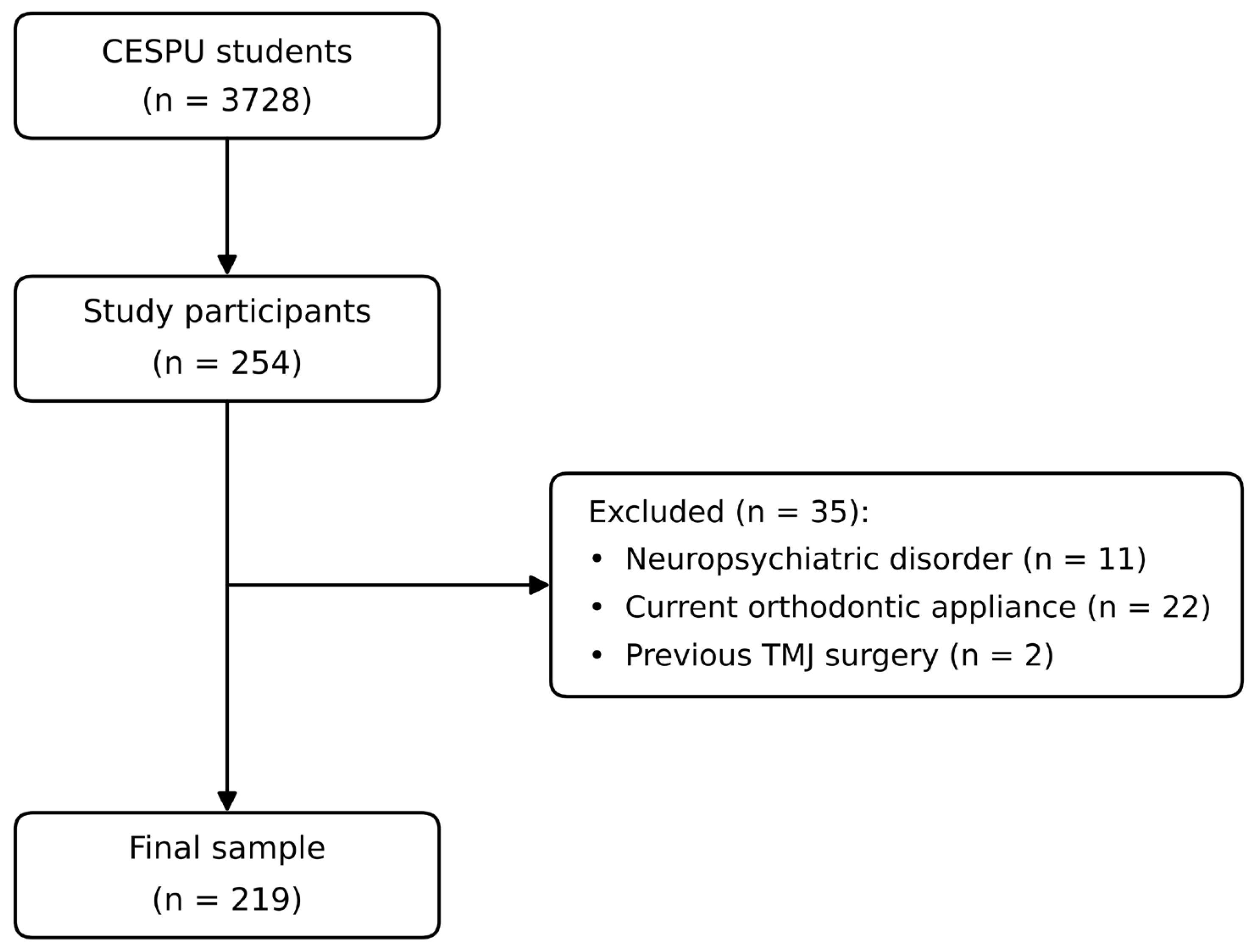

Table 1.
Severity classification of depression, anxiety, and stress on the DASS-21 according to the score obtained [39].
Table 1.
Severity classification of depression, anxiety, and stress on the DASS-21 according to the score obtained [39].
| Severity | Depression | Anxiety | Stress |
|---|---|---|---|
| Normal | 0–9 | 0–7 | 0–14 |
| Mild | 10–13 | 8–9 | 15–18 |
| Moderate | 14–20 | 10–14 | 19–25 |
| Severe | 21–27 | 15–19 | 26–33 |
| Extremely severe | ≥28 | ≥20 | ≥34 |
Table 2.
Sociodemographic characteristics and lifestyle habits of the students (n = 219).
| Variable | Category | n (%) |
|---|---|---|
| Age (years), Mdn (IQR) | 22 (4) | |
| Gender | Female | 168 (76.7) |
| Male | 51 (23.3) | |
| Nationality | Portuguese | 147 (67.1) |
| Other nationalities # | 72 (32.9) | |
| Field of study | Physiotherapy | 72 (32.9) |
| Nursing | 49 (22.4) | |
| Dental medicine | 49 (22.4) | |
| Other programs § | 49 (22.4) | |
| Year of study | First | 50 (22.8) |
| Second | 51 (23.3) | |
| Third | 31 (14.2) | |
| Fourth | 65 (29.7) | |
| Fifth | 22 (10.0) | |
| Smoking | No | 171 (78.1) |
| Yes | 48 (21.9) | |
| Alcohol consumption | No | 147 (67.1) |
| Yes | 72 (32.9) | |
| Caffeine consumption | No | 71 (32.4) |
| Yes | 148 (67.6) |
n, absolute frequency; %, percentage; Mdn, median; IQR, interquartile range. # French, Brazilian, Italian, and Spanish. § Gerontology; Spa and Wellness Studies; Clinical Physiology; Osteopathy; Medical Imaging and Radiotherapy; Dental Prosthetics; Applied Communication; Bioanalysis and Quality Control; Clinical Secretarial Studies; Medical-Surgical Nursing Specialization; Forensic Laboratory Sciences; Pharmaceutical Sciences; Biomedical Sciences; Psychology; Nutrition Sciences; Veterinary Medicine; and Master’s in Health Psychology and Neuropsychology.
Table 3.
Frequency of the DASS-21 subscales (n = 219).
| DASS-21 subscale | Severity | n (%) |
|---|---|---|
| Anxiety, n (%) = 53 (24.3) | Normal | 21 (9.6) |
| Mild | 2 (0.9) | |
| Moderate | 12 (5.5) | |
| Severe | 8 (3.7) | |
| Extremely severe | 10 (4.6) | |
| Depression, n (%) = 42 (19.2) | Normal | 10 (4.6) |
| Mild | 5 (2.3) | |
| Moderate | 13 (5.9) | |
| Severe | 4 (1.8) | |
| Extremely severe | 10 (4.6) | |
| Stress, n (%) = 124 (56.6) | Normal | 61 (27.9) |
| Mild | 15 (6.8) | |
| Moderate | 21 (9.6) | |
| Severe | 17 (7.8) | |
| Extremely severe | 10 (4.6) |
DASS-21, 21-item Depression, Anxiety and Stress Scale; n, absolute frequency; %, percentage.
Table 4.
Analysis of the DASS-21 subscales by gender (n = 219).
| Subscale | Female, Mean (SD) | Male, Mean (SD) | p-Value |
|---|---|---|---|
| Anxiety | 5.82 (4.68) | 4.10 (4.05) | 0.013 * |
| Depression | 5.65 (5.05) | 4.31 (5.01) | 0.04 * |
| Stress | 8.30 (4.90) | 5.65 (4.95) | <0.001 * |
SD, standard deviation; * p < 0.05.
Table 5.
Frequency of responses on sleep bruxism and awake bruxism (n = 219).
| Type | OBC item (DC/TMD, Axis II) and response | n (%) |
|---|---|---|
| Sleep bruxism | Clench or grind teeth when asleep, based on any information you may have | |
| None of the time | 140 (63.9) | |
| 1–3 nights/week | 54 (24.7) | |
| 4–7 nights/week | 25 (11.4) | |
| Awake bruxism | Grind teeth together during waking hours | |
| None of the time | 165 (75.3) | |
| A little of the time | 38 (17.4) | |
| Some of the time | 11 (5.0) | |
| Most of the time | 4 (1.8) | |
| All of the time | 1 (0.5) | |
| Clench teeth together during waking hours | ||
| None of the time | 104 (47.5) | |
| A little of the time | 69 (31.5) | |
| Some of the time | 31 (14.2) | |
| Most of the time | 13 (5.9) | |
| All of the time | 2 (0.9) |
OBC, Oral Behaviors Checklist; DC/TMD, Diagnostic Criteria for Temporomandibular Disorders; n, absolute frequency; %, percentage.
Table 6.
Prevalence of bruxism (n = 219).
| Variable | Category | n (%) |
|---|---|---|
| Possible bruxism | No | 87 (39.7) |
| Yes | 132 (60.3) | |
| Type of bruxism | Sleep bruxism | 10 (4.6) |
| Awake bruxism | 53 (24.2) | |
| Mixed bruxism | 69 (31.5) |
n, absolute frequency; %, percentage.
Table 7.
Association between symptoms of anxiety, depression, and stress and bruxism (n = 219).
| Subscale | Severity | Possible bruxism | p-Value | |
|---|---|---|---|---|
| No, n (%) | Yes, n (%) | |||
| Anxiety | Normal | 14 (16.1) | 7 (5.3) | 0.043 * |
| Mild | 1 (1.1) | 1 (0.8) | ||
| Moderate | 4 (4.6) | 8 (6.1) | ||
| Severe | 1 (1.1) | 7 (5.3) | ||
| Extremely severe | 6 (6.9) | 4 (3.0) | ||
| Predominant stress or depression | 61 (70.1) | 105 (79.5) | ||
| Total score, Mean (SD) | 4.13 (4.03) | 6.27 (4.75) | <0.001 * | |
| Depression | Normal | 6 (6.9) | 4 (3.0) | 0.691 |
| Mild | 1 (1.1) | 4 (3.0) | ||
| Moderate | 6 (6.9) | 7 (5.3) | ||
| Severe | 2 (2.3) | 2 (1.5) | ||
| Extremely severe | 4 (4.6) | 6 (4.5) | ||
| Predominant anxiety or stress | 68 (78.2) | 109 (82.6) | ||
| Total score, Mean (SD) | 4.18 (4.43) | 6.10 (5.32) | 0.005 * | |
| Stress | Normal | 28 (32.2) | 33 (25.0) | 0.018 * |
| Mild | 5 (5.7) | 10 (7.6) | ||
| Moderate | 3 (3.4) | 18 (13.6) | ||
| Severe | 5 (5.7) | 12 (9.1) | ||
| Extremely severe | 1 (1.1) | 9 (6.8) | ||
| Predominant anxiety or depression | 45 (51.7) | 50 (37.9) | ||
| Total score, Mean (SD) | 6.33 (4.50) | 8.58 (5.17) | 0.001 * | |
n, absolute frequency; %, percentage; SD, standard deviation; * p < 0.05.
Table 8.
Association of gender, smoking, alcohol consumption, and caffeine consumption with bruxism (n = 219).
Table 8.
Association of gender, smoking, alcohol consumption, and caffeine consumption with bruxism (n = 219).
| Variable | Category | Possible bruxism | p-Value | |
|---|---|---|---|---|
| No, n (%) | Yes, n (%) | |||
| Gender | Female | 68 (78.2) | 100 (75.8) | 0.745 |
| Male | 19 (21.8) | 32 (24.2) | ||
| Smoking | No | 71 (81.6) | 100 (75.8) | 0.323 |
| Yes | 16 (18.4) | 32 (24.2) | ||
| Alcohol consumption | No | 62 (71.3) | 85 (64.4) | 0.307 |
| Yes | 25 (28.7) | 47 (35.6) | ||
| Caffeine consumption | No | 24 (27.6) | 47 (35.6) | 0.240 |
| Yes | 63 (72.4) | 85 (64.4) | ||
n, absolute frequency; %, percentage.
Table 9.
Association of knowledge responses with field of study and year of study (n = 219).
| Knowledge item | Field of study | Year of study | ||||||||||
|---|---|---|---|---|---|---|---|---|---|---|---|---|
| PT | NUR | DM | Other | p | 1st | 2nd | 3rd | 4th | 5th | p | ||
| n (%) | n (%) | n (%) | n (%) | n (%) | n (%) | n (%) | n (%) | n (%) | ||||
| Role of the physiotherapist in the therapeutic management of bruxism | No | 20 (27.8) | 36 (73.5) | 16 (32.7) | 28 (57.1) | <0.001 * | 32 (64) | 35 (68.6) | 14 (45.2) | 12 (18.5) | 7 (31.8) | <0.001 * |
| Yes | 52 (72.2) | 13 (26.5) | 33 (67.3) | 21 (42.9) | 18 (36) | 16 (31.4) | 17 (54.8) | 53 (81.5) | 15 (68.2) | |||
| Physiotherapy intervention in the management of bruxism | No | 13 (18.1) | 24 (49) | 11 (22.4) | 20 (40.8) | <0.001 * | 18 (36) | 25 (49) | 10 (32.3) | 9 (13.8) | 6 (27.3) | 0.002 * |
| Yes | 59 (81.9) | 25 (51) | 38 (77.6) | 29 (59.2) | 32 (64) | 26 (51) | 21 (67.7) | 56 (86.2) | 16 (72.7) | |||
| Therapeutic exercises | No | 27 (37.5) | 34 (69.4) | 18 (36.7) | 23 (46.9) | 0.002 * | 27 (54) | 29 (56.9) | 17 (54.8) | 22 (33.8) | 7 (31.8) | 0.036 * |
| Yes | 45 (62.5) | 15 (30.6) | 31 (63.3) | 26 (53.1) | 23 (46) | 22 (43.1) | 14 (45.2) | 43 (66.2) | 15 (68.2) | |||
| Multidisciplinary approach to bruxism | No | 15 (20.8) | 38 (77.6) | 9 (18.4) | 21 (42.9) | <0.001 * | 28 (56) | 31 (60.8) | 14 (45.2) | 7 (10.8) | 3 (13.6) | <0.001 * |
| Yes | 57 (79.2) | 11 (22.4) | 40 (81.6) | 28 (57.1) | 22 (44) | 20 (39.2) | 17 (54.8) | 58 (89.2) | 19 (86.4) | |||
| Classification of bruxism | No | 58 (80.6) | 45 (91.8) | 28 (57.1) | 37 (75.5) | <0.001 * | 44 (88) | 44 (86.3) | 25 (80.6) | 41 (63.1) | 14 (63.6) | 0.004 * |
| Yes | 14 (19.4) | 4 (8.2) | 21 (42.9) | 12 (24.5) | 6 (12) | 7 (13.7) | 6 (19.4) | 24 (36.9) | 8 (36.4) | |||
| Circadian rhythm of bruxism | No | 12 (16.7) | 17 (34.7) | 6 (12.2) | 11 (22.4) | 0.034 * | 15 (30) | 15 (29.4) | 5 (16.1) | 9 (13.8) | 2 (9.1) | 0.063 |
| Yes | 60 (83.3) | 32 (65.3) | 43 (87.8) | 38 (77.6) | 35 (70) | 36 (70.6) | 26 (83.9) | 56 (86.2) | 20 (90.9) | |||
| Definition of bruxism | No | 9 (12.5) | 13 (26.5) | 2 (4.1) | 9 (18.4) | 0.015 * | 13 (26) | 12 (23.5) | 4 (12.9) | 3 (4.6) | 1 (4.5) | 0.005 * |
| Yes | 63 (87.5) | 36 (73.5) | 47 (95.9) | 40 (81.6) | 37 (74) | 39 (76.5) | 27 (87.1) | 62 (95.4) | 21 (95.5) | |||
| Characteristics of bruxism | No | 14 (19.4) | 18 (36.7) | 4 (8.2) | 9 (18.4) | 0.005 * | 17 (34) | 14 (27.5) | 4 (12.9) | 7 (10.8) | 3 (13.6) | 0.013 * |
| Yes | 58 (80.6) | 31 (63.3) | 45 (91.8) | 40 (81.6) | 33 (66) | 37 (72.5) | 27 (87.1) | 58 (89.2) | 19 (86.4) | |||
| Risk factors for bruxism | No | 40 (55.6) | 33 (67.3) | 15 (30.6) | 28 (57.1) | 0.002 * | 35 (70) | 35 (68.6) | 17 (54.8) | 25 (38.5) | 4 (18.2) | <0.001 * |
| Yes | 32 (44.4) | 16 (32.7) | 34 (69.4) | 21 (42.9) | 15 (30) | 16 (31.4) | 14 (45.2) | 40 (61.5) | 18 (81.8) | |||
| Possible effects of bruxism | No | 23 (31.9) | 34 (69.4) | 5 (10.2) | 25 (51) | <0.001 * | 31 (62) | 29 (56.9) | 15 (48.4) | 10 (15.4) | 2 (9.1) | <0.001 * |
| Yes | 49 (68.1) | 15 (30.6) | 44 (89.8) | 24 (49) | 19 (38) | 22 (43.1) | 16 (51.6) | 55 (84.6) | 20 (90.9) | |||
| Changes induced by bruxism | No | 12 (16.7) | 32 (65.3) | 4 (8.2) | 19 (38.8) | <0.001 * | 27 (54) | 24 (47.1) | 10 (32.3) | 5 (7.7) | 1 (4.5) | <0.001 * |
| Yes | 60 (83.3) | 17 (34.7) | 45 (91.8) | 30 (61.2) | 23 (46) | 27 (52.9) | 21 (67.7) | 60 (92.3) | 21 (95.5) | |||
PT, physiotherapy; NUR, nursing; DM, dental medicine; Other, other programs; 1st–5th, year of study; n, absolute frequency; %, percentage; * p < 0.05.
Disclaimer/Publisher’s Note: The statements, opinions and data contained in all publications are solely those of the individual author(s) and contributor(s) and not of MDPI and/or the editor(s). MDPI and/or the editor(s) disclaim responsibility for any injury to people or property resulting from any ideas, methods, instructions or products referred to in the content. |
© 2026 by the authors. Licensee MDPI, Basel, Switzerland. This article is an open access article distributed under the terms and conditions of the Creative Commons Attribution (CC BY) license (http://creativecommons.org/licenses/by/4.0/).
Copyright: This open access article is published under a Creative Commons CC BY 4.0 license, which permit the free download, distribution, and reuse, provided that the author and preprint are cited in any reuse.