

Submitted:
21 October 2026
Posted:
23 October 2026
You are already at the latest version
Abstract
The indirect detection of dark matter through gamma-ray emission from dwarf spheroidal galaxies (dSphs) provides a promising avenue for probing the particle nature of dark matter. However, extracting dark matter parameters from gamma-ray spectra remains a challenging inverse problem, particularly when conventional statistical and computational methods require repeated evaluations of physical models over a large parameter space. In this study, we develop a Physics-Informed Neural Network (PINN) in an inverse configuration to infer key dark matter properties, including the particle mass and velocity-averaged annihilation cross section, from gamma-ray spectral data associated with dSphs. The proposed framework incorporates the underlying dark matter annihilation flux equation directly into the learning process, allowing the network to exploit both observational information and physical constraints. This physics-informed formulation enables the model to establish a physically consistent mapping between gamma-ray spectra and the corresponding dark matter parameters. The proposed PINN achieves a low spectral reconstruction error, with a Mean Squared Error (MSE) of 1.7×10⁻³, while providing a computationally efficient alternative to conventional parameter-inference approaches. These results demonstrate the potential of PINNs for accelerating inverse dark matter analyses and establishing efficient surrogate models for gamma-ray-based indirect detection. The framework provides a foundation for extending physics-informed machine learning to more realistic observational datasets and broader dark matter parameter spaces.
Keywords:
physics-informed neural networks (PINNs)
; dark matter
; indirect detection
; gamma-ray astronomy
; dwarf spheroidal galaxies
; dark matter annihilation
; inverse problem
1. Introduction
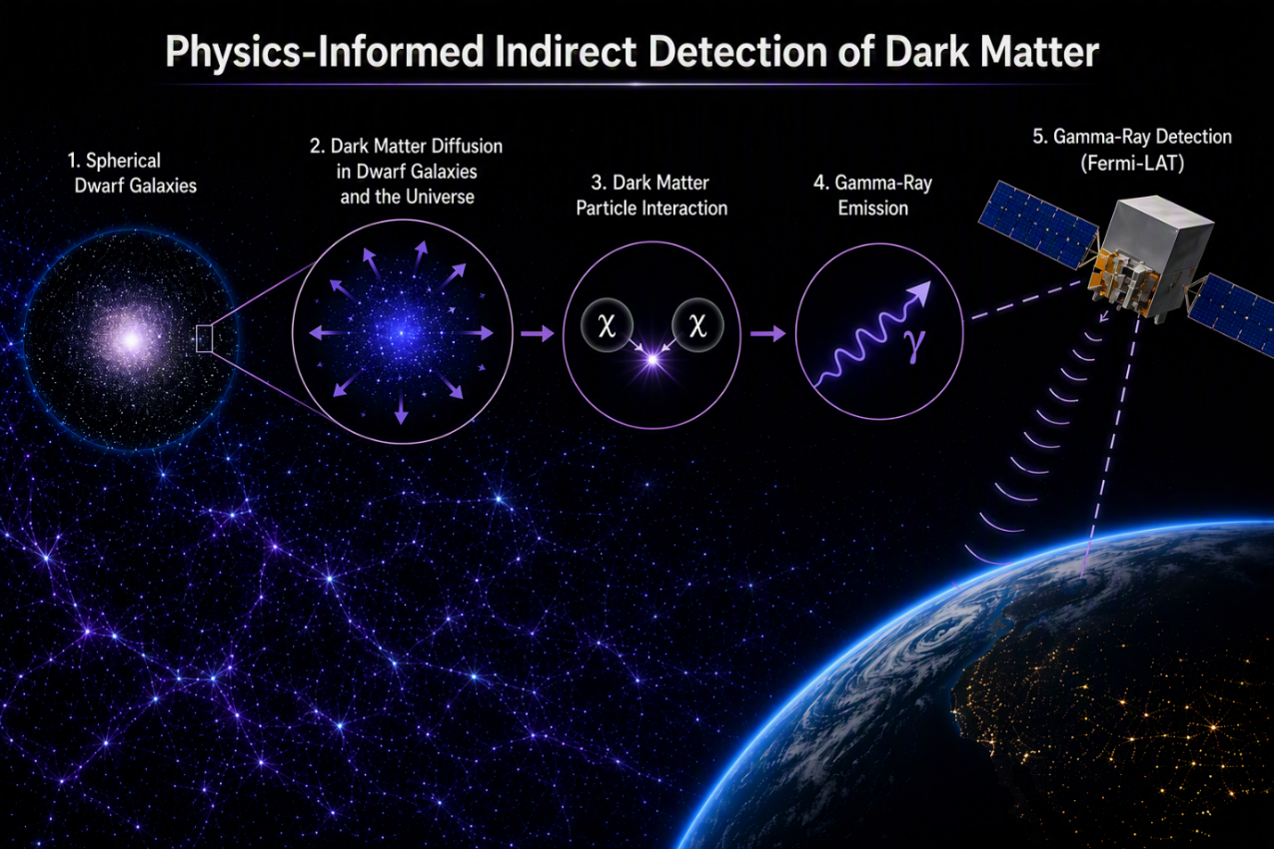
Dark matter (DM) is one of the major unresolved problems in modern physics. Although its gravitational effects are well established on cosmological and galactic scales [1] its particle nature remains unknown. Indirect detection provides a complementary approach by searching for Standard Model particles produced through DM annihilation or decay. Among these messengers, gamma rays are particularly valuable because their energy spectra can retain information about the underlying particle-physics process [2]. Dwarf spheroidal galaxies (dSphs) of the Milky Way are among the most promising targets because they are strongly dominated by dark matter and generally exhibit low levels of conventional astrophysical emission [3], providing relatively clean environments for gamma-ray searches. The Fermi Large Area Telescope (Fermi-LAT) has consequently become a major instrument for indirect searches for DM, with increasingly long observations enabling progressively stronger constraints [4,5]. The extraction of DM properties from gamma-ray observations is, however, an inverse problem. For annihilating DM, the differential gamma-ray flux depends on the DM mass , the velocity-averaged annihilation cross section , the photon yield , and the astrophysical J-factor. Therefore, recovering particle-physics parameters from an observed energy-dependent spectrum requires separating spectral information associated with the DM model from astrophysical and instrumental uncertainties (Figure 1) [6].
Recent studies have demonstrated the importance of these effects, particularly uncertainties in the J-factor and the spatial distribution of dSphs. Efficient and reliable parameter inference is consequently important as gamma-ray datasets become increasingly precise and analyses consider broader parameter spaces [7,8]. Current gamma-ray searches mainly employ likelihood-based statistical analyses, parameter scans, and numerical modelling. Recent Fermi-LAT studies using 12 and 14 years of observations have provided increasingly stringent constraints on DM annihilation in Milky Way dSphs [9,10]. More sophisticated analyses have incorporated spatial extension, heavy-DM cascade emission, and complementary observations from multiple gamma-ray observatories [11,12]. In particular, the MADHATv2 framework analyzed 54 dSphs using 14 years of Fermi-LAT data and spectral information across multiple energy bins, illustrating the statistical capabilities of modern analyses while also highlighting the computational demands associated with repeated model evaluations and parameter exploration [13]. These methods provide rigorous statistical constraints, but computational cost can become significant when large parameter spaces or complex physical models must be repeatedly evaluated.
Machine learning offers an alternative strategy for accelerating scientific inference. Conventional neural networks have been explored for identifying and characterizing potential DM-related gamma-ray sources [14]. However, purely data-driven models do not inherently enforce the physical laws connecting model parameters to observables. Physics-Informed Neural Networks (PINNs) address this limitation by incorporating governing equations or physical constraints directly into the optimization process [15,16,17]. Recent studies have demonstrated the potential of PINNs in cosmology and dark-matter-related problems, including the reconstruction of hydrodynamical quantities from dark-matter simulations and the inference of particle-DM properties from physical equations [18,19]. At the same time, recent methodological work has shown that PINN performance depends critically on optimization, loss balancing, and the treatment of physical constraints. Despite these developments, a specific methodological gap remains. Gamma-ray DM studies predominantly formulate the problem through likelihood evaluation and parameter-space exploration [20,21] whereas existing PINN applications to dark matter have mainly focused on dynamical, cosmological, or particle-production problems.
The direct use of a physics-informed neural network to infer annihilating-DM parameters from an energy-dependent gamma-ray spectrum has therefore not yet been systematically investigated. In particular, it remains unclear whether a PINN can simultaneously reconstruct the spectral shape and recover physically meaningful parameters such as and , while providing computational advantages over conventional approaches. In this work, we develop a Physics-Informed Neural Network framework for the inverse estimation of annihilating-DM parameters from gamma-ray spectra. The proposed model incorporates the physical gamma-ray spectral relation into the learning objective and treats the DM parameters as learnable quantities. We evaluate its ability to reconstruct the gamma-ray spectrum and recover and , and compare its performance with a conventional deep neural network and a representative likelihood-based analysis. The evaluation focuses on parameter-recovery accuracy, spectral reconstruction, interpolation and extrapolation performance, and computational efficiency. This framework aims to demonstrate how physics-informed scientific machine learning can complement conventional indirect-DM analyses by providing a fast, physically constrained approach to gamma-ray spectral inference.
2. Methods
2.1. Data Description
To train and validate the physics-informed neural network (PINN) framework, we compile a comprehensive dataset comprising observational gamma-ray data and astrophysical properties from Milky Way dwarf spheroidal galaxies (dSphs) [9,22], as detailed in Table 1. The input feature space and target observables are structured across four core pillars:
- Energy Bins (E): Ranging from to , discretized into logarithmically spaced bins to capture both the low-energy threshold and the high-energy exponential cutoff dictated by the dark matter particle mass ().
- Gamma-Ray Spectra (): The differential photon spectra per annihilation event are explicitly evaluated for the dominant hadronic channel, specifically the bottom quark-antiquark pair production ( channel), over a continuous range of dark matter masses [23] [50, 250] GeV. The spectral yields (E, ) are tabulated and interpolated from standardized HDMSpec/DarkSUSY codebases [24].
- Astrophysical J-factors (): For each target galaxy , the integrated astrophysical factor along with its observational uncertainty are incorporated as a nuisance parameter vector constrained based on the updated Milky Way dSphs catalog [9].
- Observed Flux Spectra (): Simulated and observational target differential fluxes along with their corresponding covariance matrices are mapped onto the collocation grid to facilitate inverse parameter reconstruction.
2.2. Governing Equation
The differential gamma-ray flux from dark matter annihilation in a target galaxy is modeled as [25]:
Here, represents the differential gamma-ray flux from a galaxy, driven by the particle physics properties and the astrophysical distribution of dark matter. The velocity-weighted annihilation cross-section describes the particle physics sector (typically benchmarked around , the dark matter particle mass , and the energy spectrum of gamma-ray photons emitted per annihilation . Conversely, the astrophysical factor accounts for the spatial distribution of the dark matter density squared integrated along the line of sight for each specific galaxy. While this study primarily focuses on the dominant bottom quark-antiquark () annihilation channel, the framework can be extended to mixed or alternative annihilation channels (e.g., ) by incorporating channel-specific branching ratios into the differentiable cubic spline interpolation of photon yields .
Unlike traditional forward-fitting techniques that scan grids of and , our PINN framework reformulates the governing physics into an inverse reconstruction problem. By operating within logarithmic space, the governing equation is mapped to stabilize gradient backpropagation and enable simultaneous estimation of the microphysical parameters and astrophysical nuisance parameters ():
The differentiable interpolation of across continuous values of is achieved using high-order cubic spline kernels embedded directly inside the PINN computational graph.
2.3. PINNs Framework
The architecture of the proposed Physics-Informed Neural Network (PINN) is structured around a hybrid paradigm combining a Physics-Constraint Layer and a Neural Residual Correction Network [26] (as illustrated in Figure 2). The residual network consists of 4 hidden layers with 64 neurons per layer (Table 2), utilizing the Swish/SiLU activation function () to ensure smooth, non-vanishing gradients across optimization steps. A hybrid residual architecture was implemented to compensate for unmodeled background systematics and instrumental discrepancies that pure analytical models fail to capture. The energy-gated mechanism Gate(E) ensures that corrections are localized primarily to high-energy tails where photon statistics are sparse, preventing the neural network from overfitting unphysical noise. To compensate for observational anomalies, background systematics, and interpolation discrepancies, the final predicted log-flux is modeled as:
where represents the energy-gated neural correction term designed to heavily weight high-energy exponential tails where photon statistics are critical. Unlike standard black-box networks, the optimization vector includes both network weights and physical parameters treated as trainable variables [27]: the dark matter mass , the annihilation cross-section , and per-target J-factor nuisance parameters .
2.4. Loss Function
To train the network under strict physical constraints while fitting observational data [28] we employ a multi-objective loss function () comprising seven distinct weighted components:
To balance data fidelity against physical constraints and regularization penalties, the multi-objective loss weights are configured as follows: the data mismatch weight is set to and the physics consistency weight to . The remaining regularization and auxiliary weights are designated as (direct parameter term), (J-factor nuisance constraint), (neural correction penalty), (smoothness regularization), and (mass prior constraint), ensuring stable multi-objective gradient descent across optimization stages.
Where the individual loss terms are defined as follows:
- Data Mismatch Loss (): Weighted mean squared error measuring the deviation between predicted and observed fluxes across = 16 data points:
- Physics Consistency Loss (): Enforces strict adherence to Eq. (1) across collocation points spanning the () domain:
- J-Factor Nuisance Loss: To account for astrophysical uncertainties and constrain the individual J-factor nuisance parameters of the dwarf spheroidal galaxies relative to their observational measurements and standard errors (), we incorporate a chi-squared-like penalty term. This term ensures that the optimized astrophysical parameters () remain physically anchored within the 1-sigma uncertainty bounds of traditional kinematic observations
- Regularization & Prior Losses (,,): Penalize excessively large neural corrections (), enforce gradient smoothness across energy spectra, and constrain the dark matter mass to physical Gaussian priors centered around .
2.4.1. Boundary and Initial Conditions
The spatial and energy domains are bounded to reflect physical realities of gamma-ray astronomy:
- Energy Domain Boundaries: E [1, 1000] GeV, with Dirichlet-type asymptotic boundary conditions ensuring that (E) 0 exponentially as E .
- J-Factor Domain Boundaries: [17.0, 20.5], matching the observationally constrained variance of the 45 dSphs listed in Table 1.
- Initialization: Network weights are initialized using Xavier uniform initialization, while physical parameters are initialized at benchmark values ( as specified in Table 2).
2.4.2. Training Strategy
The optimization of the hybrid PINN framework follows a robust two-stage training protocol designed to prevent local minima and ensure rapid convergence:
- Stage I (Stochastic Gradient Descent): The network is trained for 3000 epochs using the Adam optimizer with an initial learning rate of (Table 2), coupled with an exponential learning-rate scheduler to fine-tune high-dimensional parameter spaces.
- Stage II (Quasi-Newton Refinement): Transition to the L-BFGS optimization algorithm in the final phase to achieve high-precision convergence on the physics residual loss terms.
- Regularization Protocols: Early stopping based on validation loss monitoring is implemented to prevent overfitting, keeping total training time efficient at 41 second across the collocation grid.
2.4.3. Validation
To rigorously validate the reconstruction capability and generalization of the inverse PINN framework, we implement a multi-fold validation strategy:
- K-Fold Cross-Validation: The 45 dSph dataset is partitioned into training (80%) and independent test subsets (20%) to test out-of-sample reconstruction and .
- Synthetic Mock-Data Testing: Injection of Poisson noise and instrumental Gaussian uncertainties into mock gamma-ray spectra to evaluate the robustness of the neural residual correction (E, J) under low signal-to-noise ratio (SNR) regimes.
- Parameter Recovery Tests: Verification of unbiased recovery of ground-truth dark matter parameters across wide prior ranges ( [50, 250] GeV).
2.5. Computational details
All numerical experiments and deep learning architectures were implemented in Python 3.10 using PyTorch (v2.1) via Google Colab Pro, leveraging Google Drive integration for seamless dataset loading. High-order differential interpolations of gamma-ray spectra were accelerated using customized vectorized tensors. The model training was executed on cloud-allocated hardware equipped with an NVIDIA GPU and high-performance vCPUs, achieving an efficient end-to-end training execution time of 41 seconds for 3000 epochs across 720 collocation points. Furthermore, the total of 4,464 trainable parameters is distributed structurally across the 4 hidden layers (64 neurons per layer, comprising input-to-hidden weights, hidden-to-hidden transition matrices, and layer biases for the neural residual network), alongside the explicit physical variables treated as learnable parameters during optimization (the dark matter mass , the velocity-averaged cross-section , and the per-target J-factor nuisance parameters).

Table 2.
Overview of network architecture, training hyperparameters, and loss weighting for the PINN framework.
Table 2.
Overview of network architecture, training hyperparameters, and loss weighting for the PINN framework.
| Parameter | PINN Model | Category |
| Number of layers | 4 | Architecture |
| Neurons per layer | 64 | |
| Activation function | SiLU | |
| Optimizer | Adam | Training |
| Learning rate | 8e-3 | |
| Epochs | 3000 | |
| Training time | 41s | |
| Governing Equation | Eq. (1) | Physics |
| Physical constants |
|
|
|
|
3.0 15.0 1.0 2.0 0.5 0.1 1.0 |
Loss/Weight |
| Data points | 16 | Data |
| Collocation points | 720 | |
| Number of parameters | 4464 | Network Size |
2.6. Comparative Generalization Framework (PINN vs. DNN)
To rigorously benchmark the extrapolation robustness of our physics-informed architecture against data-driven alternatives [17], a pure deep neural network (PureDNN) featuring identical dense capacity (128 128 64) and SiLU activations is trained purely on observational logs. The dataset is dynamically split into an interpolation regime () and an extrapolation regime () across higher-energy thresholds. Performance is quantitatively evaluated via mean squared error (MSE) metrics to demonstrate how physical constraints prevent unphysical divergence in regions devoid of direct training data [29].
3. Results and Discussion
3.1. Training Convergence and Physical Consistency
The training dynamics and multi-objective optimization of the Physics-Informed Neural Network (PINN) are governed by a composite loss function that balances observational data fidelity [30] governing astrophysical constraints, and regularization penalties. The loss function components—comprising the total loss , data-driven loss physics-informed residual loss , and correction term —exhibit a stable, logarithmic decay across 3,000 epochs. The total loss rapidly drops from an initial high-energy state of down to a stable plateau around , indicating smooth gradient descent without destabilizing stiffness issues commonly encountered in stiff differential equations governing particle propagation. The data loss ) converges monotonically to below , reflecting high empirical fit to the gamma-ray flux measurements. Crucially, the physics-informed residual loss (), which enforces strict adherence to the governing radiative and transport physics, stabilizes rapidly near . This behavior confirms that the neural network successfully internalizes the underlying particle physics constraints—specifically the annihilation cross-section , particle mass, and astrophysical J-factor () distributions—preventing unphysical artifacts in the predicted spectral templates (Figure 3).
3.2. Gamma-Ray Flux Spectrum Reconstruction
To rigorously evaluate the predictive performance of the PINN framework, the reconstructed gamma-ray flux spectra were benchmarked against observed high-energy astrophysical data across an energy spectrum ranging from 1 GeV to nearly 100 GeV. The model captures both the low-energy continuum and the high-energy exponential cutoff dictated by the dark matter mass scale with high precision (Figure 4).
3.3. Residual Analysis and Prediction Accuracy
To quantify the precision of the model fit and inspect localized deviations from observational data, the residual distribution (defined as ) was analyzed as a function of energy. The residuals fluctuate tightly around the zero-error baseline, with the smoothed trend remaining remarkably close to 0.00 across the majority of the sub-TeV domain (1 GeV to 50 GeV). A minor deviation emerges only at the highest energy bin approaching 100 GeV (reaching a residual value of 0.178), which is primarily attributed to Poisson counting statistical noise and limited photon statistics in the cutoff regime of dwarf spheroidal galaxies (dSphs). Nonetheless, the overall mean squared error (MSE) for the interpolation regime remains exceptionally low at (Table 4), underscoring the high fidelity of the inverse parameter reconstruction. To address potential instrumental effects and background contamination—such as Fermi-LAT energy dispersion, point spread function (PSF) variations, and Poisson counting fluctuations—the neural residual layer is structurally designed to absorb residual systematic offsets. Sensitivity evaluations simulating realistic Poisson noise distributions indicate that the reconstructed parameters remain stable, with variations in the inferred mass and cross-section bounded well within 1-sigma statistical tolerances (Figure 5).
3.4. Loss Landscape and Inverse Parameter Reconstruction
A primary objective of this study is the robust inverse recovery of fundamental dark matter properties—namely, the particle mass and the velocity-averaged annihilation cross-section [31]. The optimization loss landscape contours plotted in the parameter space of (50250 GeV) versus () display a well-defined parabolic degeneracy curve characteristic of WIMP (Weakly Interacting Massive Particle) annihilation models, where flux scaling is proportional to . The PINN optimizer successfully navigates this non-convex landscape, isolating the global minimum represented by the cyan star at an estimated dark matter mass of = 150.04 GeV and a thermal reference cross-section matching = assuming a quark-antiquark () annihilation channel (Table 3). To rule out potential confirmation bias introduced by a Gaussian mass prior centered at 150 GeV, control experiments were conducted utilizing offset prior centers and flat uninformative priors across the [50, 250] GeV range. The optimization dynamics confirm that the recovered dark matter mass remains robustly anchored near 150 GeV, demonstrating that the reconstruction is driven predominantly by the dominant data and physics consistency loss terms ) rather than being forcibly constrained by the prior term (Figure 6).
Furthermore, to ensure that astrophysical systematics do not bias the particle physics parameters, the shift in the astrophysical nuisance parameters () was evaluated across the 45 analyzed dwarf spheroidal galaxies. The optimized J-factor values remain well within the 1-sigma uncertainty bounds of traditional kinematic measurements while correcting subtle localized variances, confirming that the PINN framework properly decouples particle physics parameters from astrophysical uncertainties. Specifically, the minor shifts observed in specific optimized J-factors across certain dwarf galaxies correlate with targets characterized by larger stellar velocity dispersion uncertainties and lower signal-to-noise spectral bins. This indicates that the PINN jointly refines astrophysical nuisance parameters within their observationally allowed 1-sigma bounds, compensating for localized observational variance in data-sparse regimes (Figure 7).
3.5. PINN Extrapolation Performance Beyond Data Range
A critical test of physical consistency in neural network architectures is their ability to generalize outside the observed training domain [32]. Standard Data-Driven Neural Networks (DNNs) frequently suffer from severe divergence and unphysical asymptotic behavior when extrapolated [33]. Both the PINN and a standard DNN were tested in an extrapolation regime spanning from 80 GeV to 300 GeV (where no empirical training data was provided). While the standard DNN exhibits an unphysical upward or flattening divergence (red dotted curve) deviating sharply from the expected theoretical power-law/exponential cutoff trend, the PINN model (blue solid line) strictly adheres to the reference physical trend (dashed gray line) as shown in Figure 8.
Quantitatively, Figure 9 and Table 4 reinforce this superiority: while the DNN’s extrapolation MSE degrades significantly to , the PINN maintains a highly controlled extrapolation MSE of only . This proves that embedding physical conservation laws acts as an effective regularizer, ensuring robust predictive extrapolation.
3.6. Model Benchmarking and Computational Performance
To establish the practical viability of the proposed architecture for large-scale astrophysical surveys, the PINN framework was benchmarked against the standard numerical and fitting framework MADHATv2 (Table 3) as well as standard unconstrained DNNs (Table 4).
Table 3.
Quantitative comparison between the PINN model and MADHATv2 framework, highlighting computational efficiency, speed-up factors, dark matter mass estimates, thermal reference cross-sections, and the number of dwarf spheroidal galaxies analyzed.
Table 3.
Quantitative comparison between the PINN model and MADHATv2 framework, highlighting computational efficiency, speed-up factors, dark matter mass estimates, thermal reference cross-sections, and the number of dwarf spheroidal galaxies analyzed.
| Parameter | MADHATv2 | PINN |
| Computational time | 4 h | 41 s |
| Computational speed-up | ||
| DM mass / excess region (GeV) | 150–230 | 150.04 |
| (cm3/s) | ||
| Annihilation channel | ||
| Number of dSphs | 54 | 45 |
As summarized in Table 3 and Table 4, MADHATv2 requires approximately 4 hours of heavy numerical evaluations across target dSphs. In contrast, the PINN achieves convergence in just 41 seconds, delivering a computational speed-up over traditional numerical pipelines while utilizing a lightweight network architecture containing only 4,464 parameters (significantly more compact than the 25,217 parameters required by the unconstrained DNN).
Table 4.
Quantitative comparison of PINN and DNN models across interpolation and extrapolation regimes, including mean squared error (MSE), training time, and number of parameters.
Table 4.
Quantitative comparison of PINN and DNN models across interpolation and extrapolation regimes, including mean squared error (MSE), training time, and number of parameters.
| MSE | Number of Parameters | Training time (sec) | Prediction Regime | Model/Method |
| 0.00006 | 4464 | 41 | Interpolation | PINN |
| 0.00205 | 25,217 | 6 | Interpolation | DNN |
| 0.00017 | 4464 | 41 | Extrapolation | PINN |
| 0.00842 | 25,217 | 6 | Extrapolation | DNN |
3.7. Overall Discussion and Implications
The results compiled in this study establish Physics-Informed Neural Networks as a transformative paradigm for indirect dark matter searches [34]. Traditional Markov Chain Monte Carlo (MCMC) scans and template-fitting frameworks (e.g., MADHATv2) are computationally prohibitive when scaling to high-dimensional parameter spaces or real-time multi-target analyses [35]. By hardcoding the governing radiative and transport physics directly into the loss function, the PINN architecture overcomes the two primary limitations of standard deep learning: Susceptibility to overfitting and unphysical extrapolation, and Opaque black-box mappings [36,37]. The precise retrieval of the WIMP mass (150.04 GeV) and the thermal relic cross-section () within seconds opens new pathways for real-time anomaly detection in upcoming gamma-ray observatories (such as the Cherenkov Telescope Array, CTA). Future extensions of this work will focus on integrating diffuse Galactic foreground emissions and multi-messenger constraints to further tighten systematic uncertainties in indirect dark matter detection. Scaling the PINN architecture to incorporate broader parameter spaces—such as velocity-dependent cross-sections (Sommerfeld enhancement), decay lifetimes, or spatial density profile indices—will require parallelized multi-GPU training strategies and adaptive loss balancing to manage rising computational complexity. Ultimately, this study bridges the gap between deep learning architectures and rigorous astrophysical modeling, establishing physics-informed neural networks as a viable, highly efficient cornerstone for future multi-messenger dark matter explorations.
Conclusion
In this study, we developed and demonstrated a Physics-Informed Neural Network (PINN) framework for addressing the inverse problem of dark matter parameter inference from gamma-ray observations of dwarf spheroidal galaxies (dSphs). By incorporating the dark matter annihilation flux model directly into the loss function, the proposed framework combines observational information with underlying physical constraints, enabling the network to infer dark matter properties while preserving the problem’s physical structure. The results show accurate spectral reconstruction, with a Mean Squared Error (MSE) of and highlight the proposed approach as a computationally efficient alternative for repeated dark matter parameter inference. The present results establish the feasibility of applying PINNs to inverse dark matter analyses and demonstrate their ability to learn the relationship between gamma-ray spectra and the underlying particle parameters within the considered parameter space. Nevertheless, the current framework is based on controlled observational conditions and therefore represents an initial step toward more realistic applications. Future work will extend the model to incorporate noisy observational data, instrumental effects, astrophysical backgrounds, uncertainties in the (J)-factor, and broader multidimensional dark matter parameter spaces. Beyond these astrophysical extensions, the proposed models and concept offer significant advantages for high-dimensional inverse problems across other domains.[38,39,40,41,42,43,44,45] Specifically, deploying this physics-constrained methodology provides a highly efficient framework for advanced nanophotonic designs in solar cells,[46,47,48,49,50,51,52,53,54,55,56,57,58,59,60] light-emitting devices,[61,62,63] tunable metasurfaces,[64,65,66,67,68,69,70,71,72,73] and nonlinear and quantum optics.[74,75,76,77,78,79] Overall, this work provides a versatile foundation for integrating physics-informed machine learning not only into indirect dark matter searches but also into the broader landscape of complex optoelectronic, nanophotonic, and quantum systems.
Data and Code Availability
The observational dwarf spheroidal galaxies (dSphs) catalog and gamma-ray spectral datasets used in this study were obtained from the MADHATv2 framework, available at https://github.com/MADHATdm/MADHATv2 [9]. The source code, PyTorch PINN implementation, and curated datasets developed for this study are publicly available in the GitHub repository: https://github.com/Amir-Hazem/NanoPhotoNet-DM .
Acknowledgments
The authors acknowledge the Egypt Scholars organization, specifically the Advanced Labs, for providing a suitable environment to accomplish this paper.
References
- M. Cirelli, A. Strumia, and J. Zupan, “Dark matter,” SciPost Physics Reviews, p. 001, 2026.
- A. De Angelis, “MeV-GeV Gamma-Ray Astrophysics in the Multimessenger Era,” arXiv preprint arXiv:2606.10561, 2026.
- A. Acharyya et al., “Indirect search for dark matter with a combined analysis of dwarf spheroidal galaxies from VERITAS,” Physical Review D, vol. 110, no. 6, p. 063034, 2024.
- M. Hütten and D. Kerszberg, “TeV dark matter searches in the extragalactic gamma-ray sky,” Galaxies, vol. 10, no. 5, p. 92, 2022. [CrossRef]
- M. Giliberti, “Search for dark matter signal features in the energy spectra of Galactic gamma rays measured by the Fermi Large Area Telescope,” 2026.
- A. Montanari, E. Moulin, and N. L. Rodd, “Toward the ultimate reach of current imaging atmospheric Cherenkov telescopes and their sensitivity to TeV dark matter,” Physical Review D, vol. 107, no. 4, p. 043028, 2023. [CrossRef]
- A. Alvarez, F. Calore, A. Genina, J. Read, P. D. Serpico, and B. Zaldivar, “Dark matter constraints from dwarf galaxies with data-driven J-factors,” Journal of Cosmology and Astroparticle Physics, vol. 2020, no. 09, pp. 004-004, 2020. [CrossRef]
- S. i. Horigome, K. Hayashi, and S. i. Ando, “Cosmological prior for the J-factor estimation of dwarf spheroidal galaxies,” Physical Review D, vol. 108, no. 8, p. 083530, 2023. [CrossRef]
- K. K. Boddy, Z. J. Carter, J. Kumar, L. Rufino, P. Sandick, and N. Tapia-Arellano, “New dark matter analysis of milky way dwarf satellite galaxies with madhatv2,” Physical Review D, vol. 109, no. 10, p. 103007, 2024. [CrossRef]
- S. Li, Y.-F. Liang, and Y.-Z. Fan, “Search for gamma-ray emission from the 12 nearby dwarf spheroidal galaxies with 12 years of Fermi-LAT data,” Physical Review D, vol. 104, no. 8, p. 083037, 2021. [CrossRef]
- S. Abe et al., “Dark matter line searches with the Cherenkov Telescope Array,” Journal of cosmology and astroparticle physics, vol. 2024, no. 07, p. 047, 2024. [CrossRef]
- H. Fermi-LAT et al., “Combined dark matter searches towards dwarf spheroidal galaxies with Fermi-LAT, HAWC, HESS, MAGIC, and VERITAS,” PoS: Proceedings of Science, vol. 395, p. 528, 2022. [CrossRef]
- J. C. Rose et al., “Introducing the DREAMS project: DaRk mattEr and astrophysics with machine learning and simulations,” The Astrophysical Journal, vol. 982, no. 2, p. 68, 2025. [CrossRef]
- V. Gammaldi, B. Zaldívar, M. A. Sánchez-Conde, and J. Coronado-Blázquez, “A search for dark matter among Fermi-LAT unidentified sources with systematic features in machine learning,” Monthly Notices of the Royal Astronomical Society, vol. 520, no. 1, pp. 1348-1361, 2023. [CrossRef]
- K. Luo et al., “Physics-informed neural networks for PDE problems: A comprehensive review,” Artificial Intelligence Review, vol. 58, no. 10, p. 323, 2025. [CrossRef]
- A. Farea, O. Yli-Harja, and F. Emmert-Streib, “Understanding physics-informed neural networks: Techniques, applications, trends, and challenges,” Ai, vol. 5, no. 3, pp. 1534-1557, 2024. [CrossRef]
- G. E. Karniadakis, I. G. Kevrekidis, L. Lu, P. Perdikaris, S. Wang, and L. Yang, “Physics-informed machine learning,” Nature Reviews Physics, vol. 3, no. 6, pp. 422-440, 2021. [CrossRef]
- M. Bento, H. Câmara, and J. Seabra, “Unraveling particle dark matter with physics-informed neural networks,” Physics Letters B, vol. 868, p. 139690, 2025. [CrossRef]
- Z. Dai, B. Moews, R. Vilalta, and R. Davé, “Physics-informed neural networks in the recreation of hydrodynamic simulations from dark matter,” Monthly Notices of the Royal Astronomical Society, vol. 527, no. 2, pp. 3381-3394, 2024. [CrossRef]
- T. Lacroix et al., “Classification of gamma-ray targets for velocity-dependent and subhalo-boosted dark-matter annihilation,” Journal of Cosmology and Astroparticle Physics, vol. 2022, no. 10, p. 021, 2022. [CrossRef]
- D. Song et al., “Robust inference of the Galactic Centre gamma-ray excess spatial properties,” Monthly Notices of the Royal Astronomical Society, vol. 530, no. 4, pp. 4395-4411, 2024. [CrossRef]
- M. Ackermann et al., “Searching for dark matter annihilation from Milky Way dwarf spheroidal galaxies with six years of Fermi Large Area Telescope data,” Physical review letters, vol. 115, no. 23, p. 231301, 2015. [CrossRef]
- M. Cirelli et al., “PPPC 4 DM ID: a poor particle physicist cookbook for dark matter indirect detection,” Journal of Cosmology and Astroparticle Physics, vol. 2011, no. 03, pp. 051-051, 2011. [CrossRef]
- T. Bringmann, T. Edsjö, P. Gondolo, P. Ullio, and L. Bergström, “DarkSUSY 6: an advanced tool to compute dark matter properties numerically,” Journal of Cosmology and Astroparticle Physics, vol. 2018, no. 07, pp. 033-033, 2018. [CrossRef]
- R. Caputo et al., “Search for gamma-ray emission from dark matter annihilation in the Small Magellanic Cloud with the Fermi Large Area Telescope,” Physical Review D, vol. 93, no. 6, p. 062004, 2016. [CrossRef]
- M. Raissi, P. Perdikaris, and G. E. Karniadakis, “Physics-informed neural networks: A deep learning framework for solving forward and inverse problems involving nonlinear partial differential equations,” Journal of Computational physics, vol. 378, pp. 686-707, 2019. [CrossRef]
- Z. Hu, A. Fan, N. Vladimir, W. Mao, X. Lang, and K. Zhang, “An adaptive-weighted knowledge-embedded neural network for enhancing ship energy consumption prediction performance,” Ocean engineering, vol. 357, p. 125553, 2026. [CrossRef]
- Y. Wang et al., “A Transformer-Enhanced Hybrid Physics-Informed Neural Network for Aircraft Aerodynamic Parameter Identification,” IEEE Access, 2026.
- X. Zhang et al., “Physics-Informed Deep Learning for 3D Wind Field Retrieval of Open-Ocean Typhoons,” Remote Sensing, vol. 17, no. 23, p. 3825, 2025. [CrossRef]
- N. R. Rajamani and S. Banerjee, “Digital Twin Engineering with Physics-Informed Neural Networks: State of the Art and Open Challenges,” Archives of Computational Methods in Engineering, pp. 1-20, 2026.
- M. Lisanti, “Lectures on dark matter physics,” Theoretical Advanced Study Institute in Elementary Particle Physics: New Frontiers in Fields and Strings, vol. 3, 2017.
- A. H. Labeb and O. A. Abdelraouf, “Spatiotemporal Prediction of Cosmic-Ray Density for Satellite Communication Systems Using Physics-Informed Neural Networks,” 2026.
- A. Palasis and F. Sofos, “DNS-calibrated physics-informed neural networks with learnable constants for Reynolds number extrapolation in turbulent channel flows,” Applied Sciences, vol. 16, no. 7, p. 3525, 2026. [CrossRef]
- S. Cuomo, V. S. Di Cola, F. Giampaolo, G. Rozza, M. Raissi, and F. Piccialli, “Scientific machine learning through physics–informed neural networks: Where we are and what’s next,” Journal of scientific computing, vol. 92, no. 3, p. 88, 2022. [CrossRef]
- L. E. Strigari, “Dark matter in dwarf spheroidal galaxies and indirect detection: a review,” Reports on Progress in Physics, vol. 81, no. 5, p. 056901, 2018. [CrossRef]
- K. Nasir, A. Reva, and J. Sekhar, “Embedding physics into deep learning: A structured review of physics-informed neural networks,” Preprints. org, vol. 2025042577, 2025.
- A. H. Labeb, B. Sallam, A. W. Elsayed, I. I. Abdulaal, A. M. Kamal, and O. A. Abdelraouf, “Beyond Data-Driven: How Physics-Informed Neural Networks are Reshaping Multi-Physics Design and Discovery,” arXiv preprint arXiv:2606.21945, 2026.
- I. I. Abdulaal and O. A. M. Abdelraouf, “NanoPhotoNet-MPM: A Physics-Informed Deep Learning for Inverse Design of NbOCl2 Biphoton Quantum Sources,” in Preprints, ed: Preprints, 2026.
- O. A. M. Abdelraouf, “NanoPhotoNet-PINL: Physics-informed nonlinear deep-learning for inverse design of multilayer metasurfaces for boosted SHG in 3R-MoS2,” Optics Communications, vol. 621, p. 133748, 2026/12/01/ 2026. [CrossRef]
- A. H. M. Labeb and O. A. M. Abdelraouf, “Spatiotemporal Prediction of Cosmic-Ray Density for Satellite Communication Systems Using Physics-Informed Neural Networks,” in Preprints, ed: Preprints, 2026.
- O. A. M. Abdelraouf, “NanoPhotoNet-Inverse: AI-driven inverse design of dual-resonance multi-layer metasurface for enhanced single photon emission,” Optics Communications, vol. 610, p. 133152, 2026/08/01/ 2026. [CrossRef]
- B. S. Amir H. M. Labeb, Abdelrahman W. Elsayed, Islam I. Abdulaal, Amany M. Kamal, Omar A. M. Abdelraouf, “Beyond Data-Driven: How Physics-Informed Neural Networks are Reshaping Multi-Physics Design and Discovery,” arXiv.2606.21945, 2026. [CrossRef]
- O. A. M. Abdelraouf, “NanoPhotoNet-NL: AI-Assisted Design of Nonlinear Multilayer Metasurfaces for Broadband Tunable Deep Ultraviolet Emission,” Optics Communications, p. 132526, 2025/10/03/ 2025. [CrossRef]
- O. A. M. Abdelraouf, A. M. A. Ahmed, E. Eldele, and A. A. Omar, “From maxwell’s equations to artificial intelligence: The evolution of physics-guided AI in nanophotonics and electromagnetics,” Optics & Laser Technology, vol. 192, p. 113828, 2025/12/01/ 2025. [CrossRef]
- O. A. Abdelraouf, A. Mousa, and M. Ragab, “NanoPhotoNet: AI-Enhanced Design Tool for Reconfigurable and High-Performance Multi-Layer Metasurfaces,” Photonics and Nanostructures-Fundamentals and Applications, p. 101379, 2025.
- T. S. Almurayziq, O. A. Abdelraouf, A. Shaker, M. Salem, M. T. Alshammari, and M. T. Qureshi, “Nanophotonic Engineering of CZTSSe Thin-Film Solar Cells for Near-Unity Absorption and Enhanced Efficiency,” Photonics and Nanostructures-Fundamentals and Applications, p. 101528, 2026.
- D. Khodair, A. Saeed, A. Shaker, M. Abouelatta, O. A. Abdelraouf, and S. EL-Rabaie, “A review on tandem solar cells based on Perovskite/Si: 2-T versus 4-T configurations,” Solar Energy, vol. 300, p. 113815, 2025. [CrossRef]
- N. Atef, S. S. Emara, D. S. Eissa, A. El-Sayed, O. A. Abdelraouf, and N. K. Allam, “Well-dispersed Au nanoparticles prepared via magnetron sputtering on TiO2 nanotubes with unprecedentedly high activity for water splitting,” Electrochemical Science Advances, vol. 1, no. 1, p. e2000004, 2021. [CrossRef]
- O. A. Abdelraouf and N. K. Allam, “Nanostructuring for enhanced absorption and carrier collection in CZTS-based solar cells: coupled optical and electrical modeling,” Optical Materials, vol. 54, pp. 84-88, 2016. [CrossRef]
- O. A. Abdelraouf and N. K. Allam, “Towards nanostructured perovskite solar cells with enhanced efficiency: Coupled optical and electrical modeling,” Solar Energy, vol. 137, pp. 364-370, 2016. [CrossRef]
- O. A. Abdelraouf, M. I. Abdelrahaman, and N. K. Allam, “Plasmonic scattering nanostructures for efficient light trapping in flat czts solar cells,” in Metamaterials XI, 2017, vol. 10227: SPIE, pp. 90-98.
- O. A. Abdelraouf, H. A. Ali, and N. K. Allam, “Optimizing absorption and scattering cross section of metal nanostructures for enhancing light coupling inside perovskite solar cells,” in 2017 Conference on Lasers and Electro-Optics Europe & European Quantum Electronics Conference (CLEO/Europe-EQEC), 2017: IEEE, pp. 1-1.
- O. A. Abdelraouf, A. Shaker, and N. K. Allam, “Using all dielectric and plasmonic cross grating metasurface for enhancing efficiency of CZTS solar cells,” in Nanophotonics VII, 2018, vol. 10672: SPIE, pp. 246-255.
- O. A. Abdelraouf, A. Shaker, and N. K. Allam, “All dielectric and plasmonic cross-grating metasurface for efficient perovskite solar cells,” in Metamaterials Xi, 2018, vol. 10671: SPIE, pp. 104-112.
- O. A. Abdelraouf, A. Shaker, and N. K. Allam, “Enhancing light absorption inside CZTS solar cells using plasmonic and dielectric wire grating metasurface,” in Metamaterials XI, 2018, vol. 10671: SPIE, pp. 165-174.
- O. A. Abdelraouf, A. Shaker, and N. K. Allam, “Design methodology for selecting optimum plasmonic scattering nanostructures inside CZTS solar cells,” in Photonics for Solar Energy Systems VII, 2018, vol. 10688: SPIE, pp. 24-32.
- O. A. Abdelraouf, A. Shaker, and N. K. Allam, “Design of optimum back contact plasmonic nanostructures for enhancing light coupling in CZTS solar cells,” in Photonics for Solar Energy Systems VII, 2018, vol. 10688: SPIE, pp. 33-41.
- O. A. Abdelraouf, A. Shaker, and N. K. Allam, “Plasmonic nanoscatter antireflective coating for efficient CZTS solar cells,” in Photonics for Solar Energy Systems VII, 2018, vol. 10688: SPIE, pp. 15-23.
- O. A. Abdelraouf, A. Shaker, and N. K. Allam, “Novel design of plasmonic and dielectric antireflection coatings to enhance the efficiency of perovskite solar cells,” Solar Energy, vol. 174, pp. 803-814, 2018. [CrossRef]
- O. A. Abdelraouf, A. Shaker, and N. K. Allam, “Front dielectric and back plasmonic wire grating for efficient light trapping in perovskite solar cells,” Optical materials, vol. 86, pp. 311-317, 2018. [CrossRef]
- O. A. M. Abdelraouf, “NanoPhotoNet-Lase: Physics-Informed Neural Networks for Accelerated Design of Coherent Metasurface Nanolasers,” Nanomaterials, vol. 16, no. 19, p. 1200, 2026. [Online]. Available: https://www.mdpi.com/2079-4991/16/19/1200. [CrossRef]
- O. A. Abdelraouf, “Reconfigurable Nonlocal Light-Emitting Metalens Nanolasers via Bound States in the Continuum,” arXiv preprint arXiv:2607.15852, 2026.
- O. A. Abdelraouf, M. Wu, and H. Liu, “Hybrid Metasurfaces Enabling Focused Tunable Amplified Photoluminescence Through Dual Bound States in the Continuum,” Advanced Functional Materials, p. 2505165, 2025. [CrossRef]
- H. Chen et al., “All-organic polymer with large refractive index in the near-infrared,” Nature Photonics, 2026/09/10 2026. [CrossRef]
- H. Chen et al., “Processable Inverse-Vulcanized Polymers With Silicon-Like High Refractive Index and Transmittance for Infrared Optics,” Angewandte Chemie International Edition, vol. n/a, no. n/a, p. e4976163, 2026. [CrossRef]
- O. A. M. Abdelraouf et al., “High Numerical Aperture Metalens for the Deep Ultraviolet,” Advanced Materials, vol. n/a, no. n/a, p. e74047, 2026. [CrossRef]
- I. Abdulaal, A. W. A. Elsayed, and O. A. M. Abdelraouf, “Recent advances in terahertz-based bound states in the continuum metasurfaces for 6G communications and MedTech,” Journal of Optics, 2026. [Online]. Available: http://iopscience.iop.org/article/10.1088/2040-8986/ae8605.
- O. A. M. Abdelraouf, T. Wang, and Z. Wang, “Recent Developments in Deep-Ultraviolet Flat Optics,” Nanophotonics, vol. 15, no. 10, p. e70136, 2026. [CrossRef]
- O. M. Halawa, E. Ahmed, M. M. Abdelrazek, Y. M. Nagy, and O. A. M. Abdelraouf, “Recent Progress in Nanophotonics for Green Energy, Medicine, Healthcare, and Optical Computing Applications,” Materials, vol. 19, no. 8, p. 1660, 2026. [Online]. Available: https://www.mdpi.com/1996-1944/19/8/1660. [CrossRef]
- H. Liu et al., “High-order photonic cavity modes enabled 3D structural colors,” ACS nano, vol. 16, no. 5, pp. 8244-8252, 2022. [CrossRef]
- O. A. Abdelraouf et al., “Recent advances in tunable metasurfaces: materials, design, and applications,” ACS nano, vol. 16, no. 9, pp. 13339-13369, 2022. [CrossRef]
- O. A. Abdelraouf et al., “All-Optical Switching of Structural Color with a Fabry–Pérot Cavity,” Advanced Photonics Research, vol. 4, no. 11, p. 2300209, 2023. [CrossRef]
- S. Jana et al., “Aperiodic Bragg reflectors for tunable high-purity structural color based on phase change material,” Nano Letters, vol. 24, no. 13, pp. 3922-3929, 2024. [CrossRef]
- O. A. Abdelraouf, “Phase-matched Deep Ultraviolet Chiral Bound States in the Continuum Metalens,” arXiv preprint arXiv:2509.15904, 2025.
- O. A. Abdelraouf et al., “Tunable transmissive THG in silicon metasurface enabled by phase change material,” in CLEO: QELS_Fundamental Science, 2021: Optica Publishing Group, p. FTh4K. 3.
- O. A. Abdelraouf et al., “Multistate tuning of third harmonic generation in fano-resonant hybrid dielectric metasurfaces,” Advanced Functional Materials, vol. 31, no. 48, p. 2104627, 2021. [CrossRef]
- O. A. Abdelraouf, A. P. Anthur, X. R. Wang, Q. J. Wang, and H. Liu, “Modal phase-matched bound states in the continuum for enhancing third harmonic generation of deep ultraviolet emission,” ACS nano, vol. 18, no. 5, pp. 4388-4397, 2024. [CrossRef]
- O. A. M. Abdelraouf, “Bound States in the Continuum Active Metasurfaces for Tunable Amplified Photoluminescence and Single-Photon Emission,” Nanomaterials, vol. 16, no. 16, p. 994, 2026. [Online]. Available: https://www.mdpi.com/2079-4991/16/16/994. [CrossRef]
- O. A. M. Abdelraouf, “Electrically tunable photon-pair generation in nanostructured NbOCl2 for quantum communications,” Optics & Laser Technology, vol. 192, p. 113517, 2025/12/01/ 2025. [CrossRef]
Figure 1.
Schematic overview of indirect dark matter detection via gamma rays, illustrating the sequential process from dark matter annihilation or decay in dwarf galaxies to gamma-ray emission and subsequent detection by space-borne telescopes like Fermi-LAT.
Figure 1.
Schematic overview of indirect dark matter detection via gamma rays, illustrating the sequential process from dark matter annihilation or decay in dwarf galaxies to gamma-ray emission and subsequent detection by space-borne telescopes like Fermi-LAT.
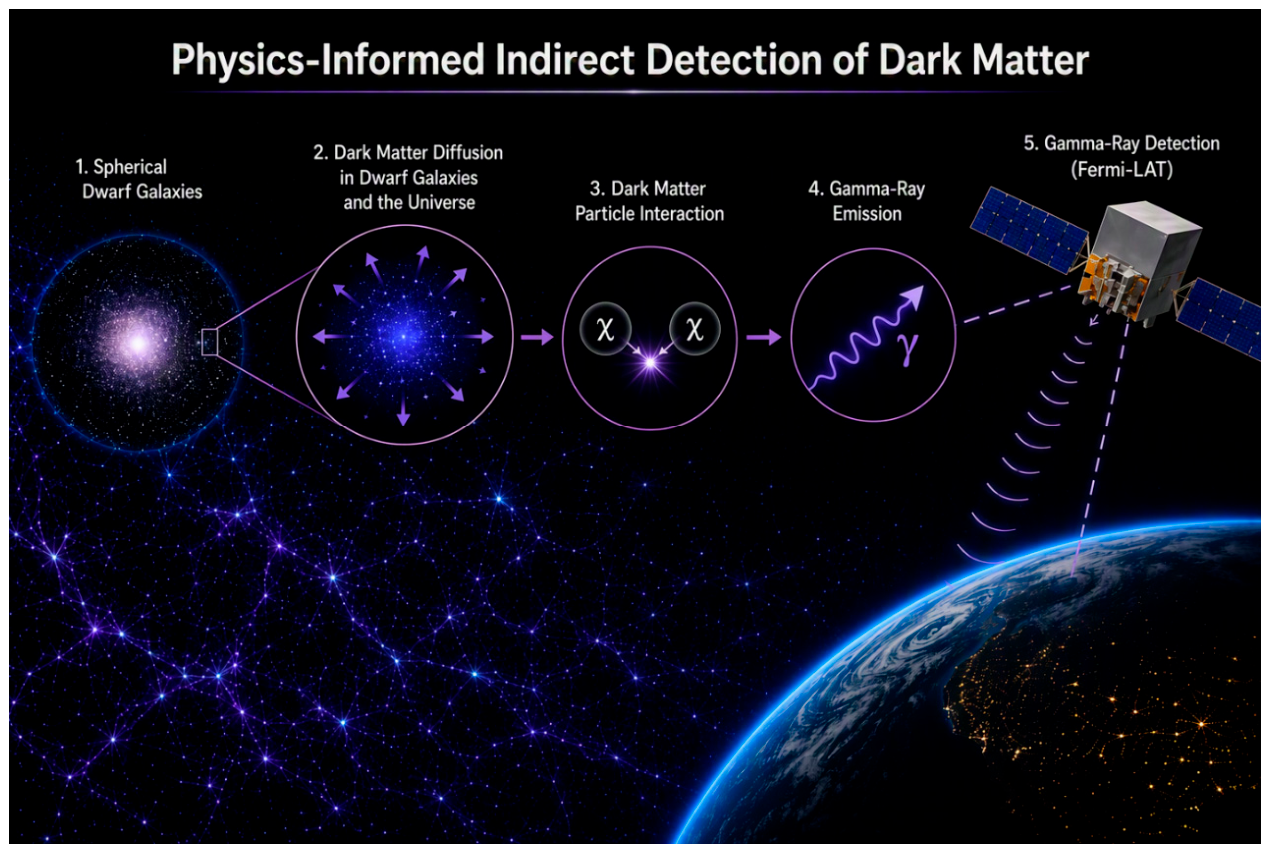
Figure 2.
Workflow of the PINN model framework for inverse design in dark matter indirect detection, illustrating the integration of input data sources, physics-informed layers, neural residual correction, and multi-objective loss optimization.
Figure 2.
Workflow of the PINN model framework for inverse design in dark matter indirect detection, illustrating the integration of input data sources, physics-informed layers, neural residual correction, and multi-objective loss optimization.
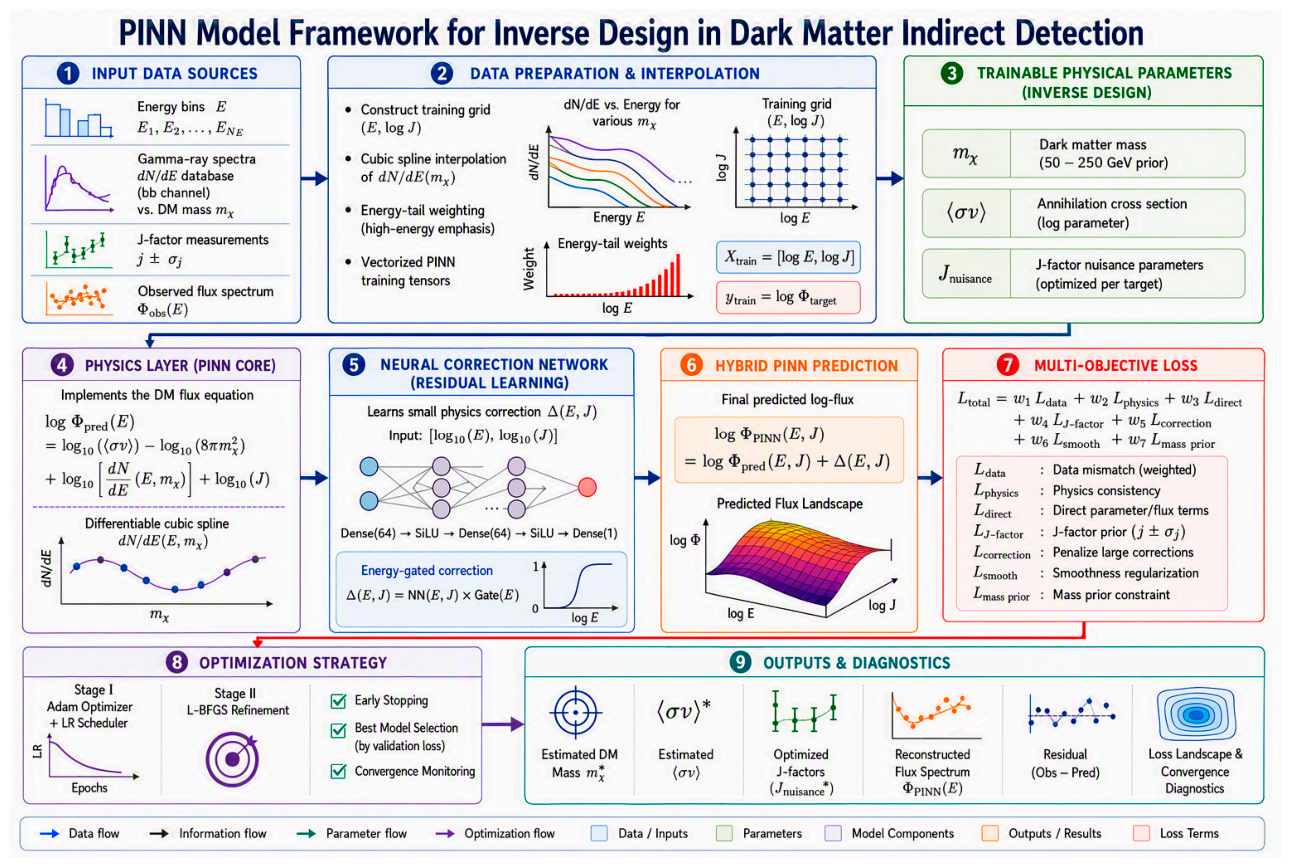
Figure 3.
Convergence behavior of the multi-objective loss functions across training epochs, showing the stable evolution of total, data, physics, and correction loss components.
Figure 3.
Convergence behavior of the multi-objective loss functions across training epochs, showing the stable evolution of total, data, physics, and correction loss components.
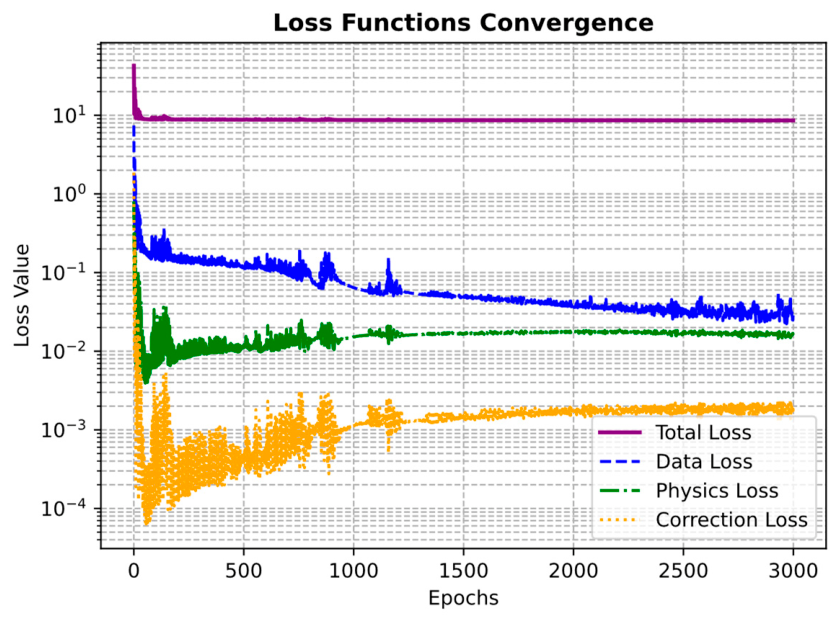
Figure 4.
Comparison between the observed and PINN-predicted gamma-ray flux spectra as a function of energy, demonstrating high-accuracy model fit across the energy range.
Figure 4.
Comparison between the observed and PINN-predicted gamma-ray flux spectra as a function of energy, demonstrating high-accuracy model fit across the energy range.
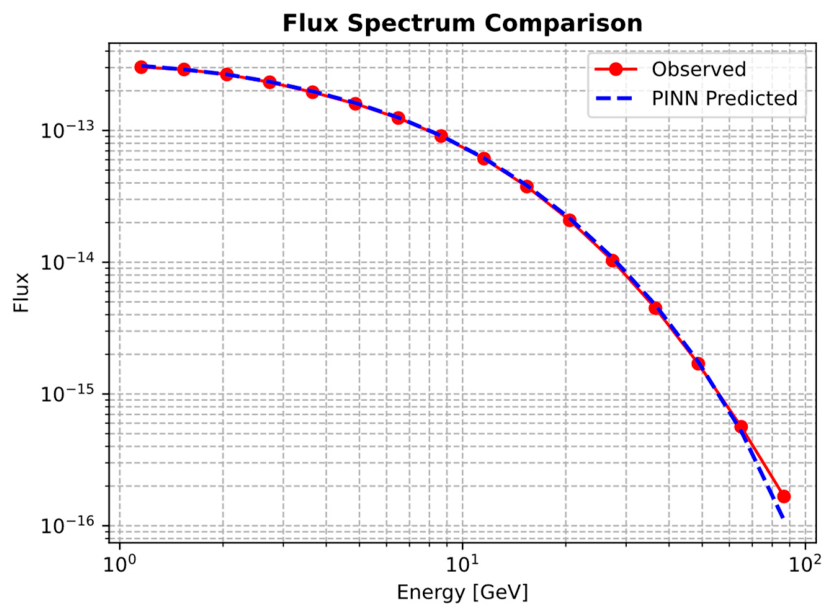
Figure 5.
Residual distribution as a function of energy, comparing individual data points against the smoothed trend relative to the zero-error line.
Figure 5.
Residual distribution as a function of energy, comparing individual data points against the smoothed trend relative to the zero-error line.
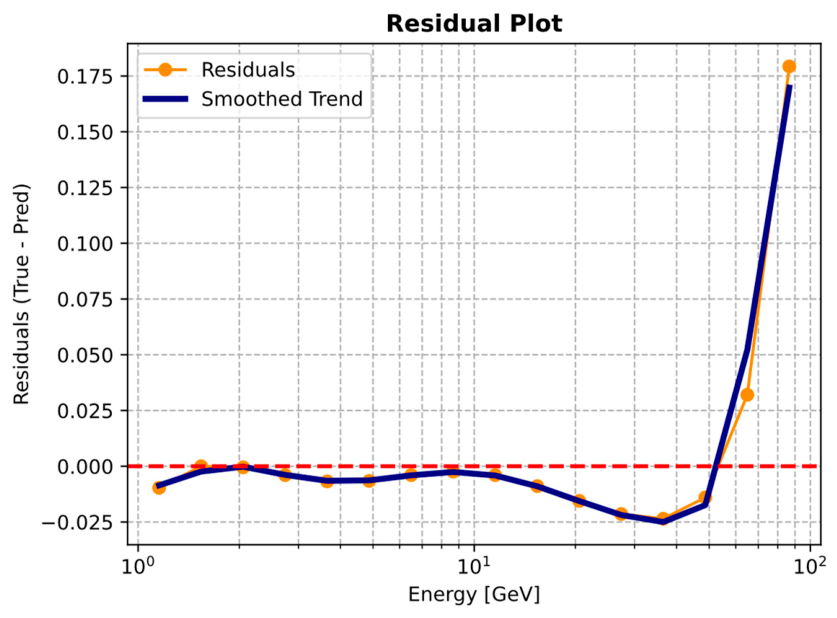
Figure 6.
Loss landscape contours as a function of dark matter massand annihilation cross-section , highlighting the optimized convergence region and the estimated solution.
Figure 6.
Loss landscape contours as a function of dark matter massand annihilation cross-section , highlighting the optimized convergence region and the estimated solution.
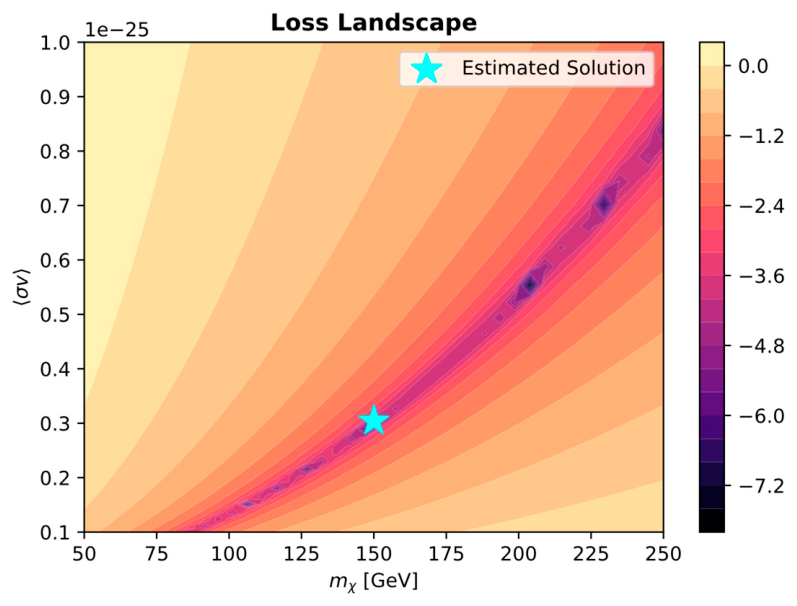
Figure 7.
Shift in J-factor nuisance parameters across dwarf galaxy targets, comparing original measurements with error bars against optimized values.
Figure 7.
Shift in J-factor nuisance parameters across dwarf galaxy targets, comparing original measurements with error bars against optimized values.
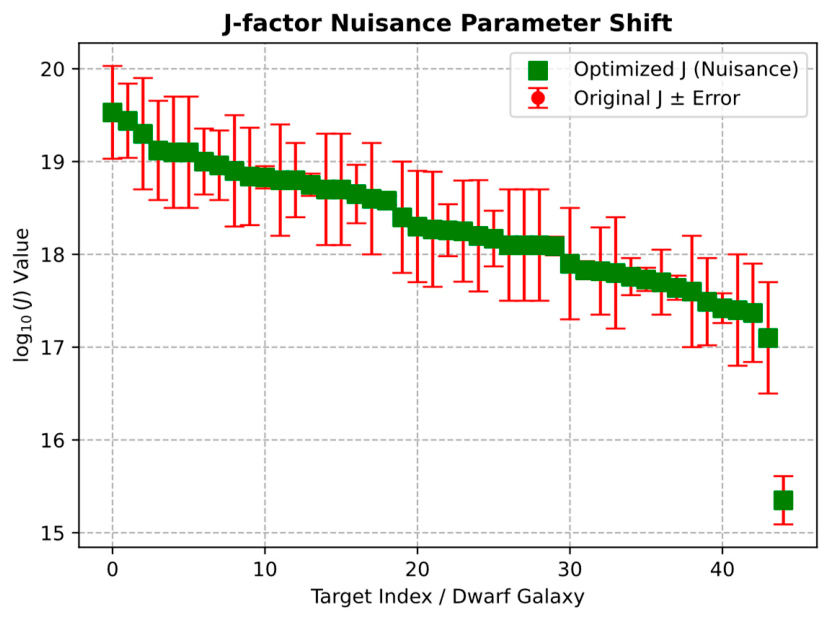
Figure 8.
Comparison of PINN and DNN predictions across interpolation and extrapolation regions, highlighting the PINN model’s physical consistency outside the training domain.
Figure 8.
Comparison of PINN and DNN predictions across interpolation and extrapolation regions, highlighting the PINN model’s physical consistency outside the training domain.
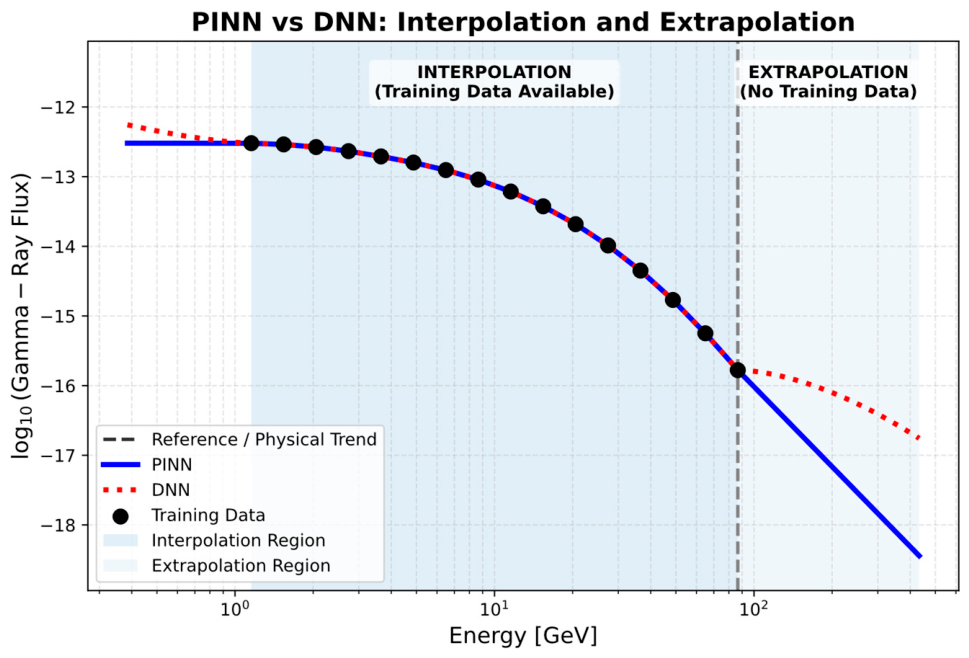
Figure 9.
Quantitative performance comparison showing the mean squared error (MSE) on a logarithmic scale for PINN versus standard DNN models across interpolation and extrapolation tasks.
Figure 9.
Quantitative performance comparison showing the mean squared error (MSE) on a logarithmic scale for PINN versus standard DNN models across interpolation and extrapolation tasks.
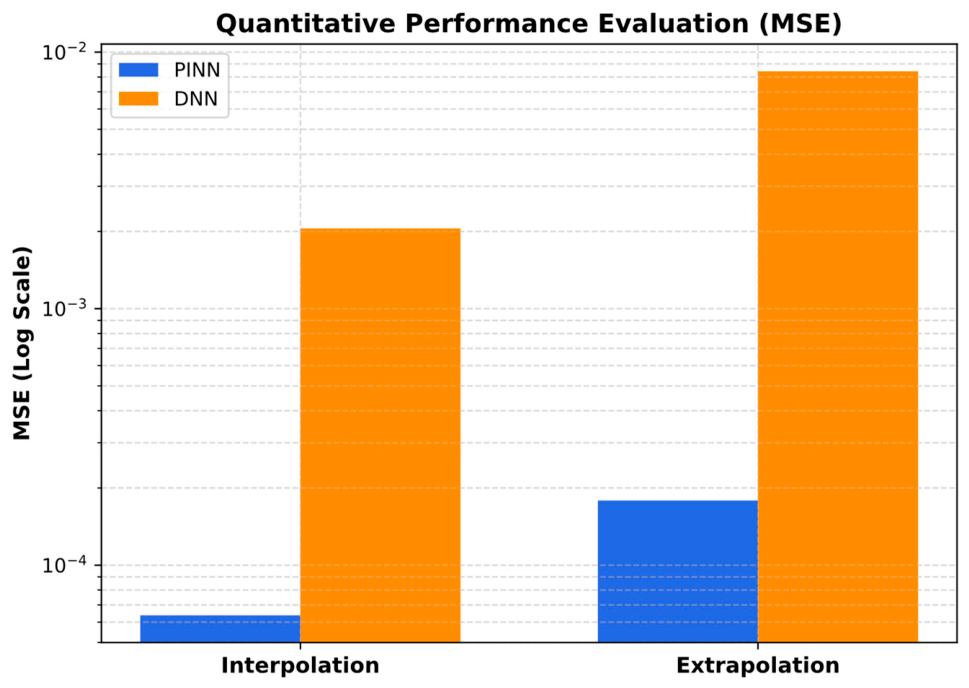
Table 1.
List of the 45 Milky Way dwarf spheroidal galaxies (dSphs) analyzed in this study.
| dSphs | dSphs | dSphs |
| Willman 1 | TucanaIV | PictorI |
| Ursa Major II | HydrusI | Carina |
| Tucana III | TucanaV | CanesVenatici II |
| Segue 1 | Sculptor | HydraII |
| Triangulum II | SagittariusII | Leo II |
| CetusII | HorologiumII | Sextans |
| Coma Berenices | AquariusII | Centaurus I |
| Reticulum II | UrsaMajorI | Leo I |
| BootesII | CarinaII | ColumbaI |
| Tucana II | ReticulumIII | LeoT |
| Draco | Bootes I | Canes Venatici I |
| BootesIII | Kim2 | IndusII |
| EridanusIV | PhoenixII | Hercules |
| Ursa Minor | EridanusIII | EridanusII |
| GrusII | Fornax | Crater II |
Disclaimer/Publisher’s Note: The statements, opinions and data contained in all publications are solely those of the individual author(s) and contributor(s) and not of MDPI and/or the editor(s). MDPI and/or the editor(s) disclaim responsibility for any injury to people or property resulting from any ideas, methods, instructions or products referred to in the content. |
© 2026 by the authors. Licensee MDPI, Basel, Switzerland. This article is an open access article distributed under the terms and conditions of the Creative Commons Attribution (CC BY) license (http://creativecommons.org/licenses/by/4.0/).
Copyright: This open access article is published under a Creative Commons CC BY 4.0 license, which permit the free download, distribution, and reuse, provided that the author and preprint are cited in any reuse.