

Submitted:
14 October 2026
Posted:
23 October 2026
You are already at the latest version
Abstract
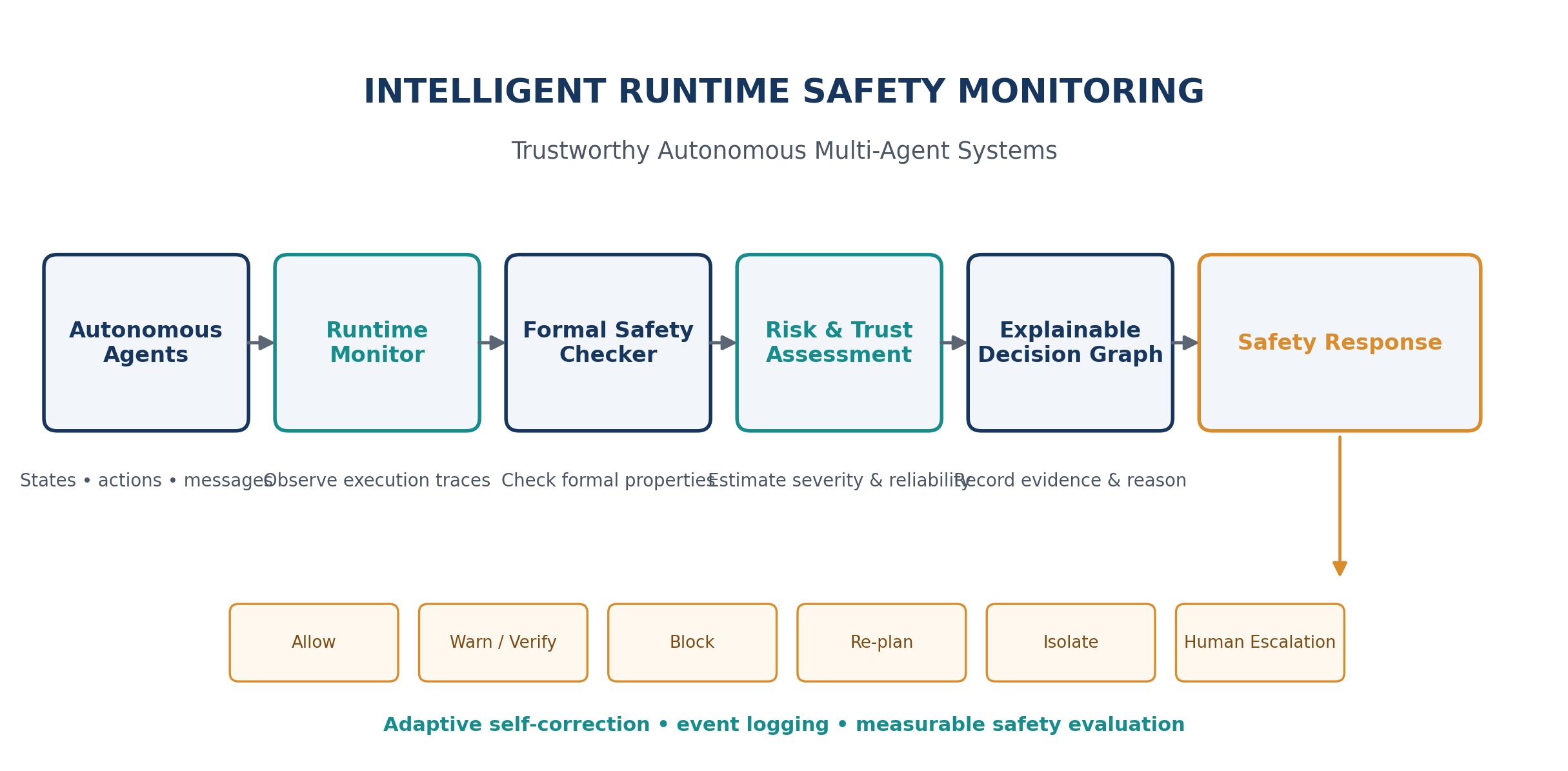
Autonomous Multi-Agent Systems (MAS) are increasingly being adopted in autonomous vehicles, robotic coordination, smart manufacturing, healthcare, cybersecurity, and intelligent decision-support applications. Although multiple autonomous agents can independently plan, communicate, and act, their interactions introduce system-level safety risks in which incorrect actions, unreliable agents, corrupted communication, or changing environmental conditions can propagate across the system. Existing approaches often focus on pre-deployment verification or address individual concerns such as trust, communication security, or policy verification. This paper presents an Intelligent Runtime Safety Monitoring framework for trustworthy autonomous multi-agent systems that continuously observes agent states, actions, communications, and decisions during execution. The proposed framework integrates formal safety verification, risk assessment, dynamic trust estimation, explainable decision-making, and adaptive self-correction. Based on the detected safety condition, the framework can allow, warn, block, re-plan, isolate, or escalate an event for human intervention. For empirical evaluation, the study adopts public autonomous-driving motion resources, using the nuScenes dataset as the primary pilot resource and the Waymo Open Motion Dataset as a scale-up benchmark. The proposed methodology defines data preprocessing, safety-event construction, baseline comparisons, evaluation metrics, statistical analysis, and visualization procedures. The paper intentionally distinguishes dataset-grounded analysis from empirical performance claims, as completed benchmark results are not yet available in the current study. The framework provides a modular foundation for improving runtime safety, reliability, explainability, and adaptive response in autonomous multi-agent systems.
Keywords:
autonomous multi-agent systems
; runtime safety monitoring
; runtime verification
; trustworthy AI
; formal verification
; risk assessment
; explainable AI
; adaptive self-correction
; multi-agent safety
; motion forecasting
I. Introduction
A. Background
Artificial intelligence has enabled autonomous agents to plan, reason, communicate, and act with limited human in-tervention. A Multi-Agent System extends this capability by coordinating multiple agents that may have different roles, information, objectives, and reliability.
Such systems are attractive for autonomous driving, robotic warehouses, smart factories, drone coordination, and other cyber-physical applications. However, the safety problem is system-level: agents interact through shared environments and communication channels, so a local failure can become a multi-agent failure.
Conventional static verification and offline testing are useful for known failure modes but cannot exhaustively anticipate dy-namic execution conditions. Runtime Verification (RV) com-plements design-time assurance by checking observed execu-tions against formal properties while the system is operating. The proposed work therefore treats runtime monitoring as a safety layer between autonomous decision generation and physical or digital execution.
B. Problem Statement
The central problem is to detect and respond to unsafe multi-agent behavior during execution while maintaining low latency, low false alarms, explainability, and acceptable com-putational overhead.
The monitor must reason over individual actions as well as communication, coordination, historical reliability, and envi-ronmental context. A useful system should not merely label an event as unsafe; it should identify the violated property, estimate risk, select a proportionate response, and record evidence for later audit.
C. Research Gap
The literature reviewed in the supplied research shows that existing contributions tend to focus on separate dimensions. Safe MARL work integrates runtime verification with policy generation; trust research formalizes agent capability; recent work combines RV and LLMs; formal safety frameworks eval-uate embodied agents at multiple levels; and communication-monitoring work focuses on corruption attacks.
The gap is a unified runtime architecture that combines continuous behavior monitoring, formal safety verification, communication monitoring, risk and trust assessment, explain-ability, adaptive recovery, and human escalation.
D. Objectives
The objectives of this research are:
- To design an intelligent runtime monitoring architecture for continuous observation of autonomous MAS behavior.
- To develop safety rules for policy violations, unsafe actions, abnormal communication, and coordination fail-ures.
- To estimate risk and trust for individual agents and the overall system.
- To provide explainable decision graphs showing why a runtime safety action was selected.
- To enable adaptive self-correction through blocking, mod-ification, re-planning, isolation, verification, or escalation.
- To evaluate detection quality, latency, recovery, reliability, and computational and communication overhead quanti-tatively.
E. Contributions
The main contributions of this paper are:
- 1)
- A unified architecture linking runtime monitoring, for-mal verification, risk, trust, explanation, and correction.
- 2)
- A dataset-grounded evaluation design using public multi-agent motion data.
- 3)
- A formal risk-to-action policy.
- 4)
- A reproducible metric and statistical-analysis protocol.
- 5)
- A visualization set intended to expose agent interactions, safety events, dataset scale, and runtime decisions.
II. Related Work and Literature Review
A. Existing Approaches
Liu and Li proposed a runtime-verification-based safe MARL framework for multi-robot warehouse systems. Their method models safety-constrained Markov games, expresses properties using probabilistic temporal logic, and uses run-time verification to refine the model before safety-constrained policy optimization [1].
Akintunde et al. introduced a computational notion of actual trust based on an agent’s capacity to deliver intended tasks in the current interaction context [2]. This work is important for the trust component of the proposed architecture, but it does not itself provide a continuous runtime safety monitor with automated recovery.
Ferrando’s work argues for combining runtime verification with large language models. Runtime verification can act as a guardrail while learning-enabled components can help specification capture and reasoning under uncertainty [4].
SENTINEL extends formal safety evaluation to semantic, planning, and trajectory levels for embodied agents [5]. Wu et al. monitor LLM-based multi-agent communication graphs and dynamically adjust topology against corruption attacks [6]. These works motivate individual modules of the proposed framework.
B. Existing Systems
Three practical families are particularly relevant:
- Safe multi-agent reinforcement learning.
- Runtime verification for autonomous systems.
- Trajectory and interaction benchmarks for autonomous driving.
The proposed system is designed as a runtime supervisory layer rather than as a replacement for the underlying planner or policy.

Table I.
Comparison of Existing Approaches.
| Approach |
Primary Focus |
Runtime | Trust | Explainability | Recovery |
| Liu and Li (2024) |
Safe MARL / multi-robot |
Yes | Limited | Limited | Policy optimization |
| Akintunde et al. (2024) |
Actual trust | Conceptual | Yes | Conceptual | No |
| Ferrando (2025) |
RV + LLM autonomy |
Yes | Indirect | Yes | Guardrail con- cept |
| SENTINEL (2025) |
Formal embodied safety |
Evaluation | No | Formal | Limited |
| Wu et al. (2025) |
MAS cor- ruption de-fense |
Yes | Node- based |
Limited | Topology change |
| Proposed framework |
Unified MAS safety |
Yes | Yes | Yes | Adaptive and escalation |
C. Comparative AnalysisD. Research Gap
The comparison indicates that no single reviewed approach simultaneously targets execution monitoring, formal proper-ties, agent trust, communication behavior, explainable deci-sions, adaptive recovery, and human escalation.
The proposed architecture addresses this integration gap while remaining modular so that different planners, learning policies, or simulation environments can be substituted.
III. Proposed Methodology
A. System Overview
The system is modeled as a set of autonomous agents
operating in an environment E.
A = {a1, a2, . . . , an}
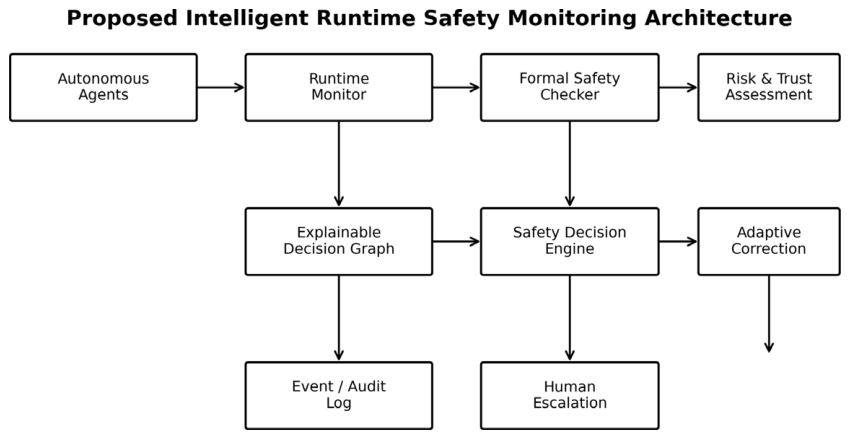
At time t, each agent produces an action ai(t), exchanges messages mi(t), and has an observable state si(t). A runtime monitor converts these observations into an execution trace τ . The safety checker evaluates τ against a set of formal properties Φ. A risk-trust layer computes a normalized risk score R(t) and trust estimate Ti(t). An explainable decision graph records the evidence path, and a decision engine selects a response u(t).
B. System Architecture
The architecture follows the proposed research design. Au-tonomous agents generate actions and communications. The runtime monitor observes execution. The formal safety checker verifies constraints. Risk and trust assessment quantify severity and reliability. An explainable decision graph records the reasoning, and the safety decision engine chooses allow, warn, block, re-plan, isolate, or escalate.
C. Runtime Observation and Event Extraction
The observation module collects timestamped agent state, action, message, resource, task, and dependency information.
For trajectory datasets, this can include:
- Position.
- Velocity.
- Acceleration.
- Heading.
- Agent class.
- Neighboring-agent distance.
- Lane context.
- Interaction indicators.
Events are represented as tuples:
et = (agent, state, action, context, timestamp).
Figure 1.
Proposed intelligent runtime safety monitoring architecture.
D. Formal Safety Verification
Safety properties can be expressed using temporal logic or executable rules. Examples include minimum separation, pro-hibited maneuvers, permission constraints, temporal ordering, and communication consistency.
A simple separation property is:
where dij(t) is the distance between agents i and j, and dmin is the minimum permitted separation.
G(dij(t) ≥ dmin),
The monitor reports a violation when the observed trace contradicts the property.
E. Risk and Trust Assessment
Risk is modeled using event severity, estimated probability, agent reliability, interaction impact, environmental context, and historical behavior.
Trust is treated as a dynamic reliability estimate rather than a static reputation score. This is consistent with the emphasis on actual capability in the current interaction context.
F. Explainable Decision and Adaptive Self-Correction
The decision graph follows the sequence:
Agent Action → Safety Rule → Violation → Risk Level → Trust Context → Decision → Reason
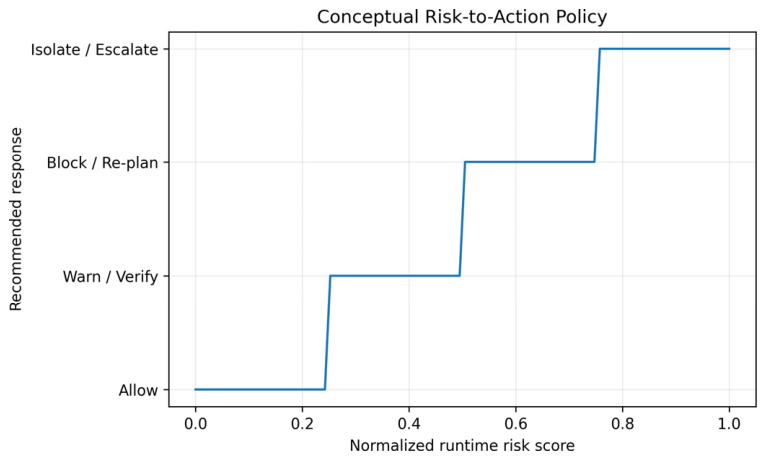
Corrective actions are selected proportionally. Safe events continue normally. Moderate events can trigger warning or verification. High-risk events can be blocked or re-planned. Critical events can isolate an agent and request human inter-vention.
G. Runtime Safety Monitoring AlgorithmH
| Algorithm 1 Runtime Safety Monitoring |
| 1: Receive timestamped agent observations, actions, and messages. 2: Update the execution trace and derive interaction features. 3: Evaluate formal safety properties and communication con-straints. 4: if no violation is detected then 5: Record a safe event and continue execution. 6: else 7: Compute severity, probability, trust, and impact. 8: Compute normalized risk R(t). 9: Map risk to an action policy. 10: Generate an explanation containing the violated rule and evidence. 11: Execute allow, warn, block, re-plan, isolate, or human escalation. 12: end if 13: Log the event, response, latency, and outcome. 14: Update trust and historical reliability. |
H. Mathematical Formulation
Let si(t) denote the state of agent i, ai(t) its action, and mij(t) a message from agent i to agent j. The pairwise separation is defined as:
dij(t) = ||pi(t) − pj(t) ||2 .
A basic safety predicate is:
A weighted risk model is:
where S is severity, P is probability, I is interaction impact, C is contextual hazard, H is historical risk, T is trust, w values are tunable weights, and σ is a normalization function.
R(t) = σ (wsS + wpP + wiI + wcC + whH − wtT ) ,
The response policy is:
with threshold regions corresponding to allow, warn or verify, block or re-plan, and isolate or escalate.
u(t) = π(R(t)),
For binary safety-event detection:
and
Detection latency is the elapsed time between the first observable violation condition and the monitor’s decision. Recovery success is the proportion of detected violations for which the selected corrective action returns the system to a safe state within a predefined horizon.
IV. Experimental Setup
A. Dataset
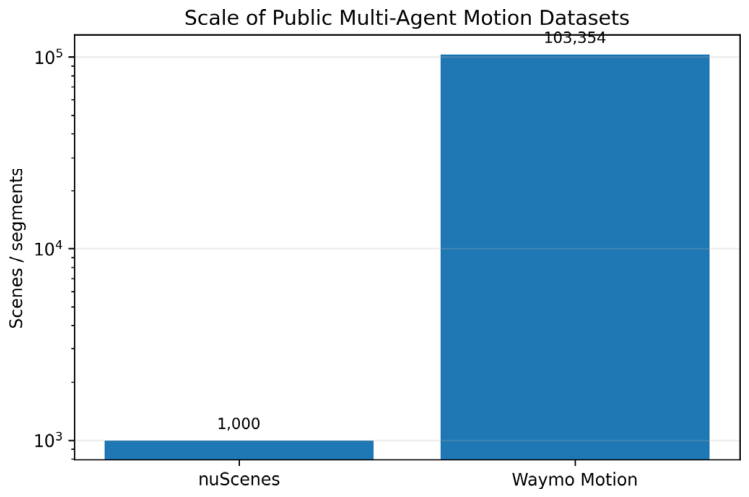
The primary pilot resource is the public nuScenes dataset. It contains 1,000 scenes of 20 seconds each, with a full sensor suite of six cameras, five radars, and one lidar, together with 3D annotations [7].
Its prediction interface represents agent trajectories as se-quences of x-y positions and provides past and future query-ing, velocity, acceleration, and heading-change utilities.
The scale-up benchmark is the Waymo Open Motion Dataset. It contains large-scale motion segments involving vehicles, pedestrians, and cyclists [8].
Table II.
Datasets Used in the Study.
| Dataset | Scale / Content | Use in This Study |
| nuScenes | 1,000 scenes; 20 seconds; multimodal; 3D annotations | Primary pilot for trajectory, interaction, and safety-event features |
| nuScenes mini | 10 scenes; 404 samples in official tutorial | Development, debugging, and visualization |
| Waymo Motion | Large-scale 20-second motion segments; multiple tracked objects | Scale-up validation and interaction stress testing |
B. Data Preprocessing
The preprocessing procedure includes:
- Synchronizing timestamps and converting trajectories to a common coordinate representation.
- Filtering invalid or incomplete tracks.
- Retaining agents with sufficient temporal history.
- Computing velocity, acceleration, heading-change rate, pairwise distance, relative velocity, and interaction prox-imity.
- Constructing safety-event labels from explicit rule viola-tions and scenario metadata.
- Normalizing continuous variables while preserving tem-poral ordering.
- Splitting by scene rather than by individual rows to prevent temporal leakage.
C. Experimental Environment
A reproducible implementation can use Python, NumPy, pandas, scikit-learn, matplotlib, the nuScenes devkit, and a simulator or replay engine for controlled violation injection.
The implementation should document the number and roles of agents, safety rules, risk and trust calculations, correction policy, simulation parameters, hardware and software config-uration, scenarios, and evaluation metrics.
D. Baseline Methods
The baseline should be a multi-agent system without the proposed intelligent runtime safety layer.
Additional ablations should remove one component at a time:
- Formal verification.
- Trust estimation.
- Explainability.
- Adaptive correction.
- Communication monitoring.
This isolates the contribution of each module.
E. Evaluation Metrics
Primary metrics include:
- Safety-event detection accuracy.
- Precision.
- Recall.
- F1-score.
- False-positive rate.
- False-negative rate.
- Detection latency.
- Recovery success.
- Trust score.
- System reliability.
- Computational overhead.
- Communication overhead.
For trajectory-oriented analysis, minimum distance, relative speed, acceleration, and heading-change rate can be used as risk indicators.
V. Data Analysis and Visualization
A. Exploratory Data Analysis
Exploratory data analysis should quantify the distribution of agent classes, track lengths, scene durations, interaction counts, speeds, accelerations, and pairwise distances.
Scene-level splitting is essential because adjacent frames from the same scene are strongly correlated.
B. Statistical Summary
For each continuous feature, report count, mean, standard deviation, median, interquartile range, minimum, and maxi-mum.
For safety events, report event prevalence per scene and per agent. Because rare violations can dominate safety evaluation, class imbalance should be explicitly reported.
C. Feature Analysis
Candidate safety features include:
- Minimum pairwise distance.
- Time-to-collision where velocity assumptions are valid.
- Relative speed.
- Acceleration.
- Jerk.
- Heading-change rate.
- Local density.
- Message consistency.
- Prior violation count.
- Trust score.
Feature importance can be evaluated using permutation im-portance or a tree-based baseline. Correlation analysis should be interpreted cautiously because trajectory features are tem-porally dependent.
D. Data Visualization
Figure 2.
Example future trajectory reproduced from the official nuScenes prediction tutorial output. This is a dataset-grounded illustration and not an experimental result of the proposed monitor.
Figure 2.
Example future trajectory reproduced from the official nuScenes prediction tutorial output. This is a dataset-grounded illustration and not an experimental result of the proposed monitor.
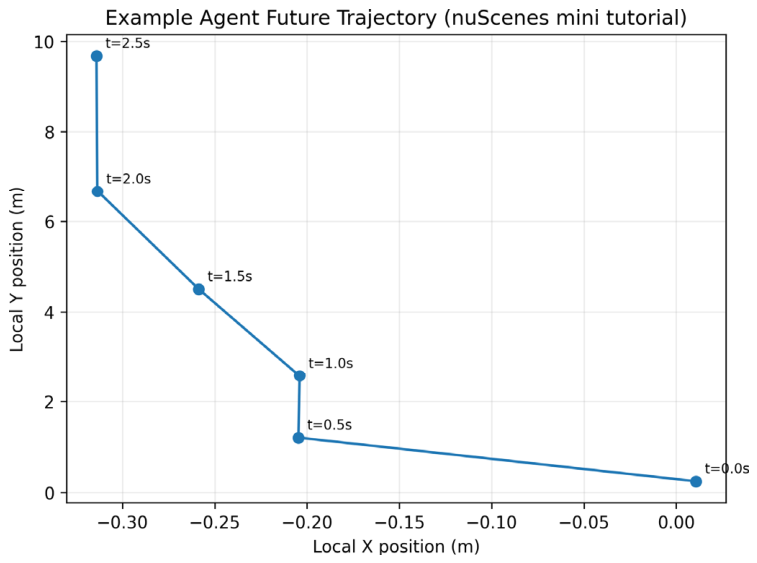
Figure 3.
Public dataset scale comparison using official dataset counts.
VI. Results
A. Performance Results
The current research document defines the experimental design and expected outcomes but does not report completed benchmark measurements. Accordingly, this paper does not invent accuracy, F1-score, latency, or recovery values.
Figure 4.
Conceptual mapping from normalized runtime risk to corrective action.
The final conference version should populate Table ?? after executing the implementation on the selected scene-level splits.
| Method | Prec. | Rec. | F1 | FPR | Latency | Recovery |
| No monitor |
— | — | — | — | — | — |
| Rule monitor only |
— | — | — | — | — | — |
| Proposed frame-work |
To measure |
To measure |
To measure |
To measure |
To measure |
To measure |
B. Comparative Analysis
The key comparison is not simply detection accuracy. A useful safety monitor must balance detection quality against latency, false alarms, recovery success, and computational overhead.
A system with higher recall but excessive false positives may reduce operator trust, while a low-latency detector that cannot recover safely may still be unsuitable for autonomous deployment.
C. Ablation Study
Table III.
Ablation Study Configurations.
| Configuration | Removed Component | Expected Diagnostic |
| Full | None | Reference system |
| A1 | Trust module | Effect of reliability context |
| A2 | Formal checker | Effect of explicit safety properties |
| A3 | Explainability | Effect on auditability |
| A4 | Adaptive correction | Effect on recovery |
| A5 | Communication monitor | Effect on coordination failures |
D. Error Analysis
False positives should be categorized into benign close interactions, sensor or track noise, ambiguous right-of-way situations, and overly conservative rules.
False negatives should be categorized into missed proximity events, delayed detection, communication-induced failures, and violations caused by context not represented in the rule set.
Temporal plots should be inspected around each error to determine whether the failure is due to feature extraction, rule design, risk calibration, or response selection.
VII. Statistical Analysis
A. Descriptive Statistics
Report scene-level and agent-level distributions rather than treating every timestamp as an independent sample.
Median and interquartile range are recommended for skewed safety variables such as minimum distance and latency.
B. Statistical Tests
For paired baseline-versus-proposed comparisons across the same scenes, use the Wilcoxon signed-rank test when metric distributions are non-normal.
Use a paired t-test only when its assumptions are adequately supported. For binary event proportions, McNemar’s test is appropriate when the same labeled events are classified by two systems.
Multiple comparisons should be corrected, for example using the Holm procedure.
C. Confidence Intervals
Report 95% confidence intervals using scene-level bootstrap resampling. For F1-score, recall, recovery success, and latency, bootstrap scenes rather than individual frames to preserve temporal dependence.
D. Statistical Interpretation
A statistically significant improvement should not automat-ically be treated as practically important.
The final analysis should report effect size, confidence interval, and operational relevance. In safety monitoring, a small improvement in recall may be valuable if it does not introduce unacceptable latency or false alarms.
VIII. Discussion and Interpretation
A. Findings
The architecture directly addresses the identified research gap: safety is treated as a continuous system-level property rather than a one-time pre-deployment check.
The combination of formal rules and learned or contextual risk features is intended to improve detection under dynamic conditions, while trust and explanation make the decision process more interpretable.
B. Comparison with Existing Work
Relative to safe MARL methods, the proposed framework adds runtime trust, communication monitoring, explainable decisions, and adaptive response.
Relative to trust models, it adds execution-time safety enforcement. Relative to communication-focused defenses, it expands monitoring from graph corruption to broader behav-ioral and policy violations.
Relative to formal embodied-agent evaluation, it emphasizes continuous multi-agent execution and post-violation response.
C. Implications
The framework is applicable to autonomous vehicles, robotic warehouses, smart manufacturing, drone teams, and other systems in which an agent can affect another agent.
Public trajectory datasets can support offline replay and stress testing, while simulation can be used to inject controlled violations that are difficult to obtain from naturally occurring datasets.
D. Limitations
Public motion datasets do not directly encode every seman-tic property required by a trustworthy MAS monitor, especially internal agent intentions, message content, permissions, or human escalation.
Safety labels may therefore need rule-based construction or simulation-based event injection. Dataset-specific results should not be interpreted as certification of real autonomous systems.
The proposed risk equation and action thresholds are design choices requiring calibration and validation.
IX. Conclusion
This paper presents an Intelligent Runtime Safety Mon-itoring framework for trustworthy autonomous Multi-Agent Systems.
The proposed architecture continuously observes execution, verifies formal safety properties, estimates risk and trust, explains decisions, and applies adaptive correction.
The literature and research plan support the need for an integrated architecture rather than isolated safety modules. nuScenes provides a practical pilot resource with multimodal sensing and annotated agent trajectories, while Waymo Motion offers a much larger interaction-rich benchmark.
The paper deliberately separates dataset-grounded facts and pilot visualizations from empirical performance claims. Com-pleting the implementation and filling the defined evaluation tables will transform this draft into a results-based conference submission.
X. Future Work
Future work will focus on:
- Implementing the monitor as a real-time replay and simulation service with configurable safety specifications.
- Developing temporal-logic and rule-based libraries for collision, policy, communication, and coordination safety.
- Learning adaptive risk and trust models from historical event outcomes.
- Evaluating on nuScenes and Waymo Motion with scene-level cross-validation and controlled violation injection.
- Investigating LLM-assisted specification generation while keeping formal verification as the final safety gate.
- Studying scalability, distributed monitoring, fault toler-ance, and certification-oriented assurance cases.
- Releasing code, configuration files, safety specifications, scenario seeds, and evaluation scripts for reproducibility.
Supplementary Materials
The following supporting information can be downloaded at the website of this paper posted on Preprints.org.
Acknowledgment
The author acknowledges Sanjivani University, Kopargaon, Department of Artificial Intelligence and Data Science, for academic support. The author also acknowledges the maintainers of the public nuScenes and Waymo Open Dataset resources used as external data references for the proposed evaluation design.
Appendix A
- Dataset version and access date.
- Scene-level split files.
- Feature-generation code.
Table IV.
Recommended Experimental Run Matrix.
| Scenario | Event Type | Severity | Response Candidates |
| Normal | No violation | Low | Allow |
| Dense interaction | Near-conflict | Medium | Warn / verify |
| Unsafe maneuver | Policy violation | High | Block / re-plan |
| Corrupted message | Communication anomaly | High | Isolate / re-route |
| Repeated failure | Low trust + violation | Critical | Isolate / escalate |
| Environment change | Context hazard | Variable | Re-plan / verify |
- Safety-rule definitions.
- Risk and trust parameters.
- Baseline configurations.
- Random seeds.
- Hardware and software versions.
- Raw metric outputs.
- Statistical test scripts.
- Figure-generation scripts.
- Failure-case logs.
References
- Y. Liu and J. Li, “Runtime Verification-Based Safe MARL for Optimized Safety Policy Generation for Multi-Robot Systems,” Big Data and Cog-nitive Computing, vol. 8, no. 5, p. 49, 2024. [CrossRef]
- M. Akintunde, V. Yazdanpanah, A. Salehi Fathabadi, C. Cirstea, M. Dastani, and L. Moreau, “Actual Trust in Multiagent Systems,” in Proceedings of the 23rd International Conference on Autonomous Agents and Multiagent Systems, Auckland, New Zealand, 2024, pp. 2114–2116.
- M. Akintunde, V. Yazdanpanah, A. Salehi Fathabadi, C. Cirstea, M. Dastani, and L. Moreau, “Formal Specification of Actual Trust in Multiagent Systems,” HHAI, 2024. [CrossRef]
- A. Ferrando, “Watchdogs and Oracles: Runtime Verification Meets Large Language Models for Autonomous Systems,” Electronic Proceedings in Theoretical Computer Science, vol. 436, pp. 80–87, 2025. [CrossRef]
- S. S. Zhan et al., “SENTINEL: A Multi-Level Formal Framework for Safety Evaluation of LLM-based Embodied Agents,” arXiv:2510.12985, 2025.
- C. Wu, Z. Zhang, M. Xu, Z. Wei, and M. Sun, “Monitoring LLM-based Multi-Agent Systems Against Corruptions via Node Evaluation,” arXiv:2510.19420, 2025.
- H. Caesar et al., “nuScenes: A Multimodal Dataset for Autonomous Driving,” in Proceedings of the IEEE/CVF Conference on Com-puter Vision and Pattern Recognition, 2020, pp. 11621–11631. [CrossRef]
- S. Ettinger et al., “Large Scale Interactive Motion Forecasting for Au-tonomous Driving: The Waymo Open Motion Dataset,” in Proceedings of the IEEE/CVF International Conference on Computer Vision, 2021, pp. 9710–9719. [CrossRef]
- R. Taleb, S. Halle´, and R. Khoury, “Uncertainty in Runtime Verification: A Survey,” Computer Science Review, vol. 50, Art. no. 100594, 2023. [CrossRef]
- A. G. Lewis, B. Horva´th, and R. Costa, “A Systematic Review of Formal Verification Models for Safety of Autonomous AI Agents: Methods, Architectures, and Future Research Directions,” International Journal on Advanced Computer Theory and Engineering, vol. 14, no. 2, pp. 99–107, 2025.
- Waymo, “Waymo Open Dataset: About and Motion Dataset,” offi-cial dataset documentation, updated 2025. [Online]. Available: https://waymo.com/open/about/.
- nuScenes, “nuScenes Prediction Task and Prediction Tutorial,” official dataset documentation. [Online]. Available: https://www.nuscenes.org/ prediction.
Disclaimer/Publisher’s Note: The statements, opinions and data contained in all publications are solely those of the individual author(s) and contributor(s) and not of MDPI and/or the editor(s). MDPI and/or the editor(s) disclaim responsibility for any injury to people or property resulting from any ideas, methods, instructions or products referred to in the content. |
© 2026 by the authors. Licensee MDPI, Basel, Switzerland. This article is an open access article distributed under the terms and conditions of the Creative Commons Attribution (CC BY) license (http://creativecommons.org/licenses/by/4.0/).
Copyright: This open access article is published under a Creative Commons CC BY 4.0 license, which permit the free download, distribution, and reuse, provided that the author and preprint are cited in any reuse.