

Submitted:
22 October 2026
Posted:
22 October 2026
You are already at the latest version
Abstract
The Evolutionary Information Layering (EIL) framework describes biological coordination as superimposed informational layers. Its basal Layer 0, pre-neural regulation, was originally treated as a single block. Here I propose that Layer 0 can be examined as a set of proposed functional subdivisions, not established evolutionary stages: ionic or adhesive regulation, junctional and extracellular-matrix coupling, bioelectric patterning, and pre-neural integration (provisional). Multicellularity does not invent coordination; unicellular organisms already sense and regulate. What multicellularity adds is the problem of group-level coordination, in which previously separate regulatory capacities become organizationally coupled (Bozdag et al., 2026). This article refines Layer 0 provisionally, states what the subdivisions are not, and identifies comparative and experimental tests required next. Clinical implications are deferred to a separate series.
Keywords:
Evolutionary Information Layering
; Layer 0
; multicellularity
; pre-neural coordination
; bioelectricity
; cell–cell signalling
1. Introduction
In EIL v1, Layer 0 gathered bioelectric gradients, extracellular matrix (ECM), and mechanical forces under one label: pre-neural substrate. That compression was useful for cross-scale argument, but it hides a conceptual issue. Coordination is not born at multicellularity. A single cell maintains membrane potential, senses chemical gradients, and adjusts behaviour without any neighbour. Multicellularity changes the unit of the problem: regulation must now serve not only the cell, but the cohesive group that can reproduce, differentiate, and adapt as a collective (Bozdag et al., 2026).
The question addressed here is narrow. Before neurons exist, what kinds of regulatory capacity must a multicellular body already possess, and how might those capacities be reused by later nervous systems?
This article is a theoretical companion. It reports no new empirical data; its contribution is a refinement of Layer 0 as a working taxonomy, an explicit statement of what that taxonomy does not claim, and a research programme by which the taxonomy could be tested, revised, or dissolved.
2. Materials and Methods
This is a conceptual analysis based on published literature. No new experimental data were generated. The method consists of three steps: (i) identification, from the comparative and developmental literature, of the regulatory capacities that a multicellular body must possess before nervous systems arise; (ii) organisation of these capacities into proposed functional subdivisions of EIL Layer 0, using evidence-level statements rather than hypothetical evolutionary stages; (iii) evaluation of the resulting taxonomy against two requirements—that each subdivision be distinguished by a recognisable mechanism class, and that the taxonomy as a whole make no claim it cannot in principle be tested. Sources were selected from the peer-reviewed literature on cell-type evolution (Arendt et al., 2016), the evolution of animal neural systems (Liebeskind et al., 2017), the evolutionary transition to multicellularity (Bozdag et al., 2026), and bioelectric signalling in development and regeneration (McLaughlin and Levin, 2018).
3. Results
The result of this analysis is a provisional taxonomy of Layer 0 as four functional subdivisions.
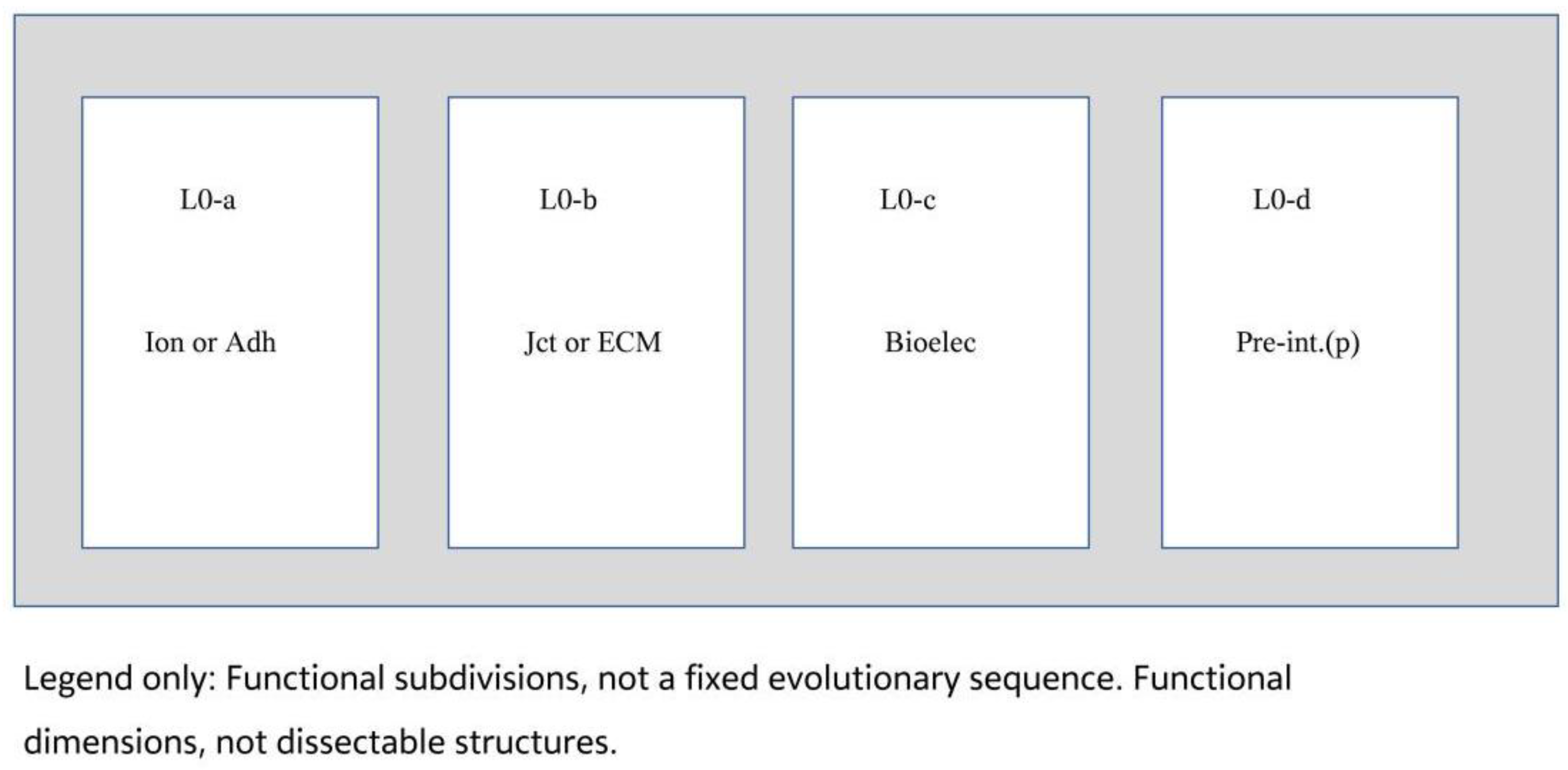
L0-a, ionic and adhesive regulation, is driven by membrane potential, ion channels, and adhesion molecules. It supports cellular excitability, environmental responsiveness, and cell association.
L0-b, junctional and ECM coupling, is driven by gap junctions, tight and anchoring junctions, and matrix stiffness. It supports intercellular communication, tissue integrity, and mechanical coupling through distinct mechanisms.
L0-c, bioelectric patterning, is driven by endogenous voltage gradients, bioelectric fields, and morphogenetic cues. It may contribute to spatial regulation of development, polarity, and regeneration in specific systems (McLaughlin and Levin, 2018).
L0-d, pre-neural integration (provisional), is driven by secretory signalling, neuroid-like cells, and non-synaptic integration. This is a proposed category requiring clearer operational definition, not yet a mature biological class.
The functional roles of these subdivisions can be summarised as follows: cohesion is the information-binding problem; cell differentiation is the information-allocation problem; tissue repair is the information-restoration problem; and collective behaviour is the information-integration problem. The biological processes named here are empirical; their redescription as information problems is the author's theoretical interpretation, and the two should not be conflated. Nervous systems are specialised forms of rapid integrated signalling, evolved through modification of pre-existing cellular mechanisms; older regulatory processes need not disappear, though their relationships vary across lineages. The emergence of nerves involves repurposing, cellular specialisation, and reorganisation of signalling architectures (Liebeskind et al., 2017). Complexity arises from retention, specialisation, and integration, not from a clean staircase.
Two caveats bound the taxonomy. First, these mechanisms are not absent in unicellular life. Ion regulation and adhesion-related behaviours exist before multicellularity; multicellularity reorganises them rather than inventing them (Arendt et al., 2016). Second, the order L0-a to L0-d is not a claim that all lineages pass through this sequence. Multicellularity has dozens of independent origins, and animals, algae, slime moulds and fungi reuse different ancestral parts (Bozdag et al., 2026; Liebeskind et al., 2017). The subdivisions are a working taxonomy for animal-centred EIL discussion, not a phylogenetic law. Crucially, they are functional dimensions, not four same-level biological entities; treating them as one kind of object would be a category error.
Figure 1.
Layer 0 as functional space, not staircase. Four functional subdivisions. L0-a ionic/adhesive regulation; L0-b junctional/ECM coupling; L0-c bioelectric patterning; L0-d pre-neural integration, provisional presented side by side, without ordering arrows. The subdivisions are functional dimensions, not a fixed evolutionary sequence, and not dissectable structures.(Figure created by the author).
4. Discussion
4.1. What Is Deliberately Not Claimed
Several claims are explicitly disclaimed, because each would be a natural misreading. Robustness is not claimed: ancient does not mean robust, and the robustness of any subdivision is an empirical question. Information density is used heuristically only; where it matters, it should be replaced with operable dimensions such as spatial range, temporal dynamics, variables integrated, feedback gain, and error-correction capacity. Neural origin causality is not claimed: multicellularity creates the problem space, and neurons are one specialist solution to it. Layer 0 is not claimed to consist of discrete entities; its subdivisions are functional dimensions. Finally, the relation to EIL v1 is a provisional internal specification of Layer 0; the macro-architecture of the framework is unchanged.
4.2. Research Programme
Five lines of work follow from the taxonomy. First, ion-channel and adhesion repertoires should be mapped across unicellular relatives, simple multicellular groups, and early-diverging animals, to test whether the subdivisions correspond to distinguishable mechanism repertoires (Arendt et al., 2016). Second, whether junctional or ECM coupling predicts the spatial range of bioelectric patterning should be tested in regenerating and developing systems (McLaughlin and Levin, 2018). Third, which pre-neural circuits are necessary for regeneration, polarity, and collective movement should be identified. Fourth, comparative work should distinguish Layer 0 components that were co-opted from those invented in nerve nets, nerve cords, and brains (Liebeskind et al., 2017). Fifth, operational criteria for L0-d should be defined: what mechanism signature would justify keeping it as an independent category, and what result would dissolve it back into L0-a through L0-c. Arendt et al.'s definition of cell types as regulatory units rather than phenotypic boxes is the appropriate lens for this work.
4.3. Falsifiability Note
The provisional status of L0-d is anchored to explicit failure conditions. L0-d would lose its independent status if no cross-lineage mechanism signature is recoverable; if its phenomena prove fully reducible to combinations of L0-a through L0-c without residual explanatory value; or if comparative data show massive overlap with general secretory signalling and no additional coordination capacity. These questions are not answered here; they define the next manuscript in the series.
5. Conclusions
This article belongs inside the EIL programme. It does not settle nervous-system origins; it clarifies what must already be true before that question becomes meaningful. Clinical expression—including postural demand, motor decompensation, and non-neural repair observables—is intentionally deferred to the clinical series, because premature inclusion here would weaken the theoretical claim. The macro-architecture of EIL v1 is unchanged by this refinement of Layer 0.
Author Contributions
D.H. conceived the theoretical refinement, selected the literature, determined the interpretation and scope, and wrote the manuscript.
Funding
None.
Data Availability
No data generated; theoretical article.
Competing Interests
None declared.
Series note
This is Theoretical Companion 1.5 to EIL v1, internal series numbering, not displayed on title page.
AI Disclosure
Tencent Yuanbao and ChatGPT were used to assist with draft organisation and language editing. The author critically evaluated the literature, determined the theoretical interpretation and scope of the manuscript, and takes full responsibility for the final text and its claims.
References
- Arendt, D; Musser, JM; Baker, CVH; et al. The origin and evolution of cell types. Nat Rev Genet. 2016, 17(12), 744–757. [Google Scholar] [CrossRef]
- Liebeskind, BJ; Hofmann, HA; Hillis, DM; Zakon, HH. Evolution of Animal Neural Systems. Annu Rev Ecol Evol Syst. 2017, 48, 377–398. [Google Scholar] [CrossRef]
- Bozdag, GO; Tong, K; Yunker, PJ; Herron, MD; Ratcliff, WC. Overcoming key challenges in the evolutionary transition to multicellularity. Nature 2026, 658(8135), 327–336. [Google Scholar] [CrossRef]
- McLaughlin, KA; Levin, M. Bioelectric signaling in regeneration: mechanisms of ionic controls of growth and form. Dev Biol. 2018, 433(2), 177–189. [Google Scholar] [CrossRef]
- Hu, D. Evolutionary Information Layering: A Framework for Understanding the Emergence of Biological Coordination Across Scales. 2026. [Google Scholar] [CrossRef]
Disclaimer/Publisher’s Note: The statements, opinions and data contained in all publications are solely those of the individual author(s) and contributor(s) and not of MDPI and/or the editor(s). MDPI and/or the editor(s) disclaim responsibility for any injury to people or property resulting from any ideas, methods, instructions or products referred to in the content. |
© 2026 by the author. Licensee MDPI, Basel, Switzerland. This article is an open access article distributed under the terms and conditions of the Creative Commons Attribution (CC BY) license.
Copyright: This open access article is published under a Creative Commons CC BY 4.0 license, which permit the free download, distribution, and reuse, provided that the author and preprint are cited in any reuse.