

Submitted:
21 October 2026
Posted:
22 October 2026
You are already at the latest version
Abstract
Peptides are promoted as longevity and healthy-aging interventions, and US regulators are moving to widen access to unapproved ones. I asked which FDA-approved peptides have improved functional reserve and resilience in aging, measured as loaded function in older adults. Of 144 non-insulin peptide records from three published lists, 93 had current US prescribing information, and 26 of these could act on one of five physiological capacities that sustain reserve: bioenergetic capacity, endocrine signaling, proteostasis and mitochondrial quality control, hormetic stress response, and autonomic regulation. I searched PubMed for each. A peptide counted if a blinded controlled trial in older adults improved a loaded functional outcome such as walking capacity, strength or cognition. Five did, though only one has strong support. Semaglutide, tirzepatide and liraglutide improved walk distance; in two trials the gain rose with weight loss, and strength was not reported. Tesamorelin improved executive function in one trial of older adults. Teriparatide improved mobility after fracture but acts on bone, an actuator, rather than a regulatory capacity. None of the 26 moved a loaded outcome through proteostasis, hormesis or autonomic regulation, the targets claimed for unapproved longevity peptides such as BPC-157 and TB-500, which FDA found poorly characterized and without adequate human data. I set out the product-quality standards any peptide must meet before a clinical claim, and the endpoints that would make a claim about reserve falsifiable. Geroscience trials of peptides should require loaded functional endpoints and report reserve costs such as loss of lean mass and strength.
Keywords:
functional reserve
; peptides
; GLP-1 receptor agonists
; tesamorelin
; older adults
; physical function
; geroscience
1. Introduction
Older adults rarely meet aging as a list of molecular lesions. They meet it as a shrinking capacity to absorb demand: a respiratory infection, a hip operation or a week in bed that a younger body would shrug off ends independent living. Frailty describes that loss as a phenotype of weakness, slowness, exhaustion, low activity and weight loss that predicts falls, disability and death (Fried et al., 2001), and gait speed alone stratifies survival (Studenski et al., 2011). The hallmarks of aging catalog the molecular processes beneath these outcomes (López-Otín et al., 2023); they do not tell a clinician which to defend first. O'Leary (2026a) named the variable beneath these outcomes functional reserve, the physiological capacity beyond what basic independent function requires, and admitted five capacities that sustain it. Reserve can be read only by loading a system toward its limit, so a drug that builds it should move a loaded measure: walking, strength, exercise capacity or timed cognition. Reserve-oriented thinking is gaining ground elsewhere: insulin resistance in aging has been recast as a loss of physiological reserve across organ systems (Boccardi and Sinclair, 2026), and resilience as a multilevel construct that links molecular maintenance, an immune-endocrine-autonomic triad and intrinsic capacity (Schlögl et al., 2026).
Peptides are now sold as builders of exactly this resilience. Injectable peptides are promoted for wellness and longevity and sold as "research use only," while clinical evidence for anti-aging interventions remains sparse (Nature Medicine, 2026). FDA lists BPC-157 and TB-500 among bulk substances that may present significant safety risks, citing possible immunogenicity, peptide-related impurities and little or no human safety data (US Food and Drug Administration, n.d.-a). In July 2026 an FDA advisory panel nevertheless recommended, in a non-binding vote, that six of seven candidate peptides be made available for compounding; FDA staff had urged caution, and six of the panel members sell peptides (Nature Medicine, 2026). In October 2026 a notice titled "Interim Access Policy for Compounding Using Certain Peptides" went to the White House for review (Office of Information and Regulatory Affairs, 2026), after FDA's plans to widen access had been reported in the medical press (Rubin, 2026). The same editorial calls for functional tests of strength and exercise capacity, and for prospective studies of whether such tests respond to intervention (Nature Medicine, 2026).
Approved peptides are the fair comparison. More than 80 peptide drugs have reached the market (Muttenthaler et al., 2021), each with controlled trials, verified manufacture and a label, and many act where the framework places its control loops: nutrient signaling, hypothalamic-pituitary setpoints and hormone axes. If any peptide builds reserve in older adults, the evidence should appear there first. Recent narrative reviews have described peptides for healthy aging (Mavrych et al., 2026) and approved and unapproved peptides in sports medicine (Mendias and Awan, 2026); neither counted the evidence against loaded function in older adults. I asked one question: which FDA-approved peptides have improved a loaded functional outcome in a blinded controlled trial in older adults, and which of the five capacities do they reach? Nothing here is a dosing recommendation.
2. Methods
2.1. Five Capacities
The framework admits a capacity only if it scores 2 of 2 on independence and at least 1 on necessity and on modifiability, against fixed anchors. Five pass (O'Leary, 2026a). Each is a control system, not an intervention:
- Bioenergetic capacity: systemic energy throughput and metabolic flexibility, through circadian entrainment, physical movement and substrate handling.
- Endocrine signaling integrity: the communication layer that turns environmental and substrate states into coordinated programs, through thyroid hormones, sex steroids, the growth hormone/IGF-1 axis and insulin.
- Molecular quality control: clearing, refolding and replacing damaged components, through proteostasis, autophagy, mitophagy and redox and membrane integrity.
- Adaptive (hormetic) stress response: the capacity to mount and resolve heat-shock, mitohormetic, biogenic and thermogenic programs after sublethal stress. Its human evidence is the thinnest of the five.
- Neuro-autonomic regulation: autonomic balance, regulated hypothalamic-pituitary-adrenal (HPA) activity and sleep; the condition under which the other four operate.
Musculoskeletal integrity was not admitted. Skeletal muscle is modeled as the actuator through which bioenergetic capacity is expressed (O'Leary, 2026a), so a gain in bone density or a fall in fracture rate, however valuable, is read here as an actuator output and not as reserve. I use the capacities only to sort the evidence, not to score it.
2.2. Inventory
I built the inventory from three published sources: the PepTherDia database of approved peptide therapeutics and diagnostics (D'Aloisio et al., 2021), read online on 17 October 2026, when it held 125 entries; the table of peptide drugs approved since 2000 in Wang et al. (2022); and the annual reviews of FDA peptide and oligonucleotide approvals for 2017 to 2025 (listed in Supplementary Table S1). The inventory takes its peptides as these sources list them. PepTherDia states criteria of fewer than 50 amino acids and below 5,000 g/mol and leaves out insulins (D'Aloisio et al., 2021), but the sources list some larger peptides, such as tesamorelin at 5,135.9 Da (Theratechnologies, 2026), so the boundary is membership of the sources, not a size cutoff. Insulin is outside this review. I then set aside, in order, protein conjugates, small-molecule peptidomimetics, agents without current US prescribing information, and agents in classes with no plausible action on any of the five capacities. An agent had current US prescribing information if openFDA held a prescription label for it or Drugs@FDA listed a product marketed by prescription, checked on 18 October 2026 (US Food and Drug Administration, 2026c, 2026d). Each retained peptide was assigned to the capacity on which its labeled mechanism acts, using the components named in Section 2.1.
2.3. Search and What Counted
For each retained peptide I searched PubMed on 18 October 2026, combining the drug name and its brand and code names with terms for controlled trials, older adults and loaded functional outcomes, including fatigue, endurance, memory and cognition. Because an age filter misses records not yet indexed and abstracts that give age only as a number, I ran each search again without the age terms and screened every additional record by title, and by abstract where the title left eligibility open. Because autonomic regulation is tested by challenge rather than at rest, I also searched each drug's terms with terms for orthostatic and postural hypotension, tilt testing, baroreflex function, heart rate variability and recovery, autonomic failure, syncope, postprandial hypotension and standing time, without age terms (full strings in Supplementary Table S2; identifiers in Supplementary Tables S3 to S5). I screened titles and read the abstracts of candidate trials. A peptide counted as having moved a loaded outcome if a blinded controlled trial, randomized or otherwise, in a population with a mean or median age of 65 years or more (an age summary, which does not show that most participants were 65 or older) showed a between-group improvement in walk distance, gait speed, Timed Up and Go, strength, exercise capacity or cognitive performance, whether that outcome was primary or secondary. Cognitive tests counted when they were timed or graded tasks that push processing speed and executive control toward their limit, as a walk test does for the legs. An autonomic outcome counted when it measured performance under a standardized challenge, such as time tolerated on a tilt table or standing, or walking time before symptomatic hypotension; resting heart rate variability and blood pressure or heart rate readings were recorded as physiology. A null trial of the same peptide did not cancel a qualifying one; null trials are listed beside it in Supplementary Table S2. I recorded weaker signals separately: open-label or within-group gains, gains on tests outside the counted set, structural or intermediate outcomes, subgroup-only results, and gains in trials whose abstract did not report age. I extracted the evidence for each peptide from the trial abstracts. For the trials that counted, I also read the full report where it was free, to confirm blinding, ages, endpoint status and result, and checked its reference list for trials the searches missed; where an abstract omitted a result or the ages and the full report was paywalled, I took them from an open-access review or pooled analysis that reports the trial. Supplementary Table S2 marks which source was read. I graded the support for each peptide that counted by one rule, because one favorable result is weaker evidence than two. Support was strong when two or more independent trials showed the gain on a primary endpoint or on a secondary endpoint tested under control of type I error; it rested on a single trial when one such trial did; and it was limited when every qualifying gain came from a secondary endpoint without that control, from a comparison with an active drug, or from a trial of fewer than 50 patients. The measured finding is a controlled gain in loaded function; reading that gain as a gain in reserve is the framework's interpretation (O'Leary, 2026a).
3. Results
3.1. The inventory
Merging the three sources gave 144 records (Supplementary Table S1). I set aside 10 protein conjugates and 9 small-molecule peptidomimetics, then 32 agents without current US prescribing information, leaving 93. Of these, 67 were in classes with no plausible action on any capacity (16 antimicrobial or antiviral, 7 antineoplastic or radiotherapeutic, 16 diagnostic, 3 antithrombotic, 5 immunomodulatory, 8 with no other plausible action, 7 limited to pediatric, neonatal, reproductive or obstetric use, and 5 acute or rescue therapies). Twenty-six peptides went to full review. Their searches returned 192 records, 176 of them unique (Supplementary Tables S2 and S3). Without the age terms the searches returned 937 records, 843 unique; the 667 not found by the main search (Supplementary Table S4), screened in full, added two blinded trials in older adults, STEP-HFpEF DM, which counted (Section 3.2), and a null abaloparatide trial (Section 3.6); two null tesamorelin trials whose abstracts gave no ages (Section 3.4); and null or younger-population trials of liraglutide, semaglutide and elamipretide (Supplementary Table S2). The autonomic search returned 93 records, 90 unique (Supplementary Table S5); its only challenge-performance results were for octreotide (Section 3.7). Reading the free full reports changed no peptide's classification but corrected one trial: the femoral neck trial of teriparatide, null on the outcomes its abstract reports, found a favorable secondary gait result (Section 3.5). Their reference lists added no eligible trial.
3.2. Five Peptides Moved A Loaded Outcome
Five did: semaglutide, tirzepatide, liraglutide, tesamorelin and teriparatide (Table 1; Figure 1). Four act on a regulatory capacity, the three incretin agents on bioenergetic capacity and tesamorelin on endocrine signaling. Teriparatide acts on bone, which the framework treats as an actuator. Seven more peptides showed only weaker signals (Section 3.6), and the remaining 14 had no qualifying trial (Supplementary Table S2). The five differ in strength (Table 1). Under the grading rule (Section 2.3), semaglutide's support is strong: three independent trials, with two walking tests, on two confirmatory secondary endpoints and one primary endpoint. Tirzepatide's and tesamorelin's each rest on a single trial, tirzepatide's on a secondary endpoint tested under control of type I error and tesamorelin's on a primary composite that two smaller trials did not repeat. Liraglutide's support is limited, to unadjusted secondary endpoints of two trials whose primary endpoints were null, and so is teriparatide's, to a comparison with risedronate, a 35-patient trial and an unadjusted secondary result. A favorable result exists for all five; semaglutide's applies only to the populations studied.
Semaglutide and tirzepatide act on nutrient sensing and energy intake, and their approved weight and glycemic benefits arise from energy-balance and substrate effects (Wilding et al., 2021; Jastreboff et al., 2022). Liraglutide, the earlier GLP-1 receptor agonist, sits with them. GLP-1 is itself an incretin hormone, so all three could also be placed in endocrine signaling; I place them in bioenergetic capacity because their approved outcomes concern energy balance. In STEP-HFpEF (median age 69 years), semaglutide increased 6-minute walk distance by 20.3 m (95% CI 8.6 to 32.1) relative to placebo, a confirmatory secondary endpoint (Kosiborod et al., 2023). In STEP-HFpEF DM, a separate trial in patients who also had type 2 diabetes (median age 69 years), the gain was 14.3 m (95% CI 3.7 to 24.9), again a confirmatory secondary endpoint (Kosiborod et al., 2024; Butler et al., 2024). Across the two trials the benefit held in every age group, including the quarter of participants aged 75 or older (Pandey et al., 2025). In SUMMIT (mean age 65.2 years), tirzepatide increased walk distance by 18.3 m (95% CI 9.9 to 26.7), a secondary endpoint tested under the trial's control of type I error (Zile et al., 2025), and reduced the composite of cardiovascular death or worsening heart failure through fewer heart failure events, 29 against 52, while cardiovascular deaths numbered 8 against 5 (Packer et al., 2025). In STRIDE, in people with peripheral artery disease and type 2 diabetes (median age 68 years), semaglutide increased maximum walking distance on a constant-load treadmill, the primary endpoint, by an estimated ratio of 1.13 (95% CI 1.06 to 1.21) relative to placebo (Bonaca et al., 2025). In LIVE, in heart failure with reduced ejection fraction (mean age 65 years in both groups; Beaudart et al., 2026), liraglutide did not change left ventricular ejection fraction, the primary outcome, and it raised heart rate by 7 beats per minute and serious cardiac events, 12 against 3 (Jorsal et al., 2017); 6-minute walk distance, a secondary outcome not given in the abstract, rose 24 m (95% CI 2 to 47) relative to placebo (Allam et al., 2023). In ELAD, in mild to moderate Alzheimer's disease (mean ages 72.5 and 70.6 years in the two groups, given in the open-access report), liraglutide did not change cerebral glucose metabolism, the primary outcome, but improved an executive-function score relative to placebo, a secondary outcome with an unadjusted P of 0.01 (Edison et al., 2026). Two open-label trials point the same way but count only as support: one in peripheral artery disease (mean age 67.5 years), in which walk distance rose 25.1 m against usual care (Caruso et al., 2024), and a crossover trial in type 2 diabetes, in which the 6-minute walk lengthened after liraglutide but not after pioglitazone (Chowdhary et al., 2024). A placebo-controlled trial in 24 patients with type 2 diabetes, aged 52 on average, found no change in walk distance or peak oxygen uptake (Wägner et al., 2019), liraglutide alone did not improve stair-climb performance or fitness in adults aged 18 to 65 (Jensen et al., 2026), and in a crossover trial in stable angina it did not improve exercise tolerance on serial treadmill tests (Myat et al., 2021).
3.3. Weight Loss and Walking
The heart failure gains arrived with weight loss. In STEP-HFpEF, body weight fell 13.3% with semaglutide and 2.6% with placebo (Kosiborod et al., 2023), and in STEP-HFpEF DM, where the walk gain was smaller, 9.8% and 3.4% (Kosiborod et al., 2024); in SUMMIT, tirzepatide lowered body weight by 10.7 to 14.4 percentage points more than placebo across thirds of baseline body mass index (Borlaug et al., 2025b). Walking moves the body's own mass, and a person who carries less can walk farther on the same muscle; in the framework, that is a fall in demand rather than a rise in capacity (O'Leary, 2026a). The trials' own analyses point both ways. In STEP-HFpEF, walk distance rose 14.4 m (95% CI 5.5 to 23.3) for each 10% of body weight lost on semaglutide (Borlaug et al., 2023). In the pooled STEP-HFpEF program, each unit of body mass index lost was associated with 4.1 m more walk distance, yet the gain was already present at 20 weeks, before maximal weight loss (Borlaug et al., 2025a). In SUMMIT, greater weight loss went with larger gains in walk distance (Borlaug et al., 2025b). In STRIDE, by contrast, the walking benefit was consistent across body mass index categories, including people without obesity, and change in body mass index correlated only weakly with the gain (Rasouli et al., 2025). In heart failure the walking gains tracked weight loss; in peripheral artery disease they did not. These are associations, and they do not measure how much of either gain weight loss caused.
None of the incretin trials reported muscle strength. Where strength has been measured, the picture is mixed: short-term trials in adults with obesity found handgrip strength preserved despite lean-mass loss, while longitudinal and retrospective studies in older adults with type 2 diabetes reported falling handgrip strength with prolonged semaglutide use (Prokopidis, 2026). Lean mass has accounted for 40% to 60% of weight lost in some studies of GLP-1-based therapy and about 15% or less in others (Neeland et al., 2024), and whether the loss matters clinically is debated (Conte et al., 2024). Lean mass is also a poor guide to function: strength or performance can fall beyond measurement error without a matching fall in lean mass, a pattern described as functional discordance (O'Leary, 2026b). The incretin results show that older adults with these conditions walk farther on treatment; whether they are stronger is untested.
3.4. Tesamorelin
Tesamorelin, a growth hormone-releasing hormone analog, acts on the growth hormone/IGF-1 axis, a named component of endocrine signaling, and its approved reduction of visceral fat in HIV-associated lipodystrophy is mediated by that axis (Falutz et al., 2007; Theratechnologies, 2026). In a randomized trial in older adults with mild cognitive impairment and in healthy older adults, it improved a cognitive composite, mainly executive function (Baker et al., 2012). In the same trial percent body fat fell 7.4% (Baker et al., 2012), and in a secondary analysis of two randomized trials in people with HIV, tesamorelin increased the area and density of trunk muscles on computed tomography over 26 weeks (193 responders against 148 on placebo), although only patients whose visceral fat fell were analyzed (Adrian et al., 2019). Muscle size is not force, and none of these trials reported strength. Its standing is thin: the functional evidence is one off-label trial. A 10-week low-dose pilot in 22 adults with normal cognition to mild cognitive impairment found no change in cognition or physical performance (Stewart et al., 2026), and an open-label trial in people with HIV found no between-group difference in neurocognitive performance (Ellis et al., 2025); neither abstract gave ages. The label warns of glucose intolerance and fluid retention (Theratechnologies, 2026). A randomized trial of tesamorelin added to exercise in 100 frail or prefrail adults aged 50 to 80 living with HIV, with physical function as the main clinical endpoint, is under way (Erlandson et al., 2026).
3.5. Teriparatide
Teriparatide is approved for osteoporosis at high fracture risk (Eli Lilly and Company, 2026c) and reduces vertebral fractures (Neer et al., 2001). In a double-blind trial that randomized 224 patients and analyzed 171, with a mean age of 77 years, started within two weeks of fixation of a pertrochanteric hip fracture, teriparatide shortened the Timed Up and Go test, a secondary end point, compared with risedronate at 6, 12, 18 and 26 weeks, by 3.1 to 5.7 seconds (P = 0.021 for the overall difference), with less pain during the test at 12 and 18 weeks; ability to walk and use of walking aids did not differ (Aspenberg et al., 2016). In a placebo-controlled trial of 35 patients with a mean age of 82 years after pelvic fracture, a composite physical performance score improved more with teriparatide than with placebo; the Timed Up and Go improved within the teriparatide group, and radiographic healing and pain did not differ (Nieves et al., 2022). In two identical double-blind, placebo-controlled trials after femoral neck fracture, analyzed together (median age 70 years), teriparatide did not reduce revision surgery, the primary endpoint, or improve radiographic healing or pain; among patients able to take the gait-speed test, more kept their gait speed without decline at 12 months, 89% against 73%, a secondary result tested one-sided without adjustment for multiple comparisons (P = 0.021), and return to prefracture walking did not differ (Bhandari et al., 2016). These are the strongest loaded-outcome data for any approved peptide in the oldest patients. Under the framework they show faster recovery of an injured actuator rather than a gain in a regulatory capacity; a reader who counts parathyroid hormone as an endocrine signal would place teriparatide beside tesamorelin, which adds no new capacity.
3.6. Weaker Signals
Seven peptides showed only weaker signals. Elamipretide (Forzinity) received accelerated approval in September 2025 to improve muscle strength in Barth syndrome, a monogenic disorder of cardiolipin (US Food and Drug Administration, 2025; Stealth BioTherapeutics, 2025), but in the randomized phase of its pivotal trial neither primary endpoint, the 6-minute walk test and a symptom score, was met; improvements appeared only in the open-label extension, and its Barth syndrome studies enrolled no one aged 65 or older (Reid Thompson et al., 2021; Stealth BioTherapeutics, 2025). In a randomized trial of a single dose in 39 adults aged 60 to 85, elamipretide raised maximal mitochondrial ATP production in a hand muscle (P = 0.045 for the percentage change, 0.055 for the absolute change), an effect gone by day 7, and did not change its fatigue resistance (Roshanravan et al., 2021). Abaloparatide reduces vertebral fractures (Miller et al., 2016), a structural outcome; in a blinded trial of 48 patients with a mean age of 82 after pelvic fracture, the Short Physical Performance Battery and the Timed Up and Go improved over time with no difference from placebo (Nieves et al., 2026). Calcitonin added to epidural steroid lengthened walking distance in lumbar spinal stenosis in one blinded trial whose abstract gave no ages (Elsheikh and Amr, 2016); its nasal trials were null or mixed. Octreotide, given as a single infusion, improved story recall in cognitively intact older adults (Watson et al., 2009), a memory test outside the cognitive tasks counted here, and it lengthened time tolerated upright in small studies in autonomic failure (Section 3.7). Leuprolide, like the other gonadotropin-releasing hormone analogs, acts on sex-steroid signaling by suppressing it; no trial showed a between-group loaded gain on its primary analysis, and men given these drugs for prostate cancer performed worse on tests of attention and memory than men under monitoring (Green et al., 2002). Exenatide and oxytocin gave null, mixed or structural results (Supplementary Table S2).
3.7. Three Capacities Without a Loaded Gain
Here, without a loaded gain means that no approved peptide in this audit moved a loaded outcome through the capacity; approved peptides do act on parts of two of them, and a search this size cannot show that none could.
Molecular quality control. Elamipretide is the nearest case. Its label calls it a cardiolipin binder at the inner mitochondrial membrane (Stealth BioTherapeutics, 2025), which is action on membrane integrity, a named component. In older adults, its one randomized trial raised mitochondrial ATP production briefly but not fatigue resistance (Roshanravan et al., 2021); no trial has shown a loaded functional gain.
Adaptive stress response. I found no approved peptide whose labeled mechanism induces or resolves a hormetic program, and no approved peptide trial that measured stress trainability. There is no edge case.
Neuro-autonomic regulation. Pasireotide and corticotropin are the approved peptides aimed directly at a component of this capacity, the HPA axis. Pasireotide lowers ACTH and cortisol and is indicated for Cushing's disease when pituitary surgery is not an option or has not been curative (Recordati Rare Diseases, 2026). I found no trial with a loaded outcome, and its label notes that clinical studies did not include enough patients aged 65 or older to judge their response. On performance under an autonomic challenge, octreotide, assigned to endocrine signaling by its labeled mechanism, comes closest: given acutely in autonomic failure, it lengthened time tolerated on a tilt table by 28% in nine patients with multiple system atrophy (Bordet et al., 1995) and standing time from 3.5 to 13.2 minutes against no treatment (Hoeldtke et al., 1998). It works by narrowing splanchnic vessels, which compensates for a failed reflex rather than restoring autonomic regulation, and neither abstract reports blinding against placebo or the ages, so it remains a weaker signal. Corticotropin's current label covers infantile spasms, exacerbations of multiple sclerosis in adults and a range of steroid-responsive disorders (Mallinckrodt ARD LLC, 2026); its one retrieved trial, in pulmonary sarcoidosis, compared two doses and reported questionnaire outcomes (Baughman et al., 2017). Bremelanotide acts on central melanocortin pathways, but it is approved for hypoactive sexual desire disorder in premenopausal women, and its only autonomic signal is adverse: a transient rise in blood pressure and fall in heart rate after each dose (Kingsberg et al., 2019; Cosette Pharmaceuticals, 2025). Cosyntropin probes the HPA axis but is approved only for diagnosis (Amphastar Pharmaceuticals, 2025). Oxytocin is approved for obstetric use (Par Health, 2026), and desmopressin injection for central diabetes insipidus and for hemostasis in specified bleeding disorders (Ferring Pharmaceuticals, 2022).
Across the review, autonomic variables appear mainly as costs. Resting heart rate rises with incretin agents (Novo Nordisk, 2026a; Eli Lilly and Company, 2026b); in a placebo-controlled crossover trial in type 2 diabetes with coronary disease, liraglutide reduced heart rate variability and raised mean heart rate by 8.1 beats per minute (Kumarathurai et al., 2017); and the parathyroid hormone receptor agonists carry orthostatic hypotension warnings (Eli Lilly and Company, 2026c; Radius Health, 2026). The five peptides that moved a loaded outcome carry costs of their own: lean-mass loss with the incretins (Neeland et al., 2024), more serious cardiac events than placebo with liraglutide in heart failure with reduced ejection fraction (Jorsal et al., 2017), more hip and pelvis fractures than placebo in patients aged 75 or older in the semaglutide cardiovascular outcomes trial (Novo Nordisk, 2026a), and glucose intolerance and fluid retention with tesamorelin (Theratechnologies, 2026). In an older adult near the independence threshold, each is a possible draw on reserve.
4. Discussion
4.1. What the Audit Shows
The evidence that any approved peptide builds reserve in older adults is thin and narrow. Five peptides have moved a loaded outcome, and semaglutide's gain has the strongest support, from three independent trials. The gains are modest: the 6-minute walk gains against placebo, 14 to 24 m, sit near the 20 m estimated as a small meaningful change for an individual older adult and well short of the 50 m estimated as substantial (Perera et al., 2006). In heart failure the semaglutide and tirzepatide gains rose with weight loss; liraglutide's rests on secondary outcomes of two trials whose primary outcomes were null, one of which also raised serious cardiac events; tesamorelin's rests on a single off-label trial that two smaller trials did not repeat; and teriparatide acts on bone rather than a regulatory capacity. All five sit in bioenergetic or endocrine territory, and none of the incretin trials reported strength. The framework decided which peptides were searched, since classes with no plausible action on any capacity were set aside; every record and its category is listed in Supplementary Table S1, so the screen can be checked or rerun. Read differently, the incretins would sit in endocrine signaling and teriparatide beside tesamorelin, which narrows coverage to one capacity.
4.2. Where the Market Sells
On my reading, the three capacities without a loaded gain are where unapproved peptides make their claims: products are marketed for repair, resilience and recovery, functions the framework assigns to quality control, stress adaptation and autonomic recovery. BPC-157 and TB-500 are the leading examples. FDA staff reviewed BPC-157 for the 503A bulks list, for ulcerative colitis, and presented the review in July 2026. They found the substance not well characterized, the data insufficient to support that use and the clinical safety information insufficient, and they found quality data, including impurities, aggregates, bioburden and endotoxin, missing (US Food and Drug Administration, 2026a). A 2026 systematic review of human evidence found three small uncontrolled studies with 30 participants in all and rated the certainty of evidence very low (Poolton et al., 2026). For TB-500, FDA found no report of the substance being given to patients for any condition, no in vivo wound-healing pharmacology and no nonclinical toxicity studies (US Food and Drug Administration, 2026b). The advisory committee voted 8 to 6, with one abstention, to recommend both (Steinzor, 2026). Neither meets the conditions under which a pharmacist may compound from a bulk substance (21 U.S.C. §353a; US Food and Drug Administration, 2026a, 2026b), and before any clinical claim about either can mean anything, its identity, purity, sterility and endotoxin must be shown to compendial standards (United States Pharmacopeia, n.d.-a, n.d.-b, n.d.-c). A favorable vote changes none of that. Even a product of verified quality would need a reserve endpoint stated in advance before it could be said to act on reserve.
4.3. What Trials Should Measure
A claim that a peptide builds reserve should be one that a trial could refute. That requires:
1. At least one loaded functional outcome as a pre-specified endpoint, with absolute strength reported beside any walk test: 6-minute walk distance (ATS Committee, 2002), Short Physical Performance Battery (Guralnik et al., 1994) and grip strength (Leong et al., 2015; Cruz-Jentoft et al., 2019).
2. Walk gains analyzed with and without adjustment for weight change, as the STEP-HFpEF and SUMMIT analyses began to do (Borlaug et al., 2023, 2025b).
3. Results reported separately for participants aged 75 to 84 and 85 or older; the pooled STEP-HFpEF program reported those aged 75 or older (Pandey et al., 2025).
4. Deaths, hospital stays and inability to complete the test counted in the analysis, since dropping those who can no longer do the test makes a group look better than it is.
5. Reserve cost, in lean mass, strength, orthostatic tolerance and glucose, reported as a co-primary safety signal; on incretin therapy, grip strength, chair-stand time and gait speed belong beside weight (O'Leary, 2026b).
6. The three capacities without a loaded gain tested first with approved, quality-assured peptides, for example a centrally acting peptide tested against time tolerated upright on a standardized tilt, with resting heart rate variability recorded as physiology (Freeman et al., 2011; Task Force, 1996).
4.4. Limitations
The search covered one database, and extraction used abstracts plus the free full reports of the trials that counted, so a result reported only in a paywalled report can be missed, and only the free reports' reference lists were checked; one author extracted the evidence, assigned the capacities and graded the support; and labels and regulatory status are as checked on 17 and 18 October 2026.
5. Conclusion
Of 144 peptide records, 93 had current US prescribing information, 26 reached full review, and five have moved a loaded functional outcome in older adults, semaglutide with the strongest support. Four act on a regulatory capacity, all in bioenergetic or endocrine signaling. In heart failure the incretin walking gains came with weight loss, and no trial has yet asked whether these patients are stronger. In this audit no approved peptide moved a loaded outcome through the other three capacities, and on my reading those are where the unregulated market makes its claims.
Every intervention, a peptide included, answers to the same two questions. What does the help leave for the person to do? And how would anyone know? A drug can lower weight, raise a hormone or thicken bone, pass every test its label sets, and still leave a patient with less to stand on. The only way to know is to load the system and look.
Supplementary Materials
The supplementary information can be downloaded at the website of this paper posted on Preprints.org
Funding
This research did not receive any specific grant from funding agencies in the public, commercial, or not-for-profit sectors.
Declaration of competing interests
The author declares no competing interests.
Data availability
No new data were generated. The inventory, search strings, extracted evidence and every PubMed identifier retrieved are in Supplementary Tables S1 to S5.
Use of artificial intelligence
AI tools were used for background research, citation retrieval, and output formatting. All content and conclusions were created by the author, who is solely responsible for the work.
References
- 21 U.S.C. §353a. Pharmacy compounding (Federal Food, Drug, and Cosmetic Act §503A). https://www.law.cornell.edu/uscode/text/21/353a (accessed 17 October 2026).
- Adrian, S., Scherzinger, A., Sanyal, A., Lake, J.E., Falutz, J., Dubé, M.P., Stanley, T., Grinspoon, S., Mamputu, J.C., Marsolais, C., Brown, T.T., Erlandson, K.M., 2019. The growth hormone releasing hormone analogue, tesamorelin, decreases muscle fat and increases muscle area in adults with HIV. J. Frailty Aging 8, 154-159. [CrossRef]
- Allam, S., Sartaj, S., Moquim, H., Husnain, M.A., Bustos, D., Lakkimsetti, M., Randhawa, A.K., Gupta, I., 2023. Role of liraglutide use in patients with heart failure. Cureus 15, e50065. [CrossRef]
- Amphastar Pharmaceuticals, 2025. CORTROSYN (cosyntropin) for injection: prescribing information. DailyMed setid 746856e9-3930-4f6a-b8e6-a03845d6dd0b, version 9, effective 30 January 2025. https://dailymed.nlm.nih.gov/dailymed/lookup.cfm?setid=746856e9-3930-4f6a-b8e6-a03845d6dd0b (accessed 17 October 2026).
- Aspenberg, P., Malouf, J., Tarantino, U., García-Hernández, P.A., Corradini, C., Overgaard, S., Stepan, J.J., Borris, L., Lespessailles, E., Frihagen, F., Papavasiliou, K., Petto, H., Caeiro, J.R., Marin, F., 2016. Effects of teriparatide compared with risedronate on recovery after pertrochanteric hip fracture: results of a randomized, active-controlled, double-blind clinical trial at 26 weeks. J. Bone Joint Surg. Am. 98, 1868-1878. [CrossRef]
- ATS Committee on Proficiency Standards for Clinical Pulmonary Function Laboratories, 2002. ATS statement: guidelines for the six-minute walk test. Am. J. Respir. Crit. Care Med. 166, 111-117. [CrossRef]
- Baker, L.D., Barsness, S.M., Borson, S., Merriam, G.R., Friedman, S.D., Craft, S., Vitiello, M.V., 2012. Effects of growth hormone-releasing hormone on cognitive function in adults with mild cognitive impairment and healthy older adults: results of a controlled trial. Arch. Neurol. 69, 1420-1429. [CrossRef]
- Baughman, R.P., Sweiss, N., Keijsers, R., Birring, S.S., Shipley, R., Saketkoo, L.A., Lower, E.E., 2017. Repository corticotropin for chronic pulmonary sarcoidosis. Lung 195, 313-322. [CrossRef]
- Beaudart, C., Malréchauffé, Y., van Heden, S., Sanchez-Rodriguez, D., Scheen, A., Bruyère, O., Mobasheri, A., Duque, G., Rizzoli, R., Reginster, J.Y., Thiyagarajan, J.A., 2026. GLP-1 receptor agonists and musculoskeletal outcomes: a systematic literature review and meta-analysis. Drugs 86, 1661-1691. [CrossRef]
- Bhandari, M., Jin, L., See, K., Burge, R., Gilchrist, N., Witvrouw, R., Krohn, K.D., Warner, M.R., Ahmad, Q.I., Mitlak, B., 2016. Does teriparatide improve femoral neck fracture healing: results from a randomized placebo-controlled trial. Clin. Orthop. Relat. Res. 474, 1234-1244. [CrossRef]
- Boccardi, V., Sinclair, A.J., 2026. Rethinking insulin resistance in aging: a reserve-oriented clinical framework. Ageing Res. Rev. 119, 103180. [CrossRef]
- Bonaca, M.P., Catarig, A.M., Houlind, K., Ludvik, B., Nordanstig, J., Ramesh, C.K., Rasouli, N., Sourij, H., Videmark, A., Verma, S., STRIDE Trial Investigators, 2025. Semaglutide and walking capacity in people with symptomatic peripheral artery disease and type 2 diabetes (STRIDE): a phase 3b, double-blind, randomised, placebo-controlled trial. Lancet 405, 1580-1593. [CrossRef]
- Bordet, R., Benhadjali, J., Destée, A., Belabbas, A., Libersa, C., 1995. Octreotide effects on orthostatic hypotension in patients with multiple system atrophy: a controlled study of acute administration. Clin. Neuropharmacol. 18, 83-89. [CrossRef]
- Borlaug, B.A., Kitzman, D.W., Davies, M.J., Rasmussen, S., Barros, E., Butler, J., Einfeldt, M.N., Hovingh, G.K., Møller, D.V., Petrie, M.C., Shah, S.J., Verma, S., Abhayaratna, W., Ahmed, F.Z., Chopra, V., Ezekowitz, J., Fu, M., Ito, H., Lelonek, M., Melenovsky, V., Núñez, J., Perna, E., Schou, M., Senni, M., van der Meer, P., Von Lewinski, D., Wolf, D., Kosiborod, M.N., 2023. Semaglutide in HFpEF across obesity class and by body weight reduction: a prespecified analysis of the STEP-HFpEF trial. Nat. Med. 29, 2358-2365. [CrossRef]
- Borlaug, B.A., Kitzman, D.W., Patel, S., Chinnakondepalli, K.M., Butler, J., Davies, M.J., Petrie, M.C., Shah, S.J., Verma, S., Núñez, J., Einfeldt, M.N., Liisberg, K., Salsali, A., Kosiborod, M.N., STEP-HFpEF Trial Committees and Investigators, 2025a. Semaglutide and exercise function in obesity-related HFpEF: insights from the STEP-HFpEF program. JACC Heart Fail. 13, 102660. [CrossRef]
- Borlaug, B.A., Zile, M.R., Kramer, C.M., Ye, W., Ou, Y., Hurt, K., Murakami, M., Packer, M., SUMMIT Trial Study Group, 2025b. Impact of body mass index, central adiposity, and weight loss on the benefits of tirzepatide in HFpEF: the SUMMIT trial. J. Am. Coll. Cardiol. 86, 242-255. [CrossRef]
- Butler, J., Shah, S.J., Petrie, M.C., Borlaug, B.A., Abildstrøm, S.Z., Davies, M.J., Hovingh, G.K., Kitzman, D.W., Møller, D.V., Verma, S., Einfeldt, M.N., Lindegaard, M.L., Rasmussen, S., Abhayaratna, W., Ahmed, F.Z., Ben-Gal, T., Chopra, V., Ezekowitz, J.A., Fu, M., Ito, H., Lelonek, M., Melenovský, V., Merkely, B., Núñez, J., Perna, E., Schou, M., Senni, M., Sharma, K., van der Meer, P., Von Lewinski, D., Wolf, D., Kosiborod, M.N., STEP-HFpEF Trial Committees and Investigators, 2024. Semaglutide versus placebo in people with obesity-related heart failure with preserved ejection fraction: a pooled analysis of the STEP-HFpEF and STEP-HFpEF DM randomised trials. Lancet 403, 1635-1648. [CrossRef]
- Caruso, P., Maiorino, M.I., Longo, M., Porcellini, C., Matrone, R., Digitale Selvaggio, L., Gicchino, M., Carbone, C., Scappaticcio, L., Bellastella, G., Giugliano, D., Esposito, K., 2024. Liraglutide for lower limb perfusion in people with type 2 diabetes and peripheral artery disease: the STARDUST randomized clinical trial. JAMA Netw. Open 7, e241545. [CrossRef]
- Chowdhary, A., Thirunavukarasu, S., Joseph, T., Jex, N., Kotha, S., Giannoudi, M., Procter, H., Cash, L., Akkaya, S., Broadbent, D., Xue, H., Swoboda, P., Valkovič, L., Kellman, P., Plein, S., Rider, O.J., Neubauer, S., Greenwood, J.P., Levelt, E., 2024. Liraglutide improves myocardial perfusion and energetics and exercise tolerance in patients with type 2 diabetes. J. Am. Coll. Cardiol. 84, 540-557. [CrossRef]
- Conte, C., Hall, K.D., Klein, S., 2024. Is weight loss-induced muscle mass loss clinically relevant? JAMA 332, 9-10. [CrossRef]
- Cosette Pharmaceuticals, 2025. VYLEESI (bremelanotide) injection: prescribing information. DailyMed setid f1d0c1b5-2f39-4bad-a6a4-0066e3ad5dcf, version 1, effective 13 November 2025. https://dailymed.nlm.nih.gov/dailymed/lookup.cfm?setid=f1d0c1b5-2f39-4bad-a6a4-0066e3ad5dcf (accessed 17 October 2026).
- Cruz-Jentoft, A.J., Bahat, G., Bauer, J., Boirie, Y., Bruyère, O., Cederholm, T., Cooper, C., Landi, F., Rolland, Y., Sayer, A.A., Schneider, S.M., Sieber, C.C., Topinkova, E., Vandewoude, M., Visser, M., Zamboni, M., Writing Group for the European Working Group on Sarcopenia in Older People 2 (EWGSOP2), and the Extended Group for EWGSOP2, 2019. Sarcopenia: revised European consensus on definition and diagnosis. Age Ageing 48, 16-31. [CrossRef]
- D'Aloisio, V., Dognini, P., Hutcheon, G.A., Coxon, C.R., 2021. PepTherDia: database and structural composition analysis of approved peptide therapeutics and diagnostics. Drug Discov. Today 26, 1409-1419. [CrossRef]
- Edison, P., Femminella, G.D., Ritchie, C., Nowell, J., Holmes, C., Walker, Z., Ridha, B., Raza, S., Livingston, N.R., Frangou, E., Love, S., Williams, G., Lawrence, R., Mcfarlane, B., Archer, H., Coulthard, E., Underwood, B.R., Koranteng, P., Karim, S., Bannister, C., Perneczky, R., Prasanna, A., Junaid, K., McGuinness, B., Nilforooshan, R., Macharouthu, A., Donaldson, A., Thacker, S., Russell, G., Malik, N., Mate, V., Knight, L., Kshemendran, S., Holscher, C., Mansouri, A., Chester-Jones, M., Holmes, J., Tan, T., Williams, S., Ashraf, A., Brooks, D.J., Harrison, J., Hinz, R., Tadros, G., Passmore, A.P., Ballard, C., 2026. Liraglutide in mild to moderate Alzheimer's disease: a phase 2b clinical trial. Nat. Med. 32, 353-361. [CrossRef]
- Eli Lilly and Company, 2026a. MOUNJARO (tirzepatide) injection: prescribing information. DailyMed setid d2d7da5d-ad07-4228-955f-cf7e355c8cc0, version 40, effective 27 August 2026. https://dailymed.nlm.nih.gov/dailymed/lookup.cfm?setid=d2d7da5d-ad07-4228-955f-cf7e355c8cc0 (accessed 17 October 2026).
- Eli Lilly and Company, 2026b. ZEPBOUND (tirzepatide) injection: prescribing information. DailyMed setid 487cd7e7-434c-4925-99fa-aa80b1cc776b, version 40, effective 28 August 2026. https://dailymed.nlm.nih.gov/dailymed/lookup.cfm?setid=487cd7e7-434c-4925-99fa-aa80b1cc776b (accessed 17 October 2026).
- Eli Lilly and Company, 2026c. FORTEO (teriparatide) injection: prescribing information. DailyMed setid aae667c5-381f-4f92-93df-2ed6158d07b0, version 44, effective 3 August 2026. https://dailymed.nlm.nih.gov/dailymed/lookup.cfm?setid=aae667c5-381f-4f92-93df-2ed6158d07b0 (accessed 17 October 2026).
- Ellis, R.J., Vaida, F., Hu, K., Dube, M., Henry, B., Chow, F., Heaton, R.K., Lee, D., Sattler, F., 2025. Effects of tesamorelin on neurocognitive impairment in persons with HIV and abdominal obesity. J. Infect. Dis. 231, 1230-1238. [CrossRef]
- Elsheikh, N.A., Amr, Y.M., 2016. Effect of adding calcitonin to translaminar epidural steroid in degenerative lumbar spinal canal stenosis. Pain Physician 19, 139-146.
- Erlandson, K.M., Gustafson, L., Johnson, J.E., Kulik, G.L., Khuu, V., Chahal, N., Walpert, A.R., Galdamez, M.E., Zorgno, I., Foldyna, B., Jarraya, M., Reusch, J.E., Lee, H., Grinspoon, S.K., Jankowski, C.M., Fourman, L.T., 2026. Tesamorelin as an adjunct to exercise for improving physical function in HIV (TRIUMPH): a clinical trial protocol. BMJ Open 16, e120740. [CrossRef]
- Falutz, J., Allas, S., Blot, K., Potvin, D., Kotler, D., Somero, M., Berger, D., Brown, S., Richmond, G., Fessel, J., Turner, R., Grinspoon, S., 2007. Metabolic effects of a growth hormone-releasing factor in patients with HIV. N. Engl. J. Med. 357, 2359-2370. [CrossRef]
- Ferring Pharmaceuticals, 2022. DDAVP (desmopressin acetate) injection: prescribing information. DailyMed setid 651f6fee-a2c7-431b-8d5d-58b156c72244, version 15, effective 28 September 2022. https://dailymed.nlm.nih.gov/dailymed/lookup.cfm?setid=651f6fee-a2c7-431b-8d5d-58b156c72244 (accessed 17 October 2026).
- Freeman, R., Wieling, W., Axelrod, F.B., Benditt, D.G., Benarroch, E., Biaggioni, I., Cheshire, W.P., Chelimsky, T., Cortelli, P., Gibbons, C.H., Goldstein, D.S., Hainsworth, R., Hilz, M.J., Jacob, G., Kaufmann, H., Jordan, J., Lipsitz, L.A., Levine, B.D., Low, P.A., Mathias, C., Raj, S.R., Robertson, D., Sandroni, P., Schatz, I., Schondorff, R., Stewart, J.M., van Dijk, J.G., 2011. Consensus statement on the definition of orthostatic hypotension, neurally mediated syncope and the postural tachycardia syndrome. Clin. Auton. Res. 21, 69-72. [CrossRef]
- Fried, L.P., Tangen, C.M., Walston, J., Newman, A.B., Hirsch, C., Gottdiener, J., Seeman, T., Tracy, R., Kop, W.J., Burke, G., McBurnie, M.A., Cardiovascular Health Study Collaborative Research Group, 2001. Frailty in older adults: evidence for a phenotype. J. Gerontol. A Biol. Sci. Med. Sci. 56, M146-M157. [CrossRef]
- Green, H.J., Pakenham, K.I., Headley, B.C., Yaxley, J., Nicol, D.L., Mactaggart, P.N., Swanson, C., Watson, R.B., Gardiner, R.A., 2002. Altered cognitive function in men treated for prostate cancer with luteinizing hormone-releasing hormone analogues and cyproterone acetate: a randomized controlled trial. BJU Int. 90, 427-432. [CrossRef]
- Guralnik, J.M., Simonsick, E.M., Ferrucci, L., Glynn, R.J., Berkman, L.F., Blazer, D.G., Scherr, P.A., Wallace, R.B., 1994. A short physical performance battery assessing lower extremity function: association with self-reported disability and prediction of mortality and nursing home admission. J. Gerontol. 49, M85-M94. [CrossRef]
- Hoeldtke, R.D., Horvath, G.G., Bryner, K.D., Hobbs, G.R., 1998. Treatment of orthostatic hypotension with midodrine and octreotide. J. Clin. Endocrinol. Metab. 83, 339-343. [CrossRef]
- Jastreboff, A.M., Aronne, L.J., Ahmad, N.N., Wharton, S., Connery, L., Alves, B., Kiyosue, A., Zhang, S., Liu, B., Bunck, M.C., Stefanski, A., SURMOUNT-1 Investigators, 2022. Tirzepatide once weekly for the treatment of obesity. N. Engl. J. Med. 387, 205-216. [CrossRef]
- Jensen, S.B.K., Fiorenza, M., Juhl, C.R., Sandsdal, R.M., Jensen, E., Seier, S.S., Janus, C., Jørgensen, J.R., Blond, M.B., Holst, J.J., Stallknecht, B.M., Madsbad, S., Bandholm, T., Torekov, S.S., 2026. Physical fitness with exercise and GLP-1 receptor agonist treatment alone or combined after diet-induced weight loss: a secondary analysis of a randomized controlled trial in adults with obesity. Sports Med. 56, 1785-1800. [CrossRef]
- Jorsal, A., Kistorp, C., Holmager, P., Tougaard, R.S., Nielsen, R., Hänselmann, A., Nilsson, B., Møller, J.E., Hjort, J., Rasmussen, J., Boesgaard, T.W., Schou, M., Videbaek, L., Gustafsson, I., Flyvbjerg, A., Wiggers, H., Tarnow, L., 2017. Effect of liraglutide, a glucagon-like peptide-1 analogue, on left ventricular function in stable chronic heart failure patients with and without diabetes (LIVE): a multicentre, double-blind, randomised, placebo-controlled trial. Eur. J. Heart Fail. 19, 69-77. [CrossRef]
- Kingsberg, S.A., Clayton, A.H., Portman, D., Williams, L.A., Krop, J., Jordan, R., Lucas, J., Simon, J.A., 2019. Bremelanotide for the treatment of hypoactive sexual desire disorder: two randomized phase 3 trials. Obstet. Gynecol. 134, 899-908. [CrossRef]
- Kosiborod, M.N., Abildstrøm, S.Z., Borlaug, B.A., Butler, J., Rasmussen, S., Davies, M., Hovingh, G.K., Kitzman, D.W., Lindegaard, M.L., Møller, D.V., Shah, S.J., Treppendahl, M.B., Verma, S., Abhayaratna, W., Ahmed, F.Z., Chopra, V., Ezekowitz, J., Fu, M., Ito, H., Lelonek, M., Melenovsky, V., Merkely, B., Núñez, J., Perna, E., Schou, M., Senni, M., Sharma, K., Van der Meer, P., von Lewinski, D., Wolf, D., Petrie, M.C., STEP-HFpEF Trial Committees and Investigators, 2023. Semaglutide in patients with heart failure with preserved ejection fraction and obesity. N. Engl. J. Med. 389, 1069-1084. [CrossRef]
- Kosiborod, M.N., Petrie, M.C., Borlaug, B.A., Butler, J., Davies, M.J., Hovingh, G.K., Kitzman, D.W., Møller, D.V., Treppendahl, M.B., Verma, S., Jensen, T.J., Liisberg, K., Lindegaard, M.L., Abhayaratna, W., Ahmed, F.Z., Ben-Gal, T., Chopra, V., Ezekowitz, J.A., Fu, M., Ito, H., Lelonek, M., Melenovský, V., Merkely, B., Núñez, J., Perna, E., Schou, M., Senni, M., Sharma, K., van der Meer, P., Von Lewinski, D., Wolf, D., Shah, S.J., STEP-HFpEF DM Trial Committees and Investigators, 2024. Semaglutide in patients with obesity-related heart failure and type 2 diabetes. N. Engl. J. Med. 390, 1394-1407. [CrossRef]
- Kumarathurai, P., Anholm, C., Larsen, B.S., Olsen, R.H., Madsbad, S., Kristiansen, O., Nielsen, O.W., Haugaard, S.B., Sajadieh, A., 2017. Effects of liraglutide on heart rate and heart rate variability: a randomized, double-blind, placebo-controlled crossover study. Diabetes Care 40, 117-124. [CrossRef]
- Leong, D.P., Teo, K.K., Rangarajan, S., Lopez-Jaramillo, P., Avezum Jr., A., Orlandini, A., Seron, P., Ahmed, S.H., Rosengren, A., Kelishadi, R., Rahman, O., Swaminathan, S., Iqbal, R., Gupta, R., Lear, S.A., Oguz, A., Yusoff, K., Zatonska, K., Chifamba, J., Igumbor, E., Mohan, V., Anjana, R.M., Gu, H., Li, W., Yusuf, S., Prospective Urban Rural Epidemiology (PURE) Study investigators, 2015. Prognostic value of grip strength: findings from the Prospective Urban Rural Epidemiology (PURE) study. Lancet 386, 266-273. [CrossRef]
- López-Otín, C., Blasco, M.A., Partridge, L., Serrano, M., Kroemer, G., 2023. Hallmarks of aging: an expanding universe. Cell 186, 243-278. [CrossRef]
- Mallinckrodt ARD LLC, 2026. ACTHAR GEL (repository corticotropin injection): prescribing information. DailyMed setid 7b48ddec-e815-45f4-9ca0-5c0daaf56f30, version 29, effective 15 July 2026. https://dailymed.nlm.nih.gov/dailymed/lookup.cfm?setid=7b48ddec-e815-45f4-9ca0-5c0daaf56f30 (accessed 18 October 2026).
- Mavrych, V., Shypilova, I., Bolgova, O., 2026. Therapeutic peptides in gerontology: mechanisms and applications for healthy aging. Front. Aging 7, 1790247. [CrossRef]
- Mendias, C.L., Awan, T.M., 2026. Safety and efficacy of approved and unapproved peptide therapies for musculoskeletal injuries and athletic performance. Sports Med. 56, 1921-1935. [CrossRef]
- Miller, P.D., Hattersley, G., Riis, B.J., Williams, G.C., Lau, E., Russo, L.A., Alexandersen, P., Zerbini, C.A., Hu, M.Y., Harris, A.G., Fitzpatrick, L.A., Cosman, F., Christiansen, C., ACTIVE Study Investigators, 2016. Effect of abaloparatide vs placebo on new vertebral fractures in postmenopausal women with osteoporosis: a randomized clinical trial. JAMA 316, 722-733. [CrossRef]
- Muttenthaler, M., King, G.F., Adams, D.J., Alewood, P.F., 2021. Trends in peptide drug discovery. Nat. Rev. Drug Discov. 20, 309-325. [CrossRef]
- Myat, A., Redwood, S.R., Arri, S., Gersh, B.J., Bhatt, D.L., Marber, M.S., 2021. Liraglutide to Improve corONary haemodynamics during Exercise streSS (LIONESS): a double-blind randomised placebo-controlled crossover trial. Diabetol. Metab. Syndr. 13, 17. [CrossRef]
- Nature Medicine, 2026. Anti-aging interventions need less hype and more clinical evidence [Editorial]. Nat. Med. 32, 2693. [CrossRef]
- Neeland, I.J., Linge, J., Birkenfeld, A.L., 2024. Changes in lean body mass with glucagon-like peptide-1-based therapies and mitigation strategies. Diabetes Obes. Metab. 26 (Suppl. 4), 16-27. [CrossRef]
- Neer, R.M., Arnaud, C.D., Zanchetta, J.R., Prince, R., Gaich, G.A., Reginster, J.Y., Hodsman, A.B., Eriksen, E.F., Ish-Shalom, S., Genant, H.K., Wang, O., Mitlak, B.H., 2001. Effect of parathyroid hormone (1-34) on fractures and bone mineral density in postmenopausal women with osteoporosis. N. Engl. J. Med. 344, 1434-1441. [CrossRef]
- Nieves, J.W., Cosman, F., McMahon, D., Redko, M., Hentschel, I., Bartolotta, R., Loftus, M., Kazam, J.J., Rotman, J., Lane, J., 2022. Teriparatide and pelvic fracture healing: a phase 2 randomized controlled trial. Osteoporos. Int. 33, 239-250. [CrossRef]
- Nieves, J.W., Cosman, F., McMahon, D., Berman, H., Bartolotta, R.J., Kazam, J.J., Hentschel, I., Egol, K., Forsh, D., Zhu, Y.S., Yoo, J.E., Lane, J., 2026. Abaloparatide and pelvic fracture healing: a phase 2 randomized placebo-controlled trial. Osteoporos. Int. [CrossRef]
- Novo Nordisk, 2026a. WEGOVY (semaglutide) injection and tablets: prescribing information. DailyMed setid ee06186f-2aa3-4990-a760-757579d8f77b, version 19, effective 18 June 2026. https://dailymed.nlm.nih.gov/dailymed/lookup.cfm?setid=ee06186f-2aa3-4990-a760-757579d8f77b (accessed 17 October 2026).
- Novo Nordisk, 2026b. OZEMPIC (semaglutide) injection: prescribing information. DailyMed setid adec4fd2-6858-4c99-91d4-531f5f2a2d79, version 20, effective 1 June 2026. https://dailymed.nlm.nih.gov/dailymed/lookup.cfm?setid=adec4fd2-6858-4c99-91d4-531f5f2a2d79 (accessed 17 October 2026).
- Office of Information and Regulatory Affairs, 2026. Pending EO 12866 regulatory review: Interim Access Policy for Compounding Using Certain Peptides (RIN 0910-ZD94; received 14 October 2026; stage: notice). https://www.reginfo.gov/public/do/eoDetails?rrid=1568964 (accessed 17 October 2026).
- O'Leary, R.T., 2026a. The preservation of functional reserve: a control systems framework for human aging. Life (Basel) 16, 1457. [CrossRef]
- O'Leary, R.T., 2026b. Weaker, not just lighter: monitoring strength and function, not lean mass, during GLP-1 weight loss. Preprints.org [Preprint]. [CrossRef]
- Packer, M., Zile, M.R., Kramer, C.M., Baum, S.J., Litwin, S.E., Menon, V., Ge, J., Weerakkody, G.J., Ou, Y., Bunck, M.C., Hurt, K.C., Murakami, M., Borlaug, B.A., SUMMIT Trial Study Group, 2025. Tirzepatide for heart failure with preserved ejection fraction and obesity. N. Engl. J. Med. 392, 427-437. [CrossRef]
- Pandey, A., Moroney, M., Verma, S., Borlaug, B.A., Butler, J., Davies, M.J., Kitzman, D.W., Shah, S.J., Petrie, M.C., Rönnbäck, C., Domdey, A., Rasmussen, S., Chinnakondepalli, K.M., Patel, S., Kosiborod, M.N., 2025. Effects of semaglutide in obesity-related heart failure with preserved ejection fraction across the age spectrum: findings from the STEP-HFpEF programme. Eur. J. Heart Fail. 27, 2537-2543. [CrossRef]
- Par Health, 2026. PITOCIN (oxytocin injection, USP): prescribing information. DailyMed setid 6e5a66fc-e507-497c-b5ce-44a8c95898ad, version 15, effective 5 May 2026. https://dailymed.nlm.nih.gov/dailymed/lookup.cfm?setid=6e5a66fc-e507-497c-b5ce-44a8c95898ad (accessed 17 October 2026).
- Perera, S., Mody, S.H., Woodman, R.C., Studenski, S.A., 2006. Meaningful change and responsiveness in common physical performance measures in older adults. J. Am. Geriatr. Soc. 54, 743-749. [CrossRef]
- Poolton, J.T., Minett, J., Kazmi, A., 2026. Human evidence for BPC-157 in orthopaedic and regenerative medicine: a systematic review of efficacy and safety. Acta Orthop. Belg. 92. [CrossRef]
- Prokopidis, K., 2026. Glucagon-like peptide-1 receptor agonists and muscle strength changes in older adults: risks beyond muscle mass reductions. Br. J. Pharmacol. Online ahead of print. [CrossRef]
- Radius Health, 2026. TYMLOS (abaloparatide) injection: prescribing information. DailyMed setid 712143d9-e21e-4013-bb3b-3426a21060a8, version 19, effective 11 August 2026. https://dailymed.nlm.nih.gov/dailymed/lookup.cfm?setid=712143d9-e21e-4013-bb3b-3426a21060a8 (accessed 17 October 2026).
- Rasouli, N., Guder Arslan, E., Catarig, A.M., Houlind, K., Ludvik, B., Nordanstig, J., Sourij, H., Thomas, S., Verma, S., Bonaca, M.P., 2025. Benefit of semaglutide in symptomatic peripheral artery disease by baseline type 2 diabetes characteristics: insights from STRIDE, a randomized, placebo-controlled, double-blind trial. Diabetes Care 48, 1529-1535. [CrossRef]
- Recordati Rare Diseases, 2026. SIGNIFOR (pasireotide) injection: prescribing information. DailyMed setid a09a25fc-a5a3-0c82-e053-2995a90a5d74, version 20, effective 17 February 2026. https://dailymed.nlm.nih.gov/dailymed/lookup.cfm?setid=a09a25fc-a5a3-0c82-e053-2995a90a5d74 (accessed 17 October 2026).
- Reid Thompson, W., Hornby, B., Manuel, R., Bradley, E., Laux, J., Carr, J., Vernon, H.J., 2021. A phase 2/3 randomized clinical trial followed by an open-label extension to evaluate the effectiveness of elamipretide in Barth syndrome, a genetic disorder of mitochondrial cardiolipin metabolism. Genet. Med. 23, 471-478. [CrossRef]
- Roshanravan, B., Liu, S.Z., Ali, A.S., Shankland, E.G., Goss, C., Amory, J.K., Robertson, H.T., Marcinek, D.J., Conley, K.E., 2021. In vivo mitochondrial ATP production is improved in older adult skeletal muscle after a single dose of elamipretide in a randomized trial. PLoS One 16, e0253849. [CrossRef]
- Rubin, R., 2026. Under FDA, unapproved peptides likely to become more widely available. JAMA 335, 1920-1921. [CrossRef]
- Schlögl, M., Frisardi, V., Marano, L., Boccardi, V., 2026. Resilience-based longevity medicine: a multiscale and dynamic integrative framework. Ageing Res. Rev. 118, 103081. [CrossRef]
- Stealth BioTherapeutics, 2025. FORZINITY (elamipretide) injection: prescribing information. DailyMed setid 146bf34c-76f2-48db-ac07-fb29cce2cd75, version 10, effective 10 December 2025. https://dailymed.nlm.nih.gov/dailymed/lookup.cfm?setid=146bf34c-76f2-48db-ac07-fb29cce2cd75 (accessed 17 October 2026).
- Steinzor, P., 2026. FDA panel backs 6 peptides for compounding. AJMC, 31 July. https://www.ajmc.com/view/fda-panel-backs-6-peptides-for-compounding (accessed 17 October 2026).
- Stewart, C.E., French, K.P., Wright, T.J., Wilhoit, K., Randolph, K.M., Danesi, C.P., Gilkison, C.R., Karmonik, C., Lu, L., Dillon, E.L., Durham, W.J., Urban, R.J., Sheffield-Moore, M., Masel, B.E., 2026. The effect of growth hormone-releasing hormone on cognition and brain connectivity in adults with cognition ranging from normal to mild cognitive impairment. eNeurologicalSci 44, 100616. [CrossRef]
- Studenski, S., Perera, S., Patel, K., Rosano, C., Faulkner, K., Inzitari, M., Brach, J., Chandler, J., Cawthon, P., Connor, E.B., Nevitt, M., Visser, M., Kritchevsky, S., Badinelli, S., Harris, T., Newman, A.B., Cauley, J., Ferrucci, L., Guralnik, J., 2011. Gait speed and survival in older adults. JAMA 305, 50-58. [CrossRef]
- Task Force of the European Society of Cardiology and the North American Society of Pacing and Electrophysiology, 1996. Heart rate variability: standards of measurement, physiological interpretation, and clinical use. Circulation 93, 1043-1065. [CrossRef]
- Theratechnologies, 2026. EGRIFTA SV and EGRIFTA WR (tesamorelin): prescribing information. DailyMed setids 3d783378-b02d-4f19-99dd-0fc91a042224 (version 9) and 839334d3-8c1d-4c26-9036-2ab524a6ea75 (version 2), effective 29 July 2026. https://dailymed.nlm.nih.gov/dailymed/lookup.cfm?setid=3d783378-b02d-4f19-99dd-0fc91a042224 (accessed 17 October 2026).
- United States Pharmacopeia, n.d.-a. General Chapter <71> Sterility Tests. USP-NF. USP, Rockville, MD. [CrossRef]
- United States Pharmacopeia, n.d.-b. General Chapter <85> Bacterial Endotoxins Test. USP-NF. USP, Rockville, MD. [CrossRef]
- United States Pharmacopeia, n.d.-c. General Chapter <1503> Quality Attributes of Synthetic Peptide Drug Substances. USP-NF. USP, Rockville, MD. [CrossRef]
- US Food and Drug Administration, 2025. FDA grants accelerated approval to first treatment for Barth syndrome [Press announcement], 19 September. https://www.fda.gov/news-events/press-announcements/fda-grants-accelerated-approval-first-treatment-barth-syndrome (accessed 17 October 2026).
- US Food and Drug Administration, 2026a. FDA briefing document: BPC-157-related bulk drug substances (BPC-157 free base and BPC-157 acetate). Pharmacy Compounding Advisory Committee, 23-24 July 2026. https://www.fda.gov/media/193343/download (accessed 17 October 2026).
- US Food and Drug Administration, 2026b. FDA briefing document: TB-500-related bulk drug substances (TB-500 free base and TB-500 acetate). Pharmacy Compounding Advisory Committee, 23-24 July 2026. https://www.fda.gov/media/193349/download (accessed 17 October 2026).
- US Food and Drug Administration, 2026c. openFDA drug labeling endpoint. https://open.fda.gov/apis/drug/label/ (accessed 18 October 2026).
- US Food and Drug Administration, 2026d. openFDA Drugs@FDA endpoint. https://open.fda.gov/apis/drug/drugsfda/ (accessed 18 October 2026).
- US Food and Drug Administration, n.d.-a. Certain bulk drug substances for use in compounding that may present significant safety risks. https://www.fda.gov/drugs/human-drug-compounding/certain-bulk-drug-substances-use-compounding-may-present-significant-safety-risks (accessed 17 October 2026).
- Wägner, A.M., Miranda-Calderín, G., Ugarte-Lopetegui, M.A., Marrero-Santiago, H., Suárez-Castellano, L., López-Madrazo, M.J., Alberiche-Ruano, M.P., Abselam Ahmed, N., Alemán, C., Castellot-Martín, A., Díez Del Pino, A., Nóvoa-Mogollón, F.J., 2019. Effect of liraglutide on physical performance in type 2 diabetes: results of a randomized, double-blind, controlled trial (LIPER2). Diabetes Metab. 45, 268-275. [CrossRef]
- Wang, L., Wang, N., Zhang, W., Cheng, X., Yan, Z., Shao, G., Wang, X., Wang, R., Fu, C., 2022. Therapeutic peptides: current applications and future directions. Signal Transduct. Target. Ther. 7, 48. [CrossRef]
- Watson, G.S., Baker, L.D., Cholerton, B.A., Rhoads, K.W., Merriam, G.R., Schellenberg, G.D., Asthana, S., Cherrier, M., Craft, S., 2009. Effects of insulin and octreotide on memory and growth hormone in Alzheimer's disease. J. Alzheimers Dis. 18, 595-602. [CrossRef]
- Wilding, J.P.H., Batterham, R.L., Calanna, S., Davies, M., Van Gaal, L.F., Lingvay, I., McGowan, B.M., Rosenstock, J., Tran, M.T.D., Wadden, T.A., Wharton, S., Yokote, K., Zeuthen, N., Kushner, R.F., STEP 1 Study Group, 2021. Once-weekly semaglutide in adults with overweight or obesity. N. Engl. J. Med. 384, 989-1002. [CrossRef]
- Zile, M.R., Borlaug, B.A., Kramer, C.M., Baum, S.J., Litwin, S.E., Menon, V., Ou, Y., Weerakkody, G.J., Hurt, K.C., Kanu, C., Murakami, M., Packer, M., SUMMIT Trial Study Group, 2025. Effects of tirzepatide on the clinical trajectory of patients with heart failure, preserved ejection fraction, and obesity. Circulation 151, 656-668. [CrossRef]
Figure 1.
Where FDA-approved peptides have moved a loaded functional outcome, after screening 144 peptide records, 93 with current US prescribing information, and reviewing 26 in full. A peptide is shown when a blinded controlled trial in older adults (mean or median age 65 or more) improved a loaded functional outcome. Open columns hold those peptides. Shaded columns: no approved peptide in this audit moved a loaded outcome through the capacity, though approved peptides act on parts of molecular quality control and neuro-autonomic regulation, and octreotide lengthened time tolerated upright in small acute studies; the nearest case is shown. * Walking gains in heart failure rose with weight loss; semaglutide also improved walking in peripheral artery disease. § Secondary outcomes of two trials with null primary endpoints; more serious cardiac events in the heart failure trial. † Off-label cognitive outcome, one trial; two smaller trials null. ‡ Teriparatide improved mobility after fracture by acting on bone, which the framework treats as an actuator. Unapproved peptides are not scored.
Figure 1.
Where FDA-approved peptides have moved a loaded functional outcome, after screening 144 peptide records, 93 with current US prescribing information, and reviewing 26 in full. A peptide is shown when a blinded controlled trial in older adults (mean or median age 65 or more) improved a loaded functional outcome. Open columns hold those peptides. Shaded columns: no approved peptide in this audit moved a loaded outcome through the capacity, though approved peptides act on parts of molecular quality control and neuro-autonomic regulation, and octreotide lengthened time tolerated upright in small acute studies; the nearest case is shown. * Walking gains in heart failure rose with weight loss; semaglutide also improved walking in peripheral artery disease. § Secondary outcomes of two trials with null primary endpoints; more serious cardiac events in the heart failure trial. † Off-label cognitive outcome, one trial; two smaller trials null. ‡ Teriparatide improved mobility after fracture by acting on bone, which the framework treats as an actuator. Unapproved peptides are not scored.
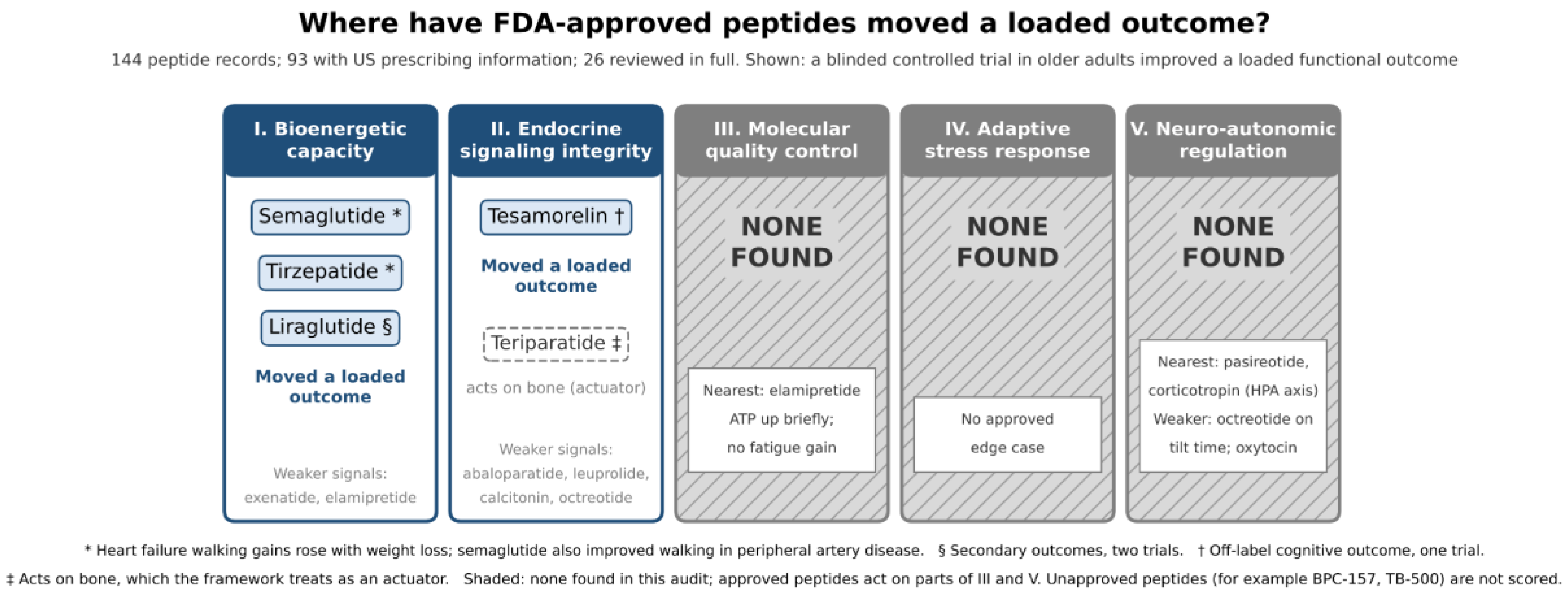

Table 1.
FDA-approved peptides that moved a loaded functional outcome in older adults, and the nearest case in each capacity.
Table 1.
FDA-approved peptides that moved a loaded functional outcome in older adults, and the nearest case in each capacity.
| Capacity | Peptide | Approved indication (label) | Loaded outcome in a controlled trial | Population | Strength of the evidence | Role of weight loss | Reserve cost |
|---|---|---|---|---|---|---|---|
| I. Bioenergetic |
Semaglutide MOVED |
Chronic weight management; MACE risk reduction; type 2 diabetes, including kidney risk in chronic kidney disease; MASH (Novo Nordisk, 2026a, 2026b) | 6-min walk +20.3 m (95% CI 8.6 to 32.1) and +14.3 m (3.7 to 24.9) in two HFpEF trials (Kosiborod et al., 2023, 2024); treadmill walking ratio 1.13 in peripheral artery disease (Bonaca et al., 2025) | Median ages 69, 69 (Butler et al., 2024) and 68; benefit held at 75 or older (Pandey et al., 2025) | Strong: three independent trials; confirmatory secondary in two HFpEF trials, primary in peripheral artery disease | HFpEF gain tracked weight loss (Borlaug et al., 2023, 2025a); peripheral artery disease gain did not (Rasouli et al., 2025) | Lean mass (Neeland et al., 2024); resting heart rate; more hip and pelvis fractures at 75 or older (Novo Nordisk, 2026a) |
|
Tirzepatide MOVED |
Type 2 diabetes, including MACE risk reduction; chronic weight management; obstructive sleep apnea with obesity (Eli Lilly and Company, 2026a, 2026b) | 6-min walk +18.3 m (95% CI 9.9 to 26.7) in HFpEF (Zile et al., 2025) | Mean age 65.2 | Single trial: secondary endpoint under control of type I error | Larger gain with more weight loss (Borlaug et al., 2025b) | Lean mass (Neeland et al., 2024); heart rate (Eli Lilly and Company, 2026b) | |
|
Liraglutide MOVED |
Type 2 diabetes; chronic weight management (US labeling; US Food and Drug Administration, 2026c) | 6-min walk +24 m (95% CI 2 to 47) in heart failure with reduced ejection fraction (Jorsal et al., 2017; Allam et al., 2023); executive score better in Alzheimer's disease (Edison et al., 2026); open-label support (Caruso et al., 2024) | Mean age 65 in heart failure (Beaudart et al., 2026); 72.5 and 70.6 in Alzheimer's disease | Limited: unadjusted secondary endpoints in two trials with null primary endpoints | Not reported | More serious cardiac events, 12 against 3; heart rate +7 beats/min (Jorsal et al., 2017) | |
| II. Endocrine signaling |
Tesamorelin MOVED |
Excess abdominal fat in HIV-associated lipodystrophy (Theratechnologies, 2026) | Cognitive composite, mainly executive function; off-label (Baker et al., 2012) | Mean age 68, with and without mild cognitive impairment | Single trial: primary composite; two smaller trials null (Stewart et al., 2026; Ellis et al., 2025) | Not studied; body fat fell 7.4% (Baker et al., 2012); trunk muscle area rose in HIV (Adrian et al., 2019) | Glucose intolerance; fluid retention (Theratechnologies, 2026) |
| Bone (actuator, not a capacity) |
Teriparatide MOVED |
Osteoporosis at high fracture risk (Eli Lilly and Company, 2026c) | Timed Up and Go faster than risedronate after hip fracture (Aspenberg et al., 2016); performance composite better than placebo after pelvic fracture, with no between-group Timed Up and Go difference (Nieves et al., 2022); gait speed kept more often than with placebo after femoral neck fracture (Bhandari et al., 2016) | Mean ages 77 and 82; median 70 (femoral neck) | Limited: secondary against risedronate (hip, 171 of 224 analyzed); 35-patient trial (pelvic); unadjusted one-sided secondary (femoral neck) | n/a | Orthostatic hypotension (Eli Lilly and Company, 2026c) |
| III. Molecular quality control |
Elamipretide nearest case |
Muscle strength in Barth syndrome, 30 kg or more; accelerated approval (Stealth BioTherapeutics, 2025) | Weaker signal: Barth syndrome randomized phase null, gains open-label (Reid Thompson et al., 2021); in older adults ATP production rose briefly, fatigue resistance did not (Roshanravan et al., 2021) | Barth studies: no one aged 65 or older; single-dose trial at ages 60 to 85 | n/a | n/a | None established |
| IV. Adaptive stress response | None identified | No approved peptide with a hormetic-program mechanism | n/a | n/a | n/a | n/a | n/a |
| V. Neuro-autonomic regulation |
Pasireotide nearest case |
Cushing's disease when pituitary surgery is not an option or not curative (Recordati Rare Diseases, 2026) | No qualifying trial, including corticotropin; octreotide (endocrine) lengthened tilt and standing time in small acute studies, a weaker signal (Bordet et al., 1995; Hoeldtke et al., 1998) | Too few aged 65 or older in studies (label) | n/a | n/a | n/a |
Moved: a blinded controlled trial in a population with a mean or median age of 65 years or more showed a between-group improvement in a loaded functional outcome, primary or secondary; null trials do not cancel it and are listed in Supplementary Table S2. Strength of the evidence, graded as in Section 2.3: strong, two or more independent trials with the gain on a primary endpoint or on a secondary endpoint under control of type I error; single trial, one such trial; limited, gains only on secondary endpoints without that control, against an active drug, or in trials of fewer than 50 patients. Rows show the five peptides that moved a loaded outcome and the nearest case in each capacity; all 26 retained peptides are in Supplementary Table S2. Indications are paraphrased from current US labels; dosing is omitted. HFpEF, heart failure with preserved ejection fraction; MACE, major adverse cardiovascular events; MASH, metabolic dysfunction-associated steatohepatitis.
Disclaimer/Publisher’s Note: The statements, opinions and data contained in all publications are solely those of the individual author(s) and contributor(s) and not of MDPI and/or the editor(s). MDPI and/or the editor(s) disclaim responsibility for any injury to people or property resulting from any ideas, methods, instructions or products referred to in the content. |
© 2026 by the authors. Licensee MDPI, Basel, Switzerland. This article is an open access article distributed under the terms and conditions of the Creative Commons Attribution (CC BY) license (http://creativecommons.org/licenses/by/4.0/).
Copyright: This open access article is published under a Creative Commons CC BY 4.0 license, which permit the free download, distribution, and reuse, provided that the author and preprint are cited in any reuse.