

Submitted:
20 October 2026
Posted:
22 October 2026
You are already at the latest version
Abstract
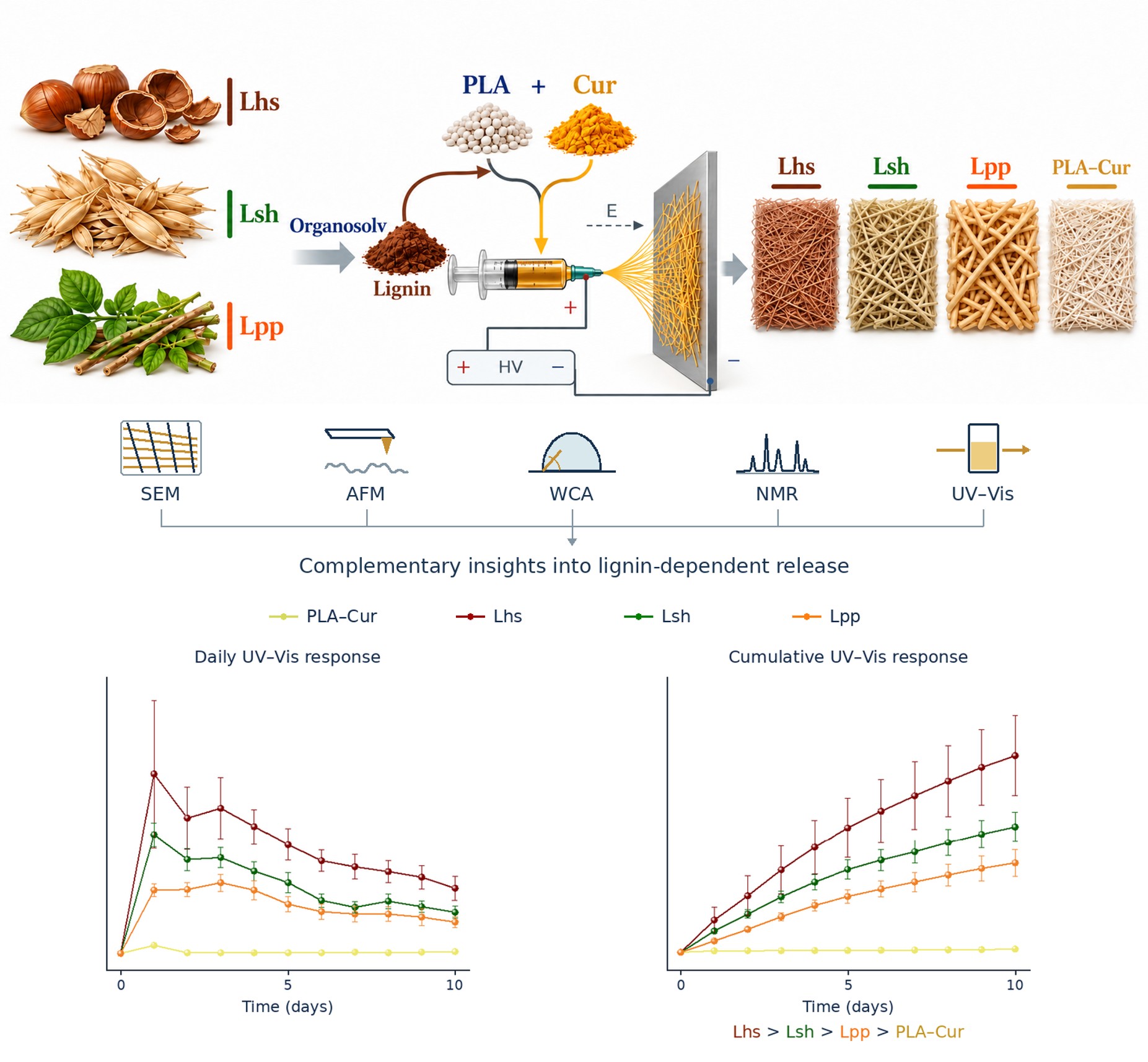
Controlling the extent and timing of bioactive release requires understanding how material chemistry and scaffold architecture jointly govern compound accessibility. Here, lignin source was explored as a formulation variable for tuning electrospun poly(lactic acid) (PLA) nanofibres, using curcumin as a model bioactive compound. Three organosolv lignins recovered from hazelnut shells (Lhs), spelt husks (Lsh), and potato plant residues (Lpp) using a common extraction protocol were incorporated into the same polymer matrix at fixed nominal component loadings. 1H-13C HSQC NMR characterised the aromatic fingerprints of the lignins, while fibre morphology, surface topography, wettability, and release-related responses were compared among the resulting scaffolds. Release was monitored over 10 days in phosphate buffer (pH 7.4) using UV–Vis spectroscopy. All lignin-containing scaffolds showed higher cumulative release-related spectral responses than PLA–curcumin, following the order Lhs > Lsh > Lpp. The Lhs-containing scaffold combined the finest fibres and lowest local roughness with the highest cumulative response, while the Lsh-containing scaffold exhibited intermediate fibre diameters, roughness, and cumulative response among the three lignin-containing formulations. Despite its most favourable initial surface wetting, the Lpp-containing scaffold exhibited larger, rougher fibres and reached its maximum interval release-related response at 48–72 h, later than the first-day maxima observed for the Lhs- and Lsh-containing scaffolds. This divergence shows why wettability alone is insufficient to explain the observed release behaviour. The comparison identifies a distinct release-related spectral profile for each formulation, alongside differences in lignin chemistry and scaffold structure. These findings establish a comparative basis for selecting residual lignins according to their functional contribution and support their valorisation in nanofibrous materials designed towards specific delivery profiles.
Keywords:
agro-industrial residues valorization
; lignin
; organosolv extraction
; electrospinning
; poly(lactic acid)
; curcumin
; controlled drug delivery
Copyright: This open access article is published under a Creative Commons CC BY 4.0 license, which permit the free download, distribution, and reuse, provided that the author and preprint are cited in any reuse.