

Submitted:
21 October 2026
Posted:
22 October 2026
You are already at the latest version
Abstract
We propose a conceptual hypothesis involving two independently modeled spacetime worlds embedded—or represented as finite-thickness world-regions—in a common higher dimensional ambient manifold. During a finite, nonzero interval of geometric overlap, each world retains its own intrinsic temporal structure, while an explicitly defined synchronization relation associates selected event pairs with a common label τ. We hypothesize that, within this overlap interval, one and the same entity P may possess two distinct world-indexed locations, one in each world, at a synchronized value τ∗. This bilocation claim depends on a primitive cross-world identity relation and is not inferred from geometric overlap alone. The framework further assumes transit rather than reflection: after the overlap interval, the two world-regions continue through one another and separate in the ambient description. We distinguish geometric intersection from dynamical interaction and information transfer, neither of which follows from intersection alone, and distinguish numerical identity from counterpart similarity and post-branch continuity. The proposal is presented as a formalized conceptual hypothesis rather than as an empirically established physical theory. We identify the additional geometric, dynamical, operational, and empirical structures that a future realization would require to become testable. If a consistent mathematical realization can be constructed, the framework may clarify questions concerning multilocation, cross-spacetime synchronization, persistence, and observability.
Keywords:
parallel worlds
; braneworld
; intersecting branes
; extra dimensions
; cross-spacetime synchronization
; transworld identity
; multilocation
; philosophy of physics
1. Introduction
The expression “parallel worlds” is used for several physically and conceptually distinct structures. In Everettian quantum mechanics, what are often called worlds are usually understood as relative-state branches or emergent structures within a universal quantum state [1,2]. In eternal-inflation models, a multiverse may consist of causally separated pocket universes [3]. In braneworld models, observable physics may be localized on a lower-dimensional brane embedded in a higher-dimensional bulk [4]. These notions should not be treated as interchangeable without an explicit theoretical bridge.
Extra dimensions are likewise more than a visual device. A physically meaningful ambient description must specify at least a differentiable structure, dimensionality, metric signature, causal structure, and dynamical content before terms such as “motion,” “distance,” “intersection,” and “passing through” acquire a precise physical meaning. Accordingly, a drawing of two transparent spheres can represent only spatial sections or finite-thickness analogues of the proposed world-regions; it cannot literally represent two four-dimensional spacetimes.
The present paper advances a narrower conceptual hypothesis. Consider two independently modeled spacetime worlds embedded, or represented as finite-thickness world-regions, in a common higher-dimensional ambient manifold. Assume that the represented world-regions overlap during a finite, nonzero interval and that an explicitly defined synchronization relation assigns a common label to selected event pairs within that overlap. We hypothesize that, at a synchronized value , one and the same entity P may possess two distinct world-indexed locations, one in each world. We further assume transit rather than reflection: after the overlap interval, the two world-regions continue through one another and separate in the ambient description.
The central claim is not that geometric overlap alone produces bilocation. Rather, the overlap supplies the finite domain within which the proposed bilocation may occur, while a primitive cross-world identity relation associates the two selected world-indexed manifestations with the same entity P. Geometric intersection, cross-world identity, dynamical interaction, and information transfer are therefore treated as logically distinct. In particular, neither interaction nor information transfer follows from intersection alone.
Several established research programs contain individual elements of this proposal. Brane collisions and intersections occur in cosmological and string-inspired models [5,6,7], while philosophical literature examines transworld identity, counterpart relations, persistence, and multiple location [8,9,10,11]. These precedents prevent a broad novelty claim for any one ingredient. The defensible novelty of the present hypothesis instead concerns the specific conjunction and formal organization of finite geometric overlap, explicit cross-world synchronization, the bilocation of one entity at two world-indexed locations, and continued transit through the overlap.
The purpose of this study is to formulate this conjunction transparently, expose the logical dependencies among its postulates, and identify the additional structures that a future physical realization would require. The remainder of the paper reviews the relevant physical and philosophical background, states the hypothesis, develops a minimal formal framework, examines its conceptual and physical interpretation, and discusses its potential explanatory scope, conditions for future testability, limitations, and open problems.
2. Background and Relation to Prior Work
Everett’s relative-state formulation describes a universal quantum state evolving without the introduction of wave-function collapse as a fundamental dynamical process. It characterizes the states of subsystems relationally through correlations within the universal quantum state [1]. Later Everettian interpretations often use decoherence to motivate approximately autonomous branch structures that are described as “worlds.” Barrett emphasizes, however, that Everett did not originally formulate his interpretation in terms of literally splitting parallel universes and that both the status and the individuation of Everettian worlds require additional interpretive assumptions [2]. An Everettian branch is therefore not, merely by virtue of being a branch, an independently modeled Lorentzian spacetime embedded in and moving through a higher-dimensional bulk.
Branching also raises questions concerning personal and numerical identity. Post-branch successors may share an earlier causal history or person-stage, but that shared history does not by itself establish that one numerically identical entity is wholly present in more than one branch. Everettian discussions instead analyze branching in terms of personal fission, shared person-stages, and self-locating uncertainty [12,13]. In the broader metaphysics of possible worlds, transworld identity and counterpart relations are also treated as distinct alternatives [8].
The present hypothesis is therefore not a consequence or extension of Everettian quantum mechanics. It introduces an additional and explicit cross-world identity postulate: for selected synchronized event pairs within a finite geometric overlap, one and the same entity P may possess two distinct world-indexed locations. Neither the existence of Everettian branches nor their shared pre-branch history entails this bilocation claim. The language of multiple worlds is also used in cosmology, although in a different sense. Eternal inflation can produce an expanding ensemble of pocket universes and gives rise to a measure problem when probabilities are assigned across an indefinitely reproducing spacetime [3]. Tegmark’s multiverse hierarchy groups together several increasingly broad proposals, ranging from regions beyond our observable horizon to post-inflationary domains, Everettian branches, and different mathematical structures [14]. This classification is useful here because it shows how little the word “multiverse” implies by itself. It does not provide a geometric intersection between worlds, a common clock relation, or a basis for identifying one entity across distinct worlds. Those are separate assumptions introduced by the present hypothesis.
Braneworld models provide a closer geometric precedent. In these models, an observable -dimensional universe may be represented as a brane embedded in a higher-dimensional bulk. Arkani-Hamed, Dimopoulos, and Dvali used large compact extra dimensions to address the hierarchy between the electroweak and gravitational scales [15]. Randall and Sundrum obtained an exponential hierarchy from the warped geometry of an extra dimension [16]. In the models reviewed by Maartens and Koyama, Standard Model fields may be confined to the brane while gravity has access to the bulk [4].
This literature gives a mathematically serious precedent for describing an observable world within a higher-dimensional ambient geometry. It does not, however, imply that two branes must overlap, that they pass through one another, or that one entity can occupy two world-indexed locations. The present hypothesis uses the braneworld setting as a geometric point of departure, while introducing finite overlap, cross-world synchronization, transit, and the bilocation of the entity P as additional postulates. Brane intersection and collision already occur in established physical models. In the ekpyrotic scenario, the collision of a brane with a bounding orbifold plane forms part of a cosmological account of the hot big bang [5]. Pavšič developed a model in which branes can intersect or self-intersect and in which their intersections may appear as matter-like structures on a selected brane [6]. Abel and Owen studied scattering processes involving fields localized at D-brane intersections [7]. These examples show that neither motion in a bulk nor brane intersection is itself new. They also show that an interaction at an intersection must be specified by the dynamics of the particular model. Intersection alone does not entail interaction, information transfer, or the bilocation of an entity.
Relativity introduces a separate issue concerning synchronization. A globally hyperbolic spacetime admits a smooth time function and an associated metric splitting under suitable conditions [17]. This is a result about temporal structure within one spacetime. It does not supply a preferred comparison between the clock readings of two independently modeled spacetimes. The cross-world synchronization used in the present hypothesis must therefore be introduced explicitly, either as a relation between selected events or, in a future physical realization, through a specified clock protocol or shared bulk structure.
The identity claim also has precedents in metaphysics. Miller discusses how an enduring object could be wholly present at more than one spatial location in a time-travel setting [9], while Eagle defends the coherence of multiple location more generally [10]. Gilmore examines persistence and location in relativistic spacetime [11], and the literature on transworld identity distinguishes the numerical identity of one entity from relations between merely similar counterparts [8]. These works provide conceptual resources for discussing multilocation, but they do not provide a physical mechanism for the proposed overlap of two spacetime worlds.
Within the literature considered here, we have not found a proposal that combines two independently modeled spacetime worlds represented as finite-thickness regions in a common ambient manifold, a finite overlap followed by continued transit, an explicit synchronization relation, and one entity P with two distinct world-indexed locations during that overlap. This observation does not establish exhaustive priority. The defensible novelty claim concerns the specific conjunction and formal organization of these assumptions, rather than any one of the ingredients taken separately.
3. Statement of the Hypothesis
We hypothesize that, during a finite overlap of two world-regions represented within a common higher-dimensional ambient manifold, one and the same entity P may possess two distinct world-indexed locations, one in each world, at a pair of events selected by an explicitly defined synchronization relation. The two world-regions subsequently continue through one another and separate rather than reflecting or halting at the overlap.
Let and denote two independently modeled spacetime worlds. Each world has its own event manifold, Lorentzian metric, matter or field content, and intrinsic temporal structure. They are represented in a higher-dimensional ambient geometry either as embedded submanifolds or, when a nonzero overlap volume is required, as finite-thickness neighborhoods of embedded worldvolumes.
The hypothesis consists of six logically separable postulates:
- Geometric postulate. The two worlds admit embeddings, or finite-thickness representations, in a common pseudo-Riemannian ambient manifold.
- Overlap postulate. The represented world-regions have a nonempty intersection during a finite interval of an explicitly specified kinematic parameter.
- Synchronization postulate. Selected event pairs within the overlap are associated with a common label . This label specifies a cross-world relation between those events and is not assumed to be a universal time.
- Cross-world identity postulate. At a selected synchronized value , the two world-indexed manifestations instantiate one and the same entity P, rather than merely two qualitatively similar counterparts.
- Bilocation postulate. At , the entity P possesses two distinct world-indexed locations, one in each world, and the corresponding event pair lies within the finite overlap.
- Transit postulate. The relative kinematics continues through the overlap, so that the world-regions subsequently separate without reflection or termination.
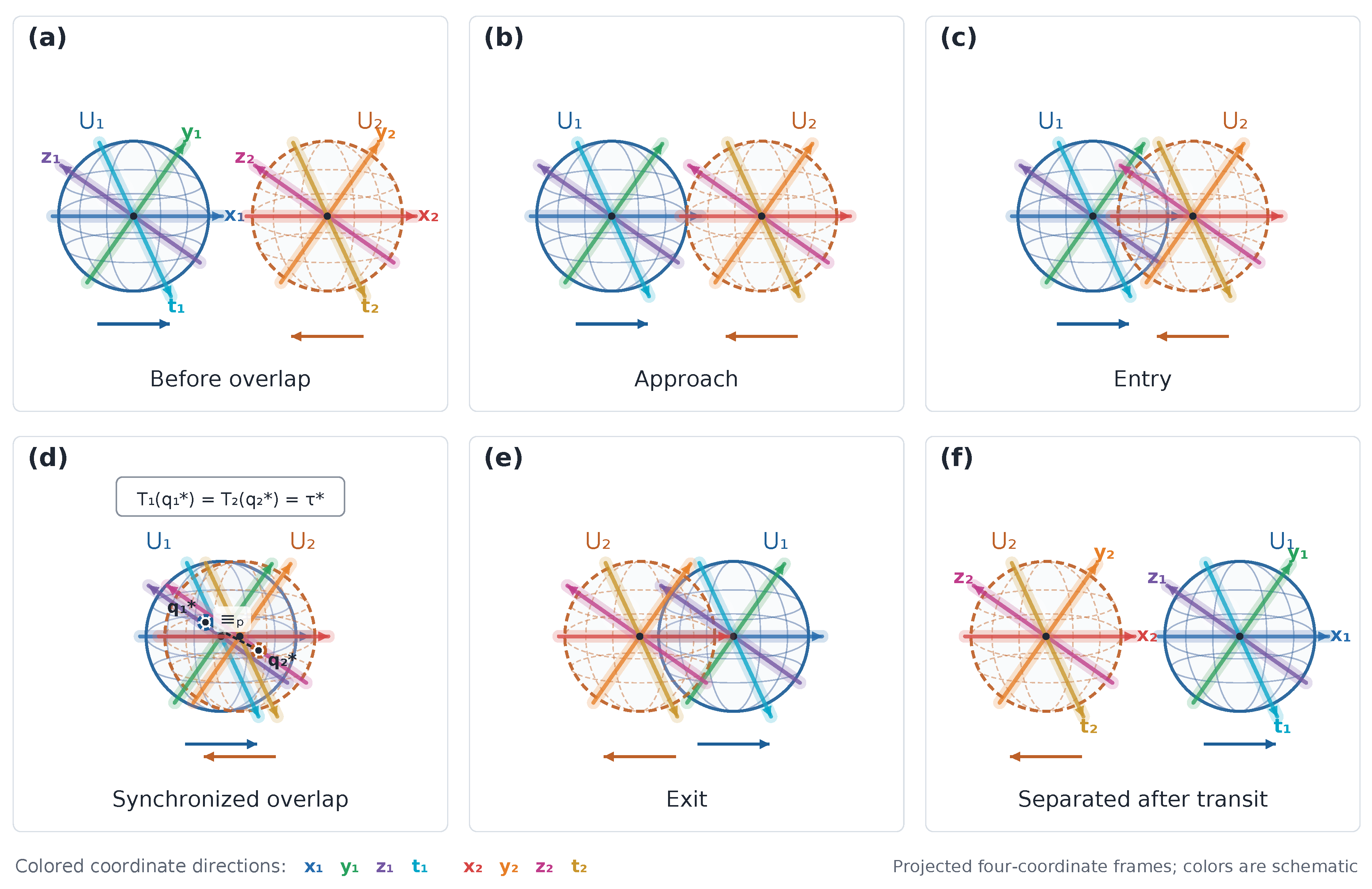
The geometric and overlap postulates do not entail the remaining postulates. In particular, an intersection does not by itself generate a synchronization relation, establish cross-world identity, produce bilocation, or imply physical interaction and information transfer. Figure 1 provides a schematic representation of the proposed approach, overlap, transit, and separation. Each spherical region represents a three-dimensional spatial-section analogue of a finite-thickness world-region. The colored directions associated with represent a projection of its intrinsic coordinate frame . Each coordinate direction is assigned a distinct color and is drawn as extending beyond the spherical boundary.
As the two regions enter one another, the colored coordinate directions become visually superposed within the common region. This superposition is strongest at the synchronized-overlap stage. After transit, the two regions separate, and each coordinate frame retains its initial colors and configuration. This restoration represents continued passage without reflection or loss of the world-indexed structures. The colors are a graphical analogy and do not represent a physical field, interaction mechanism, or transfer of information.
In the synchronized-overlap panel, and denote two distinct world-indexed events satisfying
The relation
expresses the central identity postulate: the two distinct events are postulated to instantiate the same entity P. This identity relation is an independent assumption and is not produced by either geometric overlap or visual color superposition. Figure 1 provides a schematic representation of the proposed approach, overlap, transit, and separation. Each spherical region represents a three-dimensional spatial-section analogue of a finite-thickness world-region. The colored directions associated with represent a projection of its intrinsic coordinate frame . Each coordinate direction is assigned a distinct color and is drawn as extending beyond the spherical boundary.
As the two regions enter one another, the colored coordinate directions become visually superposed within the common region. This superposition is strongest at the synchronized-overlap stage. After transit, the two regions separate, and each coordinate frame retains its initial colors and configuration. This restoration represents continued passage without reflection or loss of the world-indexed structures. The colors are a graphical analogy and do not represent a physical field, interaction mechanism, or transfer of information.
In the synchronized-overlap panel, and denote two distinct world-indexed events satisfying
The relation
expresses the central identity postulate: the two distinct events are postulated to instantiate the same entity P. This identity relation is an independent assumption and is not produced by either geometric overlap or visual color superposition.
4. A Minimal Formal Framework
A coordinate tuple such as
labels a local event or coordinate chart; it does not by itself define a spacetime world. We therefore represent each world by
where is a connected, time-oriented, four-dimensional differentiable manifold, is a Lorentzian metric on , and denotes its relevant matter and field content. Local coordinates may be written as
but no physical conclusion should depend on a particular coordinate chart.
Let the common ambient structure be
where is a differentiable manifold and h is a specified pseudo-Riemannian metric. Let
denote the embedding of the ith worldvolume. If the embedding is intended to preserve the intrinsic geometry of the world, then
If this condition is not imposed, the ambient representation must be identified explicitly as non-isometric or schematic.
For zero-thickness embeddings, the geometric intersection is
If the two four-dimensional submanifolds intersect transversely and the intersection is nonempty, its generic dimension is
Thus, for or 8, the generic intersection has dimension or 0, respectively. For , a transverse intersection is generically empty. A nonzero volumetric overlap therefore does not follow from two zero-thickness worldvolumes; it requires finite thickness, local coincidence, or a non-transverse configuration.
To describe finite-thickness world-regions without treating an indefinite metric as an ordinary positive distance, let
be a specified nonnegative normal-separation function on a tubular neighborhood of . Define
and
A future physical realization would need to specify how the functions are constructed, for example through spacelike normal neighborhoods or another covariant thickness prescription.
The spherical figures used in this paper are three-dimensional spatial analogies for the regions . Their spherical shape and temporary color superposition are not assumed to represent the literal geometry of four-dimensional spacetimes or a physical interaction law. The phrase “a spacetime moves through the bulk” requires care because each manifold already contains an intrinsic time coordinate. A minimal kinematic description can be given by a one-parameter family of embeddings,
with a corresponding overlap region . The parameter orders the relative geometric configurations of the two represented world-regions. It is not assumed to be a second physical time, and derivatives with respect to should not be interpreted as physical velocities unless a later dynamical model gives them that meaning.
The present hypothesis remains neutral between two possible future realizations: a family of full-spacetime embeddings parameterized by , or spatial three-branes evolving with respect to a specified bulk time. These are alternative ways of developing the hypothesis rather than simultaneous components of its minimal formulation.
To express transit schematically, let denote a signed separation along a chosen normal direction in the ambient description. A crossing configuration at satisfies
with changing sign across . This sign change distinguishes passage through the overlap from a kinematic reflection. Equation (9) states the transit postulate; it is not presented as a solution of dynamical field equations.
Let
be timelike worldlines representing the two world-indexed manifestations considered in the hypothesis. If is an intrinsic time function, the corresponding clock reading along the worldline is
Alternatively, may be introduced directly as a specified clock reading along without assuming a global time function on all of .
For each configuration parameter , let
denote the set of worldline-event pairs associated with the finite overlap at that configuration. The precise construction of depends on the thickness prescription adopted for the two world-regions. The synchronization relation is then defined by
This relation does not identify the two intrinsic time functions globally. It selects only event pairs within, or explicitly associated with, the finite overlap. In the minimal hypothesis, is stipulated. A future realization could seek to obtain it from a bulk scalar clock, paired proper times, or an operational clock protocol if an appropriate interaction is introduced.
Choose a synchronized event pair
during the overlap. Introduce a primitive cross-world identity relation such that
Equation (14) states that the two selected worldline stages instantiate one and the same entity P, rather than two merely similar counterparts. The relation is intentionally primitive in the present hypothesis. A later philosophical or physical elaboration may seek to ground it in bodily, causal, psychological, informational, or structural continuity.
The synchronized location set of P at the selected label is
The bilocation postulate is therefore expressed as
together with the world-indexed distinctness condition
The minimal hypothesis requires distinct world-indexed locations, but it does not require the corresponding embedded events to be distinct points of the ambient manifold. A stronger version could additionally impose
but this condition is not needed for the minimal bilocation claim. The world index in Equation (17) prevents a coincidence of coordinates from identifying two events that belong to different worlds.
Equation (16) follows only after the cross-world identity and bilocation postulates have been adopted. It organizes the hypothesis formally; it is not an independently derived physical prediction.
5. Conceptual and Physical Interpretation
Logical status of the framework. The formal framework separates definitions from postulates and from claims that remain open. The intrinsic spacetimes , their field content , the ambient structure , the embeddings, the finite-thickness regions, the worldlines, the clock readings, the synchronization relation, and the synchronized location set are defined mathematical objects. The hypothesis then postulates a finite overlap, a selected synchronized event pair within that overlap, a primitive cross-world identity relation, two distinct world-indexed locations of the entity P, and continued transit through the overlap.
Once these postulates are adopted, the synchronized location set has cardinality two at . This is a formal consequence of the bilocation postulate and the associated location rule; it is not an independently derived physical prediction. Likewise, the dimension formula in Equation (5) applies conditionally to nonempty transverse intersections of zero-thickness embeddings. It does not determine the geometry of every possible finite-thickness overlap.
The conceptual hypothesis leaves open whether such world-regions are physically realized, whether a covariant and operational synchronization procedure can be constructed, whether transit solutions exist in a future dynamical model, and whether an observer could detect the overlap. These questions concern possible future realizations of the framework rather than the internal statement of the hypothesis.
Identity, duplication, and multilocation. Numerical identity must be distinguished from both duplication and counterpart similarity. Duplication involves two numerically distinct entities that may share a history, structure, or set of memories. A counterpart relation associates distinct entities across different worlds on the basis of an appropriate similarity relation. Neither duplication nor counterpart similarity is numerical identity [8].
In the present hypothesis, multilocation means that one and the same entity P bears the relevant location relation to two distinct world-indexed events at a selected synchronized pair. This definition does not require the article to decide whether P is wholly or partially present at either event. Such stronger metaphysical claims would require an additional account of composition and persistence.
The hypothesis therefore adopts numerical cross-world identity rather than duplication or counterpart identity. Geometry alone does not justify this choice. Bodily, psychological, informational, and structural continuity can all be reproduced by numerically distinct entities and therefore do not, by themselves, establish that the same entity is present in both worlds. The relation is introduced as an explicit primitive postulate. This is a substantive metaphysical commitment, but making it explicit prevents qualitative similarity from being mistaken for numerical identity. Existing work on persistence and multiple location shows that the idea is conceptually discussable, although it remains philosophically contested [9,10,11].
Synchronization and relativity. Special and general relativity do not generally provide a unique, observer-independent global simultaneity relation. Even when a spacetime admits a smooth time function and a global metric splitting, the resulting structure applies within that spacetime and does not supply a canonical comparison with the clock values of another independently modeled spacetime [17].
The relation does not identify the two intrinsic time functions globally. It selects particular event pairs associated with the overlap and assigns them a common synchronization label. For this reason, the formal relation does not by itself conflict with relativity. It is not yet an operational synchronization procedure, however, and its covariance properties depend on how a future physical realization defines it.
Throughout the present framework, is therefore a synchronization label rather than a universal time. A future realization might connect it to paired proper times, the value of a bulk scalar field, a covariantly defined foliation, or an operational clock protocol. None of these implementations is assumed by the minimal hypothesis.
Geometry, dynamics, and information. Geometric overlap, physical interaction, and information transfer are distinct notions. In particular,
and
The first relation states that two represented world-regions may overlap geometrically without their fields coupling. A future dynamical realization could introduce a direct interaction localized in the overlap through a schematic term such as
where denotes the measure induced by the ambient geometry. Equation (21) is an example of how a coupling could be represented; it is not part of a completed action for the present hypothesis.
A coupling could also be mediated indirectly by fields propagating in the shared bulk. Consequently, setting only the localized term to zero would not guarantee complete dynamical independence if other cross-world or bulk-mediated couplings remained. A genuinely noninteracting realization would require all such cross-sector couplings to vanish.
Information transfer imposes an additional requirement. An output in one world must depend causally and measurably on an input or controllable state in the other. A coupling may transfer energy or generate correlations without allowing an observer to encode and recover a signal. Geometric overlap, interaction, energy exchange, correlation, and controllable communication must therefore be assessed separately.
The logical independence of the postulates follows the same pattern. An ambient embedding does not imply overlap; overlap does not imply synchronization; synchronization does not imply cross-world identity; identity does not imply bilocation without an appropriate location rule; and bilocation does not imply communication. Transit is also an independent postulate. A future interaction model might instead admit reflection, capture, reconnection, or deformation, whereas the present hypothesis selects continued passage as its kinematic possibility.
Open questions. The framework organizes a limited set of research questions:
- What account of persistence could ground the primitive relation , and under what conditions would it reduce instead to duplication or a counterpart relation?
- How should location be defined for stages belonging to different spacetime manifolds, and is world-indexed distinctness sufficient for the proposed bilocation claim?
- Can the synchronization relation be implemented operationally and covariantly without introducing a preferred universal time?
- What ambient geometry and coupling structure could permit finite overlap and continued transit while preserving conservation laws, local causal order, and any applicable no-signaling constraints?
- What observable records, if any, could distinguish cross-world bilocation from duplication, ordinary correlation, or coincidence?
6. Conditions for Future Testability
The proposed framework can be assessed at three distinct levels: internal consistency, dynamical realizability, and empirical testability. These levels should not be conflated. A formally consistent realization would not establish that the hypothesis is physically true, while an empirical test would require substantially more structure than the present conceptual formulation provides.
Internal consistency. The first task is to determine whether the definitions and postulates admit at least one coherent realization. This requires specifying the domain and logical properties of the cross-world identity relation , its connection to the location rule, and the conditions under which synchronized event pairs are selected. Reflexivity, symmetry, and transitivity should not be imposed automatically; their appropriateness depends on whether is intended as an equivalence relation over entity stages, a restricted relation between the two worldlines, or another formally defined structure.
A realization must also avoid contradictions between identity and distinct location, preserve the intrinsic causal consistency of both spacetimes, and clarify how the ordering parameter is related to the intrinsic clock variables without treating it as an unacknowledged second physical time. The inability to find a realization would not by itself refute the framework. By contrast, a proof that no structure can satisfy the stated definitions and postulates would establish the inconsistency of that formal version. Constructing one realization would establish only its mathematical satisfiability, not its physical truth.
Dynamical realizability. A physical extension would require explicit choices of the bulk and brane metrics, embeddings, thickness profiles, matter fields, initial or boundary conditions, and interaction terms. A schematic total action could take the form
where denotes possible bulk fields and represents a coupling associated with the overlap region. Equation (22) is only a template for a future model and is not proposed here as a completed action.
Once these structures are specified, the corresponding field equations, matching or junction conditions where applicable, conservation laws, and stability conditions can be derived. Analytical or numerical studies could then investigate whether finite-overlap and pass-through solutions exist, whether perturbations remain controlled, and whether the proposed synchronization rule remains well defined throughout the overlap. The coupled case should be compared with an otherwise identical uncoupled model, for example by setting while keeping the relevant initial and boundary conditions fixed.
Such a calculation could establish dynamical realizability for a specified model and parameter range. It could not, by itself, establish that the two simulated worldlines represent one numerically identical entity. For that purpose, the identity postulate would have to be connected to an explicit physical or operational criterion rather than remaining only a primitive relation.
Empirical testability. The present hypothesis does not yet determine a unique observable or quantitative signal. An empirically testable extension would have to specify coupling constants, characteristic length and time scales, overlap geometry, detector variables, background processes, and a probability distribution for measurable outcomes. It would also have to show that the predicted signal differs from those of the corresponding uncoupled theory and from established physical alternatives.
Depending on the eventual dynamics, possible classes of conditional signatures could include a transient exchange of energy or momentum in the effective description restricted to one world, balanced within the complete bulk–world system; correlated field excitations confined to the overlap interval; a parameter-dependent phase shift or spectral distortion caused by a cross-world coupling; or joint records whose statistics cannot be reproduced by the corresponding uncoupled model. These are possible types of observables, not predictions derived by the present framework.
Even an anomalous correlation would not by itself establish cross-world numerical identity. It might instead indicate interaction between two distinct systems, common initial conditions, an unmodeled background, or ordinary duplication. Testing the identity component would therefore require an operational criterion capable, at least in principle, of distinguishing the proposed multilocation of one entity from the correlated behavior of two entities.
Conditions of failure for a completed model. A completed realization could fail in several distinguishable ways:
- 1.
- its formal definitions and postulates could be shown to be mutually inconsistent;
- 2.
- its metric, embedding, or field assumptions could admit no solutions in the stated regime, or all relevant solutions could be unstable, singular, or incompatible with pass-through behavior;
- 3.
- its synchronization quantity could be gauge-dependent, non-operational, or incompatible with the intrinsic causal structures of the two worlds;
- 4.
- its proposed identity criterion could reduce to a relation between two distinct copies rather than provide a coherent realization of one entity at two world-indexed locations; or
- 5.
- a quantitatively predicted signal could be absent within the parameter range in which the model requires it, or the same parameter range could already be excluded by established gravitational, cosmological, particle-physics, or causality constraints.
The fourth possibility would undermine the identity component of the hypothesis without necessarily refuting its geometric construction. The fifth would constitute empirical evidence against a completed quantitative model. Until dynamics, parameters, and observables are specified, however, the absence of an overlap signal cannot by itself falsify the present conceptual hypothesis.
7. Limitations and Open Problems
The framework has a deliberately restricted scope. The expression “parallel worlds” does not refer to a single established physical structure. Everettian branches, inflationary pocket universes, and branes arise from different theories and should not be treated as interchangeable. In the present formulation, and are independently modeled Lorentzian spacetime worlds that admit a common ambient representation. Nothing in the hypothesis establishes that either world must be identified with an Everettian branch, an inflationary domain, or a brane from a particular existing theory. Those subjects provide relevant precedents and contrasts rather than alternative names for the same object.
Although the ambient structure
and the embeddings have been introduced, their dimension, metric signature, topology, causal structure, boundary conditions, and field content remain unspecified. The finite-thickness construction is also schematic. A complete realization would require a covariant normal-neighborhood or thickness prescription compatible with the indefinite metric. Moreover, the dimension formula for a transverse intersection applies to zero-thickness embedded manifolds and does not by itself establish the existence or stability of a finite volumetric overlap.
The one-parameter family of embeddings describes the proposed approach, overlap, transit, and separation only kinematically. No action currently determines this evolution or accounts for deformation, backreaction, energy exchange, reflection, capture, or instability. The parameter has been defined as an ordering parameter rather than a second physical time, but a dynamical realization would still have to derive this ordering from the ambient structure or replace it with a physically specified bulk evolution. The pass-through condition therefore remains an independent postulate rather than a consequence of equations of motion.
The synchronization relation selects pairs of events but does not yet provide an operational clock protocol. A physical implementation would have to determine whether the synchronization label is obtained from paired proper times, a bulk scalar field, a preferred foliation, exchanged signals, or another covariantly defined mechanism. Different choices could lead to different causal and symmetry properties. In particular, imposing a preferred synchronization globally would require justification if it introduces additional structure not contained in the intrinsic geometries.
Cross-world identity remains the most substantial conceptual assumption. The relation states that the two selected stages instantiate one entity P, but the present framework does not derive that relation from bodily, causal, psychological, informational, or structural continuity. The worldlines are also idealizations. A material entity would generally occupy an extended worldtube, and a more complete account would have to explain how its internal structure, boundaries, persistence conditions, and causal history are represented during overlap. Without such a criterion, two correlated or qualitatively identical manifestations may still be interpreted as two counterparts rather than one multilocated entity.
Geometric overlap alone supplies neither an interaction law nor an information channel. Because no specific coupling, detector variable, or quantitative observable has yet been derived, the framework cannot presently distinguish observationally between non-interacting overlap, ordinary duplication, correlated counterparts, and genuine cross-world multilocation. If a future realization is quantum mechanical, it would additionally require a Hilbert-space structure, a unitary evolution law, a treatment of decoherence, and an analysis of causality and no-signaling. These quantum requirements are conditional on the chosen physical realization and are not assumptions of the present conceptual framework.
Finally, the scope of the novelty claim must remain narrow. Intersecting branes, brane collisions, extra dimensions, transworld identity, and multilocation all have established precedents. The sources reviewed for this study did not identify the exact conjunction of finite overlap, continued transit, explicit cross-world synchronization, and one entity with two distinct world-indexed locations. This supports a limited claim concerning the combination and formal organization of these assumptions, but not an exhaustive claim of priority.
The principal open problem is therefore to construct at least one mathematically consistent realization in which the ambient geometry, overlap dynamics, synchronization mechanism, persistence criterion, and observable consequences are specified together. Different choices may produce physically inequivalent models, and some choices may show that the proposed conjunction cannot be realized under their assumptions.
8. Conclusions
We have formulated a conceptual hypothesis concerning two independently modeled spacetime worlds represented within a higher-dimensional ambient manifold. During a finite interval in which their represented regions overlap, selected events on two worldlines are related by an explicit synchronization rule. The central postulate is that the same entity P is instantiated at both selected events and therefore has two distinct world-indexed locations at the synchronization label . A separate transit postulate states that the represented world-regions continue through the overlap and subsequently separate rather than reflecting or terminating their relative motion.
The formalization clarifies the logical dependencies of this proposal. An ambient embedding does not imply overlap; overlap does not provide a synchronization relation; synchronization does not establish cross-world identity; and geometric intersection alone entails neither physical interaction nor information transfer. The cardinality-two location statement follows only after the cross-world identity and bilocation postulates have been accepted. It is therefore a formal expression of the hypothesis rather than a result derived from the geometry.
Existing research provides precedents for each major component of the proposal, including higher-dimensional embeddings, intersecting and colliding branes, cross-spacetime identity questions, and multilocation. The contribution of the present framework lies in bringing these components together in a single explicit formulation centered on synchronized, world-indexed bilocation during finite overlap. Its novelty should consequently be understood as narrow and combinatorial.
As presently formulated, the hypothesis can be evaluated for conceptual clarity and internal consistency, but it does not yet define a quantitative physical model. A further development would require an explicit ambient geometry, a dynamical action admitting stable pass-through solutions, a covariant synchronization mechanism, a physically motivated criterion of cross-world persistence, and at least one invariant observable. Constructing such a realization would not by itself establish that the hypothesis is realized in nature, but it would determine whether the proposed conjunction can be expressed as a coherent physical model and would make its empirical consequences assessable.
Code availability. No computational analysis or research code was used to obtain the results presented in this conceptual study. The accompanying figure is schematic and is included solely for explanatory purposes.
Funding
The authors received no specific funding for this work.
Data Availability Statement
No datasets were generated or analyzed in this conceptual study. Therefore, data sharing is not applicable.
Conflicts of Interest
The authors declare that they have no conflicts of interest.
Use of Artificial Intelligence
Artificial intelligence-assisted tools were used only for language editing, including improvements to grammar, wording, and readability. The hypothesis, scientific ideas, conceptual arguments, interpretations, and conclusions are original to the authors. The authors reviewed and approved the final manuscript and take full responsibility for its content.
References
- Everett; III, H. “Relative State” Formulation of Quantum Mechanics. Rev. Mod. Phys. 1957, 29, 454–462. [Google Scholar] [CrossRef]
- Barrett, J.A. Everett’s Pure Wave Mechanics and the Notion of Worlds. Eur. J. Philos. Sci. 2011, 1, 277–302. [Google Scholar] [CrossRef]
- Guth, A.H. Eternal Inflation and Its Implications. J. Phys. A Math. Theor. 2007, 40, 6811–6826. [Google Scholar] [CrossRef]
- Maartens, R.; Koyama, K. Brane-World Gravity. Living Rev. Relativ. 2010, 13, 5. [Google Scholar] [CrossRef] [PubMed]
- Khoury, J.; Ovrut, B.A.; Steinhardt, P.J.; Turok, N. The Ekpyrotic Universe: Colliding Branes and the Origin of the Hot Big Bang. Phys. Rev. D. 2001, 64, 123522. [Google Scholar] [CrossRef]
- Pavšič, M. A Brane World Model with Intersecting Branes. Phys. Lett. A 2001, 283, 8–14. [Google Scholar] [CrossRef]
- Abel, S.A.; Owen, A.W. Interactions in Intersecting Brane Models. Nucl. Phys. B 2003, 663, 197–214. [Google Scholar] [CrossRef]
- Mackie, P.; Jago, M. Transworld Identity. In The Stanford Encyclopedia of Philosophy, Winter 2022 ed.; Zalta, E.N., Nodelman, U., Eds.; Metaphysics Research Lab, Stanford University, 2022. [Google Scholar]
- Miller, K. Travelling in Time: How to Wholly Exist in Two Places at the Same Time. Can. J. Philos. 2006, 36, 309–334. [Google Scholar] [CrossRef]
- Eagle, A. Multiple Location Defended. Philos. Stud. 2016, 173, 2215–2231. [Google Scholar] [CrossRef]
- Gilmore, C. Persistence and Location in Relativistic Spacetime. Philos. Compass 2008, 3, 1224–1254. [Google Scholar] [CrossRef]
- Saunders, S.; Wallace, D. Branching and Uncertainty. Br. J. Philos. Sci. 2008, 59, 293–305. [Google Scholar] [CrossRef]
- Baker, D.J. Free Will in the Many-Worlds Interpretation of Quantum Mechanics. Philos. Stud. 2025, 182, 1049–1065. [Google Scholar] [CrossRef]
- Tegmark, M. The Multiverse Hierarchy. In Universe or Multiverse? Carr, B., Ed.; Cambridge University Press: Cambridge, 2007; pp. 99–126. [Google Scholar] [CrossRef]
- Arkani-Hamed, N.; Dimopoulos, S.; Dvali, G. The Hierarchy Problem and New Dimensions at a Millimeter. Phys. Lett. B 1998, 429, 263–272. [Google Scholar] [CrossRef]
- Randall, L.; Sundrum, R. A Large Mass Hierarchy from a Small Extra Dimension. Phys. Rev. Lett. 1999, 83, 3370–3373. [Google Scholar] [CrossRef]
- Bernal, A.N.; Sánchez, M. Smoothness of Time Functions and the Metric Splitting of Globally Hyperbolic Spacetimes. Commun. Math. Phys. 2005, 257, 43–50. [Google Scholar] [CrossRef]
Figure 1.
Six-stage schematic representation of the proposed transit. Each spherical spatial-section analogue carries a projected coordinate frame , with a distinct color assigned to each coordinate direction. The colored axes extend beyond the spherical boundaries and become visually superposed as the two world-regions interpenetrate. Panel (a) shows the initially separated regions; panel (b) shows their approach; panel (c) shows entry into the overlap; panel (d) represents the synchronized-overlap stage; panel (e) shows exit from the overlap; and panel (f) shows separation after transit. In panel (d), the synchronized and distinct events and are postulated to instantiate the same entity P. After transit, each world-region retains its original coordinate colors and configuration. Because four mutually orthogonal spacetime directions cannot be represented literally in a two-dimensional figure, the displayed direction is a graphical projection rather than an additional spatial axis. The color superposition is schematic and does not by itself imply physical interaction, energy exchange, or information transfer.
Disclaimer/Publisher’s Note: The statements, opinions and data contained in all publications are solely those of the individual author(s) and contributor(s) and not of MDPI and/or the editor(s). MDPI and/or the editor(s) disclaim responsibility for any injury to people or property resulting from any ideas, methods, instructions or products referred to in the content. |
© 2026 by the authors. Licensee MDPI, Basel, Switzerland. This article is an open access article distributed under the terms and conditions of the Creative Commons Attribution (CC BY) license (http://creativecommons.org/licenses/by/4.0/).
Copyright: This open access article is published under a Creative Commons CC BY 4.0 license, which permit the free download, distribution, and reuse, provided that the author and preprint are cited in any reuse.