

Submitted:
21 October 2026
Posted:
21 October 2026
You are already at the latest version
Abstract
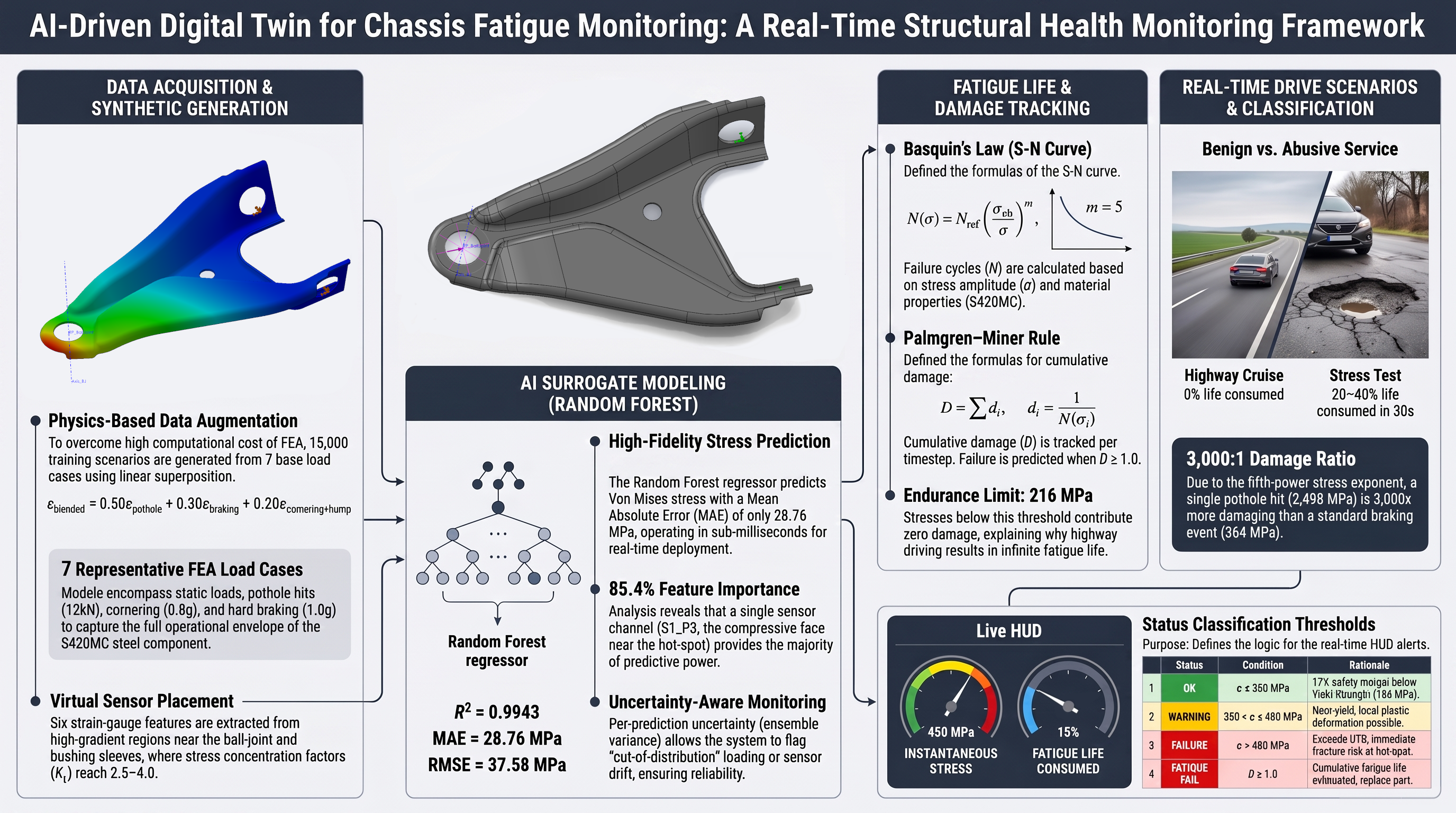
The paper presents a new Integrated Framework for AI predictive Maintenance (AMIFAIM - Andrei Muresan Integrated Framework for AI predictive Maintenance), which allows an online monitoring of the main components fatigue life. A Random Forest regressor, trained on 15,000 synthetic loading scenarios generated by physics-based superposition of seven finite element load cases, serves as a real-time surrogate for structural simulation. The framework is demonstrated on a lower control arm made from S420MC steel (EN 10149-2) in a Dacia Logan front suspension. The trained model predicts Von Mises stress from six strain-gauge channels with R² = 0.9943, MAE = 28.76 MPa, and RMSE = 37.58 MPa on unseen test data, while providing uncertainty estimates per-prediction from the variance of the ensemble. Cumulative fatigue damage is tracked in real time using the Palmgren–Miner rule with an S-N curve calibrated for hot-spot stress conditions. Simulated drive scenarios confirm that the system correctly distinguishes between benign service (near-zero fatigue damage under highway loading) and abusive conditions (5–8% life consumption in 30 seconds under repeated impact loading), consistent with the expected behavior of a properly designed suspension link. The entire pipeline – data augmentation, training, prediction, fatigue tracking, and visualization—is driven by a single configuration file. Applying it to a new component requires only finite element results and material properties; no software changes are needed. The framework is designed to be reconfigured for components for which representative FEA load cases and material-fatigue inputs are available. The current implementation operates on FEA-derived virtual sensor data, with the architecture designed for direct replacement by physical strain-gauge hardware in future experimental validation.
Keywords:
digital twin
; structural health monitoring
; Random Forest
; fatigue life prediction
; automotive chassis
; finite element analysis
; lower control arm
Copyright: This open access article is published under a Creative Commons CC BY 4.0 license, which permit the free download, distribution, and reuse, provided that the author and preprint are cited in any reuse.