

Submitted:
20 October 2026
Posted:
21 October 2026
You are already at the latest version
Abstract
Academic expression involves diverse approaches to discourse, representation, structure, quality, func-tion, and communication. These approaches provide concrete guidance for particular expression tasks, but a more general framework is needed to position and organize them at a superordinate level. This paper proposes Generalized Expression (GE) based on the Generalized Expression Coordinate System GECS ≡ (EO, EP, ERes), where EO denotes Expression Object, EP Expression Perspective, and ERes Expression Result. GE organizes expression from an expression object, through selected expression perspectives, to a realized expression result, while allowing expression to be further developed when required. GE is not intended to replace concrete writing or communication methods, but to provide a superordinate framework within which such methods may be selected and implemented according to specific expression tasks.
Keywords:
generalized expression
; generalized expression coordinate system
; expression object
; expression perspective
; expression result
1. Introduction
Academic expression has developed a wide range of approaches, conventions, and practical methods, including general guidance for scientific and academic writing (cf. Day, 1998; Cargill & O’Connor, 2013; Mensh & Kording, 2017; McIntyre, 1997; Sollaci & Pereira, 2004) and more systematic guidance for writing undergraduate, master’s, and doctoral theses (cf. Dunleavy, 2003; Evans et al., 2014; Lipson, 2005; Murray, 2006; Wu & Bai, 2020; Wu, 2026a).
These publications represent only part of the extensive literature on academic expression. Guidance is also widely available through university writing centers and journal author guidelines. Together, these resources provide important guidance on how particular expression tasks can be carried out. However, they operate at different levels and address different aspects of expression. The choice among these approaches may depend on the content to be expressed, discipline, genre, audience, purpose, and medium. This diversity raises a more general question: can different expression contents, perspectives, and methods be positioned and organized within a superordinate framework?
To address this question, this paper proposes Generalized Expression (GE) based on the Generalized Expression Coordinate System (GECS). Rather than prescribing a particular way of writing or communicating, GE provides a general framework for identifying and organizing expression positions and pathways, while leaving concrete expression methods to be selected according to specific tasks.
Section 2 introduces the Generalized Expression Coordinate System (GECS). Section 3 develops the Generalized Expression Pathway (GEP), including the main-node expression path, Local and Cross Expression within EP, and re-anchoring. Section 4 defines expression conducted through GEP as Generalized Expression (GE). Section 5 gives the main conclusions.
2. Generalized Expression Coordinate System
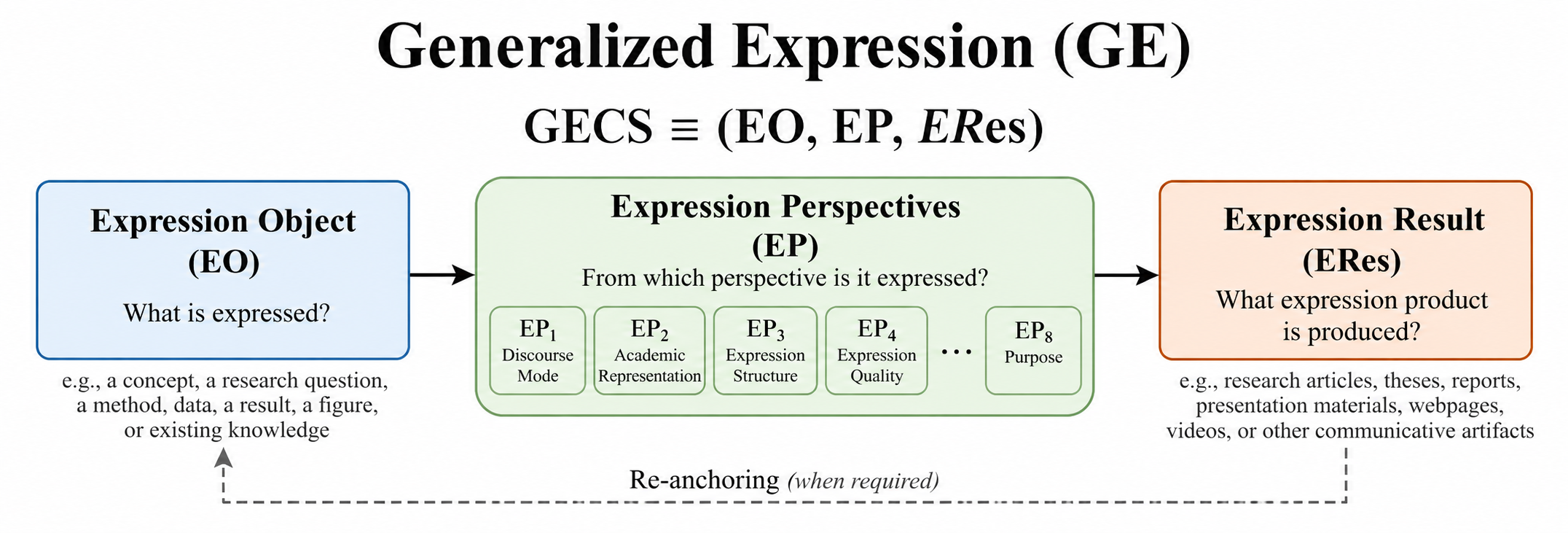
The Generalized Expression Coordinate System consists of three generalized expression coordinates:
where EO denotes Expression Object, EP denotes Expression Perspective, and ERes denotes Expression Result. They answer three basic questions:
- EO: What is expressed?
- EP: From which perspective is it expressed?
- ERes: What expression product is produced?
The basic coordinate relation is
in which EO provides the content anchor of expression, EP provides the perspectives and concrete positions for constructing and regulating expression, and ERes denotes the realized expression product.
2.1. Expression Object
The Expression Object (EO) specifies what is selected for expression:
EO may originate from the current research activity, or from external sources beyond the current research process, such as existing knowledge, literature, data, or other information.
For example, the following may all become expression objects: an aircraft, a research question, a method, a set of experimental data, a figure, a research result, a conclusion, or a piece of existing knowledge.
One expression may contain multiple expression objects:
Usually, some of them are prescribed by the expression task, while others are supplementary to the task. Thus, a particular expression operation may select one or more supplementary expression units before the entire expression is developed. Further supplementary expression units may also be generated during the development of the expression.
2.2. Expression Perspective
The Expression Perspective (EP) specifies the aspect according to which an expression object is unfolded, represented, organized, regulated, or positioned. The present framework considers eight general categories of expression perspectives:
where:
- Discourse Mode Perspective,
- Academic Representation Perspective,
- Expression Structure Perspective,
- Expression Quality Perspective,
- Expression Level Perspective,
- Academic Function Perspective,
- Cognitive Function Perspective,
- Purpose Perspective.
Each general perspective may contain more concrete expression contents:
Thus, provides a general expression entry, while provides a more concrete expression position. Representative concrete expression contents of the eight expression perspectives are provided in Appendix A.
A concrete expression may select one or several contents from one perspective and may also involve contents from several perspectives simultaneously.
The eight perspectives constitute the general categories considered in the present framework rather than a closed or exhaustive classification. Additional expression perspectives may be introduced as the framework is further developed.
2.3. Expression Result
The Expression Result (ERes) denotes the realized expression product or communicative artifact produced through an expression process. Expression results may take different forms, depending on the task and audience. Examples include:
- research articles, theses, and book chapters;
- research proposals, technical reports, and conference papers;
- presentation slide decks, lecture materials, and posters;
- webpages, videos, podcasts, interactive resources, and other communicative artifacts.
One expression process may produce more than one expression result, and a single result may incorporate multiple expression objects and perspectives. The form and content of ERes depend on the expression object, the selected expression perspectives, and the requirements of the expression task.
3. Generalized Expression Pathway
Based on GECS, expression can proceed from an Expression Object EO, through one or more Expression Perspectives EP, to an Expression Result ERes. The Generalized Expression Pathway (GEP) consists of the main-node expression path (MEP) and, when required, re-anchoring () of the expression result:
3.1. The Main-Node Expression Path
The main-node expression path (MEP) is defined as
where denotes a generalized expression coordinate or its concrete content.
Within this path, EP provides the main operational space of expression. According to whether expression is conducted within one perspective or across several perspectives, two basic operations can be distinguished: Local Expression (LE) and Cross Expression (CE).
3.2. Local and Cross Expression
Local Expression (LE) operates within a single expression perspective:
or
For example, within the Discourse Mode Perspective, an expression may use description alone or combine description, comparison, and evidence. Within the Academic Representation Perspective, it may use natural language alone or combine natural language, figures, and mathematical expressions.
Operations developed for particular perspectives may be incorporated locally. For example, combination and Duality-based Mode Operations (DMO) can operate within the Discourse Mode Perspective, while one-point, two-point, and multipoint configurations, different organizational forms, and ordering principles operate within the Expression Structure Perspective.
Cross Expression (CE) means that expression simultaneously considers contents from different expression perspectives:
For example, an expression may simultaneously use comparison as a discourse mode, a figure as an academic representation, a two-point configuration as an expression structure, explicitness as an expression-quality requirement, the Academic Standard Level, Relational Reasoning as an academic function, Alignment as a cognitive function, and Knowledge Formation as a broader purpose.
Cross Expression simply indicates that multiple expression perspectives are jointly involved in constructing the same expression. Local and Cross Expression may coexist within EP during the same main-node expression path.
3.3. Re-Anchoring
Expression does not necessarily terminate when an initial expression result has been produced. If the expression result requires revision, expansion, or transformation into another form, it may be selected again as the object of a subsequent expression operation. This operation is termed re-anchoring:
The existing expression result, now treated as , then enters the main-node expression path again:
For example, an initial report may be selected as and further developed into a journal article. A presentation may similarly be revised into a report, or an existing article may be reworked into a revised version. In each case, the existing expression product becomes the starting object for further expression.
Repeated re-anchoring therefore permits iterative expression and the development of one expression product into another:
4. Generalized Expression (GE) Model
The generalized expression coordinate system and the generalized expression pathways presented above constitute the Generalized Expression (GE) model. Now let us summarize the GE model.
Generalized Expression (GE) is based on the Generalized Expression Coordinate System (GECS):
where EO denotes Expression Object, EP Expression Perspective, and ERes Expression Result. EO specifies what is expressed, EP specifies the perspective from which it is expressed, and ERes denotes the realized expression product or communicative artifact.
Eight general Expression Perspectives are considered: Discourse Mode, Academic Representation, Expression Structure, Expression Quality, Expression Level, Academic Function, Cognitive Function, and Purpose.
Based on these coordinates, the main-node expression path is defined as
where denotes a generalized expression coordinate or its concrete content.
Within EP, Local Expression (LE) operates within a single expression perspective, whereas Cross Expression (CE) jointly considers contents from different expression perspectives. These operations provide local and cross-perspective mechanisms for constructing expression during the main-node expression path.
Expression does not necessarily terminate with the production of an initial expression result. When further revision, expansion, or transformation is required, an existing expression result may be re-anchored as a new Expression Object:
The Generalized Expression Pathway (GEP) therefore consists of the main-node expression path (MEP) and, when required, re-anchoring of the expression result:
Expression conducted through GEP is defined as Generalized Expression (GE):
Thus, GE integrates the generalized expression coordinates, the main-node expression path, Local and Cross Expression within EP, and re-anchoring into a unified framework for constructing and further developing expression.
5. Conclusions
This paper proposed Generalized Expression (GE) based on the Generalized Expression Coordinate System (GECS). GECS represents expression through three generalized coordinates: Expression Object (EO), Expression Perspective (EP), and Expression Result (ERes). These three coordinates correspond respectively to what is expressed, from which perspective it is expressed, and what expression product is produced. Eight general Expression Perspectives were considered: Discourse Mode, Academic Representation, Expression Structure, Expression Quality, Expression Level, Academic Function, Cognitive Function, and Purpose.
On this basis, the Generalized Expression Pathway (GEP) was developed to organize these coordinates and expression operations into a generalized expression process. The main-node expression path connects EO, EP, and ERes; Local and Cross Expression operate within and across expression perspectives; and re-anchoring allows an existing expression result to become a new expression object for further revision, expansion, or transformation. Expression conducted through this pathway is defined as Generalized Expression (GE).
A. The Eight Categories of Expression Perspectives
This appendix outlines representative concrete expression contents for the eight categories of expression perspectives.
A.1. Discourse Mode Perspective
The Discourse Mode Perspective () specifies the discourse mode through which an expression object is unfolded.
Discourse modes are also called patterns of development. Specifically, long-term writing practice has formed a set of discourse modes, also called modes of discourse, that can be repeatedly used across objects and disciplines. Discourse modes include basic rhetorical modes, such as description, narration, definition, classification, decomposition, comparison and contrast, analogy, process analysis, cause and effect, exemplification, evaluation and argumentation, and question and answer. These rhetorical modes have long existed in rhetoric, college writing, and academic writing traditions (Connors, 1981, 1997; Kirszner & Mandell, 1986; Corbett & Connors, 1999; Langan, 2013; Nadell, Langan & Coxwell-Teague, 2019; Hacker & Sommers, 2020; Crowther et al., 2022).
Rhetorical and writing traditions contain many recurring discourse modes. Their classifications and names vary among authors and disciplines, and GE does not require a closed list. Representative modes include:
- description,
- comparison,
- contrast,
- analogy,
- cause and effect,
- exemplification,
- evidence,
- classification,
- division or decomposition,
- process analysis,
- narration,
- definition,
- evaluation,
- argumentation,
- persuasion,
- exposition,
- question,
- answer.
Previous work on the Generalized Coordinate System for Rhetorical Modes explicitly treats the list as extensible rather than exhaustive (Wu, 2026b). These modes may be represented as concrete contents under :
For example, if “the Moon”, the object may be described, defined, compared with Earth, decomposed into structural components, discussed causally, exemplified through a lunar mission, or evaluated in terms of scientific value. The EO may remain unchanged while changes. A single discourse mode may be used independently, but complex expression frequently combines several modes. If M denotes the available set of discourse modes,
a concrete expression may use
or a combination such as
Two simple forms are parallel and embedded combinations:
and
For example, an argument may contain evidence, comparison, causal explanation, and evaluation; a definition may contain description and exemplification.
Previous work further introduced Duality-based Mode Operations (DMO), including split-unite, forward-backward, expansion-reduction, and orthogonal operations, to generate or transform rhetorical modes (Wu, 2025). In the present framework, these operations can act locally within and need not constitute separate generalized coordinates.
A.2. Academic Representation Perspective
The Academic Representation Perspective () specifies the representational form through which an expression object is presented.
Representative academic forms include:
- natural language,
- numbers,
- symbols,
- figures and tables,
- mathematical expressions,
- multimedia,
- citation representations,
- coordinate-based representations.
These representational forms are not mutually exclusive.
Natural language can describe objects, state propositions, explain relations, and organize other forms of representation.
Numbers can directly express quantity, count, frequency, ratio, intensity, order, or other quantitative information.
Symbols can represent physical quantities, mathematical variables, units, operations, logical relations, or other abstract information.
Figures may represent morphology, structure, processes, relations, distributions, and quantitative trends. Tables are particularly suitable for organizing exact values or categorical information. Christiansen (2018) pointed out that various figures are distributed between concrete and abstract. Concrete images are realistic images, such as various camera photographs, microscope images, telescope images, etc. They can present physical details at a glance. Analytical schematic diagrams are mainly used to help understand complex principles and processes, such as principle diagrams, circuit diagrams, and flowcharts. Data visualization figures are generally used to present quantitative research results, such as curve plots, scatter plots, pie charts, cloud charts, contour lines, etc. Various professional fields have professional tools for presenting data visualization, such as Tecplot, Scientific WorkPlace, etc., can also output data visualization figures. Analytical schematic diagrams are sometimes also used to present research results, such as atomic structure diagrams. The figure in Burbidge (1957), a paper on the synthesis of elements in stars, is both an analytical schematic diagram and a figure representing final results.
Mathematical expressions can represent quantitative relations, definitions, constraints, models, or knowledge formulations.
Multimedia may include audio, animation, video, interactive visualization, or combinations of media.
Citation representations allow expression to invoke information located in references, databases, appendices, supplementary materials, previous sections, or other external or internal sources.
Coordinate-based representations use positions, coordinates, curves, surfaces, grids, meshes, or related structures to express information. A point may be located by , a curve may be represented by , a surface may be represented by , and complex morphology may also be represented by discrete coordinate points, grids, or other coordinate data. Coordinate-based representation is especially convenient for converting objects that humans can observe or understand into forms that can be computed, addressed, and further operated.
The same quantitative relation may be expressed in natural language, written as an equation, plotted as a curve, and summarized numerically in a table. These representations may supplement rather than replace one another.
The selection of representation therefore constitutes an important expression perspective. It answers not what is expressed, but through what representational form the expression object is made explicit and communicable.
A.3. Expression Structure Perspective
The Expression Structure Perspective () specifies how expression points are configured, organized, and ordered. For instance, a paragraph may consist of a topic sentence and supporting sentences, or follow a context-content-conclusion structure (Mensh & Kording, 2017). An entire paper may follow the IMRAD (Introduction, Methods, Results, and Discussion) structure (Sollaci & Pereira, 2004) or adopt a more flexible structure. More generally, expression structure may be considered in terms of three related aspects:
- expression-point configuration,
- expression organization,
- expression ordering.
1. Expression-point configuration.
Let
denote the expression points participating in an expression. According to the number of expression points, three basic configurations may be distinguished: one-point expression, two-point expression, and multipoint expression.
A one-point expression is represented as
It unfolds around one principal expression point. For example, one may define a concept, describe an object, present one number or figure, raise one question, or state one conclusion.
A two-point expression is represented as
When two expression points are introduced, relations between them become possible. For example,
may represent similarity,
difference, and
a directional relation.
Two-point expression may therefore provide the elementary basis for comparison, contrast, analogy, causality, sequence, dependence, and other relations.
A multipoint expression is represented as
Multiple expression points may form sequences, hierarchies, groups, networks, cycles, or other structures. For example,
constitutes a simplified three-point argumentative structure.
Expression configuration therefore concerns the number and basic composition of expression points.
2. Expression organization.
Expression organization specifies how expression points are structurally arranged and connected.
For abstract representation, a virtual - coordinate plane may be introduced. and do not represent physical coordinates; they indicate two independent virtual directions of expression.
Basic organizational forms may be denoted by
where: point organization, horizontal organization, vertical organization, diagonal organization, curved organization, discrete organization, random organization.
Point organization: Expression concentrates mainly around one expression point:
In the virtual plane,
This structure is suitable when expression focuses on one concept, datum, question, conclusion, or other localized content.
Horizontal organization: Expression proceeds among relatively parallel expression points:
In the virtual plane,
Examples include listing several properties at the same level or presenting several alternatives of similar status.
Vertical organization: Expression proceeds through hierarchical or progressive relations:
In the virtual plane,
Examples include moving from a general category to subcategories, from a whole to components, or from a main claim to subordinate supporting contents.
Diagonal organization: Expression simultaneously changes along two virtual directions:
A simple representation is
This may represent expression moving simultaneously across categories and hierarchical levels.
Curved organization: Curved organization indicates that the expression direction is not fixed but changes during operation:
A schematic representation is
where f is nonlinear.
The mathematical curve is not intended to imply that discourse literally occupies a geometric curve. It represents an expression whose organizational direction changes during development, for example through turning, feedback, cycling, or stage transformation.
Discrete organization: Discrete organization involves separated expression points:
In the virtual plane,
The points need not initially form a continuous sequence. They may subsequently be grouped or connected according to the expression task.
Random organization: Random organization is expressed here as
The term “random” is used here in a generalized rather than strictly probabilistic sense. It indicates that the actual arrangement or connection may emerge dynamically during expression.
The seven forms are basic abstractions rather than an exhaustive taxonomy. Complex expression may combine them or shift from one form to another.
3. Expression ordering.
Expression ordering specifies the sequence in which multiple expression points are arranged. Two broad situations may be distinguished: order-constrained and order-flexible expression.
In order-constrained expression, the sequence is determined or constrained by the content itself. Such ordering may involve natural order, logical order, invariant order, dependent order, unidirectional order, or a unique order. Examples include chronological development, logical derivation, procedural steps, and dependency relations. In such cases, changing the sequence may alter the meaning, logic, or validity of the expression.
In order-flexible expression, no unique sequence is prescribed by the content itself. Such situations may involve non-natural order, non-logical order, variable order, independent order, cyclic order, or multiple possible orders. The expression points may therefore be arranged according to functional requirements.
Functional ordering may be based on purpose, efficiency, culture and convention, established practice, rules and standards, safety and health, or cognitive considerations. Cognitive ordering, for example, may proceed from simple to complex, from concrete to general, or from easier to more difficult content. Conventional ordering may include alphabetical order, chronological order, seniority order, or first-come-first-served order.
Expression ordering therefore concerns not merely whether expression points are sequentially connected, but why one expression point precedes or follows another and according to what principle the sequence is determined.
Expression configuration, organization, and ordering are therefore related but distinct. Configuration determines how many expression points participate and their basic composition; organization determines how these points are structurally arranged and connected; ordering determines whether and how their sequence is constrained and, when the sequence is not prescribed, the functional principles by which it is determined. Together, they constitute the Expression Structure Perspective.
A.4. Expression Quality Perspective
The Expression Quality Perspective () specifies the quality characteristics according to which expression is constructed and evaluated.
Expression quality may involve multiple requirements, including:
- objectivity,
- verifiability,
- relevance,
- evidence support,
- caution,
- accuracy,
- conciseness,
- readability,
- continuity,
- coherence,
- lucidity (organic change, explicitness, coherent ordering).
These characteristics characterize how well the selected expression is constructed.
For example, academic claims should generally maintain an appropriate relation between the strength or generality of a claim and the available evidence. Aull et al. (2017) found systematic differences in the use of generalization markers among first-year student writing, advanced student writing, and published academic writing, with published academic writing showing a more circumspect stance.
Conciseness requires unnecessary expression to be reduced without removing information required for understanding. Readability requires grammatical, semantic, and representational structures to remain accessible to the intended reader.
Coherence concerns the recognizable relation among expression units.
Lucidity concerns how readily readers can perceive and understand the intended expression. McIntyre (1997; 2023a, Chapter 2) related lucid scientific writing to human pattern perception. Three related principles are organic change, explicitness, and coherent ordering (McIntyre, 2023b). Organic change emphasizes gradual and continuous development, avoiding unnecessary changes in terminology, symbols, syntax, and style. Explicitness requires important concepts, symbols, referents, logical relations, and transitions to be sufficiently visible rather than unnecessarily implicit, reducing the need for readers to infer unstated meanings. Coherent ordering requires expression contents to be arranged and connected in ways that facilitate understanding. Transitional words, phrases, and sentences can help make relationships between successive expression units explicit, including addition, sequence, comparison, contrast, causation, exemplification, and conclusion (University of Technology Sydney, n.d.; Monash University, n.d.).
These quality characteristics are neither exhaustive nor mutually exclusive. Different disciplines, genres, audiences, and tasks may emphasize different combinations of them.
A.5. Expression Level Perspective
The Expression Level Perspective () specifies the level at which expression is conducted. Expression Level characterizes the depth or level at which expression is constructed, rather than the type of expression product produced.
Wu (2026b) proposed a Five-Level Expression Staircase ranging from sensory expression to knowledge-enlightenment expression. The five levels are retained here as concrete positions of :
- Sensory Level,
- Autonomous Expression Level,
- Academic Standard Level,
- Methodological Level,
- Knowledge Enlightenment Level.
1. Sensory Level.
At the Sensory Level, expression primarily concerns what is directly perceived or experienced. Objects and features are expressed largely through sensory perception and personal experience. Description is a typical operation at this level, although other elementary modes may also emerge naturally.
2. Autonomous Expression Level.
At the Autonomous Expression Level, the expresser can actively select, organize, and combine expression resources for a particular expressive purpose. Expression is no longer only an immediate response to perception. The expresser begins to make deliberate choices among modes, contents, and structures.
3. Academic Standard Level.
At the Academic Standard Level, expression is constructed and evaluated according to the conventions, requirements, and standards of academic writing and communication.
4. Methodological Level.
At the Methodological Level, expression modes and structures are used consciously as methodological resources. The expresser can deliberately select and combine discourse modes, representations, structures, and other expression perspectives according to a research or communication task, rather than merely following a conventional textual template.
5. Knowledge Enlightenment Level.
At the Knowledge Enlightenment Level, expression is used to design understanding for others and to reorganize complex knowledge into accessible and generative structures. Expression may decompose difficult knowledge, reconstruct relations, establish new pathways of understanding, or facilitate the generation of further knowledge.
The five levels therefore do not simply indicate “poor” to “good” writing. They represent different depths or levels of expression. The original Five-Level Expression Staircase likewise distinguished sensory expression, autonomous expression, academic-standard expression, methodological expression, and knowledge-enlightenment expression rather than treating them merely as quality grades.
A.6. Academic Function Perspective
The Academic Function Perspective () specifies the academic function that an expression is intended to perform or support. In earlier work, academic functions were explored through combinations of principal and supplementary rhetorical modes (Wu, 2025). Seven broad academic functions are considered here based on Wu (2026a):
- Information Presentation Function
- Relational Reasoning Function
- Process Construction Function
- Argumentation Support Function
- Understanding Construction Function
- Interaction Construction Function
- Evaluation and Reflection Function
Representative forms associated with these functions include both established rhetorical modes and additional academic-function forms, as outlined below.
1. Information Presentation Function ().
This function organizes and presents basic information about objects, properties, structures, states, backgrounds, or results. Representative forms include narration, description, definition, classification, decomposition, grading, summarization, and delineation. The first five are rhetorical-mode forms and the last three are additional academic-function forms.
2. Relational Reasoning Function ().
This function establishes and analyzes relations among objects or expression contents, helping construct connections among concepts and knowledge. Representative forms include comparison, contrast, analogy, relation, cause and effect, summary, and synthesis. Rhetorical-mode forms include comparison, contrast, analogy, and cause and effect; additional academic-function forms include relation, summary, and synthesis.
3. Process Construction Function ().
This function organizes and presents how something occurs, develops, or is carried out through stages or steps. Representative forms include process analysis and process description. The first is a rhetorical-mode form and the last is an additional academic-function form.
4. Argumentation Support Function ().
This function is used to propose, develop, support, strengthen, or challenge claims or conclusions. Representative forms are exemplification, evidence, argumentation, persuasion, expansion, and claim. The first four are rhetorical-mode forms and the last two are additional academic-function forms.
5. Understanding Construction Function ().
This function facilitates deeper understanding of complex phenomena and helps establish connections between individual knowledge elements and broader theoretical understanding. Representative forms are exposition and explanation. The rhetorical-mode form is exposition, and the additional academic-function form is explanation.
6. Interaction Construction Function ().
This function guides thinking, stimulates interest, or advances the development of an issue through interaction. Representative forms are question and answer.
7. Evaluation and Reflection Function ().
This function assesses the validity, quality, significance, limitations, applicability, or correctness of existing knowledge, methods, results, claims, or other academic contents. Representative forms include evaluation, verification, and confirmation. The first is rhetorical-mode form and the last two are additional academic-function forms.
A.7. Cognitive Function Perspective
The Cognitive Function Perspective () specifies the cognitive operation or activity that an expression is intended to support. Fourteen representative cognitive functions are retained from the earlier generalized coordinate framework (Wu, 2026b):
- Observation
- Identification
- Alignment
- Partition
- Abstraction
- Hypothesis
- Modeling
- Inference
- Testing/Verification
- Explanation
- Judgment
- Prediction
- Integration/Synthesis
- Reflection/Metacognitive Evaluation
These cognitive functions are representative rather than exhaustive and need not be mutually exclusive. A single expression may support one or several cognitive functions.
A.8. Purpose Perspective
The Purpose Perspective () specifies the broader scholarly, educational, or practical purpose served by an expression. It extends beyond the immediate function of a passage or the cognitive activity it supports. Eight representative purposes introduced by Wu (2026b) are considered here:
- Knowledge Formation
- Scientific Discovery
- Writing and Communication
- Teaching/Learning
- Problem-Solving
- Innovation/Design
- Evaluation/Decision-Making
- Policy/Action Implementation
A single expression may serve one or several purposes. These purpose categories are representative rather than exhaustive and need not be mutually exclusive. They describe the broader direction or intended use of expression.
References
- Aull, L. L.; Bandarage, D.; Miller, M. R. Generality in student and expert epistemic stance: A corpus analysis of first-year, upper-level, and published academic writing. J. Engl. Acad. Purp. 2017, 26, 29–41. [Google Scholar] [CrossRef]
- Burbidge, E. M.; Burbidge, G. R.; Fowler, W. A.; Hoyle, F. Synthesis of the elements in stars. Rev. Mod. Phys. 1957, 29(4), 547–650. [Google Scholar] [CrossRef]
- Cargill, M.; O’Connor, P. Writing Scientific Research Articles: Strategy and Steps, 2nd ed.; Wiley-Blackwell, 2013. [Google Scholar]
- Christiansen, J. Visualizing science: Illustration and beyond. In Scientific American; 25 October 2018. [Google Scholar]
- Connors, R. J. The rise and fall of the modes of discourse. Coll. Compos. Commun. 1981, 32(4), 444–455. [Google Scholar] [CrossRef]
- Connors, R. J. Composition-Rhetoric: Backgrounds, Theory, and Pedagogy; University of Pittsburgh Press, 1997. [Google Scholar]
- Corbett, E. P. J.; Connors, R. J. Classical Rhetoric for the Modern Student, 4th ed.; Oxford University Press, 1999. [Google Scholar]
- Crowther, K.; Curtright, L.; Gilbert, N.; Hall, B.; Ravita, T.; Swenson, K.; Inoshita, A.; Garland, K.; Sims, K.; Tsutsui Keuma, J. K.; Williams, T.; Wood, S.; Pantuso, T. Rhetorical modes of writing. In Informed Arguments: A Guide to Writing and Research, Rev. 2nd ed., Section 3.7; Pantuso, T., LeMire, S., Anders, K., Eds.; Texas A&M University, 2022. [Google Scholar]
- Day, R. A. How to Write and Publish a Scientific Paper, 5th ed.; Oryx Press, 1998. [Google Scholar]
- Dunleavy, P. Authoring a PhD: How to Plan, Draft, Write and Finish. Doctoral Thesis or Dissertation, Palgrave Macmillan, 2003. [Google Scholar]
- Evans, D.; Gruba, P.; Zobel, J. How to Write a Better Thesis, 3rd ed.; Springer, 2014. [Google Scholar]
- Hacker, D.; Sommers, N. A Writer’s Reference, 10th ed.; Macmillan Higher Education, 2020. [Google Scholar]
- Kirszner, L. G.; Mandell, S. R. Patterns for College Writing: A Rhetorical Reader and Guide, 3rd ed.; St. Martin’s Press, 1986. [Google Scholar]
- Langan, J. College Writing Skills with Readings, 9th ed.; McGraw-Hill Education, 2013. [Google Scholar]
- Lipson, C. How to Write a B.A. Thesis: A Practical Guide from Your First Ideas to Your Finished Paper; University of Chicago Press, 2005. [Google Scholar]
- McIntyre, M. E. Lucidity and science I: Writing skills and the pattern perception hypothesis. Interdiscip. Sci. Rev. 1997, 22(3), 199–216. [Google Scholar] [CrossRef]
- McIntyre, M. E. Science, Music, and Mathematics: The Deepest Connections, 2nd ed.; World Scientific, 2023a. [Google Scholar] [CrossRef]
- McIntyre, M. E. Lucidity principles in brief. Department of Applied Mathematics and Theoretical Physics, University of Cambridge. Originally published 2002; updated September 29, 2023. 2023b. Available online: https://www.damtp.cam.ac.uk/user/mem/lucidity-in-brief/.
- Mensh, B.; Kording, K. Ten simple rules for structuring papers. PLoS Comput. Biol. 2017, 13(9), e1005619. [Google Scholar] [CrossRef] [PubMed]
- Monash University. Signpost to guide your readers. Stud. Acad. Success Monash Univ. n.d. [Google Scholar] [CrossRef]
- Murray, R. How to Write a Thesis, 2nd ed.; Open University Press, 2006. [Google Scholar]
- Nadell, J.; Langan, J.; Coxwell-Teague, D. The Longman Reader, 12th ed.; Pearson, 2019. [Google Scholar]
- Sollaci, L. B.; Pereira, M. G. The introduction, methods, results, and discussion (IMRAD) structure: A fifty-year survey. J. Med. Libr. Assoc. 2004, 92(3), 364–371. [Google Scholar] [PubMed]
- University of Technology Sydney. Transition signals. n.d. Available online: https://www.uts.edu.au/for-students/current-students/support/helps/self-help-resources/grammar/transition-signals.
- Wu, Z.-N. Duality-based mode operation and pyramid multilayer mapping for rhetorical modes. arXiv 2025, arXiv:2511.06601. [Google Scholar]
- Wu, Z.-N. The Four-Level Approach to Thesis Writing; (in Chinese). Shaanxi Normal University Press, 2026a. [Google Scholar]
- Wu, Z.-N. The Generalized Coordinate System for Rhetorical Modes (Version 2); Preprints, 2026b. [Google Scholar] [CrossRef]
- Wu, Z.-N.; Bai, C.-Y. Thesis Writing; (in Chinese). Beihang University Press, 2020. [Google Scholar]
Disclaimer/Publisher’s Note: The statements, opinions and data contained in all publications are solely those of the individual author(s) and contributor(s) and not of MDPI and/or the editor(s). MDPI and/or the editor(s) disclaim responsibility for any injury to people or property resulting from any ideas, methods, instructions or products referred to in the content. |
© 2026 by the authors. Licensee MDPI, Basel, Switzerland. This article is an open access article distributed under the terms and conditions of the Creative Commons Attribution (CC BY) license (http://creativecommons.org/licenses/by/4.0/).
Copyright: This open access article is published under a Creative Commons CC BY 4.0 license, which permit the free download, distribution, and reuse, provided that the author and preprint are cited in any reuse.