
Submitted:
20 October 2026
Posted:
21 October 2026
You are already at the latest version
Preprints on COVID-19 and SARS-CoV-2
Abstract
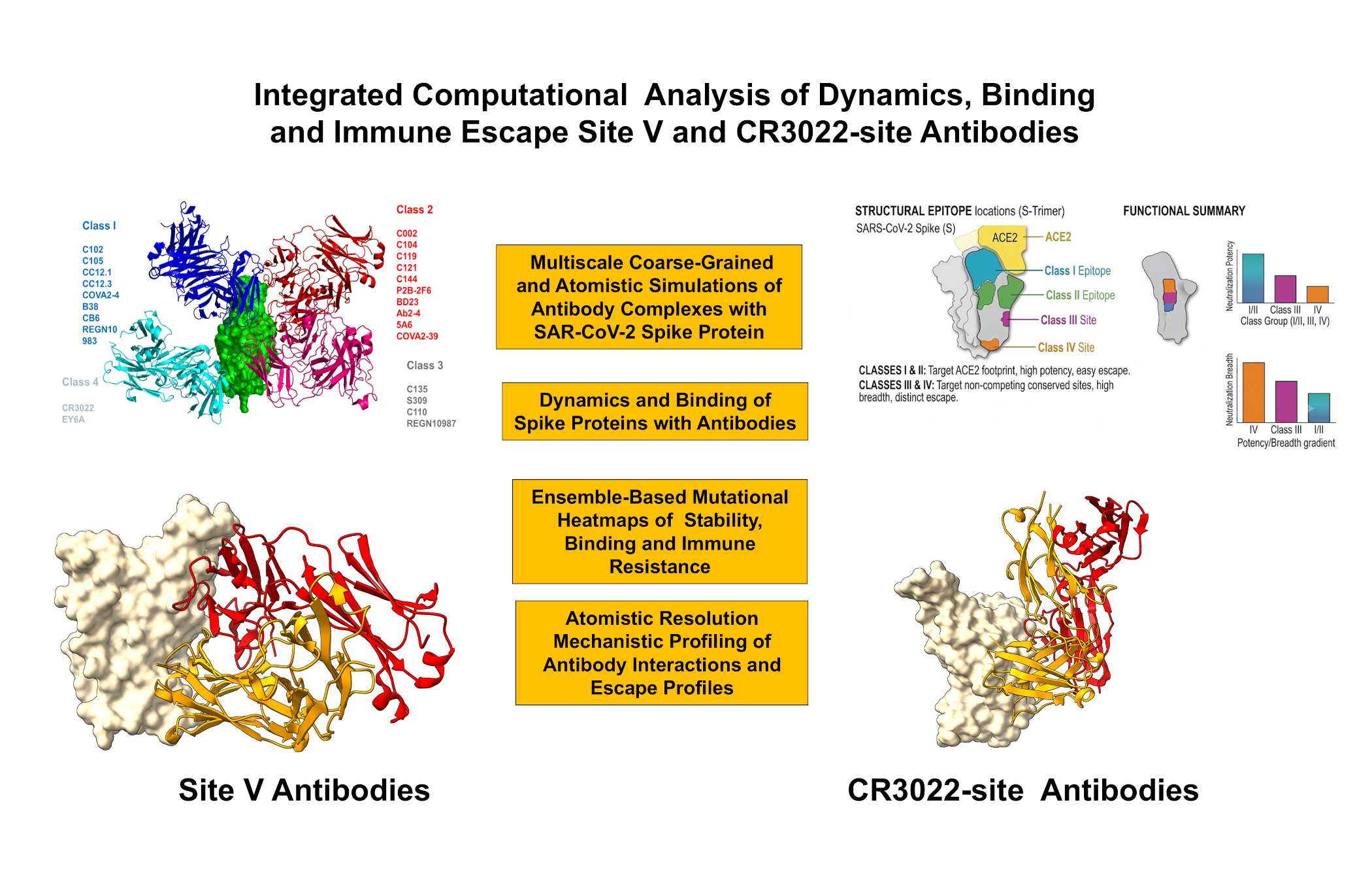
Broadly neutralizing antibodies targeting the silent face of the SARS-CoV-2 receptor-binding do-main (RBD) provide essential templates for pan-sarbecovirus therapeutics, yet the precise bio-physical mechanisms dictating their neutralization breadth, energetic propensities, and escape re-silience remain unresolved. By combining all-atom and coarse-grained molecular dynamics, systematic mutational scanning, rigorous MM-GBSA binding free energy analysis, and residue interaction network modeling we delineate the comparative structural, energetic, and allosteric signatures of Site V (CC25.4, CC25.43, CC25.56, 7D6, 6D6 ) and CR3022-site (Group 1: CC25.54, CC84.2, CC84.24) antibodies. We discover that these two classes by engaging spatially opposite faces of the RBD fold produce mutually exclusive energetic hotspot modules. Site V antibodies are anchored along a surface-exposed lateral ridge by residues R355, R357, R466, I468, F464, and K462, whereas CR3022-site antibodies engage a buried β-sheet-core module comprising R408, K378, C379, Y380, F377, and Q414. Remarkably, despite these distinct epitopes, both classes converge on an ultra-conserved paratope tyrosine triad (Y99, Y100, Y49), establishing a universal structural motif for silent-face recognition. Network centrality modeling demonstrates that Site V and CR3022-site antibodies modulate ACE2 receptor interface dynamics via distinct upstream allo-steric pathways that converge on shared RBM-loop relays at Y423, Y396, and F464. Crucially, in CR3022-site antibodies, binding free energy hotspots and allosteric communication hubs coincide directly within the structurally constrained β-sheet core. This enforces a dual-constraint mecha-nism where escape mutations inherently compromise viral fold integrity. Conversely, Site V binding hotspots and allosteric networks are structurally segregated, exposing cryptic allosteric liabilities where mutations at non-contact positions (F456, R509) dynamically rewire network communication to impair neutralization without altering static interface affinity. Furthermore, within-class resilience is governed by epitope architecture: focused antibodies (CC25.56, 6D6, CC25.54) concentrate binding energy into single dominant anchors vulnerable to point mutations, whereas broad antibodies (CC84.2, CC84.24, CC25.4, CC25.43) distribute binding energetics across multi-residue contact networks. These quantitative findings align directly with experimental neutralization data. The structural immutability of the β-sheet-core module provides a mechanistic explanation for why CR3022-site antibodies CC84.2 and CC84.24 retain activity against highly evasive Omicron sublineages BA.2.86 and JN.1. A complete absence of energetic or allosteric hotspots at major Class 1/2 escape loci explains the cross-variant breadth exhibited by both si-lent-face classes. By establishing how silent-face antibodies balance potency, breadth, and resili-ence, this work offers a predictive biophysical framework for tracking viral antigenic drift and designing durable, multi-epitope antibody cocktails.
Keywords:
SARS-CoV-2 spike protein
; Omicron variants
; antibody binding
; immune escape
; molecular dynamics
; protein stability
; mutational scanning
; binding energetics
; evolutionary mechanisms
Copyright: This open access article is published under a Creative Commons CC BY 4.0 license, which permit the free download, distribution, and reuse, provided that the author and preprint are cited in any reuse.