

Submitted:
20 October 2026
Posted:
21 October 2026
You are already at the latest version
Abstract
The global expansion of medical imaging has intensified concrete use for radiation protection, conflicting with Sustainable Development Goals (SDGs), making sustainable alternatives imperative. This study evaluates, through experimental and computational methods, how the combined effects of physicochemical stabilization and iron enrich-ment influence the photon attenuation efficiency of laterite adobe bricks. The method-ology comprised: (1) selecting samples from three regions (Center, East, and West); (2) fabricating bricks with varying particle sizes, lime and iron contents; (3) measuring shielding properties at 0.662 MeV using gamma-ray spectrometry; and (4) determining shielding properties using Phy-X/PSD and PHITS within 0.04-15 MeV. At 80 keV, bricks with 250 µm particle size, enriched with 15% iron, and 10% lime exhibited a half-value layer of 1.06 cm, versus 1.6 cm for ordinary concrete. Iron, lime, and grain size boost laterite's mass attenuation coefficient only at low energies; density affects linear at-tenuation coefficient throughout. At 0.662 MeV, physicochemical stabilization and iron enrichment increased Centre Region laterite's shielding efficiency by 4.2% and 6.8% for 10% and 15% iron addition, respectively. PHITS and Phy-X/PSD simulations matched experimental results within 6% relative deviation. Stabilized, iron-enriched adobe bricks offer a sustainable alternative to concrete for radiology room shielding, supporting the Sustainable Development Goals.
Keywords:
lateritic soil
; Adobe bricks
; gamma-ray attenuation
; radiation shielding
; Monte Carlo simulation
; building materials
1. Introduction
Ionizing radiation-based technologies have become essential components of modern healthcare. These technologies play a vital role in preserving lives through cancer therapies and in detecting underlying diseases using diagnostic imaging. Without these medical applications, both life expectancy and disease survival rates would be substantially reduced. The World Health Organization reported that more than 4.2 billion diagnostic radiology examinations were performed globally each year. In the field of nuclear medicine, approximately 40 million procedures were conducted, while radiotherapy accounted for about 8.5 million treatments [1] . These figures indicate an increasing global demand for specialized healthcare infrastructure, including X-ray imaging units, nuclear medicine facilities for both diagnostic and therapeutic applications, and radiotherapy centers. A common feature of these medical procedures is the utilization of ionizing radiation.
The discovery of ionizing radiation marked the beginning of radiology; however, early practitioners often experienced severe radiation-induced pathologies, including leukaemia, due to insufficient protective measures [2]. Ionizing radiation exposure in biological systems causes atomic and molecular ionization, which leads to cellular damage, tissue degradation, and potentially irreversible organ dysfunction. The severity of these effects depends on the radiation type, absorbed dose, and exposure duration [1]. These adverse outcomes have driven extensive research into materials capable of effectively attenuating ionizing radiation. As a result, materials such as lead, zinc, aluminum, and concrete are widely recognized for their significant radiation-shielding properties [3,4,5]. Among these, concrete is widely utilized as a shielding material because of its comparatively low-cost relative to alternatives, which has contributed to its sustained use in facilities generating ionizing radiation. Nevertheless, effective radiation protection with concrete requires substantial volumes and the consumption of resource-intensive raw materials [6]. These demands are at odds with several United Nations Sustainable Development Goals (SDGs), such as SDG 13 (Climate Action), SDG 12 (Responsible Consumption and Production), SDG 9 (Industry, Innovation, and Infrastructure), and SDG 3 (Good Health and Well-being) [7,8].
Recent research has explored the use of sustainable materials, including bricks composed of kaolin, clay, or gypsum, as alternatives to ordinary concrete (OC) for gamma-ray shielding [9,10,11,12,13]. Sayyed et al. [14] assessed the gamma-ray and neutron shielding effectiveness of eight soil samples collected between Bingöl and Solhan in Turkey. Garba et al. [15] found that the gamma-ray shielding performance of building materials is strongly influenced by their chemical composition. At photon energies of 0.662, 1.173, and 1.332 MeV, gypsum exhibited the highest shielding potential, followed by kaolin, sand, and clay. Olukotun et al. [16] investigated the gamma-ray attenuation capacity of Ball clay and kaolin from south-western Nigeria, concluding that clay-based materials are suitable for gamma-ray shielding at energies from 100 to 2000 keV. Mahmoud et al. [17] introduced a method for producing radiation-shielding clay bricks by doping them with heavy metals. Increasing the heavy metal content from 0% to 30% enhanced brick density, and simulations confirmed that this improvement directly increased radiation attenuation capacity. Multiple studies have established a direct correlation between higher metallic waste content and improved linear attenuation properties in bricks [18,19]. Hanfi et al. [20] examined how the physical and structural characteristics of red clay bricks, affected by varying fabrication pressures, influence their gamma-ray shielding capabilities. Raising the pressure rate from 7.61 to 114.22 MPa increased density from 1.50 to 1.69 g/cm3, thereby improving the linear attenuation coefficient. Similarly, Van Thuong et al. [21] studied the development of Vietnamese white clay bricks from Bat Trang for radiation protection during nuclear reactor decommissioning. Increasing fabrication pressure from 7.61 to 114.22 MPa resulted in a 22.5% increase in density and a 31.2% decrease in porosity. These physical enhancements significantly improved linear attenuation coefficients across a gamma energy range of 0.662 to 1.332 MeV. The findings indicate that higher density substantially improves gamma-ray shielding at various energies, consistent with other studies [22,23,24,25]. In Cameroon, Degbe et al. [26] analyzed the elemental composition and radiation attenuation capacity of quartzite samples from the vicinity of Pouma city.
Previous research demonstrates that the radiation shielding effectiveness of earth blocks is significantly affected by their chemical composition [27]. Despite this, limited studies have investigated the attenuation properties of Cameroonian building materials, and the combined effects of physicochemical stabilization and chemical additives on earth block performance remain largely unaddressed. The increasing use of laterite-based earth bricks in Cameroon, attributed to their economic and environmental benefits over concrete including lower cost, reduced embodied energy, and a smaller carbon footprint underscores the need for a comprehensive understanding of their properties [28,29]. This study evaluates the gamma-ray attenuation capacity of three widely used Cameroonian lateritic soils with distinct chemical compositions from three representative regions. It further analyzes the influence of iron enrichment and physical stabilization through particle size modification, as well as the effects of chemical stabilization using lime. To achieve these objectives, the research adopts a systematic methodology: first, lateritic soils from the Center, East, and West regions of Cameroon were selected to represent compositional variability in earth construction materials. Second, chemical modification through iron enrichment was implemented to assess its specific impact on gamma-ray attenuation. Third, physical and chemical stabilization strategies, namely particle size reduction and lime addition, were systematically applied to distinguish their individual contributions to attenuation. Finally, the shielding performance of the resulting adobe bricks was evaluated experimentally and validated through theoretical calculations and Monte Carlo simulations, enabling a direct comparison with conventional concrete shielding materials.
2. Materials and Methods
The experimental and computational methodology employed in this study aimed to establish a direct relationship between the physicochemical properties of lateritic materials and their gamma-ray attenuation behavior. The workflow included sample selection and preparation, elemental characterization, fabrication of stabilized adobe bricks, experimental attenuation measurements, and numerical validation using Phy-X/PSD and PHITS. Each methodological step facilitated a systematic assessment of how material composition, density, and stabilization mechanisms affect radiation shielding performance.
2.1. Preparation of Laterite Samples
Gamma radiation attenuation capacities of lateritic soils from Cameroon were investigated by collecting samples from the surface layer (0–5 cm depth) of quarries in three regions: Yaounde (Center; 3.812°N, 11.4736°E), Betare Oya (East; 5.6014°N, 14.0800°E), and Balengou (West; 5.097°N, 10.4326°E). The locations of the sampling sites are shown in Figure 1.
Following collection, the soil samples were sealed in plastic bags and transported to the spectrometry laboratory of Cameroon's Radiological Safety and Nuclear Security Authority [30] for preparation. The samples underwent thermal drying for 24 hours at 105 °C in an oven to remove residual moisture (Figure 2), in accordance with standard soil preparation protocols. Mechanical grinding was then performed to homogenize the sample texture. The samples were subsequently sieved using a 500 µm mesh to ensure uniform granulometry and reproducibility of bulk density. Three samples were prepared and labeled BC, BE, and BW, corresponding to the Center, East, and West regions, respectively.
To investigate the effects of chemical composition and granulometric modification, chemical treatments with iron and lime, as well as granulometric adjustments, were applied to the sample collected from the Center region (BC). This sample was subsequently sieved using a 250 µm mesh. Limiting particle size analysis to the BC sample was a methodological choice. The 250 µm fraction was selected to evaluate the effect of reducing particle size by half on attenuation capacity. This procedure resulted in five sub-samples: BC2, BC2L, BC2I, BC2LI, and BC2LI2 (Table 1).
All prepared samples were transferred to the National Center for Energy Sciences and Nuclear Techniques in Morocco [32] for characterization, fabrication into adobe bricks, and measurement of attenuation properties, including Linear Attenuation Coefficient (LAC), Mass Attenuation Coefficient (MAC), Half-Value Layer (HVL), and Radiation Protection Efficiency (RPE). These properties were compared with those of ordinary concrete commonly used for shielding in radiology units in Cameroon. To minimize transport related risks such as cross contamination, moisture absorption, material loss, and misidentification, all samples were hermetically sealed, clearly labeled, and handled under controlled conditions during transfer between laboratories [33,34,35].
The controlled preparation and stabilization of the lateritic samples aimed to ensure reproducible physical properties before compositional analysis. Because gamma-ray attenuation is primarily determined by elemental composition and effective atomic number, the samples were subsequently subjected to elemental characterization to quantify their major and trace constituents.
2.2. Elemental Characterization of Laterite Samples
Elemental characterization was performed to establish a quantitative basis for interpreting differences in gamma-ray attenuation behavior among the lateritic materials and their stabilized variants. It was conducted via energy-dispersive X-ray fluorescence (XRF) spectroscopy. The measurements were performed using a portable BRUKER S1 TITAN spectrometer (Figure 3) at the National Center for Energy Sciences and Nuclear Techniques with the X-ray tube operating at 15 kV and 23 µA.
This instrument can analyze elements from magnesium (Mg) to uranium (U) [36]. The laterite samples, prepared beforehand, were conditioned according to the instrument's specifications before being submitted for analysis. The elemental compositions obtained from XRF analysis were subsequently used to guide the formulation of adobe brick mixtures and to define material inputs for both experimental attenuation measurements and theoretical simulations.
2.3. Adobe Brick Preparation
Adobe bricks were fabricated to replicate construction-relevant geometries while permitting controlled variation in composition, density, and thickness. The selected formulations and dimensions facilitated direct experimental determination of attenuation parameters and enabled comparison with theoretical predictions. Sixteen bricks were produced, comprising eight with a thickness of 1 cm and eight with a thickness of 2 cm, by varying the mass proportions of laterite, iron, and lime. Each component (laterite, iron, and lime) was weighed using a SCIENTECH SA 120 analytical balance with a resolution of 10-4 g. The components were mixed, with small amounts of distilled water added using a graduated pipette until a homogeneous paste was achieved. The resulting pastes were poured into cylindrical polyvinyl chloride molds with a diameter of 4.2 cm, without compression. The formed bricks were demolded and dried at room temperature for two weeks (Figure 4).
The volume of each adobe brick sample was measured using a caliper with a resolution of 0.2 mm, and the bulk density was determined using the following formula:
where m and V represent the mass and volume of a brick sample, respectively. Relative uncertainty of the bulk density was determined by applying the following formula [37]:
where ∆V, the uncertainty of the volume, and ∆m, the uncertainty of the mass, are expressed as follows:
where is the radius and is the height of the samples, and and are their respective uncertainties.
Following fabrication and density determination, the adobe bricks were subjected to gamma-ray attenuation measurements. These measurements were designed to extract standard radiation shielding parameters that directly reflect material performance under monoenergetic photon irradiation.
2.4. Radiation Shielding Parameters Evaluations
The radiation shielding parameters provide a comprehensive and comparable assessment of gamma-ray attenuation performance across different materials and stabilization strategies. To characterize the gamma photon attenuation performance of the prepared adobe brick samples, we determined a series of essential physical parameters for each manufactured sample. The linear attenuation coefficient ( ) was the first parameter determined, followed by the mass attenuation coefficient (, the half-value layer ( and the Radiation Protection Efficiency (). The Beer-Lambert law [38] was used to determine the linear attenuation coefficient:
where: is the photon intensity measured after interaction with the sample, is the initial photon intensity measured without interaction with the sample, is the linear attenuation coefficient, and is the thickness of the sample.
To determine the uncertainty of the following expression was used [39]:
A gamma-spectrometry system equipped with an ORTEC GEM30-70 HPGe semiconductor detector with an energy resolution of 2.66 keV at 0.662 MeV was utilized. Detector efficiency calibration was performed using a certified europium source (152Eu) emitting a series of γ -rays between 121 keV and 1408 keV, as depicted in Figure 5. Photon intensities from 137Cs source with an activity of 37 kBq referenced to 1 July 2018, were initially measured in the absence of adobe brick samples to determine the unattenuated intensity at a detector distance of 3 cm. Transmitted intensities were subsequently recorded for each brick thickness, with the narrow beam passing through the sample positioned at 1 cm or 2 cm from the source and in direct contact with the detector for samples of 2 cm or 1 cm thickness, respectively (Figure 6).
Finally, for each brick sample, the linear attenuation coefficients were determined using the graphical relationship between and the thickness (x). The 137Cs source was the only one available for this investigation. The analysis was limited to the 0.662 MeV photons, excluding photons of other energies produced by scattering within the lead shielding.
Using the linear attenuation coefficient, the mass attenuation coefficient, and the half-value layer were determined by the following equations [40] :
To determine the uncertainty of the following expression was used [41]:
While experimental measurements provide direct evidence of attenuation behavior, theoretical calculations and Monte Carlo simulations are essential for validating the results and extending the analysis across a wider photon energy range. Accordingly, Phy-X/PSD calculations and PHITS simulations were employed to complement and verify the experimental findings. Furthermore, using the Phy-X/PSD software, other shielding parameters such as , the effective atomic number and , the equivalent atomic number were determined by the following relations [11,42]:
where and are respectively the total atomic and electronic cross-section. R, the specific energy is defined by equation (13):
and are the atomic numbers of the elements having et ratios, respectively.
Additionaly, the exposure buildup factor (EBF) quantifies the increase in photon exposure due to scattered photons within the material. This parameter depends on both the photon energy and the mean free path. The Phy-X/PSD computational platform evaluates this parameter using the Geometric Progression (G–P) fitting method [43].
2.5. Phy-X/PSD and PHITS
The Phy-X/PSD and the PHITS Monte Carlo code were selected due to their extensive validation and widespread use in photon interaction and radiation shielding studies[44,45,46,47,48,49]. Photon Shielding and Dosimetry (Phy-X/PSD) is an online computational tool that enables the evaluation of shielding parameters for materials against gamma photons with energies between 0.015 MeV and 15 MeV [43]. Phy-X/PSD can determine the linear attenuation coefficient, mass attenuation coefficient, including, but not limited to effective atomic number (), equivalent atomic number () and exposure buildup factor (EBF). Particle and Heavy Ion Transport code System (PHITS) is a Monte Carlo–based simulation code developed in Fortran [50,51,52,53,54,55,56,57,58,59,60,61]. Version 3.35 of PHITS was used in this work. The PHITS package contains several nuclear reaction and particle transport models for protons, neutrons, heavy ions, electrons, and photons. The input code for this study includes the following sections: Title, Parameters, Source, Material, MatNameColor, Surface, Cell, T-Track, and T-Cross. In the Parameters section, various settings were defined, such as the total number of generated particles, which was set to 2x10⁶ due to the simplicity of the system geometry. In the Source section, a gamma-ray photon source with energies ranging from 0.04 MeV to 15 MeV was considered. The chemical compositions of the manufactured bricks and their densities, as reported in Table 1 and Table 2, were introduced in the Materials and Surfaces sections. All the sections mentioned above are defined as input sections, while sections such as T-Track and T-Cross are output sections. They allow the visualization of photon trajectories within the modeled system and the determination of the residual photon flux after passing through the brick samples. For each brick sample, the linear attenuation coefficients were determined using the graphical relationship between and the thickness (x).
3. Results and Discussions
3.1. Characterization Results
The results of the laterite sample analyses performed by X-ray fluorescence (XRF) are presented in Table 2.
The findings show that the samples from the three regions are mainly composed of silica (SiO2), alumina (Al2O3), and iron oxide (Fe2O3), which together account for more than 95% of the total oxide content. The sample from the Central region shows an iron oxide content of 34%, which is significantly higher than the sample from the Western region and approximately three times higher than the sample from the Eastern region. Conversely, silicon dioxide is predominant in the Eastern sample, accounting for 62%, compared to 40% in the West and 37% in the Center. As for alumina, it is most abundant in the Western sample with a concentration of 35%, followed by 26% in the Center, and 22% in the East. These compositional differences are expected to play a key role in the gamma-ray attenuation behavior of the materials, since Iron-rich phases contribute to higher effective atomic numbers and electron densities, which enhance photon interaction probabilities, particularly at low and intermediate energies. For the elements listed in the table for which the detection limit was reached, the concentrations were below the detection limits of the XRF system, namely <300 ppm for P, <10 ppm for V, <15 ppm for Cr, <10 ppm for As, and <10 ppm for Pb. The elemental composition and density of the ordinary concrete used in this study are those reported in the NIST database [31], ensuring a standardized and widely accepted reference material for comparison (Table 1 and Table 2).
3.2. Experimental Results at 0.662 MeV
The experimental attenuation measurements at 0.662 MeV provide a reference energy commonly used in radiation shielding studies, enabling direct comparison with existing literature. In Figure 7, it can be observed that the average shielding efficiency of each sample against radiation also depends strongly on its density, as it exhibits a similar trend of variation. A comparable pattern is observed for the linear attenuation coefficients (Figure 8), which is consistent with the direct proportionality between linear attenuation coefficient and material density for a given photon energy and composition.
3.2.1. Comparative Analysis of Laterites from the Three Regions
At an energy of 0.662 MeV, the BE sample shows the highest shielding efficiency, followed by BC and BW, with respective values of 24.4%, 23.7%, and 23.4%, as shown in the Table 3. However, when considering the mass attenuation coefficients, which describe the shielding capability of a material independently of its density and thickness, BW exhibits the best performance, followed by BE and BC, with respective values of 0.080 cm2/g, 0.078 cm2/g, and 0.076 cm2/g (Figure 9 and Table 3). This apparent contrast highlights the importance of distinguishing between density-driven attenuation (LAC and shielding efficiency) and composition-driven attenuation (MAC). The higher MAC of BW can be attributed to its higher alumina content and the presence of heavier trace elements, whereas the enhanced shielding efficiency of BE results primarily from its higher bulk density.
3.2.2. Influence of Granulometry on the Radiation Attenuation Capacity of the Brick
The average shielding efficiency of the BC2 brick is 6.8% higher than that of BC. This improvement is mainly due to BC2’s slightly higher density (+4%), even though both bricks were made from the same type of laterite, differing only in particle size distribution. The reduction in particle size improves packing efficiency, reduces intergranular voids, and consequently increases bulk density. Regarding the mass attenuation coefficient, BC2 also shows a higher value than BC. This result supports other studies that have shown that soil granulometry influences the mass attenuation coefficient by modifying effective density and microstructural homogeneity [62].
3.2.3. Influence of Lime and Iron on the Radiation Shielding Performance of the Brick
In this study, a 10% lime content was selected, in accordance with previous research showing that at this level, the physical properties of bricks are improved [63]. For this proportion, we observed a 6% increase in the mass attenuation coefficient compared to BC2, a 10.5% decrease in density, and a 1.7% reduction in average shielding efficiency. This result indicates that although lime addition slightly enhances the intrinsic photon interaction capability per unit mass, the concurrent reduction in bulk density dominates the overall attenuation behavior at 0.662 MeV. This decrease in density due to the incorporation of lime has also been reported in other studies [64].
At the same energy, we explored the effect of increasing the iron and lime contents in the BC2 brick. An increase of 10% iron in BC2 does not significantly change the mass attenuation coefficient but increases the material density by 24.6%, and consequently results in an 18.1% enhancement in shielding efficiency. This enriched sample is denoted BC2I. To further improve the physical characteristics of BC2I, adding 10% lime resulted in a slight decrease in mass attenuation coefficient of 0.9%, density of 5.5%, and shielding efficiency of 6.7%. This new sample is referred to as BC2LI. Finally, increasing the iron content of BC2LI by 5% led to a 3.5% increase in the mass attenuation coefficient, a 1% rise in density, and a 9.3% improvement in shielding efficiency. Overall, these results demonstrate that at 0.662 MeV, iron enrichment primarily enhances shielding performance through density augmentation rather than intrinsic mass attenuation enhancement. At this energy level, iron has a positive impact on the shielding efficiency of adobe brick, a result that is similar to that reported by [40].
3.3. Relative Deviation Between Experimental and Simulation Results
To determine the relative deviation (RD) between the experimental and simulated values, the following formula was applied [65] :
By analyzing the values of the relative deviation shown in Table 4 according to the simulation method used, it is observed that the relative deviation between the experimental results and the simulated values obtained from Phy-X/PSD ranges from -5.69% to 0.76%. As for the deviation obtained with the Monte Carlo method implemented in the PHITS code, it ranges from -5.98% to 0%. These results indicate a very good agreement between experimental measurements and both theoretical approaches. According to Figure 10, the simulated and experimental values are in agreement, as they fall within the uncertainty range of the experimental value. The observed discrepancies between simulated and experimental results can be explained by several factors specific to each sample.
For BW, the deviation is most likely due to a slight underestimation of its bulk density during experimental characterization. In the case of BC2L and BC2LI2, the differences can be attributed to heterogeneity in the mixture of laterite, lime, and iron, as well as the presence of non-negligible impurities in the industrial lime, which were not considered in the simulations that assume pure lime. More generally, the observed discrepancies may also arise from uncertainties in photon intensity measurements, density determination, and residual moisture content not accounted for in the simulations, in addition to the simplifying assumption of material homogeneity. However, these deviations remain below 6%, which is considered acceptable in other studies [66,67]. The overall agreement between the two approaches validates the computational model and provides confidence in extending the shielding analysis to broader photon energy ranges using Monte Carlo simulations and Phy-X/PSD calculations. In the present study, Monte Carlo simulations were employed to extend the shielding assessment across a wider energy spectrum. Additionally, key shielding parameters, including the effective atomic number (), equivalent atomic number (), and exposure buildup factor (EBF), were evaluated for all samples using the Phy-X/PSD software.
3.4. Theoretical Determination of Shielding Parameters for the Samples Across a Gamma Energy Range of 0.04 MeV to 15 MeV
3.4.1. Energy-Dependent Behavior of the Linear Attenuation Coefficient and Half-Value Layer
The Monte Carlo method was used to estimate the attenuation capabilities of the manufactured bricks over an energy range between 0.04 MeV and 15 MeV. Figure 11 and Table 5 show the variation of the LAC of each sample as a function of photon energy. As expected, the LAC of all samples decreases with increasing energy, while an opposite trend is observed for the HVL values (Figure 12), reflecting the transition from photoelectric-dominated interactions at low energies to Compton scattering and pair production at higher energies.
More specifically, comparing the brick samples, sample BC2I exhibits the highest attenuation performance across most of the investigated energy range, with LAC values ranging from 3.1157 cm-1 at 0.04 MeV to 0.0531 cm-1 at 15 MeV. The only exception is observed in the energy range from 0.04 MeV to 0.08 MeV, where BC2LI2 shows slightly higher attenuation. Figure 13 illustrates that lime addition generally has a negative impact on LAC values across the energy range of interest, whereas increasing iron content consistently enhances attenuation, particularly at low energies.
When compared with ordinary concrete, it is observed that from approximately 0.2 MeV onward, ordinary concrete outperforms all adobe brick samples (Table 5 and Figure 11). Specifically, at 0.662 MeV, the attenuation capacity of ordinary concrete is observed to be superior to that of all the other brick samples. According to Table 6, the additional thicknesses required for each sample match the attenuation capacity of ordinary concrete at this energy, range between 0.24 cm and 2.03 cm. However, at photon energies below 0.2 MeV, iron-rich adobe bricks exhibit superior attenuation performance compared to ordinary concrete. For a conventional radiology room equipped with an X-ray unit emitting photons with an energy of approximately 80 keV [68], BC2LI2 exhibits an HVL of 1.06 cm, whereas ordinary concrete requires approximately 1.6 cm to achieve equivalent attenuation.
3.4.2. Energy-Dependent Behavior of the Linear Attenuation Coefficient and Half-Value Layer
Figure 14 and Table 7 show the evolution of the MAC as a function of photon energy. At low energy (0.04-0.2 MeV), the MAC closely follows the iron content of the samples (Figure 15 and Figure 16), with high-iron compositions exhibiting superior performance. This behavior is explained by the dominance of the photoelectric effect in this energy range, where the interaction cross-section scales strongly with atomic number . At medium and high energies, the influence of chemical composition becomes less pronounced, as Compton scattering dominates and MAC values converge across materials.
Furthermore, at low energy, the MAC values of sample BC2L exceed those of ordinary concrete (Figure 14). This suggests that if BC2L type bricks are fabricated with a bulk density comparable to or higher than ordinary concrete, they could serve as a viable alternative shielding material for conventional radiology facilities.
3.4.3. Energy-Dependent Behavior of the Effective Atomic Number
Figure 17 illustrates the variation of the effective atomic number of all studied samples as a function of gamma photon energy. It can be observed that this quantity exhibits a marked energy dependence, whose behavior is closely governed by the dominant interaction phenomenon within each considered energy range. Indeed, the highest values of are recorded at low energies, where the photoelectric effect constitutes the predominant interaction mechanism. In the intermediate energy range, between 0.2 MeV and 2 MeV, a notable decrease of is observed, attributable to the dominance of the Compton effect. Beyond 2 MeV, a progressive increase of is noted, resulting from the growing contribution of pair production as the dominant interaction process.
Furthermore, the comparison between the various studied samples reveals that sample BC2LI2 exhibits the highest effective atomic number, which can be attributed to its higher iron content relative to the other samples. Conversely, samples BW, BE and OC, characterized by the lowest iron contents, display the lowest values across the entire considered energy range. A higher implies that sample BC2LI2 exhibits greater opacity to radiation, as it maximizes the probability of total photon absorption, particularly in the photoelectric interaction regime.
3.4.4. Gamma Ray Buildup Factors of the Brick Samples and Ordinary Concrete
After determining the gamma-ray attenuation parameters of the samples, it is essential to evaluate the contribution of each sample to the dose enhancement induced by scattered radiation within these various materials.
Figure 18 shows the variation of the exposure build-up factor as a function of energy for all brick samples as well as ordinary concrete, at different penetration depths of 1, 10, 20, and 30 mfp. Over the entire energy range from 0.015 to 15 MeV, an increase in penetration depth leads to a greater contribution from scattered radiation. Notably, the differences in exposure buildup factor (EBF) values among the materials are most pronounced in the low-energy region between 0.04 and 0.3 MeV. It is also observed that at low and intermediate energies, ordinary concrete, characterized by a low (Figure 19), exhibits the highest EBF values, whereas the BC2LI2 sample, which has the highest , shows the lowest EBF values. The addition of iron leads to a significant reduction in exposure buildup. For example, at a penetration depth of 10 mfp, scattered radiation is much higher in BC2 than in the iron-enriched formulations (BC2I, BC2LI, and BC2LI2). These results indicate that iron not only attenuates primary gamma rays but also contributes to reducing the radiation field by absorbing a portion of the scattered photons. Thus, it can be concluded that iron-rich materials exhibit superior effectiveness for gamma-ray shielding.
3.5. Comparison of the Present Samples with Those Reported in the Literature
To assess the shielding performance of the prepared samples, their linear attenuation coefficients (LACs) at 0.662 MeV were compared with those of brick materials reported in previous studies [15,17,18,69,70,71]. Figure 20 shows that the linear attenuation coefficients (LACs) at 0.662 MeV vary from 0.113 cm-1 to 0.328 cm-1 depending on the investigated materials and densities. The lowest value is observed for sample CNT (0.113 cm-1 ; 1.52 g/cm3 ), which is composed solely of Kenyan red clay, while the highest value is obtained for N30 (0.328 cm-1 ; 4.228 g/cm3 ), consisting of 70% clay and 30% heavy minerals. In descending order of performance, we then have N10 (0.274 cm-1 ; 3.525 g/cm3 ), corresponding to 90% clay and 10% heavy minerals, followed by N20 (0.266 cm-1 ; 3.426 g/cm3 ) with 80% clay and 20% heavy minerals, and N0 (0.258 cm-1 ; 3.314 g/cm3 ) with 100% clay. Next come the natural materials from northwestern Nigeria, namely gypsum (0.228 cm-1 ; 2.28 g/cm3 ) and kaolin (0.209 cm-1 ; 1.94 g/cm3 ). Then the composite materials C-W70 (0.197 cm-1 ; 2.634 g/cm3 ), composed of 70% Egyptian clay and 30% metallic waste, and C-W50 (0.185 cm-1; 2.585 g/cm3 ), containing 50% Egyptian clay and 50% metallic waste. This is followed by sand (0.184 cm-1 ; 1.66 g/cm3 ) from northwestern Nigeria, C-W0 (0.175 cm-1 ; 2.390 g/cm3 ), composed entirely of Egyptian clay, and finally BC2I (0.173 cm-1 ; 2.230 g/cm3 ). The brick samples investigated in the present study exhibit linear attenuation coefficients ranging from 0.124 cm-1 to 0.173 cm-1 for BW and BC2I, respectively. These values fall within the intermediate range reported in the literature, reflecting moderate yet competitive attenuation performance, while offering the additional advantage of being locally sourced and sustainable materials.
The present analysis is limited by the availability of experimental data at a single photon energy (0.662 MeV), while the low-energy attenuation behavior was evaluated solely through theoretical calculations and Monte Carlo simulations. In addition, the bricks were fabricated without mechanical compaction or long-term curing, which may influence density-dependent shielding performance. Nevertheless, the results provide a robust comparative framework for optimizing laterite-based shielding materials and offer valuable guidance for the development of low-cost, locally sourced radiation shielding solutions. Future investigations will extend experimental measurements to diagnostic X-ray energies and incorporate mechanical characterization to support practical shielding applications.
4. Conclusions
To address the economic and environmental challenges associated with conventional materials such as ordinary concrete for medical imaging room shielding, this study evaluated the potential of adobe bricks produced from laterite sourced from three regions of Cameroon and enhanced with physicochemical stabilization and iron enrichment. An integrated experimental and computational methodology was employed to systematically examine the combine effects of physicochemical stabilization and iron enrichment on gamma-ray attenuation performance. The findings indicate that at low energy, physical stabilization, which consists of halving the particle size of the brick, results in a small but positive improvement in the LAC and the MAC. Combining physical and chemical stabilization also produces a slight improvement in the MAC, marginally greater than that obtained with physical stabilization alone. However, it leads to a decrease in the LAC, as the addition of 10% lime appears to cancel out the gain resulting from the density increase induced by physical stabilization. Finally, combining physical stabilization with iron enrichment considerably improves both coefficients. In addition to their shielding effectiveness, these materials provide benefits related to local resource utilization and a reduced environmental footprint, thereby contributing to the achievement of the United Nations Sustainable Development Goals (SDGs).
Author Contributions
Conceptualization, C.T.K.; methodology, C.T.K, N.Y and M.Y.M; software, C.T.K; validation, N.Y and M.Y.M.; formal analysis, C.T.K and M.Y.M.; investigation, C.T.K.; resources, C.T.K. and N.Y; data curation, C.T.K.; writing—original draft preparation, C.T.K; writing—review and editing, N.Y and M.Y.M.; supervision, N.Y.; project administration, N.Y. All authors have read and agreed to the published version of the manuscript.
Funding
This research received no external funding.
Data Availability Statement
The data presented in this study are available on request from the corresponding author.
Acknowledgments
This work was supported by the International Atomic Energy Agency (IAEA). the Government of Cameroon through the Radiological Safety and Nuclear Security Authority of Cameroon (ASRAN) and National Center for Energy Sciences and Nuclear Techniques (CNESTEN) of Morocco.
Conflicts of Interest
The authors declare no conflicts of interest.
Abbreviations
The following abbreviations are used in this manuscript:
| ASRAN | Radiological Safety and Nuclear Security Autority |
| CNESTEN | National Center for Energy Sciences and Nuclear Techniques |
| DL | Detection Limit |
| EBF | Exposure Build Up Factor |
| IAEA | International Atomic Energy Agency |
| HVL | Half Value Layer |
| LAC | Linear Attenuation Coefficient |
| MAC | Mass Attenuation Coefficient |
| OC | Ordinary Concrete |
| PHITS | Particle and Heavy Ion Transport Code System |
| RD | Relative Deviation |
| RPE | Radiation Protection Efficiency |
| SDG | Sustainable Development Goals |
| XRF | X-ray Fluorescence |
References
- WHO Ionizing Radiation and Health Effects. Available online: https://www.who.int/news-room/fact-sheets/detail/ionizing-radiation-and-health-effects (accessed on 21 November 2025).
- Linet, M.S.; Slovis, T.L.; Miller, D.L.; Kleinerman, R.; Lee, C.; Rajaraman, P.; Berrington de Gonzalez, A. Cancer Risks Associated with External Radiation From Diagnostic Imaging Procedures. CA Cancer J. Clin. 2012, 62, 75. [Google Scholar] [CrossRef] [PubMed]
- Kaye, G.W.C. Protection and Working Conditions in X-Ray Departments. Br. J. Radiol. 1928, 1, 295–312. [Google Scholar] [CrossRef]
- Kaye, G.W.C.; Binks, W. The Emission and Transmission of X and Gamma Radiation. Br. J. Radiol. 1940, 13, 193–212. [Google Scholar] [CrossRef]
- McGinley, P.H.; Miner, M.S. A History of Radiation Shielding of X-Ray Therapy Rooms. Health Phys. 1995, 69, 759–765. [Google Scholar] [CrossRef] [PubMed]
- Mohammed, T.U.; Rony, M.A.; Zunaied Bin Harun, M.; Uddin, N.; Saha, D.; Rahman, M.N.; Mahmood, A.H. Alternative Fine Aggregates to Natural River Sand for Manufactured Concrete Ensuring Circular Economy. Constr. Mater. 2024, Vol. 4, Pages 640-654 640–654. [Google Scholar] [CrossRef]
- Mekky, K.M.; Nasr, M.; Sharobim, K.; Fujii, M.; Ibrahim, M.G. Synergism of Life Cycle Assessment (LCA) and Sustainable Development Goals (SDGs) Framework for Best Selection of Sludge-Based Concrete Scenarios. Environ. Dev. Sustain. 2025, 1–30. [Google Scholar] [CrossRef]
- Scrucca, F.; Ingrao, C.; Barberio, G.; Matarazzo, A.; Lagioia, G. On the Role of Sustainable Buildings in Achieving the 2030 UN Sustainable Development Goals. Environ. Impact Assess. Rev. 2023, 100, 107069. [Google Scholar] [CrossRef]
- Arivazhagan, S.; Naseer, K.A.; Mahmoud, K.A.; Libeesh, N.K.; Arun Kumar, K. V.; Naga Kumar, K.C. V.; Sayyed, M.I.; Alqahtani, M.S.; El Shiekh, E.; Khandaker, M.U. The Radiation Shielding Proficiency and Hyperspectral-Based Spatial Distribution of Lateritic Terrain Mapping in Irikkur Block, Kannur, Kerala. Nucl. Eng. Technol. 2023, 55, 3268–3276. [Google Scholar] [CrossRef]
- Elsafi, Mohamed.; Alawaideh, S.E.; Hamada, M.A.; Sayyed, M.I. Mechanical, Thermal, Structure and Radiation Shielding Efficiency of Natural Kaolinite-Based Composites Reinforced with Heavy Metal Oxides. Sci. Rep. 2026 16:1 2026, 16, 9226. [Google Scholar] [CrossRef] [PubMed]
- Kabamakli, E.; Yalcin, S.; Aktas, B.; Yilmaz, D. Investigation of Structural and Radiation Shielding Properties of Natural Granite, Clay, Natural Cement, and Quartz Supplied from Hakkâri Region. Appl. Radiat. Isot. 2025, 225, 112097. [Google Scholar] [CrossRef] [PubMed]
- Kaika, Y.K.; Umaru, I.; Idris, M.M.; Rilwan, U.; Guto, J.A.; Sayyed, M.I.; Maisalatee, A.U.; Mundi, A.A.; Mahmoud, K.A. Microstructural, Thermal Analysis, and Gamma-Ray Shielding Properties of Bricks Made of Various Local Natural Materials. Radiat. Phys. Chem. 2025, 236, 112742. [Google Scholar] [CrossRef]
- Sagon, S.; Surujpaul, P.P. The Use of Local Alternative Materials as Structural Shielding for Diagnostic Radiological Facilities. J. Glob. Radiol. 2020, 6, e1050. [Google Scholar] [CrossRef]
- Sayyed, M.I.; Akman, F.; Turan, V.; Araz, A. Evaluation of Radiation Absorption Capacity of Some Soil Samples. Radiochim. Acta 2019, 107, 83–93. [Google Scholar] [CrossRef]
- Garba, N.N.; Aliyu, A.S.; Rabiu, N.; Kankara, U.M.; Vatsa, A.M.; Ismaila, A.; Musa, J.; Onuh, E. Investigation of Natural Radionuclides and Radiation Shielding Potential of Some Commonly Used Building Materials in Northwestern Nigeria. Sci. Rep. 2024, 14. [Google Scholar] [CrossRef] [PubMed]
- Olukotun, S.F.; Gbenu, S.T.; Ibitoye, F.I.; Oladejo, O.F.; Shittu, H.O.; Fasasi, M.K.; Balogun, F.A. Investigation of Gamma Radiation Shielding Capability of Two Clay Materials. Nucl. Eng. Technol. 2018, 50, 957–962. [Google Scholar] [CrossRef]
- Mahmoud, K.A.; Tashlykov, O.L.; Mhareb, M.H.A.; Almuqrin, A.H.; Alajerami, Y.S.M.; Sayyed, M.I. A New Heavy-Mineral Doped Clay Brick for Gamma-Ray Protection Purposes. Appl. Radiat. Isot. 2021, 173. [Google Scholar] [CrossRef] [PubMed]
- Almuqrin, A.H.; Mahmoud, K.A.; Sayyed, M.I.; Al-Ghamdi, H. Impacts of Sintering Temperature on the Mechanical Properties and Gamma Ray Protection Capacity of Clay Bricks. Nucl. Eng. Technol. 2024, 56, 2489–2497. [Google Scholar] [CrossRef]
- Van Thuong, T.; Tashlykov, O.L.; Mahmoud, K.A. A Unique Vietnam’s Red Clay-Based Brick Reinforced with Metallic Wastes for γ-Ray Shielding Purposes: Fabrication, Characterization, and γ-Ray Attenuation Properties. Nucl. Eng. Technol. 2024, 56, 1544–1551. [Google Scholar] [CrossRef]
- Hanfi, M.Y.; Saftah, A.; Alsufyani, S.J.; Alqahtani, M.S.; Mahmoud, K.A. Experimental Investigation of Fired Clay Bricks for Gamma Radiation Shielding. Radiat. Phys. Chem. 2025, 226. [Google Scholar] [CrossRef]
- Van Thuong, T.; Tashlykov, O.L.; Mahmoud, K.A. Novel Bricks Based Lightweight Vietnam’s White Clay Minerals for Gamma Ray Shielding Purposes: An Extensive Experimental Study. Nucl. Eng. Technol. 2024, 56, 666–672. [Google Scholar] [CrossRef]
- El-Samrah, M.G.; Tawfic, A.F.; Sallam, F.H.; Omar, A.M. Investigation of Specially Designed Bentonite Samples as Potential Bricks with Better Radiation Shielding Properties. Prog. Nucl. Energy 2023, 162, 104778. [Google Scholar] [CrossRef]
- Hanfi, M.Y.; Abu El-Soad, A.M.; Alresheedi, N.M.; Alsufyani, S.J.; Mahmoud, K.A. The Impact of Pressure Rate on the Physical, Structural and Gamma-Ray Shielding Capabilities of Novel Light-Weight Clay Bricks. Nucl. Eng. Technol. 2024, 56, 4938–4945. [Google Scholar] [CrossRef]
- Mahmoud, K.A.; Marashdeh, M.W. Clay-Based Bricks’ Rich Illite Mineral for Gamma-Ray Shielding Applications: An Experimental Evaluation of the Effect of Pressure Rates on Gamma-Ray Attenuation Parameters. Open Chem. 2023, 21. [Google Scholar] [CrossRef]
- Van Thuong, T.; Tashlykov, O.L.; Mahmoud, K.A. Lightweight Bricks Based Vietnamese Red Clay for Radiation Protection: A Deep Look for the Impacts of Compressive Strength on the Characterization, and Gamma Ray Shielding Evaluation. Radiat. Phys. Chem. 2024, 218, 111583. [Google Scholar] [CrossRef]
- Degbe, P.L.; Guembou Shouop, C.J.; Bongue, D.; Beyinda, M.G.; Ndontchueng Moyo, M.; Kwato Njock, M.G. Elemental Characterization of Quartzite of Pouma Sub-Division of Cameroon and Radiation Attenuation Properties Based on XCOM and GEANT4 Monte Carlo Simulation. Radiat. Eff. Defects Solids 2022, 177, 688–705. [Google Scholar] [CrossRef]
- Alshammari, A.S.; Rilwan, U.; Alafer, F.; AL-Kamali, M.F.S.H.; Almutery, A.; El-Taher, A. A Comparative Analysis of Radiation Shielding Character in Engineered Bricks Blended with CaO, Al2O3, and Fe2O3 Additives: Thermal Stability and Phy-X Simulation Insights into Attenuation Characteristics. Radiat. Phys. Chem. 2026, 243, 113674. [Google Scholar] [CrossRef]
- Lemougna, P.N.; Melo, U.F.C.; Kamseu, E.; Tchamba, A.B. Laterite Based Stabilized Products for Sustainable Building Applications in Tropical Countries: Review and Prospects for the Case of Cameroon. Sustainability 2011, Vol. 3, Pages 293-305 293–305. [Google Scholar] [CrossRef]
- Olukoya Obafemi, A.P.; Kurt, S. Environmental Impacts of Adobe as a Building Material: The North Cyprus Traditional Building Case. Case Stud. Constr. Mater. 2016, 4, 32–41. [Google Scholar] [CrossRef]
- ASRAN Structure and Organisation – ASRAN-Home. Available online: https://www.asran.cm/en/category/structure-et-organisation/ (accessed on 12 December 2025).
- NIST Composition of CONCRETE, PORTLAND. Available online: https://physics.nist.gov/cgi-bin/Star/compos.pl?matno=144 (accessed on 10 December 2025).
- CNESTEN Home - CNESTEN, National Center for Nuclear Energy, Science and Technology. Available online: https://www.cnesten.org.ma/ (accessed on 2 December 2025).
- Guembou Shouop, C.J.; Ndontchueng Moyo, M.; Chene, G.; Nguelem Mekontso, E.J.; Motapon, O.; Kayo, S.A.; Strivay, D. Assessment of Natural Radioactivity and Associated Radiation Hazards in Sand Building Material Used in Douala Littoral Region of Cameroon, Using Gamma Spectrometry. Environ. Earth Sci. 2017, 76:4 76, 164. [Google Scholar] [CrossRef]
- Hazou, E.; Guembou Shouop, C.J.; Nguelem Mekongtso, E.J.; Ndontchueng Moyo, M.; Beyala Ateba, J.F.; Tchakpele, P.K. Preliminary Assessment of Natural Radioactivity and Associated Radiation Hazards in a Phosphate Mining Site in Southern Area of Togo. Radiat. Detect. Technol. Methods 2019, 2019 3:2 3, 16. [Google Scholar] [CrossRef]
- Joel, G.S.C.; Penabei, S.; Ndontchueng, M.M.; Chene, G.; Mekontso, E.J.N.; Ebongue, A.N.; Ousmanou, M.; David, S. Precision Measurement of Radioactivity in Gamma-Rays Spectrometry Using Two HPGe Detectors (BEGe-6530 and GC0818-7600SL Models) Comparison Techniques: Application to the Soil Measurement. MethodsX 2017, 4, 42–54. [Google Scholar] [CrossRef] [PubMed]
- BRUKER S1 TITAN Handheld XRF Analyzer | Bruker. Available online: https://www.bruker.com/en/products-and-solutions/elemental-analyzers/handheld-xrf-spectrometers/S1-TITAN.html (accessed on 22 October 2025).
- ISO/IEC ISO/IEC Guide 98-3:2008; (En) Uncertainty of Measurement — Part 3: Guide to the Expression of Uncertainty in Measurement (GUM:1995). 2008.
- Alorfi, H.S.; Hussein, M.A.; Tijani, S.A. The Use of Rocks in Lieu of Bricks and Concrete as Radiation Shielding Barriers at Low Gamma and Nuclear Medicine Energies. Constr. Build. Mater. 2020, 251, 118908. [Google Scholar] [CrossRef]
- Hanfi, M.Y.; Saftah, A.; Alsufyani, S.J.; Alqahtani, M.S.; Mahmoud, K.A. Experimental Investigation of Fired Clay Bricks for Gamma Radiation Shielding. Radiat. Phys. Chem. 2025, 226, 112245. [Google Scholar] [CrossRef]
- Elsafi, M.; Shehata, A.G.; El-khatib, A.M.; Abbas, M.I.; Sayyed, M.I.; Khandaker, M.U.; Gouda, M.M. Effect of Iron and Ferrosilicon Materials to Enhance the Radiation Shielding Ability of Bentonite Clay. Radiat. Phys. Chem. 2022, 200, 110235. [Google Scholar] [CrossRef]
- Santos, A.G.M.; Dam, R.S.F.; Salgado, W.L.; Schirru, R.; Salgado, C.M. Determination of Mass Attenuation Coefficient of Polylactic Acid Using Gamma Densitometry in 50-1000 KeV Energy Range. Radiat. Phys. Chem. 2020, 177, 109097. [Google Scholar] [CrossRef]
- Karpuz, N. Radiation Shielding Properties of Glass Composition. J. Radiat. Res. Appl. Sci. 2023, 16, 100689. [Google Scholar] [CrossRef]
- Şakar, E.; Özpolat, Ö.F.; Alım, B.; Sayyed, M.I.; Kurudirek, M. Phy-X / PSD: Development of a User Friendly Online Software for Calculation of Parameters Relevant to Radiation Shielding and Dosimetry. Radiat. Phys. Chem. 2020, 166, 108496. [Google Scholar] [CrossRef]
- Akkurt, I.; Tekin, H.O. Radiological Parameters of Bismuth Oxide Glasses Using the Phy-X/PSD Software. Emerg. Mater. Res. 2020, 9, 1020–1027. [Google Scholar] [CrossRef]
- Juhim, F.; Chee, F.P.; Awang, A.; Salleh, S.; Rumaling, M.I.; Alalawi, A.; Al-Buriahi, M.S. Effect of Al2O3, RHF, and RHA on Gamma Shielding and Mechanical Properties of TeO2-Based Glass Using Phy-X/PSD. Prog. Nucl. Energy 2025, 185, 105767. [Google Scholar] [CrossRef]
- Al-Hadeethi, Y.; Sayyed, M.I. Evaluation of Gamma Ray Shielding Characteristics of CaF2–BaO –P2O5 Glass System Using Phy-X / PSD Computer Program. Prog. Nucl. Energy 2020, 126, 103397. [Google Scholar] [CrossRef]
- Guembou Shouop, C.J.; Mbida Mbembe, S.; Tayou Kamkumo, C.; Beyala Ateba, J.F.; Ndontchueng Moyo, M.; Nguelem Mekongtso, E.J.; Simo, A.; Strivay, D. Monte Carlo Optimum Management of 241Am/Be Disused Sealed Radioactive Sources. Sci. Rep. 2022, 1 12, 1183. [Google Scholar] [CrossRef] [PubMed]
- Talla Fogang, R.; Guembou Shouop, C.J.; Ngwa Ebongue, A.; Penabeï, S.; Foe Ngono, B.; MirkhaghaniHaghighi, F.; Ngankem, A.E.; Ndontchueng Moyo, M. Experimental Validation of Varian Clinac 21EX (6 MV) Commissioning Using PHITS Monte Carlo Simulations with Full-Head and Phase-Space Approaches. Eur. Phys. J. Plus 2026 141:3 2026, 141, 262. [Google Scholar] [CrossRef]
- Guembou Shouop, C.J.; Sang-In, B. Shielding Design for High-Intensity Co-60 and Ir-192 Gamma Sources Used in Industrial Radiography Based on PHITS Monte Carlo Simulations. Eur. Phys. J. Plus 2020, 135:10 135, 784. [Google Scholar] [CrossRef]
- Nose, H.; Niita, K.; Hara, M.; Uematsu, K.; Azuma, O.; Miyauchi, Y.; Komori, M.; Kanai, T. Improvement of Three-Dimensional Monte Carlo Code PHITS for Heavy Ion Therapy. J. Nucl. Sci. Technol. 2005, 42, 250–255. [Google Scholar] [CrossRef]
- Tesse, R.; Stichelbaut, F.; Pauly, N.; Dubus, A.; Derrien, J. GEANT4 Benchmark with MCNPX and PHITS for Activation of Concrete. Nucl. Instrum. Methods Phys. Res. B 2018, 416, 68–72. [Google Scholar] [CrossRef]
- Peryoga, Y.; Sagara, H.; Shiba, T. PHITS Benchmarking for HPGe Detector Efficiency. Energy Procedia 2017, 131, 246–249. [Google Scholar] [CrossRef]
- Puchalska, M.; Tessonnier, T.; Parodi, K.; Sihver, L. Benchmarking of PHITS for Carbon Ion Therapy. Int. J. Part. Ther. 2017, 4, 48–55. [Google Scholar] [CrossRef] [PubMed]
- Sato, T.; Niita, K.; Matsuda, N.; Hashimoto, S.; Iwamoto, Y.; Furuta, T.; Noda, S.; Ogawa, T.; Iwase, H.; Nakashima, H.; et al. Overview of Particle and Heavy Ion Transport Code System PHITS. Ann. Nucl. Energy 2015, 82, 110–115. [Google Scholar] [CrossRef]
- Sato, T.; Niita, K.; Matsuda, N.; Hashimoto, S.; Iwamoto, Y.; Noda, S.; Ogawa, T.; Iwase, H.; Nakashima, H.; Fukahori, T.; et al. Particle and Heavy Ion Transport Code System, PHITS, Version 2.52. J. Nucl. Sci. Technol. 2013, 50, 913–923. [Google Scholar] [CrossRef]
- Sato, T.; Iwamoto, Y.; Hashimoto, S.; Ogawa, T.; Furuta, T.; Abe, S. ichiro; Kai, T.; Tsai, P.E.; Matsuda, N.; Iwase, H.; et al. Features of Particle and Heavy Ion Transport Code System (PHITS) Version 3.02. J. Nucl. Sci. Technol. 2018, 55, 684–690. [Google Scholar] [CrossRef]
- Iwamoto, Y.; Sato, T.; Hashimoto, S.; Ogawa, T.; Furuta, T.; Abe, S.I.; Kai, T.; Matsuda, N.; Hosoyamada, R.; Niita, K. Benchmark Study of the Recent Version of the PHITS Code. J. Nucl. Sci. Technol. 2017, 54, 617–635. [Google Scholar] [CrossRef]
- Ratliff, H.N.; Matsuda, N.; Abe, S. ichiro; Miura, T.; Furuta, T.; Iwamoto, Y.; Sato, T. Modernization of the DCHAIN-PHITS Activation Code with New Features and Updated Data Libraries. Nucl. Instrum. Methods Phys. Res. B 2020, 484, 29–41. [Google Scholar] [CrossRef]
- Sato, T.; Furuta, T.; Sasaki, H.; Watabe, T. Establishment of a Practical Methodology for Evaluating Equieffective Dose of Individual Patients Based on RT-PHITS. EJNMMI Phys. 2025, 12:1 12, 28. [Google Scholar] [CrossRef] [PubMed]
- Matsuya, Y.; Yoshii, Y.; Kusumoto, T.; Ogawa, T.; Ohnishi, S.; Hirata, Y.; Sato, T.; Kai, T. Development of a Chemical Code Applicable to Ions Based on the PHITS Code for Efficient and Visual Radiolysis Simulations. Phys. Chem. Chem. Phys. 2025, 27, 6887–6898. [Google Scholar] [CrossRef] [PubMed]
- Sato, T.; Iwamoto, Y.; Hashimoto, S.; Ogawa, T.; Furuta, T.; Abe, S.; Kai, T.; Matsuya, Y.; Matsuda, N.; Hirata, Y.; et al. PHITS Instr. Man. Ver. 3.35 2025. [CrossRef]
- Mahmoud, K.A.; Tashlykov, O.L.; El Wakil, A.F.; El Aassy, I.E. Aggregates Grain Size and Press Rate Dependence of the Shielding Parameters for Some Concretes. Prog. Nucl. Energy 2020, 118, 103092. [Google Scholar] [CrossRef]
- Malkanthi, S.N.; Balthazaar, N.; Perera, A.A.D.A.J. Lime Stabilization for Compressed Stabilized Earth Blocks with Reduced Clay and Silt. Case Stud. Constr. Mater. 2020, 12, e00326. [Google Scholar] [CrossRef]
- Sunday Ajayi Emmanuel Sunday Ajayi, E. Effect of Lime Variation on the Moisture Content and Dry Density of Lateritic Soil in Ilorin, Nigeria. Int. J. For. Soil Eros. (IJFSE) 2012, 2012, 159–162. [Google Scholar]
- Alabsy, M.T.; Abbas, M.I.; Sharaby, M.A.; Elzaher, M.A.; Doma, A.S.; El-Khatib, A.M. Exploring Green Environmental Composites as Hosts for Shielding Materials Using Experimental, Theoretical and Geant4 Simulation Methods. Sci. Rep. 2024 14:1 2024, 14, 18046. [Google Scholar] [CrossRef] [PubMed]
- Kaçal, M.R.; Akman, F.; Sayyed, M.I.; Akman, F. Evaluation of Gamma-Ray and Neutron Attenuation Properties of Some Polymers. Nucl. Eng. Technol. 2019, 51, 818–824. [Google Scholar] [CrossRef]
- Obaid, S.S.; Sayyed, M.I.; Gaikwad, D.K.; Tekin, H.O.; Elmahroug, Y.; Pawar, P.P. Photon Attenuation Coefficients of Different Rock Samples Using MCNPX, Geant4 Simulation Codes and Experimental Results: A Comparison Study. Radiat. Eff. Defects Solids 2018, 173, 900–914. [Google Scholar] [CrossRef]
- Torikoshi, M.; Tsunoo, T.; Sasaki, M.; Endo, M.; Noda, Y.; Ohno, Y.; Kohno, T.; Hyodo, K.; Uesugi, K.; Yagi, N. Electron Density Measurement with Dual-Energy x-Ray CT Using Synchrotron Radiation. Phys. Med. Biol. 2003, 48, 673–685. [Google Scholar] [CrossRef] [PubMed]
- Dogan, B.; Altinsoy, N. Investigation of Photon Attenuation Coefficient of Some Building Materials Used in Turkey. AIP Conf. Proc. 2015, 1653. [Google Scholar] [CrossRef]
- Isfahani, H.S.; Abtahi, S.M.; Roshanzamir, M.A.; Shirani, A.; Hejazi, S.M. Investigation on Gamma-Ray Shielding and Permeability of Clay-Steel Slag Mixture. Bull. Eng. Geol. Environ. 2018, 2018 78:6 78, 4589–4598. [Google Scholar] [CrossRef]
- Nzivulu, D.K.; Hashim, N.O.; Musila, N.; Otieno, K.E.; Wanjala, F.O. Investigation of Red Clay and Waste Glass Composite Bricks for Ionizing Radiation Shielding. MethodsX 2024, 12, 102744. [Google Scholar] [CrossRef] [PubMed]
Figure 1.
Geographical location of lateritic soil sampling sites, collected in three regions of Cameroon: Center, East, and West.
Figure 1.
Geographical location of lateritic soil sampling sites, collected in three regions of Cameroon: Center, East, and West.
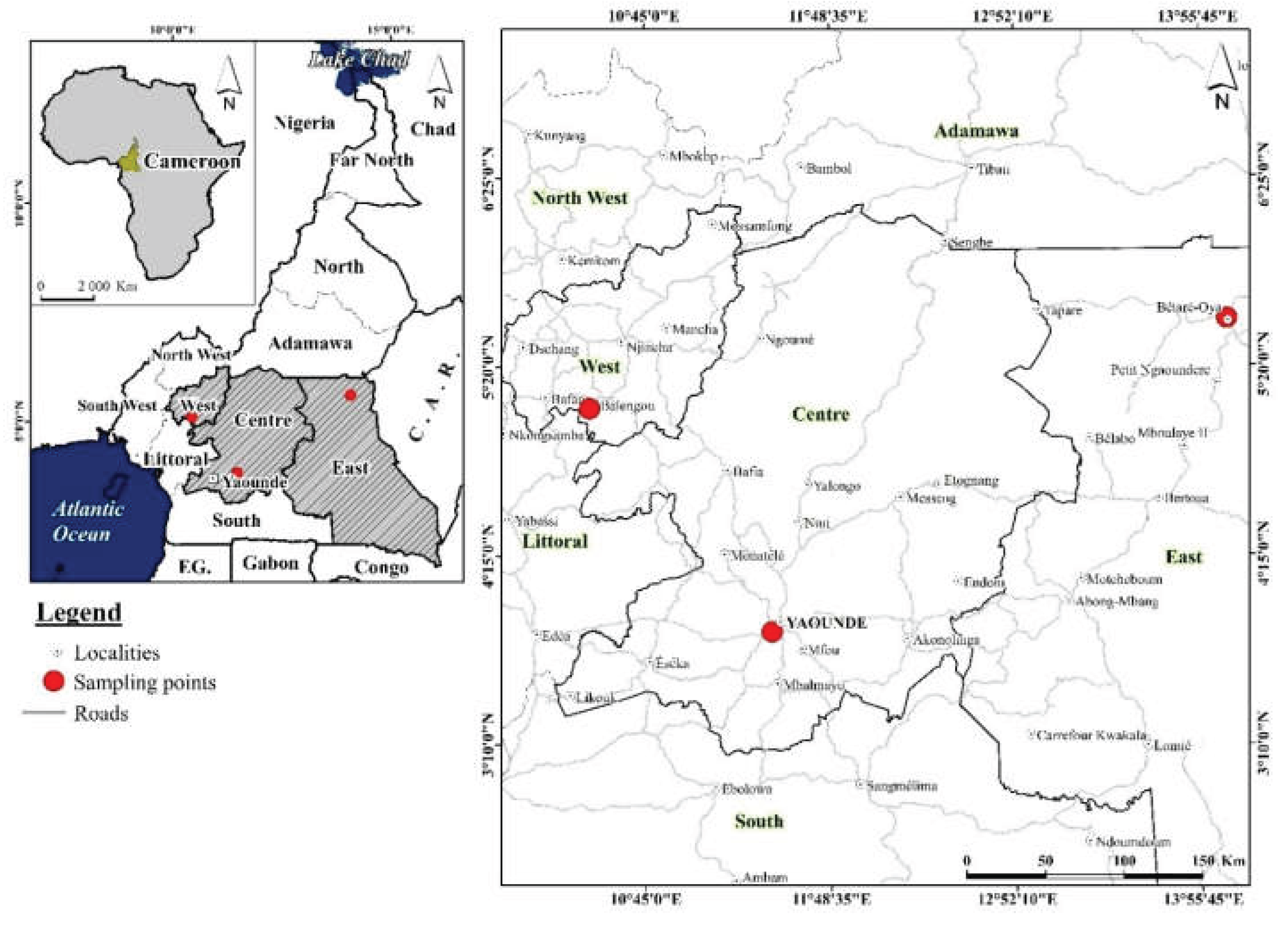
Figure 2.
Images of the laterite samples from Cameroon after oven-drying. (a) Laterite extracted from the Center region; (b) Laterite extracted from the West region; (c) Laterite extracted from the East region.
Figure 2.
Images of the laterite samples from Cameroon after oven-drying. (a) Laterite extracted from the Center region; (b) Laterite extracted from the West region; (c) Laterite extracted from the East region.
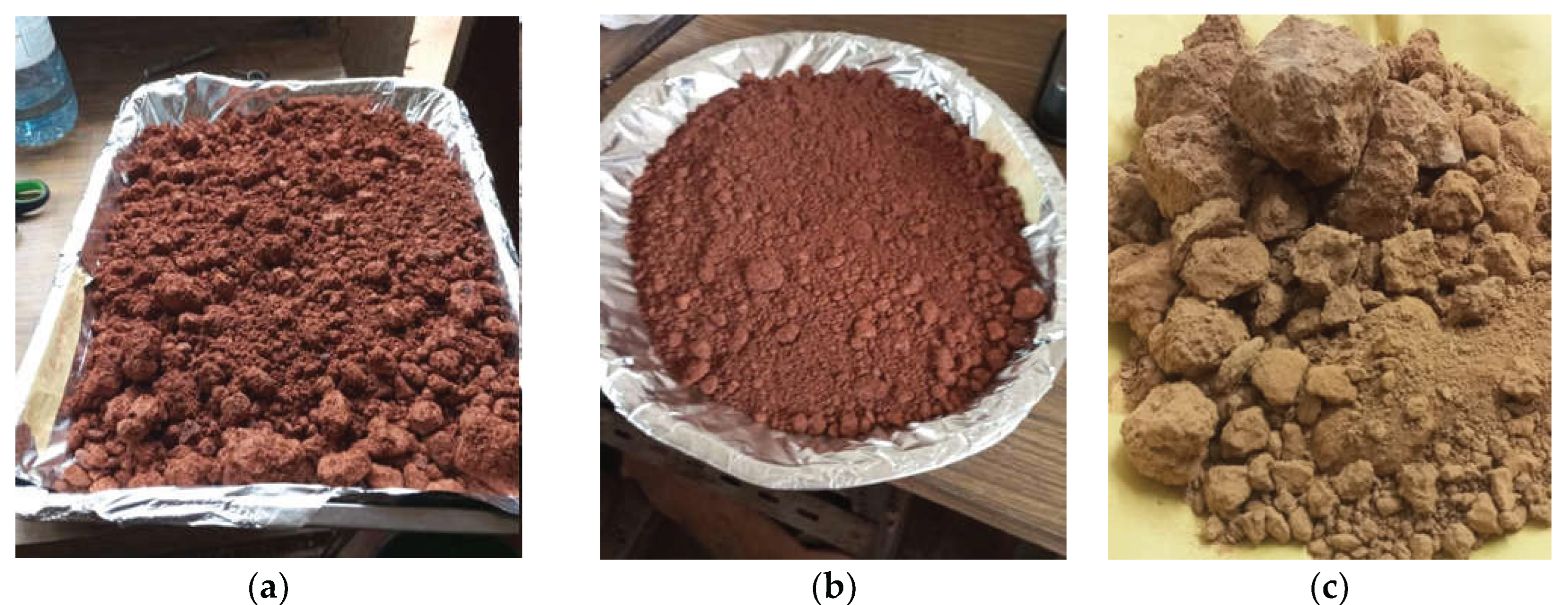
Figure 3.
Portable BRUKER S1 TITAN model, used for the characterization of laterite samples by Energy Dispersive X-ray fluorescence spectrometry technique.
Figure 3.
Portable BRUKER S1 TITAN model, used for the characterization of laterite samples by Energy Dispersive X-ray fluorescence spectrometry technique.
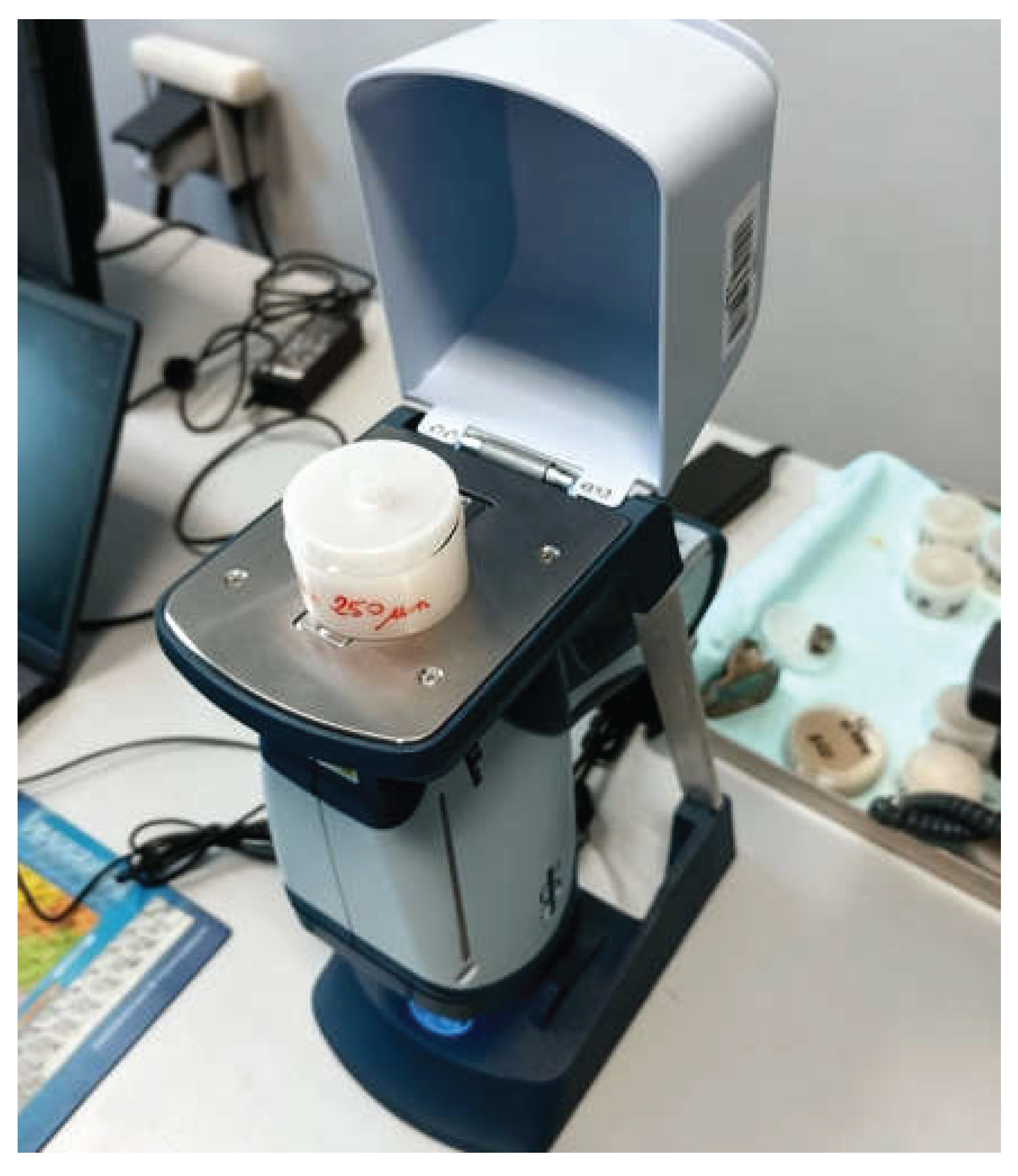
Figure 4.
Brick samples of different thicknesses (1 cm and 2 cm), prepared in the laboratory for radiation shielding parameter measurements.
Figure 4.
Brick samples of different thicknesses (1 cm and 2 cm), prepared in the laboratory for radiation shielding parameter measurements.
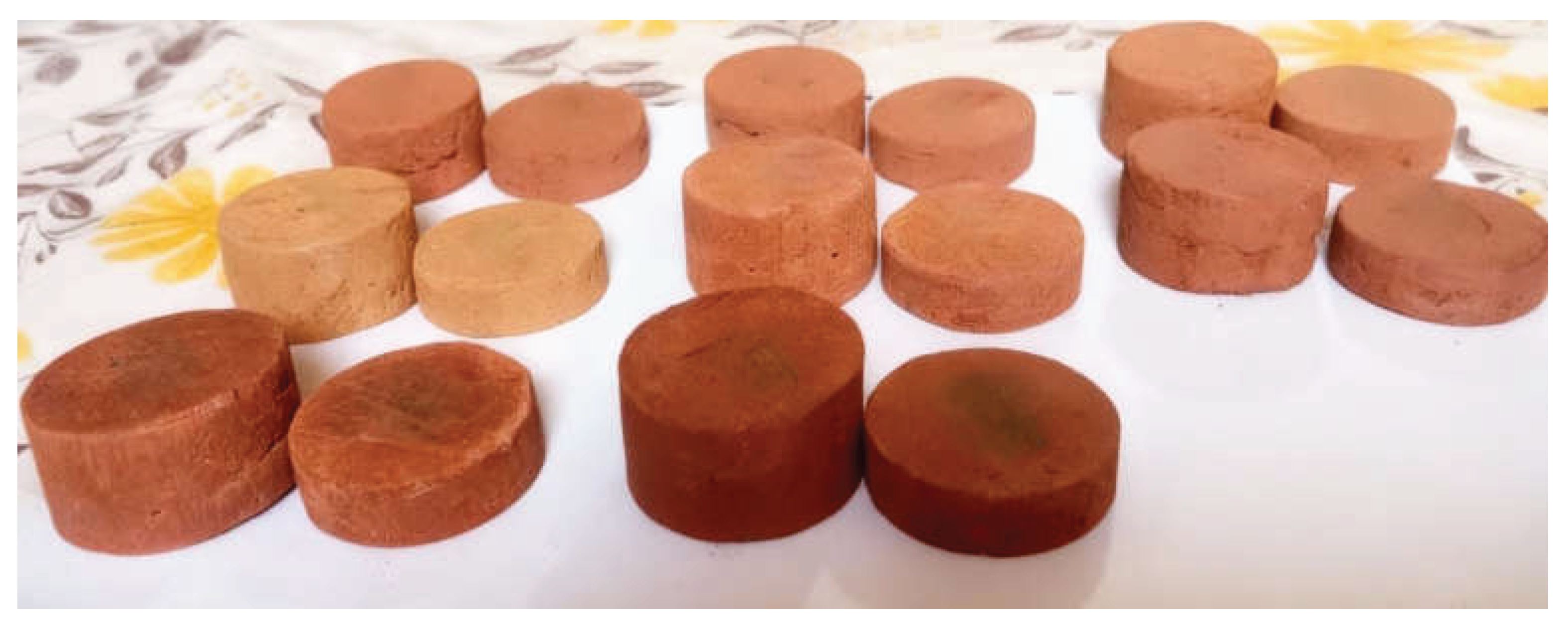
Figure 5.
Detector Efficiency curve as a function of energy for 152Eu source placed at 3.83 cm from the detector.
Figure 5.
Detector Efficiency curve as a function of energy for 152Eu source placed at 3.83 cm from the detector.
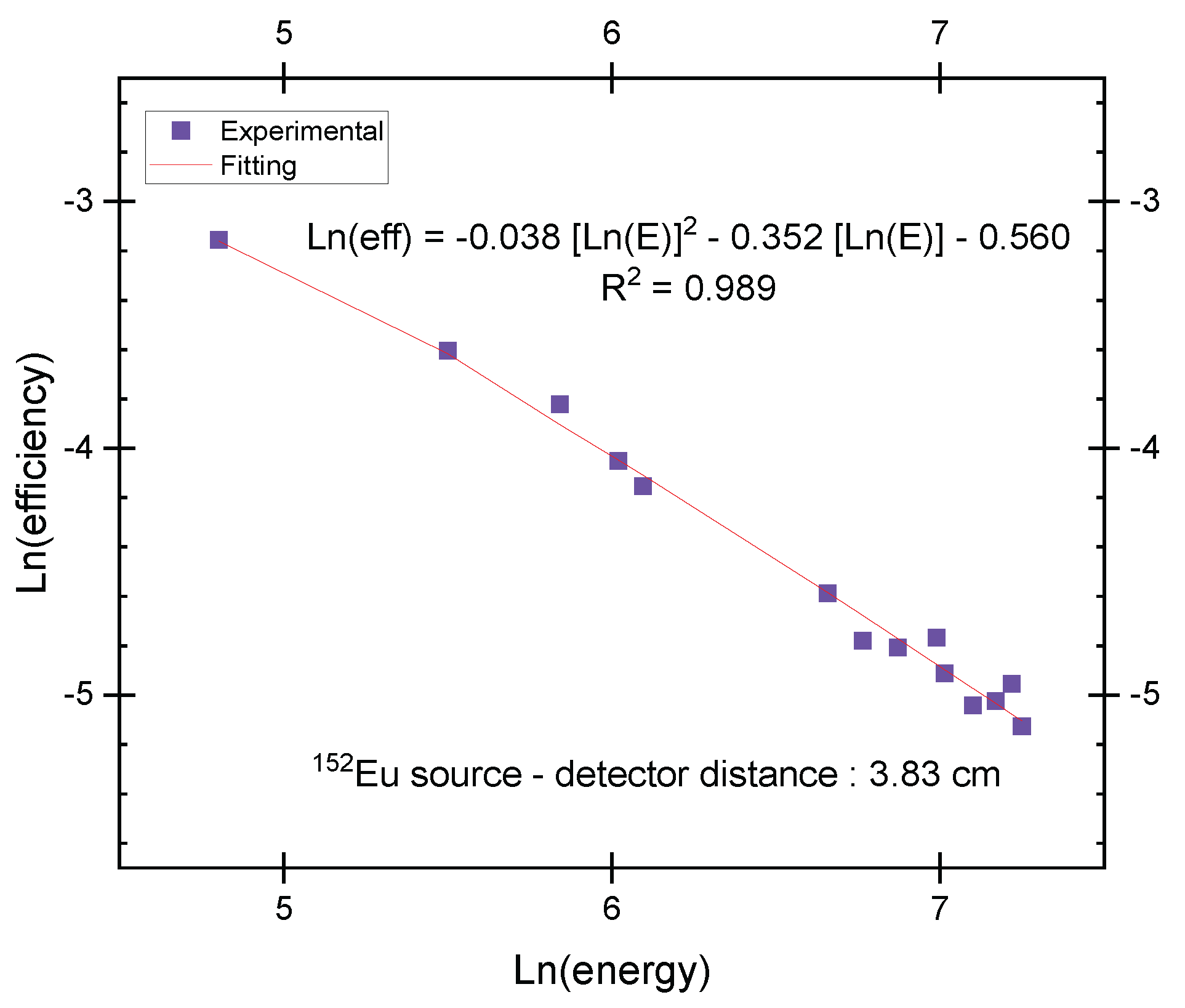
Figure 6.
Illustration of the experimental setup.
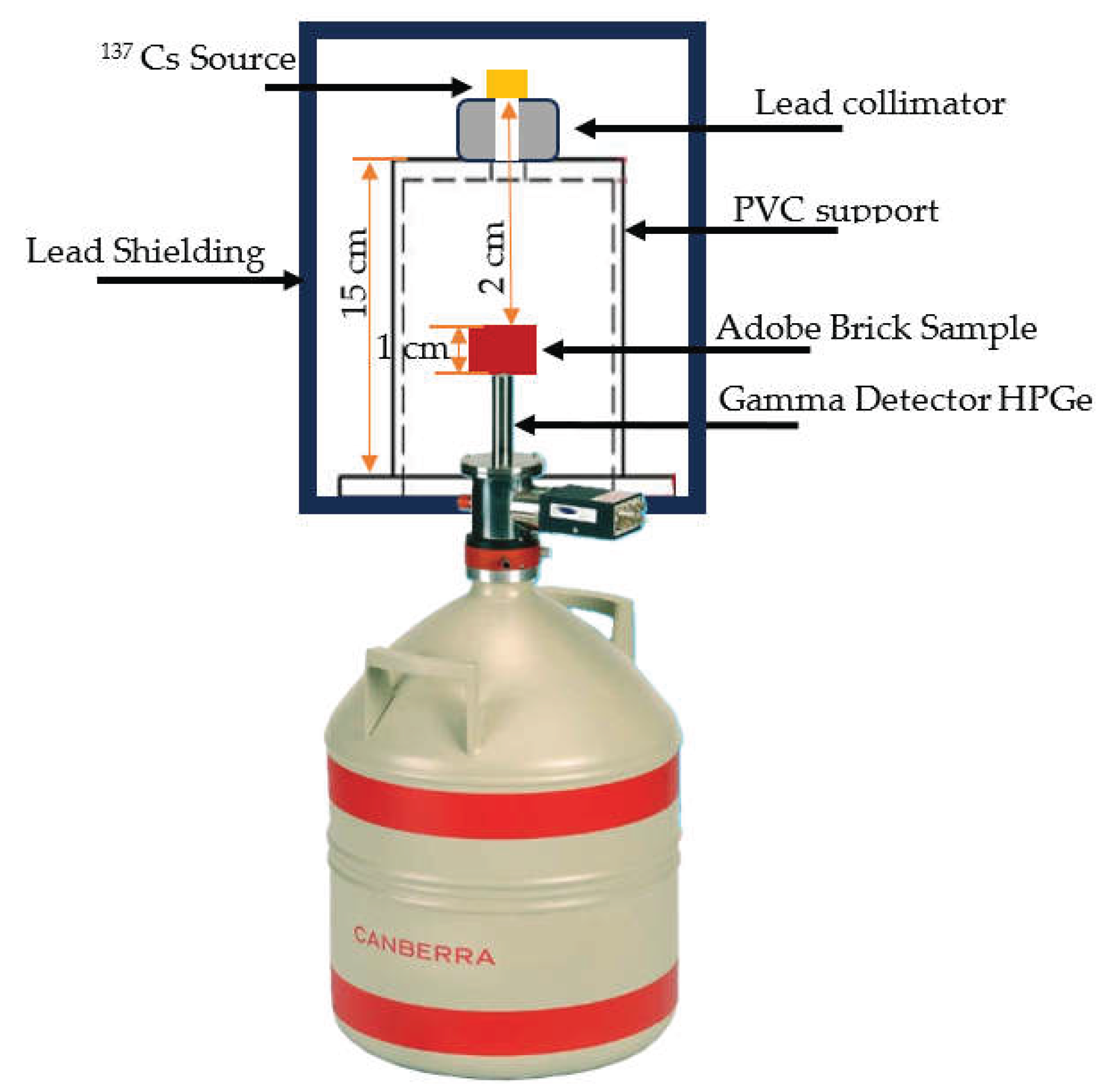
Figure 7.
Average Shielding Efficiency of different samples at 0.662 MeV and their density.
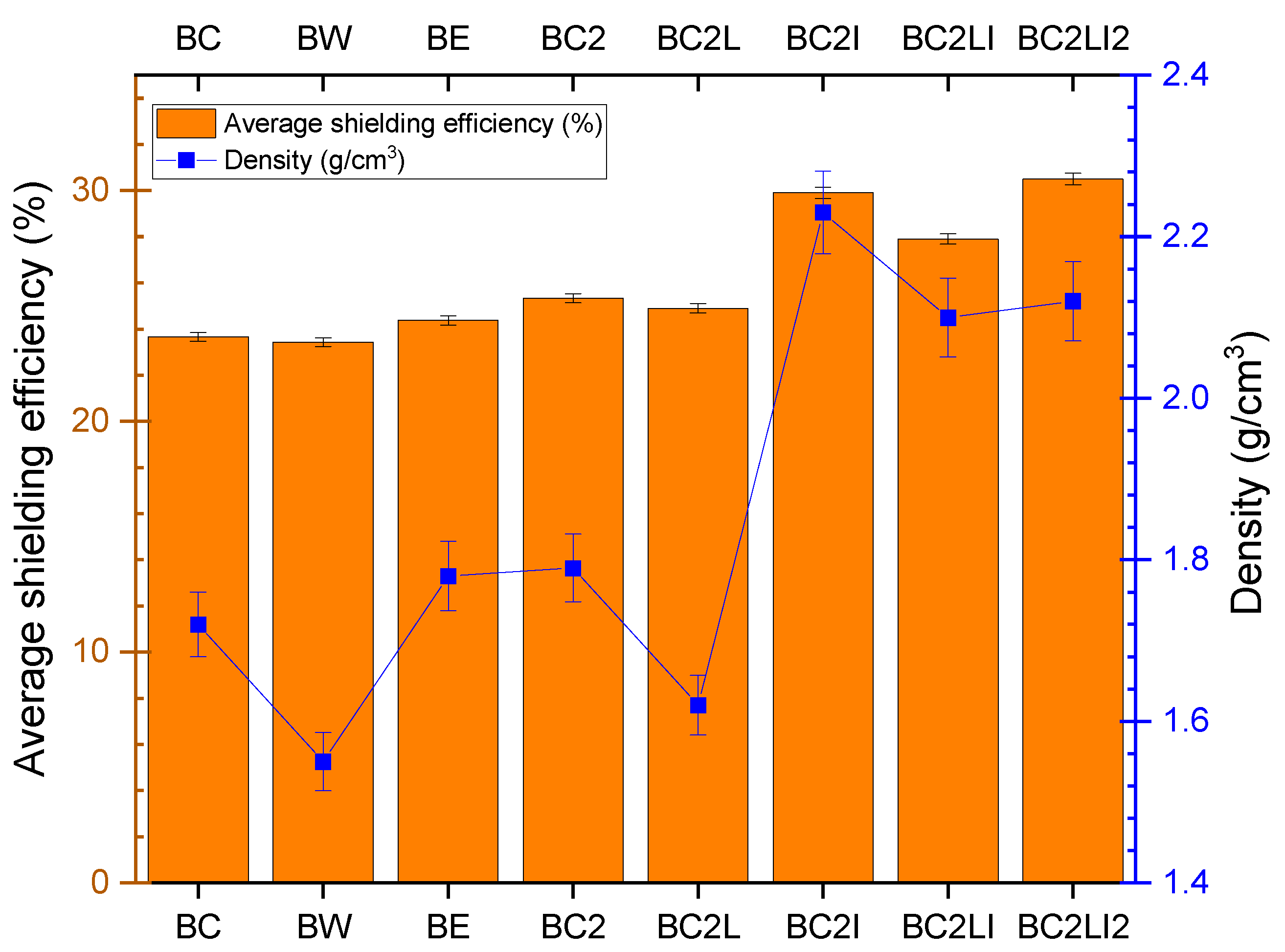
Figure 8.
Linear Attenuation Coefficient of different samples at 0.662 MeV and their density.
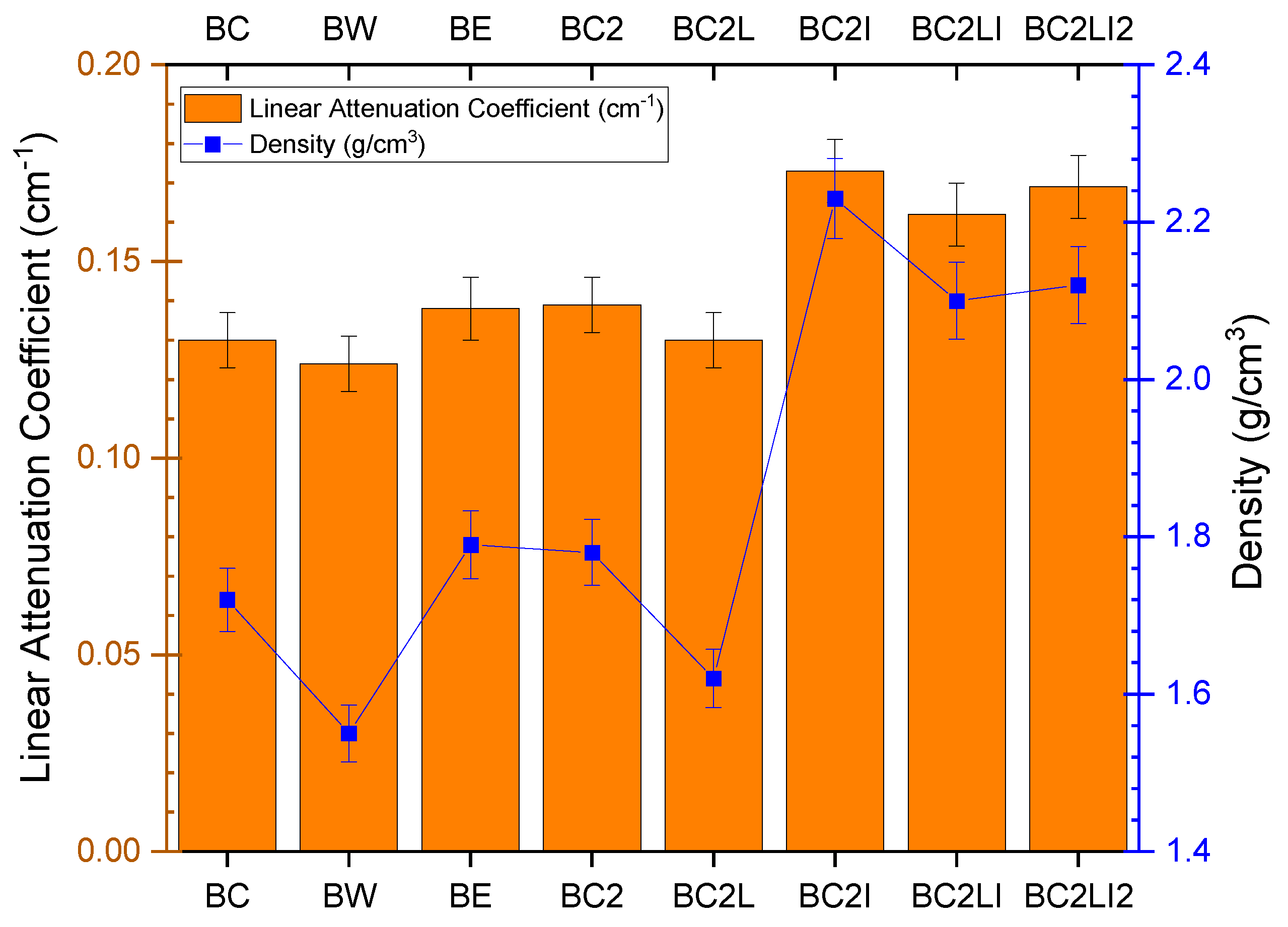
Figure 9.
Mass Attenuation coefficient of different samples at 0.662 MeV.
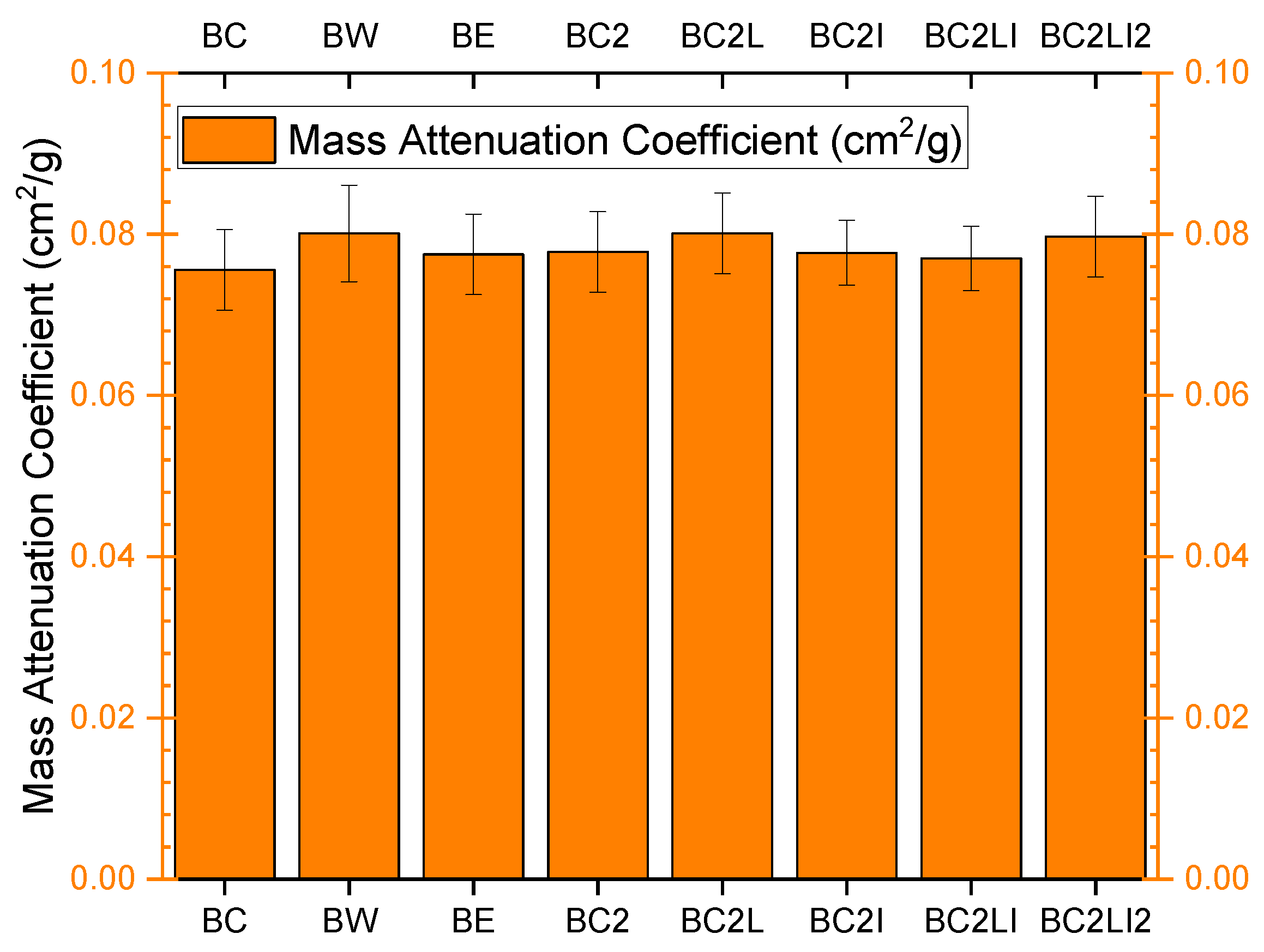
Figure 10.
Linear attenuation coefficient with uncertainties of different brick samples at 0.662 MeV determined by various methods.
Figure 10.
Linear attenuation coefficient with uncertainties of different brick samples at 0.662 MeV determined by various methods.
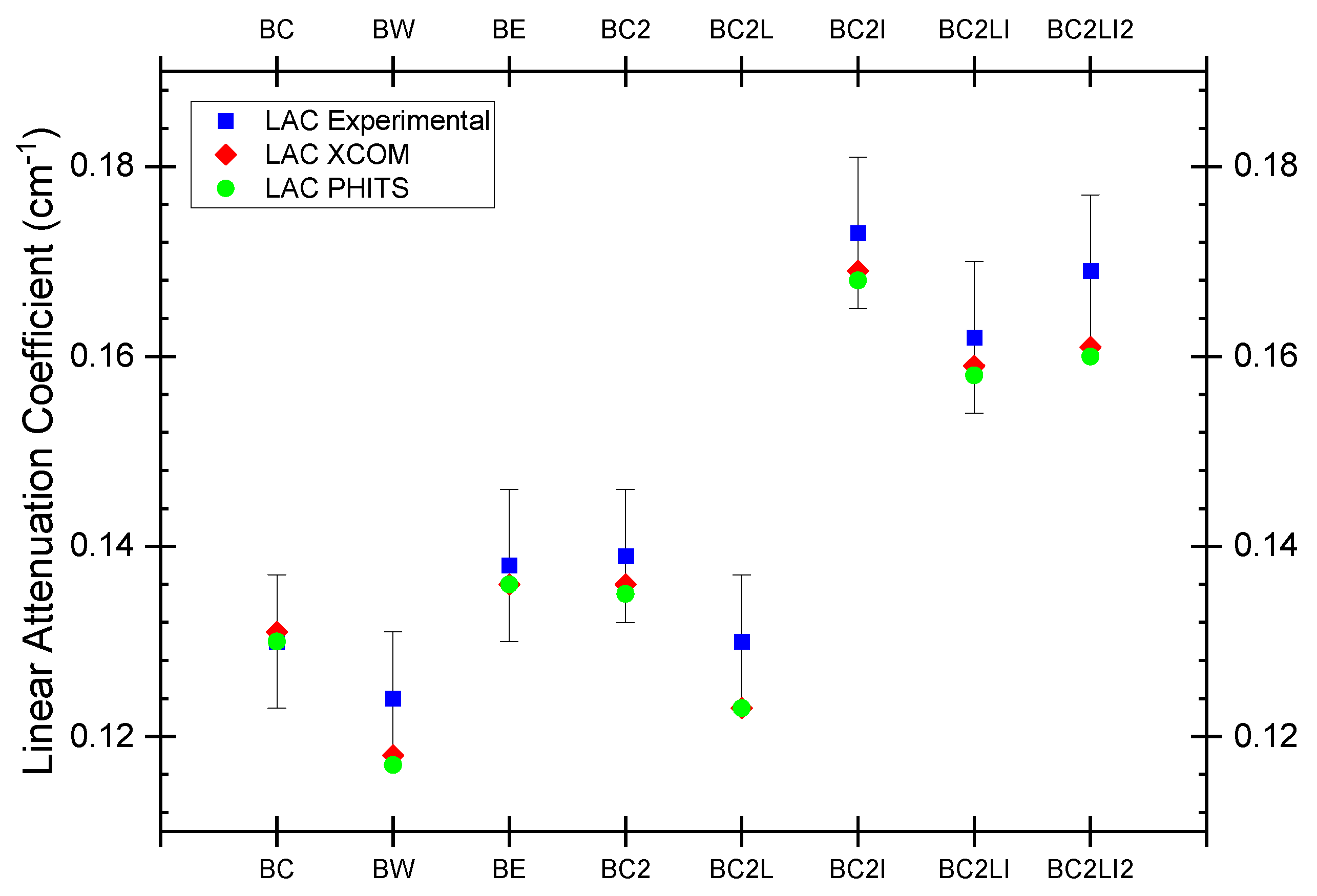
Figure 11.
Variation of the LAC of different brick samples as a function of energy.
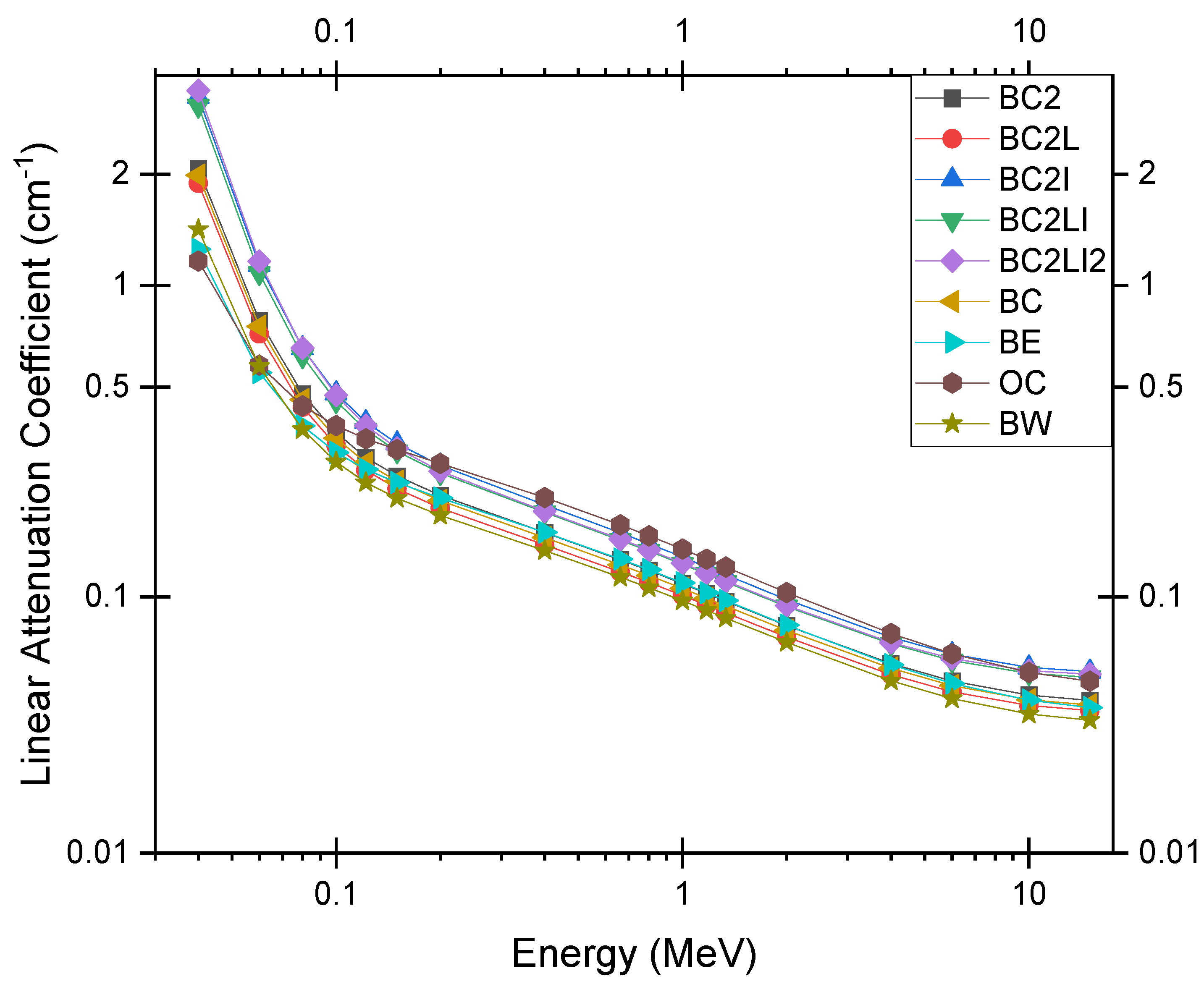
Figure 12.
Variation of the HVL of different brick samples as a function of energy.
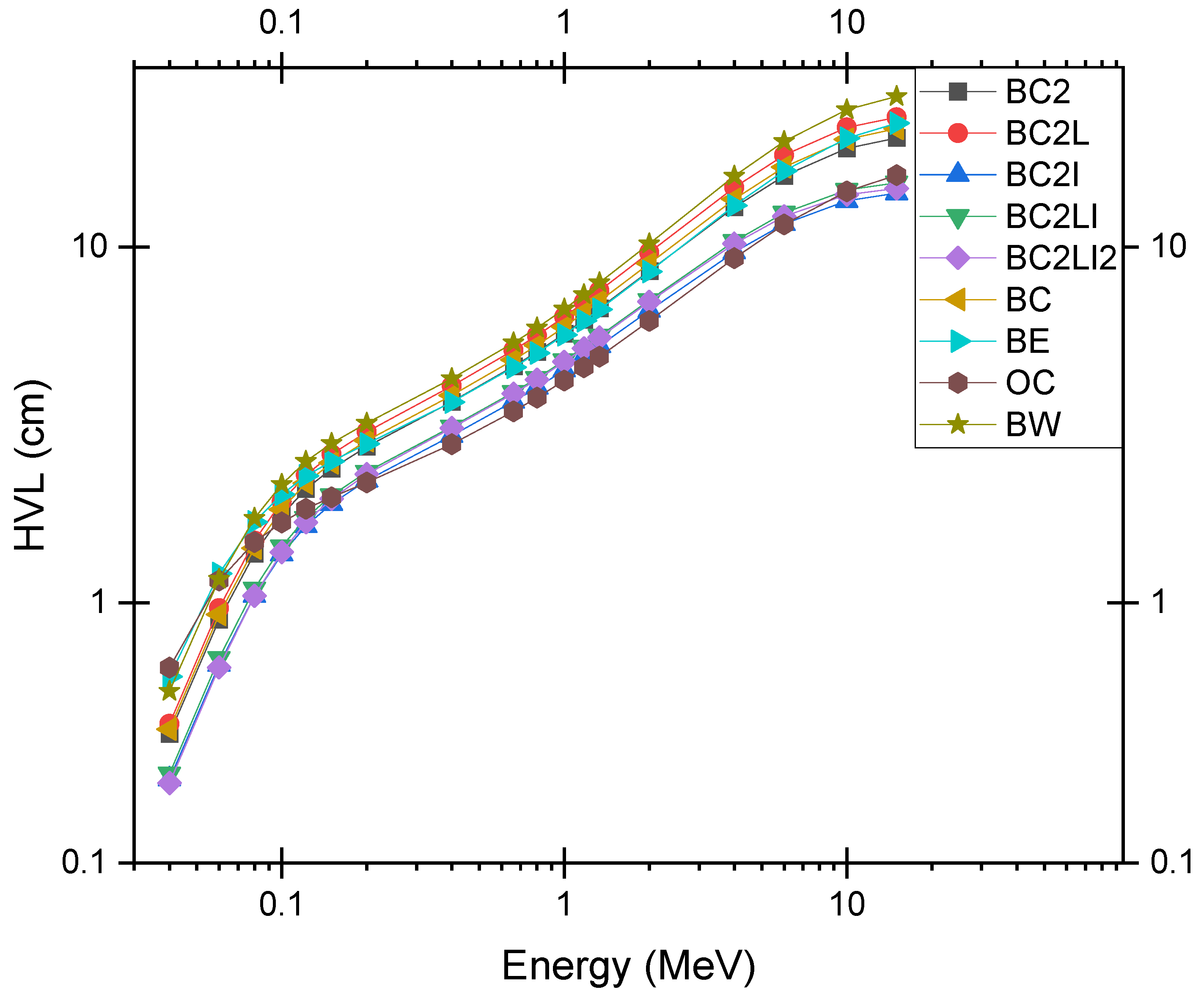
Figure 13.
Variation of LAC as a function of granulometry and proportion of Iron and Lime in samples at low, middle and high energy.
Figure 13.
Variation of LAC as a function of granulometry and proportion of Iron and Lime in samples at low, middle and high energy.
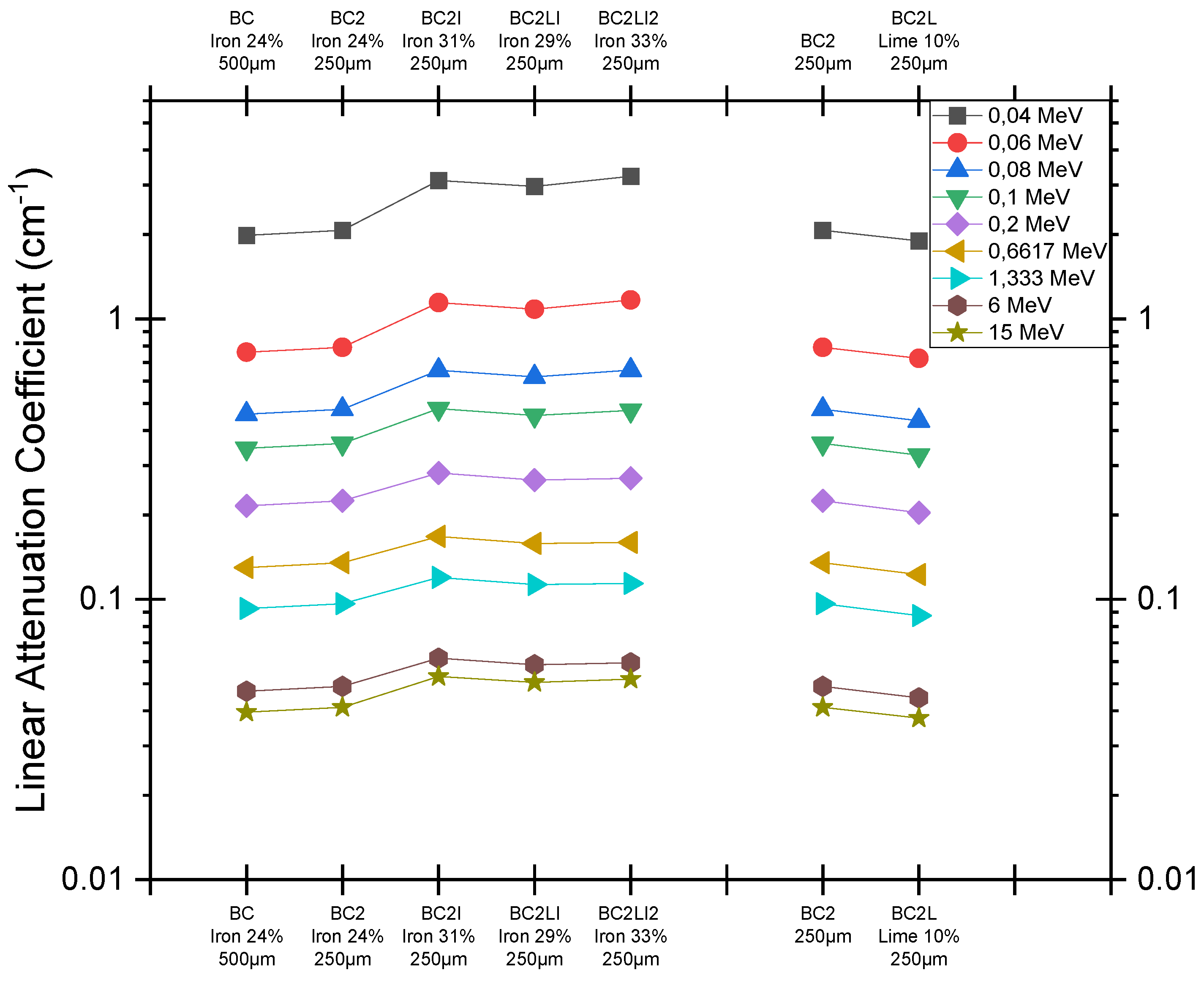
Figure 14.
Variation of the MAC of different brick samples as a function of energy.
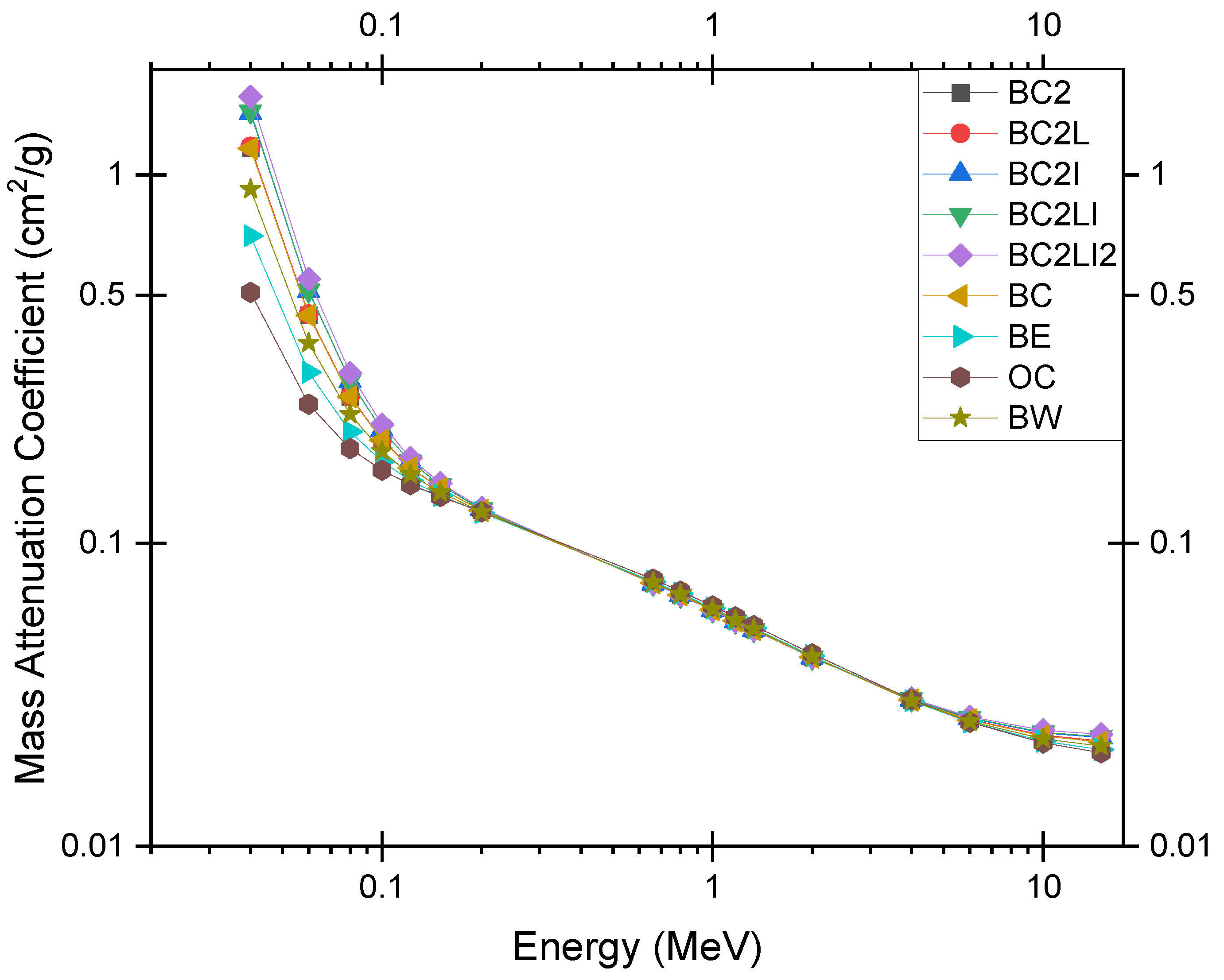
Figure 15.
Variation of MAC as a function of granulometry and proportion of Iron and Lime in samples at low, middle and high energy.
Figure 15.
Variation of MAC as a function of granulometry and proportion of Iron and Lime in samples at low, middle and high energy.
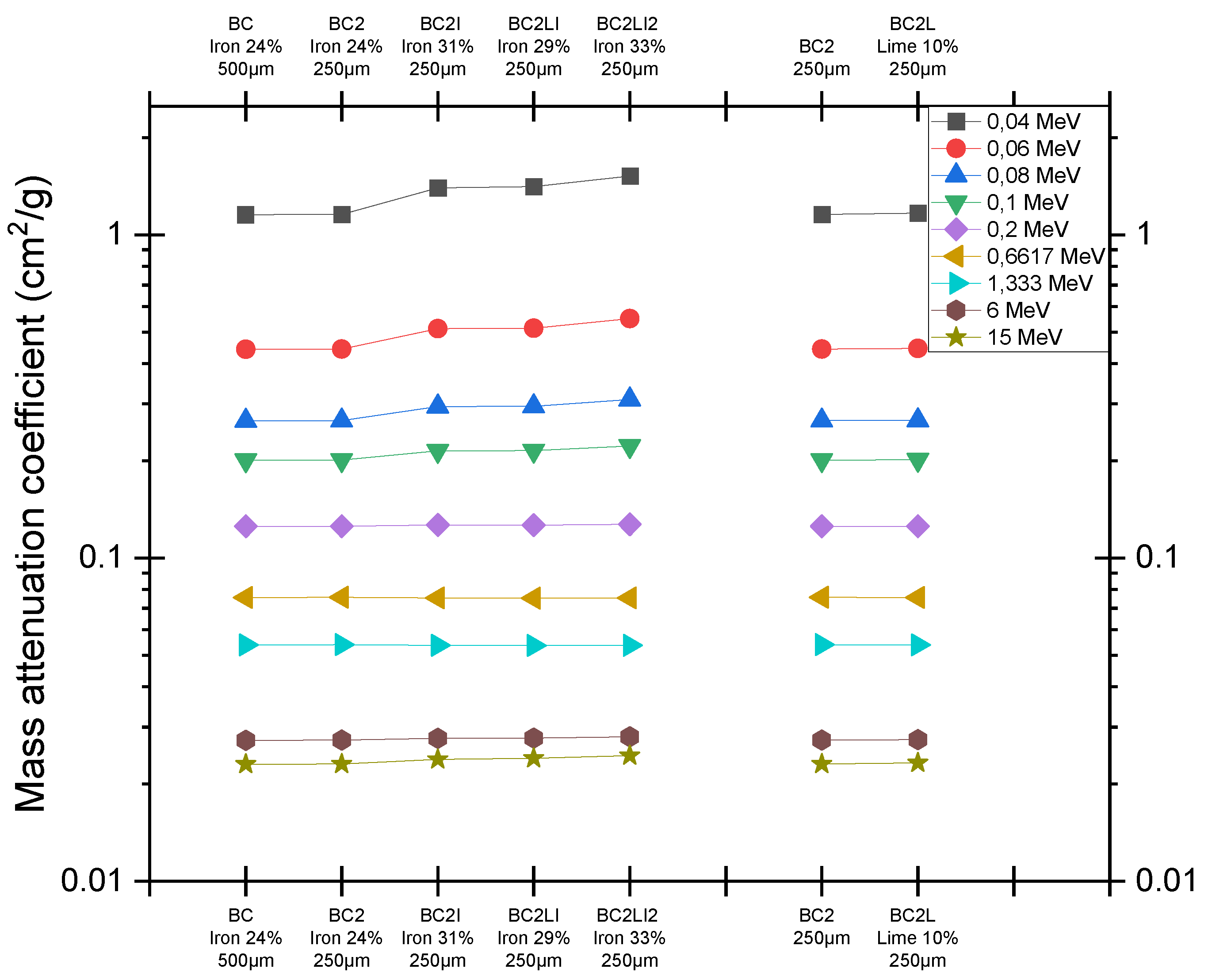
Figure 16.
Evolution of the MAC of brick samples as a function of photon energy at low energies.
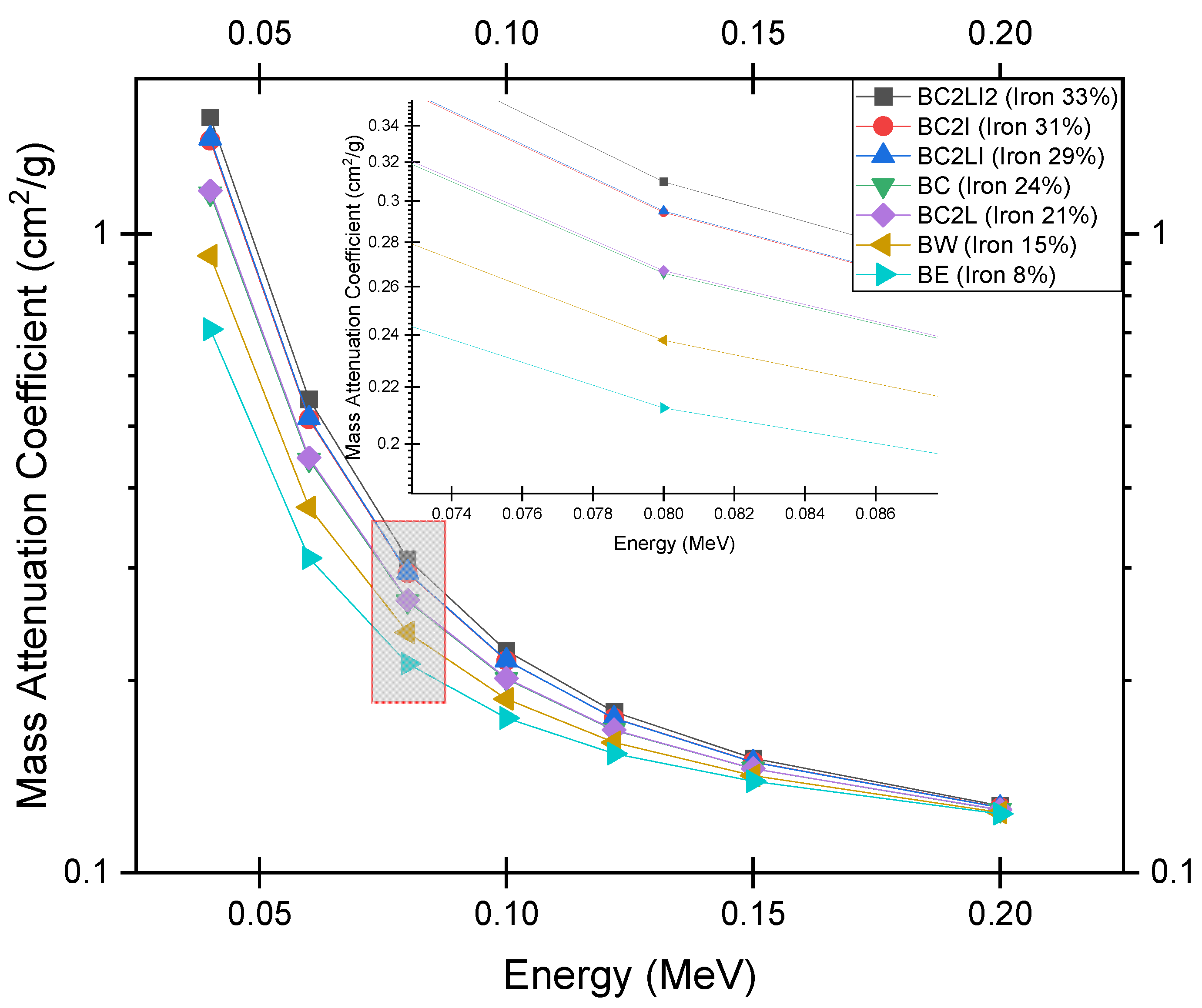
Figure 17.
Zeff as a function of energy for the studied samples.
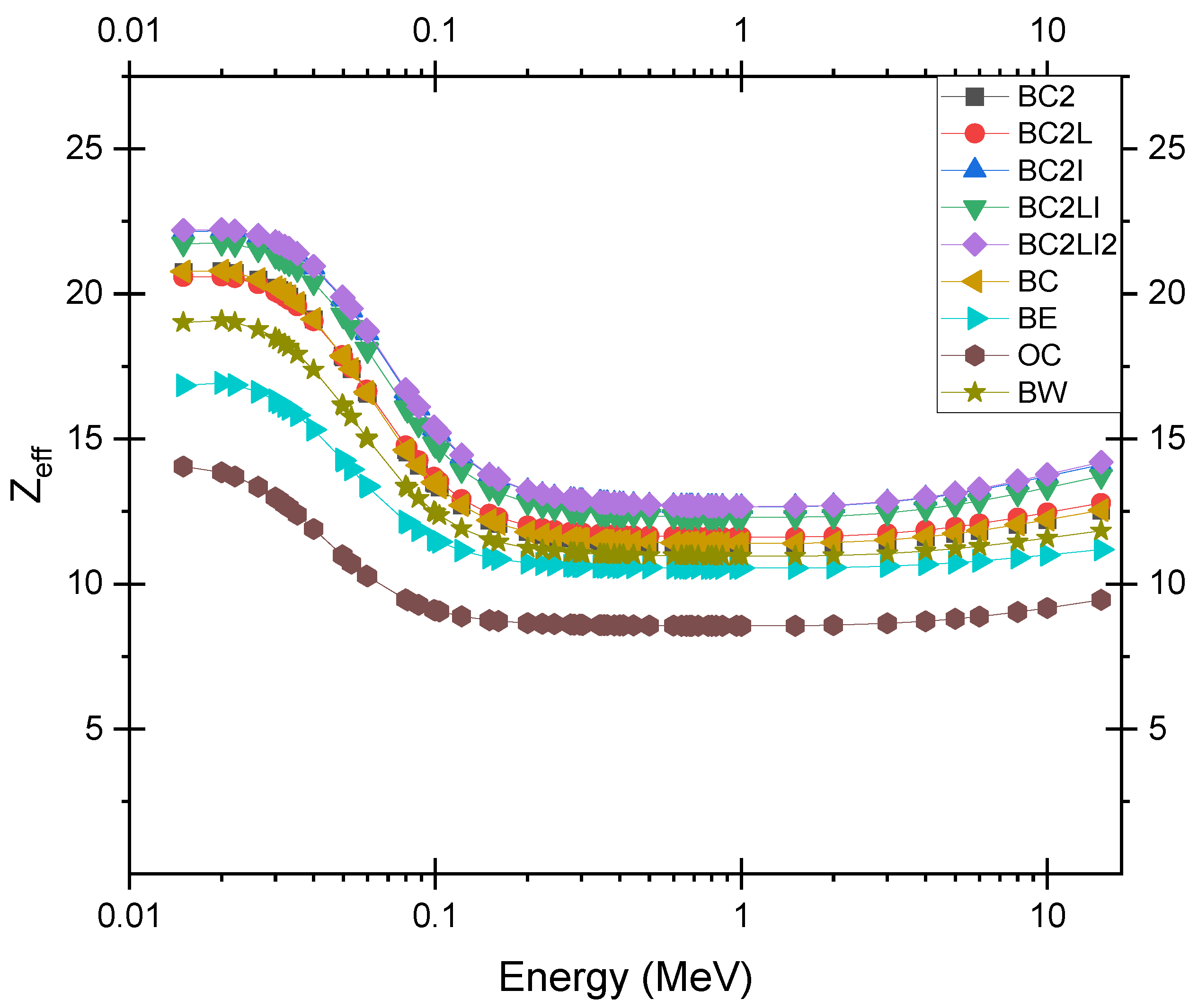
Figure 18.
The exposure build-up factor for bricks and ordinary concrete in the energy region 0.015- 15 MeV at 1, 10, 20, and 30 mfp.
Figure 18.
The exposure build-up factor for bricks and ordinary concrete in the energy region 0.015- 15 MeV at 1, 10, 20, and 30 mfp.
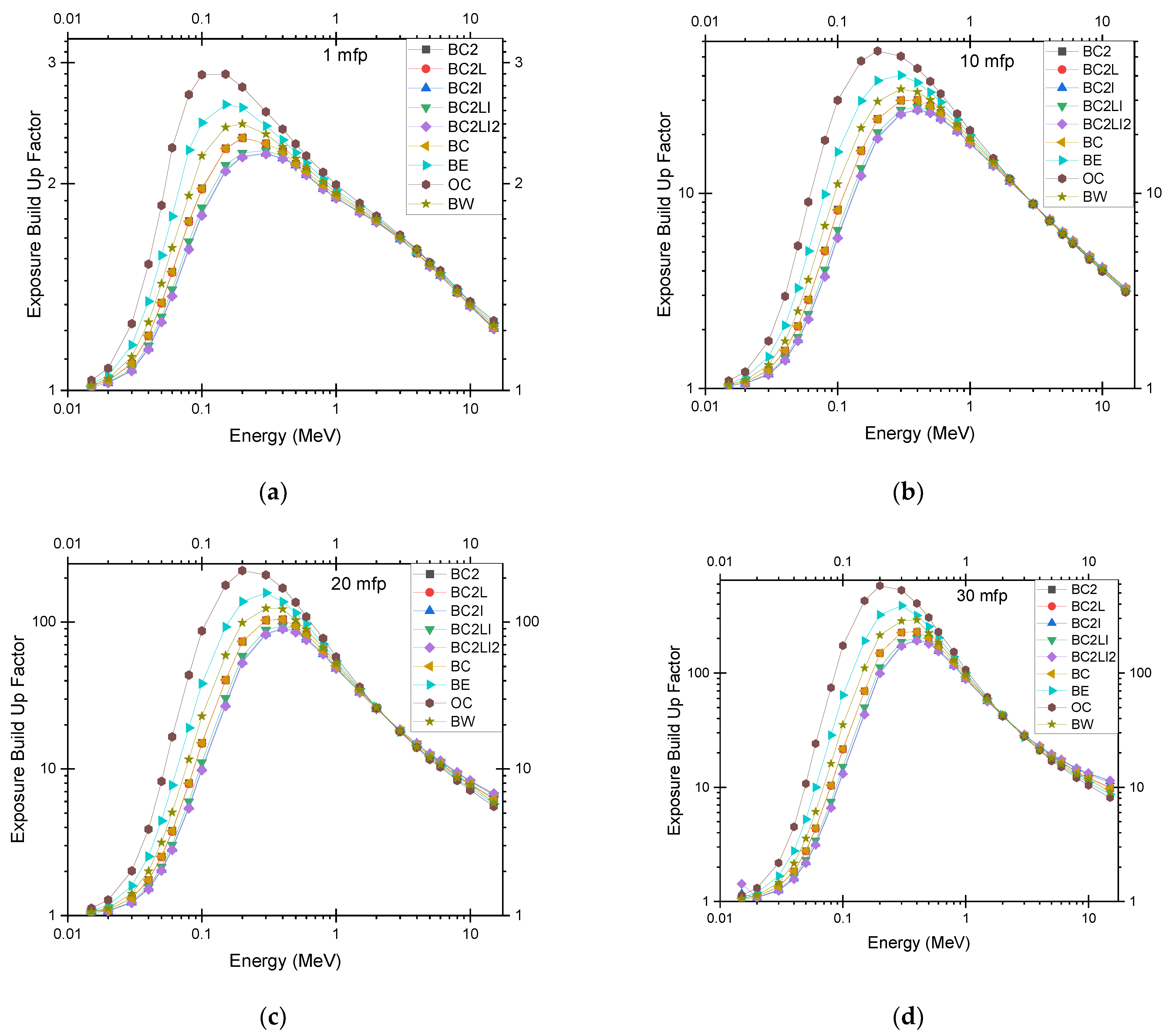
Figure 19.
Variation of equivalent atomic number as a function of energy.
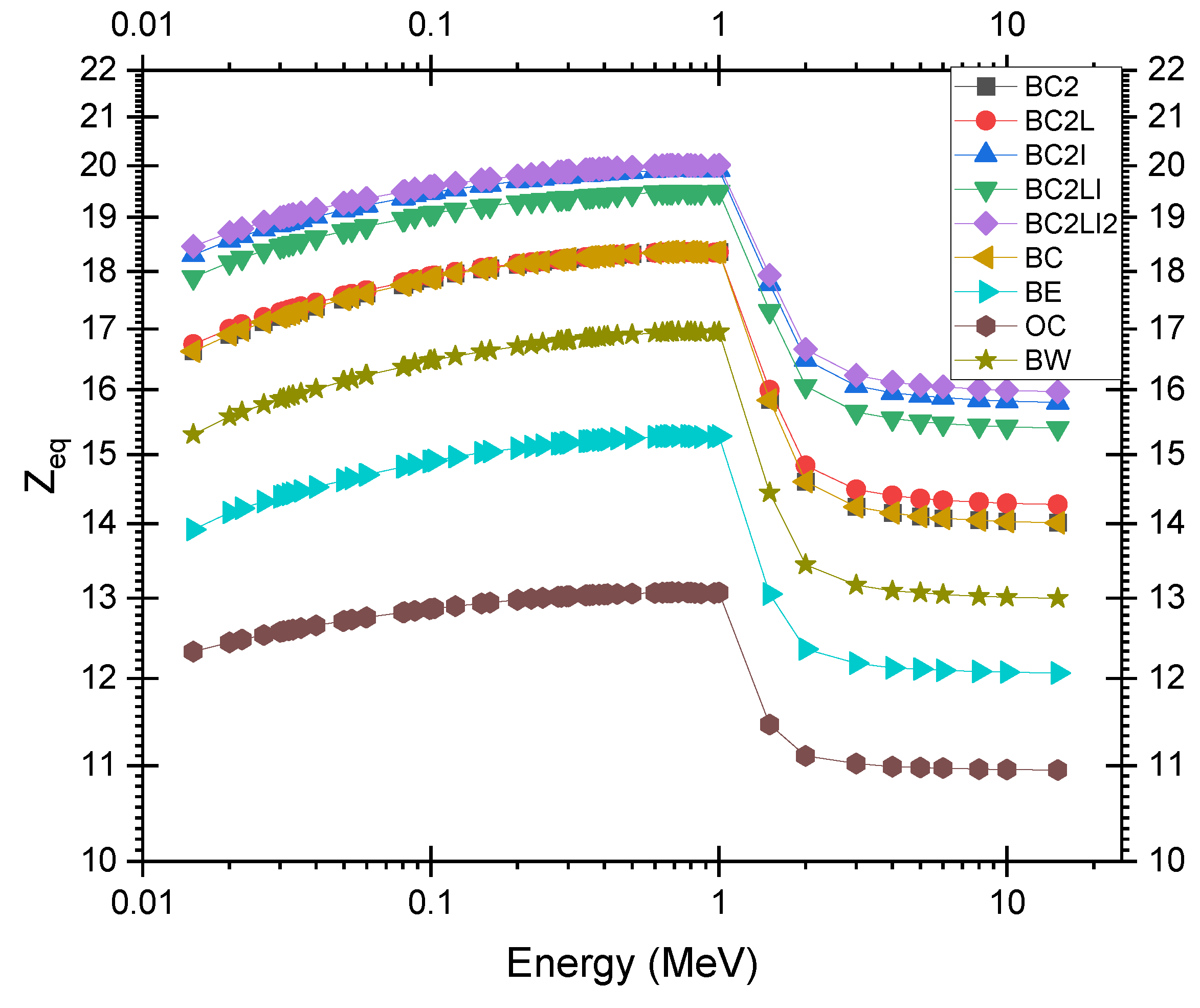
Figure 20.
Comparison of the linear attenuation coefficients of the present study with those of other samples reported in the literature.
Figure 20.
Comparison of the linear attenuation coefficients of the present study with those of other samples reported in the literature.
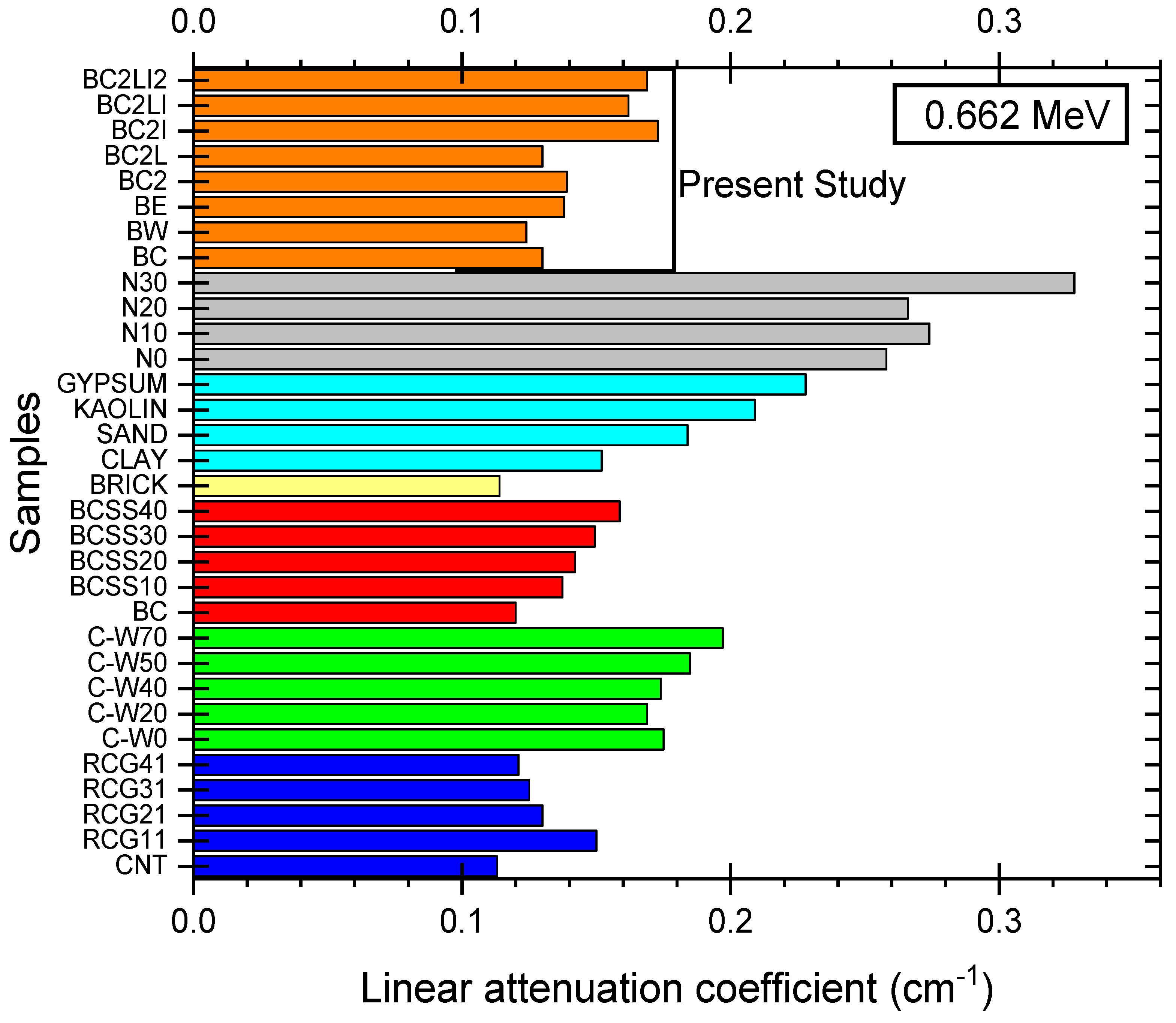

Table 1.
Mass fractions of the constituent materials in each adobe brick sample, along with their densities, and the density of ordinary concrete obtained from the National Institute of Standards and Technology (NIST) database [31].
Table 1.
Mass fractions of the constituent materials in each adobe brick sample, along with their densities, and the density of ordinary concrete obtained from the National Institute of Standards and Technology (NIST) database [31].
| N° | Sample ID | Composition | Laterite | Lime | Iron | Density (g/cm3) |
|---|---|---|---|---|---|---|
| 1 | BC | Center Laterite 500 µm | 100% | - | - | 1.72 ± 0.04 |
| 2 | BW | West Laterite 500 µm | 100% | - | - | 1.55 ± 0.04 |
| 3 | BE | East Laterite 500 µm | 100% | - | - | 1.78 ± 0.04 |
| 4 | BC2 | Center Laterite 250 µm | 100% | - | - | 1.79 ± 0.04 |
| 5 | BC2L | Center Laterite 250 µm + Lime | 90% | 10% | - | 1.62 ± 0.04 |
| 6 | BC2I | Center Laterite 250 µm + Iron | 90% | - | 10% | 2.23 ± 0.05 |
| 7 | BC2LI | Center Laterite 250 µm + Lime +Iron | 80% | 10% | 10% | 2.10 ± 0.05 |
| 8 | BC2LI2 | Center Laterite 250 µm + Lime +Iron | 75% | 10% | 15% | 2.12 ± 0.05 |
| 9 | OC | Ordinary Concrete, Portland | - | - | - | 2.3 |
Table 2.
Elemental composition of laterite samples and ordinary concrete.
| Chemical element | Center laterite sample (%) | West laterite sample (%) | East laterite sample (%) | Ordinary Concrete, Portland (%) |
|---|---|---|---|---|
| Al2O3 | 26.89 ± 0.58 | 35.08 ± 0.59 | 22.64 ± 0.42 | 6.40 |
| SiO2 | 37.33 ± 0.47 | 40.14 ± 0.46 | 62.60 ± 0.52 | 72.10 |
| Fe2O3 | 34.49 ± 0.07 | 22.19 ± 0.05 | 12.21 ± 0.04 | 2 |
| P | 0.039 ± 0.016 | 0.10± 0.02 | < DL1 (0.03) | - |
| K2O | 0.185 ± 0.012 | 0.24 ± 0.01 | 1.25 ± 0.02 | 1.57 |
| CaO | 0.046± 0.007 | 0.042 ± 0.007 | 0.11 ± 0.07 | 6.16 |
| Ti | 0.74 ± 0.01 | 2.02 ± 0.01 | 1.04 ± 0.01 | - |
| V | 0.06 ± 0.01 | < DL (0.001) | < DL (0.001) | - |
| Cr | 0.13 ± 0.01 | 0.05 ± 0.01 | < DL (0.0015) | - |
| Mn | 0.04 ± 0.01 | 0.06 ± 0.01 | 0.07 ± 0.01 | - |
| Ni | 0.020 ± 0.002 | 0.020 ± 0.002 | 0.008 ± 0.001 | - |
| Cu | 0.004 ± 0.001 | 0.004 ± 0.001 | 0.004 ± 0.001 | - |
| Zn | 0.007 ± 0.001 | 0.005 ± 0.001 | 0.004 ± 0.001 | - |
| As | < DL (0.001) | < DL (0.001) | 0.006 ± 0.001 | - |
| Rb | 0.002 ± 0.001 | 0.002 ± 0.001 | 0.006 ± 0.001 | - |
| Sr | 0.003 ± 0.001 | 0.007 ± 0.001 | 0.004 ± 0.001 | - |
| Y | 0.001 ± 0.001 | 0.002 ± 0.001 | 0.008 ± 0.001 | - |
| Zr | 0.020 ± 0.001 | 0.060 ± 0.001 | 0.070 ± 0.002 | - |
| Pb | 0.007 ± 0.002 | 0.004 ± 0.002 | < DL (0.001) | - |
| Na2O | - | - | - | 2.16 |
| MgO | - | - | - | 0.33 |
| H2O | - | - | - | 8.94 |
| CO2 | - | - | - | 0.37 |
1 DL, Detection Limit.
Table 3.
Mass attenuation coefficient, Half Value Layer, and average shielding efficiency of different samples at 0.662 MeV.
Table 3.
Mass attenuation coefficient, Half Value Layer, and average shielding efficiency of different samples at 0.662 MeV.
| N° | Sample ID | MAC Experimental (cm2/g) | HVL (cm) | Average shielding efficiency (%) |
|---|---|---|---|---|
| 1 | BC | 0.076±0.005 | 5.30±0.02 | 23.70±0.19 |
| 2 | BW | 0.080±0.006 | 5.60±0.02 | 23.40±0.19 |
| 3 | BE | 0.078±0.005 | 5.00±0.02 | 24.40±0.20 |
| 4 | BC2 | 0.078±0.005 | 5.00±0.01 | 25.30±0.20 |
| 5 | BC2L | 0.080±0.006 | 5.30±0.02 | 24.90±0.20 |
| 6 | BC2I | 0.078±0.004 | 4.00±0.01 | 29.90±0.24 |
| 7 | BC2LI | 0.077±0.004 | 4.30±0.01 | 27.90±0.22 |
| 8 | BC2LI2 | 0.080±0.005 | 4.10±0.01 | 30.50±0.25 |
Table 4.
Relative deviation between LAC experimental and LAC simulation of different samples at 0.662 MeV.
Table 4.
Relative deviation between LAC experimental and LAC simulation of different samples at 0.662 MeV.
| N° | Sample ID | LAC Experimental (cm-1) | Phy-X/PSD | PHITS | RD Phy-X/PSD -PHITS (%) | ||
|---|---|---|---|---|---|---|---|
| LAC (cm-1) | RD (%) | LAC (cm-1) | RD (%) | ||||
| 1 | BC | 0.130±0.007 | 0.131 | 0.76 | 0.130 | 0 | 0.76 |
| 2 | BW | 0.124±0.007 | 0.118 | -5.08 | 0.117 | -5.98 | 0.85 |
| 3 | BE | 0.138±0.008 | 0.136 | -1.47 | 0.136 | -1.47 | 0 |
| 4 | BC2 | 0.139±0.007 | 0.136 | -2.21 | 0.135 | -2.96 | 0.74 |
| 5 | BC2L | 0.130±0.007 | 0.123 | -5.69 | 0.123 | -5.69 | 0 |
| 6 | BC2I | 0.173±0.008 | 0.168 | -2.98 | 0.168 | -2.98 | 0 |
| 7 | BC2LI | 0.162±0.008 | 0.159 | -1.89 | 0.158 | -2.53 | 0.63 |
| 8 | BC2LI2 | 0.169±0.008 | 0.161 | -4.97 | 0.160 | -5.63 | 0.62 |
Table 5.
The Linear attenuation coefficient of the fabricated brick and ordinary concrete using the PHITS simulation code.
Table 5.
The Linear attenuation coefficient of the fabricated brick and ordinary concrete using the PHITS simulation code.
| Energy (MeV) | Linear Attenuation Coefficient (cm-1) | ||||||||
|---|---|---|---|---|---|---|---|---|---|
| BC | BW | BE | BC2 | BC2L | BC2I | BC2LI | BC2LI2 | OC | |
| 0.04 | 1.9869 | 1.4291 | 1.2617 | 2.0688 | 1.8958 | 3.1157 | 2.9671 | 3.2264 | 1.1696 |
| 0.06 | 0.7609 | 0.5777 | 0.5535 | 0.7920 | 0.7232 | 1.1421 | 1.0826 | 1.1681 | 0.5838 |
| 0.08 | 0.4572 | 0.3680 | 0.3782 | 0.4759 | 0.4332 | 0.6555 | 0.6206 | 0.6567 | 0.4375 |
| 0.1 | 0.3455 | 0.2893 | 0.3107 | 0.3596 | 0.3267 | 0.4785 | 0.4523 | 0.4716 | 0.3789 |
| 0.1218 | 0.2874 | 0.2475 | 0.2735 | 0.2991 | 0.2716 | 0.3888 | 0.3670 | 0.3786 | 0.3436 |
| 0.15 | 0.2501 | 0.2197 | 0.2476 | 0.2603 | 0.2361 | 0.3319 | 0.3133 | 0.3203 | 0.3172 |
| 0.2 | 0.2156 | 0.1923 | 0.2200 | 0.2244 | 0.2035 | 0.2819 | 0.2661 | 0.2700 | 0.2860 |
| 0.4 | 0.1613 | 0.1455 | 0.1682 | 0.1679 | 0.1522 | 0.2086 | 0.1968 | 0.1987 | 0.2208 |
| 0.6617 | 0.1298 | 0.1174 | 0.1358 | 0.1351 | 0.1225 | 0.1676 | 0.1581 | 0.1595 | 0.1784 |
| 0.8 | 0.1192 | 0.1077 | 0.1247 | 0.1240 | 0.1125 | 0.1537 | 0.1451 | 0.1463 | 0.1637 |
| 1 | 0.1071 | 0.0968 | 0.1121 | 0.1115 | 0.1011 | 0.1382 | 0.1304 | 0.1315 | 0.1473 |
| 1.173 | 0.0988 | 0.0893 | 0.1034 | 0.1028 | 0.0932 | 0.1275 | 0.1204 | 0.1214 | 0.1358 |
| 1.333 | 0.0926 | 0.0837 | 0.0969 | 0.0964 | 0.0874 | 0.1196 | 0.1129 | 0.1138 | 0.1274 |
| 2 | 0.0755 | 0.0682 | 0.0789 | 0.0786 | 0.0713 | 0.0976 | 0.0921 | 0.0930 | 0.1035 |
| 4 | 0.0546 | 0.0490 | 0.0563 | 0.0568 | 0.0517 | 0.0712 | 0.0673 | 0.0682 | 0.0735 |
| 6 | 0.0470 | 0.0418 | 0.0478 | 0.0489 | 0.0445 | 0.0617 | 0.0584 | 0.0594 | 0.0618 |
| 10 | 0.0415 | 0.0365 | 0.0413 | 0.0431 | 0.0394 | 0.0551 | 0.0523 | 0.0535 | 0.0526 |
| 15 | 0.0396 | 0.0345 | 0.0387 | 0.0412 | 0.0377 | 0.0531 | 0.0505 | 0.0519 | 0.0487 |
Table 6.
Linear attenuation coefficient and High Value Layer of the fabricated brick and ordinary concrete using the PHITS simulation code at 0.662 MeV.
Table 6.
Linear attenuation coefficient and High Value Layer of the fabricated brick and ordinary concrete using the PHITS simulation code at 0.662 MeV.
| Energy (Mev) | Samples | LAC (cm-1) | HVL (cm) |
|---|---|---|---|
| 0.662 | BC | 0.130 | 5.33 |
| BW | 0.117 | 5.92 | |
| BE | 0.136 | 5.10 | |
| BC2 | 0.135 | 5.13 | |
| BC2L | 0.123 | 5.64 | |
| BC2I | 0.168 | 4.13 | |
| BC2LI | 0.158 | 4.39 | |
| BC2LI2 | 0.160 | 4.33 | |
| OC | 0.178 | 3.89 |
Table 7.
The Mass attenuation coefficient of the fabricated brick and ordinary concrete using the PHITS simulation code.
Table 7.
The Mass attenuation coefficient of the fabricated brick and ordinary concrete using the PHITS simulation code.
| Energy (MeV) | Mass Attenuation Coefficient (cm2/g) | ||||||||
|---|---|---|---|---|---|---|---|---|---|
| BC | BW | BE | BC2 | BC2L | BC2I | BC2LI | BC2LI2 | OC | |
| 0.04 | 1.1557 | 0.9235 | 0.7087 | 1.1576 | 1.1687 | 1.3989 | 1.4104 | 1.5216 | 0.5085 |
| 0.06 | 0.4426 | 0.3733 | 0.3109 | 0.4431 | 0.4458 | 0.5128 | 0.5146 | 0.5509 | 0.2538 |
| 0.08 | 0.2659 | 0.2378 | 0.2124 | 0.2663 | 0.2670 | 0.2943 | 0.2950 | 0.3097 | 0.1902 |
| 0.1 | 0.2009 | 0.1870 | 0.1745 | 0.2012 | 0.2014 | 0.2148 | 0.2150 | 0.2224 | 0.1647 |
| 0.1218 | 0.1672 | 0.1599 | 0.1536 | 0.1674 | 0.1674 | 0.1746 | 0.1745 | 0.1785 | 0.1494 |
| 0.15 | 0.1454 | 0.1419 | 0.1391 | 0.1456 | 0.1455 | 0.1490 | 0.1489 | 0.1511 | 0.1379 |
| 0.2 | 0.1254 | 0.1242 | 0.1236 | 0.1256 | 0.1255 | 0.1266 | 0.1265 | 0.1273 | 0.1243 |
| 0.6617 | 0.0755 | 0.0758 | 0.0763 | 0.0756 | 0.0755 | 0.0752 | 0.0752 | 0.0752 | 0.0776 |
| 0.8 | 0.0693 | 0.0696 | 0.0700 | 0.0694 | 0.0693 | 0.0690 | 0.0690 | 0.0690 | 0.0712 |
| 1 | 0.0623 | 0.0625 | 0.0630 | 0.0624 | 0.0623 | 0.0620 | 0.0620 | 0.0620 | 0.0640 |
| 1.173 | 0.0574 | 0.0577 | 0.0581 | 0.0575 | 0.0575 | 0.0572 | 0.0572 | 0.0572 | 0.0591 |
| 1.333 | 0.0539 | 0.0541 | 0.0545 | 0.0539 | 0.0539 | 0.0537 | 0.0537 | 0.0537 | 0.0554 |
| 2 | 0.0439 | 0.0441 | 0.0443 | 0.0440 | 0.0440 | 0.0438 | 0.0438 | 0.0439 | 0.0450 |
| 4 | 0.0318 | 0.0316 | 0.0316 | 0.0318 | 0.0318 | 0.0320 | 0.0320 | 0.0321 | 0.0319 |
| 6 | 0.0273 | 0.0270 | 0.0268 | 0.0274 | 0.0274 | 0.0277 | 0.0278 | 0.0280 | 0.0269 |
| 10 | 0.0241 | 0.0236 | 0.0232 | 0.0241 | 0.0243 | 0.0247 | 0.0249 | 0.0252 | 0.0229 |
| 15 | 0.0230 | 0.0223 | 0.0217 | 0.0231 | 0.0232 | 0.0238 | 0.0240 | 0.0245 | 0.0212 |
Disclaimer/Publisher’s Note: The statements, opinions and data contained in all publications are solely those of the individual author(s) and contributor(s) and not of MDPI and/or the editor(s). MDPI and/or the editor(s) disclaim responsibility for any injury to people or property resulting from any ideas, methods, instructions or products referred to in the content. |
© 2026 by the authors. Licensee MDPI, Basel, Switzerland. This article is an open access article distributed under the terms and conditions of the Creative Commons Attribution (CC BY) license (http://creativecommons.org/licenses/by/4.0/).
Copyright: This open access article is published under a Creative Commons CC BY 4.0 license, which permit the free download, distribution, and reuse, provided that the author and preprint are cited in any reuse.