

Submitted:
19 October 2026
Posted:
21 October 2026
You are already at the latest version
Abstract
The low-sulfidation silver-gold prospects in the Eastern Rhodope Mountains, SE Bulgaria, united in the East Rhodopean low-sulfidation gold-silver metallogenic province, contain a considerable precious-metal endowment for current and future mining. For the most promising prospects, geochronological, stratigraphical, biostratigraphical, structural, mineralogical, and stable-isotope data exist, but their origin remains not fully understood. In this paper, we review existing data on geodynamics, metamorphism, magmatism, and their geochronology in the Rhodope Crystalline Massif, as well as data on the geology, mineralogy, stable isotope geochemistry, and formation conditions of low-sulfidation gold deposits from the Eastern Rhodopes, SE Bulgaria. The aim is to provide a synopsis of the existing data to help one construct a new genetic model for this class of economic deposits. The main conclusions which can be drawn from the reviewed literature are the following: (i) geochronological and stratigraphic constraints clearly revealed older age of these de-posits than the local Late Eocene- Early Oligocene magmatism; (ii) there is isotop-ic evi-dence of meteoric origin of the fluids; (iii) there is a seismological evidence of slab rollback since Eocene to Late Miocene-Pliocene in the Rhodope realm, (iv) conveying role of the deeply penetrating detachment fault systems for hot uprising fluids is evidenced by hy-drothermal alteration and silicification, both strong in places; and (v) heating of mete-oric water in the area of high heat flux produced by the Cenozoic crustal extension and as-thenospheric mantle upwelling in the Eastern Rhodopes is seems to be a necessary condi-tion for the formation of these deposits.
Keywords:
sedimentary rock‐hosted
; low‐sulfidation
; precious‐metal deposits
; migmatite‐cored metamorphic dome
; extensional detachment
; supra‐detachment basin
; Eastern Rhodopes
; Krumovgrad goldfield
; Bulgaria
; Eastern Mediterranean
1. Introduction
The low-sulfidation silver-gold prospects in the Eastern Rhodope Mountains contain a considerable precious-metal endowment for current and future mining [1,2]. They appear to be part of the Tethyan Eurasian Metallogenic Belt [3,4]. Some were mined from the 15th century B.C. to the 13th century [1,5]. Currently, mining operations are going on at the Ada Tepe open pit, the largest deposit in the Krumovgrad goldfield. These prospects occur over a large area, are embedded mainly in supradetachment sedimentary rocks of Eocene-Lower Oligocene age, and appear to be of the adularia–sericite type (Figure 1). For the most promising of them, there are geochronological, stratigraphical, biostratigraphical, structural, mineralogical, and stable isotope data exist [1,2,6,7,8,9,10,11,12,13], but their origin remains not fully understood.
Since none of the low-sulfidation systems discussed appear to be related to magmatic rocks in the field, they appear to be older than the numerous adjacent Oligocene magmatic rock-related Pb-Zn systems, and most are poor in base metal sulfides; they are considered a distinct group of epithermal gold-silver prospects by [6,9,14,15,16], as in [16] the author united this group in the East Rhodopean low-sulfidation gold-silver metallogenic province. In the Rhodope metallogenic province, other low-sulfidation silver-gold prospects of the adularia–sericite type are known; however, they have economic value only in the eastern part of the Rhodope Mountains [17,18].
Most researchers have underlined the close temporal relationship between the formation of this class of epithermal gold deposits and extensional tectonics, related doming and exhumation of basement metamorphic rocks, supra-detachment sedimentary basins, and volcanic activity, which span ca. 6 Ma [6,8,9,13,15,19,20,21]. At the same time, because of the close temporal relationship between the epithermal gold prospects and the voluminous Late Eocene-Oligocene magmatism in the Eastern Rhodope Massif, some researchers suggest that magmatism may have supplied heat, and possibly sulfur and/or metals to the hydrothermal systems as well [2,7,8,9,22]. Specifically, some authors assumed that primary meteoric water subsequently underwent hydrothermal convection to produce hydrothermal fluids [8].
Others link this distinct class of economic gold deposits to metamorphic core-complex formation in the Rhodope crystalline massif rather than local magmatism [6,15,16]. Because these deposits are older than the culmination of local magmatism, some researchers assumed a non-magmatic origin [16,23]. Their formation was interpreted to be linked to deeply penetrating groundwater heated in areas of high heat flux produced by Cenozoic crustal extension and asthenospheric mantle upwelling in the Eastern Rhodope Massif, with fluids conveyed along the regional detachment fault systems [23].
Since the hypotheses for the origin of this distinct class of low-sulfidation gold deposits in the Eastern Rhodopes, SE Bulgaria, were first advanced, substantial new data on the geology, mineralogy, isotope geochemistry, geochronology, and geodynamics have become available, which provide stronger support for a common origin not related to the local magmatism.
In the Greek part of the Rhodopes, Cenozoic low-sulfidation deposits related to detachment faults also occur, although they host polymetallic commodities. For instance, the Kallintiri deposit is hosted in metamorphic rocks, is controlled by a late Eocene–Oligocene detachment fault, and has no obvious connection to magmatic rocks [24]. The Cenozoic metallogeny of Greece is thought to have occurred in response to slab-rollback and migration of post-collisional calc-alkaline to shoshonitic magmatism in a back-arc extensional regime from the Rhodopes through the Cyclades, and to arc-related magmatism along the active south Aegean volcanic arc. It is envisioned that, during this extension, asthenospheric melts invaded the lower crust and caused partial melting of metasomatized lithosphere and lower-crustal cumulates [25].
Low-sulfidation, sedimentary rock-hosted gold deposits are well known in western North America (detachment fault-hosted, Carlin-type, distal disseminated gold deposits; high-grade veins). Some are related to nearby magmatic rocks; others are not. Because of their complex characteristics, no unified model exists [28,29]. The Carlin-type gold deposits in northern Nevada and northwest Utah are also encapsulated in sedimentary rocks (carbonates) and are poor in base-metal sulfides. Gold is hosted by arsenian pyrite as submicron inclusions or solid solution, similar to arsenian pyrite of the Surnak deposit - Krumovgrad goldfield [30,31]. Carlin-type gold deposits in Nevada and Utah appear deeper than epithermal, low-sulfidation deposits across the world. They were formed in the mid-Cenozoic, when the Yellowstone mantle plume is inferred to have been located below the subduction zone. That time coincided with the beginning of crustal extension. The deposits do not show consistent spatial relationships to mid-Cenozoic magmatic centers [32]. For some high-grade Carlin-type gold deposits, such as the Meikle and neighboring Carlin-type deposits in the Northern Carlin Trend, Nevada, the proposed origin involved meteoric water that evolved into an ore fluid through shallow circulation within previously gold- and sulfur-enriched rocks. Carlin-type gold deposits formed where these fluids encountered permeable, reactive Fe-rich sedimentary rocks (dolostone) [33]. A model of amagmatic, free-convection hydrothermal system was also proposed for the Osiris Carlin-type gold deposit, Yukon (W. Canada), where episodic fluid flow events spanned millions of years between ~ 73 and 11 Ma [34].
The Carlin-type deposits in China mainly contain submicroscopic and microscopic gold in arsenian pyrite and arsenopyrite, as in the classical Carlin-type deposits in Nevada and Utah, with characteristic ore-forming elements of Au-As-Sb-Ba. It is assumed that meteoric water apparently evolved into ore-forming fluids by circulation in an extensional setting and led to the deposition of Au and other elements in cool, reactive, permeable rocks at shallow levels, forming disseminated ores. Some authors suggested that the final stage of collision between the North China and South China blocks generated lithosphere-scale thermal anomalies to drive orogen-scale hydrothermal systems. The collision-related magmatism also provided a heat source for regional ore-forming fluids in the Carlin-like gold deposits in China [35].
This short list of issues connected to the low-sulfidation, gold or polymetallic deposits formed during a stage of crustal extension, detachment faulting, and exhumation of basement metamorphic rocks within the Tethyan Eurasian Metallogenic belt and beyond underlines the importance of elucidating their origin. Moreover, developing a new genetic model is vital for effective exploration strategies at a time when shallow deposits are largely known and largely exhausted, and deeper deposits is more expensive and riskier to explore.
In this paper, we review the existing data on geodynamics, metamorphism, magmatism, and their geochronology in the Rhodope Crystalline Massif with more details from the eastern part of the massif, as well as data on the geology and mineralogy of low-sulfidation gold deposits from the Krumovgrad goldfield, Eastern Rhodopes, where the first author has worked in the last 20 years. We also present results from in situ sulfur isotope analysis of pyrite from the Surnak gold deposit, Krumovgrad goldfield, to substantiate an origin non-related to the local magmatism of this distinct class of economic gold deposits in the Eastern Rhodopes and link it to the Cenozoic crustal extension, slab rollback, and associated asthenospheric mantle upwelling. The subsequent development of the Late Eocene–Early Oligocene magmatism in the Balkans, and in the Rhodopes, in particular, may therefore be viewed as a later manifestation of the same geodynamic processes. The abundance of contemporary thermal waters in the central and western parts of the Rhodope Massif in S. Bulgaria and N. Greece, where the last magmatic activity was sporadic and ceased during the Pliocene, suggests a view that the origin of the Rhodopean metallic deposits and thermal waters is common and is most likely not related to local magmatic rocks, rather than to deep heat source. This model, however, does not exclude the possibility that deep parental magmas generated at the mantle-crust boundary before their ascent to shallow levels contributed to the formation of the low-sulfidation Au-Ag metallogenic province in the Eastern Rhodope Massif by providing heat. The contribution of radiogenic heat generated by the radioactive decay of K, U, and Th in crustal granites to the heating of meteoric waters is also discussed.
2. Framework of the East Rhodopean Low-Sulfidation Gold-Silver Metallogenic Province
2.1. Regional Geodynamic and Geological Framework
The East Rhodopean low-sulfidation gold-silver metallogenic province is hosted by the Rhodope Crystalline Massif and its sedimentary basins. The Rhodope Crystalline Massif is an Alpine metamorphic complex (Figure 2) [36]. It results from dominantly north-dipping subduction, south-vergent ductile syn-metamorphic thrusting, and nappe stacking until E.-M. Cretaceous. This tectonic setting followed Middle Jurassic south-dipping subduction and intra-oceanic arc magmatism documented in the Circum-Rhodope Belt, which was thrust-emplaced to the north in the Late Jurassic and accreted to the Rhodope continental margin [37,38]. Other studies challenge the southward polarity of the Middle Jurassic subduction [39,40,41]. Seismic tomography shows no slab breakoff since the Mid Jurassic [42]. The Jurassic and Cretaceous nappe stacking resulted in crustal thickening of the Rhodope Massif, crust thickness over 50 km in the western part and 30 km in the eastern part [43,44,45], followed by syn- to post-contractional back-arc extension from the Paleocene-Eocene to about 10 Ma (Miocene), coinciding with a slowdown in subduction and starting of retreating the subducting slab southward at a high rate. Retreating of the subducting slab caused the extension to migrate southward from the Late Cretaceous to the present, and opened the Aegean Sea as a back-arc basin. Subduction of the African plate beneath the Eurasian plate has formed the presently active Hellenic Arc in the Eastern Mediterranean Sea, e.g., [39,46,50,51,52,53,54,55,56,57]. In other words, the Rhodope Crystalline Massif represents the exhumed metamorphic core of the Alpine Hellenic orogen, unroofed during Cenozoic extension, e.g., [48,51,52,54,58].
The Rhodope Massif is bounded to the North by the Maritza strike-slip fault; to the West by the Vardar suture zone; to the East by the Maritza and Thrace basins. To the South, the Rhodopes are covered by the Aegean Sea (Figure 2, lower right inset) [47].
The overall structure of the Rhodope Massif is an open antiform with dimensions of about 300×300 km. The most prominent structures of the massif, which dominate the regional geology, appear to be extensional, dome-like metamorphic core complexes, associated shear zones, and low-angle detachment faults. Ductile extension was linked to brittle extension that controlled the formation of Cenozoic sedimentary basins widely distributed over the Rhodope (Figure 2), e.g., [36,47,54,58]. The Cenozoic extensional tectonic regime likely began in the Rhodopes in the Late Cretaceous with the emplacement of weakly deformed granitoid bodies dated at ca. 80 Ma (Rb/Sr method) [59]. It continued with the intrusion of the Chuchuliga and Rosino granites (ca. 69 Ma) [60] and then advanced in Maastrichtian-Paleocene to Eocene time, evidenced by the oldest sediments overlying the Rhodope crystalline Massif [61,62,63]. Generally, the Rhodope crystalline massif consists of high-grade metamorphic basement, mainly in amphibolite facies, covered by sedimentary and volcanic rocks [47,55,64,65,67].
Although several tectonometamorphic subdivisions have been proposed over the last 30 years, consensus holds that the metamorphic complex comprises three main terranes initially juxtaposed during a Cretaceous or Cenozoic collision: Lower, Intermediate, and Upper [54]. The domes have cores mainly comprising rocks of the Lower terrane - ortho- and paragneiss, and migmatites (Rhodope continental units in Figure 2). The Upper terrane is designated as Circum-Rhodope Belt in Figure 2. The Lower and Upper terranes represent continental fragments separated by an Intermediate terrane, which hosts Jurassic ophiolitic and magmatic-arc protoliths (Rhodope units of mixed origin with metaophiolites in Figure 2). All of these Rhodopean terranes contain ultra- to high-grade/high-pressure metamorphic rocks, some of which are reported to be of Alpine ages, e.g., [54,68,69]. Trace element patterns of some Jurassic meta-plagiogranite and metagabbro, located in the Western Rhodopes, closely resemble those of the Vardar ophiolites. This strongly suggests that the Middle Allochthon comprises the metamorphosed northeastward continuation of the Vardar Zone, i.e., represents the Adria plate [68].
Two models of the timing of the major orogeny that led to the tectonic juxtaposition of the Rhodope terranes have been proposed. The first one suggests a single Late Jurassic–Early Cretaceous major orogenic episode of northward subduction, e.g., [54]. The second envisages a two-step scenario, comprising an initial north-vergent Late Jurassic arc-continent collision, followed by Eocene–Oligocene south-vergent continent–continent collision [68,70,71,72]. The model presented in [73] also distinguishes two orogenic cycles in the evolution of the Rhodope metamorphic complex: one of mid-Mesozoic age and the other of Late Cretaceous–Cenozoic age, separated by ∼a 45 Ma (117–70 Ma) period of relative tectonic quiescence.
The formation of the Rhodope metallogenic province [17,18] is largely connected to the Cenozoic extensional tectonic regime. The Cenozoic metallogeny of the Rhodopes has produced the major economic deposits there. Therefore, understanding the stages of Cenozoic extension in the Rhodope Massif is important. Many authors recognized 2 to 4 stages/phases of Cenozoic extension/exhumation [25,47,50,52,54,57,74,75,76]: 1st extensional stage: late-orogenic extension and exhumation stage, traced from Early to Middle Eocene (55–40 Ma), at the closure of the Pindos basin – starting of metamorphic core complex exhumation and sedimentary basins formation; 2nd extensional stage: accompanied by an Late Eocene marine transgression, and major thermal and magmatic events and ongoing metamorphic exhumation (40–30-26 Ma); 3rd extensional stage: Miocene extension, which was responsible for late grabens over the Rhodope Massif formed along steep normal faults (26–10 Ma); 4rd extensional stage, from the Early Late Miocene (10 Ma) to the present: when in the Rhodopes, continental sedimentation continued during the Pliocene-Pleistocene in extensional basins on top of the core complexes [52,75]. In the northwestern Rhodope Metamorphic Complex (Bulgaria), some researchers found that extension continued into the Quaternary, as indicated by continuous sedimentation in the extensional basins surrounding the Rila Mountains [57]. Notably, the kinematic pattern recorded in the exhumed metamorphic core complexes (MCCs) was found to be fully compatible with the mantle stretching direction as shown by SKS seismic wave anisotropy [77,78], thus suggesting crust-mantle coupling during the extensional crustal tectonics [79].
The whole Rhodope Massif was exhumed as a single, large core complex [79]. The Eocene extension was coeval with the formation and exhumation of the Cycladic Blueschists farther south [75,79]. The first phase of regional extension is thought to be subduction-related and associated with the formation of large detachment zones linked to the exhumation of middle- to lower-crustal rocks [20,37,50,54,55,57,74]. Other authors underlined that the beginning of extension of the Rhodope metamorphic complex in the Eocene (40-35 Ma, 2nd extensional stage), was related to back-arc extension triggered by slab rollback and Aegean trench retreat (till Middle-Late Miocene), e.g. [52,53,75,78,79,80,81,82,83]. It is widely accepted that during the Eocene extension, there was a rise of hot mantle material, which lay beneath the Rhodope Metamorphic Complex, and is related to the Aegean trench rollback. The lithosphere was hot and the lithospheric mantle thin. That hot material strongly weakened the lower-middle crust, triggered partial melting, caused stretching in the lower crust, and exhumation of core migmatites.
The third extension stage, from 16 Ma onwards, may result from westward extrusion of the Anatolian plate along the North Anatolian Fault, which slowly pulls the southern Balkan lithosphere south and causes regional north–south extension (e.g., [83,84]). This phase of regional extension was accommodated by high-angle normal faults, which were responsible for the formation or enlargement of continental basins in their hanging walls and high topographic relief in their footwalls. In detail, some authors have thought that during the Miocene extension there was no trench rollback, and the material underlying the Rhodope Metamorphic Complex did not allow melt to spread and trigger stretching in the lower crust, a process characteristic of the Eocene extension. Consequently, the middle to late Miocene extension in the Rhodope Massif was accommodated only by movement along high-angle brittle normal faults, whereas middle-to-lower crustal rocks are not exhumed, e.g., [52,55,57].
Many researchers divide the Rhodope massif into three parts based on the thickness of the Earth's crust and the spatial predominance of plutonic over volcanic Cenozoic rocks – Western, Central, and Eastern Rhodopes (Figure 2).
2.2. Regional Geology of the Eastern Rhodope Massif
The regional geology of the Eastern Rhodope Massif is described here following [37]. The regional tectonic pattern of the Eastern Rhodope Massif is dominated by two Late-Alpine extensional metamorphic domes, the Kesebir-Kardamos and the Byala reka-Kechros domes (Figure 2), exposing four tectono-stratigraphic units. Structurally, from the base to the top, these units include: (1) a lower high-grade unit (the Lower Terrane in [54], (2) an upper high-grade unit (the Intermediate Terrane in [54], (3) an overlying low-grade Mesozoic unit, and (4) a sedimentary and volcanic unit of Cenozoic cover sequences related to late-orogenic extension and collision. The lower high-grade and the upper high-grade units collectively constitute the high-grade metamorphic basement. These basement units are bounded by contractional, syn-metamorphic thrust contacts and predominantly by low-angle extensional detachments, which are related, respectively, to pre-latest Late Cretaceous crustal thickening and Tertiary extension [20,48,50,95]. The Kesebir-Kardamos dome is bounded by the Tokachka and Kardamos detachments [85,86]. The Byala reka-Kechros dome in the Bulgarian part is bounded by the Avren-Belopolltsi detachment from the west, the Oreshino-Meden Buk detachment from the north, and the Bryagovets-Brusevtsi detachment from the east [55], while in the Greek part – by the Kechros detachment [24].
Both large-scale metamorphic domes expose the lower high-grade basement unit in their cores within the footwall of the detachments, structurally flanked by the upper high-grade basement unit and the overlying low-grade Mesozoic unit in the hanging wall. The high-grade basement units include preserved relics of ultrahigh-pressure and high-pressure metamorphism and dominant medium-pressure type amphibolite- to upper greenschist-facies metamorphism, e.g., ([87] and references therein).
The lower high-grade basement unit is mainly composed of various types of orthogneiss (protolith ages of 319–265 Ma - Carboniferous–Permian; [88,89]), intercalated with paragneiss, schist and amphibolite layers, and impregnated by sillimanite-bearing migmatites [90], of continental crust’s origin. The upper high-grade basement unit comprises a lithologically heterogeneous succession with poorly constrained ages, consisting of an intimately intercalated metasedimentary (para-amphibolite, marble, metapelitic schist, paragneiss) and metaigneous rocks (gabbro, quartzofeldspathic gneiss) of mixed continental and oceanic affinity. Oceanic rocks include upper mantle components of meta-ophiolite (peridotite, pyroxenite, cumulate) bodies and lenses, which display bimodal mid-ocean ridge and supra-subduction zone tholeiitic-boninitic affinities [70,91,92,93,94,95,96].
The Jurassic-Early Cretaceous greenschist-facies rocks [97] form a distinct low-grade Mesozoic unit, regarded as an extension of the Circum-Rhodope Belt from the Chalkidiki Peninsula in Greece, e.g., [97,98,99]. It consists of green schists and phyllites overlain by arc tholeiitic-boninitic mafic lavas and meta-pyroclastic rocks, in turn overlain by turbiditic-like clastic and carbonaceous successions that contain reworked Upper Permian and Middle-Upper Triassic shallow-water carbonates. Petrology and geochemistry of the arc magmatic suite together with the lithologic characteristics of the low-grade unit are interpreted as representing an island arc-accretionary assemblage [70].
The supracrustal clastic and carbonaceous sedimentary and volcanic unit consists of syn- and post-tectonic cover sequences that range in stratigraphic age from Maastrichtian-Paleocene to Miocene [61,62]. Early Palaeogene sedimentary rocks form part of syntectonic hanging-wall supradetachment half-grabens in fault contact with the detachment zones [50] or unconformably overlie the metamorphic basement. The Paleogene section starts with the Krumovgrad Group. It comprises poorly consolidated, weakly sorted breccia-conglomerate of colluvial-proluvial-alluvial origin [61]. Upward, the Breccia-Conglomerate Formation follows with an angular discordance. It is built mainly of breccia-conglomerate, which is transformed laterally and upward into conglomerate and coarse-grained sandstone. The clasts are much rounder than those in the Krumovgrad Group. The Breccia-Conglomerate Formation is overlaid by the Coal-Bearing-Sandstone Formation via gradual transition. The Priabonian age of the Coal-Bearing-Sandstone Formation was derived from its lateral coupling with or gradual transition to the Priabonian Marly-Limestone Formation. The Coal-Bearing-Sandstone Formation is mainly composed of sandstone and transitions to conglomerate, marl, siltstone, and, in places, coal. The Marly-Limestone Formation marks the end of the Eocene sedimentary section. The formation contains reef limestone and marl. Its age is determined by abundant Priabonian fauna. The Marly-Limestone Formation is overlaid by the volcanic rocks of the First Intermediate Volcanism or the First Acid Volcanism, and in some places, volcanic rocks cross-cut limestones of the Marly-Limestone Formation [100,101].
Widespread volcanic activity was recorded within the late Eocene-Oligocene interval in the tectonic grabens, and it was established that the orientation of the tectonic grabens depends on the extensional stress field of each period and region [102,103,104,105]. [105] attributes both Cenozoic volcanic centers and tectonic grabens to back-arc extension of the Hellenic arc throughout its Late Eocene–Present evolution.
2.3. Late Cretaceous and Cenozoic Magmatism
The Rhodope Massif was a realm of Late Cretaceous granitoid magmatism, and intense Eocene-Oligocene magmatism, mainly in volcanic facies. On a larger scale, the development of magmatism in the East Mediterranean from the Late Cretaceous to Oligocene included:
1) Arc Late Cretaceous magmatism (~92-67 Ma) resulted in the Apuseni–Banat–Timok–Srednogorie–Pontides magmatic belt, e.g., [106];
2) Post-collisional Early–Middle Eocene adakite-like magmatism (56–40 Ma): part of a 250 km-long NW-trending belt which continues through northern Turkey. Adakite-like magmatism is more widely distributed in the Western and Central Rhodopes. In the Eastern Rhodopes, several small intrusives outcrop on the surface, such as the Pripek, Drangovo, and Topolovo plutons in Bulgaria [107].
The source of the adakitic magmatism was subduction-enriched depleted lithospheric mantle, with a place of origin in the deep to middle crust of Bulgaria. The adakitic signature of the Early–Middle Eocene rocks disappeared in the following magmatic episode [107]. It is thought that the adakitic magmatism was related to lithospheric delamination or a deep (>250 km) slab break-off (Vardar Ocean) [107,108].
3) Post-collisional Late Eocene–Early Oligocene magmatism (35–26 Ma).
This magmatism is expressed on the surface as a 2000-km-long volcanic belt of NW-SE direction, passing from northwest through Serbia, R. of N. Macedonia, and the Rhodope mountains in S. Bulgaria and N. Greece, and ending in Western Thrace [102,103,104].
The volcanism shows bimodal chemistry, with peaks at intermediate (andesite/latite) and acidic (rhyolite) compositions, and an orogenic affinity with calc-alkaline, shoshonitic, and minor ultrapotassic products. Earlier authors divided intermediate volcanism into four phases and acidic volcanism into four phases that alternate, with each volcanic cycle starting with intermediate volcanism [100,101,109]. Later authors divided volcanism into mappable, geographically constrained volcanic complexes and subcomplexes, developed around a paleovolcano [110]. The similar isotopic composition of the felsic and mafic rocks suggests they derived from fractionation of a common melt [104].
The oldest volcano in the Eastern Rhodopes is the Iran Tepe volcano, near Krumovgrad town. Volcanic activity began with calc-alkaline andesites and dacites at the beginning of the Oligocene (~33.9 Ma) and culminated with the intrusion of latitic dykes at ~33.0 Ma [109,111]. The youngest volcano in the Bulgarian part of the Rhodope Massif developed in the Vardar zone (R. of N. Macedonia) during the Late Miocene-Pliocene [112], preceded by the Middle Miocene Kozhuh subvolcanic intrusion in SW Bulgaria [113], and Late Miocene monzonite and granitoids in Northern Greece ([25] and references therein).
Geochemistry and Sr isotopes indicate that the basic parental magmas were generated from mantle sources heterogeneously enriched in components derived from subducted lithosphere [64,65,107].
In the Bulgarian Eastern Rhodopes, the volcanism post-dated or partly overlapped with the formation of continental and then marine sedimentary basins trending NNW–SSE to E–W. The major magma-feeding structures were large WNW–SSE to E–W dyke swarms [107]. The magmatic activity ended with the Krumovgrad within-plate alkaline basalts and lamprophyres [114]. The final closure of the Pindos Ocean at 37–35 Ma [53,115] shows that this magmatism was not directly related to subduction [107].
Upper Eocene-Oligocene volcanism is thought to be collision-related and began after the main phase of the Europe-Apulia continental collision, after considerable crustal thickening, followed by extensional collapse of the Alpine orogen. The petrogenesis of the Upper Eocene-Oligocene magmatic rocks was interpreted either as a process of lithospheric delamination, which took place after the main collisional phase affecting the Rhodope Massif [103], or as partial melting of the lithosphere due to asthenospheric upwelling and orogenic collapse [107,116].
2.4. Major Cenozoic Economic Metallic-Ore Deposits
The major economic deposits in the Rhodope Massif formed in the Cenozoic include hydrothermal base and precious metal deposits of the following types: 1) metamorphic-hosted vein and replacement Pb–Zn–Ag deposits; 2) epithermal ore deposits in calc-alkaline to shoshonitic rocks; 3) sediment-hosted gold deposits; and 4) porphyry deposits [15,25].
2.4.1. Metamorphic-Hosted Vein and Replacement Pb–Zn–Ag Deposits
Most of these deposits are associated with the Central Rhodopean dome and include the Madan, Laki, and Davidkovo ore fields, and Eniovche and Ardino deposits in Bulgaria, and the Thermes deposit in Greece, a continuation of the Madan ore field. Presently, underground operations are active in the Laki and Madan ore fields. The Byala reka-Kechros dome in the Eastern Rhodope Massif comprises the Popsko ore field hosted by metamorphic rocks and rhyolites [121].
These deposits contain hydrothermal Pb–Zn veins, disseminated vein stockworks, and metasomatic replacements mainly of marbles [15,121]. The main minerals in the ore fields of the Central Rhodopean Dome are quartz, galena, sphalerite, pyrite, arsenopyrite, chalcopyrite, and carbonates, including calcite, manganocalcite, and rhodochrosite [122,123,124,125,126]. The polymetallic vein deposits from the Madan ore field precipitated from reduced, slightly acidic to slightly alkaline fluids with a salinity of 4.5 eq. wt.% NaCl, during fluid boiling [127]. The general temperature range varies from 350 to 200 ºC [127,128,129,130]. The age of the mineralization of the biggest Madan and Laki ore fields has been determined by Ar–Ar dating of white mica from ore veins and altered wall rocks and returned ~30.4 Ma for the Madan, and ~29.3 Ma for the Laki ore fields [131]. Later, the age of the Laki ore field was determined by U-Pb geochronology using more minerals (apatite, titanite and epidote) [132]. Analysing apatite from sulphide-rich carbonate-replacement ore bodies, the authors obtained 30.8 ± 2.6 Ma, revealing the same age of the two ore fields [132].
Two main views on the origin of this class of economic base metal deposits in the Rhodope massif exist. The first one prefers the connection of the deposits with the Oligocene magmatism (ignimbrites, rhyolite dykes, or crypto-magma chambers) since they have overlapping or close ages [15,25,128,130,132]. The second view reflects the fact that in the field, these hydrothermal deposits do not display a clear, obvious connection with the Cenozoic magmatism [129]. In [133], the authors go further and argue that the large metamorphic-hosted Pb-Zn deposits of the Central Rhodopian dome were generated by large-scale hydrothermal fluid circulation, driven by the high heat flow associated with core complex formation, exhumation, and final fracturing of a rapidly thinned crust. In [120], an intermediate view was offered, assuming that crustal thinning from the increasing rate of southward subduction retreat promoted crustal heating and exhumation of metamorphic core complexes in the upper crust, supported by underlying asthenospheric flow. But they again involved magmatic fluids ascending to the upper crust, as these fluids mobilized Pb, Zn, and Ag.
2.4.2. Epithermal Ore Deposits in Calc-Alkaline to Shoshonitic Complexes
These deposits mainly represent intermediate- and high-sulfidation types, following the classification of Hedenquist et al. [134,135], with intermediate-sulfidation deposits in the Bulgarian part of the Rhodope Massif and high-sulfidation deposits in the Greek part. The commodities comprise Pb, Zn, Cu ± Ag, and Au [15,25].
All Bulgarian volcanic-hosted deposits are located within the Eastern Rhodope Massif, where large volcanic edifices developed in the Late Eocene–Oligocene, and are grouped into several ore fields: Spahievo, Zvezdel-Pcheloyad, Madjarovo, and Lozen. Mineralization in all ore fields is closely associated with dyke swarms that fed the magmatic activity within the large volcanic centers. Veins strongly predominate, but in some reactive lithologies like marble and limestone, stratabound mineralization developed. The sulfide and sulfosalt mineralogy is dominated by galena, sphalerite, chalcopyrite, and pyrite with minor marcasite, tennantite, tetraedrite, and bornite. Major sulfide mineralization occurred from 280 to 210 ºC, although ore deposition may have started at temperatures over 300 ºC and have finished at 105 to 80 ˚C. The fluids that precipitated the hydrothermal mineralization were aqueous Na–K–Ca–Cl solutions of low salinity (2 to 4 wt. % NaCl eq.). The age of the Bulgarian intermediate base-metal, volcanic rock-hosted deposits is bracketed between 35 and 22 Ma and coincides with the development of the Upper Eocene–Oligocene magmatism ([15] and references therein).
The high-sulfidation (enargite–gold) mineralizations occupy the Greek part of the eastern Rhodope Massif (Perama Hill, Mavrokoryfi, Sapes-Kassiteres, Pefka, Kalotycho), which evolved to a Pb-Zn-Ag-Au intermediate-sulfidation state in later stages. They mostly occur at the periphery of, or superimposed on, porphyry-style mineralization and show a genetic relationship to porphyry systems. The main hydrothermal alteration styles are silicification and advanced argillic. Mineralizations consist mainly of enargite-luzonite, pyrite, marcasite, chalcopyrite, and rare famatinite, goldfieldite, acanthite, freibergite, tennantite, Au-Ag tellurides, and native gold. Host rocks are diverse and comprise andesite to rhyolite, conglomerate, and sandstone. Geochronological age determinations place the mineralization between 33 and 31 Ma (Lower Oligocene), coinciding with local magmatism [9,15,25,136].
2.4.3. Low Sulfidation, Sedimentary Rock-Hosted Gold Deposits
As shown in Figure 1, these prospects form a southwest-curving arc extending from the eastern part of the Central Rhodope Massif in the West to the Bulgarian-Greek border in the East. The arc length is about 400 km, while the arc width - about 65 km. From the northwestern end toward the eastern one, the following prospects are located: Yugovo, Rusalsko, Chernigovo, Mirovets, Stremtsi, Makedontsi, Surnak, Skalak, Synap, Kuklitsa, Ada Tepe/Khan Krum, Kupel, Lensko, and Kostilkovo [16]. Roughly half are hosted in Paleocene–Late Eocene to Early Oligocene conglomerate-breccia, conglomerate, and sandstone that fill syntectonic half-graben basins immediately overlying detachment faults. The remainder is hosted by gneiss, calc-schist, and marble, which are part of the underlying metamorphic basement, and range in age from Proterozoic to Paleozoic. The styles of mineralization include low-angle layer-like (tabular) bodies of intense pervasive silicification, usually along detachment faults, and steep veins and stockworks [6,7,8,9,10,15,16,137,138,139,140,141]. At the Ada Tepe deposit, outcrops and trenches show that steep veins are rooted in the low-angle detachment fault at oblique angles, suggesting the ductile tectonic regime later transitioned to a brittle one. In the Surnak deposit, the steep breccia zone in the eastern part of the deposit clearly postdates the formation of the tabular body, based on cross-cutting relationships with distinct mineralized fillings [139].
Among the best-characterized low-sulfidation gold-silver prospects in the Eastern Rhodope Massif are the Krumovgrad goldfield and the Stremtsi and Rosino deposits. The mineralogy of the low-sulfidation, sedimentary rock-hosted deposits is simple. The main economic mineral is electrum. It is visible by naked eye only in highly mineralized colloform-banded veins such as in the Khan Krum/Ada Tepe deposit [2,6,138]. In other deposits/occurrences electrum is observed only in an optical microscope or SEM, e.g., [7,138,139]. It is accompanied by pyrite and/or marcasite, rare chalcopyrite, galena, sphalerite, arsenopyrite, tetrahedrite, and Au-Ag tellurides, as the sulfides reach 5 vol. %. The main gangue mineral is quartz; in the boiling zones it occurs with subordinate adularia and bladed calcite or dolomite. Carbonates such as calcite, dolomite, ankerite, and siderite commonly terminate mineralization [6,7,10,15,138,139,140,142]. Among these deposits, Surnak is outstanding due to its higher pyrite amount, but the mineral textures confirm its low-sulfidation features [139]. Also, the Stremtsi deposit contains a high and notable abundance of galena, sphalerite, and barite, which is explained by significantly higher fluid inclusion salinities, in comparison to other sedimentary-rock-hosted epithermal prospects discovered so far in the Eastern Rhodopes [10]. Ore mineralogy indicates predominantly reduced ore fluids that fundamentally differ from the highly oxidized fluids, which are indicative of porphyry-related systems, e.g., [143].
All these deposits were formed from low-salinity fluids at temperatures below 370−350 ºC, and mainly in the 270-200 ºC interval [7,10,139,144].
Sulfur isotope studies of pyrite from the sedimentary rock-hosted low-sulfidation gold deposits in the Eastern Rhodope Massif used mostly bulk analysis [10,139,145]. In [7], the authors obtained a range from −23.79 ‰ to +11.6 ‰ for δ34SV-CDT in 32 pyrite samples from the Ada Tepe, Skalak, and Surnak deposits, the latter represented by 14 pyrite samples. Most Surnak’s samples (79%) exhibited a much narrower interval between −4.4‰ and +3.2‰. In [145] it was concluded that the sulfur isotope data were consistent with a magmatic / metamorphic fluid source, or a surficial fluid extensively re-equilibrated with magmatic and metamorphic rocks, and that dissolution of sedimentary pyrite and thermochemical sulfate reduction were likely additional sulfur sources. In [139] a much smaller population from the Surnak deposit (5 pyrite samples) were analyzed and obtained similar δ34SV-CDT values ranging from −6.42 ‰ to +1.73 ‰. The sulfur isotope compositions of pyrite from the Stremtsi deposit ranged between −42.6 and +19.5, but the major cluster fell into the −4 ‰ +4 ‰ range as the main cluster in [145]. According to [10] the major cluster was not diagnostic for the Stremtsi gold prospect, since sulfur could be of sedimentary, magmatic, or metamorphic origin. The highly negative δ34S values between −42.6‰ and −28.8 ‰ were ascribed to framboidal diagenetic pyrite, whereas the elevated δ34S values of +7.0‰ and +19.5‰ were assumed to have originated from locally derived sulfur, generated, respectively, by bacterial and thermochemical sulfate reduction.
Available bulk sulfur isotope compositions of pyrite revealed common characteristics of hydrothermal fluids during epithermal, low-sulfidation gold formation throughout the Eastern Rhodopes. Furthermore, the major cluster of δ34SV-CDT values obtained in the reviewed studies overlaps with the range obtained for metamorphic rocks in the Rhodope Mountains (from −6.8 to +4.8 ‰ δ34SV-CDT) as well as vein pyrite from the nearby volcanic rock-hosted Pb-Zn-Au Madjarovo district [146]. Further determination of in situ sulfur isotopes in pyrite from the Surnak deposit was conducted in [23], and the results are presented in the next section herein.
In [10], hydrothermal dolomite from the Stremtsi deposit was analyzed for carbon, oxygen, and strontium isotope compositions. The obtained isotope values varied notably depending on the site of sampling – (i) outcrops of the western barite base-metal zone and (ii) veins intersected by drilling in both the western barite base-metal-rich zone and the eastern silicified zone, suggesting different processes governed the respective isotope fractionations. The δ18O and δ13C values in dolomite from the eastern silicified zone were positively co-variated and were modeled with fluid boiling. The respective values from the western barite base-metal zone were negatively co-variated and were explained by mixing of two fluids – one, deep hydrothermal fluid, which interacted with metamorphic basement rocks, and the other, shallow intra-formational fluid, which interacted with Priabonian carbonate rocks and coal-bearing sandstone overlying the host Priabonian conglomerate and sandstone strata. The strontium ratios (87Sr/86Sr) in dolomite also showed contrasting signatures. Dolomite vein samples from both the eastern and western zones manifested elevated 87Sr/86Sr ratios ranging between 0.70937 and 0.71010. These values were attributed to fluid interaction with metamorphic basement rocks, typically encountered in the Central and Eastern Rhodopes, or their eroded counterparts, included in the Priabonian clastic sedimentary host rocks at Stremtsi deposit. The other group of 87Sr/86Sr ratios, which exhibited negative co-variation of the strontium and oxygen isotope data, confirmed a fluid-mixing process for the western barite base-metal-rich zone mentioned above.
Stable isotopes from the low-sulfidation Ada Tepe, Synap, and Surnak deposits were also analyzed in [6]. The Sr and Pb isotope ratios these authors obtained from carbonate and pyrite, respectively, also revealed hydrothermal fluid signatures derived predominantly from the Rhodopean metamorphic rocks.
Oxygen isotope data (δ18O values) from mineralized quartz in the Ada Tepe, Kuklitza, and Rosino deposits were reported in [7]. For the Ada Tepe and Kuklitza deposits, the δ18O values ranged from 8.8 to 10.3 ‰ and were interpreted as dominantly meteoric water. However, the mineralized quartz from the Rosino deposit returned much heavier values of δ18O between 15.8 and 16.7 ‰. These values, combined with temperatures estimated from fluid-inclusion data, were interpreted as reflecting involvement of deeper-sourced fluid (e.g., magmatic or metamorphic) or more intense water-rock interaction.
The available geochronological data for the Stremtsi, Rosino and Ada Tepe deposits bracket their formation between 37.55 ± 0.44 Ma (Stremtsi deposit) [9]; 36.0-36.5 Ma [19] and 36.45 ± 0.26 Ma [20] (Rosino deposit); and ca. 35 Ma (Ada Tepe deposit) [6,8], i.e. in around 2.5 Ma period. Thus, they clearly predate the Late Eocene-Oligocene magmatism by at least 0.6 Ma (Ada Tepe deposit) and up to 2 Ma (Stremtsi deposit), and appear older than the metamorphic rock-hosted vein and replacement Pb–Zn–Ag deposits, and the volcanic rock-hosted Pb, Zn, Cu ± Ag ± Au deposits. In addition, they are clearly younger than muscovite and biotite from basement rocks of the Kesebir-Kardamos dome by ca. 3 Ma [6].
Stratigraphical data and field relationships also constrain the older age of the low-sulfidation, sedimentary rock-hosted gold deposits in the Eastern Rhodope Massif than the local Upper Eocene-Oligocene magmatism. For instance, clasts of volcanic rocks from the Iran Tepe volcano, the oldest volcano in the Eastern Rhodope Massif [109,111], are included in sediments of the uppermost section of the Priabonian Marly-Limestone Formation [100], which is unmineralized and thus appears to be a post-mineral cover [6,13,111].
Further, at the Skalak occurrence in the Krumovgrad goldfield, the first author found clasts of silica sinter cemented by the overlying sandstone of the Priabonian Coal-Bearing-Sandstone Formation (Figure 3). Silica sinters were mapped at other deposits and occurrences of the Krumovgrad goldfield. They formed after sedimentation of the Krumovgrad Group ended and after deposition of the overlying Priabonian Coal-Bearing Sandstone Formation ended [147], confirming the Priabonian age of the sedimentary rock-hosted low-sulfidation precious-metals deposits.
In other places, such as the Makedontsi deposit (south of Kargzhali town), clasts of epithermal mineralization are included as xenoliths in the Oligocene reseda ash tuff of the First Acid Volcanism (personal observation of I.M.). The rocks of the First Acid Volcanism throughout the Eastern Rhodopes cover the Breccia-Conglomerate Formation, the Coal-Bearing-Sandstone Formation, or the Marly-Limestone Formation, all of Priabonian age, as well as the First Intermediate Volcanism [100,101]. The Iran Tepe volcano belongs to the First Intermediate Volcanism, and we already know the volcano postdates the low-sulfidation, sedimentary rock-hosted gold deposits [100,111].
2.4.4. Porphyry Deposits
Cenozoic Porphyry deposits are known only in the Greek part of the Rhodope Massif, both in the western and eastern parts. They include Cu-Au, Cu-Mo-Au-Re, Mo-Re, and Mo-W variants. In the Greek Eastern Rhodope Massif are known Maronia, Pagoni Rachi, Konos Hill, Kasiteres and Myli deposits. The western Rhodope Massif hosts Skouris deposit, and two mining districts – Kassandra and Kilis. The host porphyries range in age from Oligocene (around 32 Ma) up to Early Miocene (18-17 Ma) ([25] and references therein).
2.5. Thermal Waters and Heat Flow
Thermal waters are present in the Rhodope Massif, although the magmatic activity ceased there in the Pliocene: as mentioned above the youngest volcano erupted in the Vardar Zone before ca. 3.0–2.7 Ma [112]. These waters occur exclusivelyin the central and western parts of the massif, in both the Bulgarian and Greek parts. The eastern part of the Bulgarian Rhodope Massif is not rich in thermal waters, but in Greece, there are thermal springs in the Alexandrouli basin. In the Bulgarian Rhodope Massif, thermal waters form several anomalies located: i) along the Strimon valley in the Western Rhodope Massif (Separeva Banya, and in the Sasndanski graben), ii) in northern-central Rhodopes at and nearby Velingrad town, and iii) in southern-central Rhodopes near the Erma Reka village and the same-named Pb-Zn deposit. The Erma Reka thermal water does not pour out on the surface, but to the south, on Greek territory, the Erma Reka reservoir discharges through several Thermes springs. The thermal waters are low-salinity, meteoric in origin, have low total dissolved solids (0.1-15 g/l), and reach temperatures up to 98 ºC (in the Separeva Banya geothermal reservoir), but about 72% of them have temperatures up to 50 ºC. By using chemical geothermometers, the highest predicted temperature is calculated at 156 ºC for the Draginovo geothermal system (to the NE of Velingrad town). The thermal waters have NaCa-HCO3-SO4 composition. Isotope characteristics of the Rhodopean thermal waters in Bulgaria are consistent with their essentially heated groundwater origin [148,149].
Anomalous values of heat flow of 80-100 and >100 mW/m2 in Bulgaria are also concentrated in the western and central parts of the Rhodope Massif [150].
In the Greek part of the Rhodope Massif, thermal waters are also concentrated along the Strimon valley (Strimon River basin); Nestos-Xanthi basin (to the south of the Bulgarian Erma Reka thermal anomaly), and Alexandroupoli basin [151,152]. Their characteristics include a wide range of temperature (from 23.2 to 95.5 ºC), pH (from 5.73 to 10.01), and salinity (from 0.3 to 43.2 g/L). According to their water compositions, they appear of (1) CaMg-HCO3 and (2) Na–HCO3 types, which include mainly low salinity samples (<4 g/L) and few intermediate salinity samples (4<g/L<30), with temperatures almost below 48 ºC; and (3) of NaCl composition, which includes high temperature and salinity samples with compositions that fall mostly close to the seawater point [153].
Overall, the geothermal reservoirs in the Rhodope Massif occupy a back-arc tectonic setting, accompanied by mantle upwelling, Earth crust thinning, elevated thermal gradient and increased heat flow, and they are related to faults, which favor the fast rise of deep thermal fluids [117,150,152,153,154,155].
2.6. In Situ Sulfur Isotope Data for Epithermal Pyrite from the Surnak Deposit, Krumovgrad Goldfield
The Krumovgrad goldfield comprises several deposits and occurrences, all related to the regional Tokachka detachment fault [85]. All they are hosted by Paleocene-Late Eocene sediments, whereas the epithermal mineralization in the Surnak deposit is also hosted by the highly deformed upper section of the metamorphic basement (Figure 4).
Pyrite in the Surnak gold deposit is the main ore mineral, occasionally accompanied by marcasite [7,139,156]. It hosts micro- to nanoscale electrum, which clearly postdates pyrite deposition, since the latter is located along cracks in pyrite [139]. Pyrite also contain lattice bounded gold as evidenced by LA-ICP-MS data – parallel spectra of As and Au; and the As vs. Au plot, where all data points fall below the line representing the upper solubility limit of gold as a function of arsenic content in pyrite [31]. Pyrite grains are texturally zoned, comprising distinct core, mantle, and rim zones, each with characteristic micro-textures. Individual grains vary from euhedral and subhedral to anhedral or colloform morphologies, as documented in both optical microscopic and SEM observations. Pyrite aggregates display compact, porous, or cracked appearances. In addition, compositional zoning due to varying arsenic content is registered in backscattered electrons by several authors, expressed by alternating light and dark grey bands as the light grey bands are characterized with higher arsenic contents compared to the dark grey ones. While both light and dark grey cores have higher nickel and cobalt contents, arsenic tends to be enriched in light grey mantles and rims [7,30,31,139,156]. The major amount of pyrite, and of marcasite, was deposited in the quartz-silfide stage (quartz-pyrite-marcasite paragenesis), followed by smaller amount of pyrite and marcasite deposited in the next quartz-sulfide-sulfosalt-gold stage [139].
These complex features of pyrite from the Surnak deposit prompted some researchers to apply in situ secondary ion mass spectrometry (SIMS) for measuring ³²S, ³³S, and ³⁴S in pyrite [23]. The SIMS technique now allows high-precision determination of multiple sulfur isotopes with spot sizes approaching ~10 µm, e.g., [157,158]. This capability makes SIMS a crucial tool for resolving intra-grain isotope variability and, consequently, for developing robust genetic models of sulfur-bearing mineral deposits, e.g., [159].
The conducted SIMS analyses mainly targeted pyrite cores. In the sulfur isotope dataset of 181 SIMS determinations, δ34SV-CDT values ranged from –25.78 ‰ to +12.11 ‰. However, 85.08 % of the δ34SV-CDT values fell into the range from –7 to +5 ‰. Notably, the negative values strongly prevailed over the positive ones ‰ [23]. Recent research found that neither progressive metamorphism (from biotite-chlorite, green-schist facies, to sillimanite-K-feldspar grade, granulite facies) nor partial melting resulted in significant fractionation of sulfur isotopes. The increase of δ34S by 2-3 ‰ in these processes [160], cannot explain the reported highly negative or highly positive values of δ34S [23]. They could be explained only by sulfur isotope fractionation due to changes in the physico-chemical characteristics of ore fluid [161].
In the δ34S dataset, three distinct trends in data variation were recognized, which were considered in the context of observed mineral textures, previously upheld mineralization stages, and the temperature conditions revealed by fluid inclusions [139].
The first trend was characterized by δ³⁴S values fluctuating around 0 ‰ [23]. This trend corresponded to samples from the first economic ore stage, the quartz–sulfide stage, and represented the main trend in the sulfur isotope data set. These range is commonly characteristic of magmatic sulfur, but as in [161] was stated, sulfides with δ³⁴S values near zero per mil do not necessarily indicate a magmatic origin for the sulfur. For the Krumograd golffield and, in particular, the Surnak deposit, igneous rocks synchronous with the epithermal mineralization, are unknown so far, as mentioned above. But, the host metamorphic rocks have mainly magmatic protoliths ([69] and references therein). This fact could explain the δ³⁴S values around 0 ‰.
The samples, which defined the second trend returned exclusively negative δ³⁴S values, but with considerable variation, ranging from –2.63 to –5.44 ‰ and extending to highly negative values of –13.16 ‰, with an extreme of –25.78 ‰. Within this group, two texturally distinct types of pyrite aggregates were identified using both optical microscopy and SEM, and determined as two pyrite generations. The first generation consisted of relatively compact pyrite aggregates, while the second one comprised much finer-grained aggregates dispersed within hydrothermal quartz. The most negative δ³⁴S values (–25.78 ‰ and –13.16 ‰) were returned from the finer pyrite aggregates. The first pyrite generation was interpreted with formation under non-boiling conditions, and corresponded to the quartz–sulfide stage, while the second pyrite generation was confidently attributed to fluid boiling [23], as evidenced by the coexistence of liquid-rich, vapor-rich, and vapor-only fluid inclusions in these samples, and have been deposited during the later quartz–sulfide–sulfosalt–gold stage [139].
The third trend was defined by δ³⁴S values that, similar to trend one, vary around 0 ‰ but also include isolated highly positive values. The latter, returned from pyrite grains from locations near the sedimentary cover–metamorphic basement contact in its shallow sections and along the central part of a N-S fault in the eastern part of the deposit. This trend was explained by a mixing of deep, hot, reduced fluid with cooler, shallow, oxidized water or steam-heated waters [23]. The latter possibility was suggested by pronounced argillization along the steep N-S fault, apparent on the surface and in some shallow drill hole cores [139, ESM–3].
Fluid inclusion data from hydrothermal quartz suggested the involvement of two distinct fluid types, each with different temperatures and salinities, responsible for depositing the two pyrite-bearing stages, which further implied the involvement of two sulfur reservoirs [139]. But the sulfur isotope data did not reveal distinct sulfur isotope compositions. Rather, the greater sulfur fractionation, which comprised only 14.92 % of the sulfur isotope dataset, both in negative or positive direction, was explained with different physico-chemical processes, which changed the fluid characteristics. The main subset of sulfur isotope data, comprising 85.08% of the dataset, showed δ34SV-CDT values ranging from –7 to +5 ‰, corresponding to the sulfur isotope compositions of metamorphic rocks from the Eastern Rhodope Massif [146]. This suggested that the hydrothermal fluids responsible for the epithermal gold mineralization had a-near identical source, and were most likely deeply penetrating groundwater that leached mainly the metamorphic basement. The prevailing negative δ34SV-CDT values of the main cluster most likely reflected hydrothermal alteration, with increasing pH of hydrothermal solutions [162], which in turn decreases δ34SV-CDT values [161].
3. Discussion
By reviewing the literature on geodynamics, magmatism, metamorphism, geochronology, and metallogeny, we can constrain an updated framework of epithermal low-sulfidation gold mineralization in the Eastern Rhodope Massif which follows below.
The discussed prospects formed mainly in supradetachment sediments of Eocene-Lower Oligocene age. In addition to the sedimentary host, the Surnak deposit and Lensko occurrence are also hosted in metamorphic rocks that are highly brittle-deformed.
There is a close temporal relationship between the formation of this class of epithermal gold deposits and extensional tectonics, related doming and exhumation of basement metamorphic rocks, supra-detachment sedimentary basins, and volcanic activity, which span in ca. 6 Ma [6,7,8,9,11,13,15,16,19,20,50,66]. However, the low-sulfidation gold deposits in the Eastern Rhodope Massif are older than the local magmatism by 2 Ma (Stremtsi deposit, [9]) to at least 0.6 Ma (Ada Tepe deposit, [6,8]).
Cenozoic tectonic extension, accompanied by crustal thinning and exhumation of metamorphic core complexes along detachment faults, has led to asthenospheric upwelling, an elevated thermal gradient, increased heat flow, and topographic uplift. The latter two persist today, even though magmatic activity ceased during the Pliocene, reflected in the presence of thermal waters in the Rhodope Massif [117,150,151,152,153,154,155]. The elevated thermal gradient and increased heat flow, constrained to the Western and Central Rhodopes, reveal that heating of the continental crust continues, albeit to a much lesser extent.
The reviewed literature constrains also the physico-chemical characteristics of the hydrothermal fluids involved in the mineralization of the gold prospects in the East Rhodopean low-sulfidation gold-silver metallogenic province. The hydrothermal fluids had temperatures of 270–190–90 °C during the quartz-sulfide stage [7,10,139,144], while CO2-bearing fluid inclusions in bladed calcite of the quartz-sulfide-sulfosalt-gold stage range from 370 °C to 350 °C [139]. The fluids were reduced, diluted, and alkaline to slightly acidic, based on fluid inclusion and mineralogical data. CO2 and H2S were the main volatile gases after H2O. The fluids were derived from meteoric water, based on oxygen isotope data [7]. The Sr, and Pb isotope ratios of carbonate and pyrite, respectively, from the Ada Tepe deposit reflect hydrothermal fluid signatures derived predominantly from the host metamorphic rocks [6,10]. The major subset of sulfur isotope data from pyrite in the East Rhodopean low-sulfidation gold deposits coincided with the sulfur isotope compositions of metamorphic rocks from the Eastern Rhodope Massif [146], which suggested that the hydrothermal fluids responsible for the epithermal gold mineralization were most likely deeply penetrating groundwater that leached the metamorphic basement and overlying sediments [7,23,139,145].
All gold prospects hosted in supra-detachment sedimentary basins in the Eastern Rhodopes appear to be of the low-sulfidation (adularia–sericite) type. Generally, they are poor in base metal sulfides. The Surnak deposit appears to be an exception, containing a considerable amount of pyrite [139]. The Stremtsi deposit also comprises a high and notable abundance of galena, sphalerite, and barite [9]. Nevertheless, both deposits exhibit low-sulfidation characteristics when considering mineral textures and fluid characteristics.
The Cenozoic magmatism in the East Rhodope Massif, manifested mainly in volcanic facies, was undoubtedly preceded by partial melting at the mantle-crust boundary [102,163] and/or in the asthenosphere [114]. Before eruption, these magmas formed shallow crustal chambers (≤ 10 km), as evidenced by the presence of crustal plutons. Pronounced dyke swarms, 15 to 65 km long, fed extensive volcanic lava flows [15]. But these shallow chambers could not supply heat and metals for the sediment-hosted low-sulfidation mineralization because of temporal constraints. Only large magma chambers which could produce a supereruption were able to generate a long-lived magmatic-hydrothermal system as in some cases in the Andes. For instance, zircon dating by the U/Pb method from a super-sized monotonous intermediate magma that fed supereruptions and ended as granodioritic plutons in the Andes of southwest Bolivia spans about 0.7 Ma before the climactic eruption and formation of the caldera, and a further about 0.4 Ma of post-climactic zircon crystallization during the crystallization of post-caldera granodioritic pluton [164]. In fact, the nearest Iran Tepe volcano did not produce a supereruption, unlike the younger phase of the First Acid Volcanism ca. 33 Ma, the Dazhdovnitsa eruption, to the northwest of Kardzhali town in the Eastern Rhodopes [165]. Thus, the obtained ages of the hydrothermal mineralization in the Ada Tepe deposit, 0.6 to 1 Ma before the magmatism of Iran Tepe volcano, or even 2 Ma older in the Stremtsi deposit [8,10,111], make it unlikely to be related to the oldest lava eruptions at the Iran Tepe.
Typically, the geochemical series of Late Cretaceous and Cenozoic magmatic rocks in the Rhodope Massif are enriched in the long-lived radioactive isotopes of potassium, uranium, and thorium, because they contain K-feldspar as a main mineral and zircon as an accessory mineral, e.g., [59,107,166,167]. These elements generate substantial radiogenic heat during decay and thus contribute to increased crustal geothermal gradients [168,169]. Even after solidification, these rocks can release significant heat for up to 300 Ma, causing thermal perturbations to 10 km into the surrounding country rocks. Sustained thermal conduction and convection drive ambient fluid movement of magmatic / metamorphic / meteoric waters surrounding such an intrusion, and establish a self-perpetuating fluid circulation system that results in Au extraction and mineralization along permeable pathways [168,169,170,171]. Similarly, thermal waters in the Rhodope Massif, an area of extensive recent magmatism, provide evidence of sustained thermal conduction and convection, as they are essentially heated groundwaters [148]. The geological data revealed that the continental crust of the Rhodope Massif is saturated with Late Cretaceous and pre-Priabonian granitoid plutons, pegmatites, and migmatites, e.g., [56,59,90,107,166,167], which should have generated substantial radiogenic heat during decay. Unfortunately, we cannot evaluate the contribution share of each of these distinct processes – upwelling of hot asthenosphere and radiogenic heat. Most likely, they operated together.
All deposits in the Krumovgrad goldfield are related to the regional Tokachka detachment fault [85] as they exhibit two styles of mineralization: (i) a tabular body of intense silicification along or close to the low-angle detachment fault and (ii) steep veins of open-space filling along listric faults. This shows that the detachment fault system was a locus of the hydrothermal mineralization [2,6,7,137,138,140]. In the Surnak deposit, the tabular body accommodates the first economic stage. Along a steep N-S-striking fault, the first economic stage was brecciated and cemented by pyrite of the second economic stage, which comprises free, microscopic electrum. These relationships indicate that the tabular body was older than the steep vein along the steep fault [139]. The Lensko deposit [137] and the Makedontsi deposit [140] also exhibit these two styles of mineralization, as the Lensko deposit is hosted by the Pelevun allochtone composed of impure marble and calc-schist, and is related to the Pelevun detachment fault [137]. At the Stremtsi deposit, only steep veins crop out at the surface and in drill holes to depths of up to 100 m, but its proximity to the Kardjali detachment is notable [10]. It was assumed that the Kardjali and near Borovica extensional detachment faults may be equivalent to Paleocene to Eocene detachments, unroofing the Kesebir Dome and initiating the formation of the East Rhodope Basin (Paleocene depression) further southeast [172]. The Kardjali and Borovica extensional detachments are older than the Kyuse-Hasanlartepesi low-angle normal fault, whose activity was constrained to 35- 32 Ma, but they are not older than 37 Ma, the age of migmatites in the Arda Unit [56].
The presence of migmatites in the metamorphic dome cores indicates partially molten crustal rocks exhumed during Cenozoic crustal extension. Some researchers think that a combination of isostatic and buoyancy forces drove diapiric ascent of migmatite-cored gneiss domes [173,174,175]. Crustal-scale buoyant doming requires the mid- to lower crust to be less dense than the overlying rocks, which may have been caused by protracted heating or crustal melting to reduce the density and viscosity of the lower crust [176].
4. Conclusions
Some main conclusions on the characteristics of the East Rhodopean low-sulfidation gold-silver metallogenic province could be drawn from the reviewed literature:
1. Geochronological and stratigraphic constraints clearly revealed that the low-sulfidation, sedimentary rock-hosted gold deposits constituting the East Rhodopean low-sulfidation gold-silver metallogenic province are older than the local Late Eocene - Early Oligocene magmatism. Geochronological and stratigraphic data bracket the deposit’s age in the Priabonian - Early Oligocene.
2. Slab rollback and trench retreat have operated in the Rhodope realm from the Eocene to the Late Miocene-Pliocene, as evidenced by seismological data. This process drove continental crust extension and the rise of hot mantle material beneath the Rhodope Metamorphic Complex. The rising hot material strongly weakened the lower-middle crust, triggered partial melting, stretched the lower crust, and exhumed core migmatites. The formation of detachment-fault-related low-sulfidation gold deposits and the subsequent development of Late Eocene–Early Oligocene magmatism in the Eastern Rhodopes may reflect the same geodynamic processes.
3. Fluids that produced the low-sulfidation sedimentary rock-hosted gold deposits in the Eastern Rhodopes originated from deeply penetrating meteoric water, as evidenced by isotopic data. Most likely, deeply penetrating meteoric water was heated in an area of elevated thermal gradient and high heat flux and mineralized mainly by leaching metals and ligands from the host metamorphic rocks. The Late Cretaceous and pre-Priabonian granitoid plutons, pegmatites, and migmatites likely contributed to this heating by providing substantial heat to the host rocks through radiogenic decay. The resulting fluids were mostly reduced, of low salinity, and produced adularia-sericite alteration. The low-sulfidation mineralization deposited at temperatures below 370-350 ºC, mainly in the 270-200 ºC range.
4. The upwelling hot fluids were conveyed along the deeply penetrating, active detachment fault systems as evidenced by intense hydrothermal alteration and silicification along detachment faults.
5. Some deposits have been preserved from erosion by a post-mineral cover built of the upper section of the Marly-Limestone Formation of Late Priabonian age.
5. Future Directions
Data accumulated over the last two decades allow one to incorporate new genetic considerations when constructing a new genetic model of sediment rock-hosted low-sulfidation precious-metal deposits in the East Rhodope Mountains. Developing a new genetic model is vital for effective exploration strategies, as shallow deposits are largely known and nearly exhausted, while deeper deposits are more expensive and riskier to explore. The model have to be built on accumulated data and reflect (i) the geochronological and stratigraphic constraints of these deposits for their older age than the local Late Eocene - Early Oligocene magmatism; (ii) isotopic evidence of the meteoric origin of the fluids and of intense fluid-host rocks interactions; (iii) the capability of heating of the meteoric water in an area of high heat flux produced by the Cenozoic crustal extension and asthenospheric mantle upwelling in the Rhodopes; (iv) the seismological evidence of slab rollback and trench retreat since Eocene to Late Miocene-Pliocene in the Rhodope realm, and (v) the conveying role of the deeply penetrating detachment fault systems for hot uprising fluids.
Author Contributions
Author Contributions: Conceptualization, I.M.; Methodology, I.M.; Software, A.G.; Validation, I.M., A.G.; Formal Analysis, I.M., A.G.; Investigation, I.M., A.G.; Resources, I.M., A.G; Data Curation, I.M.; Writing – Original Draft Preparation, I.M.; Writing – Review & Editing, I.M.; Visualization, I.M.; Supervision, I.M.; Project Administration, I.M.; Funding Acquisition, I.M.
Funding
This review has been funded both by the Bulgarian National Science Fund (contract KP-06-N54/6) and by the Ministry of Education and Science of Bulgaria within the framework of the National Science Program "Critical and strategic raw materials for a green transition and sustainable development", approved by the Resolution of the Council of Ministers no. 508/18.07.2024.
Data Availability Statement
All published results of the authors, provided or discussed in this manuscript are openly available at https://www.researchgate.net/, and https://www.academia.edu/.
Acknowledgments
The authors thank the Management of DPM Metals, Bulgaria, for granting permission to sample and providing key geological information. The authors have reviewed and edited the output and take full responsibility for the content of this publication.
Conflicts of Interest
The authors declare no conflicts of interest.
References
- Atanasov, V. The ancient Perperikon gold mine near the village of Stremtsi, Kardzhali region. Ann. Univ. Min. Geol. 2002, 45, 89–96. [Google Scholar]
- Jelev, D. Khan Krum gold deposit, Ada Tepe prospect. In Gold deposits in Bulgaria, (in Bulgarian), 1st ed.; Milev, V., Ed.; Zemya’93: Sofia, Bulgaria, 2007; pp. 104–115. [Google Scholar]
- Jankovich, S. The Carpatho-Balkanides and adjacent area: a sector of the Tethyan Eurasian metallogenic belt. Mineral. Depos. 1997, 32(5), 426–433. [Google Scholar] [CrossRef]
- Richards, J.P. Tectonic, magmatic, and metallogenic evolution of the Tethyan orogen: From subduction to collision. Ore Geol. Rev. 2015, 70, 323–345. [Google Scholar] [CrossRef]
- Popov, H.; Jockenhövel, A.; Tsintsov, Z.; Iliev, S. Montanarhcäologische Forschungen in den Ostrhodopen, Südostbulgarien. In Interdisziplinäre Forschungen zum Kulturerbe auf der Balkanhalbinsel, 1st ed.; Nikolov, V., Bachvarov, K., Popov, H., Eds.; Humboldt-Union in Bulgaria: Sofia, Bulgaria, 2011; pp. 253–290. [Google Scholar]
- Marchev, P.; Singer, B.; Jelev, D.; Hasson, S.; Moritz, R.; Bonev, N. The Ada Tepe deposit: a sediment-hosted, detachment fault-controled, low-sulfidation gold deposit in the Eastern Rhodopes, SE Bulgaria. Schweiz. Mineral. Und Petrogr. Mitt. 2004, 84, 59–78. [Google Scholar]
- Márton, I. Formation, preservation and exhumation of sedimentary rock-hosted gold deposits in the Eastern Rhodopes, Bulgaria. In Dissertation; University of Geneva, 2009. [Google Scholar]
- Márton, I.; Moritz, R.; Spikings, R. Application of low-temperature thermochronology to hydrothermal ore deposits: formation, preservation and exhumation of epithermal gold ystems from the Eastern Rhodopes, Bulgaria. Tectonophysics 2010, 483(3–4), 240–254. [Google Scholar] [CrossRef]
- Moritz, R.; Márton, I.; Ortelli, M.; Marchev, P.; Voudouris, P.; Bonev, N.; Spikings, R.; Cosca, M. A review of age constraints of epithermal precious and base metal deposits of the Tertiary Eastern Rhodopes: coincidence with late Eocene-early Oligocene tectonic plate reorganization along the Tethys. In Proceed. XIX CBGA Congress; Chatzipetros, A., Melfos, V., Marchev, P., Lakova, I., Eds.; Scientific Annals: Tessaloniki, Greece, 2010; pp. 351–358. [Google Scholar]
- Moritz, R.; Noverraz, C.; Márton, I.; Marchev, P.; Spikings, R.; Fontignie, D.; Spangenberg, J.E.; Vennemann, T.; Kolev, K.; Hasson, S. Tertiary Eastern Rhodopes, Bulgaria: new constraints from the Stremtsi gold prospect. In Gold-Transporting Hydrothermal Fluids in the Earth’s Crust; Garofalo, P.S., Ridley, J.R., Eds.; Geol. Soc. London Spec. Publ., 2014; p. 402. [Google Scholar] [CrossRef]
- Ivanov, B.; Metodiev, S.; Matenco, L.; Mihaylov, N.; Zhivkov, N.; Hadzhieva, N.; Vidinli, B.; Ali, B.; Bodurov, V.; Dospatski, V.; Kavarimov, M. Angular unconformity constraining the stratigraphic relationships of gold mineralization host units in the Surnak prospect, Eastern Rhodopes, Bulgaria. In Geol. Balcanica; Abstracts of the XXII International Congress of the CBGA.: Plovdiv, Bulgaria, 2022; p. 296. [Google Scholar]
- Ivanov, B.; Hadzhieva, N.; Mihaylov, N.; Metodiev, S.; Márton, I.; Zhivkov, N.; Georgiev, N. Tectonic framework of the Podrumche-Dazhdovnik basin, Eastern Rhodopes: implications for gold exploration in the region. Rev. Bulg. Geol. Soc. 2024, 85(3), 19–22. [Google Scholar] [CrossRef]
- Ivanov, B.; Georgieva, Y.; Zhivkov, N.; Márton, I.; Metodiev, S.; Georgiev, N. Architecture of the epithermal vein system in the Krumovgrad ore field and its relationship to the structure of the NE-flank of the Kesebir-Kardamos dome: insights from structural analyses and 3D modeling. Rev. Bulg. Geol. Soc. 2025, 86(2), 226–230. [Google Scholar] [CrossRef]
- Kunov, A.; Stamatova, V.; Atanasova, R.; Petrova, P. The Ada Tepe Au–Ag–polymetalic occurrence of low-sulfidation (adularia–sericite type) in the Krumovgrad district. Min. Delo I Geol. (in Bulgarian). 2001, 4, 16–20. [Google Scholar]
- Marchev, P.; Kaiser-Rohrmeier, M.; Heinrich, C.; Ovtcharova, M.; von Quadt, A.; Raicheva, R. Hydrothermal ore deposits related to post-orogenic extensional magmatism and core complex formation: The Rhodope Massif of Bulgaria and Greece. Ore Geol. Rev. 2005, 27, 53–89. [Google Scholar] [CrossRef]
- Dimitrov, D. Low-sulphidation, ‘non-magmatic’ epithermal Au-Ag deposits of the eastern Rhodopes mountains, Bulgaria. In Proceedings 9th Biennial SGA Meeting; Dublin, Andrew, C., et al., Eds.; 2007; Volume 1, pp. 133–135. [Google Scholar]
- Dimitrov, R. Metallogenic division of Bulgaria and lead-zinc formations. In Lead-zinc deposits in Bulgaria, (in Bulgarian with English summary), 1st ed.; Dimitrov, R., Ed.; Tehnika: Sofia, Bulgaria, 1988; pp. 13–28. [Google Scholar]
- Georgiev, V.; Machev, P.; Vlahov, A.; Mladenova, V.; Hikov, A.; Vidinli, B. The Rhodope metallogenic province in Bulgaria; Drinov, Prof. Marin, Ed.; Publ. house of the Bulgarian Academy of Sciences: Sofia, Bulgaria, 2019; 213 pp. [Google Scholar]
- Marchev, P.; Singer, B.; Andrew, C.; Hasson, S.; Moritz, R.; Bonev, N. Characteristics and preliminary 40Ar/39Ar and 87Sr/86Sr data of the Upper Eocene sedimentary-hosted low-sulfidation gold deposits Ada Tepe and Rosino, SE Bulgaria: possible relation with core complex formation. Mineral. explor. sustain. Dev. 2003, 1193–1196. [Google Scholar]
- Bonev, N.; Marchev, P.; Singer, B. 40Ar/39Ar geochronology constraints on the Middle Tertiary basement extensional exhumation, and its relation to ore-forming and magmatic processes in the Eastern Rhodope (Bulgaria). Geodin. Acta 2006, 19, 267–282. [Google Scholar] [CrossRef]
- Bonev, N.; Spikings, R.; Moritz, R.; Marchev, P.; Collings, D. 40Ar/39Ar age constraints on the timing of Tertiary crustal extension and its temporal relation to ore-forming and magmatic processes in the Eastern Rhodope Massif, Bulgaria. Lithos 2013, 180–181, 264–278. [Google Scholar] [CrossRef]
- Georgiev, V. Metallogenic map of gold deposits in Bulgaria. In Gold deposits in Bulgaria, map inset (in Bulgarian), 1st ed.; Milev, V., Ed.; Zemya’93: Sofia, Bulgaria, 2007. [Google Scholar]
- Marinova, I.; Gadzhalov, A. Inferred sulfur sources and mechanisms of pyrite deposition based on integration of micro-textures and in situ multiple sulfur isotope measurements. Case study from the low-sulfidation Sarnak gold deposit, SE Bulgaria. Rev. Bulg. Geol. Soc. 2025, 85(3), 99–111. [Google Scholar] [CrossRef]
- Liati, K.; Kanellopoulos, C.; Voudouris, P.; Mavrogonatos, C.; Lazos, I.; Sboras, S.; Tarantola, A.; Koehn, D.; Moritz, R. Investigating the Structure of Detachment Faulting and Its Role in Ore Formation: The Kallintiri Detachment System and the Associated Polymetallic Ore Deposit (Rhodope, NE Greece). Geosciences 2025, 15, 46. [Google Scholar] [CrossRef]
- Melfos, V.; Voudouris, P. Cenozoic metallogeny of Greece and potential for precious, critical and rare metals exploration. Ore Geol. Rev. 2017, 89, 1030–1057. [Google Scholar] [CrossRef]
- Yigit, O. Gold in Turkey — a missing link in Tethyan metallogeny. Ore Geol. Rev. 2006, 28, 147–179. [Google Scholar] [CrossRef]
- Moritz, R.; Ghazban, F.; Singer, B.S. Eocene gold ore formation at Muteh, Sanandaj-Sirjan tectonic zone, Western Iran: a result of late-stage extension and exhumation of metamorphic basement rocks within the Zagros Orogen. Econ. Geol. 2006, 101(8), 1497–1524. [Google Scholar] [CrossRef]
- Saunders, J.A.; Kamenov, G.D.; Hofstra, A.H.; Unger, D.L.; Creaser, R.A.; Barra, F. “Forensic” geochemical approaches to constrain the source of Au-Ag in low-sulfidation epithermal ores. In Great Basin Evolution and Metallogeny, Geological Society of Nevada, 2010 Symposium; DEStech Publications, Inc, 14-22 May 2011; Volume 1, p. 693. [Google Scholar]
- Johnson, C.L.; Ressel, M.W.; Ruprecht, P. Toward a global Carlin-type exploration model: The relationship between Eocene magmatism and diverse gold-rich deposits in the Great Basin, USA. Geol. Ore Depos. Basin Range 2020, 1, 355–382. [Google Scholar]
- Gadzhalov, A.; Marinova, I.; Tarassov, M.; Tsvetanova, L.; Tacheva, E. Minor and trace elements in pyrite and marcasite from the Sarnak low-sulfidation gold deposit, SE Bulgaria. Part 1. Rev. Bulg. Geol. Soc. 2023, 84(3), 211–214. [Google Scholar] [CrossRef]
- Marinova, I.; Gadzhalov, A. Minor and trace elements in pyrite and marcasite from the Sarnak low-sulfidation gold deposit, SE Bulgaria. Part 2. Rev. Bulg. Geol. Soc. 2024, 85(3), 117–120. [Google Scholar] [CrossRef]
- Hofstra, A.H.; Cline, J.S. Characteristics and Models for Carlin-Type Gold Deposits. SEG Rev. 2000, 13, 163–220. [Google Scholar] [CrossRef]
- Emsbo, P.; Hofstra, A.H.; Lauha, E.A.; Griffin, G.L.; Hutchinson, R.W. Origin of high-grade gold ore, source of ore fluid components, and genesis of the Meikle and neighboring Carlin-type deposits, Northern Carlin Trend, Nevada. Econ. Geol. 2003, 98(6), 1069–1100. [Google Scholar] [CrossRef]
- Steiner, A.P.; Hickey, K.A.; Weis, D.; Amini, M. U-Pb calcite geochronology indicates episodic amagmatic free-convection over tens of millions of years in Carlin-type gold deposits. Min. Depos. 2026, 61(1), 45–66. [Google Scholar] [CrossRef]
- Liu, J.; Liu, C.; Carranza, E.J.; Li, Y.; Mao, Z.; Wang, J.; Wang, Y.; Zhang, J.; Zhai, D.; Zhang, H.; Shan, L. Geological characteristics and ore-forming process of the gold deposits in the western Qinling region, China. J. Asian Earth Sci. 2015, 1(103), 40–69. [Google Scholar] [CrossRef]
- Burg, J.-P.; Ivanov, Z.; Ricou, L.-E.; Dimov, D.; Klain, L. Implications of shear-sense criteria for the tectonic evolution of the Central Rhodope massif, southern Bulgaria. Geology 1990, 18(5), 451–454. [Google Scholar] [CrossRef]
- Bonev, N.; Moritz, R.; Marton, I.; Chiaradia, M.; Marchev, P. Geochemistry, tectonics, and crustal evolution of basement rocks in the Eastern Rhodope Massif, Bulgaria. Internat. Geol. Rev. 2010, 52(2-3), 269–297. [Google Scholar] [CrossRef]
- Bonev, N.; Stampfli, G. Alpine tectonic evolution of a Jurassic subduction-accretionary complex: Deformation, kinematics and 40Ar/39Ar age constraints on the Mesozoic low-grade schists of the Circum-Rhodope Belt in the eastern Rhodope-Thrace region, Bulgaria-Greece. J. Geodyn. 2011, 52, 143–167. [Google Scholar] [CrossRef]
- Faccenna, C.; Jolivet, L.; Piromallo, C.; Morelli, A. Subduction and the depth of convection in the Mediterranean mantle. J. Geophys. Res. Solid Earth 2003, 108(B2). [Google Scholar] [CrossRef]
- Hafkenscheid, E.; Wortel, M.J.R.; Spakman, W. Subduction history of the Tethyan region derived from seismic tomography and tectonic reconstructions. J. Geophys. Res. 2006, 111, B08401. [Google Scholar] [CrossRef]
- Scherreiks, R.; BouDagher-Fadel, M. The closure of the Vardar Ocean (the western domain of the northern Neotethys) from the early Middle Jurassic to the Paleocene time, based on the surface geology of eastern Pelagonia and the Vardar zone, biostratigraphy, and seismic-tomographic images of the mantle below the Central Hellenides. UCL Open Environ. 2021, 3. [Google Scholar] [CrossRef] [PubMed]
- Bijwaard, H.; Spakman, W. Closing the gap between regional and global travel time tomography. J. Geophys. Res. 1998, 103(B12, 30), 055–30,078. [Google Scholar] [CrossRef]
- Shanov, S.; Kostadinov, I. Configuration of the deep geophysical discontinuities beneath the territory of Bulgaria. Geol. Balc. 1992, 22, 71–79. [Google Scholar] [CrossRef]
- Papazachos, C.B.; Skordilis, E.M. Crustal structure of the Rhodope and surrounding area obtained by non-linear inversion of P and S travel times and its tectonic implications. Acta Vulcanol. 1998, 10, 339–346. [Google Scholar]
- Boykova, A. Moho discontinuity in central Balkan Peninsula in the light of the geostatistical structural analysis. Phys. Earth Planet. Inter. 1999, 114(1-2), 49–58. [Google Scholar] [CrossRef]
- Burg, J.-P.; Ricou, L.-E.; Ivanov, Z.; Godfriaux, I.; Dimov, D.; Klain, L. Syn-metamorphic nappe complex in the Rhodope Massif. Struct. Kinemat. 1996, 8, 6–15. [Google Scholar] [CrossRef]
- Ricou, L.-E.; Burg, J.-P.; Godfriaux, I.; Ivanov, Z. Rhodope and Vardar: the metamorphic and the olistostromic paired belts related to the Cretaceous subduction under Europe. Geodin. Acta 1998, 11(6), 285–309. [Google Scholar] [CrossRef]
- Krohe, A.; Mposkos, E. Multiple generations of extensional detachments in the Rhodope Mountains (northern Greece): evidence of episodic exhumation of high pressure rocks. In The Timing and Location of Major Ore Deposits in an Evolving Orogen. Geolog. Soc. London Special Public.; Blundell, D.J., Neubauer, F., von Quadt, A., Eds.; 2002; Volume 204, pp. 151–178. [Google Scholar]
- Brun, J.-P.; Sokoutis, D. 40 My of Aegean lithosphere flow driven by trench retreat. Geology 2010, 38(9), 815–818. [Google Scholar] [CrossRef]
- Bonev, N.; Burg, J.-P.; Ivanov, Z. Mesozoic-Tertiary structural evolution of an extensional gneiss dome – the Kesebir-Kardamos Dome, Eastern Rhodope (Bulgaria-Greece). Internat. J. Earth Sci. 2006, 95, 218–240. [Google Scholar] [CrossRef]
- Bonev, N.; Ovtcharova-Schaltegger, M.; Moritz, R.; Marchev, P.; Ulianov, A. Peri-Gondwanan Ordovician crustal fragments in the high-grade basement of the Eastern Rhodope Massif, Bulgaria: evidence from U-Pb LA-ICP-MS zircon geochronology and geochemistry. Geodin. Acta 2013, 26(3-4), 207–29. [Google Scholar] [CrossRef]
- Jolivet, L.; Brun, J.-P. Cenozoic geodynamic evolution of the Aegean. Internat. J. Earth Sci. 2010, 99, 109–138. [Google Scholar] [CrossRef]
- Royden, L.H.; Papanikolaou, D.J. Slab segmentation and late Cenozoic disruption of the Hellenic arc. Geochem. Geophys. Geosystems 2011, 12(3), Q03010. [Google Scholar] [CrossRef]
- Burg, J.-P. Rhodope: From Mesozoic convergence to Cenozoic extension. Review of petro-structural data in the geochronological frame. J. Virtual Explor. 2012, 42, 1. [Google Scholar] [CrossRef]
- Ivanov, Z. Tecton. Bulg. St. Kl. Ohridski Publ. House Sofia 2017, 331 pp.
- Kounov, A.; Seward, D.; Burg, J.-.P.; Stockli, D.; Wüthrich, E. Cenozoic thermal evolution of the Central Rhodope Metamorphic Complex (Southern Bulgaria). Internat. J. Earth Sci. 2020. [Google Scholar] [CrossRef]
- Kounov, A.; Gerdjikov, I.; Antić, M.D.; Georgiev, N.; Spikings, R.A. Late Alpine multistage exhumation of the northwestern Rhodope metamorphic complex (northern Rila Mountains, Bulgaria). Internat. J. Earth Sci. 2023, 112(6), 1635–1660. [Google Scholar] [CrossRef]
- Ivanov, Z. Structure, Alpine Evolution and Mineralizations of the Central Rhodopes Area (South Bulgaria). Guide to Excursions (B), ABCD–GEODE 2000 Workshop; St. Kliment Ohridski Publ. House: Borovets, Bulgaria; 50 pp.
- Peytcheva, I.; Ovtcharova, M.; Sarov, S.; Kostitsin, Y. Age and metamorphic evolution of metagranites from Kessebir Reka region, Eastern Rhodopes - Rb–Sr isotope data. Abstracts XVI Congress of the Carpathian–Balkan Geological Association, Vienna, Austria, 1998; p. 471. [Google Scholar]
- Marchev, P.; Quadt, A.; Peytcheva, I.; Ovtcharova, M. The age and origin of the Chuchuliga and Rozino granites, Eastern Rhodopes. Proceed. Nation. conference of the Bulgarian Geol. Soc. “Geosciences 2006” with international participation, 2006; pp. 213–216. [Google Scholar]
- Goranov, A.; Atanasov, G. Lithostratigraphy and formation conditions of Maastrichtian-Paleocene deposit in Krumovgrad District. Geol. Balc. 1992, 22(3), 71–82. [Google Scholar] [CrossRef]
- Boyanov, I.; Goranov, A. Late Alpine (Palaeogene) superimposed depressions in parts of Southeast Bulgaria. Geol. Balc. 2001, 31(3-4), 3–36. [Google Scholar] [CrossRef]
- Burchfiel, B.C.; Nakov, R.; Tzankov, T. Evidence from the Mesta half-graben, SW Bulgaria, for the Late Eocene beginning of Aegean extension in the Central Balkan Peninsula. Tectonophysics 2003, 375(1-4), 61–76. [Google Scholar] [CrossRef]
- HarkovskaA; Yanev, Y.; Marchev, P. General features of the Paleogene orogenic magmatism in Bulgaria. Geol. Balc. 1989, 19, 37–72. [Google Scholar] [CrossRef]
- Yanev, Y.; Innocenti, F.; Manetti, P.; Serri, G. Upper Eocene-Oligocene collision-related volcanism in Eastern Rhodopes (Bulgaria)-Western Thrace (Greece): petrogenetic affinity and geodynamic significance. Acta Vulcanol. 1998, 10, 279–292. [Google Scholar]
- Marchev, P.; Raicheva, R.; Downes, H.; Vaselli, O.; Chiaradia, M.; Moritz, R. Compositional diversity of Eocene–Oligocene basaltic magmatism in the Eastern Rhodopes, SE Bulgaria: implications for genesis and tectonic setting. Tectonophysics 2004, 393(1-4), 301–328. [Google Scholar] [CrossRef]
- Shipkova, K.; Ivanov, Z. Effects of Late Alpine extension in the northwestern foot of Rila Mountain. Geol. Balc. 2001, 31, 138–139. [Google Scholar] [CrossRef]
- Froitzheim, N.; Jahn-Awe, S.; Frei, D.; Wainwright, A.N.; Maas, R.; Georgiev, N.; Nagel, T.J.; Pleuger, J. Age and composition of meta-ophiolite from the Rhodope Middle Allochthon (Satovcha, Bulgaria): A test for the maximum-allochthony hypothesis of the Hellenides. Tectonics 2014, 32, 1477–1500. [Google Scholar] [CrossRef]
- Kounov, A.; Gerdjikov, I. On the Rhodopean protoliths and their Middle Jurassic to Early Cretaceous evolution. A review. Geol. Balc. 2024, 53(1), 29–85. [Google Scholar] [CrossRef]
- Bonev, N.; Stampfli, G. Petrology, geochemistry and geodynamic implications of Jurassic island arc magmatism as revealed by mafic volcanic rocks in the Mesozoic low-grade sequence, eastern Rhodope, Bulgaria. Lithos 2008, 100, 210–233. [Google Scholar] [CrossRef]
- Jahn-Awe, S.; Froitzheim, N.; Nagel, T.J.; Frei, D.; Georgiev, N.; Pleuger, J. Structural and geochronological evidence for Paleogene thrusting in the western Rhodopes, SW Bulgaria: Elements for a new tectonic model of the Rhodope Metamorphic Province. Tectonics 2010, 29(3), TC3008. [Google Scholar] [CrossRef]
- Petrik, I.; Janak, M.; Froitzheim, N.; Georgiev, N.; Yoshida, K.; Sasinkova, V.; Konečny, P.; Miloska, S. Triassic to Early Jurassic (c. 200 Ma) UHP metamorphism in the Central Rhodopes: evidence from U–Pb–Th dating of monazite in diamond-bearing gneiss from Chepelare (Bulgaria). J. Metamorph. Geol. 2016, 34, 265–291. [Google Scholar] [CrossRef]
- Gautier, P.; Bosse, V.; Cherneva, Z.; Didier, A.; Gerdjikov, I.; Tiepolo, M. Polycyclic alpine orogeny in the Rhodope metamorphic complex: the record in migmatites from the Nestos shear zone (N. Greece). Bull. Soc. Géol. Fr. 2017, 188(6), 36. [Google Scholar] [CrossRef]
- Georgiev, N.; Pleuger, J.; Froitzheim, N.; Sarov, S.; Jahn-Awe, S.; Nagel, T. Separate Eocene-Early Oligocene and Miocene stages of extension and core complex formation in the Western Rhodopes (Bulgaria). Geol. Balc. 2010, 38, 129–130. [Google Scholar]
- Brun, J.-P.; Faccenna, C.; Gueydan, F.; Sokoutis, D.; Philippon, M.; Kydonakis, K.; Gorini, C. The two-stage Aegean extension, from localized to distributed, a result of slab rollback acceleration. Can. J. Earth Sci. 2016, 53(11), 1142–1157. [Google Scholar] [CrossRef]
- Balkanska, E.; Georgiev, N.; Pleuger, J.; Georgiev, S.; Naydenov, K.; Lazarova, A. Thermochnonological evidence for the Cenozoic exhumation of the eastern parts of the Rhodope Metamorphic Complex, Bulgaria. In Proceedings of the Goldschmidt Conference 2025, Prague, 6-11 July 2025. [Google Scholar]
- Kreemer, C.; Chamot-Rooke, N.; Le Pichon, X. Constraints on the evolution and vertical coherency of deformation in the Northern Aegean from a comparison of geodetic, geologic, and seismologic data. Earth Planet. Sci. Lett. 2004, 225, 329–346. [Google Scholar] [CrossRef]
- Jolivet, L.; Faccenna, C.; Piromallo, C. From mantle to crust: Stretching the Mediterranean. Earth Planet. Sci. Lett. 2009, 285(1-2), 198–209. [Google Scholar] [CrossRef]
- Jolivet, L.; Menant, A.; Clerc, C.; Sternai, P.; Bellahsen, N.; Leroy, S.; Pike, R.; Stabe, M.; Faccenna, C.; Gorinia, C. Extensional crustal tectonics and crust-mantle coupling, a view from the geological record. Earth Sci. Rev. 2018, 185, 1187–1209. [Google Scholar] [CrossRef]
- Berckhemer, H. Some aspects of the evolution of marginal seas deduced from observations in the Aegean region. In Proceedings of the Internat. Symposium on the Structural History of the Mediterranean Basins, Paris, France, 1977; Editions Technip; pp. 303–313. [Google Scholar]
- Le Pichon, X.; Angelier, J. Hellenic arc and trench system - key to the neotectonic evolution of the Eastern Mediterranean area. Tectonophysics 1979, 60, 1–42. [Google Scholar] [CrossRef]
- Forster, M.; Lister, G. Core-complex-related extension of the Aegean lithosphere initiated at the Eocene-Oligocene transition. J. Geophys. Res. 2009, 114, B02401. [Google Scholar] [CrossRef]
- Jolivet, L.; Faccenna, C.; Huet, B.; Labrousse, L.; Le Pourhiet, L.; Lacombe, O.; Lecomte, E.; Burov, E.; Denele, Y.; Brun, J.-P. Aegean tectonics: Strain localisation, slab tearing and trench retreat. Tectonophysics 2013, 597, 1–33. [Google Scholar] [CrossRef]
- Burchfiel, B.C.; Nakov, R.; Dumurdzanov, N.; Papanikolaou, D.; Tzankov, T.; Serafimovski, T.; King, R.W.; Kotzev, V.; Todosov, A.; Nurce, B. Evolution and dynamics of the Cenozoic tectonics of the South Balkan extensional system. Geosphere 2008, 4(6), 919–938. [Google Scholar] [CrossRef]
- Bonev, N. Tokachka shear zone southwest of Krumovgrad in Eastern Rhodopes, Bulgaria: an extensional detachment. Ann. Univ. Sofia 1996, 1-Geology(89), 97–106. [Google Scholar]
- Moulas, E.; Schenker, F.L.; Burg, J.-P.; Kostopoulos, D. Metamorphic conditions and structural evolution of the Kesebir-Kardamos dome: Rhodope metamorphic complex (Greece-Bulgaria). Internat. J. Earth Sci. 2017, 106(8), 2667–2685. [Google Scholar] [CrossRef]
- Liati, A. Identification of repeated Alpine (ultra) high-pressure metamorphic events by U–Pb SHRIMP geochronology and REE geochemistry of zircon: the Rhodope zone of Northern Greece. Contrib. Miner. Petrol. 2005, 150, 608–630. [Google Scholar] [CrossRef]
- Peytcheva, I.; von Quadt, A. U-Pb Zircon dating of metagranites from Byala-Reka region in the East Rhodopes, Bulgaria. Geol. Soc. Greece Spec. Publ. 1995, 4, 637–642. [Google Scholar]
- Turpaud, Ph. Characterization of igneous terranes by zircon dating: implications for the UHP relicts occurrences and suture identification in the Central Rhodope, Northern Greece. PhD Thesis, Johannes Gutenberg Univ., Mainz, 2006; p. 107 pp. [Google Scholar]
- Bonev, N. Sillimanite-bearing migmatites from the Rhodope metamorphic complexes, southern Bulgaria: occurrence and implications for the tectono-metamorphic history. Neues Jahrb. Geol. Und Palaontol. Abh. 2004, 232, 57–75. [Google Scholar] [CrossRef]
- Kozhoukharova, E. Origin and structural position of the serpentinized ultrabasic rocks of the Precambrian ophiolitic association in the Rhodope Massif: I. Geologic position and composition of ophiolite association. Geol. Balc. 1984, 14(4), 9–36. [Google Scholar]
- Kolcheva, K.; Zeljazkova-Panajotova, M.; Dobrecov, N.L.; Stojanova, V. Eclogites in Rhodope Metamorphic Group and their retrograde metamorphism. Geochem. Mineral. Petrol. 1986, 20–21, 130–144. [Google Scholar]
- Kolcheva, K.; Eskenazy, G. Geochemistry of metaeclogites from the Central and Eastern Rhodope Mts (Bulgaria). Geol. Balc. 1988, 18, 61–78. [Google Scholar] [CrossRef]
- Haydoutov, I.; Kolcheva, K.; Daieva, L.-A.; Savov, I.; Carrigan, C. Island arc origin of the variegated formations from the East Rhodope, Bulgaria - implications for the evolution of the Rhodope massif. Ofioliti 2004, 29(2), 145–157. [Google Scholar]
- Bonev, N.; Peychev, K.; Nizamova, D. MOR-vs. SSZ-origin of metamafic rocks in the upper high-grade basement unit of the eastern Rhodope: geochemical diversity and tectonic significance. Proceed. Nation. Conference of the Bulgarian Geol. Soc. ‘Geosciences 2006’, Sofia, Bulgaria, 2006; pp. 181–184. [Google Scholar]
- Baziotis, I.; Mposkos, E.; Asimow, P.D. Petrogenesis of ultramafic rocks from the ultrahigh-pressure metamorphic Kimi Complex in Eastern Rhodope (NE Greece). J. Petrol. 2008, 49(5), 885–909. [Google Scholar] [CrossRef]
- Boyanov, I.; Ruseva, M. Lithostratigraphy and tectonic position of the Mesozoic rocks from the East Rhodopes. Geol. Rhodopica 1989, 1, 22–33. [Google Scholar]
- Kauffmann, G.; Kockel, F.; Mollat, H. Notes on the stratigraphic and paleogeographic position of the Svoula formation in the Innermost zone of the Hellenides (Northern Greece). Bull. Geol. Soc. Fr. 1976, 18, 225–230. [Google Scholar] [CrossRef]
- Papanikolaou, D. The tectonostratigraphic terranes of the Hellenides. Ann. Ge´ologiques Des. Pays Hell. 1997, 37, 495–514. [Google Scholar]
- Goranov, A.; Kozhoukharov, D.; Boyanov, I.; Kozhoukharova, E. Explanatory note to the Geological map of Bulgaria at 1:100,000 scale. Krumovgrad and Sape map sheets; (in Bulgarian with abstract in English); 97p; Committee Geol. and Miner. Resources: Sofia, Bulgaria, 1995. [Google Scholar]
- Kozhoukharov, D.; Goranov, A.; Boyanov, I.; Kozhoukharova, E.; Schilyfova, Z.; Ruseva, M. Explanatory Note to the Geological map of Bulgaria at 1:100,000 scale Kargzhali map sheet; (in Bulgarian with abstract in English); Committee Geol. and Miner. Resources: Sofia, Bulgaria, 1995; 87 p. [Google Scholar]
- HarkovskaA; Yanev, Y.; Marchev, P. General features of the Paleogene orogenic magmatism in Bulgaria. Geol. Balc. 1989, 19, 37–72. [Google Scholar] [CrossRef]
- Yanev, Y.; Innocenti, F.; Manetti, P.; Serri, G. Upper Eocene-Oligocene collision-related volcanism in Eastern Rhodopes (Bulgaria)-Western Thrace (Greece): petrogenetic affinity and geodynamic significance. Acta Vulcanol. 1998, 10, 279–292. [Google Scholar]
- Marchev, P.; Raicheva, R.; Downes, H.; Vaselli, O.; Chiaradia, M.; Moritz, R. Compositional diversity of Eocene–Oligocene basaltic magmatism in the Eastern Rhodopes, SE Bulgaria: implications for genesis and tectonic setting. Tectonophysics 2004, 393(1-4), 301–328. [Google Scholar] [CrossRef]
- Papanikolaou, D.; Nomikou, P.; Lampridou, D. Tectonic grabens and volcanism in the Aegean, Greece. Geol. Soc. Lond. Spec. Publ. 2026, 560(1), 45–71. [Google Scholar] [CrossRef]
- Gallhofer, D.; Quadt, A.; Peytcheva, I.; Schmid, S.M.; Heinrich, C.A. Tectonic, magmatic, and metallogenic evolution of the Late Cretaceous arc in the Carpathian-Balkan orogen. Tectonics 2015, 34(9), 1813–1836. [Google Scholar] [CrossRef]
- Marchev, P.; Georgiev, S.; Raicheva, R.; Peytcheva, I.; von Quadt, A.; Ovtcharova, M.; Bonev, N. Adakitic magmatism in post-collisional setting: An example from the Early–Middle Eocene Magmatic Belt in Southern Bulgaria and Northern Greece. Lithos 2013, 180–181, 159–180. [Google Scholar] [CrossRef]
- Ersoy, E.Y.; Palmer, M.R. Eocene-Quaternary magmatic activity in the Aegean: Implications for mantle metasomatism and magma genesis in an evolving orogeny. Lithos 2013, 180, 5–24. [Google Scholar] [CrossRef]
- Ivanov, R. Magmatism in the East Rhodopean Paleogene Depression. Part I – Geology. Tr. Varhy Geol. Na Bulg. Geohim. I Polezn. Izkopaemi 1960, 1, 311–385. [Google Scholar]
- Yordanov, B.; Sarov, S.; Georgiev, S.; Valkov, V.; Balkanska, E.; Grozdev, V.; Marinova, R.; Sinyovski, D. Explanatory note to the Geological map of Bulgaria, scale 1:50,000. K-35-88-A (Studen kladenets) map sheet; Ministry Environm. and Water: Sofia, Bulgaria, 2008; 124 p. [Google Scholar]
- Marchev, P.; Kibarov, P.; Spikings, R.; Ovtcharova, M.; Márton, I.; Moritz, R. 40Ar/39Ar and U-Pb geochronology of the Iran Tepe volcanic complex, Eastern Rhodopes. Geol. Balc. 2010, 39(3), 3–12. [Google Scholar] [CrossRef]
- Molnar, K.; Lahitte, P.; Dibacto, S.; Benko, Z.; Agostini, S.; Döncző, B.; Ionescu, A.; Milevski, I.; Szikszai, Z.; Kertesz, Z.; Temovski, M. The westernmost late Miocene–Pliocene volcanic activity in the Vardar zone (North Macedonia). Internat. J. Earth Sci. 2022, 111(3), 749–66. [Google Scholar] [CrossRef]
- Harkovska, A.; Petrov, P.; Milakovska, Z.; Nakova, V. “Kozhuh volcano” (SW Bulgaria) – arrangement of the puzzle. Geol. Balc. 2010, 71(1-3), 149–166. [Google Scholar]
- Marchev, P.; Rogers, G.; Conrey, R.; Quick, J.; Vaselli, O.; Raicheva, R. Paleogene orogenic and alkaline basic magmas in the Rhodope zone: relationships, nature of magma sources, and role of crustal contamination. Acta Vulcanol. 1998, 10(2), 217–232. [Google Scholar]
- Ring, U.; Glodny, J.; Will, T.; Thomson, S. The Hellenic subduction system: high-pressure metamorphism, exhumation, normal faulting, and large-scale extension. Annu. Rev. Earth Planet. Sci. 2010, 38(1), 45–76. [Google Scholar] [CrossRef]
- Agostini, S.; Doglioni, C.; Innocenti, F.; Manetti, P.; Tonarini, S. On the geodynamics of the Aegean rift. Tectonophysics 2010, 488(1-4), 7–21. [Google Scholar] [CrossRef]
- Fytikas, M.D.; Kolios, N.P. Preliminary heat flow map of Greece. In Terrestrial heat flow in Europe; Cermak, V., Rybach, L., Eds.; Springer Berlin, Heidelberg: Berlin, Germany, 1979; pp. 197–205. [Google Scholar] [CrossRef]
- Pe-Piper, G.; Piper, D.J.W. The igneous rocks of Greece; Borntraeger: Stuttgart, Germany, 2002; 645 p. [Google Scholar]
- Pe-Piper, G.; Piper, D.J.W. Unique features of the Cenozoic igneous rocks of Greece. In Postcollisional tectonics and magmatism in the Mediterranean region and Asia; Dilek, Y., Pavlides, S., Eds.; Geol. Soc. America Special Paper; Volume 409, pp. 259–282. [CrossRef]
- Menant, A.; Jolivet, L.; Tuduric, J.; Loiselet, C.; Bertrand, G.; Guillou-Frottier, L. 3D subduction dynamics: A first-order parameter of the transition from copper- to gold-rich deposits in the eastern Mediterranean region. Ore Geol. Rev. 2018, 94, 118–135. [Google Scholar] [CrossRef]
- Dimitrov, R. (Ed.) Lead-zinc deposits in Bulgaria, (in Bulgarian with English abstract), 1st ed.; Tehnika: Sofia, Bulgaria, 1988; 257 p. [Google Scholar]
- Bonev, I. Madan lead-zinc vein and metasomatic ore deposits. In Guide-Book 3: Central Rhodopes, IMA, 13th General Meeting; Vassileff, L., Tzonev, D., Bonev, I., Eds.; IMA: Varna, Bulgaria, 1982; pp. 27–52. [Google Scholar]
- Bonev, I. Mineralogy and geochemistry of the Ardino polymetallic deposit. Geochem. Miner. Petrol. (in Bulgarian with English abstract). 1991, 27, 25–62. [Google Scholar]
- Kolkovski, B.; Dobrev, S.; Petrov, P.; Manev, D. Geology, mineralogy and genesis of Madan ore field. Proceed. the Annual Meeting: Plate tectonic aspects of the Alpine metallogeny in the Carpatho-Balkan region, Sofia, Bulgaria. UNESCO-IGCP Project No. 356, 1996; 2, pp. 157–173. [Google Scholar]
- Kolkovski, B.; Marinova, I.; Nikovski, V. New data on the composition and genesis of the strata-bound mineralizations in the Persenk ore field, Central Rhodopes. Ann. Sofia Univ. 2001, 94(94), 171–192. [Google Scholar]
- Marinova, I.; Kolkovski, B. New data on the mineralization sequence and mineralogy of Davidkovo ore field, Central Rhodopes. Ann. Sofia Univ. (in Bulgarian with Engish summary). 1994, 84(1 – Geology), 301–343. [Google Scholar]
- Piperov, N.; Penchev, N.; Bonev, I. Primary Fluid Inclusions in Galena Crystals. II. Chemical Composition of the Liquid and Gas Phase. Miner. Depos. 1977, 12(1), 77–89. [Google Scholar] [CrossRef]
- Kolkovski, B.; Manev, D. Madan ore field. In Lead-zinc deposits in Bulgaria, (in Bulgarian, summary in English), 1st ed.; Dimitrov, R., Ed.; Tehnika: Sofia, Bulgaria, 1988; pp. 37–64. [Google Scholar]
- Naftali, L.; Malinov, O. Davidkovo ore field. In Lead-zinc deposits in Bulgaria, (in Bulgarian, summary in English), 1st ed.; Dimitrov, R., Ed.; Tehnika: Sofia, Bulgaria, 1988; pp. 64–72. [Google Scholar]
- Stoynova, M. Laku ore field. In Lead-zinc deposits in Bulgaria, (in Bulgarian, summary in English), 1st ed.; Dimitrov, R., Ed.; Tehnika: Sofia, Bulgaria, 1988; pp. 79–90. [Google Scholar]
- Rohrmeier, M.K.; Handler, R.; von Quadt, A.; Heinrich, C. Hydrothermal Pb–Zn ore formation in the central Rhodopian dome, south Bulgaria: review and new time constraints from Ar–Ar geochronology. Schweiz. Mineral. Und Petrogr. Mitteilungen 2004, 84, 37–58. [Google Scholar]
- Moynier, L.; Cogné, N.; Branquet, Y.; Gautier, P.; Ivanov, B.; Gerdjikov, I.; Boulvais, P. Syn-volcanic mineralized skarn vs. syn-metamorphic barren skarn: a clarification for the Central Rhodope. Ore Geol. Rev. 2025, 184, 106755. [Google Scholar] [CrossRef]
- Rohrmeier, M.K.; von Quadt, A.; Driesner, T.; Heinrich, C.A.; Handler, R.; Ovtcharova, M.; Ivanov, Z.; Petrov, P.; Sarov, S.; Peytcheva, I. Post-orogenic extension and hydrothermal ore formation: High-precision geochronology of the central Rhodopian metamorphic core complex (Bulgaria-Greece). Econ. Geol. 2013, 108(4), 691–718. [Google Scholar] [CrossRef]
- Hedenquist, J.W.; Izawa, E.; Arribas, A., Jr.; White, N.C. Epithermal gold deposits: styles, characteristics and exploration. Soc. Resour. Geol. Spec. Publ. 1996, 1, 9–13. [Google Scholar]
- Hedenquist, J.W.; Arribas, A.N.; Gonzalez-Urien, E. Exploration for epithermal gold deposits. Rev. Econ. Geol. 2000, 13, 245–277. [Google Scholar] [CrossRef]
- Voudouris, P. A comparative mineralogical study of Te-rich magmatic-hydrothermal systems in northeastern Greece. Mineral. Petrol. 2006, 87, 241–275. [Google Scholar] [CrossRef]
- Marinova, I.; Tzetkov, A.; Malinov, O.; Kalinova, I. Geology and gold mineralizations of Lensko and Bely dol occurrences, Eastern Rhodopes, SE Bulgaria. “Universitaria Ropet 2003” Proceedings Book, Petrosani, Romania, 16-18 Oct. 2003; 2003; pp. 33–38. [Google Scholar]
- Marinova, I.; Ganev, V.; Titorenkova, R. Colloidal origin of colloform-banded textures in the Paleogene low-sulfidation Khan Krum gold deposit, SE Bulgaria. Miner. Depos. 2014, 49(1), 49–74. [Google Scholar] [CrossRef]
- Marinova, I.; Gadzhalov, A.; Bozkaya, G.; Tarassov, M. Ore and gangue mineral textures, fluid inclusions, mesoscopically structured quartz and pyrite, and their bearing on the genesis of hydrothermal breccias in the low-sulfidation Surnak gold deposit, SE Bulgaria. Miner. Depos. 2025, 60(6), 1233–1259. [Google Scholar] [CrossRef]
- Strashimirov, S.; Dobrev, S.; Dragiev, H. Mineral composition of the epithermal gold occurrence Macedontsi, Kardjali district. In Annual Univ. Mining and Geology “St. Ivan RilskiI”; 2010; Volume 53, pp. 111–118, Part I, Geology and Geophysics; (in Bulgarian with English abstract). [Google Scholar]
- Gadzhalov, A.; Marinova, I. Styles of epithermal mineralization in the Surnak deposit, Kroumovgrad Goldfield, SE Bulgaria. Data from surface outcrops. Geol. Maced. 2021, 5, 179–189. [Google Scholar]
- Stamatova, V. Native gold in “Stremtsi”. Geol. I Miner. Resur. (Geology and Mineral Resources) (in Bulgarian, summary in English). 1996, 9-10, 40–42. [Google Scholar]
- Berger, B.R.; Ayuso, R.A.; Wynn, J.C.; Seal, R. Preliminary model of porphyry copper deposits (Version 1.0). US Geol. Surv. Open-File Rep. 2008, 2008-1321, iv, 55 p. [Google Scholar] [CrossRef]
- Christova, J. Temperature, composition and salinity of gold-bearing fluid systems in pre-Alpine and Alpine ore deposits in Bulgaria (according to microthermometric studies of quartz). Compt. Rend. Acad. Bulg. Sci. 1996, 49, 85–88. [Google Scholar]
- Marton, I.; Moritz, R.; Marchev, P.; Vennemann, T.; Spangenberg, J. Fluid evolution within Eastern Rhodopian sedimentary rock-hosted low-sulfidation epithermal gold deposits, Bulgaria. In Proceedings of the 2006 IGCP-486 Field Workshop; Cook, N.J., Ozgenc, I., Oyman, T., Eds.; Izmir, Turkey, 2006; pp. 116–123. [Google Scholar]
- Rice, C.M.; McCoyd, R.J.; Boyce, A.J.; Marchev, P. Stable isotope study of the mineralization and alteration in the Madjarovo Pb–Zn district, south-east Bulgaria. Miner. Depos. 2007, 42, 691–713. [Google Scholar] [CrossRef]
- Kazalova-Stankova, T. Geyserites (sinter) in the Krumovgrad area, Eastern Rhodopes, and their relationship to the “Khan Krum” deposit’s gold mineralization. Geol. I Miner. Resur. (Geology and Mineral Resourses) (in Bulgarian with an English abstract). 2010, 3, 40–48. [Google Scholar]
- Bojadgieva, K.; Benderev, A. Geothermal resource and utilization in Bulgaria. Comptes Rendus Acad. Bulg. Des. Sci. 2011, 64(5), 711–718. [Google Scholar]
- Petrov, P.; Andreev, A. On the regime of thermal waters in the area of Erma Reka. Rep. GI-BAS Ser. Eng. Geol. Hydrogeol. (in Bulgarian). 1973, ХХI-ХХII, 123–133. [Google Scholar]
- Khutorskoy, M.; Kostova, N.; Benderev, A.; Hristov, V. Heat flow and depth temperatures in the Earth crust of Bulgaria based on numerical modelling. Rev. Bulg. Geol. Soc. (in Bulgarian, abstract in English). 2019, 80(2), 53–60. [Google Scholar]
- Minissale, A.; Duchi, V.; Kolios, N.; Totaro, G. Geochemical characteristics of Greek thermal springs. J. Volcanol. Geotherm. Res. 1989, 39(1), 1–16. [Google Scholar] [CrossRef]
- Dotsika, E.; Dalampakis, P.; Spyridonos, E. Chemical and isotopic characterization of the thermal fluids emerging along the North-Northeastern Greece. Sci. Rep. 2021, 11, 16291. [Google Scholar] [CrossRef] [PubMed]
- Vigni, L.L.; Daskalopoulou, K.; Calabrese, S.; Kyriakopoulos, K.; Parello, F.; Brugnone, F.; D’Alessandro, W. Geochemical characterisation of the thermo-mineral waters of Greece. Environ. Geochem. Health 2022, 44(7), 2111–2133. [Google Scholar] [CrossRef] [PubMed]
- Lambrakis, N.; Katsanou, K.; Siavalas, G. Geothermal fields and thermal waters of Greece: an overview. Geotherm. Syst. Energy Resour. 2014, 63–84. [Google Scholar] [CrossRef]
- Maggini, M.; Russo, D.; Caputo, R. A 3D rheological model for the Aegean Region: Mechanical layering and seismotectonic implications. J. Struct. Geol. 2023, 175, 104956. [Google Scholar] [CrossRef]
- Petrova, K. Mineralogy of Sarnak deposit, East Rhodopes. Geol. I Miner. Resur. (Geology and Mineral Resourses) (in Bulgarian with English abstract). 1996, 9–10, 15–18. [Google Scholar]
- Seal, R.R. Sulfur isotope geochemistry of sulfide minerals. Rev. Mineral. Geochem. 2006, 61(1), 633–677. [Google Scholar] [CrossRef]
- Schaepe, K.; Jungnickel, H.; Heinrich, T.; Tentschert, J.; Luch, A.; Unger, W.E.S. Secondary ion mass spectrometry. –. In Characterization of Nanoparticles; Hodoroaba, V.-D., Unger, W.E.S., Shard, A.G., Eds.; 2020; pp. 481–509. [Google Scholar] [CrossRef]
- LaFlamme, C.; Martin, L.; Jeon, H.; Reddy, S.M.; Selvaraja, V.; Caruso, S.; Bui, T.H.; Roberts, M.P.; Voute, F.; Hagemann, S.; Wacey, D.; Littman, S.; Wing, B.; Fiorentini, M.; Kilburn, M.R. In situ multiple sulfur isotope analysis by SIMS of pyrite, chalcopyrite, pyrrhotite, and pentlandite to refine magmatic ore genetic models. Chem. Geol. 2016, 444, 1–15. [Google Scholar] [CrossRef]
- Bucholz, C.E.; Biasi, J.A.; Beaudry, P.; Ono, S. Sulfur isotope behavior during metamorphism and anatexis of Archean sedimentary rocks: A case study from the Ghost Lake batholith, Ontario, Canada. Earth Planet. Sci. Lett. 2020, 549, 116494. [Google Scholar] [CrossRef]
- Ohmoto, H. Systematics of sulfur and carbon isotopes in hydrothermal ore deposits. Econ. Geol. 1972, 67(5), 551–578. [Google Scholar] [CrossRef]
- Hemley, J.J. Some mineralogical equilibria in the system K2O-Al2O3-SiO2-H2O. Am. J. Sci. 1959, 257, 241–270. [Google Scholar] [CrossRef]
- Wang, Q.; Wang, S.; Yan, Z.; Li, W.; Liu, Y.; Guo, H.; Du, J.; Huang, Y.; Gao, T.; Chen, Z. Review of the relationship between highly fractionated intrusions and gold mineralization. Ore Geol. Rev. 2026, 107145. [Google Scholar] [CrossRef]
- Kaiser, J.F.; de Silva, S.; Schmitt, A.K.; Economos, R.; Sunagua, M. Million-year melt–presence in monotonous intermediate magma for a volcanic–plutonic assemblage in the Central Andes: contrasting histories of crystal-rich and crystal-poor super-sized silicic magmas. Earth Planet. Sci. Lett. 2017, 457, 73–86. [Google Scholar] [CrossRef]
- Marchev, P.; Raicheva, R.; Filipov, P.; Jicha, B.; Spikings, R.; Ivanova, R.; Bachmann, O.; Guillong, M.; Okay, A. 40Ar/39Ar and U-Pb age correlations of the large Rupelian Rhodope Massif eruptions with airfall tuffs in SE, S and Central Europe. Rev. Bulg. Geol. Soc. 2023, 84(3), 117–120. [Google Scholar] [CrossRef]
- Arnaudov, V.; Amov, B.; Cherneva, Z.; Arnaudova, R.; Pavlova, M.; Bartnitsky. Petrological-geochemical and lead-isotope evidence of Alpine metamorphism in the Rhodope crystalline complex. Geol. Balc. 1990, 20(5), 29–44. [Google Scholar] [CrossRef]
- Arnaudov, V.; Amov, B.; Baldjieva, T.; Pavlova, M. Tertiary migmatic pegmatites in the Central Rhodope crystalline complex. Uranium-lead zircon dating. Geol. Balc. 1990, 20(6), 25–32. [Google Scholar] [CrossRef]
- Zhao, P.; Wang, J.Y.; Wang, J.A.; Luo, D.G. Characteristics of heat production distribution in SE China. Acta Petrol. Sin. 1995, 11(3), 292–305. [Google Scholar]
- Wang, S.; Zhang, B.; Lü, G.; Liu, F.; Zhu, X. Genesis Mechanism of Heat Source in Mianhuakeng Uranium Deposit, South China: Insights from Radiogenic Heat Production of Granite Bodies. Acta Geol. Sin. (English Edition). 2026, 100(1), 286–296. [Google Scholar] [CrossRef]
- McLaren, S.; Neumann, N.; Sandiford, M.; Wyborn, L. Post-intrusion heating associated with high-heat-producing Proterozoic granites – implications for mineralisation. AGSO Res. Newsl. 1999, 30, 23–26. [Google Scholar]
- McLaren, S.; Sandiford, M.; Hand, M.; Neumann, N.; Wyborn, L.; Bastrakova, I. The hot southern continent: Heat flow and heat production in Australian Proterozoic terranes. Geol. Soc. Aust. Spec. Publ. 2003, 22, 157–167. [Google Scholar]
- Jahn-Awe, S.; Pleuger, J.; Frei, D.; Georgiev, N.; Froitzheim, N.; Nagel, T.J. Time constraints for low-angle shear zones in the Central Rhodopes (Bulgaria) and their significance for the exhumation of high-pressure rocks. Internat. J. Earth Sci. 2012, 101(7), 1971–2004. [Google Scholar] [CrossRef]
- Vanderhaeghe, O. Migmatites, granites and orogeny: Flow modes of partially-molten rocks and magmas associated with melt/solid segregation in orogenic belts. Tectonophysics 2009, 477(3-4), 119–134. [Google Scholar] [CrossRef]
- Rey, P.; Teyssier, C.; Whitney, D.L. Crustal melting and core complex dynamics. Geology 2009, 37, 391–394. [Google Scholar] [CrossRef]
- Whitney, D.L.; Teyssier, C.; Rey, P.; Buck, W.R. Continental and oceanic core complexes. Geol. Soc. Am. Bull. 2013, 125(3-4), 273–298. [Google Scholar] [CrossRef]
- Levy, D.A.; Zuza, A.V.; Michels, Z.D.; DesOrmeau, J.W. Buoyant doming generates metamorphic core complexes in the North American Cordillera. Geology 2023, 51(3), 290–294. [Google Scholar] [CrossRef]
Figure 1.
Location of the East Rhodopean Au-Ag metallogenic province within the Bulgarian territory (a), and generalized map of the Eastern Rhodopes with locations of the epithermal low-sulfidation gold prospects (b), modified after [16].
Figure 1.
Location of the East Rhodopean Au-Ag metallogenic province within the Bulgarian territory (a), and generalized map of the Eastern Rhodopes with locations of the epithermal low-sulfidation gold prospects (b), modified after [16].
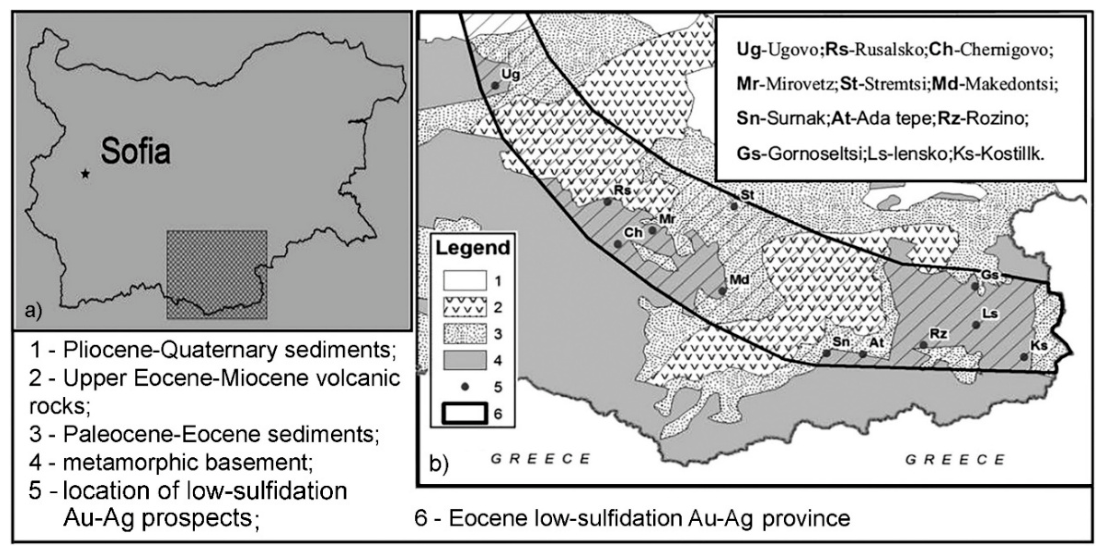
Figure 2.
Regional geological map of the Rhodope Metamorphic Complex (courtesy of Bonev, N.; from [51,54]. Inset: Position of the Rhodope Massif with respect to the main tectonic units and structures of south-eastern Europe.
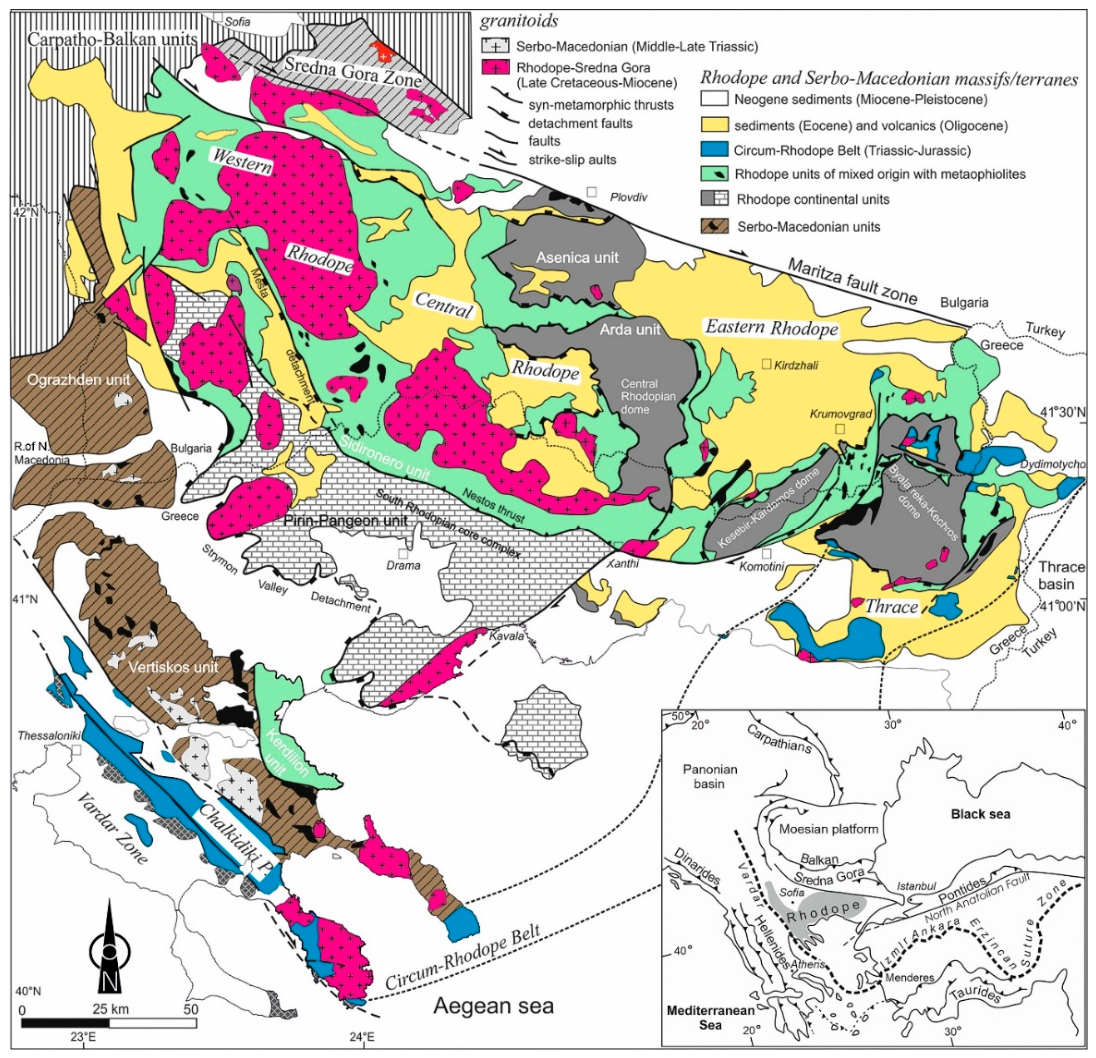
Figure 3.
Outcrop of silica sinter (a) and hand specimen of angular silica sinter clasts, cemented by sandstone of the Coal-Bearing-Sandstone Formation (b), the Skalak occurrence, Krumovgrad goldfield.
Figure 3.
Outcrop of silica sinter (a) and hand specimen of angular silica sinter clasts, cemented by sandstone of the Coal-Bearing-Sandstone Formation (b), the Skalak occurrence, Krumovgrad goldfield.
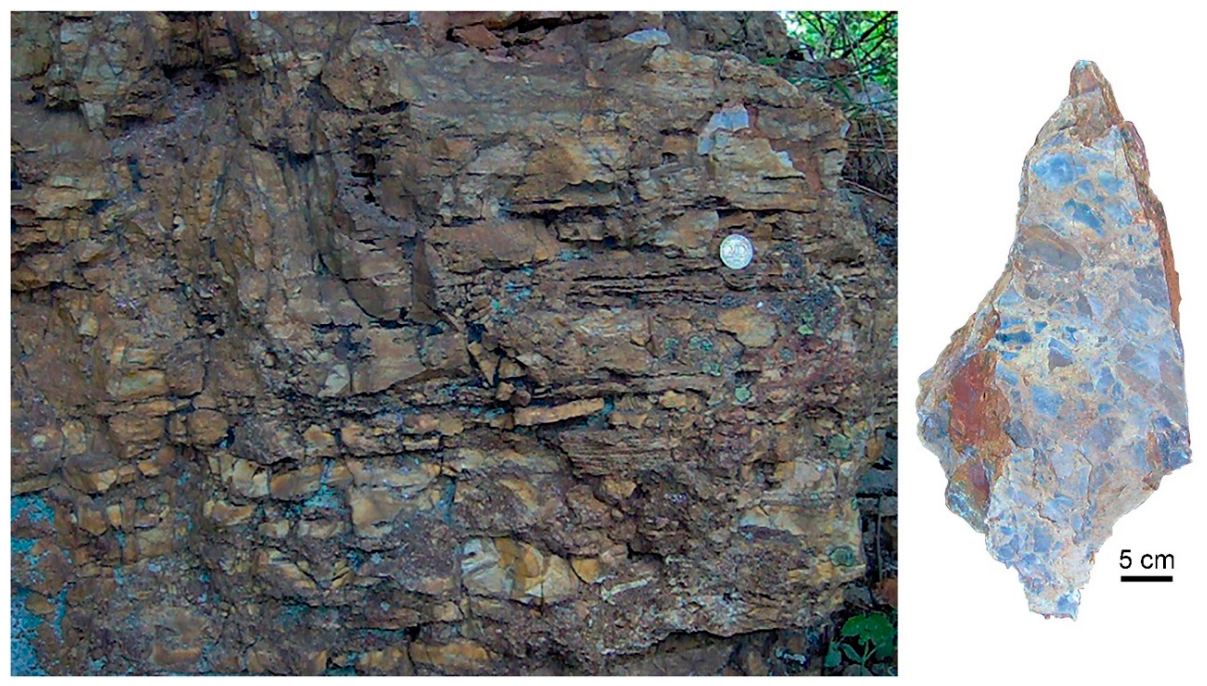
Figure 4.
Geological map of the Kessebir-Kardamos metamorphic dome (courtesy of Marchev, P., from [6], with added deposits and occurrences of the Krumovgrad goldfield as well the position of latter within the Bulgarian territory. Contours of the Rhodopean metallogenic province in Bulgaria after [22]. Abbr.: RMP – Rhodope metallogenic province, KG – Krumovgrad goldfield.
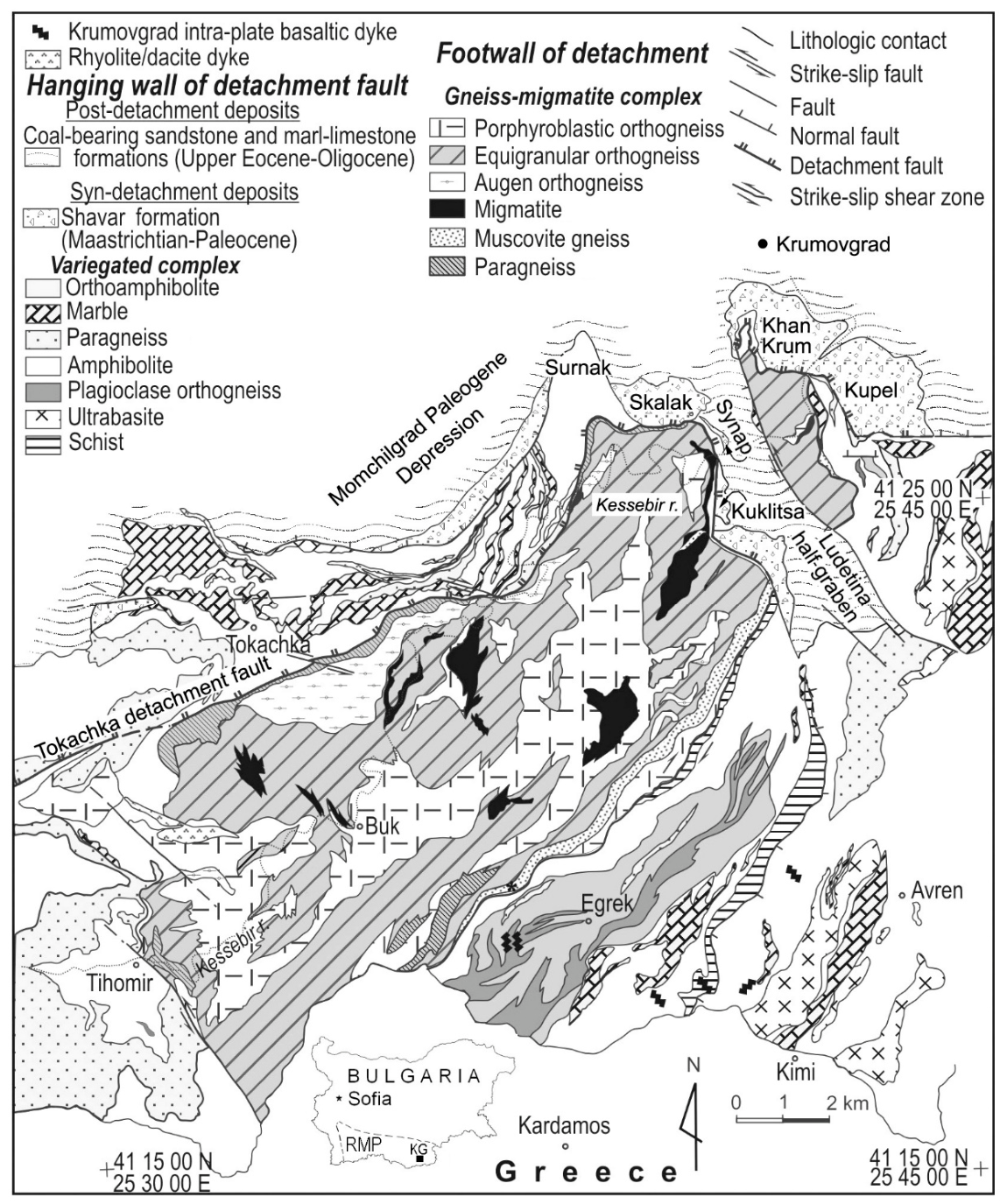
Disclaimer/Publisher’s Note: The statements, opinions and data contained in all publications are solely those of the individual author(s) and contributor(s) and not of MDPI and/or the editor(s). MDPI and/or the editor(s) disclaim responsibility for any injury to people or property resulting from any ideas, methods, instructions or products referred to in the content. |
© 2026 by the authors. Licensee MDPI, Basel, Switzerland. This article is an open access article distributed under the terms and conditions of the Creative Commons Attribution (CC BY) license (http://creativecommons.org/licenses/by/4.0/).
Copyright: This open access article is published under a Creative Commons CC BY 4.0 license, which permit the free download, distribution, and reuse, provided that the author and preprint are cited in any reuse.