

Submitted:
15 October 2026
Posted:
20 October 2026
You are already at the latest version
Abstract
UpperMyo is an open six-muscle surface electromyography (sEMG) dataset for upper-limb action detection, temporal prediction, and cross-dataset transfer, evaluated through internal validation and paired external experiments. Analyses use 264 recording blocks from 24 healthy male participants, sampled at 1 kHz with 12-bit resolution; the nine-class dataset contains 2,640 four-second samples spanning eight actions and background. Internal evaluations cover recognition, channel ablation, and elbow-flexion/rest temporal classification. A convolutional neural network (CNN) achieved a macro-F1 of 0.9860 under nested leave-one-subject-out validation. Temporal classification yielded CNN accuracies of 89.5% and 75.3% at 0 and 2,000 ms backward offsets from an sEMG onset reference. Four external experiments compare transfer with target-only learning at identical labeling budgets for matched actions, new actions, activities without class mapping, and continuous grip-force estimation. WristMotion balanced accuracy increased by 14.21 percentage points with four labeled trials; mean flexor carpi ulnaris (FCU) grip-force R2 increased from 0.6431 to 0.6899 at the full budget. Transfer yielded gains across multiple tasks and budgets, with benefits varying by task and labeling budget. UpperMyo provides traceable data and evaluation evidence for sEMG action analysis and cross-dataset learning.
Keywords:
action detection
; dataset
; surface electromyography
; temporal prediction
; transfer learning
1. Introduction
Surface electromyography (sEMG) supports prosthetics, rehabilitation, and human–machine interfaces, but individual differences and changing conditions limit stable control [1,2]. Clinical translation also depends on usability and evaluation in practical settings [3]. In upper-limb rehabilitation robotics, Wang et al. investigated adaptive training tasks and robotic assistance for motor learning [4], and developed the CASIA-EXO exoskeleton with a patient-in-the-loop control strategy [5]. Reusable datasets therefore need documented acquisition, temporal information, and independent evaluation protocols. A shared resource also enables methods to be compared on the same signals and participant splits, separating changes in modeling from differences in data collection.
A comprehensive review summarizes handcrafted features and learned representations [6]. Liu et al. showed that randomly splitting overlapping lower-limb sEMG windows yields optimistic knee-angle prediction errors, distinguishing individual calibration from cross-subject evaluation [7]. Upper-limb studies address classification, continuous recognition, and multiday evaluation [8,9,10]. Fatigue, electrode displacement, posture, and contraction intensity alter signal distributions [11,12]; noise, artifacts, and electrode configuration affect interpretation [13,14]. These findings motivate traceable recordings, control of overlap across splits, and subject-independent validation. Channel-wise evaluation tests muscle contributions.
NinaPro, Hyser, and related resources cover multiple actions, high-density sEMG, force, or synchronized kinematics [15,16,17,18,19]; EMGBench benchmarks generalization and adaptation [20]. The findable, accessible, interoperable, and reusable (FAIR) principles promote data and metadata reuse [21]. For UpperMyo, this motivates retaining the relationship between original recordings, extracted samples, and participant identities alongside the signal files. Such organization supports consistent regrouping of samples for different tasks and validation splits.
Transfer learning reuses source representations [22,23]. In wearable gait analysis, Zhang transferred gait-cycle regression representations to phase classification [24]; Wu et al. found task-selective transfer benefits across four external cohorts [25]. Wang et al. jointly estimated gait phase and cycle percentage in frail older adults [26]. Zhang et al. used transductive learning without target-subject labels [27]. Related studies examined level-walking/stair relationships for fine-grained phase prediction [28] and cross-locomotion sEMG generalization [29]. These studies motivate external evaluation with explicit target-data access rules. We distinguish subject-independent evaluation from transductive use of unlabeled test signals, comparing transfer at identical label budgets across matched actions, different action sets, and continuous force estimation.
Lower-limb sEMG has also been used for gait phase detection and prediction [30]. Recent sEMG gait-decoding research also uses phase-guided self-supervised latent representation learning to reduce reliance on dense joint-angle supervision during encoder training [31]. Here, detection denotes segment-level classification; prediction uses windows shifted backward from an EMG reference. Onset definitions and evaluation settings guide temporal interpretation [32]. Nine-class recognition and temporal classification use separate protocols.
Previous work examined signal quality in a six-channel acquisition system and compared all 63 nonempty channel combinations to investigate the minimum channel configuration for upper-limb action recognition and its performance across participants [33]. Using the same acquisition platform and protocol, this study organizes six-muscle recordings, action and background labels, and participant indices into the open UpperMyo dataset. It establishes nine-class recognition and elbow-flexion/rest temporal prediction benchmarks and extends evaluation to four cross-dataset transfer tasks. These tasks cover matched actions, new actions, activities without class mapping, and continuous grip-force estimation. Paired comparisons at identical target labeling budgets assess the reuse of source network weights and statistical information when action sets and output types change.
Our contributions are:
- 1.
- A six-muscle upper-limb sEMG dataset with acquisition information, action labels, and recording–sample–participant indices to support data sharing and subsequent analysis.
- 2.
- Subject-independent nine-class recognition, channel ablation, and elbow-flexion/rest temporal prediction benchmarks to evaluate action discrimination, channel contributions, and performance at different temporal offsets.
- 3.
- Four external tasks—WristMotion, Izmir9, Lucchetti ADL6, and FCU grip force—comparing transfer with target-only learning at identical target labeling budgets to analyze transfer across different action sets and continuous-output tasks.
2. Data Resource and Task Definitions
2.1. Acquisition and Participants
The six-channel system contains two sensing boards and one control board in a waist-worn 3D-printed enclosure (Figure 1). The analog front end buffers, amplifies, notch-filters, and level-shifts the signals. An STM32F103C8T6 triggers dual 12-bit analog-to-digital converters (ADCs) at 1 kHz per channel and transmits through a universal asynchronous receiver/transmitter (UART) or Bluetooth Low Energy. Hardware characterization is reported in [33]; this study analyzes saved recordings offline.
All 24 participants were healthy male volunteers (age 21.3 ± 2.1 years; height 1.73 ± 0.08 m; mass 64.5 ± 10.2 kg). Participants’ health status was assessed before data collection using a structured health questionnaire and a medical history interview. Screening covered neuromuscular disorders, previous upper-limb injuries or surgery, current pain or movement limitations, medications potentially affecting neuromuscular function, and skin conditions affecting electrode placement. The information was reviewed against predefined inclusion and exclusion criteria. If uncertainties arose during screening, further assessment by a healthcare professional was sought to determine participant eligibility. Only individuals with no known diseases or symptoms affecting upper-limb function or sEMG acquisition, and who met the study eligibility criteria, were included. Handedness was self-reported on a form completed before the experiment, and all participants reported being right-handed. Exclusion criteria included neuromuscular or cardiovascular disease, previous upper-limb surgery, implanted electronic devices, and skin conditions affecting electrode placement. They avoided strenuous upper-limb exercise, caffeine, and alcohol for 24 h. Written informed consent was obtained from all participants. The study was approved by the Institutional Review Board of Shandong University (IRB-SBMS-SDU(L)2025-01-3) and conducted in accordance with the Declaration of Helsinki [33]. Participants also provided specific consent for the publication of identifiable images and experimental setup photographs (Figure 1).
2.2. Channels and Acquisition Protocol
Six bipolar Ag/AgCl electrode pairs cover two upper-arm and four forearm muscles (Table 1). Skin was shaved as needed and cleaned with 70% isopropyl alcohol. Electrode placement followed the Surface ElectroMyoGraphy for the Non-Invasive Assessment of Muscles (SENIAM) recommendations, with a 20 mm interelectrode spacing. Seated participants performed elbow flexion/extension, wrist flexion/extension, ulnar/radial deviation, and hand closing/opening. Test cues specified 10 s rest, 5 s natural-speed action, and 10 s rest [33]; four-second action samples were segmented afterward (Section 2.3).
2.3. Recordings and Two Tasks
UpperMyo and the previous study [33] draw on data from the same upper-limb sEMG acquisition campaign. The present analyses use 264 recording blocks, 11 per participant, comprising 528 comma-separated values (CSV) files. Each block pairs a 70 s recording labeled as 20 s action and 50 s background with a file of five 4 s action segments (4,000 points/channel).
The nine-class set contains 1,320 action and 1,320 background samples (Table 2). Background uses nonoverlapping 4 s windows sampled deterministically from continuous background intervals, stratified by originating action. Indices retain participant, block, class, and file location. All records passed channel-count, finite-value, label, timestamp, and length checks.
Detection uses nine-class samples (Figure 2). Prediction evaluates elbow-flexion/rest classification at temporal offsets, using its own windows, labels, and evaluation units.
3. Internal Validation and External Transfer
3.1. Detection and Channel Ablation
Nine-class recognition uses 24-fold nested leave-one-subject-out (LOSO) validation: one outer-test participant, inner LOSO on the other 23 for selection, then refitting on all outer-training data. Neural screening uses deterministic reduced subsets and shorter schedules. Outer-test labels never enter fitting or selection.
Linear discriminant analysis (LDA), radial-basis support vector machines (SVM), and random forests (RF) use ten features per channel (60 dimensions). Convolutional neural networks (CNNs) and prototypical networks (ProtoNets) use 6 × 4000 signal samples. Correlation alignment (CORAL) additionally uses unlabeled test-fold signals and is reported separately as transductive. Features, architectures, and search spaces appear in Supplement S5.
Separate fixed-configuration LOSO compares all channels, each leave-one-channel-out subset, and each single channel (13 configurations). Channel contributions are evaluated relative to the all-channel result under this fixed configuration.
3.2. Prediction: Elbow-Flexion/Rest Temporal Protocol
In the temporal experiment, seated participants used the Section 2 system for equal numbers of flexion and rest trials, flexing from rest to approximately 90° and returning. Fourth-order 20–450 Hz Butterworth bandpass and 50 Hz notch filters preceded BB root-mean-square-envelope thresholding. Offsets shift windows backward from the 0 ms EMG-reference condition.
Windows of 200 ms with 50 ms steps yielded 60 features: per-channel mean absolute value, waveform length, zero crossings, slope sign changes, fourth-order autoregressive coefficients, and Welch median/mean frequencies. Z-scores used training statistics. Models were pooled-covariance LDA, Euclidean k-nearest neighbors (KNN, k = 5), a backpropagation neural network (BPNN) with 128/64 rectified linear unit (ReLU) hidden units, and CNN with a 128/64/2 fully connected component. Training settings and results at the five shared offsets are in Supplement S4.
LOSO means and between-fold standard deviations cover 13 offsets for LDA/KNN and five for BPNN/CNN. Results at the five shared offsets (0, 200, 500, 1,000, and 2000 ms) are presented in Section 4.4, separately from the nine-class results.
3.3. External Protocols and Paired Comparisons
Four tasks cover matched/different actions, activities without class mapping, and continuous outputs (Table 3; Figure 3). Training, development, and test participants are separate. Paired conditions use identical labeled target support sets and test sets; test participants provide no labeled adaptation data. Budgets count classification trials or force windows.
WristMotion uses ECR, ECU, FCR and four matched actions. Signals are resampled to 200 Hz and filtered bidirectionally using a fourth-order 20–90 Hz Butterworth filter. Twelve features per channel are extracted in 200 ms windows at 50 ms steps. Trial means, standard deviations, and interchannel correlations yield inputs, where is the channel count. FeatureCNN starts from source weights for transfer or random initialization for target-only learning; support sets are identical, and development data determine optimization settings.
3.4. Statistical Transfer Across Actions
Izmir9 uses 40 features and a dual-metric Mahalanobis/LDA model. Four wrist actions strictly match the source: extension, flexion, ulnar deviation, and radial deviation. Five new actions are gripping, finger abduction/adduction, and forearm supination/pronation. Gripping and finger abduction are functionally related to source hand closing/opening and enter statistical class associations, but remain in the new-action evaluation group. Here, new actions are defined by the absence of an exact source-class match.
Source covariance/Fisher statistics define metric priors; centers use target support. Four matched and two functionally related actions use strong shrinkage; the remaining three mix strong/weak heads at fixed weights without source prototypes or pseudo-labels. Every budget uses balanced sampling and the frozen architecture. Model grouping (six/three) differs from evaluation grouping (four/five).
ADL6 uses six healthy-participant activities without class mapping. Source scatter regularizes a target Fisher subspace; target support determines centers. Inner validation on six training participants selected dimension 5, ridge 0.70, and within-/between-source weights 0.75/0.10. Conditions differ only in source regularization. Budgets are 6–162 trials (step 6), plus all 179; two test participants remain fixed. To compare transfer performance across labeling budgets, all budgets use the same fixed configuration selected by inner validation on the target training participants.
3.5. Continuous Grip-Force Transfer
The FCU task evaluates offline grip-force estimation. Two synchronous EMG signals at each location are averaged, with the two location conditions retained as separate records. Windows of 0.5 s at 0.1 s steps estimate simultaneous dynamometer force. Each complete EMG record is normalized by the 95th percentile of its 0.5 s window root-mean-square (RMS) amplitudes, without using force labels. UpperMyo has no measured force labels, so source pretraining uses action classification and an activation proxy.
Predictions are the equally weighted average of neural and extremely randomized tree (ExtraTrees) outputs. Paired models share the tree branch and differ only in neural source initialization. Standalone ExtraTrees provides an additional baseline; the paired fusion comparison isolates the effect of source initialization.
3.6. Evaluation Metrics
Internal macro-F1, balanced accuracy (BA), and accuracy are computed from pooled outer-test predictions. External classification averages class recalls within participants, then across participants/repetitions; Izmir9 also reports group recalls. ADL6 accuracy equals BA because within-participant class counts are equal. Force is computed per participant, then averaged across participants/repetitions. Paired gain at budget b is
Classification gains are percentage points (pp); force gains are differences. The supplement reports participant intervals and support-resampling standard deviations separately. Izmir9 uses a frozen model but reuses test participants from an earlier six-class task. Izmir9/ADL6 use within-test-participant unlabeled normalization. No test labels enter fitting.
4. Validation Results
4.1. Detection and Channel Contributions
Nested LOSO yielded CNN macro-F1, BA, and accuracy of 0.9860, 0.9879, and 0.9909; SVM macro-F1 was 0.9830 (Figure 4a,b). In fixed-configuration ablation, full-channel CNN macro-F1 was 0.9923, falling to 0.9517 without ECR. ECU was the best single channel (0.6899). All channels outperformed each single channel in this ablation (Figure 4c). Complete internal validation and channel-ablation results are provided in Supplement S1.
4.2. External Classification
WristMotion showed positive mean gains at all 12 budgets: +14.21 pp with four trials and +2.16 pp with 800 (Figure 5a; Table 4).
With nine trials, Izmir9 gained 13.69 pp in BA; all six test participants had positive mean paired gains, and new-action recall rose from 23.37% to 36.40%. At 1,260 trials, BA and new-action recall fell by 0.74 and 1.33 pp, respectively, showing negative transfer at this budget (Figure 5b; grouped results in Supplement S2).
ADL6 had positive mean gains at all 28 budgets, including +4.11 and +6.22 pp at 18 and 36 trials. With all 179 trials, both test participants benefited: mean BA increased from 75.00% to 80.00%, and macro-F1 from 0.7454 to 0.7968.
4.3. Continuous Grip Force
Transfer fusion exceeded target-only fusion in mean at all 21 budgets (Figure 6a). With all 10,775 windows, increased from 0.6431 to 0.6899; participant gains were 0.09158, 0.04805, and 0.00074 (Figure 6b). It also exceeded standalone ExtraTrees at every budget, but by only 0.0013 at 70 windows. All three seeds favored transfer over paired target-only fusion at 18 of 21 budgets.
4.4. Prediction: Elbow-Flexion/Rest Temporal Results
The elbow-flexion/rest experiment yielded 0 ms LOSO accuracies of (85.7 ± 5.0)%, (85.9 ± 3.2)%, (88.8 ± 4.3)%, and (89.5 ± 4.3)% for LDA, KNN, BPNN, and CNN. At 500 ms, all four mean accuracies were at least 83%, with CNN at (87.8 ± 5.0)%. At 2,000 ms, accuracies were (34.7 ± 9.2)%, (66.2 ± 2.7)%, (73.3 ± 10.5)%, and (75.3 ± 10.2)%. Neural models retained higher mean accuracy at large offsets, with substantial between-fold variability (Figure 7).
5. Discussion
UpperMyo organizes six-muscle recordings, action and background labels, and participant indices into a dataset for action detection, temporal prediction, and transfer learning. The recording–sample–participant relationships support traceability and subject-independent splits, while explicit muscle identities facilitate channel matching with external datasets.
Strong nested-LOSO recognition indicates discriminative information that generalizes to held-out participants under the acquisition protocol. The full-channel advantage over individual channels and the decrease after removing ECR suggest complementary information across muscles. The elbow-flexion/rest experiment characterizes performance at temporal offsets. Together, these evaluations characterize the resource across action classes, channel configurations, and analysis timing.
External transfer experiments demonstrate the use of UpperMyo in different tasks. WristMotion evaluates transfer of source weights between matched actions. Gains for new actions in Izmir9 at low budgets and for ADL6 without class mapping indicate that source statistical information can support learning across different action sets. The FCU experiment extends use to continuous grip-force estimation: pretraining on action classification and activation-proxy objectives increased mean target-task without source-domain force labels.
WristMotion showed larger gains at low budgets, Izmir9 showed negative transfer at the highest budget, and ADL6 maintained positive mean gains at every evaluated budget, indicating that transfer performance varies with target task and labeling budget. At the full FCU budget, all three test participants achieved positive mean gains, with different magnitudes.
The source cohort consisted entirely of healthy, young, right-handed male participants. Further validation is needed to establish the applicability of the findings to females, left-handed individuals, other age groups, and clinical populations. The small ADL6/FCU test cohorts also limit population coverage; repeated support draws add no independent participants. ADL6 dense-budget curves are descriptive extensions, and Izmir9 reuses an earlier test cohort. Unadjusted participant intervals do not establish significance across budgets, while post hoc selected force traces illustrate favorable cases. Temporal classification uses an EMG onset reference; its offsets do not quantify anticipation of physical movement. Broader cohorts, repeated-session recordings, independent kinematic references, and prospective online evaluation would strengthen generalization and temporal interpretation.
6. Conclusions
This study organizes the six-muscle upper-limb sEMG dataset UpperMyo, establishes action-detection and elbow-flexion/rest temporal prediction benchmarks, and evaluates transfer learning through four external experiments. Internal experiments demonstrate action-discriminative information and channel contributions. External experiments show that source network weights and statistical information can support different action sets and continuous grip-force estimation, with gains varying across tasks, labeling budgets, and participants. UpperMyo provides open data and experimental reference results for upper-limb sEMG analysis and cross-dataset research.
Supplementary Materials
The following supporting information can be downloaded at the website of this paper posted on Preprints.org. The accompanying supplementary PDF contains complete internal validation results (S1), external classification-transfer results (S2), grip-force transfer results (S3), temporal classification results (S4), and model configurations and uncertainty analyses (S5).
Author Contributions
Conceptualization, J.L., J.W. and H.Z.; methodology, J.L., H.L., X.L. and H.Z.; software, J.L., H.L. and X.L.; validation, J.L., H.L., X.L., Z.L., F.Z. and D.G.; formal analysis, J.L., H.L. and X.L.; investigation, H.L., Z.L., F.Z. and D.G.; resources, J.W. and H.Z.; data curation, J.L., Z.L., F.Z. and D.G.; writing—original draft preparation, J.L.; writing—review and editing, J.L., H.L., X.L., Z.L., F.Z., D.G., J.W. and H.Z.; visualization, J.L. and Z.L.; supervision, J.W. and H.Z.; project administration, J.W. and H.Z. All authors have read and agreed to the published version of the manuscript.
Funding
This work was supported in part by the National Key R&D Program of China under Grant 2025YFC3609100, the Taishan Scholars Project (Young Expert Program) under Grant No. tsqn202408040, the Young Scientists Fund of the National Natural Science Foundation of China under Grant 62403281, and the Shandong Excellent Young Scientists Fund Program (Overseas) under Grant 2024HWYQ-019.
Institutional Review Board Statement
The study was conducted in accordance with the Declaration of Helsinki and approved by the Institutional Review Board of Shandong University (approval number: IRB-SBMS-SDU(L)2025-01-3).
Informed Consent Statement
Written informed consent was obtained from all participants. Written consent for publication of the identifiable photographs in Figure 1 was obtained from the participant shown.
Data Availability Statement
Version 1.0 of the UpperMyo dataset is publicly available on GitHub at https://github.com/HuangheZhang/UpperMyo/releases/tag/v1.0.
Conflicts of Interest
The authors declare no conflicts of interest. The funders had no role in the design of the study; in the collection, analyses, or interpretation of data; in the writing of the manuscript; or in the decision to publish the results.
References
- Jiang, N.; Chen, C.; He, J.; Meng, J.; Pan, L.; Su, S.; Zhu, X. Bio-robotics research for non-invasive myoelectric neural interfaces for upper-limb prosthetic control: a 10-year perspective review. Natl. Sci. Rev. 2023, 10(no. 5), nwad048. [Google Scholar] [CrossRef] [PubMed]
- Farina, D.; Jiang, N.; Rehbaum, H.; Holobar, A.; Graimann, B.; Dietl, H.; Aszmann, O.C. The Extraction of Neural Information from the Surface EMG for the Control of Upper-Limb Prostheses: Emerging Avenues and Challenges. IEEE Trans. Neural Syst. Rehabil. Eng. 2014, 22(no. 4), 797–809. [Google Scholar] [CrossRef] [PubMed]
- Scheme, E.; Englehart, K. Electromyogram pattern recognition for control of powered upper-limb prostheses: State of the art and challenges for clinical use. J. Rehabil. Res. Dev. 2011, 48(no. 6), 643–660. [Google Scholar] [CrossRef] [PubMed]
- Wang, C.; Peng, L.; Hou, Z.-G. A Control Framework for Adaptation of Training Task and Robotic Assistance for Promoting Motor Learning With an Upper Limb Rehabilitation Robot. IEEE Trans. Syst. Man. Cybern. Syst. 2022, 52, 7737–7747. [Google Scholar] [CrossRef]
- Wang, C.; Peng, L.; Hou, Z.-G. Development and Control of an Upper-Limb Exoskeleton CASIA-EXO for Motor Learning in Post-Stroke Rehabilitation. IEEE/CAA J. Autom. Sin. 2025, 12, 1733–1735. [Google Scholar] [CrossRef]
- Sid’El Moctar, S. M.; Rida, I.; Boudaoud, S. Comprehensive Review of Feature Extraction Techniques for sEMG Signal Classification: From Handcrafted Features to Deep Learning Approaches. IRBM 2024, 45(no. 6), 100866. [Google Scholar] [CrossRef]
- Liu, H.; Yin, C.; Gao, G.; Yang, Z.; Zhang, H. Leakage-Aware Subject-Specific Knee-Angle Prediction From Lower Limb Surface Electromyography Using a Multiscale Transformer. IEEE Sens. J. 2026, 26(no. 19), 29884–29894. [Google Scholar] [CrossRef]
- Qureshi, M. F.; Mushtaq, Z.; ur Rehman, M. Z.; Kamavuako, E. N. E2CNN: An Efficient Concatenated CNN for Classification of Surface EMG Extracted From Upper Limb. IEEE Sens. J. 2023, 23(no. 8), 8989–8996. [Google Scholar] [CrossRef]
- Hu, X.; Zeng, H.; Song, A.; Chen, D. Robust Continuous Hand Motion Recognition Using Wearable Array Myoelectric Sensor. IEEE Sens. J. 2021, 21(no. 18), 20596–20605. [Google Scholar] [CrossRef]
- Qureshi, M. F.; Mushtaq, Z.; ur Rehman, M. Z.; Kamavuako, E. N. Spectral Image-Based Multiday Surface Electromyography Classification of Hand Motions Using CNN for Human–Computer Interaction. IEEE Sens. J. 2022, 22(no. 21), 20676–20683. [Google Scholar] [CrossRef]
- Kyranou, I.; Vijayakumar, S.; Erden, M. S. Causes of Performance Degradation in Non-invasive Electromyographic Pattern Recognition in Upper Limb Prostheses. Front. Neurorobotics 2018, 12, 58. [Google Scholar] [CrossRef] [PubMed]
- Campbell, E.; Phinyomark, A.; Scheme, E. Current Trends and Confounding Factors in Myoelectric Control: Limb Position and Contraction Intensity. Sensors 2020, 20(no. 6), 1613. [Google Scholar] [CrossRef] [PubMed]
- Farago, E.; MacIsaac, D.; Suk, M.; Chan, A. D. C. A Review of Techniques for Surface Electromyography Signal Quality Analysis. IEEE Rev. Biomed. Eng. 2023, 16, 472–486. [Google Scholar] [CrossRef] [PubMed]
- Merletti, R.; Muceli, S. Tutorial. Surface EMG detection in space and time: Best practices. J. Electromyogr. Kinesiol. 2019, 49, 102363. [Google Scholar] [CrossRef] [PubMed]
- Atzori, M.; Gijsberts, A.; Castellini, C.; Caputo, B.; Hager, A.-G.M.; Elsig, S.; Giatsidis, G.; Bassetto, F.; Müller, H. Electromyography data for non-invasive naturally-controlled robotic hand prostheses. Sci. Data 2014, 1, 140053. [Google Scholar] [CrossRef] [PubMed]
- Jiang, X.; Liu, X.; Fan, J.; Ye, X.; Dai, C.; Clancy, E.A.; Akay, M.; Chen, W. Open Access Dataset, Toolbox and Benchmark Processing Results of High-Density Surface Electromyogram Recordings. IEEE Trans. Neural Syst. Rehabil. Eng. 2021, 29, 1035–1046. [Google Scholar] [CrossRef] [PubMed]
- Ozdemir, M. A.; Kisa, D. H.; Guren, O.; Akan, A. Dataset for multi-channel surface electromyography (sEMG) signals of hand gestures. Data Brief. 2022, 41, 107921. [Google Scholar] [CrossRef]
- Perez-Blanco, J.G.; Huegel, J.C.; Hernández-Rojas, L.G.; Valdez-Calderón, A.; Lizárraga-Torreblanca, H.; Cruz-Ortiz, D.; Ballesteros, M.; Gomez-Correa, M.; Antelis, J.M. An EEG-EMG-kinematics dataset from wrist pointing tasks for biomarker research in neurorehabilitation. Sci. Data 2026, 13, 931. [Google Scholar] [CrossRef] [PubMed]
- Lucchetti, F.; Bailo, G.; Cabinio, M.; Marzegan, A.; Nuara, A.; Rossetto, F.; Squartecchia, S.; Carpinella, I.; Ferrarin, M.; Lencioni, T. A Kinematic and EMG Dataset for Upper Limb and Hand Movement Analysis in Post-Stroke and Healthy Subjects. Sci. Data 2025, 12, 1904. [Google Scholar] [CrossRef] [PubMed]
- Yang, J.; Soh, M.; Lieu, V.; Weber, D. J.; Erickson, Z. EMGBench: Benchmarking Out-of-Distribution Generalization and Adaptation for Electromyography. In Adv. Neural Inf. Process. Syst. 2024, vol. 37, 50313–50342. [Google Scholar] [CrossRef]
- Wilkinson, M.D.; Dumontier, M.; Aalbersberg, I.J.; Appleton, G.; Axton, M.; Baak, A.; Blomberg, N.; Boiten, J.-W.; da Silva Santos, L.B.; Bourne, P.E.; et al. The FAIR Guiding Principles for scientific data management and stewardship. Sci. Data 2016, 3, 160018. [Google Scholar] [CrossRef] [PubMed]
- Wu, D.; Yang, J.; Sawan, M. Transfer Learning on Electromyography (EMG) Tasks: Approaches and Beyond. IEEE Trans. Neural Syst. Rehabil. Eng. 2023, 31, 3015–3034. [Google Scholar] [CrossRef] [PubMed]
- Côté-Allard, U.; Fall, C.L.; Drouin, A.; Campeau-Lecours, A.; Gosselin, C.; Glette, K.; Laviolette, F.; Gosselin, B. Deep Learning for Electromyographic Hand Gesture Signal Classification Using Transfer Learning. IEEE Trans. Neural Syst. Rehabil. Eng. 2019, 27(no. 4), 760–771. [Google Scholar] [CrossRef] [PubMed]
- Zhang, H. Transfer learning from gait cycle percentage prediction to gait phase classification using wearable sensors. Artif. Intell. Auton. Syst. 2026, 3(no. 1), 0004. [Google Scholar] [CrossRef]
- Wu, P.; Dong, H.; Ding, Z.; Gao, T.; Kong, W.; Liu, Y.; Song, R.; Zhang, H. Hierarchical multi-task learning for comprehensive gait assessment using wearable inertial sensors. npj Digit. Med. advance online publication. 2026. [Google Scholar] [CrossRef] [PubMed]
- Wang, J.; Guan, Z.; Liang, T.; Ding, Z.; Ma, X.; Li, Y.; Song, R.; Zhang, H. Multi-Task Learning for Gait Phase and Gait Cycle Percentage Prediction With Wearable Sensors in Frail Older Adults. IEEE J. Biomed. Health Inform. 2026, 30(no. 7), 6242–6254. [Google Scholar] [CrossRef] [PubMed]
- Zhang, H.; Duong, T. T. H.; Rao, A. K.; Mazzoni, P.; Agrawal, S. K.; Guo, Y.; Zanotto, D. Transductive Learning Models for Accurate Ambulatory Gait Analysis in Elderly Residents of Assisted Living Facilities. IEEE Trans. Neural Syst. Rehabil. Eng. 2022, 30, 124–134. [Google Scholar] [CrossRef] [PubMed]
- Sun, Y.; Li, X.; Ma, C.; Ma, X.; Zhang, H. Exploring the Correlation Between Level Walking and Stair Ambulation for Fine-Grained Gait Phase Prediction. Proc. IEEE 20th Int. Conf. Control Autom. (ICCA), 2026; pp. 1742–1747. [Google Scholar] [CrossRef]
- Sun, Y.; Wan, H.; Li, X.; Zhang, F.; Wu, W.; Zhang, H. Cross-Locomotion Task Generalization in sEMG-Based Gait Phase Prediction Using Artificial Neural Networks. Proc. 10th Int. Conf. Artif. Intell., Autom. Control Technol. (AIACT), 2026; pp. 77–81. [Google Scholar] [CrossRef]
- Sun, Y.; Wang, J.; Wang, Z.; Li, J.; Li, Y.; Song, R.; Zhang, H. Gait Phase Detection and Prediction with Machine Learning Models Based on sEMG. Proc. 3rd Int. Conf. Artif. Intell. Hum.-Comput. Interact. Robot. (AIHCIR) 2024, 324–330. [Google Scholar] [CrossRef]
- Wang, C.; Cui, J.; Peng, L.; Ge, Z.; Liang, G.; Huang, Y.; Ma, Z.; Zhang, Y.; Shao, H.; Zhou, Y.; Zou, A.-M.; Hou, Z.-G. Phase-Guided Self-Supervised Latent Representation Learning for sEMG-Based Gait Decoding. IEEE Trans. Biomed. Eng. 2026, early access. [Google Scholar] [CrossRef] [PubMed]
- Carvalho, C. R.; Fernández, J. M.; del-Ama, A. J.; Barroso, F. O.; Moreno, J. C. Review of electromyography onset detection methods for real-time control of robotic exoskeletons. J. Neuroeng. Rehabil. 2023, 20, 141. [Google Scholar] [CrossRef] [PubMed]
- Li, X.; Liu, H.; Shangguan, A.; Zhang, H. How few channels suffice? A hierarchical validation framework for minimal-channel wearable sEMG in upper-limb rehabilitation gesture recognition. J. Neuroeng. Rehabil. 2026, 23, 247. [Google Scholar] [CrossRef] [PubMed]
- Bazina, T.; Kamenar, E.; Fonoberova, M.; Mezić, I. Koopman-Driven Grip Force Prediction Through EMG Sensing. IEEE Trans. Neural Syst. Rehabil. Eng. 2025, 33, 2192–2202. [Google Scholar] [CrossRef] [PubMed]
Figure 1.
Six-channel acquisition system. (a) Wearable setup and electrode placement; (b) enclosure; (c) circuit boards; (d) signal connections from both sensing boards to the ADCs on the control board. The acquisition system and electrode placement follow [33]. Abbreviations: Table 1; ADC, analog-to-digital converter; UART, universal asynchronous receiver/transmitter; BLE, Bluetooth Low Energy; MCU, microcontroller unit; PC, personal computer; GND, reference ground. Written consent for publication of the identifiable photographs was obtained from the participant shown.
Figure 1.
Six-channel acquisition system. (a) Wearable setup and electrode placement; (b) enclosure; (c) circuit boards; (d) signal connections from both sensing boards to the ADCs on the control board. The acquisition system and electrode placement follow [33]. Abbreviations: Table 1; ADC, analog-to-digital converter; UART, universal asynchronous receiver/transmitter; BLE, Bluetooth Low Energy; MCU, microcontroller unit; PC, personal computer; GND, reference ground. Written consent for publication of the identifiable photographs was obtained from the participant shown.
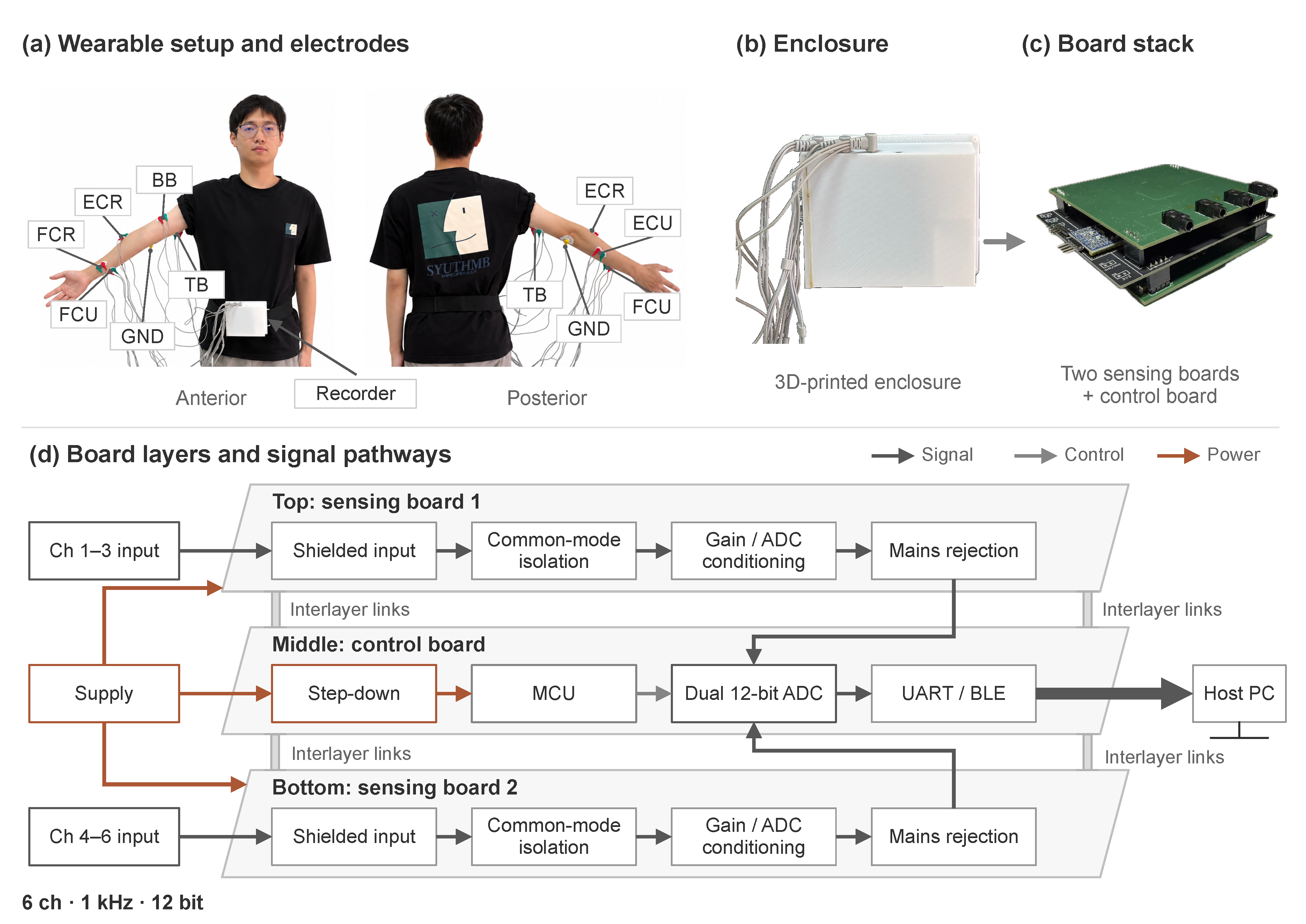
Figure 2.
Participant 1’s 70 s elbow-flexion record and third 4 s sample (orange). Overview preserves local extrema; enlargement retains all points. For display, each channel is centered, scaled by its maximum absolute amplitude, and vertically offset; labels mark saved segments. Right: nested leave-one-subject-out (LOSO) validation and 13 ablation configurations; channel order BB, TB, ECR, ECU, FCR, FCU (Section 3.1).
Figure 2.
Participant 1’s 70 s elbow-flexion record and third 4 s sample (orange). Overview preserves local extrema; enlargement retains all points. For display, each channel is centered, scaled by its maximum absolute amplitude, and vertically offset; labels mark saved segments. Right: nested leave-one-subject-out (LOSO) validation and 13 ablation configurations; channel order BB, TB, ECR, ECU, FCR, FCU (Section 3.1).
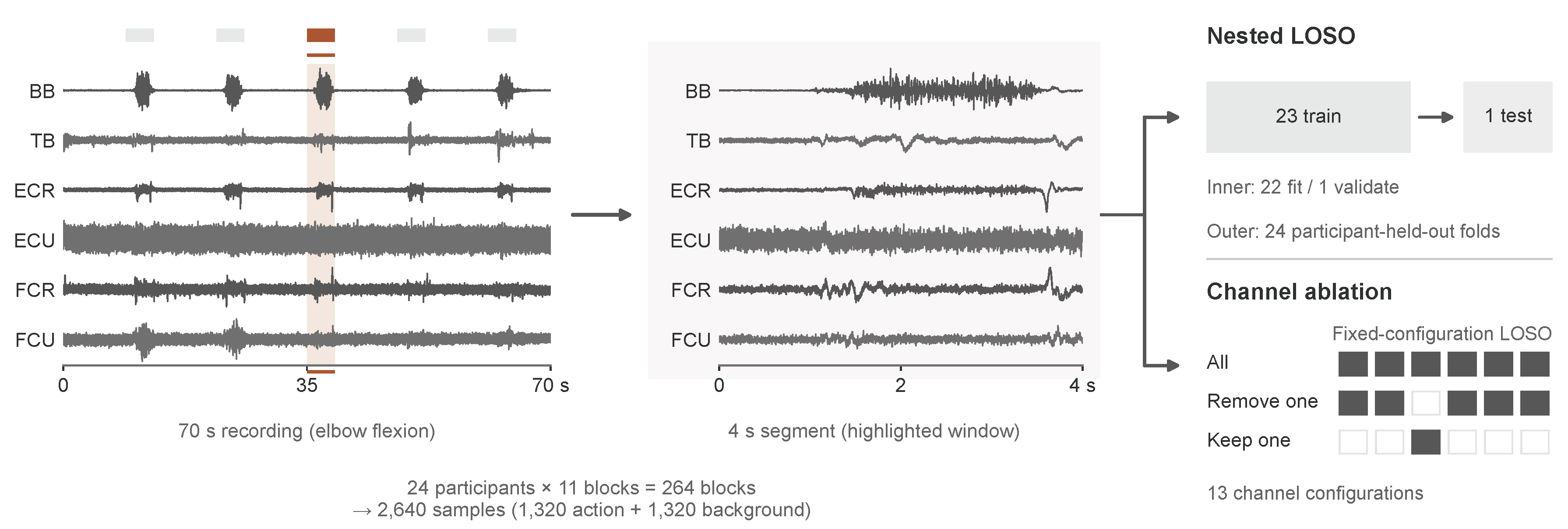
Figure 3.
Four transfer pathways: source weights (rust), statistical priors (medium gray), target processing (dark gray). Support/test sets are paired. Izmir9’s six/three model grouping differs from its four/five evaluation grouping; ADL6 has no class mapping. Signals, features, distances, and outputs are schematic; intermediate operations are omitted. Architectures and mappings: Section 3.3–3.5.
Figure 3.
Four transfer pathways: source weights (rust), statistical priors (medium gray), target processing (dark gray). Support/test sets are paired. Izmir9’s six/three model grouping differs from its four/five evaluation grouping; ADL6 has no class mapping. Signals, features, distances, and outputs are schematic; intermediate operations are omitted. Architectures and mappings: Section 3.3–3.5.
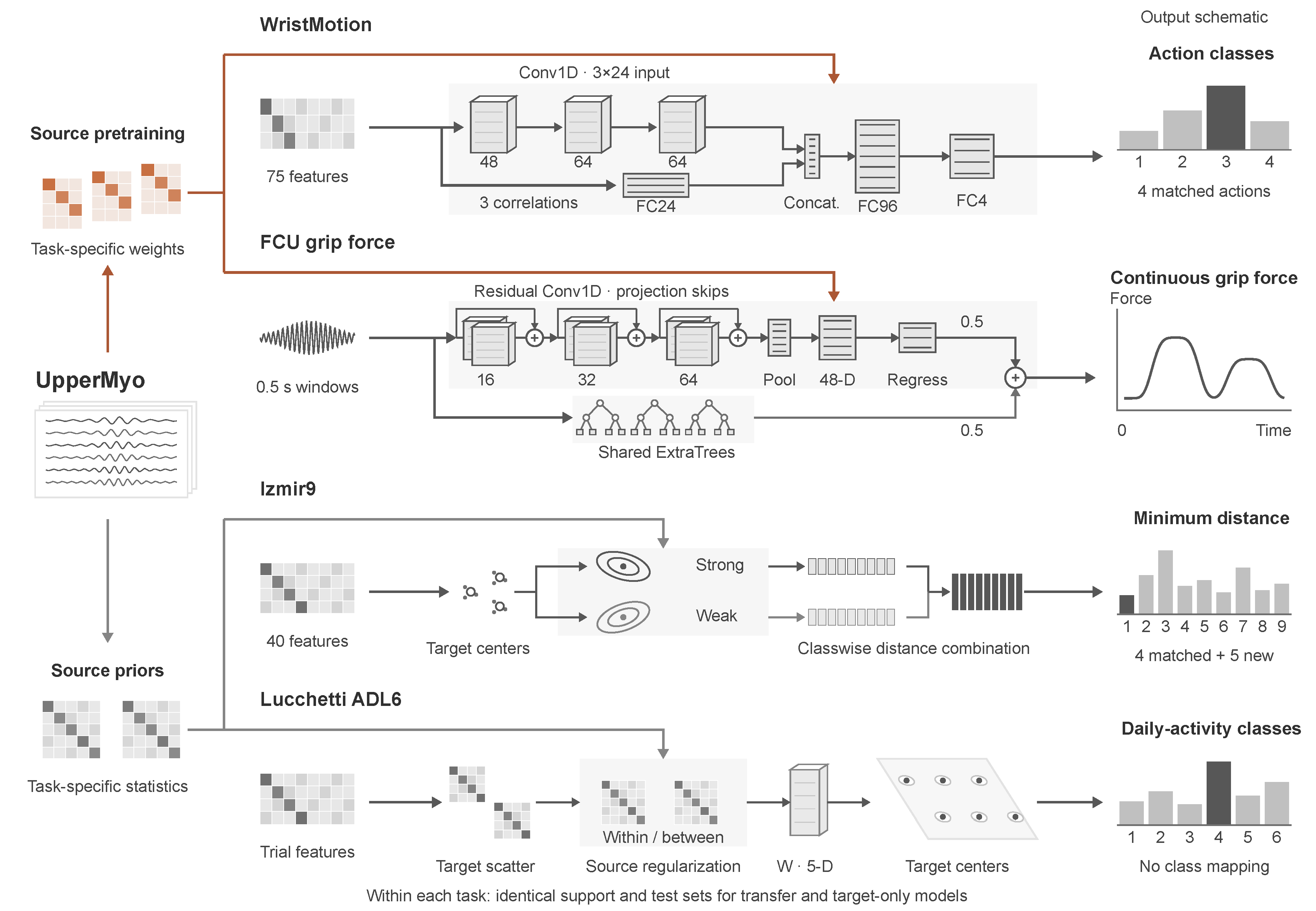
Figure 4.
(a) Pooled nested-LOSO macro-F1; CORAL* additionally accesses unlabeled test-fold inputs. (b) CNN confusion matrix normalized by true class (%). (c) Fixed-configuration LOSO ablation; dashed line: all channels. Ablation gains use the all-channel baseline in (c). Abbreviations: Tables 1–2.
Figure 4.
(a) Pooled nested-LOSO macro-F1; CORAL* additionally accesses unlabeled test-fold inputs. (b) CNN confusion matrix normalized by true class (%). (c) Fixed-configuration LOSO ablation; dashed line: all channels. Ablation gains use the all-channel baseline in (c). Abbreviations: Tables 1–2.
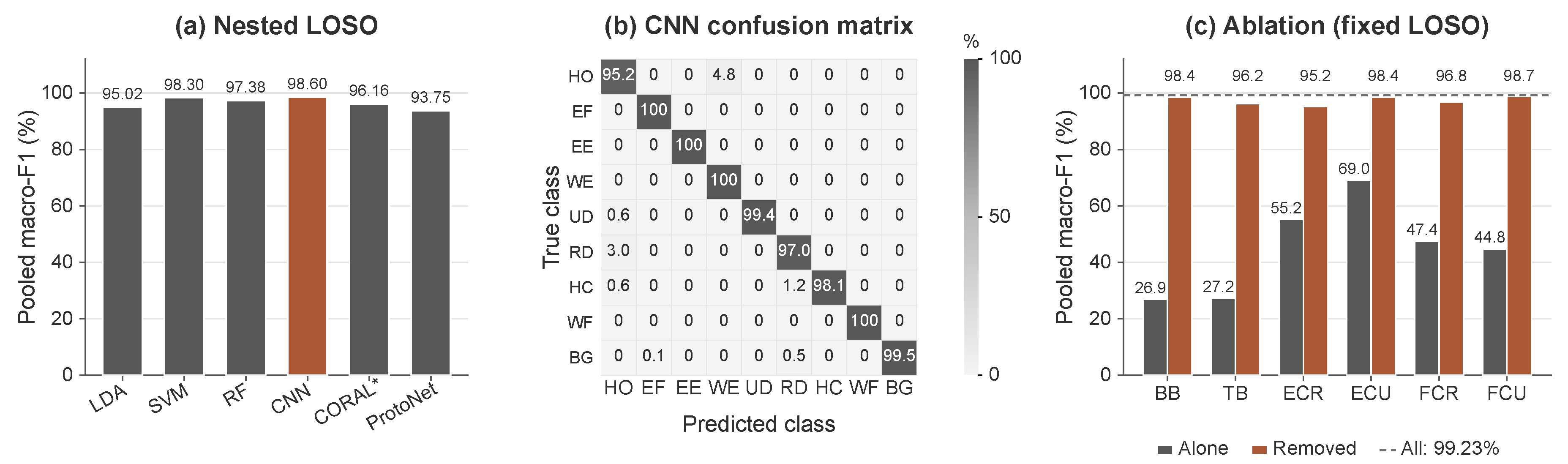
Figure 5.
External classification transfer. Each panel shows eight selected budgets: (a) WristMotion (12 total), (b) Izmir9 (11), and (c) ADL6 (28). Both conditions use the same budgets, including the minimum, maximum, and maximum-gain budgets. Axes: log (a,b), linear (c). Points are paired-repeat means (Table 3); ADL6 full support has one evaluation. Labels indicate full-curve maximum BA gains (pp), pointing to transfer values. Lines connect selected means. Complete curves and Izmir9 matched-four/new-five results: Supplement S2.
Figure 5.
External classification transfer. Each panel shows eight selected budgets: (a) WristMotion (12 total), (b) Izmir9 (11), and (c) ADL6 (28). Both conditions use the same budgets, including the minimum, maximum, and maximum-gain budgets. Axes: log (a,b), linear (c). Points are paired-repeat means (Table 3); ADL6 full support has one evaluation. Labels indicate full-curve maximum BA gains (pp), pointing to transfer values. Lines connect selected means. Complete curves and Izmir9 matched-four/new-five results: Supplement S2.
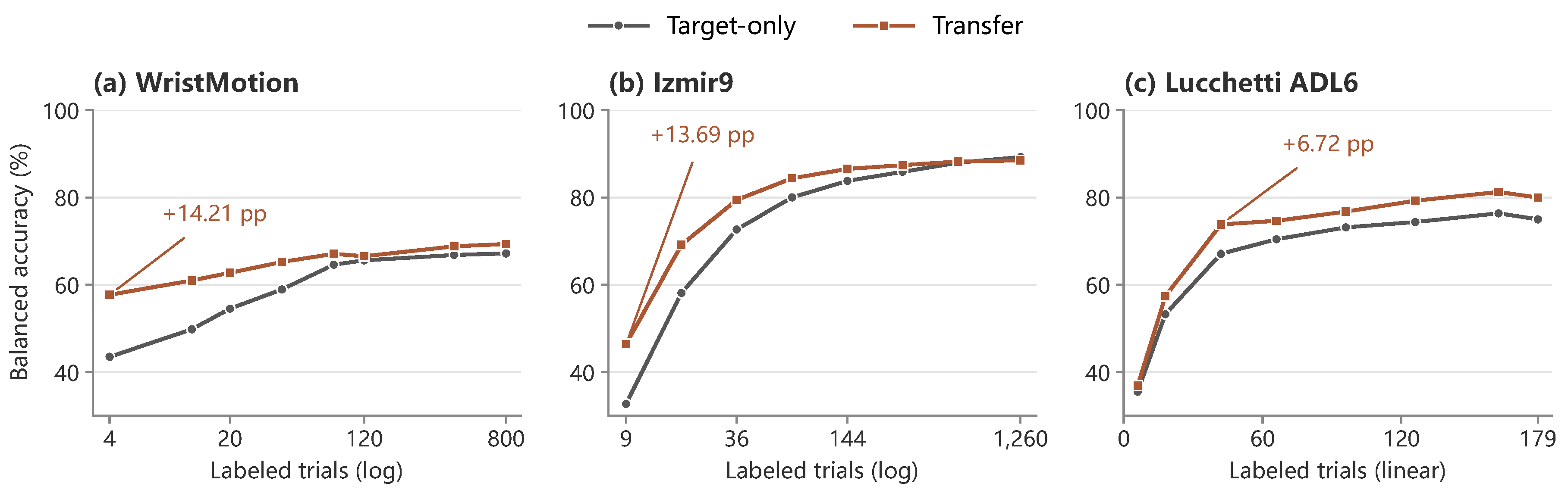
Figure 6.
(a) Mean at 12 of 21 budgets, including 10 and all 10,775 windows (log axis). (b) Participant means over three repeats and at full support, the budget with the highest mean transfer among those benefiting all participants. (c–e) For each participant, the complete record with the highest transfer among positive-gain records, selected post hoc at full support with seed 20260907; labels show record-level . Traces show the saved predictions without additional smoothing. Full curves/tree baselines: Supplement S3.
Figure 6.
(a) Mean at 12 of 21 budgets, including 10 and all 10,775 windows (log axis). (b) Participant means over three repeats and at full support, the budget with the highest mean transfer among those benefiting all participants. (c–e) For each participant, the complete record with the highest transfer among positive-gain records, selected post hoc at full support with seed 20260907; labels show record-level . Traces show the saved predictions without additional smoothing. Full curves/tree baselines: Supplement S3.
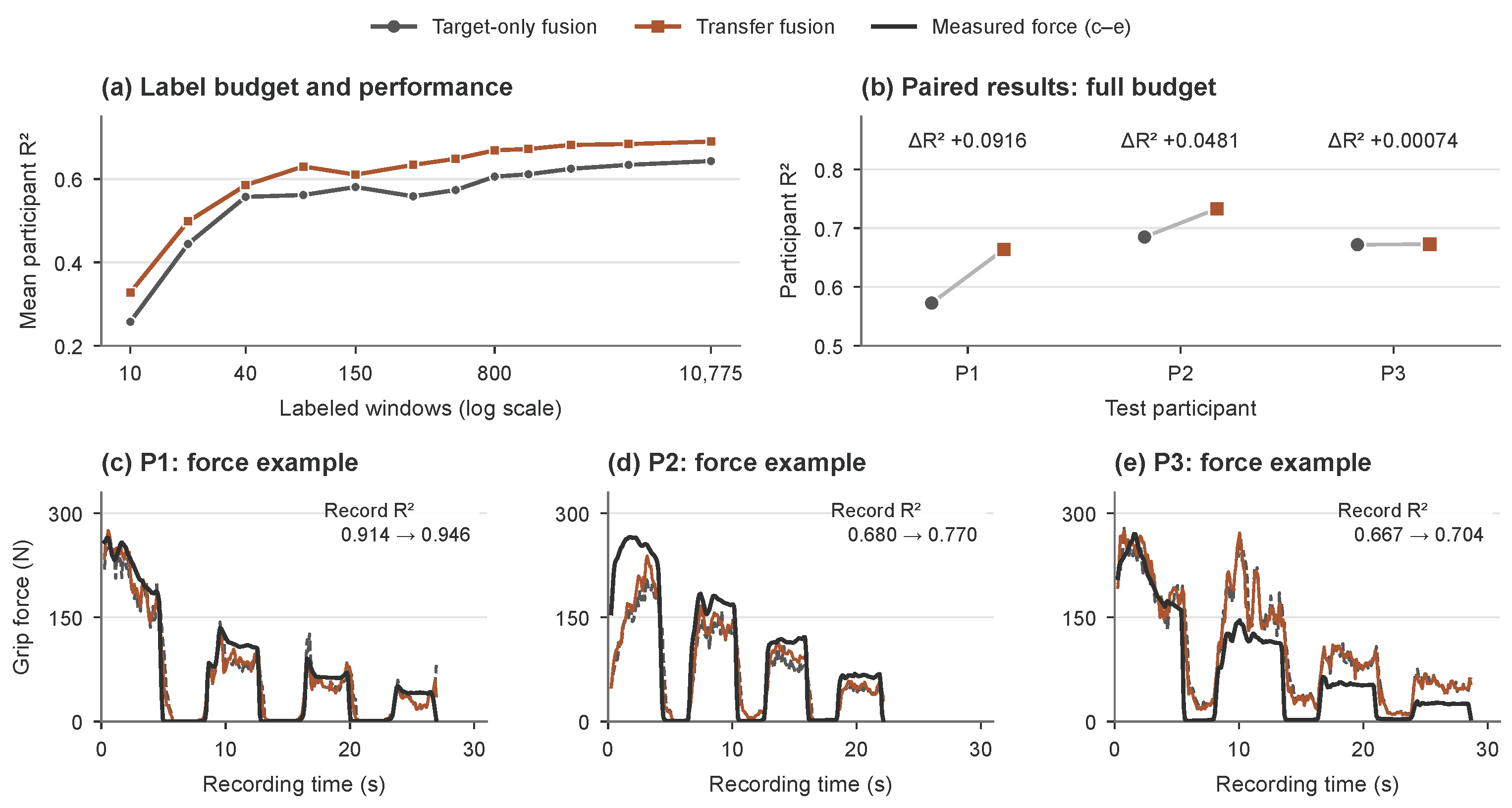
Figure 7.
Elbow-flexion/rest temporal protocol and results. (a) EMG-relative window offsets and four independently evaluated models; schematic BPNN and CNN fully connected layers. (b) LOSO mean ± between-fold standard deviation (SD); inset 0–500 ms. Full values: Supplement S4.
Figure 7.
Elbow-flexion/rest temporal protocol and results. (a) EMG-relative window offsets and four independently evaluated models; schematic BPNN and CNN fully connected layers. (b) LOSO mean ± between-fold standard deviation (SD); inset 0–500 ms. Full values: Supplement S4.
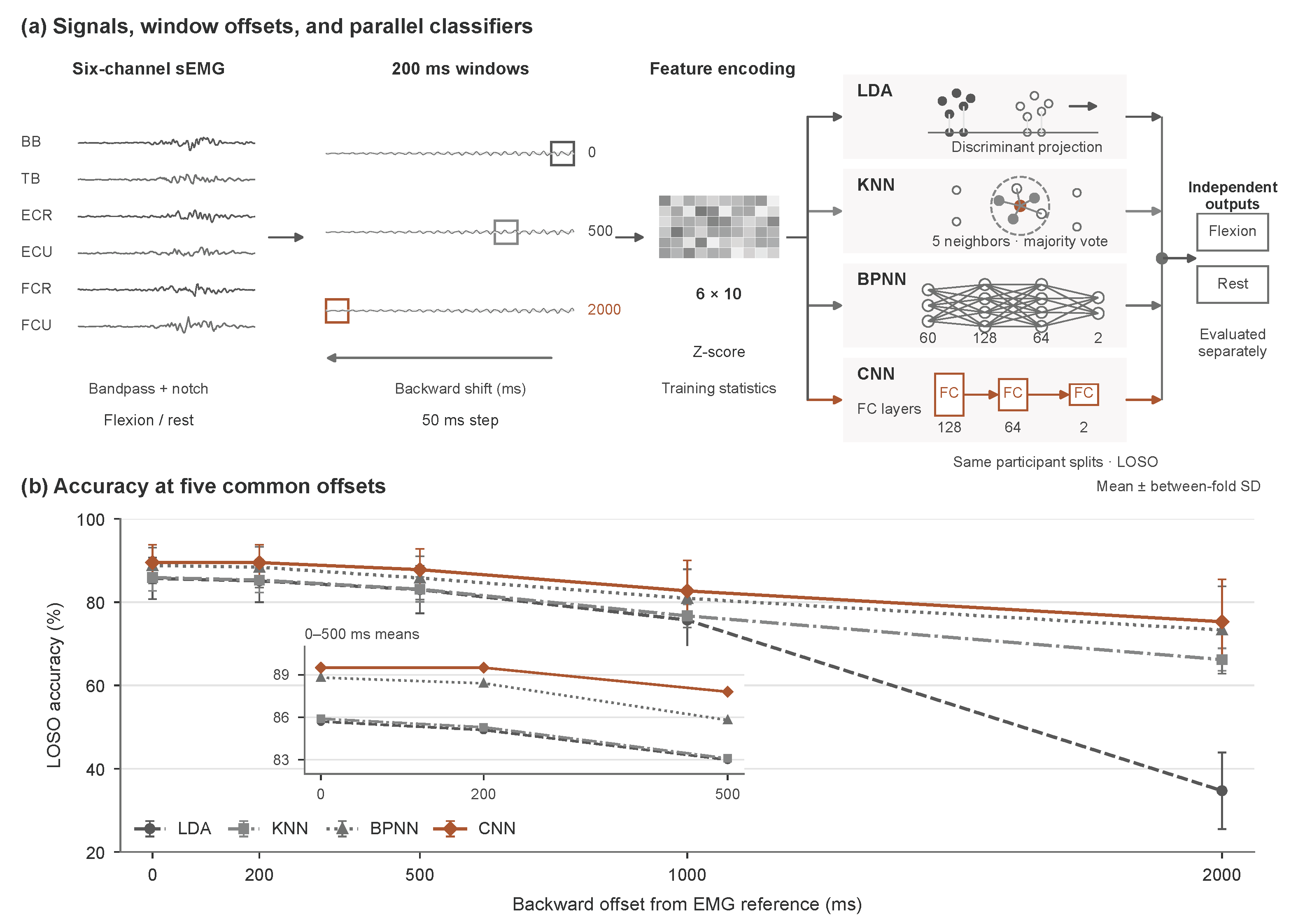

Table 1.
Muscle Channels and Sampling Configuration.
| Item | Configuration |
|---|---|
| Upper arm | 1: biceps brachii (BB); 2: triceps brachii (TB) |
| Forearm extensors | 3: extensor carpi radialis (ECR); 4: extensor carpi ulnaris (ECU) |
| Forearm flexors | 5: flexor carpi radialis (FCR); 6: flexor carpi ulnaris (FCU) |
| Sampling | 1000 Hz/channel; 12 bits |
Table 2.
Nine-Class Sample Composition
| Group | Class and number of 4 s samples |
|---|---|
| Elbow | Flexion (EF) 165; extension (EE) 160 |
| Wrist flexion/extension | Flexion (WF) 165; extension (WE) 165 |
| Wrist deviation | Ulnar (UD) 175; radial (RD) 165 |
| Hand | Closing (HC) 160; opening (HO) 165 |
| Background | BG 1320 |
| Total | Action 1320; background 1320; overall 2640 |
Table 3.
External Transfer Protocols and Target Splits.
| Protocol | Shared muscles; output | Development-stage split (train/dev/test participants) | Label budget; repetitions |
|---|---|---|---|
| WristMotion [18] | ECR, ECU, FCR; 4 classes | 31/7/7 | 4–800 trials; 5 |
| Izmir9 [17] | ECR, ECU, FCR, FCU; 9 classes | 28/6/6 | 9–1,260 trials; 20 |
| Lucchetti ADL6 [19] | BB, TB, FCR, ECR; 6 classes | 6/2/2 | 6–162 trials: 30; all 179: 1 |
| FCU grip force [34] | FCU; continuous force | 7/3/3† | 10–10,775 windows; 3 |
Note: ADL6 uses 30 paired draws at limited budgets and one full set of 179 trials. †The final FCU candidate pool combines training and development participants; three test participants remain independent.
Table 4.
Low- and Maximum-Budget External Results.
| Protocol | Budget* | Target-only | Transfer | Paired gain |
|---|---|---|---|---|
| WristMotion | 4 | 43.50 | 57.71 | +14.21 |
| WristMotion | 800 | 67.20 | 69.36 | +2.16 |
| Izmir9 | 9 | 32.74 | 46.43 | +13.69 |
| Izmir9 | 1,260 | 89.26 | 88.52 | |
| Lucchetti ADL6 | 6 | 35.50 | 36.89 | +1.39 |
| Lucchetti ADL6 | 179 | 75.00 | 80.00 | +5.00 |
| FCU grip force | 10 | 0.2574 | 0.3279 | +0.0706 |
| FCU grip force | 10,775 | 0.6431 | 0.6899 | +0.0468 |
Budgets: classification trials or force windows. Classification: BA (%) and gains in pp; grip force: participant-averaged and its difference. Gains use unrounded values. Maximum evaluated budgets need not exhaust target training data
Disclaimer/Publisher’s Note: The statements, opinions and data contained in all publications are solely those of the individual author(s) and contributor(s) and not of MDPI and/or the editor(s). MDPI and/or the editor(s) disclaim responsibility for any injury to people or property resulting from any ideas, methods, instructions or products referred to in the content. |
© 2026 by the authors. Licensee MDPI, Basel, Switzerland. This article is an open access article distributed under the terms and conditions of the Creative Commons Attribution (CC BY) license (http://creativecommons.org/licenses/by/4.0/).
Copyright: This open access article is published under a Creative Commons CC BY 4.0 license, which permit the free download, distribution, and reuse, provided that the author and preprint are cited in any reuse.