

Submitted:
19 October 2026
Posted:
20 October 2026
You are already at the latest version
Abstract
Natural materials offer chemical diversity, but their translation into reproducible nano-enabled products depends on decisions made before carrier selection. This critical review examines development as a source-to-ingredient-to-product continuum. Five thematic searches in PubMed/MEDLINE, Scopus, and Web of Science Core Collection yielded 615 exported records and 375 unique references after deduplication. Exploratory title, abstract, and keyword mapping identified stronger explicit signals for carrier design and biological performance than for source traceability and supply feasibility; these search-dependent patterns are not prevalence estimates. The proposed Natural Material-to-Product Stage-Gate Framework organizes development into 15 stages, from intended-product definition and source qualification through ingredient processing, chemical standardization, formulation, efficacy, safety, manufacturing, and translational readiness. Each gate uses product-specific criteria to assign GO, CONDITIONAL GO, or NO-GO. A source-to-product mass balance, a conceptual evidence-maturity hierarchy, and a Minimum Development Dataset support planning and transparent reporting. Reproducibility, safety, scalability, and sustainability are assessed throughout. Illustrative product benchmarks distinguish public evidence from proprietary information and commercial availability from demonstrated clinical benefit. The framework is an evidence-informed decision aid that requires prospective evaluation; it is neither a validated readiness score nor a substitute for application-specific regulatory requirements.
Keywords:
natural products
; nano-enabled formulations
; stage-gate
; chemical standardization
; qualityby design
; translational readiness
; reproducibility
; sustainability
1. Introduction
Natural materials provide chemically diverse ingredients for pharmaceutical, biomedical, food, cosmetic, and agricultural applications. Their development is nevertheless constrained by variation in identity, composition, recovery, stability, and biological exposure. Plant extracts, essential oils, fixed oils, hydrolates, oleoresins, natural fractions, and isolated phytochemicals are not interchangeable inputs: each carries a distinct source history and processing burden. Renewable origin also does not establish reproducibility or environmental benefit. Solvent demand, energy consumption, source productivity, and waste must be considered alongside functional performance [1].
Soft nanocarriers can address poor aqueous dispersibility, volatility, degradation, or inadequate target-site exposure. Liposomes, nanoemulsions, lipid particles, polymeric nanoparticles, micelles, and gel-based delivery systems offer different mechanisms and constraints. Reviews of plant-derived anticancer delivery and food-related nanomaterials document substantial formulation progress but continuing problems with standardization, manufacturing, toxicology, and translation [2,3]. A favorable particle-size measurement or biological response therefore establishes only one part of a development case.
Existing roadmaps already connect formulation science with translational questions. Thomas et al. [4] address nano-phyto formulations in drug-resistant brain cancer; Yang et al. [5] connect plant-derived exosome-like nanovesicles with therapeutic development; and Panza et al. [6] integrate botanical topical delivery with standardization and sustainability. Plant-derived exosome-like nanoparticles (PELNs) illustrate the unresolved interface between source and product: variable isolation, cargo composition, dosing metrics, and critical quality attributes (CQAs) complicate reproducibility and chemistry, manufacturing and controls (CMC) [7]. The broader framework of Segneanu et al. [8] similarly identifies heterogeneity across extracellular-vesicle, engineered, hybrid, and bioinspired carriers. These contributions motivate a practical architecture that makes upstream ingredient and supply decisions as explicit as downstream formulation decisions.
Quality by Design (QbD) provides an established basis for linking product objectives, material attributes, process parameters, and control strategies [9]. Its relevance to natural-material formulations is supported by work on transferosomes, flavor and fragrance delivery, and phytochemical nanotherapeutics [10,11,12]. However, its implementation should include source variability rather than begin from an assumed invariant payload. Likewise, stage-gate product-development methods predate their use in natural-material nanoformulation [13]. The contribution proposed here is therefore the application and integration of established decision principles, not the invention of staged product development.
Primary studies show why the evidence chain needs explicit controls. Essential-oil nanoemulsification can improve dispersion and antimicrobial performance, but interpretation depends on composition, actual exposure, comparator selection, and stability methods [14,15]. Human pharmacokinetic studies can establish an exposure-related benefit, while providing a different level of evidence from clinical efficacy or long-term safety [16,17]. Connecting these distinctions to practical progression decisions requires more than a catalog of carriers.
The present review proposes the Natural Material-to-Product Stage-Gate Framework, an evidence-informed, 15-stage guide from intended-product definition to translational readiness. An explicit Target Natural Ingredient decision determines whether the upstream route involves extraction, distillation, pressing, enrichment, isolation, microbial recovery, or qualification of a purchased compound. Three complementary tools support the pathway: a Source-to-Product Mass Balance, a conceptual Translational Evidence Maturity hierarchy, and a Minimum Development Dataset (MDD). Reproducibility, safety, scalability, and sustainability are revisited at every gate. The architecture is designed for adaptation across products and jurisdictions; numerical criteria and regulatory obligations must remain specific to the intended use [1,6,18].
An illustrative essential-oil pathway is shown in Figure 1. In this hypothetical example, the intended product determines how the botanical source is authenticated and which ingredient is targeted. The oil is then recovered by distillation, with the hydrolate as a possible co-product, and chemically standardized before an oil-in-water nanoemulsion is justified, designed, and optimized. The resulting formulation requires physicochemical characterization, stability and performance studies, biological testing against a dose-matched free-oil comparator and a blank carrier, and biosafety assessment. Pilot-scale reproducibility, packaging, and specifications must then be confirmed before readiness for a named milestone can be assessed. The six illustrated steps group the 15 stages of the framework; progression remains conditional on evidence, with feedback to earlier decisions when requirements are not met.
2. Literature Search Strategy and Framework Development
This article was designed as a critical review with a structured literature search rather than as a systematic review or meta-analysis. The search was intended to map the secondary literature relevant to development pathways and to identify competing or complementary frameworks, recurrent translational barriers, and evidence domains needed for the proposed roadmap. PubMed/MEDLINE, Scopus, and Web of Science Core Collection were searched for publications indexed from 1 January 2000 through 30 September 2026. The main database phase was restricted to review articles so that broad methodological and translational patterns could be compared across application areas. The reporting logic was informed by the transparency principles of PRISMA 2020, although the objectives and synthesis were those of a critical framework-building review rather than a systematic review or meta-analysis [19].
Five complementary searches were used. Search 1 targeted full development roadmaps and translational frameworks at the intersection of natural materials and nanotechnology. Search 2 emphasized biomass, supply, traceability, processing, and standardization. Search 3 focused on characterization, biosafety, scale-up, manufacturing, and translation. Search 4 addressed preformulation and rational nanocarrier design, whereas Search 5 targeted QbD, design of experiments (DoE), and formulation/process optimization. Search syntax was adapted to each database field structure. The 15 exported result sets contained 615 records in total: 62 from Search 1, 131 from Search 2, 247 from Search 3, 73 from Search 4, and 102 from Search 5. The database-level distribution is summarized in Table 1. No language filter was applied in the initial retrieval.
The interpretive scope prioritized natural small-molecule or multicomponent ingredients and soft nano-enabled delivery systems. Plant extracts, essential oils, fixed oils, hydrolates, oleoresins, natural fractions, and isolated phytochemicals formed the principal development cases, together with nanoemulsions, lipid-based carriers, polymeric nanoparticles, micelles, liposomes, and nanogels. Microbial products were retained where the same source-to-ingredient logic was transferable. In contrast, green-synthesized metallic or inorganic nanoparticles, macromolecular biologics, and nanoscale devices were not treated as primary framework cases unless they informed a transversal issue such as reproducibility, safety, scalability, or sustainability [1,8,20].
Here, “nano-enabled” is an operational description of a formulation containing a characterized nanoscale or submicron entity relevant to its function; it does not assert that every system satisfies the same legal nanomaterial definition. A macroscopic gel containing nanostructures should be distinguished from a dispersion of discrete nanogel particles, and carrier terminology should follow the measured structure. Naturally recovered vesicles and reassembled plant-lipid carriers also require separate descriptions of origin and processing.
Deduplication was performed hierarchically using digital object identifier, PubMed identifier, and normalized exact title. Duplicate removal within the five thematic searches reduced 615 records to 419 search-level unique records; cross-search deduplication then yielded 375 globally unique references. No merged duplicate cluster contained conflicting DOI or PMID identifiers. Three records retrieved within the search window carried 2027 bibliographic volume-year labels despite being available or indexed during 2026. These were retained as horizon-scanning records in the working dataset but were not used to establish historical prevalence or priority claims.
Titles, abstracts, and keywords were initially mapped to a 14-domain draft framework using explicit lexical and conceptual signals. During critical synthesis, the upstream pathway was refined by separating Target Natural Ingredient Definition from source identity, biomass feasibility, processing, and chemical standardization, producing the final 15-stage architecture used in this review. The original signal counts were therefore realigned to the corresponding final stages without being re-estimated; Stage 2 has no independent lexical count because it was introduced after the initial screening-level coding. Counts are non-exclusive: one review may contribute to several domains. A zero count, including that for Stage 0, means that the selected signals were not detected; it does not demonstrate absence of discussion or absence of an intended-product rationale. In the aligned framework, carrier selection/formulation design (Stage 7), biological efficacy (Stage 11), preformulation/nano-enabling rationale (Stage 6), stability/performance (Stage 10), biosafety (Stage 12), and translational readiness (Stage 14) were highly represented, whereas explicit signals for source traceability, biomass feasibility, and primary processing were comparatively sparse. Because the search strategies were not designed to estimate prevalence and because a topic can be discussed without appearing in an abstract, these counts are interpreted as indicators of emphasis rather than formal frequency estimates (Table 2).
The comparison with existing frameworks focused particularly on the 41 unique records retrieved by Search 1. Several publications already proposed translational, regulatory, materials-to-clinic, or application-specific roadmaps. Thomas et al. [4] proposed a roadmap for nano-phyto formulations in glioblastoma, Yang et al. [5] established a materials-to-clinic perspective for PELNs, and Panza et al. [6] connected phytochemistry, delivery science, sustainability, and safety in topical formulations. These studies delimit the novelty claim of the present work: the contribution is not the generic idea of a “roadmap,” but the integration of upstream source feasibility with downstream formulation, safety, manufacturing, and product-readiness gates across multiple natural-material classes and soft nano-enabled platforms.
Secondary-literature synthesis was supplemented by selected primary studies identified through targeted citation tracking to illustrate how individual experimental decisions influence later stages. These studies were used as mechanistic or translational examples and were not added to the quantitative search counts. Examples include solvent-free essential-oil nanoemulsification [14], human pharmacokinetic evaluation of nanoparticle curcumin [16], ginger-derived nanovectors [21,22], a long-term nanoemulsion optimization study [15], and developmental safety assessment of an essential-oil nanogel [23]. This two-level evidence strategy allowed broad framework construction from review literature while retaining experimentally grounded examples where they materially clarified a gate decision. For the stage-level narrative synthesis, representative reviews from the 375-record corpus were prioritized when they directly informed a gate decision, provided transferable evidence across application sectors, or exposed recurring translational constraints; the corpus was not intended to be cited exhaustively.
A separate, targeted translational-benchmarking step was performed after framework construction to test the Stage-Gate logic against named products or commercial formulation platforms for which both a defined nano-enabled system and a verifiable market or regulatory status could be identified. Regulatory databases, current manufacturer or product pages, and peer-reviewed human studies were used for this purpose. These benchmark cases were illustrative rather than exhaustive and were not added to the 615-record database count. Foundational stage-gate, reporting, and quality-development sources were also used as contextual references outside that count. Products supported only by promotional use of the term “nano” without adequate public evidence of formulation identity were not included.
Because the objective was framework construction rather than estimation of a pooled intervention effect, no meta-analysis, formal risk-of-bias assessment, or certainty-of-evidence grading was performed. The database corpus was used for thematic mapping and novelty analysis, whereas the selected primary studies functioned as illustrative cases; they were not treated as a quantitatively weighted evidence tier. The reviews can share underlying primary studies, so the 375 records are not 375 independent bodies of experimental evidence. Search emphasis, abstract availability, indexing, lexical sensitivity, and the post hoc refinement of the stages can influence the mapping. No statistical comparison of domain frequencies is inferred. This distinction is consistent with the article’s critical-review design and avoids implying the evidentiary claims of a systematic review [19].
The stage definitions, gate outcomes, and MDD are an interpretive synthesis of development requirements. They have not been prospectively validated as predictors of translation, assessed for inter-rater reliability, or calibrated as a numerical readiness score. Product benchmarks assess whether the proposed domains are useful for organizing public information; they do not validate the framework’s predictive performance.
3. Defining the Intended Product, Natural Source, and Target Ingredient
3.1. Stage 0: Start with the Intended Product, Not with the Nanocarrier
A recurring weakness in nano-enabled natural-product development is that the experimental sequence often begins with a favored carrier rather than with a clearly defined product need. Stage 0 therefore requires an Intended Product and a preliminary Target Product Profile (TPP) before materials are optimized. The TPP should identify the application, route, target population or biological system, expected performance, comparator, dosage form, storage conditions, manufacturing constraints, and major safety requirements. This approach changes the development question from “Can this extract be nanoencapsulated?” to “What product problem must be solved, and is nano-enabling a rational way to solve it?” The distinction is consistent with the translational concerns identified across plant-derived drug-delivery systems, where formulation complexity can increase faster than clinical value if the product need is not clearly defined [2,8].
The importance of this product-first logic is apparent across sectors. Singh et al. [24] reviewed nano-engineered botanical pesticides and showed that the central field problem is not merely encapsulation but insufficient residual activity caused by photodegradation, oxidation, volatility, poor water solubility, and limited target-site availability. Cheng et al. [25] reached a parallel conclusion for intranasal essential oils, where rapid central delivery must be balanced against dose control, composition, mucosal safety, and the pharmacological suitability of the nose-to-brain route. In food applications, Zhou et al. [26] emphasized that cinnamon essential-oil delivery systems must satisfy packaging, sensory, stability, and industrial requirements rather than simply minimize droplet size. These examples demonstrate that the same natural source can support fundamentally different product specifications depending on the intended use.
3.2. Stage 1: Natural Source Identity and Traceability
Natural-source identity is the first reproducibility gate and should be established before extraction, isolation, or formulation begins. For botanical materials, the minimum source definition includes taxonomic identity, plant part, origin, harvest stage, preprocessing, storage, and supplier or collection history. Newly collected botanical material should be authenticated and linked to a deposited voucher, with herbarium and accession information; qualified commercial ingredients require an appropriate, traceable identity specification. For an already isolated phytochemical purchased to compendial or analytical specifications, source control can instead emphasize supplier qualification, identity, purity, and lot traceability. Li and Kang [27] described how ginseng translation remains limited by composition changes associated with cultivation and processing even though ginsenosides are well-characterized pharmacological constituents, illustrating that advanced delivery cannot compensate for an undefined input material.
The problem becomes more visible when whole-plant resources are considered. Lan et al. [28] examined Lycium barbarum and argued that fruit-centered research can obscure tissue-specific distributions of polysaccharides, phenolics, carotenoids, and alkaloids, thereby weakening processing–property–bioactivity relationships. Shifa et al. [29] similarly reviewed Albizia procera and concluded that further translation requires active-constituent isolation, standardization, toxicity profiling, formulation development, and sustainable cultivation. These reviews converge on a practical point: the identity of a botanical starting material should include the biological and processing context needed to reproduce its composition, not only the Latin binomial.
Traceability should also be proportionate to application risk. A topical cosmetic botanical may require a different level of source control than an injectable medicinal product, while agricultural formulations need documentation compatible with field deployment and environmental assessment. Panza et al. [6] showed that advanced botanical topical products increasingly combine phytochemical standardization with green extraction, safety-by-design, and sustainability claims. The present framework therefore treats traceability as an enabling data layer that follows the candidate through all subsequent gates; changes in supplier, geography, crop year, strain, extraction site, or upstream processing route should trigger evaluation of whether the resulting ingredient remains equivalent.
3.3. Stage 2: Target Natural Ingredient Definition
After the source has been authenticated, development should explicitly define what material is actually intended to enter formulation. This decision is distinct from source identification. A medicinal plant can be developed as a crude extract, an enriched fraction, a purified or isolated compound, an essential oil, a hydrolate, a fixed oil, or another chemically defined preparation, and each choice creates a different processing, analytical, mass-balance, safety, and scale-up pathway. The same principle applies to non-botanical natural sources: a microorganism may be used as the source of an extracellular or intracellular metabolite, biopolymer, lipid, pigment, or other recovered product rather than being treated as a formulation ingredient in its original biological form. Separating source identity from target-ingredient definition prevents fundamentally different materials from being grouped under the generic label “natural product” [1,6].
For conventional botanical biomass such as leaves, bark, roots, flowers, or aerial parts, the first branching question is whether the desired ingredient is a multicomponent extract or a more chemically resolved material. If the product concept requires a crude or standardized extract, development can proceed to extraction and concentration. If a specific chemical family is desired, the route should include fractionation or selective enrichment. If a single molecule is required, the pathway should continue through isolation, structural confirmation, and purity assessment before preformulation. Reviews of chilli oleoresin and medicinal botanicals show that processing route and degree of purification materially alter recovery, composition, scalability, and downstream applicability [29,30].
Other source types require different upstream operations. Aromatic plants may be directed toward essential-oil production, hydrolate recovery, or both; oil-rich seeds and fruits may require pressing, solvent extraction, or supercritical-fluid processing to obtain fixed oils; and microbial sources require strain identity, controlled cultivation or fermentation, product recovery from biomass or broth, and purification proportional to the intended ingredient. Conversely, if a chemically defined natural compound is already available from a qualified supplier, the extraction branch can be bypassed after identity, purity, residual-solvent, and supply criteria are verified. These routes should ultimately converge only after the intended ingredient has been obtained and can be chemically characterized and standardized [1,31].
The source-specific decision pathway is summarized in Figure 2, which follows the same order as Table 3: source (Stage 1), target ingredient (Stage 2), and processing route (Stage 4). The required upstream route depends not only on the biological origin of the material but also on the form of the natural ingredient intended to enter formulation. Botanical biomass may therefore proceed toward a crude or standardized extract, an enriched fraction, or an isolated compound, whereas aromatic plant materials, oil-rich seeds or fruits, microbial sources, and previously isolated natural compounds require distinct processing strategies before converging at chemical characterization and standardization.
4. From Source-Specific Processing to a Standardized Ingredient
4.1. Stage 3: Biomass and Supply Feasibility
A natural material can be scientifically attractive yet translationally unrealistic if the required source cannot be supplied at the intended product scale. Biomass feasibility should therefore be assessed before extensive formulation optimization and should be interpreted according to the source defined in Stages 1–2. For a botanical material, the relevant questions include annual or seasonal availability, cultivated versus wild origin, regeneration time, geographical concentration of supply, competing uses, price volatility, legal access, storage requirements, and the fraction of harvested material that becomes the intended ingredient. Ma et al. [32] reviewed industrial crop-derived green nanomaterials and emphasized that feedstock design and functional matching are inseparable from downstream translational feasibility. Likewise, Li and Kang [27] described cultivation and processing variability as major constraints even for the globally established ginseng supply chain. Waste-derived feedstocks can reduce competition with primary biomass, but they do not remove upstream development requirements: Sharaf et al. [33] showed that extraction, stabilization, and nanoencapsulation remain coupled when fruit- and vegetable-waste phytochemicals are advanced toward therapeutic use.
Supply feasibility should not be reduced to kilograms of plant biomass. Different target ingredients have radically different recovery efficiencies, and non-plant sources require analogous supply metrics. Kaspute et al. [31] reported that conventional essential-oil extraction commonly yields only a small fraction of starting plant mass and argued for integration of advanced extraction, sustainability, and nanotechnology to improve utilization. Isolated phytochemicals may incur substantial losses during fractionation and purification, fixed oils depend on seed or fruit oil content and extraction efficiency, and microbial products depend on strain productivity, fermentation titer, recovery, and downstream purification. Hydrolates require a particular interpretation because they may be recovered as co-products of essential-oil distillation; in such cases, source allocation and recovery should reflect the coupled production process rather than treating the hydrolate as an independent extraction stream. Consequently, a candidate with excellent in vitro activity but limited source availability and poor overall recovery can become a NO-GO before expensive formulation and biological development begins [1,31].
4.2. Source-to-Product Mass Balance: An Early Feasibility Tool
An early mass balance makes cumulative ingredient losses explicit. For a mass-based route with consistent material definitions,
where is the required source mass on a stated wet- or dry-mass basis, is the mass of accepted final product, and is the required ingredient mass fraction in that product. is the recoverable ingredient mass per unit source mass; the remaining terms are sequential recovery fractions of that same tracked material during downstream processing, incorporation, and manufacturing. Water, solvent, polymer, surfactant, and other added materials are separate inputs, not recovered natural ingredient. For multicomponent extracts, the tracked basis must be stated explicitly, for example dry extract solids or specified marker equivalents. A change from crude extract to purified compound requires a compositional conversion as well as a recovery term.
is the fraction of ingredient retained after the incorporation operation. It is not automatically equal to encapsulation efficiency: an unencapsulated fraction that remains in the accepted formulation is not a process loss. If free material is removed, the removed mass enters the loss balance. accounts only for subsequent losses, preventing the same loss from being counted twice. If the product specification concerns encapsulated material alone, the numerator and every recovery term must instead refer to that explicitly defined fraction.
As a hypothetical planning example, a 100-kg product batch containing 1.0% ingredient requires 1.0 kg of retained ingredient. With , , , and , the source requirement is approximately 73.1 kg (Figure 3). If primary yield falls to 0.01 while the other terms remain unchanged, demand doubles to 146.2 kg. These values illustrate the calculation and are not measurements from a reviewed study. Pilot planning should use plausible yield ranges and source-lot variability rather than a single optimistic estimate.
The basis must be adapted to the route. Fermentation may be planned from broth volume and measured titer rather than a botanical mass yield. Hydrolates require recovery volume, constituent concentration, and allocation within the coupled oil–hydrolate process; their bulk aqueous mass cannot be interpreted as recovered botanical solids. The equation is therefore a planning identity, not a universal yield model. Whole-process feasibility additionally requires balances for water, solvents, excipients, energy, and waste.
4.3. Stage 4: Extraction, Processing, Fractionation, or Isolation
Once the target ingredient has been defined, the upstream process should be selected to obtain that ingredient rather than applying a generic extraction procedure to every natural source. Processing is not merely a preparative step; it determines the chemical space that ultimately enters formulation development. Extraction is therefore only one branch of Stage 4. Kumar et al. [30] reviewed chilli oleoresin and showed that conventional, microwave-assisted, ultrasound-assisted, enzyme-assisted, supercritical-fluid, and pressurized-fluid extraction produce different trade-offs in recovery, solvent use, scalability, and regulatory acceptability. Their analysis linked extraction selection directly to downstream applicability, reinforcing the need to report yield and composition together. Kaspute et al. [31] reached a similar conclusion for essential oils, where volatile recovery can be improved through advanced processing but must be evaluated against energy demand, thermal degradation, volatile losses, and scale-up complexity. Chauhan et al. [34] reached an analogous conclusion for plant- and algal-derived mucilages, showing that biological source and extraction conditions can alter yield, composition, and structure–function relationships; this reinforces the need to treat processing history as part of the ingredient definition rather than as background methodology.
For a crude or standardized extract, Stage 4 should define preprocessing, solvent or extraction medium, solid-to-liquid ratio, time, temperature, energy input, clarification, concentration, and drying where applicable. If an enriched fraction is required, the process may continue through liquid–liquid partition, precipitation, adsorption, membrane separation, or another selective fractionation method. If the target is an isolated natural compound, the relevant development variables shift toward fraction recovery, chromatographic loading, selectivity, solvent demand, crystallization or polishing, purity, and cumulative yield. These operations should be assessed as a connected process because an apparently efficient isolation step may still be translationally weak when preceded by low extraction recovery or followed by high purification losses [29,30].
Source-specific routes should be treated explicitly. Essential oils and hydrolates require control of distillation conditions, volatile recovery, phase separation, and storage; fixed oils require control of pressing or extraction conditions, oxidation, moisture, and lipid composition; and microbial products require strain-controlled cultivation or fermentation followed by recovery from broth or biomass and purification according to the intended product. Naturally assembled carriers can introduce another source-dependent route: Mallillin et al. [35] reviewed plant oleosomes and linked botanical sourcing, recovery strategy, interfacial composition, and downstream delivery performance. An already isolated compound can bypass extraction only when identity, purity, degradation, residual solvent, and supply specifications are sufficient for the intended application. The GO decision at Stage 4 therefore requires a reproducible, scalable, and chemically appropriate route to the ingredient defined at Stage 2, not merely successful recovery of some bioactive material [1,31].
Processing decisions can also alter the formulation rationale. If an upstream procedure already produces a stable water-dispersible fraction, nano-enabling may add little value. Conversely, an oil rich in volatile hydrophobic constituents may justify a carrier specifically designed to control evaporation and oxidation. Gündel et al. [14] deliberately used an organic-solvent-free, temperature-controlled method to formulate Cymbopogon flexuosus oil, thereby aligning processing with the volatility of the payload. This illustrates a broader principle: upstream processing and formulation should be co-designed so that one stage does not create an instability that a later stage must unnecessarily repair.
4.4. Stage 5: Chemical Characterization and Standardization
Chemical characterization and standardization convert the processed natural material into a formulation-ready ingredient. This stage is deliberately separated from Stage 1: Stage 1 verifies what the source is, whereas Stage 5 verifies what was obtained from that source. The minimum strategy should identify relevant markers or a reproducible fingerprint, quantify constituents when appropriate, define batch acceptance ranges, and use methods capable of detecting degradation, adulteration, or process-related shifts. For chemically complex materials, one marker may be insufficient because biological activity can depend on ratios or synergistic ensembles. Panza et al. [6] highlighted botanical standardization as a persistent challenge even when advanced delivery and sustainability strategies are available, whereas Sun et al. [7] showed that source heterogeneity and insufficiently defined CQAs similarly limit PELNs. Ferreira et al. [36] extended this quality-control logic to essential-oil-loaded lipid nanocarriers, explicitly connecting physicochemical attributes and stability with safety and efficacy rather than treating chemical identity as a stand-alone endpoint.
A practical standardization strategy should be linked both to the ingredient selected at Stage 2 and to its intended function within the final product. An essential oil intended for antimicrobial delivery may require gas-chromatographic quantification of dominant and safety-relevant constituents; an extract may require chromatographic fingerprinting with selected quantitative markers; a hydrolate may require sensitive volatile profiling because relevant constituents occur at lower concentrations; a fixed oil may require fatty-acid, oxidation, and physicochemical specifications; an isolated phytochemical should have identity, purity, residual-solvent, and degradation specifications; and a microbial metabolite requires identity and purity or compositional criteria appropriate to its intended use. Chemical data should then follow the material through loading, stability, release, efficacy, and safety studies. Without this continuity, an observed “nano-effect” may reflect different starting compositions rather than a true effect of formulation technology [27,29].
5. From Preformulation to Rational Nanoformulation Design
5.1. Stage 6: Demonstrating a Nano-Enabling Rationale
Nanotechnology should solve a demonstrated development problem rather than serve as an automatic endpoint. Stage 6 therefore asks whether the free natural material has a limitation that is mechanistically addressable by a nanoscale delivery strategy. Typical limitations include low aqueous solubility, volatility, oxidation, photodegradation, rapid metabolism, poor membrane permeability, limited target-site retention, uncontrolled release, or unfavorable sensory properties. Gali et al. [20] reviewed biopolymer- and lipid-based carriers for plant ingredients and emphasized that nanoencapsulation is most defensible when poor stability, solubility, processing tolerance, or bioavailability constrain direct use. Kee et al. [37] similarly framed resveratrol nano/microformulation around its delivery limitations rather than around carrier novelty alone. Jacob et al. [38] placed nanotechnology within a broader toolbox for poorly water-soluble drugs and phytochemicals, alongside conventional solubilization, solid-state, complexation, and lipid-based approaches; this comparison is important because a nanosystem is justified only when it offers a material advantage over simpler enabling strategies.
The value of this requirement is demonstrated experimentally. Gündel et al. [14] developed Cymbopogon flexuosus nanoemulsions specifically because the essential oil is volatile and unstable, and the nanoformulation improved antimicrobial behavior under the tested conditions. Haghbayan et al. [15] optimized Callistemon citrinus nanoemulsion variables and obtained a stable formulation with a mean size of approximately 33 nm; the optimized formulation showed lower antimicrobial minimum inhibitory concentration (MIC) values than the free oil, including 62.5 versus 250 mg mL−1 against Fusarium oxysporum and 0.256 versus 4 mg mL−1 against Escherichia coli. These findings support further evaluation of the formulation rationale under the reported conditions. They do not, by themselves, establish dose equivalence, comparative safety, or a complete Stage 11 GO; those decisions require examination of the controls and exposure basis.
A NO-GO at this stage should remain scientifically acceptable. If a conventional emulsion, cosolvent-free gel, cyclodextrin complex, or other simpler system meets the TPP with adequate stability and performance, moving to a nanocarrier may increase cost, analytical burden, and regulatory complexity without proportional benefit. This is particularly relevant in agriculture and food, where Singh et al. [24] and Zhou et al. [26] noted that commercial feasibility depends strongly on raw-material cost, field or matrix behavior, processing equipment, and scalability. Zaman et al. [39] similarly framed essential-oil nanoencapsulation around concrete liabilities—volatility, low water miscibility, photo-oxidation, and rapid dissipation—and linked formulation choice to agronomic deployment. The framework therefore treats “no need for nanotechnology” as a valid development conclusion rather than a failed research outcome.
5.2. Stage 7: Nanocarrier Selection and Formulation Design
Once the nano-enabling problem is defined, carrier choice should follow material properties and product requirements. Nanoemulsions are attractive for hydrophobic oils and lipophilic compounds but require control of interfacial composition, Ostwald ripening, droplet coalescence, and surfactant exposure. Liposomes and nanoliposomes provide bilayer and aqueous compartments and can support hydrophilic/lipophilic co-loading, but phospholipid oxidation, leakage, sterilization, and manufacturing can be limiting. Solid lipid nanoparticles and nanostructured lipid carriers provide solid or semi-solid lipid matrices that can improve chemical protection and controlled release. Polymeric nanoparticles and micelles offer broad design flexibility but introduce polymer quality, residual-solvent, degradation, and process-removal questions. Gel-based nano-enabled systems can be useful for topical delivery where rheology and local retention are product attributes; a bulk gel containing nanoparticles should be distinguished from discrete nanogel particles [8,20,40]. Zuccari and Alfei [41] compared nanosuspension- and nanoemulsion-based strategies for phytochemicals and showed that platform choice must be matched to solubility, bioavailability, and route-specific constraints rather than treated as interchangeable. For topical delivery, Jacob et al. [42] likewise emphasized vesicle composition, deformability, size distribution, surface charge, and encapsulation as coupled determinants of local delivery performance.
Application-specific reviews illustrate why no carrier is universally optimal. Sowmiya et al. [40] discussed phytochemical-loaded nanoliposomes in oncology and linked phospholipid composition, PEGylation, size, surface charge, active targeting, and stimuli responsiveness to pharmacological performance while also emphasizing continuous-flow manufacture and regulatory constraints. Rahmanian et al. [43] reviewed phytochemical nanoformulations for rheumatoid arthritis and highlighted how disease biology, route, immune interactions, and carrier behavior jointly determine translation. Kedia [44] described essential-oil nanoformulations for stored-product pest control, where volatility reduction and environmental behavior are more relevant than tumor targeting. Carrier selection should therefore be justified against the TPP rather than by platform popularity.
Nature-derived nanocarriers introduce additional design possibilities and new standardization burdens. Zhang et al. [22] characterized edible ginger-derived nanoparticles with an average size of approximately 230 nm and demonstrated preferential uptake in intestinal cells and macrophages together with anti-inflammatory effects in colitis models. In a related study, Zhang et al. [21] isolated ginger-derived lipids, reassembled them into nanovectors, loaded doxorubicin, and demonstrated targeted antitumor delivery after folate functionalization. These studies support the functional potential of natural nanocarriers, but later reviews emphasized that source heterogeneity, isolation yield, cargo variability, and CMC definition remain major translational challenges [7,8].
5.3. Stage 8: Optimization, QbD, and Design of Experiments
Formulation optimization should identify the relationships among material attributes, process variables, and CQAs rather than simply select the “best” result from sequential trial-and-error experiments. QbD provides a structured way to translate the TPP into a Quality Target Product Profile (QTPP), define the associated CQAs, relate them to CMAs and CPPs, rank risk, and establish a defensible operating region. Sumant et al. [11] emphasized this logic for flavor and fragrance delivery, while Fernández-García et al. [10] applied QbD concepts to transferosomes from laboratory design toward industrial scale. For natural formulations, QbD should additionally include source-composition variability as a potential material attribute rather than assuming that the active input is chemically invariant.
A practical optimization sequence begins with risk ranking. For a nanoemulsion, oil fraction, surfactant/co-surfactant ratio, energy input, temperature, mixing order, and aqueous-phase composition may influence size, polydispersity, viscosity, physical stability, and release. For a polymeric nanogel, polymer ratio, hydration conditions, pH adjustment, oil or extract loading, shear history, and temperature can affect supramolecular organization, rheology, and biological exposure. Haghbayan et al. [15] explicitly optimized oil fraction, Tween 80 content, and sonication time before accelerated stability testing, exemplifying how process variables can be linked to performance. Broader carrier reviews reach the same process-development conclusion: Jacob et al. [45] compared single-step, emulsification–solvent evaporation, and microfluidic fabrication of lipid–polymer hybrid nanoparticles and highlighted that manufacturing route itself influences reproducibility and scale-up potential. The Stage 8 gate should therefore require an experimentally supported operating region and evidence of robustness to realistic material and process variation. A fitted response surface or an optimum from a small DoE does not alone establish a regulatory design space. In the ICH pharmaceutical context, design space has a defined regulatory meaning and is subject to assessment; outside that context, “studied operating region” is often the more accurate term [9]. Independent confirmation batches, source-lot blocking where relevant, and uncertainty around predicted performance should accompany model-based optimization.
6. Minimum Physicochemical Characterization and Performance Requirements
6.1. Stage 9: Physicochemical and Structural Characterization
Characterization should be selected according to the claims made for the formulation. Dynamic light scattering can provide hydrodynamic size and dispersity but does not establish morphology or molecular localization; microscopy can visualize morphology but often examines dried or otherwise altered samples; zeta potential can inform electrokinetic behavior but should not be treated as a universal stability predictor. Consequently, orthogonal methods are preferable. At minimum, a soft nano-enabled formulation should generally report composition, preparation conditions, particle or droplet size distribution, dispersity, relevant surface properties, morphology, loading or recovery of the natural material, chemical integrity, and product-specific properties such as rheology, mechanical behavior, or osmolality. Sun et al. [7] identified insufficiently defined CQAs and inconsistent dosing metrics as central barriers in PELNs, whereas Segneanu et al. [8] emphasized multiparametric characterization as a prerequisite for comparing nature-derived nanocarriers. Carrier-specific reviews reinforce this requirement: Ferreira et al. [36] treated quality control of essential-oil lipid nanocarriers as inseparable from stability, safety, and efficacy, whereas Jacob et al. [42] identified vesicle size distribution, surface charge, encapsulation efficiency, lipid composition, ethanol content, and deformability as formulation variables that can materially affect topical performance.

Table 4.
Suggested minimum characterization domains for soft nano-enabled formulations containing natural materials. Requirements should be adapted to the intended product and carrier class.
Table 4.
Suggested minimum characterization domains for soft nano-enabled formulations containing natural materials. Requirements should be adapted to the intended product and carrier class.
| Domain | Minimum evidence | Typical complementary evidence |
|---|---|---|
| Composition | Full qualitative/quantitative formulation composition and preparation method | Excipient grade, supplier, lot, source-material fingerprint |
| Particle properties | Size distribution and dispersity under defined conditions | Microscopy, number-based analysis, analytical ultracentrifugation |
| Surface/interfacial behavior | Zeta potential or other relevant surface descriptor | Surface chemistry, interfacial tension, ligand density |
| Payload | Measured recovery and a stated dose basis for marker(s) or active(s) | Encapsulation efficiency and loading capacity with defined denominators; free/associated fractions |
| Chemical integrity | Marker profile before and after processing | Oxidation/degradation products, residual solvents |
| Physical state/structure | Carrier-appropriate orthogonal measurements | Differential scanning calorimetry, X-ray diffraction, spectroscopy, scattering methods |
| Semisolid performance | Rheology where relevant | Texture, spreadability, bioadhesion, injectability |
| Reproducibility | Independent batches, experimental units, and variability estimates | Source lots, operators, scales; biological versus technical replication |
Loading terminology deserves particular attention. Nominal amount added to a formulation is not equivalent to analytically measured loading or encapsulation efficiency. Analytical recovery, encapsulated fraction, and loading capacity should each state their numerator, denominator, separation method, and recovery controls. Rocha et al. [23] explicitly stated that the nominal 1% essential-oil content was not a measured encapsulation efficiency or loading capacity and avoided inferring molecular localization from changes observed by infrared spectroscopy, differential scanning calorimetry, dynamic light scattering, scanning electron microscopy, and atomic force microscopy alone. This type of claim discipline is important because multiple characterization techniques can demonstrate formulation-dependent organization without proving where a chemically complex mixture resides within a nanostructure. The same principle applies to release claims: changes in size or thermal behavior do not demonstrate controlled release unless the payload is analytically quantified over time under a discriminatory release protocol.
Size measurements require a stated dispersion medium, dilution, temperature, viscosity assumptions, and distribution basis. An intensity-weighted light-scattering distribution is not interchangeable with a number distribution, and an inferred number conversion should not be presented as an independent measurement. For biological experiments, report the experimental unit, independent formulation batches, biological replicates, and technical repeats separately; repeated readings of one batch do not demonstrate batch reproducibility. These reporting principles complement the Minimum Information Reporting in Bio–Nano Experimental Literature (MIRIBEL) recommendations [46].
6.2. Stage 10: Stability, Release, and Functional Performance
Stability should be evaluated as retention of the CQAs that matter to the final product. For natural materials, this frequently includes both colloidal stability and chemical stability because a visually unchanged formulation may still undergo oxidation, photolysis, volatilization, or marker loss. Essential-oil nanoformulations illustrate the problem well. Gündel et al. [14] designed temperature-controlled processing to reduce volatile losses, while Haghbayan et al. [15] assessed accelerated conditions and reported stability of the optimized Callistemon citrinus formulation over six months. Zhou et al. [26] nevertheless concluded that industrial cinnamon-oil delivery remains limited by stability, equipment, and raw-material cost, showing that laboratory stability is necessary but not sufficient for manufacturing readiness. Muhoza and Uriho [47] further showed that preservation strategy can create its own trade-offs: in freeze-dried essential-oil systems, matrix architecture and pore structure influence redispersion, encapsulation retention, and susceptibility to oxidative degradation during storage.
Release testing should also be application-relevant. A separation-based assay should establish analytical recovery, membrane adsorption, sink adequacy, and the free-ingredient control so that membrane transport or poor solubility is not misidentified as carrier-controlled release. For topical systems, a sink-condition membrane experiment may be useful for formulation comparison but does not necessarily predict skin retention. For oral systems, gastrointestinal transitions, digestion, mucus, and dilution may alter carrier behavior. Agricultural formulations require release and persistence under UV exposure, rainfall, leaf surfaces, soil, and environmental dilution, whereas active packaging requires migration and release in food matrices. Singh et al. [24] emphasized that field performance of botanical nanoformulations depends on photostability, residual activity, target-site availability, and environmental behavior. In food preservation, Maurya et al. [48] similarly showed that essential-oil nanoemulsion performance must be interpreted in the context of the real food matrix together with toxicity, safety, and regulatory considerations. Functional-performance testing should therefore be selected from the TPP rather than borrowed automatically from pharmaceutical dissolution testing.
Stability and performance can also trade off against biological activity. A more rigid carrier may protect a volatile payload yet release it too slowly; a surfactant may improve dispersion but alter membrane interactions; an inert oil can suppress Ostwald ripening while diluting or retaining active constituents. This is why Stage 10 should evaluate composition, physical stability, chemical stability, release, and functional output together. Stress testing alone should not be extrapolated to a shelf-life claim without an appropriate model and supporting real-time data. Microbiological quality, preservative effectiveness when applicable, and container compatibility are also relevant CQAs. The relevant GO criterion is not simply “no visible phase separation,” but preservation of the attributes required to deliver the intended dose and effect throughout the proposed product life cycle [26,49].
7. Demonstrating Biological Advantage and Biosafety
7.1. Stage 11: Biological Efficacy and Nano-Advantage
A nano-enabled formulation should demonstrate more than biological activity; it should demonstrate a reason to prefer the formulated system over the corresponding non-nano material. Appropriate comparators therefore include the free natural material at analytically matched exposure, the blank carrier, and, when relevant, a conventional formulation or market comparator. Afandi et al. [50] reviewed natural-product nanoemulsions for wound healing and highlighted substantial heterogeneity in formulation attributes and preclinical outcomes, underscoring the difficulty of interpreting biological benefit when formulation and comparator design are inconsistent. A meaningful Stage 11 assessment should identify whether the benefit arises from dispersibility, retained dose, release, target exposure, or another mechanism. Improved delivery is a valid product benefit; it should not be misdescribed as increased intrinsic pharmacological potency. A useful advantage may also be equivalent efficacy with lower exposure, improved stability, or easier application, provided that the trade-off is prespecified and measured.
Primary studies illustrate both strong and ambiguous nano-advantages. Gündel et al. [14] reported that nanoemulsification of Cymbopogon flexuosus oil enhanced antimicrobial and antibiofilm behavior, including activity against Pseudomonas aeruginosa under conditions in which the free oil was not active. Haghbayan et al. [15] reported lower MICs for an optimized Callistemon citrinus nanoemulsion than for the free oil and demonstrated high larvicidal activity. In contrast, an apparent efficacy gain can be uninterpretable if the nanoformulation changes effective concentration, contains bioactive surfactants, or lacks a dose-matched free-material control. The Stage 11 GO decision should therefore depend on a mechanistically credible and experimentally controlled advantage. Colored, turbid, or redox-active natural formulations also require assay-interference controls and, where appropriate, an orthogonal viability or functional endpoint.
Translation ultimately requires that nano-advantage be demonstrated in models relevant to product use. Kanai et al. [16] provided an early human pharmacokinetic example in six healthy volunteers receiving 150 and 210 mg nanoparticle curcumin. The study documented systemic exposure and short-term tolerability, but its sequential dose-escalation design did not provide a concurrent free-curcumin comparison or establish therapeutic efficacy. Comparative pharmacokinetic studies address the formulation comparison more directly [17]. Zhang et al. [22] showed that ginger-derived nanoparticles targeted intestinal tissues and reduced inflammatory signaling in experimental colitis, while Zhang et al. [21] reassembled ginger lipids into nanovectors capable of loading doxorubicin and improving targeted antitumor delivery in vivo. These studies address complementary evidence domains, including pharmacokinetics, biodistribution, and disease-relevant performance. They should not be ranked as if different carriers, payloads, routes, and models formed one controlled comparison. This distinction is also visible at the review level: Sato et al. [51] mapped curcumin nanocarriers for arthritis and found that the evidence base remained predominantly preclinical, with only a small clinical subset, illustrating why formulation success and clinical maturity should not be conflated.
7.2. Stage 12: Biosafety and Benefit–Risk
Safety testing should be designed around the intended route, dose, duration, exposure population, and environmental fate. “Natural” should not be used as a surrogate for safe, and “biocompatible carrier” should not be assumed to make a complex payload benign. Oladipupo et al. [52] reviewed phytochemical nanoparticle delivery and emphasized that safety, formulation complexity, and regulation remain critical to commercialization. Ahari et al. [3] similarly discussed oxidative stress, inflammatory signaling, biodistribution, chronic exposure, and regulatory inconsistency in food-related plant nanomaterials. The relevant safety package is therefore application-specific: systemic therapeutics may require pharmacokinetics, immunotoxicity, organ toxicity, and genotoxicity, whereas agricultural systems require phytotoxicity, non-target effects, environmental persistence, and ecotoxicology.
Controls are essential to attribute toxicity correctly. Rocha et al. [23] evaluated a Pluronic F127/Carbopol 974P nanogel containing Duguetia stelechantha essential oil in zebrafish embryos and observed concentration-dependent mortality, altered hatching, cardiac impairment, and morphological abnormalities at 50–200 g mL−1. The blank polymeric matrix did not reproduce the toxicity profile, indicating that the carrier alone was not responsible for the adverse effects. However, because a free-oil comparator was not included, the study appropriately did not claim that formulation increased or decreased the intrinsic toxicity of the oil. This is an instructive model for Stage 12 reporting: carrier control can identify matrix toxicity, but assessment of nano-induced changes requires matched comparison with the unformulated material.
Benefit–risk should integrate efficacy and safety rather than treat them as separate checklists. A nanoformulation that increases target exposure two-fold but narrows the safety margin may not represent progress; conversely, a formulation that maintains efficacy while reducing off-target exposure can have substantial translational value even without dramatic increases in potency. Sun et al. [7] identified long-term biosafety and pharmacokinetic uncertainty as unresolved problems for PELNs despite their apparent biocompatibility. Singh et al. [24] similarly emphasized non-target and environmental evaluation for botanical pesticides. Soares et al. [53] focused specifically on effects of botanical pesticides on non-target organisms and argued for ecotoxicological evidence before sustainability claims are accepted, while Machado et al. [54] highlighted the same benefit–risk tension for nanobiopesticides intended for modern agriculture. Stage 12 consolidates whether the evidence supports an acceptable application window; it is not the first point at which safety is considered. Hazard identification, excipient suitability, exposure limits, and non-target risks should inform earlier gates. Unresolved risks must be tied to the specific next activity, and a CONDITIONAL GO cannot substitute for safety evidence required before that activity.
8. From Laboratory Batch to Manufacturable Product
8.1. Stage 13: Scale-Up and Manufacturing Readiness
A formulation that performs well in a milliliter-scale laboratory batch is not automatically manufacturable. Scale-up can change mixing time, heat transfer, shear distribution, sonication energy density, homogenization efficiency, solvent removal, oxygen exposure, and hold times, all of which can alter particle formation and payload stability. Fernández-García et al. [10] explicitly connected QbD and transferosome development to industrial scale, demonstrating why process variables must be interpreted relative to equipment and batch size. Sowmiya et al. [40] similarly discussed microfluidic and continuous-flow approaches for phytochemical nanoliposomes, emphasizing that manufacturing route can affect reproducibility as strongly as carrier composition. Peñaherrera-Pazmiño et al. [55] likewise highlighted microfluidics as a means of controlling physicochemical attributes of phytochemical carriers, and Jacob et al. [45] compared fabrication routes for lipid–polymer hybrid nanoparticles in terms of reproducibility and scalability. Together, these examples support treating process architecture as a product variable rather than a late engineering detail.
Essential-oil systems provide a useful case study because scale-up must preserve both colloidal properties and volatile composition. Zhou et al. [26] reviewed cinnamon essential-oil delivery and identified equipment cost, raw-material cost, stability, and process optimization as major barriers to industrialization. Bhuiyan et al. [18] proposed process intensification as a way to connect extraction efficiency, delivery-system manufacture, and digital monitoring in adaptive food systems. Together, these reviews suggest that manufacturing readiness should be evaluated using a process map that identifies unit operations, in-process controls, hold times, expected losses, energy demand, and batch-release CQAs.
Scalability also depends on excipient and material availability. A laboratory formulation may rely on high-purity surfactants, specialty lipids, rare polymers, or analytical-grade solvents that are economically or regulatorily unsuitable at product scale. The same applies to the natural payload: supply variability that was tolerable for a 10-mL batch may become a dominant source of variability during kilogram production. Stage 13 should therefore reconnect with Stages 1–5 rather than treating scale-up as a downstream engineering problem. Segneanu et al. [8] highlighted variable yields and methodological heterogeneity even in plant-derived nanocarriers that are often described as inherently scalable, reinforcing the need for empirical process-yield data.
Manufacturing readiness should also include preservation and packaging. Lyophilization, spray drying, sterile filtration, aseptic processing, or terminal sterilization can change nanostructure and natural-material chemistry. For semisolid systems, filling shear and container interactions can modify rheology or volatile loss. For food and agricultural products, packaging must also consider migration, light exposure, transport temperature, and user dilution. A Stage 13 GO therefore requires demonstration that the formulation can be produced beyond exploratory scale with acceptable reproducibility, resource use, and quality retention; a CONDITIONAL GO is appropriate when the process is plausible but pilot-scale confirmation remains outstanding [6,26].
9. Translational and Final Product Readiness
9.1. Stage 14: Final Product, Regulatory, and Translational Readiness
Regulatory strategy begins with intended use, not with particle size. The same natural nano-enabled system can fall under different regulatory regimes if marketed as a medicine, cosmetic, food ingredient, packaging component, pesticide, veterinary product, or medical-device combination. This classification influences permissible excipients, safety studies, manufacturing standards, labeling, environmental assessment, and the type of efficacy evidence required. Adhikari et al. [56] reviewed genistein–chitosan systems and highlighted regulatory heterogeneity across major jurisdictions together with nanotoxicology and classification uncertainties. Ahari et al. [3] identified analogous differences in nano-specific definitions, safety assessment, and labeling for functional foods.
For medicinal products, final readiness requires a credible CMC package, stability strategy, pharmacology, safety, manufacturing controls, and a clinical-development pathway. Sun et al. [7] argued that reproducible quality-control assays and CMC frameworks are essential for translating PELNs, while Segneanu et al. [8] extended readiness to intellectual property, commercialization, and regulatory strategy. Disease-specific roadmaps reach the same conclusion from different directions: Thomas et al. [4] identified formulation and regulatory barriers in nano-phyto glioblastoma therapy, and Rahmanian et al. [43] described comparable obstacles for phytochemical nanoformulations in rheumatoid arthritis. Saadh et al. [57] broadened this point across medicinal-plant nanovesicular systems, identifying stability, scale-up, toxicity, and regulatory constraints as linked translational barriers. Translation therefore fails when technical performance is disconnected from a product-development pathway.
Readiness also includes economic and operational feasibility. A formulation requiring low-yield biomass, expensive purification, specialized high-pressure equipment, and cold-chain storage may be scientifically reproducible but commercially implausible for a low-margin agricultural or food application. Conversely, a higher-cost formulation may be justified for an oncology product if the therapeutic benefit is substantial. Zhou et al. [26] explicitly linked equipment and raw-material costs to industrialization of essential-oil systems, whereas Panza et al. [6] linked sustainability, upcycling, packaging, and regulatory claims to topical product development. For agricultural essential-oil systems, Zaman et al. [39] additionally identified shelf-life qualification, scalable manufacturing, environmental fate, and compatibility with integrated pest management as practical adoption constraints. Stage 14 should therefore combine regulatory classification, benefit–risk, CMC maturity, intellectual property, cost, packaging, logistics, and market or implementation context.
Clinical or field evidence should be interpreted according to maturity. Human pharmacokinetic evidence for nanoparticle curcumin [16,17] addresses systemic exposure, a different development question from in vitro solubility or therapeutic effectiveness. In agriculture, field-scale performance under rainfall, UV exposure, variable pest pressure, and non-target ecological conditions is more informative than laboratory mortality alone [24]. The final gate should therefore distinguish proof of mechanism, proof of formulation, proof of efficacy, and proof of product feasibility rather than collapsing all positive results into a single concept of “translation.”
This distinction is summarized in Figure 4. Translational readiness should be interpreted as the cumulative maturation of evidence rather than as a binary consequence of obtaining a positive biological result. The evidence levels shown in Figure 4 are not additional Stage-Gate steps; they provide a complementary view of how evidence accumulates across Stages 0–14, and each level indicates the stages that generate most of its evidence. Evidence should progressively demonstrate control of the starting material, formulation reproducibility, a meaningful nano-advantage, biological relevance, acceptable safety, manufacturability, and ultimately product feasibility.
9.2. Translational Benchmarking Against Marketed Products
Marketed products provide a useful external stress test for the proposed framework, but commercial presence should not be interpreted as proof that every upstream and downstream gate is publicly reconstructable. To examine this distinction, Table 5 compares six illustrative nano-enabled products or commercial formulation platforms containing natural-product or natural-product-derived actives. The set deliberately combines regulated medicines with commercially available nutraceutical systems because the amount and type of public evidence differ between these sectors. This is a purposive case set and is subject to selection and commercial-documentation bias. Cases were selected where formulation identity and a public regulatory, manufacturer, or peer-reviewed commercial-use record could be identified. Public regulatory and product documentation was reviewed in October 2026. For SinaCurcumin, commercial and registration descriptions are attributed to the cited clinical publications rather than independently confirmed as current regulatory status. All examples are time-stamped benchmarks rather than permanent classifications. Future changes in product availability, ownership, labeling, manufacturing arrangements, or regulatory status do not alter the framework itself, which is intended to remain applicable independently of the individual commercial examples used here.
The gate assignments in Table 5 are therefore descriptive rather than retrospective GO/NO-GO decisions. The table identifies selected domains supported by accessible documents and the important information those documents do not expose. It does not assign a numerical score or certify that a gate has been passed. This approach avoids assuming that absence of public documentation means that the manufacturer did not generate the information internally.
The comparison reveals two recurrent patterns. First, regulated nanomedicines such as AmBisome, Doxil/Caelyx, and Abraxane provide unusually strong public evidence for downstream identity, efficacy, safety, labeling, and regulatory readiness, yet proprietary upstream production and manufacturing details still prevent complete reconstruction of Stages 1–4, 8, and parts of Stage 13. Second, marketed nutraceutical nanoformulations can be supported by human pharmacokinetic or clinical data while still exposing larger public gaps in source traceability, CQA ranges, manufacturing controls, and scale-up evidence. Market presence is therefore an outcome of a product-specific regulatory and commercial pathway, not a surrogate for complete public documentation of the 15-stage evidence chain.
This benchmarking also clarifies the role of the Minimum Development Dataset proposed later in this review. The MDD is not intended to reproduce proprietary regulatory dossiers; rather, it defines the minimum information needed for the scientific literature to make a source-to-product development claim interpretable. The benchmark set does not represent the cosmetic or agricultural sectors comprehensively. Their omission limits cross-sector conclusions and should not be interpreted as absence of marketed products.
10. The Natural Material-to-Product Stage-Gate Framework
The literature synthesis indicates that development failures arise at different layers: source variability and poor source definition; selection of an inappropriate natural ingredient or processing route; low recovery and inadequate standardization upstream; weak nano-enabling rationale and empirical carrier selection during formulation development; incomplete characterization and comparator design during performance testing; and safety, scale-up, cost, and regulation downstream. Existing reviews identify many of these barriers, but they are usually presented as recommendations rather than as explicit progression decisions [4,6,7,18]. Building on established stage-gate logic [13], the proposed framework organizes the natural-material-to-product pathway into 15 stages with three defined outcomes: GO, CONDITIONAL GO, and NO-GO.
GO means that the minimum evidence required for the next stage has been generated and no critical unresolved risk has been identified. CONDITIONAL GO permits only work that does not depend on a bounded, non-critical evidence gap; the decision must specify a responsible person, closure test, deadline, and prohibited dependent activities. A critical identity, safety, or feasibility failure is not eligible for conditional progression. NO-GO indicates a limitation that undermines product feasibility, reproducibility, safety, scalability, sustainability, or intended use. These decisions are not universal numerical thresholds; acceptance criteria must be set prospectively according to the TPP, source type, target ingredient, carrier type, route, biological target, and applicable regulation [10,11].
A central feature of the framework is that the upstream pathway is branched rather than purely linear. After the intended product and natural source are defined, Stage 2 asks what ingredient must actually be produced. A plant can proceed toward an extract, fraction, isolate, essential oil, hydrolate, or fixed oil depending on the source and product objective; a microbial source can proceed through cultivation and recovery of a defined metabolite or biomaterial; and an already isolated compound can bypass extraction after qualification. These source-specific routes converge at chemical characterization and standardization and then enter a common nanoformulation and translation pathway. This separation avoids treating “natural material” as a single uniform input and makes upstream processing part of the development decision rather than a hidden pre-analytical step [6,30,31].
10.1. Operational Architecture and Gate Decisions
The complete operational architecture is summarized in Figure 5. The flowchart organizes the evidence chain from the source to a standardized ingredient (Stages 0–5) and from nano-enabled formulation to product (Stages 6–14). Source-specific branches within Stage 4 are selected according to the natural source and the intended ingredient (Figure 2), whereas downstream formulation, characterization, efficacy, safety, scale-up, and translational stages converge into a common development pathway. A failure at a later gate should redirect development to the specific earlier stage capable of resolving the identified limitation; Stage 0 is revisited only when the intended product or target product profile itself must change.
As illustrated by the return paths in Figure 5, failure at a downstream gate does not necessarily imply termination of development. Inadequate stability may require return to formulation design or optimization (Stage 10 to Stages 7–8); absence of a meaningful nano-advantage may require reassessment of the original nano-enabling rationale (Stage 11 to Stage 6); safety limitations may require reformulation or reconsideration of the carrier (Stage 12 to Stages 7–8); and manufacturing failure may require revision of process conditions or formulation composition (Stage 8) or even of upstream processing and ingredient specifications (Stages 4–5). The Stage-Gate structure is therefore sequential in organization but iterative in operation.
Table 6 operationalizes the three progression outcomes. A CONDITIONAL GO can trigger source requalification, reconsideration of the target ingredient, re-extraction, additional fractionation, re-standardization, reformulation, analytical-method improvement, or process optimization followed by reassessment. A NO-GO is reserved for limitations fundamental enough that downstream experimentation would consume substantial resources without addressing the underlying feasibility problem, thereby relocating optimization to the earliest stage capable of solving the failure [1,6].
The four transversal pillars are not separate stages. Reproducibility asks whether the same source-derived ingredient and product can be generated across batches; safety asks whether risk remains acceptable as purification and formulation complexity increase; scalability asks whether source supply, processing route, and manufacturing survive transition beyond exploratory batches; and sustainability asks whether solvent, energy, biomass, culture inputs, waste, and environmental burden are proportionate to the intended benefit. Because these pillars can fail at any point, they should be revisited at each gate rather than assessed only at the end [1,24].
Figure 6 illustrates how reproducibility, safety, scalability, and sustainability operate continuously across the development pathway rather than as isolated end-point assessments. Their specific implications evolve across three phases: source and ingredient (Stages 0–5), formulation and evidence generation (Stages 6–12), and manufacturing and use (Stages 13–14).
10.2. How to Use the Framework in Practice
The framework is intended to be used as a practical decision guide rather than as a checklist that must always begin from zero. A new project should normally start at Stage 0, whereas a research group, technology-transfer team, or company entering development with an established source, standardized ingredient, or pre-existing formulation may begin operationally at a later stage provided that the evidence supporting all preceding stages is retrospectively verified. Progression should remain evidence-based, and a previous GO decision should be reopened whenever new information reveals a source, formulation, safety, manufacturing, sustainability, or regulatory limitation.
The practical operating sequence is summarized in Figure 7. The user first defines the intended product, natural source, and target ingredient, then locates the candidate within Stages 0–14, assembles the minimum evidence required for the relevant gate, and records the decision. A GO supports advancement to the next stage after reassessment of the four transversal criteria; a CONDITIONAL GO allows only independent activities while a defined, non-critical gap is resolved, followed by reassessment; and a NO-GO redirects development to the earliest stage capable of addressing the limitation, prompts redesign, or supports justified termination. A Stage 14 GO supports readiness for the explicitly stated next milestone, such as pilot deployment, a clinical or field program, a regulatory submission, or commercial supply. These milestones require different evidence. A credible regulatory plan alone does not authorize commercialization.
The framework is intentionally technology- and jurisdiction-agnostic. Analytical methods, manufacturing technologies, numerical acceptance criteria, carrier platforms, and regulatory requirements are expected to evolve, whereas the underlying decision domains—identity, supply, ingredient definition, processing, standardization, rationale, formulation, characterization, performance, efficacy, safety, manufacturability, and final-product readiness—are intended to remain applicable. Current standards, validated methods, and regulatory guidance should therefore populate each gate; their version, jurisdiction, and applicability should be recorded in the decision record. In this way, the framework can be updated with new evidence and technologies without changing its underlying decision logic.
11. Minimum Development Dataset (MDD): Evidence Required Before Progression
A recurrent limitation across the literature is that studies report different subsets of information, making apparently similar nanoformulations difficult to compare. The proposed Minimum Development Dataset (MDD) is intended as a reporting floor rather than as a universal regulatory standard. It links each Stage-Gate to the minimum evidence needed to understand what source was used, what ingredient was intentionally produced from it, how that ingredient was processed and standardized, what nanostructure was generated, whether the product was reproducible, and whether biological claims can be interpreted. The MDD complements established bio–nano reporting guidance, including MIRIBEL [46], by making upstream ingredient definition, source demand, recovery, and stage-specific decisions explicit. It is a proposed reporting structure rather than a replacement for existing reporting standards [3,7,8,52].
Table 7.
Minimum Development Dataset (MDD) for reproducible reporting of nano-enabled formulations derived from natural materials.
Table 7.
Minimum Development Dataset (MDD) for reproducible reporting of nano-enabled formulations derived from natural materials.
| No. | Evidence domain | Minimum information to report |
|---|---|---|
| 1 | Intended product | Use, route/application, target, comparator, expected performance, dosage/product form. |
| 2 | Natural-source identity | Species, strain, material identity, plant part/feedstock, origin, supplier, harvest/cultivation/processing metadata where relevant. |
| 3 | Target natural ingredient | Explicit definition of the material intended for formulation: extract, fraction, isolate, essential oil, hydrolate, fixed oil, microbial metabolite/biomaterial, or qualified isolated compound. |
| 4 | Source/supply feasibility | Availability, seasonality or production capacity, source continuity, sustainability, legal access, and projected source demand. |
| 5 | Primary processing route | Extraction, distillation, pressing, fermentation/recovery, or other primary process; relevant operating conditions and primary yield. |
| 6 | Fractionation/isolation and recovery | Downstream enrichment, partition, chromatography, crystallization, purification, or refining steps where applicable, including cumulative recovery and losses. |
| 7 | Chemical characterization/standardization | Identity, marker(s), fingerprint, purity/composition, degradation or oxidation indicators, and batch acceptance logic. |
| 8 | Nano-enabling rationale | Explicit limitation of the free ingredient and mechanism by which the formulation addresses it. |
| 9 | Carrier justification | Why the selected platform fits payload properties, route, target, safety, release, and manufacturing needs. |
| 10 | Complete formulation | All ingredients, grades, concentrations, preparation sequence, equipment, energy/time/temperature. |
| 11 | Optimization | QTPP/CQAs where applicable, variables evaluated, experimental design/risk ranking, selected formulation criteria, and robustness. |
| 12 | Physicochemical characterization | Size/distribution, surface/interfacial attributes, morphology, payload recovery/loading, and orthogonal structural evidence as appropriate. |
| 13 | Product-specific properties | Rheology, mechanics, osmolality, pH, adhesion, sprayability, film properties, or other TPP-driven attributes. |
| 14 | Stability | Physical and chemical stability under defined storage and stress conditions; packaging where relevant. |
| 15 | Release/performance | Discriminatory method under application-relevant conditions. |
| 16 | Nano-advantage controls | Dose-matched free ingredient, blank carrier, and relevant conventional comparator. |
| 17 | Biological efficacy | Dose basis, experimental unit, independent batches, biological and technical replicates, uncertainty, and use-relevant efficacy. |
| 18 | Biosafety | Route/application-appropriate safety, carrier contribution, local/systemic/non-target effects. |
| 19 | Scale-up/manufacturing | Batch size, process yield, critical controls, reproducibility, equipment and material availability. |
| 20 | Translation/sustainability | Regulatory classification, CMC/product path, cost drivers, solvent/energy/source/waste considerations. |
The MDD also improves interpretation of negative results. For example, a formulation that fails biologically can be distinguished from a study in which the actual delivered payload was never measured. Likewise, a toxicity signal can be interpreted more rigorously when carrier, free material, and complete formulation controls are available. Reporting nominal addition, measured recovery, associated fraction, and free-material controls as separate fields prevents an unmeasured quantity from being mistaken for an experimental result. This reporting discipline prevents unsupported claims of encapsulation, controlled release, or carrier-mediated toxicity.
A checklist should not create false standardization across source and product classes. An agricultural foliar nanoformulation needs rainfastness, leaf retention, UV stability, crop phytotoxicity, non-target effects, and field efficacy, whereas an oral nanomedicine requires gastrointestinal stability, absorption, pharmacokinetics, systemic safety, and clinical feasibility. Upstream information also differs: an essential oil requires distillation yield and volatile composition, a fixed oil requires lipid and oxidative-quality data, an isolated phytochemical requires purity and recovery, and a microbial metabolite requires strain and cultivation/recovery information. The common dataset should therefore define the information architecture, while source-specific and product-specific modules define the actual tests and thresholds [2,6,18,24].
12. Current Gaps and Future Perspectives
The exploratory mapping shows greater downstream emphasis within the retrieved and coded corpus. Explicit signals for nanocarrier selection, efficacy, stability, biosafety, and translation were frequent, whereas source traceability and biomass feasibility were rarely explicit in titles and abstracts. This observation should not be interpreted as a formal prevalence estimate, but it is consistent with a broader pattern in which nanotechnology is often introduced after the natural material has already been selected. Future development studies should move upstream and quantify how source variation, extraction yield, marker composition, and biomass availability propagate into formulation CQAs and biological performance [27,28,32].
A second gap is the weak connection between chemical standardization and biological dose. Complex natural materials are frequently dosed by total extract or oil mass, even when the concentration of active or safety-relevant constituents varies among batches. Future studies should report both formulation concentration and chemically standardized exposure whenever feasible. This will be particularly important when comparing free and nano-enabled materials, because apparent changes in potency can otherwise reflect batch composition rather than delivery. The same problem applies to PELNs, for which Sun et al. [7] identified inconsistent dosing metrics and insufficiently defined CQAs as major barriers.
A third priority is stronger evidence for nano-advantage. Natural-product nanoformulation studies often demonstrate favorable size, encapsulation, and in vitro activity but do not show whether a simpler formulation would perform similarly. Well-controlled experiments should compare free material, conventional formulation, blank carrier, and nanoformulation at matched analytically verified doses. Human pharmacokinetic studies are valuable because they quantify exposure; a relative-bioavailability claim additionally requires an appropriate comparator [16,17]. Likewise, nature-derived nanocarrier studies by Zhang et al. [21,22] show how biodistribution and target-site behavior can substantiate a carrier rationale beyond particle-size optimization.
Safety-by-design must also move earlier. The assumption that natural materials and biodegradable carriers will necessarily yield benign products is not supported by the diversity of biological responses observed across phytochemicals and nano-enabled systems. Complete-formulation safety should be evaluated before dependent development investments, with carrier and free-material controls selected to distinguish payload toxicity from formulation-mediated changes. For agricultural and food applications, future studies should additionally connect carrier degradation, environmental fate, chronic exposure, and non-target effects with field or consumer-relevant concentrations [3,24].
Artificial intelligence (AI), automation, and digital process monitoring can accelerate several stages but should not substitute for well-defined material inputs. Bhuiyan et al. [18] proposed integration of AI, process intensification, sensing, digital twins, and multi-omics for essential-oil preservation systems, while Segneanu et al. [8] discussed AI-driven process optimization for plant-derived nanocarriers. The strongest future use of these tools may be in connecting multidimensional source chemistry, formulation variables, process history, stability, and biological response. Such models will only be reliable if datasets include negative results, batch information, analytical uncertainty, and standardized descriptors.
Sustainability should likewise move from narrative claims to quantified design criteria. Water-based processing, renewable polymers, low-energy methods, upcycled biomass, and solvent reduction are attractive, but environmental benefit depends on the entire process. Life-cycle assessment (LCA), process mass intensity, solvent and water use, energy intensity, biomass productivity, and waste generation can identify burden shifting between extraction and nanoformulation stages. Comparisons need a defined functional unit, system boundary, co-product allocation, and performance-matched comparator; a low footprint per gram is not sufficient if a higher dose is required. Manafzadeh et al. [1] emphasized the need to distinguish substantive green design from superficial “green” labeling, whereas Panza et al. [6] connected circular-economy sourcing and LCA to topical product development. Future Stage-Gate implementations should therefore incorporate quantitative sustainability indicators when product scale justifies them.
Finally, numerical GO/NO-GO thresholds require application-specific evidence and should not be invented from broad review literature. The framework proposed here deliberately defines decision domains rather than universal cutoffs for size, polydispersity, zeta potential, encapsulation efficiency, toxicity, or release. A future research program should derive threshold ranges from regulatory guidance, pharmacopeial or sector-specific standards, validated primary studies, and product-class experience. The immediate contribution is to make each decision explicit; the next step is to populate gates with justified quantitative criteria for defined product classes [10,11]. Prospective evaluation should include independent teams, unsuccessful as well as successful projects, inter-rater agreement on gate decisions, and tracking of decision changes, resource use, and development outcomes. Until such testing is available, improved development success remains a hypothesis, not a demonstrated property of the framework.
13. Conclusions
Reproducible nano-enabled products depend on an evidence chain that begins with the natural source and the intended ingredient. Carrier optimization cannot compensate for uncertain identity, inadequate supply, uncontrolled composition, or implausible cumulative recovery. Conversely, favorable formulation and biological results remain insufficient when safety, manufacturing, stability, and implementation requirements are unresolved.
The proposed Natural Material-to-Product Stage-Gate Framework organizes these interdependencies into 15 stages and three explicit decision outcomes. Its source-specific upstream branches, ingredient-based mass balance, conceptual evidence-maturity hierarchy, and MDD provide practical tools for identifying the next information need and documenting why a candidate advances, returns for redesign, or stops. Public product benchmarks illustrate the distinction between commercial or regulatory status and a fully reconstructable development record.
The framework is a proposed decision aid, not a validated predictor of translation. Acceptance criteria must be defined for the product, route, jurisdiction, and intended milestone, while reproducibility, safety, scalability, and sustainability are reconsidered at every gate. Prospective testing and application-specific calibration are needed to determine whether this architecture improves decision consistency and resource allocation in natural-material nanoformulation development.
Funding
This research received no external funding.
Institutional Review Board Statement
Not applicable. This article is a critical review of published literature and did not involve human participants or animals.
Informed Consent Statement
Not applicable.
Data Availability Statement
Conflicts of Interest
The authors declare no conflicts of interest.
References
- Manafzadeh, S.; Kumar, S.L.K.; Vinzant, K.; Khodakovskaya, M. A Decade of Green Nanotechnology: Applications, Advances, and Emerging Directions. Adv. Sustain. Syst. 2026, 10, e70576. [Google Scholar] [CrossRef]
- Shi, C.; Zhang, L.; Yan, L.; Geng, Q.; Li, L.; He, X.; Zhao, N.; Tan, Y.; Zhang, X.; Lu, C. Plant-Derived Natural Product Nanodelivery System in Cancer Therapy. Phyther. Res. 2026, ptr.70441. [Google Scholar] [CrossRef] [PubMed]
- Ahari, H.; Kalateh-Seifari, F.; Salimi Galangashi, Y. Plant-Derived Extract-Loaded Nanocarriers and Green-Synthesized Nanomaterials in Functional Foods: Applications, Challenges, and Safety Perspectives. Food Bioprocess Technol. 2026, 19, 294. [Google Scholar] [CrossRef]
- Thomas, J.O.; Margaret, I.I.; Dehou, R.J.; Ocholi, S.S. Nano-phyto formulations for overcoming drug resistance in brain cancer: A translational roadmap. Mater. Today Chem. 2025, 47, 102876. [Google Scholar] [CrossRef]
- Yang, T.; He, M.; Huang, J.; Zhang, D.; Song, T.; Tan, J.; Wang, X.; Lu, Y.; Kong, Q.; Zhang, J. From Garden to Clinic: Plant-Derived Exosome-Like Nanovesicles for Precision Oxidative Stress Therapy. Int. J. Nanomed. 2025, 20, 15569–15598. [Google Scholar] [CrossRef] [PubMed]
- Panza, S.; Pellegrini, B.; Fiore, D.; Tarsitano, M.; Mancuso, A.; Cristiano, M.C.; Paolino, D. Botanical and Upcycled Bioactives for Advanced Topical Formulations: Mechanistic Pathways, Cutaneous Delivery, and Sustainability-by-Design. Pharmaceutics 2026, 18, 375. [Google Scholar] [CrossRef] [PubMed]
- Sun, Y.; Xu, Z.; Cui, L.; Guo, J.; Zhang, X.; Xiao, Y. Plant-Derived Exosome-Like Nanoparticles in Neurodegenerative Diseases: From Dual Bioactive-Delivery Roles to Translational Challenges. Int. J. Nanomed. 2026, 21, 1–47. [Google Scholar] [CrossRef] [PubMed]
- Segneanu, A.-E.; Mogoşanu, G.D.; Bejenaru, C.; Kostici, R.; Bejenaru, L.E. Plant-Derived Nanocarriers for Drug Delivery: A Unified Framework Integrating Extracellular Vesicles, Engineered Phytocarriers, Hybrid Platforms, and Bioinspired Systems. Plants 2026, 15, 908. [Google Scholar] [CrossRef] [PubMed]
- International Conference on Harmonisation. ICH Q8(R2): Pharmaceutical Development; Step 4 version, August 2009. Available online: https://database.ich.org/sites/default/files/Q8_R2_Guideline.pdf (accessed on 4 October 2026).
- Fernández-García, R.; Lalatsa, A.; Statts, L.; Bolás-Fernández, F.; Ballesteros, M.P.; Serrano, D.R. Transferosomes as nanocarriers for drugs across the skin: Quality by design from lab to industrial scale. Int. J. Pharm. 2020, 573, 118817. [Google Scholar] [CrossRef] [PubMed]
- Sumant; Naman, S.; Sharma, S.; Baldi, A. Quality by Design Perspectives for Designing Delivery System for Flavour and Fragrance: Current State-of-the-Art and for Future Exploration. Flavour Fragr. J. 2024, 39, 336–361. [Google Scholar] [CrossRef]
- Varsha, N.S.; Naveen, N.R. JAK/STAT3 axis in breast cancer: opportunities for intervention with natural phytochemical-based nanotherapeutics. Med. Oncol. 2026, 43, 186. [Google Scholar] [CrossRef] [PubMed]
- Cooper, R.G. Stage-gate systems: A new tool for managing new products. Bus. Horiz. 1990, 33, 44–54. [Google Scholar] [CrossRef]
- da Silva Gündel, S.; de Souza, M.E.; Quatrin, P.M.; Klein, B.; Wagner, R.; Gündel, A.; Vaucher, R.d.A.; Santos, R.C.V.; Ourique, A.F. Nanoemulsions containing Cymbopogon flexuosus essential oil: Development, characterization, stability study and evaluation of antimicrobial and antibiofilm activities. Microb. Pathog. 2018, 118, 268–276. [Google Scholar] [CrossRef] [PubMed]
- Haghbayan, H.; Moghimi, R.; Sarrafi, Y.; Taleghani, A.; Hosseinzadeh, R. Enhancing bioactivity of Callistemon citrinus (Curtis) essential oil through novel nanoemulsion formulation. J. Biomater. Sci. Polym. Ed. 2024, 35, 2660–2681. [Google Scholar] [CrossRef] [PubMed]
- Kanai, M.; Imaizumi, A.; Otsuka, Y.; Sasaki, H.; Hashiguchi, M.; Tsujiko, K.; Matsumoto, S.; Ishiguro, H.; Chiba, T. Dose-escalation and pharmacokinetic study of nanoparticle curcumin, a potential anticancer agent with improved bioavailability, in healthy human volunteers. Cancer Chemother. Pharmacol. 2012, 69, 65–70. [Google Scholar] [CrossRef] [PubMed]
- Chung, H.; Yoon, S.H.; Cho, J.-Y.; Yeo, H.K.; Shin, D.; Park, J.-Y. Comparative pharmacokinetics of Theracurmin, a highly bioavailable curcumin, in healthy adult subjects. Int. J. Clin. Pharmacol. Ther. 2021, 59, 684–690. [Google Scholar] [CrossRef] [PubMed]
- Bhuiyan, M.N.I.; Rahman, M.S.; Rahman, M.M. Introduces programmable essential oil delivery architectures for adaptive food systems. Trends Food Sci. Technol. 2026, 175, 105915. [Google Scholar] [CrossRef]
- Page, M.J.; McKenzie, J.E.; Bossuyt, P.M.; Boutron, I.; Hoffmann, T.C.; Mulrow, C.D.; Shamseer, L.; Tetzlaff, J.M.; Akl, E.A.; Brennan, S.E.; et al. The PRISMA 2020 statement: an updated guideline for reporting systematic reviews. BMJ 2021, 372, n71. [Google Scholar] [CrossRef] [PubMed]
- Gali, L.; Pirozzi, A.; Donsì, F. Biopolymer- and Lipid-Based Carriers for the Delivery of Plant-Based Ingredients. Pharmaceutics 2023, 15, 927. [Google Scholar] [CrossRef] [PubMed]
- Zhang, M.; Xiao, B.; Wang, H.; Han, M.K.; Zhang, Z.; Viennois, E.; Xu, C.; Merlin, D. Edible Ginger-derived Nano-lipids Loaded with Doxorubicin as a Novel Drug-delivery Approach for Colon Cancer Therapy. Mol. Ther. 2016, 24, 1783–1796. [Google Scholar] [CrossRef] [PubMed]
- Zhang, M.; Viennois, E.; Prasad, M.; Zhang, Y.; Wang, L.; Zhang, Z.; Han, M.K.; Xiao, B.; Xu, C.; Srinivasan, S.; et al. Edible ginger-derived nanoparticles: A novel therapeutic approach for the prevention and treatment of inflammatory bowel disease and colitis-associated cancer. Biomaterials 2016, 101, 321–340. [Google Scholar] [CrossRef] [PubMed]
- Rocha, R.L.; de Assis Valadares, L.P.; da Costa, C.S.; Souza, M.P.; Rates, E.R.D.; Camara, M.B.P.; Vilaça Costa, E.; Alencar, L.M.R.; Rocha, T.L.; Gonçalves, R.S. A Pluronic F127/Carbopol 974P Nanogel Provides a Water-Dispersible Formulation of Duguetia stelechantha Essential Oil for Developmental Safety Assessment in Zebrafish Embryos. ACS Appl. Bio Mater. 2026, 9, 8860–8877. [Google Scholar] [CrossRef] [PubMed]
- Singh, A.K.; Kumar, N.; Pandey, A.K. Nano-engineered botanical pesticides for sustainable crop protection: Mechanistic advances, formulation strategies, and field-scale perspectives. Plant Nano Biol. 2026, 17, 100340. [Google Scholar] [CrossRef]
- Cheng, K.; Zhao, H.; He, K.; Xia, X.; Wang, Y.; Wang, S.; Li, W. Progress, critical challenges, and translational prospects of intranasal administration of botanical essential oils for the treatment of depression. Front. Pharmacol. 2026, 16, 1748824. [Google Scholar] [CrossRef] [PubMed]
- Zhou, L.; Cai, Y.; Li, Y.; Zhou, Y.; Xiao, Z. Cinnamon Essential Oil Delivery Systems: Preparation Processes, Packaging Forms, and Industrialization Potentials. Food Sci. Nutr. 2025, 13, e70814. [Google Scholar] [CrossRef] [PubMed]
- Li, X.-K.; Kang, J. The medicinal value of ginseng: phytochemistry, pharmacological actions, and translational applications. Tradit. Med. Res. 2026, 11, 76. [Google Scholar] [CrossRef]
- Lan, Y.; Ma, L.; Kong, Y.; Mahemuti, D.; Zhang, C.; Zhang, Y.; Li, W.; Maimaitijiang, A. From Whole-Plant Phytochemistry to Precision Oncology: A Paradigm-Shifting Systematic Review of Lycium barbarum L. (Goji Berries). Pharmaceuticals 2026, 19, 1115. [Google Scholar] [CrossRef] [PubMed]
- Shifa, S.A.; Zada, L.; Shah, S.S.; Alfasane, M.A.; Rahman, T.; Shaikh, M.N.; Shams, M.I.; Rahman, S.M.; Aziz, M.A. Investigating Albizia procera as a Natural Source of Bioactive Compounds: Phytochemistry, Pharmacological Activities, and Therapeutic Prospects in Disease Management. Curr. Pharmacol. Rep. 2026, 12, 26. [Google Scholar] [CrossRef]
- Kumar, K.N.; Devi, H.U.N.; Sankari, A.; Sudha, P.; Gurusamy, K. Chilli Oleoresin: A Review of Phytochemistry, Green Extraction Technologies, Biological Activities and Industrial Applications. Asian J. Pharm. 2026, 20, 991–1003. [Google Scholar] [CrossRef]
- Kaspute, G.; Ivaskiene, T.; Mobasheri, A.; Viter, R.; Ramanavicius, A.; Prentice, U. Enhancing essential oils: advanced extraction, sustainability, and nanotechnology for optimal use. Planta 2025, 262, 71. [Google Scholar] [CrossRef] [PubMed]
- Ma, F.; Liu, S.; Xiao, Q.; Tang, B.; Khan, M.A.; pan, Q. Industrial crop-derived green nanomaterials for cancer research: Feedstock design, functional matching, and translational challenges. Ind. Crops Prod. 2026, 250, 123965. [Google Scholar] [CrossRef]
- Sharaf, N.S.; Shetta, A.; Farrag, R.; El Salakawy, N.; Mamdouh, W. Sustainable nanomedicine: exploiting fruit and vegetable waste-derived extracts for targeted anticancer application. Cancer Nanotechnol. 2026, 17, 24. [Google Scholar] [CrossRef]
- Chauhan, D.S.; Mishra, D.; Hamid; Sharanagat, V.S.; Jaiswal, A.K. Plant and algal mucilage: a comprehensive review on sources, extraction, functional properties, health benefits, and emerging trends in food. Sustain. Food Technol. 2026, 4, 4714–4743. [Google Scholar] [CrossRef]
- Mallillin, M.C., III; Pajimna, R.M.B.; Zhao, S.; Salami, M.; Loebenberg, R.; Davies, N.M. Oleosome Delivery Systems: Enhancing Stability and Therapeutic Potential of Natural Products and Xenobiotics. Pharmaceutics 2025, 17, 1303. [Google Scholar] [CrossRef] [PubMed]
- Ferreira, P.P.d.M.; Bastos, A.C.S.; Raffin, F.N.; Ribeiro, L.N.d.M. Essential Oil-Loaded Lipid Nanocarriers with Anti-Inflammatory Activity: Quality Control, Safety, and Efficacy. Biomedicines 2026, 14, 2027. [Google Scholar] [CrossRef] [PubMed]
- Kee, P.E.; Liew, K.B.; Mohamad, N.; Jayakrishnan, A.; Tan, J.Q.; Ng, S.M.; Sharma, D.; Pandey, M.; Kumar, T.; Helal Uddin, A.; et al. Resveratrol: Delivery Challenges and the Role of Nano/Micro Formulations. Drug Deliv. Lett. 2026, 16. [Google Scholar] [CrossRef]
- Jacob, S.; Shah, H.; Nair, A.B. Formulation Strategies to Enhance the Solubility of Poorly Water-Soluble Drugs and Phytochemicals: Current Advances and Challenges. Pharmaceutics 2026, 18, 611. [Google Scholar] [CrossRef] [PubMed]
- Zaman, W.; Ayaz, A.; Zafar, M.; Amin, A. Nanoencapsulated EO-based drug delivery for pest control: from chemistry to formulation design. Protoplasma 2026, 263, 1209–1225. [Google Scholar] [CrossRef] [PubMed]
- S, S.; V, S.; P R, J. Phytochemical nanoliposomes: next-generation therapeutics in precision oncology. Nano Express 2025, 6, 042002. [Google Scholar] [CrossRef]
- Zuccari, G.; Alfei, S. Development of Phytochemical Delivery Systems by Nano-Suspension and Nano-Emulsion Techniques. Int. J. Mol. Sci. 2023, 24, 9824. [Google Scholar] [CrossRef] [PubMed]
- Jacob, S.; Varkey, N.R.; Nair, A.B. Ultradeformable Vesicles for Wound Healing: Ethosomes, Transferosomes, and Transethosomes in Topical Drug Delivery. Pharmaceutics 2026, 18, 361. [Google Scholar] [CrossRef] [PubMed]
- Rahmanian, M.; Khosropanah, S.; Moghaddam, S.H.; Vatankhah, A.; Haghbin, A.; Oroojalian, F.; Abass, K.S.; Kesharwani, P.; Sahebkar, A. Phytochemicals and nanoformulation strategies for rheumatoid arthritis: mechanistic insights, therapeutic advances, and translational challenges. Inflammopharmacology 2026, 34, 91–123. [Google Scholar] [CrossRef] [PubMed]
- Kedia, A. A review on nanoformulation of essential oils as an innovative approach for controlling Sitophilus species: Efficacy, mechanisms and challenges. Plant Nano Biol. 2026, 15, 100262. [Google Scholar] [CrossRef]
- Jacob, S.; Varkey, N.R.; Boddu, S.H.S.; Gorain, B.; Rao, R.; Nair, A.B. Advances in Lipid-Polymer Hybrid Nanoparticles: Design Strategies, Functionalization, Oncological and Non-Oncological Clinical Prospects. Pharmaceuticals 2025, 18, 1772. [Google Scholar] [CrossRef] [PubMed]
- Faria, M.; Björnmalm, M.; Thurecht, K.J.; Kent, S.J.; Parton, R.G.; Kavallaris, M.; Johnston, A.P.R.; Gooding, J.J.; Corrie, S.R.; Boyd, B.J.; et al. Minimum information reporting in bio–nano experimental literature. Nat. Nanotechnol. 2018, 13, 777–785. [Google Scholar] [CrossRef] [PubMed]
- Muhoza, B.; Uriho, A. Freeze-Dried Essential Oils Encapsulated in Biopolymeric Matrices: Design, Formulation, and Stability: A Comprehensive Review. Food Biophys. 2025, 20, 80. [Google Scholar] [CrossRef]
- Maurya, A.; Singh, V.K.; Das, S.; Prasad, J.; Kedia, A.; Upadhyay, N.; Dubey, N.K.; Dwivedy, A.K. Essential Oil Nanoemulsion as Eco-Friendly and Safe Preservative: Bioefficacy Against Microbial Food Deterioration and Toxin Secretion, Mode of Action, and Future Opportunities. Front. Microbiol. 2021, 12, 751062. [Google Scholar] [CrossRef] [PubMed]
- Ahmed, A.; Barbhuiya, P.A.; Kumari, P.; Chakrabarti, S.; Pathak, M.P. Advanced encapsulation techniques for essential oils: enhancing stability and bioavailability through nanocarriers. J. Essent. Oil Res. 2026, 38, 133–159. [Google Scholar] [CrossRef]
- Afandi, F.; Firmansyah, F.; Narsa, A.C.; Wilar, G.; Mohammed, A.F.A.; Mahmoud, S.A.; Wathoni, N. Formulation Attributes and Preclinical Wound Healing Outcomes of Natural Product Based Nanoemulsions: A Systematic Review. Int. J. Nanomed. 2026, 21, 1–31. [Google Scholar] [CrossRef] [PubMed]
- Sato, B.Y.S.; Chong, S.I.; Souza, N.M.P.; Lazo, R.E.L.; Pontarolo, R.; Rego, F.G.d.M.; Ferreira, L.M.; Sari, M.H.M. Nanocarriers Containing Curcumin and Derivatives for Arthritis Treatment: Mapping the Evidence in a Scoping Review. Pharmaceutics 2025, 17, 1022. [Google Scholar] [CrossRef] [PubMed]
- Oladipupo, S.; Rotimi, D.E.; Ezenabor, E.H.; Ojo, A.B.; Akinsola, O.A.; Ojo, O.A. Harnessing nanoparticles for phytochemical delivery: a comprehensive review of safety and therapeutic potential. Ther. Deliv. 2025, 16, 1111–1125. [Google Scholar] [CrossRef] [PubMed]
- Soares, A.P.; Zocolo, G.J.; Bueno, A.d.F. The Overlooked Impact of Botanical Pesticides on Non-Target Organisms. Plants 2026, 15, 917. [Google Scholar] [CrossRef] [PubMed]
- Machado, S.; Pereira, R.; Sousa, R.M.O. Nanobiopesticides: Are they the future of phytosanitary treatments in modern agriculture? Sci. Total Environ. 2023, 896, 166401. [Google Scholar] [CrossRef] [PubMed]
- Peñaherrera-Pazmiño, A.B.; Criollo, M.; Gonzalez-Pastor, R. Phytochemical nanoencapsulation and microfluidics drive gene and tumor microenvironment modulation. Front. Pharmacol. 2025, 16, 1694752. [Google Scholar] [CrossRef] [PubMed]
- Adhikari, B.; Venkatesh, D.N.; Puri, V.; Sharma, A.; Nayak, P.; Ahmed, S.S. A Comprehensive Review of Genistein and Chitosan: Mechanistic Foundations, Regulatory Roadmap, and Future Research Directions. Recent Pat. Anti-Cancer Drug Discov. 2026, 21. [Google Scholar] [CrossRef] [PubMed]
- Saadh, M.J.; Mustafa, M.A.; Kumar, S.; Gupta, P.; Pramanik, A.; Rizaev, J.A.; Shareef, H.K.; Alubiady, M.H.S.; Al-Abdeen, S.H.Z.; Shakier, H.G.; et al. RETRACTED ARTICLE: Advancing therapeutic efficacy: nanovesicular delivery systems for medicinal plant-based therapeutics. Naunyn-Schmiedeberg’s Arch. Pharmacol. 2024, 397, 7229–7254. [Google Scholar] [CrossRef] [PubMed]
- National Center for Biotechnology Information. PubChem Compound Summary for Amphotericin B, CID 5280965. Available online: https://pubchem.ncbi.nlm.nih.gov/compound/5280965 (accessed on 2 October 2026).
- U.S. National Library of Medicine. DailyMed: AmBisome (amphotericin B) liposome for injection. Available online: https://dailymed.nlm.nih.gov/dailymed/fda/fdaDrugXsl.cfm?setid=f7be6506-4d20-401e-a0ff-02ad7c33158a (accessed on 2 October 2026).
- U.S. Food and Drug Administration. Orphan Drug Designations and Approvals: Liposomal amphotericin B (AmBisome). Marketing approval date 11 August 1997. Available online: https://www.accessdata.fda.gov/scripts/opdlisting/oopd/detailedIndex.cfm?cfgridkey=99496 (accessed on 2 October 2026).
- Gilead Sciences. Medicines: AmBisome (amphotericin B liposome for injection). Available online: https://www.gilead.com/medicines (accessed on 2 October 2026).
- U.S. National Library of Medicine. Medical Subject Headings: Doxorubicin. Available online: https://www.ncbi.nlm.nih.gov/mesh/68004317 (accessed on 2 October 2026).
- U.S. National Library of Medicine. DailyMed: DOXIL (doxorubicin hydrochloride liposome injection). Label updated 10 March 2026. Available online: https://dailymed.nlm.nih.gov/dailymed/drugInfo.cfm?setid=917eddf9-1d3f-4abe-8c81-d33b066e5bae (accessed on 2 October 2026).
- European Medicines Agency. Caelyx pegylated liposomal: EPAR. Available online: https://www.ema.europa.eu/en/medicines/human/EPAR/caelyx-pegylated-liposomal (accessed on 2 October 2026).
- National Cancer Institute. Paclitaxel. NCI Drug Dictionary. Available online: https://www.cancer.gov/publications/dictionaries/cancer-drug/def/paclitaxel (accessed on 2 October 2026).
- European Medicines Agency. Abraxane: EPAR. Available online: https://www.ema.europa.eu/en/medicines/human/EPAR/abraxane (accessed on 2 October 2026).
- U.S. Food and Drug Administration. FDALabel/Drugs@FDA record for Abraxane (paclitaxel protein-bound particles for injectable suspension, albumin-bound; NDA 021660). Available online: https://nctr-crs.fda.gov/fdalabel/ui/spl-summaries/criteria/709315 (accessed on 2 October 2026).
- Natural Factors. Theracurmin Curcumin 30 mg CurcuminRich. Available online: https://naturalfactors.com/products/curcuminrich-theracurmin-30-mg (accessed on 2 October 2026).
- Schiborr, C.; Kocher, A.; Behnam, D.; Jandasek, J.; Toelstede, S.; Frank, J. The oral bioavailability of curcumin from micronized powder and liquid micelles is significantly increased in healthy humans and differs between sexes. Mol. Nutr. Food Res. 2014, 58, 516–527. [Google Scholar] [CrossRef] [PubMed]
- AQUANOVA, A.G. NovaSOL Curcumin. Available online: https://aquanova.de/health-solutions/novasol-curcumin (accessed on 2 October 2026).
- Hatamipour, M.; Sahebkar, A.; Alavizadeh, S.H.; Dorri, M.; Jaafari, M.R. Novel nanomicelle formulation to enhance bioavailability and stability of curcuminoids. Iran. J. Basic Med. Sci. 2019, 22, 282–289. [Google Scholar] [CrossRef] [PubMed]
- Hassaniazad, M.; Eftekhar, E.; Inchehsablagh, B.R.; Kamali, H.; Tousi, A.; Jaafari, M.R.; Rafat, M.; Fathalipour, M.; Nikoofal-Sahlabadi, S.; Gouklani, H.; et al. A triple-blind, placebo-controlled, randomized clinical trial to evaluate the effect of curcumin-containing nanomicelles on cellular immune responses subtypes and clinical outcome inCOVID-19 patients. Phyther. Res. 2021, 35, 6417–6427. [Google Scholar] [CrossRef] [PubMed]
Figure 1.
Illustrative pathway from an aromatic plant to a nano-enabled product, using a hypothetical essential-oil nanoemulsion. The six numbered steps group the 15 framework stages: (1) define the intended product, authenticate the source, and specify the target ingredient (Stages 0–2); (2) assess supply and recover the essential oil by distillation, with the hydrolate as a possible co-product (Stages 3–4); (3) characterize and standardize the oil using a chromatographic fingerprint, quantified markers, and batch specifications (Stage 5); (4) justify, design, and optimize an oil-in-water nanoemulsion (Stages 6–8); (5) evaluate physicochemical quality, stability and performance, efficacy against a dose-matched free-oil comparator and a blank carrier, and safety (Stages 9–12); and (6) confirm pilot-scale reproducibility, packaging, and specifications, and assess readiness for the next milestone (Stages 13–14). Reproducibility, safety, scalability, and sustainability are assessed at every gate, and a failed gate returns development to the relevant earlier stage (Figure 5). The plant, apparatus, chromatogram, size distributions, droplet, and product formats are schematic and not to scale; they do not represent a specific species, operating conditions, measured results, acceptance thresholds, efficacy, or regulatory authorization.
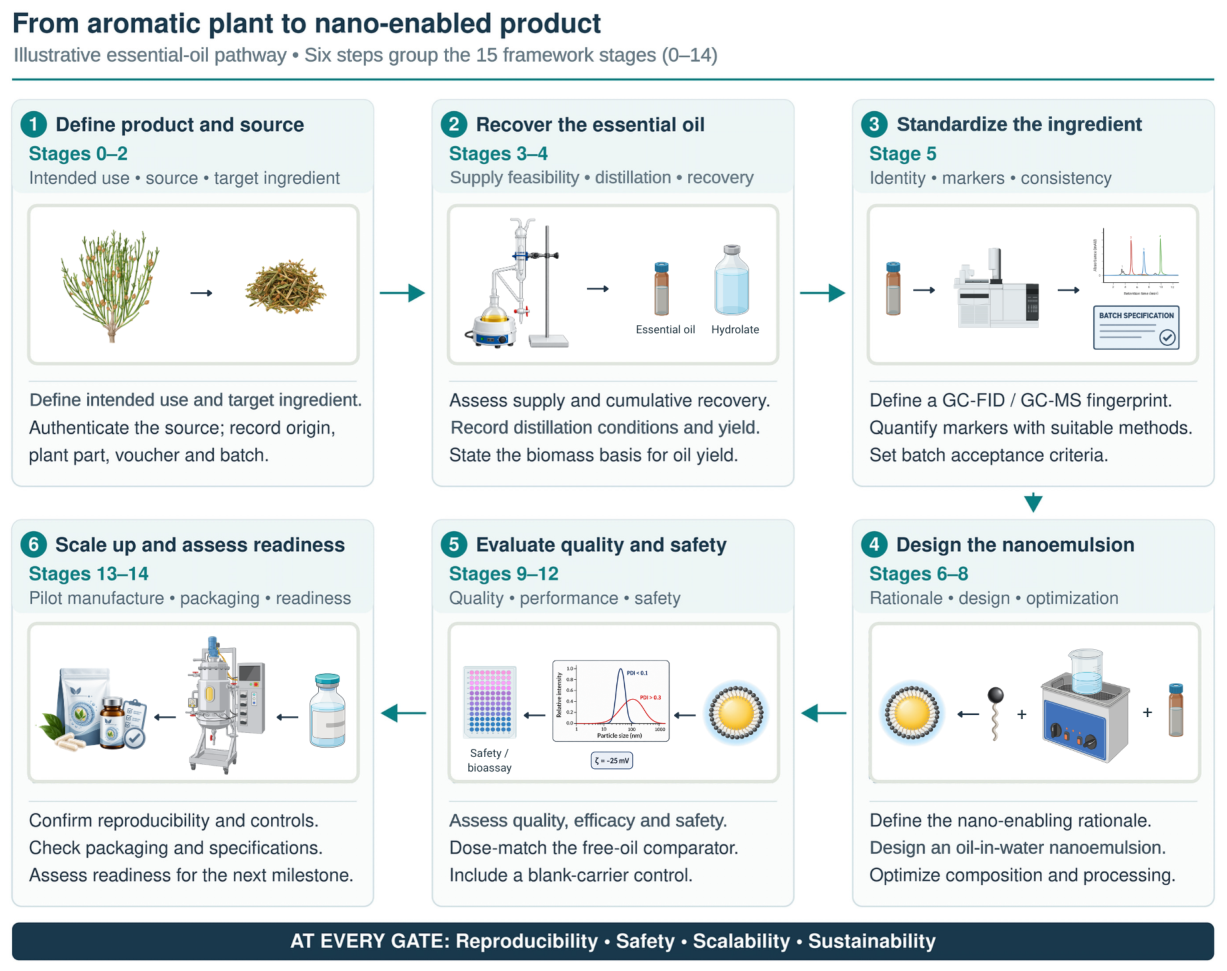
Figure 2.
Source-specific routes to a qualified natural ingredient. After the source is identified (Stage 1), the target ingredient is defined (Stage 2): an extract, enriched fraction, isolate, essential oil, hydrolate, fixed oil, or microbial product. This choice determines the processing route (Stage 4), whose supply feasibility is assessed in Stage 3. Purchased or previously isolated compounds require supplier and chemical qualification instead of extraction. All routes converge at Stage 5 before the nano-enabling rationale is assessed (Stage 6). The listed operations are examples, not mandatory methods.
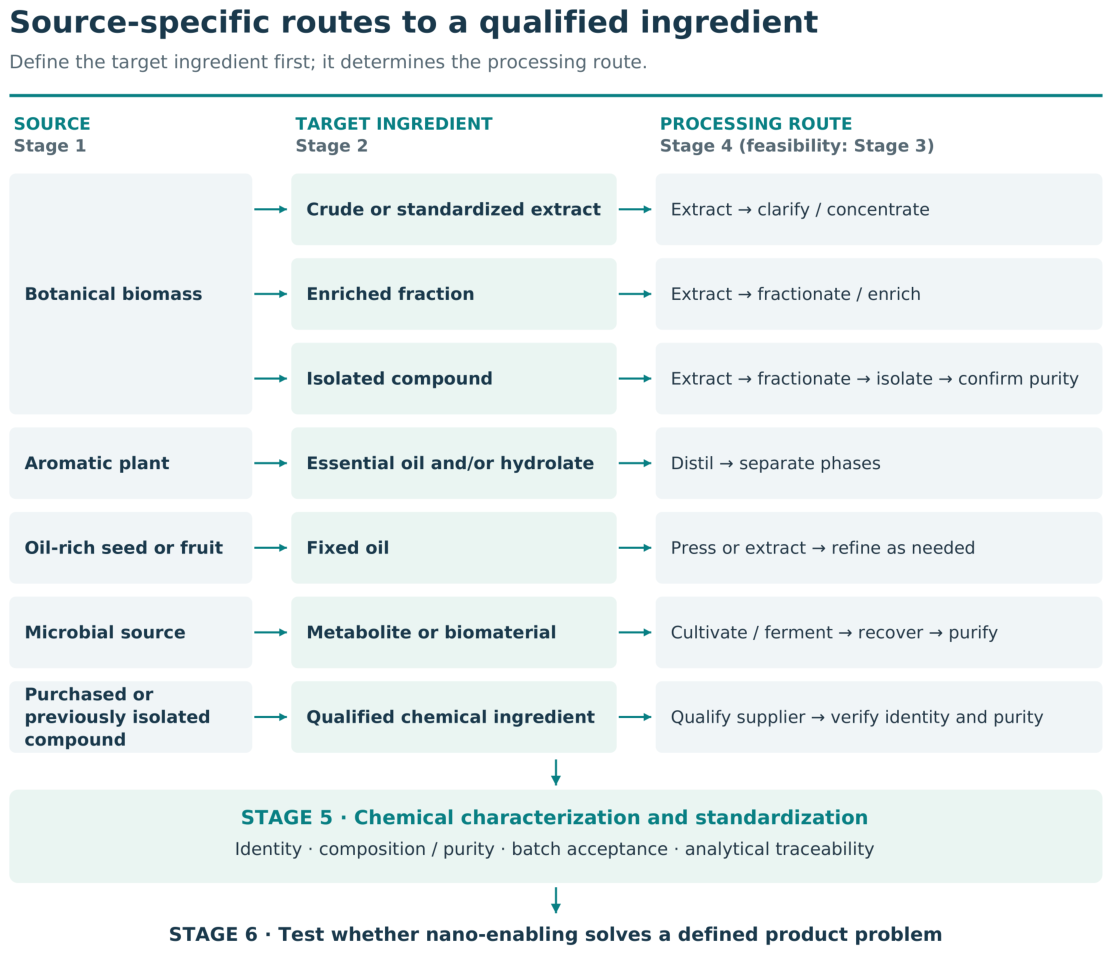
Figure 3.
Source-to-product ingredient balance with hypothetical values. The pathway tracks one consistent ingredient basis from dry source to the amount retained in an accepted 100-kg product batch. Added water and excipients are excluded from ingredient recovery. The four factors in Equation (1) represent distinct operations; incorporation recovery is not automatically encapsulation efficiency.
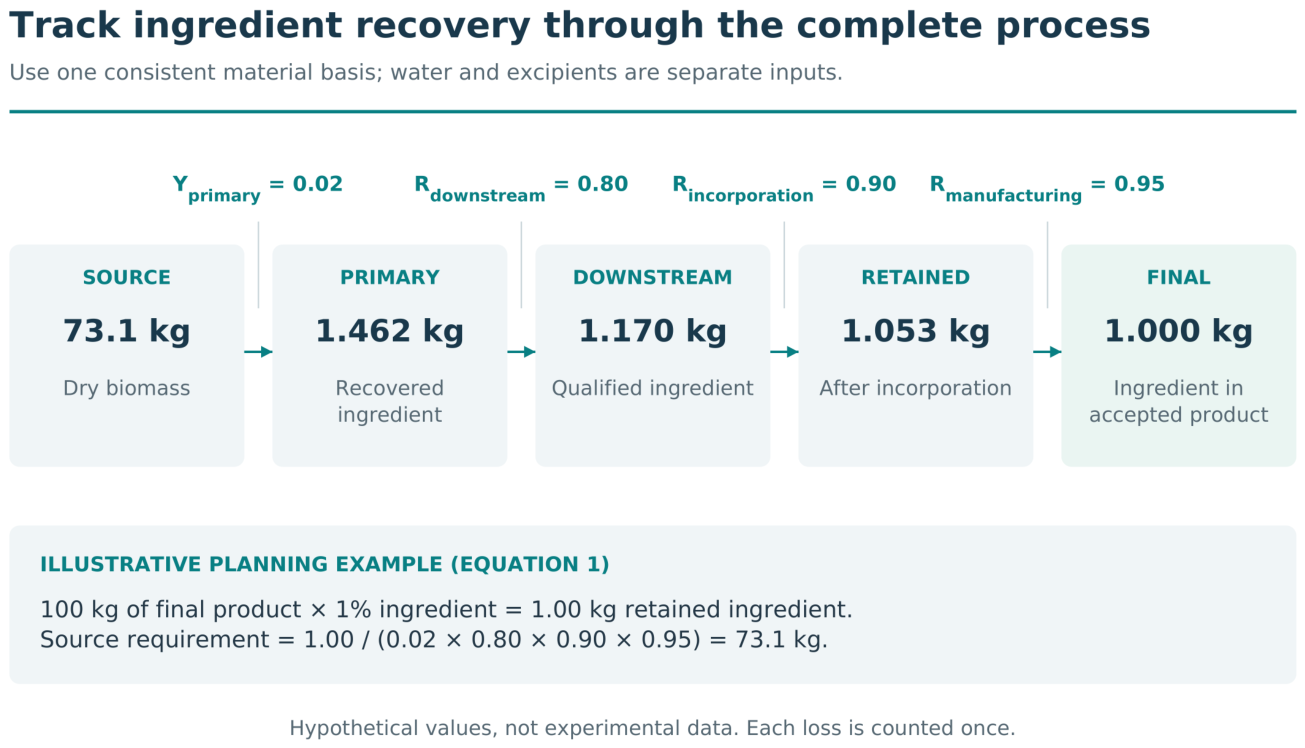
Figure 4.
Translational Evidence Maturity hierarchy for nano-enabled formulations derived from natural materials. Evidence progresses from material and formulation control through comparative (nano-)advantage, biological relevance, acceptable benefit–risk, and manufacturability to final-product feasibility. The right-hand column indicates the stages that generate most of the evidence for each level; deeper shading denotes later maturity, not greater importance. The hierarchy is conceptual and unscored; it is not an empirical ranking of studies or an instruction to postpone safety until after efficacy. A readiness assessment requires all relevant domains, and biological activity alone cannot establish product readiness.
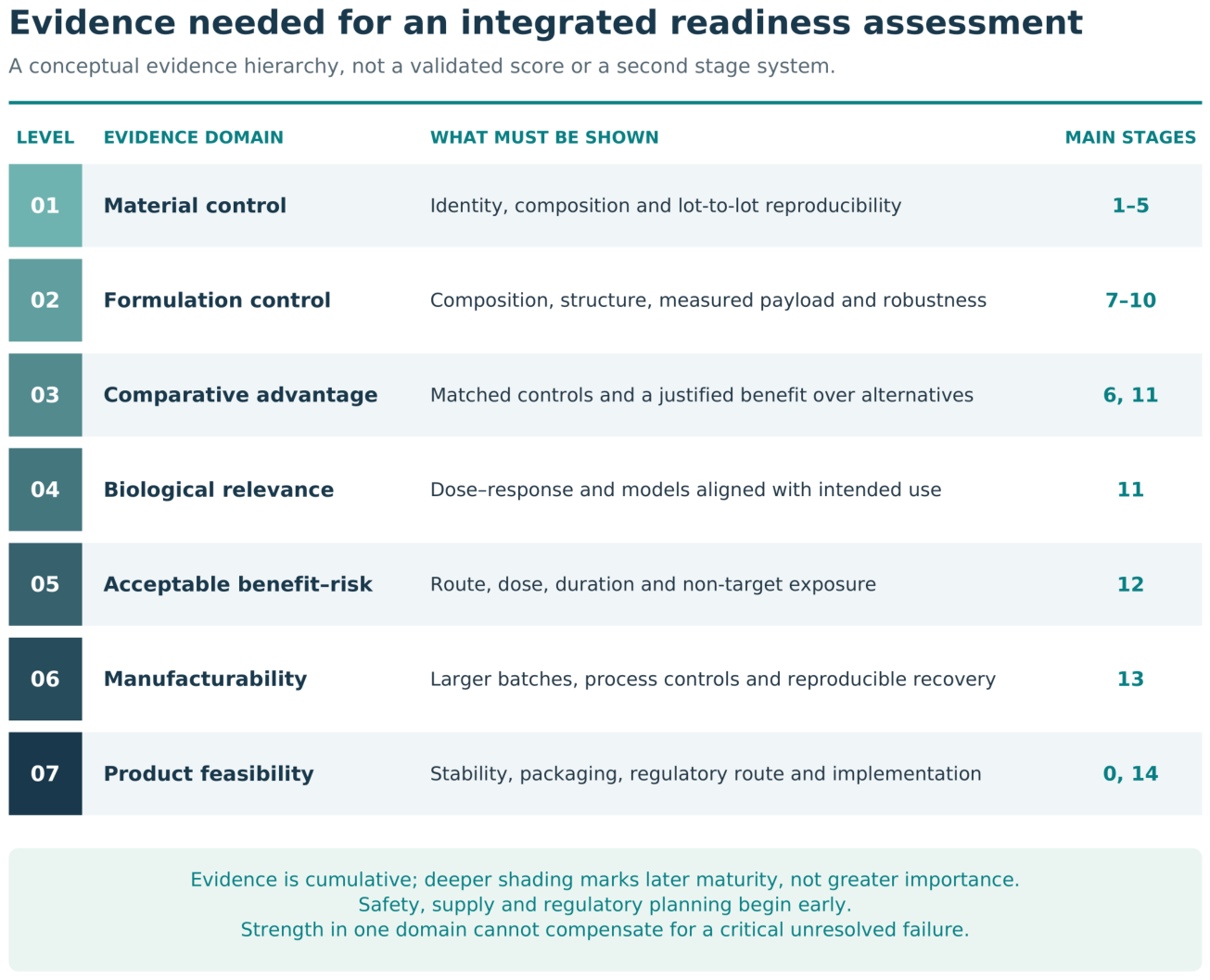
Figure 5.
Operational architecture of the proposed 15-stage framework. Shading distinguishes the path from source to standardized ingredient (Stages 0–5) from nano-enabled formulation to product (Stages 6–14). Numbering organizes the evidence chain; it does not require a strictly linear experimental schedule. Upstream source-specific routes are detailed in Figure 2. A failed gate prompts reassessment at the relevant earlier stage, as in the examples of return paths shown; return to Stage 0 is reserved for changes to the intended product. Safety, supply, sustainability, and regulatory planning begin early; Stages 12–14 consolidate their evidence for a defined milestone.
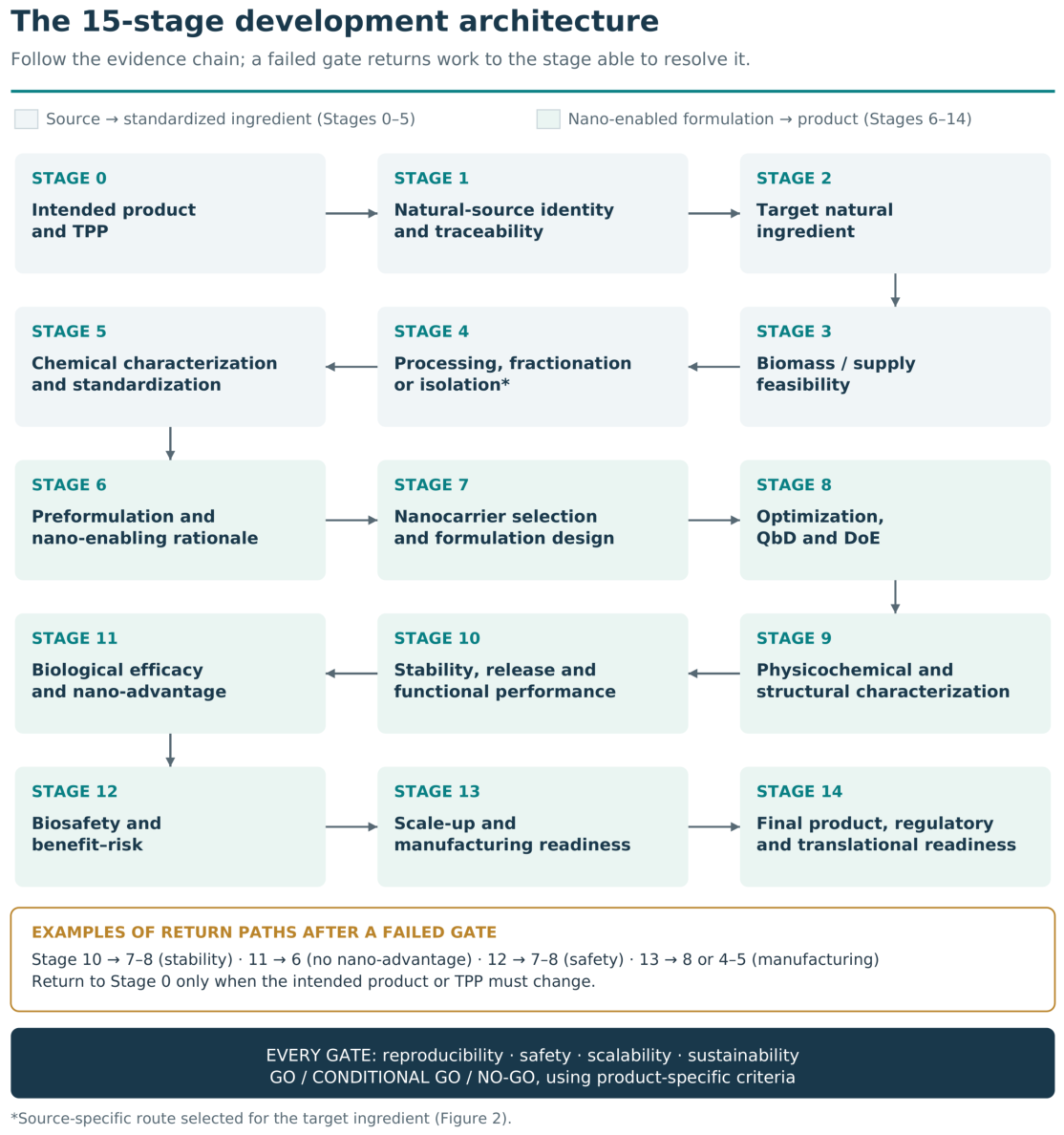
Figure 6.
Four transversal development criteria—reproducibility, safety, scalability, and sustainability—accompany the candidate through three development phases: source and ingredient (Stages 0–5), formulation and evidence (Stages 6–12), and manufacturing and use (Stages 13–14). Cells give examples of the evidence typically required in each phase. The specific evidence for each criterion evolves throughout development, and translational robustness requires simultaneous consideration of all four, with trade-offs assessed against the same intended use and a stated comparator.
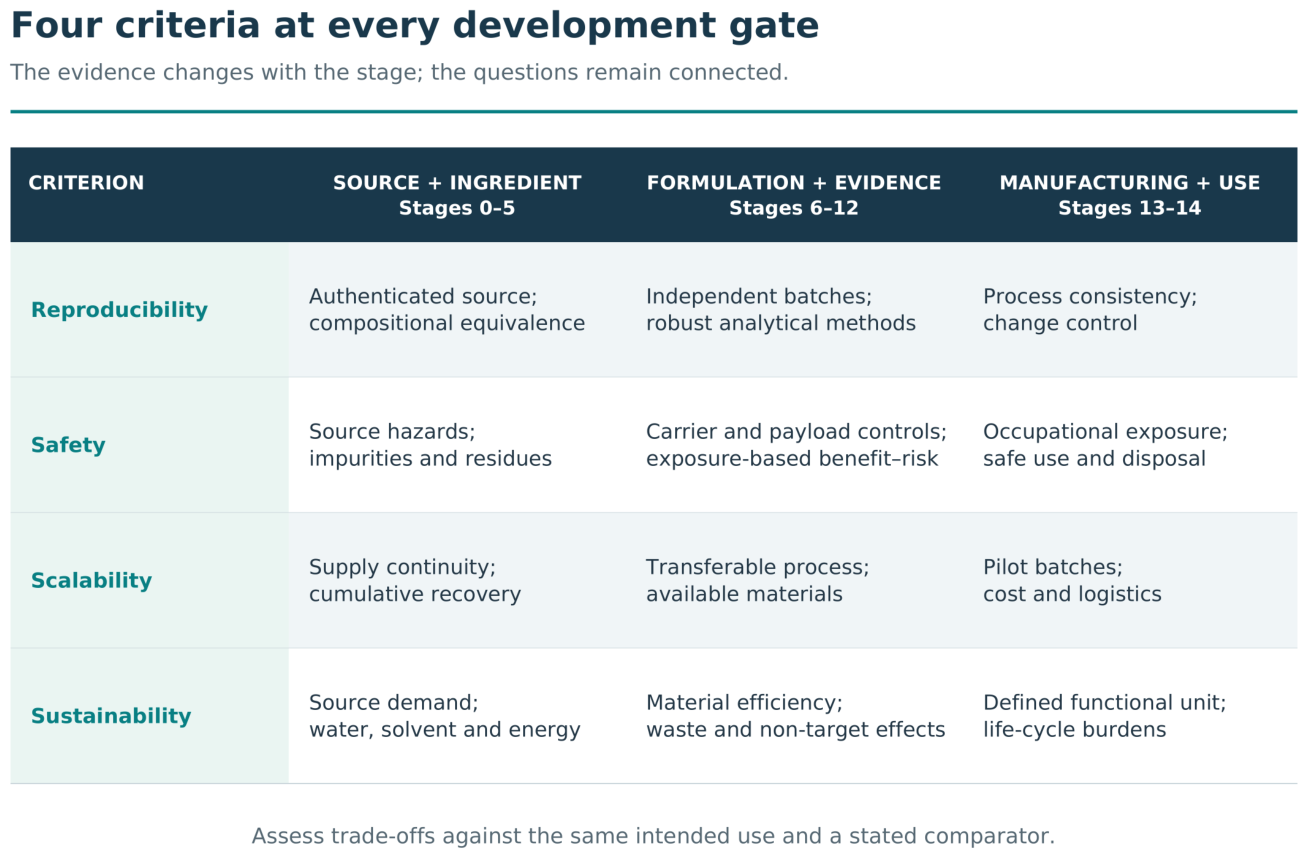
Figure 7.
Practical use of the Natural Material-to-Product Stage-Gate Framework. The guide is applied iteratively by defining the intended product, natural source, and target ingredient; locating the candidate within Stages 0–14; generating the minimum evidence required for the relevant gate; and assigning a GO, CONDITIONAL GO, or NO-GO decision. GO permits advancement after reassessment of all four criteria. CONDITIONAL GO requires an owner, closure test, and deadline for a non-critical gap, with dependent activities held until reassessment. NO-GO redirects development to the earliest relevant stage, supports redesign, or leads to justified termination. Existing projects may enter at later stages when preceding gates can be retrospectively verified, and previous GO decisions may be reopened when new evidence reveals a critical limitation. A Stage 14 GO indicates readiness for the named milestone; commercial supply additionally requires all applicable authorizations and ongoing obligations.
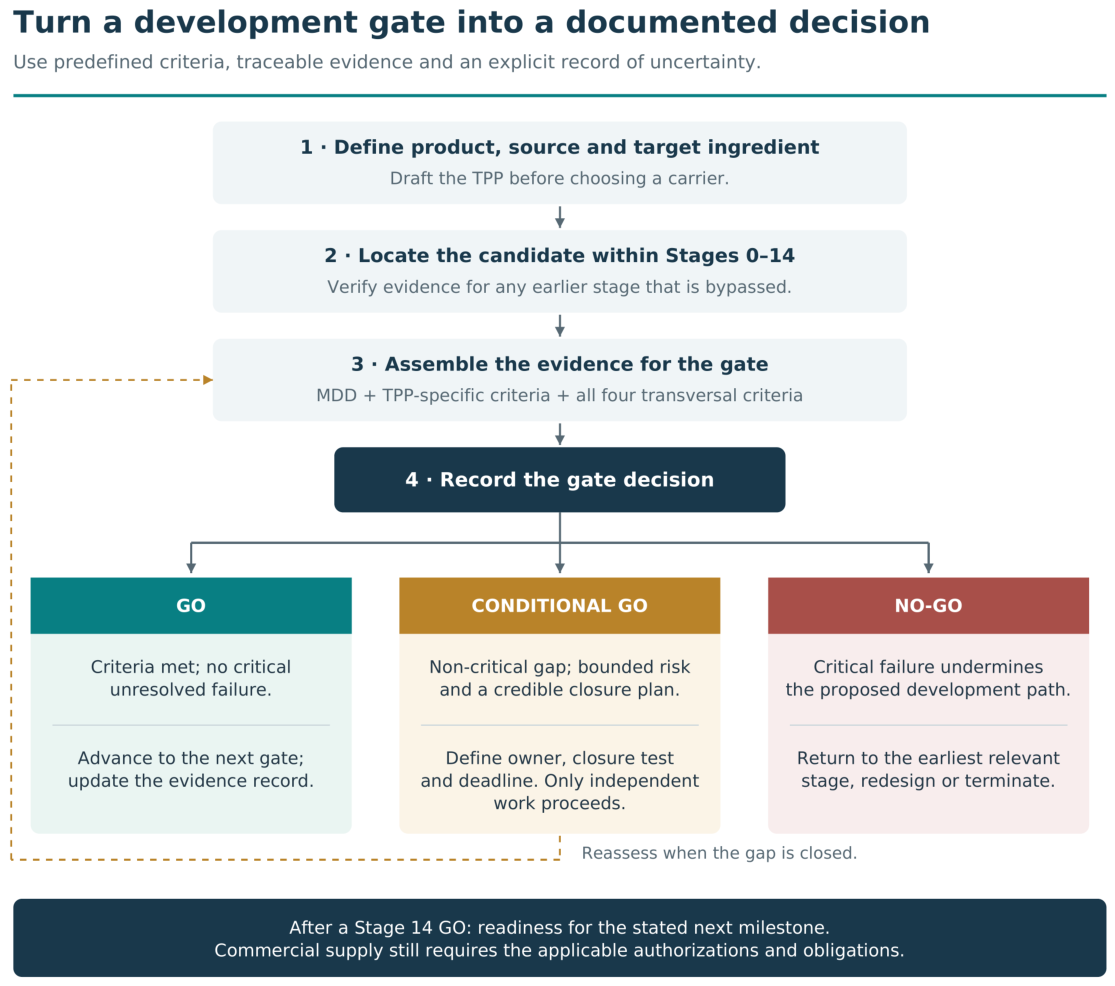
Table 1.
Structured literature-search results used for framework development. Counts correspond to the records contained in the final exported files.
Table 1.
Structured literature-search results used for framework development. Counts correspond to the records contained in the final exported files.
| Search | Scopus | Web of Science | PubMed | Total |
|---|---|---|---|---|
| 1. Full roadmap / novelty and overlap | 29 | 22 | 11 | 62 |
| 2. Biomass, supply, and standardization | 67 | 45 | 19 | 131 |
| 3. Characterization, biosafety, scale-up, translation | 74 | 50 | 123 | 247 |
| 4. Preformulation and rational nanoformulation design | 21 | 19 | 33 | 73 |
| 5. QbD, DoE, and formulation optimization | 59 | 28 | 15 | 102 |
| Total | 250 | 164 | 201 | 615 |
Table 2.
Exploratory metadata signals aligned to the final 15-stage framework (375 unique records; non-exclusive categories). Counts describe the retrieved corpus and coding scheme, not full-text prevalence or development maturity. A zero indicates no detected signal. Stage 2 was introduced after coding and was not separately quantified.
| Stage | Development domain | Explicit-signal records |
|---|---|---|
| 0 | Intended Product / Target Product Profile | 0 |
| 1 | Natural Source Identity and Traceability | 3 |
| 2 | Target Natural Ingredient Definition | – |
| 3 | Biomass and Supply Feasibility | 26 |
| 4 | Extraction, Processing, Fractionation, or Isolation | 43 |
| 5 | Chemical Characterization and Standardization | 84 |
| 6 | Preformulation and Nano-Enabling Rationale | 243 |
| 7 | Nanocarrier Selection and Formulation Design | 323 |
| 8 | Optimization / QbD / DoE | 67 |
| 9 | Physicochemical and Structural Characterization | 68 |
| 10 | Stability / Release / Functional Performance | 241 |
| 11 | Biological efficacy-related signals | 309 |
| 12 | Biosafety and Benefit–Risk | 235 |
| 13 | Scale-Up and Manufacturing Readiness | 170 |
| 14 | Regulatory and translation-related signals | 239 |
Table 3.
Source-specific upstream routes proposed before nanoformulation development. The examples are decision pathways rather than mandatory processing methods.
Table 3.
Source-specific upstream routes proposed before nanoformulation development. The examples are decision pathways rather than mandatory processing methods.
| Natural source | Target ingredient | Typical upstream route before standardization |
|---|---|---|
| Botanical biomass (leaf, root, bark, flower, aerial part) | Crude or standardized extract | Preprocessing → extraction → clarification/concentration → chemical fingerprinting. |
| Botanical biomass | Enriched fraction | Extraction → partition, adsorption, precipitation, membrane separation, or other fractionation → compositional definition. |
| Botanical biomass | Isolated natural compound | Extraction → fractionation → chromatographic or crystallization-based isolation → identity and purity confirmation. |
| Aromatic plant material | Essential oil and/or hydrolate | Hydrodistillation, steam distillation, or another validated volatile-recovery process → phase recovery → compositional analysis. |
| Oil-rich seed or fruit | Fixed oil | Mechanical pressing, solvent extraction, or supercritical-fluid extraction → clarification/refining as required → lipid and oxidative-quality profiling. |
| Microbial source | Extracellular or intracellular metabolite/biomaterial | Strain qualification → cultivation/fermentation → recovery from broth or biomass → purification as required → identity/composition testing. |
| Previously isolated or purchased natural compound | Defined chemical ingredient | Supplier/source qualification → identity, purity, residual-solvent/degradation assessment → direct preformulation when specifications are met. |
Table 5.
Illustrative product benchmarks and the limits of publicly accessible evidence. Regulatory records, clinical studies, and commercial claims are different evidence types. The listed domains indicate relevance to the framework, not retrospective gate certification.
Table 5.
Illustrative product benchmarks and the limits of publicly accessible evidence. Regulatory records, clinical studies, and commercial claims are different evidence types. The listed domains indicate relevance to the framework, not retrospective gate certification.
| Product | Ingredient and formulation | Public evidence and status | Limits and development lesson |
|---|---|---|---|
| AmBisome® | Amphotericin B, a microbial polyene associated with Streptomyces nodosus, in unilamellar liposomes [58,59]. | U.S. approval dates to 1997; current product documentation describes composition, use, efficacy and safety [60,61]. Supports selected domains in Stages 5–7 and 9–14. | Public labeling does not expose strain specifications, fermentation and purification yields, complete acceptance ranges, or manufacturing economics. Downstream authorization cannot reconstruct the entire upstream chain. |
| Doxil®/Caelyx® | Doxorubicin, an anthracycline originally obtained from Streptomyces peucetius, in PEGylated liposomes [62,63]. | U.S. labeling updated in March 2026 and an EU authorization record describe product-specific clinical and quality requirements [63,64]. Supports selected downstream domains. | Detailed source control, liposome-process CPPs, yields, and full CMC ranges are not reconstructed from labeling. Approval applies to the defined product and cannot be transferred to an alternative liposomal formulation. |
| Abraxane® | Paclitaxel, a taxane historically isolated from Taxus brevifolia, in albumin-bound nanoparticles [65,66]. | U.S. approval dates to 2005; FDA and EMA documentation support product identity, clinical benefit–risk, labeling and regulatory status [66,67]. | Historical natural origin does not identify the present commercial supply route. Source sustainability, process losses, detailed scale-up controls, and proprietary acceptance ranges require additional evidence. |
| Theracurmin® | Curcumin in a colloidal submicron dispersion designed to enhance oral exposure [16,17]. | Human pharmacokinetic studies and a current Natural Factors supplement listing support formulation/exposure domains and commercial availability [68]. | Pharmacokinetics is not proof of disease-specific efficacy or complete long-term safety. Public source-lot traceability, cumulative recovery, commercial CQA limits, and manufacturing yields remain incomplete. |
| NovaSOL® Curcumin | Curcumin delivered in liquid micelles; the investigated system has human bioavailability data [69]. | AQUANOVA lists a commercial ingredient platform and related product formats [70]. The study and listing address different questions: exposure and availability. | Manufacturer quality claims are not independent verification of every gate. Full proprietary formulation, source recovery, long-term safety, scale-up performance, and batch-release specifications are incompletely public. |
| SinaCurcumin® | Curcuminoid nanomicelles, reported at approximately 10 nm in formulation research [71]. | The cited clinical publication reports use of 40-mg capsules and provides human trial evidence [72]. Commercial descriptions are historical reports, not an independently verified current authorization. | Evidence for formulation and clinical use does not disclose the full manufacturing dossier or establish all claimed clinical benefits. Current regulatory status, source specifications and commercial process controls require separate confirmation. |
Table 6.
Natural Material-to-Product Stage-Gate decision logic.
| Stage | Domain | GO | CONDITIONAL GO | NO-GO |
|---|---|---|---|---|
| 0 | Intended Product / TPP | Intended use, route, comparator, product format, expected performance, safety and manufacturing constraints defined. | One or more non-critical attributes remain provisional but are testable. | No clear use case, target, comparator, or plausible product configuration. |
| 1 | Source Identity / Traceability | Biological or chemical identity, origin, relevant source metadata, and supply chain are traceable. | Minor metadata incomplete but recoverable. | Identity/provenance uncertain or source is irreproducibly defined. |
| 2 | Target Natural Ingredient | Required ingredient form is explicitly defined (e.g., extract, fraction, isolate, essential oil, hydrolate, fixed oil, microbial metabolite, qualified isolated compound) and is compatible with the TPP. | Two or more ingredient forms remain plausible and require comparative screening. | No defined ingredient form, or selected ingredient cannot plausibly meet the intended product requirements. |
| 3 | Biomass / Supply Feasibility | Quantity, continuity, productivity, sustainability, cost, legal access, and seasonality or production capacity are compatible with projected scale. | Supply limitations have credible mitigation plans. | Source demand, ecological burden, productivity, legal access, or cost makes scale unrealistic. |
| 4 | Processing / Fractionation / Isolation | Route-specific extraction, distillation, pressing, fermentation recovery, fractionation, or isolation gives reproducible yield and composition using scalable, acceptable processing. | Yield, selectivity, purity, or resource intensity requires optimization but remains feasible. | Recovery is irreproducible/very low or process is hazardous, destructive, excessively resource-intensive, or impractical. |
| 5 | Characterization / Standardization | Identity, marker(s), fingerprint, purity/composition, and batch acceptance strategy are defined for the obtained ingredient. | Major constituents known but limits or method validation incomplete. | Composition cannot be reliably monitored or batch variability prevents equivalence. |
| 6 | Nano-Enabling Rationale | Demonstrated formulation limitation with mechanistically plausible nano-solution. | Limitation clear but magnitude of nano-advantage not yet confirmed. | No relevant limitation or simpler formulation can meet the TPP with lower burden. |
| 7 | Carrier Selection | Carrier justified by payload properties, route, release, safety, manufacturability, and TPP. | Multiple viable carriers require comparative screening. | Carrier is empirical, incompatible, unsafe, or implausible for final use. |
| 8 | Optimization / QbD | QTPP-linked CQAs, relevant CMAs and CPPs, risks, and a robust operating region identified. | Promising formulation but robustness/design space incomplete. | Formulation is fragile or optimization is unsupported by reproducibility evidence. |
| 9 | Characterization | Orthogonal, fit-for-purpose evidence supports composition, size, structure, loading, and relevant physical attributes. | Core characterization adequate but secondary confirmation incomplete. | Key claims rely on inadequate, inconsistent, or non-discriminatory measurements. |
| 10 | Stability / Performance | CQAs and chemical composition maintained under relevant storage/use conditions; functional performance appropriate. | Short-term performance acceptable but long-term or stress data incomplete. | Instability, payload loss, unacceptable release, or functional failure under realistic conditions. |
| 11 | Efficacy / Nano-Advantage | Reproducible, TPP-relevant advantage over dose-matched free material and relevant alternatives; blank-carrier effects accounted for. | Promising benefit; its magnitude or relevance requires confirmation before dependent progression. | No TPP-relevant advantage, unaccounted carrier effects, or efficacy only at unrealistic exposure. |
| 12 | Biosafety / Benefit–Risk | Route-appropriate safety and acceptable efficacy–toxicity window demonstrated. | A non-critical gap is bounded and a closure plan protects the next activity; required safety evidence cannot be deferred. | Relevant toxicity occurs near effective exposure or carrier/formulation risk is unacceptable. |
| 13 | Scale-Up / Manufacturing | Larger batches maintain CQAs with realistic operations, materials, process controls, yield, and resource demand. | Pilot confirmation or process-control refinement required. | Quality collapses with scale or equipment/material/cost demands are incompatible with product. |
| 14 | Product / Regulatory Readiness | Evidence supports the named milestone; quality, benefit–risk, packaging, implementation and applicable authorizations are appropriate. | Defined, non-critical gap remains; activities requiring that evidence or authorization stay on hold. | No credible product/regulatory path or benefit–risk/manufacturing package cannot support translation. |
Disclaimer/Publisher’s Note: The statements, opinions and data contained in all publications are solely those of the individual author(s) and contributor(s) and not of MDPI and/or the editor(s). MDPI and/or the editor(s) disclaim responsibility for any injury to people or property resulting from any ideas, methods, instructions or products referred to in the content. |
© 2026 by the authors. Licensee MDPI, Basel, Switzerland. This article is an open access article distributed under the terms and conditions of the Creative Commons Attribution (CC BY) license (http://creativecommons.org/licenses/by/4.0/).
Copyright: This open access article is published under a Creative Commons CC BY 4.0 license, which permit the free download, distribution, and reuse, provided that the author and preprint are cited in any reuse.