

Submitted:
19 October 2026
Posted:
20 October 2026
You are already at the latest version
Abstract
Canola cultivars carrying the blackleg resistance genes Rlm2 and Rlm7 were released in Western Canada in 2022. To determine the origin of virulence on these genes, we phenotyped and sequenced 21 Leptosphaeria maculans isolates collected before deployment (2010–2015) and seven isolates recovered from Rlm2 and Rlm7 plots. Three AvrLm2 variants differed only at residues 133 and 146: 13 of 14 isolates carrying the reference Gly133/Glu146 allele were avirulent on Rlm2, whereas 10 of 14 carrying His133/Gln146, Asn133/Gln146 or an allele inactivated by repeat-induced point mutation (RIP) were virulent or intermediate. Eight isolates carried RIP-inactivated AvrLm4-7 alleles sharing a premature stop at codon 35; seven were virulent or intermediate on Rlm7, and five were avirulent on Rlm3, consistent with masking of AvrLm3 by AvrLm4-7. Virulence alleles at both loci predated deployment: both post-pressure Rlm7 isolates carried an AvrLm4-7 allele identical to that of a 2015 isolate, and the His133/Gln146 allele of two post-pressure Rlm2 isolates occurred in four pre-pressure lineages. A core-genome phylogeny based on 39,012 SNPs placed the post-pressure isolates in at least five lineages of a single regional clade. Rlm2 and Rlm7 deployment is therefore selecting on standing variation that can be monitored before resistance genes are released.
Keywords:
Leptosphaeria maculans
; blackleg
; canola
; avirulence
; AvrLm2
; AvrLm4-7
; repeat-induced point mutation
; resistance durability
; whole-genome sequencing
1. Introduction
In Canada, canola production reached a record 22.2 million tonnes in 2025 [1]. Most canola is grown in the Prairie provinces of Saskatchewan, Alberta and Manitoba.
Blackleg, caused by the ascomycete fungus Leptosphaeria maculans, is one of canola's most damaging diseases in Canada and worldwide, causing losses exceeding USD 900 million per growing season [2]. Provincial surveys in western Canada assess blackleg prevalence, incidence, and severity each year; about 70% of surveyed fields show symptoms, and incidence in 2019 was 10% in Manitoba, 11% in Saskatchewan, and 10% in Alberta [3]. Since the early 2000s, blackleg incidence has doubled because of more frequent canola cropping and shifts in the L. maculans race profile [4].
Recommended practices to limit blackleg include crop rotation with at least two years between canola crops, scouting and accurate pathogen identification, resistant cultivars, rotation of resistance sources, and fungicide seed or foliar treatments [5]. In Canada, the Western Canada Canola and Rapeseed Recommending Committee establishes blackleg resistance ratings before cultivar registration through defined procedures. The introduction of resistant cultivars in the late 1990s and early 2000s reduced incidence to well below 5% across the Prairies [6], but incidence has increased gradually over the past decade, raising questions about the effectiveness of current cultivars [7].
Resistance to blackleg in canola is either qualitative, conferred by single major genes (R genes), or quantitative, governed by multiple quantitative trait loci [8,9]. Major-gene resistance has been the main tool for blackleg control in commercial canola. Although L. maculans is a hemibiotroph, R-gene recognition occurs early, during symptomless intercellular colonization of cotyledons and leaves, before the fungus moves down the petiole to the stem. The cloned Rlm genes encode cell-surface receptors that detect apoplastic effectors [10,11,12], so an effective R gene stops the pathogen at the leaf lesion. Quantitative resistance acts later, mainly by limiting stem canker, and is harder to select in breeding [13]. Single R genes are therefore attractive to breeders but short-lived: Rlm1 was overcome in France within three years of deployment [14], and Rlm3 followed a similar course in Canada [15]. Research initiated in 2012 identified Rlm1, Rlm2, Rlm3, Rlm4, Rlm9, RlmS, LepR1 and LepR2 in Canadian canola cultivars, with Rlm3 the most prevalent [16].
In Canada, Rlm3 protected the canola industry from blackleg from the early 1990s to the early 2000s, but its effectiveness was eventually lost as new races evolved in the pathogen population [4]. From 2010 to 2015, the frequencies of AvrLm1, AvrLm2, AvrLm3, AvrLm9 and AvrLepR1 declined, indicating breakdown of the corresponding R genes, and severe infections of resistant cultivars were recorded in some fields as early as 2002 and 2003 [4]. These trends underline the need to understand and prevent resistance breakdown, identify new R genes, and assess their durability.
Genomic studies have revealed several routes by which L. maculans escapes R-gene recognition, including point mutations, large deletions, repeat-induced point (RIP) mutations, and transposable element-mediated rearrangements [17,18,19]. Avirulence genes (Avr)lie in AT-rich, transposable element-rich regions of the genome that are prone to rapid change [18,20], and sexual reproduction and large population sizes further accelerate allelic diversification [21].
A survey by Liu et al. [16] found high frequencies of AvrLm2, AvrLm4, AvrLm5, AvrLm6, AvrLm7, AvrLm11 and AvrLmS alleles, and low frequencies or absence of AvrLm1, AvrLm3, AvrLm9, AvrLepR1 and AvrLepR2. The most recent Prairie-wide survey characterized 1,073 isolates collected in 2015–2017 [22]. AvrLm4, AvrLm6 and AvrLm7 were present in more than 50% of isolates, whereas AvrLm1, AvrLm3, AvrLm9 and AvrLep2 were rare (<5%) or not detected. AvrLm2 frequency differed between provinces: in 2015 it was found in fewer than 10% of isolates from Alberta and Manitoba but in more than 40% from Saskatchewan, and it later increased in Alberta and Manitoba. The survey identified 44 races and found at least one race virulent on every known R gene in western Canada, concluding that no single R gene is likely to remain durable if deployed alone. It also cautioned that phenotypic surveys underestimate AvrLm3 and AvrLm9, because AvrLm4-7 masks their recognition [23,24,25], and called for molecular tools to be combined with differential-host assays.
Canadian growers did not have canola cultivars carrying Rlm2 or Rlm7 until 2022, and newer cultivars now also carry Rlm4, Rlm9, LepR1, and RlmS/LepR2 [26]. Rlm7 is attractive because AvrLm7 has been among the most prevalent Avr genes in Western Canadian populations [16,22]. AvrLm2 is common in Saskatchewan but was much less frequent in Manitoba and Alberta in 2015 [22], so isolates already virulent on Rlm2 were present in parts of the Prairies before the gene was deployed. Cultivars carrying these genes are expected to resist isolates carrying AvrLm2 or AvrLm7, but it is not known how quickly virulent isolates increase once the genes are in use.
Experience in Europe shows how quickly Rlm7 can be eroded. In France, where Rlm7 was widely deployed from 2004, the frequency of AvrLm7 isolates fell from 96.5% in 2010 to 29.2% in 2019–2020 [27]. In Germany, the frequency of isolates virulent on Rlm7 increased from 0.9% to 17.6% between 2011–2012 and 2017–2020, reaching 28% in some regions [28]. This rapid evolution has been attributed to several mechanisms at the AvrLm4-7 locus, including RIP mutations and complete gene deletions [27,29].
AvrLm2 evolves differently. It lies in a small GC-rich island within an AT-rich isochore, and virulence toward Rlm2 has been associated mainly with point mutations rather than deletions [30]. Three single-nucleotide polymorphisms in the AvrLm2 coding sequence have been associated with virulence toward Rlm2 [31], and AvrLm2 can also be inactivated by RIP following gene duplication [32].
In our monitoring programs, we observed successful infection of canola cotyledons despite AvrLm2–Rlm2 or AvrLm7–Rlm7 interactions. Although such lesions may disappear at later growth stages, they could signal the first stages of Rlm2 and Rlm7 breakdown.
Because virulence can arise by different molecular routes at the two loci, and because phenotyping alone can miss Avr genes that are masked, tracking Rlm2 and Rlm7 breakdown requires the Avr alleles themselves to be identified alongside phenotypes. Our laboratory obtained canola seed lines carrying Rlm2 and Rlm7 were released commercially and grew them in experimental field plots. Isolates recovered from lesions on these plants therefore represent the local L. maculans population's first exposure to Rlm2 and Rlm7 selection, and we refer to them as post-pressure isolates. . This study aimed to determine the source of virulence on Rlm2 and Rlm7in these isolates. We phenotyped and sequenced them alongside pre-pressure isolates collected from commercial fields before the genes were released, identified their AvrLm2 and AvrLm4-7 alleles, and used core-genome phylogeny to place the post-pressure isolates within the regional population.
2. Results
Twenty-eight isolates were analyzed: 21 pre-pressure isolates collected from commercial fields in Manitoba, Alberta and Saskatchewan in 2010–2015, and seven post-pressure isolates recovered from cotyledon lesions on Rlm2 (five) and Rlm7 (two) plots at Carman, Manitoba (Table 1). Each isolate was phenotyped on a Brassica differential set and sequenced with Oxford Nanopore technology, and the assemblies were used for whole-genome comparisons, a core-genome phylogeny and analysis of the AvrLm2 and AvrLm4-7 alleles (Figure 1).
2.1. Avr Phenotypes of the Isolates
All 28 isolates were inoculated onto the differential set (Table S1). Most isolates were avirulent on Rlm6, LepR1, Rlm4, LepR3/RlmS, Rlm2 and Rlm7. Six isolates were virulent on Rlm7, including both post-pressure Rlm7 isolates, and four were virulent on Rlm2, none of them post-pressure. In contrast, most isolates were virulent on Rlm9 and Rlm3, consistent with the earlier breakdown of Rlm3 in western Canada [15]. LepR2 reactions were the most evenly split (Table 2).
2.2. Serial Inoculation in the Greenhouse
We subjected six isolates that were avirulent on the corresponding gene to three successive cycles of inoculation and re-isolation: 2-2, 2-3 and 2-4 on single resistant gene Rlm7, and A5, avr10_9 and Avr6_2 on genotype carrying single Rlm2 gene (Figure 2). Mean severity over the three cycles was 2.90–3.07 for isolates 2-2, 2-3 and 2-4 and 1.93–2.29 for A5, avr10_9 and Avr6_2, compared with 9.0 on Westar in every cycle. Severity did not differ significantly among isolates across the three cycles (one-way ANOVA, F = 0.975, P = 0.347). Mean severity was higher in the third cycle than in the first (2.39 ± 0.19 vs 2.73 ± 0.19; paired t-test, t = −2.988, P = 0.031), an increase of 0.35 units (14.5%). All mean scores nevertheless remained below 3.1, so none of the isolates became virulent during the three cycles. Isolate 2-4 was the most consistent across cycles (coefficient of variation 0.69%) and 2-2 the most variable (19.87%).
2.3. Genome Assemblies
All 28 assemblies were highly complete, with BUSCO scores of 99.5–99.9% and Compleasm scores of 99.87–100% (Table 3). Assembly lengths ranged from 34.5 to 40.3 Mb, within the range expected for L. maculans.
2.4. Whole-Genome Similarity Confirms Species Identity
2.5. Variation Relative to the Reference Genome
Against the CAN1 reference genome (GCF_022343315.1), the isolates carried 36,387–115,473 SNPs and 15,628–53,435 indels (Figure 4). Isolate avr10_6 had the most SNPs (115,473); all other isolates had 36,387–72,800. Indel counts differed systematically between sampling groups: four of the five post-pressure Rlm2 isolates had 15,628–24,585 indels (group median 17,984), compared with 33,852–53,435 in all other groups, and the ratio of indels to SNPs was about 0.45 in that group and 0.73–0.76 in the other three. Because indels in nanopore assemblies are enriched for homopolymer errors, this difference more likely reflects sequencing or assembly batch than biology, and indel counts were not compared further.
Structural differences from CAN1 totalled 820–3,838 per genome (Figure 5). Duplications were the most common class (67.6% of all events), followed by gaps (15.6%), breaks (8.3%), sequence insertions (5.2%), jumps (2.1%) and inversions (1.2%). Group medians were 1,878 for pre-pressure Rlm2, 937 for post-pressure Rlm2, 1,134 for pre-pressure Rlm7 and 2,198 for post-pressure Rlm7 isolates, but totals within each group spanned a wide range and overlapped those of other groups. avr10_6 again had the highest total (3,838).
2.6. AvrLm4-7 Alleles
A full-length AvrLm4-7 copy was recovered from all 28 isolates (Figure 6; Table 4). Eight alleles were RIP-inactivated: 1-1, 1-2, 1-3, 1-7, 1-8, A5, R7-8 and R7-9. Each carried 56–65 C→T or G→A transitions (44–51 at CpA sites) and at most two other substitutions. All eight shared a first premature stop at codon 35, truncating the protein to 34 of its 143 residues, and carried six to nine stops in total. The allele in 1-2 also had a mutated intron donor site (GT→AT). The post-pressure isolates R7-8 and R7-9 carried an allele identical to that of pre-pressure isolate 1-8, collected in Manitoba in 2015, and the alleles of 1-3 and 1-7 were also identical.
The remaining 20 alleles encoded full-length proteins. Eleven matched the reference exactly; the rest carried K41N (10-1, 11-1, 21-9 and avr10_6), R32S (15-1 and 2-5), or D86N with G120R (AB-1, AB-3 and avr10_5). G120R is the substitution previously shown to abolish recognition by Rlm4 [33]. Of the three isolates carrying it, avr10_5 was virulent on Rlm4, whereas AB-1 and AB-3 were avirulent.
Allele status matched the Rlm7 phenotype closely (Table 4). Seven of eight RIP-inactivated alleles were in isolates virulent (5) or intermediate (2) on Rlm7, and 17 of 20 intact alleles were in avirulent isolates (Fisher's exact test, P = 7.1 × 10⁻⁴). The exceptions were 1-2, which was avirulent despite a RIP-inactivated allele (mean score 3.0, at the boundary between avirulent and intermediate), and Avr6_2 (virulent) and Avr6_9 and 15-1 (intermediate), which carried intact alleles.
AvrLm4-7 status was also associated with the Rlm3 reaction. Five of eight isolates with RIP-inactivated alleles were avirulent on Rlm3, compared with one of 20 isolates with intact alleles (Fisher's exact test, P = 0.0030).
2.7. AvrLm2 Alleles
AvrLm2 was likewise present in all 28 isolates (Figure 7; Table 5). Translation identified four protein variants. Fourteen isolates encoded the reference protein (Gly133/Glu146): A3, A5, avr10_9, Avr6_2, Avr6_9 and all nine isolates of the Rlm7 set. Seven encoded Asn133/Gln146 (10-6, 15-1, 15-5, AB-1, AB-3, R7-8 and R7-9), and six encoded His133/Gln146 (10-1, 11-1, 15-8, 21-9, avr10_5 and avr10_6). No other amino acid differences were present. The fourth variant, in isolate 11-5, had 39 substitutions relative to the reference, all C→T or G→A transitions, and 25 of them at CpA sites, which together created eight premature stop codons, the first at codon 53. This is the same RIP signature seen at AvrLm4-7.
Allele class was strongly associated with the reaction on genotype carrying single Rlm2 (Table 5). Thirteen of 14 Gly133/Glu146 isolates were avirulent; the exception was Avr6_9 (intermediate), although its near-clone avr10_9, carrying the same allele, was avirulent. Ten of 14 isolates with His133/Gln146, Asn133/Gln146 or the RIP allele were virulent or intermediate (Fisher's exact test, P = 0.0013). Four isolates carrying His133/Gln146 or Asn133/Gln146 were avirulent: 10-1, 15-8, AB-3 and avr10_5. Of the five post-pressure Rlm2 isolates, avr10_5 (avirulent) and avr10_6 (intermediate) carried His133/Gln146, the same allele as pre-pressure isolates 10-1, 11-1, 15-8 and 21-9. The other three carried the avirulent reference allele and were avirulent (avr10_9, Avr6_2) or intermediate (Avr6_9).
2.8. Population Structure and Origin of the Post-Pressure Isolates
The core-genome alignment covered 62.4% of the reference genome (51.5–67.7% per genome; Table S3) and contained 39,012 variable sites, 26,535 of them parsimony-informative. All 28 isolates and CAN1 (GCF_022343315.1) formed a single clade with 100% bootstrap support, separate from NZT4 and JN3 (Figure 8). Pairwise distances among the 28 isolates had a median of 7,829 SNPs (range 39–15,856; Figure 9; Table S4). CAN1 nested within the study isolates as the sister of 2-4 (100% bootstrap support), and its median distance to the 28 isolates was 5,646 SNPs, compared with 15,123 for NZT4 and 15,540 for JN3.
The seven post-pressure isolates fell into at least five lineages scattered among the pre-pressure isolates rather than into a single clade. Two pairs were near-identical: Avr6_9 and avr10_9 differed by 39 SNPs, and R7-8 and R7-9 by 160. Three post-pressure Rlm2 isolates had close pre-pressure relatives: avr10_9 was 1,814 SNPs from 1-2, Avr6_9 1,787 SNPs from 1-2, and Avr6_2 1,901 SNPs from A3. These distances are shorter than the median nearest-neighbour distance among pre-pressure isolates (3,979 SNPs). avr10_5 (6,313 SNPs from A3) and the R7 pair (about 7,600 SNPs from 2-2) were more distant from any sampled pre-pressure isolate. Restricting the comparison to the 13 Manitoba pre-pressure isolates did not change this pattern: nearest distances were 1,901–1,987 SNPs for avr10_9, Avr6_2 and Avr6_9, and 6,313–7,708 SNPs for avr10_5, R7-8 and R7-9.
The avr10_6 isolate was the most divergent. Its median distance to the other isolates was 15,199 SNPs, similar to the distances separating the study isolates from NZT4 and JN3, and its closest sampled relative (21-9) was 11,327 SNPs away. It grouped with 15-1 with weak support (74%).
When the AvrLm2 and AvrLm4-7 alleles were mapped onto the tree (Figure 8), the virulence-associated alleles of neither gene formed a single clade. His133/Gln146 occurred in at least four separate lineages and Asn133/Gln146 in at least three. RIP-inactivated AvrLm4-7 alleles occurred in several neighbouring lineages (1-2, 1-3, 1-7 and A5; 1-8; 1-1) and separately in the R7 lineage.
3. Discussion
The central finding of this study is that virulence on Rlm2 and Rlm7 in isolates recovered from resistant plots came from alleles already present in the western Canadian population before either gene was deployed. The two loci reached virulence by different routes. At AvrLm4-7, RIP inactivated the gene and conferred virulence; at AvrLm2, amino-acid substitutions at residues 133 and 146 conferred virulence.
At AvrLm4-7, genotype and phenotype agreed closely. Seven of eight RIP-inactivated alleles were in virulent or intermediate isolates, and 17 of 20 intact alleles were in avirulent isolates. Although AvrLm7 was carried by more than half of the isolates in the 2015–2017 Prairie survey [22], RIP-inactivated alleles were present in our pre-pressure isolates from Saskatchewan, Manitoba and Alberta collected in 2010 and 2015, so virulence on Rlm7 was present at low frequency across the Prairies before deployment. RIP inactivation of AvrLm4-7 has been reported in European populations [17] and is a recurrent route to virulence in L. maculans, because effector genes sit within repeat-rich, AT-rich genomic regions that RIP targets [18].
Two features of the AvrLm4-7 alleles point to standing variation rather than new mutation. First, all eight RIP alleles share the same first stop codon at codon 35, suggesting descent from a common inactivated ancestor that has since accumulated further changes. Second, the allele carried by both post-pressure Rlm7 isolates matched that of pre-pressure isolate 1-8, collected in Manitoba in 2015, seven years before Rlm7 cultivars were released. The three isolates that were virulent or intermediate on Rlm7 despite an intact allele (Avr6_2, Avr6_9 and 15-1) may lose recognition through reduced expression or another mechanism not visible in the coding sequence; expression analysis would be needed to resolve this. Conversely, 1-2 scored at the boundary between avirulent and intermediate on Rlm7 although its allele carries eight premature stops and a mutated intron donor site, so its Rlm7 reaction should be re-tested.
Loss of AvrLm4-7 was also associated with avirulence on Rlm3. This is consistent with the epistatic interaction in which AvrLm4-7 suppresses Rlm3-mediated recognition of AvrLm3, so that isolates lacking a functional AvrLm4-7 become avirulent on Rlm3 again [23]. Peng et al. [22] attributed the low frequency of AvrLm3 in Prairie surveys to this masking and suggested that AvrLm3 is more widespread than phenotyping indicates. Our data provide direct sequence evidence for that interpretation and support their recommendation that molecular detection of Avr alleles be combined with differential-host assays. In practical terms, populations selected for virulence on Rlm7 through loss of AvrLm4-7 may become more susceptible to control by Rlm3, which is worth considering when planning gene rotations.
At AvrLm2, three of the four alleles differed from the avirulent reference only at residues 133 and 146, and both virulence-associated pairs, His133/Gln146 and Asn133/Gln146, were found in pre-pressure isolates collected between 2010 and 2015. The His133/Gln146 allele carried by post-pressure isolates avr10_5 and avr10_6 matched that of four pre-pressure Manitoba isolates, and on the phylogeny it appeared in at least four separate lineages. The virulence-associated allele recovered from Rlm2 plots was therefore one already widespread in the population, not a new mutation. This agrees with the AvrLm2 polymorphism described by Ghanbarnia et al. [30]. Isolate 11-5 showed that RIP can also inactivate AvrLm2: its allele carried 39 transitions, mostly at CpA sites, and eight premature stops, the same signature seen at AvrLm4-7 and consistent with the RIP-mediated loss of AvrLm2 described by Idnurm et al. [32].
The provincial distribution of AvrLm2 alleles matches survey data. All five Saskatchewan pre-pressure isolates (1-1, 1-2, 1-3, 2-2 and 2-3) carried the avirulent Gly133/Glu146 allele, whereas 8 of 13 Manitoba pre-pressure isolates carried a virulence-associated allele. Peng et al. [22] similarly found AvrLm2 in more than 40% of Saskatchewan isolates but fewer than 10% of Manitoba isolates in 2015. Our isolates were not randomly sampled, but both datasets indicate that virulence on Rlm2 was already common in Manitoba when Rlm2 cultivars were introduced.
Genotype and phenotype agreed less closely for AvrLm2 than for AvrLm4-7. Four isolates carrying His133/Gln146 or Asn133/Gln146 (10-1, 15-8, AB-3 and avr10_5) were avirulent on genotype carrying single Rlm2, and several others were only intermediate. These substitutions may therefore reduce rather than abolish recognition by Rlm2, or their effect may depend on expression or on other loci. Part of the discordance is likely to be assay variation: Avr6_9 and avr10_9 differ by only 39 core-genome SNPs and carry the same AvrLm2 allele, yet scored 4.3 and 0.2. The re-analysis also showed that a single-nucleotide deletion near the start of AvrLm2 in eight assemblies is a nanopore homopolymer error rather than a mutation: it was present in R7-8 but absent from its near-clone R7-9.
The genome-wide analyses support the same interpretation. The post-pressure isolates fell into at least five lineages within the regional population, not into a single expanding clade. Three had pre-pressure relatives closer than most pre-pressure isolates were to one another, also in a Manitoba-only comparison, and the two near-identical pairs (Avr6_9 with avr10_9, and R7-8 with R7-9) indicate clonal spread within plots. Most post-pressure isolates therefore came from the local population. avr10_6 is the exception: it was about as distant from the other isolates as the French and New Zealand genomes were, and none of our isolates was a close relative. It may represent an introduced lineage or an under-sampled lineage that has been present in Canada for some time; distinguishing these would require genomes from a wider geographic sample. The CAN1 genome, deposited as originating from China, nested within the Canadian isolates, which shows that the public genome record also reflects movement of L. maculans between regions.
We have deliberately not interpreted total SNP, indel, or structural-difference counts as measures of selection. These counts are made against a single reference genome, so they largely reflect how distant each isolate's lineage is from that reference. Indel and structural-difference counts are also sensitive to assembly quality: the lower indel counts in one sampling group and the homopolymer error in AvrLm2 show that sequencing batch can affect these measures in nanopore assemblies. Comparisons between isolates, using core-genome phylogeny and pairwise SNP distances, are more informative about population structure and form the basis of our conclusions.
The phenotypes indicate that most isolates have already overcome Rlm9 and Rlm3 (81.5% and 71.4% virulent), whereas Rlm7 remained effective against most (64.3% avirulent), even though RIP-inactivated AvrLm4-7 alleles were present before deployment. LepR2 reactions were mostly virulent or intermediate (21 of 28 isolates), consistent with the near disappearance of AvrLmS-Lep2 from Alberta and Manitoba populations reported by Peng et al. [22]. Low-frequency virulence before widespread deployment is the situation that preceded rapid Rlm7 breakdown in France and Germany [27,28]. Because Rlm2 and Rlm7 reached Canadian fields only in 2022, our pre-pressure isolates provide a dated baseline that the European surveys lacked, since Rlm7 had been deployed there for over a decade before such comparisons began.
Peng et al. [22] found at least one virulent race for every known R gene in western Canada, and our finding that virulence alleles at both AvrLm2 and AvrLm4-7 predate deployment points the same way. Rotating or stacking Rlm2 and Rlm7 with other resistance sources, rather than deploying either gene alone, would slow the rate at which either effector locus is exposed to selection, and combining major-gene resistance with quantitative resistance has already extended durability in this pathosystem [34]. Surveillance programs should track Avr alleles as well as phenotypes, because a resistance gene can appear effective in phenotypic or presence-based surveys while a meaningful fraction of the pathogen population already carries non-functional or masked alleles.
This study has some limitations. The pre- and post-pressure isolates were not sampled from the same fields or years, so the study shows where post-pressure virulence came from but cannot measure the genome-wide change caused by selection. We obtained only seven post-pressure isolates, and three of the five from Rlm2 plots carried the avirulent AvrLm2 allele; therefore, the lesions they came from do not reflect loss of AvrLm2 recognition and may reflect incomplete resistance at the cotyledon stage or other field factors. No substitution has been functionally validated, and expression of AvrLm2 and AvrLm4-7 was not measured. Repeated sampling of the same fields as Rlm2 and Rlm7 cultivars are adopted, with short-read polishing of assemblies, would allow changes in allele frequency to be followed directly.
4. Materials and Methods
4.1. Field Trial and Collection of Post-Pressure Isolates
Field experiments were conducted at the Ian N. Morrison Research Station, Carman, Manitoba, Canada (49.5°N, 98.0°W). We established natural pathogen pressure over four growing seasons (2018–2021) through crop residue accumulation and natural inoculum build-up. Seed for the Rlm2 and Rlm7 lines was provided by seed companies before commercial release, and the lines were grown in experimental plots at Carman to assess disease response; isolates recovered from these plots therefore represent the local L. maculans population's first exposure to these genes. Canola carrying Rlm2 and Rlm7 was sown in a randomized complete block design (plots 3 m × 10 m; four replicates per cultivar; 1-m buffer zones)
Plants were sampled 20, 50, and 80 days after seeding and before harvest. Up to 10 plants per plot were collected when atypical infections were observed, specifically plants with cotyledon lesions despite carrying functional Rlm2 or Rlm7. Each sampled plant was tagged with its collection date and a unique code.
4.2. Collection of Pre-Pressure Isolates
Pre-pressure isolates (n = 21) were obtained from diseased canola stems collected from commercial fields in Manitoba (13), Alberta (3) and Saskatchewan (5) in 2010, 2011 and 2015 (Table 1), before the commercial release of Rlm2 and Rlm7 cultivars in 2022. Because none of the source fields could have been exposed to Rlm2 or Rlm7 selection, these isolates provide a baseline against which the post-pressure isolates from the Carman plots can be compared. Stem tissue was collected from plants with typical blackleg symptoms, and single-spore cultures were established as described below.
4.3. Isolation of L. maculans
Diseased stem pieces were cut to 5 mm and surface-sterilized in 70% ethanol (5 s) and 10% sodium hypochlorite (2 min), then rinsed three times in sterile distilled water (30 s each). Tissue was plated on V8 juice agar amended with 0.0035% (w/v) streptomycin sulfate and incubated at 22 ± 2 °C under a 12-h photoperiod for 4–7 days until pycnidia formed. Single-spore cultures were established from individual pycnidia. Pycnidiospores were harvested by flooding plates with 5 mL of sterile water.
4.4. Avr Profiling on the Differential Set
Avr profiles were determined by inoculating each isolate onto 11 Brassica differential lines carrying defined R genes (Table S1). Seeds were sown in 96-cell flats of ProMix BX and grown in a growth chamber at 16/21 °C (night/day) with a 16-h photoperiod. Spore suspensions were adjusted to 2 × 10⁷ spores mL−1. Both lobes of each cotyledon of 7-day-old seedlings were wounded and inoculated with a 10-µL droplet [15]. Symptoms were scored 14 days after inoculation on a 0–9 scale based on lesion size, necrosis or chlorosis, and the presence of pycnidia [15]. Each isolate was scored on 9–25 cotyledons per differential, and the mean score was used to classify the reaction as avirulent (≤3.0), intermediate (3.1–6.0), or virulent (>6.0). AvrLm2 was scored on the single-gene line Rlm2, and AvrLm7 was scored on the single-gene line Rlm7.
4.5. Serial Inoculation in the Greenhouse
Genotypes carrying single Rlm2 and Rlm7 lines were grown alongside the susceptible cultivar Westar in ProMix BX in a growth chamber at 22/14 °C (day/night) with a 16-h photoperiod. Six plants were used for each isolate–line combination. At 6–7 days after seeding, each cotyledon lobe was wounded and inoculated with a 10-µL droplet of spore suspension (four wounds per plant). Plants were fertilized with 20:20:20 (N:P:K) at 200 ppm one day after inoculation, emerging true leaves were removed to delay cotyledon senescence, and plants were watered daily without wetting the leaves. Disease was scored on the 0–9 scale. Lesions were then excised, surface-disinfected, rinsed and plated on V8 agar, and the spores produced were used to inoculate the next set of 7-day-old cotyledons. This cycle was repeated three times.
4.6. Avr Gene Extraction and Allele Calling
AvrLm2 and AvrLm4-7 were located in each assembly with BLASTn [35] [CHECK version] (e-value ≤ 10−10), using the reference sequences KM073975 (AvrLm2, isolate 00-100; 699 bp, single exon) and AM998638 (AvrLm4-7). The highest-scoring hit was extended to the full length of the query, extracted with SAMtools faidx [36] and reverse-complemented when the hit was on the minus strand. All 28 assemblies, CAN1 and NZT4 returned a full-length hit for both genes.
AvrLm2 coding sequences were translated directly. The AvrLm4-7 coding sequence was assembled from its two exons (exon 1, 402 bp; 46-bp intron; exon 2, 30 bp) before translation, giving a 143-residue protein in the reference. Eight AvrLm2 assemblies carried a 1-nt deletion in the poly-T tract at nt 17–24. Single-base deletions in homopolymers are a known error of nanopore assemblies, and this deletion was found in R7-8 but not in its near-clone R7-9 and in isolates avirulent on genotype carrying single Rlm2 such as 2-3, so it was treated as a sequencing error and corrected before translation.
An allele was classed as inactivated by RIP when its substitutions relative to the reference were almost all C→T or G→A transitions, were concentrated at CpA dinucleotides, and created premature stop codons. Protein sequences were aligned with Clustal in Jalview [37] [CHECK version] and are presented in Table 1 order (Figure 6 and Figure 7).
4.7. Statistical Analysis
Associations between allele class and phenotype were tested in SciPy [38] with two-sided Fisher's exact tests on reaction classes, grouping intermediate with virulent reactions. AvrLm2 alleles were compared with reactions on genotype carrying single Rlm2, and AvrLm4-7 alleles with reactions on the single gene Rlm7 line. The same test compared Rlm3 reactions between isolates with RIP-inactivated and intact AvrLm4-7. Disease severity in the serial-inoculation experiment was compared among isolates by one-way ANOVA and between the first and third cycles by a paired t-test.
4.8. High-Molecular-Weight DNA Extraction and Sequencing
Genomic DNA for sequencing was isolated from 8- to 12-day-old single-spore cultures on V8 agar, ground with a pestle and mortar, using a modified version of the protocol of Lee and Taylor [39]. Ground material was suspended in lysis buffer (Tris-HCl, EDTA, SDS and NaCl), disrupted with beads at 5,000 rpm for 30 s and incubated at 65 °C for 30 min. Nucleic acids were extracted with phenol:chloroform:isoamyl alcohol (25:24:1), precipitated with 5 M NaCl, dissolved in 100 µL of sterile distilled water and cleaned with AMPure XP beads. DNA quality was assessed with a NanoDrop 2000 spectrophotometer (Thermo Fisher Scientific, Waltham, MA, USA) and an Agilent 4150 TapeStation (Agilent Technologies, Santa Clara, CA, USA) (genomic DNA ScreenTape). High-molecular-weight DNA fragments (>10 kb) were selected using a BluePippin system (Sage Science, Beverly, MA, USA). Libraries were prepared using the Rapid Sequencing Kit (SQK-RAD004; Oxford Nanopore Technologies, Oxford, UK), with modifications optimized for fungal genomic DNA. Libraries were sequenced on a GridION (Oxford Nanopore Technologies) using R10.4.1 flow cells for sample Avr6_2, Avr6_9, avr10_9, avr10_5, and avr10_6 while the rest of the sampled were sequenced using R9.4.1 with 72-h sequencing runs targeting approximately 50× genome coverage.
4.9. Read Processing, Assembly and Quality Assessment
The workflow is summarized in Figure 1. Read quality was summarized with NanoStat and reads shorter than 2,500 bp or with a mean Q-score below 7 were removed with NanoFilt 2.8.0 [40]. Genomes were assembled de novo with Flye 2.9.5-b1801 using default parameters [41]. Assembly statistics were obtained with QUAST 5.3.0 [42], and completeness was assessed with BUSCO 5.8.3 [43] and Compleasm 0.2.6 [44] against the fungi_odb10 (Table 3).
4.10. Whole-Genome Comparisons
To confirm species identity, each assembly was aligned with every other study assembly and with representative Dothideomycete genomes using nucmer from MUMmer4 [45] and the percentage of each genome covered by alignments was used as a similarity measure (Figure 3; Table S2). Each assembly was also compared with the RefSeq genome of isolate CAN1 (GCF_022343315.1), whose BioSample lists China as its place of origin, using MUMmer4 dnadiff. SNP and indel totals were taken from the dnadiff report, and structural differences were counted from the dnadiff difference file in isolate coordinates. dnadiff classes these as duplications (DUP), gaps between adjacent alignments (GAP), unaligned sequence at contig ends (BRK), inserted sequence from another reference contig (SEQ), rearrangements within a contig (JMP) and inversions (INV).
4.11. Core-Genome Phylogeny
A core-genome alignment of the 28 study assemblies and two public genomes, CAN1 and NZT4 (New Zealand; GCA_900465115.1), was built with Parsnp 2.1.5 [46,47], using JN3 (France; GCA_900538235.1) as the reference and the -c option to force inclusion of all genomes. Core SNPs were exported with HarvestTools 1.3. A maximum-likelihood tree was inferred from the variable sites with IQ-TREE 3.1.4 [48]. ModelFinder [49] selected GTR+F+ASC+R4 by the Bayesian information criterion; the ascertainment-bias correction was applied because only variable sites were analysed. Branch support was estimated from 1,000 ultrafast bootstrap replicates [50], and the tree was rooted with JN3. Pairwise SNP distances were counted from the core SNP alignment, excluding for each pair any site with a gap or ambiguous base in either genome. For each post-pressure isolate, the closest pre-pressure isolate, and its distance were recorded and compared with the nearest-neighbor distances among pre-pressure isolates.
5. Conclusions
Virulence on Rlm2 and Rlm7 in the first isolates recovered from resistant plots in western Canada came from alleles already present in the regional L. maculans population before deployment: amino-acid substitutions at residues 133 and 146 of AvrLm2, and RIP inactivation of AvrLm4-7. Because these alleles predate deployment, their frequency in a region can be measured before a resistance gene is introduced, which would let breeders and growers anticipate how long that gene is likely to remain effective. Combining Avr allele typing with differential-host phenotyping and rotating or stacking Rlm2 and Rlm7 with other resistance sources, should extend the useful life of these genes.
Supplementary Materials
The supporting information can be downloaded at the website of this paper posted on Preprints.org. Table S1: Brassica differential lines used to determine the avirulence profiles of Leptosphaeria maculans isolates; Table S2: Whole-genome similarity matrix among L. maculans isolates and Dothideomycete genomes; Table S3: Parsnp core-genome coverage of each genome; Table S4: Pairwise core-genome SNP differences among L. maculans genomes; Data S1: AvrLm2 and AvrLm4-7 sequences, core-genome SNP alignment and maximum-likelihood tree.
Author Contributions
Conceptualization, W.G.D.F. and S.B. and S.W.; methodology, S.B ran whole analysis, DNA extraction, running sequencing, genomic analysis; S.W. and N.W.G. helped with library prep, sequencing, L.Z. and N.W.G. isolated DNA for some isolates; formal analysis, S.B; serial inoculation in the greenhouse, R.D.S and S.B ; investigation, S.B., S, W.; writing original draft preparation, S.B.; writing, review and editing, all authors; supervision, W.G.D.F.; funding acquisition, W.G.D.F. All authors have read and agreed to the published version of the manuscript.
Funding
Funds used were from a Technical Services grant of W.G.D.F.
Institutional Review Board Statement
Not applicable.
Informed Consent Statement
Not applicable.
Data Availability Statement
The original data presented in the study are openly available in NCBI under BioProject PRJNA1346118; isolate identifiers are listed in Table 1. AvrLm2 and AvrLm4-7 sequences, the core-genome SNP alignment and the tree file are provided as supplementary data.
Acknowledgments
We thank the seed companies for providing seed of the Rlm2 and Rlm7 lines before commercial release. We thank Arshani Alukumbura and Shathirani Kannangara for their help in the lab in identifying all pre-isolates we used for the study.
Conflicts of Interest
The authors declare no conflicts of interest.
References
- Statistics Canada. Table 32-10-0359-01. Estimated Areas, Yield, Production, Average Farm Price and Total Farm Value of Principal Field Crops, in Metric and Imperial Units. Available online: https://www150.statcan.gc.ca/.
- Fitt, B.D.L.; Brun, H.; Barbetti, M.J.; Rimmer, S.R. World-wide importance of phoma stem canker (Leptosphaeria maculans and L. biglobosa) on oilseed rape (Brassica napus). Eur. J. Plant Pathol. 2006, 114, 3–15. [Google Scholar] [CrossRef]
- Canadian Plant Disease Survey 2020 Volume 100: Disease Highlights 2019. Can. J. Plant Pathol. 2020, 42, 1–175. [CrossRef]
- Zhang, X.; Fernando, W.G.D. Insights into fighting against blackleg disease of Brassica napus in Canada. Crop Pasture Sci. 2018, 69, 40–47. [Google Scholar] [CrossRef]
- Canola Council of Canada. Blackleg. Canola Encyclopedia. Available online: https://www.canolacouncil.org/canola-encyclopedia/diseases/blackleg/.
- Kutcher, H.R.; Balesdent, M.H.; Rimmer, S.R.; Rouxel, T.; Chèvre, A.M.; Delourme, R.; Brun, H. Frequency of avirulence genes in Leptosphaeria maculans in western Canada. Can. J. Plant Pathol. 2010, 32, 77–85. [Google Scholar] [CrossRef]
- Hwang, S.F.; Strelkov, S.E.; Peng, G.; Ahmed, H.; Zhou, Q.; Turnbull, G. Blackleg (Leptosphaeria maculans) severity and yield loss in canola in Alberta, Canada. Plants 2016, 5, 31. [Google Scholar] [CrossRef]
- Mayerhofer, R.; Good, A.G.; Bansal, V.K.; Thiagarajah, M.R.; Stringam, G.R. Molecular mapping of resistance to Leptosphaeria maculans in Australian cultivars of Brassica napus. Genome 1997, 40, 294–301. [Google Scholar] [CrossRef]
- Rimmer, S.R. Resistance genes to Leptosphaeria maculans in Brassica napus. Can. J. Plant Pathol. 2006, 28, S288–S297. [Google Scholar] [CrossRef]
- Larkan, N.J.; Lydiate, D.J.; Parkin, I.A.P.; Nelson, M.N.; Epp, D.J.; Cowling, W.A.; Rimmer, S.R.; Borhan, M.H. The Brassica napus blackleg resistance gene LepR3 encodes a receptor-like protein triggered by the Leptosphaeria maculans effector AVRLM1. New Phytol. 2013, 197, 595–605. [Google Scholar] [CrossRef]
- Larkan, N.J.; Ma, L.; Borhan, M.H. The Brassica napus receptor-like protein RLM2 is encoded by a second allele of the LepR3/Rlm2 blackleg resistance locus. Plant Biotechnol. J. 2015, 13, 983–992. [Google Scholar] [CrossRef]
- Haddadi, P.; Larkan, N.J.; Van de Wouw, A.; Zhang, Y.; Neik, T.X.; Beynon, E.; Bayer, P.; Edwards, D.; Batley, J.; Borhan, M.H. Brassica napus genes Rlm4 and Rlm7, conferring resistance to Leptosphaeria maculans, are alleles of the Rlm9 wall-associated kinase-like resistance locus. Plant Biotechnol. J. 2022, 20, 1229–1231. [Google Scholar] [CrossRef]
- Delourme, R.; Chèvre, A.M.; Brun, H.; Rouxel, T.; Balesdent, M.H.; Dias, J.S.; Salisbury, P.; Renard, M.; Rimmer, S.R. Major gene and polygenic resistance to Leptosphaeria maculans in oilseed rape (Brassica napus). Eur. J. Plant Pathol. 2006, 114, 41–52. [Google Scholar] [CrossRef]
- Rouxel, T.; Penaud, A.; Pinochet, X.; Brun, H.; Gout, L.; Delourme, R.; Schmit, J.; Balesdent, M.H. A 10-year survey of populations of Leptosphaeria maculans in France indicates a rapid adaptation towards the Rlm1 resistance gene of oilseed rape. Eur. J. Plant Pathol. 2003, 109, 871–881. [Google Scholar] [CrossRef]
- Zhang, X.; Peng, G.; Kutcher, H.R.; Balesdent, M.H.; Delourme, R.; Fernando, W.G.D. Breakdown of Rlm3 resistance in the Brassica napus–Leptosphaeria maculans pathosystem in western Canada. Eur. J. Plant Pathol. 2016, 145, 659–674. [Google Scholar] [CrossRef]
- Liu, F.; Zou, Z.; Peng, G.; Fernando, W.G.D. Leptosphaeria maculans isolates reveal their allele frequency in western Canada. Plant Dis. 2021, 105, 1440–1447. [Google Scholar] [CrossRef]
- Fudal, I.; Ross, S.; Brun, H.; Besnard, A.L.; Ermel, M.; Kuhn, M.L.; Balesdent, M.H.; Rouxel, T. Repeat-induced point mutation (RIP) as an alternative mechanism of evolution toward virulence in Leptosphaeria maculans. Mol. Plant-Microbe Interact. 2009, 22, 932–941. [Google Scholar] [CrossRef]
- Rouxel, T.; Grandaubert, J.; Hane, J.K.; Hoede, C.; van de Wouw, A.P.; Couloux, A.; Dominguez, V.; Anthouard, V.; Bally, P.; Bourras, S.; et al. Effector diversification within compartments of the Leptosphaeria maculans genome affected by repeat-induced point mutations. Nat. Commun. 2011, 2, 202. [Google Scholar] [CrossRef]
- Grandaubert, J.; Lowe, R.G.; Soyer, J.L.; Schoch, C.L.; Van de Wouw, A.P.; Fudal, I.; Robbertse, B.; Lapalu, N.; Links, M.G.; Ollivier, B.; et al. Transposable element-assisted evolution and adaptation to host plant within the Leptosphaeria maculans–Leptosphaeria biglobosa species complex of fungal pathogens. BMC Genom. 2014, 15, 891. [Google Scholar] [CrossRef]
- Rouxel, T.; Balesdent, M.H. Life, death and rebirth of avirulence effectors in a fungal pathogen of Brassica crops, Leptosphaeria maculans. New Phytol. 2017, 214, 526–532. [Google Scholar] [CrossRef]
- Taylor, J.W.; Branco, S.; Gao, C.; Hann-Soden, C.; Montoya, L.; Sylvain, I.; Gladieux, P. Sources of fungal genetic variation and associating it with phenotypic diversity. Microbiol. Spectr. 2017, 5, FUNK-0057-2016. [Google Scholar] [CrossRef]
- Peng, G.; Zhai, C.; Liu, X.; Harding, M.W.; Akhavan, A.; Peru, C.; Kim, Y.M.; Fernando, W. G. D.; Yu, F.; Hwang, S.F.; Strelkov, S.E. Population structure, avirulence profiles and race diversity of Leptosphaeria maculans in western Canada. Can. J. Plant Pathol. 2026. [Google Scholar] [CrossRef]
- Plissonneau, C.; Daverdin, G.; Ollivier, B.; Blaise, F.; Degrave, A.; Fudal, I.; Rouxel, T.; Balesdent, M.H. A game of hide and seek between avirulence genes AvrLm4-7 and AvrLm3 in Leptosphaeria maculans. New Phytol. 2016, 209, 1613–1624. [Google Scholar] [CrossRef]
- Ghanbarnia, K.; Ma, L.; Larkan, N.J.; Haddadi, P.; Fernando, W.G.D.; Borhan, M.H. Leptosphaeria maculans AvrLm9: a new player in the game of hide and seek with AvrLm4-7. Mol. Plant Pathol. 2018, 19, 1754–1764. [Google Scholar] [CrossRef]
- Liu, F.; Zou, Z.; Huang, S.; Parks, P.; Fernando, W.G.D. Development of a specific marker for detection of a functional AvrLm9 allele and validating the interaction between AvrLm7 and AvrLm9 in Leptosphaeria maculans. Mol. Biol. Rep. 2020, 47, 7115–7123. [Google Scholar] [CrossRef]
- Canola Council of Canada. Commercial Canola Cultivars and Their Traits 2026. Available online: https://www.canolacouncil.org/canola-encyclopedia/history-of-canola-seed-development/canola-seed-traits/.
- Balesdent, M.H.; Gautier, A.; Plissonneau, C.; Le Meur, L.; Loiseau, A.; Leflon, M.; Carpezat, J.; Pinochet, X.; Rouxel, T. Twenty years of Leptosphaeria maculans population survey in France suggests pyramiding Rlm3 and Rlm7 in rapeseed is a risky resistance management strategy. Phytopathology 2022, 112, 2126–2137. [Google Scholar] [CrossRef]
- Alnajar, D.; von Tiedemann, A.; Koopmann, B. Efficacy of blackleg major resistance genes in B. napus in Germany. Pathogens 2022, 11, 461. [Google Scholar] [CrossRef]
- Van de Wouw, A.P.; Sheedy, E.M.; Ware, A.H.; Marcroft, S.J.; Idnurm, A. Independent breakdown events of the Brassica napus Rlm7 resistance gene including via the off-target impact of a dual-specificity avirulence interaction. Mol. Plant Pathol. 2022, 23, 997–1010. [Google Scholar] [CrossRef]
- Ghanbarnia, K.; Fudal, I.; Larkan, N.J.; Links, M.G.; Balesdent, M.H.; Profotova, B.; Fernando, W.G.D.; Rouxel, T.; Borhan, M.H. Rapid identification of the Leptosphaeria maculans avirulence gene AvrLm2 using an intraspecific comparative genomics approach. Mol. Plant Pathol. 2015, 16, 699–709. [Google Scholar] [CrossRef]
- Patel, D. Population Diversity and Genomics of the Fungal Pathogen of Canola Leptosphaeria maculans. Ph.D. Thesis, The University of Queensland, Brisbane, Australia, 2016. [Google Scholar]
- Idnurm, A.; McCallum, A.J.; Van de Wouw, A.P. No safe haven: loss of avirulence in the plant pathogen Leptosphaeria maculans by DNA duplication and repeat-induced point mutation. Plant Pathol. 2024, 73, 1127–1135. [Google Scholar] [CrossRef]
- Parlange, F.; Daverdin, G.; Fudal, I.; Kuhn, M.L.; Balesdent, M.H.; Blaise, F.; Grezes-Besset, B.; Rouxel, T. Leptosphaeria maculans avirulence gene AvrLm4-7 confers a dual recognition specificity by the Rlm4 and Rlm7 resistance genes of oilseed rape, and circumvents Rlm4-mediated recognition through a single amino acid change. Mol. Microbiol. 2009, 71, 851–863. [Google Scholar] [CrossRef]
- Brun, H.; Chèvre, A.M.; Fitt, B.D.L.; Powers, S.; Besnard, A.L.; Ermel, M.; Huteau, V.; Marquer, B.; Eber, F.; Renard, M.; Andrivon, D. Quantitative resistance increases the durability of qualitative resistance to Leptosphaeria maculans in Brassica napus. New Phytol. 2010, 185, 285–299. [Google Scholar] [CrossRef]
- Camacho, C.; Coulouris, G.; Avagyan, V.; Ma, N.; Papadopoulos, J.; Bealer, K.; Madden, T.L. BLAST+: architecture and applications. BMC Bioinform. 2009, 10, 421. [Google Scholar] [CrossRef]
- Danecek, P.; Bonfield, J.K.; Liddle, J.; Marshall, J.; Ohan, V.; Pollard, M.O.; Whitwham, A.; Keane, T.; McCarthy, S.A.; Davies, R.M.; Li, H. Twelve years of SAMtools and BCFtools. GigaScience 2021, 10, giab008. [Google Scholar] [CrossRef]
- Waterhouse, A.M.; Procter, J.B.; Martin, D.M.A.; Clamp, M.; Barton, G.J. Jalview version 2—a multiple sequence alignment editor and analysis workbench. Bioinformatics 2009, 25, 1189–1191. [Google Scholar] [CrossRef]
- Virtanen, P.; Gommers, R.; Oliphant, T.E.; Haberland, M.; Reddy, T.; Cournapeau, D.; Burovski, E.; Peterson, P.; Weckesser, W.; Bright, J.; et al. SciPy 1.0: fundamental algorithms for scientific computing in Python. Nat. Methods 2020, 17, 261–272. [Google Scholar] [CrossRef]
- Lee, S.B.; Taylor, J.W. Isolation of DNA from fungal mycelia and single spores. In PCR Protocols: A Guide to Methods and Applications; Innis, M.A., Gelfand, D.H., Sninsky, J.J., White, T.J., Eds.; Academic Press: San Diego, CA, USA, 1990; pp. 282–287. [Google Scholar]
- De Coster, W.; D'Hert, S.; Schultz, D.T.; Cruts, M.; Van Broeckhoven, C. NanoPack: visualizing and processing long-read sequencing data. Bioinformatics 2018, 34, 2666–2669. [Google Scholar] [CrossRef]
- Kolmogorov, M.; Yuan, J.; Lin, Y.; Pevzner, P.A. Assembly of long, error-prone reads using repeat graphs. Nat. Biotechnol. 2019, 37, 540–546. [Google Scholar] [CrossRef]
- Gurevich, A.; Saveliev, V.; Vyahhi, N.; Tesler, G. QUAST: quality assessment tool for genome assemblies. Bioinformatics 2013, 29, 1072–1075. [Google Scholar] [CrossRef]
- Manni, M.; Berkeley, M.R.; Seppey, M.; Simão, F.A.; Zdobnov, E.M. BUSCO update: novel and streamlined workflows along with broader and deeper phylogenetic coverage for scoring of eukaryotic, prokaryotic, and viral genomes. Mol. Biol. Evol. 2021, 38, 4647–4654. [Google Scholar] [CrossRef]
- Huang, N.; Li, H. compleasm: a faster and more accurate reimplementation of BUSCO. Bioinformatics 2023, 39, btad595. [Google Scholar] [CrossRef]
- Marçais, G.; Delcher, A.L.; Phillippy, A.M.; Coston, R.; Salzberg, S.L.; Zimin, A. MUMmer4: a fast and versatile genome alignment system. PLoS Comput. Biol. 2018, 14, e1005944. [Google Scholar] [CrossRef]
- Treangen, T.J.; Ondov, B.D.; Koren, S.; Phillippy, A.M. The Harvest suite for rapid core-genome alignment and visualization of thousands of intraspecific microbial genomes. Genome Biol. 2014, 15, 524. [Google Scholar] [CrossRef]
- Kille, B.; Nute, M.G.; Huang, V.; Kim, E.; Phillippy, A.M.; Treangen, T.J. Parsnp 2.0: scalable core-genome alignment for massive microbial datasets. Bioinformatics 2024, 40, btae311. [Google Scholar] [CrossRef]
- Wong, T.K.F.; Ly-Trong, N.; Ren, H.; Baños, H.; Roger, A.J.; Susko, E.; Bielow, C.; De Maio, N.; Goldman, N.; Hahn, M.W.; et al. IQ-TREE 3: phylogenomic inference software using complex evolutionary models. Mol. Biol. Evol. 2026, msag117. [Google Scholar] [CrossRef]
- Kalyaanamoorthy, S.; Minh, B.Q.; Wong, T.K.F.; von Haeseler, A.; Jermiin, L.S. ModelFinder: fast model selection for accurate phylogenetic estimates. Nat. Methods 2017, 14, 587–589. [Google Scholar] [CrossRef]
- Hoang, D.T.; Chernomor, O.; von Haeseler, A.; Minh, B.Q.; Vinh, L.S. UFBoot2: improving the ultrafast bootstrap approximation. Mol. Biol. Evol. 2018, 35, 518–522. [Google Scholar] [CrossRef]
Figure 1.
Workflow of the study. We phenotyped isolates from commercial fields before Rlm2 and Rlm7 deployment (pre-pressure) and from cotyledon lesions on Rlm2 and Rlm7 plots (post-pressure) on a Brassica differential set and sequenced them with Oxford Nanopore technology. Assemblies were used for whole-genome comparisons, a core-genome phylogeny, and extraction of the AvrLm2 and AvrLm4-7 alleles, which were compared with phenotypes and mapped onto the phylogeny.
Figure 1.
Workflow of the study. We phenotyped isolates from commercial fields before Rlm2 and Rlm7 deployment (pre-pressure) and from cotyledon lesions on Rlm2 and Rlm7 plots (post-pressure) on a Brassica differential set and sequenced them with Oxford Nanopore technology. Assemblies were used for whole-genome comparisons, a core-genome phylogeny, and extraction of the AvrLm2 and AvrLm4-7 alleles, which were compared with phenotypes and mapped onto the phylogeny.
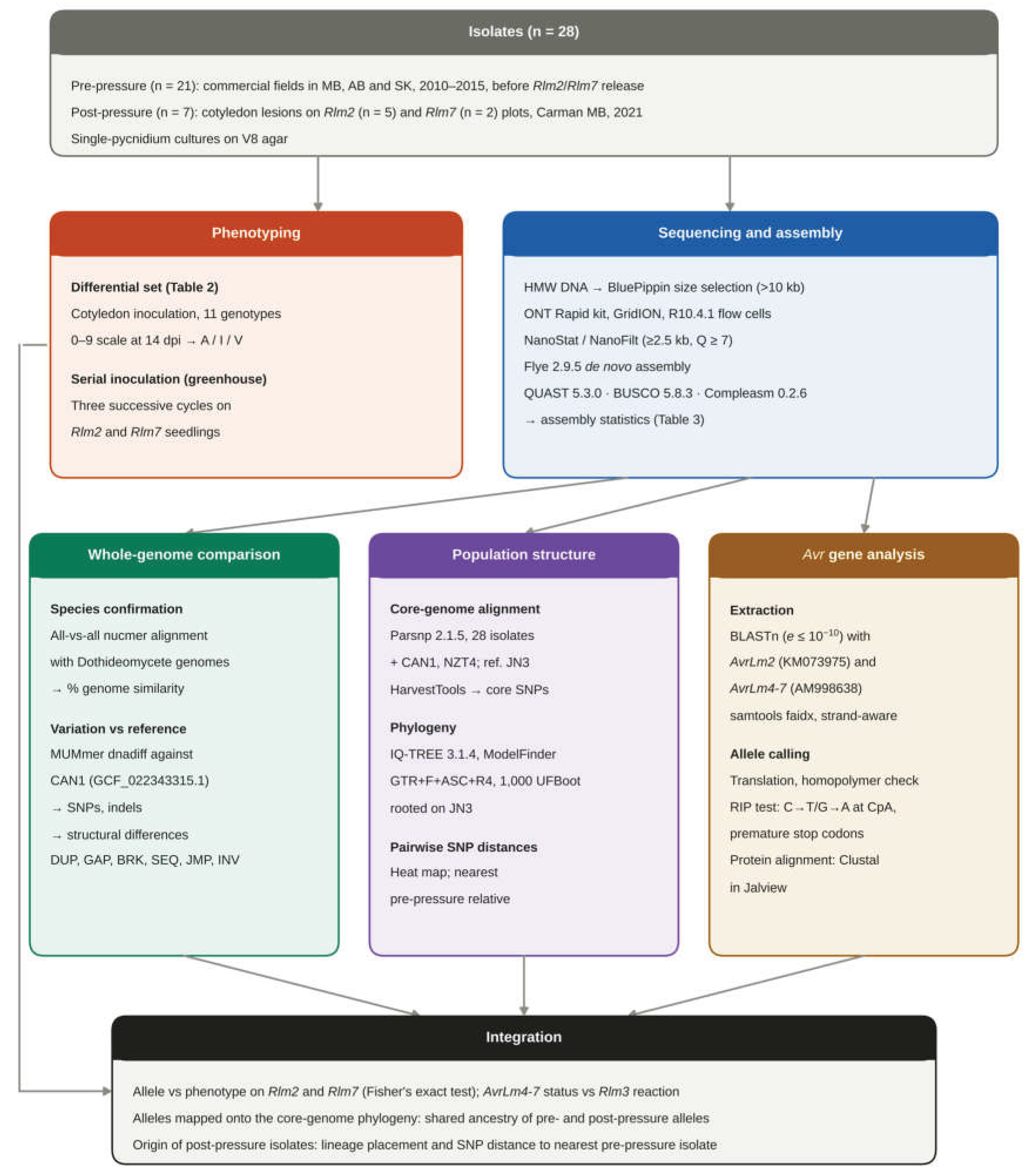
Figure 2.
Disease severity of Leptosphaeria maculans isolates on genotype carrying single Rlm2 and Rlm7 seedlings over three successive cycles of inoculation and re-isolation. (A) Mean severity (0–9 scale) of six isolates and the susceptible control Westar in cycles 1–3. (B) Severity in cycles 1 and 3; mean severity across the six isolates increased from 2.39 to 2.73 (paired t-test, P = 0.031). Isolate labels are colored by sampling group as in Table 1; post-pressure isolates are in bold.
Figure 2.
Disease severity of Leptosphaeria maculans isolates on genotype carrying single Rlm2 and Rlm7 seedlings over three successive cycles of inoculation and re-isolation. (A) Mean severity (0–9 scale) of six isolates and the susceptible control Westar in cycles 1–3. (B) Severity in cycles 1 and 3; mean severity across the six isolates increased from 2.39 to 2.73 (paired t-test, P = 0.031). Isolate labels are colored by sampling group as in Table 1; post-pressure isolates are in bold.
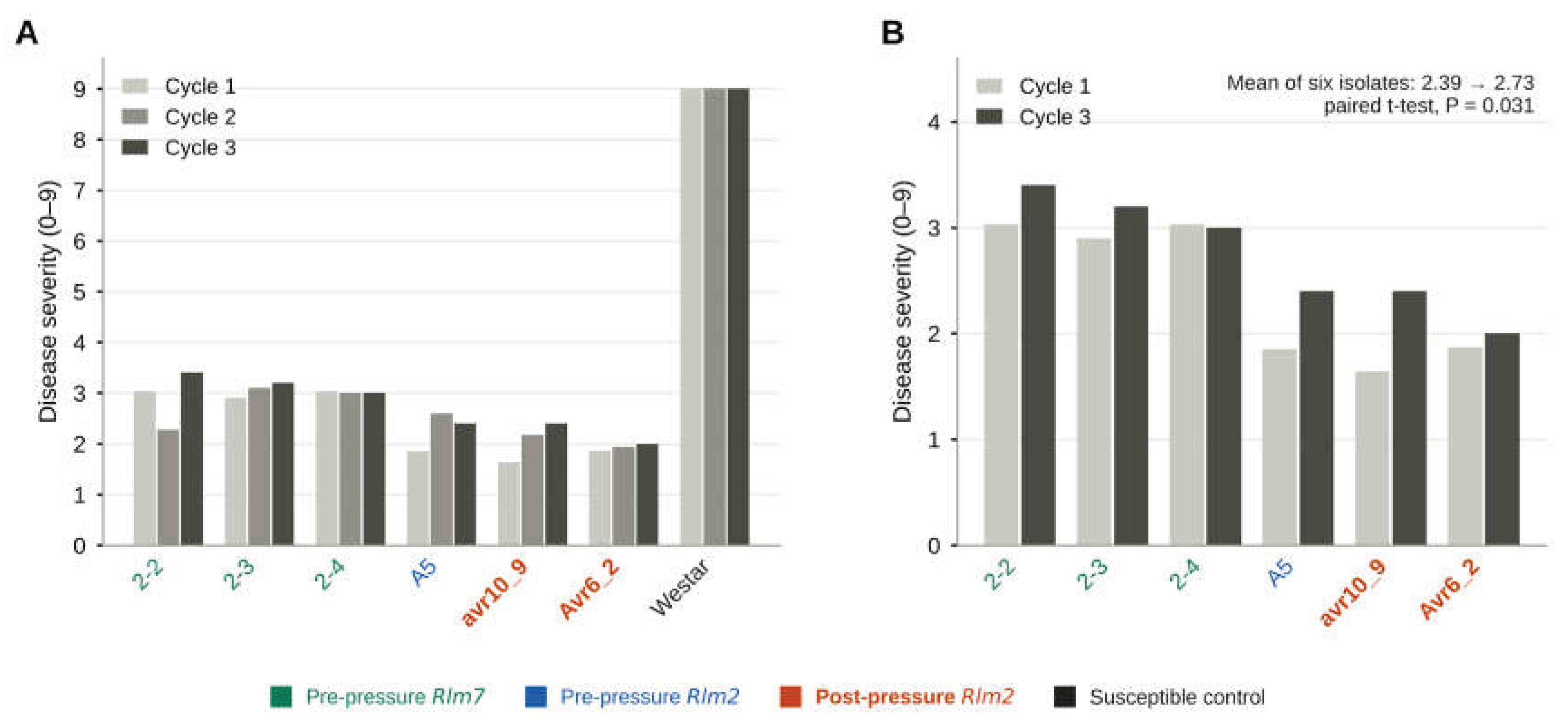
Figure 3.
Whole-genome similarity among the 28 Leptosphaeria maculans isolates and representative Dothideomycete species, based on nucmer alignment. Darker colours indicate higher similarity. Full values are given in Table S2.
Figure 3.
Whole-genome similarity among the 28 Leptosphaeria maculans isolates and representative Dothideomycete species, based on nucmer alignment. Darker colours indicate higher similarity. Full values are given in Table S2.
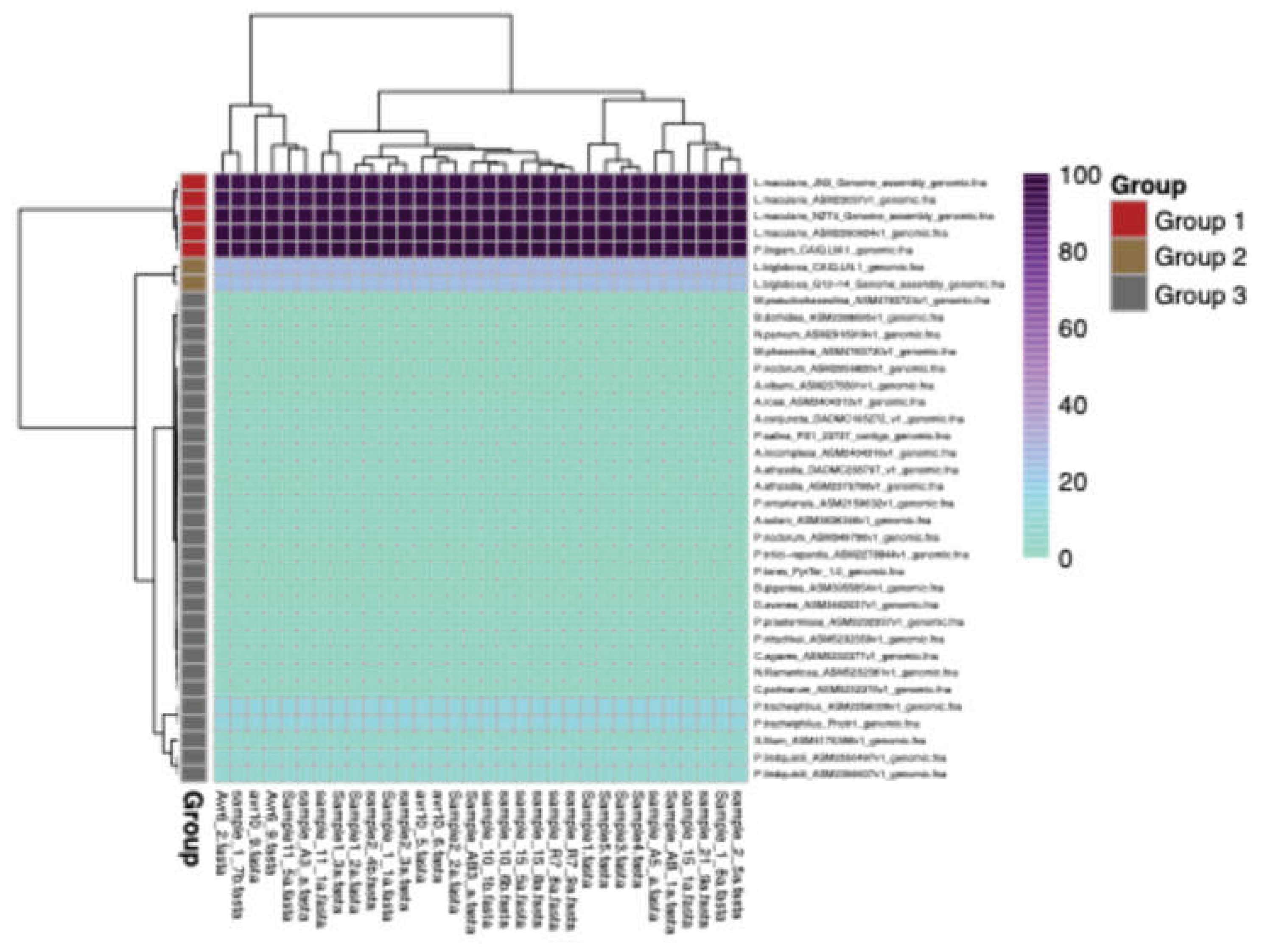
Figure 4.
SNPs (a) and indels (b) in each Leptosphaeria maculans isolate relative to the reference genome CAN1 (GCF_022343315.1), identified with MUMmer dnadiff. Post-pressure isolates are in bold. Dashed lines show group medians (× 1,000).
Figure 4.
SNPs (a) and indels (b) in each Leptosphaeria maculans isolate relative to the reference genome CAN1 (GCF_022343315.1), identified with MUMmer dnadiff. Post-pressure isolates are in bold. Dashed lines show group medians (× 1,000).
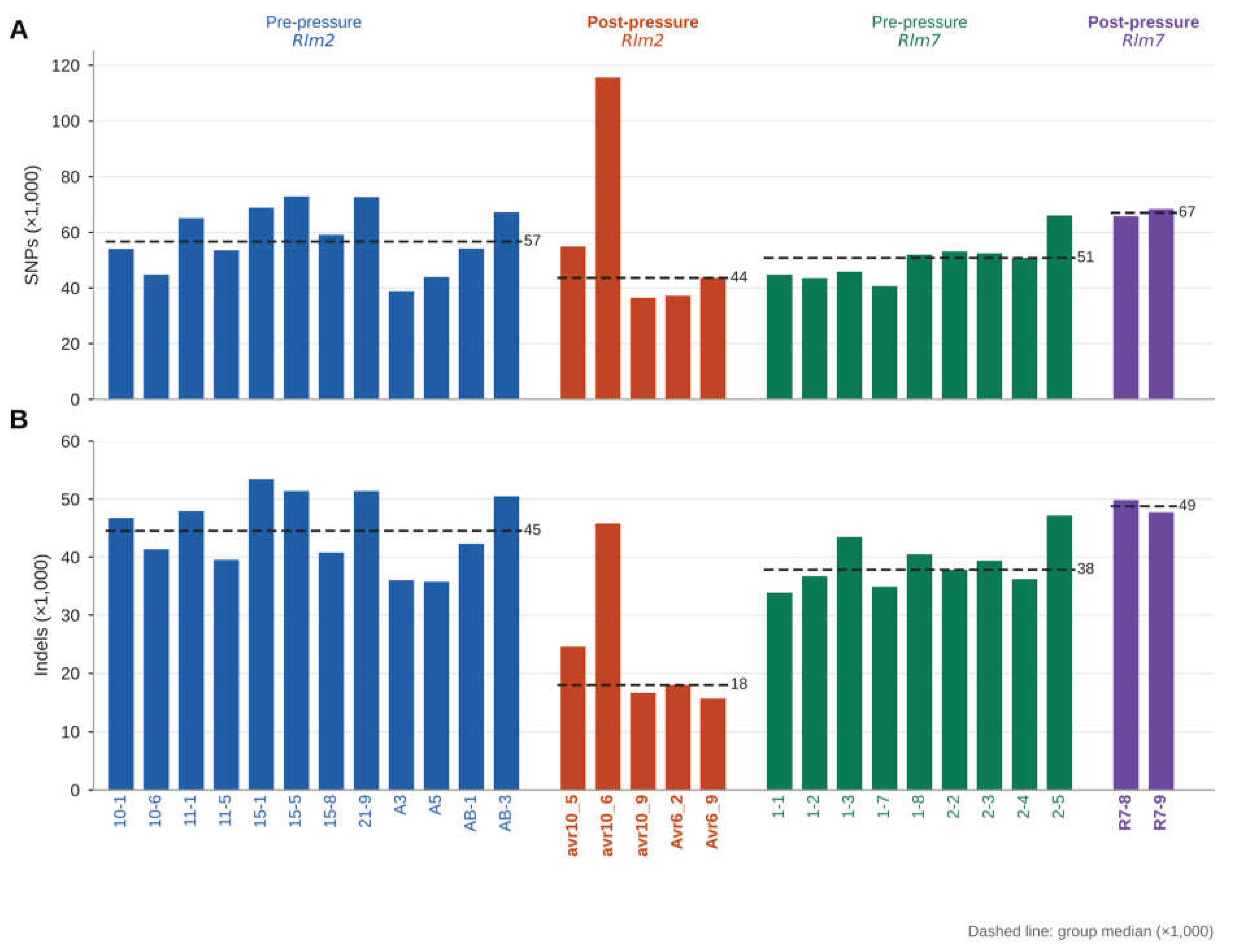
Figure 5.
Structural differences between each Leptosphaeria maculans isolate and the reference genome CAN1 (GCF_022343315.1), identified with MUMmer dnadiff and counted in isolate coordinates. DUP, duplicated sequence; GAP, gap between adjacent alignments; BRK, unaligned sequence at a contig end; SEQ, inserted sequence from another reference contig; JMP, rearrangement within a contig; INV, inversion. Post-pressure isolates are in bold. Dashed lines show group medians.
Figure 5.
Structural differences between each Leptosphaeria maculans isolate and the reference genome CAN1 (GCF_022343315.1), identified with MUMmer dnadiff and counted in isolate coordinates. DUP, duplicated sequence; GAP, gap between adjacent alignments; BRK, unaligned sequence at a contig end; SEQ, inserted sequence from another reference contig; JMP, rearrangement within a contig; INV, inversion. Post-pressure isolates are in bold. Dashed lines show group medians.
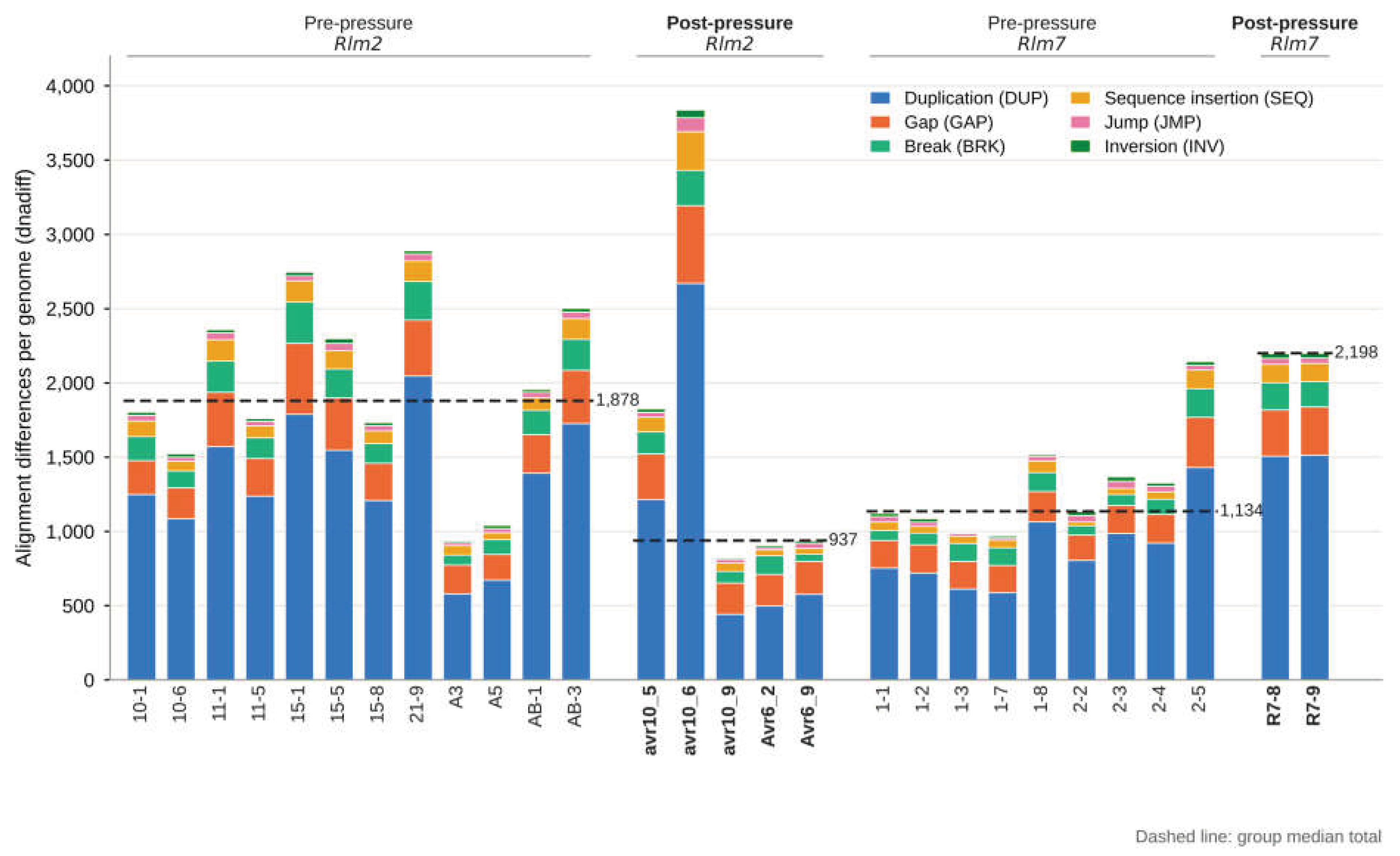
Figure 6.
Alignment of AvrLm4-7 protein sequences from 28 Leptosphaeria maculans isolates and the reference AM998638 (143 aa), made with Clustal in Jalview. Residues that differ from the reference are shown in white boxes, and * marks premature stop codons. Isolates shaded grey are the pre- and post-pressure Rlm7 isolates (the Rlm7 set). Eight isolates (1-1, 1-2, 1-3, 1-7, 1-8, A5, R7-8 and R7-9) carry RIP-inactivated alleles with the first premature stop at codon 35.
Figure 6.
Alignment of AvrLm4-7 protein sequences from 28 Leptosphaeria maculans isolates and the reference AM998638 (143 aa), made with Clustal in Jalview. Residues that differ from the reference are shown in white boxes, and * marks premature stop codons. Isolates shaded grey are the pre- and post-pressure Rlm7 isolates (the Rlm7 set). Eight isolates (1-1, 1-2, 1-3, 1-7, 1-8, A5, R7-8 and R7-9) carry RIP-inactivated alleles with the first premature stop at codon 35.
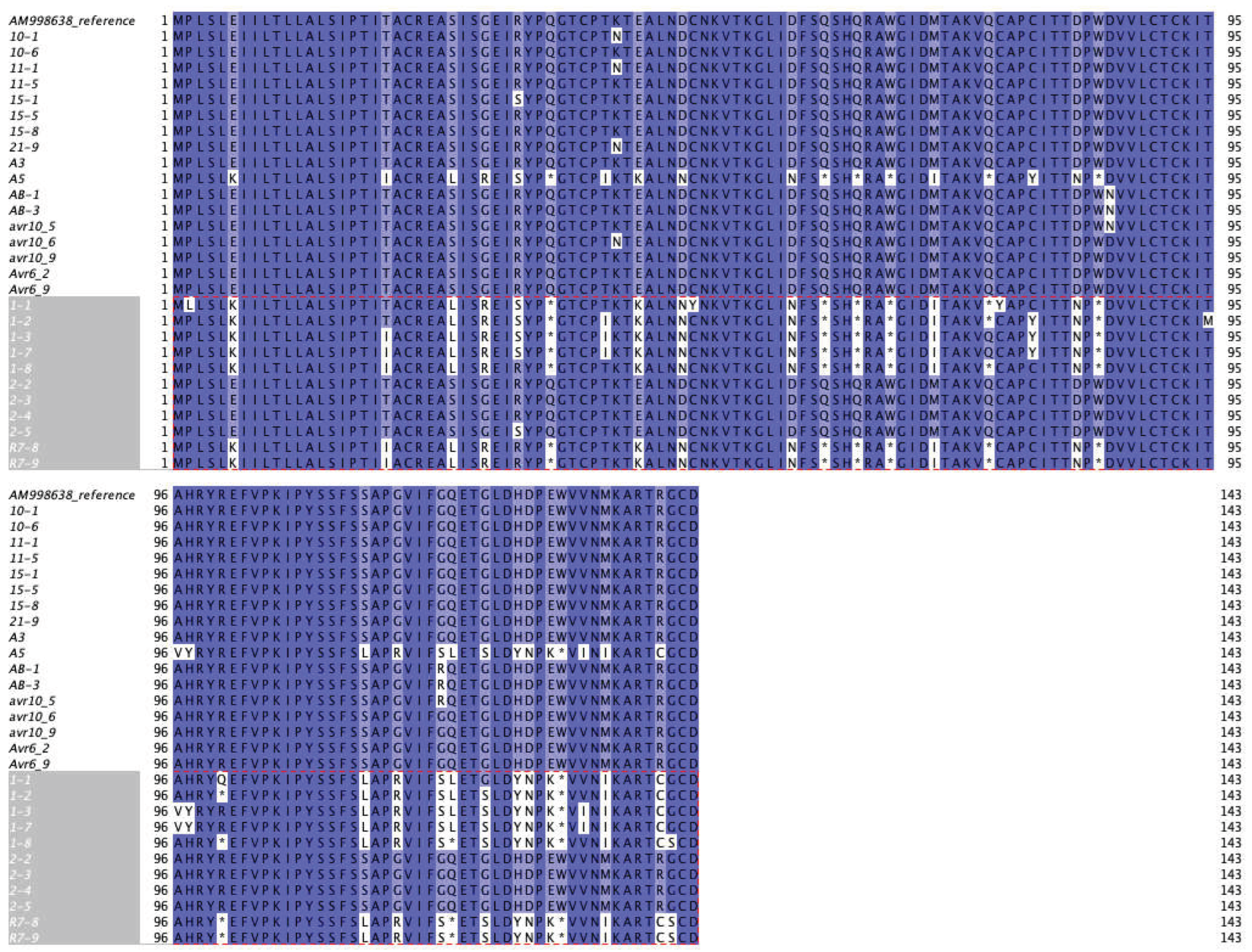
Figure 7.
Alignment of AvrLm2 protein sequences from 28 Leptosphaeria maculans isolates and the reference KM073975 (232 aa), made with Clustal in Jalview. Residues that differ from the reference are shown in white boxes, and * marks premature stop codons. Isolates shaded grey are the pre- and post-pressure Rlm2 isolates (the Rlm2 set). Residues 133 and 146 distinguish the reference allele (Gly/Glu) from the Asn/Gln and His/Gln alleles; isolate 11-5 carries a RIP-inactivated allele.
Figure 7.
Alignment of AvrLm2 protein sequences from 28 Leptosphaeria maculans isolates and the reference KM073975 (232 aa), made with Clustal in Jalview. Residues that differ from the reference are shown in white boxes, and * marks premature stop codons. Isolates shaded grey are the pre- and post-pressure Rlm2 isolates (the Rlm2 set). Residues 133 and 146 distinguish the reference allele (Gly/Glu) from the Asn/Gln and His/Gln alleles; isolate 11-5 carries a RIP-inactivated allele.
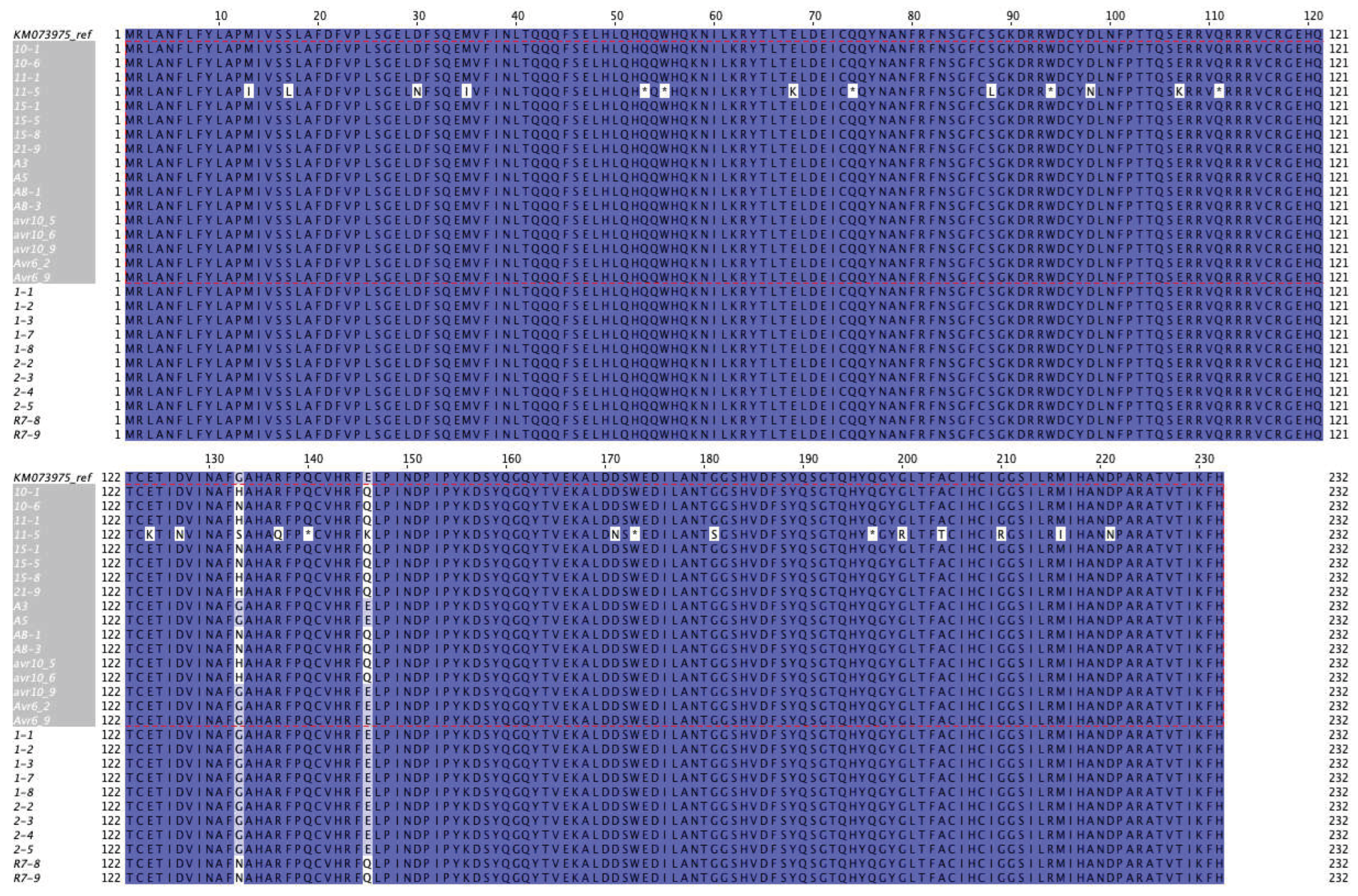
Figure 8.
Maximum-likelihood phylogeny of 28 Leptosphaeria maculans isolates and the public genomes CAN1 (China; GCF_022343315.1), NZT4 (New Zealand; GCA_900465115.1) and JN3 (France; GCA_900538235.1), based on 39,012 core-genome SNPs (Parsnp; IQ-TREE, GTR+F+ASC+R4). Node values are ultrafast bootstrap support (≥70% shown). The tree is rooted on JN3, and both root branches are shortened (//). Isolate labels are coloured by sampling group, with post-pressure isolates in bold. Columns show the AvrLm2 amino acids at positions 133/146 and the AvrLm4-7 allele; RIP-inactivated, allele carrying multiple C→T/G→A transitions, mostly at CpA dinucleotides, that create premature stop codons. Scale bar, substitutions per site.
Figure 8.
Maximum-likelihood phylogeny of 28 Leptosphaeria maculans isolates and the public genomes CAN1 (China; GCF_022343315.1), NZT4 (New Zealand; GCA_900465115.1) and JN3 (France; GCA_900538235.1), based on 39,012 core-genome SNPs (Parsnp; IQ-TREE, GTR+F+ASC+R4). Node values are ultrafast bootstrap support (≥70% shown). The tree is rooted on JN3, and both root branches are shortened (//). Isolate labels are coloured by sampling group, with post-pressure isolates in bold. Columns show the AvrLm2 amino acids at positions 133/146 and the AvrLm4-7 allele; RIP-inactivated, allele carrying multiple C→T/G→A transitions, mostly at CpA dinucleotides, that create premature stop codons. Scale bar, substitutions per site.
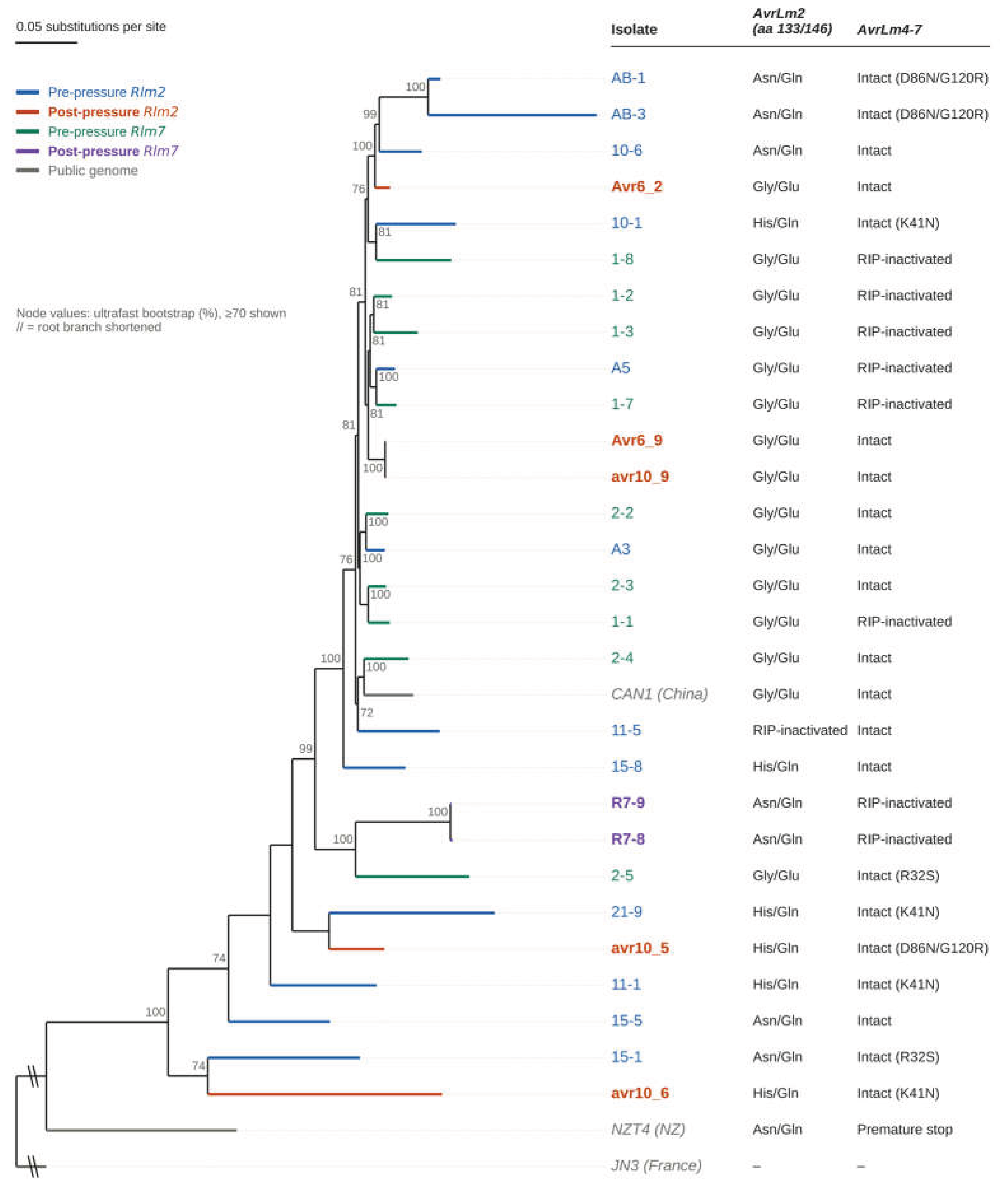
Figure 9.
Pairwise core-genome SNP differences among 28 Leptosphaeria maculans isolates and three public genomes, ordered as in the phylogeny (Figure 8). Values for the two near-identical pairs (Avr6_9/avr10_9 and R7-8/R7-9) are shown in the cells. Full values are given in Table S4.
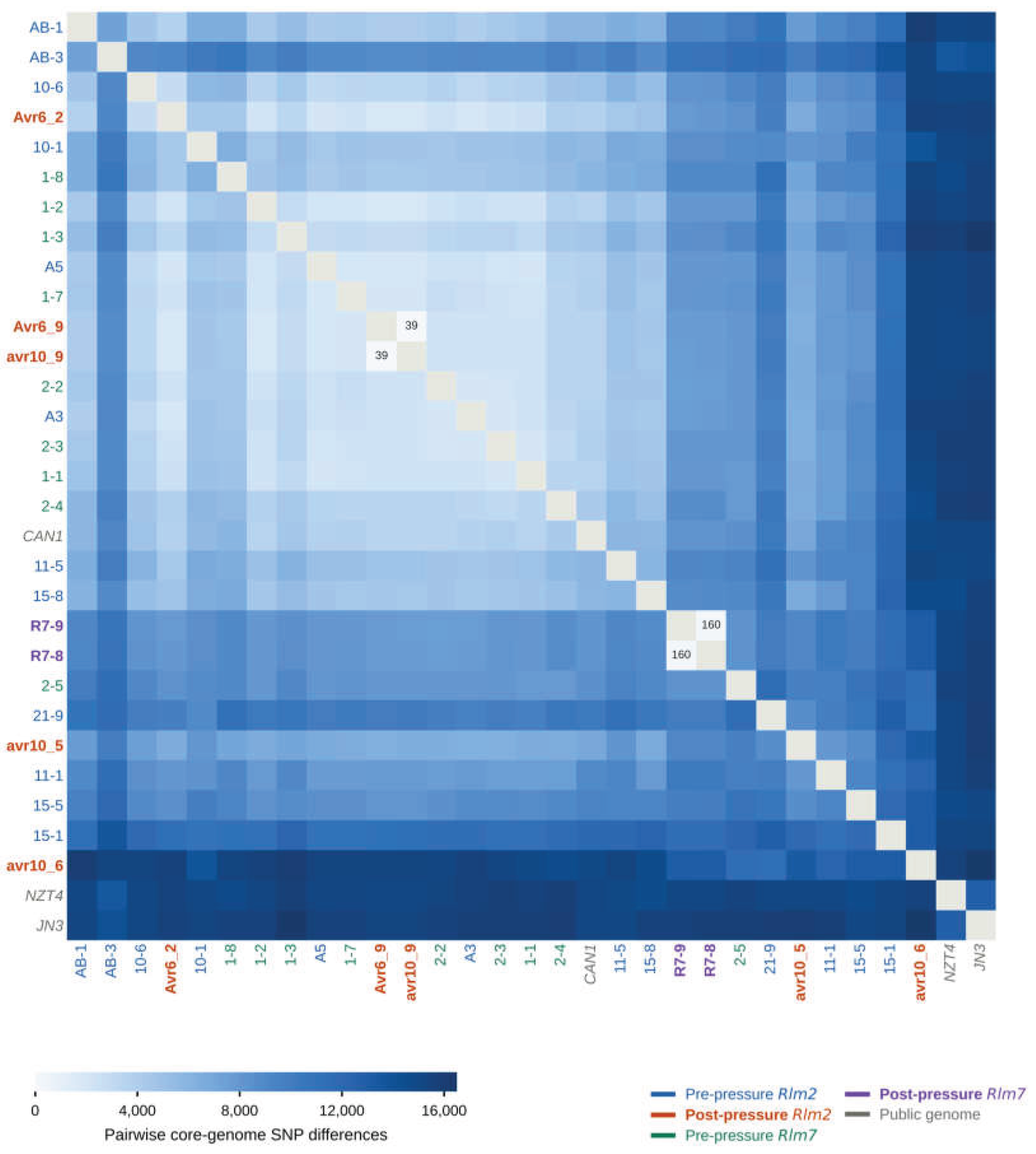

Table 1.
Leptosphaeria maculans isolates used in this study, with location and year of collection.
| Isolate code | NCBI isolate ID | Location | Year | Sampling group |
| 10-1 | Lm_Rlm2_07 | MB | 2010 | Pre-pressure Rlm2 |
| 10-6 | Lm_Rlm2_08 | MB | 2010 | |
| 11-1 | Lm_Rlm2_09 | MB | 2011 | |
| 11-5 | Lm_Rlm2_06 | MB | 2011 | |
| 15-1 | Lm_Rlm2_10 | MB | 2015 | |
| 15-5 | Lm_Rlm2_11 | MB | 2015 | |
| 15-8 | Lm_Rlm2_12 | MB | 2015 | |
| 21-9 | Lm_Rlm2_13 | MB | 2015 | |
| A3 | Lm_Rlm2_14 | MB | 2010 | |
| A5 | Lm_Rlm2_15 | AB | 2010 | |
| AB-1 | Lm_Rlm2_17 | AB | 2010 | |
| AB-3 | Lm_Rlm2_16 | AB | 2010 | |
| avr10_5 | Lm_Rlm2_01 | MB | 2021 | Post-pressure Rlm2 |
| avr10_6 | Lm_Rlm2_02 | MB | 2021 | |
| avr10_9 | Lm_Rlm2_03 | MB | 2021 | |
| Avr6_2 | Lm_Rlm2_04 | MB | 2021 | |
| Avr6_9 | Lm_Rlm2_05 | MB | 2021 | |
| 1-1 | Lm_Rlm7_06 | SK | 2010 | Pre-pressure Rlm7 |
| 1-2 | Lm_Rlm7_01 | SK | 2010 | |
| 1-3 | Lm_Rlm7_02 | SK | 2010 | |
| 1-7 | Lm_Rlm7_07 | MB | 2010 | |
| 1-8 | Lm_Rlm7_08 | MB | 2015 | |
| 2-2 | Lm_Rlm7_03 | SK | 2010 | |
| 2-3 | Lm_Rlm7_04 | SK | 2010 | |
| 2-4 | Lm_Rlm7_05 | MB | 2015 | |
| 2-5 | Lm_Rlm7_09 | MB | 2015 | |
| R7-8 | Lm_Rlm7_10 | MB | 2021 | Post-pressure Rlm7 |
| R7-9 | Lm_Rlm7_11 | MB | 2021 |
MB, Manitoba; AB, Alberta; SK, Saskatchewan. Post-pressure isolates were recovered from Rlm2 and Rlm7 plots at Carman, MB.
Table 2.
Avirulence profiles of Leptosphaeria maculans isolates on the Brassica differential set, by sampling group.
Table 2.
Avirulence profiles of Leptosphaeria maculans isolates on the Brassica differential set, by sampling group.
| Isolate code | Westar | Rlm3 | LepR1 | LepR2 | Rlm6 | LepR3/RlmS | Rlm4 | Rlm9 | Rlm2ᵇ | Rlm7 | Avr profileᵃ | Sampling group |
| 10-1 | a | I | A | a | A | I | A | a | A | A | AvrLm2-(3)-4-6-7-(S), AvrLepR1 | Pre-pressure Rlm2 |
| 10-6 | a | a | A | I | A | I | A | a | I | A | AvrLm(2)-4-6-7-(S), AvrLepR1-(2) | |
| 11-1 | a | a | A | a | I | A | A | a | a | A | AvrLm4-(6)-7-S, AvrLepR1 | |
| 11-5 | a | a | I | a | a | A | A | a | I | A | AvrLm(2)-4-7-S, AvrLepR(1) | |
| 15-1 | a | a | A | a | A | I | A | a | a | I | AvrLm4-6-(7)-(S), AvrLepR1 | |
| 15-5 | a | a | A | a | A | I | A | a | I | A | AvrLm(2)-4-6-7-(S), AvrLepR1 | |
| 15-8 | a | a | A | a | A | A | A | a | A | A | AvrLm2-4-6-7-S, AvrLepR1 | |
| 21-9 | a | a | A | I | A | A | A | a | a | A | AvrLm4-6-7-S, AvrLepR1-(2) | |
| A3 | a | a | A | I | A | A | A | A | A | A | AvrLm2-4-6-7-9-S, AvrLepR1-(2) | |
| A5 | a | A | A | I | A | A | a | a | A | a | AvrLm2-3-6-S, AvrLepR1-(2) | |
| AB-1 | a | a | I | a | A | A | A | a | a | A | AvrLm4-6-7-S, AvrLepR(1) | |
| AB-3 | a | a | A | I | A | A | A | a | A | A | AvrLm2-4-6-7-S, AvrLepR1-(2) | |
| avr10_5 | a | a | A | A | A | A | a | a | A | A | AvrLm2-6-7-S, AvrLepR1-2 | Post-pressure Rlm2 |
| avr10_6 | a | a | A | I | A | I | A | a | I | A | AvrLm(2)-4-6-7-(S), AvrLepR1-(2) | |
| avr10_9 | a | a | A | I | A | a | I | a | A | A | AvrLm2-(4)-6-7, AvrLepR1-(2) | |
| Avr6_2 | a | a | A | A | A | a | A | a | A | a | AvrLm2-4-6, AvrLepR1-2 | |
| Avr6_9 | a | a | A | A | A | A | A | A | I | I | AvrLm(2)-4-6-(7)-9-S, AvrLepR1-2 | |
| 1-1 | a | A | A | A | A | A | A | A | A | I | AvrLm2-3-4-6-(7)-9-S, AvrLepR1-2 | Pre-pressure Rlm7 |
| 1-2 | a | A | A | A | A | A | A | A | A | A | AvrLm2-3-4-6-7-9-S, AvrLepR1-2 | |
| 1-3 | a | A | A | A | A | A | I | a | A | a | AvrLm2-3-(4)-6-S, AvrLepR1-2 | |
| 1-7 | a | a | A | I | I | A | A | a | A | a | AvrLm2-4-(6)-S, AvrLepR1-(2) | |
| 1-8 | a | A | A | a | A | I | a | A | A | I | AvrLm2-3-6-(7)-9-(S), AvrLepR1 | |
| 2-2 | a | a | a | a | A | I | A | a | A | A | AvrLm2-4-6-7-(S) | |
| 2-3 | a | a | I | I | I | I | A | a | A | A | AvrLm2-4-(6)-7-(S), AvrLepR(1)-(2) | |
| 2-4 | a | a | a | I | A | A | A | a | A | A | AvrLm2-4-6-7-S, AvrLepR(2) | |
| 2-5 | a | A | A | A | A | A | a | a | A | A | AvrLm2-3-6-7-S, AvrLepR1-2 | |
| R7-8 | a | I | A | I | A | A | I | a | I | a | AvrLm(2)-(3)-(4)-6-S, AvrLepR1-(2) | Post-pressure Rlm7 |
| R7-9 | a | a | I | I | A | A | I | a | I | a | AvrLm(2)-(4)-6-S, AvrLepR(1)-(2) |
A = avirulent, a = virulent, I = intermediate, — = not tested. Isolate codes and groups as in Table 1.; ᵃAvirulence genes inferred from avirulent reactions; intermediate reactions are shown in parentheses.;ᵇ Scored on the single-gene line Rlm2.
Table 3.
Assembly statistics of the 28 sequenced Leptosphaeria maculans isolates.
| Isolate code | BUSCO (%) | Compleasm (%) | Assembly length (Mb) |
| 10-1 | 99.6 | 100.00 | 36.16 |
| 10-6 | 99.7 | 100.00 | 36.71 |
| 11-1 | 99.7 | 100.00 | 35.70 |
| 11-5 | 99.9 | 99.87 | 37.38 |
| 15-1 | 99.5 | 100.00 | 34.49 |
| 15-5 | 99.7 | 100.00 | 36.74 |
| 15-8 | 99.6 | 100.00 | 37.69 |
| 21-9 | 99.9 | 100.00 | 36.77 |
| A3 | 99.9 | 100.00 | 35.69 |
| A5 | 99.7 | 100.00 | 36.40 |
| AB-1 | 99.9 | 100.00 | 37.02 |
| AB-3 | 99.9 | 99.87 | 35.85 |
| avr10_5 | 99.6 | 99.87 | 36.55 |
| avr10_6 | 99.7 | 100.00 | 38.29 |
| avr10_9 | 99.6 | 100.00 | 34.56 |
| Avr6_2 | 99.6 | 99.87 | 34.93 |
| Avr6_9 | 99.7 | 99.87 | 38.21 |
| 1-1 | 99.9 | 100.00 | 37.47 |
| 1-2 | 99.9 | 100.00 | 37.85 |
| 1-3 | 99.6 | 100.00 | 34.66 |
| 1-7 | 99.7 | 100.00 | 34.53 |
| 1-8 | 99.7 | 100.00 | 37.40 |
| 2-2 | 99.7 | 100.00 | 40.27 |
| 2-3 | 99.6 | 100.00 | 40.11 |
| 2-4 | 99.9 | 99.87 | 38.73 |
| 2-5 | 99.6 | 100.00 | 35.61 |
| R7-8 | 99.7 | 100.00 | 36.54 |
| R7-9 | 99.7 | 100.00 | 36.56 |
Post-pressure isolates are shown in bold.; Completeness was assessed with BUSCO v5.8.3 (fungi_odb10) and Compleasm v0.2.6; assembly length was calculated with QUAST v5.3.0.
Table 4.
AvrLm4-7 alleles and Rlm7 phenotypes of the 28 Leptosphaeria maculans isolates.
| Isolate code | Rlm7 | Rlm3 | Allele | Amino acid change | Comments | Sampling group |
| AM998638 | — | — | Intact | — | Reference allele (143 aa, two exons) | Reference |
| 10-1 | A | I | Intact | Lys41→Asn | Pre-pressure Rlm2 |
|
| 10-6 | A | a | Intact | None | ||
| 11-1 | A | a | Intact | Lys41→Asn | ||
| 11-5 | A | a | Intact | None | ||
| 15-1 | I | a | Intact | Arg32→Ser | ||
| 15-5 | A | a | Intact | None | ||
| 15-8 | A | a | Intact | None | ||
| 21-9 | A | a | Intact | Lys41→Asn | ||
| A3 | A | a | Intact | None | ||
| A5 | a | A | RIP-inactivated | Stop at codon 35 | 60 C→T/G→A (48 at CpA), 2 other; 7 stops | |
| AB-1 | A | a | Intact | Asp86→Asn, Gly120→Arg | ||
| AB-3 | A | a | Intact | Asp86→Asn, Gly120→Arg | ||
| avr10_5 | A | a | Intact | Asp86→Asn, Gly120→Arg | Post-pressure Rlm2 |
|
| avr10_6 | A | a | Intact | Lys41→Asn | ||
| avr10_9 | A | a | Intact | None | ||
| Avr6_2 | a | a | Intact | None | ||
| Avr6_9 | I | a | Intact | None | ||
| 1-1 | I | A | RIP-inactivated | Stop at codon 35 | 63 C→T/G→A (49 at CpA), 2 other; 7 stops | Pre-pressure Rlm7 |
| 1-2 | A | A | RIP-inactivated | Stop at codon 35 | 65 C→T/G→A (51 at CpA), 2 other; 8 stops; intron donor GT→AT | |
| 1-3 | a | A | RIP-inactivated | Stop at codon 35 | 57 C→T/G→A (45 at CpA), 2 other; 6 stops | |
| 1-7 | a | a | RIP-inactivated | Stop at codon 35 | 57 C→T/G→A (45 at CpA), 2 other; 6 stops | |
| 1-8 | I | A | RIP-inactivated | Stop at codon 35 | 56 C→T/G→A (44 at CpA), 0 other; 9 stops | |
| 2-2 | A | a | Intact | None | ||
| 2-3 | A | a | Intact | None | ||
| 2-4 | A | a | Intact | None | ||
| 2-5 | A | A | Intact | Arg32→Ser | ||
| R7-8 | a | I | RIP-inactivated | Stop at codon 35 | 56 C→T/G→A (44 at CpA), 0 other; 9 stops | Post-pressure Rlm7 |
| R7-9 | a | a | RIP-inactivated | Stop at codon 35 | 56 C→T/G→A (44 at CpA), 0 other; 9 stops |
Rlm7 and Rlm3 phenotypes on 01-23-2-1 (Rlm7) and 02-22-2-1 (Rlm3) (Table 2): A = avirulent, I = intermediate, a = virulent. Isolate codes and order follow Table 1; post-pressure isolates in bold. Positions are numbered from the start codon of the reference AvrLm4-7 sequence (GenBank AM998638), which is identical to isolate 2-4.; RIP-inactivated alleles carry multiple C→T/G→A transitions, mostly at CpA dinucleotides, that create premature stop codons; all eight share the first stop at codon 35, so the encoded protein is truncated to 34 of 143 residues. R7-8 and R7-9 carry the same allele as pre-pressure isolate 1-8.; Rlm7: RIP-inactivated alleles 7/8 virulent or intermediate (exception 1-2); intact alleles 17/20 avirulent (exceptions Avr6_2, Avr6_9 and 15-1); Fisher's exact test, P = 7.1 × 10⁻⁴. Rlm3: 5/8 RIP-inactivated vs 1/20 intact alleles avirulent; Fisher's exact test, P = 0.0030.
Table 5.
AvrLm2 alleles and Rlm2 phenotypes of the 28 Leptosphaeria maculans isolates.
| Isolate code | Rlm2phenotype | Nucleotide position | Amino acid position | Comments | Sampling group |
| KM073975 | — | G397 G398 G436 | Gly133 Glu146 | Reference allele (isolate 00-100) | Reference |
| 10-1 | A | C397 A398 C436 | His133 Gln146 | Pre-pressure Rlm2 |
|
| 10-6 | I | A397 A398 C436 | Asn133 Gln146 | ||
| 11-1 | a | C397 A398 C436 | His133 Gln146 | ||
| 11-5 | I | A397 G398 A436 | Ser133 Lys146 | RIP: 39 C→T/G→A (25 at CpA); 8 premature stops, first at codon 53 | |
| 15-1 | a | A397 A398 C436 | Asn133 Gln146 | ||
| 15-5 | I | A397 A398 C436 | Asn133 Gln146 | ||
| 15-8 | A | C397 A398 C436 | His133 Gln146 | ||
| 21-9 | a | C397 A398 C436 | His133 Gln146 | ||
| A3 | A | G397 G398 G436 | Gly133 Glu146 | ||
| A5 | A | G397 G398 G436 | Gly133 Glu146 | ||
| AB-1 | a | A397 A398 C436 | Asn133 Gln146 | ||
| AB-3 | A | A397 A398 C436 | Asn133 Gln146 | ||
| avr10_5 | A | C397 A398 C436 | His133 Gln146 | Post-pressure Rlm2 |
|
| avr10_6 | I | C397 A398 C436 | His133 Gln146 | ||
| avr10_9 | A | G397 G398 G436 | Gly133 Glu146 | ||
| Avr6_2 | A | G397 G398 G436 | Gly133 Glu146 | ||
| Avr6_9 | I | G397 G398 G436 | Gly133 Glu146 | ||
| 1-1 | A | G397 G398 G436 | Gly133 Glu146 | Pre-pressure Rlm7 |
|
| 1-2 | A | G397 G398 G436 | Gly133 Glu146 | ||
| 1-3 | A | G397 G398 G436 | Gly133 Glu146 | ||
| 1-7 | A | G397 G398 G436 | Gly133 Glu146 | ||
| 1-8 | A | G397 G398 G436 | Gly133 Glu146 | ||
| 2-2 | A | G397 G398 G436 | Gly133 Glu146 | ||
| 2-3 | A | G397 G398 G436 | Gly133 Glu146 | ||
| 2-4 | A | G397 G398 G436 | Gly133 Glu146 | ||
| 2-5 | A | G397 G398 G436 | Gly133 Glu146 | ||
| R7-8 | I | A397 A398 C436 | Asn133 Gln146 | Post-pressure Rlm7 |
|
| R7-9 | I | A397 A398 C436 | Asn133 Gln146 |
Rlm2 phenotype on the single-gene line Rlm2 (Table 2): A = avirulent, I = intermediate, a = virulent. Post-pressure isolates in bold. Positions are numbered from the start codon of the reference AvrLm2 sequence (GenBank KM073975; single exon, 699 bp, 232 aa). No amino-acid differences other than those shown were found. A 1-nt deletion in the poly-T tract at nt 17–24 in eight assemblies (10-1, 15-1, 15-8, 21-9, A5, 1-8, 2-3, R7-8) was treated as a nanopore homopolymer error and corrected before translation (see Methods).; Gly133/Glu146 alleles: 13/14 avirulent; His133/Gln146, Asn133/Gln146 and RIP alleles: 10/14 virulent or intermediate (Fisher's exact test, P = 0.0013).
Disclaimer/Publisher’s Note: The statements, opinions and data contained in all publications are solely those of the individual author(s) and contributor(s) and not of MDPI and/or the editor(s). MDPI and/or the editor(s) disclaim responsibility for any injury to people or property resulting from any ideas, methods, instructions or products referred to in the content. |
© 2026 by the authors. Licensee MDPI, Basel, Switzerland. This article is an open access article distributed under the terms and conditions of the Creative Commons Attribution (CC BY) license (http://creativecommons.org/licenses/by/4.0/).
Copyright: This open access article is published under a Creative Commons CC BY 4.0 license, which permit the free download, distribution, and reuse, provided that the author and preprint are cited in any reuse.