

Submitted:
19 October 2026
Posted:
20 October 2026
You are already at the latest version
Abstract
Artificial intelligence is reshaping education, yet research remains fragmented across technological streams and often conflates technical capability with demonstrated educational effectiveness. This narrative review synthesizes representative literature published mainly between 2010 and 2026 to trace the evolution of AI-enabled education from computer-assisted instruction toward adaptive, immersive, generative, and potentially more general forms of intelligence. It compares three major technological streams: intelligent tutoring and adaptive learning systems, extended reality (XR), and large language model-based generative AI. The review finds that intelligent tutoring systems support learner modeling, adaptive feedback, and personalization, but their evidence base is methodologically heterogeneous. XR shows comparatively more consolidated evidence, particularly through systematic reviews and meta-analyses, with generally positive but context-dependent effects on engagement and learning outcomes. Generative AI expands dialogic explanation, scaffolding, content generation, and personalized support, although learner-outcome evidence remains limited relative to capability benchmarking. Building on these findings, the review proposes a Technology–Mechanism–Outcome–Challenge framework and argues that future progress toward artificial general intelligence (AGI) should be evaluated through learning mechanisms, measurable outcomes, human oversight, equity, and responsible governance.
Keywords:
artificial intelligence
; conceptual framework
; educational evolution
; human-computer collaboration
; educational ethics
; artificial general intelligence
1. Introduction
With the rapid development of information technology, Artificial Intelligence (AI) technology is profoundly transforming the landscape of the education sector and driving revolutionary changes in educational and teaching methodologies. AI has not only elevated the standard of educational technology, but also reshaped the core of educational models, refined teaching methods and learning experiences, and provided robust technical support for the innovative development of education (Walter, 2024; Chen et al., 2020). Driven by AI technology, education is undergoing a transformative upgrade toward digitalization (Carmo et al., 2025), personalization (Strielkowski et al., 2025; Liu, 2025), and intellectualization (Xie and Jiao, 2025). From early computer-assisted instruction and online learning platforms to contemporary AI-supported personalized learning systems, technological advances have continuously reshaped the organization of teaching and learning. In particular, the recent development of generative AI has introduced new possibilities for interactive learning support, content generation, and human–AI collaboration, while also raising new pedagogical and ethical concerns (Chiu, 2024; Šedlbauer et al., 2024; Giannakos et al., 2025).
Recent advances in large language models (LLMs), multimodal foundation models, and other general-purpose AI technologies have renewed discussion about the longer-term possibility of Artificial General Intelligence (AGI) (Raman et al., 2025; Fei et al., 2022). AGI possesses cross-domain (Raman et al., 2025) and multimodal (Fei et al., 2022) cognitive capabilities. It can not only comprehend and learn knowledge, but also flexibly transfer and apply such knowledge in complex tasks, demonstrating an intelligence level close to that of humans. At present, it is generative AI and other advanced AI technologies that are being integrated into educational practice to support personalized learning, content generation, interactive assistance, and flexible instructional experiences (Gu et al., 2023). At the same time, their growing use has raised a range of ethical and educational concerns, including the digital divide, privacy protection, algorithmic fairness, and the changing relationship between teachers and intelligent systems (Wang et al., 2024; Al-Zahrani and Alasmari, 2024; Simon, 2019; Chan and Tsi, 2024). Against this background, how to scientifically and rationally integrate AI into teaching practice, balance the role relationship between human educators and intelligent systems, and avoid the blind application or even abuse of technology has become a critical issue that needs to be addressed urgently (Chan and Tsi, 2024). Therefore, it is necessary to systematically sort out the inherent logic of technology-driven evolution of teaching models, clarify its advantages and limitations, and provide theoretical support for the innovation of educational technology and the improvement of relevant systems.
To address the aforementioned issues, this study traces the evolution of AI-enabled education and summarizes the corresponding transformation of educational and teaching models. Focusing on key technologies such as intelligent teaching assistants, extended reality (XR) technologies, and large language models (LLMs), this paper examines their practical applications and analyzes how different forms of AI support innovation in teaching and learning. Building on these findings, the review proposes an evidence-informed Technology–Mechanism–Outcome–Challenge framework that positions learning mechanisms as an intermediate explanatory layer between technological affordances and educational outcomes. It further identifies teacher-role transformation, learner overreliance, digital inequality, privacy, transparency, bias, and human oversight as cross-cutting challenges. Looking toward the prospective development of AGI, the review argues that broader and more autonomous AI capabilities may amplify these challenges, while learner agency, human oversight, equity, transparency, and responsible governance remain essential across technological stages.
The remainder of this paper is structured as follows: Section 2 describes the narrative review approach and literature selection strategy. Section 3 traces the evolution of AI-enabled educational and pedagogical models. Section 4 examines representative applications and evidence concerning intelligent tutoring systems, XR-enabled learning, and generative AI. Section 5 synthesizes these findings through a Technology–Mechanism–Outcome–Challenge framework and explains the mediating role of learning mechanisms in translating technological affordances into educational outcomes. Section 6 discusses pedagogical, equity, ethical, and governance challenges in current AI-enabled education and considers their implications for the prospective AGI horizon. Section 7 concludes the review and outlines future directions.
2. Review Approach and Literature Selection
2.1. Review Approach
This study adopts a narrative review and conceptual synthesis approach to examine the evolution of artificial intelligence in education from computer-assisted instruction (CAI) to the emerging prospect of AGI. Rather than aiming for exhaustive coverage of all publications, the literature corpus was selected purposively and illustratively to represent major technological paradigms, educational mechanisms, applications, and challenges across different stages of AI-enabled education.
The primary literature corpus focuses on studies published between 2010 and 2026. Earlier seminal works were additionally retained when necessary to establish the historical and conceptual foundations of CAI, intelligent tutoring systems (ITS), cognitive tutoring, and related educational paradigms. These earlier sources were used primarily for historical contextualization rather than as part of the contemporary evidence base.
2.2. Search Strategy
Relevant literature was identified primarily through Web of Science, Scopus, ERIC, IEEE Xplore, and Google Scholar. Searches combined terms related to artificial intelligence and education, including “artificial intelligence”, “computer-assisted instruction”, “intelligent tutoring system”, “adaptive learning”, “learning analytics”, “extended reality”, “virtual reality”, “augmented reality”, “generative AI”, “large language model”, “ChatGPT”, and “artificial general intelligence”, together with educational terms such as “education”, “teaching”, “learning”, “student”, “teacher”, and “higher education”.
Additional searches were conducted for themes related to educational impact and governance, including “academic integrity”, “critical thinking”, “privacy”, “fairness”, “algorithmic bias”, “digital divide”, and “teacher–AI collaboration”. Reference lists of relevant reviews and representative studies were also examined to identify additional foundational or influential publications.
2.3. Purposive Sampling and Selection Criteria
Literature selection followed a purposive and illustrative sampling strategy. Priority was given to studies that met the following criteria: (1) publication between 2010 and 2026, except for seminal historical works; (2) publication through established or indexed academic venues; (3) direct relevance to AI-enabled teaching, learning, educational assessment, teacher support, or educational governance; and (4) contribution to at least one major mechanism examined in this review, including intelligent tutoring and adaptive learning, data-driven learning analytics, XR-supported learning, generative AI and LLM-supported education, or human–AI collaboration.
When discussing educational effectiveness, greater emphasis was placed on systematic reviews, meta-analyses, controlled or longitudinal studies, and substantive empirical evaluations. Studies concerned only with general AI model performance, without a meaningful educational process, learner or teacher outcome, or pedagogical implication, were not treated as primary evidence of educational effectiveness. Conceptual papers, books, and policy reports were selectively retained when they contributed to historical interpretation, theoretical development, or ethical and governance discussions.
The final literature corpus comprised 104 references, including 40 primary empirical or system-evaluation studies and 64 contextual sources, such as reviews, meta-analyses, conceptual and theoretical works, books, and policy-oriented publications. Literature selection was conducted purposively by the author team to provide representative coverage of the technological paradigms, educational mechanisms, applications, and challenges examined in this review. A formal dual-reviewer independent screening procedure was not implemented, and inter-rater agreement was therefore not calculated. Consistent with the narrative and conceptual-synthesis design of the study, a PRISMA flow diagram is not reported. The review does not claim exhaustive identification or screening of all eligible publications, but instead aims to provide a transparent and evidence-informed synthesis of representative literature relevant to the scope of the study.
3. The Development Course of AI in Education and Teaching
The explosive development of AI is driving education and teaching into a critical transition period of paradigm reconstruction. To profoundly grasp the trajectory of this educational transformation, it is imperative to first clarify its core driving mechanism, systematically sort out the development context of the integration of AI with education and teaching, and present the underlying logic and full development landscape of this educational transformation.
The development of AI in education and teaching is a progressive evolutionary process from an “auxiliary tool” to a “cognitive partner”, and further to a “reshaper of the educational ecosystem”. Its development trajectory is not a linear leap; instead, it has formed stages with distinct characteristics under the intertwined driving forces of technological breakthroughs, the renewal of educational philosophies, and social demands. Taking the core technological paradigm and the depth of its integration with education as the primary basis, this development process can be divided into the following four critical stages, as shown in Figure 1.
3.1. The Period of AI Emergence
The 1950s to 1980s marked the embryonic stage of the educational application of AI. The essence of this stage lies in the initial integration of the concept of “programmed instruction” guided by behaviorist learning theory with early computer technology. At the technical level, this stage relied on mainframe computers and early personal computers to deliver teaching through pre-set programs and fixed algorithms. Typical forms included the early prototypes of CAI (Atkinson and Wilson, 1968) and Intelligent Tutoring Systems (ITS) (Nwana, 1990). Such systems broke down knowledge into linear or simply branched teaching sequences, which were essentially an extension of “electronic programmed textbooks”.
During the 1980s, educational applications of AI and computing began to diversify beyond conventional CAI. Educational expert systems increasingly applied knowledge-based reasoning to diagnosis, guidance, and tutoring, while the LOGO programming environment encouraged learners to explore, program, and construct knowledge through active interaction with computers. Papert’s work with LOGO laid important foundations for the constructionist tradition, which emphasized learning through the creation of personally meaningful artifacts rather than passive knowledge reception (Papert and Harel, 1991). These developments broadened the pedagogical role of computers and provided an important transition toward the more adaptive and learner-centered systems of the 1990s (Papert, 2020; Nwana, 1990; Wenger, 2014).
At the educational application level, the core objective of this stage was to realize preliminary individualized teaching and support learners to complete learning tasks at their own pace. However, its so-called “intelligence” was only reflected in rule-based path branching (e.g., switching learning units according to answering results), which failed to truly identify learners’ cognitive states and lacked dynamic modeling and adaptive adjustment of the learning process. During this period, AI could only play the role of a “tutoring machine” with limited functions. Although it could improve the efficiency of repetitive training, it had a single interaction mode and a rigid feedback mechanism. Furthermore, due to the high cost of hardware and systems, the widespread popularization of AI was ultimately not achieved.
3.2. The Period of Model-Driven AI Development
From the 1990s to the early 21st century, with the improvement of computer performance and the development of related disciplines such as cognitive science and educational psychology, the application of AI in education gradually entered a model-driven stage, the core development of which lay in learner modeling (Du Boulay et al., 2023). During this period, AI systems began to attempt to infer learners’ knowledge mastery levels, cognitive characteristics, and potential misconceptions by constructing learner models, thereby improving the pertinence and adaptability of teaching support. The key underpinnings of this stage mainly included cognitive modeling, Bayesian Knowledge Tracing, and preliminary machine learning methods. Based on these technologies, adaptive learning systems and ITS were further developed, with a typical representative being the early Cognitive Tutor (Anderson et al., 1995).
In the field of education, influenced by cognitivist learning theory during this period, greater attention was paid to the analysis and support of learners’ internal cognitive processes. Teaching activities no longer merely stayed at content presentation and behavioral feedback, but gradually shifted to a model-based “diagnosis-intervention” model. However, the model construction had poor scalability and limited support for open knowledge, and truly individualized teaching could not yet be realized.
3.3. The Period of Data-Driven AI Education
From 2010 to 2022, driven by the rapid development of technologies such as big data, cloud computing, and deep learning, the application of AI in education gradually entered the data-driven stage. The most prominent feature of this stage is that AI identifies learning patterns, predicts learning risks, and supports educational decision-making through the collection, processing, and analysis of large-scale learning behavior data (Ahmad et al., 2023; Salas-Martínez and Ramírez-Martinell, 2024). Relying on online learning platforms, systems can continuously collect a large volume of behavioral data generated by learners during digital learning processes, and implement applications including learning risk identification, dropout early warning, and resource recommendation on this basis. AI thus began to provide data-driven, precise services for large-scale learning scenarios in the field of education.
In the field of education, this stage was influenced by connectivism and learning science, with an emphasis on understanding learning patterns through data in authentic, large-scale learning environments. However, while the data-driven paradigm has brought about efficiency improvement and service optimization, it has also exposed a series of limitations, such as data privacy risks and algorithmic bias.
3.4. The Period of Generative and AI-Enabled Education
The rapid development of generative AI represented by LLMs marks that education and teaching have entered a new stage with generative interaction and cognitive enhancement as its core characteristics. Since 2022, applications based on LLMs such as ChatGPT have emerged one after another, marking that AI technology has made critical progress in advancing toward AGI (Gu et al., 2023). Generative AI in this stage can not only understand the questions raised by learners, but also generate explanations, examples, feedback, materials and tasks around specific scenarios, embodying stronger interactivity, generativity and collaboration.
Looking beyond current generative AI, the prospective emergence of AGI could further reshape the roles and relationships of stakeholders in the education system. For example, Xu et al. proposed a conceptual framework and practical scheme for the standardization system of AI models in the field of education, which clarifies the basic principles and application strategies for teachers and students to use such AI tools. They emphasize that teachers and students should correctly understand the value and limitations of AI, maintain a prudent attitude toward AI-generated content, and improve their literacy and competencies in collaborative work with AI (Xu et al., 2025). In this transformation process, the role of teachers will shift from knowledge imparters to learning guides, innovation inspirers, and personality shapers; the role of students will transform from knowledge consumers to generative co-creators; and AI will evolve from a tool to a human-like agent, jointly assuming educational responsibilities with teachers and students to provide learners with a more personalized, flexible, and inclusive educational experience.
In the field of education, the rapid development of generative AI and related AI technologies has contributed to important changes in learning-support paradigms. For example, the development of generative AI has added a new dimension to ITS, enabling them to accurately model students’ cognitive states, learning styles, and knowledge mastery levels, thereby providing personalized and adaptive learning and teaching pathways (Liu et al., 2024). Meanwhile, AI in the field of education is gradually realizing multimodal fusion, encompassing multiple data forms such as text, images, videos, and audios, to construct a more comprehensive learning analytics framework and provide more accurate and insightful support for educational decision-making (Lee et al., 2025). AI-based adaptive learning systems can continuously track students’ progress, analyze their strengths and weaknesses, monitor changes in their learning states, promptly identify learning difficulties, and adjust teaching content and progress in real time (Yenduri et al., 2025; Yolcu, 2023). Furthermore, Virtual Reality, Augmented Reality, and Mixed Reality technologies, empowered by generative AI, also deliver more immersive and interactive learning experiences for learners (Tracy and Spantidi, 2025; Chamola et al., 2024).
However, while the growing adoption of generative AI has created new opportunities for education, the education system is also confronted with numerous challenges, including the potential weakening of learners’ agency and cognitive development, the further widening of the digital divide, the increasingly prominent issues of educational ethics, and the risk of the weakening of humanistic values (Muthukrishna et al., 2025).
4. Practical Applications of AI-Enabled Education
With the rapid development and growing adoption of AI, particularly generative AI, educators and educational institutions have increasingly explored how these technologies can support teaching, learning, assessment, and instructional decision-making. This Section conducts case analysis and summary from the following three aspects: intelligent teaching assistants, XR empowerment, and LLMs.
4.1. Intelligent Teaching Assistants
ITS has become a critical tool in educational technology. Such systems model students’ cognitive states, learning styles, and knowledge mastery levels based on AI, so as to provide personalized learning pathways and real-time feedback (Bloom, 1984; VanLehn, 2011). By systematically reviewing the relevant literature on ITS, Suwita et al. concluded that three core components should be focused on in the design of ITS: the student model, the knowledge model, and the interaction model (Suwita et al., 2024). With the rapid development of generative AI in the field of education, ITS have also ushered in new technological transformations. For example, the study by Liu et al. integrated GPT-4 into ITSs, which significantly enhanced the effectiveness of the systems in personalized teaching and demonstrated the broad prospects of generative AI-enabled ITS (Liu et al., 2024).
Existing studies indicate that intelligent teaching assistants exert their functions primarily through mechanisms such as learner modeling, real-time feedback, adaptive learning pathway adjustment, and continuous learning companionship. These distinct mechanisms collectively form the fundamental framework for their learning support functions. Their main manifestations are presented in Table 1.
Whether through the dynamic identification of learners’ status, or via real-time prompts, pathway adjustment, and learning companionship, intelligent teaching assistants are driving the shift of learning support from static resource provision to dynamic process intervention. At the practical application level, existing studies suggest that intelligent tutoring and adaptive learning systems can support learning across different educational contexts, but the underlying evidence base is heterogeneous in terms of study design, sample size, and methodological rigor (Kulik and Fletcher, 2016; Ma et al., 2014). To provide a more transparent comparison of this evidence, Table 2 summarizes representative studies according to educational context, study design, sample or evidence base, learning mechanism and reported findings or outcomes.
4.2. Immersive Virtual Learning Environment
Unlike intelligent teaching assistants, which primarily function in cognitive diagnosis and feedback support, the advantages of XR technologies (including VR, AR and MR) in education are more predominantly reflected in situational construction, spatial representation, and practical training. By constructing highly realistic virtual experimental environments, reproducing historical scenarios, and presenting three-dimensional visual models of complex concepts, XR technologies provide students with a safe and controllable practical space. XR technologies also enhance the immersion, interactivity, and explorability of the learning process, and effectively facilitate the development of students’ deep learning and higher-order thinking skills. From the perspective of learning mechanisms, XR supports learning primarily through five approaches, as shown in Table 3.
In specific applied research, empirical evidence for XR-enabled education and teaching has gradually evolved from scattered case studies to systematic reviews, meta-analyses, and interdisciplinary comparative studies. Existing literature indicates that XR has not only been applied in fields emphasizing hands-on practice and spatial comprehension, including medicine, nursing, engineering, and STEM education, but has also been gradually extended to a broader range of conceptual learning, situational experience, and participatory activities. To more comprehensively present the supported tasks, learning mechanisms, outcome indicators, and evidence types of XR across diverse learning scenarios, this paper selects representative studies for systematic summarization, as shown in Table 4.
4.3. Generative AI–Enabled Learning Support
Generative artificial intelligence, particularly systems based on large language models (LLMs), has broadened the scope of AI-supported teaching and learning. Unlike earlier rule-based or predominantly predictive systems, generative AI can engage learners in open-ended dialogue, generate explanatory materials and examples, provide formative feedback, support problem solving and content creation, and assist teachers in instructional design (Salvador et al., 2025). These capabilities enable generative AI to function not merely as an information-delivery tool, but as an interactive component embedded in teaching and learning processes. It has already been applied across a range of disciplinary contexts, including programming education, language learning, and medical education (Chen et al., 2026; Wang, 2025; Moskovich and Rozani, 2025; Hui et al., 2025; Bhuyan et al., 2025).
In authentic educational settings, generative AI has been integrated into various learning activities. In programming education, it can support code generation, debugging, and feedback provision; in language learning, it can facilitate personalized practice and communicative training; and in medical education, it has been incorporated into problem-based learning and clinical training activities (Wang, 2025; Moskovich and Rozani, 2025; Garcia, 2025). These applications indicate that generative AI can support multiple stages of the learning process, including explanation, practice, feedback, and reflection. However, the educational value of such systems depends not only on their functional capabilities, but also on how they are integrated into instructional activities.
Alongside these application-oriented studies, another line of research has examined the task-level capabilities of LLMs in education-related domains. Comparative studies have evaluated model performance in anatomy question answering, medical licensing examinations, Python code generation, and language assessment (Singal and Goyal, 2025; Pattanshetti et al., 2025; Shahzad and Iqbal, 2025; Rasheed et al., 2024). These studies provide useful evidence for understanding the functional strengths and limitations of current models across different tasks. Nevertheless, specific model rankings should be interpreted with caution, as performance may be influenced by task design, evaluation criteria, model configuration, and the rapid iteration of model versions. More importantly, task-level performance does not directly demonstrate that the use of such systems leads to improved student learning outcomes.
Accordingly, recent research has begun to move beyond model capability benchmarking toward the evaluation of learning outcomes in authentic instructional settings. For example, Kestin et al. evaluated AI tutoring using a randomized controlled trial design, while Chen et al. investigated a teachable ChatGPT agent in programming education (Kestin et al., 2025; Chen et al., 2026). Such studies shift the research focus from whether an AI system can successfully perform an educational task to whether its integration into teaching and learning can lead to measurable learner development. Clarifying this distinction is important for assessing the practical educational value of generative AI and for guiding its effective integration into future instructional practice.
5. Technology–Mechanism–Outcome–Challenge Framework
5.1. Framework Components and Analytical Logic
Building on the historical analysis in Section 3 and the application evidence synthesized in Section 4, this review proposes the Technology–Mechanism–Outcome–Challenge framework shown in Figure 2. The framework consists of four analytically connected layers: Technology, Learning Mechanisms, Educational Outcomes, and Challenges.
A central proposition of the framework is that technological affordances do not directly determine educational outcomes. Instead, their educational value depends on the learning mechanisms activated through instructional design, learner interaction, and implementation context. Technology provides possibilities for learning support, whereas mechanisms explain how these possibilities are translated into changes in learning processes and outcomes.
The same technological affordance may therefore lead to different outcomes depending on how it is used. For example, a generative AI system may provide direct answers, scaffolded hints, explanatory dialogue, or reflective prompts. Although these functions rely on similar underlying generative capabilities, they may activate different levels of learner engagement and cognitive processing. Accordingly, the framework treats the technology–mechanism relationship, rather than technology alone, as the key analytical link between technical capability and educational value.
5.2. Interpreting Educational Evidence Through the Framework
Applying the framework to the evidence reviewed in Section 4 reveals different levels of maturity across the three technology–mechanism–outcome pathways. Intelligent tutoring and adaptive learning systems mainly operate through learner diagnosis, adaptive feedback, and pathway adjustment to support personalization and learning performance, although the evidence remains heterogeneous. XR-enabled learning shows a comparatively more consolidated pathway from immersive and situated mechanisms to engagement and learning outcomes, supported by a relatively stronger body of systematic reviews and meta-analyses. By contrast, generative AI provides increasingly visible forms of cognitive support and scaffolding, but its effects on measurable educational outcomes remain less firmly established.
The framework also explains why technical capability benchmarks cannot be treated as direct evidence of educational effectiveness. Demonstrating that an AI system can answer questions, generate code, or evaluate text establishes technological capability, but does not show whether that capability activates a productive learning mechanism or improves learner outcomes. Educational effectiveness therefore requires evidence connecting technological affordances, learning mechanisms, and measured outcomes.
6. Challenges in AI-Enabled Education
The effective application of educational technology is inseparable from the in-depth integration of educational concepts and practice, and requires comprehensive consideration of multiple factors including teacher transformation, student competency development, and ethics (Nguyen et al., 2023; Baker and Hawn, 2022; Shahzad et al., 2025; Francis et al., 2025; Holmes and Tuomi, 2022). If future AI systems acquire broader and more general capabilities, these studies still provide an important basis for anticipating how educational risks and governance requirements may evolve.
6.1. Teacher Role Transformation and the Demand for Integrated Platform Construction
As AI has gradually penetrated into core teaching links including knowledge transmission, skill demonstration, and learning diagnosis, teachers are facing unprecedented pressure of role transformation and challenges of competency reconstruction. While AI can effectively assist teaching in aspects such as curriculum planning, writing guidance, and outcome feedback, its widespread application may also trigger problems including academic misconduct and impeded development of students’ thinking and comprehensive competencies. Therefore, teachers not only need to proficiently master and appropriately apply AI tools, but also should adhere to the essential goals of education, and cultivate students’ correct values, critical thinking, and autonomous decision-making abilities (Samala et al., 2025; Qadir, 2023; Ahmed et al., 2024). Within increasingly automated educational environments, teachers’ pedagogical judgment, interpersonal interactions, contextual understanding, and ethical responsibilities retain irreplaceable importance (Chan and Tsi, 2024; Selwyn, 2019).
Jinhee Kim conducted a study focusing on Teacher-AI Collaboration (TAC) through in-depth interviews with 20 leading Chinese teachers in AI-enabled education. For the first time, the study systematically defined the core dimensions and correlational logic of the effective implementation of TAC, which provides a critical reference for instructional design and teacher professional development (Kim, 2024). Wang et al. proposed Tutor CoPilot, a human–AI approach designed to provide tutors with real-time instructional support and to scale access to expert tutoring practices (Wang et al., 2024). In response to the demand for the transformation of teachers’ competency structure brought by the rapid evolution of technology, relevant scholars have successively constructed a variety of teacher profiling frameworks. For example, Hu et al. proposed a teacher profiling framework consisting of three dimensions and eight sub-dimensions, namely teacher cognition and emotion, teacher knowledge and skills, and the interaction between teacher cognition and competency. They also identified the potential challenges of the framework, which provides an important reference for the development and transformation of teachers’ professional competencies (Hu et al., 2024).
In addition to competency reconstruction at the individual teacher level, another key bottleneck currently restricting the deep integration of AI into teaching practice lies in the lack of a user-friendly, fully functional integrated platform. Functions such as curriculum design, resource generation, assignment grading, learning diagnosis and feedback are often scattered across different tools. Teachers are required to frequently switch between multiple tools, import and export data, repeatedly set prompts, and continuously conduct result verification and error correction. This situation confines the application of AI to fragmented use, making it difficult to form systematic teaching practices. Therefore, there is an urgent need to develop an implementable integrated AI teaching platform for teachers. Meanwhile, the platform should be embedded with compliance mechanisms to alleviate the burden on teachers in terms of quality control and risk avoidance.
6.2. Risks of Alienation of Students’ Learning Modes and the Demand for Academic Integrity Governance
Against the backdrop of the rapid popularization of intelligent tools, as users of AI tools, students are undergoing structural changes in their learning modes. Generative AI can provide nearly “instant and complete” solutions for tasks including problem solving, writing, programming, and literature integration. While this significantly improves learning efficiency, it also induces the substitution of students’ learning behaviors. Students’ attention has shifted from concept construction and problem representation to result acquisition and expression packaging, and the time for independent thinking has been significantly compressed. Over time, students’ metacognitive ability and reflective awareness will decline, and the learning process will be locked in the information comfort zone constructed by AI, leading to a trend of degradation in critical thinking and autonomous decision-making abilities (Singh et al., 2025; Bastani et al., 2025).
In addition, students may avoid learning input through methods such as AI ghostwriting, AI-completed assignments, and AI surrogate learning, disguising process-based learning as outcome-based output, thus forming a covert cheating chain (Cotton et al., 2024; Eke, 2023). Existing studies have pointed out that while generative AI brings opportunities for learning and scientific research, it is also accompanied by threats to the learning process, academic integrity, and competency development, which requires the education system to respond from the strategic and governance levels (Francis et al., 2025; Rahman and Watanobe, 2023).
The core of education lies not only in knowledge acquisition, but also in the shaping of a sound personality, the formation of value judgment ability, and the cultivation of social responsibility awareness. The education system needs to make simultaneous efforts at the levels of institutional norms, curriculum design, and learning support, to guide students to position AI as a cognitive empowerment tool rather than a cognitive substitution tool, and avoid the long-term impairment of key competencies such as critical thinking and innovation ability caused by the alienation of learning modes (Nie et al., 2025).
6.3. Ethical Challenges in the Use of AI
6.3.1. Digital Divide
The digital divide has long been a key bottleneck for countries worldwide in advancing the digital and intelligent transformation of education. With the rapid development of AI, the digital divide in the traditional sense is gradually evolving into a more complex multi-dimensional divide (Antoninis et al., 2023). The National Educational Technology Plan released by the United States in 2024 puts forward initiatives from three dimensions: the digital access divide, the digital design divide, and the digital use divide. In the context of higher education, Wang et al. took four higher education institutions in China that apply AI technology as research objects, and verified through modeling analysis that the AI capability of higher education institutions consists of three dimensions: resources, skills, and awareness (Wang et al., 2023).
Table 5 not only clearly presents the multi-dimensional structure of the digital divide, but also reveals the formation mechanism and governance priorities of each dimension, which provides a decision-making reference for education administrators, schools, and policymakers.
6.3.2. Data Privacy and Security
In the context of educational applications of AI, data privacy and security serve as the prerequisite and fundamental guarantee for the implementation of the technology, the core of which lies in the protection of sensitive data throughout the entire education process. Applications including intelligent assisted teaching, learning situation analysis, and personalized learning all require in-depth processing and analysis of massive, multi-dimensional educational data. Therefore, during the processes of data collection, transmission and use, it is imperative to prevent data from being illegally acquired, misused, leaked, or tampered with, so as to effectively protect students’ privacy and data security (Rawas, 2024; Yang et al., 2025; Al-Zahrani, 2024). Within the European context, the GDPR (The European Parliament and the Council of the European Union, 2016) is the main legal framework for regulating personal data processing. Its principles are of direct reference value for educational AI systems handling student data. Currently, existing studies have proposed combining federated learning and differential privacy technologies to build privacy-preserving AI models, enabling institutions to conduct intelligent and scalable learning analytics without crossing legal boundaries or relinquishing control over their own data governance (Imohimi, 2025; Desai et al., 2026). However, technical safeguards alone cannot substitute for legal and institutional accountability. Privacy-preserving educational AI therefore requires the integration of technical protection, data-governance procedures, and compliance with applicable data-protection requirements.
6.3.3. Algorithmic Transparency
Algorithmic transparency is a key prerequisite for avoiding implicit bias and enhancing the trust of the academic community and educational practitioners in AI (Marín et al., 2025). In the application scenarios of AI in education, algorithmic transparency enables teachers to more clearly understand the decision-making process of intelligent systems, thereby improving the perceptibility and controllability of the teaching process. However, the practice of transparency faces dual tensions: on the one hand, excessive emphasis on transparency may lead to the leakage of enterprises’ core technologies; on the other hand, overprotection of technical confidentiality may trap algorithms in a “black box” state, undermining the right to know and supervisory capacity of educational stakeholders. Therefore, it is necessary to explore a reasonable implementation path for algorithmic transparency that balances the protection of trade secrets and educational responsibilities. The EU Artificial Intelligence Act (The European Parliament and the Council of the European Union, 2024) provides a more concrete regulatory context for these concerns.
6.3.4. Algorithmic Bias
Algorithmic bias continuously undermines educational equity and has become a key bottleneck for the high-quality development of AI-enabled education (Yin et al., 2024; Kurumayya, 2025). Yin et al. pointed out in FairAIED that algorithmic bias in educational scenarios is not caused by a single link, but a systemic risk that runs through the entire chain of “data-algorithm-user interaction-institutional governance” (Yin et al., 2024). If the training data is biased in terms of population, culture, or other dimensions, the output of the model may present unfair or even discriminatory results. This will not only directly affect students’ learning experience and academic performance, but may further solidify educational disparities and violate the fundamental principle of educational equity (Samala et al., 2025). UNESCO’s (Miao and Holmes, 2023) human-centered guidance further reinforces the need to prevent AI adoption from reproducing or amplifying existing educational inequalities. Existing studies have conducted a comparative evaluation of three mainstream LLMs, namely ChatGPT, Gemini, and Claude, focusing on social bias and gender bias. The results show that ChatGPT has persistent bias, Gemini has occasional bias, while Claude has a relatively low level of bias (Shetty et al., 2024). This study reveals the significant differences in the degree of bias across LLMs, and further calls for the strengthening of governance strategies for AI bias to ensure the equity of AI in educational applications. In addition, the governance of algorithmic bias should extend the benchmarks to more challenging reasoning tasks and multimodal tasks, and establish a continuous measurement and fine-grained monitoring system that evolves over time, so as to construct verifiable and more stable fair AI systems in real educational and public service scenarios (Simpson et al., 2025).
7. Conclusions
This study reviews the evolutionary trajectory of AI in education and examines how technological advances have reshaped educational and pedagogical practices. The findings indicate that intelligent teaching assistants, XR technologies, and large language models are increasingly being integrated into key educational activities, including knowledge presentation, learning support, learning diagnosis, feedback, and instructional management. These developments reflect a broader transition from technology-assisted instruction toward more interactive, adaptive, and AI-supported forms of teaching and learning. The evidence-informed conceptual framework developed in this review integrates these findings by linking technological affordances with learning mechanisms and educational outcomes, while treating pedagogical, equity, ethical, and governance challenges as cross-cutting constraints rather than downstream consequences.
At the same time, the growing adoption of AI in education is accompanied by challenges related to educational equity, teaching quality, learner agency, data privacy, algorithmic transparency, and fairness. Addressing these issues requires not only continued technological development, but also appropriate pedagogical integration, institutional governance, and human oversight. Looking ahead, advances toward more general forms of artificial intelligence may further reshape educational models and stakeholder relationships. However, their educational value will depend on whether such systems can be integrated in ways that preserve human agency, promote equitable access, and support meaningful learning.
Author Contributions
Conceptualization, H.W., F.S., H.N. and J.D.; methodology, H.W., F.S. and J.D.; literature investigation, M.J., F.D. and J.W.; evidence synthesis, M.J., F.D. and J.W.; framework development, M.J., H.W., F.S. and J.D.; visualization, M.J. and J.W.; writing—original draft preparation, M.J., F.D. and J.W.; writing—review and editing, H.W., F.S., H.N. and J.D.; supervision, H.W., H.N. and J.D.; project administration, H.W. and J.D. All authors have read and agreed to the published version of the manuscript.
Funding
This research received no external funding.
Institutional Review Board Statement
Not applicable. This study is a narrative review and conceptual synthesis of previously published literature and did not involve human participants or animals.
Informed Consent Statement
Not applicable.
Data Availability Statement
No new empirical datasets were generated in this study. The literature corpus and evidence-classification materials used in the review are available from the corresponding authors upon reasonable request.
Conflicts of Interest
The authors declare no conflicts of interest.
References
- Walter, Y. Embracing the future of Artificial Intelligence in the classroom: the relevance of AI literacy, prompt engineering, and critical thinking in modern education. International journal of educational technology in higher education 2024, 21, 15. [CrossRef]
- Chen, L.; Chen, P.; Lin, Z. Artificial intelligence in education: A review. IEEE access 2020, 8, 75264–75278. [CrossRef]
- Carmo, J.E.S.; Lacerda, D.P.; Klingenberg, C.O.; Piran, F.A.S. Digital transformation in the management of higher education institutions. Sustainable Futures 2025, 9, 100692. [CrossRef]
- Strielkowski, W.; Grebennikova, V.; Lisovskiy, A.; Rakhimova, G.; Vasileva, T. AI-driven adaptive learning for sustainable educational transformation. Sustainable development 2025, 33, 1921–1947. [CrossRef]
- Liu, W. Enhancing Adaptive Learning with Deep Neural Networks for Personalized Education. IEEE Access 2025. [CrossRef]
- Xie, J.; Jiao, J. Enhancing language education in developing countries through intelligent transformation: a comprehensive study. Educational technology research and development 2025, 73, 1263–1291. [CrossRef]
- Chiu, T.K. The impact of Generative AI (GenAI) on practices, policies and research direction in education: A case of ChatGPT and Midjourney. Interactive learning environments 2024, 32, 6187–6203. [CrossRef]
- dlbauer et al.]8 Šedlbauer, J.; Činčera, J.; Slavík, M.; Hartlová, A. Students’ reflections on their experience with ChatGPT. Journal of Computer Assisted Learning 2024, 40, 1526–1534. [CrossRef]
- Giannakos, M.; Azevedo, R.; Brusilovsky, P.; Cukurova, M.; Dimitriadis, Y.; Hernandez-Leo, D.; Järvelä, S.; Mavrikis, M.; Rienties, B. The promise and challenges of generative AI in education. Behaviour & Information Technology 2025, 44, 2518–2544. [CrossRef]
- Raman, R.; Kowalski, R.; Achuthan, K.; Iyer, A.; Nedungadi, P. Navigating artificial general intelligence development: societal, technological, ethical, and brain-inspired pathways. Scientific Reports 2025, 15, 8443. [CrossRef]
- Fei, N.; Lu, Z.; Gao, Y.; Yang, G.; Huo, Y.; Wen, J.; Lu, H.; Song, R.; Gao, X.; Xiang, T.; et al. Towards artificial general intelligence via a multimodal foundation model. Nature Communications 2022, 13, 3094. [CrossRef]
- Gu, X.; Hu, Y.; Hao, X. Is AGI Approaching: Rethinking the Development of AI and Future Education in the Context of the ChatGPT Craze. Journal of East China Normal University (Educational Sciences) 2023, 41, 117. [CrossRef]
- Wang, N.; Wang, X.; Su, Y.S. Critical analysis of the technological affordances, challenges and future directions of Generative AI in education: a systematic review. Asia Pacific Journal of Education 2024, 44, 139–155. [CrossRef]
- Al-Zahrani, A.M.; Alasmari, T.M. Exploring the impact of artificial intelligence on higher education: The dynamics of ethical, social, and educational implications. Humanities and social sciences communications 2024, 11, 1–12. [CrossRef]
- Simon, C.J. Ethics and artificial general intelligence: technological prediction as a groundwork for guidelines. In Proceedings of the 2019 IEEE International Symposium on Technology and Society (ISTAS). IEEE, 2019, pp. 1–6. [CrossRef]
- Chan, C.K.Y.; Tsi, L.H. Will generative AI replace teachers in higher education? A study of teacher and student perceptions. Studies in Educational Evaluation 2024, 83, 101395. [CrossRef]
- Atkinson, R.C.; Wilson, H. Computer-assisted instruction. Science 1968, 162, 73–77. [CrossRef]
- Nwana, H.S. Intelligent tutoring systems: an overview. Artificial Intelligence Review 1990, 4, 251–277. [CrossRef]
- Papert, S.; Harel, I. Situating constructionism. constructionism 1991, 36, 1–11.
- Papert, S.A. Mindstorms: Children, computers, and powerful ideas; Basic books, 2020.
- Nwana, H.S. Intelligent tutoring systems: an overview. Artificial Intelligence Review 1990, 4, 251–277. [CrossRef]
- Wenger, E. Artificial intelligence and tutoring systems: Computational and cognitive approaches to the communication of knowledge; Morgan Kaufmann, 2014.
- Du Boulay, B.; Mitrovic, A.; Yacef, K. Handbook of artificial intelligence in education; Edward Elgar Publishing, 2023.
- Anderson, J.R.; Corbett, A.T.; Koedinger, K.R.; Pelletier, R. Cognitive tutors: Lessons learned. The journal of the learning sciences 1995, 4, 167–207. [CrossRef]
- Ahmad, K.; Iqbal, W.; El-Hassan, A.; Qadir, J.; Benhaddou, D.; Ayyash, M.; Al-Fuqaha, A. Data-driven artificial intelligence in education: A comprehensive review. IEEE transactions on learning technologies 2023, 17, 12–31. [CrossRef]
- Salas-Martínez, Á.; Ramírez-Martinell, A. Learning Analytics in Higher Education: A Decade in Systematic Literature Review. Programming and Computer Software 2024, 50, 690–700. [CrossRef]
- Xu, Q.; Wu, Y.; Zheng, H.; Yan, H.; Wu, H.; Qian, Y.; Wu, Y.; Liu, B. Standardization in artificial general intelligence model for education. Computer Standards & Interfaces 2025, 94, 104006. [CrossRef]
- Liu, S.; Guo, X.; Hu, X.; Zhao, X. Advancing generative intelligent tutoring systems with GPT-4: design, evaluation, and a modular framework for future learning platforms. Electronics 2024, 13, 4876. [CrossRef]
- Lee, G.; Shi, L.; Latif, E.; Gao, Y.; Bewersdorff, A.; Nyaaba, M.; Guo, S.; Liu, Z.; Mai, G.; Liu, T.; et al. Multimodality of ai for education: Towards artificial general intelligence. IEEE Transactions on Learning Technologies 2025. [CrossRef]
- Yenduri, G.; Murugan, R.; Maddikunta, P.K.R.; Bhattacharya, S.; Sudheer, D.; Savarala, B.B. Artificial general intelligence: Advancements, challenges, and future directions in AGI research. IEEE Access 2025. [CrossRef]
- Yolcu, H. Redefining the teacher’s role in education through artificial general intelligence (AGI) 2023. [CrossRef]
- Tracy, K.; Spantidi, O. Impact of GPT-driven teaching assistants in VR learning environments. IEEE Transactions on Learning Technologies 2025, 18, 192–205. [CrossRef]
- Chamola, V.; Sai, S.; Bhargava, A.; Sahu, A.; Jiang, W.; Xiong, Z.; Niyato, D.; Hussain, A. A comprehensive survey on generative AI for metaverse: enabling immersive experience. Cognitive Computation 2024, 16, 3286–3315. [CrossRef]
- Muthukrishna, M.; Dai, J.; Panizo Madrid, D.; Sabherwal, R.; Vanoppen, K.; Yao, H. AI can revolutionise education but technology is not enough: human development meets cultural evolution. Journal of Human Development and Capabilities 2025, 26, 482–492. [CrossRef]
- Bloom, B.S. The 2 sigma problem: The search for methods of group instruction as effective as one-to-one tutoring. Educational researcher 1984, 13, 4–16. [CrossRef]
- VanLehn, K. The relative effectiveness of human tutoring, intelligent tutoring systems, and other tutoring systems. Educational psychologist 2011, 46, 197–221. [CrossRef]
- Suwita, J.; Prabowo, H.; Warnars, H.L.H.S.; Meyliana, M. Trend Intelligent Tutoring System 2018-2022: Systematic Literature Review. In Proceedings of the 2024 3rd International Conference for Innovation in Technology (INOCON). IEEE, 2024, pp. 1–6. [CrossRef]
- Kulik, J.A.; Fletcher, J.D. Effectiveness of intelligent tutoring systems: A meta-analytic review. Review of educational research 2016, 86, 42–78. [CrossRef]
- Ma, W.; Adesope, O.O.; Nesbit, J.C.; Liu, Q. Intelligent tutoring systems and learning outcomes: A meta-analysis. Journal of educational psychology 2014, 106, 901. [CrossRef]
- Kestin, G.; Miller, K.; Klales, A.; Milbourne, T.; Ponti, G. AI tutoring outperforms in-class active learning: an RCT introducing a novel research-based design in an authentic educational setting. Scientific Reports 2025, 15, 17458. [CrossRef]
- Wu, S.; Xu, X.; Liu, R.; Liang, G.; Meng, H.; He, B. An intelligent tutoring system for math word problem solving with tutorial solution generation. In Proceedings of the 2022 International Conference on Intelligent Education and Intelligent Research (IEIR). IEEE, 2022, pp. 183–188. [CrossRef]
- Liu, L.; Chen, L.; Shi, C.; Chen, H. The study of collaborative learning grouping strategy in Intelligent Tutoring System. In Proceedings of the The 2010 14th International Conference on Computer Supported Cooperative Work in Design. IEEE, 2010, pp. 642–646. [CrossRef]
- Nguyen, H.D.; Pham, V.T.; Tran, D.A.; Le, T.T. Intelligent tutoring chatbot for solving mathematical problems in High-school. In Proceedings of the 2019 11th international conference on knowledge and systems engineering (KSE). IEEE, 2019, pp. 1–6. [CrossRef]
- Widiastuti, I.; Fanani, N.Z. Adjustment levels for Intelligent Tutoring System using modified items response theory. In Proceedings of the 2014 The 1st International Conference on Information Technology, Computer, and Electrical Engineering. IEEE, 2014, pp. 217–221. [CrossRef]
- Spitzer, M.W.H.; Moeller, K. Performance increases in mathematics within an intelligent tutoring system during COVID-19 related school closures: A large-scale longitudinal evaluation. Computers and Education Open 2024, 6, 100162. [CrossRef]
- Zakaria, R.; Hadhoum, B.; Mourad, E.; Mustapha, M. Dynamic adaptation in an intelligent multi-tutoring system: A multi-agent approach. IEEE Access 2025. [CrossRef]
- Lee, Y.O.; Bang, B.; Lee, J.; Oh, S. Personalized Auto-Grading and Feedback System for Constructive Geometry Tasks Using Large Language Models on an Online Math Platform. IEEE Access 2026. [CrossRef]
- Fang, N.; Guo, Y. A web-based interactive intelligent tutoring system for undergraduate engineering dynamics. In Proceedings of the 2013 IEEE Frontiers in Education Conference (FIE). IEEE, 2013, pp. 159–160. [CrossRef]
- Xia, C. Research on College English Speaking Evaluation and Intelligent Tutoring System Based on Artificial Intelligence. In Proceedings of the 2025 International Conference on Computers, Information Processing and Advanced Education (CIPAE). IEEE, 2025, pp. 416–420. [CrossRef]
- Xu, Y. Research on Intelligent Tutor System of Spoken English based on Phonetic Evaluation. In Proceedings of the 2020 International Conference on Robots & Intelligent System (ICRIS). IEEE, 2020, pp. 352–355. [CrossRef]
- Doddapaneni, S.J.; Luther, V.S.; Prakasam, K.; Pagidipati, B.; Alphonse, F.R.; et al. Leveraging Reinforcement Learning in Intelligent Tutoring Systems for Real-Time Feedback in English Grammar Practice. In Proceedings of the 2024 4th International Conference on Innovative Sustainable Computational Technologies (CISCT). IEEE, 2024, pp. 1–5. [CrossRef]
- Burke, D.; Crompton, H.; Nickel, C. The use of extended reality (XR) in higher education: A systematic review. TechTrends 2025, 69, 998–1011. [CrossRef]
- Chen, J.; Fu, Z.; Liu, H.; Wang, J. Effectiveness of virtual reality on learning engagement: A meta-analysis. International Journal of Web-Based Learning and Teaching Technologies (IJWLTT) 2024, 19, 1–14. [CrossRef]
- Howard, M.C.; Davis, M.M. A Meta-analysis of augmented reality programs for education and training. Virtual Reality 2023, 27, 2871–2894. [CrossRef]
- Chang, H.Y.; Binali, T.; Liang, J.C.; Chiou, G.L.; Cheng, K.H.; Lee, S.W.Y.; Tsai, C.C. Ten years of augmented reality in education: A meta-analysis of (quasi-) experimental studies to investigate the impact. Computers & Education 2022, 191, 104641. [CrossRef]
- Wang, X.M.; Yu, D.D.; Yu, X.H.; Hwang, G.J.; Li, F. Impacts of augmented reality-supported STEM education on students’ achievement: A meta-analysis of selected SSCI publications from 2010 to 2023. Education and Information Technologies 2024, 29, 20547–20585. [CrossRef]
- Ota, Y.; Aikawa, G.; Nishimura, A.; Kawashima, T.; Imanaka, R.; Sakuramoto, H. Effects of educational methods using extended reality on pre-registration nursing students’ knowledge, skill, confidence, and satisfaction: A systematic review and meta-analysis. Nurse education today 2024, 141, 106313. [CrossRef]
- Sinurat, S.; Karo, M.B.; Simbolon, R.; Saragih, I.D.; Tarihoran, D.E.T.A.U.; Sharma, S.; Chou, F.H. The efficacy of virtual-reality teaching and learning method in enhancing interprofessional knowledge, clinical skill performance, and self-confidence in nursing education: A systematic review and meta-analysis. Nurse education today 2025, 149, 106661. [CrossRef]
- Stracke, C.M.; Bothe, P.; Adler, S.; Heller, E.S.; Deuchler, J.; Pomino, J.; Wölfel, M. Immersive virtual reality in higher education: a systematic review of the scientific literature. Virtual Reality 2025, 29, 64. [CrossRef]
- Conrad, M.; Kablitz, D.; Schumann, S. Learning effectiveness of immersive virtual reality in education and training: A systematic review of findings. Computers & Education: X Reality 2024, 4, 100053. [CrossRef]
- Salvador, L.R.; Llerena, C.A.; Dai, N.H.P. ChatGPT in Education: Challenges and Best Practices. In Proceedings of the 2025 IEEE 29th International Conference on Intelligent Engineering Systems (INES). IEEE, 2025, pp. 000291–000296. [CrossRef]
- Chen, A.; Wei, Y.; Le, H.; Zhang, Y. Learning by teaching with ChatGPT: The effect of teachable ChatGPT agent on programming education. British Journal of Educational Technology 2026, 57, 163–184. [CrossRef]
- Wang, Y. A study on the efficacy of ChatGPT-4 in enhancing students’ English communication skills. Sage Open 2025, 15, 21582440241310644. [CrossRef]
- Moskovich, L.; Rozani, V. Health profession students’ perceptions of ChatGPT in healthcare and education: insights from a mixed-methods study. BMC Medical Education 2025, 25, 98. [CrossRef]
- Hui, Z.; Zewu, Z.; Jiao, H.; Yu, C. Application of ChatGPT-assisted problem-based learning teaching method in clinical medical education. BMC Medical Education 2025, 25, 1–7. [CrossRef]
- Bhuyan, S.S.; Sateesh, V.; Mukul, N.; Galvankar, A.; Mahmood, A.; Nauman, M.; Rai, A.; Bordoloi, K.; Basu, U.; Samuel, J. Generative artificial intelligence use in healthcare: opportunities for clinical excellence and administrative efficiency. Journal of medical systems 2025, 49, 10. [CrossRef]
- Garcia, M.B. Teaching and learning computer programming using ChatGPT: A rapid review of literature amid the rise of generative AI technologies. Education and information technologies 2025, 30, 16721–16745. [CrossRef]
- Singal, A.; Goyal, S. Comparative evaluation of AI platforms “Google Gemini 2.5 Flash, Google Gemini 2.0 Flash, DeepSeek V3 and ChatGPT 4o” in solving multiple-choice questions from different subtopics of anatomy. Surgical and Radiologic Anatomy 2025, 47, 193. [CrossRef]
- Pattanshetti, R.M.; Sidddanagoudra, S.; Chand, S.; Hebbar, R.; et al. Assessing the Performance of Large Language Models on the Foreign Medical Graduate Examination (FMGE): Insights from GPT-4 Turbo, Gemini Advanced, and LLaMA 3.1 (70B). In Proceedings of the 2025 International Conference on Biomedical Engineering and Sustainable Healthcare (ICBMESH). IEEE, 2025, pp. 1–6. [CrossRef]
- Shahzad, K.; Iqbal, S. Comparative analysis of ChatGPT, DeepSeek, and Gemini for automated code generation. In Proceedings of the 2025 18th International Conference on Engineering of Modern Electric Systems (EMES). IEEE, 2025, pp. 1–4. [CrossRef]
- Rasheed, A.F.; Chasib, S.A.; Alabbas, H.N.; Zarkoosh, M.; Abbas, S.F. IELTS Writing Tasks Evaluation Using LLMs: A Comparative Study of ChatGPT, Claude, Copilot, and Google Gemini. In Proceedings of the 2024 IEEE International Conference on Machine Learning and Applied Network Technologies (ICMLANT). IEEE, 2024, pp. 32–37. [CrossRef]
- Nguyen, A.; Ngo, H.N.; Hong, Y.; Dang, B.; Nguyen, B.P.T. Ethical principles for artificial intelligence in education. Education and information technologies 2023, 28, 4221–4241. [CrossRef]
- Baker, R.S.; Hawn, A. Algorithmic bias in education. International journal of artificial intelligence in education 2022, 32, 1052–1092. [CrossRef]
- Shahzad, M.F.; Xu, S.; Zahid, H. Exploring the impact of generative AI-based technologies on learning performance through self-efficacy, fairness & ethics, creativity, and trust in higher education. Education and Information Technologies 2025, 30, 3691–3716. [CrossRef]
- Francis, N.J.; Jones, S.; Smith, D.P. Generative AI in higher education: Balancing innovation and integrity. British Journal of Biomedical Science 2025, 81, 14048. [CrossRef]
- Holmes, W.; Tuomi, I. State of the art and practice in AI in education. European journal of education 2022, 57, 542–570. [CrossRef]
- Samala, A.D.; Rawas, S.; Wang, T.; Reed, J.M.; Kim, J.; Howard, N.J.; Ertz, M. Unveiling the landscape of generative artificial intelligence in education: a comprehensive taxonomy of applications, challenges, and future prospects. Education and Information Technologies 2025, 30, 3239–3278. [CrossRef]
- Qadir, J. Engineering education in the era of ChatGPT: Promise and pitfalls of generative AI for education. In Proceedings of the 2023 IEEE global engineering education conference (EDUCON). IEEE, 2023, pp. 1–9. [CrossRef]
- Ahmed, Z.; Shanto, S.S.; Rime, M.H.K.; Morol, M.K.; Fahad, N.; Hossen, M.J.; Abdullah-Al-Jubair, M. The generative AI landscape in education: Mapping the terrain of opportunities, challenges, and student perception. IEEE access 2024, 12, 147023–147050. [CrossRef]
- Selwyn, N. Should robots replace teachers?: AI and the future of education; John Wiley & Sons, 2019.
- Kim, J. Leading teachers’ perspective on teacher-AI collaboration in education. Education and information technologies 2024, 29, 8693–8724. [CrossRef]
- Wang, R.E.; Ribeiro, A.T.; Robinson, C.D.; Loeb, S.; Demszky, D. Tutor copilot: A human-ai approach for scaling real-time expertise. arXiv preprint arXiv:2410.03017 2024. [CrossRef]
- Hu, X.; Sui, H.; Geng, X.; Zhao, L. Constructing a teacher portrait for the artificial intelligence age based on the micro ecological system theory: A systematic review. Education and Information Technologies 2024, 29, 16679–16715. [CrossRef]
- Singh, A.; Guan, Z.; Rieh, S.Y. Enhancing critical thinking in generative AI search with metacognitive prompts. Proceedings of the Association for Information Science and Technology 2025, 62, 672–684. [CrossRef]
- Bastani, H.; Bastani, O.; Sungu, A.; Ge, H.; Özge Kabakcı.; Mariman, R. Generative AI without guardrails can harm learning: Evidence from high school mathematics. Proceedings of the National Academy of Sciences 2025, 122, e2422633122. [CrossRef]
- Cotton, D.R.; Cotton, P.A.; Shipway, J.R. Chatting and cheating: Ensuring academic integrity in the era of ChatGPT. Innovations in education and teaching international 2024, 61, 228–239. [CrossRef]
- Eke, D.O. ChatGPT and the rise of generative AI: Threat to academic integrity? Journal of Responsible Technology 2023, 13, 100060. [CrossRef]
- Rahman, M.M.; Watanobe, Y. ChatGPT for education and research: Opportunities, threats, and strategies. Applied sciences 2023, 13, 5783. [CrossRef]
- Nie, X.; Tian, Y.; Liu, M.; Wu, D.; Guo, Y. The impact of generative artificial intelligence on students’ higher order thinking: Evidence from a three-level meta-analysis. Education and Information Technologies 2025, 30, 25359–25390. [CrossRef]
- Antoninis, M.; Alcott, B.; Al Hadheri, S.; April, D.; Fouad Barakat, B.; Barrios Rivera, M.; Baskakova, Y.; Barry, M.; Bekkouche, Y.; Caro Vasquez, D.; et al. Global Education Monitoring Report 2023: Technology in education: A tool on whose terms? 2023. [CrossRef]
- Wang, S.; Sun, Z.; Chen, Y. Effects of higher education institutes’ artificial intelligence capability on students’ self-efficacy, creativity and learning performance. Education and Information Technologies 2023, 28, 4919–4939. [CrossRef]
- Rawas, S. ChatGPT: Empowering lifelong learning in the digital age of higher education. Education and Information Technologies 2024, 29, 6895–6908. [CrossRef]
- Yang, C.; Gao, M.; Shen, T. Research on Data Privacy and Security Management in Artificial Intelligence Enabled Personalized Education. In Proceedings of the 2025 5th International Conference on Artificial Intelligence and Education (ICAIE). IEEE, 2025, pp. 254–257. [CrossRef]
- Al-Zahrani, A.M. Unveiling the shadows: Beyond the hype of AI in education. Heliyon 2024, 10. [CrossRef]
- GDPR2016 The European Parliament and the Council of the European Union. Regulation (EU) 2016/679 of the European Parliament and of the Council of 27 April 2016 on the Protection of Natural Persons with Regard to the Processing of Personal Data and on the Free Movement of Such Data (General Data Protection Regulation), 2016.
- Imohimi, E. Building privacy and preserving AI models for secure student data management in educational technology platforms. Journal of Intelligent Learning Systems and Applications 2025, 17, 149–171. [CrossRef]
- Desai, P.; Patel, V.; Patel, S. Privacy Preserving AI Models for Ubiquitous Learning Management Systems. In Proceedings of the 2026 International Conference on AI-Driven Smart Systems and Ubiquitous Computing (ICAUC). IEEE, 2026, pp. 1141–1146. [CrossRef]
- Marín, Y.R.; Caro, O.C.; Rituay, A.M.C.; Llanos, K.A.G.; Perez, D.T.; Bardales, E.S.; Tuesta, J.N.A.; Santos, R.C. Ethical challenges associated with the use of artificial intelligence in university education. Journal of Academic Ethics 2025, 23, 2443–2467. [CrossRef]
- EUAIAct2024 The European Parliament and the Council of the European Union. Regulation (EU) 2024/1689 Laying Down Harmonised Rules on Artificial Intelligence (Artificial Intelligence Act), 2024.
- Yin, Z.; Chinta, S.V.; Wang, Z.; Gonzalez, M.; Zhang, W. FairAIED: Navigating fairness, bias, and ethics in educational AI applications. arXiv preprint arXiv:2407.18745 2024. [CrossRef]
- Kurumayya, V. Towards fair AI: a review of bias and fairness in machine intelligence. Journal of Computational Social Science 2025, 8, 55. [CrossRef]
- Miao, F.; Holmes, W. Guidance for Generative AI in Education and Research; UNESCO: Paris, 2023. [CrossRef]
- Shetty, P.; Rao, V.S.; Muralikrishna, S. Assessing bias in large language models: a comparative study of ChatGPT, gemini, and claude. In Proceedings of the 2024 International Conference on Modeling, Simulation & Intelligent Computing (MoSICom). IEEE, 2024, pp. 133–137. [CrossRef]
- Simpson, S.; Nukpezah, J.; Brooks, K.; Pandya, R. Parity benchmark for measuring bias in LLMs. AI and Ethics 2025, 5, 3087–3101. [CrossRef]
Figure 1.
Four-Stage Evolution of AI-Enabled Education and Pedagogical Models
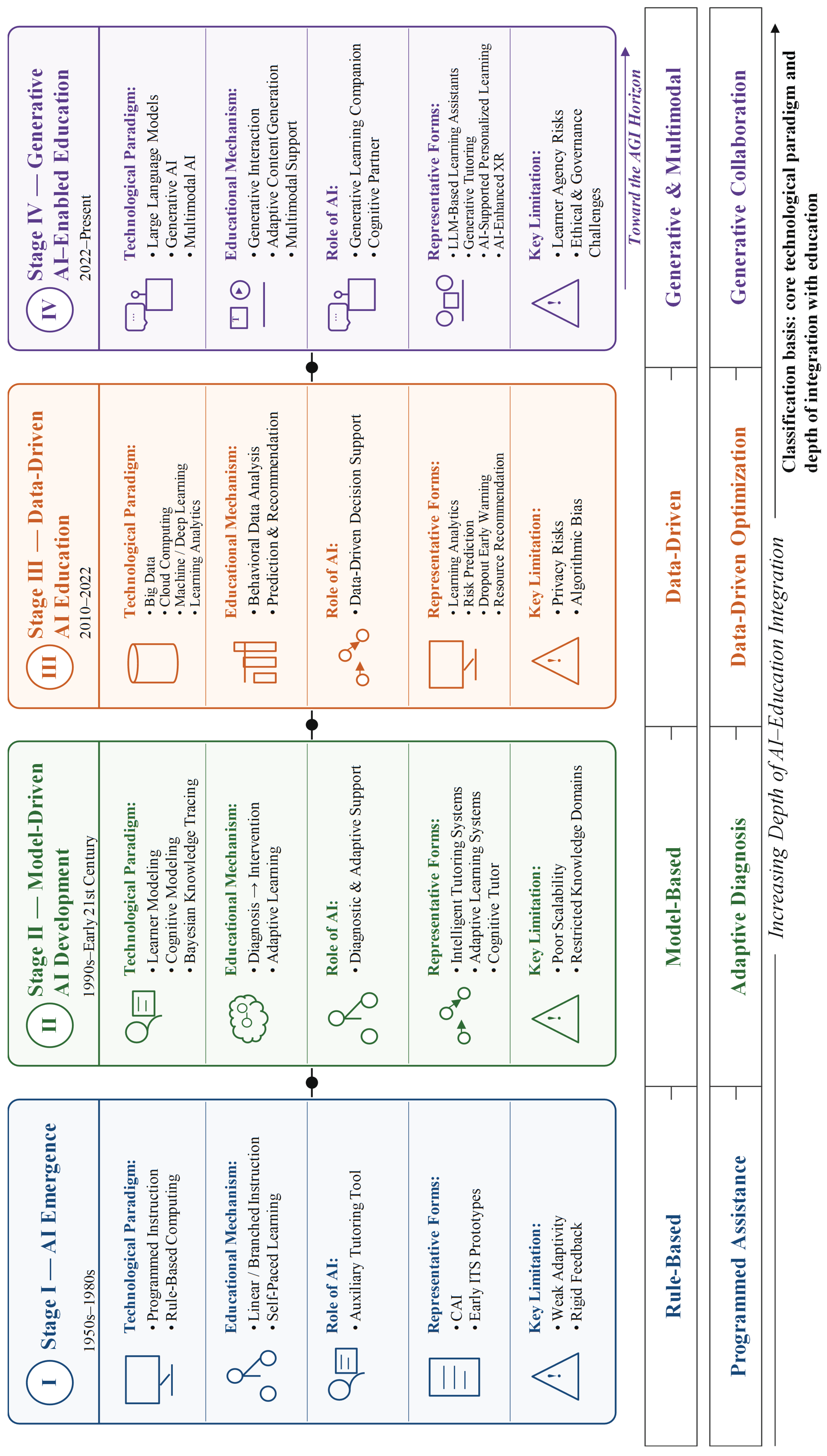
Figure 2.
Technology–Mechanism–Outcome–Challenge Framework for AI-Enabled Education
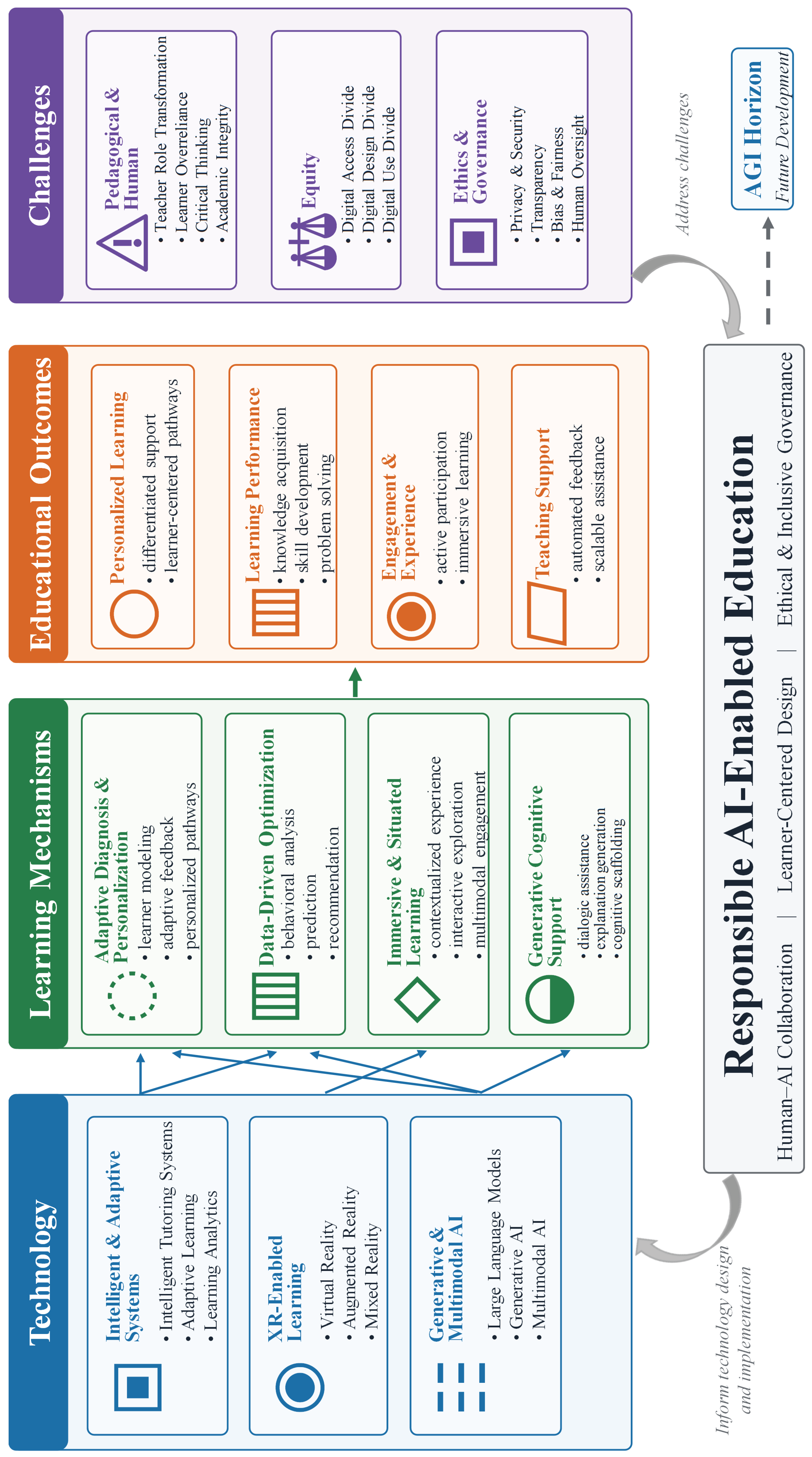

Table 1.
Core Mechanisms of Learning Support Provided by Intelligent Teaching Assistants
| Mechanism | Specific Manifestation |
|---|---|
| Learner Modeling | Constructs a dynamic profile based on students’ knowledge mastery level, error types, and learning behaviors, thereby identifying learning barriers and supporting differentiated intervention |
| Real-Time Feedback | In contrast to the time lag of traditional homework correction, intelligent teaching assistants can provide real-time prompts and error correction during learners’ problem-solving, exercise completion, or interaction processes, shortening the time interval between error exposure and correction |
| Adaptive Pathway Adjustment | The system can dynamically recommend difficulty levels, learning content, and subsequent tasks according to learners’ learning progress and performance |
| Continuous Companionship and Learning Support | In online learning or large-scale educational scenarios, intelligent teaching assistants improve learning engagement through high-frequency interaction and process reminders, and alleviate the problems of learning interruption and dropout |
Table 2.
Representative Studies of Intelligent Tutoring and Adaptive Learning Systems
| Study | Educational Context | Study Design | Sample / Evidence Base | Learning Mechanism | Reported Findings / Outcomes |
|---|---|---|---|---|---|
| (Kestin et al., 2025) | Undergraduate physics | Randomized controlled crossover trial | 194 eligible students | Structured generative-AI tutoring, personalized feedback, scaffolding, self-paced learning, and cognitive-load management | AI-tutored students achieved substantially higher post-test performance than students receiving in-class active learning |
| (Wu et al., 2022) | Elementary-school mathematical word-problem solving | System design + functional evaluation | No learner sample reported; three representative MWP cases | Tutorial-solution generation, adaptive hints, multi-turn interaction, and immediate feedback | Demonstrated automatic generation of interpretable solutions and step-by-step adaptive tutoring for the tested problem types |
| (Liu et al., 2010) | Collaborative learning in discrete mathematics | Algorithm/system implementation + preliminary experiment | Sample size not reported | Genetic algorithm + K-means grouping, learner modeling, and collaborative grouping | The authors reported improved grouping effectiveness and learning achievement, but no clearly reported learner sample, controlled comparison, or robust statistical learning-outcome analysis was provided |
| (Nguyen et al., 2019) | High-school mathematics | Knowledge-based chatbot design + task-level system testing | 97 mathematical exercises; no learner sample reported | Hint-based dialogue, step-by-step scaffolding, knowledge-based reasoning, and example support | The chatbot successfully tutored or solved 85%–100% of exercises across five problem categories |
| (Widiastuti and Fanani, 2014) | Fifth-grade elementary-school learning | School implementation + descriptive adaptive-system evaluation | students | Fuzzy-logic learner diagnosis, modified item-response theory, and adaptive question difficulty | The system classified learner ability and dynamically adjusted question difficulty and learning materials |
| (Spitzer and Moeller, 2024) | Primary and secondary school mathematics | Large-scale longitudinal evaluation | about 2,700 students, 5 million problems | Instant feedback, continuous practice, learning-trajectory tracking | Mathematics performance improved over time, with comparatively larger benefits reported for lower-performing students |
| (Zakaria et al., 2025) | Online learning in higher education | Controlled experiment + system implementation | 64 undergraduate computer science students | Learning-behavior detection, dynamic decision making, and hierarchical machine/peer/teacher intervention | Reported improvements in academic performance, learning engagement, satisfaction, and dropout-related outcomes |
| (Lee et al., 2026) | Secondary-school mathematics / online geometry | Classroom experiment / mixed-methods analysis | 79 middle-school students | Hybrid scoring, attempt-aware feedback, teacher-example-guided instruction, and hierarchical scaffolding | Reported high scoring consistency and correction following feedback, together with positive participation and self-efficacy indicators |
| (Fang and Guo, 2013) | Undergraduate engineering dynamics | Quasi-experimental pretest–posttest study | M1: control 62, treatment 44; M2: control 55, treatment 36 | Web-based interactive tutoring, step-by-step hints, and guided problem solving | This web-based interactive intelligent tutoring system can significantly improve the normalized learning gains of students in engineering dynamics |
| (Xia, 2025) | College English speaking | AI-based system design + applied experimental analysis | Sample size not reported; learners from beginner, intermediate, and advanced proficiency levels | ASR, NLP, multidimensional speaking assessment, personalized feedback, and adaptive learning-path recommendation | The authors reported improvements in fluency and expression accuracy after repeated interaction |
| (Xu, 2020) | Spoken English learning | System design + application-effect description | Sample size not reported | Phonetic evaluation, learner modeling, automatic pronunciation feedback, and personalized resource recommendation | The authors reported positive effects on pronunciation evaluation, oral-English learning, and learner interest |
| (Doddapaneni et al., 2024) | English-language learning / grammar practice | Comparative system evaluation | Sample size not reported | MDP modeling, DQN-based feedback optimization, and real-time personalized feedback | Reported improved feedback accuracy and response efficiency, together with positive engagement and satisfaction indicators |
Table 3.
Core Learning Support Mechanisms of XR-Enabled Education and Teaching
| Approach | Specific Manifestation |
|---|---|
| Immersive Experience | Enables learners to temporarily disengage from the abstract symbolic environment and enter a perceptible, operable, and explorable learning space |
| Safe Trial and Error | For learning tasks that are high-risk, high-cost, or difficult to repeat frequently in real-world settings, XR provides a controllable training environment |
| 3D Visualization and Embodied Cognition Support | Can transform complex, dynamic, or abstract structures into operable objects, reducing the difficulty for learners to comprehend complex spatial relationships |
| Situational Reproduction | XR can reconstruct historical, linguistic, cultural, or professional environments, linking knowledge acquisition with situational experience |
| Repetitive Practice | Students can repeatedly practice key movements and procedures in a virtual environment to gradually develop skill proficiency |
Table 4.
Representative Studies of XR-Enabled Education and Teaching
| Scholars | Learning Scenario | Support Tasks | Learning Mechanism | Outcome Indicators | Study Design |
|---|---|---|---|---|---|
| (Burke et al., 2025) | Higher Education | Simulation training, visual learning, problem solving, gamified activities | Immersive simulation, 3D visualization, interactive operation, situational participation | Improves learning experience and task engagement, with specific effects varying across scenarios | Systematic Review |
| (Chen et al., 2024) | Predominantly Higher Education | Procedural knowledge learning, practical training | Immersive experience, interactive engagement, cognitive activation | Significant improvement in learning engagement | Meta-Analysis |
| (Howard and Davis, 2023) | Cross-grade, multidisciplinary | Conceptual learning, situational comprehension, interactive exploration | Information overlay, situational augmentation, visualization support | Overall academic performance superior to that of the control group | Meta-Analysis |
| (Chang et al., 2022) | Cross-grade | Knowledge acquisition, skill training, performance tasks | Augmented visualization, situational support, interactive operation | Exerts a facilitative effect on multi-level learning outcomes | Meta-Analysis |
| (Wang et al., 2024) | STEM Education | Conceptual understanding, experimental observation, problem solving | Augmented visualization, spatial comprehension, interactive exploration | Moderate improvement in students’ academic performance | Meta-Analysis |
| (Ota et al., 2024) | Medical Education | Clinical skills, procedural operation, situational training | Immersive simulation, safe trial and error, repetitive practice | Improvement in knowledge, skills, and satisfaction | Meta-Analysis |
| (Sinurat et al., 2025) | Nursing Education | Knowledge acquisition, clinical training | Immersive simulation, situational drill | Improvement in knowledge and self-confidence; inconsistent effects on clinical skills | Meta-Analysis |
| (Stracke et al., 2025) | Higher Education | Spatial comprehension, skill training, situational simulation, exploratory learning | Immersive experience, embodied interaction, situational construction | Most studies reported positive effects | Systematic Review |
| (Conrad et al., 2024) | General Education | Conceptual learning, situational experience, participatory activities | Immersion, embodied engagement, interactive operation | Positive learning effects compared with other media | Systematic Review |
Table 5.
Core Manifestations and Response Measures of the Digital Divide
| Type of Divide | Core Manifestation | Response Measures |
|---|---|---|
| Digital Access Divide | Imbalance in network infrastructure, smart devices, and internet access capabilities; the gap in accessibility to large AI models and intelligent education applications continues to widen | Promote the full-domain coverage of educational digital infrastructure; introduce inclusive policies for equipment and network access; advance the inclusive development and barrier-free design of educational AI applications |
| Digital Design Divide | Significant gaps in educational digital governance capabilities and teachers’ competencies in integrating AI into teaching; uneven quality of teaching platforms and educational resources; disparities in digital competencies, with the prominent pain point of “technologically available but educationally inapplicable” | Improve regional and school-level digital governance capabilities; systematically cultivate teachers’ literacy in integrating AI into teaching; formulate design standards for educational AI applications; optimize the educational adaptability of teaching resources and platforms |
| Digital Use Divide | Severe differentiation in the depth and quality of students’ use of AI tools for learning, with prominent gaps in digital literacy, AI literacy, and critical thinking; insufficient guidance capabilities of home and school for technology application | Construct a training system for students’ digital and AI literacy to strengthen critical thinking; establish a school-level digital learning support system; improve the collaborative guidance capability of home and school for AI application |
Disclaimer/Publisher’s Note: The statements, opinions and data contained in all publications are solely those of the individual author(s) and contributor(s) and not of MDPI and/or the editor(s). MDPI and/or the editor(s) disclaim responsibility for any injury to people or property resulting from any ideas, methods, instructions or products referred to in the content. |
© 2026 by the authors. Licensee MDPI, Basel, Switzerland. This article is an open access article distributed under the terms and conditions of the Creative Commons Attribution (CC BY) license (http://creativecommons.org/licenses/by/4.0/).
Copyright: This open access article is published under a Creative Commons CC BY 4.0 license, which permit the free download, distribution, and reuse, provided that the author and preprint are cited in any reuse.