

Submitted:
18 October 2026
Posted:
20 October 2026
You are already at the latest version
Abstract
Purpose – This study examines whether public relations (PR) operate as a subordinate subset of corporate communication (CC) or as an autonomous strategic function, and tests how the structural positioning of PR is associated with practitioner identity, legitimacy and influence across institutional contexts. Design/methodology/approach – A sequential explanatory mixed-methods design combines a survey of 612 PR/CC professionals in Anglo-American, European and Asia-Pacific multinationals—analyzed through structural equation modeling, measurement invariance testing and latent profile analysis—with Foucauldian discourse analysis of 412 job descriptions and 60 organizational charts. Findings – Structural autonomy is associated with strategic professional identity (β = 0.54) and coalition access with perceived legitimacy (β = 0.58); role ambiguity partially mediates the structure–authority link, and boundary-spanning intensity moderates’ structure–identity effects. Path strengths vary by region (β = 0.62, 0.47 and 0.39), and a four-profile typology—Strategic Autonomous, Integrated CC Subordinated, Hybrid Distributed and Marginalized Tactical—is consistent with the Recursive Legitimacy Model of PR Positioning (RLM-PRP). Research limitations/implications – The cross-sectional design supports associational rather than causal inference, the non-probability sample and three-region scope limit generalization, and the recursive loop awaits longitudinal testing. Practical implications – Durable gains in PR’s standing require organizational-design interventions—formalized coalition access, jurisdictional clarification and investment in boundary spanning—alongside individual-level development. Originality/value – The study integrates role, boundary-spanning, professionalization and power-dynamic theories into a testable model of how PR’s structural positioning shape’s professional identity, and offers a parsimonious, cross-regionally validated typology for diagnosing communication functions.
Keywords:
public relations
; corporate communication
; strategic communication
; professional identity
; occupational legitimacy
; mixed methods
1. Introduction
The relationship between public relations (PR) and corporate communication (CC) remains conceptually unsettled and empirically underexamined (Macnamara, 2016; Zerfass et al., 2018; Seiffert-Brockmann et al., 2023). The question of whether PR constitutes a strategically autonomous discipline or a functionally subordinate component of an integrated CC architecture is not merely taxonomic. How it is answered—by organizational designers, by practitioners themselves and by the discourses circulating in hiring, credentialing and research—determines who gains strategic influence, whose expertise is recognized as legitimate, and what kind of communicative work is valued.
Two baseline definitions anchor what follows. PR is understood here as the occupational field claiming jurisdiction over the management of organization–public relationships (Grunig et al., 2002); CC as the management framework that orchestrates an organization’s total communication to align identity, image and reputation (van Riel and Fombrun, 2007; Cornelissen, 2020). A third term, strategic communication (SC), is defined from the outset as “the purposeful use of communication by an organization to fulfil its mission” (Zerfass et al., 2018, p. 493). The paper’s conceptual assumption, developed in Section 2.2, is that these three terms operate at different levels of analysis: SC names a paradigm (a level of theory), CC an organizational architecture (a level of structure) and PR an occupational jurisdiction (a level of practice and profession). The question is therefore not whether one term subsumes another in principle, but how the PR occupation fares—in identity, authority and legitimacy—when it is positioned within CC architectures. Three interrelated developments make this question urgent.
First, the structural reorganization of communication functions in multinational corporations has accelerated. Successive editions of the European Communication Monitor document the concentration of communication activities under a Chief Communication Officer (CCO) or their integration with marketing, investor relations and corporate affairs (Tench et al., 2017; Zerfass et al., 2021), recasting PR as one tool among many (Volk and Zerfass, 2018). Recent work shows that communication departments now compete openly with adjacent functions for standing and budget (Brockhaus and Zerfass, 2022; Zerfass and Link, 2024), and that executives and middle managers frequently misunderstand what the function is for (Brockhaus et al., 2026).
Second, digital transformation and platform-mediated stakeholder engagement have blurred operational distinctions between PR, marketing communication and internal communication (Wiesenberg et al., 2017). The convergence of paid, earned, shared and owned media destabilizes the boundary work that legitimized PR as a discrete profession (Luoma-aho and Badham, 2023), and artificial intelligence (AI) intensifies this convergence: algorithmic content generation and automated stakeholder analytics redistribute communicative authority across functional silos, even though structural change inside communication departments remains, so far, modest (Galloway and Swiatek, 2018; Zerfass et al., 2024; Buhmann et al., 2026).
Third, professionalization debates remain unresolved. Despite codified ethics, accredited curricula and a substantial scholarly literature, PR continues to suffer from low occupational prestige, persistent role ambiguity and gendered devaluation (Fitch, 2016; L’Etang, 2008; Topić et al., 2020). Practitioners articulate fragmented identities oscillating between strategic-managerial and tactical-implementational self-understandings (Zerfass et al., 2021; Garsten et al., 2025). The persistence of this paradox—aspirational claims to strategic status routinely undermined by structural constraints—indicates a systemic rather than an individual problem.
Existing scholarship has pursued these threads in isolation. What is absent is an empirically grounded, theoretically integrated and globally comparative analysis of how PR’s structural positioning within CC architecture shapes its professional identity and strategic authority. This study addresses that gap by advancing and testing the Recursive Legitimacy Model of PR Positioning (RLM-PRP), which specifies the mechanisms through which structure and identity are expected to condition one another across diverse institutional environments. The paper proceeds as follows. Section 2 reviews five bodies of scholarship, derives an empirical expectation from each and states the research gap. Section 3 formalizes the research questions and hypotheses that the review licenses, and Section 4 specifies the model. Section 5 describes the multi-method design, Section 6 reports the findings, Section 7 interprets them against prior literature and derives implications for communication management, and Section 8 answers each research question directly.
2. Literature Review
This section reviews the scholarship on which the study’s theoretical model and hypotheses rest. The central puzzle it addresses is a well-documented one: public relations practitioners increasingly describe themselves as strategic, yet the organizational structures in which they work—most often integrated corporate communication departments—tend to confine them to tactical execution. No single theoretical tradition accounts for this gap. Role theory, boundary-spanning theory, professionalization theory, scholarship on organizational power and comparative cross-cultural research each explain part of the mechanism, but they have rarely been brought into dialogue within one empirical design. The review therefore proceeds in three steps. It first clarifies the contested relationship between public relations, corporate communication and strategic communication, since the ambiguity of these terms has obscured what is actually at stake in debates over structural positioning. It then examines each theoretical lens in turn, drawing from each a testable expectation about how structure shapes professional identity and legitimacy. Finally, it synthesizes these expectations into the case for an integrated model and identifies the research gap that the remainder of the article addresses.
2.1. Orientation: The Problem This Review Must Solve
The review is organized around a single explanatory problem: why practitioners who self-identify as strategic so routinely find themselves enacting tactical roles. Five bodies of scholarship each illuminate one mechanism in the chain producing this paradox: role theory (how positions are experienced), boundary-spanning theory (how interface work creates strategic value), professionalization theory (how occupations win jurisdiction), power-dynamic scholarship (how coalitions confer authority), and comparative scholarship (how institutional context conditions all four). The review demarcates the field’s contested vocabulary (Section 2.2), then examines each lens, deriving an empirical expectation, before Section 2.8 demonstrates why only an integrated model can resolve the paradox they jointly describe. Two cross-cutting developments—the digital and AI-driven reconfiguration of communication work, and the internal contest over how the function’s value is measured—are treated within the boundary-spanning and power lenses (Section 2.4 and Section 2.6) rather than as a separate theme. They alter the mechanisms those lenses describe; they do not add a new one.
2.2. Conceptual Foundations: Two Genealogies and a Demarcation
Two intellectual traditions inform contemporary understandings of organizational communication. The PR tradition, anchored in Grunig and Hunt (1984) and elaborated through the Excellence Study (Grunig et al., 2002), conceives PR as the management of relationships between an organization and its publics. The CC tradition, articulated by van Riel and Fombrun (2007) and Cornelissen (2020), defines CC as a management framework integrating internal and external communication to align identity, image and reputation.
These traditions are constitutive rather than merely descriptive. The PR tradition positions communication as relational, ethical and societal; the CC tradition positions it as integrative, managerial and instrumentally aligned with corporate strategy. Heath (2006) and Ihlen and Verhoeven (2012) reassert PR’s distinctive societal mandate, arguing that integration discourses obscure normative obligations to publics and democratic deliberation. That the two genealogies have not converged is itself well documented: a survey of early-career PR scholars combined with citation analysis finds that PR research has diversified paradigmatically without maturing into a generally accepted theoretical foundation (Seiffert-Brockmann et al., 2023).
The emergence of strategic communication as an integrative meta-field has further complicated the debate. SC, as defined in Section 1, is positioned by its proponents as an umbrella concept that subsumes both PR and CC (Zerfass et al., 2018). Yet, as Holtzhausen and Zerfass (2015) argue, this conceptual move risks dissolving PR’s distinctive normative commitments under managerial telos. Table 1 synthesizes the principal positions.
The apparent rivalry among the three terms dissolves once their levels of analysis are separated. Strategic communication is defined, following Zerfass et al. (2018, p. 493), as the purposeful use of communication by an organization to fulfill its mission; its level is paradigmatic—SC names a research program and an integrative aspiration, not an organizational unit or an occupation (Holtzhausen and Zerfass, 2015). Corporate communication is defined, following van Riel and Fombrun (2007) and Cornelissen (2020), as the management framework that orchestrates an organization’s total communication to align identity, image and reputation; its level is structural—CC exists as an architecture of departments, reporting lines and CCO mandates. Public relations is defined, following Grunig et al. (2002), with the critical qualifications of L’Etang (2008) and Edwards (2018), as the occupational field claiming jurisdiction over the management of organization–public relationships; its level is that of practice and profession—PR exists as a body of practitioners, expertise claims and normative commitments to publics. Figure 1 visualizes the framework: SC as the enclosing field, PR and CC as overlapping domains whose intersection—media relations, issues and crisis management, executive communication, reputation stewardship—is the contested jurisdiction where structural positioning is decided.
Throughout this article the three terms are therefore held at distinct levels of analysis: strategic communication designates a paradigm (a level of theory), corporate communication designates an organizational architecture (a level of structure), and public relations designates an occupational jurisdiction (a level of practice and profession). The question the study pursues is accordingly not whether SC subsumes PR in principle, but whether—and through what mechanisms—the PR occupation retains or loses jurisdictional autonomy, identity and legitimacy when positioned within CC architectures. Three assumptions follow and are carried through the paper. First, a CC architecture can house a PR function without absorbing its occupational identity; whether it does so is an empirical question. Second, SC discourse is a resource that actors on both sides of the jurisdictional contest draw upon—integrationists to justify consolidation, PR advocates to claim strategic standing—so it enters the analysis as discourse rather than as a competing structure. Third, because the three terms sit at different levels, evidence about one (for example, that SC has become the field’s dominant research vocabulary) does not settle questions about another (for example, whether PR practitioners retain decision authority).
2.3. Role Theory and PR Practitioner Identity
Broom and Smith’s (1979) typology of PR roles—technician, expert prescriber, communication facilitator and problem-solving facilitator—established role theory as a foundational lens. The technician role encompasses the craft functions of writing, editing and producing communication materials, while the managerial roles involve advisory, relational and strategic-planning activities. This technician–manager axis became the dominant frame of PR role research over the subsequent four decades. Dozier and Broom (1995) demonstrated persistent role ambiguity and conflict, particularly within integrated CC structures where mandates compete with marketing or corporate affairs. Recent empirical work confirms that role conflict is gendered (Topić et al., 2020), culturally inflected (Sriramesh and Verčič, 2020) and exacerbated by digital convergence (Wiesenberg et al., 2017).
Rizzo et al.’s (1970) operationalization of role conflict and ambiguity remains the benchmark instrument. Role ambiguity denotes uncertainty about the scope of one’s responsibilities and the expectations of significant others; role conflict denotes incompatible demands from multiple principals—a salient condition where practitioners receive directives from marketing heads, corporate-affairs officers and business-unit leaders simultaneously. Recent scholarship foregrounds how practitioners actively construct, contest and perform their roles rather than merely occupying pre-given positions: Andersson (2024) distinguishes four modes in which practitioners “do” strategy, and Weder et al. (2023) show practitioners in five countries reconstructing their identity as curators of public conversation. European Communication Monitor studies document a paradox in which practitioners self-identify as strategic yet report that organizational structures relegate them to tactical execution (Zerfass et al., 2021). The consequences of this dissonance are increasingly well evidenced: a multi-country study of well-being in PR identifies misalignment between professional ideals and organizational realities—“management disconnection”—as the principal source of negative sentiment about the work (Garsten et al., 2025), and Meng and Berger (2022) show that the institutional environment of the organization shapes practitioners’ trust and satisfaction through engagement and leadership performance. Knight and Sweetser (2021) add a crucial detail: the dominant coalition systematically underestimates practitioners’ managerial competence relative to practitioners’ own assessments, which locates the identity gap in recognition rather than in skill.
If role ambiguity is the experiential trace of unsettled structural mandates, as Rizzo et al.’s (1970) formulation implies and Zerfass et al.’s (2021) monitor data suggest, then ambiguity should function as the mechanism through which hierarchical position translates into (diminished) decision authority. This expectation is formalized as H2 in Section 3.
2.4. Boundary-Spanning Theory in a Digitally Transformed Environment
Drawing on Aldrich and Herker (1977), boundary-spanning theory frames PR as an interface function mediating information flow between the organization and its environment, serving two primary functions: representation (communicating organizational positions externally) and information processing (collecting, filtering and translating environmental intelligence internally). Boundary spanning confers strategic value through environmental scanning and stakeholder intelligence (Tushman and Scanlan, 1981) yet exposes practitioners to liminality—belonging fully to neither organization nor external constituencies. This liminality is double-edged: it can authorize PR’s distinctive contribution or marginalize it as peripheral to “core” corporate functions (Berger, 2005; Knight and Sweetser, 2021).
Contemporary scholarship extends the theory to networked environments. Luoma-aho and Badham (2023) argue that platform-mediated communication recasts boundary work as continuous and recursive—no longer discrete outreach campaigns but always-on monitoring, engagement and relationship maintenance. The organizational-listening literature specifies what this interface work now involves: architectures for hearing stakeholders (Macnamara, 2016), listening practices that were reinvented under pandemic conditions (Neill and Bowen, 2021), and a “service logic” in which strategic listening is the source of value creation (Svingstedt and Heide, 2025). Whether interface work translates into influence, however, depends on recognition by the dominant coalition. Knight and Sweetser (2021) document a substantial gap between practitioners’ self-assessed competence and the coalition’s assessment of it, and Brockhaus and Zerfass (2022) show that communication departments gain standing “at the top of and throughout” organizations only through deliberate positioning strategies aimed at executives and adjacent functions. Boundary-spanning effectiveness is therefore not a fixed attribute of the practitioner but a contingent outcome of the relationship between the practitioner’s activities and the cognitive frameworks of organizational leaders.
Digital transformation and AI alter both sides of this relationship and are therefore integral to the theoretical argument rather than an addendum to it. On the practitioner side, automation absorbs the tactical tasks that historically defined entry-level boundary work—monitoring, drafting, adapting content. Early conceptual work anticipated this shift (Galloway and Swiatek, 2018), and the most recent European Communication Monitor reports that a majority of leading companies now use AI-based tools routinely for media and social-media monitoring, with content inspiration and adaptation following (Zerfass et al., 2024). On the leadership side, the same tools render communication value in metric terms that are more legible to marketing logics, changing what the dominant coalition recognizes as a contribution (Wiesenberg et al., 2017; Brockhaus et al., 2023). Two qualifications matter for the model. First, interviews with 30 CCOs of Europe’s largest companies find that AI-induced structural change inside communication departments is so far barely observable (Buhmann et al., 2026), so AI is better theorized as a moderator of existing mechanisms than as a new antecedent. Second, practitioners report that senior leadership offers minimal guidance on AI use, producing ad hoc practice and a diffusion of responsibility (Harris and St. John, 2025); the sociotechnical environment therefore feeds back into role ambiguity as well as into legitimacy. For these reasons AI maturity is retained as an exploratory moderator of the structure–legitimacy relationship rather than hypothesized.
If boundary-spanning intensity is the contingent amplifier this literature describes—valuable only when leaders recognize external stakeholder intelligence as strategically consequential (Knight and Sweetser, 2021; Brockhaus and Zerfass, 2022)—then interface work should moderate, rather than merely accompany, the translation of structural position into professional identity. This expectation is formalized as H4.
2.5. Professionalization and Occupational Legitimacy
Drawing on Abbott (1988), scholars have debated whether PR meets the criteria of an established profession: a systematic and esoteric body of knowledge, formal credentials, a code of ethics and jurisdictional control over a defined domain of work. L’Etang (2008) traces PR’s contested professionalization, showing that successive attempts to assert professional status have achieved only partial success; Edwards (2018) interrogates the discipline’s epistemic foundations, questioning whether a genuinely autonomous PR knowledge base exists or whether the field perpetually borrows from sociology, psychology and communication studies. The persistent challenge is jurisdictional control: PR’s claims to expertise overlap with marketing, journalism and organizational psychology, weakening monopolistic claims over a body of knowledge (Fitch, 2016).
Comparative scholarship reveals significant variation in how professional associations, accreditation regimes and educational standards shape PR’s legitimacy (Sriramesh and Verčič, 2020): strong associational infrastructure in Anglo-American contexts contrasts with the weaker boundary-marking characteristic of European integrated CC models. Jurisdiction is also negotiated discursively. Garsten et al. (2024) show that the British trade press performed professional boundary-setting over a quarter-century, re-engaging specialist practitioners who were distancing themselves from the wider PR occupation; Weder et al. (2023) find that PR practitioners and journalists retain distinct identities even as their practices converge; and the arrival of generative AI has exposed gaps in professional codes on authorship, disclosure and accountability, together with practitioners’ concerns about what the technology means for professional identity (Dong and van den Berg, 2025). Gender cuts across all of this: Topić et al. (2020) document, over four decades of scholarship, the persistence of structural feminization alongside continued exclusion of women from senior strategic roles, and Murphy (2023) documents how female CCOs describe their own leadership traits. This gender dimension is directly relevant to legitimacy dynamics: certain practitioners face systematic barriers to coalition access and structural autonomy independent of their skills or aspirations—a contradiction that the integrative CC paradigm obscures by presenting functional consolidation as gender-neutral rationalization.
If jurisdiction is collectively negotiated and perpetually contested, as Abbott’s (1988) framework implies, then occupational legitimacy cannot be read off credentials or codes of ethics; it must be explained by the organizational conditions under which claims to expertise are recognized. Legitimacy is therefore the outcome specification of our model places alongside professional identity.
2.6. Organizational Power Dynamics and the Measurement of Communicative Value
Berger (2005) demonstrates that PR’s strategic influence is contingent on access to the dominant coalition—the group of senior leaders exercising formal and informal authority over organizational direction. Reporting lines, budget control and inclusion in C-suite deliberations are operational proxies for power. Zerfass and Volk (2018) extend this through communicative value creation, arguing that CC functions accrue legitimacy by demonstrating contributions to enterprise strategy, brand equity and risk management, and so must translate their value into metrics intelligible to senior leadership. Subsequent work has specified the tools through which that translation occurs (Volk and Zerfass, 2021), reconceived the communication department as a business model competing internally for budget and standing (Zerfass and Link, 2024), and reframed value as a process in which conjectured value is realized—or slips away—through socially embedded mechanisms (Andersson, 2025).
Despite rhetorical commitments to strategic communication, many practitioners remain excluded from strategic deliberation (Macnamara, 2016). The reasons are partly evaluative and partly perceptual. Legitimization increasingly depends on data-driven performance narratives (Buhmann and Likely, 2018; Macnamara, 2018) that may favor marketing logics over relational ones—a dynamic reinforced by AI-enabled measurement infrastructures that privilege quantifiable, marketing-aligned outputs and marginalize relational and dialogic work that resists quantification (Wiesenberg et al., 2017; Zerfass et al., 2024). At the same time, a survey of more than 1,100 executives, middle managers and employees in large German companies finds that a sizeable share of employees—and even of middle managers—do not understand the communication function’s goals (Brockhaus et al., 2026). Operational work is recognized far more readily than strategic contribution, and budget-holding middle managers are the most skeptical about the function’s value. Coalition access thus matters not only because it confers authority but because it is the channel through which the function’s strategic contribution becomes visible at all.
If authority follows coalition access and resource control, as Berger (2005) demonstrates, two expectations follow: structural autonomy should predict practitioners’ strategic self-identification (H1), and access to the dominant coalition should predict the function’s perceived legitimacy (H3).
2.7. Comparative and Cross-Cultural Perspectives
PR institutionalization is shaped by national institutional logics, political-economic systems and cultural communication norms (Sriramesh and Verčič, 2020). Anglo-American contexts privilege consultancy models with strong professional associations and an advocacy orientation. Continental European contexts institutionalize PR within integrated CC structures, often anchored in stakeholder co-determination traditions (Tench et al., 2017). Asia-Pacific contexts exhibit relational, high-context configurations in which PR is embedded within corporate affairs and government relations (Macnamara et al., 2018; García, 2024). Multi-paradigmatic and de-Westernizing scholarship has long argued that the field’s dominant paradigms were built on a narrow set of cases (Bardhan and Weaver, 2011); García (2024) extends the argument by showing that personal and patronage relationships—marginalized as deviations in Western theory—are legitimate strategic-communication practices across Latin America, Southern Europe, China, India and sub-Saharan Africa. Together this work problematizes the implicit Western universalism of PR’s professional standards.
If institutional logics condition how structure confers legitimacy, as this scholarship documents, then the structural relationships theorized above should vary systematically in strength across regions—strongest where formal position is the primary signal of value. This expectation is formalized as H5.
2.8. Synthesis: The Case for an Integrated Model and the Research Gap
These lenses are typically deployed in parallel rather than synthesized. This study argues that role expectations are produced by structural positioning, enacted through interface work, legitimated through professionalization claims and continuously reconfigured by digital and cultural forces. The lenses constitute a recursive system in which structure condition’s identity, identity conditions practice, practice conditions legitimacy, and legitimacy feeds back into structural authority.
Three tensions run through these traditions. The first opposes autonomy to integration: the excellence tradition treats PR’s strategic contribution as conditional on functional independence, while the integrative CC tradition treats independence as a failure of coordination. The second opposes societal to managerial mandates: reflective scholarship anchors PR’s legitimacy in publics and democratic deliberation, while CC and SC accounts anchor it in mission fulfillment. The third opposes universal to contextual theorization: the paradigms dominating the field were built largely on Anglo-American cases, yet comparative evidence shows institutionalization following region-specific logics.
Each tension is real, but none is resolvable on its own terms, and that is the case for an integrated model. Consider the first. The excellence tradition is right that decision authority requires access to the dominant coalition (Berger, 2005), but it cannot explain why practitioners in some integrated CC architectures—German co-determination settings, for instance—report substantial influence without formal autonomy (Tench et al., 2017). The integrative tradition is right that coherence of identity, image and reputation is an organizational good (Cornelissen, 2020), but it cannot explain why consolidation so often produces the role ambiguity and tactical relegation the monitor data record (Zerfass et al., 2021) or why executives in consolidated departments still fail to recognize the function’s strategic contribution (Brockhaus et al., 2026). The two positions are talking past each other because one theorizes at the level of the occupation and the other at the level of the architecture. Held at distinct levels, as Section 2.2 proposes, the dispute becomes an empirical question about mechanisms: under what structural conditions does coalition access, rather than formal autonomy per se, confer legitimacy?
The second tension has a parallel resolution. Societal and managerial accounts of legitimacy differ in what they think legitimacy is for, but both agree that it must be conferred by other publics in one case, executives in the other. The professionalization lens (Abbott, 1988) supplies the missing link: jurisdiction is won through claims that are recognized, and recognition inside the corporation runs through the measurement regimes the power lens describes (Zerfass and Volk, 2018; Andersson, 2025). AI belongs here rather than in a separate discussion, because it changes the currency in which recognition is paid: it makes some contributions more legible and others less so (Section 2.4). The third tension, finally, cannot be adjudicated by any single-region study; it requires the mechanisms specified by the other lenses to be tested for invariance across institutional contexts. An integrated model is therefore not a synthesis for its own sake. It is the only specification in which the paradox that opens this review—strategic self-identity alongside tactical enactment—can be explained, because the paradox is produced across levels: by a structure (CC architecture) acting on an occupation (PR) through mechanisms (role dynamics, interface work, coalition access, jurisdictional claims) whose strength depends on context and whose outcomes feed back into the structure.
The gap, stated plainly, is this: no existing study has tested, within a single design, whether PR’s structural positioning produces the identity and legitimacy outcomes that role, boundary-spanning, professionalization and power scholarship each predict in isolation—still less whether those relationships hold across institutional contexts. The most closely related recent work either theorizes positioning strategies without testing their identity and legitimacy consequences (Brockhaus and Zerfass, 2022), measures how the function is perceived by others without linking perception to structure (Knight and Sweetser, 2021; Brockhaus et al., 2026), or documents role dissonance and its costs without modeling its structural antecedents (Garsten et al., 2025). Closing this gap matters for communication management because the remedies implied by the competing traditions differ: if identity and legitimacy are individual achievements, the answer is training and credentialing; if they are structural outcomes, the answer is organizational design. Four research questions operationalize this gap; five hypotheses, each derived in the preceding subsections, render the mechanistic claims falsifiable. Table 2 summarizes the derivation.
3. Research Questions and Hypotheses
Four research questions operationalize the gap stated in Section 2.8; five hypotheses, each derived in the subsection indicated, formalize the mechanistic claims. Table 3 (Section 5.1) maps every question and hypothesis to its data source, analysis and reporting location. The research questions are retained alongside the hypotheses for two reasons. RQ3 concerns discursive construction and is answered qualitatively; it cannot be reduced to a hypothesis. RQ1, RQ2 and RQ4 each integrate more than one hypothesis with the qualitative strand, so that the answer to each question is a joint reading of statistical and discursive evidence rather than a single test. Section 6.6 (Table 8) and Section 8 answer every question directly.
3.1. Research Questions
RQ1. To what extent and through what mechanisms does the structural positioning of PR within (or alongside) corporate communication shape practitioners’ professional identity, perceived authority and contribution to strategic decision-making? This question is answered through structural modeling of the survey data (H1–H3; Section 6.1 and Section 6.2).
RQ2. How are role expectations, ambiguity and conflict experienced differently by practitioners in subordinated versus autonomous PR configurations? Answered through the mediation and moderation analyses and the profile contrasts (H2, H4; Section 6.2 and Section 6.3).
RQ3. How do organizational discourses—articulated in job descriptions and reporting structures—construct and constrain PR’s jurisdictional boundaries vis-à-vis adjacent disciplines? Answered through discourse and structural analysis of job descriptions and organizational charts (Section 6.4 and Section 6.5).
RQ4. To what extent do patterns of PR institutionalization converge or diverge across Anglo-American, European and Asia-Pacific contexts? Answered through invariance testing and multi-group modeling, joined to the regional discursive evidence (H5; Section 6.2 and Section 6.6).
3.2. Hypotheses
Each hypothesis states the expectation derived in the literature review and the reasoning that licenses it.
H1. Structural autonomy of the PR function is positively associated with practitioners’ professional self-identification as strategic advisors rather than tactical implementers. (Derived in Section 2.6.) Rationale: if strategic influence follows resource control and coalition access (Berger, 2005), practitioners in autonomous functions have both the occasion and the warrant to understand their role as strategic; those in subordinated functions do not.
H2. Role ambiguity mediates the relationship between hierarchical positioning and perceived decision-making authority. (Derived in Section 2.3.) Rationale: unsettled mandates are experienced as ambiguity (Rizzo et al., 1970), and ambiguity erodes the confidence with which authority is claimed and recognized (Dozier and Broom, 1995; Zerfass et al., 2021); position should therefore act on authority partly through ambiguity.
H3. Direct reporting access to the CEO or dominant coalition is positively associated with PR’s perceived strategic legitimacy, controlling for organizational size and industry. (Derived in Section 2.6.) Rationale: legitimacy is conferred by those who recognize a contribution, and inside the corporation recognition runs through the dominant coalition (Berger, 2005; Brockhaus and Zerfass, 2022; Brockhaus et al., 2026).
H4. Boundary-spanning intensity moderates the relationship between structural positioning and professional identity. (Derived in Section 2.4.) Rationale: interface work supplies the stakeholder intelligence that makes a strategic self-understanding credible (Tushman and Scanlan, 1981), but its value is realized only when leaders recognize it (Knight and Sweetser, 2021); it should therefore amplify, rather than substitute for, the effect of position.
H5. The strength of these relationships varies systematically by region, with Anglo-American contexts exhibiting stronger autonomy–legitimacy associations than European or Asia-Pacific contexts. (Derived in Section 2.7.) Rationale: where formal position is the primary signal of value (Anglo-American consultancy logics), autonomy should matter most; where co-determination or relational embeddedness supplies alternative routes to influence (Tench et al., 2017; García, 2024), it should matter less.
4. Conceptual Model
This section consolidates the expectations derived in the literature review into a single explanatory framework, the Recursive Legitimacy Model of PR Positioning (RLM-PRP). The model holds that the structural positioning of public relations within corporate communication architectures shapes practitioners’ professional identity and the function’s perceived legitimacy, and that it does so through four mediating mechanisms—role dynamics, boundary spanning, access to the dominant coalition and jurisdictional claims—whose strength is conditioned by institutional and organizational context. Its distinguishing feature is recursion: identity and legitimacy outcomes are theorized to feed back into structural positioning over time, so that the model describes a self-reinforcing cycle rather than a one-directional chain. The section first specifies the model’s constructs, pathways and boundary conditions in textual form (Section 4.1), then presents its schematic representation with the empirical path estimates reported later in the article (Section 4.2).
4.1. Textual Specification
The Recursive Legitimacy Model of PR Positioning (RLM-PRP) articulates four interdependent sets of constructs and their hypothesized pathways.
Antecedent (structural): organizational positioning of PR (autonomous function vs. subordinated CC subset vs. distributed/hybrid configuration).
Mediating mechanisms: role clarity/ambiguity/conflict; boundary-spanning intensity and salience; access to the dominant coalition; jurisdictional claims and counterclaims.
Outcomes (identity–legitimacy): professional self-identification (technician vs. strategist); perceived occupational legitimacy; strategic decision-making authority.
Recursive loop: identity–legitimacy outcomes feed back into structural positioning over time, either reinforcing autonomy (when legitimacy is high) or accelerating subordination (when legitimacy is low). This loop is theoretically specified; the present cross-sectional design can test its cross-sectional implications but not the loop itself (Section 7.8).
Moderators: regional-cultural context; industry sector; organizational size; CCO/CEO communication orientation; digital/AI maturity.
The model’s boundaries follow from the demarcation adopted in Section 2.2. First, the RLM-PRP is a model of PR positioning: its unit of theorization is the PR occupation and its practitioners, not the total communication system. Second, CC enters the model as structure—the architectural field (autonomous, subordinated, distributed) within which PR is positioned; the model does not evaluate CC’s effectiveness as a management framework. Third, SC enters the model as discourse—the paradigm whose integrative vocabulary supplies many of the jurisdictional claims and counterclaims through which positioning is negotiated; the model is agnostic on SC’s merits as a research program. Fourth, the linkages among the three fields are carried by two constructs: jurisdictional claims (which translate SC discourse into structural argument) and coalition access (which translates structural position into legitimacy). Fifth, the model’s scope conditions are multinational corporate settings in the three sampled regions; extension to agencies, public-sector and Global South contexts is an empirical question, not an entailment. Stated as a single sentence: CC is where PR is positioned, SC is the vocabulary in which that positioning is argued over, and PR is what the positioning acts upon.
4.2. Schematic Representation
Figure 2 renders the RLM-PRP with the study’s standardized path coefficients superimposed. Structural positioning operates through four mediating mechanisms—role dynamics, boundary spanning, coalition access and jurisdictional claims—that jointly account for variation in professional identity and occupational legitimacy (explaining 38.4% and 49.7% of their variance respectively). Legitimacy outcomes are theorized to recursively reshape structural positioning over time. Moderators—most consequentially region (H5)—condition the strength of individual pathways; the region-moderated autonomy–legitimacy path is reported separately in Figure 3 (Section 6.2).
5. Method
This section describes how the RLM-PRP was tested. Because the model makes two kinds of claims—that structural positioning operates as a generative mechanism on practitioner-level identity and legitimacy, and that those positions are reproduced through organizational texts—it required a design capable of handling both. The study therefore adopted a sequential explanatory mixed-methods design grounded in critical realism. A survey of 612 PR and corporate communication professionals in multinational companies across Anglo-American, European and Asia-Pacific regions provided the data for testing H1–H5 through structural equation modeling; a discourse analysis of 412 job descriptions and 60 organizational charts examined how jurisdictional boundaries are inscribed in practice; and an integration phase brought the two strands together through joint displays and a typology of positioning configurations. The section first sets out the research paradigm and design rationale (Section 5.1), then details the quantitative component, including sampling, measurement, the development of two new scales and analytical procedures (Section 5.2), the qualitative component (Section 5.3), the integration strategy (Section 5.4) and ethical considerations (Section 5.5).
5.1. Research Paradigm and Design
The study adopts critical realism as its philosophical framework, accommodating measurement of generative mechanisms while recognizing the discursive construction of organizational realities, making it suitable for a sequential explanatory mixed-methods design (Creswell and Plano Clark, 2018; Fletcher, 2017). Critical realism distinguishes the real (generative mechanisms such as structural positioning), the actual (events these mechanisms produce under particular conditions) and the empirical (what researchers observe), allowing structural positioning to be treated as a mechanism whose effects are contingent on institutional context—precisely the conditionality captured by the moderation hypotheses.
The design unfolds in three phases: (a) a quantitative survey to test hypothesized relationships; (b) a qualitative discourse analysis to explicate underlying mechanisms and contextual conditions; and (c) integration through joint displays and typology construction. The discourse analysis is not merely supplementary but theoretically necessary: the RLM-PRP claims that structural positions are reproduced through discursive practices in job descriptions, reporting structures and performance regimes, and testing this claim requires analysis of those practices in their textual and visual forms.
The design is dictated by the model’s dual ontology. Hypotheses H1–H5 concern generative mechanisms operating on practitioner-level constructs and are tested with survey measurement and structural equation modeling (SEM) (RQ1, RQ2 and RQ4 in its quantitative aspect). RQ3, by contrast, concerns the discursive reproduction of structural positions and is answerable only through analysis of the organizational texts—job descriptions and reporting charts—in which positions are inscribed. The sequential integration phase supplies what neither strand can alone: evidence that the statistical configurations and the discursive formations describe the same institutional arrangements. Table 3 maps each research question and hypothesis to its data source, analysis and reporting location. Three further rationales guided the choice of a multi-method rather than a single-method design. A survey alone would leave the “discursive deficit” claim of the model untested; a discourse analysis alone could describe how positions are inscribed but not estimate their consequences; and a typology derived from only one strand would risk confusing statistical clusters with institutional configurations. The integration phase therefore uses convergence between strands as evidence and divergence as a diagnostic (Section 5.4).
5.2. Phase 1: Quantitative Component
5.2.1. Population and Sampling
The target population comprised PR/CC professionals in multinationals listed in Forbes Global 2000 or Financial Times Global 500 (Financial Times, 2015; Forbes, 2025). Stratified purposive sampling (Palinkas et al., 2015; Patton, 2015; Teddlie & Yu, 2007) partitioned the population by region (Anglo-American, European, Asia-Pacific), industry (financial services, technology, energy, consumer goods, healthcare) and organizational scale. Recruitment proceeded through professional associations, LinkedIn outreach and direct contact—a non-probability frame (Baker et al., 2013) whose implications are examined in Section 7.8. Because the frame was non-probabilistic, the achieved sample was compared with the stratification targets on region, industry and seniority that this comparison was made and to supply any deviations], and estimates are interpreted as internally valid for the sampled population rather than as population parameters (Baker et al., 2013; Patton, 2015).
A total of 1,847 invitations yielded 687 responses (response rate = 37.2%). After listwise deletion of incomplete cases (>10% missing) and screening for inattentive responding via two embedded attention-check items, the final analytic sample comprised N = 612 (200 Anglo-American, 211 European, 201 Asia-Pacific). A post hoc sensitivity analysis confirmed that this sample exceeds the minimum required to detect medium structural effects (β ≥ 0.20) at power = 0.80 and α = 0.05 given the model’s complexity. Sample characteristics appear in Table 4.
5.2.2. Instrument and Measurement
A 60-item questionnaire operationalized the RLM-PRP constructs, all items using 7-point Likert scales (1 = strongly disagree, 7 = strongly agree). The instrument was developed in English and translated/back-translated into German, French, Korean and Japanese following Brislin’s (1970) protocol, then pilot-tested with 42 practitioners (14 per region) to confirm linguistic and conceptual equivalence. Construct operationalization appears in Table 5. Established scales were used for role ambiguity and role conflict (Rizzo et al., 1970) and for professional identification (Mael and Ashforth, 1992). Structural autonomy, boundary-spanning intensity, coalition access and AI maturity were adapted from published operationalizations. Strategic identity and perceived legitimacy were developed for this study (Section 5.2.3).
5.2.3. Development and Validation of Strategic Identity and Perceived Legitimacy Scales
Because no existing instrument capture’s strategic identity and perceived legitimacy at the occupational level theorized here, both scales were developed for this study following established procedures (DeVellis, 2017; Hinkin, 1998). The procedure comprised five steps, reported here in the order in which they were carried out.
Item generation. Items were generated deductively. Strategic identity items were written to capture the strategist pole of the technician–manager axis (Broom & Smith, 1979; Dozier & Broom, 1995) as a self-understanding rather than as a set of tasks; perceived legitimacy items were written to capture recognition of the function’s contribution by organizational decision-makers, following Abbott’s (1988) account of jurisdiction as recognized claim and Berger’s (2005) account of coalition access this theoretical anchoring. An initial pool of strategic identity items and perceived legitimacy items was produced.
Expert review. The pool was reviewed by a panel of experts comprising composition, e.g., academic specialists in PR/CC measurement and senior practitioners], who rated each item for relevance and clarity on Items with retention criterion, e.g., a content validity index below 0.78 (Lynn, 1986; Polit & Beck, 2006)] were removed or rewritten, leaving and items respectively.
Practitioner involvement and pretesting. The retained items were pretested with the 42 practitioners (14 per region) described in Section 5.2.2. Pretesting served two purposes: linguistic and conceptual equivalence across the five languages (Brislin, 1970), and item performance, total correlations, ceiling effects, comprehension problems flagged in cognitive debriefing (Willis, 2005). items were modified or dropped at this stage.
Confirmatory factor analysis supported the one-dimensionality of each scale (loadings 0.67–0.84; Hair et al., 2019; Hu & Bentler, 1999), with satisfactory reliability (α = 0.88 and 0.92; Nunnally & Bernstein, 1994) and convergent validity composite reliability (Fornell & Larcker, 1981) Discriminant validity from each other and from professional identification (Mael & Ashforth, 1992) was supported (all HTMT < 0.85; Henseler et al., 2015), and both scales met metric invariance across regions (Putnick & Bornstein, 2016; Vandenberg & Lance, 2000). The final strategic identity scale comprises seven items and the perceived legitimacy scale eight (Table 5). Two limitations of this pipeline are acknowledged in Section 7.8: the scales were validated in the same sample used to test the hypotheses, and an independent replication with a separate sample has not yet been conducted.
5.2.4. Analytical Procedures
Analyses were performed in R (4.3.1) using lavaan for SEM, semTools for invariance testing and tidyLPA for latent profile analysis (LPA). The sequence comprised: (1) confirmatory factor analysis (CFA); (2) SEM with maximum-likelihood-robust (MLR) estimation to test H1–H4; (3) multi-group SEM and invariance testing (configural, metric, scalar) using ΔCFI ≤ 0.010 (Putnick and Bornstein, 2016); (4) bootstrap mediation (5,000 resamples; bias-corrected 95% confidence interval, CI) for H2; (5) latent-interaction moderation for H4; and (6) latent profile analysis with the number of profiles selected by comparing the Bayesian information criterion (BIC), the bootstrap likelihood-ratio test and entropy across one- to six-profile solutions. Acceptable fit followed CFI ≥ 0.95, TLI ≥ 0.95, RMSEA ≤ 0.06, SRMR ≤ 0.08 (Hu and Bentler, 1999).
5.2.5. Validity and Reliability
Reliability was assessed via Cronbach’s α and composite reliability (>0.70). Convergent validity used average variance extracted (AVE ≥ 0.50); discriminant validity used the Fornell–Larcker and heterotrait–monotrait (HTMT < 0.85) criteria. Common-method bias was assessed via Harman’s single-factor test (24.3% of variance, below the 50% threshold) and the marker-variable technique (Podsakoff et al., 2003), neither of which indicated substantial bias.
5.3. Phase 2: Qualitative Component
5.3.1. Discourse analysis of Job Descriptions
A corpus of 412 job descriptions for PR/CC positions was assembled from corporate websites, LinkedIn and recruitment platforms (October 2024–March 2025), with proportional sampling across regions and seniority. Analysis followed two stages: critical discourse analysis (Fairclough, 2010) identified how texts construct jurisdictional boundaries; Foucauldian analysis (Motion and Leitch, 2007) surfaced power–knowledge relations. Coding employed NVivo 14 with deductive and inductive categories; trustworthiness was supported through an audit trail, reflexive memoing and negative-case analysis. Inter-coder reliability on 20% of the corpus yielded κ = 0.82.
5.3.2. Organizational Chart Analysis
A purposive sample of 60 organizational charts (20 per region) was examined to map reporting structures and PR’s structural location. Visual semiotic analysis (Kress and van Leeuwen, 2006) complemented network analysis quantifying centrality, hierarchical depth and proximity to the C-suite.
5.4. Phase 3: Integration
Findings were integrated through joint displays (Guetterman et al., 2015) juxtaposing statistical relationships with discursive evidence. A typology was developed through latent profile analysis on the survey data and triangulated with archetypes derived from the discourse analysis, with convergence and divergence between the two strands treated as substantively informative rather than as error.
5.5. Ethical Considerations
The study received institutional ethical approval. All participants provided informed consent; data were anonymized at collection; organizational charts were redacted; and data were stored on encrypted servers compliant with the General Data Protection Regulation and equivalent regional regulations.
6. Findings
6.1. Measurement Model
The CFA supported the eight-factor measurement model: χ²(1,524) = 3,287.4, p < 0.001; CFI = 0.953; TLI = 0.949; RMSEA = 0.048 (90% CI [0.045, 0.051]); SRMR = 0.052. All standardized loadings exceeded 0.65 (p < 0.001), AVE ranged 0.54–0.73 and composite reliabilities ranged 0.81–0.93; HTMT ratios were below 0.85 for all construct pairs, supporting convergent and discriminant validity. Two results deserve emphasis because they bear on the new scales. First, strategic identity and professional identification (Mael and Ashforth, 1992) loaded on separate factors and their HTMT ratio fell below 0.85, indicating that identifying with PR as a profession and understanding one’s own role as strategic are empirically distinct—a distinction that role theory presupposes but rarely tests. Second, perceived legitimacy was discriminable from coalition access, so the H3 estimate reported below is not an artifact of two measures of the same thing.
6.2. Hypothesis Tests
The structural model demonstrated good fit: χ²(1,612) = 3,468.2, p < 0.001; CFI = 0.948; RMSEA = 0.049; SRMR = 0.057. Standardized path estimates appear in Table 6 and, with their confidence intervals, in Figure 3.
H1. Structural autonomy was positively associated with strategic identity (β = 0.54, p < 0.001), explaining 38.4% of its variance. In substantive terms, a one standard-deviation increase in autonomy corresponds to roughly half a standard deviation of movement along the technician–strategist axis—the axis that role research has treated as the field’s central fault line since Broom and Smith (1979) and Dozier and Broom (1995).
H2. Role ambiguity significantly mediated the position–authority relationship (indirect effect = 0.19, 95% CI [0.13, 0.25]); the direct effect remained significant (β = 0.31, p < 0.001), indicating partial mediation. Ambiguity thus accounts for about two-fifths of the total association between position and authority (0.19 of 0.50), consistent with the monitor evidence that consolidated architectures leave practitioners uncertain about the scope of their mandate (Zerfass et al., 2021) and with the “management disconnection” that Garsten et al. (2025) identify as the principal strain in PR work.
H3. Coalition access was the strongest single predictor of legitimacy (β = 0.58, p < 0.001); predictors collectively explained 49.7% of legitimacy variance. This result quantifies, from the practitioner’s side, what Knight and Sweetser (2021) and Brockhaus et al. (2026) report from the decisionmakers’ side—that the function’s contribution is recognized unevenly—and it identifies proximity to those decision-makers as the condition under which recognition occurs.
H4. Boundary-spanning intensity moderated the structure–identity relationship (β = 0.22, p < 0.001); the autonomy–identity link was strongest at high intensity (+1 SD: β = 0.71) and weakest at low intensity (−1 SD: β = 0.29). The interaction is ordinal: autonomy is associated with strategic identity at every level of boundary spanning, but intensive interface work more than doubles the association. Interface work therefore amplifies structural position rather than compensating for its absence, as the boundary-spanning literature would predict (Tushman and Scanlan, 1981; Brockhaus and Zerfass, 2022).
H5. Multi-group testing established configural and metric invariance but failed scalar invariance (ΔCFI = 0.017), indicating that latent means cannot be directly compared but structural relationships can. The autonomy–legitimacy path was significantly stronger in the Anglo-American (β = 0.62) than the European (β = 0.47) or Asia-Pacific (β = 0.39) samples (Δχ² = 14.8, p = 0.001). The failure of scalar invariance is itself informative: respondents in the three regions use the response scales differently for the same latent constructs, which is what a context-sensitive account of institutionalization (Sriramesh and Verčič, 2020; García, 2024) would lead one to expect. The gradient of path strengths is reported in Figure 3(b).
Figure 3(a) makes visible a pattern that Table 6 states only numerically: every hypothesized path has a confidence interval that excludes zero by a wide margin, whereas the exploratory AI-maturity interaction (β = 0.14, 95% CI [0.04, 0.24]) is the weakest estimate in the model and the only one whose lower bound approaches zero. It is retained as hypothesis-generating for that reason. Figure 3(b) shows that the regional gradient is monotonic rather than a single outlier: the Anglo-American estimate is roughly 1.6 times the Asia-Pacific estimate, with the European estimate between them.
6.3. Latent Profile Analysis
The four-profile solution was optimal: it minimized BIC (14,283) relative to adjacent solutions, returned a significant bootstrap likelihood-ratio test against the three-profile model, and achieved acceptable classification certainty (entropy = 0.84). The profiles correspond to four institutionalization configurations; Table 7 integrates their quantitative, discursive and structural signatures, and Figure 4 maps them in the autonomy × coalition-access plane.
Three features of Table 7 carry the interpretive weight. First, the modal configuration is not autonomy but subordination: the Integrated CC Subordinated profile is the largest (31.2%), and together with the Marginalized Tactical profile it accounts for almost half the sample (49.3%). The “PR as strategic profession” self-image that dominates the field’s normative literature describes, on this evidence, a little over a quarter of practitioners in the world’s largest corporations. Second, the profiles differ in kind, not only in degree. The Hybrid Distributed profile combines mid-level autonomy and access with mid-to-high strategic identity—practitioners who understand themselves as strategic without the structural warrant that the Anglo-American model would require—which is exactly the pattern a relational route to influence (García, 2024) would produce. Third, the Marginalized Tactical profile is the only one whose four indicators are uniformly low, and it is not concentrated in any region: structural marginalization is a cross-regional condition, not a regional one. Figure 4 locates the four profiles in the plane defined by the two structural antecedents.
Figure 4(a) shows that autonomy and coalition access do not move in lockstep. The Integrated CC Subordinated profile sits at low autonomy but mid access: the CCO-centric architecture takes formal independence away while keeping the function’s leadership close to the executive. The Hybrid Distributed profile sits at mid autonomy and mid access through embeddedness in corporate affairs. That the two structural antecedents can be decoupled is what makes coalition access, rather than autonomy alone, the decisive predictor of legitimacy (H3). It is also consistent with the positioning framework of Brockhaus and Zerfass (2022), in which standing is secured through several distinct spheres of influence rather than through a single reporting line.
6.4. Discourse Analysis Findings
Critical and Foucauldian analyses of the 412 job descriptions yielded four overarching patterns.
Strategic–tactical bifurcation. Senior PR/CC roles (director and above) were dominated by lexicons of “strategy”, “advisory”, “stakeholder leadership” and “reputation”—particularly in Anglo-American postings. Junior and mid-level roles foregrounded execution-oriented vocabularies (“draft”, “monitor”, “post”, “amplify”), with European and Asia-Pacific listings exhibiting the most pronounced tactical emphasis at junior levels. The bifurcation reproduces, in hiring texts, the technician–manager axis that role research has documented for four decades (Broom and Smith, 1979; Dozier and Broom, 1995); it also shows the trade-press boundary-setting that Garsten et al. (2024) describe operating at the point of recruitment.
Jurisdictional encroachment was discursively normalized. Approximately 64% of CC roles enumerated responsibilities historically claimed by marketing (campaign management, brand storytelling, performance marketing), whereas only 19% of marketing roles enumerated PR-claimed activities (media relations, issues management). The asymmetry suggests that integration discourses operate predominantly to absorb PR functions rather than to create reciprocal jurisdictional arrangements. In Abbott’s (1988) terms, this is a jurisdictional settlement in which one occupation’s claims are written into the other’s job architecture without reciprocity—the textual counterpart of the competition for standing that Brockhaus and Zerfass (2022) and Zerfass and Link (2024) describe.
Measurement-driven legitimacy dominated senior role descriptions. Phrases such as “demonstrate ROI”, “data-driven storytelling” and “communications analytics” appeared in 71% of director-and-above postings, corroborating the evaluation literature’s observation that legitimacy is increasingly claimed in the currency of metrics (Buhmann and Likely, 2018; Macnamara, 2018; Volk and Zerfass, 2021).
Regional discursive signatures were evident: Anglo-American postings emphasized advocacy and stakeholder challenge; European postings emphasized integration and co-determination; Asia-Pacific postings emphasized relationship cultivation, government affairs and reputational stewardship—mapping onto regional logics theorized by Sriramesh and Verčič (2020), Macnamara et al. (2018) and García (2024).
6.5. Organizational Chart Findings
Network analysis revealed three structural archetypes. The CCO-centric architecture (32 of 60 charts; predominantly European) consolidates PR, internal communication and brand under a single CCO reporting to the CEO. The functionally autonomous architecture (16 of 60; predominantly Anglo-American) maintains PR/external affairs as a peer to marketing, both reporting to the CEO; this structure was associated with the Strategic Autonomous profile in 73% of cases. The distributed/embedded architecture (12 of 60; predominantly Asia-Pacific) embeds PR within corporate affairs or government relations, with reporting often routed through legal or strategy functions. The three archetypes correspond to the three non-marginalized profiles in Table 7, and the 73% association between the functionally autonomous architecture and the Strategic Autonomous profile is the study’s most direct evidence that a statistical profile and an institutional configuration describe the same arrangement. The Marginalized Tactical profile has no archetype of its own; it appears where PR is several reporting steps from the C-suite within any of the three architectures, which is why marginalization is cross-regional.
6.6. Summary of Findings by Research Question
All five hypotheses were supported. Structural positioning was associated with strategic identity (H1) and legitimacy via coalition access (H3); role ambiguity mediated the structure–authority relationship (H2); boundary-spanning intensity moderated the structure–identity relationship (H4); and regional context conditioned the strength of structural relationships (H5). The four-profile typology empirically substantiates a heterogeneous landscape of PR institutionalization mapping onto distinct discursive and structural signatures.
Table 8 consolidates the evidence by research questions; the answers are elaborated in Section 7 and restated in Section 8. Each answer draws on both strands of the design, as Table 3 anticipated: the quantitative estimates establish the strength and form of the relationships, and the discursive and structural evidence establishes the institutional arrangements in which those relationships obtain.

Table 8.
Findings by Research Question.
| RQ | Decisive evidence | Answer |
| RQ1 | H1 (β = 0.54), H2 (indirect = 0.19), H3 (β = 0.58); R² = 38.4% / 49.7% | Structural positioning shapes identity and authority chiefly through role clarity and coalition access, with autonomy the largest single predictor of strategic identity. |
| RQ2 | H2 mediation; H4 interaction (simple slopes 0.71 vs. 0.29); profile contrasts (Table 7) | Subordinated configurations produce systematically higher ambiguity and conflict, which transmit position into diminished authority—attenuated where boundary-spanning intensity is high. |
| RQ3 | Strategic–tactical lexical bifurcation; asymmetric jurisdictional absorption (64% vs. 19%); measurement-driven legitimacy in 71% of senior postings | Organizational discourses construct PR’s boundaries asymmetrically, normalizing absorption of PR work into CC and marketing categories while withholding reciprocal claims. |
| RQ4 | Configural/metric invariance held, scalar failed; path gradient 0.62 / 0.47 / 0.39; regional discursive signatures | Mechanisms replicate in form but not strength across regions: structural convergence with institutional-logic divergence. |
Note. RQ = research question. Source: Authors.
7. Discussion
The study set out to examine whether public relations functions as a subordinate subset of corporate communication or as an autonomous strategic discipline, and to theorize how structural positioning may constitute—rather than merely correlate with—practitioner identity, legitimacy and influence. The findings reject the binary premise: PR is institutionalized in at least four configurations, and the typology shows subordination and autonomy to be poles of a differentiated landscape. Two caveats govern everything that follows. The evidence is cross-sectional and drawn from a non-probability sample, so the relationships reported are associations whose direction is theoretically motivated rather than empirically demonstrated. The constitutive claim of the RLM-PRP—that structure shapes identity rather than merely accompanying it—is supported in the sense that the data are consistent with it and inconsistent with a purely individual-level account. It is not supported in the sense that alternatives have been excluded. The discussion below interprets these results against each research question in turn before deriving theoretical, practical and policy implications.
7.1. The Structural–Identity Nexus
Addressing RQ1 and RQ2, this section considers the mechanisms through which structural positioning shapes identity and authority, and how role dynamics differ across configurations.
PR’s professional identity cannot be adequately understood in isolation from structural positioning. The strong direct association between autonomy and strategic identity (β = 0.54) indicates that role identity varies systematically with organizational architecture, not only with self-understanding (Andersson, 2024; Garsten et al., 2025). Earlier identity-centered scholarship often attributed the practitioner’s strategic deficit to individual-level factors—inadequate credentials, insufficient confidence—implicitly locating the problem in the practitioner rather than the system. The RLM-PRP relocates the explanation in organizational architecture, accounting for the paradox documented by Zerfass et al. (2021) and corroborated by the Marginalized Tactical profile (18.1% of the sample), in which practitioners express strategic aspirations but inhabit positions structurally precluded from strategic enactment. The relocation is consistent with three independent lines of recent evidence. Knight and Sweetser (2021) locate the competence gap in the dominant coalition’s perception rather than in practitioners’ skill. Brockhaus et al. (2026) find that executives and middle managers recognize operational work more readily than strategic contribution. Garsten et al. (2025) identify management disconnection, rather than workload or pay, as the principal source of negative sentiment in PR work. None of these studies modeled structure directly; the present results supply the structural antecedent they imply.
This reframes professional development. If structural positioning is a primary correlate of enacted identity, individual-focused interventions—coaching, presentation training, credential acquisition—are necessary but not sufficient absent parallel structural reform. The boundary-spanning interaction (H4) qualifies this: even within constrained positions, practitioners who intensify external engagement can partially offset the identity-limiting effects of low autonomy, indicating a practitioner-agency pathway compatible with, rather than dependent on, structural change. This is where the positioning framework of Brockhaus and Zerfass (2022) connects to the model: the strategies through which a department gains standing with executives and adjacent functions are how boundary-spanning intensity is converted into recognized strategic identity.
7.2. The Recursive Nature of Legitimacy
This section extends RQ1 to the model’s recursive specification and consolidates the answer to RQ3: how discursive practices reproduce structural positions (Section 6.4 and Section 6.5).
Cross-sectional findings—particularly the strong coalition-access-to-legitimacy path (β = 0.58) and the moderating role of boundary-spanning intensity—are consistent with, though they cannot directly verify the recursive specification. The mechanism is best understood as institutional reproduction: structures granting autonomy generate the conditions under which practitioners demonstrate legitimacy; that demonstrated legitimacy is interpreted by decision-makers as evidence that the autonomous structure was well designed; and this interpretation is encoded into the next round of job descriptions, reporting lines and budget allocations. The evaluation literature describes the same loop from the inside: value that is conjectured but not made legible “slips” (Andersson, 2025), and departments that cannot articulate a business model for what they do lose the internal competition for budget and standing (Zerfass and Link, 2024).
Marginalized functions face a discursive deficit restricting avenues for renegotiating positioning (Buhmann and Likely, 2018; Macnamara, 2018). Without formal authority to define what communication excellence means within their organizations, practitioners in subordinated structures cannot participate in the self-legitimizing cycles that sustain autonomous configurations. Path dependency, rather than rational organizational design, may best characterize PR’s institutional trajectory: durable change requires disrupting the discursive conditions through which structural arrangements are reproduced—new performance frameworks, cross-functional alliances, or external pressures that reset the terms of legitimacy. The asymmetry documented in Section 6.4—CC roles absorbing marketing-claimed work far more often than marketing roles absorb PR-claimed work—is the clearest trace of this reproduction. It answers RQ3 directly: organizational discourses do not merely describe PR’s jurisdiction; they settle it, and they settle it in one direction.
7.3. AI and Digital Transformation as Conditions of Legitimacy
Section 2.4 argued that AI belongs inside the theoretical account because it changes the currency in which recognition is paid. The exploratory finding that AI maturity moderates the structure–legitimacy relationship (β = 0.14, p = 0.005) is consistent with that argument, though it is the weakest estimate in the model and is treated as hypothesis-generating (Section 7.8). Read alongside the discursive evidence that 71% of director-level postings now require analytics competence, it suggests that algorithmic tools, data infrastructures and platform-mediated stakeholder relations are not neutral additions but reconfigure the very metrics through which legitimacy is established (Wiesenberg et al., 2017; Brockhaus et al., 2023; Zerfass et al., 2024). Where practitioners can articulate communication’s distinctive contributions in domains that resist quantification—ethics, dialogue, sense-making—AI maturity may amplify legitimacy; where they cannot, AI risks subordinating PR more decisively to marketing and analytics functions (Heath, 2006; Ihlen and Verhoeven, 2012). Recent qualitative evidence sharpens the point. Senior communicators describe their emerging value in the AI era precisely in the non-automatable registers of ethical guardianship, relationship stewardship and strategic counsel (O’Neil and Vasquez, 2026); practitioners report that leadership offers little guidance on AI, leaving responsibility diffused (Harris and St. John, 2025) and professional codes silent on authorship and disclosure (Dong and van den Berg, 2025); and industry guidance on generative AI has been found to privilege efficiency over ethics (Salzano and Ashby-King, 2025). In the vocabulary of the model, AI therefore acts on two mechanisms at once: it raises the metric legibility that coalition access rewards, and it introduces a new source of role ambiguity for which the structure has not yet assigned responsibility. Because CCOs themselves report that structural change inside departments remains limited (Buhmann et al., 2026), the moderation observed here is best read as an early signal rather than a settled effect.
7.4. Regional Variation and the Limits of Universal Theorization
Addressing RQ4, the extent to which patterns of PR institutionalization converge or diverge across regions. The demarcation of Section 2.2 does interpretive work here: what an occupation-level analysis registers as subordination may, at the level of structure, be an alternative route to coalition access.
The failure of scalar invariance, combined with significant differences in path strengths across regions, is consistent with long-standing critiques of Anglo-American universalism (Bardhan and Weaver, 2011; García, 2024). The autonomy–legitimacy relationship is strongest in Anglo-American contexts (β = 0.62), where institutional logic privileges market-liberal stakeholder advocacy and formal structural position is a primary signal of value; weaker in European contexts (β = 0.47), where integrated-CC architectures distribute legitimacy across functions and co-determination norms create alternative pathways to influence; and weakest in Asia-Pacific contexts (β = 0.39), where relational and high-context norms confer legitimacy through embeddedness rather than formal autonomy.
PR’s professional identity is therefore not merely modulated by region but appears to be constituted differently across institutional environments. A practitioner in a German firm may achieve substantial strategic influence through a CCO-centric architecture that Anglo-American analyses would classify as ‘subordinated’, because co-determination creates alternative routes to coalition access; a practitioner in a Japanese firm may exercise significant reputational stewardship through embedded government-affairs relationships outside the formal reporting structure. García’s (2024) account of personal and patronage relationships as legitimate strategic practice across much of the world, and the Asia-Pacific trend evidence of Macnamara et al. (2018), describe precisely such routes. Recognizing this institutional plurality is a prerequisite for PR theory that is genuinely global rather than Anglo-American in reach.
7.5. Theoretical Implications
Four theoretical contributions are advanced. First, integrating four established lenses into a recursive system specifies mechanisms none alone can capture, responding to calls for integrative theorization (Holtzhausen and Zerfass, 2015; Macnamara, 2016; Seiffert-Brockmann et al., 2023). Second, explicit incorporation of digital and AI moderation extends classical role and boundary theories into the contemporary sociotechnical environment, contributing empirical evidence to a largely conceptual literature (Galloway and Swiatek, 2018; Buhmann et al., 2026). Third, the comparative framing repositions PR theory as a context-sensitive enterprise; the failure of scalar invariance is not merely a technical limitation but a substantive finding contributing methodologically to de-Westernization efforts (Bardhan and Weaver, 2011; García, 2024). Fourth, specifying legitimacy as both outcome and antecedent invites the longitudinal designs that remain underutilized in PR scholarship. A fifth contribution is conceptual: the level-of-analysis demarcation of SC, CC and PR (Section 2.2) turns a definitional dispute into a set of empirical questions and explains why the field’s traditions have talked past one another (Section 2.8).
7.6. Implications for Communication Management Practice
The study’s purpose, as stated in the abstract, was to establish whether PR’s standing is a structural or an individual achievement. The answer—largely structural, with a practitioner-agency pathway—yields five implications, each tied to a specific finding.
First, for CCOs and heads of communication, the typology is a diagnostic instrument. A function can locate itself in Figure 4 using two questions—how much budgetary and jurisdictional autonomy PR has, and how routinely is its leadership present in executive deliberation—and the answer indicates which lever matters. For an Integrated CC Subordinated function, the lever is access, not autonomy: the H3 result (β = 0.58) suggests that securing standing membership of the executive, risk or disclosure committee is likely to do more for legitimacy than reclaiming formal independence from marketing. For senior communication executives, the robust coalition-access effect implies that direct C-suite reporting lines warrant explicit design consideration; where direct CEO reporting is impractical, formalized alternative standing membership of the executive or risk committee, board advisory representation—may partially replicate its benefits.
Second, legitimacy has to be made visible to those who confer it. Because executives and middle managers recognize operational work more readily than strategic contribution (Brockhaus et al., 2026), a function with good access can still be under-recognized. The remedies are the contribution frameworks (Zerfass and Volk, 2018), management tools (Volk and Zerfass, 2021) and business-model articulations (Zerfass and Link, 2024) that translate relational and reputational work into terms the coalition uses. They should be applied without surrendering the non-quantifiable contributions that Section 7.3 shows are becoming PR’s distinctive claim.
Third, jurisdictional agreements with marketing should be explicit and reciprocal. The 64% versus 19% asymmetry in Section 6.4 shows that, left to hiring practice, integration absorbs PR work without returning PR’s claims. Written role architectures—RACI (responsible, accountable, consulted, informed) matrices, joint issue-management protocols, agreed ownership of reputation metrics—are the organizational-design response to the role-ambiguity mediation (H2). For chief human resources officers, the role-ambiguity mediation finding underscores that ambiguity and conflict are structural symptoms requiring organizational-design responses—job-architecture review, RACI frameworks, explicit jurisdictional agreements.
Fourth, boundary spanning is the practitioner’s own lever, and it should be resourced as such. The boundary-spanning moderation implies that even within constrained structures, practitioners can amplify identity-building potential by intensifying high-salience external engagement (Volk and Zerfass, 2018). Concretely, this means investing in listening architecture—systematic stakeholder monitoring, issue scanning and the feeding of external intelligence into executive agendas (Macnamara, 2016; Neill and Bowen, 2021; Svingstedt and Heide, 2025)—because H4 shows that such work more than doubles the association between position and strategic identity (simple slopes 0.71 versus 0.29).
Fifth, AI governance is a positioning issue, not only a compliance issue. Because AI shifts the metrics of legitimacy (Section 7.3) and introduces ambiguity about who is responsible for AI-generated communication (Harris and St. John, 2025; Wang et al., 2026), communication leaders who take ownership of AI governance—disclosure rules, authorship standards, quality assurance—claim a jurisdiction that no adjacent function has yet occupied. For practitioners, the four-profile typology offers a diagnostic vocabulary for recognizing and contesting the conditions of their positioning with evidence-grounded authority.
7.7. Policy Implications
The findings carry two implications for policy actors within the field’s reach. For professional associations: the exploratory AI-maturity moderation, joined to the evidence that practitioners receive little leadership guidance on AI (Harris and St. John, 2025), that professional codes are silent on authorship, disclosure and accountability for AI-generated content (Dong and van den Berg, 2025) and that current industry guidance privileges efficiency over ethics (Salzano and Ashby-King, 2025), argues for association-level governance standards for AI-assisted communication work—developed before external regulatory pressure imposes terms the profession has not shaped. For educators and accreditation bodies: the regional conditionality of the structure–legitimacy relationship implies that curricula and accreditation standards should certify context-sensitive structural competence—the capacity to diagnose and negotiate positioning within CCO-centric, functionally autonomous and embedded architectures alike—rather than a single Anglo-American model of practice.
7.8. Limitations
Several limitations bound the study. First and most importantly, the cross-sectional design precludes direct verification of the recursive feedback loop central to the RLM-PRP; longitudinal panel data are required, and all path estimates should be read as associations whose direction is theoretically motivated rather than empirically established. Second, the three-region scope excludes Latin American, African and Middle Eastern institutional logics. Third, self-report data are subject to common-method bias, though statistical tests indicated this was not severe (Harman’s single factor 24.3%; marker-variable technique). Fourth, recruitment through professional associations and LinkedIn constitutes a non-probability frame likely over-representing professionally networked practitioners; those outside these circuits—plausibly concentrated in the Marginalized Tactical configuration—may be under-sampled, making that profile’s 18.1% prevalence a conservative estimate. The same frame may over-represent practitioners who are active on professional platforms and therefore more likely to hold, or aspire to, a strategic self-image, which would inflate the prevalence of the Strategic Autonomous profile. Because no sampling frame exists for the population, non-response could not be modeled, and the 37.2% response rate is calculated on invitations rather than on the population. Regional comparisons are also comparisons of the practitioners each recruitment channel reached in each region, which the failure of sculpture may partly reflect. Fifth, the perceived-legitimacy and strategic-identity scales were newly developed, were validated in the same sample used to test the hypotheses and warrant independent replication. Finally, the AI-maturity moderation (β = 0.14) is exploratory and should be treated as hypothesis-generating pending preregistered confirmatory replication.
8. Conclusions
This study has argued, and provided systematic evidence consistent with the argument, that the long-running debate over PR’s relationship to corporate communication is not merely definitional but a substantive question whose resolution shapes professional identity, organizational power and the discipline’s social contribution. Integrating role, boundary-spanning, professionalization and power-dynamic theories into the RLM-PRP and testing it across a mixed-methods evidence base, the research specified how structural choices and identity outcomes are expected to recursively condition one another, and how digital transformation and cultural-institutional context moderate that relationship.
The research questions admit direct answers. In answer to RQ1: structural positioning shapes identity, authority and strategic contribution primarily through role clarity and coalition access, with autonomy’s direct association (β = 0.54) the largest single influence observed. In answer to RQ2: practitioners in subordinated configurations report systematically higher ambiguity and conflict, which partially transmit position into diminished decision authority, an effect that intensive boundary spanning attenuates. In answer to RQ3: organizational discourses bifurcate strategic from tactical vocabularies and normalize asymmetric jurisdictional absorption of PR work into CC and marketing categories. In answer to RQ4: the mechanisms replicate across regions in form but not in strength, converging structurally while diverging in the institutional logics that confer legitimacy.
Three conclusions consolidate the contribution. First, PR’s structural positioning operates as a powerful structural condition of identity and legitimacy: autonomy explains 38.4% of variance in strategic identity and coalition access explains nearly half the variance in perceived legitimacy—effect sizes that are large by the conventions of survey-based PR research, and that suggest structural redesign is a necessary complement to, rather than a substitute for, individual-focused interventions. Second, the persistent gap between aspirational and enacted identity is best explained by recursive dynamics through which structure, role experience and legitimacy reproduce one another over time; the concept of the discursive deficit offers a new analytical vocabulary for understanding how structurally marginalized functions are also discursively constrained. Third, the rapid reconfiguration of communication work by digital and AI infrastructures both threatens and creates opportunities for PR’s professional jurisdiction, with outcomes depending on whether practitioners can articulate, in legible organizational terms, the distinctive contributions of relational, ethical and dialogic work.
The four-profile typology—Strategic Autonomous, Integrated CC Subordinated, Hybrid Distributed and Marginalized Tactical—offers a parsimonious framework for describing and intervening in the institutional landscape, demonstrating empirically that no single trajectory of PR institutionalization exists. Several productive avenues follow from these findings. Longitudinal panel designs spanning five to seven years are needed to estimate cross-lagged effects between positioning, identity and legitimacy; multi-level modeling with organizationally nested data would disentangle within- from between-organization variance. Dedicated examination of how generative AI tools redistribute communicative authority among practitioners, marketing technologists and data scientists warrants priority (Buhmann et al., 2026; O’Neil and Vasquez, 2026). Expansion to underrepresented regions—Latin America, Africa, the Middle East—is needed (Bardhan and Weaver, 2011; García, 2024), and intersectional perspectives should be integrated to clarify whose legitimacy is reinforced or undermined by structural configurations (Topić et al., 2020; Murphy, 2023). Independent replication of the strategic identity and perceived legitimacy scales in a separate sample is a prerequisite for their wider use. The broader stake remains the future of a discipline whose social value—the construction of mutual understanding between organizations and their publics—is as consequential in the era of platform capitalism and algorithmic mediation as in the formative decades of the field.
9. Recommendations for Further Studies
The findings establish that PR’s structural positioning, role experience and legitimacy are tightly coupled; that this coupling is moderated by boundary spanning, digital infrastructure and regional institutional logics; and that organizational discourse reproduces PR’s subordination. Each conclusion rests on evidence whose limits (Section 7.8) define the next research agenda. Six priorities follow.
Test the recursive loop longitudinally. The cross-sectional design cannot establish the direction of the structure–identity–legitimacy relationship the RLM-PRP posits. Three- to four-wave panel designs spanning five to seven years, analyzed with random-intercept cross-lagged models, should determine whether legitimacy gains preceded structural upgrading or follow it. Restructurings that move PR into or out of a corporate communication umbrella offer quasi-experimental leverage on the same question.
Model the organizational level. Future surveys should nest practitioners within organizations (at least 30–50 organizations with five or more respondents each) to separate within- from between-organization variance and to test whether coalition access operates as an individual or an organizational property. Collecting job descriptions and organizational charts from the same organizations would link the discursive deficit directly to measured identity and authority outcomes.
Replicate and refine the new scales. The strategic identity and perceived legitimacy scales were validated in the sample used to test the hypotheses. Independent replication, tests of discriminant validity against professional commitment, role self-efficacy and perceived organizational support, and cognitive interviewing to diagnose why scalar invariance failed across regions are prerequisites for cross-national comparison of means.
Preregister the AI moderation. The AI-maturity effect (β = 0.14) is exploratory. Confirmatory studies should preregister hypotheses, measure AI adoption through objective indicators such as tool inventories and budget shares rather than self-report, and combine survey estimates with interview or ethnographic work tracing how authority over messaging is redistributed among PR practitioners, marketing technologists and data scientists as generative tools are introduced.
Broaden the regional and sampling base. Research should extend to Latin America, Africa and the Middle East and, in every region, recruit beyond professional associations and LinkedIn—through employer registries, sector censuses or snowball sampling in public and nonprofit organizations—to reach practitioners likely concentrated in the Marginalized Tactical profile. Such studies should test whether the four-profile typology holds, or whether additional configurations emerge, under different institutional logics.
Connect configurations to people and outcomes. Intersectional analysis should examine whether gender, ethnicity, age and career stage condition occupies each profile and whose legitimacy claims structural configurations reinforce. Linking configurations to organizational outcomes—reputation, stakeholder trust and crisis performance—would ground the case for structural redesign in consequences rather than practitioner perceptions alone.
Together these studies would convert the associations reported here into a tested account of how PR’s organizational position is produced and reproduced and would specify the conditions under which the discipline’s relational, ethical and dialogic contribution can be made legible in organizational terms.
Funding
This work was supported and funded by the funded by the Deanship of Scientific Research at Imam Mohammad ibn Saud Islamic University (IMSIU) (grant number IMSIU-DDRSP2602).
Data Availability Statement
All data analyzed in this study derive from publicly available treaty texts, official policy documents, institutional statistical databases, and published scholarship, each cited in the reference list.
Conflicts of Interest
The author declares no conflicts of interest. The author confirms that the manuscript is an honest, accurate, and transparent account of the study; that no vital features of the study have been omitted; and that any discrepancies from the study as planned have been explained. This study followed all applicable ethical practices in its conduct and reporting.
Declaration of Generative AI
The author used (Paperpal) for language editing and (Perplexity) to verify the accuracy of citations and references. The author reviewed and edited all content and assumed full responsibility for the published article.
References
- Abbott, A. (1988), The System of Professions: An Essay on the Division of Expert Labor, University of Chicago Press, Chicago, IL. [CrossRef]
- Aldrich, H. and Herker, D. (1977), “Boundary spanning roles and organization structure”, Academy of Management Review, Vol. 2 No. 2, pp. 217-230. [CrossRef]
- Andersson, R. (2024), “Public relations strategizing: a theoretical framework for understanding the doing of strategy in public relations”, Journal of Public Relations Research, Vol. 36 No. 2, pp. 91-112. [CrossRef]
- Andersson, R. (2025), “Strategic communication and value creation: a process theoretical understanding of value formation in strategic communication management”, Public Relations Review, Vol. 51 No. 2, 102559. [CrossRef]
- Baker, R., Brick, J. M., Bates, N. A., Battaglia, M., Couper, M. P., Dever, J. A., Gile, K. J., & Tourangeau, R. (2013). Summary report of the AAPOR Task Force on Non-probability Sampling. Journal of Survey Statistics and Methodology, 1(2), 90–143. [CrossRef]
- Bardhan, N. and Weaver, C.K. (Eds.) (2011), Public Relations in Global Cultural Contexts: Multi-paradigmatic Perspectives, Routledge, New York, NY. [CrossRef]
- Berger, B.K. (2005), “Power over, power with, and power to relations: critical reflections on public relations, the dominant coalition, and activism”, Journal of Public Relations Research, Vol. 17 No. 1, pp. 5-28. [CrossRef]
- Brislin, R.W. (1970), “Back-translation for cross-cultural research”, Journal of Cross-Cultural Psychology, Vol. 1 No. 3, pp. 185-216. [CrossRef]
- Brockhaus, J. and Zerfass, A. (2022), “Strengthening the role of communication departments: a framework for positioning communication departments at the top of and throughout organizations”, Corporate Communications: An International Journal, Vol. 27 No. 1, pp. 53-70. [CrossRef]
- Brockhaus, J., Buhmann, A. and Zerfass, A. (2023), “Digitalization in corporate communications: understanding the emergence and consequences of CommTech and digital infrastructure”, Corporate Communications: An International Journal, Vol. 28 No. 2, pp. 274-292. [CrossRef]
- Brockhaus, J., Zerfass, A. and Rüth, A. (2026), “Between cluelessness and (dis)satisfaction: what C-level executives, middle managers and employees know and think about corporate communications in their organizations”, Journal of Communication Management, Vol. 30 No. 2, pp. 271-286. [CrossRef]
- Broom, G.M. and Smith, G.D. (1979), “Testing the practitioner’s impact on clients”, Public Relations Review, Vol. 5 No. 3, pp. 47-59. [CrossRef]
- Buhmann, A. and Likely, F. (2018), “Evaluation and measurement in strategic communication”, in Heath, R.L. and Johansen, W. (Eds.), The International Encyclopedia of Strategic Communication, Wiley-Blackwell, Hoboken, NJ, pp. 625-640. [CrossRef]
- Buhmann, A., Zerfass, A., Laborde, A., Moreno, Á., Romenti, S., Tench, R. and Siegel, C. (2026), “’We’re right in the foothills’: the adoption of artificial intelligence in corporate communication departments”, Corporate Communications: An International Journal, Vol. 31, ahead of print. [CrossRef]
- Cornelissen, J. (2020), Corporate Communication: A Guide to Theory and Practice, 6th ed., Sage, London, ISBN 9781526491978.
- Creswell, J.W. and Plano Clark, V.L. (2018), Designing and Conducting Mixed Methods Research, 3rd ed., Sage, Thousand Oaks, CA, ISBN 9781483344379.
- DeVellis, R.F. (2017), Scale Development: Theory and Applications, 4th ed., Sage, Thousand Oaks, CA, ISBN 9781506341569.
- Dong, C. and van den Berg, M. (2025), “Revisiting PR professionalism and ethics in the generative AI era through PR practitioners’ insights”, Public Relations Review, Vol. 51 No. 3, 102582. [CrossRef]
- Dozier, D.M. and Broom, G.M. (1995), “Evolution of the manager role in public relations practice”, Journal of Public Relations Research, Vol. 7 No. 1, pp. 3-26. [CrossRef]
- Edwards, L. (2018), Understanding Public Relations: Theory, Culture and Society, Sage, London, ISBN 9781473913097.
- Financial Times. (2015). FT 500 2015. https://www.ft.com/ft500.
- Fairclough, N. (2010), Critical Discourse Analysis: The Critical Study of Language, 2nd ed., Routledge, London. [CrossRef]
- Fitch, K. (2016), Professionalizing Public Relations: History, Gender and Education, Palgrave Macmillan, London. [CrossRef]
- Forbes. (2025). The Global 2000. https://www.forbes.com/lists/global2000/.
- Fletcher, A.J. (2017), “Applying critical realism in qualitative research: methodology meets method”, International Journal of Social Research Methodology, Vol. 20 No. 2, pp. 181-194. [CrossRef]
- Fornell, C., & Larcker, D. F. (1981). Evaluating structural equation models with unobservable variables and measurement error. Journal of Marketing Research, 18(1), 39–50. [CrossRef]
- Galloway, C. and Swiatek, L. (2018), “Public relations and artificial intelligence: it’s not (just) about robots”, Public Relations Review, Vol. 44 No. 5, pp. 734-740. [CrossRef]
- García, C. (2024), “De-westernizing public relations: a comparative and global perspective on the influence of personal and patronage relationships across the world”, Catalan Journal of Communication & Cultural Studies, Vol. 16 No. 1, pp. 83-99. [CrossRef]
- Garsten, N., Anton, A., Benecke, D.R., Glăvan, E. and Tibaingana, A. (2025), “A global exploration of workplace well-being in public relations”, Public Relations Review, Vol. 51 No. 5, 102622. [CrossRef]
- Garsten, N., Cronin, B. and Howard, J. (2024), “An exploration of PR Week UK’s framing of specialist PR identities (1985–2010)”, Public Relations Review, Vol. 50 No. 4, 102468. [CrossRef]
- Grunig, J.E. and Hunt, T. (1984), Managing Public Relations, Holt, Rinehart and Winston, New York, NY, ISBN 9780030583377.
- Grunig, L.A., Grunig, J.E. and Dozier, D.M. (2002), Excellent Public Relations and Effective Organizations: A Study of Communication Management in Three Countries, Lawrence Erlbaum, Mahwah, NJ. [CrossRef]
- Guetterman, T.C., Fetters, M.D. and Creswell, J.W. (2015), “Integrating quantitative and qualitative results in health science mixed methods research through joint displays”, Annals of Family Medicine, Vol. 13 No. 6, pp. 554-561. [CrossRef]
- Hair, J. F., Black, W. C., Babin, B. J., & Anderson, R. E. (2019). Multivariate data analysis (8th ed.). Cengage Learning. ISBN 9781473756540.
- Harris, K. and St. John, B. (2025), “Public relations practitioners and AI implementation: the challenges presented by the dominant coalition’s diffusion of responsibility”, Public Relations Review, Vol. 51 No. 5, 102648. [CrossRef]
- Heath, R.L. (2006), “Onward into more fog: thoughts on public relations’ research directions”, Journal of Public Relations Research, Vol. 18 No. 2, pp. 93-114. [CrossRef]
- Henseler, J., Ringle, C. M., & Sarstedt, M. (2015). A new criterion for assessing discriminant validity in variance-based structural equation modeling. Journal of the Academy of Marketing Science, 43(1), 115–135. [CrossRef]
- Hinkin, T.R. (1998), “A brief tutorial on the development of measures for use in survey questionnaires”, Organizational Research Methods, Vol. 1 No. 1, pp. 104-121. [CrossRef]
- Holtzhausen, D.R. and Zerfass, A. (Eds.) (2015), The Routledge Handbook of Strategic Communication, Routledge, New York, NY. [CrossRef]
- Hu, L. and Bentler, P.M. (1999), “Cutoff criteria for fit indexes in covariance structure analysis: conventional criteria versus new alternatives”, Structural Equation Modeling, Vol. 6 No. 1, pp. 1-55. [CrossRef]
- Ihlen, Ø. and Verhoeven, P. (2012), “A public relations identity for the 2010s”, Public Relations Inquiry, Vol. 1 No. 2, pp. 159-176. [CrossRef]
- Knight, W.M. and Sweetser, K.D. (2021), “Mind the gap: understanding public relations competence in the eyes of practitioners and the dominant coalition”, Public Relations Review, Vol. 47 No. 2, 102037. [CrossRef]
- Kress, G. and van Leeuwen, T. (2006), Reading Images: The Grammar of Visual Design, 2nd ed., Routledge, London. [CrossRef]
- L’Etang, J. (2008), Public Relations: Concepts, Practice and Critique, Sage, London, ISBN 9781412930482.
- Luoma-aho, V. and Badham, M. (Eds.) (2023), Handbook on Digital Corporate Communication, Edward Elgar, Cheltenham. [CrossRef]
- Lynn, M. R. (1986). Determination and quantification of content validity. Nursing Research, 35(6), 382–386. [CrossRef]
- Macnamara, J. (2016), Organizational Listening: The Missing Essential in Public Communication, Peter Lang, New York, NY, ISBN 9781433130526.
- Macnamara, J. (2018), Evaluating Public Communication: Exploring New Models, Standards, and Best Practice, Routledge, London. [CrossRef]
- Macnamara, J., Zerfass, A., Lwin, M.O. and Adi, A. (2018), “PR and communication management in Asia-Pacific: trends, growth and gaps”, Communication and Media in Asia Pacific, Vol. 1 No. 1, pp. 1-16, available at: https://so01.tci-thaijo.org/index.php/CMAP/article/view/131372 (accessed 27 September 2026).
- Mael, F. and Ashforth, B.E. (1992), “Alumni and their alma mater: a partial test of the reformulated model of organizational identification”, Journal of Organizational Behavior, Vol. 13 No. 2, pp. 103-123. [CrossRef]
- Meng, J. and Berger, B.K. (2022), “The role of institutional environment in building communication professionals’ trust and satisfaction: a moderated multiple-mediation analysis”, Corporate Communications: An International Journal, Vol. 27 No. 2, pp. 245-263. [CrossRef]
- Motion, J. and Leitch, S. (2007), “A toolbox for public relations: the oeuvre of Michel Foucault”, Public Relations Review, Vol. 33 No. 3, pp. 263-268. [CrossRef]
- Murphy, B. (2023), “The female chief communication officer: an exploration into her leadership traits”, Public Relations Inquiry, Vol. 12 No. 1, pp. 113-133. [CrossRef]
- Neill, M.S. and Bowen, S.A. (2021), “Ethical listening to employees during a pandemic: new approaches, barriers and lessons”, Journal of Communication Management, Vol. 25 No. 3, pp. 276-297. [CrossRef]
- Nunnally, J. C., & Bernstein, I. H. (1994). Psychometric theory (3rd ed.). McGraw-Hill. ISBN 9780070478497.
- O’Neil, J. and Vasquez, R.A. (2026), “The role and value of senior communicators in the AI era: ethical guardians, relationship champions, trainers, and strategic advisors”, Corporate Communications: An International Journal, Vol. 31 No. 7, pp. 39-61. [CrossRef]
- Palinkas, L. A., Horwitz, S. M., Green, C. A., Wisdom, J. P., Duan, N., & Hoagwood, K. (2015). Purposeful sampling for qualitative data collection and analysis in mixed method implementation research. Administration and Policy in Mental Health and Mental Health Services Research, 42(5), 533–544. [CrossRef]
- Patton, M. Q. (2015). Qualitative research & evaluation methods: Integrating theory and practice (4th ed.). Sage. ISBN 9781412972123.
- Podsakoff, P.M., MacKenzie, S.B., Lee, J.-Y. and Podsakoff, N.P. (2003), “Common method biases in behavioral research: a critical review of the literature and recommended remedies”, Journal of Applied Psychology, Vol. 88 No. 5, pp. 879-903. [CrossRef]
- Polit, D. F., & Beck, C. T. (2006). The content validity index: Are you sure you know what’s being reported? Critique and recommendations. Research in Nursing & Health, 29(5), 489–497. [CrossRef]
- Putnick, D.L. and Bornstein, M.H. (2016), “Measurement invariance conventions and reporting: the state of the art and future directions for psychological research”, Developmental Review, Vol. 41, pp. 71-90. [CrossRef]
- Rizzo, J.R., House, R.J. and Lirtzman, S.I. (1970), “Role conflict and ambiguity in complex organizations”, Administrative Science Quarterly, Vol. 15 No. 2, pp. 150-163. [CrossRef]
- Salzano, M. and Ashby-King, D.T. (2025), “Examining proposed generative AI integrations in public relations: offering participatory (AI) public relations”, Public Relations Inquiry, Vol. 14 No. 2, pp. 221-246. [CrossRef]
- Seiffert-Brockmann, J., Hackl, L. and Ihlen, Ø. (2023), “Between progress and struggle: young PR-scholars’ contribution to theory building and progress in public relations research”, Journal of Communication Management, Vol. 27 No. 3, pp. 362-380. [CrossRef]
- Sriramesh, K. and Verčič, D. (Eds.) (2020), The Global Public Relations Handbook: Theory, Research, and Practice, 3rd ed., Routledge, New York, NY. [CrossRef]
- Svingstedt, A. and Heide, M. (2025), “Service logic – the key to strategic listening: introducing the framework of strategic listening for value creation”, Journal of Communication Management, Vol. 29 No. 5, pp. 18-38. [CrossRef]
- Teddlie, C., & Yu, F. (2007). Mixed methods sampling: A typology with examples. Journal of Mixed Methods Research, 1(1), 77–100. [CrossRef]
- Tench, R., Verčič, D., Zerfass, A., Moreno, Á. and Verhoeven, P. (2017), Communication Excellence: How to Develop, Manage and Lead Exceptional Communications, Palgrave Macmillan, Cham. [CrossRef]
- Topić, M., Cunha, M.J., Reigstad, A., Jelen-Sanchez, A. and Moreno, Á. (2020), “Women in public relations (1982–2019)”, Journal of Communication Management, Vol. 24 No. 4, pp. 391-407. [CrossRef]
- Tushman, M.L. and Scanlan, T.J. (1981), “Boundary spanning individuals: their role in information transfer and their antecedents”, Academy of Management Journal, Vol. 24 No. 2, pp. 289-305. [CrossRef]
- Vandenberg, R. J., & Lance, C. E. (2000). A review and synthesis of the measurement invariance literature: Suggestions, practices, and recommendations for organizational research. Organizational Research Methods, 3(1), 4–70. [CrossRef]
- van Riel, C.B.M. and Fombrun, C.J. (2007), Essentials of Corporate Communication: Implementing Practices for Effective Reputation Management, Routledge, London. [CrossRef]
- Volk, S.C. and Zerfass, A. (2018), “Alignment: explicating a key concept in strategic communication”, International Journal of Strategic Communication, Vol. 12 No. 4, pp. 433-451. [CrossRef]
- Volk, S.C. and Zerfass, A. (2021), “Management tools in corporate communication: a survey about tool use and reflections about the gap between theory and practice”, Journal of Communication Management, Vol. 25 No. 1, pp. 50-67. [CrossRef]
- Wang, Y., Ravazzani, S. and Anton, A. (2026), “Generative AI risks: are European communication professionals ready? A study on individual and organizational readiness”, Journal of Communication Management, Vol. 30 No. 3, pp. 407-424. [CrossRef]
- Weder, F., Weaver, C.K. and Rademacher, L. (2023), “Curating conversations in times of transformation: convergence in how public relations and journalism are ‘doing’ communication”, Public Relations Inquiry, Vol. 12 No. 2, pp. 163-182. [CrossRef]
- Willis, G. B. (2005). Cognitive interviewing: A tool for improving questionnaire design. Sage. [CrossRef]
- Wiesenberg, M., Zerfass, A. and Moreno, Á. (2017), “Big data and automation in strategic communication”, International Journal of Strategic Communication, Vol. 11 No. 2, pp. 95-114. [CrossRef]
- Zerfass, A. and Link, J.M. (2024), “Business models for communication departments: a comprehensive approach to analyzing, explaining and innovating communication management in organizations”, Journal of Communication Management, Vol. 28 No. 3, pp. 384-403. [CrossRef]
- Zerfass, A. and Volk, S.C. (2018), “How communication departments contribute to corporate success: the communications contributions framework”, Journal of Communication Management, Vol. 22 No. 4, pp. 397-415. [CrossRef]
- Zerfass, A., Buhmann, A., Laborde, A., Moreno, Á., Romenti, S. and Tench, R. (2024), European Communication Monitor 2024/25. Managing Tensions in Corporate Communications in the Context of Geopolitical Crises, Artificial Intelligence, and Managerial Learning, EUPRERA, Brussels, available at: www.communicationmonitor.eu (accessed 27 September 2026).
- Zerfass, A., Buhmann, A., Tench, R., Verčič, D. and Moreno, Á. (2021), European Communication Monitor 2021. CommTech and Digital Infrastructure, Video-Conferencing, and Future Roles for Communication Professionals. Results of a Survey in 46 Countries, EUPRERA/EACD, Brussels, available at: www.communicationmonitor.eu (accessed 27 September 2026).
- Zerfass, A., Verčič, D., Nothhaft, H. and Werder, K.P. (2018), “Strategic communication: defining the field and its contribution to research and practice”, International Journal of Strategic Communication, Vol. 12 No. 4, pp. 487-505. [CrossRef]
Figure 1.
Conceptual Demarcation of Public Relations, Corporate Communication and Strategic Communication. Note. SC designates a paradigm (level of theory); CC an organizational architecture (level of structure); PR an occupational jurisdiction (level of practice and profession). The intersection is the contested jurisdiction whose structural resolution the RLM-PRP theorizes. Source: Authors, drawing on Zerfass et al. (2018), van Riel and Fombrun (2007), Cornelissen (2020) and Grunig et al. (2002).
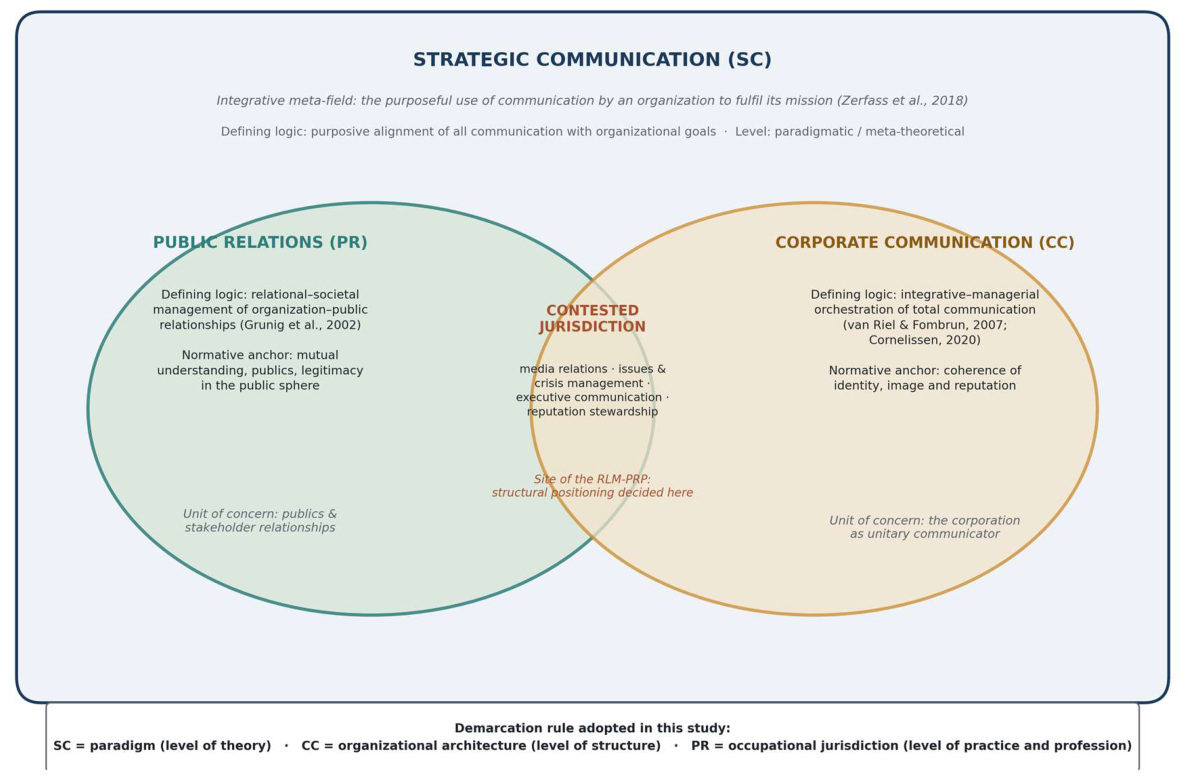
Figure 2.
The Recursive Legitimacy Model of PR Positioning (RLM-PRP). Note. Solid navy arrows denote structural paths with standardized coefficients; teal arrows denote mediated paths; the dashed terracotta arc denotes the recursive feedback path (theoretically specified; cross-sectionally inferred, not directly estimated); dashed plum arrows denote moderation. R² values are the variance explained in each endogenous construct; the region-moderated autonomy–legitimacy path (H5) is reported in Figure 3. Model boundaries: constructs are specified at the level of the PR occupation; CC enters as structural field, SC as discursive resource (see Section 2.2 and Section 4.1). ***p < 0.001. Source: Authors. Integrates Abbott (1988), Aldrich and Herker (1977), Berger (2005), Broom and Smith (1979), Rizzo et al. (1970) and Zerfass and Volk (2018).
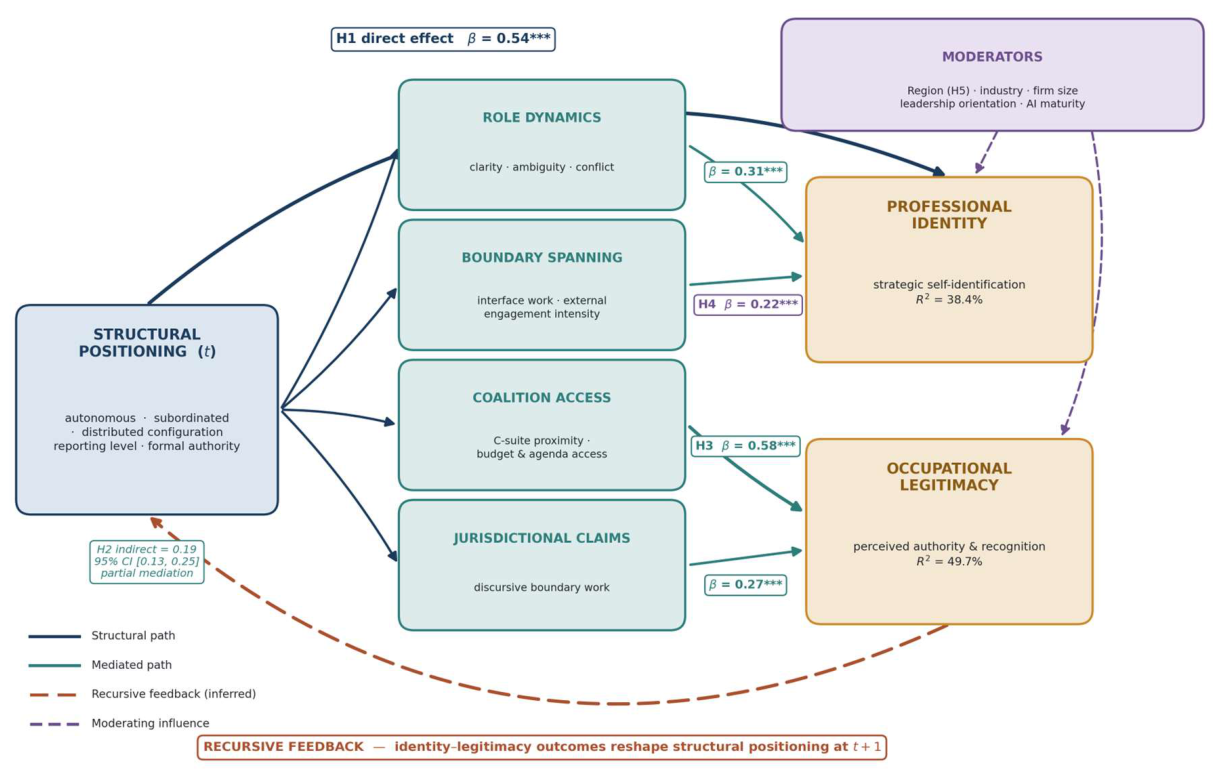
Figure 3.
Structural Estimates and Regional Moderation. Note. (a) Standardized estimates with bootstrap 95% CIs (N = 612); grey denotes the exploratory moderation. (b) The autonomy → legitimacy path by region; configural and metric invariance held, scalar invariance failed, so structural relationships—not latent means—are compared. Source: Authors’ SEM analysis.
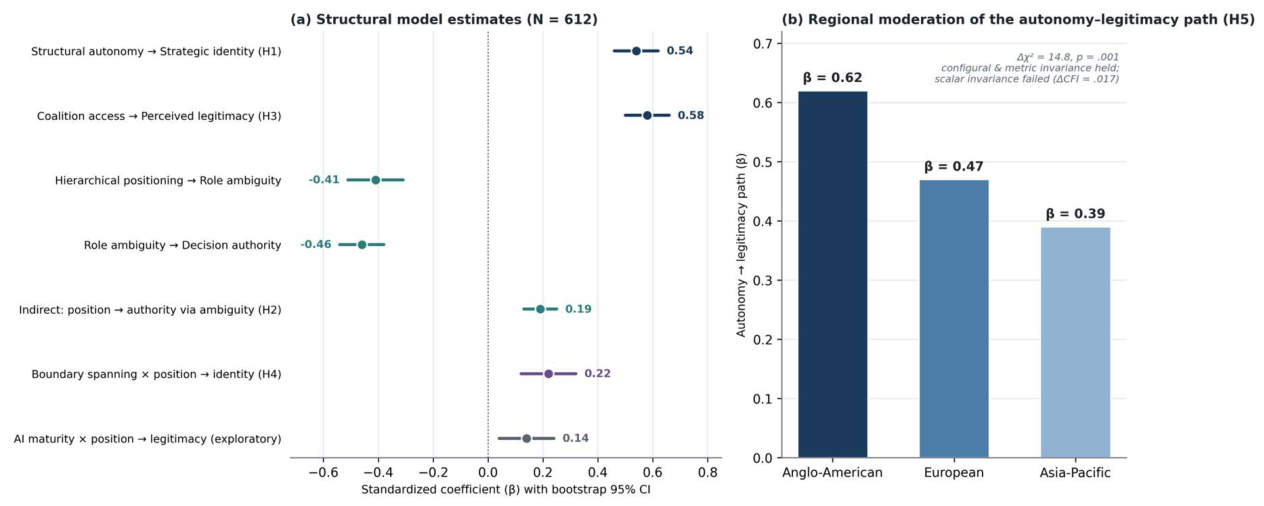
Figure 4.
The Four-Profile Typology of PR Institutionalization. Note. (a) Profiles in the autonomy × coalition-access plane; bubble area proportional to sample share; dominant region annotated. (b) Standardized profile signatures across the RLM-PRP constructs. Source: Authors’ LPA.
Figure 4.
The Four-Profile Typology of PR Institutionalization. Note. (a) Profiles in the autonomy × coalition-access plane; bubble area proportional to sample share; dominant region annotated. (b) Standardized profile signatures across the RLM-PRP constructs. Source: Authors’ LPA.
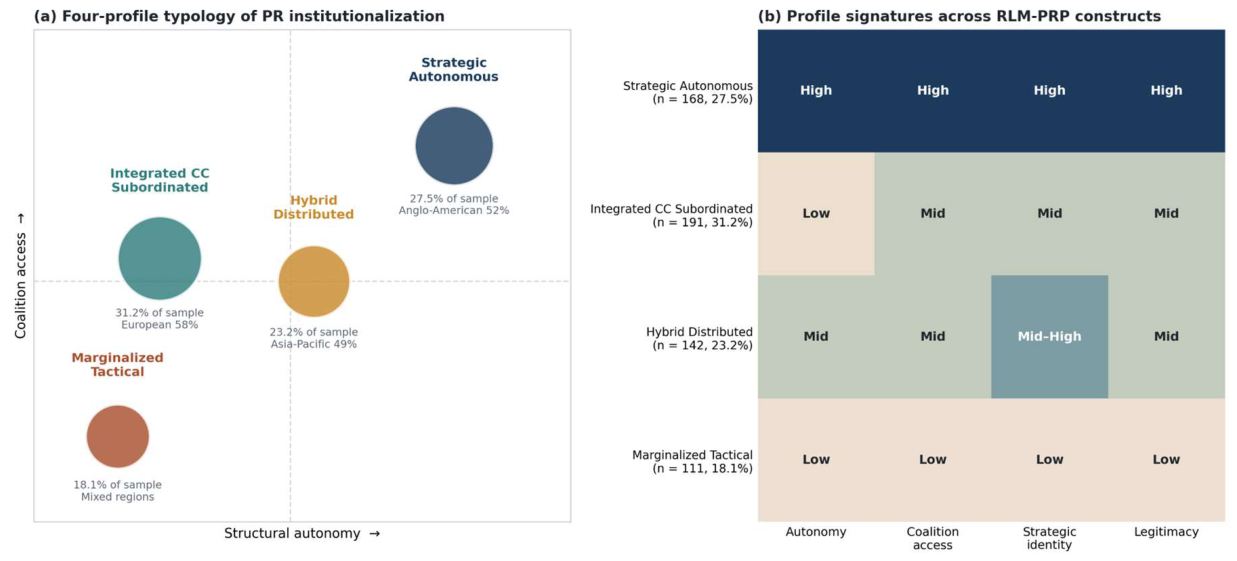
Table 1.
Theoretical Traditions and the PR–CC–SC Relationship.
| Tradition (key sources) | Conceptualization of PR |
Position on the PR–CC–SC relation |
Core tension with adjacent traditions |
| Excellence/symmetrical (Grunig and Hunt, 1984; Grunig et al., 2002) | Strategic management of organization–public relationships | PR as autonomous strategic function; CC integration unnecessary where excellence criteria are met | Autonomy claim collides with integrationist reading of communication coherence |
| Integrative CC (van Riel and Fombrun, 2007; Cornelissen, 2020) | Operational arm of integrated communication | PR as CC subset; coherence of identity, image and reputation overrides functional autonomy | Absorption of PR obscures its societal mandate and jurisdictional claims |
| Strategic communication (Holtzhausen and Zerfass, 2015; Zerfass et al., 2018) | Component of purposive organizational communication | SC as umbrella paradigm subsuming both PR and CC | Umbrella move risks dissolving PR’s normative commitments under managerial telos |
| Critical/sociocultural (L’Etang, 2008; Edwards, 2018; Fitch, 2016) | Discursive, cultural and political practice | Field-level contest; positioning itself an exercise of power | Rejects the managerial framing shared by CC and SC accounts |
| Reflective/societal (Heath, 2006; Ihlen and Verhoeven, 2012) | Public-oriented democratic practice | PR as deliberative interface irreducible to corporate function | Societal obligations resist subsumption under mission-fulfillment logics |
Note. The demarcation adopted in this section—SC as paradigm, CC as structure, PR as occupational jurisdiction—explains why these positions conflict: each tradition privileges a different level of analysis. Source: Authors’ synthesis of cited works.
Table 2.
Theoretical Lenses, Their Analytical Contributions and the Hypotheses They License.
| Theoretical lens | Core analytical concern | Key constructs in the RLM-PRP | Expectation licensed | Hypothesis |
| Role theory | How positions are defined and experienced | Role clarity, ambiguity, conflict | Ambiguity transmits position into (diminished) authority | H2 |
| Boundary-spanning theory | How interface work creates strategic value | Boundary-spanning intensity, salience; AI maturity (exploratory) | Interface intensity amplifies structure–identity effects | H4 |
| Professionalization theory | How occupations win jurisdiction | Jurisdictional claims; occupational legitimacy | Legitimacy is the contested outcome to be explained | (outcome specification) |
| Organizational power dynamics | How coalitions confer authority | Structural autonomy; coalition access | Autonomy → strategic identity; access → legitimacy | H1, H3 |
| Comparative/cross-cultural | How institutional context conditions mechanisms | Regional-cultural moderation | Path strengths vary by institutional logic | H5 |
Note. The sociotechnical/AI perspective is integrated into the boundary-spanning and power rows (Section 2.4 and Section 2.6), with AI maturity retained as an exploratory moderator. Source: Authors’ synthesis from Abbott (1988), Aldrich and Herker (1977), Berger (2005), Broom and Smith (1979), Buhmann and Likely (2018) and Zerfass and Volk (2018).
Table 3.
Alignment of Research Questions, Hypotheses, Methods and Reporting Locations.
| Research question | Hypotheses | Data source | Analysis | Answered in |
| RQ1 Mechanisms linking position to identity, authority and strategic contribution | H1, H2, H3 | Survey (N = 612) | SEM; bootstrap mediation | Section 6.1 and Section 6.2; 7.1–7.2 |
| RQ2 Role experience across subordinated vs. autonomous configurations | H2, H4 | Survey; LPA profiles | SEM; latent-interaction moderation; LPA | Section 6.2 and Section 6.3; 7.1 |
| RQ3 Discursive construction of jurisdictional boundaries | — (qualitative) | 412 job descriptions; 60 organizational charts | CDA; Foucauldian analysis; visual-semiotic and network analysis | Section 6.4 and Section 6.5; 7.2 |
| RQ4 Regional convergence/divergence of institutionalization | H5 | Survey (multi-group); qualitative corpus by region | Invariance testing; multi-group SEM; integrated typology | Section 6.2 and Section 6.6; 7.4 |
Note. SEM = structural equation modeling; LPA = latent profile analysis; CDA = critical discourse analysis. Source: Authors.
Table 4.
Sample Characteristics (N = 612).
| Characteristic | Distribution |
| Region | Anglo-American 200 (32.7%) · European 211 (34.5%) · Asia-Pacific 201 (32.8%) |
| Gender | Female 374 (61.1%) · male 229 (37.4%) · non-binary/undisclosed 9 (1.5%) |
| Seniority | Junior 138 (22.5%) · senior/manager 271 (44.3%) · director/head 142 (23.2%) · C-level 61 (10.0%) |
| Industry | Financial services 142 (23.2%) · technology 138 (22.5%) consumer goods/retail 121 (19.8%) · energy/industrials 109 (17.8%) · healthcare/pharmaceuticals 102 (16.7%) |
| Tenure | M = 11.4 years (SD = 6.8) |
Note. Anglo-American = US, UK, Canada, Australia; European = Germany, France, Netherlands, Sweden, Spain; Asia-Pacific = Singapore, South Korea, Japan, India. Percentages may not sum to 100 owing to rounding. Source: Authors’ survey data.
Table 5.
Measurement and Validation of Latent Constructs.
| Construct (items) | Sample item | Source | Validation status | α | CR | AVE |
| Structural autonomy (6) | “The PR function operates with budgetary independence from marketing.” | Adapted: Berger (2005); Volk and Zerfass (2018) | Adapted; CFA | 0.87 | [supply] | [supply] |
| Role ambiguity (6) | “I know exactly what is expected of me in my role.” (R) | Rizzo et al. (1970) | Established | 0.89 | [supply] | [supply] |
| Role conflict (8) | “I receive incompatible requests from two or more people.” | Rizzo et al. (1970) | Established | 0.84 | [supply] | [supply] |
| Boundary-spanning intensity (7) | “My work regularly involves liaising with external stakeholders.” | Adapted: Tushman and Scanlan (1981) | Adapted; CFA | 0.86 | [supply] | [supply] |
| Coalition access (5) | “I am routinely included in C-suite strategic deliberations.” | Adapted: Berger (2005) | Adapted; CFA | 0.91 | [supply] | [supply] |
| Professional identification (6) | “When someone praises PR as a profession, it feels like a personal compliment.” | Mael and Ashforth (1992) | Established | 0.90 | [supply] | [supply] |
| Strategic identity (7) | “I see my role primarily as advising senior leaders on strategic issues.” | Newly developed | Section 5.2.3 | 0.88 | [supply] | [supply] |
| Perceived legitimacy (8) | “My function is recognized as essential to organizational strategy.” | Newly developed | Section 5.2.3 | 0.92 | [supply] | [supply] |
| AI maturity (7; moderator) | “Our communication function uses AI tools systematically for stakeholder analytics.” | Adapted: Zerfass et al. (2021); Brockhaus et al. (2023) [AUTHOR TO CONFIRM] | Adapted; CFA | 0.85 | [supply] | [supply] |
Note. (R) = reverse-scored; all items 7-point Likert. CFA = confirmatory factor analysis; CR = composite reliability; AVE = average variance extracted. [supply] = per-construct value to be inserted by the authors from the CFA output before resubmission (reported ranges: CR 0.81–0.93; AVE 0.54–0.73). Source: Authors’ instrument development informed by cited sources.
Table 6.
Hypothesis Tests: Standardized Estimates from the Structural Model (N = 612).
| Hypothesis and path | β [95% CI] | Verdict |
| H1 Structural autonomy → strategic identity | 0.54 [0.46, 0.62] | Supported (R² identity = 38.4%) |
| H2 Hierarchical positioning → role ambiguity | −0.41 [−0.51, −0.31] | Supported—partial mediation |
| H2 Role ambiguity → decision authority | −0.46 [−0.54, −0.38] | |
| H2 Indirect effect (position → authority via ambiguity) | 0.19 [0.13, 0.25]; direct effect 0.31 | |
| H3 Coalition access → perceived legitimacy | 0.58 [0.50, 0.66] | Supported (R² legitimacy = 49.7%) |
| H4 Boundary spanning × position → identity | 0.22 [0.12, 0.32]; simple slopes 0.71 (+1 SD) / 0.29 (−1 SD) | Supported |
| H5 Autonomy → legitimacy, by region | Anglo-American 0.62 · European 0.47 · Asia-Pacific 0.39 (Δχ² = 14.8, p = 0.001) | Supported—metric invariance held; scalar failed (ΔCFI = 0.017) |
| Additional path: role dynamics → professional identity (Figure 2) | 0.31 [AUTHOR TO CONFIRM value; supply CI] | Structural path, not hypothesized |
| Additional path: jurisdictional claims → legitimacy (Figure 2) | 0.27 [AUTHOR TO CONFIRM value; supply CI] | Structural path, not hypothesized |
| Exploratory AI maturity × position → legitimacy | 0.14 [0.04, 0.24], p = 0.005 | Hypothesis-generating |
Note. MLR-estimated SEM; bootstrap 95% bias-corrected CIs (5,000 resamples); controls: organizational size, industry, gender, tenure; all p < 0.001 unless stated. The two additional paths are shown in Figure 2 and are listed here for completeness. Source: Authors’ SEM analysis.
Table 7.
Integrated Typology of PR Institutionalization: Quantitative, Discursive and Structural Signatures.
Table 7.
Integrated Typology of PR Institutionalization: Quantitative, Discursive and Structural Signatures.
| Profile (n, %) | RLM-PRP signature (autonomy / access / identity / legitimacy) | Discursive signature | Structural archetype (dominant region) | Interpretation |
| Strategic Autonomous (168; 27.5%) | High / High / High / High | Advocacy, advisory, stakeholder-leadership lexicon | Functionally autonomous; direct CEO line (Anglo-American, 52%) | PR institutionalized as a distinct strategic profession |
| Integrated CC Subordinated (191; 31.2%) | Low / Mid / Mid / Mid | Integration, alignment, brand-coherence lexicon | CCO-centric; PR as sub-function (European, 58%) | PR absorbed into integrated CC architecture |
| Hybrid Distributed (142; 23.2%) | Mid / Mid / Mid–High / Mid | Relationship, government-affairs, reputation lexicon | Distributed/embedded via corporate affairs (Asia-Pacific, 49%) | PR institutionalized through relational logics |
| Marginalized Tactical (111; 18.1%) | Low / Low / Low / Low | Execution-only lexicon; tactical verbs | Multiple steps removed from C-suite (mixed regions) | PR delegitimized; structural marginalization |
Note. Profile means standardized: High > +0.5 SD; Mid ±0.5 SD; Low < −0.5 SD of grand mean. Four-profile solution: BIC = 14,283; bootstrap LRT p < 0.05 vs. three profiles; entropy = 0.84. Sources: Authors’ LPA, discourse analysis and chart analysis, integrated as a joint display following Guetterman et al. (2015).
Disclaimer/Publisher’s Note: The statements, opinions and data contained in all publications are solely those of the individual author(s) and contributor(s) and not of MDPI and/or the editor(s). MDPI and/or the editor(s) disclaim responsibility for any injury to people or property resulting from any ideas, methods, instructions or products referred to in the content. |
© 2026 by the authors. Licensee MDPI, Basel, Switzerland. This article is an open access article distributed under the terms and conditions of the Creative Commons Attribution (CC BY) license (http://creativecommons.org/licenses/by/4.0/).
Copyright: This open access article is published under a Creative Commons CC BY 4.0 license, which permit the free download, distribution, and reuse, provided that the author and preprint are cited in any reuse.