

Submitted:
18 October 2026
Posted:
20 October 2026
You are already at the latest version
Abstract
Background: Pain management in wilderness and austere care must balance humane, effective analgesia against limited monitoring, environmental exposure, restricted drug inventories, and evacuation delays that may last hours. This review evaluates practical analgesic strategies for prolonged wilderness evacuation and quantitatively synthesizes directly comparable prehospital ketamine-versus-morphine trials. Methods: A focused systematic search of PubMed/MEDLINE-indexed literature and backward citation chaining was conducted through September 5, 2026. Human prehospital, wilderness, remote, austere, and prolonged-field-care studies evaluating acetaminophen, nonsteroidal anti-inflammatory drugs (NSAIDs), opioids, ketamine, or regional anesthesia were prioritized. Guidelines and systematic reviews were used to contextualize operational feasibility. A random-effects meta-analysis pooled studies reporting directly comparable changes in 0-10 pain intensity for ketamine versus morphine. Results: Direct evidence specific to prolonged civilian wilderness evacuation was sparse. Across the broader prehospital literature, acetaminophen and NSAIDs provided useful low-complexity analgesia for mild-to-moderate pain and as components of multimodal therapy. Opioids remained effective for severe pain but impose respiratory, hemodynamic, nausea, sedation, and monitoring burdens. Ketamine produced analgesia broadly comparable with morphine in contemporary randomized trials, with faster onset in some studies and a different adverse-effect profile characterized by more emergence phenomena but less opioid-associated nausea, hypotension, or respiratory compromise in some datasets. Two directly comparable trials (n=559) yielded a pooled mean difference in pain-score change of -0.27 points favoring ketamine (95% CI, -0.70 to 0.17; I2=13%), indicating no clinically important difference in analgesic efficacy. Regional techniques, particularly fascia iliaca compartment block for proximal femur injury, showed substantial opioid-sparing potential when performed by trained clinicians. Conclusions: No single agent is optimal for prolonged wilderness evacuation. The most defensible strategy is staged multimodal analgesia matched to pain severity, physiology, evacuation duration, provider skill, and monitoring capacity. Oral acetaminophen and/or an NSAID form a practical foundation when not contraindicated; severe pain may justify titrated ketamine or an opioid, while regional anesthesia can be valuable for selected injuries. The major evidence gap is not short-term analgesic efficacy but safety, redosing, monitoring, and functional outcomes during evacuations lasting many hours.
Keywords:
wilderness medicine
; austere medicine
; prolonged evacuation
; analgesia
; ketamine
; opioids
; regional anesthesia
Introduction
Acute pain is common after wilderness trauma, yet the environment changes the risk-benefit calculation of analgesia. In an emergency department, deterioration after an analgesic can be recognized quickly and treated with oxygen, suction, airway equipment, intravenous access, monitoring, and additional staff. During wilderness evacuation, the patient may instead be carried over steep terrain, transported in cold or heat, packaged in a litter that limits reassessment, or cared for by a small team with finite medications and batteries. The 2024 Wilderness Medical Society (WMS) guideline therefore defines austere care as wilderness, remote, or highly resource-limited care in which conventional emergency resources are unavailable and evacuation may be challenging or prolonged [1].
Prolonged field care illustrates the magnitude of that problem. In a review of 54 military prolonged-field-care cases, prehospital care lasted 4 to 120 hours, with a median of 10 hours, and 96% of encounters occurred in remote or austere environments [2]. Although military systems are not identical to civilian wilderness rescue, the duration problem is directly relevant: a drug that is safe and effective for a 20-minute ambulance transport may behave differently operationally when repeated dosing, sleep, hydration, hypothermia, occult hemorrhage, altitude, and limited observation become important [2,3].
The evidence base for prehospital analgesia has expanded substantially. Contemporary reviews describe trials involving opioids, ketamine, nonopioid analgesics, inhaled agents, and regional anesthesia, while evidence-based EMS guidelines emphasize that multiple drug classes can provide effective analgesia [3,4,5]. The WMS guideline similarly supports a progressive, multimodal approach in which low-risk treatments are used when appropriate before higher-risk therapies, while permitting simultaneous multimodal treatment when pain is severe [1].
The central wilderness question is therefore not simply which drug lowers a pain score most effectively. It is which strategy remains practical and acceptably safe when definitive care is delayed. This review evaluates acetaminophen, NSAIDs, opioids, ketamine, and regional anesthesia through that operational lens and performs a targeted meta-analysis of directly comparable prehospital ketamine-versus-morphine trials.
Methods
Design and Reporting
This was a focused systematic evidence review with a targeted quantitative synthesis. Reporting was informed by PRISMA 2020 principles [6]. The review was designed for an operational wilderness-medicine question rather than as a comprehensive comparative-effectiveness review of every analgesic used in emergency care. The protocol was not prospectively registered.
Search Strategy
A focused search of PubMed/MEDLINE-indexed literature was conducted through October 5, 2026, supplemented by backward citation chaining from the 2024 WMS acute-pain guideline, contemporary prehospital guidelines, systematic reviews, and included trials [1,3,4,5]. Search concepts combined prehospital, wilderness, austere, remote, prolonged field care, evacuation, trauma, and pain/analgesia with ketamine, morphine, fentanyl, opioid, acetaminophen/paracetamol, NSAID/ketorolac, regional anesthesia, nerve block, and fascia iliaca. The exact reproducible search string is provided in Appendix A. English-language human studies were prioritized.
Eligibility and Evidence Hierarchy
Eligible evidence addressed acute pain treatment before hospital arrival or in a resource-limited setting relevant to wilderness evacuation. Primary comparative trials were prioritized for efficacy and adverse effects. Prospective feasibility studies were included for regional anesthesia when randomized evidence was sparse. Systematic reviews and clinical practice guidelines were included to characterize the broader evidence base and operational recommendations. Studies confined exclusively to postoperative or chronic pain were excluded. Military prolonged-field-care literature was used for contextual evidence about delayed evacuation rather than assumed to be directly generalizable to civilian wilderness care.
Data Extraction and Appraisal
For included primary studies, the author extracted setting, sample size, intervention, comparator, principal pain outcome, and clinically relevant adverse effects from the published report. Methodologic limitations were appraised qualitatively, with attention to randomization, blinding, route differences, outcome measurement, missing data, and generalizability. Because this was a single-author focused review, duplicate independent screening and extraction were not performed.
Targeted Meta-Analysis
A quantitative synthesis was prespecified for studies comparing ketamine alone with morphine alone and reporting a directly comparable change in pain intensity on a 0-10 scale. Two studies met these criteria: the rural Vietnam cluster-randomized trial by Tran et al and the multicenter KETAMORPH trial by Le Cornec et al. [7,8] Negative mean differences indicate greater pain reduction with ketamine. Study estimates were pooled using inverse-variance random effects with a DerSimonian-Laird estimator for between-study variance. Heterogeneity was summarized with I². PACKMaN was not pooled because its primary outcome was the Sum of Pain Intensity Difference (SPID), which was not directly interchangeable with the simple change-score endpoint without additional patient-level or time-point data [9].
Results
Evidence Landscape
The directly applicable wilderness evidence was limited. Most comparative trials were conducted in organized EMS systems with transport measured in minutes rather than hours. The most relevant exception was the rural Vietnam ketamine-morphine trial, in which mean time from injury to hospital admission was approximately 3.6 hours, approaching the lower range of a prolonged evacuation [7,9]. A military prolonged-field-care case series demonstrates that much longer prehospital intervals occur, but it does not provide comparative analgesic efficacy data [2]. Consequently, recommendations for evacuations extending well beyond several hours depend partly on extrapolation from conventional prehospital trials, pharmacology, and expert wilderness guidance.
A 2026 scoping review of adult prehospital pain management synthesized 22 systematic reviews covering 193 unique primary studies and more than 93,000 adults, illustrating both the size and heterogeneity of the field [3]. Earlier systematic review data also showed that opioid treatment often left clinically important residual pain during the first 10 to 30 minutes of care, supporting multimodal rather than opioid-only thinking [5].
Acetaminophen and NSAIDs
Acetaminophen and NSAIDs have major operational advantages in prolonged evacuation: they are familiar, compact, do not cause clinically important respiratory depression, and can often be administered orally without intravenous access. Evidence-based prehospital guidelines conditionally support either oral acetaminophen or an oral NSAID when the oral route is preferred, and the WMS guideline strongly supports acetaminophen plus an NSAID for moderate-to-severe pain when no contraindication exists [1,4].
A randomized prehospital trial of 150 patients compared intravenous acetaminophen 1 g with ketorolac 30 mg. Mean pain-score reduction was similar (14.9 versus 16.0 on the study's visual analog scale; P=.429) [10]. This trial does not establish superiority of either agent and included both traumatic and nontraumatic pain, but it supports the practical concept that nonopioid analgesia can provide meaningful prehospital benefit.
For wilderness use, toxicity rather than potency often determines suitability. NSAIDs require caution in renal dysfunction, gastrointestinal bleeding risk, dehydration, significant hypovolemia, and other conventional contraindications; prolonged exertion and limited access to fluid can amplify renal concerns. Acetaminophen avoids platelet and renal effects at usual dosing but requires attention to cumulative dose and hepatic risk. The WMS guideline recommends the lowest effective NSAID dose for the shortest necessary duration and describes acetaminophen as a core low-risk option [1].
Opioids
Morphine and fentanyl remain effective options for severe acute pain. A randomized double-blind prehospital comparison found no important difference in analgesic effectiveness between intravenous morphine and fentanyl [11]. The choice between them in wilderness care is therefore often operational: route availability, expected transport duration, redosing requirements, hemodynamics, nausea, and the team's ability to monitor ventilation and manage oversedation.
The principal wilderness disadvantage of opioids is not that serious events are inevitable, but that the consequences of a rare event are magnified when monitoring and rescue resources are constrained. Respiratory depression, sedation, nausea/vomiting, hypotension, and impaired mobility can complicate evacuation. WMS recommends that clinicians using opioids in austere settings possess appropriate airway skills and access to reversal capability, and supports intranasal fentanyl as a practical nonintravenous route [1]. For prolonged care, repeated dosing also creates an accumulation problem that is not well captured by short EMS trials.
Ketamine
Ketamine is attractive in austere care because analgesic dosing can reduce severe pain while generally preserving spontaneous ventilation and cardiovascular stability. WMS recommends ketamine for acute severe pain in austere environments when administered by appropriately trained providers with the capability to manage complications [1]. Systematic reviews have concluded that prehospital ketamine provides analgesia at least comparable with opioids, while producing a different adverse-effect profile: less nausea/vomiting in some datasets but more agitation or emergence phenomena [12,13].
The rural Vietnam cluster-randomized trial enrolled 308 trauma patients (169 ketamine, 139 morphine). Mean VAS reduction was 3.5 points with ketamine versus 3.1 with morphine; vomiting occurred in 5% versus 19%, whereas hallucination or agitation occurred in 11% versus 1.5%, respectively [7]. The multicenter KETAMORPH trial randomized 251 adults and found ketamine noninferior to morphine: mean pain-score change was -3.7 versus -3.8, for a between-group difference of 0.1 points (95% CI, -0.7 to 0.9). Adverse effects were more frequently reported with ketamine (40.8% versus 16.8%), driven largely by emergence phenomena; no adverse event required intervention [8].
The larger PACKMaN double-blind phase 3 trial randomized 449 patients with severe traumatic pain. Ketamine did not outperform morphine on SPID (3.5 versus 3.4; adjusted mean difference 0.1, 95% CI, -0.4 to 0.6), although ketamine had a faster onset and morphine had a longer duration of effect [9]. A 2026 systematic review and meta-analysis similarly concluded that ketamine and opioid-based analgesia have broadly comparable analgesic effectiveness in adult prehospital trauma, with clinically relevant differences in physiologic and adverse-effect profiles rather than a decisive efficacy advantage [14].
Adjunctive ketamine data are mixed. Jennings et al found that adding ketamine to morphine produced a larger reduction in pain than additional morphine alone, but minor adverse effects were more common [15]. Galinski et al found that low-dose ketamine reduced subsequent morphine requirement in severe acute trauma pain [16]. In contrast, a 2024 randomized trial did not detect a significant benefit from adding 50 mg intranasal ketamine to fentanyl [17]. For wilderness practice, these findings argue against reflexively stacking sedating medications; adjunctive therapy should be individualized to pain severity, prior response, physiology, and monitoring capability.
Targeted Meta-Analysis: Ketamine Versus Morphine
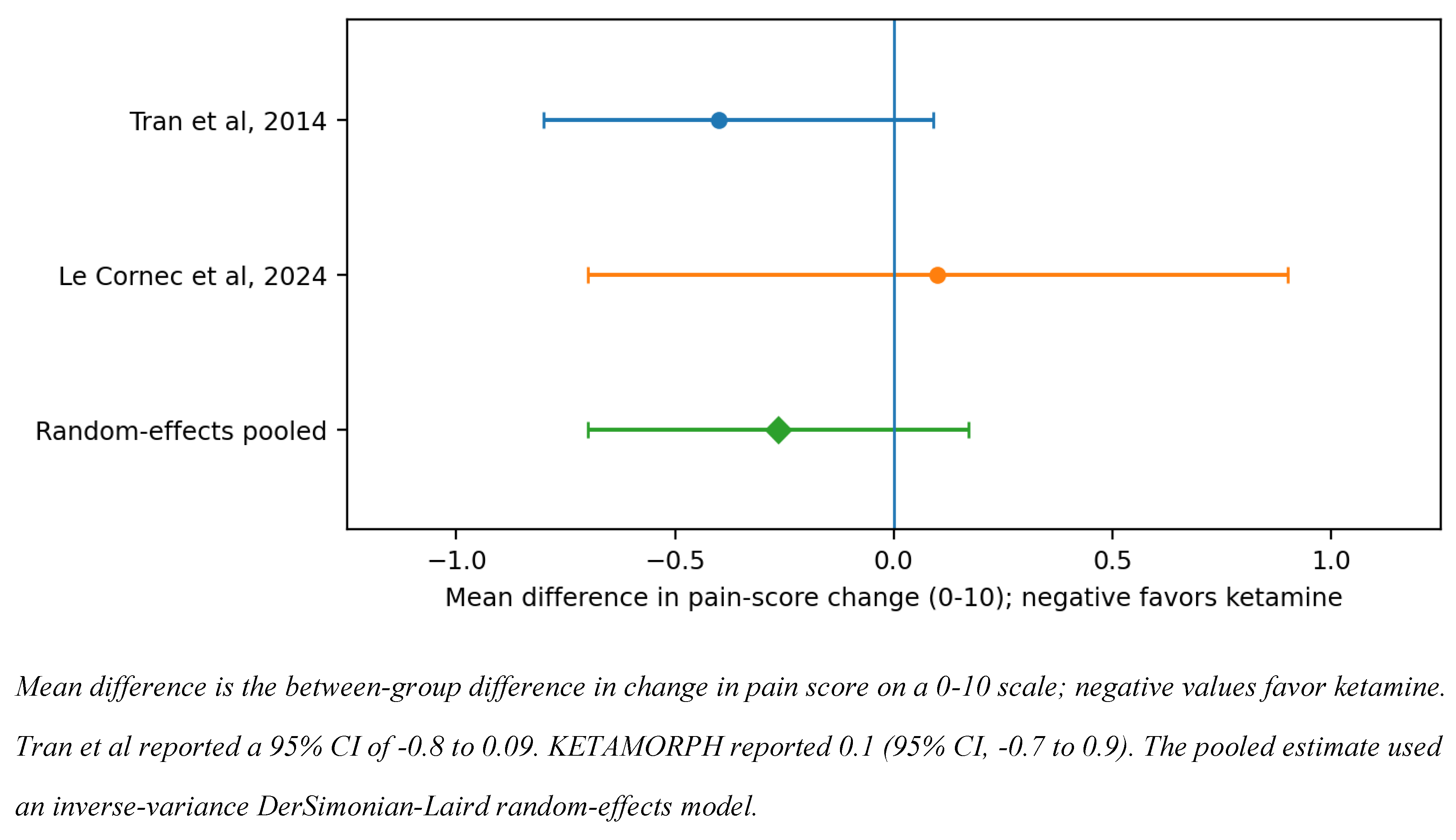
Two trials reporting directly comparable 0-10 pain-change outcomes were pooled (total n=559) [7,8]. The random-effects pooled mean difference was -0.27 points (95% CI, -0.70 to 0.17; I²=13%), with negative values favoring ketamine (Figure 1). The confidence interval includes no difference and is well within the range generally considered a small change on a 0-10 pain scale. Thus, the quantitative synthesis does not demonstrate superiority of either drug and is consistent with broadly similar average analgesic effects. PACKMaN, which used a longitudinal SPID outcome, was concordant but intentionally not combined with the simple change-score trials [9].
Regional Anesthesia
Regional anesthesia offers a different solution to the prolonged-evacuation problem: instead of repeatedly exposing the whole patient to systemic analgesics, a targeted block can provide profound analgesia to an injured extremity. In a small randomized controlled trial of suspected femoral fractures, paramedic-performed fascia iliaca compartment block after an initial morphine dose reduced median pain by 5 points at 15 minutes compared with 2 points under standard care, without a significant scene-time penalty or immediate adverse events [18].
A separate feasibility study trained EMS nurses to perform fascia iliaca compartment blocks. Among 100 evaluable patients, 96 blocks were judged effective, with progressive reduction in median pain and no reported complications [19]. These data are encouraging but should not be generalized to all blocks or all rescuers. Local-anesthetic systemic toxicity, intravascular injection, nerve injury, infection, and block failure remain relevant, and an ultrasound device may not be available. The practical wilderness role is therefore injury-specific and skill-dependent: regional anesthesia is most compelling when a trained provider can perform a familiar block for an injury expected to remain very painful throughout a long extraction.
A Practical Staged Approach
Taken together, the evidence supports a staged rather than drug-centric model. First, correct the pain generator when possible: splint fractures, reduce appropriately selected dislocations, dress burns and wounds, reposition the patient, insulate from cold, and reduce anxiety. Second, use nonopioid systemic therapy early when safe, particularly oral acetaminophen and/or an NSAID. Third, for severe pain or painful procedures, escalate to a titratable advanced agent - ketamine or an opioid - selected according to physiology, route, anticipated redosing, provider skill, and monitoring. Fourth, consider regional anesthesia when the injury is anatomically suitable and the provider is trained. The objective is not necessarily zero pain; it is tolerable pain that permits examination, packaging, movement, rest, and safe evacuation without creating a new airway or hemodynamic problem [1].

Table 1.
Operational characteristics of major analgesic strategies.
| Strategy | Operational strengths | Important limitations | Best-fit wilderness role | Selected evidence |
|---|---|---|---|---|
| Acetaminophen +/- NSAID | Compact; oral route; no respiratory depression; multimodal opioid-sparing effect | NSAIDs: renal/GI/bleeding concerns; acetaminophen: cumulative-dose/hepatic risk | Foundation for mild-moderate pain and background therapy for severe pain | WMS guideline; prehospital acetaminophen-vs-ketorolac RCT |
| Opioid | Familiar; titratable; effective for severe pain; several routes | Respiratory depression, sedation, nausea/vomiting, hypotension; repeated-dose accumulation | Severe pain when monitoring and airway rescue capability are adequate | Morphine-vs-fentanyl RCT; EMS guideline |
| Ketamine | Effective severe-pain analgesia; rapid onset; generally preserves ventilation and blood pressure | Emergence phenomena, agitation/dysphoria, nausea; requires training and monitoring | Severe pain, especially when opioid respiratory/hemodynamic effects are undesirable | Tran, KETAMORPH, PACKMaN; systematic reviews |
| Regional anesthesia | Profound focal analgesia; opioid-sparing; minimal systemic sedation | Training, block failure, local-anesthetic toxicity, procedural equipment | Selected limb injuries during long extraction when skilled provider available | Fascia iliaca controlled and feasibility studies |
Discussion
The main finding is that prolonged wilderness evacuation changes the preferred analgesic strategy more than it changes the relative analgesic potency of individual drugs. Short-duration prehospital trials suggest that several modalities work. The practical problem is sustaining analgesia safely when the patient cannot be reassessed continuously and when side effects may interfere with rescue operations. That favors multimodal therapy, dose titration, route flexibility, and an explicit monitoring plan.
For mild or moderate pain, and as background therapy for severe pain, oral acetaminophen and an NSAID are difficult to improve upon when contraindications are absent. Their greatest value during a long evacuation is not that they are stronger than ketamine or morphine; it is that they can reduce reliance on higher-risk rescue analgesia without imposing ventilation monitoring or causing cognitive impairment. The WMS guideline's recommendation to begin with lower-risk treatments when clinically appropriate is especially relevant when the next clinician may be many hours away [1].
For severe trauma pain, the ketamine-versus-opioid debate is often framed too simplistically. The pooled result in this review and the larger PACKMaN trial indicate that ketamine is not meaningfully more analgesic than morphine on average [7,8,9]. Its wilderness advantage is conditional: preservation of ventilation and hemodynamics can be valuable in selected patients, but dysphoria, agitation, nausea, hypersalivation, or dissociation can be operationally disruptive in a narrow litter, helicopter, cave, or technical rescue. Conversely, opioids are familiar and effective, but respiratory depression, hypotension, nausea, and cumulative sedation matter more as evacuation lengthens. The appropriate question is therefore which adverse-effect profile the rescue team is best prepared to manage.
Regional anesthesia may offer the greatest theoretical benefit for certain long evacuations, because a successful block can provide sustained focal analgesia with less systemic sedation. The evidence is strongest for proximal femur injuries and remains modest in sample size [18,19]. Wider wilderness adoption would require training, maintenance of procedural competency, local-anesthetic safety protocols, and preferably ultrasound when logistics allow. It should be viewed as an advanced capability rather than a universal replacement for systemic analgesia.
The review also exposes a major research gap. The outcomes that matter during a 6-, 12-, or 24-hour evacuation are not fully captured by a 30-minute pain score. Future wilderness trials should measure cumulative rescue medication, repeated-dose adverse events, respiratory and hemodynamic deterioration, nausea/vomiting, delirium or dysphoria, sleep, ability to cooperate with movement, rescue-team workload, need for evacuation interruption, and pain at definitive care. Civilian wilderness registries could provide pragmatic observational data while prospective multicenter rescue studies test protocolized multimodal pathways.
Recent military-derived prolonged-field-care concepts are increasingly discussed for civilian remote and austere trauma systems [20]. Translation should be selective. Military teams may carry different formularies, have different scopes of practice, use telemedical support, and operate in different injury patterns. Nevertheless, the underlying principle is transferable: once evacuation becomes prolonged, analgesia should be planned as a longitudinal care process rather than a single prehospital dose.
Limitations
This review has several limitations. First, direct civilian wilderness evidence was sparse, so much of the comparative evidence came from conventional EMS systems and was extrapolated to prolonged evacuation. Second, the focused search was limited primarily to PubMed/MEDLINE-indexed literature and citation chaining rather than a multi-database librarian-assisted search. Third, screening and extraction were performed by a single reviewer, increasing the possibility of missed studies or extraction error. Fourth, the targeted meta-analysis included only two directly comparable trials and therefore provides limited power to assess heterogeneity or publication bias. Fifth, routes, dosing strategies, populations, and pain outcomes varied across the broader evidence base. Finally, the analysis addresses acute analgesia and does not establish the safety of repeated administration over many hours. These limitations are particularly important because the operational conclusions concern a setting in which evidence is thinner than the general prehospital analgesia literature.
Conclusions
Pain control during prolonged wilderness evacuation should be treated as a staged, multimodal process rather than a search for a single ideal drug. Acetaminophen and NSAIDs provide a practical low-risk foundation when appropriate. For severe pain, ketamine and opioids offer broadly similar analgesic effectiveness; selection should be driven by physiology, route, anticipated redosing, adverse-effect profile, provider competence, and monitoring resources rather than an assumption that one agent is universally superior. Regional anesthesia can be highly effective for selected injuries when performed by trained clinicians. The most important unresolved question is how these strategies perform after repeated dosing and limited monitoring during evacuations lasting many hours.
Author Contributions
I.A. conceived the review question and is responsible for final source verification, interpretation, revision, and approval of the manuscript.
Funding
No specific funding was received for this work.
Ethics Approval and Consent to Participate
Not applicable. This review used aggregate results reported in previously published studies and did not obtain individual-level human data or involve direct interaction with human participants.
Consent for Publication
Not applicable.
Data Availability Statement
All data used in the evidence synthesis are available in the cited publications. Study-level effect estimates used in the targeted meta-analysis are reported in the manuscript and Figure 1.
Conflicts of Interest
The author declares no competing interests.
Review Registration
This focused review was not prospectively registered.
Appendix A. Reproducible Focused PubMed Search Strategy
("prehospital"[Title/Abstract] OR "wilderness"[Title/Abstract] OR "austere"[Title/Abstract] OR "remote"[Title/Abstract] OR "prolonged field care"[Title/Abstract] OR "evacuation"[Title/Abstract]) AND ("pain"[Title/Abstract] OR "analgesia"[Title/Abstract]) AND ("ketamine"[Title/Abstract] OR "morphine"[Title/Abstract] OR "fentanyl"[Title/Abstract] OR "opioid"[Title/Abstract] OR "acetaminophen"[Title/Abstract] OR "paracetamol"[Title/Abstract] OR "NSAID"[Title/Abstract] OR "ketorolac"[Title/Abstract] OR "regional anesthesia"[Title/Abstract] OR "nerve block"[Title/Abstract] OR "fascia iliaca"[Title/Abstract])
The search was supplemented by backward citation chaining from the WMS guideline, contemporary prehospital guidelines, recent systematic/scoping reviews, and eligible primary studies. Search date: October 5, 2026.
References
- Fink, P.B.; Wheeler, A.R., III; Smith, W.R.; et al. Wilderness Medical Society Clinical Practice Guidelines for the Treatment of Acute Pain in Austere Environments: 2024 Update. Wilderness Environ. Med. 2024, 35, 198–218. [Google Scholar] [CrossRef] [PubMed]
- DeSoucy, E.S.; Shackelford, S.A.; DuBose, J.J.; et al. Review of 54 Cases of Prolonged Field Care. J. Spec. Oper. Med. 2017, 17, 121–129. [Google Scholar] [CrossRef] [PubMed]
- Burgert, J.M.; Vadas, D.; Heneghan, C.J.; Richards, G.C. Pain management of adults in the prehospital setting: a scoping review. BMC Emerg. Med. 2026, 26, 82. [Google Scholar] [CrossRef] [PubMed]
- Lindbeck, G.; Shah, M.I.; Braithwaite, S.; et al. Evidence-Based Guidelines for Prehospital Pain Management: Recommendations. Prehosp Emerg. Care 2023, 27, 144–153. [Google Scholar] [CrossRef] [PubMed]
- Park, C.L.; Roberts, D.E.; Aldington, D.J.; Moore, R.A. Prehospital analgesia: systematic review of evidence. J. R Army Med. Corps 2010, 156((4) Suppl 1, 295–300. [Google Scholar] [CrossRef] [PubMed]
- Page, M.J.; McKenzie, J.E.; Bossuyt, P.M.; et al. The PRISMA 2020 statement: an updated guideline for reporting systematic reviews. BMJ 2021, 372, n71. [Google Scholar] [CrossRef] [PubMed]
- Tran, K.P.; Nguyen, Q.; Truong, X.N.; et al. A comparison of ketamine and morphine analgesia in prehospital trauma care: a cluster randomized clinical trial in rural Quang Tri province, Vietnam. Prehosp Emerg. Care 2014, 18, 257–264. [Google Scholar] [CrossRef] [PubMed]
- Le Cornec, C.; Le Pottier, M.; Broch, H.; et al. Ketamine Compared With Morphine for Out-of-Hospital Analgesia for Patients With Traumatic Pain: A Randomized Clinical Trial. JAMA Netw. Open 2024, 7, e2352844. [Google Scholar] [CrossRef] [PubMed]
- Smyth, M.A.; Noordali, H.; Starr, K.; et al. Paramedic analgesia comparing ketamine and morphine in trauma (PACKMaN): a randomised, double-blind, phase 3 trial. Lancet Reg. Health Eur. 2025, 53, 101265. [Google Scholar] [CrossRef] [PubMed]
- Mahshidfar, B.; Rezai, M.; Abbasi, S.; et al. Intravenous Acetaminophen vs. Ketorolac in Terms of Pain Management in Prehospital Emergency Services: A Randomized Clinical Trial. Adv. J. Emerg. Med. 2019, 3, e37. [Google Scholar] [CrossRef] [PubMed]
- Galinski, M.; Dolveck, F.; Borron, S.W.; et al. A randomized, double-blind study comparing morphine with fentanyl in prehospital analgesia. Am. J. Emerg. Med. 2005, 23, 114–119. [Google Scholar] [CrossRef] [PubMed]
- Sandberg, M.; Hyldmo, P.K.; Kongstad, P.; et al. Ketamine for the treatment of prehospital acute pain: a systematic review of benefit and harm. BMJ Open 2020, 10, e038134. [Google Scholar] [CrossRef] [PubMed]
- Bansal, A.; Miller, M.; Ferguson, I.; Burns, B. Ketamine as a Prehospital Analgesic: A Systematic Review. Prehosp Disaster Med. 2020, 35, 314–321. [Google Scholar] [CrossRef] [PubMed]
- Meyer, A.C.; Kuo, M.; Duriancik, D.M. Analgesic and Physiologic Effects of Ketamine Compared with Opioids in Prehospital Trauma Care: A Systematic Review and Meta-Analysis. J. Emerg. Med. 2026, 85, 28–44. [Google Scholar] [CrossRef] [PubMed]
- Jennings, P.A.; Cameron, P.; Bernard, S.; et al. Morphine and ketamine is superior to morphine alone for out-of-hospital trauma analgesia: a randomized controlled trial. Ann. Emerg. Med. 2012, 59, 497–503. [Google Scholar] [CrossRef] [PubMed]
- Galinski, M.; Dolveck, F.; Combes, X.; et al. Management of severe acute pain in emergency settings: ketamine reduces morphine consumption. Am. J. Emerg. Med. 2007, 25, 385–390. [Google Scholar] [CrossRef] [PubMed]
- McMullan, J.T.; Droege, C.A.; Chard, K.M.; et al. Out-of-Hospital Intranasal Ketamine as an Adjunct to Fentanyl for the Treatment of Acute Traumatic Pain: A Randomized Clinical Trial. Ann. Emerg. Med. 2024, 84, 363–373. [Google Scholar] [CrossRef] [PubMed]
- McRae, P.J.; Bendall, J.C.; Madigan, V.; Middleton, P.M. Paramedic-performed Fascia Iliaca Compartment Block for Femoral Fractures: A Controlled Trial. J. Emerg. Med. 2015, 48, 581–589. [Google Scholar] [CrossRef] [PubMed]
- Dochez, E.; van Geffen, G.J.; Bruhn, J.; Hoogerwerf, N.; van de Pas, H.; Scheffer, G.J. Prehospital administered fascia iliaca compartment block by emergency medical service nurses, a feasibility study. Scand. J. Trauma Resusc. Emerg. Med. 2014, 22, 38. [Google Scholar] [CrossRef] [PubMed]
- Larcher, S.; Marini, G.; Rigobello, A.; De Rosa, S. Management of trauma in remote and austere settings: civilian implications of military-derived prolonged field care principles - A narrative review. Med Intensiva (Engl Ed) 2026. [Google Scholar] [CrossRef] [PubMed]
Figure 1.
Targeted meta-analysis of ketamine versus morphine.
Disclaimer/Publisher’s Note: The statements, opinions and data contained in all publications are solely those of the individual author(s) and contributor(s) and not of MDPI and/or the editor(s). MDPI and/or the editor(s) disclaim responsibility for any injury to people or property resulting from any ideas, methods, instructions or products referred to in the content. |
© 2026 by the authors. Licensee MDPI, Basel, Switzerland. This article is an open access article distributed under the terms and conditions of the Creative Commons Attribution (CC BY) license (http://creativecommons.org/licenses/by/4.0/).
Copyright: This open access article is published under a Creative Commons CC BY 4.0 license, which permit the free download, distribution, and reuse, provided that the author and preprint are cited in any reuse.