

Submitted:
17 October 2026
Posted:
20 October 2026
You are already at the latest version
Abstract
Digital markets give consumers access to more alternatives than they can realistically examine. Search rankings and recommendation systems help manage this abundance, but they also influence which alternatives receive attention. This paper examines the difference between available and considered choice and its implications for consumer autonomy. We propose a four-stage framework covering available (A), visible (V), experienced (E), and final choice (C), and examine its observable stages using three behavioral datasets: Coveo, RecGaze, and FINN.no. In Coveo, an average of 5.88% of returned search results received a recorded click. In RecGaze, participants visually attended to an average of 39.96 out of 150 available films. FINN.no shows that clicks were concentrated near the top of ranked lists, with stronger concentration in search results than in recommendations. These findings show that the number of alternatives presented to consumers differs considerably from the number receiving recorded attention or interaction. They do not establish that algorithms reduce consumer autonomy. Limited consideration may also reflect consumer preferences and efficient search. We argue that autonomy cannot be assessed from the number of available alternatives alone. For sustainable consumption, this raises a further question: whether environmentally preferable alternatives have a realistic opportunity to enter consumer consideration.
Keywords:
sustainable consumption
; consumer autonomy
; algorithmic markets
; consumer choice
; recommender systems
; choice architecture
; choice diversity
1. Introduction
Digital markets offer more choice than any consumer can realistically examine. A single product search may return hundreds or thousands of alternatives, most of which will never enter the consumer's decision. Search rankings, recommendation systems, and personalized interfaces determine which products appear first. The consumer makes the final choice, but who determines the choice set?
Large assortments need some form of organization. Iyengar and Lepper [1] demonstrated that extensive choice can make decisions harder, although the effect depends on the circumstances of the decision. Chernev et al. [2] found that the effects of assortment size depend on the difficulty of the decision, the complexity of the alternatives, and how clearly consumers know what they want. Reducing the number of alternatives can therefore be useful. Yet the size of an assortment tells us little about how consumers interpret its structure or construct preferences within it [3,4]. The question is who does the reducing.
Recommendation systems complicate the picture further. They can introduce consumers to products they would not otherwise find. Lee and Hosanagar [5] showed that recommendations increased the diversity of products consumed by individual users, even as aggregate consumption became more concentrated. A smaller or more selective presentation of alternatives is not necessarily a restriction. It may improve discovery. Recommender systems can also reduce the effort required to navigate large assortments, although their design influences how consumers experience the available options [6,7]. The number of products available in a market and the number that enter an individual decision remain two different things.
Digital consumer data capture clicks, product views, purchases, and other recorded actions. What they rarely reveal is which alternatives consumers never encountered. Nor can a click be read as a straightforward expression of preference. Joachims et al. [8] demonstrated that click behavior is affected by how search results are presented. A product may receive no interaction because it was rejected, because it appeared too far down the list, or because the consumer never saw it. Research on ranking systems has also treated the distribution of exposure as a distinct issue, rather than assuming that every available alternative has an equal opportunity to be encountered [9]. The transaction may be identical in the data. The decision behind it is not.
This creates a problem for how consumer autonomy is understood. A person can freely choose among five recommended products without knowing why those five were selected. Another consumer may arrive at the same five products after searching, comparing, and eliminating alternatives independently. Both make a decision. Their influence over the formation of the choice set is different. Research on automated decision-making has examined the relationship between algorithmic assistance and consumer control [10]. Studies of algorithmic exposure have also examined how information environments distribute visibility across alternatives [11,12]. Yet the formation of the consumer's choice set before the final decision remains a separate question.
The distinction becomes particularly relevant when consumers are expected to make sustainable choices. A consumer cannot prefer a more sustainable product that never enters consideration. Environmental information may be available, but its presence does not mean it is noticed or used. Grunert et al. [13] found that sustainability labels played a limited role in consumers' food choices despite expressed concern about sustainability. The problem is not necessarily a lack of willingness. Research on environmentally conscious behavior has long examined the conditions under which environmental concern translates into action [14]. More recent studies have considered the role of digital nudges and platform design in shaping sustainable consumption [15,16]. Sometimes the relevant information or alternative does not become part of the decision at all.
The choice process can be examined through four stages: available (A), visible (V), experienced (E), and final choice (C). Available choice includes the alternatives that can in principle be selected. Visible choice refers to those presented through a digital interface. Experienced choice concerns the alternatives that consumers actually examine or interact with. Final choice is what they eventually select. The stages are conceptually distinct, even when the available data do not allow all four to be observed.
The framework also separates two dimensions of autonomy. Decision autonomy concerns the freedom to evaluate and select among alternatives already under consideration. Choice-set autonomy concerns the consumer's ability to understand, influence, or change how those alternatives came to be considered. A person may have considerable freedom at the point of purchase and much less influence over the preceding selection. The reverse is also possible. Neither dimension can be inferred from the number of alternatives alone.
The empirical analysis draws on three behavioral datasets: Coveo, RecGaze, and FINN.no. They cover e-commerce search, visual attention in an experimental film-selection environment, and interactions with ranked marketplace listings. The datasets do not follow the same consumers, and none captures the entire sequence from market availability to final purchase. Their value lies in showing different parts of the distance between what a system offers and what a consumer actually engages with.
The research question is:
How does consumer engagement change across available and presented alternatives in digital markets, and what can these patterns tell us about the relationship between choice and autonomy?
The study makes two contributions. First, it examines the difference between available and considered choice using behavioral evidence from three digital environments. Second, it proposes a distinction between decision autonomy and choice-set autonomy that cannot be captured by observing final choices alone. The findings do not establish that algorithms reduce consumer autonomy, nor do they measure sustainable purchasing directly. They identify an earlier part of the decision process that deserves attention.
A market can offer more alternatives without expanding the choice consumers actually consider. Understanding autonomy therefore requires looking beyond the size of the assortment to how the choice set is formed.
2. Theoretical Background
The difference between available and experienced choice sits at the intersection of three research problems. The first concerns the limits of consumer attention when the number of alternatives increases. The second concerns the mechanisms that select and order alternatives before consumers evaluate them. The third concerns autonomy: whether freedom of choice can be assessed only at the point of decision, or whether it also depends on how the choice set was formed. These three perspectives provide the theoretical basis for examining choice as a sequence rather than a single decision.
2.1. When More Choice Becomes Work
More choice increases the possibility of finding something suitable. It also increases the amount of work required to find it. A consumer facing twenty alternatives has a different task from someone facing two thousand. The larger assortment may contain a better option, but finding that option requires time, attention, and some way of deciding what deserves closer examination.
This problem is not new. Simon [17] argued that decisions are made under limits of information and cognitive capacity. Consumers cannot evaluate every available alternative, nor do they necessarily try to identify the objectively best one. They often search until they find an option that meets their requirements. In digital markets, where the number of alternatives can be exceptionally large, such selective behavior is not unusual. It is a practical response to abundance.
The relationship between assortment size and consumer welfare is less straightforward than the expression paradox of choice might suggest [18]. A meta-analysis by Scheibehenne et al. [19] found no consistent overall effect of choice overload across the studies examined. Chernev et al. [2] subsequently showed that the effect depends on the circumstances of the decision. Consumers with clear preferences may benefit from a large assortment, while those facing complex alternatives or uncertain goals may find the same assortment difficult to navigate. The number of options matters, but so does the work required to compare them.
Digital platforms have developed tools to perform part of that work. Search filters, sorting functions, and recommendation systems help consumers move through large assortments without examining every product. Häubl and Trifts [20] showed that interactive decision aids can influence how consumers search for and compare products online. Such tools do more than save time. They affect which alternatives receive closer consideration.
Recommendation systems may also broaden discovery by introducing products that consumers would otherwise overlook [5].
This finding matters because it prevents a simple interpretation of algorithmic selection as a loss of choice. A system that presents fewer alternatives may help consumers encounter products they would otherwise miss.
A consumer who examines a large assortment and deliberately narrows it to five alternatives has performed part of the selection. A consumer who receives five algorithmically selected alternatives begins from a different position. The composition of the choice set can itself influence preferences, as research on attraction and compromise effects has demonstrated [21]. Both may find a suitable product. Both may be satisfied with the outcome. But the formation of their choice sets is not the same.
Choice overload explains why reducing alternatives can be useful. It does not explain who determines which alternatives remain. In digital markets, that question increasingly involves the systems through which consumers search, browse, and compare products.
2.2. Selection Before Selection
A consumer rarely encounters the full assortment of a digital market. A search produces a ranked list. A recommendation system presents a selection of products. Filters remove alternatives that do not meet specified criteria. By the time the consumer begins comparing products, the original assortment has already been reduced.
This first selection is easy to overlook because the alternatives that disappear from view do not necessarily disappear from the market. A product may remain available for purchase but appear far down a search ranking or outside a recommendation list. The consumer can still find it, at least in principle. Whether it will become part of the decision is another matter.
Position makes a difference. Joachims et al. [8] found that clicks provide useful but biased information about relevance. Craswell et al. [22] examined position bias experimentally and showed that the order in which search results appear affects clicking behavior. Consumers do not distribute their attention evenly across a ranked list. A product's position is therefore part of the conditions under which it is evaluated. Ranking systems can also be designed to distribute exposure more fairly across alternatives, making visibility a property of the system rather than merely an outcome of consumer interest [23].
Personalization introduces a further difference between market availability and the alternatives presented to an individual. Two consumers can submit the same query and receive different results. Hannak et al. [24] measured personalization in web search and found that its extent varied across queries and ranking positions. Their findings do not suggest that every search is heavily personalized. They establish a more specific point: the set presented to a consumer need not be identical to the set presented to someone else.
The implications extend beyond search engines. Online marketplaces and recommendation systems also organize alternatives before consumers evaluate them. This organization can be useful, particularly when the assortment is too large to examine manually. Interface design can also affect how alternatives are evaluated, including in decisions involving sustainability-related information [25]. The organization of the interface therefore introduces a second source of selection alongside the consumer's own preferences and decisions.
Consider a product that receives no click. It may have been examined and rejected. It may have appeared too far down the list to attract attention. It may never have been presented in the first place. The behavioral record alone does not distinguish these possibilities. Yet each describes a different relationship between the consumer and the available alternatives.
The term selection before selection describes the organization of alternatives that precedes the consumer's active comparison. The first selection concerns which alternatives are presented and how they are ordered. The second concerns what the consumer does with those alternatives. The distinction is not absolute. Consumers can change queries, apply filters, compare platforms, or ignore recommendations. They can also accept the system's initial selection without examining what lies beyond it.
The question is therefore not whether platforms influence choice. Every organized market does that to some extent. The more relevant question is how much influence consumers retain over the alternatives that enter consideration.
A consumer may be free to choose among the products on the screen. That does not tell us how much control the consumer had over what appeared there.
2.3. Consumer Autonomy in Algorithmic Choice
Consumer autonomy is usually discussed in relation to the decisions people make. Can they evaluate alternatives, form their own preferences, and choose without undue interference? In digital markets, these questions remain important. But they begin too late if the alternatives have already been selected and organized by someone else.
André et al. [10] examined consumer autonomy in the context of artificial intelligence and big data, where systems increasingly predict preferences and assist with decisions. Such assistance can be valuable. Consumers may discover better products, spend less time searching, and avoid decisions that require more information than they can reasonably process. Delegating part of a decision does not necessarily mean giving up control over it.
The difficulty is that assistance and influence often operate through the same interface. A recommendation may help a consumer find a relevant product while directing attention away from others. A ranking can make comparison easier while giving some alternatives a much greater chance of being considered. Yeung [26] described how data-driven systems can shape the informational environment in which decisions are made. The consumer still chooses, but the conditions of that choice are partly organized elsewhere.
Burr et al. [27] examined the relationship between intelligent software agents and human users, including the implications for autonomy. Their analysis is relevant here because algorithmic systems do not merely supply information. They mediate access to it. The distinction matters even when the system produces a satisfactory result. A consumer may welcome a recommendation without understanding how the recommendation was generated or which alternatives were excluded.
This does not make every recommendation a form of manipulation. Consumers routinely rely on advice, rankings, expert judgment, and other ways of reducing uncertainty. They also differ in how much control they want to exercise. For someone who knows exactly what to buy, a well-designed filter may strengthen autonomy by removing irrelevant alternatives. For someone exploring an unfamiliar market, the same filter may exclude possibilities worth considering. The effect depends on the consumer's purpose and the scope for changing the system's initial selection.
Two dimensions of autonomy are relevant here: decision autonomy and choice-set autonomy. Decision autonomy concerns the freedom to evaluate and select among alternatives that have entered consideration. Choice-set autonomy concerns the consumer's ability to understand, influence, or revise the process through which those alternatives are assembled. This distinction builds on research showing that consumer preferences may be constructed during the decision process rather than existing independently of the alternatives presented [4,21]. The two dimensions are related, but they need not move together.
A consumer may have considerable decision autonomy within a recommended list and little influence over how that list was produced. Another may actively search across platforms, modify filters, and compare different rankings before selecting a product. Both can make an informed final decision. Their involvement in constructing the choice set is different.
The distinction extends the discussion of algorithmic mediation to the formation of consumer choice sets. Mittelstadt et al. [28] showed that the ethical implications of algorithms extend beyond individual outcomes to the processes through which information is interpreted and decisions are shaped. Our argument is more specific. In consumer markets, autonomy should not be assessed solely at the point where an alternative is selected. It also depends on what had a realistic opportunity to become an alternative.
The distinction is especially relevant to sustainable consumption. Consumers cannot evaluate the environmental merits of products that never enter consideration. Yet the presence of an environmentally preferable product in a marketplace tells us little about whether it was displayed, noticed, or compared. Responsibility for sustainable consumption cannot be understood entirely through the final purchase if the preceding choice set remains unexamined.
The A–V–E–C framework provides a way to describe this process. It does not measure autonomy directly, and a smaller experienced choice set is not necessarily evidence of restricted freedom. What it makes possible is a more precise question: how much of the available or presented choice reaches the consumer, and where does selection occur before the final decision?
3. Materials and Methods
3.1. Research Design
The study examines consumer choice across four conceptually distinct stages: available choice (A), visible choice (V), experienced choice (E), and final choice (C). The framework describes how the range of alternatives changes between what is accessible in a digital market and what ultimately enters a consumer's decision.
Figure 1.
Four-stage framework of the digital choice process.
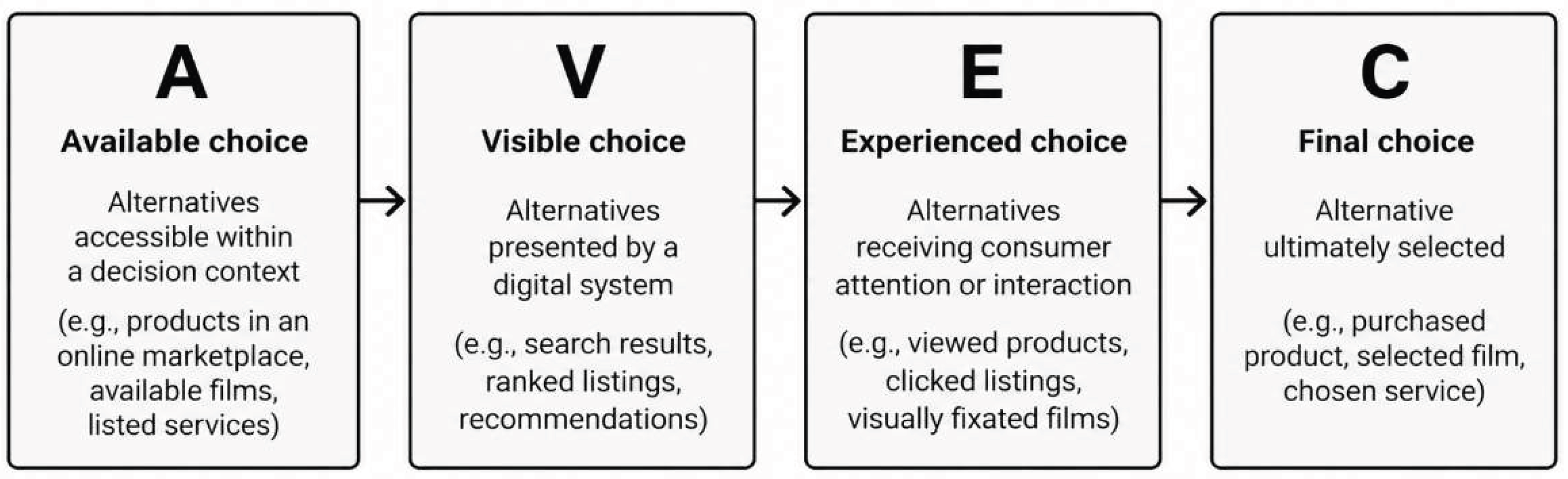
Available choice (A) refers to alternatives accessible within a particular decision context. Visible choice (V) consists of alternatives presented through search results, rankings, recommendations, or other interface mechanisms. Experienced choice (E) includes alternatives receiving recorded consumer attention or interaction. Final choice (C) refers to the alternative ultimately selected.
For a consumer or session i, the conceptual relationship between the four stages is expressed as:
Ci ⊆ Ei ⊆ Vi ⊆ Ai
The relationship represents a simplified sequence rather than a fixed pattern of consumer behavior. Consumers may revise searches, change filters, return to previously examined products, or move between platforms. What matters is that an alternative can remain available without being presented, be presented without receiving attention, or receive attention without being selected.
The empirical analysis draws on three behavioral datasets: Coveo, FINN.no, and RecGaze. They capture different parts of this process and are analyzed separately.
Coveo contains e-commerce search results and subsequent clicks, allowing us to examine the proportion of returned alternatives receiving recorded interaction. FINN.no provides ranked search and recommendation lists with interaction records, allowing us to examine the distribution of clicks across ranking positions. RecGaze contains eye-tracking observations from an experimental film-selection environment, where the initial assortment, visual attention, and final selection can be identified.
The unit of analysis differs across the datasets: individual searches in Coveo, recorded marketplace interactions in FINN.no, and experimental sessions in RecGaze. Their choice-set sizes and behavioral measures are not pooled. Instead, each dataset provides evidence about a different observable part of the proposed framework.
Two properties are examined: the proportion of alternatives receiving attention or interaction and the concentration of that activity across ranked positions. The corresponding measures are defined in the following sections.
Neither property directly measures consumer autonomy. A narrow pattern of interaction may reflect a deliberate preference, efficient search, or the organization of alternatives by a digital system. The analysis therefore examines the difference between available or presented choice and recorded consumer behavior without attributing that difference to algorithmic influence alone.
3.2. Data Sources
Three behavioral datasets were used: Coveo, FINN.no, and RecGaze. They cover e-commerce search, online classifieds, and experimental film selection. The datasets were selected because they capture different observable stages of the A–V–E–C framework rather than a complete consumer decision process.
Coveo contains anonymized e-commerce search records, including returned product lists, clicks, product-detail interactions, cart actions, and purchases [29]. The present analysis includes 602,754 searches with at least one returned product. Returned product identifiers (product_skus_hash) represent the system-generated choice set, while matching clicked products (clicked_skus_hash) provide a behavioral measure of interaction. The full assortment available to each consumer cannot be reconstructed, and returned results do not necessarily indicate actual screen exposure.
FINN.no contains search and recommendation interactions from a Norwegian online marketplace [30]. The analyzed dataset includes 37,426,847 interactions involving 2,277,645 users. Product lists and recorded click positions allow engagement to be examined across ranked alternatives and compared between search and recommendation settings. The publicly released data retain only 10% of the original no-click observations. Consequently, overall click-through rates cannot be interpreted as representative of the platform's natural traffic.
RecGaze contains eye-tracking and interaction records from a film recommendation experiment involving 87 participants [31]. Subsequent research has examined browsing behavior and visual attention in carousel recommendation interfaces using eye-tracking data [32]. The present analysis covers 3,476 sessions across free-browsing, semi-free, and direct-search tasks.
Each task presents an experimental choice set of 150 films arranged in ten carousels. Eye fixations identify alternatives receiving visual attention, while recorded selections identify the final choice. The public data do not provide a complete independent record of viewport exposure. The analysis therefore examines the relationship between the experimental set of 150 films, recorded visual attention, and final film selection, without assigning a separate measure to V.

Table 1.
Data sources and observable stages of the A-V-E-C framework.
| Dataset | A - Available | V - Visible | E - Experienced | C - Final |
|---|---|---|---|---|
| Coveo | Not observed | Returned search results | Matched product clicks | Not analyzed (purchase events available)1 |
| FINN.no | Not observed | Search and recommendation lists | Recorded clicks | Not separately observed |
| RecGaze | 150 films per task | Not independently observed | Eye fixation | Selected film |
Note: A = available choice; V = visible choice; E = experienced choice; C = final choice. Returned search results and ranked lists represent alternatives presented by a system, not verified screen exposure. ¹ Coveo includes purchase events, but these are not linked to the analyzed search-to-click transitions.
The datasets are analyzed separately. Their results are compared in terms of choice-set retention and the concentration of engagement across ranked positions, without treating clicks, eye fixations, and experimental selections as identical behavioral measures.
3.3. Operationalization and Measures
The three datasets require different definitions of observed choice. In Coveo, the unit of analysis is an individual search. Returned products (product_skus_hash) form the presented set (V), while distinct products subsequently clicked within that set (clicked_skus_hash) represent experienced choice (E). Each product is counted once per search, regardless of repeated clicks. Searches without returned products are excluded, while searches with no matched clicks receive a Choice Retention Rate (CRR) of zero.
For two observed stages X and Y within the same decision context, where Y is a subset of X, the Choice Retention Rate is calculated as:
The Choice Reduction Rate (CRD) is the complement of retention:
CRDi,X→Y = 100%−CRRi,X→Y
Both measures are expressed as percentages and calculated only for non-empty initial sets. They describe the proportion of distinct alternatives retained or excluded between two observable stages. Where an intermediate stage cannot be identified, the analysis uses the directly observed transition without assigning values to missing stages.
RecGaze provides a more direct measure of attention. Available choice (A) consists of the 150 films assigned to each experimental task. Experienced choice (E) includes distinct films receiving at least one eye fixation within their defined area of interest. Final choice (C) is the film selected by the participant. Because complete viewport exposure is not independently observed, retention is calculated from A to E rather than through V. Final selections are examined separately and are not assumed to have received a recorded fixation.
FINN.no is used to examine the concentration of interaction across ranked alternatives. Clicks are grouped by their positions within search and recommendation lists. Cumulative shares are calculated for the first one, three, five, and ten positions. These figures describe where recorded clicks occur, not the probability that a presented item receives a click. The incomplete representation of sessions without clicks prevents reliable estimation of overall platform click-through rates.
Retention and ranking concentration measure different properties of consumer behavior. Retention concerns the proportion of distinct alternatives receiving recorded attention or interaction. Ranking concentration concerns the distribution of recorded actions across positions. A narrow experienced choice set does not necessarily imply strong positional concentration, and neither measure directly establishes a loss of consumer autonomy.
Results are summarized using means, medians, and interquartile ranges where applicable. The datasets are analyzed separately. No common engagement rate is calculated across clicks, eye fixations, and final selections.
These measures describe what is observed, not why it occurs. An alternative may receive no interaction because it was irrelevant, difficult to find, or never noticed. The available data do not distinguish these explanations or identify the causal effect of ranking algorithms.
3.4. Analytical Procedure and Robustness Checks
Each dataset was processed and analyzed separately, using the behavioral measures available in its original records.
For Coveo, returned product lists were matched to subsequent clicks within individual searches. Only clicks referring to products in the corresponding result set were retained. Of the recorded clicked product identifiers, 9.16% could not be matched and were excluded from the retention and ranking calculations. Mean retention was calculated across searches, including searches with no matched clicks. Statistical uncertainty was assessed using a session-cluster bootstrap.
For RecGaze, eye fixations were matched to predefined film areas of interest within each experimental session. The primary analysis counted distinct films receiving at least one fixation inside their defined boundaries. A sensitivity check extended these boundaries by 60 pixels to examine whether small differences in gaze positioning affected the results. Retention was calculated for the full sample and separately for free-browsing, semi-free, and direct-search tasks. Final film selections were checked against recorded fixations rather than assumed to have received prior visual attention.
For FINN.no, interactions with valid position records were grouped by search and recommendation context. The cumulative share of recorded clicks was calculated for the first result and the first three, five, and ten positions. These calculations describe the distribution of clicks within ranked lists. They do not estimate the probability of clicking a displayed product. No attempt was made to reconstruct the no-click observations excluded from the publicly released dataset.
The analysis does not combine the datasets into a single statistical model. Clicks, eye fixations, and experimental selections represent different behaviors, and the available records do not support identical measures across all three environments. Comparisons are therefore restricted to patterns of choice retention and positional concentration.
The results are interpreted as descriptive evidence. Ranking position may be associated with product relevance, popularity, consumer preferences, or interface design. The analysis cannot isolate these influences or establish that algorithmic ranking caused the observed concentration of attention or interaction.
4. Results
The analysis begins with Coveo search data, followed by the RecGaze eye-tracking experiment and FINN.no marketplace interactions. Results are reported separately because the datasets record different forms of consumer behavior.
4.1. Choice Retention in E-Commerce Search: Coveo
The Coveo sample contains 602,754 searches with at least one returned product. The median result set comprised 25 products (IQR: 9–25). A matched product click was recorded in 27.95% of searches. The median number of distinct clicked products per search was zero.
The mean Choice Retention Rate (CRR) was 5.88% (95% session-cluster bootstrap CI: 5.81–5.95%), leaving a Choice Reduction Rate (CRD) of 94.12%. On average, fewer than six out of every hundred returned products received a recorded click.
Figure 2.
Choice retention and reduction in Coveo e-commerce search results. Data source: Coveo SIGIR 2021 E-Commerce Data Challenge; 602,754 searches with non-empty result sets. Values represent mean search-level retention of distinct clicked products matched to returned results (CRR = 5.88%; 95% session-cluster bootstrap CI: 5.81–5.95%). CRD = 100% − CRR.

The distribution of clicks was uneven. The first-ranked product accounted for 21.87% of matched clicks, and the first three positions accounted for 43.97%. The cumulative share rose to 56.64% at position five and 75.88% at position ten.
This concentration is particularly visible in the upper positions of the ranking. Although users could continue exploring the list, most recorded clicks occurred within its first ten positions. Figure 3 illustrates how quickly the cumulative share of clicks increases across the ranking.
Figure 3. Cumulative share of matched product clicks across ranked Coveo search results. Data source: Coveo SIGIR 2021 E-Commerce Data Challenge; authors' analysis. Shares are calculated from recorded matched clicks at positions 1, 1–3, 1–5, and 1–10.
Position-specific click-through rates declined from 8.46% at the first position to 3.82% at the third, 2.58% at the fifth, and 1.60% at the tenth. At position 25, the rate was 0.68%.
A further 9.16% of recorded clicked product identifiers could not be matched to the corresponding returned results and were excluded from the calculations.
4.2. Visual Attention and Final Selection: RecGaze
The RecGaze dataset covers 3,476 experimental sessions involving 87 participants. Each task included 150 films arranged in ten carousels. Eye-tracking records were used to identify films receiving visual attention before selection.
Participants fixated on a mean of 39.96 distinct films per session, or 26.64% of the available set. The median was 31 films. The corresponding Choice Reduction Rate (CRD) was 73.36%. Extending the fixation boundaries by 60 pixels increased the mean to 41.05 films.
Figure 4.
Available and visually attended alternatives in the RecGaze experiment. Data source: RecGaze eye-tracking and interaction dataset; 3,476 experimental sessions. Available choice comprises 150 films per task. Experienced choice is measured by the mean number of distinct films receiving at least one fixation (39.96).
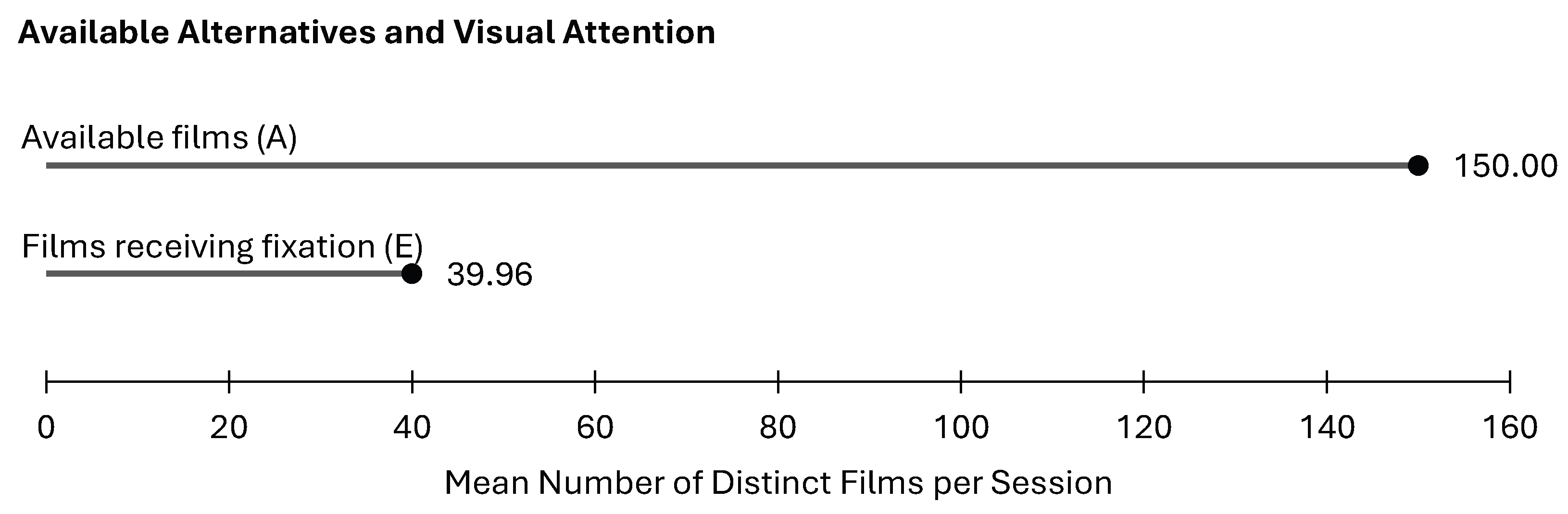
Visual attention varied considerably across tasks. Free browsing produced a mean of 47.94 fixated films (31.96% of the available set). The corresponding figures were 19.13 films (12.75%) for semi-free tasks and 12.99 films (8.66%) for direct search. Participants therefore examined substantially more alternatives when browsing without a predefined target.
Figure 5.
Share of available films receiving visual attention by experimental task. Data source: RecGaze eye-tracking dataset; free browsing (2,606 sessions), semi-free tasks (435 sessions), and direct search (435 sessions). Percentages represent the mean number of distinct fixated films divided by the 150 films available per task.
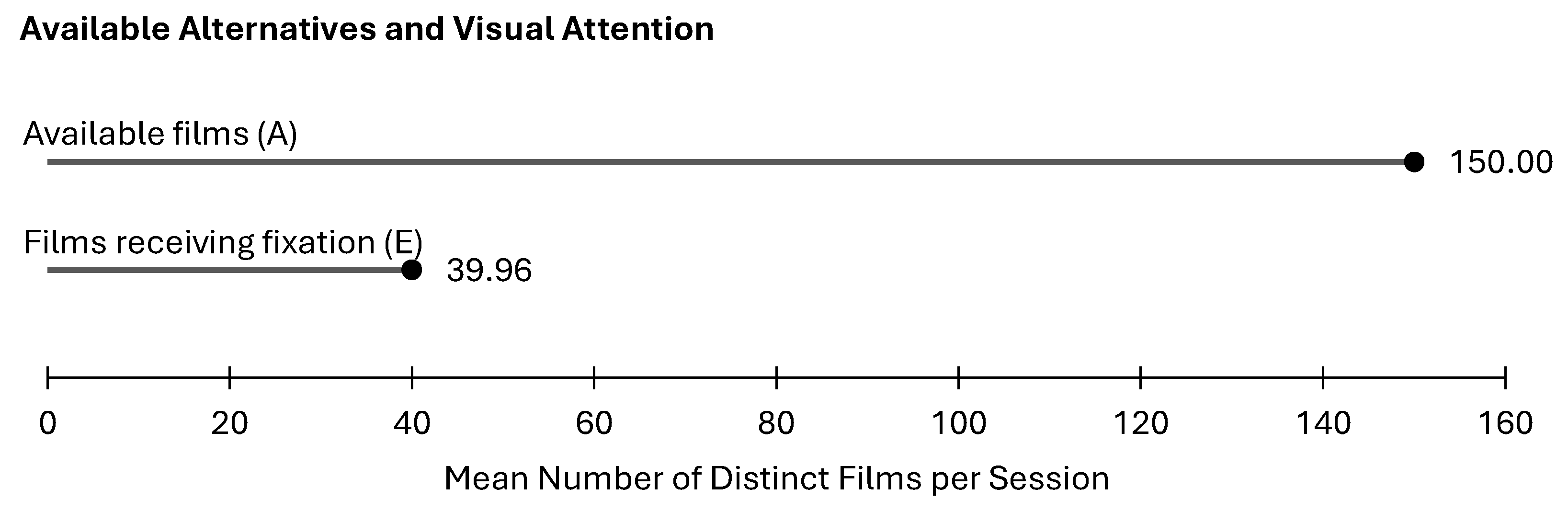
A final film selection was recorded in 3,239 sessions (93.18%). Of these selections, 98.02% involved a film that had received a recorded fixation. The remaining selections had no matching fixation record.
Selections were also concentrated toward the beginning of the carousels. In free-browsing tasks, 22.82% of selected films occupied the first horizontal position, while 51.15% appeared within the first three positions. The cumulative share reached 74.26% within the first five positions and 90.42% within the first ten.
The breadth of visual exploration differed sharply between tasks, even though the number of available films remained constant.
4.3. Choice Concentration in Online Marketplaces: Evidence from FINN.no
The FINN.no dataset contains 37,426,847 interactions involving 2,277,645 users. The mean number of items in a recorded slate was 10.14, with a median of seven.
Clicks were concentrated near the beginning of ranked lists. The first position accounted for 17.14% of recorded clicks, and the first three positions for 44.95%. The cumulative share reached 62.84% at position five and 83.19% at position ten.
The concentration was stronger in search results than in recommendation lists. The first search position accounted for 18.80% of clicks, compared with 12.30% in recommendations. For the first three positions, the corresponding shares were 48.81% and 33.66%. At position five, they reached 67.32% and 49.72%, respectively. By position ten, the cumulative shares were 86.68% for search results and 72.95% for recommendations.
Figure 6.
Cumulative share of clicks by ranking position in FINN.no search results and recommendation lists. Data source: FINN.no interaction dataset; authors' analysis. Values represent the cumulative share of recorded clicks within the first 3, 5, and 10 positions in search results and recommendation lists.
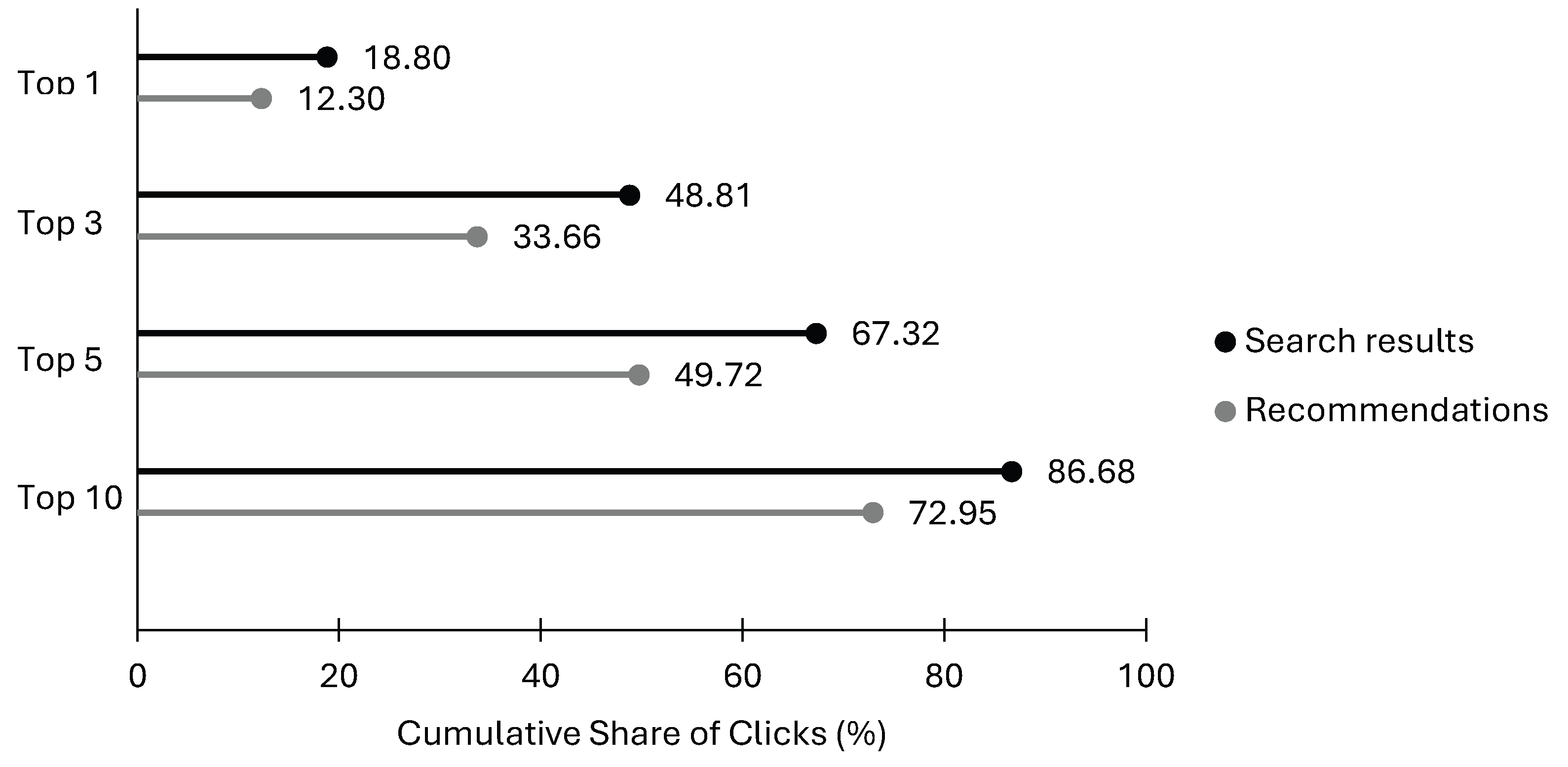
The difference between search and recommendations is visible throughout the first ten positions. Search interactions were more heavily concentrated at the top of the ranking, while clicks in recommendation lists were distributed across a wider range of positions.
These figures refer to recorded clicks rather than completed transactions. The public dataset also retains only 10% of the original no-click observations, so the results cannot be used to estimate representative platform-wide click-through rates.
4.4. Cross-Dataset Synthesis: From Available Alternatives to Observed Choice
In Coveo, an average of 5.88% of returned products received a matched click per search. RecGaze participants fixated on 26.64% of the 150 available films per session. In FINN.no, 44.95% of recorded clicks occurred within the first three ranking positions. The three datasets capture different behaviors, but each shows that consumer activity is concentrated within a limited part of the alternatives presented or made available.
The RecGaze experiment offers a particularly useful comparison. Participants had the same 150 films available in every task, yet the mean number receiving visual attention ranged from 47.94 during free browsing to 19.13 in semi-free tasks and 12.99 in direct search. The available set remained unchanged. The extent of visual exploration did not.
Coveo and FINN.no also show similar concentrations at the top of search rankings. The first three positions accounted for 43.97% of matched clicks in Coveo and 48.81% of search-result clicks in FINN.no. Within FINN.no, the corresponding share was lower for recommendations (33.66%). Ranking concentration therefore varied across choice environments, including within the same platform.
The measures are not interchangeable. Coveo records clicks on returned products, RecGaze records eye fixations and film selections, and FINN.no records clicks by ranking position. None directly measures consumer autonomy or isolates the effect of algorithmic ranking.
A large choice set and a broad process of choosing are not the same thing.
5. Discussion
5.1. More Choice, Less Autonomy?
Digital markets have made choice almost unlimited. At least on paper. Consumers can search through thousands of products, compare prices across countries, and find alternatives that would once have been beyond their reach. Yet having access to more does not necessarily mean choosing from more.
The three datasets tell different parts of the same story. In Coveo, most returned products received no click. In RecGaze, the same 150 films produced very different patterns of visual attention depending on the task. In FINN.no, clicks clustered near the top of ranked lists, particularly in search results.
But is this really a loss of autonomy?
Not necessarily. A consumer looking for a particular product may find a suitable option immediately. Continuing to search would add little value. Ignoring hundreds of alternatives can be perfectly rational. The problem is not that consumers consider fewer products than the market offers. They always have.
The more interesting question is who determines which alternatives deserve consideration.
This is where two forms of autonomy need to be separated. Decision autonomy concerns the freedom to choose among alternatives already encountered. Choice-set autonomy concerns something earlier: the ability to understand, influence, or change the process through which those alternatives enter the consumer's field of choice.
A consumer may freely select one of ten recommended products without knowing why those ten were presented. Another may use filters to narrow thousands of products to ten. The final number is identical. The consumer's role in producing that number is not.
Algorithms can reduce search costs, introduce unfamiliar products, and make large markets easier to navigate. Their implications for autonomy depend partly on the control consumers retain over the process. Can they change the criteria, reject personalization, or search beyond the initial recommendations?
The datasets do not measure consumer control directly. They show why the number of available alternatives is an incomplete description of the choice process.
5.2. The Role of Rankings and Algorithms
A product can be available and still have almost no chance of being noticed. In a digital market, its position may matter nearly as much as its existence.
Rankings make large markets manageable. Without them, consumers would have to search through hundreds or thousands of alternatives with little guidance. Algorithms reduce that work. They can also introduce products that consumers would never have discovered on their own.
But there is a price to this convenience. Someone, or something, decides what comes first.
In Coveo, almost 44% of matched clicks occurred within the first three search positions. FINN.no shows a similar pattern, with nearly 49% of search-result clicks concentrated in those positions. These figures do not prove that ranking caused the clicks. The first results may simply have been more relevant. Consumers may also have stopped searching once they found something suitable.
The comparison between search and recommendations is particularly revealing. In FINN.no, the first three positions accounted for 48.81% of search-result clicks, compared with 33.66% in recommendation lists. If recommendation algorithms necessarily restricted exploration, we might expect the opposite. Instead, the more concentrated behavior appeared in search.
Consumer intent may explain part of this difference. People searching for a particular product have less reason to explore than those browsing recommendations. The data cannot confirm this explanation. They do, however, make it difficult to equate concentrated clicks with restricted choice.
Nor is algorithmic selection entirely new. Supermarkets have always decided which products occupy eye-level shelves. Retailers choose what to display in their windows. Advertising directs attention toward some products and away from others. Digital platforms continue this practice, but with a different capacity for personalization and continuous adjustment.
A ranking can change from one consumer to another. It can respond to previous searches, clicks, purchases, or inferred preferences. The consumer sees the result, not necessarily the decisions behind it.
The consumer may reject the first recommendation without knowing what was excluded. The ability to modify ranking criteria or explore beyond the initial selection becomes part of the autonomy question.
The distinction is not between choosing with algorithms and choosing without them. It is between using algorithms as instruments of choice and allowing them to define the boundaries of choice without meaningful consumer involvement.
The consumer still makes the final selection. The market encountered before that selection may already have been substantially organized by someone else.
5.3. Sustainable Consumption and the Visibility of Choice
Consumers are increasingly expected to consider environmental consequences when making purchases. This expectation rests on a less frequently examined assumption: that sustainable alternatives have a reasonable opportunity to enter the decision.
What happens when they do not?
Consider two products with similar functions but different environmental impacts. One is more durable, easier to repair, or less resource-intensive. Both are available in the same digital marketplace. Yet only one appears among the first recommendations, while the other remains somewhere in the catalogue. If the consumer purchases the first product, can we conclude that sustainability was not important to them?
Not necessarily. The alternative may never have entered the decision.
This is the difference between product availability and meaningful choice. Research on sustainable consumption has examined the gap between favorable attitudes and purchasing behavior, including in the context of recycled and upcycled fashion products [33]. Such studies help explain why environmental concern does not always translate into purchasing decisions. The A–V–E–C framework addresses an earlier stage: before consumers can prefer or reject a sustainable alternative, they must have an opportunity to encounter it.
The A–V–E–C framework places this earlier stage within the analysis. A sustainable product may exist in the available assortment (A) without appearing in the presented results (V). It may be presented without receiving attention or interaction (E). Only then does the question of final selection (C) arise.
There is no reason to assume that algorithms necessarily make sustainable choices less visible. A recommendation system might introduce consumers to environmentally preferable products they would never have found independently. It might also favor familiar brands, popular products, or alternatives with a higher predicted probability of purchase. Much depends on what the system is designed to prioritize.
For platforms, the implication extends beyond product availability. Sustainable alternatives must also have a realistic opportunity to appear in the consumer's choice environment.
A sustainability label tells consumers something about a product. It does not explain why that product was shown while another was not. Product information and the organization of visibility are different parts of the same decision environment.
The analysis does not identify sustainable products or measure environmental outcomes. Whether the platforms favored or disadvantaged sustainable alternatives therefore remains unknown.
What it does show is how much attention and interaction can be concentrated within a limited part of a larger choice environment. The implications for sustainable consumption are therefore conceptual, not a direct empirical finding.
The distinction matters when responsibility is assigned. Buying a less sustainable product after considering a credible sustainable alternative is one decision. Buying it without encountering that alternative is another.
The transaction may look identical. The opportunity to choose was not.
Consumer responsibility remains important. But responsibility for sustainable consumption cannot be understood entirely from the final choice when the route to that choice is largely invisible.
The question is not only what consumers choose. It is also what they have a meaningful chance to choose from.
5.4. Theoretical Implications
Consumer choice is usually observed at the point where something happens. A product is clicked, added to a cart, purchased, or rejected. These actions generate data, and the data become evidence of consumer preferences.
But a recorded choice is only the end of a process. It tells us much less about the alternatives that never entered it.
The first contribution of this study is to separate four stages that are easily confused: available choice (A), visible choice (V), experienced choice (E), and final choice (C). The A–V–E–C framework does not propose that consumers should examine every available alternative. Nor does it assume that movement from one stage to another represents a loss of freedom. Its purpose is more specific: to make the reduction of choice observable rather than treating it as an unimportant step before the decision.
Two platforms may offer the same number of products and still give consumers very different choices. Even on a single platform, what appears depends on the query, previous behavior, and ranking criteria. Market size tells us how much is available. It tells us much less about what consumers actually get to consider.
The second contribution concerns autonomy. Research on constructed preferences shows that the composition of the choice set can influence the decision itself [4,21]. Algorithmic assistance can make complex choices easier, but the freedom to select an alternative and the ability to influence which alternatives are considered are different dimensions of consumer control.
Decision autonomy concerns the freedom to evaluate and select among alternatives already encountered. Choice-set autonomy concerns the ability to understand, influence, or revise how those alternatives were selected for consideration.
A consumer may have considerable freedom at the moment of purchase and little influence over the construction of the preceding choice set. The opposite is also possible: a consumer may deliberately narrow a large assortment through filters and search criteria, then choose from only a few products. The final choice set may be small in both cases. What differs is the consumer's involvement in producing it.
This distinction also changes the interpretation of algorithmic personalization. A recommendation system necessarily selects from a larger assortment. Compared with the entire catalogue, it reduces the number of alternatives presented. Compared with what the consumer might have discovered without assistance, it may expand the range of relevant options. Both can be true.
The missing comparison is what the consumer would otherwise have encountered.
The empirical findings do not resolve this counterfactual. They establish patterns of attention and interaction, not whether consumers would have made different decisions under another ranking or recommendation system. Nor do they measure autonomy directly. The framework identifies what future studies would need to observe before making those claims.
This opens a further question about choice diversity. A system may present twenty products that are nearly identical in price, brand, or characteristics. Another may present five that differ substantially. Counting alternatives would favor the first system. Whether it offers a broader choice is less obvious.
Future research should therefore examine not only how many alternatives remain between A, V, E, and C, but also which alternatives remain. Their diversity, relevance, and correspondence with consumer-defined preferences may matter more than the size of the set alone.
The central theoretical point is that consumer choice begins before the consumer makes a selection. In digital markets, part of the economic process of choosing takes place in the construction of the alternatives from which the final decision is made.
5.5. Limitations and Future Research
The main limitation of this study is also a reason for introducing the A–V–E–C framework: the available data reveal only parts of the choice process.
None of the three datasets captures the full sequence from market availability to final purchase. Coveo records returned search results and matched product clicks, but not verified visual exposure. RecGaze records eye fixations and film selections within a controlled assortment, without independently establishing which films were visible on screen at each moment. FINN.no provides ranked interactions but no complete record of the available marketplace or final transactions.
The measures are therefore different. A click is not an eye fixation, and neither necessarily means that an alternative was seriously considered. A film selected during an experiment is not equivalent to a purchase. The datasets can illustrate different stages of choice, but they cannot be combined into a single estimate of how much consumer choice survives from availability to final selection.
There are also limits within the individual datasets. In Coveo, 9.16% of clicked product identifiers could not be matched to the corresponding returned results and were excluded from the calculations. In RecGaze, the number of films classified as fixated depends partly on the boundaries used to match gaze coordinates to film areas, although the sensitivity check produced only a modest change in the mean. The public FINN.no dataset retains only 10% of no-click observations, preventing representative estimates of overall click-through rates.
A further limitation concerns causality. Products near the top of a ranking may receive more clicks because of their position, their relevance, their popularity, or some combination of these factors. Our analysis cannot separate these explanations. The differences between search and recommendation contexts are descriptive, not evidence that one type of algorithm gives consumers greater autonomy than another.
Consumer autonomy was not measured directly. The datasets provide no evidence of consumers' understanding of ranking criteria, their ability to modify those criteria, or their satisfaction with the alternatives encountered.
The distinction between decision autonomy and choice-set autonomy is therefore a theoretical proposition supported by the observed structure of choice, not a directly tested psychological measure.
None of the datasets identifies environmentally preferable alternatives or measures environmental performance. Whether sustainable products were promoted, overlooked, or excluded from consideration remains an open empirical question.
The next step is to observe more of the process within the same decision. An experiment could vary ranking criteria while keeping the available assortment constant, then record which products appear on screen, which receive attention, and which are selected. Consumers could also be given different levels of control over filtering and personalization. This would make it possible to examine whether changing the construction of the choice set changes the decision itself.
For sustainable consumption, such experiments could include products with independently established differences in durability, repairability, or environmental impact. The relevant comparison would not be limited to final purchases. It would also ask whether sustainable alternatives reached the consumer, received attention, and remained under consideration.
A second direction concerns time. Previous clicks can influence future recommendations, while those recommendations can influence subsequent clicks. Repeated interaction may reinforce existing preferences or introduce new ones. Longitudinal data would help distinguish these possibilities.
The present study identifies where choice narrows. Future research needs to establish who controls that narrowing, how easily consumers can change it, and what difference it makes to their decisions.
6. Conclusions
Digital markets have expanded the number of alternatives consumers can access. They have also made selection an increasingly important part of how those markets work.
Across the three datasets, recorded attention and interaction are concentrated within a limited part of the available or presented alternatives. This concentration does not establish a loss of autonomy, but it reveals why the final decision alone provides an incomplete picture of consumer choice.
The distinction between decision autonomy and choice-set autonomy shifts attention to an earlier question: who influences what consumers have the opportunity to consider?
For sustainable consumption, this matters. Consumers cannot be expected to choose alternatives they never meaningfully encounter.
More choice in the market is not necessarily more choice for the consumer.
Author Contributions
Conceptualization, I.J.; methodology, I.J. and E.G.; formal analysis, E.G.; data curation, E.G.; visualization, E.G.; writing - original draft preparation, I.J.; writing - review and editing, I.J. and E.G. All authors have read and agreed to the published version of the manuscript.
Funding
This research received no external funding.
Institutional Review Board Statement
Not applicable.
Informed Consent Statement
Not applicable.
Data Availability Statement
This study is based on the secondary analysis of three previously released datasets: Coveo, FINN.no, and RecGaze. No new primary data were collected. The datasets and their access instructions are available through the following repositories: Coveo (https://github.com/coveooss/SIGIR-ecom-data-challenge/blob/main/README.md), FINN.no (https://opensource.finntech.no/recsys_slates_dataset/), and RecGaze (https://github.com/santideleon/RecGaze_Dataset/blob/main/README.md). Access to and reuse of the datasets are subject to the conditions specified by their respective providers.
Conflicts of Interest
The authors declare no conflicts of interest.
Declaration of Generative AI and AI-Assisted Technologies in the Writing Process
During the preparation of this manuscript, the authors used ChatGPT (OpenAI) to assist with manuscript structuring, drafting, and language editing. The authors reviewed and revised the AI-assisted content, verified the references and scientific arguments, and take full responsibility for the final manuscript, including its analysis, findings, and conclusions.
Abbreviations
The following abbreviations are used in this manuscript:
| Abbreviation | Full term |
| A | Available choice |
| V | Visible choice |
| E | Experienced choice |
| C | Final choice |
| CRR | Choice Retention Rate |
| CRD | Choice Reduction Rate |
References
- Iyengar, S.S.; Lepper, M.R. When Choice Is Demotivating: Can One Desire Too Much of a Good Thing? J. Pers. Soc. Psychol. 2000, 79, 995–1006. [Google Scholar] [CrossRef]
- Chernev, A.; Böckenholt, U.; Goodman, J. Choice Overload: A Conceptual Review and Meta-Analysis. J. Consum. Psychol. 2015, 25, 333–358. [Google Scholar] [CrossRef]
- Kahn, B.E.; Wansink, B. The Influence of Assortment Structure on Perceived Variety and Consumption Quantities. J. Consum. Res. 2004, 30, 519–533. [Google Scholar] [CrossRef]
- Bettman, J.R.; Luce, M.F.; Payne, J.W. Constructive Consumer Choice Processes. J. Consum. Res. 1998, 25, 187–217. [Google Scholar] [CrossRef]
- Lee, D.; Hosanagar, K. How Do Recommender Systems Affect Sales Diversity? A Cross-Category Investigation via Randomized Field Experiment. Inf. Syst. Res. 2019, 30, 239–259. [Google Scholar] [CrossRef]
- Bollen, D.; Knijnenburg, B.P.; Willemsen, M.C.; Graus, M. Understanding Choice Overload in Recommender Systems. In Proceedings of the Fourth ACM Conference on Recommender Systems, Barcelona, Spain, 26–30 September 2010; pp. 63–70. [Google Scholar] [CrossRef]
- Adomavicius, G.; Tuzhilin, A. Toward the Next Generation of Recommender Systems: A Survey of the State-of-the-Art and Possible Extensions. IEEE Trans. Knowl. Data Eng. 2005, 17, 734–749. [Google Scholar] [CrossRef]
- Joachims, T.; Granka, L.; Pan, B.; Hembrooke, H.; Gay, G. Accurately Interpreting Clickthrough Data as Implicit Feedback. In Proceedings of the 28th Annual International ACM SIGIR Conference on Research and Development in Information Retrieval, Salvador, Brazil, 15–19 August 2005; pp. 154–161. [Google Scholar] [CrossRef]
- Singh, A.; Joachims, T. Fairness of Exposure in Rankings. In Proceedings of the 24th ACM SIGKDD International Conference on Knowledge Discovery & Data Mining, London, UK, 19–23 August 2018; pp. 2219–2228. [Google Scholar] [CrossRef]
- André, Q.; Carmon, Z.; Wertenbroch, K.; Crum, A.; Frank, D.; Goldstein, W.; Huber, J.; van Boven, L.; Weber, B.; Yang, H. Consumer Choice and Autonomy in the Age of Artificial Intelligence and Big Data. Cust. Needs Solut. 2018, 5, 28–37. [Google Scholar] [CrossRef]
- Bakshy, E.; Messing, S.; Adamic, L.A. Exposure to Ideologically Diverse News and Opinion on Facebook. Science 2015, 348, 1130–1132. [Google Scholar] [CrossRef]
- Mitra, B.; Ma, C.; Diaz, F.; Wu, H.; Liu, X. Joint Multisided Exposure Fairness for Recommendation. In Proceedings of the 45th International ACM SIGIR Conference on Research and Development in Information Retrieval, Madrid, Spain, 11–15 July 2022. [Google Scholar] [CrossRef]
- Grunert, K.G.; Hieke, S.; Wills, J. Sustainability Labels on Food Products: Consumer Motivation, Understanding and Use. Food Policy 2014, 44, 177–189. [Google Scholar] [CrossRef]
- Lee, J.A.; Holden, S.J.S. Understanding the Determinants of Environmentally Conscious Behavior. Psychol. Mark. 1999, 16, 373–392. [Google Scholar] [CrossRef]
- Jing, S. Green Nudging in Platform-Mediated Sustainable Consumption: Ethical Boundaries and Governance Requirements. Sustainability 2026, 18, 8721. [Google Scholar] [CrossRef]
- Khalufi, N.A.M. Digital Nudges and Environmental Concern in Shaping Sustainable Consumer Behavior Aligned with SDGs 12 and 13. Sustainability 2025, 17, 11292. [Google Scholar] [CrossRef]
- Simon, H.A. A Behavioral Model of Rational Choice. Q. J. Econ. 1955, 69, 99–118. [Google Scholar] [CrossRef]
- Schwartz, B. The Paradox of Choice: Why More Is Less; Ecco: New York, NY, USA, 2004. [Google Scholar]
- Scheibehenne, B.; Greifeneder, R.; Todd, P.M. Can There Ever Be Too Many Options? A Meta-Analytic Review of Choice Overload. J. Consum. Res. 2010, 37, 409–425. [Google Scholar] [CrossRef]
- Häubl, G.; Trifts, V. Consumer Decision Making in Online Shopping Environments: The Effects of Interactive Decision Aids. Mark. Sci. 2000, 19, 4–21. [Google Scholar] [CrossRef]
- Simonson, I. Choice Based on Reasons: The Case of Attraction and Compromise Effects. J. Consum. Res. 1989, 16, 158–174. [Google Scholar] [CrossRef]
- Craswell, N.; Zoeter, O.; Taylor, M.; Ramsey, B. An Experimental Comparison of Click Position-Bias Models. In Proceedings of the International Conference on Web Search and Web Data Mining, Palo Alto, CA, USA, 11–12 February 2008; pp. 87–94. [Google Scholar] [CrossRef]
- Beutel, A.; Chen, J.; Doshi, T.; Qian, H.; Wei, L.; Wu, Y.; Heldt, L.; Zhao, Z.; Hong, L.; Chi, E.H.; Goodrow, C. Fairness in Recommendation Ranking through Pairwise Comparisons. In Proceedings of the 25th ACM SIGKDD International Conference on Knowledge Discovery & Data Mining, Anchorage, AK, USA, 4–8 August 2019; pp. 2212–2220. [Google Scholar] [CrossRef]
- Hannak, A.; Sapiezynski, P.; Molavi Kakhki, A.; Krishnamurthy, B.; Lazer, D.; Mislove, A.; Wilson, C. Measuring Personalization of Web Search. In Proceedings of the 22nd International Conference on World Wide Web, Rio de Janeiro, Brazil, 13–17 May 2013; pp. 527–538. [Google Scholar] [CrossRef]
- Levina, O.; Revina, A.; Lindauer, F. Influenced by Design—How Design Cues Can Shape Sustainable Design and Evaluation Choices. Sustainability 2026, 18, 7256. [Google Scholar] [CrossRef]
- Yeung, K. 'Hypernudge': Big Data as a Mode of Regulation by Design. Inf. Commun. Soc. 2017, 20, 118–136. [Google Scholar] [CrossRef]
- Burr, C.; Cristianini, N.; Ladyman, J. An Analysis of the Interaction Between Intelligent Software Agents and Human Users. Minds Mach. 2018, 28, 735–774. [Google Scholar] [CrossRef]
- Mittelstadt, B.D.; Allo, P.; Taddeo, M.; Wachter, S.; Floridi, L. The Ethics of Algorithms: Mapping the Debate. Big Data Soc. 2016, 3, 1–21. [Google Scholar] [CrossRef]
- Tagliabue, J.; Greco, C.; Roy, J.-F.; Yu, B.; Chia, P.J.; Bianchi, F.; Cassani, G. SIGIR 2021 E-Commerce Workshop Data Challenge. In Proceedings of the SIGIR eCom 2021 Workshop, Virtual Event, 15 July 2021; Available online: https://arxiv.org/abs/2104.09423 (accessed on 15 October 2026).
- Eide, S.; Frigessi, A.; Jenssen, H.; Leslie, D.S.; Rishaug, J.; Verrewaere, S. FINN.no Slates Dataset: A New Sequential Dataset Logging Interactions, All Viewed Items and Click Responses/No-Click for Recommender Systems Research. arXiv 2021, arXiv:2111.03340. [Google Scholar] [CrossRef]
- de Leon-Martinez, S.; Kang, J.; Moro, R.; de Rijke, M.; Kveton, B.; Oosterhuis, H.; Bielikova, M. RecGaze: The First Eye Tracking and User Interaction Dataset for Carousel Interfaces. In Proceedings of the 48th International ACM SIGIR Conference on Research and Development in Information Retrieval, Padua, Italy, 13–18 July 2025; pp. 3702–3711. [Google Scholar] [CrossRef]
- de Leon-Martinez, S.; Moro, R.; Kveton, B.; Bielikova, M. Riding the Carousel: The First Extensive Eye Tracking Analysis of Browsing Behavior in Carousel Recommenders. In Proceedings of the 31st International Conference on Intelligent User Interfaces, 2026; pp. 2120–2130. [Google Scholar] [CrossRef]
- Park, H.J.; Lin, L.M. Exploring Attitude–Behavior Gap in Sustainable Consumption: Comparison of Recycled and Upcycled Fashion Products. J. Bus. Res. 2020, 117, 623–628. [Google Scholar] [CrossRef]
Disclaimer/Publisher’s Note: The statements, opinions and data contained in all publications are solely those of the individual author(s) and contributor(s) and not of MDPI and/or the editor(s). MDPI and/or the editor(s) disclaim responsibility for any injury to people or property resulting from any ideas, methods, instructions or products referred to in the content. |
© 2026 by the authors. Licensee MDPI, Basel, Switzerland. This article is an open access article distributed under the terms and conditions of the Creative Commons Attribution (CC BY) license (http://creativecommons.org/licenses/by/4.0/).
Copyright: This open access article is published under a Creative Commons CC BY 4.0 license, which permit the free download, distribution, and reuse, provided that the author and preprint are cited in any reuse.