

Submitted:
16 October 2026
Posted:
20 October 2026
You are already at the latest version
Abstract
The term “Green logistics” appeared more than 20 years ago and still provokes debate among scientists and business representatives. The number of publications on green logistics is increasing by an average of 17–31% each year, confirming researchers' interest in implementing modern concepts related to environmental protection in logistics activities. Despite the large number of publications, there is still no clear understanding of what green logistics is, what the scope of application of this term is, and to what extent green logistics is integrated into logistics activities. The aim of this article is to provide a comprehensive review of scientific literature related to the concept of green logistics. This is to understand the essence of the term “Green logistics,” its evolution in the works of scientists around the world, and its integration into logistics activities. It also focuses on the concept of sustainable development. A set of methods, including the PRISMA methodology and content analysis of scientific publications from the Scopus database, was used in the study. We identified 56 original definitions of the term “Green logistics,” performed a meta-analysis of all definitions, and an analysis of the keywords most frequently used in the definitions. We also determined the evolution of the term under study and its connection with aspects of the concept of sustainable development. The results refine the concept and fields of use of the term “Green chain” and form the basis for further research into various types of logistics systems.
Keywords:
green logistics
; literature review
; concept
; definition
; term
; logistics
; sustainable development
; Scopus
1. Introduction
Interested in green logistics (GL) is growing every year among government officials, businesses, citizens, and scientists around the world [1]. This is due to the unique nature of this concept, which combines a unified approach to the effective management of logistics systems with a commitment to environmental protection. The fundamental basis for such management consists of various logistics concepts and concepts related to environmental protection — such as sustainable development, the triple bottom line, ESG (Environmental, Social, and Corporate Governance), and others.
Green logistics is gradually becoming attractive to businesses as well. Many companies around the world are successfully implementing green logistics practices [2]. Governments in various countries continue to introduce regulations and incentives to promote cleaner technologies and methods, while businesses are increasingly adopting green logistics initiatives and practices [3].
Nevertheless, recent papers note gaps in research, despite the growing attention to green logistics [4] and the increase in the total number of papers in this field [5]. In [3], the authors point to insufficient regulation of green logistics practices and assessments of their effectiveness, while in [6], researchers conclude that there is a lack of a systematic understanding of the concept of green logistics as a whole. There is an imbalance between academic research and industry practice in the implementation of the concept of green logistics, which hinders the integration of theoretical ideas and practical solutions, slowing progress in reducing the environmental impact of logistics functions [2]. The result is a lack of coordination and a low level of interaction among participants in green supply chains who perform various logistics functions in the field of green logistics [7].
This situation is partly due to the use of different terminology in academic research and in the practical application of green logistics. Discussions among scholars regarding the terminology used have continued since the emergence of terms such as “green” and “sustainable” in logistics [8]. There have been attempts to distinguish between these terms in logistics [9]. Most scholars tend to agree that ‘green’ refers primarily to the environmental aspects of operations, while ‘sustainable’ implies the integration of social, economic, and environmental aspects [10]. However, the question of the essence of the concept and term “Green logistics” remains a matter of debate. In our opinion, the absence of a universally accepted approach to understanding the term “Green logistics” impedes the implementation of this concept to reduce negative environmental impacts and improve business sustainability, as well as the generation of new ideas and initiatives in logistics.
The authors address the following research questions (RQ):
RQ1 – Which keywords are most frequently used in definitions of the term “Green logistics”?
RQ2 – How have the keywords in definitions of the term “Green logistics” evolved and what does the term “Green logistics” mean in the academic literature?
RQ3 – How do various authors use the term “Green logistics” in their research?
RQ4 – How is green logistics related to the concept of sustainable development?
RQ5 – To what extent is green logistics linked to the concept of sustainable development?
RQ6 – How has the term “Green logistics” evolved in the scientific literature?
RQ7 – What are the main promising areas for future research in the field of “green logistics”, and how can the classification of definitions of the term “Green logistics”—as well as the identification of commonalities and differences among the original definitions of this term—be used in determining these areas?
The article consists of five sections. Following the “Introduction” section, the “Literature Review” section presents an analysis of previous review articles in the field of green logistics based on Scopus data. The “Materials and Methods” section presents the general outline and a description of the research stages. The “Results and Discussion” section contains answers to the research questions based on the analysis of scientific papers. Finally, the “Conclusion” section wraps up the article and presents the main findings, as well as brief answers to the research questions.
2. An Analysis of Review Papers in the Green Logistics Field of Study
The analysis was conducted along two directions. First, groups of keywords were identified in the review articles, which allowed us to draw a preliminary conclusion about the thematic areas on which the authors of these papers focused. Second, the thematic areas identified through formal analysis were refined by examining the content of these papers. In addition, we conducted a quantitative assessment of the corpus of definitions for the term “Green logistics” in the published reviews.
The analysis was conducted using data from the Scopus database as of May 3, 2025, via the following query: TITLE (“Green logistics” AND “Review”). A total of 14 English-language review articles were identified.
Clustering of 101 keywords in the selected articles, performed using the VOSviewer program (Figure 1), revealed three main clusters — “green logistics,” “logistics,” and “literature review”—which indicates the adequacy of the sample of review articles obtained. An analysis of the relationships among all 12 clusters revealed that the authors of review articles in the field of green logistics are most interested in issues related to the green economy, green development, environmental pollution, the use of advanced technologies, and corporate social responsibility. These issues are examined in the context of transportation and warehousing, supply chain management, and Industry 4.0/5.0 solutions. Stakeholder theory is most frequently mentioned as the theoretical framework, while heuristic methods and combinatorial optimization methods are cited as research methods.
The results of the thematic analysis of the selected review articles are presented in Table 1. We were unable to identify any reviews that comprehensively examine the use of the term “Green logistics” from its inception to the present. The authors of the reviewed articles did not set such a goal, as evidenced by the limited number of definitions of the term “Green logistics” analyzed in these papers. One exception is the review [16], in which Išoraitė M. compares seven different definitions presented in papers published between 2014 and 2021.
A thematic analysis of the review papers allowed us to identify three main groups of reviews. The first group included reviews focused on specific aspects of logistics activities. The second group consisted of reviews of studies on general issues and trends in the development of green logistics. Finally, the third group comprised cross-functional studies dedicated to examining the connections between GL and other subject areas.
The shortcomings identified in existing reviews in the field of green logistics motivated the authors of this article to conduct a systematic review and analysis of definitions of the term “Green logistics” in the scientific literature. Furthermore, we believe it is important to address the gaps in previous reviews by systematizing the definitions of the term “Green logistics” and elucidating its essence based on an examination of the term’s etymology and evolution in scientific works over the past 25 years. In our opinion, such a systematization will enable a clear understanding of the connections between green logistics and contemporary concepts in the field of environmental protection, serve as the foundation for managerial initiatives and policies in the field of green logistics, and expand the theoretical and methodological basis of the concept.
3. Materials and Methods
This study is based on an analysis of papers in English published between 1999 and 2024 and indexed in the Scopus database (Elsevier). The query TITLE (“Green” AND “Logistics”) AND (LIMIT-TO (LANGUAGE, ‘English’)) AND (LIMIT-TO (DOCTYPE, “ar”)) identified 498 papers in the initial stage of the study.
Figure 2.
Flowchart of the research methodology.
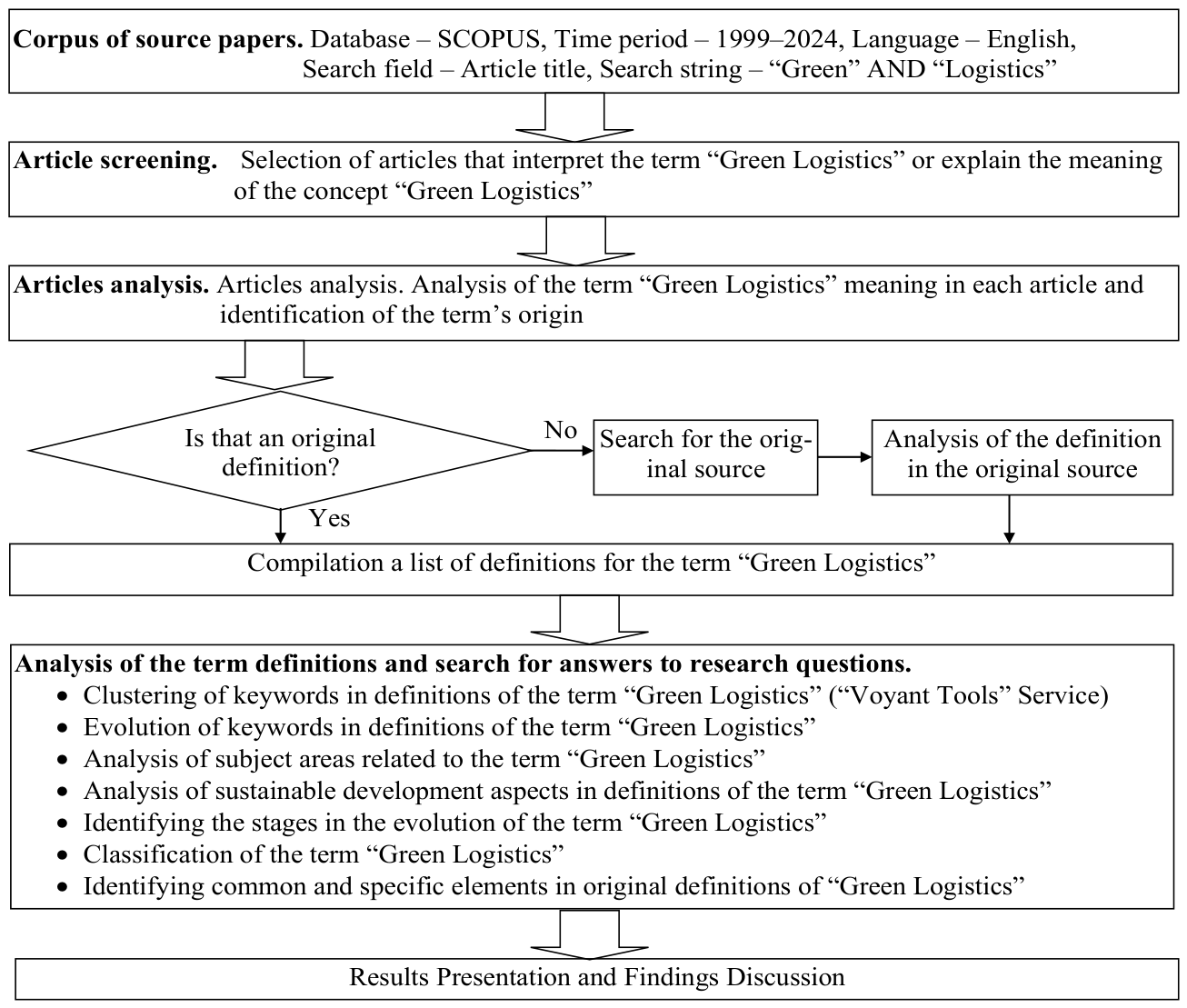
The initial set of papers was screened to identify articles containing interpretations of the term “Green logistics.” As a result of the screening, 56 papers were selected. A detailed analysis of the text of the selected papers was conducted to identify original definitions of the term “Green logistics” and the concepts associated with it. It is important to note that, for the subsequent meta-analysis, only papers containing original definitions of the term under study were selected.
The compiled list of definitions for the term “Green logistics” (Table 2) was used as the source data to answer the main research questions of this study. These questions concerned identifying commonalities and differences among the known definitions, establishing the etymology and evolution of the term “Green logistics”, and identifying the specific areas of application for this concept. The corpus of definitions identified made it possible to establish connections between the term “Green logistics” and aspects of sustainable development and to propose an original classification of this term.
4. Results and Discussion
A formal analysis of word frequency in the 56 definitions of the study term (Table 2) was conducted to prepare the data for answering the first research question. The five words most frequently mentioned in the definitions are: “Logistics” (46 mentions), “Environmental” (30), “Activities” (27), “Green” (20), and “Development” (18). A total of 230 unique words were identified out of a total of 594 keywords across all definitions. Figure 3 shows a keyword cloud generated using the “Voyant Tools” service. Analysis of the results led to the conclusion (RQ1) that researchers have a clear interest in using keywords related to aspects of sustainable development in their definitions. For example, the words “Social” (16 mentions), “Environment” (15 mentions), and “Economic” (15 mentions) are among the Top 10 and, respectively, rank 6th, 7th, and 9th. Frequently occurring words (10 or more mentions) are related to management and logistics — “Supply” (14 mentions), “Management” (13), “Transportation” (11), “Objectives” (11), and “Distribution” (10); actions and consequences — “Impact” (16 mentions), “Reduce” (14), “Processes” (13), “Negative” (10), “Minimize” (10), “Friendly” (10).
The keywords found in the definitions of the term “Green logistics” were divided into four chronological intervals to identify trends in the authors’ interest in various aspects of GL and to answer the second research question. The frequency of a given word’s use over a specific period was used as the criterion for dividing the 25-year study period into segments. The starting point of each chronological interval was defined as the moment a new word appeared in at least two definitions. Furthermore, this word had to appear in definitions at least three times in subsequent periods. Four chronological stages were identified: Stage I (1999–2008), Stage II (2009–2013), Stage III (2014–2018), and Stage IV (2019–2024). A similar criterion was applied for including keywords in the sample under analysis. Thus, a total of 49 words were selected.
A visualization of the trends in keyword usage frequency in the definitions of “logistics activities” is presented in Figure 4. The variety of keywords increases over time, which is primarily due to the growing number of publications in this field (RQ2). Period IV had the highest frequency of keyword usage — 38 words — while Period I had the lowest — 1 word. Periods II and III account for 24 and 20 words, respectively. Only one keyword, “logistics activities”, was used in the definitions throughout all periods. Its frequency of use increased from 2 to 8. The top five most frequently used words also include “environment” (frequency = 15), “reduce” (frequency = 13), “activities” (frequency = 10), and “environmental” (frequency = 9).
The results obtained regarding the frequency and evolution of keywords in the selected papers, as well as a detailed examination of the content of these studies, made it possible to identify subject areas (RQ3). On these areas, the authors of the analyzed articles focus their attention in their definitions of logistics. A total of four most frequently mentioned areas were identified.
The first subject area is logistics, which includes: logistics functions and operations (procurement, supply, production, processing, storage, warehousing, packaging, transportation, and distribution), as well as logistics principles; the use of logistics resources (particularly energy resources); challenges in implementing logistics activities; forward and reverse logistics; and the adoption of innovative logistics technologies.
The second thematic area is management: management functions (planning, organizing, controlling, directing); and supply chain management practices and strategies.
The third thematic area is aspects of sustainable development: economic (cost minimization, business operations, meeting consumer demand, product life cycle, economic development, circular economy); environmental (assessment of environmental damage, environmental footprint, reduction of harmful impacts, waste reduction, waste disposal, noise, accidents, use of environmentally safe technologies, green technologies); social (customer service, achievement of social development goals, improvement of society’s quality of life, provision of social benefits, government, and society).
The results of the analysis of thematic areas revealed significant interest among the authors of GL definitions in the concept of sustainable development. To clarify this interest in specific aspects of sustainable development and to answer the fourth research question, the definitions of the term “GL” were grouped according to the aspects of sustainable development—economy, environment, and society (Figure 5). Most definitions use the combination “logistics – environment – economy” (23 definitions) and “logistics – environment – economy – society” (19 definitions). Six definitions emphasize the achievement of economic and environmental goals in logistics, without explicitly considering social goals. The shaded areas in the figure indicate that there are no definitions in the scientific literature in which the term “GL” is explained exclusively from the perspective of “logistics” (Area A), “environment” (area B), and “society” (area C), as well as at the intersection of “logistics – economics” (area D), “environment – society” (area E), and “economics – society” (area F). At the same time, two definitions consider GL solely from an economic perspective and equate it with the circular economy.
An analysis of the dynamics of the relationship between GL and aspects of sustainable development over the 25-year study period revealed a rather unexpected result (Figure 6). This is primarily due to a decrease in the number of references to social aspects and an increase in the emphasis on economic aspects at the current stage of GL development (RQ5). In Stage I (1999–2008), definitions predominated that emphasized all three aspects of sustainable development or focused exclusively on the relationship between logistics and the environment. This trend only intensified in all subsequent stages, and as a result, in the final Stage IV (2019–2024), the share of definitions combining these aspects accounted for more than 77% of the total. Starting in 2009 (Stages II–IV), authors have consistently used the combination “logistics–environment–economy” in their definitions. The social aspect was used most frequently in the definitions of Phases II and III (2009–2018), and its frequency of use dropped to a minimum in Phase IV. At the same time, the predominance of the economic aspect in the definitions became noticeable in Phase IV.
An analysis of the evolution of the key terms used in various definitions of the term “GL”, as well as the dynamics of how aspects of sustainable development are reflected in these definitions, allowed us to identify four stages in the evolution of the term “Green logistics” (Figure 7).
The “Lack of Understanding” stage (uncertainty, ambiguity, emergence of the concept, initial establishment) — 1999–2008. This stage is characterized by conceptual uncertainty surrounding the term “GL”, which had only just emerged and was still taking shape. The original definition appears in the works of several authors and is characterized by a concise and understandable explanation emphasizing the connection between logistics activities and the environment. The term “green” is perceived exclusively as “ecological.”
The “Accumulation” stage (enrichment and saturation, formation) — 2009–2013. The term undergoes conceptual saturation. The number of original (author-specific) definitions of the term increases, along with their substantive elaboration; interpretations and conceptual boundaries expand. However, the term’s meaning is not yet clearly established. Attention is focused not only on the environmental aspects of logistics but also on its connection to other fields—management, the environment, the economy, and social aspects. Gradually, the link to aspects of sustainable development is strengthening.
The “Differentiation” stage (expansion, problematization, complication) — 2014–2018. This stage is characterized by a continuing increase in the number of interpretations of the term “GL”, a further expansion of its scope of application, and a simultaneous complication of conceptual boundaries due to excessive detail in the definitions. The meaning of the term “GL” becomes less unambiguous, and conceptual boundaries become blurred. New author-defined definitions specify individual characteristics while simultaneously losing a unified understanding of the essence of GL.
The “Modification” stage (transformation, adaptation, variable development) — 2019–2024. The number of author-proposed definitions continues to increase; some of them are simplified, while others, conversely, become more complex and detailed. New formulations are often based on previously existing definitions, which are refined and partially revised. The definitions show an expansion and renewal of their lexical composition, with new keywords and semantic emphases emerging. Authors strive to reflect connections to new concepts, technologies, and innovations in their definitions.
Thus, we are currently witnessing a broadening of the concept of GL. In our view, the main factor driving this is the emergence and rapid development of new technologies such as blockchain, artificial intelligence, Industry 5.0, and so on. The evolution of the term “Green logistics” suggests that it may become more broadly defined in the future. This hypothesis is because expanding the concept of “green logistics” by incorporating new aspects, areas of research, or technologies into its definition will not result in a qualitative change in its essence. Therefore, we propose limiting the term “Green logistics” to reflect the connection between logistics and sustainable development, since the concepts of “logistics” and “sustainable development” are now well-established. Moreover, the emergence of new technologies, solutions, and logistics methods does not contribute to a fundamental change in either the principles of logistics or the goals of sustainable development. Proposed definition: “Green logistics is the implementation of logistics principles using methods for managing logistics flows to achieve sustainable development goals.”
We submit evaluating known and future green logistics (GL) terms using the following general classification, based on the responses to previous research questions. We have identified the following classification criteria: form of presentation format, complexity, originality, and citations (RQ7).
Identification of GL definitions based on the presentation format:
- explicit, when the authors use the term “GL” and provide a description of it. A characteristic feature is the use of the words “is understood to mean”, “is called”, or “this is”;
- implicit, when the emphasis is not on the term itself, but on a brief description of green logistics, as well as on its differences from traditional logistics in terms of goals, principles, methods, etc.
Identification of GL definitions based on complexity:
- simple – a brief description of the term “GL”, consisting of a single, usually long sentence that combines various aspects of GL;
- complex – consisting of several (two or more) statements defining what GL is. These represent a compilation of various definitions of the term “GL” or a description of its features and specific characteristics.
Identification of GL definitions based on originality:
- original – new, author-created definitions of the term “GL”;
- borrowed – authors use definitions from other scholarly works;
- borrowed with modifications – authors use a definition from other works as a basis but make minor changes to the wording.
- Identification of GL definitions based on citation criteria:
- primary citation – a reference to an article that provides the original definition of the term “GL”;
- secondary (indirect) citation – a reference to an article whose authors use a borrowed definition of the term “GL” without being the authors of that definition. Thus, a chain of references is created in which it is difficult to identify the original source;
- misquotation – a reference to an article that either lacks a definition of the term “GL” or provides definitions of similar terms, such as “Sustainable logistics” or “Green supply chain.”
Using the proposed evaluative classification makes it possible to understand how the definition of the term “GL” was formed, to reveal its essence, and to determine the authorship of the definition. It also allows the use of the corresponding term in each paper.
5. Conclusions
This study represents the most comprehensive and in-depth analysis of definitions of the term “Green logistics” (GL) in scientific articles indexed in the Scopus database from 1999 to 2024. The analysis identified 56 original definitions of the term “Green logistics,” conducted a meta-analysis of all definitions, analyzed the keywords most frequently used in the definitions, and determined the relationship between the term “Green logistics” and aspects of the concept of sustainable development.
There is currently no consensus within the academic community on what constitutes “Green logistics.” Over a 25-year period (from 1999 to 2024), no clear and unified understanding of the term “Green logistics” has emerged. Different authors focus on various goals, objectives, or specific aspects of logistics in their definitions. This is typically the focus or subject of their research, and authors emphasize this in the wording of their definitions of the term “GL”. At the same time, most definitions of GL highlight the environmental aspect or the close connection between logistics and the concept of sustainable development, which involves the integration of economic, social, and environmental components.
In our analysis of the term “GL”, we identified numerous synonyms and terms with similar meanings. For example: sustainable logistics, eco-logistics, environmental logistics, eco-friendly logistics, resilience logistics, and lean sustainable logistics. On the one hand, this diversity of terms broadens the scope of the concept of green logistics and demonstrates its close connection to various modern concepts, technologies, and management methods; on the other hand, it highlights the complexity of the subject of our study — the logistics system. On the other hand, it makes it difficult to grasp the specifics of each term, the differences between them, their interpretations, and the scope of application for each term.
We have found that the definitions of the term “GL” incorporate new “green” terminology: green supply (supplies), green needs, green demand, green solutions, green action, green technologies, green transportation, green storage, green packaging, green distribution, green services, green economy, green supply chain, and others. In most studies, authors generally do not elaborate on the meaning of these terms but instead focus on the fact that specific functions, processes, or solutions in logistics align with environmental protection or sustainable development goals. It is important to note that some definitions address specific logistics functions, such as transportation, warehousing, distribution, and others. In several definitions, authors mention all functional areas of logistics—from the procurement of raw materials to the delivery of finished products to the end consumer.
Key findings addressing the research questions:
RQ1 – There is a clear tendency among scholars to include, in their definitions of the term “GL”, keywords related to one or more aspects of the concept of sustainable development.
RQ2 – Over time, the variety of keywords in definitions of the term “GL” has increased, primarily due to the growing number of publications in this field. The term “logistics activities” was used in GL definitions throughout the entire period analyzed. The five most frequently used words in GL definitions include “environment,” “reduce,” “activities,” and “environmental”.
RQ3 – Authors of papers containing definitions of the term “GL” most often focus on the following broad subject areas: logistics, management, and aspects of sustainable development concept.
RQ4 – The connection between GL and aspects of the concept of sustainable development, as reflected in definitions of the term “GL”, is confirmed by the fact that most definitions use the combinations “logistics – ecology – economy” and “logistics – ecology – economy – society.” Furthermore, we did not identify any papers in which the term “GL” is defined exclusively from the perspective of “logistics”, “ecology”, and “society”, nor at the intersection of “logistics – economics”, “ecology – society”, and “economics – society”.
RQ5 – In the early stages of the term “GL” (1999–2008), definitions that emphasized all three aspects of the concept of sustainable development—or exclusively the relationship between logistics and the environment—predominated. This focus intensified in subsequent periods. The authors consistently use the triad “logistics – environment – economy” in their definitions. However, at the present stage (since 2019), the economic aspect has become the predominant focus in definitions of GL.
RQ6 – The results of a study on the evolution of definitions of the term “GL” in scientific papers revealed a trend toward the expansion and modification of the GL concept. The logic behind the evolution of the term “GL” allows us to hypothesize that it will be generalized in the future. It is advisable to limit the term “GL” to reflecting the connection between logistics and sustainable development, since the concepts of “logistics” and “sustainable development” are now well-established. We propose the following generalized definition: “Green logistics is the implementation of logistics principles using methods for managing logistics flows to achieve sustainable development goals”.
RQ7 – We have identified classification criteria for definitions of the term “GL”: form of presentation, complexity, originality, and citation. We propose an evaluative classification of definitions of the term “GL”. This classification helps to understand how a particular definition of “GL” was formulated, to reveal its essence, and to determine the authorship of the definition and the use of the corresponding term in each paper.
The procedure for the systematic analysis of the term “Green logistics” described in this article can serve as a methodological framework for studying other concepts that are not yet fully formed or established.
The main limitation of this study is the use of a single scientometric database, Scopus, and the use of keywords from the titles of English-language papers exclusively as search criteria. Expanding the number of scientific databases and modifying the search criteria for publications will allow for a more detailed analysis and an examination of specific issues regarding the interpretation of the term “GL”. In future studies, we plan to address these limitations and extend the time frame to confirm the hypothesis regarding the generalization of definitions of the term “Green logistics”.
Author Contributions
Conceptualization, A.R. and N.O.; methodology, A.R. and N.O.; software, N.O.; validation, N.O. and A.R.; formal analysis, N.O.; investigation, N.O.; resources, A.R. and N.O.; data curation, N.O.; writing—original draft preparation, N.O.; writing—review and editing, A.R.; visualization, N.O.; supervision, A.R.; project administration, N.O.; funding acquisition, A.R. and N.O. Both authors have read and agreed to the published version of the manuscript.
Funding
No finding.
Data Availability Statement
Data are contained within the article.
Conflicts of Interest
The authors declare no conflicts of interest.
References
- Ren, R.; Hu, W.; Dong, J.; Sun, B.; Chen, Y.; Chen, Z. A systematic literature review of green and sustainable logistics: Bibliometric analysis, research trend and knowledge taxonomy. Int. J. Environ. Res. Public Health 2020, 17. [Google Scholar] [CrossRef] [PubMed]
- Jazairy, A.; Pohjosenperä, T.; Prataviera, L.B.; Juntunen, J. Innovators and transformers: Revisiting the gap between academia and practice: insights from the green logistics phenomenon. Int. J. Phys. Distrib. Logist. Manag. 2024, 55, 341–360. [Google Scholar] [CrossRef]
- Tetteh, F.K.; Owusu Kwateng, K.; Mensah, J. Green logistics practices: A bibliometric and systematic methodological review and future research opportunities. J. Clean. Prod. 2024, 476, 143735. [Google Scholar] [CrossRef]
- Starostka-Patyk, M.; Bajdor, P.; Białas, J. Green logistics performance Index as a benchmarking tool for EU countries environmental sustainability. Ecol. Indic. 2024, 158, 111396. [Google Scholar] [CrossRef]
- Osintsev, N.; Rakhmangulov, A. A systematic review of green and sustainable logistics research. Tomsk State Univ. J. Econ. 2024, 7–39. [Google Scholar]
- Jefimovaitė, L.; Vienažindienė, M. Green logistics concept and the impact of its implementation in the organisation: a systematic literature review and meta-analysis. Eng. Manag. Prod. Serv. 2025, 17, 39–51. [Google Scholar] [CrossRef]
- Simm, N. Greener logistics through resource sharing - A resource dependency lens on supply chain interaction. Res. Transp. Bus. Manag. 2025, 101405. [Google Scholar] [CrossRef]
- Osintsev, N.; Rakhmangulov, A. Sustainable development of logistics chains of cargo flows; INFRA-M: Moscow, 2025. [Google Scholar] [CrossRef]
- Delmonico, D.V.D.G.; Bezerra, B.S. A systematic literature review on sustainable logistics. Lat. Am. J. Manag. Sustain. Dev. 2020, 5, 47. [Google Scholar] [CrossRef]
- Brandenburg, M.; Govindan, K.; Sarkis, J.; Seuring, S. Quantitative models for sustainable supply chain management: Developments and directions. Eur. J. Oper. Res. 2014, 233, 299–312. [Google Scholar] [CrossRef]
- Hoang, T.-H.; Tran, T.-T.; Huynh, L.N.T.; Vo, D.K.; Huynh, B.G.; Tran, T.M.T.; Le Nguyen, N.D. Advances and barriers in promoting green logistics 4.0 from a multi-stakeholder perspective – a systematic review. Environ. Syst. Decis. 2025, 45. [Google Scholar] [CrossRef]
- Nicoletti, B.; Appolloni, A. Green Logistics 5.0: A review of sustainability-oriented innovation with foundation models in logistics. Eur. J. Innov. Manag. 2024, 27, 542–561. [Google Scholar] [CrossRef]
- Temizceri, T.; Kara, S.S. Last decade of green logistics with multiple modes of transportation: a literature review. Logforum 2023, 19, 703–721. [Google Scholar] [CrossRef]
- Wu, Y.; Wang, S.; Zhen, L.; Laporte, G. Integrating operations research into green logistics: A review. Front. Eng. Manag. 2023, 10, 517–533. [Google Scholar] [CrossRef]
- Yedilbayev, B.; Kazmagambetov, A.; Kazbekova, K.; Akhmetkaliyeva, S.; Majewski, M.; Malybayev, R.; Alimzhanova, L.; Aidarkulov, B. The role of green logistics for environmental issues in city transport road ecology: A review. E3S Web Conf. 2023, 412, 1086. [Google Scholar] [CrossRef]
- Išoraitė, M. Green logistics and marketing features: Literature review. In TRANSBALTICA XIII: Transportation Science and Technology; Prentkovskis, O., Yatskiv, I., Skačkauskas, P., Maruschak, P., Karpenko, M., Eds.; Springer International Publishing: Cham, 2023; pp. 618–626. ISBN 978-3-031-25862-6. [Google Scholar]
- Liu, A.; Osewe, M.; Shi, Y. Green logistics in China: a systematic literature review. Int. J. Logist. Syst. Manag. 2023, 45, 88. [Google Scholar] [CrossRef]
- Aroonsrimorakot, S.; Laiphrakpam, M.; Mungkun, S. Green Logistics (GL) for environmental sustainability: A review in search of strategies for Thailand’s GL management. ABAC J. 2022, 42, 293–319. [Google Scholar] [CrossRef]
- Yadav, V.; Gaur, P.; Jain, R. On adoption of green logistics: a literature review. Int. J. Logist. Syst. Manag. 2021, 40, 193. [Google Scholar] [CrossRef]
- Al-Minhas, U.; Ndubisi, N.O.; Barrane, F.Z. Corporate environmental management: A review and integration of green human resource management and green logistics. Manag. Environ. Qual. An. Int. J. 2020, 31, 431–450. [Google Scholar] [CrossRef]
- Zhang, S.; Lee, C.; Chan, H.K.; Choy, K.L.; Wu, Z. Swarm intelligence applied in green logistics: A literature review. Eng. Appl. Artif. Intell. 2015, 37, 154–169. [Google Scholar] [CrossRef]
- Bajdor, P. Comparison between sustainable development concept and green logistics – The literature review. Pol. J. Manag. Stud. 2012, 5, 236–244. [Google Scholar]
- Rogers, D.S.; Tibben-Lembke, R.S. Going Backwards: Reverse Logistics Trends and Practices; Reverse Logistics Executive Council: Reno, 1999; ISBN 0967461901. [Google Scholar]
- Rodrigue, J.-P.; Slack, B.; Comtois, C. Green logistics (The paradoxes of). In Handbook of Logistics and Supply-Chain Management; Brewer, A.M., Button, K.J., Hensher, D.A., Eds.; Pergamon: Amsterdam, London, 2001; pp. 339–350. ISBN 0-08-043593-9. [Google Scholar]
- Chunguang, Q.; Xiaojuan, C.; Kexi, W.; Pan, P. Research on green logistics and sustainable development. In 2008 International Conference on Information Management, Innovation Management and Industrial Engineering. 2008 International Conference on Information Management, Innovation Management and Industrial Engineering (ICIII), Taipei, Taiwan, 19–21 Dec. 2008; IEEE, 2008; Volume 122008, pp. 162–165. ISBN 978-0-7695-3435-0. [Google Scholar]
- Chang, Q.; Qin, R. Analysis on development path of Tianjin green logistics. Int. J. Bus. Manag. 2008, 3, 96–98. [Google Scholar] [CrossRef]
- Ping, L. Strategy of green logistics and sustainable development. In 2009 International Conference on Information Management, Innovation Management and Industrial Engineering. 2009 International Conference on Information Management, Innovation Management and Industrial Engineering, Xian, China, 26–27 Dec. 2009; IEEE, 2009; Volume 122009, pp. 339–342. ISBN 978-0-7695-3876-1. [Google Scholar]
- Sbihi, A.; Eglese, R.W. Combinatorial optimization and green logistics. Ann. Oper. Res. 2010, 175, 159–175. [Google Scholar] [CrossRef]
- Zhang, J.; Zheng, L. Research on the building of green logistics system and the development strategy in Jilin province. In ICLEM 2010. International Conference of Logistics Engineering and Management (ICLEM) 2010, Chengdu, China, October 8–10, 2010; Zhang, J., Xu, L., Zhang, X., Yi, P., Jian, M., Eds.; American Society of Civil Engineers: Reston, VA, 2010; pp. 288–293. ISBN 9780784411391. [Google Scholar]
- Peng, J. Development strategy of green logistics based on SWOT matrix - A case study. In 2010 International Conference on Optoelectronics and Image Processing. 2010 International Conference on Optoelectronics and Image Processing (ICOIP), Haiko, Hainan, China, 11–12 Nov. 2010; IEEE, 2010; Volume 112010, pp. 432–435. ISBN 978-1-4244-8683-0. [Google Scholar]
- Zhang, G.; Gu, N.; Lv, X.; Wang, X. The study of operation mode of green logistics. In 2010 Second International Conference on Intelligent Human-Machine Systems and Cybernetics. 2010 2nd International Conference on Intelligent Human-Machine Systems and Cybernetics (IHMSC), Nanjing, China, 26–28 Aug. 2010; IEEE, 2010; pp. 65–68. ISBN 978-1-4244-7869-9. [Google Scholar]
- Zheng, L.; Zhang, J. Research on green logistics system based on circular economy. Asian Soc. Sci. 2010, 6, 116–119. [Google Scholar] [CrossRef]
- Thiell, M.; Zuluaga, J.P.S.; Montañez, J.P.M.; van Hoof, B. Green logistics: Global practices and their implementation in emerging markets. In Green finance and sustainability: Environmentally-aware business models and technologies; Luo, Z., Ed.; Business Science Reference: London: Hershey, Pa., 2011; ISBN 1609605322. [Google Scholar]
- Jamshidi, M. Reverse Logistics. In Logistics Operations and Management: Concepts and Models; Farahani, R.Z., Rezapour, S., Eds.; Elsevier: Amsterdam, 2011; pp. 247–266. ISBN 978-0-12-385202-1. [Google Scholar]
- Guirong, Z.; Qing, G.; Bo, W.; Dehua, L. Green logistics and sustainable development. In 2012 International Conference on Information Management, Innovation Management and Industrial Engineering. 2012 International Conference on Information Management, Innovation Management and Industrial Engineering (ICIII), Sanya, China, 20–21 Oct. 2012; IEEE, 2012; Volume 102012, pp. 131–133. ISBN 978-1-4673-1931-7. [Google Scholar]
- Tamulis, V.; Guzavicius, A.; Zalgiryte, L. Factors influencing the use of green logistics: theoretical implications. Econ. Manag. 2012, 17, 706–711. [Google Scholar] [CrossRef]
- Zhang, G.; Zhao, Z. Green packaging management of logistics enterprises. Phys. Procedia 2012, 24, 900–905. [Google Scholar] [CrossRef]
- Dekker, R.; Bloemhof, J.; Mallidis, I. Operations research for green logistics – an overview of aspects, issues, contributions and challenges. Eur. J. Oper. Res. 2012, 219, 671–679. [Google Scholar] [CrossRef]
- Liu, L. A new advanced logistics supply chain for food management based on green logistics theory. Adv. J. Food Sci. Technol. 2013, 5, 1337–1341. [Google Scholar] [CrossRef]
- Li, A.; Zhang, Y.; Shang, D. Strategy of collaborative transportation based on green logistics. In ICTE 2013. Fourth International Conference on Transportation Engineering, Chengdu, China, October 19–20, 2013; Peng, Q., Wang, K.C.P., Eds.; American Society of Civil Engineers: Reston, VA, 2013; pp. 2795–2802. ISBN 9780784413159. [Google Scholar]
- El-Berishy, N.; Rügge, I.; Scholz-Reiter, B. The interrelation between sustainability and green logistics. IFAC Proc. Vol. 2013, 46, 527–531. [Google Scholar] [CrossRef]
- Tissayakorn, K.; Akagi, F. Green logistics management and performance for Thailand’s logistic enterprises. In 2014 IEEE International Conference on Industrial Technology (ICIT). 2014 IEEE International Conference on Industrial Technology (ICIT), Busan, South Korea, 26 Feb.–01 Mar. 2014; IEEE, 2014; Volume 22014, pp. 707–711. ISBN 978-1-4799-3939-8. [Google Scholar]
- Jedliński, M. The position of green logistics in sustainable development of a smart green city. Procedia-Soc. Behav. Sci. 2014, 151, 102–111. [Google Scholar] [CrossRef]
- McKinnon, A.C. Green Logistics: Improving the Environmental Sustainability of Logistics, Third edition; Kogan Page: London, Philadelphia, 2015; ISBN 978-0-7494-7185-9. [Google Scholar]
- Chhabra, D.; Singh, R.K. Justification of green logistic practices in Indian enterprises using analytic hierarchy process. Int. J. Logist. Syst. Manag. 2016, 25, 295. [Google Scholar] [CrossRef]
- Pannirselvan, M.D.; Bin Rahamaddulla, S.R.; Muuhamad, P.F.; Maarof, M.G.; Sorooshian, S. Innovative solution for barriers of green logistics in food manufacturing industries. Int. J. Appl. Eng. Res. 2016, 11, 9478–9487. [Google Scholar]
- Dudin, M.N.; Frolova, Y.Y.; Artemyeva, Y.A.; Bezbakh, V.V.; Shakirov, S.S. Business entities within the agro-industrial sector and present-day trends in “green” logistics in a climate of transformation of the world economy. Int. J. Econ. Res. 2016, 13, 2379–2390. [Google Scholar]
- Zaman, K.; Shamsuddin, S. Green logistics and national scale economic indicators: evidence from a panel of selected European countries. J. Clean. Prod. 2017, 143, 51–63. [Google Scholar] [CrossRef]
- Arslan, M.; Şar, S. Examination of environmentally friendly “green” logistics behavior of managers in the pharmaceutical sector using the Theory of Planned Behavior. Res. Soc. Adm. Pharm. 2018, 14, 1007–1014. [Google Scholar] [CrossRef] [PubMed]
- Qu, Q.; Tang, M.; Liu, Q.; Song, W.; Zhang, F.; Wang, W. Empirical research on the core factors of green logistics development. Acad. Strateg. Manag. J. 2017, 16. [Google Scholar]
- Wang, D.-F.; Dong, Q.; Peng, Z.-M.; Khan, S.A.R.; Tarasov, A. The Green Logistics Impact on International Trade: Evidence from Developed and Developing Countries. Sustainability 2018, 10, 2235. [Google Scholar] [CrossRef]
- Lew, A.; Chew, B.; Hamid, S. Green logistics implementation factors: A study on a global logitics provider. J. Adv. Manuf. Technol. 2018, 12, 115–128. [Google Scholar]
- Seroka-Stolka, O.; Ociepa-Kubicka, A. Green logistics and circular economy. Transp. Res. Procedia 2019, 39, 471–479. [Google Scholar] [CrossRef]
- Kwak, S.-Y.; Cho, W.-S.; Seok, G.-A.; Yoo, S.-G. Intention to use sustainable green logistics platforms. Sustainability 2020, 12, 3502. [Google Scholar] [CrossRef]
- Zowada, K. Green logistics: The way to environmental sustainability of logistics. Empirical evidence from polish SMEs. Eur. J. Sustain. Dev. 2020, 9, 231–240. [Google Scholar] [CrossRef]
- Zhang, W.; Zhang, M.; Zhang, W.; Zhou, Q.; Zhang, X. What influences the effectiveness of green logistics policies? A grounded theory analysis. Sci. Total Environ. 2020, 714, 136731. [Google Scholar] [CrossRef] [PubMed]
- Navavongsathian, A.; Vuthipadadorn, D.; Farangthong, S.; Janthongpan, S.; Juntasart, R. Study of green logistics managing potential and the preparedness of auto parts industries in Thailand. TEM J. 2020, 9, 1524–1534. [Google Scholar] [CrossRef]
- Patra, P.K. Green logistics: Eco-friendly measure in supply-chain. Manag. Insight 2020, 14, 65–71. [Google Scholar] [CrossRef]
- Larina, I.V.; Larin, A.N.; Kiriliuk, O.; Ingaldi, M. Green logistics - modern transportation process technology. Prod. Eng. Arch. 2021, 27, 184–190. [Google Scholar] [CrossRef]
- Dzwigo, H.; Trushkina, N.; Kwilinski, A. The organizational and economic mechanism of implementing the concept of green logistics. Virtual Econ. 2021, 4, 41–75. [Google Scholar] [CrossRef] [PubMed]
- Atmayudha, A.; Syauqi, A.; Purwanto, W.W. Green logistics of crude oil transportation: A multi-objective optimization approach. Clean. Logist. Supply Chain 2021, 1, 100002. [Google Scholar] [CrossRef]
- Liu, C.; Ma, T. Green logistics management and supply chain system construction based on internet of things technology. Sustain. Comput. Inform. Syst. 2022, 35, 100773. [Google Scholar] [CrossRef]
- Shramenko, N.; Merkisz-Guranowska, A.; Kiciński, M.; Shramenko, V. Model of operational planning of freight transportation by tram as part of a green logistics system. Arch. Transp. 2022, 63, 113–122. [Google Scholar] [CrossRef]
- Jefimovaitė, L.; Vienažindienė, M. Factors influencing the application of green logistics: findings from the Lithuanian logistics center. Pol. J. Manag. Stud. 2022, 25, 193–212. [Google Scholar] [CrossRef]
- van Vo, H.; Nguyen, N.P. Greening the Vietnamese supply chain: The influence of green logistics knowledge and intellectual capital. Heliyon 2023, 9, e15953. [Google Scholar] [CrossRef] [PubMed]
- Zhou, B.; Siddik, A.B.; Zheng, G.-W.; Masukujjaman, M. Unveiling the role of green logistics management in improving SMEs’ sustainability performance: Do circular economy practices and supply chain traceability matter? Systems 2023, 11, 198. [Google Scholar] [CrossRef]
- Pham, N.D.K.; Dinh, G.H.; Pham, H.T.; Kozak, J.; Nguyen, H.P. Role of green logistics in the construction of sustainable supply chains. Pol. Marit. Res. 2023, 30, 191–211. [Google Scholar] [CrossRef]
- Oliveri, L.M.; D’Urso, D.; Trapani, N.; Chiacchio, F. Electrifying green logistics: A comparative life cycle assessment of electric and internal combustion engine vehicles. Energies 2023, 16, 7688. [Google Scholar] [CrossRef]
- Setyadi, A.; Akbar, Y.K.; Ariana, S.; Pawirosumarto, S. Examining the effect of green logistics and green human resource management on sustainable development organizations: The mediating role of sustainable production. Sustainability 2023, 15, 10667. [Google Scholar] [CrossRef]
- Kanyepe, J.; Alfaneta, M.; Zizhou, B. Green logistics adoption and operational performance within the road freight sector: The moderating role of management commitment . 2023, 16. [Google Scholar] [CrossRef] [PubMed]
- Roy, S.; Mohanty, R.P. Green logistics operations and its impact on supply chain sustainability: An empirical study. Bus. Strategy Environ. 2024, 33, 1447–1476. [Google Scholar] [CrossRef]
- Chhabra, D.; Kr Singh, R. Analyzing barriers to green logistics in context of Circular Economy and Industry 4.0 in the Indian manufacturing industry. Int. J. Logist. Res. Appl. 2024, 27, 1939–1952. [Google Scholar] [CrossRef]
- Nagy, G.; Szentesi, S. Green logistics: Transforming supply chains for a sustainable future. Adv. Logist. Syst.-Theory Pract. 2024, 18, 29–42. [Google Scholar] [CrossRef]
- Čižiūnienė, K.; Matijošius, J.; Sokolovskij, E.; Balevičiūtė, J. Assessment of Implementing Green Logistics Principles in Railway Transport: The Case of Lithuania. Sustainability 2024, 16, 2716. [Google Scholar] [CrossRef]
- Ye, X. The Impact of Green Logistics on the Sustainable Development of Enterprises. Adv. Econ. Manag. Political Sci. 2024, 120, 61–73. [Google Scholar] [CrossRef]
- Khayyat, M.; Balfaqih, M.; Balfaqih, H.; Ismail, M. Challenges and Factors Influencing the Implementation of Green Logistics: A Case Study of Saudi Arabia. Sustainability 2024, 16, 5617. [Google Scholar] [CrossRef]
- Tran, M.N. Impact of green logistics on Vietnam’s regional trade. Asian J. Shipp. Logist. 2024, 40, 126–132. [Google Scholar] [CrossRef]
Figure 1.
Clustering keywords in review articles on green logistics based on data from the Scopus database.
Figure 1.
Clustering keywords in review articles on green logistics based on data from the Scopus database.
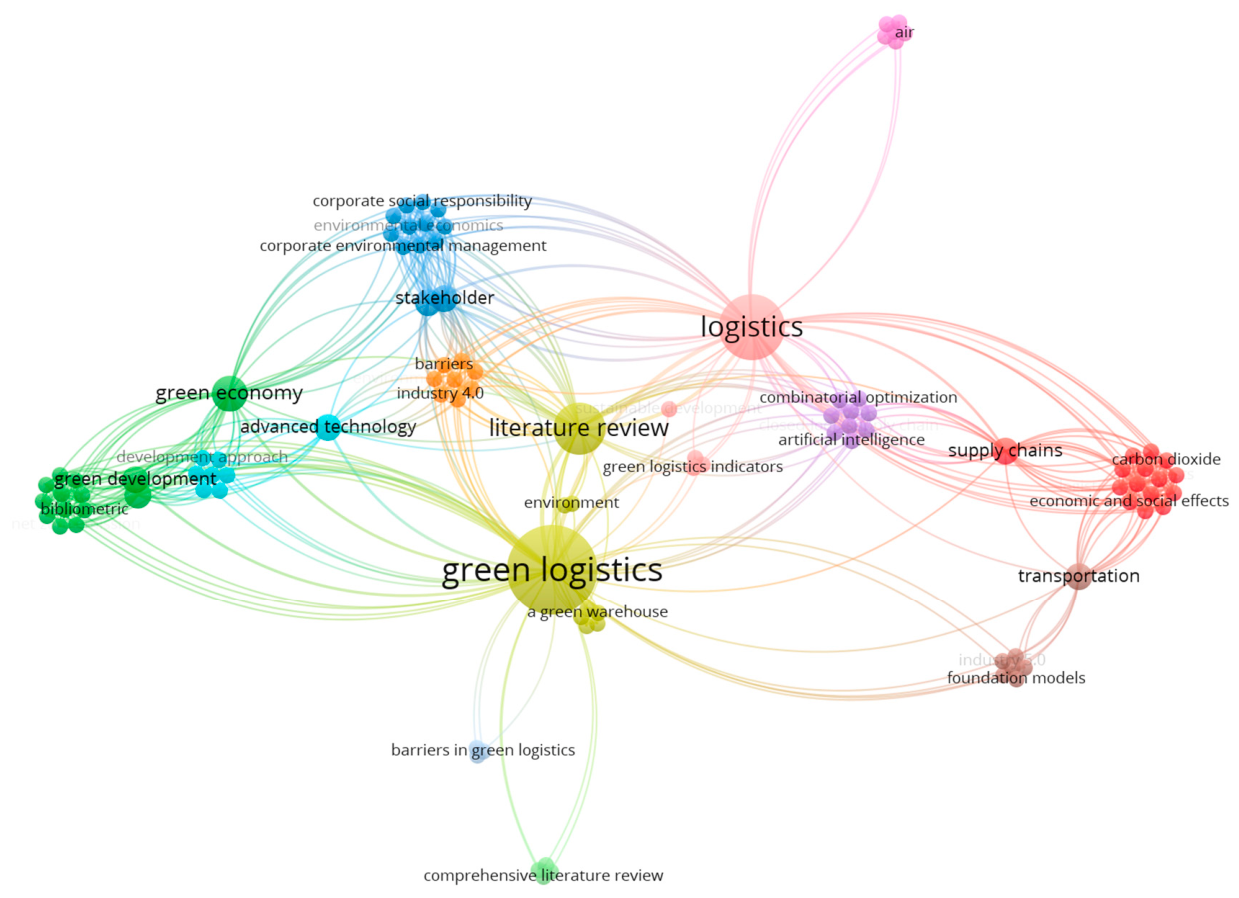
Figure 3.
Flowchart of the research methodology Word cloud based on definitions of “Green logistics”.
Figure 3.
Flowchart of the research methodology Word cloud based on definitions of “Green logistics”.
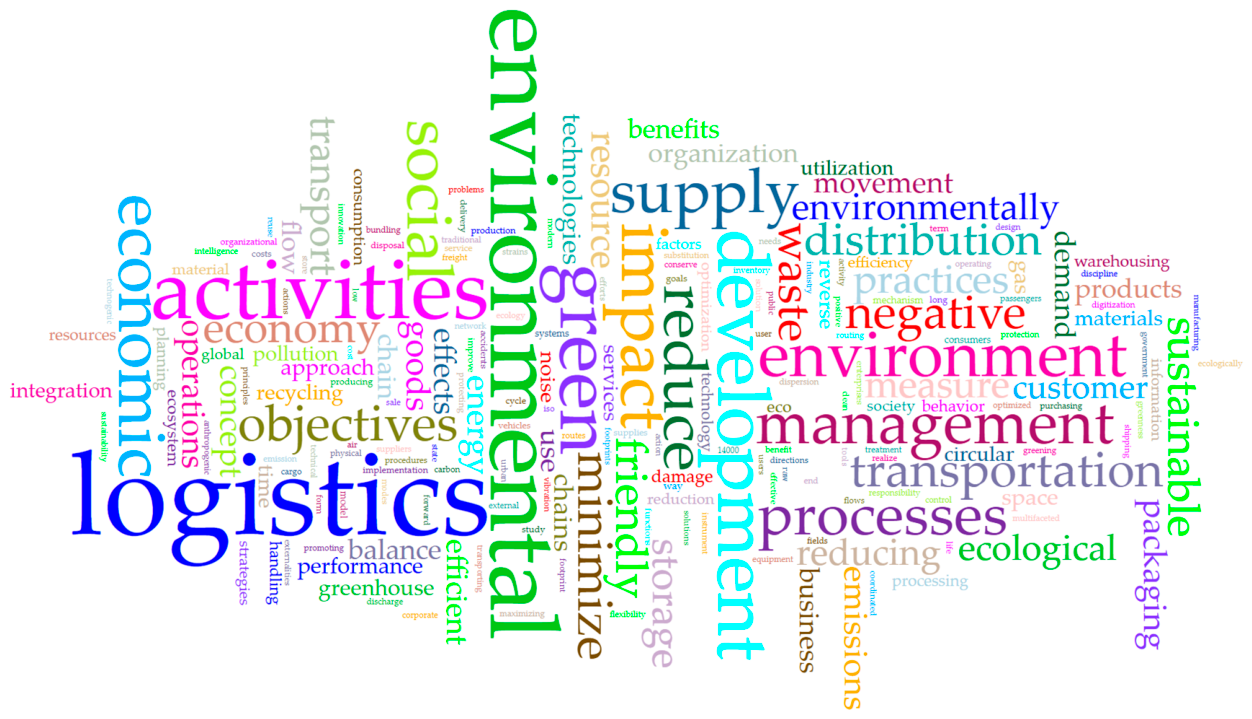
Figure 4.
Evolution of key terms used in definitions of the term “Green logistics” from 1999 to 2024.
Figure 4.
Evolution of key terms used in definitions of the term “Green logistics” from 1999 to 2024.
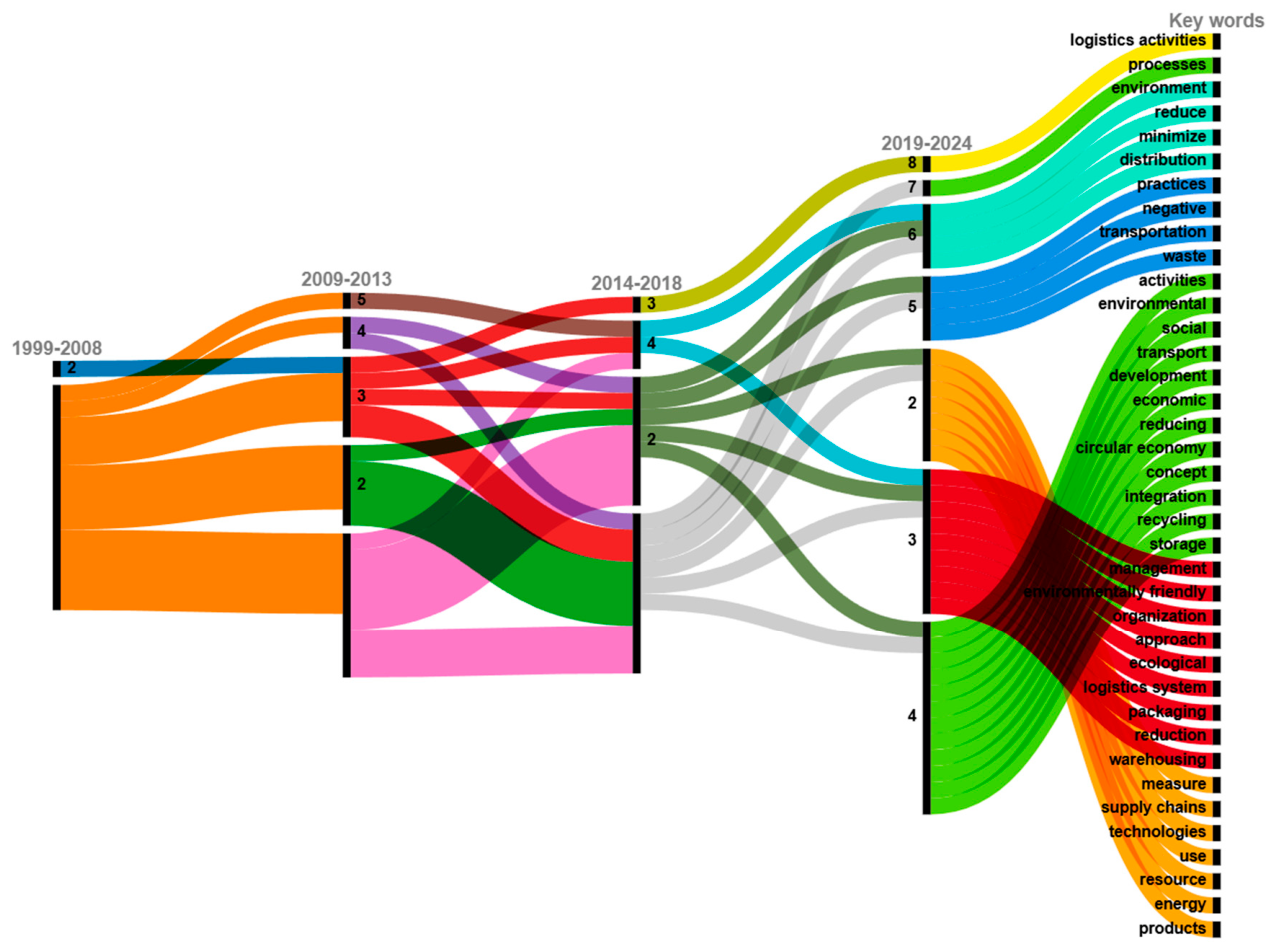
Figure 5.
Evolution of key terms used in definitions of the term “Green logistics” from 1999 to 2024 Classification of definitions of the term “Green logistics” according to aspects of the concept of sustainable development (The numbers in the figure correspond to the item numbers of the definitions in Table 1).
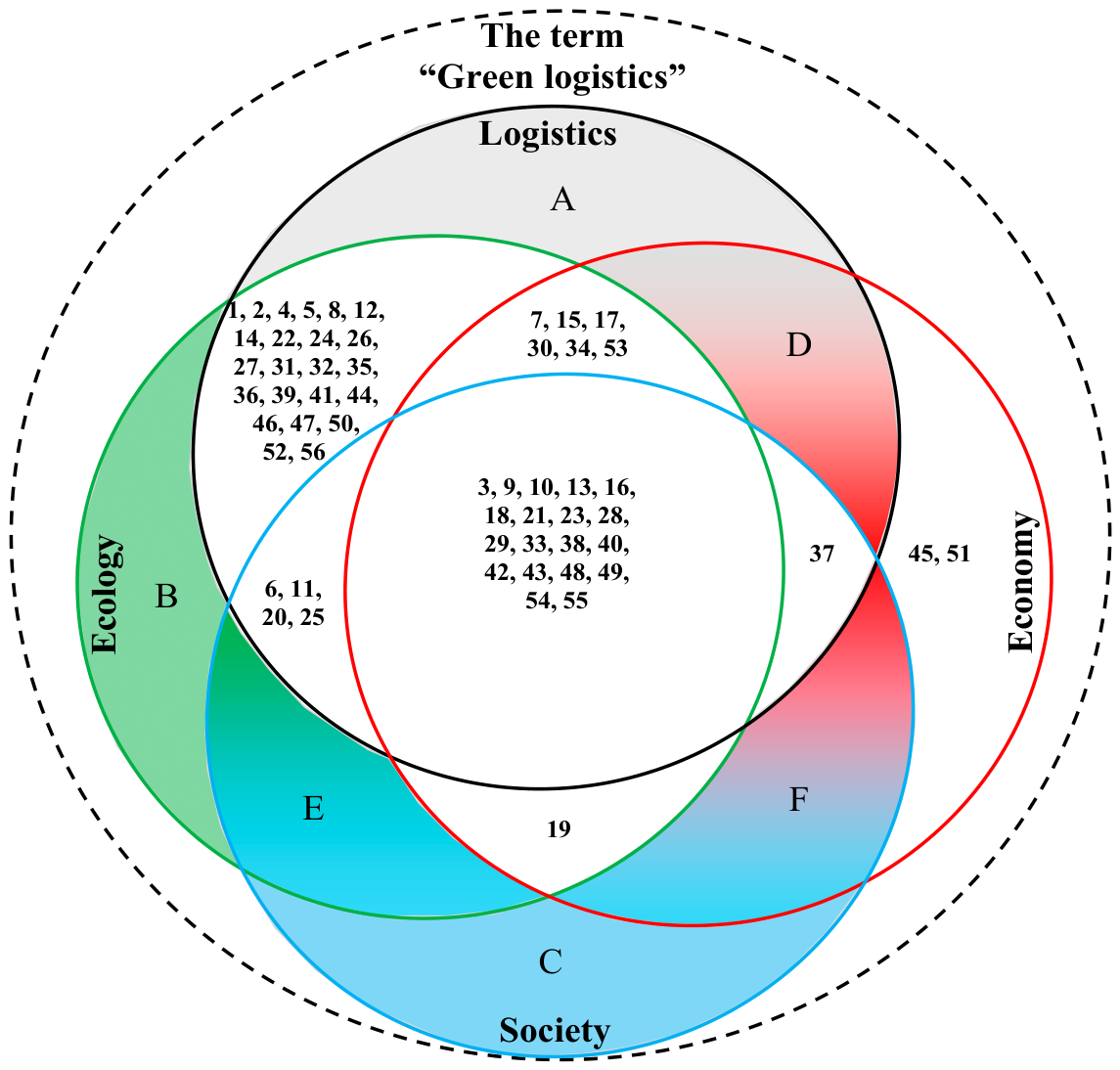
Figure 6.
Trends in the mention of sustainable development aspects in definitions of the term “Green logistics” from 1999 to 2024.
Figure 6.
Trends in the mention of sustainable development aspects in definitions of the term “Green logistics” from 1999 to 2024.
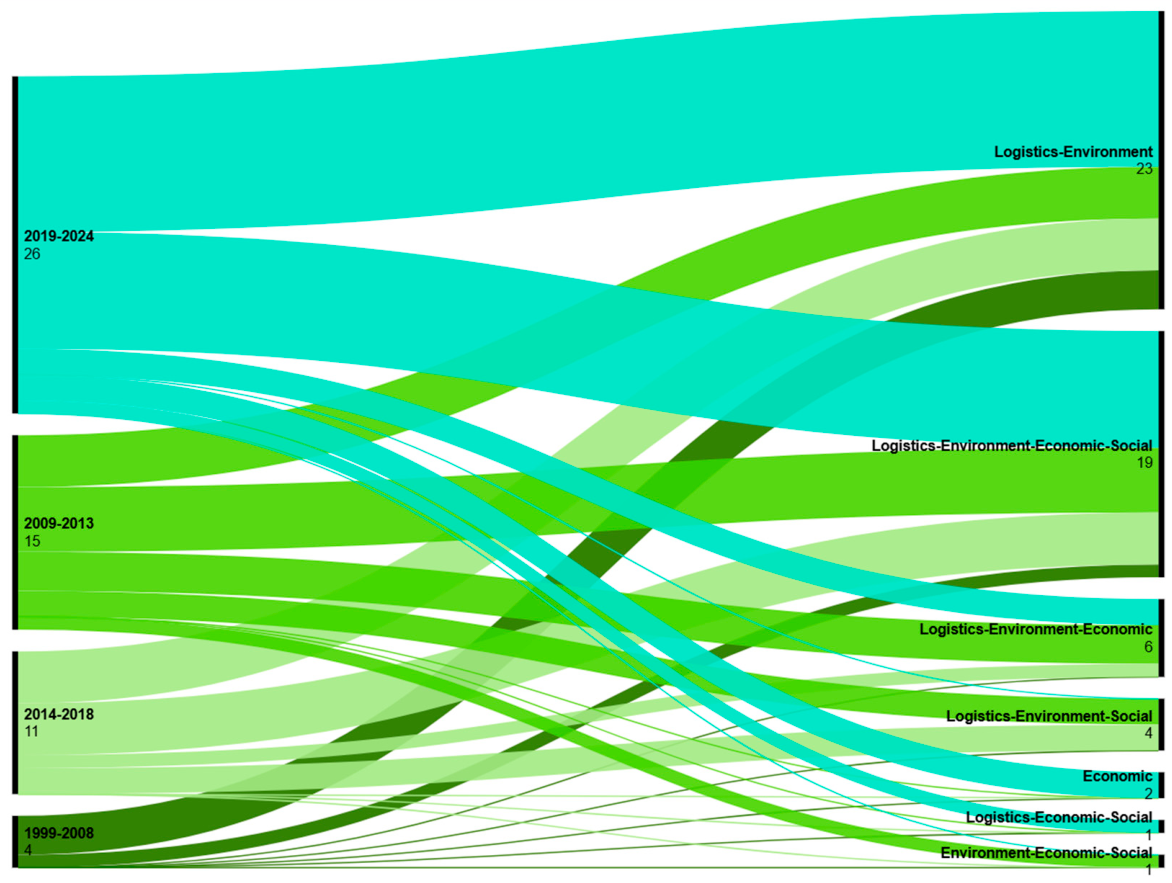
Figure 7.
Stages in the evolution of the term “Green logistics”.
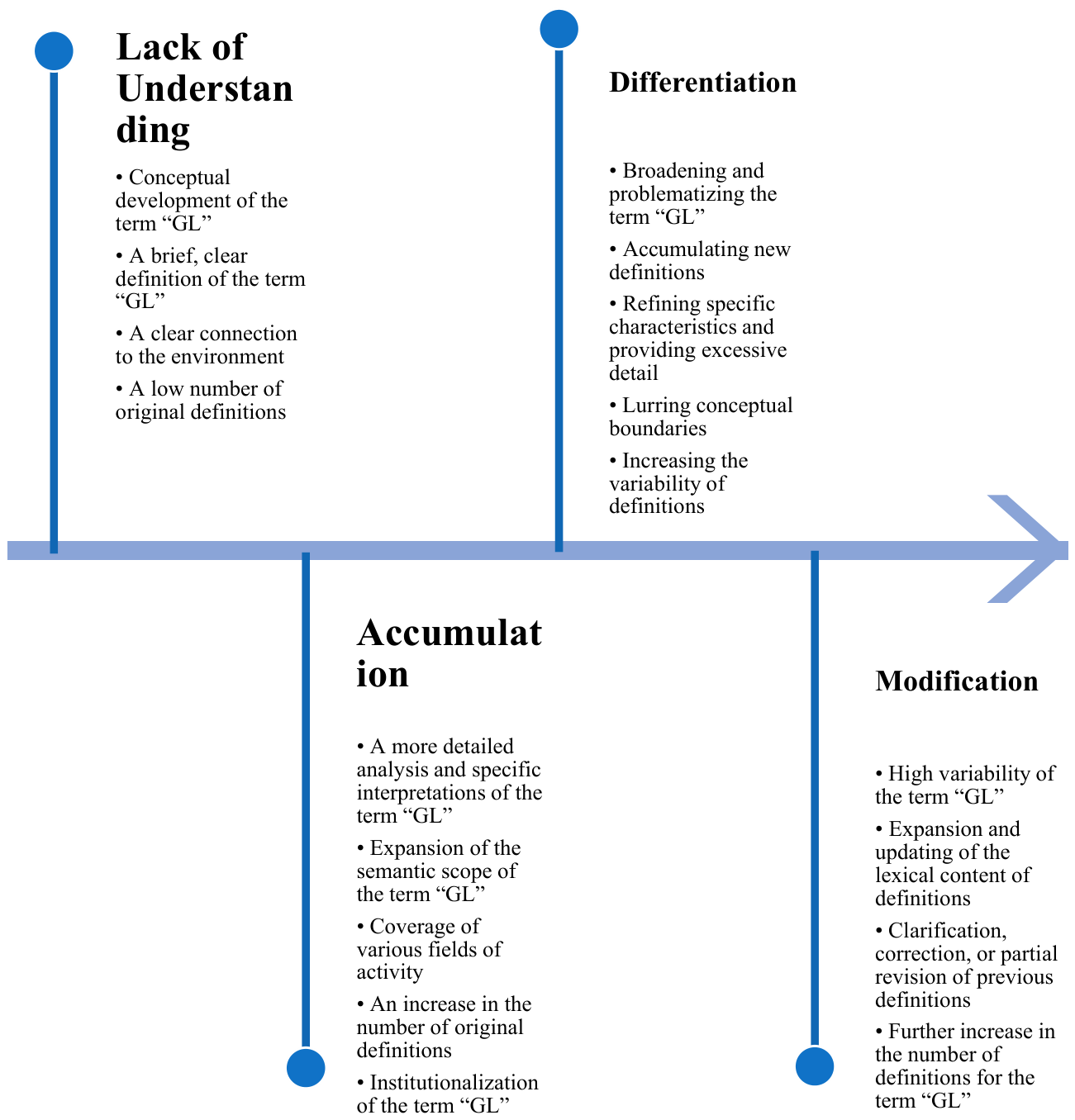

Table 1.
Analysis of review articles in the field of green logistics selected from the Scopus database.
Table 1.
Analysis of review articles in the field of green logistics selected from the Scopus database.
| № | Authors, [reference] | Year | Title | Field of study | Number of papers in the review | Number of the term “GL” definitions analyzed, (pages with analysis results) |
|---|---|---|---|---|---|---|
| 1. | Hoang T.-H. et al., [11] | 2025 | Advances and barriers in promoting green logistics 4.0 from a multi-stakeholder perspective – a systematic review | GL technologies and methods in Industry 4.0: identifying barriers to their adoption by primary and secondary stakeholders | 157 | No data available |
| 2. | Jefimovaite L., Vienažindiene M., [6] | 2025 | Green logistics concept and the impact of its implementation in the organisation: A systematic literature review and meta-analysis | A systematization of theoretical and practical research on GL to define its concept, areas of research, and prospects for the GL implementation | 223 | 4, (44-45) |
| 3 | Nicoletti B., Appolloni A., [12] | 2024 | Green Logistics 5.0: A review of sustainability-oriented innovation with foundation models in logistics | Basic models for integrating green approaches into Logistics 5.0 to achieve social, economic, and management goals | Not specified | - |
| 4. | Tetteh F.K. et al., [3] | 2024 | Green logistics practices: A bibliometric and systematic methodological review and future research opportunities | GL Practices, Methodological and Theoretical Approaches | 45 | - |
| 5. | Temizceri T., Kara S.S., [13] | 2023 | Last decade of green logistics with multiple modes of transportation: A literature review | The contribution of multimodal and intermodal transportation systems to the GL development | 76 | - |
| 6. | Wu Y. et al., [14] | 2023 | Integrating operations research into green logistics: A review | The impact of operations research on GL | 670 | 1 (517) |
| 7. | Yedilbayev B. et al., [15] | 2023 | The role of green logistics for environmental issues in city transport road ecology: A review | GL’s relations with the territorial and urban planning environmental administration | Not specified | 3, (4-5) |
| 8. | Išoraitė M., [16] | 2023 | Green logistics and marketing features: Literature review | Theoretical aspects of the GL concept, metrics for evaluating it, and GL marketing | Not specified | 7, (620-621) |
| 9. | Liu A. et al., [17] | 2023 | Green logistics in China: A systematic literature review | Analysis of GL research in China and identification of research gaps for transportation and logistics companies | Not specified | No data available |
| 10. | Aroonsrimorakot S. et al., [18] | 2022 | Green logistics (GL) for environmental sustainability: A review in search of strategies for Thailand’s GL management | GL’s development strategies and their contribution to achieving environmental sustainability in Thailand | 33 | 3, (294-295) |
| 11. | Yadav V. et al., [19] | 2021 | On adoption of green logistics: A literature review | Methods of eco-friendly transportation, paradoxes, and barriers to GL implementation | Not specified | No data available |
| 12. | Al-Minhas U. et al., [20] | 2020 | Corporate environmental management: A review and integration of green human resource management and green logistics | The relationship between Green Human Resource Management (GHRM) and Sustainable Green Logistics (SGLOG) | Not specified | 4, (437) |
| 13. | Zhang S. et al., [21] | 2015 | Swarm intelligence applied in green logistics: A literature review | Using swarm intelligence in GL | 115 | 3, (437) |
| 14. | Bajdor P., [22] | 2012 | Comparison between sustainable development concept and green logistics – The literature review | The essence of the concepts of sustainable development and GL, a comparison of these concepts | Not specified | 2, (240-241) |
Table 2.
A corpus of representative of the term “Green logistics” definitions in English-language academic papers.
Table 2.
A corpus of representative of the term “Green logistics” definitions in English-language academic papers.
| № | Year | The original definition of the term “Green Logistics” [reference], page |
|---|---|---|
| 1. | 1999 | “Green logistics – attempts to measure and minimize the ecological impact of logistics activities.” [23], p. 258 |
| 2. | 2001 | “Logistics” is at the heart of modern transport systems. “Greenness” has become a code word for a range of environmental concerns and is usually considered positively. When put together the two words suggest an environmentally friendly and efficient transport and distribution system.” [24], p. 339 |
| 3. | 2008 | “Green logistics is the demand of logistics activities for environmental protection and economy sustainable development.” [25], p. 163 |
| 4. | 2008 | “The green logistics refers to plan, control, management and implementation the logistics system through the advanced logistics technology and environmental management, aiming to reduce the pollutant emission.” [26], p. 96 |
| 5. | 2009 | “Green logistics refers to when damage to environment is restrained in the course of logistics, the purification of logistics environment and making logistics resources to its full use. The purpose of green logistics is to realize economic benefits of certain subject, and at the same time, to look after saving resources, protecting environment especially.” [27], p. 339 |
| 6. | 2010 | “Green logistics is concerned with producing and distributing goods in a sustainable way, taking account of environmental and social factors. Green Logistics activities include measuring the environmental impact of different distribution strategies, reducing the energy usage in logistics activities, reducing waste and managing its treatment.” [28], p. 159 |
| 7. | 2010 | “Green Logistics, also known as environmental protection logistics, is the process of the green movement to achieve customer satisfaction to connect the green supplies and green needs to overcome the obstacles of space and time. It includes the green of the links of logistics operation and the whole process of logistics management. It is the scientific concept of logistics development based on the general principles of economics. The connotation of green logistics includes intensive resources, green transportation, green storage, green packaging, and waste logistics.” [29], p. 288 |
| 8. | 2010 | “Green logistics is an environmentally friendly way of logistics, will be the development direction of urban logistics.” [30], с. 432 |
| 9. | 2010 | “Green Logistics is an economic management activity that aims on serving the customer and social development, connecting the green suppliers and demanders, overcoming the space and time o stacles to achieve efficient and rapid movement of goods and services. It can stop the logistics doing harm to the environment, while it also can achieve logistics environment purification. So that logistics resources can be most fully utilized.” [31], p. 66 |
| 10. | 2011 | “Green logistics is the management activities to pursue customer satisfaction and social development goals, connecting the main body of green supply and demand, overcoming space and time obstacles to achieve efficient and rapid movement of goods and services. It inhibited the damage to environmental to achieve the purification of the logistics environment and the best use of logistics resources. “Green logistics is a multi-level concept which includes both the green logistics business activities and social activities for green logistics management, standardize and control.” [32], p.116 |
| 11. | 2011 | “Green logistics consists of all activities related to the eco-efficient management of the forward and reverse flows of products and information between the point of origin and the point of consumption whose purpose is to meet or exceed customer demand.” [33], p. 335 |
| 12. | 2011 | “Green logistics (ecological logistics) can be defined as understanding and reducing the ecological impact of logistics. It encompasses measuring the environmental effects of particular transportation modes, decreasing the usage of energy and materials in logistics activities, and following the guidelines of ISO 14000.” [34], p. 247 |
| 13. | 2012 | “Green Logistics’ Connotation includes: (1) Green logistics’ end goal is sustainable development; (2) Green logistics’ sphere of activity covers product life cycle; (3) The behavior subject of green logistics includes the public, government and all the members in supply chain. Green logistics’ function elements mainly contain green packaging, green transportation, green distribution processing and green storage.” [35], p. 131 |
| 14. | 2012 | “Green logistics focuses on all logistics fields where appear emissions, waste, inefficient use of resources. Some of green solutions may be not useful for business, as it may reduce flexibility of logistics process.” [36], p. 710 |
| 15. | 2012 | “Green Logistics is a logistics activity, which aimed to reduce pollution of the environment and consumption of resource, using of advanced logistics technology planning and implementation of transport, storage, packaging, handling, processing and distribution. It is an effective and efficient flow of goods that connecting the main green supply and the main green demand to overcome the obstacles between space and time and green services activities in the process of economic management, also known as environmental logistics.” [37], p. 901 |
| 16. | 2012 | “Green logistics, which is the study of practices that aim to reduce the environmental externalities, mainly related to greenhouse gas emissions, noise and accidents, of logistics operations and therefore develop a sustainable balance between economic, environmental and social objectives.” [38], p. 671 |
| 17. | 2013 | “All of these effort aims to form a promoted healthy development of the economy and consumption logistics system, namely the green logistics. Therefore, modern green logistics management emphasizes the overall and long-term interests, emphasizes the all-round concern for the environment. It manifests the green action to the environment and hence it is a kind of new logistics management tendency.” [39], p. 1337 |
| 18. | 2013 | “Green Logistics is one of the development tendencies of modern logistics and Green Transportation is its important link, whose development plays an important role in social benefits, economic benefits, and coordinated development of consumers benefit and environmental benefit.” [40], p. 2795 |
| 19. | 2013 | “Green logistics is a multifaceted discipline, which comprises economic, environmental and social elements. It focuses on actions to minimize harmful effects on the environment and introduces the tools and behaviors that contribute to improve society and its economic level.” [41], p. 528 |
| 20. | 2014 | “Green logistics includes two aspects of the meaning: on the one hand the green logistics are these operations in all processes of environmental performance (behavior), on the other hand the green logistics refers to the effective logistics operational mechanism or logistics activities as a carrier to improve and achieve organizational or social environment performance (behavior).” [42], p. 707 |
| 21. | 2014 | “Undoubtedly, such an approach is represented by green logistics, which is an integrated management of all activities required to move the product along the supply chain to meet the expectations of customers at minimum global cost including also the external costs related to, among others, climate change, air pollution, noise, vibration and accidents.” [43], p. 104 |
| 22. | 2015 | “Green logistics as the study of the environmental effects of all the activities involved in the transport, storage and handling of physical products as they move through supply chains in both forward and reverse directions. It assesses the nature and scale of these effects and examines the various ways in which they can be reduced.” [44], p. 4 |
| 23. | 2016 | “GL is the ability of the organisation to be producing, manufacturing and delivering in an environmental friendly manner along with maintaining economic efficiency. GL is a term used to highlight various practices followed to reduce the environmental problems of logistics operations, specially related to greenhouse gas emissions, noise pollutions, etc., and develop a sustainable balance between economic, environmental and social objectives.” [45], p. 296 |
| 24. | 2016 | “Green logistics is a store network administration practices and procedures that lower the natural and vitality foot shaped impression of cargo dispersion, which concentrates on material taking care of, waste administration, bundling and transport.” [46], p. 9479 |
| 25. | 2016 | “Green logistics implies organizing the movement of freight and passengers and other transportation/logistics services provided to various business entities and those operating within the social welfare sector in such а way as to ensure the use of environmentally safe technologies that would not increase, and would actually reduce, the anthropogenic and technogenic strains on the global ecosystem.” [47], p. 2381 |
| 26. | 2017 | “Green logistics i.e., environmental friendly logistics is emerged as a growing concern, which provide a fair solution to conserve global environment.” [48], p. 52 |
| 27. | 2017 | “It is possible to define green logistics (GL) as planning and implementing logistics activities with the aim of minimizing the negative effects of these activities on the environment.” [49], p. 1007 |
| 28. | 2017 | “Green logistics refers to reducing the damage to environment caused by the logistics industry and maximizing resource utilization in the cycle of logistics, with the aim to move toward sustainable development. Green logistics is a component of both the environmental symbiotic economy and adaptive economic development, which have important roles in national green economy strategy.” [50], p. 1 |
| 29. | 2018 | “The main aim of green logistics is to reduce the environmental externalities of logistics operations, such as GHG emissions, noise, and waste, and obtain balanced development among the economy, society, and the environment.” [51], p. 3 |
| 30. | 2018 | “The main aim of green logistics is to reduce the environmental externalities of logistics operations, such as GHG emissions, noise, and waste, and obtain balanced development among the economy, society, and the environment.” [52], p. 116 |
| 31. | 2019 | “The term “Green logistics” is defined as a set of supply chain management practices and strategies that reduce the ecological and energy footprints of the distribution of goods, which focuses on material handling, waste management, packaging and transport.” [53], p. 472 |
| 32. | 2020 | “Green logistics is defined as the concept of logistics that takes into account the impact of the transport and environmental sectors on the overall process of logistics activities. The narrow meaning of green logistics refers to the activities of reducing and managing pollutants, such as measures to reduce air pollution emissions and gas emissions that can occur when transporting freight. The broader concept of green logistics encompasses not only the effect on the environment of logistics activity but also the overall logistics activities covering traditional forward logistics and reverse logistics.” [54], p. 2 |
| 33. | 2020 | “Green logistics is a concept for managing the flow of material and the accompanying flow of information, starting from the design stage, in such a way that the ecological, social and economic goals of the organisation can be achieved.” [55], p. 232 |
| 34. | 2020 | “Green logistics is the development of traditional logistics, which emphasizes the performance of logistics activities in an ecologically friendly way to realize the development of logistics and economy while conserving resources and protecting the environment. Green logistics is an eco-friendly logistics system, which includes the greening of logistical processes such as transportation, warehousing and distribution, as well as the green recycling of reverse logistics such as waste recycling and disposal.” [56], p. 2 |
| 35. | 2020 | “Green logistics is a way to create innovation in logistics and supply chain management, which is considered environmental. Consists of duties related to purchasing, reduction, recycling, reuse, and substitution of materials.” [57], p. 1524 |
| 36. | 2020 | “Green Logistics may be defined as the entire set of efforts taken by organisations to measure and minimize the environmental impact of logistics activities.” [58], p. 65 |
| 37. | 2021 | “Green logistics is not only a scientific theory, a concept of doing business, but also the next stage in the development of the concept of logistics. Green logistics brings positive results not only to enterprise, but also to the state and society.” [59], p. 184 |
| 38. | 2021 | “Green logistics is understood as a circular economy instrument; a component of corporate social responsibility of business in the transport sector and logistics activities; a type of economic activity, including the processes of material and technical supply, warehousing, environmentally friendly storage, production, customer service, transportation, sale of finished products, recycling (recycling and waste disposal), which allows reducing the negative impact on the ecosystem and the environment in a circular economy.” [60], p. 60 |
| 39. | 2021 | “Green logistics are defined as logistics activities that consider the optimization of energy efficiency through the use of energy-saving vehicles, the optimization of distribution processes through better routing and delivery scheduling, integrated shipping processes to reduce the amount of transportation, and the use of environmentally friendly technology in transportation.” [61], p. 1 |
| 40. | 2022 | “Green logistics is based on reducing energy consumption, focusing on the environment, and making full use of advanced logistics technologies that are fully integrated with economic and social benefits to carry out logistics activities such as transportation, storage, packaging, discharge, and processing.” [62], p. 1 |
| 41. | 2022 | “Green logistics (GL) can be defined as having the same functions as logistics but combined with the concern of minimizing the environmental impacts of logistics activities.” [18], p. 294 |
| 42. | 2022 | “The concept of green logistics can be defined as organizational activities aimed at addressing environ-mental issues in supply chains in order to reduce the impact of negative factors on the environment in the process of promoting material flows from suppliers to end users and achieve stable balance between environmental, economic and social objectives of the logistics system.” [63], p. 114 |
| 43. | 2022 | “GL [Green logistics] may be viewed as a form of logistics, which, in its practice, focuses on reduction of the negative environmental effects of logistics throughout the logistics processes without compromising any social and economic goals.” [64], p. 196 |
| 44. | 2023 | “Green logistics is considered an integral part of the green supply chain, and refers to strategies and practices in supply chain management that aim to minimize the negative impact related to the distribution of goods on the ecological environment.” [65], p. 1 |
| 45. | 2023 | “Green logistics is an essential requirement and fundamental mechanism for the advancement of Circular Economy.” [66], p. 5 |
| 46. | 2023 | “GL [Green logistics] is defined as all efforts and measures undertaken to minimise the negative environmental impacts of logistics activities on the ecosystem.” [67], p. 194 |
| 47. | 2023 | “Green logistics is an approach aimed at reducing the environmental impact of transport, storage, and distribution practices, through low-emission vehicles, optimized routes, clean energy tech in warehouses, and efficient waste management. Green logistics, also known as sustainable logistics or eco-logistics, refers to the practice of integrating environmentally friendly principles and practices into the planning, implementation, and management of logistics activities.” [68], p. 1-2 |
| 48. | 2023 | “Green logistics is the integration of all activities involving product movement in the supply chain. The process starts from the raw materials for certain products to the production and distribution systems to the end consumers, while linking reverse logistics. These activities have the main objective of achieving a balance of economic, environmental, and social sustainability through a structured sequence of activities to meet customer needs with cost efficiency.” [69], p. 3 |
| 49. | 2023 | “Green logistics is a business approach aimed at reducing the environmental impact of the flow of inventory, funds, and related information from the point of origin up until they reach the end-user.” [70], p. 2 |
| 50. | 2024 | “Green or sustainable logistics is concerned with reducing the environmental and other adverse impacts in the long-term future associated with the movement of supplies. Green logistics precedes green supply chains, so the organisation should try and establish green logistics in its operations, paving the way for a green supply chain.” [71], p. 3 |
| 51. | 2024 | “Green logistics is an intrinsic condition and a fundamental mechanism of circular economy development. The circular economy model focuses on characteristics that aid in waste reduction and resource tracking.” [72], p. 3 |
| 52. | 2024 | “Green logistics refers to the sustainable practices and technologies adopted in logistics to reduce the ecological footprint.” [73], p. 30 |
| 53. | 2024 | “Green logistics is an environmentally friendly and sustainable logistics system that encompasses activities affecting logistics functions and processes, promoting the environment and the development of a circular economy. Green logistics is a form of logistics that is linked to environmental objectives and promotes the sustainable development of the transport sector, a reduction in CO2 emissions, congestion, noise and accidents and the improvement of air quality.” [74], p. 1 |
| 54. | 2024 | “Green logistics is the embodiment of the digitization and intelligence of traditional logistics, and to a certain extent, it plays an important role in promoting the sustainable development performance of enterprises.” [75], p. 62 |
| 55. | 2024 | “Green logistics, as defined in the literature, is an approach that aims to minimize the negative environmental impacts of logistics processes while maintaining social and economic objectives.” [76], p. 2 |
| 56. | 2024 | “Green logistics is a model that aims to reduce carbon emissions and minimize negative environmental impacts in the logistics field by utilizing green technologies and eco-friendly solutions in transportation, packaging, recycling, and storage activities.” [77], p. 127 |
Disclaimer/Publisher’s Note: The statements, opinions and data contained in all publications are solely those of the individual author(s) and contributor(s) and not of MDPI and/or the editor(s). MDPI and/or the editor(s) disclaim responsibility for any injury to people or property resulting from any ideas, methods, instructions or products referred to in the content. |
© 2026 by the authors. Licensee MDPI, Basel, Switzerland. This article is an open access article distributed under the terms and conditions of the Creative Commons Attribution (CC BY) license (http://creativecommons.org/licenses/by/4.0/).
Copyright: This open access article is published under a Creative Commons CC BY 4.0 license, which permit the free download, distribution, and reuse, provided that the author and preprint are cited in any reuse.