

Submitted:
16 October 2026
Posted:
20 October 2026
You are already at the latest version
Abstract
Real-world evidence on the influence of sex, age, and tumour type on pembroli-zumab-associated adverse reaction reporting remains limited. We retrospectively ana-lysed individual case safety reports (ICSRs) submitted to EudraVigilance between 1 January and 31 December 2025 involving pembrolizumab monotherapy. Adverse re-actions were classified according to MedDRA System Organ Class (SOC), and toxicity burden was defined as single- versus multiple-SOC involvement. Associations were assessed using Pearson’s chi-square test and Cramér’s V; sex comparisons across nine SOCs used a Bonferroni-adjusted threshold of p< 0.0056. Overall, 8,488 ICSRs were an-alysed; sex was available in 7,991 reports, age in 6,941, and 6,482 were evaluable across 14 tumour types. Overall toxicity burden did not differ by sex (p=0.110). Endocrine (18.4% vs 12.4%) and blood and lymphatic disorders (13.4% vs 9.5%) were more frequent in women, whereas respiratory (12.4% vs 7.0%) and cardiac disorders (13.9% vs 11.5%) were more frequent in men, all remaining significant after Bonferroni correction. However, none persisted after adjustment for tumour histotype and age (adjusted ORs: 1.06, 0.85, 1.22 and 1.02, respectively). Multiple-SOC reporting differed modestly by age, being lower in individuals >85 years (39.9% vs 47.7% and 48.1%; p=0.026), and by tumour type (p=0.016). Effect sizes were small. Observed sex-related reporting patterns may therefore largely reflect tumour-type composition rather than an independent sex effect. Findings are exploratory and require confirmation in denominator-based prospective studies.
Keywords:
pembrolizumab
; immune-related adverse events
; sex-related toxicities
; pharmacovigilance
; EudraVigilance
1. Introduction
Immune checkpoint inhibitors (ICIs) have transformed cancer treatment by blocking inhibitory pathways such as programmed death-1 (PD-1), programmed death-ligand 1 (PD-L1), and cytotoxic T-lymphocyte-associated protein 4 (CTLA-4), thereby restoring antitumour immunity. Pembrolizumab, a humanised monoclonal antibody targeting PD-1, is among the most widely approved ICIs, with indications including non-small cell lung cancer (NSCLC), melanoma, and tumours with high microsatellite instability or tumour mutational burden, among others [1,2]. Despite these advances, only a proportion of patients achieve durable benefit from immune checkpoint blockade, highlighting the need for reliable predictors of response. Current selection strategies mainly rely on tumour-related biomarkers, including PD-L1 expression, microsatellite instability or mismatch repair deficiency (MSI-H/dMMR), and tumour mutational burden (TMB). However, their predictive accuracy remains limited, as responses may occur in biomarker-negative patients and resistance may develop despite favourable profiles [3,4,5]. Additional tumour- and host-related factors, including tumour-infiltrating lymphocytes, circulating immune cells, cytokines, autoantibodies, human leukocyte antigen genotypes, inflammatory indices, and the gut microbiome, are being investigated as determinants of efficacy and immune-related toxicity [6,7,8,9,10]. Nevertheless, no biomarker has been sufficiently validated to reliably predict the occurrence, severity, or organ-specific pattern of immune-related adverse events (irAEs) in clinical practice [11]. Identifying accessible and reproducible toxicity biomarkers could therefore improve risk stratification, surveillance, and early intervention without unnecessarily excluding patients from effective immunotherapy. irAEs result from non-specific immune activation and may affect virtually any organ system, including endocrine glands, lungs, skin, gastrointestinal tract, liver, kidneys, cardiovascular system, and blood [12,13]. Although most are manageable with immunosuppression and treatment interruption, severe events such as pneumonitis, myocarditis, colitis, and hypophysitis are increasingly reported in real-world settings [14,15,16]. With expanding pembrolizumab indications, accurate characterisation of irAE patterns across patient subgroups is therefore increasingly relevant. Sex is a well-established biological determinant of immune function. Females generally mount stronger innate and adaptive immune responses than males [17,18]. Estrogens enhance B- and T-cell activity, promote pro-inflammatory cytokine release, and increase expression of X-linked immune genes, including TLR7 and FOXP3, which may escape X-inactivation [19,20]. Conversely, androgens exert broadly immunosuppressive effects by reducing T-cell activation, pro-inflammatory cytokine production, and autoimmune reactivity [21,22]. These differences are further influenced by sex-specific genetic factors, including HLA haplotypes and immune-related polymorphisms, as well as pharmacokinetic variability, with females generally showing lower clearance and higher ICI exposure [23,24]. Consequently, PD-1 blockade may induce different patterns of immune dysregulation between sexes. Clinical evidence for sex-related differences in ICI toxicity remains inconsistent. Several meta-analyses and retrospective studies have reported higher overall irAE rates in females, particularly endocrine and dermatological toxicities, whereas respiratory and cardiovascular events have been more frequently observed in males [24,25]. However, many studies are limited by small cohorts, single tumour types, or insufficient power for organ-specific analyses after multiple-comparison correction. Prospective data stratified by sex and irAE subtype across multiple tumour histologies remain scarce [26]. Histology may also influence toxicity through differences in the tumour immune microenvironment, PD-L1 expression, tumour-infiltrating lymphocyte activity, and organ-specific immune susceptibility [27]. Real-world pharmacovigilance databases offer a valuable resource for investigating these associations at scale. EudraVigilance, maintained by the European Medicines Agency (EMA), collects Individual Case Safety Reports (ICSRs) from the European Economic Area and beyond, enabling stratified analyses of adverse drug reactions, including rare events and underrepresented populations. Although pharmacovigilance data have been used to characterise irAEs associated with several ICIs, comprehensive analyses of pembrolizumab monotherapy simultaneously stratified by sex and tumour histology remain lacking. This study investigated whether sex and tumour histology are associated with distinct irAE patterns in patients receiving pembrolizumab monotherapy using the 2025 EudraVigilance dataset. Associations between sex or histological category and nine System Organ Class (SOC)-level irAEs, (endocrine, respiratory, haematological, cardiac, gastrointestinal, general disorders/administration site conditions, renal, cutaneous, and immune system toxicities) were analysed with Bonferroni correction for multiple comparisons. These findings provide hypothesis-generating evidence on subgroup-specific toxicity patterns and may inform future prospective studies aimed at improving monitoring and risk-stratification strategies for patients receiving pembrolizumab.
2. Materials and Methods
This retrospective observational pharmacovigilance study included ICSRs retrieved from EudraVigilance between 1 January and 31 December 2025. Reports listing pembrolizumab as a suspected drug were included only when administered as monotherapy; reports involving concomitant systemic anticancer treatments were excluded. As EudraVigilance data are publicly available and fully anonymised, ethics approval and informed consent were not required. Variables included sex, age group (18–64, 65–85, >85 years), and tumour type. Reports with unspecified sex or age were excluded from the corresponding stratified analyses. Adverse drug reactions (ADRs) were coded according to MedDRA and grouped by System Organ Class (SOC), with each SOC classified as present or absent for each report. The primary outcome was overall toxicity burden, assessed using the pre-coded single-versus-multiple irAE variable. Secondary outcomes were the frequencies of individual SOCs. Tumour-type analyses included cancer categories represented by >50 reports; non-tumour indications and heterogeneous or unspecified cancer categories were excluded. Categorical variables were summarised as counts and percentages. Associations between sex, age group, or tumour type and toxicity outcomes were assessed using Pearson’s χ2 test, with Cramér’s V used to estimate effect size. Multivariable binary logistic regression was used to estimate the independent associations of sex, age band and tumour histotype with the primary outcome, and to estimate sex-specific associations with individual organ classes adjusted for age band and histotype. Analyses were restricted to complete cases (n=5,496). Because four histotypes were effectively confined to one sex, organ-class models were additionally fitted in the subset of histotypes represented in both sexes (n=3,964). Lung cancer, female sex and the 18–64-year age group served as a reference category. Variable-level significance was assessed by likelihood-ratio test. For sex-stratified comparisons across nine SOCs, Bonferroni correction was applied (p<0.0056); for all other analyses, statistical significance was set at two-sided p<0.05. Analyses were performed using IBM SPSS.
3. Results
Between 1 January and 31 December 2025, a total of 8,488 ICSRs in which pembrolizumab was administered as monotherapy were retrieved from the EudraVigilance database and analysed. Sex was reported in 7,991 cases (94.1%), comprising 4,159 women (49.0% of the overall cohort) and 3,832 men (45.1%); sex was not specified in 497 cases (5.9%). Age was documented within a defined age band in 6,941 cases (81.8%), distributed as 18–64 years (n=2,825; 33.3%), 65–85 years (n=3,823; 45.0%), and >85 years (n=293; 3.5%). Age was not specified in 1,547 cases (18.2%), which were excluded from all age-stratified analyses. Analyses stratified by tumour type were restricted to tumour categories represented by more than 50 reports, yielding 6,482 evaluable ICSRs. Lung cancer and breast cancer were the most frequently represented tumour types, accounting for 1,967 and 1,363 reports, respectively, followed by melanoma (n=602) and renal cancer (n=592). The demographic characteristics and complete distribution of tumour types included in the study are summarised in Table 1.
3.1. Overall Pattern of Reported Adverse Reactions
Across the overall cohort, the most frequently reported SOCs were general disorders and administration-site conditions (24.0%), gastrointestinal disorders (17.5%), endocrine disorders (15.5%), immune-system disorders (14.2%), neoplasms (13.9%), cardiac disorders (12.7%), blood and lymphatic-system disorders (11.5%), and respiratory, thoracic and mediastinal disorders (9.6%). The mean number of organ systems involved per report was 1.77 (median, 1; range, 1–15), and 45.6% of reports involved two or more SOCs (Figure 1).
3.2. Toxicity Burden According to Sex and Age
No significant sex-related difference was observed in the overall toxicity burden, defined as involvement of a single versus multiple SOCs (χ2=2.55, p=0.110; Cramér’s V=0.018). Thus, although the specific organ systems involved differed between women and men, the overall number of affected organ systems did not. In contrast, the proportion of reports involving multiple SOCs differed significantly across the three documented age groups: 47.7% among individuals aged 18–64 years, 48.1% among those aged 65–85 years, and 39.9% among those aged >85 years (χ2=7.31, p=0.026; Cramér’s V=0.032). This difference was primarily attributable to the lower proportion of multiple-reaction reports in the >85-year age group, whereas the two younger groups showed nearly identical rates. The magnitude of the association was small (Figure 2).
Nine SOCs with sufficient event counts were compared between women and men using a Bonferroni-corrected significance threshold of p<0.0056. Four SOCs showed statistically significant sex-related differences. Women had higher reporting rates of endocrine disorders (18.4% vs 12.4%; χ2=54.85, p<0.001; Cramér’s V=0.083) and blood and lymphatic-system disorders (13.4% vs 9.5%; χ2=29.65, p<0.001; V=0.061). Conversely, men had higher reporting rates of respiratory, thoracic and mediastinal disorders (12.4% vs 7.0%; χ2=68.90, p<0.001; V=0.093) and cardiac disorders (13.9% vs 11.5%; χ2=10.54, p=0.001; V=0.036) (Figure 3a). The remaining five SOCs showed no statistically significant sex-related differences after correction for multiple comparisons. Skin and subcutaneous-tissue disorders were reported at identical rates in women and men (5.9% vs 5.9%; p=0.938). Gastrointestinal disorders were slightly more frequent in women (18.4% vs 16.4%; p=0.016), although the difference did not remain significant after Bonferroni correction. General disorders and administration-site conditions were slightly more frequent in men (24.7% vs 23.3%; p=0.126). Immune-system disorders (13.8% vs 14.7%; p=0.269) and renal and urinary disorders (3.4% vs 3.9%; p=0.211) did not differ significantly between women and men. Effect sizes were consistently small across all associations, including those reaching statistical significance (all Cramér’s V<0.10). The age-specific distribution of the four SOCs showing significant sex-related differences is presented descriptively in Figure 3b. No formal statistical comparisons across age groups were performed for individual SOC
3.3. Toxicity Burden According to Tumour Type
The proportion of reports involving multiple SOCs differed across the 14 evaluable tumour types (χ2=26.11, 13 df, p=0.016; Cramér’s V=0.064). The highest proportions of multiple-reaction reports were observed in gastric cancer (60.5%), oesophageal cancer (55.6%), and bladder cancer (53.8%), whereas the lowest were observed in squamous cell carcinoma (41.5%) and head and neck cancer (41.6%). Given the small effect size and the absence of adjustment for indication-specific reporting patterns, this association should be considered hypothesis-generating.
3.4. Multivariable Analysis of Sex-, Age-, and Tumour-Related Associations with Toxicity Outcomes
In multivariable logistic regression adjusting for age band and tumour histotype (n=5,496), none of the four organ classes associated with sex in unadjusted analysis retained a significant association: respiratory/thoracic (adjusted OR 1.22, 95% CI 0.98-1.51, p=0.075), endocrine (1.06, 0.86-1.29, p=0.61), blood and lymphatic (0.85, 0.68-1.06, p=0.15) and cardiac (1.02, 0.83-1.26, p=0.85). Because four histotypes were effectively single-sex, the analysis was repeated among the ten histotypes represented in both sexes (n=3,964); in this subset the endocrine, haematological and cardiac differences were absent before adjustment (OR 1.06, 0.85 and 1.02 respectively), and the respiratory difference was attenuated (unadjusted OR 1.37, adjusted 1.23, p=0.064). Across histotypes, respiratory toxicity increased with the male share of reports (Spearman rho=+0.89, p<0.0001) and endocrine toxicity decreased (r=-0.58, p=0.029). Breast cancer contributed 36.6% of reports in women and showed the highest endocrine toxicity of any histotype (27.3% vs 13.5%), whereas lung, bladder and oesophageal cancer contributed 55.9% of reports in men and showed the highest respiratory toxicity. Adjustment did not alter the two remaining associations with toxicity burden: reports from patients older than 85 years remained less likely to describe multiple reactions (adjusted OR 0.61, 95% CI 0.45-0.82, p=0.001), and histotype remained associated with burden (likelihood-ratio p=0.024), with gastric (adjusted OR 1.81, p=0.005) and oesophageal cancer (1.70, p=0.006) showing the highest adjusted odds. Sex was unassociated with burden both before and after adjustment (adjusted OR 0.95, p=0.45).
4. Discussion
In this analysis of 8,488 EudraVigilance individual case safety reports (ICSRs) describing pembrolizumab administered as monotherapy during 2025, we examined whether sex, age, and tumour type were associated with the pattern and burden of reported toxicity. Three findings emerged. First, the overall toxicity burden, defined as single- versus multi-system involvement, did not differ between women and men (45.4% vs 47.2%; p=0.110). Second, and in contrast, the distribution of affected organ systems differed by sex: women disproportionately reported endocrine and haematological toxicity, whereas men disproportionately reported respiratory and cardiac toxicity. All four associations remained significant after Bonferroni correction for the nine pre-specified organ classes. Third, tumour type was associated with toxicity burden (p=0.016), whereas age exerted only a modest effect, confined to a lower multiple-reaction rate in patients older than 85 years (p=0.026). Taken together, these results indicate that biological sex was associated with distinct organ-specific reporting patterns during pembrolizumab monotherapy, without affecting the overall burden of reported toxicity. The direction of the sex-specific safety signals observed in our analysis is biologically plausible and broadly consistent with the toxicity profile reported across the pivotal KEYNOTE clinical trials. Endocrine irAEs, particularly hypothyroidism and hyperthyroidism, were consistently among the most frequently reported toxicities in the registration programme, including the adjuvant melanoma KEYNOTE-054 trial, in which hypothyroidism (14.3%) and hyperthyroidism (10.2%) represented the most common irAEs [28], as well as in studies involving head and neck, urothelial, and breast cancers, where hypothyroidism was the single most frequent pembrolizumab-related adverse event [29,30,31,32]. The higher reporting frequency of endocrine toxicity among women observed in our study (18.4% vs 12.4%; OR for male sex 0.63) is consistent with the well-established female predominance of autoimmune thyroid disorders and may reflect the broader tendency of women to mount more robust humoral and cell-mediated immune responses. Similarly, the increased reporting of blood and lymphatic disorders in women (13.4% vs 9.5%; OR 0.68) aligns with this broader pattern of sex-related differences in immune function. Conversely, the higher reporting frequency of respiratory toxicity among men (12.4% vs 7.0%; OR 1.90) is clinically noteworthy because pneumonitis represents one of the most serious irAEs associated with PD-1 blockade. In both KEYNOTE-024 and KEYNOTE-091, pneumonitis and pneumonia were among the leading causes of grade 3–4 treatment-related adverse events and, in KEYNOTE-091, contributed to treatment-related deaths [33,34]. Likewise, the male predominance observed for cardiac toxicity (13.9% vs 11.5%; OR 1.24) deserves attention given the rare but potentially fatal nature of immune-mediated myocarditis, which was also reported among treatment-related fatal events in KEYNOTE-091 [34]. Although spontaneous reporting data cannot establish incidence or causality, the observed sex-specific reporting patterns in these clinically severe organ systems suggest that biological sex may contribute to differences in the toxicity profile associated with pembrolizumab. If confirmed in prospective incidence-based studies, these findings could support more individualized toxicity surveillance strategies, particularly for male patients. Importantly, however, these sex-related differences should be interpreted in light of the multivariable analyses. After adjustment for age and tumour histotype, none of the four organ-specific associations remained statistically significant. A similar attenuation was observed when the analysis was restricted to tumour types represented in both sexes, suggesting that differences in the distribution of cancer types between women and men may account for a substantial proportion of the apparent sex-related signal. This interpretation is further supported by the strong correlation between the proportion of male reports across histotypes and respiratory toxicity, together with the inverse correlation observed for endocrine toxicity. In particular, breast cancer, which accounted for a substantial proportion of reports among women, showed the highest frequency of endocrine toxicity, whereas lung, bladder, and oesophageal cancers, more frequently represented among men, showed higher respiratory toxicity. A major rationale for the present analysis was the limited availability of sex-stratified safety data from the pivotal pembrolizumab clinical trials. Although these studies provide high-quality evidence regarding the overall safety profile of pembrolizumab, toxicity outcomes were rarely analysed according to sex. Several pivotal trials prespecified subgroup analyses for efficacy and consistently demonstrated no significant treatment-by-sex interaction, including KEYNOTE-045 and KEYNOTE-052 in urothelial carcinoma [30,35], KEYNOTE-040 in head and neck squamous cell carcinoma [29], KEYNOTE-177 in colorectal cancer [36], and KEYNOTE-590 in oesophageal cancer [37]. In contrast, sex-stratified safety analyses were generally not reported. Across the studies reviewed, sex was recorded as a baseline demographic characteristic, but adverse events were not presented separately for women and men. Moreover, several disease-specific populations were markedly imbalanced with respect to sex, for example, men accounted for 74–84% of participants in the head and neck and urothelial cancer trials [29,30,32], whereas the triple-negative breast cancer studies enrolled almost exclusively women [31,38]. Such distributions inherently limit meaningful within-trial comparisons of toxicity between sexes. In this context, real-world pharmacovigilance data provide an important complementary source of evidence. By pooling reports across multiple tumour types and clinical settings, these datasets include sufficiently large numbers of both women and men to identify organ-specific sex-related reporting patterns that individual clinical trials are generally neither designed nor adequately powered to evaluate. The absence of a clinically meaningful association between age and overall toxicity burden, with the exception of a lower frequency of multi-system reporting among patients older than 85 years, should be interpreted with caution. This finding may reflect under-reporting, competing comorbidities, differences in treatment selection, or a more conservative therapeutic approach in the oldest patients, rather than a true reduction in biological susceptibility to immune-related toxicity. Consistent with this interpretation, dedicated studies in older or less fit populations, such as KEYNOTE-052 in cisplatin-ineligible urothelial carcinoma (median age, 74 years), have shown that pembrolizumab maintains a manageable safety profile in elderly patients [35], supporting the relatively modest influence of age observed in the present analysis. The observed association between tumour type and toxicity burden, with the highest frequency of multi-system reporting in gastric, bladder, and oesophageal cancers, is difficult to interpret because of potential confounding by sex, age, PD-L1 expression, treatment line, indication-specific reporting patterns, and differences in the timing of regulatory approval. This association should therefore be considered hypothesis-generating rather than evidence of a tumour-intrinsic effect and requires confirmation in incidence-based studies with appropriate adjustment for potential confounders. The large sample of pembrolizumab monotherapy reports allowed detailed subgroup analyses while limiting confounding from concomitant anticancer treatments. However, EudraVigilance lacks exposure denominators, precluding incidence estimates and causal inference, and spontaneous reporting is subject to under-reporting, reporting biases, duplicate reports, and missing data. Moreover, SOC-level analyses do not identify the individual Preferred Terms underlying each signal. Given the small effect sizes observed, these findings should be considered exploratory. Overall, these findings suggest sex-related differences in organ-specific reporting patterns during pembrolizumab monotherapy, whereas age and tumour type showed only modest associations with overall toxicity burden. Prospective incidence-based studies are needed to determine whether these signals reflect true biological differences and whether they may ultimately inform individualized toxicity surveillance.
5. Conclusions
In this large real-world pharmacovigilance analysis of 8,488 individual case safety reports involving pembrolizumab monotherapy, we identified distinct organ-specific adverse reaction reporting patterns according to sex, despite a comparable overall toxicity burden. Endocrine and haematological disorders were more frequently reported in women, whereas respiratory and cardiac disorders were more frequently reported in men. Importantly, multivariable analyses highlighted the substantial contribution of tumour histotype to these apparent sex-related differences, underscoring the importance of considering cancer characteristics when interpreting immunotherapy safety signals. Furthermore, tumour type remained independently associated with multiple-organ-system reporting, while patients older than 85 years showed lower odds of multiple-system involvement. By integrating sex, age, and tumour-related factors, our study provides valuable real-world evidence that advances the understanding of pembrolizumab-associated toxicity patterns and supports a more comprehensive approach to pharmacovigilance analyses. These findings offer a foundation for future prospective investigations aimed at refining toxicity risk stratification and developing more personalised monitoring strategies in patients receiving immune checkpoint inhibitors.
Author Contributions
Conceptualization, G.C., F.B., C.L.R., M.M. and M.B.; methodology, G.C. and F.B.; formal analysis, G.C., F.B., C.L.R., G.D.M. and M.B.; investigation, G.C., F.B., C.L.R., M.M., G.D.M., D.I., E.M., V.Q., P.C., A.A., A.O., G.F., N.M., E.T., F.D.L., E.E., F.M., V.Z., A.I., T.F. and M.B.; data curation, F.B., C.L.R. and M.M.; writing—original draft preparation, G.C., F.B., C.L.R. and M.M.; writing—review and editing, G.C., F.B., C.L.R., M.M., G.D.M., D.I., E.M., V.Q., P.C., A.A., A.O., G.F., N.M., E.T., F.D.L., E.E., F.M., V.Z., A.I., T.F. and M.B.; supervision, E.E., T.F. and M.B.; project administration, E.E. and M.B. All authors have read and agreed to the published version of the manuscript.
Funding
This research received no external funding.
Institutional Review Board Statement
Not applicable.
Informed Consent Statement
Not applicable.
Data Availability Statement
The data analysed in this study were obtained from publicly accessible, anonymised suspected adverse drug reaction reports available through the European Medicines Agency's EudraVigilance public portal (https://www.adrreports.eu/). No new patient-level data were collected for this study.
Conflicts of Interest
The authors declare no conflicts of interest.
References
- Mansour, R.; Shreba, A.; Khaddour, K.; Georgeos, M.; Alshehabi, Z. Therapeutic Indications of Pembrolizumab in Eight Common Cancers: Current Evidence and Future Directions. Cancer Rep. 2025, 8(7), e70234. [Google Scholar] [CrossRef] [PubMed]
- Du Rusquec, P.; De Calbiac, O.; Robert, M.; Campone, M.; Frenel, J.S. Clinical utility of pembrolizumab in the management of advanced solid tumors: an evidence-based review on the emerging new data. CMAR 2019, Volume 11, 4297–4312. [Google Scholar] [CrossRef] [PubMed]
- Doroshow, D.B.; et al. PD-L1 as a biomarker of response to immune-checkpoint inhibitors. Nat. Rev. Clin. Oncol. 2021, 18(6), 345–362. [Google Scholar] [CrossRef] [PubMed]
- Le, D.T.; Durham, J.N.; Smith, K.N.; et al. Mismatch repair deficiency predicts response of solid tumors to PD-1 blockade. Science 2017, 357(6349), 409–413. [Google Scholar] [CrossRef] [PubMed]
- Marabelle, A.; et al. Association of tumour mutational burden with outcomes in patients with advanced solid tumours treated with pembrolizumab: prospective biomarker analysis of the multicohort, open-label, phase 2 KEYNOTE-158 study. Lancet Oncol. 2020, 21(10), 1353–1365. [Google Scholar] [CrossRef] [PubMed]
- Ciappina, G.; et al. Impact of Proton Pump Inhibitor Use on Progression-Free and Overall Survival in Cancer Patients Undergoing Immune Checkpoint Inhibitor Therapy: A Systematic Review and Meta-Analysis of Recent Studies. Cancers 2025, 17(13), 2228. [Google Scholar] [CrossRef] [PubMed]
- Ciappina, G.; et al. A Silent Saboteur of Immunotherapy: Antibiotic Use and Its Impact on Immune Checkpoint Inhibitors Efficacy, a Systematic Review and Meta-Analysis of Recent Studies. Cancers 2026, 18(5), 869. [Google Scholar] [CrossRef] [PubMed]
- Cristescu, R.; et al. Pan-tumor genomic biomarkers for PD-1 checkpoint blockade–based immunotherapy. Science 2018, 362(6411), eaar3593. [Google Scholar] [CrossRef] [PubMed]
- Chennamadhavuni, A.; Abushahin, L.; Jin, N.; Presley, C.J.; Manne, A. Risk Factors and Biomarkers for Immune-Related Adverse Events: A Practical Guide to Identifying High-Risk Patients and Rechallenging Immune Checkpoint Inhibitors. Front Immunol. 2022, 13, 779691. [Google Scholar] [CrossRef] [PubMed]
- Les, I.; et al. Predictive Biomarkers for Checkpoint Inhibitor Immune-Related Adverse Events. Cancers 2023, 15(5), 1629. [Google Scholar] [CrossRef] [PubMed]
- Sullivan, R.J.; Weber, J.S. Immune-related toxicities of checkpoint inhibitors: mechanisms and mitigation strategies. Nat. Rev. Drug Discov. 2022, 21(7), 495–508. [Google Scholar] [CrossRef] [PubMed]
- Makunts, T.; Burkhart, K.; Abagyan, R.; Lee, P. Retrospective analysis of clinical trial safety data for pembrolizumab reveals the effect of co-occurring infections on immune-related adverse events. In PLoS ONE; Hirohashi, Y., Ed.; 2022; Volume 17, 2. [Google Scholar] [CrossRef] [PubMed]
- Baxi, S.; et al. Immune-related adverse events for anti-PD-1 and anti-PD-L1 drugs: systematic review and meta-analysis. BMJ Published online. 2018, k793. [Google Scholar] [CrossRef] [PubMed]
- Auch, L.A.M.; Sieber, C.; Lehnick, D.; Hug, B.L. Adverse drug events of immune checkpoint inhibitors - a retrospective, descriptive real-world data analysis. BMC Cancer 2025, 25(1), 1303. [Google Scholar] [CrossRef] [PubMed]
- Brahmer, J.R.; et al. Safety profile of pembrolizumab monotherapy based on an aggregate safety evaluation of 8937 patients. Eur. J. Cancer 2024, 199, 113530. [Google Scholar] [CrossRef] [PubMed]
- Ciappina, G.; et al. Cardiotoxicity Induced by Anticancer Therapies: A Call for Integrated Cardio-Oncology Practice. Pharmaceuticals 2025, 18(9), 1399. [Google Scholar] [CrossRef] [PubMed]
- Jaillon, S.; Berthenet, K.; Garlanda, C. Sexual Dimorphism in Innate Immunity. Clin. Rev. Allerg. Immunol. 2019, 56(3), 308–321. [Google Scholar] [CrossRef] [PubMed]
- Canzian, J.; et al. Sex-Related Differences in Immunotherapy Toxicities: Insights into Dimorphic Responses. Cancers 2025, 17(7), 1054. [Google Scholar] [CrossRef] [PubMed]
- Özdemir, B.C.; Coukos, G.; Wagner, A.D. Immune-related adverse events of immune checkpoint inhibitors and the impact of sex—what we know and what we need to learn. Ann. Oncol. 2018, 29(4), 1067. [Google Scholar] [CrossRef] [PubMed]
- Youness, A.; Miquel, C.H.; Guéry, J.C. Escape from X Chromosome Inactivation and the Female Predominance in Autoimmune Diseases. IJMS 2021, 22(3), 1114. [Google Scholar] [CrossRef] [PubMed]
- Henze, L.; Schwinge, D.; Schramm, C. The Effects of Androgens on T Cells: Clues to Female Predominance in Autoimmune Liver Diseases? Front Immunol. 2020, 11, 1567. [Google Scholar] [CrossRef] [PubMed]
- Ben-Batalla, I.; Vargas-Delgado, M.E.; Von Amsberg, G.; Janning, M.; Loges, S. Influence of Androgens on Immunity to Self and Foreign: Effects on Immunity and Cancer. Front Immunol. 2020, 11, 1184. [Google Scholar] [CrossRef] [PubMed]
- Delahousse, J.; et al. Sex differences in the pharmacokinetics of anticancer drugs: a systematic review. ESMO Open 2024, 9(12), 104002. [Google Scholar] [CrossRef] [PubMed]
- Bai, Y.; Liu, H.; Meng, H. Sex-specific reporting patterns and onset timing of immune-related adverse events associated with nivolumab and pembrolizumab: a dual-database pharmacovigilance analysis. Front Immunol. 2026, 17, 1837640. [Google Scholar] [CrossRef] [PubMed]
- Zhong, X.; et al. The Effect of Sex on the Therapeutic Efficiency of Immune Checkpoint Inhibitors: A Systematic Review and Meta-Analysis Based on Randomized Controlled Trials. Cancers 2024, 16(2), 382. [Google Scholar] [CrossRef] [PubMed]
- Yanagisawa, T.; et al. Impact of sex on the efficacy of immune checkpoint inhibitors in kidney and urothelial cancers: a systematic review and meta-analysis. World J. Urol. 2023, 41(7), 1763–1774. [Google Scholar] [CrossRef] [PubMed]
- Khoja, L.; Day, D.; Wei-Wu Chen, T.; Siu, L.L.; Hansen, A.R. Tumour- and class-specific patterns of immune-related adverse events of immune checkpoint inhibitors: a systematic review. Ann. Oncol. 2017, 28(10), 2377–2385. [Google Scholar] [CrossRef] [PubMed]
- Eggermont, A.M.M.; et al. Adjuvant Pembrolizumab versus Placebo in Resected Stage III Melanoma. N Engl. J. Med. 2018, 378(19), 1789–1801. [Google Scholar] [CrossRef] [PubMed]
- Cohen, E.E.W.; et al. Pembrolizumab versus methotrexate, docetaxel, or cetuximab for recurrent or metastatic head-and-neck squamous cell carcinoma (KEYNOTE-040): a randomised, open-label, phase 3 study. The Lancet 2019, 393(10167), 156–167. [Google Scholar] [CrossRef] [PubMed]
- Bellmunt, J.; et al. Pembrolizumab as Second-Line Therapy for Advanced Urothelial Carcinoma. N Engl. J. Med. 2017, 376(11), 1015–1026. [Google Scholar] [CrossRef] [PubMed]
- Adams, S.; Loi, S.; Toppmeyer, D.; et al. Pembrolizumab monotherapy for previously untreated, PD-L1-positive, metastatic triple-negative breast cancer: cohort B of the phase II KEYNOTE-086 study. Ann. Oncol. 2019, 30(3), 405–411. [Google Scholar] [CrossRef] [PubMed]
- Burtness, B.; et al. Pembrolizumab alone or with chemotherapy versus cetuximab with chemotherapy for recurrent or metastatic squamous cell carcinoma of the head and neck (KEYNOTE-048): a randomised, open-label, phase 3 study. The Lancet 2019, 394(10212), 1915–1928. [Google Scholar] [CrossRef] [PubMed]
- Reck, M.; et al. Pembrolizumab versus Chemotherapy for PD-L1–Positive Non–Small-Cell Lung Cancer. N Engl. J. Med. 2016, 375(19), 1823–1833. [Google Scholar] [CrossRef] [PubMed]
- O’Brien, M.; et al. Pembrolizumab versus placebo as adjuvant therapy for completely resected stage IB–IIIA non-small-cell lung cancer (PEARLS/KEYNOTE-091): an interim analysis of a randomised, triple-blind, phase 3 trial. Lancet Oncol. 2022, 23(10), 1274–1286. [Google Scholar] [CrossRef] [PubMed]
- Balar, A.V.; et al. First-line pembrolizumab in cisplatin-ineligible patients with locally advanced and unresectable or metastatic urothelial cancer (KEYNOTE-052): a multicentre, single-arm, phase 2 study. Lancet Oncol. 2017, 18(11), 1483–1492. [Google Scholar] [CrossRef] [PubMed]
- Diaz, L.A.; et al. Pembrolizumab versus chemotherapy for microsatellite instability-high or mismatch repair-deficient metastatic colorectal cancer (KEYNOTE-177): final analysis of a randomised, open-label, phase 3 study. Lancet Oncol. 2022, 23(5), 659–670. [Google Scholar] [CrossRef] [PubMed]
- Sun, J.M.; et al. Pembrolizumab plus chemotherapy versus chemotherapy alone for first-line treatment of advanced oesophageal cancer (KEYNOTE-590): a randomised, placebo-controlled, phase 3 study. The Lancet 2021, 398(10302), 759–771. [Google Scholar] [CrossRef] [PubMed]
- Winer, E.P.; et al. Pembrolizumab versus investigator-choice chemotherapy for metastatic triple-negative breast cancer (KEYNOTE-119): a randomised, open-label, phase 3 trial. Lancet Oncol. 2021, 22(4), 499–511. [Google Scholar] [CrossRef]
Figure 1.
The 15 most-reported organ systems across the cohort.
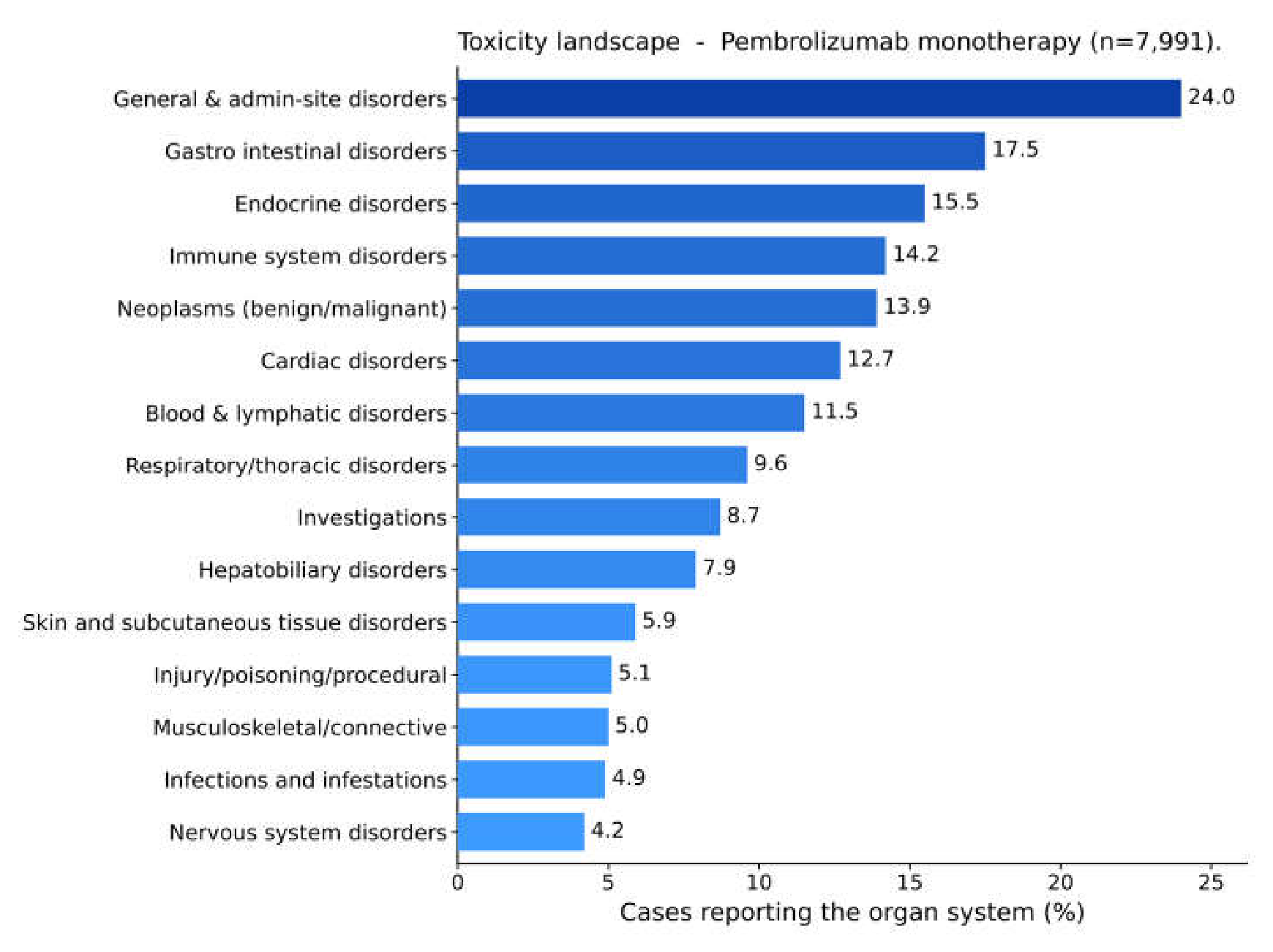
Figure 2.
Toxicity burden according to sex and age. Proportion of reports involving multiple SOCs according to sex and documented age group. No significant difference was observed according to sex (p=0.110), whereas the proportion differed significantly across age groups (p=0.026), with a lower rate among individuals aged >85 years.
Figure 2.
Toxicity burden according to sex and age. Proportion of reports involving multiple SOCs according to sex and documented age group. No significant difference was observed according to sex (p=0.110), whereas the proportion differed significantly across age groups (p=0.026), with a lower rate among individuals aged >85 years.
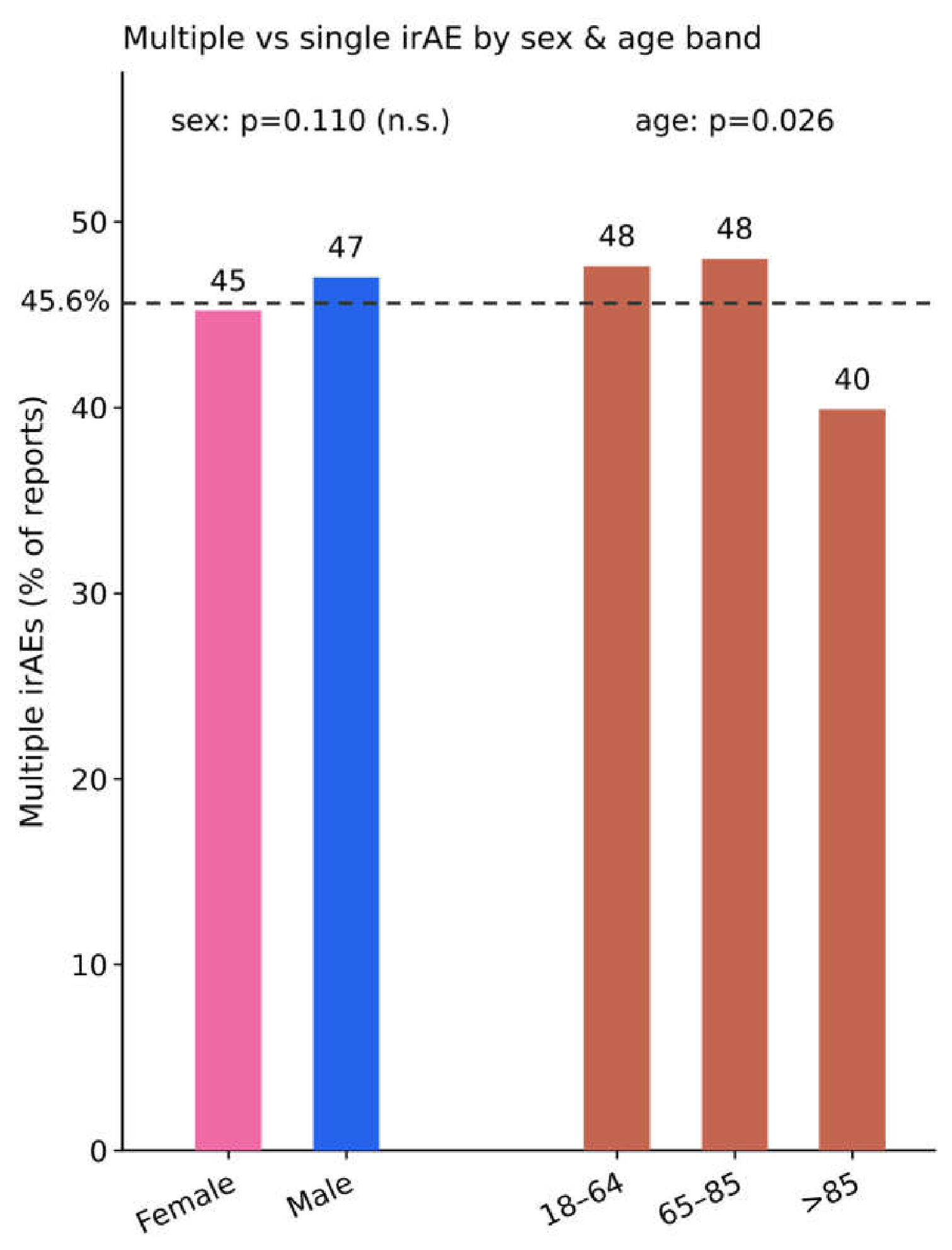
Figure 3.
Sex- and age-related patterns of reported toxicity. A) Odds ratios (male versus female, log scale) for each of the nine pre-specified MedDRA System Organ Classes among the 7,991 reports with documented sex. Bars are 95% confidence intervals. Coloured points denote classes significant at the Bonferroni-corrected threshold (p<0.05/9=0.0056); grey points are not significant. Odds ratios above 1 indicate more frequent reporting in men. B) Proportion of reports mentioning each of the four sex-associated organ classes, by documented age band (n=6,941). Panel (b) is descriptive; no statistical comparison across age bands was performed for individual organ classes.
Figure 3.
Sex- and age-related patterns of reported toxicity. A) Odds ratios (male versus female, log scale) for each of the nine pre-specified MedDRA System Organ Classes among the 7,991 reports with documented sex. Bars are 95% confidence intervals. Coloured points denote classes significant at the Bonferroni-corrected threshold (p<0.05/9=0.0056); grey points are not significant. Odds ratios above 1 indicate more frequent reporting in men. B) Proportion of reports mentioning each of the four sex-associated organ classes, by documented age band (n=6,941). Panel (b) is descriptive; no statistical comparison across age bands was performed for individual organ classes.
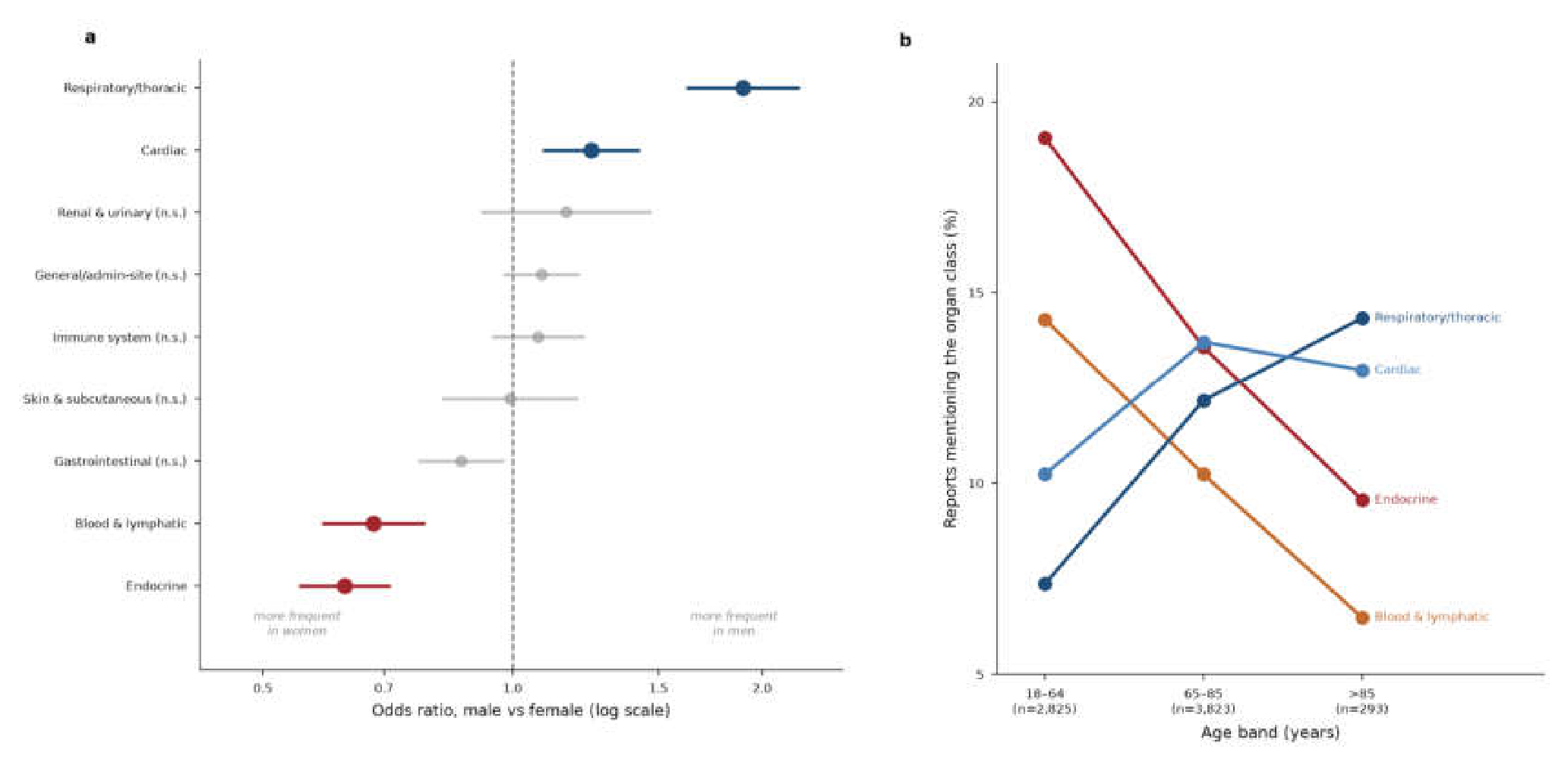

Table 1.
Characteristics of individual case safety reports included in the study.
| Characteristic | n (%) |
| Overall study population | 8,488 (100.0) |
| Sex | |
| Female | 4,159 (49.0) |
| Male | 3,832 (45.1) |
| Not specified | 497 (5.9) |
| Age group, years | |
| 18–64 | 2,825 (33.3) |
| 65–85 | 3,823 (45.0) |
| >85 | 293 (3.5) |
| Not specified | 1,547 (18.2) |
| Tumour-type evaluable population* | 6,482 (76.4) |
| Tumour type** | |
| Lung cancer | 1,967 (30.3) |
| Breast cancer | 1,363 (21.0) |
| Melanoma | 602 (9.3) |
| Renal cancer | 592 (9.1) |
| Cervical cancer | 423 (6.5) |
| Head and neck cancer | 377 (5.8) |
| Colon cancer | 243 (3.7) |
| Bladder cancer | 184 (2.8) |
| Genitourinary cancer | 182 (2.8) |
| Oesophageal cancer | 135 (2.1) |
| Endometrial cancer | 130 (2.0) |
| Bile duct cancer | 117 (1.8) |
| Gastric cancer | 114 (1.8) |
| Squamous cell carcinoma | 53 (0.8) |
*The tumour-type evaluable population included tumour categories represented by more than 50 reports. The percentage was calculated relative to the overall study population (N=8,488). ** Percentages for individual tumour types were calculated using the tumour-type evaluable population (n=6,482). Percentages may not sum to 100% because of rounding. ICSR, individual case safety report.
Disclaimer/Publisher’s Note: The statements, opinions and data contained in all publications are solely those of the individual author(s) and contributor(s) and not of MDPI and/or the editor(s). MDPI and/or the editor(s) disclaim responsibility for any injury to people or property resulting from any ideas, methods, instructions or products referred to in the content. |
© 2026 by the authors. Licensee MDPI, Basel, Switzerland. This article is an open access article distributed under the terms and conditions of the Creative Commons Attribution (CC BY) license (http://creativecommons.org/licenses/by/4.0/).
Copyright: This open access article is published under a Creative Commons CC BY 4.0 license, which permit the free download, distribution, and reuse, provided that the author and preprint are cited in any reuse.