

Submitted:
17 October 2026
Posted:
20 October 2026
You are already at the latest version
Abstract
This paper presents two related benchmark studies of AI-enabled wireless power transfer (WPT) for FR3 (7–24 GHz) ultra-massive MIMO (UM-MIMO) 6G base stations. Study 1 benchmarks time-slotted WPT scheduling across multiple IoT devices, comparing naive, sustainability-aware, round-robin and proportional-fair policies with a learned time-to-depletion predictor. Across 80 randomized 15-device populations, naive battery-priority scheduling saved none of the 238 physically sustainable devices, sustainability awareness raised the save rate to 23.5%, and a proportional-fair policy weighted by harvesting surplus performed best (51.7%), ahead of the learned predictor (42.4%). Study 2 asks whether an array should share its aperture between communication and WPT by partitioning its elements (power-splitting) or by alternating between the two functions in time (time-switching) under time-varying battery and queue demand. Power-splitting yielded shorter communication queues at every tested distance, and at 5 m, adaptive power-splitting avoided battery depletion in all 40 trials, whereas fixed allocation depleted the battery in every trial; adaptivity provided no such benefit under time-switching. Together, the studies indicate that the aperture-sharing architecture sets the achievable ceiling and the scheduling policy determines how close a deployment comes to it, so the architecture decision should be made first.
Keywords:
FR3
; ultra-massive MIMO
; wireless power transfer
; energy harvesting
; artificial intelligence
; scheduling
; SWIPT
; aperture sharing
; power splitting
; 6G
1. Introduction
This paper reports two complementary AI-enabled benchmark studies of wireless power transfer (WPT) for FR3 ultra-massive MIMO (UM-MIMO) 6G base stations. They are combined here because both address how to deliver RF power efficiently to multiple IoT devices from the same class of base-station array, but through two different design levers: the scheduling policy (Study 1) and the antenna-aperture architecture (Study 2).
FR3 (7–24 GHz), the “golden band” widely expected to anchor early 6G deployment [1,2], will combine substantial bandwidth with ultra-massive MIMO arrays of hundreds of elements [3]. The resulting beamforming gain (24.1 dB for a representative 256-element array, matching a validated closed-form computation used in the authors' companion studies) is large enough to deliver meaningful WPT to nearby energy-harvesting IoT devices. This extends decades of rectenna and RF energy-harvesting research [4,5] into a regime in which dedicated power delivery from the base station, rather than ambient RF scavenging alone, becomes a practical design option at short range. It also creates a scheduling problem specific to ultra-massive MIMO deployment: a base station with a single steerable beam serves at most one device at a time and must decide, slot by slot, which of potentially many competing devices to serve and whether to deliver power or communication data.
Dedicated power delivery of this kind is the basis of wireless powered communication networks (WPCNs), in which a controllable RF source, rather than ambient scavenging, supplies energy to low-power devices [6,7]. The canonical WPCN protocol divides each block in time between downlink energy transfer and uplink information transmission and already exhibits a “doubly near-far” unfairness, in which distant devices both harvest less and must transmit further [8]. Harvested power falls with distance according to the free-space link budget and is further limited by the RF-to-DC conversion efficiency of the rectenna [4,9]. Large antenna arrays mitigate this loss through energy beamforming [10]. Massive RF wireless energy transfer has been identified as an enabler of sustainable battery-less or battery-assisted IoT in the 6G era [11,12], and machine-learning-driven designs are increasingly proposed alongside model-based optimization for WPT resource allocation [13,14]. These strands converge at FR3, where the beamforming gain of ultra-massive arrays makes WPT from the base station feasible at short range but not far beyond it; deciding which device to power, when, and with which part of the aperture therefore becomes a central design question.
Study 1 develops an open simulation of this problem, combining the validated FR3 array-gain model used in the authors' companion studies with a Friis-equation WPT link budget, and directly tests a practically important question: which scheduling policy should govern this shared, contended resource, and can a learned predictor improve on simple, interpretable heuristics? The answer is more nuanced, and more useful, than a purely negative or purely positive result. A naive policy that always prioritizes the device with the lowest battery is not merely suboptimal but pathological: because it cannot distinguish a device that is merely low on charge from one that can never be sustained at its distance from the base station, it repeatedly serves the latter and, in the benchmark reported here, saves none of the devices that could have been saved. Accounting for physical sustainability substantially improves matters, but a further, less obvious finding emerges once several sustainable devices compete for the same beam: a hand-derived policy that allocates power in proportion to each device's harvesting surplus outperforms both simpler heuristics and a compact neural network trained to predict device urgency, and combining that learned urgency estimate with a proportional (rather than winner-take-all) allocation structure performs worse still.
The contributions of Study 1 are: (1) an open, physically grounded simulation of multi-device WPT and communication scheduling for FR3 ultra-massive MIMO base stations, released with full source code; (2) the identification and quantification of a scheduling pathology (naive battery-priority scheduling) that real deployments should avoid; and (3) a controlled comparison that separates the contribution of prediction accuracy from that of the allocation structure, showing that the latter matters more for this problem and that this could not have been predicted from the accuracy of either component alone. All reported results were obtained by executing the described simulation and training code. Where an initial, more limited system design masked the true scale of the scheduling problem (Section 4.1), we report the correction and what it revealed rather than the original result.
Study 2 turns to a complementary design lever for the same FR3 WPT problem: whether the antenna aperture should be shared between the communication and power-transfer functions in the power domain (splitting) or in the time domain (switching).
Ultra-massive MIMO array architectures, multisource energy-harvesting antenna design [15] and AI-enabled antenna design methods for 6G are each maturing, but they fit together poorly at UM-MIMO element pitch. Study 2 addresses an unresolved design tension that arises where they meet: aperture-sharing conflict. Communication-optimized array elements (tuned for gain, sidelobe level and polarization purity) and harvesting-optimized elements (tuned for broadband rectification and, in hybrid designs, optical transparency) compete for the same physical aperture at UM-MIMO element pitch. Closed-form illustrative analysis alone cannot resolve this constraint, so Study 2 addresses it through a dedicated simulation study.
Study 2 builds an open simulation of this problem, using standard array-gain and corrected Friis link-budget models (Section 5.1) as the physical basis for the comparison. Two classical architectural resolutions of aperture-sharing conflict, both established in the wider simultaneous wireless information and power transfer (SWIPT) literature [16,17], are compared under realistic, time-varying communication and harvesting demand: power-splitting, which permanently partitions the array's elements between communication and harvesting, and time-switching, which alternates the full array between the two functions over time. Within each architecture, a fixed allocation (static and tuned for the average case) is compared with an adaptive allocation that responds to the harvesting device's real-time battery level and the communication link's real-time queue state.
The results give the aperture-sharing problem a quantitative answer that closed-form analysis alone could not provide. Power-splitting dominates time-switching in communication queue stability at every tested distance, because full-array time-switching necessarily creates intervals with no communication service during harvesting phases, a structural cost that the continuous partial service of power-splitting avoids. The simulation also confirms that dedicated RF harvesting from a UM-MIMO array is viable only at short range, and it extends this finding with a new result: at a marginal distance near this viability boundary, adaptive power-splitting keeps the device sustainable indefinitely, whereas a fixed allocation depletes the battery in every trial, a qualitative rather than incremental improvement. The same adaptivity, however, is harmful when applied to the time-switching architecture.
The contributions of Study 2 are: (1) an open simulation of a well-posed aperture-sharing problem in UM-MIMO energy-harvesting antenna design, built on standard array-gain and link-budget models rather than an independently constructed physical model; (2) to our knowledge, the first controlled comparison of power-splitting and time-switching specifically for UM-MIMO aperture sharing under realistic time-varying demand; and (3) the identification of a conditional (not universal) benefit of adaptive allocation, verified across both architectures and three distance regimes rather than assumed from a single operating point.
2. Related Work
SWIPT research has established that the beamforming gain of massive MIMO can be reused directly as a dedicated, controllable energy source for nearby devices, and joint beamforming and power-splitting optimization frameworks have been proposed for cell-free massive MIMO and small-cell deployments [18,19]. FR3 in particular is expected to require ultra-massive MIMO arrays substantially larger than the 256-element arrays already used in 5G NR, sometimes termed extremely large aperture arrays (ELAAs) or “gigantic MIMO”, to realize its capacity potential [3]. A dedicated study of FR3 for integrated sensing and communication argues that ELAA-scale arrays will require learning-based solutions to address real-time design challenges as conventional far-field assumptions break down at this scale [2].
Proportional fairness is a well-established principle in wireless scheduling, used to balance throughput and fairness among users competing for shared spectrum resources [20]. Study 1 applies the same principle, allocating a shared resource in proportion to each contender's marginal benefit rather than to raw urgency or a fixed rotation, to a problem that, to our knowledge, has not previously been benchmarked: WPT-versus-communication scheduling under a physical sustainability constraint specific to dedicated (rather than ambient) RF energy harvesting. Reinforcement-learning and deep-learning approaches to joint communication and energy-harvesting resource allocation have been demonstrated for related problems, including antenna selection and precoding for full-duplex MIMO systems that harvest energy while exchanging information [21], and they typically report improvements over non-learned baselines. Study 1 instead shows a case in which a learned predictor, despite being accurate at its own narrow task, does not improve on a well-designed non-learned allocation principle, and identifies why.
In network rate control, proportional fairness was formalized as the maximization of a sum of logarithmic utilities, with decentralized rate-control algorithms that converge to proportionally fair allocations [22]; it also underlies the proportional-fair scheduler used with opportunistic beamforming in multi-user downlinks [20]. On the energy side, the relevant notion of sustainability is energy-neutral operation, under which a harvesting-powered node's long-run consumption must not exceed its harvested energy, with the battery buffering short-term variations [23]; the eligibility rule used in Study 1 applies this criterion per device to dedicated WPT. Time and energy allocation among multiple wireless-powered devices has been studied extensively in the WPCN literature, including the fairness issues that arise from distance-dependent harvesting [7], and deep reinforcement learning has recently been applied to scheduling multi-antenna RF charging of multiple devices with non-linear harvesters, reducing transmit energy, although performance degrades as the number of devices grows [14]. Because practical rectifiers saturate at high input power, resource allocation designed under a constant-efficiency model may not match real harvesters [24]; this caveat applies to the link budgets used here and is revisited in Section 8.
Related machine-learning-based WPT resource-allocation work includes contextual-learning beam scheduling for IoT power transfer, joint beamforming and power-splitting control for SWIPT-enabled IoT based on deep reinforcement learning and game theory, machine-learning-based SWIPT for cell-free massive MIMO non-orthogonal multiple access (NOMA) networks, deep-reinforcement-learning resource allocation for massive MIMO-NOMA-SWIPT systems, and robust deep-reinforcement-learning beamforming for integrated sensing, communication and power transmission [25,26,27,28,29].
The Study 2 simulation (Section 5.1) builds on standard closed-form models from array and link-budget theory: array gain and beamwidth scaling with element count; a corrected Friis-based WPT link budget that includes 1-bit phase-quantization loss, frequency-dependent atmospheric absorption and realistic antenna radiation efficiency; and power-density figures for different harvesting modalities compiled from the literature. Applying this link budget shows that dedicated RF harvesting from a 1024-element array becomes competitive with ambient harvesting modalities only within approximately 1–2 m, a substantially shorter range than an idealized (uncorrected) calculation implies. The simulation, built independently around a time-varying battery and queue model rather than a static link-budget analysis, reproduces this short-range-viability conclusion (Section 6.1) and therefore provides an independent, dynamic cross-check of the static result.
Power-splitting and time-switching were established as the two canonical hybrid-receiver architectures for SWIPT in the foundational rate–energy trade-off analysis, which introduced dynamic power splitting and characterized time switching, static power splitting and on–off power splitting as its special cases [16]; the same dichotomy was extended to multi-antenna broadcasting shortly afterwards [17]. This foundational literature, and the large body of SWIPT resource-allocation research that followed, including treatments specific to massive MIMO [30,31] and joint beamforming and power-splitting frameworks for cell-free and small-cell deployments [18,19], treats power-splitting and time-switching as two configurations of a single beamforming resource with a tunable ratio. It does not address the aperture-sharing question specific to UM-MIMO that Study 2 examines: how many discrete physical array elements to dedicate, permanently or dynamically, to each function. A 2017 study, the closest in spirit to this architectural question, adopts dynamic time-switching antennas in place of power-splitting antennas in a massive MIMO energy-harvesting network, citing the practical problems of power-splitting hardware (complex architectures, power loss and signal distortion when the received signal is split), and uses many such antennas so that information decoding and energy harvesting proceed concurrently on different antennas [32]. However, it optimizes transmission power and antenna allocation for a static energy-efficiency objective rather than under the time-varying battery and queue dynamics modeled here. A more recent framework jointly optimizes the time-slot allocation and the power-splitting ratio within a single SWIPT-enabled sensor network, rather than treating them as competing architectural alternatives as Study 2 does [33].
Surveys of SWIPT receiver design identify three practical ways to share an RF front end between information decoding and energy harvesting: time switching, power splitting and antenna switching [34,35]. Antenna switching partitions the antenna elements into one subset used for information decoding and another used for harvesting [36], and is therefore the element-level counterpart of what this paper, following the aperture-sharing framing, calls power-splitting (Section 5.2). Dynamically adapting the power-splitting ratio to channel conditions improves the rate–energy trade-off over fixed splitting [37], and analytical comparisons of time-switching and power-splitting relaying protocols show that neither dominates universally; the preferred choice depends on the signal-to-noise ratio and the transmission rate [38]. The dominance of one architecture over the other reported in Study 2 should therefore be read as specific to the element-partitioned, battery-and-queue setting modeled here. At massive-MIMO scale, the frame-level time allocation between downlink energy beamforming and uplink information transmission has been optimized for max–min throughput as the antenna count grows [39], and massive RF energy transfer to IoT devices is increasingly framed as a 6G system function [11]. As arrays grow further, devices may fall within the radiative near field, where beams can be focused in both angle and distance [40] and energy beam focusing can raise WPT efficiency [41]; the far-field array model used in Study 2 does not capture this effect, which is discussed in Section 8.
Several works adapt the power-splitting decision to the system state. Dynamic power-splitting strategies that adjust the splitting ratio to instantaneous channel-state information have been proposed for relay networks [42], and schemes that jointly control power allocation and the splitting ratio, optimizing information decoding and energy harvesting together, outperform conventional rate maximization [43]. This is in the same spirit as the Study 2 finding that adaptive allocation can turn an unsustainable operating point into a sustainable one; unlike Study 2, however, these works adapt to the channel state rather than to the joint battery and queue state, and they do not compare the resulting benefit across architecturally distinct receiver structures. Reconfigurable intelligent surfaces (RISs), the hardware platform underlying the 1-bit-quantized array configuration modeled in the link budget (Section 5.1), have been analyzed and experimentally validated as a platform for WPT beamforming and beam focusing [44], which is directly relevant to the emphasis here on RIS-based UM-MIMO implementations. On the queueing side of the battery-and-queue model, a foundational analysis of throughput-optimal and delay-minimizing energy management policies for a sensor node with a harvested-energy buffer and a data queue [45] establishes the joint battery-and-data-queue structure used in the simulation, and this has more recently been extended to account explicitly for customer impatience in the queueing dynamics of an energy-harvesting service system [46]. Research on energy-efficient antenna selection for extra-large-scale (XL-) MIMO under non-stationary channels [47] provides further context for why element-level (rather than purely beamforming-level) resource decisions, the focus of Study 2, matter increasingly at UM-MIMO scale.
A hybrid deep-reinforcement-learning design of antenna selection and precoding for a full-duplex MIMO system that harvests energy while exchanging information has been proposed alongside a relaxation-based method, and the resulting system outperforms conventional time-switching SWIPT in spectral efficiency [21]. This establishes learned, adaptive resource allocation as a viable approach for this class of problem at the system level. As Study 2 shows, however, such a benefit is specific to the architecture within which it is applied and is not guaranteed to transfer to another. The reviewed literature does not address this distinction, as it typically evaluates a single architecture rather than comparing the benefit of adaptive allocation across two structurally different ones.
Related work on shared-aperture and joint SWIPT hardware and systems includes a shared-aperture dual-band transmit array for RF wireless power transfer, a reconfigurable wideband MIMO antenna combining communication and RF energy harvesting, a jointly modulated programmable metasurface for high-efficiency SWIPT, and robust SWIPT design for beamspace massive MIMO [31,48,49,50].
Taken together, these literatures leave two specific gaps, which the two studies address in turn. For scheduling, WPCN and learning-based WPT studies optimize time, power or beamforming allocations, but they rarely separate the contribution of prediction accuracy from that of the allocation structure in which a learned component is embedded, or examine how a physical sustainability constraint interacts with multi-device contention for a single beam. For architecture, SWIPT research treats power splitting, time switching and antenna switching mainly as receiver-side options adapted to the channel state, whereas the question of how many physical elements of an ultra-massive transmit array to dedicate to each function, under joint battery and queue dynamics, has not been benchmarked directly.
Study 1: WPT Scheduling
3. System Model and Methods
3.1. FR3 WPT Link Budget
A 256-element uniform linear array (ULA) at 15 GHz (FR3), with an array gain of 24.1 dB (matching the independently validated computation used in the authors' companion studies) and a conducted transmit power of 33 dBm, delivers RF power to each device according to the Friis transmission equation; this power is converted to harvested DC power with a representative RF–DC rectifier efficiency of 50%. Devices are placed uniformly at random within a small cell of 30 m radius. An initial system design used the measured Power Saving Mode (PSM) current of a representative narrowband IoT (NB-IoT) modem (25.34 μA, cited in the authors' companion studies) as the device background drain. On inspection, this drain exceeded the harvestable power at all but the shortest distances (below approximately 3 m), leaving no meaningful scheduling problem, since no device beyond a few meters could be sustained under any policy (Section 4.1 reports this check). Devices in the simulation therefore use a representative ultra-low-power energy-harvesting sensor profile (3 μA average drain at 3.3 V), consistent with the sub-100 μW design targets common in the energy-harvesting wireless sensor network (WSN) literature. Under this profile, the break-even distance (at which harvested power equals background drain) is approximately 8 m, short enough to create a physically bounded scheduling problem that is neither trivial nor hopeless. Formally, the RF power received by device i at distance d_i follows the Friis transmission equation [51], P_r(d_i) = P_t G_t G_r (λ/(4πd_i))^2, where P_t = 33 dBm, G_t = 24.1 dB is the array gain, G_r is the device antenna gain (taken as isotropic, 0 dBi) and λ = 2 cm at 15 GHz; the harvested DC power is h_i = η P_r(d_i), with η = 0.5 [4]. These values give h_i ≈ 38 μW at 4.1 m and ≈ 1.6 μW at 20.2 m, the harvest rates reported for the example devices in Section 4.1, and h_i equals the 9.9 μW sensor drain at d_i ≈ 8 m. A constant η is a first-order approximation: measured rectifiers are non-linear and saturate at high input power [9,24], as discussed in Section 8.
3.2. Time-Slotted Scheduling Problem
Time is divided into 1 s slots. In each slot, the base station's single beam serves exactly one device, either with WPT (increasing that device's battery charge at its distance-dependent harvest rate) or with communication service (draining that device's data queue by a fixed amount). The batteries of all devices drain continuously at the background rate, regardless of which device is served in that slot. Communication data arrive at each device as an independent Poisson process. A device that is never, or too rarely, scheduled for WPT will have its battery deplete, which is recorded as a depletion event. The central question is therefore how to schedule the single shared beam in each slot across potentially many devices that are simultaneously low on battery and have queued data. Formally, with slot length Δt = 1 s, the stored energy of device i evolves as b_i(t+1) = b_i(t) + (h_i s_i(t) − c_i)Δt, bounded by the battery capacity, where s_i(t) = 1 if device i receives WPT in slot t and 0 otherwise, and c_i is its background drain; a depletion event is recorded when b_i(t) reaches zero. Device i is physically sustainable only if h_i > c_i, the per-device form of energy-neutral operation [23]; no scheduling policy can keep a device with h_i ≤ c_i alive indefinitely.
3.3. Scheduling Policies
Five policies are compared. All use the same information (each device's current battery level, communication queue length and harvest rate, implied by its known distance) and differ only in the allocation rule. Naive greedy: serves the device with the lowest battery with WPT whenever any device is below a fixed threshold, regardless of whether that device is physically sustainable. Sustainability-aware greedy: restricts WPT eligibility to devices whose harvest rate exceeds their background drain rate and then serves the eligible device with the lowest battery. Round-robin: cycles through the eligible, below-threshold devices in turn rather than always selecting the one with the lowest battery. Proportional-fair: allocates each slot probabilistically among the eligible, below-threshold devices, with probability proportional to each device's harvesting surplus (harvest rate minus drain rate), a direct application of the proportional-fairness principle from the wireless scheduling literature [20] to this WPT allocation problem. ML predictive (machine-learning-based): a compact neural network (Section 3.4) predicts the time-to-depletion of each eligible device, and the device with the shortest predicted time-to-depletion is served in each slot (a learned analogue of the sustainability-aware greedy rule). A sixth, hybrid ML-proportional policy, which uses the same learned urgency estimate as probabilistic allocation weights rather than for greedy selection, is also tested (Section 4.3) to determine whether the value of the learned predictor depends on the allocation structure in which it is embedded. Formally, the proportional-fair policy serves eligible device i in slot t with probability p_i(t) = (h_i − c_i)/Σ_{j∈E(t)} (h_j − c_j), where E(t) is the set of sustainable devices currently below the battery threshold. Unlike the logarithmic-utility form of proportional fairness used for rate allocation [22], the weights here are the devices' harvesting surpluses, a direct measure of each device's marginal benefit per WPT slot.
3.4. Learned Time-to-Depletion Predictor
A compact multilayer perceptron (two hidden layers of 32 units, ReLU activation) is trained to predict a device's time-to-depletion, expressed in log-space because of the target's wide dynamic range, from four input features: normalized battery level, harvest rate, recent WPT service fraction and harvesting surplus. The model is implemented in PyTorch [52] and trained with the Adam optimizer [53] and a mean-squared-error (MSE) loss on 50,000 synthetically generated (battery, harvest-rate, service-fraction) examples with exactly computed ground-truth time-to-depletion. On a held-out validation set of 10,000 examples, it converges to a validation MSE of 1.10 in log-space, corresponding to a typical multiplicative prediction error of the order of e^1.05 ≈ 2.9× relative to the true time-to-depletion, which is sufficient for the coarse urgency-ranking task for which the predictor is used.
All policies are evaluated on the same 80 randomly generated 15-device populations, so that differences in outcome can be attributed to the allocation rule alone. Across these populations, 238 devices are physically sustainable (h_i > c_i). The principal metric, the save rate, is the fraction of these 238 devices that are kept from depleting; devices that are not physically sustainable are excluded from the denominator because no policy can save them. The learned predictor is trained only on synthetically generated examples, never on trajectories from the evaluation populations, and all simulation, training and evaluation code is provided as Supplementary Material (see the Data Availability Statement), so that every reported figure can be regenerated.
3.5. Generative AI Disclosure
Literature retrieval, development of the WPT link-budget and multi-device scheduling simulation code, model training, the device-power-profile correction and the subsequent policy-design investigation described in Section 4.1, Section 4.2 and Section 4.3, figure generation and manuscript drafting were carried out with the assistance of an AI language model (Claude, Anthropic) under direct human supervision and iterative review. All reported quantitative results were computed by executing the described simulation and training code. The authors are responsible for verifying, and take full responsibility for, the accuracy of all reported figures, model assumptions and citations.
4. Results
All results were computed by running the code described in Section 3 on 80 randomly generated 15-device populations (238 physically sustainable devices in total); no result was written before the corresponding code had been executed.
4.1. The Device Power-Profile Check and the Naive-Policy Pathology
Before any scheduling comparison could be meaningful, a basic physical check was needed: does dedicated WPT with this link budget actually exceed a realistic device's background drain at plausible small-cell distances? With the measured PSM current of a representative NB-IoT modem (25.34 μA, i.e., 83.6 μW at 3.3 V) as the device profile, harvested power exceeded the drain only within approximately 3 m of the base station and fell to roughly one-tenth of the drain by 10 m. Under this profile, almost no device in a realistic small-cell deployment could be sustained by WPT under any scheduling policy, leaving no real scheduling problem to study. Switching to a representative energy-harvesting-optimized sensor profile (3 μA, 9.9 μW), consistent with the sub-100 μW design targets in the energy-harvesting WSN literature, gave a break-even distance of approximately 8 m, and this corrected profile is used for all remaining results.
Table 1 and Figure 1 show that the naive greedy policy saves none of the 238 physically sustainable devices across the entire benchmark; it does not merely underperform but fails completely. Inspection of one representative population (device distances 3.4–28.2 m) explains why. The naive policy allocated 3343 of the 3600 available WPT slots (93%) to a single device at 20.2 m, whose harvest rate (0.0016 mW) was far below its drain rate (0.0099 mW), so that it could never be sustained regardless of how much WPT time it received. Meanwhile, a device at 4.1 m, whose harvest rate (0.038 mW) was nearly four times its drain rate and which could easily have been sustained with modest attention, received only 6 WPT slots during the entire hour-long simulation and depleted. The flaw is that the naive policy has no mechanism to distinguish a device that is merely low on charge from one that cannot be saved, and a metric based on battery level alone cannot make this distinction: both devices look identical (low battery) to the policy, but only one can be helped.
4.2. Sustainability Awareness Is Necessary but Not Sufficient
Restricting WPT eligibility to devices whose harvest rate exceeds their drain rate (sustainability-aware greedy) raises the save rate from 0% to 23.5%, confirming that simply avoiding the core error of the naive policy, namely spending time on devices that cannot be saved, recovers a substantial fraction of the otherwise avoidable loss. However, 23.5% remains far below the 51.7% achieved by the best policy tested (Section 4.3), showing that sustainability awareness alone is insufficient. Figure 2 shows why: when several sustainable devices fall below the low-battery threshold at the same time and compete for the single beam, always serving the device with the lowest battery (as the sustainability-aware policy does) leaves some competing devices neglected long enough to deplete, even though each would be sustainable in isolation. This capacity-contention effect is distinct from the error of the naive policy: a device can be sustainable when it is the only one needing attention, yet still deplete when several sustainable devices compete for a shared single-beam resource without an explicit fairness mechanism.
Figure 2 shows that when a population contains a single sustainable device, all three policies save it, since there is no competition for the shared beam; populations with no sustainable device are plotted at zero because there is nothing to save. With two or three sustainable devices, outcomes already vary between populations, and the sustainability-aware greedy policy (blue) fails completely in several of them. As the number of competing sustainable devices grows to four or more, the policies diverge substantially: the sustainability-aware greedy policy clusters at zero survival, whereas the proportional-fair policy (red) is the only one to reach survival fractions of 0.5 or above in populations with five or more sustainable devices, and it still saves some devices at the highest contention level tested (seven).
4.3. Allocation Structure Matters More Than Predictor Accuracy
Round-robin fairness among eligible devices raises the save rate further, to 38.7%, without using any battery or urgency information beyond eligibility: simply guaranteeing that no single device can monopolize the shared beam already substantially outperforms the urgency-only prioritization of the sustainability-aware greedy policy. The proportional-fair policy, which allocates WPT probabilistically in proportion to each eligible device's harvesting surplus, performs best of all six policies tested, at 51.7%.
The learned predictor, evaluated in a greedy configuration (always serving the device with the shortest predicted time-to-depletion), achieves 42.4%, a clear improvement over both the sustainability-aware and round-robin baselines, which confirms that the learned urgency estimate carries useful information. However, it does not reach the 51.7% achieved by the much simpler, hand-derived proportional-fair policy. Combining the same learned urgency estimate with proportional (rather than greedy, winner-take-all) allocation, to test whether the predictor's accuracy and the fairness of the proportional structure could be combined for a further improvement, instead performs markedly worse, at 27.3%, below even simple round-robin. This result was obtained by implementing and executing the hybrid policy, not inferred.
The most direct interpretation is that the advantage of the proportional-fair policy comes from what it optimizes, namely harvesting surplus, a direct measure of the marginal benefit a device receives per unit of WPT time, rather than from the sophistication of its device-selection mechanism. The learned predictor targets a different and superficially reasonable quantity: time-to-depletion, that is, urgency. However, urgency and marginal benefit per unit time are not the same and can favor different devices: a device very close to depletion may need substantial WPT time before it is meaningfully helped, whereas a device with a high harvesting surplus but a comfortable battery level offers more benefit per unit of scheduling time. Embedding an urgency-based estimate in a proportional-sharing structure rather than a greedy one does not resolve this mismatch and can compound it, because proportional sharing spreads limited WPT time across several devices in proportion to urgency rather than concentrating it efficiently, which worsens outcomes when an urgent device needs sustained rather than divided attention. This mechanistic explanation also yields a concrete, testable design implication: to match or exceed the proportional-fair baseline, a learned policy for this problem should be trained to predict or approximate marginal benefit rather than urgency.
Study 2: Aperture-Sharing Architecture
5. System Model and Methods
5.1. Array-Gain and Link-Budget Models
Array gain and half-power beamwidth are computed from standard array-theory formulas [54]: array gain (dBi) = 10log10(N) + 5 (assuming a per-element gain of 5 dBi), with a 3.9 dB penalty applied for 1-bit phase quantization, and half-power beamwidth = 0.886λ/(Nd) for an element spacing of d = λ/2. These formulas give 17.0 dBi and 6.35° at N = 16, 47.1 dBi and 0.01° at N = 16,384, and 31.2 dBi (quantized) for the representative N = 1024 configuration used throughout Study 2. The received WPT power is computed with a corrected Friis link budget (Section 2): P_r = P_t + G_t + G_r − L_p − L_atm − L_η, with P_t = 33 dBm, G_r = 3 dBi, frequency-dependent atmospheric attenuation and frequency-dependent antenna efficiency. The WPT ranges at a −20 dBm threshold derived from this link budget (e.g., 4.1 m at 100 GHz) are taken from the authors' own calculation; the Study 2 results themselves use the received-power values directly rather than any threshold-based range. The 10log10(N) scaling of array gain reflects the coherent beamforming gain that underpins massive MIMO [55,56], and it is this gain, at the array sizes anticipated for the upper mid-band [1,3], that makes WPT from the base station feasible at short range.
5.2. Aperture-Sharing Architectures
A 1024-element array serves one device that requires both communication service and WPT charging. Communication capacity is computed as log2(1 + SINR), where SINR is the signal-to-interference-plus-noise ratio, using the same array-gain and link-budget model as the WPT calculation (Section 5.1), so that both functions share a single, internally consistent physical model. Power-splitting permanently partitions the array into N_comm communication elements and N_total − N_comm harvesting elements, each subset achieving its own array gain according to the same 10log10(N) scaling law; time-switching instead allocates the full array to communication for a fraction ρ of each scheduling frame and to harvesting for the remaining 1 − ρ. In SWIPT terminology, this element-partitioned form of power-splitting corresponds to antenna switching, in which disjoint subsets of antenna elements serve information and energy [34,36]; the term power-splitting is retained here for consistency with the aperture-sharing framing of Section 1. Formally, power-splitting provides simultaneous gains G_c = 10log10(N_comm) + G_e − L_q and G_h = 10log10(N_total − N_comm) + G_e − L_q, where G_e = 5 dBi is the element gain and L_q = 3.9 dB is the 1-bit quantization loss, whereas time-switching provides the full-array gain to each function, but only for a fraction ρ (communication) or 1 − ρ (harvesting) of each frame.
5.3. Time-Varying Demand Model
The battery of the harvesting device drains continuously at the measured NB-IoT PSM current (25.34 μA at 3.3 V; Nordic nRF9151-DK, cited and used in the authors' companion studies) from a small representative buffer (0.05 mWh). Communication data arrive as an independent Poisson process whose mean rate is set below the maximum sustainable service rate at full communication allocation, so that queue instability (arrivals exceeding even the best-case service capacity under any policy) does not confound the comparison between policies. Four policies are compared: fixed power-splitting and fixed time-switching, each using a single static allocation (N_comm = 0.85 N_total or ρ = 0.85, tuned to favor communication under typical conditions) regardless of the real-time state; and adaptive power-splitting and adaptive time-switching, each of which shifts toward harvesting when the battery is low and the queue is not yet critical, toward communication when the queue is critical and the battery is not yet low, and to a balanced default otherwise. A measured current for a commercial module is used because experimental characterizations of commercial NB-IoT devices show that energy consumption varies strongly with operating conditions [57]. Formally, with time step Δt, the battery evolves as B(t+1) = min{B_max, max{0, B(t) + (P_h(t) − P_d)Δt}}, where P_h(t) is the harvested power delivered by the current allocation, P_d = 83.6 μW is the device drain (25.34 μA at 3.3 V) and B_max = 0.05 mWh, and the communication queue evolves as Q(t+1) = max{0, Q(t) + A(t) − S(t)}, where A(t) is the Poisson arrival count and S(t) is the service delivered by the current communication allocation. A trial is recorded as depleted if B(t) reaches zero; each trial runs for 3000 time steps, and the reported metrics are the depletion rate across the 40 trials per distance and the mean queue length.
5.4. Generative AI Disclosure
Literature retrieval, development of the array-gain, link-budget, aperture-sharing and time-varying demand simulation code, figure generation and manuscript drafting were carried out with the assistance of an AI language model (Claude, Anthropic) under direct human supervision and iterative review. All reported quantitative results were computed by executing the described simulation code. The authors are responsible for verifying, and take full responsibility for, the accuracy of all reported figures, model assumptions and citations.
6. Results
All results were computed by running the code described in Section 5 on 40 held-out trials per distance; no result was written before the corresponding code had been executed.
6.1. Short-Range Viability
The simulation, built around a time-varying battery and queue model rather than a static link-budget analysis alone, confirms the short-range-viability conclusion implied by the static link budget discussed in Section 2. Full-array dedicated harvesting delivers 3.05 mW at 1 m but only 0.05 mW at 8 m, and the harvest/drain ratio (harvested power relative to the measured device drain) falls from 36.5× at 1 m to about 1.5× at 5 m, reaching the 1.0× sustainability break-even point at approximately 6 m (about 0.6× at 8 m). This dynamic-simulation result is an independent cross-check of the static closed-form analysis in Section 2, not a re-derivation of the same result by the same method.
6.2. Power-Splitting Dominates Time-Switching
Figure 3 shows that power-splitting achieves a substantially lower mean communication queue length than time-switching at every tested distance: by roughly 2–3× under fixed allocation and, under adaptive allocation, by a factor of about five at 2 m and by more than two orders of magnitude at 5 m and 8 m. This is a structural effect of the architecture rather than an artifact of parameter tuning: time-switching allocates the full array to harvesting for a fraction of each frame, during which communication receives no service at all, creating bursts of queue growth that the continuous partial service of power-splitting avoids by construction. This result answers the aperture-sharing question identified in Section 1 quantitatively, in a way that closed-form analysis alone could not: for UM-MIMO arrays that serve both communication and harvesting, power-splitting is the architecturally preferable solution, not merely one of two comparable options.
6.3. Adaptive Allocation's Benefit Is Conditional on Architecture
Table 2 and Figure 4 show the central finding of Study 2: at 5 m, near the harvest/drain break-even distance identified in Section 6.1, adaptive power-splitting results in no depletion in any of the 40 trials, whereas fixed power-splitting depletes in every trial. This is a qualitative change from certain failure to indefinite sustainability rather than an incremental improvement, and it is directly actionable for UM-MIMO deployment: in this identifiable distance regime, the choice between fixed and adaptive allocation determines whether a harvesting device works indefinitely or not at all.
This benefit does not transfer to the time-switching architecture. Adaptive time-switching still depletes in 100% of trials at 5 m, exactly as fixed time-switching does, while, as Figure 3 (Section 6.2) shows, incurring a mean queue length more than two orders of magnitude higher than that of either power-splitting policy. The benefit of adaptive allocation is therefore conditional on the architecture rather than universal. Within power-splitting, continuous partial service to both functions gives the adaptive policy useful intermediate operating points, allowing it to turn unsustainability into sustainability; within time-switching, the all-or-nothing service structure of the architecture limits what any allocation policy, however well designed, can achieve.
7. Joint Discussion
The most immediately actionable finding of Study 1 is also the simplest: naive battery-priority scheduling is not a reasonable default for WPT and should not be assumed safe merely because it seems intuitive (helping whoever is currently worst off). Any FR3 UM-MIMO deployment offering dedicated WPT to energy-harvesting devices should, at a minimum, restrict WPT eligibility to devices whose harvest rate at their known or estimated distance exceeds their expected drain rate, a check that requires only a link-budget calculation, not a learned model. This step alone recovers a substantial fraction of the achievable device survival relative to the naive alternative.
The subtler finding, that a hand-derived proportional-fairness policy outperforms a purpose-trained learned predictor and that combining the predictor with a proportional allocation structure performs worse still, qualifies an implicit assumption common in the AI-for-wireless-scheduling literature reviewed in Section 2: that a more accurate or more sophisticated learned component should improve system-level outcomes. The results show that the choice of optimization target (marginal benefit versus urgency) and its interaction with the allocation structure (greedy versus proportional) can matter more than the accuracy of the underlying predictor, and that these two design choices are not independent: the same predictor performs differently depending on the allocation structure it feeds, in a direction that is not obvious in advance. AI-driven resource-allocation research on structurally similar problems should therefore report results for several allocation structures for any learned component, rather than assuming a single natural pairing, and should check whether the predicted quantity is actually the right optimization target before assuming that predicting it more accurately will help.
The design implication identified in Section 4.3, that an effective learned policy for this problem should predict or approximate marginal benefit rather than urgency, is a testable hypothesis for future work, not a claim validated here. Training a model directly on a marginal-benefit target, or on the eventual system-level device-survival outcome through reinforcement learning rather than a supervised proxy target, are natural next steps that the benchmark structure directly supports.
The Study 2 discussion below addresses the architectural trade-off specific to aperture sharing. Taken together, the two studies indicate that the scheduling policy and the aperture-sharing architecture are largely separable design levers for FR3 WPT: the choice of architecture (power-splitting or time-switching) sets the achievable ceiling, and the scheduling policy determines how close a given deployment comes to it.
Study 2 gives the aperture-sharing gap identified in Section 1 a two-part answer, and both parts matter for real deployment decisions. First, the choice of architecture has a large and consistent effect, independent of the sophistication of the allocation: power-splitting should be preferred over time-switching for UM-MIMO arrays that serve both communication and harvesting, because this preference holds under both fixed and adaptive allocation and at all three tested distances, making it a low-risk, broadly applicable recommendation. Second, the value of adaptive allocation is real but architecture-specific. It justifies the added complexity within power-splitting, where it can make the difference between a sustainable and an unsustainable device at realistic operating distances, but it does not rescue an unsustainable time-switching deployment and should not be assumed to transfer between architectures without direct testing. This is consistent with a broader pattern in the authors' companion studies, in which the benefit of an adaptive policy depends on the structure within which it operates, not only on the sophistication of the policy.
The distance regime identified in Section 6.3 (adaptive power-splitting achieving sustainability at 5 m, where fixed allocation always fails) is itself a useful and checkable design target: a real system could identify its own marginal-distance regime using the harvest/drain break-even calculation of Section 6.1 and apply adaptive allocation specifically there, rather than uniformly at all operating distances.
These findings have practical implications beyond the simulated settings. For operators considering dedicated WPT from FR3 base stations, Study 1 indicates that a link-budget-based sustainability check and a surplus-weighted fair scheduler should be in place before any learned component is introduced, and Study 2 indicates that element-partitioned (power-splitting) aperture sharing, with adaptive allocation near the harvest/drain boundary, is the configuration most likely to keep marginal devices alive. Such configurations are relevant to battery-assisted and battery-less IoT sensors in dense deployments, where massive wireless energy transfer is expected to reduce battery replacement and maintenance [11,12], and to user equipment whose harvesters are designed for RF charging from 5G/6G infrastructure [5].
8. Limitations and Future Research Directions
Study 1 has several limitations. First, the device population model (Section 3.1) places devices uniformly at random within a small cell of fixed radius; real deployments would have structured, non-uniform device distributions that could change the relative importance of the effects identified here. Second, the communication-queue model (Section 3.2) uses a simple Poisson arrival process and a fixed per-slot service rate; it does not capture quality-of-service (QoS)-differentiated traffic or sophisticated communication-side scheduling, and it was deliberately kept simple so that the WPT scheduling comparison, the focus of Study 1, would not be confounded by communication-scheduling complexity. Third, the learned predictor (Section 3.4) is trained on synthetically generated, independent and identically distributed (battery, harvest-rate, service-fraction) examples rather than on trajectories generated by interaction with the multi-device simulation; a predictor trained through direct interaction with the environment (e.g., by reinforcement learning) might behave differently, and testing this is left for future work. Fourth, the surplus-based weighting of the proportional-fair policy was derived by hand from first principles rather than tuned or learned; although it performed best among the policies tested here, this does not make it provably optimal, and a more sophisticated hand-derived or learned policy might perform better still. Fifth, the RF–DC rectifier efficiency (50%) and other link-budget parameters (Section 3.1) are representative rather than measured; different values would shift the break-even distance and the absolute save rates without changing the qualitative findings, which follow from the structure of the scheduling problem rather than from these particular parameter values. Sixth, no field measurements or hardware implementation are reported; this is a simulation-based benchmark, and the absolute save rates should be interpreted as illustrating the comparative findings (the naive-policy pathology, contention effects and sensitivity to allocation structure) rather than as validated operational targets for a specific deployed system.
Study 2 also has limitations. First, the array-gain and link-budget models (Section 5.1) are closed-form, first-order approximations that exclude mutual coupling, amplitude/phase taper losses, per-element calibration errors, multipath and beam misalignment, each of which would be expected to reduce further the gain and received-power figures used in the simulation. Second, the communication capacity model (Section 5.2) uses a simplified log2(1 + SINR) proxy rather than a full throughput model that accounts for link adaptation, coding and modulation. Third, the time-varying demand model (Section 5.3) uses a single representative device (one battery buffer size, one drain current and one arrival-rate regime); a population of heterogeneous devices with different demand profiles was not modeled and is a natural extension, given the multi-device benchmarks used in the authors' companion studies. Fourth, no full-wave electromagnetic simulation, hardware measurement or physical prototype of either aperture-sharing architecture is reported; this is a simulation-based benchmark built on standard closed-form array-gain and link-budget models, and the absolute queue and depletion figures should be interpreted as illustrating the comparative and architectural findings rather than as validated operational targets for a specific deployed system.
Beyond the specific next steps identified above, several broader research directions follow. The link budgets in both studies should be combined with measured, non-linear rectifier models [9,24], since saturation at short range and sensitivity limits at long range would change both the break-even distance and the value of concentrating WPT time on a single device. Learned schedulers should be trained on marginal-benefit or system-level survival objectives, for example with deep reinforcement learning of the kind recently applied to multi-user RF charging [14], and compared with the proportional-fair baseline under the benchmark protocol used here. For aperture sharing, dynamic adaptation of the element partition could draw on dynamic power-splitting theory [37], and, as arrays approach the sizes anticipated for FR3, near-field beam focusing [40,41] should be incorporated, since it can concentrate energy on a device at a specific range and may extend the short viable WPT range found here.
9. Conclusions
Study 1 Conclusion: Study 1 developed an open simulation of WPT-versus-communication beam scheduling for FR3 ultra-massive MIMO base stations serving energy-harvesting IoT devices, combining validated array-gain physics with a Friis-equation WPT link budget, and benchmarked six scheduling policies across 80 randomized device populations. A naive policy that always prioritizes the device with the lowest battery saved none of the 238 physically sustainable devices, because it cannot distinguish a device that is merely low on charge from one that can never be sustained, and repeatedly directs power to the latter. Accounting for physical sustainability raised the save rate to 23.5%, but contention among devices for the single shared beam left substantial further losses, which were reduced by round-robin fairness (38.7%) and, most effectively, by a hand-derived proportional-fairness policy that allocates power according to harvesting surplus (51.7%). A compact neural network trained to predict device urgency improved on the simpler heuristics when used greedily (42.4%) but did not match proportional fairness, and combining the same learned estimate with proportional allocation performed worse still (27.3%). For this problem, therefore, the choice of optimization target (marginal benefit versus urgency) and of allocation structure (proportional versus greedy) matters more than predictor accuracy, and these choices interact in ways that are not obvious in advance. Future work should test learned policies trained directly on marginal-benefit or system-level survival targets, evaluate structured (non-uniform) device deployments, and validate the identified break-even-distance and contention effects against FR3 UM-MIMO WPT hardware measurements as these become available.
Study 2 Conclusion: Study 2 developed an open simulation of aperture-sharing conflict in UM-MIMO energy-harvesting antenna design, using standard array-gain and corrected Friis link-budget models as its physical basis. The simulation found that dedicated RF harvesting from a UM-MIMO array is viable only at short range, a dynamic-simulation result that complements static closed-form analysis. A comparison of power-splitting and time-switching, the two classical SWIPT architectures for resolving aperture-sharing conflict, under realistic time-varying communication and harvesting demand showed that power-splitting dominates time-switching in communication queue stability, by more than two orders of magnitude under adaptive allocation at 5 m and 8 m, because full-array time-switching structurally creates intervals without communication service that power-splitting avoids. At a marginal distance identified from the harvest/drain break-even point, adaptive power-splitting turned certain battery depletion into indefinite sustainability, a qualitative rather than incremental improvement, whereas the same adaptivity applied to time-switching provided no comparable benefit and substantially worsened queue performance. These results answer the aperture-sharing question with a specific, actionable recommendation: prefer power-splitting, and apply adaptive allocation within it, particularly near the harvest/drain sustainability boundary. Future work should extend this benchmark to heterogeneous multi-device populations and to communication models that account for link adaptation, and ultimately validate the favored power-splitting architecture through full-wave electromagnetic simulation and hardware measurements.
Author Contributions
Conceptualization, M.A. and S.C.E.; methodology, M.A., Z.A. and L.D.A.; software, M.A.; validation, Z.A., F.E., L.D.A. and S.T.U.; formal analysis, M.A., Z.A. and M.U.H.; investigation, C.O.N., L.D.A. and Z.A.; resources, S.T.U., M.E., E.I. and S.A.; data curation, M.A.; writing—original draft preparation, M.A. and Z.A.; writing—review and editing, F.E., C.O.N., L.D.A., I.U.N., M.U.H., S.C.E., Z.A. and S.T.U.; visualization, M.A.; supervision, S.C.E.; project administration, S.C.E. All authors have read and agreed to the published version of the manuscript.
Funding
This research received no external funding.
Institutional Review Board Statement
Informed Consent Statement
Not applicable.
Data Availability Statement
The Study 1 simulation code, trained time-to-depletion predictor and full benchmark results (80 randomized device populations, six scheduling policies), and the Study 2 array-gain, link-budget, aperture-sharing and time-varying demand simulation code and full benchmark results (40 trials per distance for four policy/architecture combinations), which underlie every number in the Results sections, are provided as Supplementary Material. All results can be regenerated from the released code, which is deterministic for a given random seed. The code will also be deposited in a public repository (e.g., Zenodo) with a permanent DOI upon publication, and the DOI will be added here.
Acknowledgments
For Study 1, a device-power-profile check revealed that the initial system design left no meaningful scheduling problem to study (Section 4.1); this was identified and corrected before any policy-comparison result was generated and is disclosed in the paper. The authors have reviewed, and take full responsibility for, the content of this publication.
Conflicts of Interest
The authors declare no conflicts of interest.
References
- Kang, S.; Mezzavilla, M.; Rangan, S.; Madanayake, A.; Venkatakrishnan, S.B.; Hellbourg, G.; Ghosh, M.; Rahmani, H.; Dhananjay, A. Cellular Wireless Networks in the Upper Mid-Band. IEEE Open J. Commun. Soc. 2024, 5, 2058–2075. [Google Scholar] [CrossRef]
- Aruma Baduge, G.; Vaezi, M.; Dassanayake, J.K.; Hameed, M.Z.; Ollila, E.; Vorobyov, S.A. Frequency Range 3 for ISAC in 6G: Potentials and Challenges. IEEE Commun. Mag. 2026, early access. [Google Scholar] [CrossRef]
- Björnson, E.; Kara, F.; Kolomvakis, N.; Kosasih, A.; Ramezani, P.; Salman, M.B. Enabling 6G Performance in the Upper Mid-Band by Transitioning From Massive to Gigantic MIMO. IEEE Open J. Commun. Soc. 2025, 6, 5450–5463. [Google Scholar] [CrossRef]
- Lu, X.; Wang, P.; Niyato, D.; Kim, D.I.; Han, Z. Wireless Networks With RF Energy Harvesting: A Contemporary Survey. IEEE Commun. Surv. Tutor. 2015, 17, 757–789. [Google Scholar] [CrossRef]
- Amaizu, C.; Elias, F.; Amaizu, O.; Ekpo, S.; Hussein, A.I.; Alyami, G. Energy Harvester Design Considerations for the Wireless Charging of 5G/6G User Equipment. In The Third International Adaptive and Sustainable Science, Engineering and Technology (ASSET 2024);Signals and Communication Technology; Ekpo, S.C., Ed.; Springer: Cham, Switzerland, 2025; pp. 143–152. [Google Scholar] [CrossRef]
- Bi, S.; Ho, C.K.; Zhang, R. Wireless Powered Communication: Opportunities and Challenges. IEEE Commun. Mag. 2015, 53, 117–125. [Google Scholar] [CrossRef]
- Bi, S.; Zeng, Y.; Zhang, R. Wireless Powered Communication Networks: An Overview. IEEE Wirel. Commun. 2016, 23, 10–18. [Google Scholar] [CrossRef]
- Ju, H.; Zhang, R. Throughput Maximization in Wireless Powered Communication Networks. IEEE Trans. Wirel. Commun. 2014, 13, 418–428. [Google Scholar] [CrossRef]
- Clerckx, B.; Zhang, R.; Schober, R.; Ng, D.W.K.; Kim, D.I.; Poor, H.V. Fundamentals of Wireless Information and Power Transfer: From RF Energy Harvester Models to Signal and System Designs. IEEE J. Sel. Areas Commun. 2019, 37, 4–33. [Google Scholar] [CrossRef]
- Zeng, Y.; Clerckx, B.; Zhang, R. Communications and Signals Design for Wireless Power Transmission. IEEE Trans. Commun. 2017, 65, 2264–2290. [Google Scholar] [CrossRef]
- López, O.L.A.; Alves, H.; Souza, R.D.; Montejo-Sánchez, S.; Fernández, E.M.G.; Latva-Aho, M. Massive Wireless Energy Transfer: Enabling Sustainable IoT Toward 6G Era. IEEE Internet Things J. 2021, 8, 8816–8835. [Google Scholar] [CrossRef]
- Rosabal, O.M.; López, O.L.A.; Alves, H.; Latva-aho, M. Sustainable RF Wireless Energy Transfer for Massive IoT: Enablers and Challenges. IEEE Access 2023, 11, 133979–133992. [Google Scholar] [CrossRef]
- Clerckx, B.; Huang, K.; Varshney, L.R.; Ulukus, S.; Alouini, M.-S. Wireless Power Transfer for Future Networks: Signal Processing, Machine Learning, Computing, and Sensing. IEEE J. Sel. Top. Signal Process. 2021, 15, 1060–1094. [Google Scholar] [CrossRef]
- Azarbahram, A.; López, O.L.A.; Popovski, P.; Pandey, S.R.; Latva-aho, M. Deep Reinforcement Learning for Multi-User RF Charging with Non-linear Energy Harvesters. In Proceedings of the IEEE Global Communications Conference (GLOBECOM 2024), Cape Town, South Africa, 8–12 December 2024; pp. 3075–3080. [Google Scholar] [CrossRef]
- Elias, F.; Ekpo, S.; Uko, M.; Alabi, S.; Enahoro, S.; Ijaz, M.; Ji, H.; Unnikrishnan, R.; Olasunkanmi, N. Passive Massive MIMO Hybrid RF-Perovskite Energy Harvesting Frontend for LEO Satellite Applications. Discov. Electron. 2026, 3, 63. [Google Scholar] [CrossRef]
- Zhou, X.; Zhang, R.; Ho, C.K. Wireless Information and Power Transfer: Architecture Design and Rate-Energy Tradeoff. IEEE Trans. Commun. 2013, 61, 4754–4767. [Google Scholar] [CrossRef]
- Zhang, R.; Ho, C.K. MIMO Broadcasting for Simultaneous Wireless Information and Power Transfer. IEEE Trans. Wirel. Commun. 2013, 12, 1989–2001. [Google Scholar] [CrossRef]
- Liu, J.-S.; Lin, C.-H.R.; Chang, W.-L. Joint Beamforming and Power Splitting Design for MISO Downlink Communication with SWIPT: A Comparison between Cell-Free Massive MIMO and Small-Cell Deployments. EURASIP J. Wirel. Commun. Netw. 2024, 2024, 19. [Google Scholar] [CrossRef]
- Alageli, M.; Ikhlef, A.; Alsifiany, F.; Abdullah, M.A.M.; Chen, G.; Chambers, J. Optimal Downlink Transmission for Cell-Free SWIPT Massive MIMO Systems with Active Eavesdropping. IEEE Trans. Inf. Forensics Secur. 2020, 15, 1983–1998. [Google Scholar] [CrossRef]
- Viswanath, P.; Tse, D.N.C.; Laroia, R. Opportunistic Beamforming Using Dumb Antennas. IEEE Trans. Inf. Theory 2002, 48, 1277–1294. [Google Scholar] [CrossRef]
- Al-Eryani, Y.; Akrout, M.; Hossain, E. Antenna Clustering for Simultaneous Wireless Information and Power Transfer in a MIMO Full-Duplex System: A Deep Reinforcement Learning-Based Design. IEEE Trans. Commun. 2021, 69, 2331–2345. [Google Scholar] [CrossRef]
- Kelly, F.P.; Maulloo, A.K.; Tan, D.K.H. Rate Control for Communication Networks: Shadow Prices, Proportional Fairness and Stability. J. Oper. Res. Soc. 1998, 49, 237–252. [Google Scholar] [CrossRef]
- Kansal, A.; Hsu, J.; Zahedi, S.; Srivastava, M.B. Power Management in Energy Harvesting Sensor Networks. ACM Trans. Embed. Comput. Syst. 2007, 6, 32. [Google Scholar] [CrossRef]
- Boshkovska, E.; Ng, D.W.K.; Zlatanov, N.; Schober, R. Practical Non-Linear Energy Harvesting Model and Resource Allocation for SWIPT Systems. IEEE Commun. Lett. 2015, 19, 2082–2085. [Google Scholar] [CrossRef]
- Lee, H.-S.; Lee, J.-W. Contextual Learning-Based Wireless Power Transfer Beam Scheduling for IoT Devices. IEEE Internet Things J. 2019, 6, 9606–9620. [Google Scholar] [CrossRef]
- Liu, J.; Lin, C.-H.R.; Hu, Y.-C.; Donta, P.K. Joint Beamforming, Power Allocation, and Splitting Control for SWIPT-Enabled IoT Networks with Deep Reinforcement Learning and Game Theory. Sensors 2022, 22, 2328. [Google Scholar] [CrossRef] [PubMed]
- Zhang, R.; Xiong, K.; Lu, Y.; Ng, D.W.K.; Fan, P.; Letaief, K.B. SWIPT-Enabled Cell-Free Massive MIMO-NOMA Networks: A Machine Learning-Based Approach. IEEE Trans. Wirel. Commun. 2024, 23, 6701–6718. [Google Scholar] [CrossRef]
- Luo, Y.; Zhang, S.; Si, Q.; Zhao, X.; Liu, Y.; Qiu, T. Energy-Efficient Resource Allocation Based on Deep Reinforcement Learning for Massive MIMO-NOMA-SWIPT System. AEU-Int. J. Electron. Commun. 2025, 201, 155947. [Google Scholar] [CrossRef]
- Xie, C.; Xiu, Y.; Yang, S.; Miao, Q.; Chen, L.; Gao, Y.; Zhang, Z. Deep Reinforcement Learning for Robust Beamforming in Integrated Sensing, Communication and Power Transmission Systems. Sensors 2025, 25, 388. [Google Scholar] [CrossRef] [PubMed]
- Alamu, O.; Olwal, T.O.; Djouani, K. An Overview of Simultaneous Wireless Information and Power Transfer in Massive MIMO Networks: A Resource Allocation Perspective. Phys. Commun. 2023, 57, 101983. [Google Scholar] [CrossRef]
- Zhu, F.; Gao, F.; Eldar, Y.C.; Qian, G. Robust Simultaneous Wireless Information and Power Transfer in Beamspace Massive MIMO. IEEE Trans. Wirel. Commun. 2019, 18, 4199–4212. [Google Scholar] [CrossRef]
- Hwang, Y.M.; Park, J.H.; Shin, Y.; Kim, J.Y.; Kim, D.I. Transmission Power and Antenna Allocation for Energy-Efficient RF Energy Harvesting Networks with Massive MIMO. Energies 2017, 10, 802. [Google Scholar] [CrossRef]
- He, Z.; Liu, X.; Lin, D. An Energy-Sustainable Approach Combining Time Slot Allocation and Power Splitting Ratio Determination in SWIPT-Enabled WSNs. Electronics 2026, 15, 2434. [Google Scholar] [CrossRef]
- Krikidis, I.; Timotheou, S.; Nikolaou, S.; Zheng, G.; Ng, D.W.K.; Schober, R. Simultaneous Wireless Information and Power Transfer in Modern Communication Systems. IEEE Commun. Mag. 2014, 52, 104–110. [Google Scholar] [CrossRef]
- Ponnimbaduge Perera, T.D.; Jayakody, D.N.K.; Sharma, S.K.; Chatzinotas, S.; Li, J. Simultaneous Wireless Information and Power Transfer (SWIPT): Recent Advances and Future Challenges. IEEE Commun. Surv. Tutor. 2018, 20, 264–302. [Google Scholar] [CrossRef]
- Krikidis, I.; Sasaki, S.; Timotheou, S.; Ding, Z. A Low Complexity Antenna Switching for Joint Wireless Information and Energy Transfer in MIMO Relay Channels. IEEE Trans. Commun. 2014, 62, 1577–1587. [Google Scholar] [CrossRef]
- Liu, L.; Zhang, R.; Chua, K.-C. Wireless Information and Power Transfer: A Dynamic Power Splitting Approach. IEEE Trans. Commun. 2013, 61, 3990–4001. [Google Scholar] [CrossRef]
- Nasir, A.A.; Zhou, X.; Durrani, S.; Kennedy, R.A. Relaying Protocols for Wireless Energy Harvesting and Information Processing. IEEE Trans. Wirel. Commun. 2013, 12, 3622–3636. [Google Scholar] [CrossRef]
- Yang, G.; Ho, C.K.; Zhang, R.; Guan, Y.L. Throughput Optimization for Massive MIMO Systems Powered by Wireless Energy Transfer. IEEE J. Sel. Areas Commun. 2015, 33, 1640–1650. [Google Scholar] [CrossRef]
- Zhang, H.; Shlezinger, N.; Guidi, F.; Dardari, D.; Imani, M.F.; Eldar, Y.C. Beam Focusing for Near-Field Multiuser MIMO Communications. IEEE Trans. Wirel. Commun. 2022, 21, 7476–7490. [Google Scholar] [CrossRef]
- Zhang, H.; Shlezinger, N.; Guidi, F.; Dardari, D.; Imani, M.F.; Eldar, Y.C. Near-Field Wireless Power Transfer for 6G Internet of Everything Mobile Networks: Opportunities and Challenges. IEEE Commun. Mag. 2022, 60, 12–18. [Google Scholar] [CrossRef]
- Hu, L.; Zhang, C.; Ding, Z. Dynamic Power Splitting Policies for AF Relay Networks with Wireless Energy Harvesting. In Proceedings of the IEEE International Conference on Communication Workshop (ICCW 2015), London, UK, 8–12 June 2015; pp. 2035–2039. [Google Scholar] [CrossRef]
- Tang, J.; Yu, Y.; Liu, M.; So, D.K.C.; Zhang, X.; Li, Z.; Wong, K.-K. Joint Power Allocation and Splitting Control for SWIPT-Enabled NOMA Systems. IEEE Trans. Wirel. Commun. 2020, 19, 120–133. [Google Scholar] [CrossRef]
- Tran, N.M.; Amri, M.M.; Park, J.H.; Kim, D.I.; Choi, K.W. Reconfigurable Intelligent Surface-Aided Wireless Power Transfer Systems: Analysis and Implementation. IEEE Internet Things J. 2022, 9, 21338–21356. [Google Scholar] [CrossRef]
- Sharma, V.; Mukherji, U.; Joseph, V.; Gupta, S. Optimal Energy Management Policies for Energy Harvesting Sensor Nodes. IEEE Trans. Wirel. Commun. 2010, 9, 1326–1336. [Google Scholar] [CrossRef]
- Dudin, A.; Lee, M.H.; Dudin, S. Optimization of the Service Strategy in a Queueing System with Energy Harvesting and Customers' Impatience. Int. J. Appl. Math. Comput. Sci. 2016, 26, 367–378. [Google Scholar] [CrossRef]
- Ubiali, G.A.; Abrão, T. XL-MIMO Energy-Efficient Antenna Selection under Non-Stationary Channels. Phys. Commun. 2020, 43, 101189. [Google Scholar] [CrossRef]
- Song, C.-M.; Lim, H.-J.; Trinh-Van, S.; Lee, K.-Y.; Yang, Y.; Hwang, K.-C. Dual-Band RF Wireless Power Transfer System with a Shared-Aperture Dual-Band Tx Array Antenna. Energies 2021, 14, 3803. [Google Scholar] [CrossRef]
- Das, P.; Karmakar, A. A Reconfigurable Wideband MIMO Antenna Combines RF Energy Harvesting. Int. J. Commun. Syst. 2024, 37, e5683. [Google Scholar] [CrossRef]
- Wang, X.; Han, J.Q.; Li, G.X.; Xia, D.X.; Chang, M.Y.; Ma, X.J.; Xue, H.; Xu, P.; Li, R.J.; Zhang, K.Y.; et al. High-Performance Cost Efficient Simultaneous Wireless Information and Power Transfers Deploying Jointly Modulated Amplifying Programmable Metasurface. Nat. Commun. 2023, 14, 6002. [Google Scholar] [CrossRef] [PubMed]
- Friis, H.T. A Note on a Simple Transmission Formula. Proc. IRE 1946, 34, 254–256. [Google Scholar] [CrossRef]
- Paszke, A.; Gross, S.; Massa, F.; Lerer, A.; Bradbury, J.; Chanan, G.; Killeen, T.; Lin, Z.; Gimelshein, N.; Antiga, L.; et al. PyTorch: An Imperative Style, High-Performance Deep Learning Library. In Proceedings of the Advances in Neural Information Processing Systems 32 (NeurIPS 2019), Vancouver, BC, Canada, 8–14 December 2019; Vancouver, BC, Canada, 8–14 December; pp. 8024–8035. [Google Scholar]
- Kingma, D.P.; Ba, J. Adam: A Method for Stochastic Optimization. In Proceedings of the 3rd International Conference on Learning Representations (ICLR 2015), San Diego, CA, USA, 7–9 May 2015. [Google Scholar] [CrossRef]
- Balanis, C.A. Antenna Theory: Analysis and Design, 4th ed.; Wiley: Hoboken, NJ, USA, 2016. [Google Scholar]
- Marzetta, T.L. Noncooperative Cellular Wireless with Unlimited Numbers of Base Station Antennas. IEEE Trans. Wirel. Commun. 2010, 9, 3590–3600. [Google Scholar] [CrossRef]
- Björnson, E.; Hoydis, J.; Sanguinetti, L. Massive MIMO Networks: Spectral, Energy, and Hardware Efficiency. Found. Trends Signal Process. 2017, 11, 154–655. [Google Scholar] [CrossRef]
- Martinez, B.; Adelantado, F.; Bartoli, A.; Vilajosana, X. Exploring the Performance Boundaries of NB-IoT. IEEE Internet Things J. 2019, 6, 5702–5712. [Google Scholar] [CrossRef]
Figure 1.
Device survival rate by scheduling policy, 80 randomized 15-device populations.
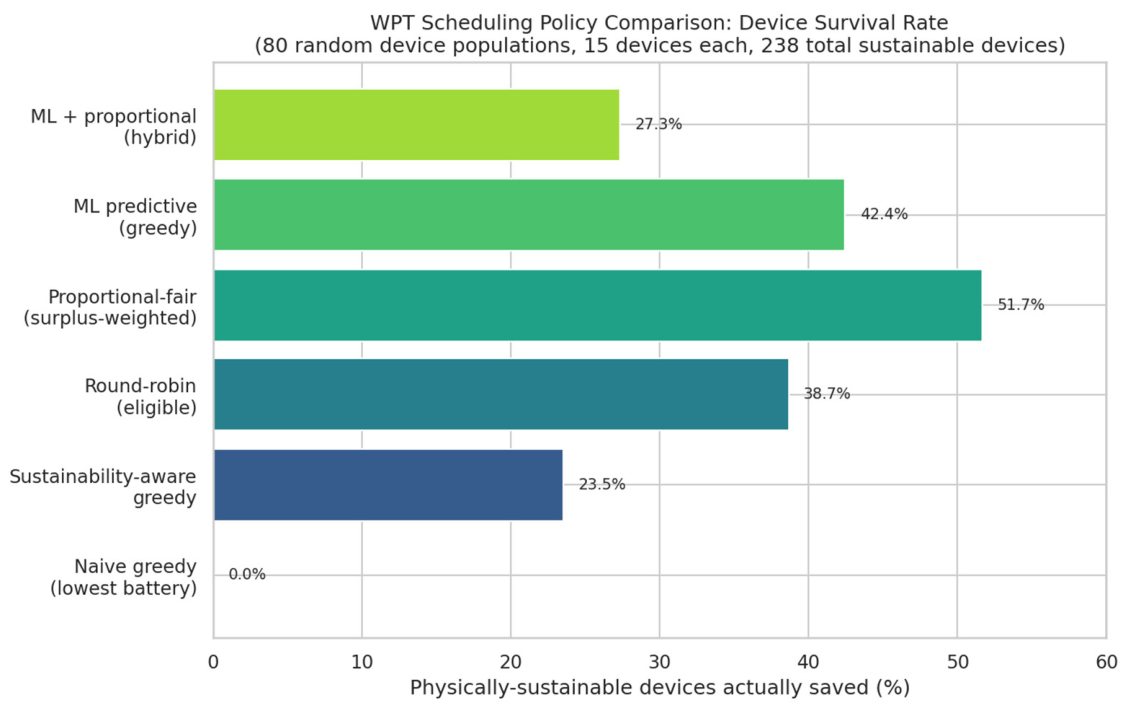
Figure 2.
Per-population fraction of sustainable devices saved versus contention level (the number of physically sustainable devices competing in that population) for three representative policies; points are jittered horizontally for visibility.
Figure 2.
Per-population fraction of sustainable devices saved versus contention level (the number of physically sustainable devices competing in that population) for three representative policies; points are jittered horizontally for visibility.
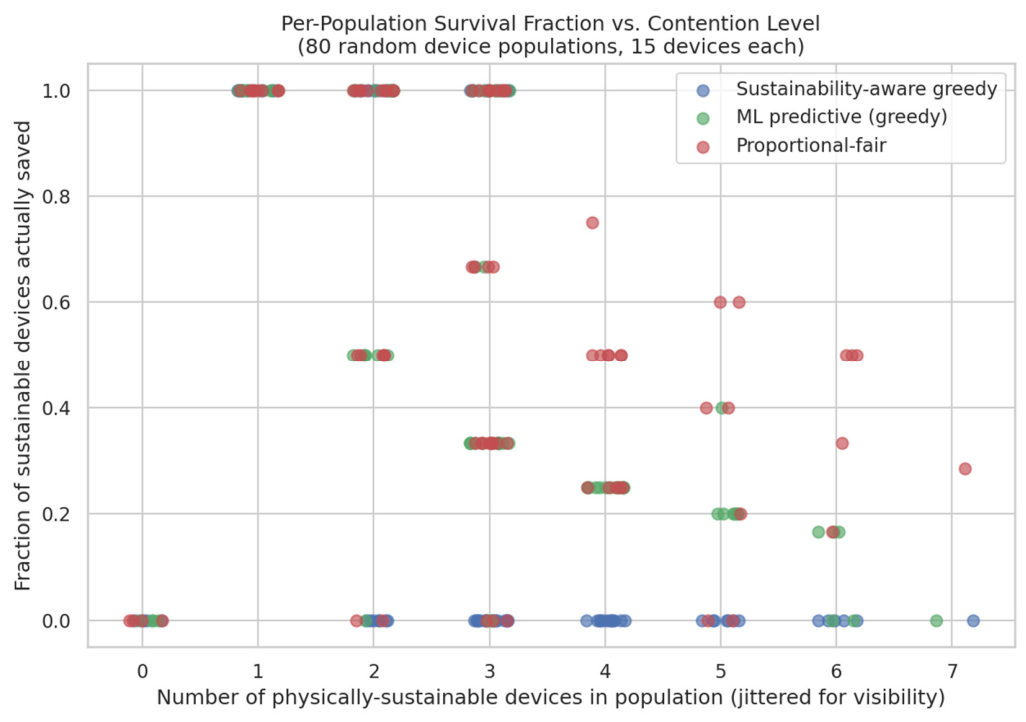
Figure 3.
Mean communication queue length by architecture and allocation policy at three distances (40 trials per distance, 3000 time steps per trial).
Figure 3.
Mean communication queue length by architecture and allocation policy at three distances (40 trials per distance, 3000 time steps per trial).
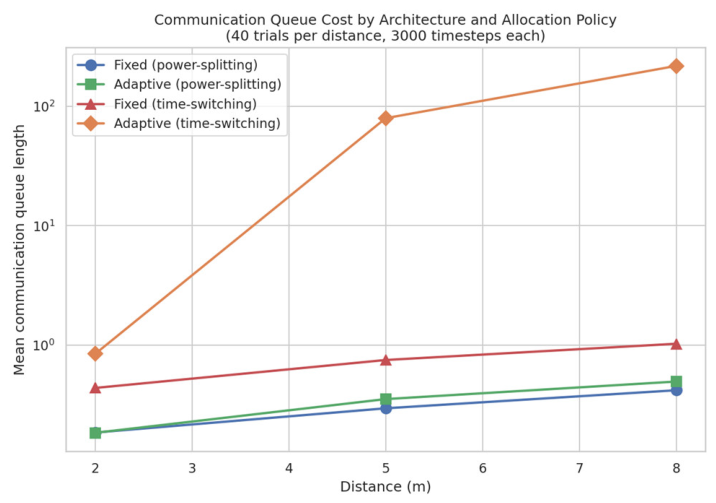
Figure 4.
Battery depletion rate by architecture and allocation policy at three distances (40 trials per distance, 3000 time steps per trial). The fixed power-splitting curve coincides with, and is hidden beneath, the two time-switching curves.
Figure 4.
Battery depletion rate by architecture and allocation policy at three distances (40 trials per distance, 3000 time steps per trial). The fixed power-splitting curve coincides with, and is hidden beneath, the two time-switching curves.
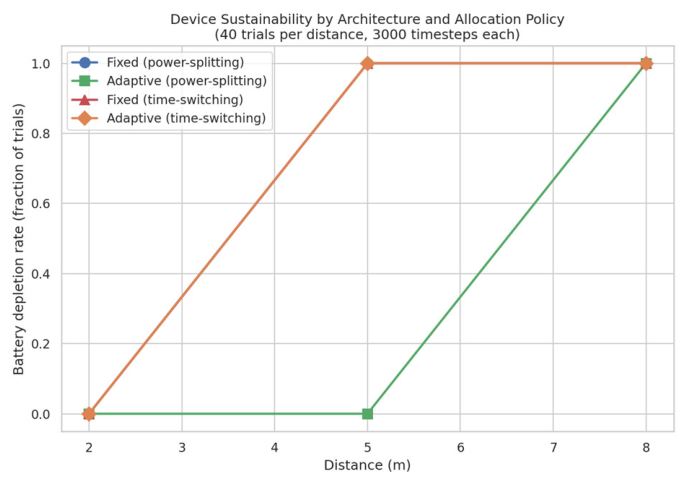

Table 1.
Physically sustainable devices saved, by scheduling policy, across 80 randomized 15-device populations (238 sustainable devices in total).
Table 1.
Physically sustainable devices saved, by scheduling policy, across 80 randomized 15-device populations (238 sustainable devices in total).
| Policy | Devices Saved (of 238 sustainable) | Save Rate |
|---|---|---|
| Naive greedy | 0 | 0.0% |
| Sustainability-aware greedy | 56 | 23.5% |
| Round-robin (eligible) | 92 | 38.7% |
| Proportional-fair | 123 | 51.7% |
| ML predictive (greedy) | 101 | 42.4% |
| ML + proportional (hybrid) | 65 | 27.3% |
Table 2.
Battery depletion rate by architecture, allocation policy and distance (40 trials per cell).
Table 2.
Battery depletion rate by architecture, allocation policy and distance (40 trials per cell).
| Distance | Fixed Split | Adaptive Split | Fixed Switch | Adaptive Switch |
|---|---|---|---|---|
| 2m | 0% depleted | 0% depleted | 0% depleted | 0% depleted |
| 5m | 100% depleted | 0% depleted | 100% depleted | 100% depleted |
| 8m | 100% depleted | 100% depleted | 100% depleted | 100% depleted |
Disclaimer/Publisher’s Note: The statements, opinions and data contained in all publications are solely those of the individual author(s) and contributor(s) and not of MDPI and/or the editor(s). MDPI and/or the editor(s) disclaim responsibility for any injury to people or property resulting from any ideas, methods, instructions or products referred to in the content. |
© 2026 by the authors. Licensee MDPI, Basel, Switzerland. This article is an open access article distributed under the terms and conditions of the Creative Commons Attribution (CC BY) license (http://creativecommons.org/licenses/by/4.0/).
Copyright: This open access article is published under a Creative Commons CC BY 4.0 license, which permit the free download, distribution, and reuse, provided that the author and preprint are cited in any reuse.